Showing posts with label un security council. Show all posts

Wednesday, December 19, 2018

At UN France and Guterres Selling Out African Peacekeeping Funding DC Winds Sources Tell Inner City Press


By Matthew Russell Lee, Exclusive, CJR PFT


UNITED NATIONS GATE, December 19  – UN Secretary General Antonio Guterres, like France and certain other historical colonial countries in Europe, makes a claim to support Africa and the current proposal that UN dues pay for peacekeeping missions staffed by Africans. But on the current proposal, with US budget cutters asking for a delay to late 2019, France has rolled over and is trying to break off “its” Cote d'Ivoire from Ethiopia and Equatorial Guinea and other sponsors outside the UN Security Council, sources exclusively tell banned Inner City Press. Guterres, typically, had sold out in advance - he is more of a colonialist than most realize, with for example a son doing undisclosed business in Angola, Namibia, Sao Tome and Cabo Verde.

   A draft resolution in blue - obtained by Inner City Press although banned from UN for 168 days and counting by Guterres and published in full on Scribd here, on Patreon for download here - was set for vote on December 19. But it got postponed to December 21. Sources tell Inner City Press the rub is Operative Paragraph 16: “16.    Decides in principle that United Nations-assessed contributions can be provided, with decisions to be taken on a case-by-case basis, to support African Union-led peace support operations authorized by the Security Council, in accordance with the existing financial rules of the United Nations to complement annual funding from the African Union and/or its Member States.”

  The US, with a cost cutting Administration, wants to delay it. Some thing they might back down if pushed. But France as noted is trying to break off Cote d'Ivoire and Guterres is... well, Guterres. Here are some of the other Operative Paragraphs in the draft: "21.    Requests the Secretary-General, in close consultation with the African Union to provide the Security Council with a detailed report within six months of the adoption of this resolution on its efforts and progress to strengthen financing, human rights protections, accountability, transparency, performance, and conduct and discipline standards, and compliance with applicable international law, including international human rights law and international humanitarian law, across its peace support operations, as well as on progress of the United Nations and African Union Cooperation in these areas;
    22.    Requests the Secretary-General to include in his regular reporting to the Security Council on each future African Union-led peace support operation, authorized by the Security Council and authorized pursuant to the Security Council’s role and prerogatives as set out in Chapter VIII of the United Nations Charter, and partially funded by United Nations assessed contribution, his assessment of the operation’s performance in the areas set out in paragraph 20 of this resolution."
 When the Security Council President for October, Cote d'Ivoire Ambassador Kacou Houadja Léon Adomu, held a Press-less press conference on December 3, he listed as Africa issues to be address during the month South Sudan, Central African Republic, Guinea Bissau and the Sahel. No one present asked about Burundi much less Cameroon, and Inner City Press was unable, being banned without hearing or appeal. Kacou Houadja Léon Adomu would not answer on North Korea human rights if his country will sign the draft letter for a Council meeting, nor how it would stand in any procedural vote. Many of the questions could have been addressed by just looking at the Program of Work. Inner City Press has more questions - watch this site.Troublingly, the UN allows in Morocco state media, which got a question from its perspective. Inner City Press still banned from the UN without any due process or appeal gets questions answered by the International Monetary Fund which it covers, on Yemen and Sri Lanka. At the IMF briefing, spokesman Gerry Rice was asked about US sanctions on Venezuela gold sales. In New York, Ambassador Ma reiterated that China is against all unilateral sanctions. So what will the Council be doing when the new US sanctions on Iran kick in? Watch this site - we continue the UN as actively as anyone. Last month Bolivia's Ambassador Llorenti talked up his upcoming field trip to DR Congo, like the Security Council visit he led to Haiti, which Inner City Press went on and reported from. But now that Guterres for his own reasons has had Inner City Press roughed up and banned since July 3, Llorenti's Mission has yet to respond to this, regarding (now) October 11: "find myself banned from even entering the UN, since 3 July 2018 when I was physically ousted while staking out the Fifth Committee meeting from the Vienna Cafe area, at the invitation of member states on the Committee. I would like to request that you / your Mission ensure that I can enter the UN to cover and hopefully ask a question at your Program of Work press conference tomorrow, and after that to cover / stakeout such meetings at the October 11 consultations on Western Sahara / MINURSO, which is almost impossible to cover without being in the building. As you may know, there are numerous Morocco state media given office space and resident correspondent status by DPI under USG Alison Smale, who has refused to answer a single one of my 10 e-mails. They will cover the Western Sahara meeting, from their perspective. I believe I have a similar right to continue this issue.
Responsible are Chef de Cabinet Viotti (who was called by the Reporters Committee on Freedom of the Press) and/or DSG Amina Mohammed. Or, pending that, please have the Mission bring me in to these meetings. The only written communication I have received from the UN is this letter from USG Smale, here." We'll have more on this, (well) before October 11.  Back on September 4 when US Ambassador Nikki Haley held a press conference about her Security Council residency, her second, of the 14 questions called on by the US Mission to the UN not one was about anything in Africa or even about UN reform. This happened as 60% of the UN's work is in Africa, the UN is caught up in sexual abuse and harassment scandals and while Inner City Press, which covers UN abuse and has uncovered Secretary General Antonio Guterres' inaction in Cameroon and the African business links of his son Pedro Guimarães e Melo De Oliveira Guterres has been bannedfrom the UN for 63 days by Guterres, prospectively to miss access to the General Assembly High Level week for the first time in 11 years.
   When Inner City Press was roughed up while it covered the UN Budget Committee and a plan by Guterres to move jobs including from New York to Mexico City, it was covered by Fox News which one assumes the US Mission reads. Inner City Press did not reach out for any assistance from the Mission, holding to the principle that the UN should treat journalists fairly without a state sponsor.
   Nothing improved. In fact, Guterres' British head of Global Communications Alison Smale issued a letter banning Inner City Press, dredging up old discredited complaints from Morocco and her bitter deputy. Still, nothing from Haley or the US Mission.
   Finally on August 24, after Inner City Press learned from a non-US source of President Trump's plan for a meeting about drugs on September 24, Inner City Press formally raised the matter to Haley's spokesman, a holdover from the Samantha Power days, John Degory. He indicated he heard what was said.
  But access was not arranged to Haley's September 4 press conference, at which after Haley to her credit at least raised South Sudan in her opening remarks Degory tried to give a question to among others a retired travel agent and a barely intelligible resident correspondent from Pakistan who beyond assisting in Inner City Press' eviction spent the past weekend tweeting that tennis star Serena Williams and her outfits are “pathetic.” That's today's UN.
   Now there is a deadline to cover the UN General Assembly and Inner City Press has applied and has writing an open letter to Haley, below, and cc-ed her and Degory on its polite letter to Smale. Watch this site. Sixty days after Inner City Press was physically ousted frm the UN and then subject to a ongoing ban from entry to cover the Security Council or UN noon briefing, Inner City Press sent a now open letter to US Ambassador Nikki Haley, here:
Dear Ambassador Haley:
   On this the first day of your UN Security Council Presidency, this concerns the censorship of Press the UN has engaged in since July 3.
   I was physically ousted that day by UN Security while I staked-out a meeting of the Fifth (Budget) Committee as I have for a decade. Right after I spoke to Cameroon Ambassador Tommo Monthe, chair of the Fifth Committee, I was grabbed by Lt Ronald E. Dobbins and another officer, shirt torn, laptop damaged, arm twisted. This was covered in Fox News, here, as well as The (UK) Independent.

  On July 5 when I came to cover the Security Council meetings on Syria and Yemen, I was banned from entering UN. After a no due process review by the Department of Public Information's Alison Smale, my accreditation was “withdrawn” on August 17, seemingly for life. The letter is online here, downloadable with some of my rebuttal (not heard by Smale or DPI) here.
  I have raised this verbally to some in your US Mission to the UN, including eight days ago to your spokesman John Degory, followed up in writing with a request to be admitted to your September 4 Program of World press conference. In your first such press conference on 3 April 2017, I asked you about peacekeepers' sexual abuse and the continuing need for the Freedom of Information Act at the UN. Video here. 
   As things stand, without any due process, I am banned from your press conference -- at which, for the record, I would like to ask you about the Anglophone crisis in Cameroon which I asked you about on 18 October 2017. Video here. I am also banned from covering the General Assembly High Level week, the deadline for accreditation for which is September 5. 
   I firmly believe I have a right to cover this member states' event, despite what I see as bias and lawlessness by DPI and the wider Secretariat. UN spokesman Stephane Dujarric in an August 27 noon briefing I was banned from attending cut off a question about my ouster, video here insisting that to say this is about freedom of the press would be wrong. (Then why is it in the Press Freedom Tracker, here, and the Columbia Journalism Review, among others for example in the UKJapan,Italy and Cameroon? Why this 5000+ signature petition?) They have gotten so petty as to get UNICEF to block me from a book event they had invited me to on September 5. They similarly got my blocked from a press conference held outside of the UN at the Pierre Hotel by the UN World Intellectual Property Organization, whose work on North Korea's cyanide patents I have also asked you about.
  So I am writing to you, asking for your intervention at least on the limited issues of not being blocked from attending your September 4 press conference and relatedly DPI relenting and not blocking me from covering the GA High Level Week, and allowing me to apply and be accredited on Sept 5 like thousands of other correspondents, many state media of government with little respect for press freedom.

Bigger picture, why has the UN banned me for 60 days and counting? I think it is because, more than before, they cannot or feel they do not have to put up with critical questions and coverage.
  Not to be put too fine a point on it, but this is NOT a new day at the UN - or what is new about it is the willingness to rough up and journalist and ban its media for life, with no due process or appeal. This is not consistent with the First Amendment of the US Constitution (which it is now clear entirely stops east of First Avenue) - nor with Article 19 of the UN Universal Declaration of Human Rights.
  This is an outrage at the UN that must be addressed.

Matthew Russell Lee, InnerCityPress.com

Sunday, June 25, 2017

In Haiti, UN Sweats How To Phrase Evasion on Cholera It Brought, Its Victims UNheard


By Matthew Russell Lee, Video

NEW YORK, June 25 – What has been the United Nations' impact on Haiti? There will be longer answers to that questions - watch this site - but for now a vignette. After two days of speed meetings with the President, parliamentarians, police trainers, proud peacekeepers from India and Brazil, some civil society reps followed by businessmen with flash drives, a UN bus raced over ragged streets on June 24. 

Inside, European staffers of the UN's MINUSTAH mission fretted about the addition of a vague paragraph about the cholera the UN brought in a statement soon to read out at the MINUSTAH Logistics Base. Outside the bus, Haitians pushing heavy cartloads of fruit, riding in in backs of pickup trucks pushed ot the side by the UN convoy, stared out, some in anger. 

The Press, along for the ride, heard the day before from residents of Cite Soleil who lost relatives to the cholera the UN brought, with criminally negligent inattention to sanitation for troops brought in from a cholera hot-spot in Nepal, who got cholera themselves. “The UN has to pay for this,” one said. “What good would a community plaza be fore me?”

 But it is community projects that new UN Secretary General Antonio Guterres is offering, as he told Inner City Press back in UN headquarters. The Security Council delegation that visited Haiti June 22-24 repeated over and over they support the Secretary General's “new” approach. But what is new about it? We'll have more on this.  

When the UN Security Council visited Haiti's Presidential Palace on Thursday, they heard about the cholera the UN brought, specifically that the $40 million remaining in the MINUSTAH mission's budget should remain behind. On Saturday morning, the Security Council's president for June Sasha Sergia Llorentty Soliz held a press conference at the MINUSTAH mission's "Log-Base." Periscope video here.Inner City Press asked him about the UN cholera victims it has spoken with the day before, who said that the UN must pay individual reparations, not community project that are of no use to them. He said that messages had been heard. We will follow up on this in New York - and in Haiti on the intimidation and under-payment of judges. The Security Council got a briefing from India's Assam Rifles, complete with a slide about the unit's history in Sri Lanka. (More on that to follow). Outside, rifles and riot suppression equipment was displayed. A short bus ride led to the Brazilian camp, fruit juices and what felt like the wrap up of the visit. Should UN peacekeeping contingents buy more of what they use from the countries they deploy to? More on this to follow, too. Back on Friday when the Security Council met at the country's Cour de Cassation, invitee Massillon told them and then the Press that some judges in Haiti can't even afford any law books, work surrounded by garbage and are subject to intimidation and corruption. Another invitee told Inner City Press that while Massillon "said what had to be said," he had offended UN Envoy Sandra Honore with his criticism of MINUSTAH's performance. Who will head MINUJUSTH? (In a bad joke, some call it Mini-Jupe or mini-skirt, as some in the Congo have ajudge MONUSCO to be MONUSELESS.) We are putting Massillon's and a colleague's later audio up on sound-cloud; Inner City Press asked again about Haitian judges' paltry salaries. Earlier on Friday there was a protest while the Security Council met with the "private sector." A bus full of UN cholera victims was pressured to leave - but then returned, along with advocate Mario Joseph, and spoke with the Press. Long Periscope with Mario Joseph near the end here; second Periscope turned into YouTube here. Uniformly, the call was for individual reparations. Of a 57 year old victim who can now barely walk it was asked, what good would a community plaza do for him? But that is what the UN, when Inner City Press last asked, is offering. Done with the private sector, the Security Council drove a short way to the Cour de Cassation. The UN stands for justice? Cholera was less pointedly raised after the meeting with President Moise by his acting (for a day?) foreign minister, and was the subject of the sole questioner allowed. Video hereFriday when after a closed door meeting with Parliamentarians - the Army came up, wit the US - the Security Council had lunch with invited civil society members, there was a place set for cholera advocate Mario Joseph, next to Camille Chalmers. At first he wasn't there, and those who'd specifically invited him wondered why. Then he rolled in. But the Press was already told to wait outside, under a beautiful red flowering tree, and wait for the "private sector" to arrive. Earlier on Friday, the Security Council drove uphill to the Parc de Martissant and each placed a white rose at the earthquake memorial. FOKAL President Ms Duvivier brought up the UN's cholera and how little money the UN has raised; the artist Ms. Monnin explained her hanging heads of concrete and metal, with shattered mirrors on top. It spoke for itself. A small drone buzzed overhead. At the Council's next meeting, the Press was not even left in for five minutes. Earlier the delegation was escorted (run-up Periscope here) to the Haitian National Police School, where just as a meeting including the Prime Minister began, the Press was ushered out. For now, tweeted photo here. In the School courtyard, roosters could be heard crowing, and cadets singing during training. "Vous est journaliste?" a man asked, hand on his sidearm. Oui, je suis journaliste. Nothing yet on cholera, except finally some talk of new UN (part-time) envoy Josette Sheeran and her past. We'll have more on this.  On this too: in the MINUSTAH mission the talk is of re-applying for posts in the new, smaller MINUJUSTH replacement set to start October 16, 2017. The UN's presence become routinized. There is a former star of the UN Budget Committee, now working on political affairs; there's Security from other Security Council trips - one in which a UN Security officer fired a bullet inside the UN plane, leaving Ambassadors and the press on a bus ride from Goma to Kigali in Rwanda. There are long-time UN communications people and ex-pat journalists. There is a dismissive or perhaps fatalistic view of those Haitians protesting the UN's presence and impact. Then there are Haitians striving, setting up small businesses in nooks and crannies by the side of the road, while French business people fly in for contracts, assisted by their country's ambassador Elisabeth Beton, who spoke June 22 on TV Metropole about Bollore, Total and Suez. What is the UN's role in this? After the June 22 meeting, Haiti's acting foreign minister spoke on cholera, that the $40 million unspent by MINUSTAH should remain in-country. But will it? In the UN Budget Committee there's talk against it, as a bad precedent. Wasn't bringing cholera, and then denying it for six years, a worse precedent? Sui generis. Earlier on Thursday morning, the country's booming voiced Ambassador to the UN was at the airport to greet the Council members. Protests, too, awaited - although MINUSTAH staff, and a Haiti-based European journalist, mocked the protest as small.  In the minibus that took the Council members up into the hills to the Royal Oasis Hotel, the talk was of the wind-down of the MINUSTAH mission, begun after the ouster of President Aristide in 2004, of access for interpreters but barely - five minutes at each meeting? - for the press. a meeting was held with the UN Country Team.  The Press was ushered about amid generic statistics from the Deputy SRSG. Civil society, however, has been chiming in with the Press. When UN Secretary General Antonio Guterres held a press conference on June 20, Inner City Press about the UN having brought cholera to Haiti under his predecessor Ban Ki-moon but now reneging even on what Ban belatedly proposed for individual reparations. Inner City Press mentioned upcoming protests in Haiti that it will be covering from there, June 22 and 23, accompanying the UN Security Council mission which took off from JFK airport early on June 22. Photo here, Periscope video here.Guterres announced that he was just then - minutes later the announcement went out - naming as a new special envoy on Haiti Josette Sheeran, formerly the director of the UN World Food Program and now the head of the Asia Society. Video here. Transcript here. He seemed to say the UN was never going to compensate individuals or families impacted by the cholera the UN brought. And the demands are for more than that: here's a sample list, in advance of the protest(s): "1. Close the MINUSTAH acknowledging its failure
2. Cancel the MINUJUSTH articulated following the ques Chapter 7 is a contradiction with the mandate defined
3. re-articulate globally the concept of relations between the UN and Haiti and especially among Latin American countries and Haiti. Recalling the generous internationalist commitment of the founders of our country and concrete, substantial and decisive solidarity offered to Miranda and Simon Bolivar
4. Launch a process of compensation, justice and reparation contemplating the numerous victims and destruction caused by this military occupation of 13 years.
5. Compensate victims of rape, men, women and children were raped or processes used in sexual exploitation
6. Support the thousands of women who have babies and children / children without parents because soldiers and police of MINUSTAH left without parents assume their responsibilities without leaving their addresses
7. compensate the families of citizens / citizens killed by the introduction of cholera by Nepalese MINUSTAH troops. We're talking about at least 20,000 bodies (the official figure underestimated speaks of nearly 10,000 dead)
8. Compensate survivors were infected by cholera by but did not die but their lives were severely affected (we're talking about more than 800,000 people)
9. To compensate the country for the huge economic losses caused by the presence of cholera during these long 7 years.
10. Invest to universalize access to drinking water for the entire population
11. To strengthen the system of public health and sanitation." On June 21 Inner City Press asked Guterres' deputy spokesman Farhan Haq to clarify. 
UN Video here, from Minute 16:21. From the UN transcript: Inner City Press: this was something that the Secretary-General said on the record when I asked him about the seeming change in the cholera in Haiti plan.  And he said that that policy was announced by his predecessor and had two dimensions; one is fighting cholera, and the other is the possibility to support communities impacted.  It was devised not as individual support.  And just, since then, I went back and actually looked at the November A/71/620 document, and there’s a whole section on individual support.  It was called track 2B.  So I just wanted to--

Deputy Spokesman:  And I was here at the time.  And I remember the discussions that the former Secretary-General, Ban Ki-moon, had about this.  And, at that point, it was not determined whether it would be individual or community-based.  Even at that point, I believe the discussion was towards community-based.  So that’s something that’s… a process that’s been crafted.

Inner City Press:  I wish I’d had that document in front of me when he answered, because there are many people that are in Haiti that have seen the new announcement made by Amina Mohammed as a retrenchment, as a taking back of that before even consulting people.  Mario Joseph and others have put out a press release; they’re protesting on Thursday.  So I wanted to just get your quote before that protest, that at one time the idea of individual reparations to people harmed by cholera was in a UN document as being considered and it’s now not being considered at all?

Deputy Spokesman:  I wouldn’t say that it’s not being considered at all.  And I wouldn’t say that initially it was something that was devised as the primary idea.  This is something that’s been under consideration.  It remains under consideration, but the primary focus, for reasons that were described at the end of last year and again at the start of this year, have been community-based.  And if you look at what Ban Ki-moon said in December, again, it mentions the community-based approach.
  But the UN document in November 2016 has a Track 2B, individual. Here's the beginning of the press release for the protests: "Port-au-Prince: Haitian cholera victims and their advocates called on the UN Security Council to deliver on the promise of a new, victim-centered approach to cholera during its visit to Haiti this week, by meeting directly with victims and committing to funding the $400 million initiative before MINUSTAH --the peacekeeping mission that caused the cholera epidemic—pulls out in October. 'The UN’s apology and promises were promising in December,' said Mario Joseph, Managing Attorney of the Bureau des Avocats Internationaux (BAI) that has led the fight for justice for cholera victims. 'But seven months later, with only a pittance raised for the so-called "New Approach" and not a single promised consultation with the cholera victims, they look like empty public relations gestures. It is time for the UN to deliver.' The 15-member Security Council is in Haiti from June 22-24 to finalize the transition from MINUSTAH to a new mission focused on supporting justice that will be known as MINUJUSTH. The BAI announced two protests during the visit: one at the UN logistics base in Haiti on Thursday at 11 am, and a second one in Champs de Mars on Friday at 11." We'll have more on this: Inner City Press will be accompanying and covering, in as much detail as possible, the UN Security Council's visit to Haiti from June 22 to 24. Watch this site.
Footnote: on behalf of the Free UN Coalition for Access, to which Guterres' spokesman Stephane Dujarric does NOT "lend" the briefing room and which has never and will never ask for a journalist to be thrown out or restricted, Inner City Press urged Guterres to more routinely take questions, for example on his way in and out of the Security Council. We'll see.

Thursday, June 22, 2017

On Haiti Cholera, After ICP Asked SG Guterres, UN Spins, Victims To Protest in Port au Prince

By Matthew Russell Lee

UNITED NATIONS, June 21 – When UN Secretary General Antonio Guterres held a press conference on June 20, Inner City Press about the UN having brought cholera to Haiti under his predecessor Ban Ki-moon but now reneging even on what Ban belatedly proposed for individual reparations. Inner City Press mentioned upcoming protests in Haiti that it will be covering from there, June 22 and 23. Guterres announced that he was just then - minutes later the announcement went out - naming as a new special envoy on Haiti Josette Sheeran, formerly the director of the UN World Food Program and now the head of the Asia Society. Video here. Transcript here. He seemed to say the UN was never going to compensate individuals or families impacted by the cholera the UN brought. 

On June 21 Inner City Press asked Guterres' deputy spokesman Farhan Haq to clarify. UN Video here, from Minute 16:21. From the UN transcript: Inner City Press: this was something that the Secretary-General said on the record when I asked him about the seeming change in the cholera in Haiti plan.  And he said that that policy was announced by his predecessor and had two dimensions; one is fighting cholera, and the other is the possibility to support communities impacted.  It was devised not as individual support.  And just, since then, I went back and actually looked at the November A/71/620 document, and there’s a whole section on individual support.  It was called track 2B.  So I just wanted to--

Deputy Spokesman:  And I was here at the time.  And I remember the discussions that the former Secretary-General, Ban Ki-moon, had about this.  And, at that point, it was not determined whether it would be individual or community-based.  Even at that point, I believe the discussion was towards community-based.  So that’s something that’s… a process that’s been crafted.

Inner City Press:  I wish I’d had that document in front of me when he answered, because there are many people that are in Haiti that have seen the new announcement made by Amina Mohammed as a retrenchment, as a taking back of that before even consulting people.  Mario Joseph and others have put out a press release; they’re protesting on Thursday.  So I wanted to just get your quote before that protest, that at one time the idea of individual reparations to people harmed by cholera was in a UN document as being considered and it’s now not being considered at all?

Deputy Spokesman:  I wouldn’t say that it’s not being considered at all.  And I wouldn’t say that initially it was something that was devised as the primary idea.  This is something that’s been under consideration.  It remains under consideration, but the primary focus, for reasons that were described at the end of last year and again at the start of this year, have been community-based.  And if you look at what Ban Ki-moon said in December, again, it mentions the community-based approach.
  But the UN document in November 2016 has a Track 2B, individual. Here's the beginning of the press release for the protests: "Port-au-Prince: Haitian cholera victims and their advocates called on the UN Security Council to deliver on the promise of a new, victim-centered approach to cholera during its visit to Haiti this week, by meeting directly with victims and committing to funding the $400 million initiative before MINUSTAH --the peacekeeping mission that caused the cholera epidemic—pulls out in October. 'The UN’s apology and promises were promising in December,' said Mario Joseph, Managing Attorney of the Bureau des Avocats Internationaux (BAI) that has led the fight for justice for cholera victims. 'But seven months later, with only a pittance raised for the so-called "New Approach" and not a single promised consultation with the cholera victims, they look like empty public relations gestures. It is time for the UN to deliver.' The 15-member Security Council is in Haiti from June 22-24 to finalize the transition from MINUSTAH to a new mission focused on supporting justice that will be known as MINUJUSTH. The BAI announced two protests during the visit: one at the UN logistics base in Haiti on Thursday at 11 am, and a second one in Champs de Mars on Friday at 11." We'll have more on this: Inner City Press will be accompanying and covering, in as much detail as possible, the UN Security Council's visit to Haiti from June 22 to 24. Watch this site.
Footnote: on behalf of the Free UN Coalition for Access, to which Guterres' spokesman Stephane Dujarric does NOT "lend" the briefing room and which has never and will never ask for a journalist to be thrown out or restricted, Inner City Press urged Guterres to more routinely take questions, for example on his way in and out of the Security Council. We'll see.

Friday, May 5, 2017

From Cameroon to UNSC, "Urgent & Confidential" Memo About Weapons, Copter, Here


By Matthew Russell Lee, Exclusive Series

UNITED NATIONS, May 5 – While the UN Security Council visited Cameroon during the 94 day Internet cut off and said nothing publicly about it, Inner City Press has obtained and has exclusively published on Patreon and now Scribd, here Cameroon's "Urgent and Confidential" letter to the UN Security Council, about weapons. It lists Chinese weapons, helicopters and more, to be repatriated to CAR. 


This comes amid reports that armaments Cameroon got ostensibly to fight Boko Haram have been spotted in the Anglophone regions. On May 2 when Inner City Press told the UN's spokesman Stephane Dujarric that it had a question on Cameroon, he walked off the podium, as he has done before. He and the UN Department of Public Information, whose Cameroon mis-information is profiled below, worked together to evict and still restrict Inner City Press. The spin of the Francophone Cameroon government of Paul Biya has now reached the UN Security Council, or at least its media stakeout area. As Inner City Press asked questions at the stakeout on April 28, and telling Morocco's hatchet-man Ambassador that on decolonization Inner City Press errs on the side of the underdogs, video here, Cameroon's Ambassador Tommo Monthe approached. He handed two documents to Inner City Press: a chart of "actions taken by the Government following concerns raised by Cameroon Anglophone teaches and lawyers," and a press release mis-spelled "Realease." Inner City Press has put both online on Patreon, here. But here's how out of touch or worse the UN Department of Public Information, which evicted and still restricts Inner City Press with minders, is: its UNIC ("Information" Center) in Cameroon held a training and wrote it up with a single reference to "social upheaval in English speaking regions," nothing on the Internet cut-off. Here is DPI's full text, from the UN's iSeek intranet: "Tuesday, 2 May 2017 | Yaounde | UNIC Yaounde: Cameroon is currently being rocked by waves of attacks from the Boko Haram terrorist insurgency in the northern region. English-speaking regions have been witnessing social upheaval since November 2016. Overall, young people have been excluded in the peace building process of these conflicts - unaware of UN Security Council resolution S/RES/2250 (2015) on Youth, Peace and Security, which acknowledges the urgent need to engage young peacebuilders in promoting peace and countering extremism.
To tackle this issue, the UN Information Centre (UNIC) in Yaoundé organized a one-day workshop on “youth, peace and development”, in partnership with Promise Africa and the Organization of African Youth for Peace. The objective was to educate youth leaders on the fundamentals of peace consolidation, conflict prevention, and crisis management. The hope is to engage them in the peacebuilding process.
During the 13 April session, UNIC Yaoundé’s Jean Njita emphasized the correlation between peace and development, linking to Sustainable Development Goal 16 (Peace, Justice and Strong Institutions). The high rate of youth unemployment in Cameroon (about 6.7% in 2013, according to the ILO) was identified as the cause of conflicts. Political authorities were urged to exercise good governance to resolve the issue. While education, public awareness, and training are prerequisites for a durable peace, genuine mediation can be a catalyst in reconciling and healing post-conflict societies.
One participant called on young people to “bury their egoism, be tolerant, and accept different viewpoints for peace to thrive in their hearts…for today’s youths are too proud”. Participants acknowledged the youth’s role in conflict resolution and they were encouraged to use social media to transmit messages of love and reconciliation with a view to rebuild broken homes and their society. Just as war is waged, Cameroonian youths should also ‘wage peace’ by making peace as a full-time activity. NGOs and associations advocating for peace were urged to improve coordination for a greater impact on the field."
 That's UN DPI. On May 1, Inner City Press asked the UN's holdover spokesman Stephane Dujarric, UN transcript here: Inner City Press: I wanted to ask you a Cameroon question.  Over the most recent weekend, there was a guy, Awah Romeo, beaten to death by the police.  And there’s footage of it.  And I’m just sort of wondering, what’s the follow-up of that mission by François Louncény Fall, he said he’s coming back at some other date but…

Spokesman:  Right.  He said I think he was coming back… [inaudible] I think he was coming back in May, which is this month, and I have no doubt his office is following the situation.
Inner City Press: Because the Cameroonian Mission here is now using his statement as sort of to say everything is great.  I was handed just now…

Spokesman:  That’s… I mean, I think everybody’s free to interpret… I think Mr. Louncény Fall’s statement was fairly clear in what he felt the situation was and what he felt needed to be done.
  Tellingly, behind the "Realease" which tries to justify the cutting off the Internet for more than 90 days is the UN's own press release praising Paul Biya for belatedly "instructing that internet service be fully restored" and urging "avoiding the use of the Internet to incite hatred or violence" - precisely Biya's pretext. To this has the UN sunk. The day after Biya government belatedly restored the Internet he cut in the two Anglophone regions of the country, on April 21 Inner City Press asked long time Cameroonian Ambassador to the UN Tommo Monthe about it. Monthe, set to chair the UN's Fifth (Budget) Committee next year, told Inner City Press "the scissors are in our hands... we will cut it" if it is used not only for so-called hate speech but for secession talk of any kind. For exclusive audio click here. Now Inner City Press has published the 2-page letter demanding the censorship of TV channel Afrique Media for saying “it's a corrupt government” and “France is controlling many African countries." Where is the UN on this? To try to find out, Inner City Press on April 27 asked UN Spokesman Stephane Dujarric, and about Felix Agbor-Balla, UN transcript here: Inner City Press: I wanted to ask you, in Cameroon, again, the… the former UN legal adviser in Afghanistan and MONUC and also a former employee of the Special Court in Sierra Leone, Felix Agbor Balla, is facing death penalty by military trial.  And I wanted to know… there are also many of the other people that were… were… have faced trial today, and I wanted to know, is there any follow-up by the UN system on the issue?

Spokesman:  I will take… I didn’t see those reports.

Inner City Press: There’s also a TV station, Afrique Media, that’s being taken off the cable networks there for having had two statements in English, one that the Government is corrupt, the other one that France controls many countries in Africa.   [inaudible]  Is that a… does the UN think that that’s a reason…

Spokesman:  I will… I don’t… I can’t comment on something I don’t know about.
  Like nearly everything about Cameroon. They won't say who is their acting Resident Coordinator since Antonio Guterres promoted Najat Rochdi to Central African Republic; whoever it is is not speaking about blatant censorship. Then again, today's UN itself is continuing censorship. We'll have more on this. Monthe said people should be jailed for burning the Cameroon flag, and that it was fine to destroy the businesses of entrepreneurs in Southern Cameroons even if they were not involved in secession talk. Cameroon from the top is against freedom of speech and press. On April 25, Inner City Press asked UN Secretary General Antonio Guterres' holdover spokesman Stephane Dujarric, UN transcript here: Inner City Press:  in Cameroon, a journalist, Ahmed Abba, was yesterday sentenced to 10 years in jail for reporting on the Boko Haram conflict.  And many press freedom groups have expressed concern.  I'm wondering, does the UN have any concern?  And I wanted… I guess I'm just asking you again, who is the Resident Coordinator in the country?

Spokesman:  As soon as the Resident Coordinator has been named, that person will… we'll announce it, and there will obviously be a press release.  As I've said before, the UNICEF representative is the acting Resident Coordinator.

Inner City Press: Right.  And are you aware of this case of the person being sentenced to 10 years?

Spokesman:  I've heard the case.  I think any sentencing of journalists, I think, is something that is of concern to us, and we have to make sure that it is not done for… in reprisals for anything that that person may have said or written.
Which is exactly what has happened. Last week Dujarric repeatedly refused to tell Inner City Press the name of the acting Resident Coordinator in Cameroon after failed Najat Rochdi was promoted and said to ask UNICEF, Inner City Press did. Inner City Press submitted these questions to two UNICEF spokespeople on April 20: "Please state who are UNICEF is the acting Resident Coordinator in Cameroon and what if anything they have said and done about the 92 day Internet cut off in two regions, including to schools, and on the current doctors strikes. What is UNICEF's position on the 92 Internet cut off in Cameroon, as impacts children and otherwise?" UNICEF's Najwa Mekki, Officer in Charge of the Media Section, replied "received, we'll get back to you as soon as we can." Five days later, nothing - not even the name of who's the head of UNICEF in Cameroon, despite a second question to Dujarric (who has declared Press criticism of the UN's performance to be harassment, and threw Inner City Press out of the Press Briefing Room and has it still restricted after 14 months). We'll have more on this.

Friday, August 12, 2016

On South Sudan, International Crisis Group Lobbied UNSC Against Sanctions on Malong, Only Ethiopia and Kenya to Deploy?


By Matthew Russell Lee, Exclusive

UNITED NATIONS, August 12 -- As the UN Security Council prepared to meet on South Sudan on August 12, the vote pushed back from 10 am to 3 pm, Inner City Press is this morning exclusively publishing a memo that the International Crisis Group sent to lobby the Council, against sanctions  -- in this case against Salva Kiir's Chief of General Staff Paul Malong, about whom we have repeatedly reported.

The author, Casie Copeland, has appeared more publicly in the page of the UK Independent, here. In her ICG memo some may see an echo of the NYT's current series on “think tanks” in Washington, or may question how opposing sanctions on Malong, given his history then and since, is consistent with researching and lobbying for peace. Ms. Copeland's explanation, which we requested, we publish in full below.

 Separately Inner City Press hears that neither Kiir-favoring Uganda nor Sudan may officially send new troops to South Sudan, leaving it for Kenya and, yes, Ethiopia. From the ICG memo:

"From: Casie Copeland [at] crisisgroup.org
Date: 2015-09-06
Subject: South Sudan Sanctions

I hope this finds you well and enjoying the last days of summer. I am writing with respect to the proposed sanctions on two South Sudanese generals.
As you know, the ceasefire workshop after some delays is now scheduled from September 10-15. Both the government and opposition have nominated a set of strong military and police leaders to the workshop and individuals we know to be serious about taking the next steps to establish modalities for the ceasefire - such as identification of forces, number of forces in Juba, withdraw of allies, re-supply procedures, and so on. There is reason to be cautiously optimistic for the outcomes of the workshop.

It would not be an exaggeration to say that much of the fate of this very tenuous agreement rests on the parties abilities to come to agreement at the workshop and leave committed to implementing the agreement.

Sanctions at this point would dramatically undermine IGAD's ability to secure workable arrangements for the ceasefire and thus, potentially the overall agreement. However the threat of sanctions for those who undermine the workshop or violate the agreement afterthe workshop could be useful.

This is particularly true from the perspective of the government. The Chief of General Staff, despite his reservations about much of the peace agreement, came to the venue the day of the signing in Juba to support his President's decision. His support for Kiir was critical in overcoming many of his Bahr el Ghazal (and other) constituency's threats to withdraw support from Kiir if he signed the agreement. To sanction him would appear to be a "slap in the face" to a man whose support for the President's decision to sign was critical in maintaining cohesion in Juba and whose continued support will be absolutely critical to implementing the peace agreement.To make a small point about a ceasefire violation, the Security Council could doom the entire agreement.

I look forward to being in touch with you on this and other matters moving forward. Please do be in touch if I can provide any further information or insight that may be of use.

Kind regards,

Casie Copeland, J.D.
South Sudan Analyst
International Crisis Group"

As noted Inner City Press requested an explanation and anything else and publishes it in full:

"Dear Matthew,

Last year within a few weeks of the signing of the peace agreement (ARCSS) we understood there was a proposal to sanction the Chief of General Staff of the national army. This followed weeks of intensive pressure on the government to encourage them to sign the ARCSS. The pressure was successful and the government signed the agreement despite the reluctance of many senior officials in government. It was our belief, at that time, that to sanction General Malong would have led to the government disavowing the peace agreement and could have led to an irrevocable deterioration in relations between the Governments of South Sudan and the United States. It is our belief that neither of those outcomes would have served the interests of peace in South Sudan. I am not aware of any proposal since then to sanction General Malong so would be unable to comment on any such proposal.

As for the email in question, we undertake advocacy to all council members on a regular basis. This is done through a number of means and modes of communication, including email. So while this email was widely circulated, it was part of wider advocacy on this topic which included a public statement - "No Sanctions without Strategy" - and reached many other council members directly, including the US government. Warm regards,"

Casie Copeland, J.D.
South Sudan Analyst
International Crisis Group

  Back on August 10 after UN Emergency Relief Coordinator Stephen O'Brien visited South Sudan, Inner City Press asked him about UN delays in registering Internally Displaced People (IDPs) arriving at the UN's Protection of Civilians sites and about reported UN inaction as mostly Nuer women were raped just outside the PoC site in Juba.

  O'Brien acknowledged some delay in registration, diplomatically chiding the government for suggestion that people return to where they had fled from in order to register. He described a quickly built camp in Wau, though the reports of registration delay have mostly been from Juba.

   Pressed on the issue of UN inaction on rapes, O'Brien said he had not gathered any new information about the allegations during his visit, adding that Salva Kiir told him rapes are “unacceptable.”

  Interestingly, O'Brien said that now food is only allowed be to flown in from Uganda, not Sudan or Kenya. We'll have more on this.

  Separately, Inner City Press asked O'Brien about the “Functional Review” he had commissioned, and the Heads of Office critique of it, which Inner City Press published here.

O'Brien in his response offered praise and emphasized how short a time he's been at OCHA. We'll continue to report on whether O'Brien, and certain other Ban Ki-moon Under Secretaries General, can or will remain under the Next SG. Some, "even" P-5, should go. Watch this site.

In the UN's continued withholding of news and answers about South Sudan, the reports of the UN's own knowledge of abuses are now being withheld from its own impacted national staff.

 As the UN refuses to answer questions, and Bans the Press from South Sudan meetingsvideo here, we publish this internal UN report:

"On 04 August in Yambio, UNMISS received a copy of a directive from the National Security Service (NSS) instructing the senior SPLA Liaison Officer to inform UNMISS that all staff arriving in Gbudwe State from Juba or elsewhere must register at the NSS office in Yambio before proceeding to the UNMISS compound. The Internal Security Bureau (ISB) Director stated that the registration of UNMISS staff is for their own security."

Inner City Press asked UN Spokesman Farhan Haq about the incident with no real answer. Later on August 5, the UN belatedly emailed its Malakal report, or the executive summary, which Inner City Pressimmediately put online here. On August 8, Inner City Press asked Ban's spokeman Farhan Haq, UN transcript here: 

Inner City Press: The Malakal report that was released on Friday. It seems like one of the recommendations is that, going forward, any… any failure to respond by TCCs [troop-contributing countries] or police-contributing countries [PCCs] be… it said reported to UN Headquarters and to the TCC or PCC involved.  In the spirit of kind of name-and-shame, which is taken to the sexual abuse issue, is there a problem with naming the contingents who either didn't respond or said they could only respond if their capital told them they could respond?  Is the idea to make that public or to simply keep it in-house?

Deputy Spokesman:  At this stage, we're following up with the relevant countries and trying to make sure that any appropriate follow-up is happening.  We've also set in motion adjustments to the force structure to identify some of the issues in the investigation, but in terms of actions by the contributing countries, we're working with them to make sure that they do follow up.

ICP Question:  Right.  And so is that the sum total, all you have on DPKO's (Department of Peacekeeping Operations) response to this lengthy and pretty troubling report?

Deputy Spokesman:  Well, there is more.  As it is, two commanders were repatriated following the Malakal incident.  And, as you have seen from the report, we gave a detailed summary of the events in Malakal of the response by the mission and their recommendations in there.  And so that describes the state of play.

  We note

“local authorities accused UNMISS of not protecting civilians, Paragraph 14;

UN complains of “unrealistic expectations for the protection [UN] could feasibly afford” Paragraph 19. So UN, What Is It Good For?

Feb18-19 was “not the fist instance when military units in Malakal demonstrated unwillingness to implement ROE,” Rules of Engagement, Paragraph 21;

The UN “acted without urgency to repair the breach in the PoC fence which had been reported on 17 February” - that is called negligence.

Then the UN report cites “failing to cease [sic] an opportunity to  better manage the developing security situation” - that is called misspelling. Paragraph 22

The UN BoI's Malakal report says the names of UNresponsive units should be given to UNHQ and to their missions - but NOT to the press or public. This is Ban Ki-moon's ad Herve Ladsous' UN.

And here is the UN's “Confidential” instructions to UN staff, how to deal with authorities in South Sudan - when the Press tries exactly the same inside UN Headquarters with UN Security, it gets ousted (audio here) and evicted.

"CONFIDENTIAL

Ref: 104/SB/06/08/2016

UN Security will like to remind staff members on actions that should be
taken on approach to/at military check points.

v  Reduce speed, slow down and stop completely at the checkpoint.

v  Dim headlights/put interior light on, if at night.

v  Roll window down not more than 1”, be friendly/courteous.

v  Show ID if asked - do not surrender, stay in vehicle unless ordered out.

v  Observe any search of vehicle - theft or planting of items.

v  Protest the removal of personal items - but do not resist.

v  Do not attempt to bribe your way out of a situation.

v  Remain calm and give honest answers if questioned. If they mis-state
facts, correct them.

v  Insist on your rights as a United Nations staff member. Never forget that
you have rights.

Note: At no point should a staff member speed pass or ignore an official
check point, as such action could be misinterpreted to be hostile and could
result in the vehicle being shot at.

CONFIDENTIAL"            

Just two points for now: when Inner City Press points out that the UN mis-spoke to the Special Rapporteurs on Freedom of Expression and Human Rights Defenders, claiming there was an “altercation” in the UN Press Briefing Room which is disproved by video, the UN does not correct itself. And UN Security's McNulty tore Inner City Press' UN ID off its neck, threw bag with laptop in it  on the sidewalk. We'll have more on this.

"On 03 August at 15:00 hours in Juba, one UNMISS Military Personnel (MLO) was prevented by airport security personnel from boarding Kenya Airways flight at Juba International Airport for allegedly taking pictures at the passengers’ waiting room. Before being released HG security personnel seized his laptop, national passport and a smartphone and asked him to report to their office on 04 August. The case was reported to UN Security."

Inner City Press on August 4 asked UN deputy spokesman Farhan Haq about it. Video here. From the UN transcript: 

Inner City Press: I wanted to ask you two things about South Sudan. One is this report that… that, in the camps, in light of the recent violence, the people that have gone into them weren't, in fact, registered as… as… basically, in order to have food delivered to them, to register… to get bigger WFP and that this is in fact leaving some of them without food, and so, they have to go out of the camp, and it puts them at risk.  The second question I have it from an UNMISS [United Nations Mission in South Sudan] memo I've obtained and published, which said that on 3 August an UNMISS military personnel was stopped at the airport by the Government.  Computer laptop and phone all taken.  UNDSS [United Nations Department of Safety and Security] is aware of it.  And I wanted to know, what is the protocol for a Member State to take electronics concluding… presumably including secret information from UNMISS military personnel?  And what is the UN doing in this case both to protest it and to make sure the information is not misused?

Deputy Spokesman:  Well, I will check what UNMISS is doing by way of reaction, but, certainly, our… all of their personnel are supposed to have freedom of movement.  And they and their belongings, including, of course, their communications, are to be protected.

ICP Question:  This one… I just want to ask you, because what it says is that this was taken because they were taking photographs inside the airport.  So I wanted to know, does your interpretation of freedom of movement and freedom of action include taking photographs inside an air… the airport, which is the Government's rationale?

Deputy Spokesman:  Well, we would have to see whether the actions taken by staff are appropriate.  But, certainly, the Government knows what its obligations are under the Status of Forces Agreement, but also, of course, UN personnel are… wherever they go are supposed to have freedom of movement if they go in accordance with their work responsibilities.

ICP Question:  And registration?  Did you have an answer on that, on whether IDPs [internally displaced persons] that have gone into the camps last week have registered…?

Deputy Spokesman:  As far… if I hear otherwise, I can let you know, but as far as I'm aware, all… at all Protection of Civilians sites, the registration continues.

ICP Question: There's an AP story that says totally the contrary, by Justin Lynch.

Deputy Spokesman:  Well, registration is a standard practice of the sites.  I don't know whether there's a problem at any particular site, but it's standard for all of the inhabitants to be registered.

On August 3 we published these UN internal reports from South Sudan, marked "“UN STRICTLY CONFIDENTIAL: ST/SGB/2007/6, Information Sensitivity, Classification and Handling" --

"Armed Conflict – Attack: On 03 August at about 05:00 hours in Leer, reportedly, SPLA soldiers from Koch launched attacks at the villages located north of the UNTCC TOB destroying and looting villages. At 08:10 hours, about 105 IDPs from Kuleer Payam arrived at the Leer TOB seeking protection from GHANBATT.

"On 02 August at about 23:47 hours in Juba, a UN ambulance escorted by UN military departed UN House Level I Clinic to UNMISS-Tomping Level II Clinic, with a female IDP patient in labour. Along the way, the team was harassed by HG security forces at numerous check points. At one check point, the HG security personnel threatened to take the patient out because of her ethnicity."

On August 3, Inner City Press asked Ban Ki-moon's spokesman Stephande Dujarric, UN transcript here:

Inner City Press: on South Sudan, I wanted to know, I've seen a memo from DSS [Department of Safety and Security] in South Sudan, saying they're aware of these attacks on Leer by the SPLA [Sudan People’s Liberation Army].  It seems from the memo that the UN acknowledges that it's the Salva Kiir forces attacking this Riek Machar area.  So, I wanted to know, when is the UN… what's the process for the UN reporting on this type of fighting that it sees?  The memo also talks about a woman IDP [internally displaced person] being harassed on the way to giving birth based on her ethnicity.  So, I’m just wondering, what is the protocol for UNMISS [United Nations Mission in South Sudan] or other UN forces in South Sudan to actually say what's taking place?

Spokesman:  Well, I think, you know, it's always… it would be helpful for your friends at DSS to share whatever they share with you with me before the briefing so I can give you a better update.  But, what is clear is that we have regularly reported from here on fighting, on incidents, when they occur.  And the Secretary-General reports regularly to the Security Council, whether in its… in the periodic reports on the mission or periodic briefings, verbal briefings by DPKO [Department of Peacekeeping Operations].

ICP Question:  But, just as an example, for example, it's reported that many UN staff have now been unable to get back into the country under this travel restriction.  So, when… it seems like this is a violation of the SOFA [Status of Forces Agreement].  Is the UN complaining publicly about…?

Spokesman:  I think we have raised this publicly.  We're obviously raising it privately.  It is critical that the Government of South Sudan allow the UN staff to go in and do its work and implement the resolutions of the Security Council and the mandate given to us by the Security Council.

  Riek Machar was attacked and chased out of Juba; now he and his forces say they will return absent the deployment of an enhanced international force which those in control of Juba say would immediately be attacked.

Sources tell Inner City Press Paul Malong is setting up his artillery by the main bridge into Juba on the main road artery linking Juba with Nimule, some 9,500 meters opposite UN “Protection of Civilians” and in direct line of sight. This is described by the sources as an act of brinkmanship and an attempt to secure the road corridor.

The UN has had imposed restrictions which violate its Status of Forces Agreement but has quietly accepted them. Inner City Press has published and asked the UN about its (lack of) response, including to rapes, and has been Banned from covering South Sudan meetings inside the UN.

Today Inner City Press publishes in full the resignation letter of Lam Akol, here.

And Inner City Press can report that the UN Security Council anticipated visit to South Sudan and perhaps Sudan from August 15 to 19 is being discouraged by the US, which says it is not ready. We'll have more on this.

The US on July 30 issued a statement saying the UN had documented rapes - but NOT saying that UN Peacekeepers watched and did nothing.

On August 2, Inner City Press asked Ban Ki-moon's spokesman Stephane Dujarric what the ramifications are for UN peacekeepers who watch rapes and offer no protection: "on what you said about the witness accounts saying that UN peacekeepers stood by as women were raped outside of the camp of UN House.  What would be the ramifications if there’s an investigation if, in fact, it’s found that peacekeepers saw, watched, and did nothing?  What happens?

Spokesman Dujarric:  "Individual accountability of soldiers is, as it is in every case, up to the troop-contributing country to decide on what disciplinary action is taken."

Ban's UN has no basis to make claims about "zero tolerance."

In the UN Security Council on July 29 US Ambassador Samantha Power said the US had reports of an upsurge of violence in the Equatorias: "I want to stress this also for Council members here today – we have just received very disturbing reports of significant violence in the Equatorias in South Sudan. And all of us need to be on alert, I think, this weekend, because events could spiral rapidly out of control, yet again." What might she have meant?

   Inner City Press can report that the US' Ambassador in South Sudan Mary McPhee and US envoy Donald Booth have received this - and it has been reiterated to them by the office of a U.S. Senator, not necessarily one that might be imagined:

Sent: Thursday, July 28, 2016 8:02 PM
To: Donald Booth [at] state.gov
Cc: Mary McPhee [at] state.gov
Subject: An offensive is on the way soon

Sir, there is an offensive coming soon, probably in the next 7 days.

The plan for SPLA/ IO is to launch simultaneous assaults in three locations at once, probably in a few days from now:  1: attack from Yuai on Pajut; 2:in Malakal and 3rd: on Juba from the direction of  the Nimule road and also from Terekeka.

 Johnson Olony is the leader of the planned attack in Malakal. Gatwech himself is said to be organizing the attacks around or on Juba liaising with Wani Konga forces kitted out with taken SAF cache in 2005; he is said to be based not far from Juba, possibly around Lafon.

I have no information on the reality or number of the militia forces said to be mobilizing to attack in Malakal or Juba; these forces are being talked about by the tribal factions mobilized in Yuai.

From IO “It will all start North...but details changes are imminent in the last minute.... those Su[san] Rice are weak”

I don’t know if the international community will sit this one out as well but there will be many dead people possible myself since I am here in the UN House.... I can put on a backpack and keep moving on my own but I do care about this country enough to stick it out. Don’t let this next offensive be what I have been worried about turning into the genocide I have been warning about. Everything I had said would happen and come true did come true and I was ignored. Please for the love of humanity don’t let this next offensive take place, there are women and children here, people who are friends and these are human beings, these are personal relationships that were developed out of kindness and trust and here we sit once again, here I am once again warning of what is about to come.

 If black lives matter in the United States why don’t they matter here? The people in the POC are trapped with a false sense of security, what we saw last time is a preview, the killing has been rehearsed.”

     Previous warnings leading up to this one got only interim responses from one Stetson Sanders, Director of International Narcotics and Law Enforcement at the UN Embassy in Juba. We report this part in light of the US Embassy's chiding of South Sudanese media for reports, while the US Mission to the UN has been less than responsive, including onUN free press issues. Albert Taban is out on bail, but UN radio reporter Goerge Livio remain imprisoned and UNremarked upon.

In the UN's continued withholding of news and answers about South Sudan, the reports of the UN's own knowledge of abuses are now being withheld from its own impacted national staff.

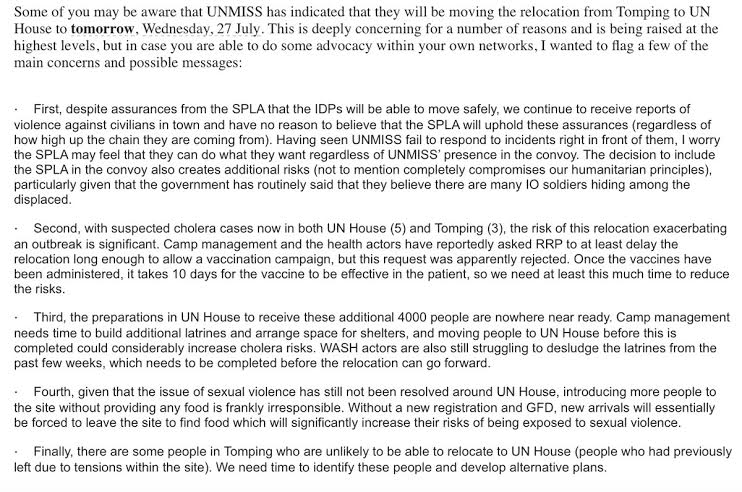
 Since the UN refuses to answer questions, and its Department of Safety and Security (DSS) Bans the Press from South Sudan meetingsvideo here, we published below a document of complaint against the UN's reported plan to relocate Internally Displaced Persons to the UN House where its peacekeepers stood by watching as IDPs were raped. Photo of complaint here. and below.

On July 28, following an order from the government replete with mis-spellings, tweeted photo here, the UN in South Sudan accepted violations of its Status of Forces Agreement - and says that if UN staff doesn't accept and comply, they will be charged money. This is Ban's UN: Ban's deputy spokesman Farhan Haq said he was unaware of any of this, hours after the UNMISS Broadcast email Inner City Press published. (Haq also tried to deny UN corruption right insiee UN Headquarters, here.) From the UN transcript: 

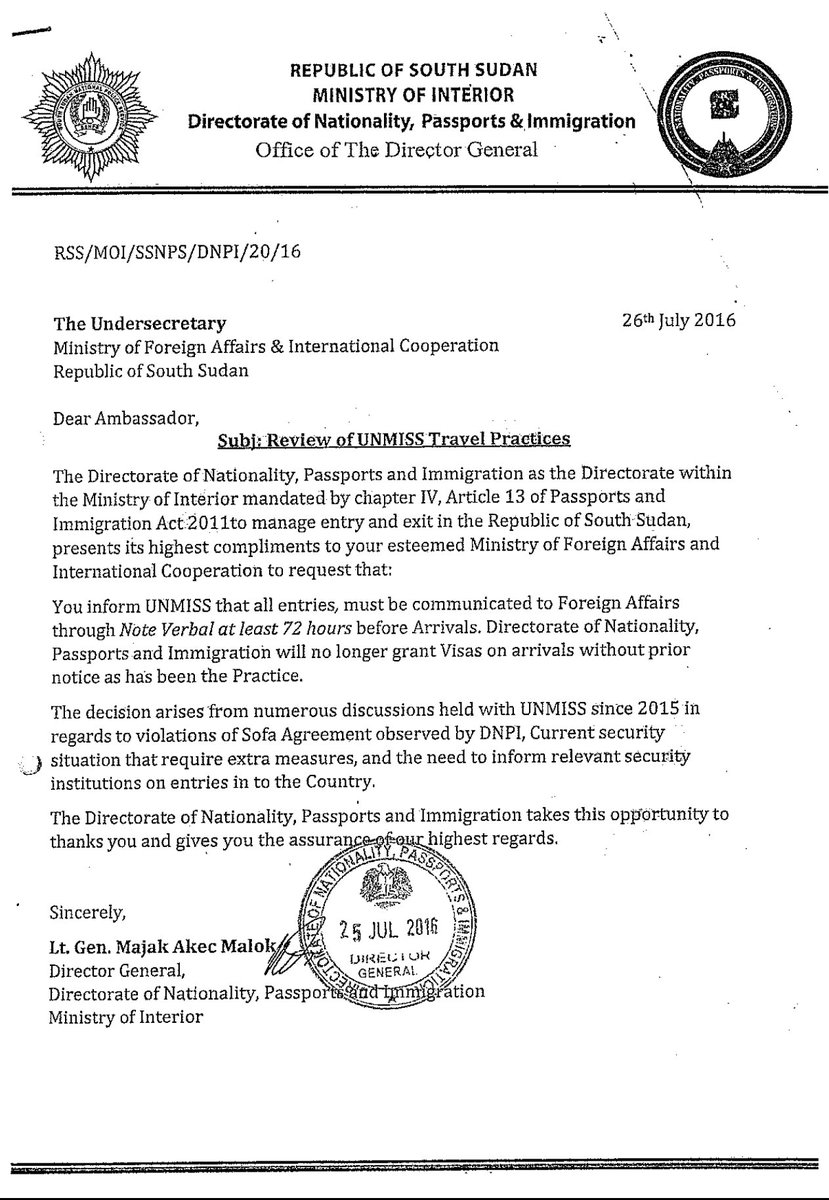
Inner City Press: I wanted to ask you on South Sudan.  I've seen a letter from the Government to UNMISS, saying that going forward, all entries to the country require 72 hours' notice and also some further restrictions on leaving.  I've also seen a memo, a broadcast of UNMISS telling people that they have complied with this and if they don't they can basically be charged money if they seek to travel outside of the restrictions imposed by the Government.  I wanted to know whether these restrictions comply with the Status of Forces Agreement, and if they don't, why UNMISS is not only acquiescing to them but charging staff for not complying with them?

Deputy Spokesman:  I would need to check whether this is something that is happening.  I'm not aware of this as a matter of policy.

ICP Question:  A broadcast on this staff today about this.

Deputy Spokesman:  I will have to check about what the details are of that.

The UN memo, from DSS whose Inspector Matthew Sullivan has been exposed selling out the UN, with the extent of the scandal still expanding:

"Sent: Thursday, July 28, 2016 12:53 PM
Subject: New Immigration Procedures for UNMISS Personnel Arriving at Juba by UNMISS and Commercial Flights

New Immigration Procedures for UNMISS Personnel Arriving at Juba by UNMISS and Commercial Flights

The purpose of this broadcast is to inform all personnel that UNMISS is now required to submit the names of all passengers arriving in South Sudan to the Ministry of Foreign Affairs (MOFA) three working days before the planned arrival date.  Only passengers that have been notified to the Ministry will be permitted to proceed through immigration and enter the country.  Personnel not notified to MOFA are likely to face deportation.  The new notification procedures apply to all UNMISS personnel arriving by both UN and commercial flights.

Consequently, all UNMISS personnel are required to note the following restrictions and plan their travel accordingly:

UNMISS Flights Arriving from Entebbe and Nairobi.  UNMISS passenger manifests will be closed three working days before planned arrival in Juba.  The manifest will then be dispatched to MOFA for processing.  Only those passengers listed on the manifest will be permitted to check-in at Entebbe or Nairobi.  Manifested passengers that fail to check-in for their flight will be required to re-submit their MOP request and will be delayed for a minimum of four days at their own cost and against their leave entitlement.  These procedures apply to all categories of personnel travelling on UNMISS flights.
   
Commercial Flights Arriving at Juba International Airport.  As an interim measure all UNMISS personnel, except National Staff, returning to South Sudan by commercial flights are to provide UN POL Immigration Officers with the following information in Excel format at least 4 workings days before returning to the country, and ideally before they depart South Sudan...

Failure to provide the required information at least 4 working days before planned arrival back in South Sudan could result in the passenger being delayed at their own cost and against their leave entitlement."


 tells UN to give 3 days notice of any entry. UN giving in, charging staff, ICP exclusive

On July 27 Inner City Press asked Ban Ki-moon's deputy spokesman Farhan Haq about the rapes, the inaction, and the planned relocation.Vines here and hereUN transcript here: 

Inner City Press: witnesses in the UN House camp as saying that peacekeepers watched and did nothing as these rapes occurred on 17 July, and I'm wondering, you know, what is being done about that?

Deputy Spokesman:  Well, first of all, yes, we take very seriously the allegations that peacekeepers may not have rendered aid to civilians in distress.  Of course, that is exactly what they are supposed to do, and there would be serious repercussions if they failed in that duty.  But, in this case, the force command of the mission of UNMISS is looking into the allegations, in line with its established protocols.

ICP Question:  And we will get the results, whether they confirm or deny them?

Deputy Spokesman:  Yes, certainly.  We will update you once there is a result to that.

ICP Question:  And I wanted to ask you something else about South Sudan.  There is an NGO [non-governmental organization] memo that I've seen and published, which is basically protesting the shifting, the movement by the UN of IDPs [internally displaced persons] from Tomping to UN House and they say it's not prepared there, they say because of this, it could create greater Cholera risk.  And they are also, obviously, in the case if it's true that people can be raped right outside the gate of the camp with peacekeepers watching, why would you be moving them there?  So, I'm wondering, I know this memo has been delivered to UNMISS, but is UNMISS going to forcibly relocate IDPs from Tomping to UN house and if so why?

Deputy Spokesman:  It's not a question of forcibly relocating them.  What we are trying to do is make sure that, wherever the displaced people are kept, it's a place with the safest standards, so we are trying to move them to a place of greater safety.  The problem throughout the country has been one of safety and the responsibility for that ultimately lies with the warring parties who have rendered huge areas, including around Juba, in and around Juba, as unsafe.  But what we would need to do is have a place where we can have the best provision of facilities.  The Tomping site has, as you know, been full for quite some time, and what we are trying to do is move from one area to the other gradually and as a way of ensuring better safety for the displaced people.

ICP Question:  What the NGOs are saying is that Nuer in particular are at risk in UN House; that, in fact, people are saying that, in fact, the rapes that you are describing were largely targeting Nuer woman and that putting Nuer men into UN House basically makes them a target for the majority group, so are you aware of that?

Deputy Spokesman:  Well, you heard what I've just said about the problems regarding the rapes.  We are documenting all of the rapes, as much as we can.  And we also following up at the level of the UNMISS force command with any of the problems involving peacekeepers.  But, ultimatel,y we have to make evaluations based on where displaced people are located and where they will be safest, and as we make those evaluations, part of what we will be doing is moving them from one to another.

There is cholera, lack of protection and lack of planning. This is Ban's UN.


Now, Ban Ki-moon's UN has confined to only internal reporting the detention of a UN national staff member, while Ban stealthly attends book parties in New York, taking no questions.

On July 25, Inner City Press asked the UN if it recognizes the replacement of Riek Machar, and why it covers up Kiir's detention of UN staff. From the UN transcript: 

Inner City Press: I also wanted to ask about a staff member.  I've seen a memo from DSS (Department of Safety and Security) and UNMISS (United Nations Mission in the Republic of South Sudan) and I'm wondering why we have not heard more about it.  In Yambio, an UNMISS female national staff member was arrested and detained by the National Security Service, reason unclear, thought to be political, still detained.  So this is as of Friday, and I haven't heard anything since from the UN.  Is this staff member still detained by National Security in South Sudan?

Deputy Spokesman:  I will check with UNMISS where we stand with that.  Many times, what we're trying to do is just deal with the local authorities to make sure that any misunderstandings are cleared up; but, certainly, whenever that happens, we want to make sure our staff will be released.

ICP Question:  Just one more on this in the same memo.

Deputy Spokesman:  Hold on.

This deputy spokesman, who defends and stonewalls on Ban's and Gallach's Banning of Inner City Press from South Sudan and Haiti meetings, waited a full 24 hours to, instead of emailing his answer as he dos to scribes who do not criticize or question Ban, this canned answer: "I was also asked yesterday about the detention of a staff member in Yambio last week.  According to the latest information from the UN Mission in South Sudan, she has not yet been released.  UNMISS is continuing to press for access and visitation, but has thus far been denied.  We are aware that her family has been able to visit her.  UNMISS is continuing its engagement with the authorities in this regard."

 UN whistleblowers have leaked to Inner City Press a UN memo that

"WESTERN BAHR EL GHAZAL: On 20 July at about 14:00 hours in Wau, two SPLA personnel stopped a UN vehicle carrying two UNMISS national staff members (of CAD Section) when they were conducting official duty (commodity survey) at Jou marked area. The SPLA questioned the UN staff members about their activities and forcefully took the shoes of one of the staff members as well as the amount 15000 SSP before releasing them unharmed."

The UN being silent on its staff robbed by the government is one thing. The UN has recently been silent, like the Committee to Protect Journalists which seeks Ban-supported access to the UN on July 25, on the detention of UN Radio journalist George Livio. But what about this?

"On 21 July, at approximately 16:25 hours, in Yambio an UNMISS female national staff member was arrested and detained by National Security Services (NSS). The reason for the Staff's detention is unclear but may be political. UN Security was denied access to the staff member... She is still detained by NSS."

  Why has the UN said (and seemingly done) nothing about this? On the evening of July 22, not on his schedule which listed only UK Foreign Secretary Boris Johnson, Ban Ki-moon appeared at a book event for the spouse of the US Ambassador to the UN.

It was pre-planned: Ban's personal podium was set up in advance. But it was not on his schedule, and Ban's name was omitted from the squawk announcement by this spokesperson's office. And despite a written claimit was open to all journalists, in front of the event along with bodyguards was a sign, here, "Closed Meeting." We'll have more on this.

The nationalities of UN Police who left their posts amid the recent fighting is being withheld by Ban Ki-moon's UN, see below.

The day after UN Spokesman Farhan Haq said police which left would not be allowed to return, on July 22 Inner City Press asked him about German saying it would return despite leaving, UN Transcript here:

 Inner City Press: you said yesterday that you were unable to determine whether there was any memo about the police that left their posts or were pulled out of the country in Juba, so I wanted to know can you now confirm that there is such a memo from Mr. [Hervé] Ladsous to Ban Ki-moon about it, that it doesn't have the Security Council material?  But I also wanted to ask you, Germany has said they are going to return.  This is a direct quote from Deutsche Welle, Germany's Foreign Ministry spokesman said that German police officers would return to South Sudan when the time has come.  So it seems like you have said from this podium that some people won't be returning.  Are the Germans returning, as they say?

Deputy Spokesman:  I believe there are already still some Germans in the police contingent in the UN Mission in South Sudan, so there are some there.  But, beyond that, I don't have anything specific to say about any national contingents, but I believe that they are there already.

ICP Question:  They acknowledged they took people out and say that they will be returning, so that is why I'm asking you, will these same officers who left return?

Deputy Spokesman:  The officers who left would not return, under the understandings we have reached; unless there is other clarification about how there was notification, the policy that we have is what I've stated a few days ago.

   We'll see. UN Secretary General Ban Ki-moon has played fast and loose with the media. On July 21 it was announced Ban would have “press remarks” at 3:30 pm. Inner City Press asked Ban's deputy spokesman Farhan Haq if the topic would be only Inter-Parliamentary Union, or something else. Haq said IPU, that's what it's about.

  But once upstairs at 3:30 pm, Ban Ki-moon launched into a statement about South Sudan, while taking no question on it. Video here. He spoke about the media in South Sudan, when his UNMISS has Banned the media from entering and covering the Protection of Civilian sites at UN House and Tomping for ten days. (Inner City Press for the Free UN Coalition for Access asked about it on July 20.)

   Ban did not mention the UN Police who left their posts during the violence, nor why his UN is treating them with kidgloves, and not naming them, due to their nationality. Inner City Press asked if it could ask a question and was told no. So it's propaganda. Knowing how Ban's UN retaliates - evicting Inner City Press from its longtime office for merely trying to cover an event in the UN Press Briefing Room that was nowhere described in writing as Closed, Inner City Press did not shout out its question. But this is Ban's UN: censorship.

And lack of transparency. From the July 21 UN transcript: Inner City Press: can you confirm  that the UK withdrew two, Germany seven and Sweden three, and then can you state whether the US has withdrawn its police component?

Deputy Spokesman:  No.  I can't confirm any nationalities.  Basically, the concerned Member States were informed of our decision.  It's up to them to make public details on their decision to evacuate their officers, and that is of their choosing.

ICP Question:  And what about a UN that opines on the qualifications of a country to be a permanent member of the Security Council?  I'm wondering does the Secretariat have the same view of France, given sexual abuse in CAR (Central African Republic), and we can go down the line of the P5...

Deputy Spokesman:  First of all, I'm not aware that there is any sort of authentic memo.  I was actually trying to check up with my colleagues this morning about this document that was reported on one of the news wires.  And, no, they looked over all their memos and there is no such document that they see, so I'm not aware of any such thing.

ICP Question:   Finally, even if a country gives notice in the middle of a crisis and pulls its soldiers out, doesn't that also hurt morale?  In terms of civilian staff remaining, what is the difference in terms of hurting morale?  And do you encourage countries, can Chad pull out of Mali any time they want or when it gets dangerous?  How does that work?

Deputy Spokesman:  First of all, this is not simply an issue or pulling out.  We are well aware that there are times when military circumstances on the ground are extremely dangerous.  We are well aware that troop-contributing countries and police contributing countries have sovereign control over their personnel and may take operational decisions to ensure their safety, which may, from time to time, include relocating them or withdrawing them; that's very clear.  For us, the issue is really one of communication and coordination; that in this case where some withdrawals were done without consulting the mission, that impedes our work and that's what we wanted to make sure does not happen.

ICP Question:  How is it consistent with protection of civilians if the UN is saying to its peacekeeping and police-contributors you can leave, whenever it gets dangerous you can leave, no problem?

Deputy Spokesman:  That's not what we are saying.  We are not saying you can leave.

ICP Question:  As long as you tell us we are leaving?

Deputy Spokesman:  No, it's not even that.  People have to take military decisions.  We are not trying to put people into a path where they have to sacrifice themselves.  There are ways to protect people in conditions of conflict that do not involve that kind of action.  But what we are saying is that those actions that they take need to be coordinated.  And, of course, when we do these things, we have to make sure that we can ensure the protection of civilians.  We have to do that.

ICP Question:  Isn't there a chain of command?  Doesn't the command to come out, well, whatever, doesn't it come from the top or can individual countries say, I'm going my own way, this is what I'm asking you?

Deputy Spokesman:  Of course we have a chain of command.  We have force commanders for peacekeeping missions.  There is a way in which all of these issues are to be handled.  Again, with the appropriate amount of communication and coordination, there is a lot of things that can be done.  Without that, the system doesn't work and that is why we need to make sure that all contingents understand that.

 Likewise the UN was slow to call for the release of Alfred Taban, and has been quiet about its own UN radio reporter George Livio. On July 21, the UN Special Rapporteur for Freedom of Expression David Kaye spoke out for the former:

"It is crucial for a country seeking to establish peace and stability that it takes active steps to encourage freedom of expression for everyone. Any pressure against journalists based on the content of their reporting represents regressive steps that South Sudan cannot afford to take. The arrest and detention of Mr. Taban are unlawful as they are directly linked to the legitimate exercise of his right to freedom of expression."

Mr Kaye’s statement has also been endorsed by the UN Special Rapporteur on the situation of human rights defenders, Michel Forst; and the UN Working Group on Arbitrary Detention."

  This pair, to their credit, asked the UN why it ousted Inner City Press. But the UN's response two month later contained a falsehood - that there was an altercation, disproved by video - and Inner City Press is not aware of any follow up, and was Banned from covering a UN meeting as recently as July 20. We'll have more on this.

As Inner City Press has reported including leaks, the UN on February 19 and April 16 ousted and evicted it, petition here, and on July 10 Inner City Press was ordered by Ban Ki-moon's UN Security to leave the UN Security Council stakeout while other favored correspondents could stay. This is censorship.

  Below is another internal UN system document leaked to Inner City Press, including on harassment of UN staff by the Salva Kiir government, backlash against Ban Ki-moon's proposals covered up by the UN in its public statements (Inner City Press asked the UN about it, below). And also below was the US' warning for July 20, the demonstration which featured, among other things, the old post of the UN's last SRSG packing heat.

On July 20, Inner City Press asked the UN about journalists' open letter to Ban Ki-moon to end his mission's banning of media from the UN camps. Video here.


From the UN Transcript: 

Inner City Press: an open letter to Ban Ki-moon, in South Sudan a number, almost all media organizations have written an open letter to Ban Ki-moon urging that after a week of being ban from entering that they be allowed to access and report on the protection of civilian sites and UN House in Tomping say that there is no basis for keeping them out, that they are unable to report, so they have asked him directly in this open letter that I'm staring at to change the policy and allow them access.  What is the overall policy of the UN and why hasn't it been implemented, if it is what I think it is, in this case?

Deputy Spokesman:  Well, I'll check.  I mean, as you know, we've had security concerns about the various sites, including Tomping, given the events of last time, so there has been a need to make sure that the populations that we're caring for in those areas will be protected.  Beyond that I will check if there is anything.

Inner City Press:  Sure.  Even in other circumstances the UN sees the benefit of having a reporting of even the dangerous situations.  They know that it's dangerous.  They want a report on it.

Deputy Spokesman:  Certainly.  And we try to open up sites as quickly as we can, but we try to do that with respect for the security concerns; and, as you know, the last week and a half has been a fairly exceptional circumstance in that regard.

"U.S. Embassy Juba, South Sudan, Security Message for U.S. Citizens: Demonstration in Juba on July 20

The government of South Sudan has announced that it is sponsoring ademonstration against the IGAD-proposed and AU-endorsed increase of UNMISS troops to Juba.  The protest is scheduled to take place in Juba on Wednesday morning, July 20, beginning at SPLM House and moving to the John Garang Memorial.  U.S. Citizens are advised to avoid the areas in which the demonstration will take place. Even demonstrations intended to be peaceful can turn confrontational and escalate into violence."

Here's recent UN document, and what Inner City Press asked UN about it:

"The fighting might reignite despite a ceasefire. Troops are moving in Malakal, Nassir, Bor and Unity.

A recommendation has been made to relocate all UN Staff currently in Juba to the UN House Compound of the UNMISS Compound, Tomping - action was taken by FAO already.

There have been demonstrations by the Dinka against the arrival of additional International troops today, 18 July 2016.

UNMISS incoming passengers have been facing difficulties with local authorities at the airport in Juba. The president of South Sudan has instructed the local authorities not to allow foreign soldiers into South Sudan. UNMISS soldiers are considered foreign. The Special Representative of the Secretary-General (SRSG) for South Sudan is trying to work out a solution with the Ministry of Foreign Affairs and the Ministry of Interior.

3300 IDPs are currently in the UNMISS compound – Tomping, Juba, however they will be transferred to the Protection of Civilians (POC) area.

The Ugandan military convoy is escorting Ugandans that were trapped in the capital, Juba during the heavy fighting out of South Sudan.

The IGAD summit in Rwanda and New York propose to fortify the UN Mission in South Sudan and the strengthening of Civilian Protection. This may however increase the animosity against the United Nations.

Thirty percent of the shops in Juba are open, however most shops managed by foreigners closed. There is a shortage of food, water and fuel in Juba and the border to Uganda is closed.

Looting of NGO’s inside and outside of Juba is ongoing - this may continue for a period of time.

All program criticality level 1 and 2 staff currently outside Juba must be cleared for travel by the Designated Official before proceeding to Juba. It remains the responsibility of Agency Security Focal Points and Security Officers, and UNMISS heads of sections to seek security clearance for this travel from the Chief Security Officer.There is an outbreak of cholera in Juba town, Tomping and Duk."

On July 19, Iner City Press asked Ban Ki-moon's deputy spokesman Farhan Haq, UN Transcript here:

Inner City Press: I've seen a UN memo which links these hindrances with orders by Salva Kiir to oppose any foreign troops coming in.  Says that… that UNMISS is viewed as foreign troops, and that the level… that there's an anticipation that the level of animosity will increase, given the Secretary-General's call for troops and an arms embargo.  So I wanted to, I guess, get you to say… do you… this is what the memo says, but are you willing to say that there's… there's a connection, that this is a pattern of harassment based on the Secretary-General's proposals, and how do you… how do you propose to protect staff from this harassment or respond to it?

Deputy Spokesman:  Well, I wouldn't link it to the Secretary-General's proposals.  Our basic point is that there has been increased harassment of personnel.  There have been increased levels of obstructions.  There have been increased denials.  Those are all clear, and those cannot and must not be allowed to stand.  We have to be able to go about our work with… without any sort of hindrance like that.  Regarding why there's a… different types of harassment from the population, I wouldn't conjecture what the reasoning is.  I do believe that if there's any coordinated effort to obstruct our work, that has to be halted immediately.

Inner City Press:  Right.  This memo also says that the Special Representative, I guess Ms. [Ellen Margrethe] Løj, is trying to work out a solution with the Ministry of Foreign Affairs and the Ministry of Interior.  Is that… is it fair to say that she's trying to… is… is it… is it simply to… to ensure free movement of UN staff, or is it to actually get permission to bring in the troops that have been voted on by the African Union?

Deputy Spokesman:  Well, in terms of the permission and consent for troops, that is ultimately… this is something also that is being considered by the Security Council, and we'll leave some of this in their hands.  As you know, the Council is considering the matter, and we're not getting in advance of that. But regarding Ms. Løj's discussions, of course she is in regular touch with the authorities in South Sudan to make sure that we can go about our work without any hindrance.

Inner City Press:  And I just wanted to ask one… and thanks for the statement on Alfred Taban.  There's this other journalist in South Sudan, George Livio, who's been now in prison for a year.  And he's an employee of the UN's radio station there.  And I wanted to know, and some people there want to know, has UNMISS made a similar call?  What progress has been made in terms of getting Mr. George Livio freed?

Deputy Spokesman:  We continue to work on all of these issues.  Throughout the situation in South Sudan, we've been trying to make sure that freedom of expression and freedom of the media is upheld, and our Human Rights Office does monitor and investigate all of these cases.

After Ban Ki-moon's unsuccessful, some say self-serving whistlestop African tour, Uganda's Yoweri Museveni has said no way to any arms embargo. Wires like Reuters, quick to regurgitate in other instances the economics of arms sales, didn't do so here. But here is a document Inner City Press has obtained, of South Sudan's Paul Malong asking Museveni's UPDF for end user certificates on weapons.


We'll have more on this.

Below is UN's internal communication, signed off on by the head of the UN Department of Safety and Security Peter Drennan. (UNMISS' Ellen Loj said on July 13 to Inner City Press, You get everything as related to DSS, Vine here.)

Now from within UN DSS, leaked exclusively to Inner City Press, comes this: "On 15 July in Juba on two occasions during the day on the Yei Road, INGO vehicles moving to UN House PoC 1 and PoC 3 were stopped by SPLA.  The occupants were reportedly questioned aggressively on a number of matters before being allowed to proceed."

And this: "On 14 July at about 16:00 hours in Malakal a private truck contracted to IOM was stopped by a group of IDPs within the PoC.  The driveSen McCain and Rep Bass, those trapped were saved. No thanks to the UN, we'll have more on this.

UN leak to Inner City Press:

"Exchange of heavy gunfire outside the UN house, at about 300 meter north of the main gate started in the early hours of 10 July 2016. Few rounds of mortar shells landed close to POC 1 and inside the UN house. IDPs in large numbers subsequently began to seek refuge inside the UN house. Heavy fighting continued throughout the day including movement of towed artillery, tanks and troops. Heavy fire was observed on the hill north-east of the main gate.  Fighting intensified in the afternoon near POC-3. Heavy and concentrated mortar rounds in the immediate vicinity of the UN house resulted in the SPLA IO troops concentrating around POC-1 western gate.

The UN Tomping compound area also witnessed build-up of heavily armed SPLA soldiers who took up positions and fired bursts of small arms weapon. Multiple instances of bursts of rapid small arms fire followed by heavy weapons and mortar were heard around the Tomping area all thought the day. A large number IDPs and civilians sought refuge inside UN compound in Tomping. The western gate of Tomping was affected by heavy fire.

Heavy fighting resumed this morning 11 July 2016, at about 08:50 hours in most parts of the city. UN house and Tomping compound witnessed intensified heavy bombardment with the use of mortar, tanks, artillery and fires from helicopter gunships. Other areas that witnessed armed activity where within close proximity of WFP, UNICEF, IOM and UNDP residential compounds.

Please see the attached Communiqué electronically approved by Mr. Peter Drennan, Under-Secretary-General, Department of Safety and Security dated 10 July 2016 for your information.

The text in the document reads as follows:

1.        In view of the prevailing security situation in Juba, the Designated Official for South Sudan, in consultation with the Crisis Management Team, has recommended the temporary suspension of all incoming and outgoing official travel of UNSMS personnel to and from Juba until further notice, with exceptions to be decided by the Designated Official.

2.        I endorse the above recommendation and request UNSMS organizations to comply. Should any mission be deemed of critical importance, advance coordination with the Designated Official should take place for consideration and approval. The security situation is continuously monitored, and once permissible, the suspension will be reviewed."

Previously leaked to Inner City Press on early on July 10: two fatalities in UN "Protection of Civilians" camp 3, seven Chinese peacekeeper injured, three to four critically. And the role of Paul Malong, see below.

After more than three hours of meeting, on July 10 the UN Security Council members emerged. US Samantha Power spoke briefly, about getting more troops from regional countries.

Inner City Press then asked the Council's president for July, Koro Bessho of Japan, if an arms embargo had been discussed - no - and which countries are being looked to. He said he would not name names.Video here.

Could it be, as the UN's Herve Ladsous seeks to continue using in Central African Republic, from Burundi? We'll have more on this.  TheCouncil's Press Statement, InnerCityPro.com has put online here.

Belatedly reaching the US Security Council stakeout on July 10, Inner City Press asked French Ambassador Francois Delattre about the injured peacekeepers - nothing -- then asked US Ambassador Samantha Power about the role of Paul Malong, should he be sanctioned? Again, nothing. After 6 pm, Inner City Press asked Angola's Ambassador about the use of attack helicopters; he said heavy weapons shouldn't be used.

The head of UN Peacekeeping Herve Ladsous, who should know or quit, said he couldn't give any casualty figures. Inner City Press asked about the seven Chinese peackeepers seriously injured it reported hours earlier; Ladsous said two more, beyond the Chinese. Inner City Press asked if his DPKO has dealt with Paul Malong. No answer. Video here.

Some say the US has been too quiet, even as aircraft are prepared in Djibouti for an evacuation. From US sources, citing a "hero from Benghazi," comes word of US personnel "trapped" in Juba, amid ambushes and NSA Susan Rice set to meet with South Sudanese diaspora / in exile, including Pagan Amum as well as Bakosoro, see below.

US officials Donald Booth and Susan Page have been informed of SPLA-IO reinforcements on their way and the role of Paul Malong, with Ugandan backing. Meanwhile officials of the UN, which has helped in the cover up, blithely tweet "shame on their leaders" -- are they aware of Malong?

Inner City Press was delayed in getting to the Security Council stakeout by the eviction and accreditation downgrade by Team Ban Ki-moon as retaliation for reporting.

Here is a letter from NGOs to the Security Council, put onling by Inner City Press here.


Now as some of those fleeing are forced to climb over the UN's closed gates, with helicopters with links to Uganda's UPDF over Juba, here was the 
initial memo Inner City Press exclusively published:

“JUBA Nearly 150 soldiers are reported dead from Friday's clash between South Sudan's rival forces loyal to President Salva Kiir and those loyal to  the First Vice President Riek Machar.

The heavy fighting occurred on Friday near J1, the Presidential Palace, between troops of the South Sudanese army (SPLA) and protection unit of the First Vice President, Machar, of the SPLA in Opposition.

35 of the SPLA-IO soldiers lying dead and over 80 died from the SPLA’s side.

All the bodyguards of the First Vice President who were deployed on the street outside J1 were killed, said a senior SPLA officer.

A huge force came from nowhere and joined up with President Kiir’s tiger force and opened fire on Machar’s bodyguards deployed outside the Palace for protection."
On July 8 amid the surge in violence in South Sudan, the UN Ambassador of Lithuania, until recently on the UN Security Council, tweeted on Friday that the Council would meet that afternoon about the crisis.
But when ICP asked the month's President of the Council, Koro Bessho of Japan, he said there would be no Security Council meeting that afternoon. The Lithuania ambassador deleted the tweet; the UNTV crew took down their camera. This as, for example, World Vision went on lock-down in Juba. Ban Ki-moon, in China, issued a canned statement - this as his spokesman refuses Press questions about South Sudan, calling them "too granular." 

On July 7, Inner City Press asked Ban Ki-moon's spokesman Stephane Dujarric about it, video here, UN Transcript here. Dujarric refused an answer, calling it "too granular."

The UN Department of Safety and Security situation report covers up what other sources say was the targeted assassination of an SPLA-IO soldier:

3.         Crime – Shooting:  On 05 July at about 10:30 hours in Juba, UN military personnel on patrol reported a shooting incident near the NISS HQ on Jebel Road.  The report indicated that an SPLA soldier who appeared to have been shot was taken away from the scene by other Host Government security personnel. The body of a deceased SPLA –IO was reportedly later discovered in the same general area. It could however not be ascertained if this was the same person earlier taken away by HG security personnel neither could it be confirmed if the cause of death was  as a result of gunshots.

On June 21, UN DSS issued and Inner City Press has obtained and exclusively publishes the below advisory about South Sudan - well, Juba - which contrasts to DSS officials' behavior, for example in New York where on February 19 they pushed Inner City Press into the street(apparently ordered to do so by DPI's Cristina Gallach), on March 10ordered it out of the UN contrary to published rules, and since then have harassed the Press even when it has a minder.