Showing posts with label EU. Show all posts

Monday, May 13, 2019

On Cameroon Belated UNSC Session Ends With No Outcome EU Likes Monthe Who Trashes Social Media


By Matthew Russell Lee, CJR PFT NYP

UNITED NATIONS GATE, May 13 – As the UN Security Council began a belated session about Cameroon, albeit an informal one with no expected outcome and notably not co-sponsored by veto holding colonial power France, hypocrisy and cover up of the UN's failure are evident. 

The meeting ended without any outcome, after Paul Biya's longtime Ambassador Tommo Monthe lashed out at social media as UNSG Antonio Guterres does. Monthe told Inner City Press, as it asked about Biya cutting the Internet in the Anglophone zones, that Inner City Press could get thrown out of the UN. And it was, by Guterres, now 313 days and counting.

  In the meeting, China said the Biya can impose law and order - Xinjiang style, some wondered, through Guterres' alliance with China is even larger, including as their CEFC China Energy tried to buy the oil company of Gulbekian Foundation which paid Guterres. France's Francois Delattre said his country will work with Biya. 
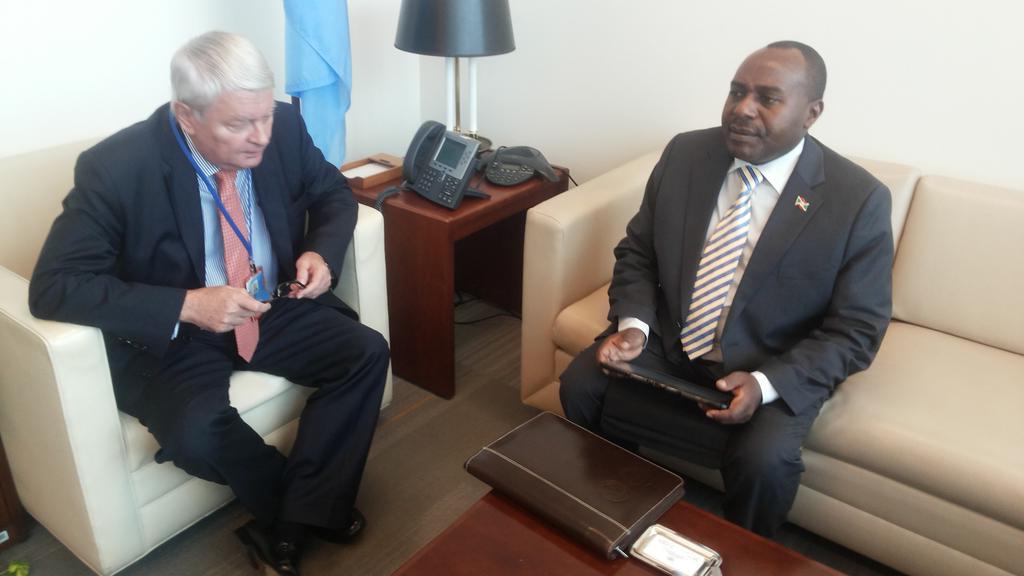
The EU's João Vale de Almeida, who tweeted a selfie with Monthe before the meeting assuring him the EU would be support, came through. He and the EU Mission have done nothing about Guterres' open censorship. These people are killing the UN.
   Inner City Press, banned from entering the UN for the 313th day in a row, asked UK Deputy Ambassador Jonathan Allen when his country expected to get out of the meeting. He said, "Hello Matthew" but just like his Mission, no substantive answer. Video here.
  Inside the meeting, he expressed surprise that the UK is viewed as pro Paul Biya, ignoring that his minister Liam Fobragged about UK-based New Age's oil deal with Biya. Germany's speech was even less focused; they have not answered Inner City Press'Cameroon's questions, or done anything about the UN's censorship of the Press.
 (Inner City Press went and began interested at the Ambazonia / Southern Cameroonsdemonstration in the 47th Street park, in the rain, video here.)
The head of the UN, Antonio Guterres, took a golden statue from Paul Biya in his last interaction, and cut a deal of silence for Biya's support in the UN Budget Committee which Biya's Ambassador Tommo Monthe chaired.
 The UK's Liam Fox bragged about UK-based New Age's hydro carbons deal with Biya, just as another example. Sycophant media which ignored than dismissed the killings now mechanically mis-report this "Arria formula" meeting, essentially to rehabilitate the remaining credibility of the UN and themselves, like Human Rights Warch which told Inner City Press Cameroon was not a top 90 problem to be included in HRW's 2018 World Report.
  Don't believe the hype. In 2009, for example, after the UNSC belatedly held such sessions on Sri Lanka, the lack of outcome emboldened the Rajapaksas to go ahead and "finish off" the Tamils in what's called the Bloodbath on the Beach. The UN system has not held anyone accountable; Guterres representative Singer was smiling with Mahinda Rajapaka this year. The only thing missing was a golden statute. 
Will what Guterres accepted from Biya beseen, or even mentioned, in the May 13 meeting that Inner City Press for reporting on it cannot even enter to cover in personbannedfrom entering the UN for the 313th day by Guterres, with similar inaction by the UNSC members? Watch this site.

Wednesday, March 16, 2016

IMF Says Banks in Lithuania Don't Lend to Small Biz, Why No EU Scheme?


By Matthew Russell Lee

UNITED NATIONS, March 16 -- The International Monetary Fund has painted a rosy picture of banks in Lithuania, merely slipping in that lending to small businesses is "exploratory at best," in its March 16 concluding statement after its Article IV mission:

"The banking sector is stable and lending again. There are no immediate risks to financial stability. Lithuania’s predominantly Nordic-owned banking sector boasts impressive financial soundness indicators, with capital adequacy and liquidity ratios rising further in 2015 from already strong levels...

Thanks to cost cuts, bank profitability has so far proven resilient despite revenue losses from euro adoption and the low interest rate environment. Some smaller banks and credit unions still need close monitoring but are not systemic... However, new bank lending to the SME segment remains exploratory at best. This underscores the need for continued support for SME and startup financing under the various schemes implemented with EU funds...

Despite the overhauled regulatory regime and a full-fledged macro-prudential tool kit, close cooperation with home-country authorities remains important to add traction to domestic policy tools and better deal with any unforeseen circumstances."

 So banks in Lithuania aren't lending to small business, this is done under EU "schemes." How about a "scheme" to make make reinvest in their communities? We'll have more on this.

Back on March 3 when the International Monetary Fund held is biweekly briefing, Inner City Press asked questions and got responses on Tunisia, Jamaica and Zimbabwe.

  In Jamaica, after an extended period of austerity, a new government has been elected, led by the Jamaica Labour Party's Andrew Holness IMF spokesperson Gerry Rice said the IMF "takes note" of the new government and will hold discussions with it.

  But what will it portend for the upcoming austerity-related benchmarks and reviews?

Inner City Press asked: "On Jamaica, what is the relation between the IMF's program and review(s) and the elections and their results? When will the review due March 15 be done?"

Rice answered: "There’s a question about Jamaica, what’s the relationship now between the IMF and Jamaica, given the elections, and when will the review, due on March 15th, be done. You know, clearly, we note the election of Mr. Holness and the GOP, the election results. We look forward to continuing to support Jamaica under its new leadership and we plan to discuss the economic priorities with the new authorities soon. Again, I’d note Mr. Holness has made clear during his campaign the intent to continue the reform program supported by the IMF, so we look forward again to a close policy dialog with the new leadership and geopolitical changes that the authorities and the staff have agreed to delay the discussions of the 11th Review for now, and I’ll come back when we have a date on that.

  In Zimbabwe, despite a Staff Monitored Program, parliamentarians are complaining about the IMF's delay, moving toward new elections with no progress with the IMF.

Inner City Press asked: "On Zimbabwe, what is the IMF's response to criticism by parliamentarians that the normalization of relations under the Staff Monitored Agreement is taking too long and that if it does not speed up, the country will prepare for new elections without any meaningful progress with the IMF?"

Rice answered: " On Zimbabwe, what’s the IMF’s response to criticism from parliamentarians about normalization of our relations, is it taking too long? The status with Zimbabwe is that we have what we call a staff monitored program. We’ve had that for some time. It helps a country establish a policy record with a view to normalizing relations with creditors. We are also providing some technical assistance. We have an ongoing mission and it’s aimed at conducting the third and final review under that SMP, that staff monitored program, and the 2016 Article IV.
As you probably know, Zimbabwe is currently in arrears to the IMF and others and the strategy entails how to clear those arrears that are due to the IMF, the World Bank and others. The Zimbabwean authorities presented their plans for repaying their arrears during the annual meetings in Lima and that has received support from creditors and development partners. So successful completion of that SMP and a depending of ongoing reforms sets the stage for advancing the discussions about the reengagement process. That’s where we are on Zimbabwe. I’m going to leave it there for today. Thank you very much for your cooperation and patience this morning. I really appreciate it."

 On Tunisia, Inner City Press asked: "On Tunisia, is a new IMF line of credit on schedule to be approved by the Board on April 22? What did Mr Blotevogel when he said “"Expected growth for 2016 does not correspond to the aspirations of the Tunisian people. It will not be strong enough to reduce unemployment.” What does the IMF recommend, then?"

Rice directed Inner City Press to a forthcoming press release: "There’s a question on Tunisia asking about asking about the status of the program with Tunisia. There’s an IMF mission in Tunisia until today negotiating a new four year Fund arrangement to support the authority’s program. And in fact, we’re going to be releasing a press release as soon as I finish here, so I can refer you to that. It will give the complete update on where we are on that matter."

Back on February 11, Inner City Press asked the IMF, "On Sri Lanka, please comment on and provide context for the reported request from the government for a new IMF program."

   IMF Spokesperson Gerry Rice, after noting how Inner City Press submits its questions (electronically), replied that Sri Lankan authorities have expressed an interest in a program to deal with balance of payments. He said there would be a negotiating mission in late March or early April.

  The embargoed briefing began with a read-out of the press release that there is no competition to Christine Lagarde for a second term -- similar to the way at the UN, there was no competition to Ban Ki-moon for a second term. Is this any way to run a multilateral, quasi universal international organization?

  Inner City Press also asked about Romania (“Romania on Monday made the last interest payment on the 13 billion euro it took from IMF in 2009” and Dragos Tudorache, head of the Chancellery of the Prime Minister, has said "We don’t plan to conclude a new deal with the IMF” - please provide an IMF comment / response)
 and this, on Burundi:

"On Burundi, at the UN Peacebuilding meeting at the UN yesterday (Feb 10), the IMF said any new program would depend on relations with the international community. Please explain this, how relations with the international community impact an IMF program."

Back on January 14, Inner City Press submitted a number of questions, leading with Burundi and whether the Nkurunziza government's "income" from sending troops to Somalia and Central African Republic should be disclosed in the budget. See below.

  On February 10 in the UN Peacebuilding Commission, while the IMF still didn't directly address the sleight of hand with the UN's peacekeeping funds, it presented a stark picture of Burundi's economy. It said GDP fell over four percent in 2015.

 The IMF said any new program would depend on relations with the international community.

 The World Bank's Bella Bird spoke by video from Addis Ababa; she said the World Bank still has $270 million of projects in Burundi, but said the government is closing down, not reaching out.

  Burundi's Ambassador to the UN Albert Shingiro, after these critiques, went on and on bragging about blocking the proposed MAPROBU peacekeeper force in Addis, denouncing NGOs he left UNnamed and false media reports. He continues to block @InnerCityPress on Twitter. We'll have more on this.

  Back on January 14, IMF spokesperson Gerry Rice read out Inner City Press' question then referred to the IMF's March 2015 sixth review, saying the government had committed to include the income from peacekeeping operations in the budget. Rice then said due to deterioration in the security situation, the seventh and eight reviews are not possible and the program is "off track."

  On January 14 the IMF's Rice also noted the US Congress having approved quota reform (answering that he was not aware of any new oversight this might trigger), and said that Managing Director Lagarde will hold Greece meetings in Davos. Rice declined to answer ICP's question on Nigeria, saying much has been said on the topic; a Trinidad and Tobago question remained outstanding as the embargo time expired, but Inner City press was later on January 14 told on Trinidad and Tobago, the IMF's engagement with the country is one of economic policy advice or what we call surveillance. There is no program nor any talk of that, Inner City Press was told.

  Back on December 5, 2015, Inner City Press also asked the IMF about Burundi (and Zambia), and Rice said following as to Burundi, audio here:

“In terms of the outlook in Burundi, it's effected by the decline in economic activity there and the . withdrawal of donor support. Confidence in the economy has been weakened by the political climate and adverse security developments. The growth rate in Burundi, which we had initially projected 5% in 2015, is now estimated at minus 4.1% in real terms.... In the current environment, completion of the 7th and the 8th review under our program there is not possible and as such, Burundi's program with the IMF, which is an ECF arrangement, is now off track.”

  Inner City Press had also asked, on Zambia, it is reported that the IMF “proposed a $1 billion facility which the president had turned down. A sticking point for the president was the insistence by the IMF that government commit to drastic reductions in expenditure, particularly on road construction.” What is the IMF's response?

   Rice said that no program has been “formally” requested, but that the Zambian authorities committed to “internal consultations.” Inner City Press had asked about Sri Lanka, and the same “no formal request yet” answer was given.Audio here.
 Inner City Press also asked about Malawi and, lastly, Ghana; more on this to follow.

On October 29, Inner City Press asked IMF spokesperson Rice “in Jamaica, the National Democratic Movement has blamed the IMF for the country's 'health-care system becoming a national disgrace.' What is the IMF's response?”

  Rice during the IMF's embargoed briefing read out this question, audio here, and said he does not agree, that Jamaica's 2015-16 budget includes an increase for the Ministry of Health. Audio of full answer here.

  The IMF left unanswered, for now, Inner City Press' question about Antigua and Barbuda, below; there will be more about Dominica.

 The IMF, it seems, should be more responsive: the Gleaner for example opines that “in 2014, Jamaica paid $138 million more to the IMF than it received from it. We are constantly being told Jamaica passed the IMF test. Look at the punitive primary surplus imposed on Jamaica. At 7.5%, it is way above what is being asked of any other country in the IMF program. It is 4% for Cyprus, 3% for Ireland, 3% for Greece, 3% for Portugal and a puny 1% for Ukraine. One has to wonder why Jamaica is being treated this way.”

  Here are two other questions Inner City Press submitted on October 29, still without answer:

On Antigua & Barbuda, in light of recent comments by IMF Mission Chief Arnold McIntyre, what is the IMF's view of and comment on the information in the US FBI's charge sheet and indictment of Antigua's former ambassador (and former UN PGA) John Ashe, particularly with regard to corruption in the country?

In light of the UN Special Rapporteur's report on human rights (non) compliance by the World Bank, presented this week at the UN, please summarize how the IMF considers the human rights impacts on its decisions.

  We'll have more on this.

  Back on July 8 when the International Monetary Fund released reviews and papers about the United States, complete with support of the Dodd Frank Act and mentions of anti money laundering protection Inner City Press asked about the proposal to raise the definition of Systemically Important Financial Institution from $50 billion up to $500 billion and if tight AML strictures are to blame for cutting off remittances to Somalia.

  Aditya Narain, IMF mission chief for the Financial Sector Assessment Program and deputy director, Monetary and Capital Markets department, told Inner City Press that the IMF believes such definition should give predictability, but should be based on risk and not necessarily only asset size.

  Narain told Inner City Press, "On the first one, our general belief is that supervisory approaches should be risk based, and therefore the materiality and proportionality of institutions should be taken into account for to develop supervisory frameworks. At the same time, we also recognize that it’s important to have some clear rules, regarding a unit, in this case size of institutions, because not only does it set a baseline of expectations, but it also provides a useful framework for people to anchor their expectations on. So that’s why, in a sense we would agree that it’s important to make these approaches risk based and therefore not dependent on size alone. I should add also, that our only political ideology is financial stability, for the purpose of this exercise.

  But will this be used FOR the Senator Richard Shelby draft bill?

  On remittances, Aditya Narain said it is an important question but one that the IMF is dealing with in other venues; it apparently wasn't raised to the US during this process. Why not?

 Narain told Inner City Press, "On the regulatory question, this is an issue which is being discussed in several forums where the IMF has been participating, and this is an issue not just for the US, although it has been most discussed in the context of the US, but the effects of the AML on remittances and the result, the stringent adherence to standards has led to a concern more globally that might be affecting the flow of remittances to those jurisdictions... where such remittances and the channels through which they flow are more important. We have not discussed this... there is work ongoing in the Fund, including in collaboration with other institutions like the World Bank... and we expect to be able to have more information on this in a few months time."

   In the embargoed media conference call, two questions in a row went to the Financial Times, which opined that the IMF report takes the side of the Democratic Party. The IMF disagreed. The IMF said, in writing, “As the epicenter of the global financial crisis that began in 2008, the United States passed a major law in 2010, the Dodd-Frank Act, to reform its financial system. Officials need to complete the rulemaking under the law, while parts of reform agenda face legislative proposals to water them down.”

   Central Banking asked two questions and Reuters one, on federal insurance regulation.  Watch this site.

Monday, January 25, 2016

On Burundi, Inner City Press Asks PR Rycroft Of UK Minister James Duddridge Pushing for EU Sanctions, Rycroft on 3 Ds


By Matthew Russell Lee

UNITED NATIONS, January 25 -- After UN Secretary General Ban Ki-moon on New Year's Eve issued a statement praising the Burundi “talks” held in Entebbe, Uganda, multiple sources told Inner City Press these not really talks but rather a photo op. The January 6 session announced for Arusha did not happen.  Inner City Press requested to cover the UNSC's trip to Burundi, but was UNtransparently rejected.

  On January 25, with the Security Council having returned from a trip widely called “disappointing,” Inner City Press asked UK Ambassador Matthew Rycroft about a written statement by the UK Minister for Africa James Duddridge that if Burundians continues to refuses to come to the negotiating table, the UK will push for EU sanctions against those blocking progress toward peace. Letter herehere.

  Rycroft said the focus of the trip has been on the three Ds -- dialogue, de-escalation and deployment, adding that the deployment wouldn't have to be exactly what was first proposed and mentioning the (blocked) observers. Video here. Here's UK transcript:

Inner City Press: does the UK favour sanctions if the Burundi government doesn’t move towards talks? A UK Minister was quoted to that effect.

PR Rycroft: What we were talking about on the visit was the 3 D’s, for dialogue, de-escalation and some form of deployment of an international presence. And that’s what we are focusing on at the moment. And unfortunately we didn’t get a huge amount back on the visit. I think there are a few openings on each of those. But it is absolutely crucial that the government of Burundi takes the initiative to de-escalate, takes the initiative to reach out, not just to its friends but to its enemies as well to begin a genuine dialogue with international mediation and is open to some form of deployment of an international presence. It doesn’t have to be exactly what was first proposed by the African Union, but it does need to be something, including as a first phase observers, monitors to really improve the human rights situation and other areas of concerned.

  We'll have more on this.

Inner City Press asked the UN about the trip on January 20, 21 and 22. The UN spokespeople refused to provide Press-requested information, but the Council also met with at least some of the concerned members of civil society, and some journalists who inevitably raised the issue of attacks and censorship.

  Inner City Press has interviewed attendees of the Council's meeting with journalists, where the closures of radio stations RPA, Isanganiro and
Renaissance were raised, leaving the journalists to use social media (unlike the three scribes from Reuters, VOA and AFP handpicked to accompany the Council). Invitations to the meeting and information went out from the Communication Officer of the US Embassy in Bujumbura. Interviews were conducted, too, with representatives of Uprona and Frodebu parties.

 Attacks by the Imbonerakure youth militia, the existence of which was denied by Pierre Nkurunziza, were raised. But the accompanying the Council scribes barely covered this. We'll have more on it.

  The UN Country Team in Burundi is now led by Paolo Lembo, who also served in Yemen where Special Adviser Jamal Benomar did. Neither Lembo nor the shadowy "UNIC Bujumbura," however, arranged for a video or even audio steam of the Council's and Burundian government's press statements. We're told that Ambassador Albert Shingiro, who blocks the Press on Twitter, told the scribes that US Power said she would send “a strong message to the government of Rwanda." Again, Shingiro blocks the Press on Twitter: some diplomat.

  One of the four handpicked pass-throughs opined that "the fact that Council members presented Nkurunziza with a largely unified message on the different issues was seen as a positive sign that they had come closer to a common position." So they traveled to Burundi to work on their own issues? We'll have more on this - and on the Council's junket-ending meetings in Addis, if not on Oromo protests, than this we've asked about. Watch this site.

On January 22 -- at 4:32 pm in New York, four minutes before Inner City Press then publshed it -- the UN has issued this Note to Correspondents:

"Security Council members just departed Bujumbura less than an hour ago. The delegation is headed to Addis to meet with the Peace and Security Council of the African Union tomorrow.

"Council members met with a range of stakeholders during their visit to Burundi, including the President, First Vice President, Foreign Minister and representatives from political parties, the media, and civil society organizations. The Council also met with religious leaders.

Special Adviser Jamal Benomar is in Burundi. The core group of his team called for in Resolution 2248 deployed to Bujumbura and will be engaged with all stakeholders to support dialogue and address security concerns."

 How?

   On January 22, Inner City Press asked UN Deputy Spokesperson Farhan Haq for the UN's response to Pierre Nkurunziza denying the existence of his party's youth militia, and why there was no video or even audio stream of the Security Council's - and Nkurunziza's -- press statements. Video here.

  Haq replied that "the facilities are difficult," that the UN Spokesperson's Office had reached out to the traveling party for information but hadn't gotten any. The Free UN Coalition for Accesscalls this a failure.

 On January 21 Inner City Press in New York learned both of Pierre Nkurunziza plans to parade "community work" for the Security Council members on January 22 and has been provided with a letter promoting same, here.

  On January 22, even after the Council's meeting with Nkurunziza was over, when Inner City Press asked the UN for a read-out there was none, nor any good explanation of why the UN with its country team could not arrange at least an audio stream of the Council's (and Nkurunziza's) press statements.

  Inner City Press asked the head of the Campaign Against the Third Term (“Halte au troisième mandat”) Vital Nshimirimana about the UNSC visit, and why the AU human rights observers are not yet in place. His answers to Inner City Press:

"As for the deployment of the AU Human rights observers, I would recall that the same was decided back in June following the June 13, 2015 Johannesburg Summit on Burundi. Initially, the number was to be about 70 observers but the government refused and allowed a narrow team.

"My thought over the issue is that Nkurunziza has chosen to humiliate everybody in as much as he does not care about any principle or value. So, the AU and other bodies as well choose to deal with him very carefully for he is a man (and a regime) "irrational," likely to commit whatever crime, insult whomever.....

"With regard to the UNSC visit, I hope this is the very last warning towards a kind of regime likely to commit genocide. They are expected to dually and objectively assess the situation and especially the strength and presence of Imbonerakure, the CNDD-FDD militia.... And this was shown through a huge anti- peacekeeping mission mission to Burundi, MAPROBU rhetoric.
Burundians expect the UNSC support the deployment of such a mission in line with the responsibility to protect (Pillar III) since Burundi is no longer able and is unwilling to protect citizens from crimes against humanity (ongoing from April 2015) and genocide (of which dozens of signs suggest that it is likely to happen and some acts are already undertaken).

Lastly, the UNSC is expected to talk with Nkurunziza and the AU as well regarding peace talks. They should assess Museveni's performance, after what conclude that he should be assigned AU and UN teams (to enhance his capacity) or change him.... I commend your endeavors to keep the world informed about the Burundi crisis."

 We'll have more on this -- including in light the UN Deputy Spokesperson's response to Inner City Press that transcripts may be provided.

  Here are parts of an Inner City Press interview with a journalist attacked by the Nkurunziza government and for that reason anonymous:

In English: "It would be better if the Security Council met for example UPRONA leader Nditije Charles, with the non-governmental branch of the UPRONA party) or his Spokesman Thacien Sibomana. The Council should try to meet civil society but  there is almost no one left to really speak with now in Bujumbura. All those still in Bujumbura, they can't say anything about the abuses of authorithies. If it was possible, they should ask to meet the young men in prison. They should see themselves how the government abuses those young men, with tortures... Tell them visit to the prisoners in Gitega (those who are accused to attempting a coup d'etat) UN has the right to visit prisoners."

  Inner City Press note: another source says "the government moved several detainees from the SNR jails. I highly doubt they'd allow a visit to detainees."

 More, in French:  "Oui, ils ont déjà mobilisé beaucoup de personnes (jeunes, femmes, taxis velos et taxi motos pour aller accueillir the UNSC pour leur montrer qu'il y a la paix et qu'ils n'ont pas besoin de force de maintien de la paix. Ils manipulent la Population sur base de menaces comme quoi celui ou celle qui n'ira pas au rassamblement sera considéré comme ennemi national.
malheureusement c'est ce qu'ils ont fait depuis des années."

 Tellingly, IWACU reports that bike taxi and motorcycle taxi drivers offered money to protest in favor of Nkurunziza weren't, after the fact, paid: here.
    At the January 21 UN noon briefing, Inner City Press asked UN deputy spokesperson Farhan Haq about the "community works" and meeting(s). Video here, UN transcript here:

Inner City Press:  I wanted to ask you this just because I'm trying to cover it, and I know that you'd said yesterday that the Special Adviser, Jamal Benomar, is in Burundi in part of the trip.  So what I wanted to ask you is, I've seen documents that show that the… the… the… tomorrow, the meeting with the President, [Pierre] Nkurunziza, will involve a demonstration of “community work”, i.e., people have been asked to go and I don't know if it's to show how happy they are — Gitega and Karuzi.  Does the Special Adviser… not the Security Council, does the Special Adviser of the Secretary-General believe that this type of… of… of show is the right one and will they be meeting with UPRONA and other opposition groups or prisoners currently in jail?

Deputy Spokesman Haq:  Well, we'll be able to provide details of the meetings once they've taken place.  As you know, the expectation is for the members of the Council to meet with President Nkurunziza.  That hasn't happened so far, but once that's happened, we'll see what the circumstances are and what the views of Mr. Benomar are.


 This is reminiscent of the type of dog-and-pony show Sri Lanka's then President Mahinda Rajapaksa put on for visiting UN Secretary General Ban Ki-moon and that Inner City Press accompanied and covered(apparently not to the UN's and its allies' liking - it has been Banned from trips since.) But will the UNSC, unlike Ban, have the fortitude or leverage to reject a dog and pony show? Watch this site.

On January 19 at the UN, Inner City Press asked Uruguay's Vice Minister for Foreign Affairs Jose Luis Cancela, chairing the Security Council debate on Protection of Civilians, about Burundi and the Council's trip. Video here.

  On January 21, Inner City Press and the Free UN Coalition for Accessasked UK Permanent Representative Matthew Rycroft about his stop-over on Addis Ababa, "will you as UK meet with AU before heading to Burundi? About AU's proposed deployment?"

   Rycroft replied, "Yes! Looking forward to meeting @AU_Chergui today. Will also return to Addis with whole UNSC after Burundi."

  In Addis, Chergui had filed the Concept of Operation for the MAPROBU peacekeeping mission. We'll have more on this.

  Burundian civil society has written to Ban seeking the repatriation of the country's peacekeepers. Inner City Press has put the letter from Vital Nshimirimana to Ban online here, and will be asking the UN about it. Watch this site.

  On December 30 Nkurunziza threatened to have his forces attack peacekeepers proposed for the country.


Obtained by Inner City Press

Ladsous' lack of vetting was criticized in the recently released report into the cover up of peacekeepers' rapes in the Central African Republic. Earlier, Inner City Press exclusive reported on Ladsous in his October 1, 2015 meeting with Burundi's vice president saying that he is "pragmatic" on human rights.

 On December 16 Inner City Press was banned from questions to Secretary General Ban Ki-moon, but learned from the mission MINUSCA that Baratuza was already in Entebbe. Inner City Press asked several Security Council members, then Ban's spokesman Stephane Dujarric on December17.

Dujarric told Inner City Press Baratuza's deployment is suspended and he is being repatriated: "based on the information we've received regarding the Lieutenant Colonel, his deployment has been suspended, and he will be repatriated back to Burundi." Video here. Dujarric told Inner City Press this shows the UN system working - on a day when a report on rapes was issued showing UN Peacekeeping under Herve Ladsous not sufficiently vetting for human rights. We'll have more on this.


 Amid the escalating killings in Burundi, last weekend's summary executions in neighborhoods opposed to Pierre Nkurunziza's third term stand out. But Burundi Army spokesman Gaspard Baratuza was quoted on December 12 blaming all of the deaths on attempts to steal weapons to free prisoners.

   Inner City Press had heard that Mr. Baratuza was already in the process of being deployed to the UN Peacekeeping mission in the Central African Republic (MINUSCA) even when he was giving these quotes, issuing statements and speaking to state-owned radio, and so asked MINUSCA's acting spokesperson, “Is Gaspard Baratuza of Burundi's army getting a MINUSCA job?”

  On December 16, hours before UN Secretary General Ban Ki-moon held a rare press conference, MINUSCA's acting spokesperson sent this to Inner City Press:

"To: Matthew.Lee [at] InnerCityPress.com
From: Vladimir MONTEIRO [at] UN.org
Date: Wed, Dec 16, 2015
Subject: ICP question: Gaspard Baratuza of Burundi's army getting a MINUSCA-related post?
Cc: FUNCA [at] funca.info

"No decision related to Lt Col Baratuza's deployment can be taken before we finish looking into the matter. We can confirm that Lt Col Baratuza is in Entebbe but he has not yet deployed to MINUSCA.  Regards. VNM"

There are some questions about Baratuza, a Colonel in Burundi's Army, being listed by the UN as “Lt. Col.”

  Despite multiple follow-up questions by Inner City Press, Mr. Monteiro - previously a spokesperson for the UN electoral mission in Burundi - replied that “This is what we can say about this issue.”

   But the UN should have to say more. Inner City Press has repeatedly asked the UN how its Department of Peacekeeping Operations under Herve Ladsous vets those who deploy to UN missions; Inner City Pressexclusively reported on an October 1, 2015 meeting in which Ladsous told Burundi's Vice President Joseph Butare that he is “pragmatic” on human rights.


 Ban Ki-moon and his spokesman declined to take Inner City Press' questions on December 16, as they did on December 14. Vine here.  Watch this site.

Saturday, January 9, 2016

Online Censorship Opposed by Inner City Press, Under EU "Privacy" & Digital Millennium Copyright Act in US, Examples Here


By Matthew Russell Lee

UNITED NATIONS, January 9 -- What is censorship? Late on January 8, 2016, Inner City Press received a notice from Google that a page on its website, an article concerned Kosovo, would henceforth be blocked from Search from Europe. The notice is published below, along with Inner City Press' response.

  While still seeing this as censorship, at least in this case Google provided notice of what it had done, and a form to petition for the page's reinstatement. By contrast, when Reuters' UN bureau chief Louis Charbonneau ex parteclaimed to Google that his email to the UN, seeking to get Inner City Press thrown out of the UN, was somehow copyrighted, Google did not provide any notice, but simply blocked access to the leaked document, from everywhere.

  Inner City Press only learned of this censorship by a fluke, and by the notice put up by the Chilling Effects project of the Electronic Frontier Foundation (EFF, hat-tip).

   That experience has led Inner City Press, alongside its reporting on the UN and IMF and on predatory lending by banks, under-regulation by the Federal Reserve and others, to dig into the ways in which the Trans Pacific Partnership could globalize the type of censorship the Reuters bureau chief got Google to do, using the US Digital Millennium Copyright Act, DMCA. This has become a project of the new Free UN Coalition for Access.


  In this January 2016 case, here is what Google sent to Inner City Press:

"Notice of European data protection removal from Google Search

To: Webmaster of http://www.innercitypress.com/,

Due to a request under data protection law in Europe, Google can no longer show one or more pages from your site in Google Search results. This only affects responses to some search queries for names or other personal identifiers that might appear on your pages. Only results on European versions of Google are affected. No action is required from you.

What we’d like you to know: These pages haven’t been blocked entirely from our search results

They’ve only been blocked on certain searches for names on European versions of Google Search. These pages will continue to appear for other searches.

We aren’t disclosing which queries have been affected.
In many cases, affected queries don’t relate to the name of any person mentioned prominently on the page.

For example, the name might only appear in a comment section.
You can notify us of concerns

If you have additional information regarding the content of a page that you believe warrants a reversal, you can notify Google. Please note that while we read all requests, we do not always respond. Only the registered siteowner can access this form.
Here are the affected URL(s):

http://www.innercitypress.com/kosovo010307.html

  And here is what Inner City Press, confined to 250 characters per box, has sent to Google:

This article concerns Kovoso. Most individuals it it are public figures. Perhaps 1 individual in it filed a spurious request to censor. But see, for example,http://uk.reuters.com/article/uk-serbia-kosovo-corruption-idUKL0314562220070103, online.

  Then

"Reporting on contested areas such as Kosovo is in the public interest and should not be censored, particularly not based on an anonymous complaint. This is a request for Google's response to  what we see as a form of censorship.

Inner City Press reports on the UN, and here, Kosovo. We note previously unexplained censorship and false invocation of copyright:http://www.chillingeffects.org/notice.cgi?sID=1117933We request reversal of both, and an explanation."


  Watch this site.