Showing posts with label Deir ez-Zor. Show all posts
Showing posts with label Deir ez-Zor. Show all posts
Wednesday, February 24, 2016
On Syria, Airdrops In Deir ez-Zor, Blankets, For de Mistura Press Banned
By Matthew Russell Lee
UNITED NATIONS, February 24 -- When the UN pulled the plug on the Intra-Syrian Talks, or as envoy Staffan de Mistura said merely pushed them back, de Mistura said that the UN "is not prepared to hold talks for the sake of talks."
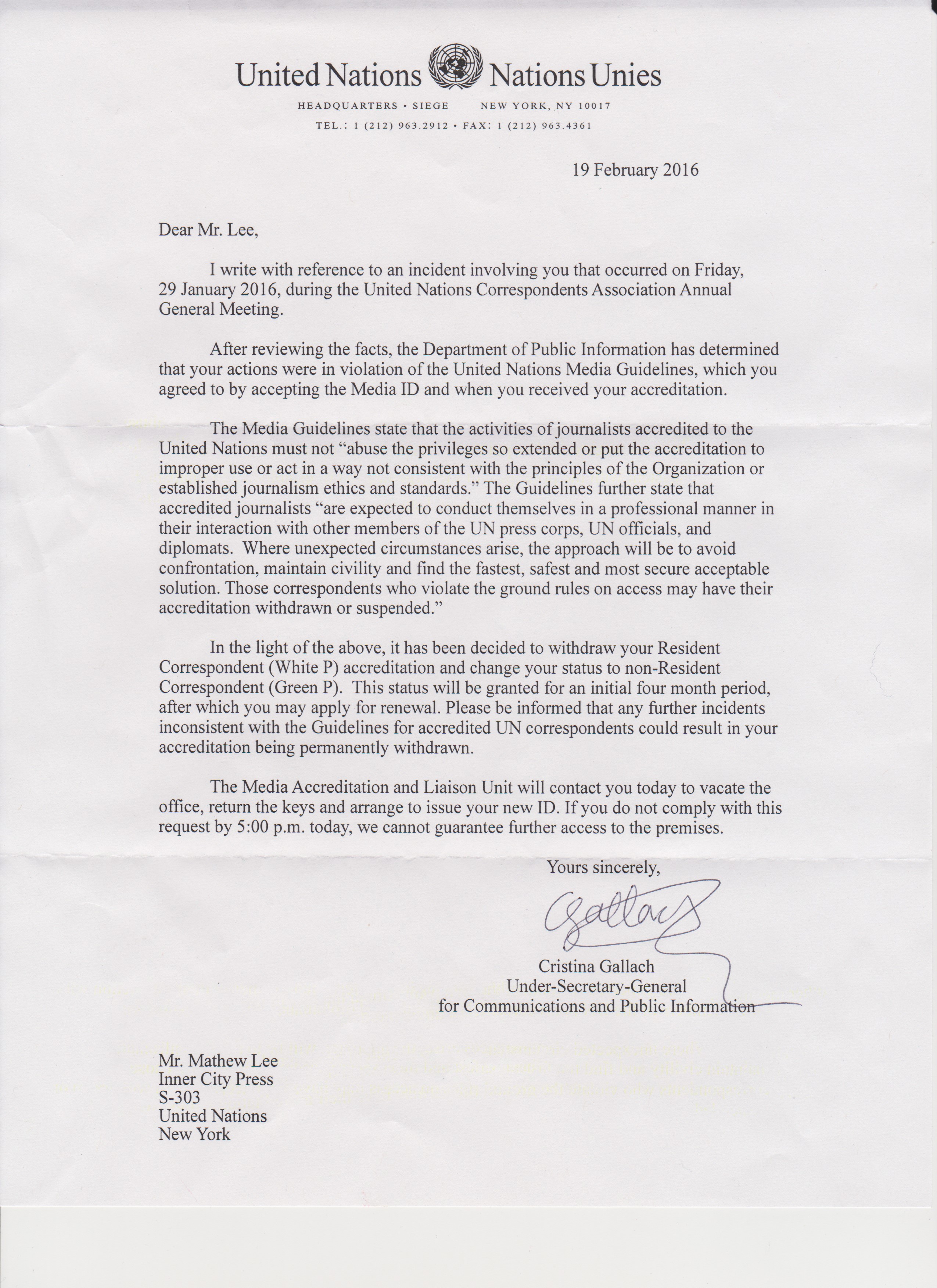
Now de Mistura is scheduled after delay to brief the Security Council on Friday, February 26 at 3 pm. It seems Inner City Press will have to cover it, as it did UN Relief Chief Stephen O'Brien's speech on air drops to Deir ez-Zor, from the park across First Avenue from the UN, having been ousted from the UN on two hours notice, petition here.
Virtually the only thing the scribes at UN Spokesman Stephan Dujarric's Coffee Klatch briefing on February 24 asked was about air-drops to Deir ez-Zor (which Dujarric outrageously refused to admit is controlled by ISIS or Daesh). So we'll cover UNRWA and its blankets, or the thermal blankets of those UNRWA serves:
"Today, Wednesday 24 February, UNRWA concluded the distribution of thermal blankets after four consecutive days of operation in the Damascus suburb of Yalda. We provided 5,000 blankets to an additional estimated 1,160 Palestine refugee and other civilian families from the besieged and hard to reach communities of Yarmouk, Yalda, Babila and Beit Saham.
A total of 19,160 blankets have been distributed to approximately 5,700 families since the distribution operation started on Sunday 21 February.
UNRWA was able to resume operations in Yalda on February 14 for the first time in over six months, distributing 5,700 food parcels to families from Yarmouk, Yalda, Babila and Beit Saham over a 5-day operation. UNRWA seeks to bring a mobile health team in the coming week, to provide much-needed basic primary healthcare to civilians from the area."
The above from UNRWA spokesperson Chris Gunness.
On February 19, Russia convened a UN Security Council meeting and proposed a draft resolution on the sovereignty and territorial integrity of Syria. Western powers, as they're called, were dismissive the draft.
Here's some of what Turkey's Permanent Representative said, as fast transcribed by InnerCityPro.com:
"The fighting, it’s not only bombing militarily, hospitals, schools, medical facilities, are being bombed, after the Russian Federation’s intervention in the war, the majority of the civilian casualties are caused by this intervention. So it is, the resolution is there, so why do we need another resolution in that regard? When I see the text I found it... silent on the humanitarian issue.
"For us, any terrorist organization is a terrorist organization, full stop. For PYD they seem to try to get legitimacy by seeming fighting with Daesh. Actually this is not the case... For us, fighting against another terrorist organization does not give legitimacy to any terrorist organization."
Here is what US Ambassador Samantha Power said, as transcribed by the US Mission - which is aware of the UN trying to eject investigative Inner City Press for covering a meeting in the UN Press Briefing Room, UN letter here:
"Quick comment in my own right, which is that what’s really important is that rather than trying to distract the world with the resolution they just laid down, it would be really great if Russia would implement the resolution it’s already agreed to. We have Resolution 2254, we all came together in the Council before the end of the year, we all united around its provisions, and our emphasis should be on implementation.
Right now, we have a bombing campaign in the northern part of Syria that is hitting hospitals, that has caused mass displacement, more than 70,000 people gathering now at the border – huge suffering. We need to focus on implementing 2254. It’s incredibly important that there’s de-escalation, that all parties use restraint and show restraint.
But this is a distraction from the core fact, which is that 2254 needs to be implemented. We have a resolution on the books. It’s the right resolution. We’ve committed ourselves to it, and we need Russia to do the same."
Inner City Press -- in the middle of being thrown out of the UN for seeking to covering meetings in the building, click here for that -- talked its way through a UN Security block at the Council stakeout and asked Turkey's Permanent Representative Cevic if his country would send in ground troops. He said only if part of a multinational force.
Also at the stakeout - with a UN Security "minder" still trailing Inner City Press, like one of Ban Ki-moon's thought police as one wag put it -- Inner City Press asked the President of the Council for February, Venezuela's Rafael Ramirez, if he would convene and emergency meeting if Turkey or Saudi Arabia were to send in ground troops. He said yes, he would convene such a meeting.
But as things stands, even with Ban Ki-moon's censor Cristina Gallach receiving calls to delay and reverse her decision, Inner City Press could not cover such an emergency Security Council meeting.
We'll have more on all this.
On February 16, Inner City Press asked Syrian Ambassador Bashar Ja'afari about de Mistura's and Ban Ki-moon's explanations of why those talks ended - and about the UN saying Ban was misquoted in or misinterpreted by the Financial Times.
Ja'afari said that the UN would rather blame itself than the opposition, because then the UN would get push-back from “Westerners.” Ja'afari said that de Mistura's deputy only provided him with a partial list of the opposition delegations as the talks were ending. Ja'afari called them badly organized.
Before Ja'afari spoke, the Security Council's president for February Rafael Ramirez of Venezuela told reporters that the Council's members agreed to tell Turkey to comply with international law. Associated Press - click here for AP's UN rape reporting on Feb 15 - asked if that meant all members. All to different degrees, was the answer.

Thursday, February 18, 2016
On Syria, UN's Staffan de Mistura on Air Drops to Deir ez-Zor and Elsewhere, Cessation of Hostilities UNclear
By Matthew Russell Lee
UNITED NATIONS, February 18 -- When the UN pulled the plug on the Intra-Syrian Talks, or merely as envoy Staffan de Mistura said pushed them back to February 25, de Mistura said that the UN "is not prepared to hold talks for the sake of talks."
From Munich on February 11, this statement below was issued. While the cessation of hostilities remains unclear, on February 18 de Mistura spoke about air drops to Deir ez-Zor and elsewhere:
"Let me first of all say I had a conference call with the 18 countries who are part of the International Support Group. We had a video conference just today in Geneva, and we were reporting together with Yacoub El Hillo and Khawla Mattar how this long night took place. And I must say, I must say, they were all very encouraged by the fact that more than 100 trucks, 114 trucks, were able to reach 82,000 people Madaya, Mouadhimiyeh, up all the way to Kafrayah and Fouah, and also in Zabadany.
So I must say that this was a difficult test for the United Nations to show they could do it, for the government and for the armed opposition, but so far we are quite pleased about the fact that this was able to reach 82,000 people, so it did work.
Now of course we should go beyond that, we should go far beyond that in order to be able to reach everyone in Syria who is either besieged or in need of being assisted and that's why the idea also of air drops in Deir Ez Zour has become a very concrete proposal which we want to work on, but not only there, even eastern Aleppo, even in Daraa in eastern Ghouta, many other places including Kafrayah and Fouah, where people are in need of help. I think we can work on that."
We'll have more on this.
On February 11 in the press conference in Munich, three questions were taken: New York Times, Russian N TV, and BBC Arabic.
Russia's Sergey Lavrov brought up Ukraine, and said he would not mention Palestine. (One waited to hear of Yemen.) He said the Financial Times misused what Ban Ki-moon said, that Ban hadn't blamed Russia. (Inner City Press witnessed Ban enter the Security Council soon after Vitaly Churkin on February 9, but Ban's spokesman refused to say why.) We'll have more.
Inner City Press on February 10 asked UK Ambassador to the UN Matthew Rycroft about the exclusion of the Kurdish PYD from the talks. Video here.
Rycroft, one of the few Security Council Ambassadors who still speaks to the media gaggle on his way into the Council, told Inner City Press he didn't want to second-guess the co-chairs of the talks, de Mistura, John Kerry and Sergey Lavrov.
Back on February 5, the UN Security Council met to hear from de Mistura by video, behind closed doors. Afterward, Inner City Press asked three of the Permanentn Representatives in attendance why the Kurdish PYD had been excluded from the talks.
Security Council President for February Rafael Ramirez of Venezuela said, Yes, this had been discussed. Russia's Ambassador Vitaly Churkin said since Kurds at 15% of Syria, they should be included - and that if Turkey supports Syria's territorial integrity, it should stop blocking the PYD.
But after French Ambassador Francois Delattre speechified at the UNTV microphone and had taken two questions, Inner City Press asked quite audibly about the PYD. Video here. Delattre's spokesman directed that the UNTV microphone be given to Reuters for a vague question, then Delattre said, C'est fini.
Inner City Press asked again, loudly, about the PYD. Delatte walked away, indicating as he has before, I will have to get back to you. But he has not, for eaxmple on Burundi. Later Inner City Press heard rumblings about the use of Periscope -- see here for acts of Voice of America -- which, ironically, a number of Security Council delegations use and follow Inner City Press on. But what ABOUT the PYD? Watch this site.
On the way in, UK Ambassador Matthew Rycroft stopped and took five questions from four media, largely blaming Russia for the pause in the talks. Video here.
Inner City Press tried asking, third time until it worked, what about the “petty procedural issues” that Secretary General Ban Ki-moon had also blamed in his post-pause statement. A definition has yet to be given; Rycroft replied to Inner City Press' question on what the opposition should do on February 25 by saying that the opposition needs to be shown it is supported.
For balance, Russia's Ambassador Vitaly Churkin was asked about this accusation and called it “in bad taste.” Churkin added, “They should blame those who support the terrorists. It's not a Russian escalation, it's intensified efforts by the government to fight the terrorists.”
On February 4 in front of the UN Security Council, Inner City Press asked Rycroft's Deputy Peter Wilson what Ban Ki-moon meant by "petty procedural" and other issues stalling the talks. Video here, and see below.
Later on February 4 the UN Mission of Venezuela, President of the Security Council for February, issued a statement that, on February 5 the Security Council will hold a meeting to evaluate the political situation in Syria after the talks were suspended for three weeks by the Special Envoy of the Secretary General Staffan de Mistura.
Venezuela's Ambassador Rafael Ramirez said in his national capacity, “We are in favor of dialogue without any preconditions, and the most important thing is that the countries that have influence with the government or the opposition are committed to and confident in the negotiations.”
Inner City Press asked Ramirez if Sudan will speak on the debate on sanctions on February 11; Ramirez said yes. On February 1 Inner City Press for the Free UN Coalition for Access (FUNCA) asked Ramirez to hold such Q&A stakeouts after closed door meetings: and on February 4, he did. Tweeted photo here.
The UK's Peter Wilson said the London Conference is "our" (UK) focus, and to pay attention to the speech Ban gave. On that way to the UN Security Council stakeout, another country's diplomat told Inner City Press there would be a session with de Mistura on February 5.
As Inner City Press was filming the Q&A with Wilson, the correspondent from Voice of America took two photographs... of Inner City Press' phone. The gola, we surmise for past and recent experience, may be to Ban filming and whole technologies at the UN Security Council stakeout and even elsewhere in the UN, which the old UN Correspondents Association has tried to do in the past.
The new Free UN Coalition for Access (FUNCA) would oppose that - watch this site, and note that many Security Council delegations use Periscope, and the UN itself purports to promote social media.
Notably, de Mistura's statement did not cast blame for the failure - but hours later, Reuters channeled a "senior UN official" it allowed to remain unnamed:
"A senior U.N. official told Reuters on condition of anonymity that de Mistura called a halt to the talks after Russia increased air strikes to help the government of Syrian President Bashar al-Assad, undermining the negotiating process. 'I think the special envoy decided to suspend the talks because the (United Nations) did not want to be associated with the Russian escalation in Syria, which risks undermining the talks completely,' the official said."
Reuters did not explain WHY it granted anonymity to this described "senior UN official." But since even this source said he or she "thinks" de Mistura decided, it called into question, what kind of source is this? UN Political chief Feltman, whom Reuters UN bureau chief has previously used, would not "think" what de Mistura decided.
But now Ban Ki-moon has said, or read, what the unnamed senior UN official said, albeit without naming any country, see below.
Does Reuters grant (more) anonymity to Ban Ki-moon?
At the UN in New York on February 3, Reuters' correspondent actively cut off Inner City Press questioning about UN corruption, saying "you're grasping at straws." Vine here, story here.
Meanwhile the UN bureau chief promoted himself appearing at aVienna UN event, top-heavy with Reuters connections.
On February 4, Ban said this:
"It is deeply disturbing that the initial steps of the talks have been undermined by the continuous lack of sufficient humanitarian access, and by a sudden increase of aerial bombings and military activities within Syria. The focus on the people of Syria is also being lost amid petty procedural matters."
Ban Ki-moon and petty? Say it ain't so.
Back on December 18 in the Lotte New York Palace Hotel, ministers Lavrov and Gentiloni, Fabius and Kerry passed through with entourages; UN Secretary General Ban Ki-moon left early typically without answering any questions, as Inner City Press Periscoped andreported. Hours later, the draft resolution was agreed to, then adopted 15-0 by the UN Security Council, here.
On December 26, the UN issued this for its envoy Staffan de Mistura:
"Further to resolution 2254 (2015) of the Security Council, unanimously adopted on 18 December 2015, United Nations Special Envoy for Syria, Mr. Staffan de Mistura, has intensified efforts towards convening representatives of the Syrian Government and the broadest possible spectrum of the Syrian opposition and others to engage in a political process leading towards implementation of the objectives and principles for a political solution to the Syrian conflict as contained in the Geneva Communique of 30 June 2012, and the Vienna Statements of 30 October and 14 November 2015.
"In line with the clear parameters outlined in Security Council resolution 2254 (2015), the Special Envoy intends to complete his consultations in early January, with a view to initiating intra-Syrian talks on a target date of 25 January 2016 in Geneva. He counts on full cooperation of all the relevant Syrian parties in this process. Continuing developments on the ground should not be allowed to derail it. The Special Envoy also relies on the continued crucial support of the International Syria Support Group.
The people of Syria have suffered enough. Their tragedy is now felt throughout the region and beyond. They deserve the full attention and commitment from all their Syrian representatives, who should now show leadership and vision to overcome differences for the sake of Syria."
The day before, on December 25, on Syria UNRWA's spokesman Chris Gunness said:
"UNRWA welcomes any developments that could end the armed conflict in and around Yarmouk, and ease the inhuman conditions that Palestine refugees and other civilians are in Yarmouk continue to endure. Over the past three months, there have been persistent reports of negotiations for some form of truce or evacuation arrangement in Yarmouk. These reports are credible and UNRWA is taking them seriously, although they have not been officially or formally confirmed, and details have been vague. There are several thousands of civilians living in deeply abject conditions in Yarmouk. As UNRWA is deeply concerned about their well-being, the Agency is seeking from the Syrian government further details of any negotiated arrangements that will affect the humanitarian situation of civilians in Yarmouk. In particular, UNRWA demands that any arrangements being negotiated in and around Yarmouk must include guarantees for a durable cessation of hostilities, for the protection of civilians, and for safe, uninterrupted humanitarian access for UNRWA and other humanitarian actors. UNRWA is redoubling its strong appeals to the Government of Syria and relevant actors to allow and facilitate humanitarian access to Yarmouk. This is urgently needed to enable UNRWA to deliver food, clean water, winter supplies, healthcare, and other humanitarian assistance and services to civilians in Yarmouk. UNRWA stands ready immediately to respond to the humanitarian needs of the entire civilian population of Yarmouk."
Meanwhile the head of Jaysh al Islam Zahran Alloush was killed al Ghouta.
Back on December 18 at the UN the US day ended in a bilateral meeting between Iranian minister Zarif and John Kerry -- a photo spray was canceled -- and a low key meeting on Iraq and Turkey that we asked about and reported on here.
Kerry and Lavrov, joined by UN envoy Staffan de Mistura, held this three-question press conference. Kerry said the negotiations should begin in mid to late January (in contrast to the early January in the resolution). Lavrov said only the “patriotic opposition” should be involved in negotiations. Staffan de Mistura said very little.
That Kerry's spokesman John Kirby, who ran the press conference, gave the second question to the Washington Post, and the third to Russian media, was perhaps understandable. But the first question, Kirby set aside for “Al Arabiya.” The question quickly turned into three, after being branded for “UNCA,” now the UN Corruption Association, a group which sold seats with UN Secretary General Ban Ki-moon for $6000 only earlier this week.
We now add: UNCA gave one of its prizes, a free trip to Turkey, to one of its Vice Presidents, from Agence France Presse. Even Kellogg's prohibits its employees from competing for its prizes. But not UNCA, which ignoring the Iraq - Turkey meeting in the Security Council was trying to buy people with Prosecco on December 18, after selling seats with Ban for $6,000.
Several other UN-based journalists -- not (only) this one -- complained afterward that the first question and attempted follow up were a “Saudi circus” which made the UN press corps look bad -- as did attempt to throw out certain journalists, photographers, from the front row at the beginning.
Afterward a photo spray of a meeting between Kerry and Iran's Zarif was declared “by invitation only” and then canceled. In the Security Council, with very few journalists still at the stakeout, the US presidency began the meeting on Iraq's complaint against Turkey being in its territory. We'll have more on this.
After the vote inside the Council Lavrov said, “The unanimous adoption today on the Council has created a broad front on the basis of the UN Charter, on the basis of all of those who are pushing back against terror, including the Syrian army, [some] armed militias, parts of the Syrian opposition, and the Russian air forces, in response to the legitimate request of the Syrian government."
Inside as Nasser Judeh of Jordan spoke, UN TV cut repeatedly to Syria's Bashar Ja'afari, looking more and more skeptical. France's Fabius spoke briefly and left. Outside at the stakeout, talk turned to a Kerry press conference, open to all.
Italy's Paolo Gentiloni, by contrast, scheduled a press availability only for Italian media. A wag from the Free UN Coalition for Access asked, Isn't Gentiloni the foreign and not interior minister? Isn't he running for a Security Council seat? We'll have more on this.
In the hotel lobby in the late morning a Permanent Five member of the Security Council's spokesperson briefed a gaggle of journalists in the lobby amid hissed that it was “off the record.”
There was a gingerbread model of the NY Palace hotel which, the sign said, took 300 hours to make. All that was lacking, one wag - this one - snarked on Twitter, was a little gingerbread Laurent Fabuis.
Back that UN, the 1 pm stakeout by the EU's Mogherini was postponed and then canceled. The Security Council scheduled for 3 pm got pushed back to 4. Inner City Press asked Ban's spokesman Stephane Dujarric if Ban had spoken, what would he have said? Vine here.
On December 17, the day before Syria talks resumed at the New York Palace Hotel in Manhattan, finance ministers spoke in the UN Security Council about cutting off financing for ISIS. French finance minister Michel Sapin spoke darkly of the use of pre-paid cards for the November 13 Paris attacks; Russia's Ambassador Churkin named two Turkish companies as involved in ISIS oil sale.
Inner City Press asked Syria's Ambassador Bashar Ja'afari, who came to take questions at the Council stakeout, about ISIS' oil. He named Turkey, then want on to name Qatar and Saudi Arabia, slamming its “Sunni coalition” recently announced.
When US Treasury Secretary Jacob Lew, along with Sapin and the UK's George Osborne held a short press conference in the UN briefing room, Inner City Press hoped to asked Sapin about pre-paid cards, and Lew and Osborne about Bitcoin. But the question, just four, were limited to Reuters, the Wall Street Journal, the New York and Financial Times. So it goes.
It seems there will be no Press access at the New York Palace; Ja'afari has said he will speak, at the UN, and whatever ISSG press availability there is should be at the UN, with a 3 pm meeting on December 18 scheduled. Watch this site.
Back on December 8, Inner City Press put thee questions to Turkey's Ambassador Cevic. Video here. Here's fast transcript byInnerCityPro.com:
Inner City Press: On Syria, do you think the Vienna process meeting should take place in New York on the 18th? Are you satisfied with the Saudi process for choosing the opposition?
Amb Cevik: The plans, I don’t know how fixed, I mean how clear it is, but we are making our preparations for the meeting.
Inner City Press: Are there any groups invited to Saudi Arabia that you think shouldn’t be part of the opposition delegation?
Amb Cevik: I think so far, in our view, they are working on the right concept. Let’s see if they succeed. Having a coalition group that would be able to take part in the process is one of the most important things.
Inner City Press: [Russia] said the group that killed their pilot should be put on the terror list. Do you have any view on that?
Amb Cevik: If they know the specifics, I don’t know. But to our knowledge, there was no terrorist organization, no extreme Daesh, Nusra, in that area. They are the Turkomens, and we know them, they are moderate people.
This may be an issue. Watch this site.
Wednesday, January 27, 2016
On Syria Sieges, Inner City Press Asks Spain's PR Roman Oyarzun Marchesi About Deir Ezzor, He Says Not Easy
By Matthew Russell Lee
UNITED NATIONS, January 27 -- When UN envoy on Syria Staffan de Mistura started his press conference in Geneva on January 25 he said, "the date which we’ll be aiming at having the beginning of intra-Syrian talks [is] 29th January."
On January 27 in front of the UN Security Council the Permanent Representative of New Zealand Gerard van Bohemen said, "we know that the answer to the problem is a peace agreement, which is what Geneva is about."
So Inner City Press asked, "Ambassador(s), you seem to say that the peace talks would deal with this issue of humanitarian access, but WFP was talking about Deir Ezzor which seems to be besieged by ISIS, what’s the plan or strategy if they’re not part of the peace talks to deal with that siege of 100,000 or some people say 200,000 people?"
It was Ambassador Roman Oyarzun Marchesi of Spain who answered Inner City Press:
"We shouldn’t lose focus of this, we do not only have in Syria 200,000 besieged people, we have 400,000 and if I heard well, the numbers were even higher it was mentioned even 500,000. What can we do? Well, in the case of those besieged areas by Syrian regime, it is very clear that we have an interlocutor, we have a member of the United Nations, a member we can speak with.
"In the case of the besieged areas by ISIL/Daesh, that is a very difficult thing to do but that doesn’t mean we forget about them, that doesn’t mean that these are different people, that they have less rights, we will have to do something but the situation on the ground doesn’t make it very easy."
Earlier on January 27, WFP's Ertharin Cousin said, "Deir ez-Zor has largely been inaccessible to humanitarian assistance since May last year. Currently, ISIL is controlling most parts of the governorate, while the airport, along with the five neighborhoods of the city are uner the control of the Syrian Government. It has been reported that the besieged locations are targeted on an almost daily basis by ISIL, resulting in fatalities and injuries among civilians. ISIL maintains an extremely tight control over the cities with little prospects for negotiations."
We 'll stay on this. And on this - Burundi, here's New Zealand's summary.
Back on January 18 when after closed door consultation with de Mistura the Security Council's president for January Elbio Rosselli said at the stakeout:
"“The Security Council heard today the first oral report by Mr. de Mistura who's been working very, very actively following on the different aspects of Resolution 2254 of 18 December last year. As you all know, Mr. de Mistura has had a very, very active and hectic agenda, visiting most of the capitals of the concerned states, traveling from Riyadh to Damascus, to Amman, back to Geneva, moving to Tehran, moving everywhere.
“There has been since the very first days of January concern about whether the situation that erupted between Saudi Arabia and Iran could affect the course of the process. Mr. de Mistura has made very clear references that he got directly from the ministers of foreign affairs of both Iran and Saudi Arabia assurances that that would not be the case, and that that incident is completely isolated from the consideration of the agenda of 2254.
“We the Council reiterated its very strong unanimous support for the role that Mr. de Mistura is playing, has played and will continue to play and the central aspect of the process in the the terms of resolution 2254. This is as much as I would be in a position to transmit to you.”
Meaning, it seems, that these were the Council's agreed-to Press Elements. We'll have more on this.
Back on December 18 in the Lotte New York Palace Hotel, ministers Lavrov and Gentiloni, Fabius and Kerry passed through with entourages; UN Secretary General Ban Ki-moon left early typically without answering any questions, as Inner City Press Periscoped andreported. Hours later, the draft resolution was agreed to, then adopted 15-0 by the UN Security Council, here.
On December 26, the UN issued this for its envoy Staffan de Mistura:
"Further to resolution 2254 (2015) of the Security Council, unanimously adopted on 18 December 2015, United Nations Special Envoy for Syria, Mr. Staffan de Mistura, has intensified efforts towards convening representatives of the Syrian Government and the broadest possible spectrum of the Syrian opposition and others to engage in a political process leading towards implementation of the objectives and principles for a political solution to the Syrian conflict as contained in the Geneva Communique of 30 June 2012, and the Vienna Statements of 30 October and 14 November 2015.
"In line with the clear parameters outlined in Security Council resolution 2254 (2015), the Special Envoy intends to complete his consultations in early January, with a view to initiating intra-Syrian talks on a target date of 25 January 2016 in Geneva. He counts on full cooperation of all the relevant Syrian parties in this process. Continuing developments on the ground should not be allowed to derail it. The Special Envoy also relies on the continued crucial support of the International Syria Support Group.
The people of Syria have suffered enough. Their tragedy is now felt throughout the region and beyond. They deserve the full attention and commitment from all their Syrian representatives, who should now show leadership and vision to overcome differences for the sake of Syria."
The day before, on December 25, on Syria UNRWA's spokesman Chris Gunness said:
"UNRWA welcomes any developments that could end the armed conflict in and around Yarmouk, and ease the inhuman conditions that Palestine refugees and other civilians are in Yarmouk continue to endure. Over the past three months, there have been persistent reports of negotiations for some form of truce or evacuation arrangement in Yarmouk. These reports are credible and UNRWA is taking them seriously, although they have not been officially or formally confirmed, and details have been vague. There are several thousands of civilians living in deeply abject conditions in Yarmouk. As UNRWA is deeply concerned about their well-being, the Agency is seeking from the Syrian government further details of any negotiated arrangements that will affect the humanitarian situation of civilians in Yarmouk. In particular, UNRWA demands that any arrangements being negotiated in and around Yarmouk must include guarantees for a durable cessation of hostilities, for the protection of civilians, and for safe, uninterrupted humanitarian access for UNRWA and other humanitarian actors. UNRWA is redoubling its strong appeals to the Government of Syria and relevant actors to allow and facilitate humanitarian access to Yarmouk. This is urgently needed to enable UNRWA to deliver food, clean water, winter supplies, healthcare, and other humanitarian assistance and services to civilians in Yarmouk. UNRWA stands ready immediately to respond to the humanitarian needs of the entire civilian population of Yarmouk."
Meanwhile the head of Jaysh al Islam Zahran Alloush was killed al Ghouta.
Back on December 18 at the UN the US day ended in a bilateral meeting between Iranian minister Zarif and John Kerry -- a photo spray was canceled -- and a low key meeting on Iraq and Turkey that we asked about and reported on here.
Kerry and Lavrov, joined by UN envoy Staffan de Mistura, held this three-question press conference. Kerry said the negotiations should begin in mid to late January (in contrast to the early January in the resolution). Lavrov said only the “patriotic opposition” should be involved in negotiations. Staffan de Mistura said very little.
That Kerry's spokesman John Kirby, who ran the press conference, gave the second question to the Washington Post, and the third to Russian media, was perhaps understandable. But the first question, Kirby set aside for “Al Arabiya.” The question quickly turned into three, after being branded for “UNCA,” now the UN Corruption Association, a group which sold seats with UN Secretary General Ban Ki-moon for $6000 only earlier this week.
We now add: UNCA gave one of its prizes, a free trip to Turkey, to one of its Vice Presidents, from Agence France Presse. Even Kellogg's prohibits its employees from competing for its prizes. But not UNCA, which ignoring the Iraq - Turkey meeting in the Security Council was trying to buy people with Prosecco on December 18, after selling seats with Ban for $6,000.
Several other UN-based journalists -- not (only) this one -- complained afterward that the first question and attempted follow up were a “Saudi circus” which made the UN press corps look bad -- as did attempt to throw out certain journalists, photographers, from the front row at the beginning.
Afterward a photo spray of a meeting between Kerry and Iran's Zarif was declared “by invitation only” and then canceled. In the Security Council, with very few journalists still at the stakeout, the US presidency began the meeting on Iraq's complaint against Turkey being in its territory. We'll have more on this.
After the vote inside the Council Lavrov said, “The unanimous adoption today on the Council has created a broad front on the basis of the UN Charter, on the basis of all of those who are pushing back against terror, including the Syrian army, [some] armed militias, parts of the Syrian opposition, and the Russian air forces, in response to the legitimate request of the Syrian government."
Inside as Nasser Judeh of Jordan spoke, UN TV cut repeatedly to Syria's Bashar Ja'afari, looking more and more skeptical. France's Fabius spoke briefly and left. Outside at the stakeout, talk turned to a Kerry press conference, open to all.
Italy's Paolo Gentiloni, by contrast, scheduled a press availability only for Italian media. A wag from the Free UN Coalition for Access asked, Isn't Gentiloni the foreign and not interior minister? Isn't he running for a Security Council seat? We'll have more on this.
In the hotel lobby in the late morning a Permanent Five member of the Security Council's spokesperson briefed a gaggle of journalists in the lobby amid hissed that it was “off the record.”
There was a gingerbread model of the NY Palace hotel which, the sign said, took 300 hours to make. All that was lacking, one wag - this one - snarked on Twitter, was a little gingerbread Laurent Fabuis.
Back that UN, the 1 pm stakeout by the EU's Mogherini was postponed and then canceled. The Security Council scheduled for 3 pm got pushed back to 4. Inner City Press asked Ban's spokesman Stephane Dujarric if Ban had spoken, what would he have said? Vine here.
On December 17, the day before Syria talks resumed at the New York Palace Hotel in Manhattan, finance ministers spoke in the UN Security Council about cutting off financing for ISIS. French finance minister Michel Sapin spoke darkly of the use of pre-paid cards for the November 13 Paris attacks; Russia's Ambassador Churkin named two Turkish companies as involved in ISIS oil sale.
Inner City Press asked Syria's Ambassador Bashar Ja'afari, who came to take questions at the Council stakeout, about ISIS' oil. He named Turkey, then want on to name Qatar and Saudi Arabia, slamming its “Sunni coalition” recently announced.
When US Treasury Secretary Jacob Lew, along with Sapin and the UK's George Osborne held a short press conference in the UN briefing room, Inner City Press hoped to asked Sapin about pre-paid cards, and Lew and Osborne about Bitcoin. But the question, just four, were limited to Reuters, the Wall Street Journal, the New York and Financial Times. So it goes.
It seems there will be no Press access at the New York Palace; Ja'afari has said he will speak, at the UN, and whatever ISSG press availability there is should be at the UN, with a 3 pm meeting on December 18 scheduled. Watch this site.
Back on December 8, Inner City Press put thee questions to Turkey's Ambassador Cevic. Video here. Here's fast transcript byInnerCityPro.com:
Inner City Press: On Syria, do you think the Vienna process meeting should take place in New York on the 18th? Are you satisfied with the Saudi process for choosing the opposition?
Amb Cevik: The plans, I don’t know how fixed, I mean how clear it is, but we are making our preparations for the meeting.
Inner City Press: Are there any groups invited to Saudi Arabia that you think shouldn’t be part of the opposition delegation?
Amb Cevik: I think so far, in our view, they are working on the right concept. Let’s see if they succeed. Having a coalition group that would be able to take part in the process is one of the most important things.
Inner City Press: [Russia] said the group that killed their pilot should be put on the terror list. Do you have any view on that?
Amb Cevik: If they know the specifics, I don’t know. But to our knowledge, there was no terrorist organization, no extreme Daesh, Nusra, in that area. They are the Turkomens, and we know them, they are moderate people.
This may be an issue. Watch this site.
Wednesday, January 28, 2015
On Syria, UN Cites Government Barrel Bombs, Nusra Water Cuts, Calls Islamic State An "Armed Group"
By Matthew Russell Lee
UNITED NATIONS, January 28 -- The UN's Syria humanitarian monthly briefing for January had this to say about Islamic State:
“access to ISIL controlled Raqqa and Deir ez Zor is particularly concerning. UN agencies were unable to deliver food to the entire caseload of 600,000 people in these two governorates in December due to lack of agreement with armed groups on the ground."
So is Islamic State the "armed group" the UN is referring to? And were none of the 600,000 people served, or not all of them?
The government “has continued to conduct airstrikes, including barrel bombs, in densely populated areas... for nearly two weeks, Al Nusra Front has cut water supplies to Idlib city, affecting some 600,000 people.”
This monthly briefing was given on January 28 by Kyung-wha Kang "on behalf of Valerie Amos," who leaves the UN in March. (Click here for Inner City Pressexclusive coverage.) The underlying report was not distributed in advance through the UN Spokesperson's office "gray lady" system, see below, instead handed selectively to Western wire service(s).
The Syria humanitarian resolution adopted by the UN Security Council back on December 17 covers "all parties to the Syrian domestic conflict."
After the adoption, Inner City Press asked Australian Permanent Representative Gary Quinlan, yes or no, if any of the obligations in the resolution apply to the US-led campaign of air strikes in Syria.
"No," Quinlan replied.
"Why not?" Inner City Press asked.
Quinlan said "I know where you are going" with that, but emphasized that the resolution had been adopted unanimously.
But the question is, why carve out anyone, particularly one using force from the air, from a Security Council resolution about international humanitarian law? To some, the answer is obvious, involving Israel being exempt from resolutions about the Golan Heights, US aversion to the International Criminal Court, etc.
But why are these double standards simply accepted without question? After Quinlan and his counterparts from Luxembourg and Jordan finished speaking at the Security Council stakeout microphone, the dozen journalists listening to them left as Syria's Permanent Representative Bashar Ja'afari came to the microphone to reply. And so it goes at the UN.
When outgoing UN humanitarian aid chief Valerie Amosbriefed the Security Council about Syria on December 15, there was in the Spokesperson's Office no accompanying report. Amos' briefing to the Council did not address casualties from US and Gulf allies' air strikes, as November's written report had.
Instead, Amos said that “all parties to the conflict continue to violate the most basic laws with devastating consequences. The Government has continued to use barrel bombs in densely populated areas, killing and maiming people. The use of barrel bombs has been particularly acute in Aleppo, Hama, Idlib, Rural Damascus, Deir Ez-Zor, Ar-Raqqa and Da'ra.”
She did mention that “opposition groups have also prevented medical supplies from reaching besieged communities in Nubul and Zarah.”
Most troublingly, Amos said that the UN has received reports of 350 children, some as young as five years old, being trained for combat in a military camp in Ar-Raqqa by ISIL.
Back in late November, the UN released its Syria aid access report in the same pre-spun way it did on April 23,then on May 22, on June 20 and then on July 24 and August 28. Unlike other reports, for example on Sudanwhere both the UN's Herve Ladsous and Valerie Amos have been petitioned by Darfuri groups, here, the UN put an advance copy of this Syria report its its so-called "gray lady."
As previously reported, the "gray lady" holds documents, of late only the month's Security Council program of work, of which advance copies are released, sometimes with a heads-up to favored media.
Who decided for the UN Secretariat and Spokesman which are the important issues meriting such treatment? The Free UN Coalition for Access posits that it should be all reports, with no advance notice to favored media. The system could be fixed, but to simply without explanation return to the current murk is UNacceptable - and typically UN.
In December, a correspondent was told, "there is no more gray lady."
The new "advance" report, dated November 21, nevertheless says, in Paragraph 9, that "armed opposition and designated terrorist groups continue shelling government controlled areas, including in civilian populated areas... including in Damascus, Homs, Hama and Quneitra. For example, on October 20, mortar shelling was reported on a university in Quneitra."
So who did this shelling: the "designated terrorist groups" ISIL and Al Nusra, or the "armed opposition" and did this include the Free Syrian Army?
In Paragraph 15, the new / "advance" UN report says that "the international coalition continued airstrikes against ISIL in Syria on a near-daily basis with reports of some 865 people killed, including 50 civilians, in Aleppo, Deir ez-Zor, Hasakeh, Idlib and Raqqa since strikes began."
Fifty out of 865 - the UN doesn't opine. The UN report describes the proposal of its envoy Staffan de Mistura (without giving credit to the Geneva-based Center for Humanitarian Dialogue for the idea). Today, the Syrian Coalition said:
"Commenting on the ceasefire proposal put forward by the UN special envoy to Syria Staffan de Mistura, the Syrian Coalition stated that “the goal of any UN move should guarantee the right of the Syrian people to self-determination, to choose their political system, to preserve the unity of Syria and to reject any foreign intervention, especially Iran’s military and political intervention. “Any political process must be based on the Security Council resolutions, including resolutions No. 2118, 2165, 2170, the Geneva I protocols, and the clauses related to the establishment of a transitional governing body with full powers, and accountability for war crimes and crimes against humanity. The starting points for Mistura’s plan must include the establishment of protected safe zones, a no-fly zone north of latitude 35, and south of latitude 33, and in the Qalamoun region, and taking tangible measures to expel the terrorist foreign militias imported by the Assad regime. The plan must also ensure the delivery of relief aid to the areas under siege, the prevention of the Assad regime from using civilians as hostages in exchange for political gains, the release of detainees and the disclosure of Assad’s secret prisons.” Moreover, the statement stresses that the proposed local ceasefires in some areas must be based on the Geneva protocols and the UN Security Council resolutions, including Resolution 2165." The Syrian Coalition, as the legitimate representative of the Syrian people, confirms it is open to any efforts aimed at helping the Syrian people get rid of tyranny, stressing that it is the only party mandated to respond to the UN initiatives that should not affect the unity of the Syrian opposition, rehabilitate the Assad regime or its head, or fuel fears of a taking Syria toward fragmentation and division."
The September report, conveniently cutting off on September 17, said "Government forces also shelled and undertook airstrikes against ISIL positions in the northern and eastern parts of the country in an attempt to stop ISIL." What about the US and five Kingdom's airstrikes?
Inner City Press on behalf of the Free UN Coalition for Access went to the UN Spokesperson's Office on September 29, the eve of the Security Council's month meeting, and asked for an explanation why rather than reform the pre-spin system, the reports are simply not pre-released. There was no explanation.
Update: on September 30, the UN Spokesperson's office put the report, dated September 23, into its "Gray Lady." What was the point? We'll have more on this. The UN should be transparent.
The new report goes on, "Government- controlled cities and towns continued to be subject toindiscriminate mortar attacks, shelling and vehicle-borne improvised explosivedevices by armed opposition, extremist and designated terrorist groups, notably in
Aleppo and Damascus governorates. For example, in Aleppo city, extensive shellingin the Khalideah residential and commercial area at the beginning of September resulted in the deaths of eight civilians, including women and children."
On a group neither listed with ISIL and Al Nursa, nor (formally) with the Free Syrian Army, the new UN report says "On September 5, armed opposition groups took control of the Dokhanya and Ein Tarma suburbs of Damascus and engaged government forces in Midan and Zahira al Jadida, located less than 2 km from the Old City. A similar operation took place in Teshrine district, north of Damascus. On 16 September, one of the main Islamic Front factions (Ajnad al Sham) announced the beginning of a second phase of rocket attacks on the centre of Damascus."
Aleppo and Damascus governorates. For example, in Aleppo city, extensive shellingin the Khalideah residential and commercial area at the beginning of September resulted in the deaths of eight civilians, including women and children."
On a group neither listed with ISIL and Al Nursa, nor (formally) with the Free Syrian Army, the new UN report says "On September 5, armed opposition groups took control of the Dokhanya and Ein Tarma suburbs of Damascus and engaged government forces in Midan and Zahira al Jadida, located less than 2 km from the Old City. A similar operation took place in Teshrine district, north of Damascus. On 16 September, one of the main Islamic Front factions (Ajnad al Sham) announced the beginning of a second phase of rocket attacks on the centre of Damascus."
In the new system, selective reports circulate for days before the UN's actual report.
The spoon-fed pre-spinner, ironically, has engaged incensorship of other leaks, click here for ChillingEffects.org, here for critique by the Electronic Frontier Foundation.
As Inner City Press reported here, Australia along with Luxembourg and Jordan pushed a resolution on Syria aid access.
Again, the UN report does not directly address calls in Washington to support the Free Syrian Army -- which is still listed by another part of the UN as recruiting and using child soldiers.
On ISIL, the report continues in Paragraph 8: "ISIL continues to increase its influence in the Syrian Arab Republic, predominantly along the main supply lines in rural central Homs, Hama, Rif
Dimashq, southern Hasakeh and western Aleppo. It also continues to fight for the control of border crossings and natural resources. During the reporting period, it made advances in Raqqa, Hasakeh, and Aleppo governorates following clashes with Government forces."
Dimashq, southern Hasakeh and western Aleppo. It also continues to fight for the control of border crossings and natural resources. During the reporting period, it made advances in Raqqa, Hasakeh, and Aleppo governorates following clashes with Government forces."
How has the pre-spinning worked, or not worked? Back on July 24 at 11:15 am US state media began tweeting about the report. Inner City Press went to the Spokesperson's Office and asked if it had been put out as described below. No, was the answer.
But 15 minutes later, the Spokesperson's Office squawked that the report had been distributed to the Council, and there is then was in the "gray lady" -- the only UN report still distributed this way -- no reports on Africa are.
Back on June 20, just before 6 pm, the UN Spokesperson's Office announced over its "squawk" system to correspondents still in the building that the report had been circulated. This meant it had been placed in piece of furniture in the Spokesperson's Office which has sat empty for many days now.
Apparently only these Syria reports are now pre-released, pre-announced and pre-spun.
In terms of the Spokesperson's duty to answer questions, there was by closure on June 20 no answer to Inner City Press' request to confirm or deny Ban Ki-moon was handed legal papers about the introduction of cholera into Haiti as he entered the Asia Society, Inner City Presscoverage here.
Back on May 22 the UN's go-to wire service, which has also tried to get other media thrown out, gushed that Secretary General Ban Ki-moon's "toughly worded report... said Syrian President Bashar al-Assad's government bore the greater responsibility."
This wire's report didn't mention the Free Syrian Army displacing people (in the report) or the FSA recruiting child soldiers (in another recent UN report, which Inner City Press noted here.)
Nor did it mention, for example, "45,000 in areas besieged by opposition forces in Nubul and Zahra." The number remains the same in the June 20 report.
As we diplomatically sketched on April 23 hoping for some reform, the UN Spokesperson's Office makes "advance copies" of reports available. That is fine - but there is no consistency in who they tell of the availability of reports or how they make the announcement.
Showing bias, they only "squawk" over the internal intercom system some but not all reports.
Now this inconsistency applies to pre-releasing some but not all reports. Who decides? How?
Using the squawk system rather than e-mailing all resident correspondents favors media, like the UN friendly wire, which have a person sitting in their office -- for example a person who filed a "for the record" complaint against another media, than scammed Google into banning the leaked complaint from Search, misusing the Digital Millennium Copyright Act, click here for that.
Other international organizations handle this with less bias. The IMF gives accredited media like Inner City Press embargoed copies of documents, and hold embargoed briefings to which accredited journalists anywhere in the world can pose questions, then wait and report at the embargo time. The UN must improve: and the Free UN Coalition for Access is working on this.
Other have complained about this murky UN practices; others still a month ago asked FUNCA to wait a week before proposing reforms, which it did. But where are any reforms? We will continue to Press.
If the Gulf & Western insiders on the board of the UN Correspondents Association, which tried to get other media thrown out of the UN, have a problem with disclosure, they too should push the UN to reform. But they won't even reform themselves, and for example commit not to seek the expulsion of other media from the UN.
The current spokesperson has taken sides on this and other things; it is time for reform. If Ban Ki-moon is so tough and principled, why was he praising the president of Sri Lanka just after a report showed him seeking to "go all the way" and kill all his opponents? This all circles back. We'll have more on this.
Further back-ground: On April 30 when UN Humanitarian chief Valerie Amos took media questions, Inner City Press asked her about two paragraphs of her report on Syria, the advance copy of which was released on April 23 as analyzed below.
Paragraph 47 disclosed 25 UN staff members detained. Inner City Press asked, by whom? Amos said by both the government and the armed groups.
The June 20 report, in Paragraph 44, says "29 UN staff (27 UNRWA and 2 UNDP) are currently detained of which four are missing."
The Free UN Coalition for Access has repeatedly asked, including at UN noon briefings, why these reports don't just go online for all to see. The response, off-camera, has been to allow translation into the UN's official six languages. Really?
The result is that stories are written, for example here by Reuters, that focus on the Syrian government while the report has whole sections about Al Qaeda, Al Nusra, ISIS, et al. Is this retyping really "reporting" by the Reuters bureau chief, who himself is engaged in censorship, here?
Despite the lack of any stated rule in this regard, FUNCA and Inner City Press have been criticized for even questioning or reporting on this anti-public process. A previous UN spokesperson told Inner City Press the reason for stealth is that "the member states" would like pre-release before translation. But doesn't the Secretariat WORK for member states? Or is this how they buy the fealty of the scribes?
But if Gulf media immediately scans and puts the advance copy online, where is the mystery? Where is the double standard? Wouldn't it be better for the UN itself to put the report online when available?
And then not, as it did on Western Sahara, change the report after getting pushed around? FUNCA is and will remain for UN transparency and fair treatment. And FUNCA maintains there should be answers -- including from UN Under Secretaries General -- and written rules. The UN has outright refused to explain why for example the Turkish Cypriot leader Eroglu was allowed to speak on UNTV but Polisario is not. The lack of rules only benefits the powerful: media, countries, corporations.
When Qatar sponsored an event at the UN in New York on March 21 featuring the Syrian Coalition headed by Ahmad al Jarba, a group calling its the Syrian Grassroots Movement held protests seeking to oust Jarba.
By March 22, the group stated that some 40,000 people in 58 cities inside Syria had participated in demonstrations to get Jarba out of his post, saying "it is time to put an end to political corruption."
Back in September 2013, France sponsored an event in the UN and called Jarba the sole legitimate representative of the Syrian people. French Ambassador Gerard Araud was the first questioning at Qatar's March 21 Syrian Coalition event. What is France's position now? Who chooses the leaders?
Likewise, back in July 2013 and earlier this month, the Jarba-led Syrian Coalition held faux "UN" events in the clubhouse Ban Ki-moon's Secretariat gives to the largely Gulf and Western UN Correspondents Association. How does that now appear, in light of the anti-Jarba protests?
Qatar's March 21 event was not listed in the UN Journal nor in the UN Media Alert. It was not on the UN's publicly available webcast.
Select media outlets were there, when Inner City Press came in at the end to ask a question: Al Jazeera on the podium in Qatar's event, Al Arabiya like a Saudi diplomat -- not the Permanent Representative -- in the audience along with Al Hayat, even Al Hurra, on whose Broadcasting Board of Governors US Secretary of State John Kerry serves.
The new Free UN Coalition for Access is against fauxUN events, in the clubhouse the Secretariat gives to what's become its UN Censorship Alliance or elsewhere.
Watch this site.
Monday, December 15, 2014
On Syria, UN Amos Silent on Coalition Casualties, Cites Nubul, Gray Lady No More
By Matthew Russell Lee
UNITED NATIONS, December 15 -- When outgoing UN humanitarian aid chief Valerie Amos briefed the Security Council about Syria on December 15, there was in the Spokesperson no accompanying report. Amos' briefing to the Council did not address casualties from US and Gulf allies' air strikes, as November's written report had.
Instead, Amos said that “all parties to the conflict continue to violate the most basic laws with devastating consequences. The Government has continued to use barrel bombs in densely populated areas, killing and maiming people. The use of barrel bombs has been particularly acute in Aleppo, Hama, Idlib, Rural Damascus, Deir Ez-Zor, Ar-Raqqa and Da'ra.”
She did mention that “opposition groups have also prevented medical supplies from reaching besieged communities in Nubul and Zarah.”
Most troublingly, Amos said that the UN has received reports of 350 children, some as young as five years old, being trained for combat in a military camp in Ar-Raqqa by ISIL.
Back in late November, the UN released its Syria aid access report in the same pre-spun way it did on April 23,then on May 22, on June 20 and then on July 24 and August 28. Unlike other reports, for example on Sudanwhere both the UN's Herve Ladsous and Valerie Amos have been petitioned by Darfuri groups, here, the UN put an advance copy of this Syria report its its so-called "gray lady."
As previously reported, the "gray lady" holds documents, of late only the month's Security Council program of work, of which advance copies are released, sometimes with a heads-up to favored media.
Who decided for the UN Secretariat and Spokesman which are the important issues meriting such treatment? The Free UN Coalition for Access posits that it should be all reports, with no advance notice to favored media. The system could be fixed, but to simply without explanation return to the current murk is UNacceptable - and typically UN.
In December, a correspondent was told, "there is no more gray lady."
The new "advance" report, dated November 21, nevertheless says, in Paragraph 9, that "armed opposition and designated terrorist groups continue shelling government controlled areas, including in civilian populated areas... including in Damascus, Homs, Hama and Quneitra. For example, on October 20, mortar shelling was reported on a university in Quneitra."
So who did this shelling: the "designated terrorist groups" ISIL and Al Nusra, or the "armed opposition" and did this include the Free Syrian Army?
In Paragraph 15, the new / "advance" UN report says that "the international coalition continued airstrikes against ISIL in Syria on a near-daily basis with reports of some 865 people killed, including 50 civilians, in Aleppo, Deir ez-Zor, Hasakeh, Idlib and Raqqa since strikes began."
Fifty out of 865 - the UN doesn't opine. The UN report describes the proposal of its envoy Staffan de Mistura (without giving credit to the Geneva-based Center for Humanitarian Dialogue for the idea). Today, the Syrian Coalition said:
"Commenting on the ceasefire proposal put forward by the UN special envoy to Syria Staffan de Mistura, the Syrian Coalition stated that “the goal of any UN move should guarantee the right of the Syrian people to self-determination, to choose their political system, to preserve the unity of Syria and to reject any foreign intervention, especially Iran’s military and political intervention. “Any political process must be based on the Security Council resolutions, including resolutions No. 2118, 2165, 2170, the Geneva I protocols, and the clauses related to the establishment of a transitional governing body with full powers, and accountability for war crimes and crimes against humanity. The starting points for Mistura’s plan must include the establishment of protected safe zones, a no-fly zone north of latitude 35, and south of latitude 33, and in the Qalamoun region, and taking tangible measures to expel the terrorist foreign militias imported by the Assad regime. The plan must also ensure the delivery of relief aid to the areas under siege, the prevention of the Assad regime from using civilians as hostages in exchange for political gains, the release of detainees and the disclosure of Assad’s secret prisons.” Moreover, the statement stresses that the proposed local ceasefires in some areas must be based on the Geneva protocols and the UN Security Council resolutions, including Resolution 2165." The Syrian Coalition, as the legitimate representative of the Syrian people, confirms it is open to any efforts aimed at helping the Syrian people get rid of tyranny, stressing that it is the only party mandated to respond to the UN initiatives that should not affect the unity of the Syrian opposition, rehabilitate the Assad regime or its head, or fuel fears of a taking Syria toward fragmentation and division."
The September report, conveniently cutting off on September 17, said "Government forces also shelled and undertook airstrikes against ISIL positions in the northern and eastern parts of the country in an attempt to stop ISIL." What about the US and five Kingdom's airstrikes?
Inner City Press on behalf of the Free UN Coalition for Access went to the UN Spokesperson's Office on September 29, the eve of the Security Council's month meeting, and asked for an explanation why rather than reform the pre-spin system, the reports are simply not pre-released. There was no explanation.
Update: on September 30, the UN Spokesperson's office put the report, dated September 23, into its "Gray Lady." What was the point? We'll have more on this. The UN should be transparent.
The new report goes on, "Government- controlled cities and towns continued to be subject toindiscriminate mortar attacks, shelling and vehicle-borne improvised explosivedevices by armed opposition, extremist and designated terrorist groups, notably in
Aleppo and Damascus governorates. For example, in Aleppo city, extensive shellingin the Khalideah residential and commercial area at the beginning of September resulted in the deaths of eight civilians, including women and children."
On a group neither listed with ISIL and Al Nursa, nor (formally) with the Free Syrian Army, the new UN report says "On September 5, armed opposition groups took control of the Dokhanya and Ein Tarma suburbs of Damascus and engaged government forces in Midan and Zahira al Jadida, located less than 2 km from the Old City. A similar operation took place in Teshrine district, north of Damascus. On 16 September, one of the main Islamic Front factions (Ajnad al Sham) announced the beginning of a second phase of rocket attacks on the centre of Damascus."
Aleppo and Damascus governorates. For example, in Aleppo city, extensive shellingin the Khalideah residential and commercial area at the beginning of September resulted in the deaths of eight civilians, including women and children."
On a group neither listed with ISIL and Al Nursa, nor (formally) with the Free Syrian Army, the new UN report says "On September 5, armed opposition groups took control of the Dokhanya and Ein Tarma suburbs of Damascus and engaged government forces in Midan and Zahira al Jadida, located less than 2 km from the Old City. A similar operation took place in Teshrine district, north of Damascus. On 16 September, one of the main Islamic Front factions (Ajnad al Sham) announced the beginning of a second phase of rocket attacks on the centre of Damascus."
In the new system, selective reports circulate for days before the UN's actual report.
The spoon-fed pre-spinner, ironically, has engaged incensorship of other leaks, click here for ChillingEffects.org, here for critique by the Electronic Frontier Foundation.
As Inner City Press reported here, Australia along with Luxembourg and Jordan pushed a resolution on Syria aid access.
Again, the UN report does not directly address calls in Washington to support the Free Syrian Army -- which is still listed by another part of the UN as recruiting and using child soldiers.
On ISIL, the report continues in Paragraph 8: "ISIL continues to increase its influence in the Syrian Arab Republic, predominantly along the main supply lines in rural central Homs, Hama, Rif
Dimashq, southern Hasakeh and western Aleppo. It also continues to fight for the control of border crossings and natural resources. During the reporting period, it made advances in Raqqa, Hasakeh, and Aleppo governorates following clashes with Government forces."
Dimashq, southern Hasakeh and western Aleppo. It also continues to fight for the control of border crossings and natural resources. During the reporting period, it made advances in Raqqa, Hasakeh, and Aleppo governorates following clashes with Government forces."
How has the pre-spinning worked, or not worked? Back on July 24 at 11:15 am US state media began tweeting about the report. Inner City Press went to the Spokesperson's Office and asked if it had been put out as described below. No, was the answer.
But 15 minutes later, the Spokesperson's Office squawked that the report had been distributed to the Council, and there is then was in the "gray lady" -- the only UN report still distributed this way -- no reports on Africa are.
Back on June 20, just before 6 pm, the UN Spokesperson's Office announced over its "squawk" system to correspondents still in the building that the report had been circulated. This meant it had been placed in piece of furniture in the Spokesperson's Office which has sat empty for many days now.
Apparently only these Syria reports are now pre-released, pre-announced and pre-spun.
In terms of the Spokesperson's duty to answer questions, there was by closure on June 20 no answer to Inner City Press' request to confirm or deny Ban Ki-moon was handed legal papers about the introduction of cholera into Haiti as he entered the Asia Society, Inner City Presscoverage here.
Back on May 22 the UN's go-to wire service, which has also tried to get other media thrown out, gushed that Secretary General Ban Ki-moon's "toughly worded report... said Syrian President Bashar al-Assad's government bore the greater responsibility."
This wire's report didn't mention the Free Syrian Army displacing people (in the report) or the FSA recruiting child soldiers (in another recent UN report, which Inner City Press noted here.)
Nor did it mention, for example, "45,000 in areas besieged by opposition forces in Nubul and Zahra." The number remains the same in the June 20 report.
As we diplomatically sketched on April 23 hoping for some reform, the UN Spokesperson's Office makes "advance copies" of reports available. That is fine - but there is no consistency in who they tell of the availability of reports or how they make the announcement.
Showing bias, they only "squawk" over the internal intercom system some but not all reports.
Now this inconsistency applies to pre-releasing some but not all reports. Who decides? How?
Using the squawk system rather than e-mailing all resident correspondents favors media, like the UN friendly wire, which have a person sitting in their office -- for example a person who filed a "for the record" complaint against another media, than scammed Google into banning the leaked complaint from Search, misusing the Digital Millennium Copyright Act, click here for that.
Other international organizations handle this with less bias. The IMF gives accredited media like Inner City Press embargoed copies of documents, and hold embargoed briefings to which accredited journalists anywhere in the world can pose questions, then wait and report at the embargo time. The UN must improve: and the Free UN Coalition for Access is working on this.
Other have complained about this murky UN practices; others still a month ago asked FUNCA to wait a week before proposing reforms, which it did. But where are any reforms? We will continue to Press.
If the Gulf & Western insiders on the board of the UN Correspondents Association, which tried to get other media thrown out of the UN, have a problem with disclosure, they too should push the UN to reform. But they won't even reform themselves, and for example commit not to seek the expulsion of other media from the UN.
The current spokesperson has taken sides on this and other things; it is time for reform. If Ban Ki-moon is so tough and principled, why was he praising the president of Sri Lanka just after a report showed him seeking to "go all the way" and kill all his opponents? This all circles back. We'll have more on this.
Further back-ground: On April 30 when UN Humanitarian chief Valerie Amos took media questions, Inner City Press asked her about two paragraphs of her report on Syria, the advance copy of which was released on April 23 as analyzed below.
Paragraph 47 disclosed 25 UN staff members detained. Inner City Press asked, by whom? Amos said by both the government and the armed groups.
The June 20 report, in Paragraph 44, says "29 UN staff (27 UNRWA and 2 UNDP) are currently detained of which four are missing."
The Free UN Coalition for Access has repeatedly asked, including at UN noon briefings, why these reports don't just go online for all to see. The response, off-camera, has been to allow translation into the UN's official six languages. Really?
The result is that stories are written, for example here by Reuters, that focus on the Syrian government while the report has whole sections about Al Qaeda, Al Nusra, ISIS, et al. Is this retyping really "reporting" by the Reuters bureau chief, who himself is engaged in censorship, here?
Despite the lack of any stated rule in this regard, FUNCA and Inner City Press have been criticized for even questioning or reporting on this anti-public process. A previous UN spokesperson told Inner City Press the reason for stealth is that "the member states" would like pre-release before translation. But doesn't the Secretariat WORK for member states? Or is this how they buy the fealty of the scribes?
But if Gulf media immediately scans and puts the advance copy online, where is the mystery? Where is the double standard? Wouldn't it be better for the UN itself to put the report online when available?
And then not, as it did on Western Sahara, change the report after getting pushed around? FUNCA is and will remain for UN transparency and fair treatment. And FUNCA maintains there should be answers -- including from UN Under Secretaries General -- and written rules. The UN has outright refused to explain why for example the Turkish Cypriot leader Eroglu was allowed to speak on UNTV but Polisario is not. The lack of rules only benefits the powerful: media, countries, corporations.
Back in April when Syrian Ambassador Bashar Ja'fari came to speak, Inner City Press asked him about US-made BGM-71 TOW missiles now in Syria, of the group Harakat Hazm. They are with Al Nusra, Ja'afari said.
Inner City Press asked on what basis Ja'afari said the US approved their transfer to Syria, if they could have come through Turkey. Ja'afari said there is no way they could come in without approval from Washington. Video here -- this is Inner City Press YouTube video.
Unlike other stakeouts, the UN did not put on its UN Webcast archive Ja'afari's long April 17 stakeout including on TOW missiles. Inner City Press asked about it on April 22 at the noon briefing, and later another UN individual acknowledged it had not gone up. But why? Now, only after asking, it is up. Click here (TOW question and answer from Minute 15:17.) This is how the UN works, or doesn't.
This has happened again in June - click here.
Ja'afari was asked by Voice of America, why Syria doesn't use Russia or China to get a meeting about Kassab. Ja'afari responded to the question; he did not say as France Ambassador Gerard Araud did on April 15 to Al Mayadeen, "You are not a journalist, you are an agent."
By Araud's logic, is not Voice of America an agent? Is not France 24, also called on by Ja'afari? Ah, freedom of the press. Here is what the Free UN Coalition for Access has done so far.
By Araud's logic, is not Voice of America an agent? Is not France 24, also called on by Ja'afari? Ah, freedom of the press. Here is what the Free UN Coalition for Access has done so far.
When outgoing French Ambassador Araud scheduled a press conference on human rights for April 15, he began to receive many questions, here, about blocking human rights monitoring in Western Sahara.
It is a policy Araud is particularly associated with, since Javier Barden quoted him calling Morocco France's "mistress." Araud spoke of suing, but hasn't.
But when during the April 15 press conference, in which Inner City Press and the Free UN Coalition for Accesswere not called on, Araud was asked about France having killed people in Algeria, Araud told the questioner, You are not a journalist, you are an agent. Video here.
The French run press conference gave the first question to Al Arabiya, for UNCA (now known as the UN's Censorship Alliance), then France 24. By Araud's spokesperson Frederic Jung, a Voice of America affiliate was given a question.
Syria "Caesar" report panelist David Crane was asked who funded it and answered on camera merely that he was paid. (The photographs, Inner City Press noted and notes, are extremely troubling - all the more reason that taking Qatar's funding and denouncing the only critical question were unwise.)
Afterward, Inner City Press asked Crane to confirm the payment was from Qatar. He confirmed it. Inner City Press asked, did you seek any other, less compromised funding? The answer was no. In fact, Crane said he gave his recommendations to the Syrian National Council. Afterward Inner City Press asked him if he meant the Turkey based group headed by Ahmed Al Jarba, and Crane said yes, than added, "The resistance" writ large.
When Qatar sponsored an event at the UN in New York on March 21 featuring the Syrian Coalition headed by Ahmad al Jarba, a group calling its the Syrian Grassroots Movement held protests seeking to oust Jarba.
By March 22, the group stated that some 40,000 people in 58 cities inside Syria had participated in demonstrations to get Jarba out of his post, saying "it is time to put an end to political corruption."
Back in September 2013, France sponsored an event in the UN and called Jarba the sole legitimate representative of the Syrian people. French Ambassador Gerard Araud was the first questioning at Qatar's March 21 Syrian Coalition event. What is France's position now? Who chooses the leaders?
Likewise, back in July 2013 and earlier this month, the Jarba-led Syrian Coalition held faux "UN" events in the clubhouse Ban Ki-moon's Secretariat gives to the largely Gulf and Western UN Correspondents Association. How does that now appear, in light of the anti-Jarba protests?
Qatar's March 21 event was not listed in the UN Journal nor in the UN Media Alert. It was not on the UN's publicly available webcast.
Select media outlets were there, when Inner City Press came in at the end to ask a question: Al Jazeera on the podium in Qatar's event, Al Arabiya like a Saudi diplomat -- not the Permanent Representative -- in the audience along with Al Hayat, even Al Hurra, on whose Broadcasting Board of Governors US Secretary of State John Kerry serves.
The new Free UN Coalition for Access is against fauxUN events, in the clubhouse the Secretariat gives to what's become its UN Censorship Alliance or elsewhere.
Watch this site.
Subscribe to:
Posts (Atom)