Showing posts with label Romain Nadal. Show all posts

Friday, November 6, 2015

Before Burundi DEADline, Inner City Press Asks UN of Ban Ki-moon Statement on EAC, If In UNSC Meeting


By Matthew Russell Lee

UNITED NATIONS, November 6 -- As killings in Burundi increase, on October 23 Inner City Press asked UN Ambassador Matthew Rycroft about the status of the draft Presidential Statement in the UN Security Council. He said there are differing views, but the UK is concerned about the "threat of genocide." Video here.  On November 3, Inner City Press again put a Burundi questions to Rycroft, now President of the Security Council for November. Video herestory here.

The son of human rights defender Pierre Claver Mbonimpa has reportedly been murdered, after Pierre Nkurunziza tweeted that "No one living abroad should consider himself superior to those who stayed in Burundi, since most of them have left their families here."

 On November 6, a belated Security Council meeting on Burundi was announced -- from Paris, by French foreign ministry spokesperson Romain Nadal. Why the delay? Why announced in that way?

Later on November 6, UN Secretary General Ban Ki-moon (whose spokesman could not tell Inner City Press if Ban will have any representative in the Security Council's meeting on Monday) put out this statement.

 Inner City Press at the November 6 UN noon briefing asked how these concerns were consistent with Ban deferring to the Ugandan Defense Minister (for the EAC, Ban's spokesman pointed out), and asked if Ban will even have a representative briefing the UN Security Council on Monday. UNclear. Video here.

  The US' Tom Perriello, filmed at the State Department, noted the weekend deadline. But why then was the UN Security Council meeting left until after the deadline?
 
  US Ambassador Samantha Power put out this statement, here.

  Behind the continued killing, here's an issue: Inner City Press is informed that a number of Burundian civil society leaders and journalists have improperly been flagged to Interpol as if their passports had been stolen. This has made it impossible, for example, for Vital Nshimirimana to travel to a speak about the crisis in Burundi at a conference in (Ban Ki-moon's native) South Korea.

  Inner City Press on November 4 asked the UN Office of the High Commissioner for Human Rights' Ivan Simonovic and UN spokesman Stephane Dujarric about this.  Interpol often brags at the UN how it is useful on the issue of foreign fighters. It's Secretary General Jurgen Stock spoke before the UN Security Council on May 29, 2015. But what about when Interpol is misused by a government like Pierre Nkurunziza? What do it, the Security Council and its members do that? Watch this site.

 On November 2 Inner City Press asked UN Spokesman Stephane Dujarric about two speeches given in Burundi (the full text of one is below). Video hereUN transcript here:

Inner City Press: In Burundi, there was a speech by the President of the Senate [Révérien Ndikuriyo] saying that opposition neighborhoods may be razed [or raided. Some] people are calling it a genocide speech.  There's also a speech by the President, saying anyone who doesn't disarm within the next five days will be treated as an enemy of the State.  So, I'm wondering, not to overdo it, but things seem pretty serious.  I wanted to know:  what is the UN doing?

Spokesman:  "It's clear that those in position of power, whether in Government or in the opposition, have a responsibility not to incite fear or hate of any kind.  I think that's very important and that whatever security measures the Government takes fully comply with international law and respect for the right of people to freely assemble and protest."

 After Burundi was elected to the UN Human Rights Council with 162 votes on October 28, on October 31 security forces in Burundi opened fire on a funeral procession in Buringa, killing many.  These are the Burundian forces that UN Peacekeeping under Herve Ladsous keeps in service, offering waivers while the Government keeps the payments?

  It is reported the Burundian authorities are accusing a medical NGO of offering treatment to insurgents, and are ready to attack. Frankly, the weak UN Security Council Presidential Statement which France belatedly proffered in the Council, then didn't even hold a question and answer stakeout about, is woefully insufficient, as is the UN Secretariat's response.

 Now from Burundi this speech

https://soundcloud.com/journ-burundi/reverien-ndikuriyo-le-pdt-du-senat-illegitime-promet-de-raser-des-quartiers-de-la-capitale

 On October 28, Inner City Press asked UN spokesman Stephane Dujarric about another threat. From the UN transcript:

Inner City Press: this is a tweet from the official account of Pierre Nkurunziza, President of Burundi:  "No one living abroad should consider himself superior to those who stayed in Burundi since most of them have left their families here."  So people see this as an open-source threat to retaliate against the families of those who have fled the country.  And I'm wondering…

Spokesman:  I haven't seen the tweet.  I shall look at it.

 Inner City Press showed it to him on his way out. Earlier on October 28, Burundi got 162 votes for the UN Human Rights Council, less than the other also unopposed candidates, but still enough to get on the Council. The UN Security Council had just issued a Presidential Statement, here, which gave weight to the Museveni "mediation," and which the US later "welcomed." Usually it's the penholder (France) which speaks. But not here, not on Burundi (see Ladsous, below).

 On October 27, the UN said Secretary General Ban Ki-moon called the AU (below); Inner City Press asked Ban's spokesman Stephane Dujarric is any closer to naming the envoy he called "immanent" months ago. Dujarric said he should have used another word.

 Inner City Press asked Dujarric of reports that Burundian police in the UN's MINUSCA mission in Bangui have not received benefits in months, and of a letter sent to Ban and Herve Ladsous about the Burundian troops. Dujarric said he would check on both. Here is the full text of the UN's read-out:

"Today, the Secretary-General called H.E. Dr. Nkosazana Dlamini Zuma, Chairperson of the African Union Commission, to discuss the situation in Burundi.

The Secretary-General welcomed the decision made by the African Union’s Peace and Security Council on 17 October to address the political impasse and deteriorating security situation in Burundi. He noted that such comprehensive and resolute action could offer Burundi the opportunity to put an end to the continuing violence and find a consensual political solution on the way forward.

The Secretary-General assured the Chairperson of the African Union Commission that the United Nations stands ready to provide any support necessary to advance the implementation of the measures agreed upon by the members of the African Union Peace and Security Council. " 

  On October 28 Burundi is poised for election to the UN Human Rights Council, as one of five African Group candidates for five seats. Meanwhile on October 26, the European Union adopted the letter to President Pierre Nkurunziza that Inner City Press asked the UN about last week, here.

  Can EU members on October 28 not vote against Burundi's "Human Rights" Council candidacy at this time? And other Western NGOs coming to the UN early this week to set forth their positions, will they just phone it in with regard to Burundi? Watch this site.

 Also on October 23, Inner City Press asked UN Secretary General Ban Ki-moon:

Inner City Press: I wanted to ask on Burundi, just this morning the UK Ambassador said that the UK is concerned of a threat of genocide, is the word that he used, so I'm wondering under Rights Up Front what are your thoughts about Burundi and what the UN or the Secretariat can do.

SG Ban: "On this genocide issues, I hope there should be some creative investigations by the relevant experts and there should be, first of all, a clear understanding and investigations.  And if the conclusion is that there were such kind of genocide issues, then there should be accountability, justice must prevail and perpetrators must be brought to justice."

  But what is the UN Secretariat DOING about it?

 On October 22, Inner City Press asked Ban's deputy spokesperson Haq:

Inner City Press: I wanted to ask you a question about Burundi.  The EU is preparing a letter to invite the Burundian parties to Brussels to have a discussion about diffusing the situation.  And I wanted to know, not just what does the UN think about it, but is there any UN role in this?  And, if not, what does it say about the UN sort of action on Burundi?  It's one thing to defer maybe to the AU but this is the UE.  What is the UN doing about this?

Deputy Spokesman:  We are following up with all the various initiatives by regional parties including the African Union and the European Union and, of course, our Envoy dealing with the Great Lakes Region has been appraised of this so we are continuing to follow-up.

ICP:  But, I mean, is the EU really, can you… it is a regional organization but is it a regional organization with respect to Burundi?

Deputy Spokesman:  That is question for the European Union, not for me.

ICP:  Have you been contacted I guess is my question?

Deputy Spokesman:  But regarding this, we have been in touch with a variety of regional bodies including through the office of the Special Envoy for the Great Lakes Region but also through our Department of Political Affairs and will keep appraised of all the various actors in this.

  Back on October 20, Ban's deputy spokesperson Haq cited back to a written statement by Secretary General Ban Ki-moon more than a week ago; he said generally that MONUSCO like all UN mission affirms the right of freedom of the press. Really?

  Later on October 20 after Inner City Press asked UN rapporteur on torture Juan Mendez about Guantanamo and US prisons, in the hall after waiting through a number of questions in Spanish Inner City Press asked him if he'd received complaints about, or acted on, Burundi. No, he said, not yet. Really?

Update: later on October 20 it was announced that the UN's Jeff Feltman will briefing the Security Council behind closed doors on October 21. But what outcome with the Council's penholder, France, even ask for?

  On October 16 Inner City Press asked Haq if the UN thinks the government can investigate itself. This was based on UN Secretary General Ban Ki-moon's October 15 statement that

"The Secretary-General condemns the killing of nine civilians and two police officers in Bujumbura on 13 October... He urges Burundian authorities to undertake a rigorous and prompt investigation into the circumstances and motives behind these despicable crimes in order to ensure that their perpetrators are brought to justice."

  So can the Nkurunziza government investigate itself (as the UN purports to be investigating or "auditing" itself in the wake of corruption revelation about former Presidnet of the General Assembly John Ashe among others)? Inner City Press asked this question (video here) as well as following up on this, from October 13:

Inner City Press: the Burundi question is one that maybe you can check with DPKO [Department of Peacekeeping Operations].  Burundian human rights activists say that an officer, Jerome Ntibogora, N-t-i-b-o-g-o-r-a, who was accused of being involved in killing people in a… in a hospital after they fled from the Government, has now been deployed to MINUSMA [United Nations Multidimensional Integrated Stabilization Mission] in Mali.  So I wanted to…

Spokesman Dujarric:  Let's see what we can find out.

  Dujarric did not come back with an answer, by this deputy when Inner City Pres asked again on October 16 said he, Ntibogora is not being deployed. We'll see - watch this site.

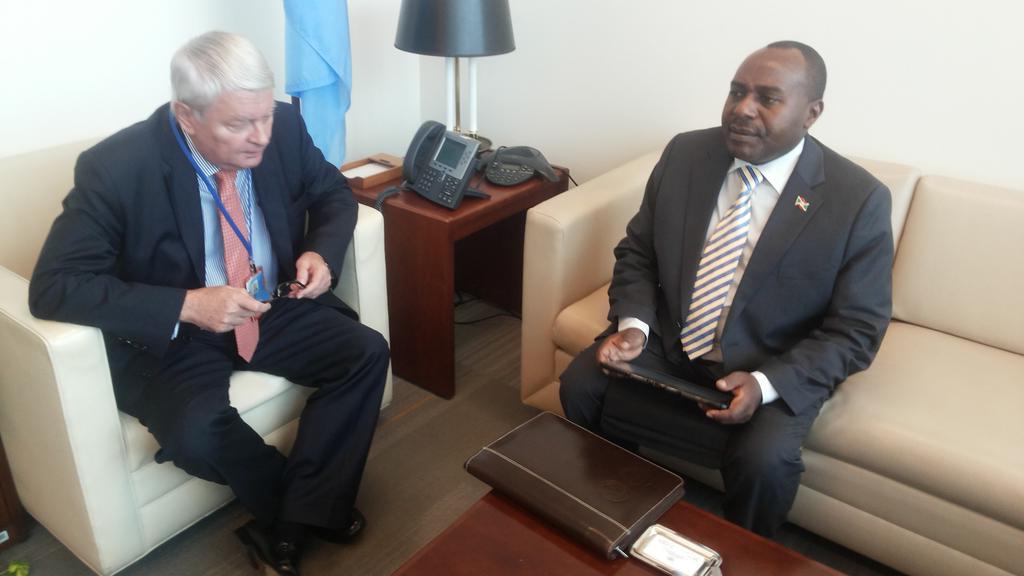
Amid crackdowns in Burundi by security forces, and allegations of sexual abuse by Burundian peacekeepers serving under the UN flag, UN Peacekeeping chief Herve Ladsous on October 1 held a meeting with Burundian Vice President Joseph Butore.

  Inner City Press has already tweeted a photograph of the meeting, but has now received the complete UN read-out, which raises more questions about Ladsous.

   On the crackdown, Ladsous assured Butore that he has a “pragmatic approach” and is of no mind to question what happens in any country, does not involve himself in "domestic affairs."

   On the sexual abuse allegations, Ladsous spoke only in platitudes, without requiring or even inquiring into any actions taken by the Burundians on the alleged abuse.

   Even though Burundi was already given a “grace period” to bring appropriate equipment into the Central African Republic for the MINUSCA mission, they have not done so. In the meeting, according to the read-out, Butore "acknowledged" the substandard equipment.

   Butore requested, and Ladsous for now granted, yet another extension to bring the requirement equipment -- until March 2016 for light equipment, and to June 2016 for heavy equipment.


  Is this safe - even for the Burundian soldiers at issue? While speaking through press releases, Ladsous' spokespeople, far from answering questions, go so far as to direct UNTV boom microphone operators to avoid Inner City Press, even preventing the Press from asking any questions to Mali's Foreign Minister Abdulaye Diop last week. We'll have more on all this.

Tuesday, December 2, 2014

On Palestine in UN Security Council, France Says "No Rush," Jordan on January, Chad Tells Inner City Press Not Seized of Draft Resolution(s)


By Matthew Russell Lee

UNITED NATIONS, December 2 -- After Mahmoud Abbas and the Arab League said Jordan would finally push in the UN Security Council for a vote in December on a draft resolution which would set a timeline to end Israel's occupation, now January is being mentioned.

  At first the commitment was to have a vote in November, when Australia was president of the Security Council. It didn't happen. On December 2, Inner City Press asked the Council president for December, Chadian Ambassador Mahamat Zene Cherif, why only a "Middle East debate" and not a vote on a Palestine resolution is on the Program of Work for December.

  Ambassador Cherif said he is not yet seized of any Palestine resolution. Amid talk of a French resolution -- French foreign ministry spokesman Romain Nadal said on December 2 there is "no rush" on a resolution -- now Jordan's Ambassador Dina Kawar says "We're going to try to make it before Christmas. If not, it will be in January."

  As Inner City Press exclusively reported, based on Security Council communications, Chad was pressured to not schedule any meetings after December 19. It pushed back, and scheduled one for December 22. But that's it.
  Already, the delay has been long. It was cold, for example, at the UNRWA event held just outside the UN on December 2, photographed by the Free UN Coalition for Accesshere. In one month's time, Venezuela and Spain join the Security Council, along with Angola, Malaysia and New Zealand. Wouldn't the draft get more "yes" votes in January 2015 than in December 2014?

   Rather than analyze this, Reuters for example again vaguely reports that "some diplomats have described the Palestinian-drafted text as 'unbalanced.'" For whom? Now Reuters adds, "some Western Council diplomats." So helpful.

 Back on October 21 as the Palestine debate of the UN Security Council went on in the Council chamber, Inner City Press conferred with a range of Council sources about the pending draft resolution to set a time frame to end Israel's occupation.

Negotiations were held on the draft last week but only at the “expert” level, not of Permanent Representatives of the Council's 15 members. Supporters of the current draft, according to Inner City Press' sources, include China and Russia, Argentina and Chile, Chad and it was assumed Nigeria, although sources say Nigeria in consultations said they didn't yet have instructions.
France was described as more excited by the draft than either the US or the UK, as not have a problem with a time frame to end the Occupation but wanting unstated changes to the draft. France did not put forth amendments, a source told Inner City Press, guessing that France didn't want to “embarrass” the US Administration before the November mid-term elections.
The UK was described as less enthusiastic, but as somehow “softened” by the recent vote in Parliament favoring recognizing Palestine as a state.
Talk turned to the new members of the Security Council coming in on January 1, with Malaysia instead of South Korea seen as a shift in favor of Palestine as a state. (This reporter's Security Council elections coverage is collected here.) Angola and Venezuela are seen as supportive and “even Spain,” as one source put it to Inner City Press. But what about New Zealand? We'll have more on this. Watch this site.


Wednesday, April 16, 2014

UN's Genocide Resolution Cites FDLR, Ladsous Won't Answer, Nor Will Araud, Keating on Turquoise "Mistake"


By Matthew Russell Lee
UNITED NATIONS, April 16 -- Before the UN Security Council adopted its Rwanda-drafted genocide resolution on April 16, New Zealand's Colin Keating gave some history of the Council's "mistakes" in 1994.
  Among these he referred to the "mistaken decision of the Council to authorize Operation Turquoise." Speech here, at Page 4. It was on precisely this issue that France snubbed the April 7, 2014 commemoration in Kigali. 
  The resolution also refers to the Hutu FDLR militia. Back on April 7, Inner City Press asked Herve Ladsous, now the head of UN Peacekeeping but in 1994 France's Deputy Permanent Representative at the UN, when his Department will belatedly neutralize the FDLR.
  "Mister, I never answer your questions," Ladsous said, and you know why.  Video here. The Why, if there is one, is that Ladsous does not want to and will not answer questions about his acts in 1994. Click here for a Ladsous 1994 cable.
   This not-answering has been adopted by current but outgoing French Permanent Representative Gerard Araud, who on April 15 did not take any question from Inner City Press but told the lone critical questioner called on, "You are not a journalist, you are an agent." Video here. This is France: in denial.
  The resolution refers to the genocide against the Tutsi in which moderate Hutu were also killed. There has been controversy even about this formulation. We'll have more on this, and on other genocide commemoration events scheduled at the UN for April 16. Watch this site.
   Back on April 5, French foreign ministry spokesperson Romain Nadal said he is "surprised" at the linking of France to the 1994 Rwanda genocide. He shouldn't be. Beyond the documentary evidence, earlier this year at the UN memorial of the genocide with Secretary General Ban Ki-Moon present France was named as guilty, see below.
  Nevertheless, now France said that its Justice Minister Christiane Taubira will no longer attend the April 7 memorial in Kigali. Ban Ki-moon was there -- and some wonder if his (or France's) head of UN Peacekeeping Herve Ladsous will go. 
  Rwanda is a major UN troop contributing country, most recently in Central African Republic. But Ladsous, who in 1994 was France's Deputy Permanent Representative at the UN, has his own history. Sample memo here. Ladsous argued for the escape of the genocidaires into Eastern Congo -- where "his" UN Peacekeeping, even now, went after the M23, then the ADF while still not the Hutu militia FDLR.
  When Inner City Press asked Ladsous about his history, in the form of a question, Ladsous responded by refusing to answer any Inner City Press questions, even about precautions against spreading cholera as UN Peacekeeping did in Haiti. Video compilation hereUK coverage here, yet
more here, on what to call the 1994 genocide.
   At the Kwibuka 20 ceremony at the UN on February 27, from the podium France was twice blamed for working with genocidaires and helping them escape into the Democratic Republic of the Congo.
  On the podium Secretary General Ban Ki-moon, who has praised French troops even his UN human rights counterpart Navi Pillay noted they'd left Muslim communities vulnerable to attack, looked uncomfortable. 
  Ban mentioned his "Rights Up Front" program, without mentioning its roots in the 2009 failure of his UN in Sri Lanka, as tens of thousands were killed. 
   Following Rwanda's Permanent Representative Gasana, genocide survivor Immaculee Ilibagiza spoke movingly of barely escaping slaughter, but then speaking of forgiveness.  Gerald Caplan said he would be less forgiving, and was
   He twice blamed France, specifically for Operation Turquoise which current UN Peacekeeping chief Herve Ladsous defended and promoted in the Security Council in 1994 as France's deputy permanent representative, click here for a memo.
   Caplan also mentioned Bill Clinton, for example -- but Clinton has apologized, unlike Ladsous. Instead, Ladsous simply refuses to answer this and other critical questions at the UN, and the UN accepts it, even tried to dictate how Ladsous can be covered.
  Forgiveness is one thing, and censorship is another. The February 27 ceremony was nothing but class. But day to day at the UN, with scribes braying about only the M23 and not the FDLR, it's another story.
  Even earlier on February 27, when Inner City Press asked Ban's spokesperson Martin Nesirky when UN Peacekeeping will go after the Hutu FDLR militia, he responded he would not speak to operational activities that "have not yet started and that might not start." Click here for that.
   In late January after the Democratic Republic of the Congo sanctions resolution was adopted by the UN Security Council, 15-0, Rwanda's Permanent Representative Gasana emerged from the Council chamber. Inner City Press asked him about his DRC counterpart's comment that Gasana was educated in the Congo. Video here and embedded below.
  Gasana laughed and said he was born in Burundi. He mused that the Congolese might want to adopt him. Then he turned to go.
  Wire services Reuters and Agence France-Presse pursued him to the esclator, where Reuters UN bureau chief asked Gasana about Rwanda being accused of supporting the M23. Gasana replied that the DRC has other problems, for example in Katanga. He said Rwanda is a scapegoat for the DRC's wider problems.
  Reuters insisted that the Group of Experts report had been welcomed by the Security Council resolution.  "Because they need that," Gasana replied. "This is the raison d'etre of the Security Council." 

  Nothing was asked there about the fight in the Council on how to described the 1994 genocide and the compromise language in the resolutionAFP's outgoing scribe was there, but asked nothing. Nor when the DRC Permanent Representative spoke minutes later at the UNTV stakeout, in French. This is how the UN works.
  An hour later at the UN's noon briefing, Inner City Press asked the UN's acting deputy spokesperson Farhan Haq for an update on any accountability for the mass rapes in Minova by units of the Congolese Army the UN supports, and if UN Peacekeeping, led by Herve Ladsous, is investigating links between the Congolese Army and the FDLR militia. On this, Haq said to look at the Council's resolutions. Video here.

  In the January 30 resolution, the language compromised on is "the 1994 genocide against the Tutsi in Rwanda, during which Hutu and others who opposed the genocide were also killed."
  Sources exclusively told Inner City Press that the United States resisted calling it a genocide against the Tutsi of Rwanda, even saying that there is a US policy against referring to it in this way.
   Inner City Press has asked the US Mission to the UN for an explanation. It was said one might be forthcoming after the vote.
  Where would such a US policy be written down? It seemed strange, particularly during a time of Holocaust events at the UN, from one aboutHungary to another about Albania.
   On January 29, Inner City Press asked a US Council diplomat, who said spokespeople would be asked. Inner City Press was told to wait for the language to be final, then, for the vote.
  In the Council's January 29 debate, the representative of the DRC spoke about Rwanda and the M23 rebels. Rwanda's Deputy Permanent Representative replied with a series of questions: was it Rwanda who killed Lumumba? Was Rwanda responsible for Mobutu? Who hosted and failed to separate the genocidaires from Rwanda in 1994?
  This continued on January 30 after the vote.  Rwanda Permanent Representative Gasana said UN Peacekeeping should investigate links between the DRC Army and the FDLR.
  The DRC representative asked to be given specifics about links between his country's army the FARDC and the FDLR militia. The resolution voted on provides:
"Noting with deep concern reports indicating FARDC collaboration with the FDLR at a local level, recalling that the FDLR is a group under United Nations sanctions whose leaders and members inchide perpetrators of the 1994 genocide against the Tutsi in Rwanda, during which Hutu and others who opposed the genocide were also killed, and have continued to promote and commit ethnically based and other killings in Rwanda and in the DRC, and stressing the importance of permanently addressing this threat"
"107. The Group interviewed 10 FARDC soldiers in Tongo, in North Kivu, who reported that FARDC and FDLR regularly meet and exchange operational information. These same sources stated that FARDC soldiers supplied ammunition to the FDLR. Col. Faida Fidel Kamulete, the commander of FARDC 2nd battalion of 601st Regiment based at Tongo, denied such collaboration, but declared to the Group that FARDC and FDLR do not fight each other."
  Going further back, it is impossible not to note, particularly given the lack of explanation or transparency, that US Permanent RepresentativeSamantha Power began her 2001 article "Bystanders to Genocide" in the Atlantic with this sentence: "In the course of a hundred days in 1994 the Hutu government of Rwanda and its extremist allies very nearly succeeded in exterminating the country's Tutsi minority."
  Given that, why would the US Mission be saying it had a policy of describing the genocide as being against the Tutsi minority? Inner City Press asked again: Since I'm told that the US has said that there is a government position not to say the 1994 genocide was against the Tutsis, can you say what that policy is? Why does it exist? Does it apply to other genocides or atrocities?
  A Rwandan diplomat told Inner City Press these were Hutu killed not because of their ethnicity but because they opposed the genocide against the Tutsi. "This is a precedent," the diplomat said. Watch this site.


Monday, April 7, 2014

In Rwanda, UN Bans Real History of Its Inaction and Sri Lanka, A La Francaise, Ladsous Connects


UNITED NATIONS, April 7 -- At the Rwanda genocide commemoration that France's Justice Minister refused to attend, UN Secretary General gave a speech that did not mention the issue -- that is, the history.
  Of Rwanda in 1994, Ban said
"Many United Nations personnel and others showed remarkable bravery. But we could have done much more. We should have done much more."
   But it was more than inaction. Take, for example, UN staff member Callixte Mbarushimana, who 
"lent vehicles and satellite telephones of the UNDP to military officers, that he also used the UNDP vehicles to facilitate his own contribution to the killings," as stated in an article that was on the UN's own MONUC mission website, since abandoned or forgotten - covered up? Another UN documents recites his role in "the death of UNDP’s National Personnel Officer, Ms. Florence Ngirumpatse, and a number of refugees in the residence where they had taken refuge."
  The international justice machinery Ban praised fumbled on this.  Now, Ban argues that but for divisions in the Security Council like on Syria, the UN has turned the corner. Referring to what's now called the "Rights Up Front" program, he said
"I have sent my own signal to UN representatives around the world. My message to them is simply this: When you see people at risk of atrocity crimes, do not wait for instructions from afar. Speak up, even if it may offend. Act. Our first duty must always be to protect people -- to protect human beings in need and distress. That is what we have done recently in South Sudan."
  This ignored -- covers up? - the roots of the Rigths Up Front program, the UN's failure in Sri Lanka in 2009 and since.  So, never again?
  French foreign ministry spokesperson Romain Nadal has said he is "surprised" at the linking of France to the 1994 Rwanda genocide. He shouldn't be. Beyond the documentary evidence, earlier this year at the UN memorial of the genocide with Secretary General Ban Ki-Moon present France was named as guilty, see below.
  Nevertheless, now France said that its Justice Minister Christiane Taubira will no longer attend the April 7 memorial in Kigali. Ban Ki-moon will be there -- and some wonder if his (or France's) head of UN Peacekeeping Herve Ladsous will go. 
  Rwanda is a major UN troop contributing country, most recently in Central African Republic. But Ladsous, who in 1994 was France's Deputy Permanent Representative at the UN, has his own history. Sample memo here. Ladsous argued for the escape of the genocidaires into Eastern Congo -- where "his" UN Peacekeeping, even now, went after the M23, then the ADF while still not the Hutu militia FDLR.
  When Inner City Press asked Ladsous about his history, in the form of a question, Ladsous responded by refusing to answer any Inner City Press questions, even about precautions against spreading cholera as UN Peacekeeping did in Haiti. Video compilation hereUK coverage here, yet
more here, on what to call the 1994 genocide.
   At the Kwibuka 20 ceremony at the UN on February 27, from the podium France was twice blamed for working with genocidaires and helping them escape into the Democratic Republic of the Congo.
  On the podium Secretary General Ban Ki-moon, who has praised French troops even his UN human rights counterpart Navi Pillay noted they'd left Muslim communities vulnerable to attack, looked uncomfortable. 
  Ban mentioned his "Rights Up Front" program, without mentioning its roots in the 2009 failure of his UN in Sri Lanka, as tens of thousands were killed. 
   Following Rwanda's Permanent Representative Gasana, genocide survivor Immaculee Ilibagiza spoke movingly of barely escaping slaughter, but then speaking of forgiveness.  Gerald Caplan said he would be less forgiving, and was
   He twice blamed France, specifically for Operation Turquoise which current UN Peacekeeping chief Herve Ladsous defended and promoted in the Security Council in 1994 as France's deputy permanent representative, click here for a memo.
   Caplan also mentioned Bill Clinton, for example -- but Clinton has apologized, unlike Ladsous. Instead, Ladsous simply refuses to answer this and other critical questions at the UN, and the UN accepts it, even tried to dictate how Ladsous can be covered.
  Forgiveness is one thing, and censorship is another. The February 27 ceremony was nothing but class. But day to day at the UN, with scribes braying about only the M23 and not the FDLR, it's another story.
  Even earlier on February 27, when Inner City Press asked Ban's spokesperson Martin Nesirky when UN Peacekeeping will go after the Hutu FDLR militia, he responded he would not speak to operational activities that "have not yet started and that might not start." Click here for that.
   In late January after the Democratic Republic of the Congo sanctions resolution was adopted by the UN Security Council, 15-0, Rwanda's Permanent Representative Gasana emerged from the Council chamber. Inner City Press asked him about his DRC counterpart's comment that Gasana was educated in the Congo. Video here and embedded below.
  Gasana laughed and said he was born in Burundi. He mused that the Congolese might want to adopt him. Then he turned to go.
  Wire services Reuters and Agence France-Presse pursued him to the esclator, where Reuters UN bureau chief asked Gasana about Rwanda being accused of supporting the M23. Gasana replied that the DRC has other problems, for example in Katanga. He said Rwanda is a scapegoat for the DRC's wider problems.
  Reuters insisted that the Group of Experts report had been welcomed by the Security Council resolution.  "Because they need that," Gasana replied. "This is the raison d'etre of the Security Council." 

  Nothing was asked there about the fight in the Council on how to described the 1994 genocide and the compromise language in the resolutionAFP's outgoing scribe was there, but asked nothing. Nor when the DRC Permanent Representative spoke minutes later at the UNTV stakeout, in French. This is how the UN works.
  An hour later at the UN's noon briefing, Inner City Press asked the UN's acting deputy spokesperson Farhan Haq for an update on any accountability for the mass rapes in Minova by units of the Congolese Army the UN supports, and if UN Peacekeeping, led by Herve Ladsous, is investigating links between the Congolese Army and the FDLR militia. On this, Haq said to look at the Council's resolutions. Video here.

  In the January 30 resolution, the language compromised on is "the 1994 genocide against the Tutsi in Rwanda, during which Hutu and others who opposed the genocide were also killed."
  Sources exclusively told Inner City Press that the United States resisted calling it a genocide against the Tutsi of Rwanda, even saying that there is a US policy against referring to it in this way.
   Inner City Press has asked the US Mission to the UN for an explanation. It was said one might be forthcoming after the vote.
  Where would such a US policy be written down? It seemed strange, particularly during a time of Holocaust events at the UN, from one aboutHungary to another about Albania.
   On January 29, Inner City Press asked a US Council diplomat, who said spokespeople would be asked. Inner City Press was told to wait for the language to be final, then, for the vote.
  In the Council's January 29 debate, the representative of the DRC spoke about Rwanda and the M23 rebels. Rwanda's Deputy Permanent Representative replied with a series of questions: was it Rwanda who killed Lumumba? Was Rwanda responsible for Mobutu? Who hosted and failed to separate the genocidaires from Rwanda in 1994?
  This continued on January 30 after the vote.  Rwanda Permanent Representative Gasana said UN Peacekeeping should investigate links between the DRC Army and the FDLR.
  The DRC representative asked to be given specifics about links between his country's army the FARDC and the FDLR militia. The resolution voted on provides:
"Noting with deep concern reports indicating FARDC collaboration with the FDLR at a local level, recalling that the FDLR is a group under United Nations sanctions whose leaders and members inchide perpetrators of the 1994 genocide against the Tutsi in Rwanda, during which Hutu and others who opposed the genocide were also killed, and have continued to promote and commit ethnically based and other killings in Rwanda and in the DRC, and stressing the importance of permanently addressing this threat"
"107. The Group interviewed 10 FARDC soldiers in Tongo, in North Kivu, who reported that FARDC and FDLR regularly meet and exchange operational information. These same sources stated that FARDC soldiers supplied ammunition to the FDLR. Col. Faida Fidel Kamulete, the commander of FARDC 2nd battalion of 601st Regiment based at Tongo, denied such collaboration, but declared to the Group that FARDC and FDLR do not fight each other."
  Going further back, it is impossible not to note, particularly given the lack of explanation or transparency, that US Permanent RepresentativeSamantha Power began her 2001 article "Bystanders to Genocide" in the Atlantic with this sentence: "In the course of a hundred days in 1994 the Hutu government of Rwanda and its extremist allies very nearly succeeded in exterminating the country's Tutsi minority."
  Given that, why would the US Mission be saying it had a policy of describing the genocide as being against the Tutsi minority? Inner City Press asked again: Since I'm told that the US has said that there is a government position not to say the 1994 genocide was against the Tutsis, can you say what that policy is? Why does it exist? Does it apply to other genocides or atrocities?
  A Rwandan diplomat told Inner City Press these were Hutu killed not because of their ethnicity but because they opposed the genocide against the Tutsi. "This is a precedent," the diplomat said. Watch this site.


Saturday, April 5, 2014

France Won't Go to Rwanda Genocide Memorial, UN Ladsous Questions, DR Congo Then and Now


By Matthew Russell Lee

UNITED NATIONS, April 5 -- French foreign ministry spokesperson Romain Nadal has said he is "surprised" at the linking of France to the 1994 Rwanda genocide. He shouldn't be. Beyond the documentary evidence, earlier this year at the UN memorial of the genocide with Secretary General Ban Ki-Moon present France was named as guilty, see below.

  Nevertheless, now France said that its Justice Minister Christiane Taubira will no longer attend the April 7 memorial in Kigali. Ban Ki-moon will be there -- and some wonder if his (or France's) head of UN Peacekeeping Herve Ladsous will go. 

  Rwanda is a major UN troop contributing country, most recently in Central African Republic. But Ladsous, who in 1994 was France's Deputy Permanent Representative at the UN, has his own history. Sample memo here. Ladsous argued for the escape of the genocidaires into Eastern Congo -- where "his" UN Peacekeeping, even now, went after the M23, then the ADF while still not the Hutu militia FDLR.
  When Inner City Press asked Ladsous about his history, in the form of a question, Ladsous responded by refusing to answer any Inner City Press questions, even about precautions against spreading cholera as UN Peacekeeping did in Haiti. Video compilation hereUK coverage here, yet
more here, on what to call the 1994 genocide.
   At the Kwibuka 20 ceremony at the UN on February 27, from the podium France was twice blamed for working with genocidaires and helping them escape into the Democratic Republic of the Congo.
  On the podium Secretary General Ban Ki-moon, who has praised French troops even his UN human rights counterpart Navi Pillay noted they'd left Muslim communities vulnerable to attack, looked uncomfortable. 
  Ban mentioned his "Rights Up Front" program, without mentioning its roots in the 2009 failure of his UN in Sri Lanka, as tens of thousands were killed. 
   Following Rwanda's Permanent Representative Gasana, genocide survivor Immaculee Ilibagiza spoke movingly of barely escaping slaughter, but then speaking of forgiveness.  Gerald Caplan said he would be less forgiving, and was
   He twice blamed France, specifically for Operation Turquoise which current UN Peacekeeping chief Herve Ladsous defended and promoted in the Security Council in 1994 as France's deputy permanent representative, click here for a memo.
   Caplan also mentioned Bill Clinton, for example -- but Clinton has apologized, unlike Ladsous. Instead, Ladsous simply refuses to answer this and other critical questions at the UN, and the UN accepts it, even tried to dictate how Ladsous can be covered.
  Forgiveness is one thing, and censorship is another. The February 27 ceremony was nothing but class. But day to day at the UN, with scribes braying about only the M23 and not the FDLR, it's another story.
  Even earlier on February 27, when Inner City Press asked Ban's spokesperson Martin Nesirky when UN Peacekeeping will go after the Hutu FDLR militia, he responded he would not speak to operational activities that "have not yet started and that might not start." Click here for that.
   In late January after the Democratic Republic of the Congo sanctions resolution was adopted by the UN Security Council, 15-0, Rwanda's Permanent Representative Gasana emerged from the Council chamber. Inner City Press asked him about his DRC counterpart's comment that Gasana was educated in the Congo. Video here and embedded below.
  Gasana laughed and said he was born in Burundi. He mused that the Congolese might want to adopt him. Then he turned to go.
  Wire services Reuters and Agence France-Presse pursued him to the esclator, where Reuters UN bureau chief asked Gasana about Rwanda being accused of supporting the M23. Gasana replied that the DRC has other problems, for example in Katanga. He said Rwanda is a scapegoat for the DRC's wider problems.
  Reuters insisted that the Group of Experts report had been welcomed by the Security Council resolution.  "Because they need that," Gasana replied. "This is the raison d'etre of the Security Council." 

  Nothing was asked there about the fight in the Council on how to described the 1994 genocide and the compromise language in the resolutionAFP's outgoing scribe was there, but asked nothing. Nor when the DRC Permanent Representative spoke minutes later at the UNTV stakeout, in French. This is how the UN works.
  An hour later at the UN's noon briefing, Inner City Press asked the UN's acting deputy spokesperson Farhan Haq for an update on any accountability for the mass rapes in Minova by units of the Congolese Army the UN supports, and if UN Peacekeeping, led by Herve Ladsous, is investigating links between the Congolese Army and the FDLR militia. On this, Haq said to look at the Council's resolutions. Video here.

  In the January 30 resolution, the language compromised on is "the 1994 genocide against the Tutsi in Rwanda, during which Hutu and others who opposed the genocide were also killed."
  Sources exclusively told Inner City Press that the United States resisted calling it a genocide against the Tutsi of Rwanda, even saying that there is a US policy against referring to it in this way.
   Inner City Press has asked the US Mission to the UN for an explanation. It was said one might be forthcoming after the vote.
  Where would such a US policy be written down? It seemed strange, particularly during a time of Holocaust events at the UN, from one aboutHungary to another about Albania.
   On January 29, Inner City Press asked a US Council diplomat, who said spokespeople would be asked. Inner City Press was told to wait for the language to be final, then, for the vote.
  In the Council's January 29 debate, the representative of the DRC spoke about Rwanda and the M23 rebels. Rwanda's Deputy Permanent Representative replied with a series of questions: was it Rwanda who killed Lumumba? Was Rwanda responsible for Mobutu? Who hosted and failed to separate the genocidaires from Rwanda in 1994?
  This continued on January 30 after the vote.  Rwanda Permanent Representative Gasana said UN Peacekeeping should investigate links between the DRC Army and the FDLR.
  The DRC representative asked to be given specifics about links between his country's army the FARDC and the FDLR militia. The resolution voted on provides:
"Noting with deep concern reports indicating FARDC collaboration with the FDLR at a local level, recalling that the FDLR is a group under United Nations sanctions whose leaders and members inchide perpetrators of the 1994 genocide against the Tutsi in Rwanda, during which Hutu and others who opposed the genocide were also killed, and have continued to promote and commit ethnically based and other killings in Rwanda and in the DRC, and stressing the importance of permanently addressing this threat"
"107. The Group interviewed 10 FARDC soldiers in Tongo, in North Kivu, who reported that FARDC and FDLR regularly meet and exchange operational information. These same sources stated that FARDC soldiers supplied ammunition to the FDLR. Col. Faida Fidel Kamulete, the commander of FARDC 2nd battalion of 601st Regiment based at Tongo, denied such collaboration, but declared to the Group that FARDC and FDLR do not fight each other."
  Going further back, it is impossible not to note, particularly given the lack of explanation or transparency, that US Permanent RepresentativeSamantha Power began her 2001 article "Bystanders to Genocide" in the Atlantic with this sentence: "In the course of a hundred days in 1994 the Hutu government of Rwanda and its extremist allies very nearly succeeded in exterminating the country's Tutsi minority."
  Given that, why would the US Mission be saying it had a policy of describing the genocide as being against the Tutsi minority? Inner City Press asked again: Since I'm told that the US has said that there is a government position not to say the 1994 genocide was against the Tutsis, can you say what that policy is? Why does it exist? Does it apply to other genocides or atrocities?
  A Rwandan diplomat told Inner City Press these were Hutu killed not because of their ethnicity but because they opposed the genocide against the Tutsi. "This is a precedent," the diplomat said. Watch this site.