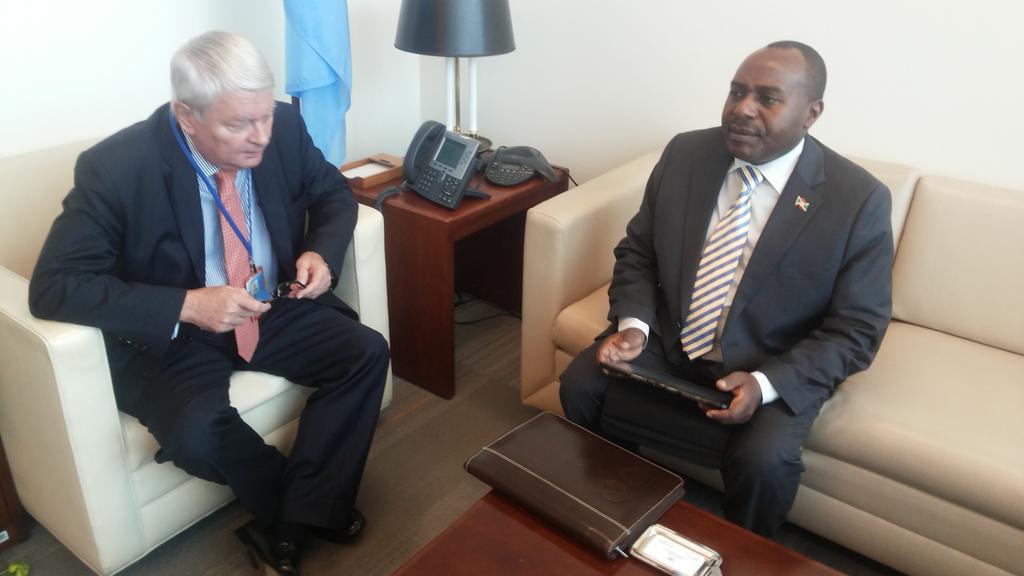
UNITED NATIONS, January 26 -- After UN Secretary General Ban Ki-moon on New Year's Eve issued a statement surreally praising the Burundi “talks” held in Entebbe, Uganda, multiple sources told Inner City Press these not really talks but rather a photo op. The January 6 session announced for Arusha did not happen. Inner City Press requested to cover the UNSC's trip to Burundi, but was UNtransparentlyrejected.
On January 26, the UN Office of the High Commissioner for Human Rights announced that even after the UNSC trip, its three experts were unable to deploy to Burundi due to a lack of response from the Nkurunziza government.
So at the UN's January 26 noon briefing Inner City Press asked Ban's spokesman Stephane Dujarric, video here, transcript here:
Inner City Press: on Burundi, they read out in Geneva that the experts that were supposed to go there under the Human Rights Council resolution, including Mr. [Christof] Heyns, Mr. [Pablo] de Greiff, have not been able to get in. Is the Special Adviser involved in this issue at all given that he has a team that was announced on the ground? What has been the response he's gotten from the Burundian authorities to this Human Rights Council team going?
Spokesman: Obviously, the Human Rights Council team is an independent team. That being said, it is incumbent on every Member State to cooperate with Special Rapporteurs, investigators from ad hoc investigative commissions set up by the Human Rights Council as part of the broader UN human rights architecture. So we would expect that they be allowed in.
Question: But does Mr. [Jamal] Benomar's mission have a human rights component to it or no?
Spokesman: There are Human Rights… the Office of the High Commissioner for Human Rights has representatives on the ground. And obviously, as part of the broader mission of Mr. Benomar, human rights are an important factor.
On January 25, Inner City Press asked UN Spokesman Dujarric why when the UN belatedly put online video of press encounters during the Security Council's mission to Burundi, it trimmed a longer stakeout by French Deputy Alexis Lamek, which gave rise to controversy, down to a mere 16 seconds.
Dujarric replied this was how the video were received from "our colleagues in Bujumbura." Video here. Which colleagues? Who decided to selectively cut the video and why? And to omit an encountered between US Power and Bururndian security that even the US Special Envoy on the Great Lakes found significant?
Inner City Press asked Ban's spokespeople about the trip on January 20, 21 and 22 - including asking why the UN was not providing a video or at least audio stream of the January 22 press encounters, says it has a "UN Information Center" in Bujumbura, which produced a smiling photo of the French deputy ambassador Alexis Lamek on the tarmac. The UN said it couldn't.
Local media in Burundi put online a video in which Lamek spoke at length; afterward a pro-government Burundian media quoted Lamek that "we" take seriously the question of interference by Rwanda to destabilize Burundi and will be working on it.
But the four scribes handpicked to accompany the Security Council trip, inlcuding Agence France Presse, it seems, for some reasons didn't cover it. Why? We'll have more on this. Instead, AFP, Reuters andVoice of America (which saw "Liberians" then cited auto-correct) filed near-identical stories with no quotes from opposition figures or attacked journalists. None of the three even tweeted on January 23, other than Reuters as a robot: talk about Old Media.
How could "Agence France Presse," handpicked to publicize the UNSC trip co-led by France, not even cover the controversy?
We note that the French Mission to the UN said that Lamek was being misrepresented (the same French Mission has tried to shield Lamek from critical Press questions, which here on Vine Lamek has refused to answer even when entirely audible). Later an AFP quote emerged of Lamek saying that any AU force, even the 100 human rights observers, should significantly focus on the Rwandan border.
On the evening of January 23 the UN has put up select clips including a mere 16 seconds of French deputy ambassador Lamek, much less than the local Burundian media present at the same press encountered had. If the UN filmed the press encounters, why did it so selectively edit them?
More specifically, now, who decided on the edits?
Inner City Press, which is the media which on January 22 asked for the live-stream, has asked the UN, publicly on Twitter, here, and in more detail by e-mail to three top UN spokespeople:
"having just seen that your Office put online edited video from Burundi, must ask: why did UN edit the footage it has, with no Burundi government speaker, and only 16 seconds of France, penholder in the UNSC on Burundi? Please provide the full footage, in response to this request and, separately, online. Would also still like answers to questions below" on Burundi.
And still no answers at all, the next day. Watch this site.
The UN spokespeople refused to say, but beyond the pro-government "religious leaders" that they cited, the Council also met with at least some of the concerned members of civil society, and some journalists who inevitably raised the issue of attacks and censorship. This was not mentioned by the UN.
We're told that Ambassador Albert Shingiro, who blocks the Press on Twitter, told the scribes that US Power said she would send “a strong message to the government of Rwanda." Again, Shingiro blocks the Press on Twitter: some diplomat.
One of the four handpicked pass-throughs opined that "the fact that Council members presented Nkurunziza with a largely unified message on the different issues was seen as a positive sign that they had come closer to a common position." So they traveled to Burundi to work on their own issues? We'll have more on this - and on the Council's junket-ending meetings in Addis, if not on Oromo protests, than this we've asked about. Watch this site.
On January 22 -- at 4:32 pm in New York, four minutes before Inner City Press then published it -- the UN has issued this Note to Correspondents:
"Security Council members just departed Bujumbura less than an hour ago. The delegation is headed to Addis to meet with the Peace and Security Council of the African Union tomorrow.
"Council members met with a range of stakeholders during their visit to Burundi, including the President, First Vice President, Foreign Minister and representatives from political parties, the media, and civil society organizations. The Council also met with religious leaders.
Special Adviser Jamal Benomar is in Burundi. The core group of his team called for in Resolution 2248 deployed to Bujumbura and will be engaged with all stakeholders to support dialogue and address security concerns."
How?
On January 22, Inner City Press asked UN Deputy Spokesperson Farhan Haq for the UN's response to Pierre Nkurunziza denying the existence of his party's youth militia, and why there was no video or even audio stream of the Security Council's - and Nkurunziza's -- press statements. Video here.
Haq replied that "the facilities are difficult," that the UN Spokesperson's Office had reached out to the traveling party for information but hadn't gotten any. The Free UN Coalition for Accesscalls this a failure.
On January 21 Inner City Press in New York learned both of Pierre Nkurunziza plans to parade "community work" for the Security Council members on January 22 and has been provided with a letter promoting same, here.
On January 22, even after the Council's meeting with Nkurunziza was over, when Inner City Press asked the UN for a read-out there was none, nor any good explanation of why the UN with its country team could not arrange at least an audio stream of the Council's (and Nkurunziza's) press statements.
Inner City Press asked the head of the Campaign Against the Third Term (“Halte au troisième mandat”) Vital Nshimirimana about the UNSC visit, and why the AU human rights observers are not yet in place. His answers to Inner City Press:
"As for the deployment of the AU Human rights observers, I would recall that the same was decided back in June following the June 13, 2015 Johannesburg Summit on Burundi. Initially, the number was to be about 70 observers but the government refused and allowed a narrow team.
"My thought over the issue is that Nkurunziza has chosen to humiliate everybody in as much as he does not care about any principle or value. So, the AU and other bodies as well choose to deal with him very carefully for he is a man (and a regime) "irrational," likely to commit whatever crime, insult whomever.....
"With regard to the UNSC visit, I hope this is the very last warning towards a kind of regime likely to commit genocide. They are expected to dually and objectively assess the situation and especially the strength and presence of Imbonerakure, the CNDD-FDD militia.... And this was shown through a huge anti- peacekeeping mission mission to Burundi, MAPROBU rhetoric. Burundians expect the UNSC support the deployment of such a mission in line with the responsibility to protect (Pillar III) since Burundi is no longer able and is unwilling to protect citizens from crimes against humanity (ongoing from April 2015) and genocide (of which dozens of signs suggest that it is likely to happen and some acts are already undertaken).
Lastly, the UNSC is expected to talk with Nkurunziza and the AU as well regarding peace talks. They should assess Museveni's performance, after what conclude that he should be assigned AU and UN teams (to enhance his capacity) or change him.... I commend your endeavors to keep the world informed about the Burundi crisis."
We'll have more on this -- including in light the UN Deputy Spokesperson's response to Inner City Press that transcripts may be provided.
Here are parts of an Inner City Press interview with a journalist attacked by the Nkurunziza government and for that reason anonymous:
In English: "It would be better if the Security Council met for example UPRONA leader Nditije Charles, with the non-governmental branch of the UPRONA party) or his Spokesman Thacien Sibomana. The Council should try to meet civil society but there is almost no one left to really speak with now in Bujumbura. All those still in Bujumbura, they can't say anything about the abuses of authorithies. If it was possible, they should ask to meet the young men in prison. They should see themselves how the government abuses those young men, with tortures... Tell them visit to the prisoners in Gitega (those who are accused to attempting a coup d'etat) UN has the right to visit prisoners."
Inner City Press note: another source says "the government moved several detainees from the SNR jails. I highly doubt they'd allow a visit to detainees."
Tellingly, IWACU reports that bike taxi and motorcycle taxi drivers offered money to protest in favor of Nkurunziza weren't, after the fact, paid: here. At the January 21 UN noon briefing, Inner City Press asked UN deputy spokesperson Farhan Haq about the "community works" and meeting(s). Video here, UN transcript here:
Inner City Press: I wanted to ask you this just because I'm trying to cover it, and I know that you'd said yesterday that the Special Adviser, Jamal Benomar, is in Burundi in part of the trip. So what I wanted to ask you is, I've seen documents that show that the… the… the… tomorrow, the meeting with the President, [Pierre] Nkurunziza, will involve a demonstration of “community work”, i.e., people have been asked to go and I don't know if it's to show how happy they are — Gitega and Karuzi. Does the Special Adviser… not the Security Council, does the Special Adviser of the Secretary-General believe that this type of… of… of show is the right one and will they be meeting with UPRONA and other opposition groups or prisoners currently in jail?
Deputy Spokesman Haq: Well, we'll be able to provide details of the meetings once they've taken place. As you know, the expectation is for the members of the Council to meet with President Nkurunziza. That hasn't happened so far, but once that's happened, we'll see what the circumstances are and what the views of Mr. Benomar are.
This is reminiscent of the type of dog-and-pony show Sri Lanka's then President Mahinda Rajapaksa put on for visiting UN Secretary General Ban Ki-moon and that Inner City Press accompanied and covered(apparently not to the UN's and its allies' liking - it has been Banned from trips since.) But will the UNSC, unlike Ban, have the fortitude or leverage to reject a dog and pony show? Watch this site.
On January 19 at the UN, Inner City Press asked Uruguay's Vice Minister for Foreign Affairs Jose Luis Cancela, chairing the Security Council debate on Protection of Civilians, about Burundi and the Council's trip. Video here.
On January 21, Inner City Press and the Free UN Coalition for Accessasked UK Permanent Representative Matthew Rycroft about his stop-over on Addis Ababa, "will you as UK meet with AU before heading to Burundi? About AU's proposed deployment?"
Rycroft replied, "Yes! Looking forward to meeting @AU_Chergui today. Will also return to Addis with whole UNSC after Burundi."
In Addis, Chergui had filed the Concept of Operation for the MAPROBU peacekeeping mission. We'll have more on this.
Burundian civil society has written to Ban seeking the repatriation of the country's peacekeepers. Inner City Press has put the letter from Vital Nshimirimana to Ban online here, and will be asking the UN about it. Watch this site.
On December 30 Nkurunziza threatened to have his forces attack peacekeepers proposed for the country.
On December 16 Inner City Press was banned from questions to Secretary General Ban Ki-moon, but learned from the mission MINUSCA that Baratuza was already in Entebbe. Inner City Press asked several Security Council members, then Ban's spokesman Stephane Dujarric on December17.
Dujarric told Inner City Press Baratuza's deployment is suspended and he is being repatriated: "based on the information we've received regarding the Lieutenant Colonel, his deployment has been suspended, and he will be repatriated back to Burundi." Video here. Dujarric told Inner City Press this shows the UN system working - on a day when a report on rapes was issued showing UN Peacekeeping under Herve Ladsous not sufficiently vetting for human rights. We'll have more on this.
Amid the escalating killings in Burundi, last weekend's summary executions in neighborhoods opposed to Pierre Nkurunziza's third term stand out. But Burundi Army spokesman Gaspard Baratuza was quoted on December 12 blaming all of the deaths on attempts to steal weapons to free prisoners.
Inner City Press had heard that Mr. Baratuza was already in the process of being deployed to the UN Peacekeeping mission in the Central African Republic (MINUSCA) even when he was giving these quotes, issuing statements and speaking to state-owned radio, and so asked MINUSCA's acting spokesperson, “Is Gaspard Baratuza of Burundi's army getting a MINUSCA job?”
On December 16, hours before UN Secretary General Ban Ki-moon held a rare press conference, MINUSCA's acting spokesperson sent this to Inner City Press:
"To: Matthew.Lee [at] InnerCityPress.com From: Vladimir MONTEIRO [at] UN.org Date: Wed, Dec 16, 2015 Subject: ICP question: Gaspard Baratuza of Burundi's army getting a MINUSCA-related post? Cc: FUNCA [at] funca.info
"No decision related to Lt Col Baratuza's deployment can be taken before we finish looking into the matter. We can confirm that Lt Col Baratuza is in Entebbe but he has not yet deployed to MINUSCA. Regards. VNM"
There are some questions about Baratuza, a Colonel in Burundi's Army, being listed by the UN as “Lt. Col.”
Despite multiple follow-up questions by Inner City Press, Mr. Monteiro - previously a spokesperson for the UN electoral mission in Burundi - replied that “This is what we can say about this issue.”
But the UN should have to say more. Inner City Press has repeatedly asked the UN how its Department of Peacekeeping Operations under Herve Ladsous vets those who deploy to UN missions; Inner City Pressexclusively reported on an October 1, 2015 meeting in which Ladsous told Burundi's Vice President Joseph Butare that he is “pragmatic” on human rights.
Ban Ki-moon and his spokesman declined to take Inner City Press' questions on December 16, as they did on December 14. Vine here. Watch this site.
UNITED NATIONS, January 17 -- After UN Secretary General Ban Ki-moon's mere a one-line mention of Burundi in his long Priorities for 2016 speech on January 14, when Ban took questions in front of the General Assembly Inner City Press five times began, "On Burundi." Inner City Press similarly requested to cover the UNSC's trip to Burundi.
Ban did not answer Inner City Press' question about Burundi; he took four questions about Syria, declaiming that the use of food as a weapons of war is a war crime.
Now on Burundi it is said that markets in "opposition" neighborhoods are being closed. Ban Ki-moon has said nothing. His spokesman on January 15 declined to answer about deployments and, separately, said that a small plane from Addis explained the Banning of Inner City Press from the upcoming Security Council mission to the country. Well placed sources tell Inner City Press the choice was to take, in classic UN selective style, one media each from the P3. We'll have more on this.
And on this: Nkurunziza spokesperson Gervais Abayeho has beenquoted that UN Peacekeeping there has been "requests for Burundi to send troops to South Sudan." UNreal.
Back on January 14 as Ban began walking away from his personal rostrum, Inner City Press asked him how his Under Secretary General Herve Ladsous could have written, here, that UN Peacekeeping is limited in its ability to address significant violence against civilians, even violence that amounts to genocide.
The question was clearly audible, but Ban did not answer it, typically.Vine here. Moments later, Inner City Press got an answer about Ladsous' memo from an Ambassador of a Permanent Five member of the Security Council. Video here. UK Deputy Ambassador Peter Wilson said the goal of the UNSC trip to to have a proper talk with Nkurunziza, for a proper dialogue and change of course. New Zealand's lead ambassador is also going -- but Inner City Press is not.
Earlier in the week when the decision was made for a Security Council trip, Inner City Press immediately replied to Ban's spokesperson's office that it was very interesting in going, as it previously covered Ban's trip to Sri Lanka and Council trips to Sudan, DR Congo and Cote d'Ivoire.
Even Nkurunziza's adviser, facetiously or not, told Inner City Press on Twitter that he hoped Inner City Press would be on the trip. At 3 pm on January 14, Reuters' correspondent bragged at the UNSC stakeout they are going. And at 4:30 pm, Inner City Press got this, from Ban's spokesman:
"Due to space limitation in the UN flight accompanying the Security Council mission to Burundi, we regret to inform you that we will not be able to accommodate your request to travel. "
So how / by whom is it decided which media can go? Inner City Press asked the UN Spokesman, Stephane Dujarrice, and another, this:
"Please describe how / by whom the decision on which media can accompany this trip was made, and which media have been allowed to go. Also, please explain why not one of the six questions Inner City Press submitted on January 12 and 13, including about Burundi, were answered, or even acknowledged."
And these are not answered. Dujarric's office called "lid" to end the day. So on January 15, Inner City Press asked Dujarric in person, video here, transcript here:
Inner City Press: ...Zeid's findings. How does this impact on the deployment of Burundian troops to UN peacekeeping in CAR? And I wanted to ask you about the trip the Council is taking next week. Can you describe how, by who… who and how the decision was made of which media can cover the trip?
Spokesman Dujarric: Sure. The numbers of seats attributed to media was very limited. A discussion was had with us, and a number… Security Council members, and a list was drawn up. Not every journalist can go on every trip. I think if you're talking about yourself, you have traveled with the Secretary-General before. As I said, not everyone can go on every trip.
Inner City Press: Journalists were supposed to cover their own costs. So what does the UN plane… is from where to where when you say there's a limited seats?
Spokesman: There's a UN plane from Addis Ababa to, from Addis Ababa to Bujumbura and back to Addis with very limited numbers, which is also limiting the numbers of staff members who can accompany. We wanted to send somebody to help mind the press. We were not able to — we were not able to either. [cross talk] If you make your own way to Bujumbura, we would be happy to assist you on the ground.
We'll have more on this.
Note that Ban's Office of the Spokesperson refused to answer any of Inner City Press' questions in the past two days, including two on Burundi, another on Ethiopia / Oromo, etc. What is WRONG with Ban's UN? Watch this site.
On January 6 UN Peacekeeping chief Herve Ladsous wrote to the UN Security Council how his Department couldn't or wouldn't stop genocide, if it were to progress, in Burundi. VICE and RFI have written on it; Inner City Press is putting the entire Ladsous document online here. We'll have more on this.
On January 11, Inner City Press asked UN Spokesman Stephane Dujarric about the killing over the weekend of cameraman Alfred Baranburiya, and what the UN Office of the High Commissioner for Human Rights staff in Burundi are doing. There was no update.
Nor on Inner City Press' question about Burundian troops in AMISOM in Somalia not getting correctly paid and, it's said, being ordered not to use the Internet. Dujarric called this too “granular” to answer.
Now Burundian civil society has written to Ban seeking the repatriation of the country's peacekeepers. Inner City Press has put the letter from Vital Nshimirimana to Ban online here, and will be asking the UN about it. Watch this site.
On January 8, Inner City Press asked Ban's spokesman Stephane Dujarric for Ban's view, video here from Min 1:07, transcript here:
Inner City Press: On Burundi… there was a press conference by the Ugandan mediation of the Burundi crisis today, and they seen… or they… they… among other things, it appears that the Burundi side, the Government side, is asking for a change of venue, and the real issue seems to be whether anyone that the Government says was in any way involved in the events of May should not be part of the talks. And I just wondered, is Mr. Benomar involved at all in this process? It seems like the key point is, who's going to participate? And also, what, what does the UN know about this desired change of venue?
Spokesman: Sure. Let me, I'll check with Mr. Benomar's team.
Six hours later and counting, nothing. On January 4, Inner City Press asked Ban's spokesman Stephane Dujarric about the threats to peacekeepers, the challenged deployments to the UN mission in the Central African Republic and reports of rapes largely in opposition neighborhoods.
The UN Spokesman had no comment on the rapes, or the threats; he said "I've mentioned the case of the Lt. Colonel, I have no further update from that, or on the other two officials you've mentioned.... The Secretary General's Special Adviser is in New York and I believe you'll probably hear from the Security Council President that they will hear from him at some point in the coming days."
On January 7, with the UN still not having responded on the rapes, Inner City Press for the Free UN Coalition for Access asked Dujarric about a Burundian minister's threat against the RFI journalist who compiled the rape report. The minister said, "the authorized government services will take the necessary measures to deal with this journalist’s disruptive activities."
Inner City Press read this quote to the UN spokesman, who replied the UN is against intimidation. He still had nothing on the rapes. Video here, transcript here:
Inner City Press: On Burundi. On Monday I'd asked you about this story about rapes by the Government militia in opposition neighbourhoods by an RFI (Radio France Internationale) reporter. And now basically the Government has said that they will… will… I'm going to read the direct quote because it's pretty troubling… crack down on or… or take care of this reporter. They said… they said, the authorized Government services will take the necessary measures to deal with this journalist's disruptive activities. So many press freedom groups are saying this is a threat by the Government, and I wanted to know, one, what do you think of that? What does the UN system think or do about that? And also what about the underlying report of an increase in rapes targeted at opposition neighbourhoods?
Spokesman: "I don't have anything specific on your second question. Obviously, those kinds of reports of increases of sexual violence are extremely disturbing and need to be investigated. On your first part, it is vital, as we've always said from here, that there is… that the media be allowed to report freely and free from harassment and especially free from personal harassment."
Meanwhile whole parts of the UN system say little to nothing at all. Last week Inner City Press asked for the comment of Ban's Secretariat (UNlikely) or, specifically, UN Women on this cartoon in pro-government media. Nothing. Total silence.
RFI reports in detail on rapes in Burundi, particularly in "opposition neighborhoods." While government spokespeople -- and wannabe government spokespeople -- attack the messengers, where is UN Women on this? Where is the UN Office of the High Commissioner for Human Rights?
OHCHR has an office and ostensibly a presence in Burundi. But even as High Commissioner Zeid cranks out statements on other topics, OHCHR in Burundi has been unable or unwilling to confirm and speak on, for example, the rounds-ups in Mugamba.
On January 2, Inner City Press asked four UN spokespeople this Burundi, along with two questions on Saudi Arabia and Yemen:
"On Burundi, does the UN have any knowledge of the rounding up of young men by the government in Mugamba & Matana (Bururi)? Is the UN doing anything?"
A day later, while the UN issued a statement on Saudi Arabia, there was no answer at all from the UN about Burundi.
Tellingly, sources tell Inner City Press that while at the end of the Entebbe “photo op” it was announced that a next meeting in Arusha on January 6 had been agreed to, in fact this hadn't even been discussed. Some pro-government sources tell Inner City Press their side is therefore “not wrong” to say they never agreed to go to Arusha.
They say that with Ugandan President Yoweri Museveni clearly occupied “in yellow t-shirt” with his run for re-re-election, those running the talks “are the same who profited off the M23 talks.” We'll have more on this.
But this is part of why Inner City Press questioned Ban Ki-moon's canned December 31 statement, issued after Ban's spokespeople refused to answer actual Press questions submitted to them, about deployments to the Central African Republic and Pierre Nkurunziza's threat to peacekeepers.
Amid criticism that Burundi's Pierre Nkurunziza seeks only to negotiate with himself and not the real opposition to his third term, and of the mediation process as a mere photo-op as the UN deploys abusers into its peacekeeping missions, Inner City Press on December 28, 29, 30 and 31 asked the UN questions. See below for (non) answers.
After refusing to comment or even respond to Press questions about Nkurunziza's threats against peacekeepers and deployment of alleged human rights abusers to UN Peacekeeping missions under Herve Ladsous, who also refuses Press questions, after 4 pm on New Year's Eve Ban issued this.
Meanwhile here are Inner City Press' December 30 (unanswered) and December 31 questions to four separate spokespeople for Ban Ki-moon:
December 30: "Burundi's Pierre Nkurunziza in a press conference threatened attacks on peacekeepers. What is Ban Ki-moon's response to this?" No answer.
December 31: "On Burundi, beyond the still unresponded to questions, what is the comment of Ban Ki-moon and, separately, of UN Women tothis cartoon in pro-government media this week?
In response to that question, the UN Office of the Spokesperson sent a press release about another question (Haiti), but nothing at all on Burundi.
Watch this site.
On December 30 Nkurunziza threatened to have his forces attack peacekeepers proposed for the country. Inner City Press asked, if attacks on international peacekeepers are called violations of international law by the UN and its Security Council, what will the UNSC or Ban Ki-moon say about this threat?
Ban's spokespeople have declined Press questions on Burundi for two days, and now Ban is on leave in Vienna. Will the UNSC penholder, France, be proposing any Press Statement or meeting, as some said would happen this week?
As to next month, incoming UNSC President Uruguay has set its Program of Work press conference for January 4. We'll be there.
On the morning of December 29, Inner City Press asked three separate UN Spokespeople Burundi questions including these:
"On Burundi, what is the Secretary General's or its Special Adviser's view of the inclusiveness of the CNARED group “representing” the opposition for the talks? In light for example of (1) this civil society critique, here and (2) Alain Nyamitwe statement that 'what happened was that the opposition was given only one slot, and of course we were not happy about the group which was selected, we do not believe that it is a legitimate group'?
"On UN deployments by alleged human rights abusers, beyond Majors Niyonzima and Rusheshe, please state whether the following are or will be deploying: Major / Lt. Col Casimir Nihankura and Captain / Major Eliezer Ndihokubwayo."
This last is on a documented trend of the Nkurunziza mis-stating the rank of those it tries to deploy ("as rewards") - but the UN as since last week with Niyonzima and Rusheshe offered no answer.
Of the five questions Inner City Press submitted to three UN Spokespeople on the morning of December 29, a partial response was received only to this one: "On Puerto Rico, please confirm (or deny) receip of the Governor Alejandro Garcia Padilla's letter to Ban Ki-moon and response to the position that the US is reversing a decades-old understanding that Puerto Rico, while a U.S. commonwealth, governs through its own constitution."
Near 4 pm on December 29, the UN spokesman answered:
"From: Stephane Dujarric [at] un.org Date: Tues, Dec 29, 2015 at 3:53 PM Subject: Press Qs in lieu of a Dec 29 UN noon briefing: Burundi, South Sudan, Puerto Rico/US, UNHQ, Jordan, still UN scandals / reforms, Yemen; thanks in advance To: Matthew Lee [at] InnerCityPress.com Cc: FUNCA [at] funca.org
"Matthew--on Puerto Rico, we can confirm that we have received the letter from Governor Garcia Padilla. On the rest, if we have updates, we will share them with you."
So, nothing at all on the Burundi questions.
On the morning of December 28, Inner City Press asked the UN four questions, including: "On Burundi, any comment or update on the talks, or demonstrations including militia inside Burundi? And, as ICP asked before Christmas, what is the status of the deployment to MINUSCA for Burundian Majors Niyonzima and Rusheshe?"
At 2 pm on December 28 the UN Spokesman replies with only this:
"From: Stephane Dujarric [at] un.org Date: Mon, Dec 28, 2015 at 2:11 PM Subject: Re: Press Qs in lieu of a UN noon briefing: South Sudan, Burundi, UN scandals / reforms, Yemen; thanks in advance To: Matthew Lee [at] InnerCityPress.com Cc: FUNCA [at] funca.org
"Dear Matthew, On Burundi, Mr Benomar is currently in Entebbe for the ceremony, having been in Bujumbura, Kigali, and Kampala before. On the other issues, if we have an update to share with you, we will."
So even on the deployment, nothing on the two Majors involved in the hospital killings in Bujumbura in May -- even as the previous answer about (Lt) Col Baratuza is being questioned by some there. Nothing on the militia: just the photo op. And nothing on the other questions.
By contrast, on December 28 the US State Department said this:
"we think today’s reopening of this dialogue, regionally mediated dialogue between parties to the Burundi crisis, is an important yet preliminary step towards putting Burundi back on the road to peace. I think it’s imperative that all Burundians renounce violence and intimidation and support peaceful, productive engagement and dialogue as a key to reestablishing in Burundi an atmosphere of openness and trust. We certainly appreciate the efforts of the Government of Uganda as well as President Museveni in hosting today’s session in Entebbe."
So the US had 80+ words, while UN offered only the location(s) of its envoy. This as a time when Secretary General Ban Ki-moon, after rejecting Press questions in the run-up to the holiday, did a one on one interview with AP promoting himself for a possible Nobel Prize on climate change. On December 28, Ban issued a statement congratulating South Korea for its agreement with Japan on the comfort women issue. And on Burundi? We'll have more on this.
Burundi's Pierre Nkurunziza government with the agreement of UN Peacekeeping chief Herve Ladsous has undertaken to deploy officers allegedly involved in human rights abuses into Ladsous' Central African Republic mission, MINUSCA, see below. Also below, civil society statement in advance of the talks in Kampala on December 28.
Also on Facebook (but not Twitter), Burundi's Permanent Representative to the UN Albert Shingiro -- who blocks Inner City Press from his Twitter feed -- tried to mock a protest by follow Burundians which Inner City Press covered on December 23, here. (Shingiro, like the presidential adviser and his alter-ego(s) liked to channel Bill Gates.) Some diplomacy: banning the Press from his statements, mocking rather than seeking to dialogue with his countrymen. To this has Burundi sunk.
And so, we publish today this Statement of the Campaign “Halte au troisième mandat” on the occasion of the official opening of negotiations between stakeholders in the Burundi conflict:
"On the occasion of the opening ceremonies of the negotiations between stakeholders in the Burundi conflict, in Kampala-Uganda on December 28, 2015, Civil society organizations members of the Campaign “Halte au troisième mandat” release the following statement:
1. They welcome the beginning of negotiations between Burundi stakeholders for their objective is to find a solution to the Burundian crisis since they will now take place outside Burundi; the same allowing stakeholders to negotiate in conditions that guarantee their safety;
2. However, they regret that the mediation has accused a huge delay in the fulfillment of its mission and that prior consultations as well as the official opening of negotiations are conducted under conditions that ignore the Campaign Halte au troisième mandat, yet widely known as leading group in defending the dignity of the people of Burundi through peaceful protests that started on April 26, 2015.
3. They take the opportunity to reaffirm their support to various groups defending the agenda of the restoration and respect for the Arusha Agreement for peace and reconciliation and the constitution; including CNARED;
4. They rejoice that the CNARED received and accepted the invitation to attend the opening ceremonies of the negotiations. Following due assessment of the achievements of the citizenry movement CNARED and bearing in mind the pressing responsibility to focus and limit mainly on the defense of democratic principles and the fight against impunity in the Supreme interest of the people of Burundi, the Campaign “Halte au troisième mandat” decides to withdraw from CNARED. They will from now on defend the positions and proposals of civil society contained in the document entitled " Burundi Crisis: Diagnosis and proposed solutions by civil society" that was made public;
6. They pledge to keep committed to the fight against the violation of the Arusha Agreement for Peace and Reconciliation and the Constitution and reaffirm their determination to continue the struggle until the restoration of citizens' constitutional legality;
7. They reiterated their willingness and readiness to fully participate in the negotiations and that civil society group should be represented on a same basis as the government of Nkurunziza and the political opposition;
8. Finally, they warn all the stakeholders against any attempt to a deal maintaining Nkurunziza in the position he has usurped and any arrangement likely to provide an opportunity for some to enjoy impunity for crimes committed. Done at Bujumbura, December 27, 2015"
This last has resonance in other mediations: we'll have more on this.
Inner City Press: whether you have any... first, any readout of Mr. Benomar's travels and attempts to speak with the Government in the region. I'm asking you... yesterday there was… you may have seen it; you may not have seen it… there was a protest outside the building by Burundians, and in speaking with them, they judge the performance of the Secretariat as weak.
And I wanted to know, just to get, I guess, your response to that, and if there's any update on the deployment of these two, Pierre Niyonzima and Jimmy Rusheshe, both of whom have been linked to the hospital killings in May…
Spokesman Stephane Dujarric: On your second part, no, I have no update than what was given. I know there are discussions going on. I don't have an update to share with you. On your first part, I think we can all agree on the frustration of the Burundian people as they see the violence increase in their country. The Secretary-General, through the work of his Special Envoy, is very much focused on finding ways to move the political dialogue forward and to obviously see an end to the current violence that we're seeing. He is currently in Kampala in Uganda meeting with local officials, and I believe there will be talks there early next week.
Inner City Press: Will your office be sending stuff out during this break?
Spokesman: Obviously, as I said, we'll be fully staffed. If there are updates to share, we will share them with you.
Back on December 17 Inner City Press was told, the third time it asked, that the Burundi's Army spokesman Gaspard Baratuza's deployment to the UN mission in CAR had been suspended, and Baratuza was being repatriated. UN spokesman Stephane Dujarric, who has shielded Secretary General Ban Ki-moon from such Press questions, said "it's an example of the [vetting] policy working."
But Inner City Press has obtained the Burundi government document for the deployment not only of Baratuza but other officers in Ladsous' MINUSCA. Today we focus and ask about Major Pierre Niyonzima.
According to Inner City Press' sources, Niyonzima not only defended extrajudicial executions, he participated in them. On May 14, they say, Major Niyonzima was the Senior army officer who led the attack on the hospital where those accused of involvement in the attempted coup were slaughtered. They say Niyonzima reports to Guillaume Bunyoni and has been involved in killings in Musaga, Nyakabiga and Mutakura. We'll have more on this, and on other deployees to Ladsous' MINUSCA, including Jimmy Rusheshe.
On December 21 Inner City Press asked the UN's Deputy Spokesperson Farhan Haq about these deployments, and the Burundian government's rejection of the African Union's proposed deployment, video here,transcript here:
Inner City Press: on Burundi, as you know, the African Union Peace and Security Council has made this proposal 5,000 peacekeepers and set a 96-hour deadline for the Government to respond. The assembly has met and rejected it and said it would be a violation of the sovereignty of the country. So, I wanted to know, what is the Secretariat… Mr. [Jamal] Benomar, what do they… you think of both the [African Union Peace and Security Council] taking a seemingly fairly aggressive protection of civilian stance and the Government rejecting it?
Deputy Spokesman: Well, first of all, regarding that, I believe that the discussions will continue with the African Union and the Government of Burundi. But, we certainly support the efforts by the African Union and its Peace and Security Council to deal with the protection of civilians in Burundi. We've made clear our alarm at recent developments and the need for there to be additional steps to bring the tensions on the ground to a halt. As you know, the Security Council itself has been apprised by the Secretary-General of various options for the way forward, and we await their guidance on that. Meanwhile, Mr. Benomar has started some of his travels. I believe he was in Washington, D.C., in the last few days, and he is expected to head to the region shortly.
Correspondent: And then… thanks a lot. I wanted… something a little more specific. It has to do with this vetting of troops from Burundi, but I guess you could say elsewhere. I know it was said last week that Gaspard Baratuza, a Deputy Spokesman of the army, was being repatriated.
Deputy Spokesman: Yes.
Inner City Press: But, I've since seen a letter… it was his deployment letter, but it also involved two other majors in the army who are said to have been involved in the… the assault on a hospital in May, right after the coup attempt in which people were killed in their beds, and these involve Mr. Pierre Niyonzima and Jimmy Rusheshe. And both of them, according to a letter from the Burundian Army, are… were being deployed to the UN in the Central African Republic. So, I wanted… I guess I want to ask you, like, what does the vetting consist of? What was the vetting that Mr. Baratuza failed that these two individuals apparently don't fail, given their involvement in extrajudicial executions?
Deputy Spokesman: As we get information… if any information causes us to have concerns about deployment, it is reviewed in that light. In that light, Mr. Baratuza, his suspension was first delayed, and then he was repatriated. And so, depending upon the information, as we get it, we'll act upon it.
Inner City Press: So, does… I guess what I'm saying is does the… either the human rights presence of the UN in Burundi have information about those who commanded the assault on this hospital, it's called Bumerec Hospital, in May and the connection to the people that were being deployed?
Deputy Spokesman: Like I said, we… yes, we do have a human rights presence in Burundi. As we get information, we act upon, and that includes anyone being deployed.
On December 16 Inner City Press was banned from questions to Secretary General Ban Ki-moon, but learned from the mission MINUSCA that Baratuza was already in Entebbe. Inner City Press asked several Security Council members, then Ban's spokesman Stephane Dujarric on December17.
Dujarric told Inner City Press Baratuza's deployment is suspended and he is being repatriated: "based on the information we've received regarding the Lieutenant Colonel, his deployment has been suspended, and he will be repatriated back to Burundi." Video here. Dujarric told Inner City Press this shows the UN system working - on a day when a report on rapes was issued showing UN Peacekeeping under Herve Ladsous not sufficiently vetting for human rights. We'll have more on this.
Amid the escalating killings in Burundi, last weekend's summary executions in neighborhoods opposed to Pierre Nkurunziza's third term stand out. But Burundi Army spokesman Gaspard Baratuza was quoted on December 12 blaming all of the deaths on attempts to steal weapons to free prisoners.
Inner City Press had heard that Mr. Baratuza was already in the process of being deployed to the UN Peacekeeping mission in the Central African Republic (MINUSCA) even when he was giving these quotes, issuing statements and speaking to state-owned radio, and so asked MINUSCA's acting spokesperson, “Is Gaspard Baratuza of Burundi's army getting a MINUSCA job?”
On December 16, hours before UN Secretary General Ban Ki-moon held a rare press conference, MINUSCA's acting spokesperson sent this to Inner City Press:
"To: Matthew.Lee [at] InnerCityPress.com From: Vladimir MONTEIRO [at] UN.org Date: Wed, Dec 16, 2015 Subject: ICP question: Gaspard Baratuza of Burundi's army getting a MINUSCA-related post? Cc: FUNCA [at] funca.info
"No decision related to Lt Col Baratuza's deployment can be taken before we finish looking into the matter. We can confirm that Lt Col Baratuza is in Entebbe but he has not yet deployed to MINUSCA. Regards. VNM"
There are some questions about Baratuza, a Colonel in Burundi's Army, being listed by the UN as “Lt. Col.”
Despite multiple follow-up questions by Inner City Press, Mr. Monteiro - previously a spokesperson for the UN electoral mission in Burundi - replied that “This is what we can say about this issue.”
But the UN should have to say more. Inner City Press has repeatedly asked the UN how its Department of Peacekeeping Operations under Herve Ladsous vets those who deploy to UN missions; Inner City Pressexclusively reported on an October 1, 2015 meeting in which Ladsous told Burundi's Vice President Joseph Butare that he is “pragmatic” on human rights.
Ban Ki-moon and his spokesman declined to take Inner City Press' questions on December 16, as they did on December 14. Vine here. But concerned members of the UN Security Council have now been asked about Baratuza by Inner City Press. Watch this site.
UNITED NATIONS, December 31 -- Amid criticism that Burundi's Pierre Nkurunziza seeks only to negotiate with himself and not the real opposition to his third term, and of the mediation process as a mere photo-op as the UN deploys abusers into its peacekeeping missions, Inner City Press on December 28, 29, 30 and now 31 has asked the UN questions. See below for (non) answers.
US Deputy Ambassador David Pressman, asked by the Press about Burundi in front of the UN Security Council on December 31, said on the record, “We think it's very important for the Security Council to travel to Burundi and are engaged to try to make that happen. The situation is in flux, it's dangerous and merits the full attention of the Council.”
Meanwhile here are Inner City Press' December 30 (unanswered) and December 31 questions to four separate spokespeople for Ban Ki-moon:
December 30: "Burundi's Pierre Nkurunziza in a press conference threatened attacks on peacekeepers. What is Ban Ki-moon's response to this?" No answer.
December 31: "On Burundi, beyond the still unresponded to questions, what is the comment of Ban Ki-moon and, separately, of UN Women tothis cartoon in pro-government media this week?
In response to that question, the UN Office of the Spokesperson sent a press release about another question (Haiti), but nothing at all on Burundi.
Watch this site.
On December 30 Nkurunziza threatened to have his forces attack peacekeepers proposed for the country. Inner City Press asked, if attacks on international peacekeepers are called violations of international law by the UN and its Security Council, what will the UNSC or Ban Ki-moon say about this threat?
Ban's spokespeople have declined Press questions on Burundi for two days, and now Ban is on leave in Vienna. Will the UNSC penholder, France, be proposing any Press Statement or meeting, as some said would happen this week?
As to next month, incoming UNSC President Uruguay has set its Program of Work press conference for January 4. We'll be there.
On the morning of December 29, Inner City Press asked three separate UN Spokespeople Burundi questions including these:
"On Burundi, what is the Secretary General's or its Special Adviser's view of the inclusiveness of the CNARED group “representing” the opposition for the talks? In light for example of (1) this civil society critique, here and (2) Alain Nyamitwe statement that 'what happened was that the opposition was given only one slot, and of course we were not happy about the group which was selected, we do not believe that it is a legitimate group'?
"On UN deployments by alleged human rights abusers, beyond Majors Niyonzima and Rusheshe, please state whether the following are or will be deploying: Major / Lt. Col Casimir Nihankura and Captain / Major Eliezer Ndihokubwayo."
This last is on a documented trend of the Nkurunziza mis-stating the rank of those it tries to deploy ("as rewards") - but the UN as since last week with Niyonzima and Rusheshe offered no answer.
Of the five questions Inner City Press submitted to three UN Spokespeople on the morning of December 29, a partial response was received only to this one: "On Puerto Rico, please confirm (or deny) receip of the Governor Alejandro Garcia Padilla's letter to Ban Ki-moon and response to the position that the US is reversing a decades-old understanding that Puerto Rico, while a U.S. commonwealth, governs through its own constitution."
Near 4 pm on December 29, the UN spokesman answered:
"From: Stephane Dujarric [at] un.org Date: Tues, Dec 29, 2015 at 3:53 PM Subject: Press Qs in lieu of a Dec 29 UN noon briefing: Burundi, South Sudan, Puerto Rico/US, UNHQ, Jordan, still UN scandals / reforms, Yemen; thanks in advance To: Matthew Lee [at] InnerCityPress.com Cc: FUNCA [at] funca.org
"Matthew--on Puerto Rico, we can confirm that we have received the letter from Governor Garcia Padilla. On the rest, if we have updates, we will share them with you."
So, nothing at all on the Burundi questions.
On the morning of December 28, Inner City Press asked the UN four questions, including: "On Burundi, any comment or update on the talks, or demonstrations including militia inside Burundi? And, as ICP asked before Christmas, what is the status of the deployment to MINUSCA for Burundian Majors Niyonzima and Rusheshe?"
At 2 pm on December 28 the UN Spokesman replies with only this:
"From: Stephane Dujarric [at] un.org Date: Mon, Dec 28, 2015 at 2:11 PM Subject: Re: Press Qs in lieu of a UN noon briefing: South Sudan, Burundi, UN scandals / reforms, Yemen; thanks in advance To: Matthew Lee [at] InnerCityPress.com Cc: FUNCA [at] funca.org
"Dear Matthew, On Burundi, Mr Benomar is currently in Entebbe for the ceremony, having been in Bujumbura, Kigali, and Kampala before. On the other issues, if we have an update to share with you, we will."
So even on the deployment, nothing on the two Majors involved in the hospital killings in Bujumbura in May -- even as the previous answer about (Lt) Col Baratuza is being questioned by some there. Nothing on the militia: just the photo op. And nothing on the other questions.
By contrast, on December 28 the US State Department said this:
"we think today’s reopening of this dialogue, regionally mediated dialogue between parties to the Burundi crisis, is an important yet preliminary step towards putting Burundi back on the road to peace. I think it’s imperative that all Burundians renounce violence and intimidation and support peaceful, productive engagement and dialogue as a key to reestablishing in Burundi an atmosphere of openness and trust. We certainly appreciate the efforts of the Government of Uganda as well as President Museveni in hosting today’s session in Entebbe."
So the US had 80+ words, while UN offered only the location(s) of its envoy. This as a time when Secretary General Ban Ki-moon, after rejecting Press questions in the run-up to the holiday, did a one on one interview with AP promoting himself for a possible Nobel Prize on climate change. On December 28, Ban issued a statement congratulating South Korea for its agreement with Japan on the comfort women issue. And on Burundi? We'll have more on this.
Burundi's Pierre Nkurunziza government with the agreement of UN Peacekeeping chief Herve Ladsous has undertaken to deploy officers allegedly involved in human rights abuses into Ladsous' Central African Republic mission, MINUSCA, see below. Also below, civil society statement in advance of the talks in Kampala on December 28.
Also on Facebook (but not Twitter), Burundi's Permanent Representative to the UN Albert Shingiro -- who blocks Inner City Press from his Twitter feed -- tried to mock a protest by follow Burundians which Inner City Press covered on December 23, here. (Shingiro, like the presidential adviser and his alter-ego(s) liked to channel Bill Gates.) Some diplomacy: banning the Press from his statements, mocking rather than seeking to dialogue with his countrymen. To this has Burundi sunk.
And so, we publish today this Statement of the Campaign “Halte au troisième mandat” on the occasion of the official opening of negotiations between stakeholders in the Burundi conflict:
"On the occasion of the opening ceremonies of the negotiations between stakeholders in the Burundi conflict, in Kampala-Uganda on December 28, 2015, Civil society organizations members of the Campaign “Halte au troisième mandat” release the following statement:
1. They welcome the beginning of negotiations between Burundi stakeholders for their objective is to find a solution to the Burundian crisis since they will now take place outside Burundi; the same allowing stakeholders to negotiate in conditions that guarantee their safety;
2. However, they regret that the mediation has accused a huge delay in the fulfillment of its mission and that prior consultations as well as the official opening of negotiations are conducted under conditions that ignore the Campaign Halte au troisième mandat, yet widely known as leading group in defending the dignity of the people of Burundi through peaceful protests that started on April 26, 2015.
3. They take the opportunity to reaffirm their support to various groups defending the agenda of the restoration and respect for the Arusha Agreement for peace and reconciliation and the constitution; including CNARED;
4. They rejoice that the CNARED received and accepted the invitation to attend the opening ceremonies of the negotiations. Following due assessment of the achievements of the citizenry movement CNARED and bearing in mind the pressing responsibility to focus and limit mainly on the defense of democratic principles and the fight against impunity in the Supreme interest of the people of Burundi, the Campaign “Halte au troisième mandat” decides to withdraw from CNARED. They will from now on defend the positions and proposals of civil society contained in the document entitled " Burundi Crisis: Diagnosis and proposed solutions by civil society" that was made public;
6. They pledge to keep committed to the fight against the violation of the Arusha Agreement for Peace and Reconciliation and the Constitution and reaffirm their determination to continue the struggle until the restoration of citizens' constitutional legality;
7. They reiterated their willingness and readiness to fully participate in the negotiations and that civil society group should be represented on a same basis as the government of Nkurunziza and the political opposition;
8. Finally, they warn all the stakeholders against any attempt to a deal maintaining Nkurunziza in the position he has usurped and any arrangement likely to provide an opportunity for some to enjoy impunity for crimes committed. Done at Bujumbura, December 27, 2015"
This last has resonance in other mediations: we'll have more on this.
Inner City Press: whether you have any... first, any readout of Mr. Benomar's travels and attempts to speak with the Government in the region. I'm asking you... yesterday there was… you may have seen it; you may not have seen it… there was a protest outside the building by Burundians, and in speaking with them, they judge the performance of the Secretariat as weak.
And I wanted to know, just to get, I guess, your response to that, and if there's any update on the deployment of these two, Pierre Niyonzima and Jimmy Rusheshe, both of whom have been linked to the hospital killings in May…
Spokesman Stephane Dujarric: On your second part, no, I have no update than what was given. I know there are discussions going on. I don't have an update to share with you. On your first part, I think we can all agree on the frustration of the Burundian people as they see the violence increase in their country. The Secretary-General, through the work of his Special Envoy, is very much focused on finding ways to move the political dialogue forward and to obviously see an end to the current violence that we're seeing. He is currently in Kampala in Uganda meeting with local officials, and I believe there will be talks there early next week.
Inner City Press: Will your office be sending stuff out during this break?
Spokesman: Obviously, as I said, we'll be fully staffed. If there are updates to share, we will share them with you.
Back on December 17 Inner City Press was told, the third time it asked, that the Burundi's Army spokesman Gaspard Baratuza's deployment to the UN mission in CAR had been suspended, and Baratuza was being repatriated. UN spokesman Stephane Dujarric, who has shielded Secretary General Ban Ki-moon from such Press questions, said "it's an example of the [vetting] policy working."
But Inner City Press has obtained the Burundi government document for the deployment not only of Baratuza but other officers in Ladsous' MINUSCA. Today we focus and ask about Major Pierre Niyonzima.
According to Inner City Press' sources, Niyonzima not only defended extrajudicial executions, he participated in them. On May 14, they say, Major Niyonzima was the Senior army officer who led the attack on the hospital where those accused of involvement in the attempted coup were slaughtered. They say Niyonzima reports to Guillaume Bunyoni and has been involved in killings in Musaga, Nyakabiga and Mutakura. We'll have more on this, and on other deployees to Ladsous' MINUSCA, including Jimmy Rusheshe.
On December 21 Inner City Press asked the UN's Deputy Spokesperson Farhan Haq about these deployments, and the Burundian government's rejection of the African Union's proposed deployment, video here,transcript here:
Inner City Press: on Burundi, as you know, the African Union Peace and Security Council has made this proposal 5,000 peacekeepers and set a 96-hour deadline for the Government to respond. The assembly has met and rejected it and said it would be a violation of the sovereignty of the country. So, I wanted to know, what is the Secretariat… Mr. [Jamal] Benomar, what do they… you think of both the [African Union Peace and Security Council] taking a seemingly fairly aggressive protection of civilian stance and the Government rejecting it?
Deputy Spokesman: Well, first of all, regarding that, I believe that the discussions will continue with the African Union and the Government of Burundi. But, we certainly support the efforts by the African Union and its Peace and Security Council to deal with the protection of civilians in Burundi. We've made clear our alarm at recent developments and the need for there to be additional steps to bring the tensions on the ground to a halt. As you know, the Security Council itself has been apprised by the Secretary-General of various options for the way forward, and we await their guidance on that. Meanwhile, Mr. Benomar has started some of his travels. I believe he was in Washington, D.C., in the last few days, and he is expected to head to the region shortly.
Correspondent: And then… thanks a lot. I wanted… something a little more specific. It has to do with this vetting of troops from Burundi, but I guess you could say elsewhere. I know it was said last week that Gaspard Baratuza, a Deputy Spokesman of the army, was being repatriated.
Deputy Spokesman: Yes.
Inner City Press: But, I've since seen a letter… it was his deployment letter, but it also involved two other majors in the army who are said to have been involved in the… the assault on a hospital in May, right after the coup attempt in which people were killed in their beds, and these involve Mr. Pierre Niyonzima and Jimmy Rusheshe. And both of them, according to a letter from the Burundian Army, are… were being deployed to the UN in the Central African Republic. So, I wanted… I guess I want to ask you, like, what does the vetting consist of? What was the vetting that Mr. Baratuza failed that these two individuals apparently don't fail, given their involvement in extrajudicial executions?
Deputy Spokesman: As we get information… if any information causes us to have concerns about deployment, it is reviewed in that light. In that light, Mr. Baratuza, his suspension was first delayed, and then he was repatriated. And so, depending upon the information, as we get it, we'll act upon it.
Inner City Press: So, does… I guess what I'm saying is does the… either the human rights presence of the UN in Burundi have information about those who commanded the assault on this hospital, it's called Bumerec Hospital, in May and the connection to the people that were being deployed?
Deputy Spokesman: Like I said, we… yes, we do have a human rights presence in Burundi. As we get information, we act upon, and that includes anyone being deployed.
On December 16 Inner City Press was banned from questions to Secretary General Ban Ki-moon, but learned from the mission MINUSCA that Baratuza was already in Entebbe. Inner City Press asked several Security Council members, then Ban's spokesman Stephane Dujarric on December17.
Dujarric told Inner City Press Baratuza's deployment is suspended and he is being repatriated: "based on the information we've received regarding the Lieutenant Colonel, his deployment has been suspended, and he will be repatriated back to Burundi." Video here. Dujarric told Inner City Press this shows the UN system working - on a day when a report on rapes was issued showing UN Peacekeeping under Herve Ladsous not sufficiently vetting for human rights. We'll have more on this.
Amid the escalating killings in Burundi, last weekend's summary executions in neighborhoods opposed to Pierre Nkurunziza's third term stand out. But Burundi Army spokesman Gaspard Baratuza was quoted on December 12 blaming all of the deaths on attempts to steal weapons to free prisoners.
Inner City Press had heard that Mr. Baratuza was already in the process of being deployed to the UN Peacekeeping mission in the Central African Republic (MINUSCA) even when he was giving these quotes, issuing statements and speaking to state-owned radio, and so asked MINUSCA's acting spokesperson, “Is Gaspard Baratuza of Burundi's army getting a MINUSCA job?”
On December 16, hours before UN Secretary General Ban Ki-moon held a rare press conference, MINUSCA's acting spokesperson sent this to Inner City Press:
"To: Matthew.Lee [at] InnerCityPress.com From: Vladimir MONTEIRO [at] UN.org Date: Wed, Dec 16, 2015 Subject: ICP question: Gaspard Baratuza of Burundi's army getting a MINUSCA-related post? Cc: FUNCA [at] funca.info
"No decision related to Lt Col Baratuza's deployment can be taken before we finish looking into the matter. We can confirm that Lt Col Baratuza is in Entebbe but he has not yet deployed to MINUSCA. Regards. VNM"
There are some questions about Baratuza, a Colonel in Burundi's Army, being listed by the UN as “Lt. Col.”
Despite multiple follow-up questions by Inner City Press, Mr. Monteiro - previously a spokesperson for the UN electoral mission in Burundi - replied that “This is what we can say about this issue.”
But the UN should have to say more. Inner City Press has repeatedly asked the UN how its Department of Peacekeeping Operations under Herve Ladsous vets those who deploy to UN missions; Inner City Pressexclusively reported on an October 1, 2015 meeting in which Ladsous told Burundi's Vice President Joseph Butare that he is “pragmatic” on human rights.
Ban Ki-moon and his spokesman declined to take Inner City Press' questions on December 16, as they did on December 14. Vine here. But concerned members of the UN Security Council have now been asked about Baratuza by Inner City Press. Watch this site.
UNITED NATIONS, June 30 -- As in Burundi the crackdown on those opposing or even questioning a third term for Pierre Nkurunziza continued through the boycotted parliamentary elections on June 29, now a coalition of civil society groups has written to the African Union urging sanctions on Nkurunziza. Inner City Press has obtained the letter and put it online here.
This comes as the United States proposes UN sanctions against at least six individuals in South Sudan, and after the US State Department on June 29 put out this statement:
"The United States supports the AU’s decision not to send electoral observers in recognition that free, fair and credible elections are impossible given the current security situation and the closure of political and media space. We share the AU’s concern about the hardships facing the people of Burundi and urge President Nkurunziza to cooperate fully with the AU and regional organizations to resolve the current crisis and enable credible elections to go forward at a later date."
If the US supports the AU position, what of the UN's UNclear position?
On June 30, Inner City Press asked UN Deputy Spokesperson Farhan Haq where the observation(s) of MENUB are. Tomorrow, he said. We'll see.
On June 28, both UN Secretary General and the UN's MENUB said that the MENUB mission IS observing the legislative election, unlike the African Union which announced that it would not, due to conditions not being met.
But in a parallel universe, on June 29 the head of the UN Development Program Helen Clark tweeted that "UN is not observing and has withdrawn from support to the conduct of the election." Then after Inner City Press noted it, Clark deleted it. Thus does the UN try to have it both ways.
Later on June 29 along with a question about climate change Inner City Press asked Ban Ki-moon about Burundi, and if the UN is observing. Video here. From the UN's own transcript:
Inner City Press: Because it is the day of the election in Burundi, I have to ask this, where does it stand for the international community for an election that is taking place without any observers, what can be done? What is the next step forward?
SG Ban Ki-moon: "Let me briefly answer your question about the current situation in Burundi. Yesterday, all day long, I have been speaking to some African leaders in the region, including President Kikwete of Tanzania who is acting as President of the East African Community. I have also spoken to AU Chairperson Madame Zuma, as well as President Zuma of South Africa. They are the leaders who have been constantly engaging in this. I have been expressing my serious concern that while all the opposition political parties have boycotted - and even the Vice-President and the Parliamentary speakers – they have all condemned and criticized President Nkurunziza and left their country because of their serious concern. While UNDP and the United Nations have withdrawn our electoral support there, our United Nations observation team is now observing this election process. Now it seems that the election has been continuing. I reiterated my appeal to all Burundian political leaders to consider the wider interest of the people of their country and to resolve political issues through dialogue in order to preserve peace and strengthen national reconciliation. I also emphasize the responsibility of the Government of Burundi to ensure that the elections take place in a secure environment and also to guarantee the safety and security of UN observers, so that they can perform their mandated responsibilities free from intimidation and harassment. This is mandated by the Security Council. This is what I can tell you at this time. I am very closely observing and watching and coordinating and consulting with African leaders. Thank you."
While the answer is appreciated, it remained unclear what Clark had meant, and the UN's stance on the elections and observing them. Inner City Press asked for a yes or no answer, was Clark wrong in saying the UN is not observing - and no clear answer was given.
We also note that while Laurent Fabius of France, the UN Security Council penholder on Burundi, was doing this as a joint press encounter with Ban, Fabius did not answer on Burundi at all. We'll have more on this.
Update: in classic UN fashion, after being caught trying to have it both ways on Burundi, Helen Clark's tweet simply "disappeared" - but here is a cell phone photograph of it
Even when the UN purports to answer on its role, it does so quietly and selectively, while remaining too quiet about local radio stations shut down. Then Ban Ki-moon speaks in a statement, UNclear as usual: this time saying that the UN's MENUB mission WILL observe the elections, and not even adding that observation doesn't validate the voting. This while the African Union has said it will NOT observe on June 29, here.
On June 28, Ban Ki-moon issued a this statement:
"The Secretary-General is concerned about the Government of Burundi's insistence on going ahead with elections on 29 June despite the prevailing political and security environment.
"The International Facilitation Team in Bujumbura has been working hard to assist the Burundian parties to reach a consensus on the way forward for holding free, fair inclusive and peaceful elections. The Secretary-General deplores the intransigence of the parties that caused those important efforts to be inconclusive.
"The Secretary-General recalls the decisions of the Security Council, including resolution 2137 (2014), which mandated the United Nations Observer Mission in Burundi (MENUB) to observe the elections. In fulfilling its mandate, MENUB will continue to work in a professional and impartial manner, in accordance with national laws applicable to electoral matters and international instruments, principles and rules of election observation. The Secretary-General emphasizes the responsibility of the Government of Burundi to ensure that elections take place in a secure environment and also to guarantee the safety and security of UN observers so that they can perform their mandated responsibilities free from intimidation or harassment.
"The Secretary-General reiterates his appeal to all Burundian political leaders to consider the wider interest of the people of their country and to resolve political issues through dialogue in order to preserve peace and strengthen national reconciliation. Condemning recent attacks reported in the country, he appeals to all Burundians to refrain from violent acts, in line with the Charter of Non-Violence agreed by all parties."
What about not validating?
On June 27, the UN's replacement envoy Bathily held a press conference in Bujumbura which the UN did not live-stream, nor provide an audio feed or file from (unlike in Mali), nor any transcript (unlike in DR Congo).
Now the UN's MENUB mission has put out a press release arguing that it is not legitimating Nkurunziza's elections. But this press release was not distributed by the UN Spokesperson's Office, to which Inner City Press has directed multiple questions about what, if anything, MENUB is doing.
“MENUB was put in place in accordance with UN Security Council resolution 2137 (2014). MENUB is mandated to follow the electoral process in Burundi before, during and after the elections, to to report to the Secretary General of the UN who, for his part, will report to the Security Council. The implementation of this mandate began on January 1, 2015. To this end, MENUB operates in a neutral and impartial manner. Its observation is carried out by professionals and is based on national laws, international instruments and all the applicable rules and principles of election observation. The first time of MENUB observers were deployed across Burundi starting in January 2015.
“The observation of elections by MENUB cannot and should not be interpreted as support to any party or as a validation of the process.
“MENUB invites all relevant parties to respect the neutrality of the observers deployed on the ground and gives heartfelt thanks to the support afforded to it in the execution of its mandate.”
Is it true, that MENUB's now murky role CANNOT be interpreted as validating or legitimating Nkurunziza's elections? Especially now that Ban Ki-moon has "spoken" without saying anything about not validating?
A coalition of civil society groups in Burundi issued a call for a systematic boycott of the parliamentary election set for June 29. (If held, these elections could be a set up to further change the constitution.)
So when the UN's replacement envoy to Burundi, UNOCA's Bathily, held a press conference in Bujumbura on June 27, one would have expect the UN to find a way to live-stream or at least audio-stream it. At least the Free UN Coalition for Access had and has such an expectation.
But it did not happen. Only second and third hand did Bathily's bon mots come out, including that the UN is not there to impose its views but to facilitate. So it has said nothing about the third term -- and, Inner City Press understands, favors the opposition just accepting the third term.
Why wasn't the Bujumbura press conference at least Periscoped, or audio streamed? We'll have more on this.
The Security Council on June 26 agreed to and adopted a version of France's draft Presidential Statement which Inner City Press exclusively published earlier this week; then Burundi's representative gave a speech vowing elections will take place on June 29 and to avoid the situations of Burkina Faso and Cote d'Ivoire, and saying that opposition is "childlike" with demands from "outside the Continent." Here is the UNSC Presidential Statement:
"The Security Council reiterates its deep concern regarding the grave security and political situation in Burundi against the backdrop of the forthcoming, communal, presidential and senatorial elections and for the impact of the crisis in the region. The Security Council strongly condemns all acts of violence and human rights violations and abuses and recalls that those responsible for such violence should be held accountable and brought to justice.
The Security Council welcomes the regional and sub-regional efforts aimed at addressing the crisis, and in this regard takes note of the conclusions of the East African Community (EAC) summits held on 13 May and 31 May 2015 in Dar-es-Salaam, of the communiquÿ issued by the African Union Peace and Security Council (AU PSC) after its Summit held on 13 June 2015 in Johannesburg, South Africa, and of the letters sent by the Government of Burundi to the Security Council.
The Security Council pays tribute to the relentless efforts of the Special Envoy of the Secretary-General (SESG) for the Great Lakes Region, Safd Djinnit and recalls that Burundian stakeholders had made some progress in a difficult dialogue thanks to SESG Djinnit's able facilitation,
The Security Council takes note of the African Union's statement that the political dialogue has not produced expected results and that the current situation could jeopardize the important gains recorded following the signing of the Arusha Agreement for Peace and Reconciliation in Burundi and the Global Ceasefire agreement of 2003, and affect the stability of the region,
The Security Council welcomes the resumption of the dialogue between all the Burundian parties, under the facilitation of the AU, the UN, the EAC and the ICGLR. In this regard, the Security Council welcomes the appointment of Professor Ibrahima Fall by the AU, Special Representative of the chairperson of the Commission for the Great Lakes Head of the AU Liaison office in Bujumbura. The Security Council also welcomes the arrival in Bujumbura of United Nations SRSG for Central Africa and Head of UNOCA, Abdoulaye Bathily, which allows for the international mediation to immediately assist all parties to expedite the search for a consensual political solution to the crisis. While acknowledging that further steps must continue to be taken by parties to adhere to the decisions taken by the EAC and the AU PSC, the Council calls on the Burundian parties to urgently participate in an inclusive dialogue which should focus, in the spirit of the Arusha Agreements, and the Constitution, on the measures to be taken to create conditions conducive to the organization of free, fair, transparent and credible elections.
The Council takes note of the statement in the AU PSC Communique of 13 June that the date of the election should be set by consensus between the Burundian parties, in the spirit of the EAC's communiqu6 of 32 May 2025 requesting a postponement of the elections, and on the basis of a technical assessment to be undertaken by the United Nations.
The Security Council emphasizes that the dialogue should address all matters on which the parties disagree. The Security Council further emphasizes that this dialogue should address concerns related to the reinstatement of private media; the protection of human rights and fundamental freedoms, in particular freedoms of expression and of peaceful assembly, including for members of the political opposition to campaign freely, as guaranteed by the Constitution of Burundi; the release of those arbitrarily detained following demonstrations; the respect for the rule of the law; and the urgent disarmament of all armed youth groups allied with political parties, as reflected in the conditions of the EAC communique of 31 May 2025, conditions to be met prior to the holding of elections.
The Security Council welcomes the commitment of the AU and the Chairperson of the AU Commission to fully assume the responsibilities stemming from its role as Guarantor of the Arusha Agreement, as well as that of the region not to stand-by in case the situation deteriorates.
In this regard, the Security Council welcomes the decision of the AU to immediately deploy human rights observers and other civilian personnel; to deploy AU military experts to verify the process of disarming of all armed youth groups allied with political parties, which will submit regular reports on the implementation of the disarmament process, and to deploy an AU election observer mission if conditions for the organization of free, fair, transparent and credible elections are met. The Council urges the Government of Burundi and other relevant actors to extend their full cooperation to these processes.
The Security Council also welcomes the AU PSC's decision to send, by the first week of July, a ministerial delegation including the Commission, to assess the implementation of the conditions required by EAC, the AU and the Council for the holding of the elections.
The Council calls on the Electoral Mission of the United Nations in Burundi (MENUB) to fully and actively pursue the implementation of its mandate in accordance with Resolution 2137 (2014) including to swiftly report to the Security Council before, during and after the elections.
The Security Council reiterates its concern about the difficult situation of the Burundian refugees who fled their country into the neighboring States, commends the host countries (Democratic Republic of Congo, Rwanda and Tanzania), as well as humanitarian agencies, for their support to the affected populations, and calls upon the international community to provide the necessary humanitarian assistance. The Council urges the Government of Burundi to create the conditions conducive to their early return.
The Security Council calls on all actors in the region the preserve the safety and security of populations in the region."
On June 25 at the UN Inner City Press asked UN deputy spokesperson Farhan Haq:
Inner City Press: I wanted to ask, about Burundi, one of the Vice-Presidents, Gervais Rufyikiri, has fled the country, and he said that after he came out in opposition to the current President running for a third term, he left in fear of his life to Belgium. So I wanted know, that seems pretty… he’s an elected official, etc. One, is the UN doing anything to provide protection to people that feel under such threats within the country or trying to arrange for it? And what’s the UN — how does this reflect on the dialogue the UN is trying to create?
Question: Well, first of all, regarding the Vice-President, you’ll have seen, of course, there have been other people who have also fled the country, and you’ll have seen the concerns we expressed at the time and those concerns remain the case. We want all the people of Burundi to be able to live without fear and we want, in particular, for the people who are going to be voting in any forthcoming elections to be able to do so without fear and to have the assurance that any elections will be free and inclusive.
Regarding the dialogue on Burundi, that dialogue, which resumed on 23 June, has, in fact, continued today with the Special Representative Abdoulaye Bathily’s participation. Meanwhile, in New York, the Under-Secretary-General for Political Affairs, Jeffrey Feltman, met this morning with the Permanent Representative of Burundi to discuss the state of the electoral process.
And what is coming of these quiet UN moves?
On June 24 at the UN in New York Inner City Press asked Stephane Dujarric, spokesman for the UN and presumably for UN envoy Bathily,video here:
Inner City Press: on Burundi, I wanted to ask, there was — yesterday it was said that the ruling party of Burundi would not take part in these most recent talks with Mr. [Abdoulaye)] Bathily. Now it's said that the Government is but the ruling party isn't. What's the status of those talks and the CNDD-FDD? And also it was reported that journalists were blocked from going to this Musaga area where a lot of crackdown is taking place. Is Mr. Bathily aware of that, and does he have any comment on it?
Spokesman: I don't know if he's aware of that. We will check. Mr. Bathily is just starting his work. He's having discussions with various parties. I think it's still a very fluid situation, as we all know, but he is continuing — he's continuing his work.
Question: But, I mean, I'm sure you've seen the — like, yesterday they had an event, and [UN PBC chair Seger] said that he spoke with the ambassador here. So it seems to me that the Secretariat is aware of the ruling party's position to not take part in…
Spokesman: No, I understand. But I think those things are being discussed locally. They're being discussed on the ground, I think on, more than on a daily basis, so I don't want to speak for Mr. Bathily at this point.
"On your question on Burundi, I was just handed an update which says that the political dialogue resumed on 23 June, which, by my calendar, is yesterday, and continued today with the facilitation of the African Union, the East African Community, the International Conference of the Great Lakes Region and the United Nations. The Special Representative of the Secretary-General, Mr. Bathily, is representing the UN in the dialogue. Participants who participate in the dialogue previously facilitated attended the meetings with the exception of the ruling party, the CNDD-FDD, its allies in the Copa and Sangwe Pader. Today the Minister of the Interior represented the Government at the meeting. We encourage all political parties that have yet to join the dialogue to join it and help reach consensus on the way forward."
In New York, the International Peace Institute set up for June 23 an event with two UN officials on “lessons learned” from Burundi. Inner City Press went to the event, YouTube here.
At IPI, Inner City Press asked why the UN was so reticent to discuss the Constitutionality of the third term, why it had stayed quiet on the arming of the ruling party's youth wing and, at the level of Ban Ki-moon, on the closing of radio stations and chasing out of the country of journalists. Inner City Press also asked why the UN Peacekeeping of Herve Ladsous keeps using Burundi security forces who have cracked down on unarmed civilians.
Parfait Onanga-Anyanga, Former Special Representative of the UN Secretary-General in Burundi, gave a lengthy and passionate answer.
The IPI event ended up being interesting and Inner City Press is glad it went, and that is has been told, from high up, that this will continue in the future. We'll see.
While UN Deputy Secretary General Jan Eliasson was at the African Union summit in Johannesburg where Burundi was discussed, Burundian independent media wrote to Secretary General Ban Ki-moon about the crackdown against them, sending to a copy to Inner City Press and the Free UN Coalition for Access, which is now online here.
On June 16, after first declining to confirm receipt, the UN said the letter was received or "logged in." But what will be done? FUNCA has asked again, after Ban's own security detail was used to eject Inner City Press from a speech by Ban to UN Peacekeeping, which continues to use security personnel of Burundi which have fired on unarmed demonstrators.
On June 21, Ban issued this statement - Bathily to Bujumbura - no word on the third term, much less freedom of press and assembly:
"The Secretary-General continues to follow with concern the political crisis in Burundi, which threatens to undo more than a decade of work to consolidate peace and reconciliation in the country. In this respect, he welcomes the communiqué of the meeting of the African Union Peace and Security Council held on 13 June at the level of Heads of State and Government. With the communiqué, the African Union provided a clear way forward towards peaceful and credible elections in Burundi.
"The Secretary-General has requested his Special Representative and Head of the UN Regional Office for Central Africa, Abdoulaye Bathily, to offer good offices in Burundi in support of regional efforts to reduce tensions and help Burundians peacefully settle their differences. Special Representative Bathily will work closely with the African Union, the East African Community and the International Conference for the Great Lakes Region. He will arrive in Bujumbura on Sunday, 21 June.
"The Secretary-General wishes to express deep gratitude to his Special Envoy for the Great Lakes Region, Said Djinnit, for his tireless efforts impartially facilitating the dialogue among Burundian stakeholders during May and June of this year.
"As elections draw near, the Secretary-General calls on all Burundian political leaders to address the current political crisis with the highest sense of responsibility. He urges them to resume political dialogue earnestly with a view to creating an environment conducive for peaceful, credible and inclusive elections."
On June 18, Inner City Press asked UN deputy spokesperson Farhan Haq:
Inner City Press: in Burundi, today there was a grenade attack in the capital that injured three and also a deadly grenade attack, I believe, yesterday. And I'm wondering it doesn't seem like things are whatever the UNOCA [United Nations Office in Central Africa] individual is doing… calming down. So, I'm just wondering is there any… what is the UN, what is the current status of the UN and other efforts to bridge the gap prior to an election that will have the current president on the ballot?
Deputy Spokesman: We are continuing with our efforts. As you know, our representative from the UN Office from Central Africa, Abdoulaye Bathily, is in touch with the various parties and he is continuing with these efforts. We are concerned about the violence, including the various incidents that you just mentioned, and we are worried about the situation on the ground, which is why we are continuing to work with the parties and see what can be done to make sure that if elections are held that they will be safe, that they will be inclusive, that people can vote without fear and that the elections will be fair.
But does that assume a run for a third term, and therefor a boycott of the parliamentary elections -- a set up for domination and even (further) constitutional change?
In a June 19 statement, the UN's expert on transitional justice Pablo de Greiff said Burundi's "authorities’ blatant failures to respect freedom of expression and peaceful assembly, the pre-conditions for any credible democratic society.” Again it seems the proposed third term was not directly addressed by the UN.
On June 20 former head of UN Peacekeeping, now Crisis Group director Jean Marie Guehenno tweeted about de Grieff's statement. Inner City Press retweeted Guehenno's statement, asked about the continued use of Burundian security personnel by Guehenno's successor Herve Ladsous. Then Guehenno's tweet disappeared, so far without explanation.
On June 16, Inner City Press asked about reports of the arrest and even torture of MSD leader Leonidas Nimpagaritse. UN Deputy spokesperson Farhan Haq said "we'll check;" Inner City Press asked what the UN's electoral mission is doing and it remains UNclear.
As lead spokesman Stephane Dujarric answered Inner City Press on June 15, Haq said that UNOCA chief Bathily is in a sense replacing Said Djinnit for the UN on Burundi, to coordinate with the African Union.Transcript:
Inner City Press: I wanted to ask you two things on Burundi. One is you had said that the DSG and Mr. [Said] Djinnit would be in the [AU] summit. Do you have… what was the term, what, if any, progress was made particularly on UN involvement in either replacing Mr. Djinnit or trying to address the ongoing disquiet there? And also there was a letter of five or more Burundi media that was directed to the Secretary-General on June 11th. I saw a copy was sent to Ms. [Susanna] Malcorra basically asking for the UN to get involved because they had to flee the country because their stations had been burned and closed and they have been threatened with violence by the Government. What is the response of the UN system?
Spokesman: I will take a look to see if we received that letter. On Burundi, the Secretary-General requested his special representative and Head of UN Mission in Central Africa, Abdoulaye Bathily, to carry out consultations to ensure the effective participation of the UN in the international facilitation called for by the African Union Peace and Security Council to quote “to create conditions conducive to the holding of free, transparent and credible elections in Burundi, as well as on the matters on which the parties disagree” — which is what the African Union Peace and Security Committee issued.
But when Inner City Press asked Haq for the UN's view of the AU sending (military?) observers to Burundi, Haq did not comment. So what of Nimpagaritse?
Ban's UN has said little amid the closing down of independent media in Burundi, other than generalities when FUNCA and Inner City Press have asked about it. Now what will they do?
The letter is from Bob Rugurika of Radio Publique Africaine, Patrick Nduwimana of Radio Bonesha FM, Anne Niyuhire of Radio Isanganiro, Innocent Muhozi of Radi-Tele Renaissance, Alexandre Niyungeko of UBJ and the Association Burundaise de radiodiffuseires, here.
On June 12 Inner City Press asked Ban's spokesman Stephane Dujarric:
Inner City Press: In Burundi, documents emerged, a ruling, legal opinion by the ministers of justice of the East African Community states, and they read very closely the constitution and the Arusha declaration and they say that a third term would be illegal, that he’s not eligible, that it's clear the first term was under the Constitution. I'm wondering, one, is there any response by the Secretariat, that it's been sort of not addressing this question? And was Mr. Djinnit aware of this ruling during the time of this facilitation? And if so, why didn't it speak more clearly on the subject?
Spokesman Dujarric: I think that Mr. Djinnit is one of our more experienced diplomats, experienced negotiator, mediator. I'm sure he was aware of everything he needed to be aware of. I don't have a response to that....
Inner City Press: Is the DSG [Deputy Secretary-General] aware of this document as he goes to the African Union Summit…?
Spokesman: I think the DSG is fully aware of the situation in Burundi and would be looking forward to his discussion with Mr. Djinnit.
We'll see.
Two days after civil society groups in Burundi wrote to UN Secretary General Ban Ki-moon how his envoy Said Djinnit should be removed from the role, here, on June 10 Djinnit issued a press statement "taking note" of this position - and stepping down or back.
On June 11 Inner City Press asked UN spokesman Stephane Dujarric whose decision the resignation was -- Djinnit's, he said -- and if the UN is going to try to replace him as facilitator.
Dujarric said that UN Deputy Secretary General Jan Eliasson is headed to the African Union meeting in South Africa on June 14, along with Djinnit, and will be holding discussion including on Burundi there. Dujarric mentioned it is a question of which organization a facilitator should represented.
Inner City Press has received a copy of the same civil society groups' which requested that Djinnit step down new letter to the East African Community for an emergency summit.
Inner City Press for the Free UN Coalition for Access asked Dujarric about the spokesman for the police and security ministry blaming ongoing demonstrations on journalists, at least 50 of whom have already fled the country.
Back on June 10, Inner City Press and the Free UN Coalition for Access had asked Ban's spokesman Stephane Dujarric about the Nkurunziza government's order banning entry into the studios of five radio and TV stations. Video here. Djinnit's statement claims there was consensus on May 28 on re-opening these:
"commended the Burundian parties, in particular, for the set of recommendations adopted by consensus at the May 28 dialogue session, on the right to information and the reopening of private radio and television stations damaged during the May 13-14 events."
The Special Envoy of the Secretary General for the Great Lakes Region, Said Djinnit, and members of the facilitation team that joined and supported the dialogue between the Burundian parties, met today in Bujumbura with members of the diplomatic corps. During this meeting, the Special Envoy briefed the participants on the dialogue who [sic] he facilitated starting from 5 May 2015, at the request of the Burundian parties who had agreed, by themselves, on the agenda as well as the list of participants.
The Special Envoy recalled that during the dialogue, the parties maintained diverging views on the candidature of President Nkurunziza for a third term. He highlighted the progress made on the four agenda items, namely: the appeasement measures and mutual commitments; the management of the electoral calendar; guarantees for the holding of free, transparent, inclusive and peaceful elections; and protection of Constitutional rights and freedoms. The conclusions of the dialogue are reflected in the attached May 29 press communique.
The Special Envoy commended the Burundian parties, in particular, for the set of recommendations adopted by consensus at the May 28 dialogue session, on the right to information and the reopening of private radio and television stations damaged during the May 13-14 events. He encourages the parties to implement these recommendations without delay.
The Special Envoy takes this opportunity to thanks all the Burundian parties for their cooperation during the dialogue that he facilitated with impartiality and, on which he reported faithfully to the Emergency Summit of the East African Community which took place in Dar-es-Salaam on May 31, and the relevant UN organs. The Special Envoy expresses his deep gratitude for the support extended to him in his role as facilitator by the East African Community, the International Conference for the Great Lakes region, the African Union and the UN including the Secretary General, the Security Council and the Peace Building Commission. He also thanks the external partners of Burundi including the European Union, the United States, France, Belgium and many others who came forth to help during the dialogue process.
Mr. Said Djinnit thanks all the Burundian parties for the facilitation role they entrusted to him on May 5. He duly takes note of the position expressed a few days ago, on his role as facilitator by some Burundian parties. In his capacity as the UN Secretary General's Special Envoy for the Great Lakes Region, Mr. Djinnit remains committed, in collaboration with relevant regional organizations, to continue to work toward preserving and consolidating peace, democracy and stability in Burundi in accordance with the objectives of the Peace, Security and Cooperation Framework for the Democratic Republic of the Congo and the region, signed in Addis Ababa on February 24, 2013.
The Special Envoy encourages the Burundian parties to continue their dialogue with a view to create conditions conducive to holding free, fair, inclusive and peaceful elections. He stresses the importance of preserving the legacy of teh Arusha Peace and Reconciliation Agreement as enshrined in the Constitution. He reiterates his appeal to all parties to exercise restraint and to refrain from any acts likely to increase tension and violence.
After the UN Security Council, the United States and the UN Peacebuilding Configuration on Burundi on May 15 issued statements urging calm in the country given the return of Pierre Nkurunziza to presumably run for a third term, on May 29 Inner City Press asked UN spokesman Stephane Dujarric about UN Peacekeeping under Herve Ladsous accepting an allegedly abusive Burundian police officer Godefroid Bizmama into his MINUSMA mission in Mali. Video here, and embedded below.
On June 9, Inner City Press asked Dujarric about civil society opposition to the electoral commission proposing presidential polls for July 15, including it seems for a possible third term. What does UN envoy Said Djinnit think of a third term? Video here.
Dujarric again refused to answer directly, while calling on Burundians to follow Djinnit. Follow him where?
Inner City Press asked about Italy suspending inclusion of Burundian forces in its training program, see below: Inner City Press has learned that Jérôme NTIBIBOGORA was rejected by vetting even in 2014.
Dujarric replied that this is up to the Italian government. But what is the UN doing, including with respect to 1000 Burundian police slated to begin "peacekeeping" in Somalia on June 11? We'll see.
Amid calls to replace UN enovy Said Djinnit as "pro-Nkurunziza," which Inner City Press has asked the UN about, on June 8 another letter went in, signed by Vital Nshimirimana. Inner City Press is putting itonline here (it is in French, and translated by the Free UN Coalition for Access here); it explains the demand that Djinnit be replaced.
Some note that Ban Ki-moon, now on travel in Central Asia but still quiet on human rights there too, gave in to requests to replace his Yemen mediator Jamal Benomar and ask, why not here? But those requests were from Saudi Arabia. Watch this site.
On June 8, Inner City Press asked Maman S. Sidikou, Special Representative of the Chairperson of the AU Commission for Somalia, about Burundian forces serving in AMISOM.
Sidikou replied that their "morale" remains high, and that one thousand are coming into Somalia from June 11 to 18. So is there no human rights due diligence for this?
The UN claims due diligence but gives no details at all. On June 8 Inner City Press asked UN Spokesman Stephane Dujarric:
Inner City Press: On Burundi, I asked you before about Godefroid Bizimana. Now I'm going to ask about Jérôme Ntibibogora, who is a Burundian police officer who, civil society there, say was involved in an attack against a hospital and firing at protesters. He's set for deployment in the Central African Republic after being trained by an Italian centre known as CoESPU, a Centre of Excellence for Stability Police Units.
Spokesman Dujarric: As much as I have everybody's files and names under my fingertips, I will check…
Inner City Press: I've actually heard from the Italian mission that they've put some of their training on hold, but likewise has the UN put anything on hold of deployment of police officers from Burundi?
Spokesman: I think we'll… you know, there is a Human Rights Due Diligence Policy and people are being screened.
Inner City Press: But, Godefroid seems to…
Spokesman: Has he been appointed?
Inner City Press: That's why I'm asking [about Jérôme]..
Early on June 8, based on more information from Inner City Press' sources in Burundi, Inner City Press asked Italy's Mission to the UN:
"In covering the crisis in Burundi, multiple sources there have informed Inner City Press that a Burundian police officer named Jérôme NTIBIBOGORA, implicated in the crackdown in Bujumbura, is now set to be deployed to the UN Peacekeeping mission in the Central African Republic, MINUSCA -- but only after he is “trained” by / in Italy.
"This a Press request for your Mission to confirm or deny that Jérôme NTIBIBOGORA / NTIBIBOGORA Jérôme or any other Burundian police or military personnel involved in putting down protests to Pierre Nkurunziza's attempted third term is scheduled or considered for training or any preparatory work in Italy prior to a deployment with UN Peacekeeping.
"For your information in responding on deadline to this, Inner City Press' sources in Burundi said that Jérôme NTIBIBOGORA / NTIBIBOGORA Jérôme has so far been involved in at least two recent troubling incidents: killings at the hospital of BUMEREC (in Bujumbura) on May 14, 2015 and firing live ammunition at unarmed protesters on June 5, 2015, resulting in the death of a protester named Theogène who was a student at University of Burundi. Overall, what due diligence does Italy do in its work with UN Peacekeeping?"
The UN Mission of Italy, running for a seat on the UN Security Council against Sweden and the Netherlands, answered also on the morning of June 8:
"Dear Mr. Lee, while at this stage I do not have any information on specific officers from Burundi, I can nevertheless confirm that any training activity by the COESPU (Center of Excellence for Stability Police Units) in Vicenza, Italy, with officers from that country, is currently on hold, due to the ongoing situation in Burundi.
Giovanni Davoli, Spokesperson, Italian Mission to the UN"
It's appreciated. But are there Burundian officers "in the pipeline"? Inner City Press asked: "Does “on hold” mean there are no Burundian personnel in the pipeline of your training program, to be deployed to peacekeeping missions? And, once you check in across the Atlantic, can the state the status of any of the individual named, and describe Italy's due diligence policy more generally?"
Italian Mission spokesperson Davoli replied:
"Dear Matthew, in general, single participants, before being accepted into the courses, are screened trough the resources available to us and to our partners in COESPU, to make sure they are compatible with the values of the Center.
On this particular individual, we are checking with Italy if we have any record, which means we won’t get any more details before tomorrow. In any instances, the participation of officers from this particular country is on hold, therefore there is no Burundian in the pipeline, until further notice.
Giovanni Davoli, Spokesperson, Italian Mission to the UN"
Inner City Press renewed its questions on June 9, and got this reply:
"Dear Matthew, I can confirm that Jérôme NTIBIBOGORA has never attended nor is expected to attend courses at CoESPU. His candidature was submitted twice and rejected twice by COESPU. On the first occasion, in 2014, this officer did not pass the vetting in place for these courses (as per mail yesterday); on the second occasion, already in 2015, all Burundi candidatures were already on freeze.
Giovanni Davoli, Spokesperson, Italian Mission to the UN"