Showing posts with label Thierry Caboche. Show all posts

Tuesday, November 10, 2015

On Burundi France, Sued for Genocide, Refuses Inner City Press Question on Ladsous Using Burundian Troops in CAR


By Matthew Russell Lee

UNITED NATIONS, November 10 -- As killings in Burundi have increased, a November 9 UN Security Council meeting was belated announced, from Paris, on Friday November 6.  The delay on Burundi, Inner City Press has been informed by well-placed UN sources, has been due to France, the Council's penholder. Even other Security Council members have questioned France's delay, or linked it to France's role in the Great Lakes, most troublingly in 1994.

  While the November 9 meeting was still ongoing, the UN announced that French Permanent Representative Francois Delattre would address the press in ten minutes. But when it happened it was the French Mission's deputy Alexis Lamek, moderated by the Mission's spokesman Thierry Caboche.

After bragging about a draft resolution French belatedly circulated -- which would be repeated by France's political coordinator Philippe Bertoux -- Lamek and his spokesperson Caboche  twice refused to take a Press question about UN Peacekeeping still using the same Bururdian forces accused of the abuses.  Vine here. Video, with UK constrast, here.

  Now, for context, beyond Herve Ladsous' role in 1994, we reported on the lawsuit filed in France by the NGO Survie, which summarized it here:

"Survie lodged a complaint against unknown persons ('plainte contre X') with the Prosecutor of the Tribunal de Grande Instance of Paris, for complicity in genocide and complicity in crimes against humanity. This complaint targets French political and military officials who were responsible, in the early 1990s, for providing assistance to the regime that prepared and then committed genocide against Rwandans designated as Tutsis in 1994, especially through delivery of arms and ammunition before and during the genocide.

[L A D S O U S]

"The complaint focuses on two areas : On the one hand, every French delivery of arms, ammunition or other type of military equipment to the pre-genocidal Rwandan regime in early 1994, even though at that time the regime had already perpetrated massacres. These are facts which, in our considered opinion, constitute complicity in crimes against humanity. For example, on 21 January 1994, ammunition was delivered to the Forces armées rwandaises / Rwandan Armed Forces (FAR) – the national army of Rwanda – from the city of Chateauroux in France.

"On the other hand, every French delivery of arms, ammunition or other type of military equipment to the Rwandan regime while it was committing genocide. These are facts which, in our considered opinion, constitute complicity in genocide. For example, on 9 April 1994, military ammunition was unloaded directly to members of the FAR (Rwandan Armed Forces) from the first military planes of the French operation Amaryllis that landed in Rwanda. According to law, a person is an accomplice to genocide if he or she has provided assistance to the perpetrators of the crime while knowing that they will perpetrate it, even if he or she does not share in the genocidal intent.

"Furthermore, President Francois Hollande committed himself this year to providing transparency with regard to the involvement of France in Rwanda, through the declassification of documents. Today, many documents are still under the seal of secrecy."

 We'll have more on this.

  On November 9 the French mission spokesperson Caboche, after calling onReuters, called on Agence France Presse. Inner City Press said, please answer why Herve Ladsous - the fourth French head of UN Peacekeeping in a row -uses Burundian troops in Central African Republic, giving them extensions to bring the right equipment (the government, sources say, takes the money.)

 "Ask him," Lamek said off camera, referring to Ladsous who repeatedlyrefuses Press questions on this (and on covering up French Sangaris forces rapes in CAR.) Inner City Press said, What a joke; the Voice of America scribe who tried to use UNCA, the UN's Censorship Alliance, to get Inner City Press thrown out of the UN made a comment, "Someone didn't take their medication." ADA, indeed.


  Moments later when Inner City Press asked UK Deputy Ambassador Peter Wilson if the UN should keep using Burundian troops or vet them, Wilson called this a "big issues" that "needs to be looked at." Audio including Elements to the Press, here. Fast transcript by InnerCityPro.com, here:

Inner City Press asked, the UN uses Burundian peacekeepers in CAR. Is there, or could there be, some review of that?

UK Deputy Peter Wilson: "on peacekeepers, I think this is a big issue, and I think it’s something certainly that needs to be looked at in a wider context of what response we take to the events in Burundi right now. I wouldn’t urge precipitate action on that, but I think it’s one of the issues that we need collectively to consider."

 Strange then, that the penholding on Burundi and controller of UN Peacekeeping wouldn't even take the questions. The history of the Great Lakes runs deep. More recently, Inner City Press is informed is belated discussion among Security Council Permanent Five members that Ladsous is a liability, should or can he even be allowed to stay on to the end of Ban Ki-moon's term. We'll have more on this.

  On the way into the Security Council, Inner City Press asked both UK Ambassador Matthew Rycroft and French Deputy Ambassador Alexis Lamek about the UN staffer killed in Bujumbura, along with others, over the weekend: would there be a Press Statement. Lamek said there'll be more.Video here.

From the UK transcript:

Inner City Press: A UN staffer was killed over the weekend. Do you expect any outcome from this meeting? A press statement or something to mark that?

Amb. Rycroft: I’m sure that will come up in some way and we’re ready to work with our SC colleagues on whatever product we find most useful.

 At the November 9 meeting, Burundi's Foreign Minister Nyamitwe droned on by video by Bujumbura, even as Security Council President Matthew Rycroft asked him to bring it to an end. He continued speaking as the other speakers on video -- Prince Zeid, Adama Dieng, Swiss Ambassador Lauber -- squirmed, seeming like the audience to wonder if Rycroft would just cut his mic (he didn't.)

  Inner City Press immediately put online that speech, and that of Uganda's Ambassador Nduhuura and the African Union's Tete Antonio, here.

 From other senior UN sources the Press was told on November 6 that Secretary General Ban Ki-moon would speak on Burundi inside the Council, along with Prince Zeid and the chair of the UN Peacebuilding Confirmation by video from Burundi. Ban Ki-moon canceled, to go to Saudi Arabia.

His replacement Jeffrey Feltman said "in the coming days the Secretary General will announce the appointment of a Special Adviser who will lead and coordinate UN efforts in support Burundi. The Special Adviser will work closely with the AU, EAC and other partners to prevent further escalation of the conflict and build peace in Burundi."

 But when, mid-meeting, the UN announced Ban has named Jamal Benomar Special Adviser, the announcement did not even use the word "Burundi." Such is the power, for now, of Pierre Nkurunziza.

  As the closed door meeting continued, the UN said that it would be UK Deputy Peter Wilson would would address the press afterward. Watch this site.

 On November 7 came reports of killings, including it was said a UN system staff member. This has been confirmed by UNDP - but only the local Buurndi office. Still from the UN, nothing. The Security Council issued a Press Statement on November 7... about Libya.

  Burundian journalist Blaise Célestin Ndihokubwayo has been arrested and sent to the Service national de renseignement (SNR). Where is UNESCO and its director, who wants to be the next UN Secretary General?

On October 23 Inner City Press asked UN Ambassador Matthew Rycroft about the status of the draft Presidential Statement in the UN Security Council. He said there are differing views, but the UK is concerned about the "threat of genocide." Video here.  On November 3, Inner City Press again put a Burundi questions to Rycroft, now President of the Security Council for November. Video here, story here.

The son of human rights defender Pierre Claver Mbonimpa has reportedly been murdered, after Pierre Nkurunziza tweeted that "No one living abroad should consider himself superior to those who stayed in Burundi, since most of them have left their families here."

 On November 6, a belated Security Council meeting on Burundi was announced -- from Paris, by French foreign ministry spokesperson Romain Nadal. Why the delay? Why announced in that way?

Later on November 6, UN Secretary General Ban Ki-moon (whose spokesman could not tell Inner City Press if Ban will have any representative in the Security Council's meeting on Monday) put out this statement.

 Inner City Press at the November 6 UN noon briefing asked how these concerns were consistent with Ban deferring to the Ugandan Defense Minister (for the EAC, Ban's spokesman pointed out), and asked if Ban will even have a representative briefing the UN Security Council on Monday. UNclear. Video here.

  The US' Tom Perriello, filmed at the State Department, noted the weekend deadline. But why then was the UN Security Council meeting left until after the deadline?
 
  US Ambassador Samantha Power put out this statement, here.

  Behind the continued killing, here's an issue: Inner City Press is informed that a number of Burundian civil society leaders and journalists have improperly been flagged to Interpol as if their passports had been stolen. This has made it impossible, for example, for Vital Nshimirimana to travel to a speak about the crisis in Burundi at a conference in (Ban Ki-moon's native) South Korea.

  Inner City Press on November 4 asked the UN Office of the High Commissioner for Human Rights' Ivan Simonovic and UN spokesman Stephane Dujarric about this.  Interpol often brags at the UN how it is useful on the issue of foreign fighters. It's Secretary General Jurgen Stock spoke before the UN Security Council on May 29, 2015. But what about when Interpol is misused by a government like Pierre Nkurunziza? What do it, the Security Council and its members do that? Watch this site.

 On November 2 Inner City Press asked UN Spokesman Stephane Dujarric about two speeches given in Burundi (the full text of one is below). Video here, UN transcript here:

Inner City Press: In Burundi, there was a speech by the President of the Senate [Révérien Ndikuriyo] saying that opposition neighborhoods may be razed [or raided. Some] people are calling it a genocide speech.  There's also a speech by the President, saying anyone who doesn't disarm within the next five days will be treated as an enemy of the State.  So, I'm wondering, not to overdo it, but things seem pretty serious.  I wanted to know:  what is the UN doing?

Spokesman:  "It's clear that those in position of power, whether in Government or in the opposition, have a responsibility not to incite fear or hate of any kind.  I think that's very important and that whatever security measures the Government takes fully comply with international law and respect for the right of people to freely assemble and protest."

 After Burundi was elected to the UN Human Rights Council with 162 votes on October 28, on October 31 security forces in Burundi opened fire on a funeral procession in Buringa, killing many.  These are the Burundian forces that UN Peacekeeping under Herve Ladsous keeps in service, offering waivers while the Government keeps the payments?

  It is reported the Burundian authorities are accusing a medical NGO of offering treatment to insurgents, and are ready to attack. Frankly, the weak UN Security Council Presidential Statement which France belatedly proffered in the Council, then didn't even hold a question and answer stakeout about, is woefully insufficient, as is the UN Secretariat's response.

 Now from Burundi this speech

https://soundcloud.com/journ-burundi/reverien-ndikuriyo-le-pdt-du-senat-illegitime-promet-de-raser-des-quartiers-de-la-capitale

 On October 28, Inner City Press asked UN spokesman Stephane Dujarric about another threat. From the UN transcript:

Inner City Press: this is a tweet from the official account of Pierre Nkurunziza, President of Burundi:  "No one living abroad should consider himself superior to those who stayed in Burundi since most of them have left their families here."  So people see this as an open-source threat to retaliate against the families of those who have fled the country.  And I'm wondering…

Spokesman:  I haven't seen the tweet.  I shall look at it.

 Inner City Press showed it to him on his way out. Earlier on October 28, Burundi got 162 votes for the UN Human Rights Council, less than the other also unopposed candidates, but still enough to get on the Council. The UN Security Council had just issued a Presidential Statement, here, which gave weight to the Museveni "mediation," and which the US later "welcomed."Usually it's the penholder (France) which speaks. But not here, not on Burundi (see Ladsous, below).

 On October 27, the UN said Secretary General Ban Ki-moon called the AU (below); Inner City Press asked Ban's spokesman Stephane Dujarric is any closer to naming the envoy he called "immanent" months ago. Dujarric said he should have used another word.

 Inner City Press asked Dujarric of reports that Burundian police in the UN's MINUSCA mission in Bangui have not received benefits in months, and of a letter sent to Ban and Herve Ladsous about the Burundian troops. Dujarric said he would check on both. Here is the full text of the UN's read-out:

"Today, the Secretary-General called H.E. Dr. Nkosazana Dlamini Zuma, Chairperson of the African Union Commission, to discuss the situation in Burundi.

The Secretary-General welcomed the decision made by the African Union’s Peace and Security Council on 17 October to address the political impasse and deteriorating security situation in Burundi. He noted that such comprehensive and resolute action could offer Burundi the opportunity to put an end to the continuing violence and find a consensual political solution on the way forward.

The Secretary-General assured the Chairperson of the African Union Commission that the United Nations stands ready to provide any support necessary to advance the implementation of the measures agreed upon by the members of the African Union Peace and Security Council. " 

  On October 28 Burundi is poised for election to the UN Human Rights Council, as one of five African Group candidates for five seats. Meanwhile on October 26, the European Union adopted the letter to President Pierre Nkurunziza that Inner City Press asked the UN about last week, here.

  Can EU members on October 28 not vote against Burundi's "Human Rights" Council candidacy at this time? And other Western NGOs coming to the UN early this week to set forth their positions, will they just phone it in with regard to Burundi? Watch this site.

 Also on October 23, Inner City Press asked UN Secretary General Ban Ki-moon:

Inner City Press: I wanted to ask on Burundi, just this morning the UK Ambassador said that the UK is concerned of a threat of genocide, is the word that he used, so I'm wondering under Rights Up Front what are your thoughts about Burundi and what the UN or the Secretariat can do.

SG Ban: "On this genocide issues, I hope there should be some creative investigations by the relevant experts and there should be, first of all, a clear understanding and investigations.  And if the conclusion is that there were such kind of genocide issues, then there should be accountability, justice must prevail and perpetrators must be brought to justice."

  But what is the UN Secretariat DOING about it?

 On October 22, Inner City Press asked Ban's deputy spokesperson Haq:

Inner City Press: I wanted to ask you a question about Burundi.  The EU is preparing a letter to invite the Burundian parties to Brussels to have a discussion about diffusing the situation.  And I wanted to know, not just what does the UN think about it, but is there any UN role in this?  And, if not, what does it say about the UN sort of action on Burundi?  It's one thing to defer maybe to the AU but this is the UE.  What is the UN doing about this?

Deputy Spokesman:  We are following up with all the various initiatives by regional parties including the African Union and the European Union and, of course, our Envoy dealing with the Great Lakes Region has been appraised of this so we are continuing to follow-up.

ICP:  But, I mean, is the EU really, can you… it is a regional organization but is it a regional organization with respect to Burundi?

Deputy Spokesman:  That is question for the European Union, not for me.

ICP:  Have you been contacted I guess is my question?

Deputy Spokesman:  But regarding this, we have been in touch with a variety of regional bodies including through the office of the Special Envoy for the Great Lakes Region but also through our Department of Political Affairs and will keep appraised of all the various actors in this.

  Back on October 20, Ban's deputy spokesperson Haq cited back to a written statement by Secretary General Ban Ki-moon more than a week ago; he said generally that MONUSCO like all UN mission affirms the right of freedom of the press. Really?

  Later on October 20 after Inner City Press asked UN rapporteur on torture Juan Mendez about Guantanamo and US prisons, in the hall after waiting through a number of questions in Spanish Inner City Press asked him if he'd received complaints about, or acted on, Burundi. No, he said, not yet. Really?

Update: later on October 20 it was announced that the UN's Jeff Feltman will briefing the Security Council behind closed doors on October 21. But what outcome with the Council's penholder, France, even ask for?

  On October 16 Inner City Press asked Haq if the UN thinks the government can investigate itself. This was based on UN Secretary General Ban Ki-moon's October 15 statement that

"The Secretary-General condemns the killing of nine civilians and two police officers in Bujumbura on 13 October... He urges Burundian authorities to undertake a rigorous and prompt investigation into the circumstances and motives behind these despicable crimes in order to ensure that their perpetrators are brought to justice."

  So can the Nkurunziza government investigate itself (as the UN purports to be investigating or "auditing" itself in the wake of corruption revelation about former Presidnet of the General Assembly John Ashe among others)? Inner City Press asked this question (video here) as well as following up on this, from October 13:

Inner City Press: the Burundi question is one that maybe you can check with DPKO [Department of Peacekeeping Operations].  Burundian human rights activists say that an officer, Jerome Ntibogora, N-t-i-b-o-g-o-r-a, who was accused of being involved in killing people in a… in a hospital after they fled from the Government, has now been deployed to MINUSMA [United Nations Multidimensional Integrated Stabilization Mission] in Mali.  So I wanted to…

Spokesman Dujarric:  Let's see what we can find out.

  Dujarric did not come back with an answer, by this deputy when Inner City Pres asked again on October 16 said he, Ntibogora is not being deployed. We'll see - watch this site.

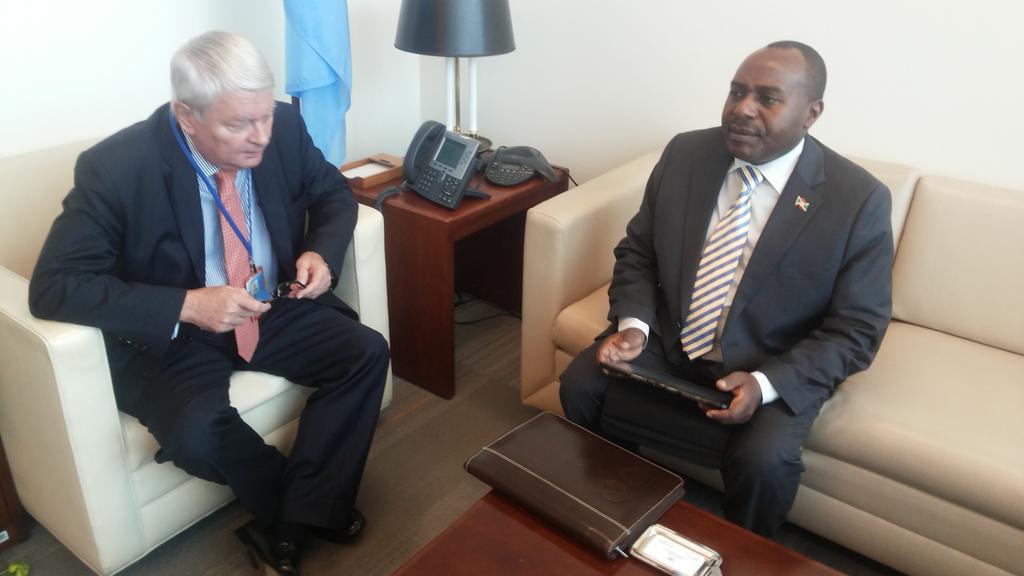
Amid crackdowns in Burundi by security forces, and allegations of sexual abuse by Burundian peacekeepers serving under the UN flag, UN Peacekeeping chief Herve Ladsous on October 1 held a meeting with Burundian Vice President Joseph Butore.

  Inner City Press has already tweeted a photograph of the meeting, but has now received the complete UN read-out, which raises more questions about Ladsous.

   On the crackdown, Ladsous assured Butore that he has a “pragmatic approach” and is of no mind to question what happens in any country, does not involve himself in "domestic affairs."

   On the sexual abuse allegations, Ladsous spoke only in platitudes, without requiring or even inquiring into any actions taken by the Burundians on the alleged abuse.

   Even though Burundi was already given a “grace period” to bring appropriate equipment into the Central African Republic for the MINUSCA mission, they have not done so. In the meeting, according to the read-out, Butore "acknowledged" the substandard equipment.

   Butore requested, and Ladsous for now granted, yet another extension to bring the requirement equipment -- until March 2016 for light equipment, and to June 2016 for heavy equipment.


  Is this safe - even for the Burundian soldiers at issue? While speaking through press releases, Ladsous' spokespeople, far from answering questions, go so far as to direct UNTV boom microphone operators to avoid Inner City Press, even preventing the Press from asking any questions to Mali's Foreign Minister Abdulaye Diop. We'll have more on all this.

Thursday, May 7, 2015

On Central African Republic Rapes, French Mission Won't Confirm Meeting UN Sexual Violence in Conflict Expert Bangura, Nor Comment on Mandate


By Matthew Russell Lee
UNITED NATIONS, May 7 -- French soldiers in the Central African Republic allegedly sexually abused children, as exposed in a UN report leaked by staffer Anders Kompass. After more than nine months, no action has been taken, other than the UN suspending Kompass for the leak. 
 On May 7, Inner City Press posed more questions about this, to the UN's Special Representative on Sexual Violence and Conflict Zainab Bangura and to the French Mission to the UN and its Ambassador Francois Delattre, video here.
  SRSG Bangura told Inner City Press that her Office has no jurisdiction ovr the French troops' alleged rape of children in CAR. Her Office's website says that CAR is one of its eight "focus" countries. Later on May 7, Inner City Press came from multiple sources to learn that Bangura met with Delattre this week not only about the Middle East but first about the CAR sexual abuse and exploitation charges. We will have more to report on this.
 But first, Inner City Press submitted these questions to Delattre's two spokespeople at the French Mission to the UN, at 1:45 pm:
"Hello. This is a Press request for your Mission (ideally, Permanent Representative) to confirm and comment on that the alleged sexual abuse by Sangaris personnel in the Central African Republic was discussed in your / his most recent meeting with the Special Representative of the Secretary-General on Sexual Violence in Conflict.

"Separately, what is your Mission's position on whether the allegations in the UN report regarding Sangaris personnel fall within the mandate of the Special Representative of the Secretary-General on Sexual Violence in Conflict, and if not, why not.

"Have other questions, but wanted to ask these, Pressingly, in the spirit in which days ago suggested some press availability on this ongoing topic. Thanks in advance."
  Having no answer, Inner City Press asked Ambassador Delattre, did you meet with SRSG Bangura about the alleged rapes? He was affable and slowed, but did not answer. Video here.

  At 7 pm on May 7, Amb Delattre's spokesman and chief of staff Thierry Caboche replied:
"Dear Sir, Thank you for your question. On this issue, the French President made a very clear statement last week, which I am happy to translate in English if need be:
« Nous avons saisis la justice. Et maintenant, il conviendra d’aller jusqu’au bout des procédures. Quand les faits seront établis - s’ils le sont - et si ces informations sont confirmées, par les enquêtes judiciaires et par l’enquête de commandement, alors, à ce moment-là, et par la justice et par les autorités militaires, il y aura des sanctions qui seront à proportion des faits qui auront été constatés. Les sanctions seront graves, elles devront même être exemplaires. Je serais implacable. »
"The Ministry of Defense also recalled today that every effort and measures have been deployed to allow for the manifestation of the truth, and that the military investigation will be declassified."
  Inner City Press, less than ten minutes after Caboche's response and two hours before publishing this story, replied:
Thanks, just want to try one more time on deadline: I am asking about SRSG Bangura's meeting with Ambassador Delattre, about the Middle East but also the CAR alleged rapes, for your side / comment on it. And for France's position on the jurisdiction of Bangura's Office, since France (back to Amb de la Sablierre and Ripert) helped set it up and develop it. I am writing about that and so asking for your comment."
  But no response has been received. We will have more on this. Meanwhile Herve Ladsous, the fourth Frenchman in a row atop UN Peacekeeping, denied his UNDT-documented role in urging the whistleblower who exposed the rapes to quit, then refused to answer any questions about it. What's next?

 The UN has been trying to distance itself from the scandal by saying it had nothing to do with DPKO. (The UN still refuses to explain or answer why DPKO chief Herve Ladsous, a long time French diplomat, appears in the UN Dispute Tribunal order reinstating the leaker as having urged that the leaker "resign" or be fired.)
  So Inner City Press told Bangura, this is not DPKO, these are French soldiers in the Central African Republic. Same answer: no jurisdiction. The UN Spokesman seemed to say, it's in the mandate. We'll check - but if so, if this UN Office on Sexual Violence and Conflict does not cover French soldiers demanding sex from children for food, that what good is the Office?

  We'll have more on this.  (Bangura also spoke, movingly, about the plight of women and children in the Islamic State area, including the inability to get birth documents which she said is a problem through the region.)

  The UN Dispute Tribunal has issued an order reinstating Kompass to his position. (Inner City Press has put the full Order online here; Guardian coverage here.) Tellingly, the order says in Paragraph 9 that the request that Kompass resign for having leaked and made public pedophilia by French solder was "made by the Under-Secretary-General for the Department of Peacekeeping Operations."

  On May 6, Inner City Press asked UN deputy spokesperson Farhan Haq:
Inner City Press: about the leaker of the Central African Republic rape allegations against the French forces.  There's a… as I'm sure you know, there's a decision by the Dispute Tribunal to reinstate him or to suspend the suspension.  And it says in it… this is what I wanted to ask you about.  It says that he was met with on March 12th 2015, and the Deputy High Commissioner requested his resignation, adding that such a request had been made by the Under-Secretary-General for the Department of Peacekeeping Operations [Hervé Ladsous].

So what I wanted to know is — I've heard from this podium that these alleged child rapes had nothing to do with DPKO (Department of Peacekeeping Operations), that DPKO has no link to them.  So, one, can you explain why the Under-Secretary-General of DPKO would ask for the resignation of the leaker?  Two, why this was… this request was made pending the OIOS (Office of Internal Oversight Services) report, which is constantly cited as we can't say anything until OIOS is done.

And also, just finally, I wonder, is the abuse that's alleged in that report, does that make the French force Sangaris eligible for listing on the Secretary-General's Children and Armed Conflict abuser's annex?  Thank you.

Deputy Spokesman Haq:  Well, on the last, that would be a question for the Office of the Special Representative on Children and Armed Conflict to consider.  But they certainly consider a wide range of allegations against many different forces around the world, and it would be up to them to determine whether that is one of those.  That would fall under their purview.

Regarding the details, you're quite right that the Office for Internal Oversight Services is continuing its investigation.  While that happens, there's not a lot I can share about much of the substance of this to avoid saying anything prejudicial one way or another about the handling of this.  Of course, what we've made clear is our concerns about the manner in which confidential information, in particular the identities of child victims of these extremely serious allegations, was communicated to external actors in possible breach of strict rules that exist to protect victims, witnesses, and investigators.  And that is something that the High Commissioner… High Commissioner Zeid [Ra'ad Al Hussein] has made clear.

Regarding what you'd said at the outset, yes, I can confirm that the staff member who is placed on administrative leave on the 17th of April with full pay pending the results of the investigation, that yesterday a judge of the UN Dispute Tribunal ordered the decision placing the staff member on administrative leave be suspended pending the outcome of a management evaluation.  The staff member has thus resumed service.

Inner City Press:  I have one follow-up question.

Deputy Spokesman Haq:  Yeah.

Inner City Press: I wanted to do this in the correct way.  My question is, it goes back to this, it's been said and it was said yesterday in a written response by your office that this… that the Human Rights Due Diligence Policy doesn't cover Sangaris because of the link or lack of link between UN Peacekeeping and Sangaris.  So what I don't understand is, I understand the concern of the Office for High Commissioner for Human Rights about names being redacted and possible threats to victims, but what is the possible connection between the Under-Secretary-General of Peacekeeping, which was not the author of the report and in which it has been said from here is not connected to the report or to the force, to asking for this individual to resign other than the nationality of the USG, which is French?  Can you explain why his role in this…

Deputy Spokesman Haq:  First of all, I can't even confirm that particular charge.  As I've said, many of these are pending the results of the investigation, and I will wait for that to come out to have the facts about this.  The concerns that we have had are what I stated and what I just said again right now which had to do with the handling of evidence.

Inner City Press:  But is that peacekeeping's concern?  Sorry.

Deputy Spokesman Haq:  And regarding the… regarding the issue of Sangaris, yes, what we have said is that the nature of the cooperation between the UN and Sangaris forces was not such that we had any sort of command and control or operational links that would bring into play the Human Rights Due Diligence Policy.  Yes.

Inner City Press:  I have another follow-up.

Voice of America:  [inaudible] tape recorder up front, I'm hearing a whole nother briefing.
 And so the next follow up question was not taken. But we will stay on this.
  This USG of DPKO is Herve Ladsous, a long time French diplomat before France placed him as the fourth of its nationals in a row atop DPKO. That ostensibly "UN" official Ladsous urged punishment of a Swedish UN staffer who leaked about sexual abuse by French soldiers in CAR is a new outrage. Who, the question becomes, should resign?
  The UN Dispute Tribunal Order, dated May 5 and reported by Inner City Press before 8 am on May 6, was issued by Judge Thomas Laker, and formally suspends the decision to place Kompass on administrative leave. Inner City Press is putting the 18 page decision online here.

  The context of Ladsous urging the "resignation" of a UN system staffer who made public child rape by French forces is that Ladsous has, since at least 2012, refused to answer Press questions about rapes by other of UN Peacekeeping's partners, in the DR Congo Army, see compilation here. Who should resign?  
 Systemically, Inner City Press has repeatedly asked the UN how its supposed "Human Rights Due Diligence Policy" applies to its work with the French forces in CAR. 
  Now the UN has sent Inner City Press this answer: conveniently, the UN's human rights policy DOES NOT apply:
"Regarding your question on the human rights due diligence policy and the French forces in the Central African Republic, our peacekeeping colleagues inform us that the human rights due diligence policy applies for UN support to non-UN forces. In the case of CAR, during the period of the allegations contained in the Office of the High Commissioner for Human Rights report, MINUSCA did not provide support to Operation Sangaris. MINUSCA has a working relationship with the French operation which does not fall under the human rights due diligence policy framework."
  While there is more to be said about the level of coordination between the MINUSCA mission, run by Frenchman Herve Ladsous, and the French Sangaris force, they are described as conducting operations together.
  So it appears that rich countries can buy their way out of the UN's Human Rights Due Diligence Policy. The Congolese Army needed or wanted supplies and transportation from the UN, opening them up to Ladsous' use of the Policy to justify the UN not participating in operations against the Hutu FDLR militia.
 Richer countries might "coordinate" with the UN, using its perceived legitimacy, but be exempt from any human rights due diligence.
  Does the Policy cover the French Force Licorne the UN has worked with in Ivory Coast?
 And if the UN or Ladsous can exempt French soldiers' rapes from the UN's supposed Human Rights Due Diligence Policy, could the UN say these child rapes don't require the inclusion of the perpetrators' forces on the Annex of the UN's Children and Armed Conflict report? We'll have more on this.
 No soldier has been prosecuted. French Defense Minister Jean-Yves Le Drian made that clear when he urges the perpetrators to turn themselves in. 
 It now emerges that UN Peacekeeping did not suspend any collaboration with the French forces, unlike its decision to not support the Congolese Army fighting the Hutu FDLR militia in the DR Congo. Both decisions are attributable to UN Peacekeeping chief (and long time French diplomat) Herve Ladsous.
 On May 5 Inner City Press asked UN Spokesman Stephane Dujarric to compare the relationships between Ladsous' MINUSCA mission in CAR and the French forces, and his MONUSCO mission and the Congolese Army, with support suspended to fight the FDLR. Video here.
  Dujarric said every relationship is different - clearly - and then when Pressed added that the UN's Human Rights Due Diligence Policy, cited by Ladsous to not fight the FDLR, applies "across the board."
 So, Inner City Press asked, how was it applied, or not, to the French forces once the UN had the child rape allegations, nine months ago?
  Dujarric paradoxically said that's under the UN Office of Internal Oversight Services. But OIOS is not in charge of the UN's supposed Human Rights Due Diligence Policy. Ladsous' refusal to answer questions, and misuse of UN Peacekeeping, is bringing UN Peacekeeping to ever-new lows.

On May 1 from Geneva the spokesperson for UN High Commissioner for Human Rights Prince Zaid, Rupert Colville, sought to explain or bolster the reputations of the Office, and of France. 
  At the UN's noon briefing in New York, UN Deputy Spokesperson Farhan Haq read out loud from Colville's statement. Inner City Press asked questions, such as had the UN told the CAR authorities what it knew about the rapes, and if not, why not.
  Haq never answered this question. He said that Colville is preparing a timeline -- clearly, Colville knows if OHCHR gave the report to CAR or only to France.
 Inner City Press also asked about the UN's investigation into OHCHR staffer Anders Kompass having leaked information about Western Sahara to the Moroccan government, and why that investigation took so long that leaking continued, to France of its victims' names. Haq would not say which investigation began first, a key point.
  Haq said that Inner City Press was cutting him off, and turned to the representative of the UN Correspondents Association to support him, and then to ask questions of which he approved. The UNCA representative began by saying that who the UN told, and when, wasn't important.
  Haq said, this is how questions are supposed to be asked -- apparently, the questions the UN wants, from the partners it selects, ignoring the UN's own role in problems. It was World Press Freedom Day at the UN; the Free UN Coalition for Access will have more on this.


Wednesday, March 4, 2015

On Mali, French UNSC President Francois Delattre Praises "Draft" Deal MNLA Hasn't Signed, Silent on Gao Shootings Report


By Matthew Russell Lee, updated
UNITED NATIONS, March 4 -- When French Ambassador Francois Delattre came to the UN Security Council stakeout on March 4 it was as Council president, with "Elements to the Press about Mali. Here is what he read, and questions he refused to answer.
"We heard a briefing by the Special Representative of the Secretary-General for Mali, Mr Mongi Hamdi, who gave us an update on the Algiers peace talks and the Agreement on Peace and Security in Mali initialed on 1 March 2015... We encourage the armed groups of the coordination to initial the agreement."
  Inner City Press asked, what about the MNLA not signing? But Delattre said, for the second time in two days, "I have to run" -- then proceeded to stand to the side of the stakeout, decidedly NOT running. 
Update: French mission spokesperson Thierry Caboche has replied that the "Press Elements agreed by UNSC on Mali encourage Coordination groups, including MNLA, to initial Algiers agreement."
 It's appreciated, and added here in full - but since the Elements to the Press in the first paragraph cites that "Agreement on Peace and Security in Mali initialed on 1 March 2015 by representatives of the Malian Government, one of the coalition of armed groups Platform' and all members of the international mediation team" then never names the MNLA, the Mali question should have been taken and answered, alongside fully three questions on Libya.
    Inner City Press also asked about the UN's "independent" report into UN Peacekeepers shooting at protesters (who were angry about the UN using attack helicopters, but that's another story).
  Delattre did not answer about this report, which one would think like the report on the Tabit rapes in Darfur also covered by UN Peacekeeping through its UNAMID mission, would go to the Security Council.
  On February 26, two days before Delattre took over as Security Council President, the UN announced that "the high-level team mandated by the Secretary-General of the United Nations to conduct an inquiry into the violent protests that took place in Gao, Mali, on 27 January is concluding an eight-day visit to Mali.
    “During this visit, the team met with the Malian national authorities, the authorities of the region of Gao, the national police and the civil protection service in Gao, representatives of MINUSMA, local leaders from the Cadre de Concertation des Notables de Gao, the associations who organized the protests on 27 January, authorities from the hospitals that received the victims, opposition parties, and several other interlocutors who could help shed light on the events. The team also spoke to the protestors who were injured during these events, and visited the bereaved families, to whom they expressed condolences.
  The team was "composed of three independent experts with extensive international experience: Bacre Waly Ndiaye (Senegal), Mark Kroeker (US) and Ralph Zacklin (UK)."
     Back on January 29, the UN said that Secretary General Ban Ki-moon  “deplores the incidents that took place on 27 January during a demonstration in front of the MINUSMA base in Gao town in the north of Mali. He is saddened by the violence that surrounded the demonstration and the reported death of at least 3 protesters and the injury of several others.”
   “The inquiry team will now travel to New York to present its preliminary report to the Secretary-General of the United Nations. It will present its final report by the end of March 2015,” the UN on Thursday said.
  What is the Security Council's role? Shouldn't the Security Council president for March, M. Delattre of France, answer this question?
   Back on January 6 when the UN Security Council met about Mali, Inner City Press waited and then aksed UN Peacekeeping chief Herve Ladsous what he has been doing to protect the peacekeepers he is responsible for.  As is his pattern -- actually, his stated policy -- he refused to answer.
    It was Malian Foreign Minister Abdoulaye Diop, and not Ladsous, who on January 6 distributed his speech and came to take Press questions.
  Inner City Press asked Diop about the Mali talks in Algiers, and about the impact of Libya. On the latter, Diop said that “in 2012 the Mali crisis started when the war started in Libya and many Malian elements who were part of the Libyan army decided to come back home with the arms and ammunition. This started the destabilization of Mali.”
   Diop added, "In the southern part of Libya there is a group that has declared allegiance to the Islamic State.” (When asked to name the group he could not or would not.)
   The Libya talks have been indefinitely postponed. A Greek ship near Derna was bombed -- Inner City Press on January 5 asked UN Spokesman Stephane Dujarric by whom; he said the UN does not know.  The Free UN Coalition for Access has asked UN Peacekeeping why the speeches of Ladsous, unlike other UN officials, are not made available.
  Jump-cut forward to March 4, when after Elements to the Press on Mali and a read out on Libya, all three of the French Mission or #FrPrez handpicked questions -- France 24, Agence France Presse then Voice of America -- were about Libya. Inner City Press said twice, "Question on Mali?"
  Delattre smiled and said, I have to run, I know it is the second time.
  On March 3 Delattre used the same "I have to run" line to not answer a question about Burundi, where France is set to lead a Council trip on March 13, the draft Terms of Reference for which (which Inner City Press published here) do no mention the Cibitoke massacre nor opine if a third Presidential term would violate the Arusha agreement, which is cited.
 Later, the French mission put up the Mali "Elements to the Press," with no mention that a question about them had been asked, on microphone, and that Delattre had again said, "I have to run."
  We are compelled to note that UN Peacekeeping, run by France four times in a row most recently by Ladsous who also does not answer Press questions, needs to answer when its personnel shoot at demonstrators, as recently happened in Haiti too. 
  But there are no answers. Nor on the sale of UN posts in the DR Congo and Haiti by Deputy Permanent Representative Ouattara of Cote d'Ivoire, here. We'll have more on this.