UNITED NATIONS, December 10 – The United Nations does some good work but is increasingly a platform for unaccountable self-styled thinkers who got their well compensated positions through murky processes including nepotism and are entirely comfortable restricting and even evicting their critics while, of course, they blather about freedom of the press and purport to fight corruption. This is happening at the very top of UN headquarters as Inner City Press has been covering of late - but it is once again on display in Kenya, host to the UN's regional UNON office. There the UN Resident Coordinator Siddharth Chatterjee, who was given the job without recusal by his father in law Ban Ki-moon, was notably silent as an election was reversed and opposition and civilians killed and detained. (Now the NASA coalition has postponed its December 12 event. What did Sid so during Kenya's detention of David Ndii - as little as the UN is doing for Patrice Nganang in Cameroon?) Or perhaps Sid did Chat - he blocks Inner City Press on Twitter, and has recently knee-jerk and conveniently come to the defense of UN Deputy Secretary General Amina J. Mohammed, claiming that the questions about her signing 4000 rosewood certificates for murky export to China from Nigeria and reportedly Cameroon, unanswered even to the UN CITES meeting in Geneva in late November, is “fake news.” In his view, the 95,000 people petitioning the UN to investigate Mohammed are deluded and to be blocked. This from a UN Resident Coordinator who threatened legal action again, or in the alternative a job for, an Indian journalist who picked up Inner City Press initial reports of Chatterjee's nepotistic rise through the UN system. Why did Staffan de Mistura name Sid his chief of staff in Iraq, and threaten those who commented on it? Then UNOPS? Why have the questions about the specifics of Siddharth Chatterjee's much use time during a bloody military campaign (including the killing of civilians) in Sri Lanka yet to be answered? Sid's pattern of threats and finding proxy defenders has now spread to the 38th floor of the UN. And "Social Media" Sid's practice of blocking critics on Twitter spread to the Resident Coordinator in Cameroon - who reversed and disavowed it - and to the the UN's Yemen Envoy and also to the UN Department of Public Information's perennial Number Two. How far into scandal and lack of transparency has today's UN of Secretary General Antonio Guterres and his Deputy Amina J. Mohammed fallen? Now while Guterres has decided not to hold any end of year press conference, Guterres on December 8 held a by invitation only session with some media from Japan, where he intends amid world crises and his own administration's scandal to visit for a relatively obscure health conference, only for money. See here, saying Guterres met with Japanese media on December 8 prior to his trip. Guterres had no news; it was only about the money, as he proved on November 21 when his UN used $1 million from China Energy Fund Committee even after the indictment for bribery of CEFC's Patrick Ho. But will Guterres' promiscuous sycophantry, between Japan and China, get him caught? He's counting on the sycophants who will "honor" him on December 15 on Wall Street, charging $1200 a table to see him. We'll have more on this. Also, now Guterres' swearing-in ceremonies, which had been open to the press and public under him and his predecessor Ban Ki-moon are no longer listed in the UN Department of Public Information's Media Alert, and Press questions about whether this was an oversight (to escape oversight) or for an explanation go unanswered. This as the Guterres and his DPI chief Alison Smale, set to belatedly be sworn in on December 6, ignored the calls of thousands as an environmental and corruption matter to investigate Amina Mohammed's UNanswered scandal of mass-signing certificates for endangered rosewood already shipped to China and as a media freedom matter to stop subjecting the Press which pursue UN corruption stories to more restrictions than other, some no-show, outlets. Smale has been on the job, or in the UN, since September. She has yet to respond to four separate inquiries despite in October saying she recognized the need to show the courtesy of a response. (Two days later her DPI issued a new threat to Inner City Press' accreditation). Guterres has yet to take questions on why his UN used $1 million from China Energy Fund Committee even after CEFC chief Patrick Ho was indicted for bribery in the UN. Amina Mohammed has refused to answer Press rosewood questions. Meanwhile Guterres is trying to sell purported reforms, for recently in a December 4 session of the UN's Fifth (Budget) Committee. On December 5, after Guterres spokesman Stephane Dujarric dodged Inner City Press' questions about the session, the UN Department of Public Information's Media Alert for December 6 did not provide notice of or access for Guterres' belated swearing in of his censor in chief at DPI, Alison Smale. Photos here. Amina Mohammed is also, according to her oft-empty schedule, supposed to be at the swearing in, perhaps further explaining the decision to close it to the press. Inner City Press immediately wrote to the UNresponsive Smale and Guterres, and MALU, with this: "Hello. The UN MALU Media Alert for December 6 has just been e-mailed out at 8:12 pm and Inner City Press has a question that it needs answered: SG Guterres' schedule for Dec 6 lists the swearing in of three senior officials including DPI's Alison Smale for 9:45 am. But DPI's Media Alert lists its first event at 10 am. Until now, swearings-in of USG have always been public, open to independent Press and in the Media Alert. Was this a mistake by DPI, or is there now even less transparency in this, as in other matters, by the UN? Inner City Press and FUNCA need to know now, to plan arrival at MALU at 9:15 am for the 9:45 am swearing in. This also informs you, as Maher Nasser was informed on the record in August, that the no-show, no-question Egyptian state media Akhbar al Yom assigned Inner City Press' long time shared work space S-303 has not come in in weeks, and has asked a single question in two years. Reversal is required." The absence continued on December 8, during the Jerusalem meeting co-requested by Egypt. On December 8, Inner City Press asked Dujarric to explain, UN transcript here: Inner City Press: In the past, events in which the Secretary-General, including the previous one and even this one, has sworn in officials, to swear in their allegiance to the global public have always been open press. Now they are not. So I wanted to know, I came in earlier for the one with Alison [Smale] and two others and was told it’s closed; but I just wanted to know, given particularly the purpose of the ceremonies, not just a handshake it’s actually a… what is the reasoning behind it?Spokesman: I think we are making some adjustments, and obviously there was the UN photographers there, UN TV, so that material is available to everybody. Thank you." This transcript cut out Inner City Press audibly saying, Why go toward being less transparent? to which Dujarric claimed it's translucent. Inner City Press said and says, murky and opaque. Note for example that when Guterres swore in Mohammed, it was open press, Inner City Press covered and live streamed it and there have been follow up questions about the cost and composition of the delegation. Now, they try to close the historically open swearing-in ceremonies to the press: this is today's UN. Watch this site. The UN has dodged Press questions for a month about UN Deputy Secretary General Amina J. Mohammed signing thousands of certificates for rosewood already exported from Nigeria and it seems Cameroon to China, just before she took up her UN position. Most recently, after UN correspondents who tried to help her evade the questions declared she is being "vilified," the CITES meeting in Geneva declined China's open and Nigeria's more stealth lobbying to close the case, and issued a decision that "With regard to trade in specimens of Pterocarpus erinaceus: b) Parties should not accept any CITES permit or certificate for Pterocarpus erinaceus issued by Nigeria unless its authenticity has been confirmed by the Secretariat, noting that China and Nigeria have existing CITES document exchanging mechanism to verify the authenticity of all CITES permits and certificates for Pterocarpus erinaceus issued by Nigeria. c) Range States and importing countries should pay particular attention to trade in Pterocarpus erinaceus to ensure that trade in this species only takes place when Parties are satisfied that it is in line with the requirements of the Convention. d) The Standing Committee welcomed the invitation by the Government of Nigeria to conduct a technical mission to Nigeria and invited the Secretariat to provide any relevant information on compliance with the Convention related to trade in Pterocarpus erinaceus to the Standing Committee." This scandal will no go away, even if as some predict Mohammed does. Watch this site. The UN becomes less transparent by the day. For more than two weeks UN Spokesman Stephane Dujarric had dodged and refused questions from Inner City Press about Deputy Secretary General Amina J. Mohammed signing 4,000 certificates for rosewood illegal logged in Cameroon and parts of Nigeria and already in China. Now in the absence of answers a cursory review of the UN's so-called "public disclosure" website finds that Amina Mohammed nine months into her tenure as Deputy SG has not filed any disclosure: she is not even listed. This stands in contrast, for example, to the UN's envoy to Afghanistan Tadamichi Yamamoto, who signed his Public Disclosure form on October 23, 2017 (Residential property, joint ownership, Japan; Mortgage, Mitsui Sumitomo Bank, Japan) and another of the few Japanese UN high officials, Izumi Nakamitsu who signed her Public Disclosure form on January 18, 2017 (Two residential properties, joint ownership, Sweden; Mortgage, Handelsbanken, jointly held, Sweden). In other murky news, after Secretary General Antonio Guterres went to Lisbon for four days (while spokesman Dujarric refused Press requests to disclosure the cost of that trip, like Amina Mohammed's to Cape Town), he will soon travel to Japan, for a merely regional health conference. We'll have more on this. As to Mohammed, the export to China of illegally harvested rosewood, reported on by Le Monde on November 3 with reference to UN Deputy Secretary General Amina J. Mohammed who signed the certificates, also involves "smuggling from Cameroon." See EIA video, here. This may put a new light on the UN's inaction on the Cameroonian government's killings and Internet cut off in the Anglophone zones. Cameroon's Ambassador to the UN, while saying he'd call upstairs to ensure Inner City Press couldn't go there any more (the UN's Department of Public Information did threaten Inner City Press' accreditation for Periscope broadcasting in connection with photo ops on the 38th floor), also bragged that the DSG's opposition to separatism in Biafra led to the same position on Cameroon. And just as UN envoy Chambas went and preached One Nigeria, failing UN envoy Francois Fall called Southern Cameroons secessionists "extremists," on DPI's UN Radio no less. They say in journalism, Follow the Money. But in this case it may be, Follow the Rosewood, or Kosso. In terms of money: Joe Biden appeared at the UN on November 3, and tables were sold for up to $50,000. One might think, after the proved corruption of the UN in the Ng Lap Seng / John Ashe trial for events in this same Delegates Dining Room, charging this kind of money for sitting with a “senior UN official” would be a thing of the past. Or after Antonio Guterres was questioned after taking a golden statue from Paul Biya, the 35-year rules of Cameroon. But no. On November 6, Deputy Secretary General Amina J. Mohammed appeared, took an award and gave a speech at an event in Washington for which $25,000 sponsorships were offered, here, by a publication which covers and is promoted by the UN (while following up on November 9 on Le Monde's November 3 story, no mention of Cameroon.) On November 9, Inner City Press asked the UN Spokesman Stephane Dujarric, UN transcript here: Inner City Press; as you know or you or Farhan [Haq] had said, she just recently received the Diplomat of the Year Award from Foreign Policy down in DC. Was she aware of this story being in preparation when she accepted the award? Often, to receive the award, you have to be present. How long were the discussions? Spokesman: I think some of those questions should be addressed to Foreign Policy. She was fully aware that the story was going to come out when she received the award." No Cameroon. Ban Ki-moon allowed the corruption of Ng Lap Seng, and Antonio Guterres has done thing to reverse it. In fact, Guterres left through the same door Biden came in, one hour before, using public funds to fly to his home in Lisbon, using a 15 minutes speech there on Monday to justify a three day UN paid junket. And his spokesman refused to answer questions, even about his one on one lunches on the 38th floor, where Inner City Press' use of Periscope during photo ops has allowed Guterres' DPI under Alison Smale to threaten its accreditation. All of this takes place while Guterres covers up mass killing in Cameroon, and is prepared to be sold himself, on Wall Street no less. We'll have more on this. On November 2, Guterres' spokesman Stephane Dujarric announced that "on Monday, the Secretary-General will be in Lisbon to participate in the Web Summit 2017, which brings together the leaders of key Internet companies with officials from different Governments. You are aware of the attention the Secretary-General has been devoting to the uses of the Internet." Really? Guterres was silent for example when Cameroon cut off the Internet for 94 days this year; his Department of Public Information has threatened Inner City Press' accreditation for unspecified violation by live-streaming a Guterres photo op using Twitter's Periscope platform. But why did Guterres take this speaking gig, which it turns out is for only 15 minutes at 7:25 pm on the evening of Monday, November 6? Inner City Press asked Dujarric, who refused to state with whom Guterres had a formal lunch meeting in the UN dining room with UN funds on November 3, where Guterres will be on Saturday and Sunday. Dujarric replied: "sg will be in lisbon over the weekend." It sure seems like that's why he took the Lisbon speaking gig. And in fact, even before 5 pm on Friday, November 3, Guterres left the UN with bodyguards, in a three-car convoy. Who is paying for all this? On October 27, after Guterres' spokespeople stonewalled Inner City Press for three days on his plans for a grip and grin meeting in a Cameroon airport with Paul Biya, who has killed hundreds this year as well as cutting the Internet Guterres loves so much, they also refused to say how Guterres personal, or shall we say Lisbon-focused, travel is paid for, and how much it costs. From the UN transcript: Inner City Press: If he goes to Lisbon, Portugal, does he take UN security with him? In which case, where do they stay, and what are the costs? How are they borne? Deputy Spokesman: However he does his stopovers, he does it at the least cost to the UN. And a lot of times, what that means is traveling with a smaller delegation, and it also means traveling on commercial flights. He does take specific steps, and he's been very conscientious over these months of making sure that he travels with as slim a delegation as he has. Inner City Press: My question is just who's paying for his security if he goes to Lisbon? And also I'm aware that he sent some people in advance to CAR. They didn't travel with him, but they were actually part of the party. So is there an attempt to bifurcate traveling trips so that some people are not considered to be traveling with him. For example, the UN photographer, I'm aware, went days in advance. Why was that? Deputy Spokesman: Well, sometimes advance teams go out when it's needed to do that. For us, in terms of the Department of Public Information, there are many times when it's useful for us to send our media crews in advance to get different coverage for the sort of pieces and features that they do. Inner City Press: Can we just get the cost? It's a straight transparency question. Deputy Spokesman: The costs of travel are calculated over the year and shared with the Member States, and that's how we do it. All right. Have a good weekend, everyone." Antonio sure will - on the public dime. Back on July 29, the day after guilty verdicts on six counts of UN bribery in the case of Ng Lap Seng, UN Secretary General Antonio Guterres flew to Split for a seven day vacation on the Dalmatian islands, according to sources there. Guterres' spokespeople did not disclose the travel or any week-long absence to the press covering the UN, at least not to the Press evicted and still restricted for covering Ng's bribery. This lack of transparency stands in contrast to the executive branch in Washington and even New York routinely disclosing travel including vacation travel. But the UN has no press protections either - Guterres has been asked. Meanwhile his spokespeople says the UN should get paid for the UNreformed corruption shown in the Ng trial and verdict. We'll have more on this. When UN Secretary General Antonio Guterres on July 27 had a brief meeting with Qatar's Foreign Minister Sheikh Mohammed bin Abdulrahman Al-Thani, Qatar state media and other UN based photographers went up. Alamy photos here. There were complaints how short the handshake was; Inner City Press noted that on the UN side of the table were only four people, all men, including Jeffrey Feltman. Periscope video here. Guterres was scheduled to be at another meeting in 25 minutes time. So will the UN help solve the stand-off in the Gulf? It seems unlikely. The UN never answered Inner City Press' questions of if Feltman had visited Saudi Arabia and if not, why not. Back on July 19 Guterres.had a meeting and photo op with Spain's Foreign Minister Alfonso María Dastis Quecedo. Inner City Press went to cover it, Alamy photos here, Periscope video hereincluding of whether Dastis should write "una poema" in the UN visitors' book. Inner City Press barely arriving on time due to the crowd of tourists at the UN's visitors entrance. It has been this waysince Spain's now-gone Under Secretary General Cristina Gallach had Inner City Press evicted from and still restricted at the UN after Inner City Press asked her about attending indicted Macau-based businessman Ng Lap Seng's South South Awards, and allowing Ng fundees improper events in the UN. Although Guterres did not continue Gallach's contract - she lobbied to stay, but failed - her negative impacts are still in evidence. The Spanish Mission to the UN, now off the Security Council, likewise did nothing to reign Gallach in. But surely they are lobbying Guterres to get another Under Secretary General position, even as their Fernando Arias Gonzalez runs against six others to head the Organization for the Prohibition of Chemical Weapons. We'll have more on this. The day before on July 18 Guterres had a meeting and photo op with the Dominican Republic's Foreign Minister Miguel Vargas Maldonado (Alamy photos here, Periscope video here); it came one day after in the UN bribery case against Ng Lap Seng a video of then then-President Leonel Fernandez Reyna visiting South South News near the UN was discussed. That video is here. South South News was a bribery conduit, its funds used for gambling by Dominican Deputy Permanent Representative Francis Lorenzo in Las Vegas and Atlantic City while the UN's Department of Public Information let SSN's content into UNTV archives and let Ng fundees have impermissible events in the UN. On July 18, Guterres' Deputy Spokesman Farhan Haq refused to answer Inner City Press' yes or no questions about South South News and the UN. After the July 18 photo op, Inner City Press had nowhere to edit - for seeking to cover an event in the UN Press Briefing Room in pursuing the UN / SSN corruption story, Inner City Press was evicted and still restricted. The 38th floor apparently loves it.On July 10 Guterres has a photo op with Colombia's Foreign Minister Maria Angela Holguin Cuellar. It was supposed to be in his office in UN Headquarters at 4:30 pm. But on little notice he moved it to his - make that, the UN and the public's - mansion on Sutton Place and 57th Street, at 4 pm. Inner City Press jumped on the city bus up First Avenue, broadcasting a Periscope video about the change, when suddenly it was urged to stop broadcasting by a board member of the UN Correspondents Association, which Guterres' deputy spoke before last week and whose former president Giampaolo Pioli's Hampton's gratiuty-fest the UN acting head of Public Information Maher Nasser attended, the UN Censorship Alliance. This is today's UN. Still, up on Sutton Place UN Security brought up a sniffing dog in a UN 4x4, and two quick photos were allowed before Guterres escorted Holguin onto "his" elevator. Back at the UN, the door to the UN Security Council stakeout was locked, and the turnstile where targeting Inner City Press' ID pass no longer works was guarded by new UN Security who didn't even recognize the UN minder. Still, we got thisPeriscope, despite UN censorship which continues.
WASHINGTON, March 16 -- Before UN envoy for Syria Staffan de Mistura took four questions in Geneva on March 14, he announced that for the next ten days, he will grant no exclusive interviews. Background below.
On March 16, after de Mistura canceled a stakeout so it could travel to Bern -- to feel the Bern, as one wag put it -- his deputy Ramzy Ezzeldin Ramzy stood in for him, with questions picked by UN spokesman "a.i." Ahmad Fawzi: France 24, Al Jazeera, Al Arabiya.
Ramzy said that de Mistura had asked the Syrian government delegation for clarifications of its paper; he said that can be difference of interpretation. He said later in the day he would meet with the Cairo group and the Moscow group, because UNSC Resolution 2254 says be inclusive. So what about the Kurds?
Minutes before on March 16, Syria's Bashar Ja'afari spoke at the UN microphone, with a too-soft UN interpretation into English.
Ja'afari was asked about the announcement by the Kurdish PYD that it will declare autonomy, on which Inner City Press previously reported, below. Ja'afari offered praise for PYD but said such unilaterally moves are not envisioned by the Geneva process. But if the PYD is not allowed at the table?
Ja'afari to CNN said Russia's decision to pull back military forces was a joint one with Damascus. We'll have more on this.
Later on March 14, after de Mistura briefed the UN Security Council by video, Ambassador Gaspar Martins of Angola, president of the Council for March, emerged to say that all members found Russia's announcement of starting to withdraw most of its forces from Syria positive.
Inner City Press asked Gaspar Martins if the (yet to be agreed) inclusion of Kurdish groups in Syria into the talks was discussed. Yes, he said, there is a desire that the talks get more inclusive.
But will they, particularly after the Ankara attack?
Now, Kurdish official Idris Nassan says Kurds will declare self determination in northern Syria. So it seems those who delayed and demurred on Kurdish involvement in the UN's Geneva talks have only themselves to blame.
On March 15, Inner City Press put the question to US State Department spokesperson John Kirby. From the State Department transcript:
Inner City Press: what does the U.S. think of the inclusion of Kurdish groups from – in Syria in the talks? There’s more and more – many countries talk – say they should be involved. Obviously, Turkey says that they shouldn’t be involved; there’s the Ankara attack. Has your – what’s the thinking here?
MR KIRBY: I’ve addressed this before and our position is exactly the same. The invitations to the talks were decided and sent by the UN, by Special Envoy de Mistura. He sent invitations this time to the same groups that he sent last time. Right now, that does not include Kurdish groups in the proximity talks. That said, as before, he continues to consult with a wide range of groups, to include Kurdish groups. And we believe that we need to respect his decision-making process going forward and how he wants to conduct these talks. We’re going to continue to support that. And again, there are consultations, there are discussions going on. We recognize that those consultations are important.
But what about Kurds declaring self determination in northern Syria? We hope to have more on this.
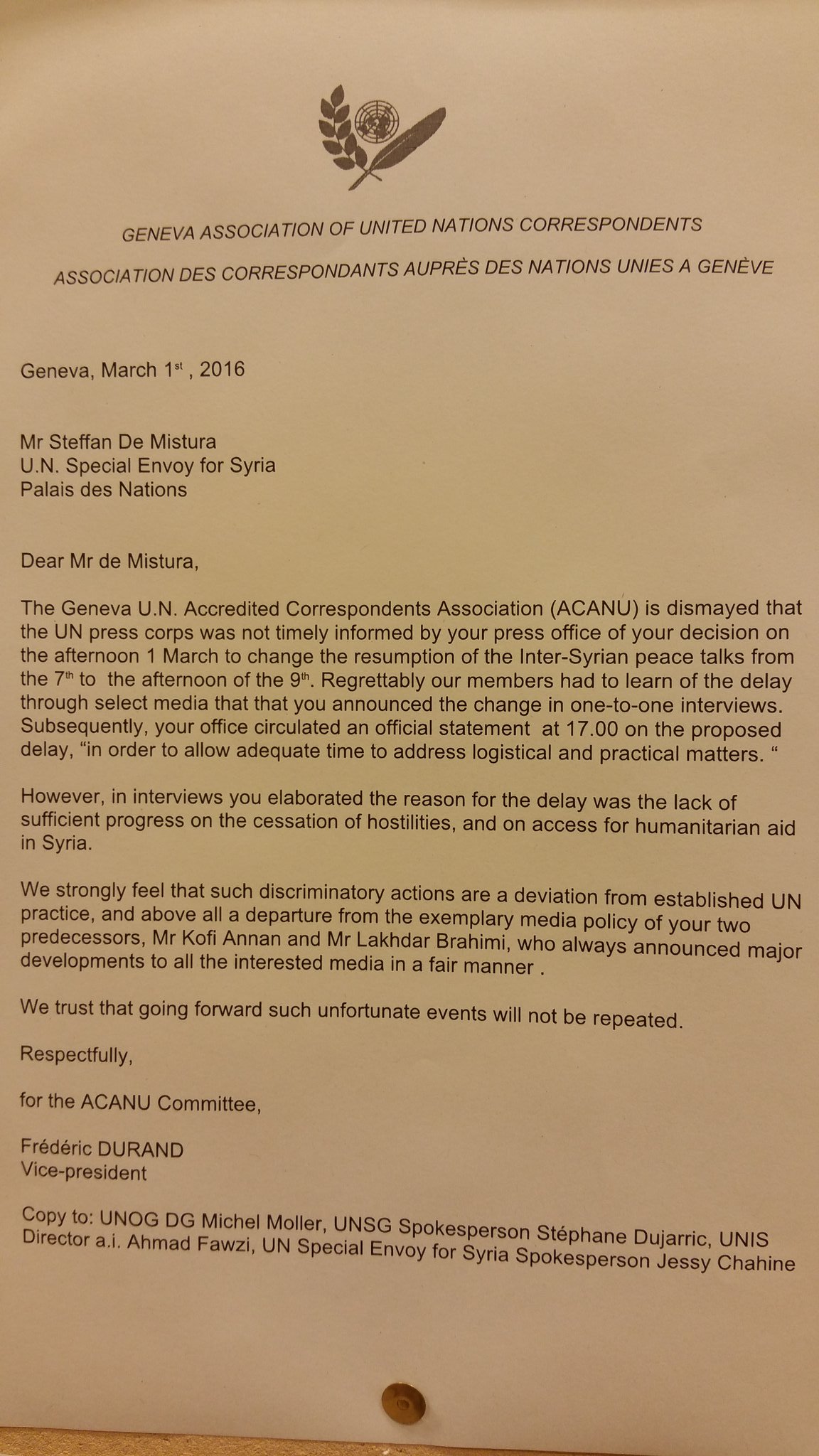
Here's some background on de Mistura's M.O. in Geneva, then Inner City Press' question on it: on March 1 the "Association des Correspondants Aupres des Nations Unies a Geneve" (ACANU), in a bit of advocacy the NY-based UNCA does not engage in, protested de Mistura making announcements about the Syria talks in exclusive interviews, and not to all correspondents at once.
In New York, Ban Ki-moon and his Under Secretaries General like Herve Ladsous dole out information to favored correspondents; Ban's USG for Public Information Cristina Gallach on February 19 went so far as to oust Inner City Press after speaking with Giampaolo Pioli's UNCA but not Inner City Press. Will de Mistura, as now pledged, be different?
On March 14, Ban Ki-moon's spokesman Stephane Dujarric told Inner City Press there is no policy in this regard. From the UN transcript:
Inner City Press: I saw you [carbon copied] on this, so it seems like a fair question to you. I saw a letter from the ACANU, or the Geneva press association of correspondents, directed to Mr… Mr. de Mistura and [carbon copied] to you, protesting that he announced a delay… initial delay in the Syria talks in an exclusive interview. And I saw him this morning very early say that he's not going to do any exclusive interviews between 14 and 24 March, sort of as an accommodation. I guess I wanted to know, what is the UN's policy in terms of both the Secretary-General or a news-maker like de Mistura giving… ACANU seemed to say very clearly this information should be given to all correspondents at the same time. Do you agree with that?
Spokesman: No, Mr. de Mistura is a seasoned diplomat. He chooses to… he deftly handles the media, and he will do whatever he feels he needs to do. There is no policy per se on any of these issues that you raised.
No policy - like on the "lending out" of the UN Press Briefing Room, resulting in differences of opinion on the right to cover events there which the UN, Dujarric, can use as a pretext to oust the Press.
UN Geneva spokesman Ahmad Fawzi on March 14 gave the first question to “our Turkish colleague” -- who asked about the timing of elections in Syria. The next picked questioner identified himself “with the Geneva press corps;” then Al Jazeera Arabic asked if there is any deadline for a deal to be reached.
To this, de Mistura said this first round would run from March 14 to 24 -- during which no exclusive interviews, he said -- then a recess of a week or ten days. This will be folllowed by a second round of two weeks, then another recess, length undefined.
Fawzi's final question went to ACANU, representing Geneva correspondents accredited by the UN, hopefully (much) better than the decaying and corrupt UN Correspondents Association the UN uses in New York. This question was to say when meetings begin and end. And then it was over.
One couldn't help wonder if there were anywhere near this focus on the slaughter in Yemen - and where is de Mistura's counterpart Ismail Ould Cheikh Ahmed?
On Syria, will the Ankara attack impact mounting demands that the Kurds be given a role in this round of talks? We'll have more on this.
WASHINGTON, March 16 -- Before UN envoy for Syria Staffan de Mistura took four questions in Geneva on March 14, he announced that for the next ten days, he will grant no exclusive interviews. Background below.
On March 16, after de Mistura canceled a stakeout so it could travel to Bern -- to feel the Bern, as one wag put it -- Syria's Bashar Ja'afari spoke at the UN microphone, with a too-soft UN interpretation into English.
Ja'afari was asked about the announcement by the Kurdish PYD that it will declare autonomy, on which Inner City Press previously reported, below. Ja'afari offered praise for PYD but said such unilaterally moves are not envisioned by the Geneva process. But if the PYD is not allowed at the table?
Ja'afari to CNN said Russia's decision to pull back military forces was a joint one with Damascus. We'll have more on this.
Later on March 14, after de Mistura briefed the UN Security Council by video, Ambassador Gaspar Martins of Angola, president of the Council for March, emerged to say that all members found Russia's announcement of starting to withdraw most of its forces from Syria positive.
Inner City Press asked Gaspar Martins if the (yet to be agreed) inclusion of Kurdish groups in Syria into the talks was discussed. Yes, he said, there is a desire that the talks get more inclusive.
But will they, particularly after the Ankara attack?
Now, Kurdish official Idris Nassan says Kurds will declare self determination in northern Syria. So it seems those who delayed and demurred on Kurdish involvement in the UN's Geneva talks have only themselves to blame.
On March 15, Inner City Press put the question to US State Department spokesperson John Kirby. From the State Department transcript:
Inner City Press: what does the U.S. think of the inclusion of Kurdish groups from – in Syria in the talks? There’s more and more – many countries talk – say they should be involved. Obviously, Turkey says that they shouldn’t be involved; there’s the Ankara attack. Has your – what’s the thinking here?
MR KIRBY: I’ve addressed this before and our position is exactly the same. The invitations to the talks were decided and sent by the UN, by Special Envoy de Mistura. He sent invitations this time to the same groups that he sent last time. Right now, that does not include Kurdish groups in the proximity talks. That said, as before, he continues to consult with a wide range of groups, to include Kurdish groups. And we believe that we need to respect his decision-making process going forward and how he wants to conduct these talks. We’re going to continue to support that. And again, there are consultations, there are discussions going on. We recognize that those consultations are important.
But what about Kurds declaring self determination in northern Syria? We hope to have more on this.
Here's some background on de Mistura's M.O. in Geneva, then Inner City Press' question on it: on March 1 the "Association des Correspondants Aupres des Nations Unies a Geneve" (ACANU), in a bit of advocacy the NY-based UNCA does not engage in, protested de Mistura making announcements about the Syria talks in exclusive interviews, and not to all correspondents at once.
In New York, Ban Ki-moon and his Under Secretaries General like Herve Ladsous dole out information to favored correspondents; Ban's USG for Public Information Cristina Gallach on February 19 went so far as to oust Inner City Press after speaking with Giampaolo Pioli's UNCA but not Inner City Press. Will de Mistura, as now pledged, be different?
On March 14, Ban Ki-moon's spokesman Stephane Dujarric told Inner City Press there is no policy in this regard. From the UN transcript:
Inner City Press: I saw you [carbon copied] on this, so it seems like a fair question to you. I saw a letter from the ACANU, or the Geneva press association of correspondents, directed to Mr… Mr. de Mistura and [carbon copied] to you, protesting that he announced a delay… initial delay in the Syria talks in an exclusive interview. And I saw him this morning very early say that he's not going to do any exclusive interviews between 14 and 24 March, sort of as an accommodation. I guess I wanted to know, what is the UN's policy in terms of both the Secretary-General or a news-maker like de Mistura giving… ACANU seemed to say very clearly this information should be given to all correspondents at the same time. Do you agree with that?
Spokesman: No, Mr. de Mistura is a seasoned diplomat. He chooses to… he deftly handles the media, and he will do whatever he feels he needs to do. There is no policy per se on any of these issues that you raised.
No policy - like on the "lending out" of the UN Press Briefing Room, resulting in differences of opinion on the right to cover events there which the UN, Dujarric, can use as a pretext to oust the Press.
UN Geneva spokesman Ahmad Fawzi on March 14 gave the first question to “our Turkish colleague” -- who asked about the timing of elections in Syria. The next picked questioner identified himself “with the Geneva press corps;” then Al Jazeera Arabic asked if there is any deadline for a deal to be reached.
To this, de Mistura said this first round would run from March 14 to 24 -- during which no exclusive interviews, he said -- then a recess of a week or ten days. This will be folllowed by a second round of two weeks, then another recess, length undefined.
Fawzi's final question went to ACANU, representing Geneva correspondents accredited by the UN, hopefully (much) better than the decaying and corrupt UN Correspondents Association the UN uses in New York. This question was to say when meetings begin and end. And then it was over.
One couldn't help wonder if there were anywhere near this focus on the slaughter in Yemen - and where is de Mistura's counterpart Ismail Ould Cheikh Ahmed?
On Syria, will the Ankara attack impact mounting demands that the Kurds be given a role in this round of talks? We'll have more on this.
WASHINGTON, March 15 -- Before UN envoy for Syria Staffan de Mistura took four questions in Geneva on March 14, he announced that for the next ten days, he will grant no exclusive interviews. Background below.
Later on March 14, after de Mistura briefed the UN Security Council by video, Ambassador Gaspar Martins of Angola, president of the Council for March, emerged to say that all members found Russia's announcement of starting to withdraw most of its forces from Syria positive.
Inner City Press asked Gaspar Martins if the (yet to be agreed) inclusion of Kurdish groups in Syria into the talks was discussed. Yes, he said, there is a desire that the talks get more inclusive.
But will they, particularly after the Ankara attack?
On March 15, Inner City Press put the question to US State Department spokesperson John Kirby. From the State Department transcript:
Inner City Press: what does the U.S. think of the inclusion of Kurdish groups from – in Syria in the talks? There’s more and more – many countries talk – say they should be involved. Obviously, Turkey says that they shouldn’t be involved; there’s the Ankara attack. Has your – what’s the thinking here?
MR KIRBY: I’ve addressed this before and our position is exactly the same. The invitations to the talks were decided and sent by the UN, by Special Envoy de Mistura. He sent invitations this time to the same groups that he sent last time. Right now, that does not include Kurdish groups in the proximity talks. That said, as before, he continues to consult with a wide range of groups, to include Kurdish groups. And we believe that we need to respect his decision-making process going forward and how he wants to conduct these talks. We’re going to continue to support that. And again, there are consultations, there are discussions going on. We recognize that those consultations are important.
Here's the background, then Inner City Press' question on it: on March 1 the "Association des Correspondants Aupres des Nations Unies a Geneve" (ACANU), in a bit of advocacy the NY-based UNCA does not engage in, protested de Mistura making announcements about the Syria talks in exclusive interviews, and not to all correspondents at once.
In New York, Ban Ki-moon and his Under Secretaries General like Herve Ladsous dole out information to favored correspondents; Ban's USG for Public Information Cristina Gallach on February 19 went so far as to oust Inner City Press after speaking with Giampaolo Pioli's UNCA but not Inner City Press. Will de Mistura, as now pledged, be different?
On March 14, Ban Ki-moon's spokesman Stephane Dujarric told Inner City Press there is no policy in this regard. From the UN transcript:
Inner City Press: I saw you [carbon copied] on this, so it seems like a fair question to you. I saw a letter from the ACANU, or the Geneva press association of correspondents, directed to Mr… Mr. de Mistura and [carbon copied] to you, protesting that he announced a delay… initial delay in the Syria talks in an exclusive interview. And I saw him this morning very early say that he's not going to do any exclusive interviews between 14 and 24 March, sort of as an accommodation. I guess I wanted to know, what is the UN's policy in terms of both the Secretary-General or a news-maker like de Mistura giving… ACANU seemed to say very clearly this information should be given to all correspondents at the same time. Do you agree with that?
Spokesman: No, Mr. de Mistura is a seasoned diplomat. He chooses to… he deftly handles the media, and he will do whatever he feels he needs to do. There is no policy per se on any of these issues that you raised.
No policy - like on the "lending out" of the UN Press Briefing Room, resulting in differences of opinion on the right to cover events there which the UN, Dujarric, can use as a pretext to oust the Press.
UN Geneva spokesman Ahmad Fawzi on March 14 gave the first question to “our Turkish colleague” -- who asked about the timing of elections in Syria. The next picked questioner identified himself “with the Geneva press corps;” then Al Jazeera Arabic asked if there is any deadline for a deal to be reached.
To this, de Mistura said this first round would run from March 14 to 24 -- during which no exclusive interviews, he said -- then a recess of a week or ten days. This will be folllowed by a second round of two weeks, then another recess, length undefined.
Fawzi's final question went to ACANU, representing Geneva correspondents accredited by the UN, hopefully (much) better than the decaying and corrupt UN Correspondents Association the UN uses in New York. This question was to say when meetings begin and end. And then it was over.
One couldn't help wonder if there were anywhere near this focus on the slaughter in Yemen - and where is de Mistura's counterpart Ismail Ould Cheikh Ahmed?
On Syria, will the Ankara attack impact mounting demands that the Kurds be given a role in this round of talks? We'll have more on this.
UNITED NATIONS, March 14 -- Before UN envoy for Syria Staffan de Mistura took four questions in Geneva on March 14, he announced that for the next ten days, he will grant no exclusive interviews.
Here's the background, then Inner City Press' question on it: on March 1 the "Association des Correspondants Aupres des Nations Unies a Geneve" (ACANU), in a bit of advocacy the NY-based UNCA does not engage in, protested de Mistura making announcements about the Syria talks in exclusive interviews, and not to all correspondents at once.
In New York, Ban Ki-moon and his Under Secretaries General like Herve Ladsous dole out information to favored correspondents; Ban's USG for Public Information Cristina Gallach on February 19 went so far as to oust Inner City Press after speaking with Giampaolo Pioli's UNCA but not Inner City Press. Will de Mistura, as now pledged, be different?
On March 14, Ban Ki-moon's spokesman Stephane Dujarric told Inner City Press there is no policy in this regard. From the UN transcript:
Inner City Press: I saw you [carbon copied] on this, so it seems like a fair question to you. I saw a letter from the ACANU, or the Geneva press association of correspondents, directed to Mr… Mr. de Mistura and [carbon copied] to you, protesting that he announced a delay… initial delay in the Syria talks in an exclusive interview. And I saw him this morning very early say that he's not going to do any exclusive interviews between 14 and 24 March, sort of as an accommodation. I guess I wanted to know, what is the UN's policy in terms of both the Secretary-General or a news-maker like de Mistura giving… ACANU seemed to say very clearly this information should be given to all correspondents at the same time. Do you agree with that?
Spokesman: No, Mr. de Mistura is a seasoned diplomat. He chooses to… he deftly handles the media, and he will do whatever he feels he needs to do. There is no policy per se on any of these issues that you raised.
No policy - like on the "lending out" of the UN Press Briefing Room, resulting in differences of opinion on the right to cover events there which the UN, Dujarric, can use as a pretext to oust the Press.
Spokesman Ahmad Fawzi on March 14 gave the first question to “our Turkish colleague” -- who asked about the timing of elections in Syria. The next picked questioner identified himself “with the Geneva press corps;” then Al Jazeera Arabic asked if there is any deadline for a deal to be reached.
To this, de Mistura said this first round would run from March 14 to 24 -- during which no exclusive interviews, he said -- then a recess of a week or ten days. This will be folllowed by a second round of two weeks, then another recess, length undefined.
Fawzi's final question went to ACANU, representing Geneva correspondents accredited by the UN, hopefully (much) better than the decaying and corrupt UN Correspondents Association the UN uses in New York. This question was to say when meetings begin and end. And then it was over.
One couldn't help wonder if there were anywhere near this focus on the slaughter in Yemen - and where is de Mistura's counterpart Ismail Ould Cheikh Ahmed?
On Syria, will the Ankara attack impact mounting demands that the Kurds be given a role in this round of talks? We'll have more on this.
Previously, when the UN pulled the plug on the Intra-Syrian Talks, or as envoy Staffan de Mistura said merely pushed them back, de Mistura said that the UN "is not prepared to hold talks for the sake of talks."
Then de Mistura was scheduled after delay to brief the Security Council on Friday, February 26 at 3 pm, in connection with a vote on a US - Russian draft Inner City Press had seen.
After a delay described below, de Mistura briefed by video, saying he intends to re-convene Intra-Syrian talks on March 7.
The Council approved the resolution 15-0, Russia's Gatilov spoke of strict implementation, and the need for "immediate" talks.
At 2:40 pm, UK Ambassador Matthew Rycroft was in the hall outside the Council, talking heatedly into his cell phone. Another Council diplomat, on background, said there would be a delay of at least 30 minutes or an hour - someone didn't agree.
Inner City Press was told by sources it was to renegotiate the annex of groups.
Now Inner City Press has been informed of more. In the public session, UK Matthew Rycroft said "The HNC represents a broad sweep of the opposition forces fighting in Syria against the tyranny of Asad. They deserve our whole-hearted support, which regrettably was not reflected in this resolution."
Other changes were to the Cairo and Moscow platforms. But, the sources tell Inner City Press, the country which occasioned the delay was.... France.
France was miffed to have been left on the sidelines by the Russian - US bilateral negotiations. Similarly miffed to have been left on the sidelines of the US - China negotiations on North Korea? Strange how when elected members complain, for example about their exclusion from the so-called "Group of Friends on Western Sahara," France is unconcerned or happy. Now, they feel excluded... We'll have more on this.
On February 19, Russia convened a UN Security Council meeting and proposed a draft resolution on the sovereignty and territorial integrity of Syria. Western powers, as they're called, were dismissive the draft.
Here's some of what Turkey's Permanent Representative said, as fast transcribed by InnerCityPro.com:
"The fighting, it’s not only bombing militarily, hospitals, schools, medical facilities, are being bombed, after the Russian Federation’s intervention in the war, the majority of the civilian casualties are caused by this intervention. So it is, the resolution is there, so why do we need another resolution in that regard? When I see the text I found it... silent on the humanitarian issue.
"For us, any terrorist organization is a terrorist organization, full stop. For PYD they seem to try to get legitimacy by seeming fighting with Daesh. Actually this is not the case... For us, fighting against another terrorist organization does not give legitimacy to any terrorist organization."
Also at the stakeout - with a UN Security "minder" still trailing Inner City Press, like one of Ban Ki-moon's thought police as one wag put it -- Inner City Press asked the President of the Council for February, Venezuela's Rafael Ramirez, if he would convene and emergency meeting if Turkey or Saudi Arabia were to send in ground troops. He said yes, he would convene such a meeting.
But as things stands, even with Ban Ki-moon's censor Cristina Gallach receiving calls to delay and reverse her decision, Inner City Press could not cover such an emergency Security Council meeting.
We'll have more on all this.
On February 16, Inner City Press asked Syrian Ambassador Bashar Ja'afari about de Mistura's and Ban Ki-moon's explanations of why those talks ended - and about the UN saying Ban was misquoted in or misinterpreted by the Financial Times.
Ja'afari said that the UN would rather blame itself than the opposition, because then the UN would get push-back from “Westerners.” Ja'afari said that de Mistura's deputy only provided him with a partial list of the opposition delegations as the talks were ending. Ja'afari called them badly organized.
Before Ja'afari spoke, the Security Council's president for February Rafael Ramirez of Venezuela told reporters that the Council's members agreed to tell Turkey to comply with international law. Associated Press - click here for AP's UN rape reporting on Feb 15 - asked if that meant all members. All to different degrees, was the answer.
UNITED NATIONS, March 14 -- Before UN envoy for Syria Staffan de Mistura took four questions in Geneva on March 14, he announced that for the next ten days, he will grant no exclusive interviews.
Here's the background: on March 1 the "Association des Correspondants Aupres des Nations Unies a Geneve" (ACANU), in a bit of advocacy the NY-based UNCA does not engage in, protested de Mistura making announcements about the Syria talks in exclusive interviews, and not to all correspondents at once.
In New York, Ban Ki-moon and his Under Secretaries General like Herve Ladsous dole out information to favored correspondents; Ban's USG for Public Information Cristina Gallach on February 19 went so far as to oust Inner City Press after speaking with Giampaolo Pioli's UNCA but not Inner City Press. Will de Mistura, as now pledged, be different? We'll see.
(Note: since the March 1, 2016, protest letter, the person atop ACANU has been changed, to Jan HERBERMANN of Germany.)
Spokesman Ahmad Fawzi on March 14 gave the first question to “our Turkish colleague” -- who asked about the timing of elections in Syria. The next picked questioner identified himself “with the Geneva press corps;” then Al Jazeera Arabic asked if there is any deadline for a deal to be reached.
To this, de Mistura said this first round would run from March 14 to 24 -- during which no exclusive interviews, he said -- then a recess of a week or ten days. This will be folllowed by a second round of two weeks, then another recess, length undefined.
Fawzi's final question went to ACANU, representing Geneva correspondents accredited by the UN, hopefully (much) better than the decaying and corrupt UN Correspondents Association the UN uses in New York. This question was to say when meetings begin and end. And then it was over.
One couldn't help wonder if there were anywhere near this focus on the slaughter in Yemen - and where is de Mistura's counterpart Ismail Ould Cheikh Ahmed?
On Syria, will the Ankara attack impact mounting demands that the Kurds be given a role in this round of talks? We'll have more on this.
Previously, when the UN pulled the plug on the Intra-Syrian Talks, or as envoy Staffan de Mistura said merely pushed them back, de Mistura said that the UN "is not prepared to hold talks for the sake of talks."
Then de Mistura was scheduled after delay to brief the Security Council on Friday, February 26 at 3 pm, in connection with a vote on a US - Russian draft Inner City Press had seen.
After a delay described below, de Mistura briefed by video, saying he intends to re-convene Intra-Syrian talks on March 7.
The Council approved the resolution 15-0, Russia's Gatilov spoke of strict implementation, and the need for "immediate" talks.
At 2:40 pm, UK Ambassador Matthew Rycroft was in the hall outside the Council, talking heatedly into his cell phone. Another Council diplomat, on background, said there would be a delay of at least 30 minutes or an hour - someone didn't agree.
Inner City Press was told by sources it was to renegotiate the annex of groups.
Now Inner City Press has been informed of more. In the public session, UK Matthew Rycroft said "The HNC represents a broad sweep of the opposition forces fighting in Syria against the tyranny of Asad. They deserve our whole-hearted support, which regrettably was not reflected in this resolution."
Other changes were to the Cairo and Moscow platforms. But, the sources tell Inner City Press, the country which occasioned the delay was.... France.
France was miffed to have been left on the sidelines by the Russian - US bilateral negotiations. Similarly miffed to have been left on the sidelines of the US - China negotiations on North Korea? Strange how when elected members complain, for example about their exclusion from the so-called "Group of Friends on Western Sahara," France is unconcerned or happy. Now, they feel excluded... We'll have more on this.
On February 19, Russia convened a UN Security Council meeting and proposed a draft resolution on the sovereignty and territorial integrity of Syria. Western powers, as they're called, were dismissive the draft.
Here's some of what Turkey's Permanent Representative said, as fast transcribed by InnerCityPro.com:
"The fighting, it’s not only bombing militarily, hospitals, schools, medical facilities, are being bombed, after the Russian Federation’s intervention in the war, the majority of the civilian casualties are caused by this intervention. So it is, the resolution is there, so why do we need another resolution in that regard? When I see the text I found it... silent on the humanitarian issue.
"For us, any terrorist organization is a terrorist organization, full stop. For PYD they seem to try to get legitimacy by seeming fighting with Daesh. Actually this is not the case... For us, fighting against another terrorist organization does not give legitimacy to any terrorist organization."
Also at the stakeout - with a UN Security "minder" still trailing Inner City Press, like one of Ban Ki-moon's thought police as one wag put it -- Inner City Press asked the President of the Council for February, Venezuela's Rafael Ramirez, if he would convene and emergency meeting if Turkey or Saudi Arabia were to send in ground troops. He said yes, he would convene such a meeting.
But as things stands, even with Ban Ki-moon's censor Cristina Gallach receiving calls to delay and reverse her decision, Inner City Press could not cover such an emergency Security Council meeting.
We'll have more on all this.
On February 16, Inner City Press asked Syrian Ambassador Bashar Ja'afari about de Mistura's and Ban Ki-moon's explanations of why those talks ended - and about the UN saying Ban was misquoted in or misinterpreted by the Financial Times.
Ja'afari said that the UN would rather blame itself than the opposition, because then the UN would get push-back from “Westerners.” Ja'afari said that de Mistura's deputy only provided him with a partial list of the opposition delegations as the talks were ending. Ja'afari called them badly organized.
Before Ja'afari spoke, the Security Council's president for February Rafael Ramirez of Venezuela told reporters that the Council's members agreed to tell Turkey to comply with international law. Associated Press - click here for AP's UN rape reporting on Feb 15 - asked if that meant all members. All to different degrees, was the answer.
UNITED NATIONS, March 14 -- When UN envoy for Syria Staffan de Mistura took four questions in Geneva on March 14, before ten days of talks beginning with the Assad government, he started with condolences for Turkey on the Ankara attack.
Spokesman Ahmad Fawzi gave the first question to “our Turkish colleague” -- who asked about the timing of elections in Syria. The next picked questioner identified himself “with the Geneva press corps;” then Al Jazeera Arabic asked if there is any deadline for a deal to be reached.
To this, de Mistura said this first round would run from March 14 to 24 -- during which no exclusive interviews, he said -- then a recess of a week or ten days. This will be folllowed by a second round of two weeks, then another recess, length undefined.
Fawzi's final question went to ACANU, representing Geneva correspondents accredited by the UN, hopefully (much) better than the decaying and corrupt UN Correspondents Association the UN uses in New York. This question was to say when meetings begin and end. And then it was over.
One couldn't help wonder if there were anywhere near this focus on the slaughter in Yemen - and where is de Mistura's counterpart Ismail Ould Cheikh Ahmed?
On Syria, will the Ankara attack impact mounting demands that the Kurds be given a role in this round of talks? We'll have more on this.
Previously, when the UN pulled the plug on the Intra-Syrian Talks, or as envoy Staffan de Mistura said merely pushed them back, de Mistura said that the UN "is not prepared to hold talks for the sake of talks."
Then de Mistura was scheduled after delay to brief the Security Council on Friday, February 26 at 3 pm, in connection with a vote on a US - Russian draft Inner City Press had seen.
After a delay described below, de Mistura briefed by video, saying he intends to re-convene Intra-Syrian talks on March 7.
The Council approved the resolution 15-0, Russia's Gatilov spoke of strict implementation, and the need for "immediate" talks.
At 2:40 pm, UK Ambassador Matthew Rycroft was in the hall outside the Council, talking heatedly into his cell phone. Another Council diplomat, on background, said there would be a delay of at least 30 minutes or an hour - someone didn't agree.
Inner City Press was told by sources it was to renegotiate the annex of groups.
Now Inner City Press has been informed of more. In the public session, UK Matthew Rycroft said "The HNC represents a broad sweep of the opposition forces fighting in Syria against the tyranny of Asad. They deserve our whole-hearted support, which regrettably was not reflected in this resolution."
Other changes were to the Cairo and Moscow platforms. But, the sources tell Inner City Press, the country which occasioned the delay was.... France.
France was miffed to have been left on the sidelines by the Russian - US bilateral negotiations. Similarly miffed to have been left on the sidelines of the US - China negotiations on North Korea? Strange how when elected members complain, for example about their exclusion from the so-called "Group of Friends on Western Sahara," France is unconcerned or happy. Now, they feel excluded... We'll have more on this.
On February 19, Russia convened a UN Security Council meeting and proposed a draft resolution on the sovereignty and territorial integrity of Syria. Western powers, as they're called, were dismissive the draft.
Here's some of what Turkey's Permanent Representative said, as fast transcribed by InnerCityPro.com:
"The fighting, it’s not only bombing militarily, hospitals, schools, medical facilities, are being bombed, after the Russian Federation’s intervention in the war, the majority of the civilian casualties are caused by this intervention. So it is, the resolution is there, so why do we need another resolution in that regard? When I see the text I found it... silent on the humanitarian issue.
"For us, any terrorist organization is a terrorist organization, full stop. For PYD they seem to try to get legitimacy by seeming fighting with Daesh. Actually this is not the case... For us, fighting against another terrorist organization does not give legitimacy to any terrorist organization."
Also at the stakeout - with a UN Security "minder" still trailing Inner City Press, like one of Ban Ki-moon's thought police as one wag put it -- Inner City Press asked the President of the Council for February, Venezuela's Rafael Ramirez, if he would convene and emergency meeting if Turkey or Saudi Arabia were to send in ground troops. He said yes, he would convene such a meeting.
But as things stands, even with Ban Ki-moon's censor Cristina Gallach receiving calls to delay and reverse her decision, Inner City Press could not cover such an emergency Security Council meeting.
We'll have more on all this.
On February 16, Inner City Press asked Syrian Ambassador Bashar Ja'afari about de Mistura's and Ban Ki-moon's explanations of why those talks ended - and about the UN saying Ban was misquoted in or misinterpreted by the Financial Times.
Ja'afari said that the UN would rather blame itself than the opposition, because then the UN would get push-back from “Westerners.” Ja'afari said that de Mistura's deputy only provided him with a partial list of the opposition delegations as the talks were ending. Ja'afari called them badly organized.
Before Ja'afari spoke, the Security Council's president for February Rafael Ramirez of Venezuela told reporters that the Council's members agreed to tell Turkey to comply with international law. Associated Press - click here for AP's UN rape reporting on Feb 15 - asked if that meant all members. All to different degrees, was the answer.
UNITED NATIONS, February 4 -- When the UN pulled the plug on the Intra-Syrian Talks, or merely as envoy Staffan de Mistura said pushed them back to February 25, de Mistura said that the UN "is not prepared to hold talks for the sake of talks" and concluded, "Mr. de Mistura will leave tomorrow to attend the London conference."
Notably, de Mistura's statement did not cast blame for the failure - but hours later, Reuters channeled a "senior UN official" it allowed to remain unnamed:
"A senior U.N. official told Reuters on condition of anonymity that de Mistura called a halt to the talks after Russia increased air strikes to help the government of Syrian President Bashar al-Assad, undermining the negotiating process. 'I think the special envoy decided to suspend the talks because the (United Nations) did not want to be associated with the Russian escalation in Syria, which risks undermining the talks completely,' the official said."
Reuters did not explain WHY it granted anonymity to this described "senior UN official." But since even this source said he or she "thinks" de Mistura decided, it called into question, what kind of source is this? UN Political chief Feltman, whom Reuters UN bureau chief has previously used, would not "think" what de Mistura decided.
But now Ban Ki-moon has said, or read, what the unnamed senior UN official said, albeit without naming any country, see below.
Does Reuters grant (more) anonymity to Ban Ki-moon?
At the UN in New York on February 3, Reuters' correspondent actively cut off Inner City Press questioning about UN corruption, saying "you're grasping at straws." Vine here, story here.
"It is deeply disturbing that the initial steps of the talks have been undermined by the continuous lack of sufficient humanitarian access, and by a sudden increase of aerial bombings and military activities within Syria. The focus on the people of Syria is also being lost amid petty procedural matters."
Ban Ki-moon and petty? Say it ain't so.
Back on January 25 de Mistura started his press conference in Geneva on a 15 minute delay, he apologized then said, "Due to the intense disagreements frankly, and different opinions on who should be on the list, the actual beginning of the talks, which was meant to be today, have been delayed. Today, therefore, instead of announcing the beginning of the talks, I’m in a position of still announcing to you the date in which, in my opinion, we will be in a position to send invitations: tomorrow. And the date which we’ll be aiming at having the beginning of intra-Syrian talks: 29th January.."
Why will that work any better? There will be no photos, de Mistura said. Then, taking over the picking of question, he took one on.. how many rooms?
de Mistura: The issue about rooms, and delegations, will be part of the creativity of the proximity talks. There will be a lot of shuttling, because there is not only diff delegations but also vicil society, women, and others who deserve to be heard…you could have quite a lot of simultanrous meetings taking place.
Q: Are you expecting a general ceasefire?
A "Every party has a right to decide when it wishes to come. Our main principle is, no preconditions
We will be pushing, and I think from the American and Russian side there’s also an interest in this: at the beginning we will be discussing a ceasefire. So the choice is whether to talk about that before or during. …I think the Syrians are telling us something, they say we want something concrete, when you start talks give us something concrete. So we will be pushing the ceasefire talk…the condition should be that it is a real ceasefire and not just local. This is not what we want. We want something that will put an end to the fighting."
Back on January 18 when after closed door consultation with UN Syria envoy de Mistura the Security Council's president for January Elbio Rosselli was asked if there will be a delay in the talks past January 25, he replied, "I would only say that no different date was considered today.”
But de Mistura has yet to send out any invitations; who will be invited has not yet been agreed, as the UN announced in its noon briefing held as Rosselli spoke. Here's what Rosselli said at the stakeout:
"“The Security Council heard today the first oral report by Mr. de Mistura who's been working very, very actively following on the different aspects of Resolution 2254 of 18 December last year. As you all know, Mr. de Mistura has had a very, very active and hectic agenda, visiting most of the capitals of the concerned states, traveling from Riyadh to Damascus, to Amman, back to Geneva, moving to Tehran, moving everywhere.
“There has been since the very first days of January concern about whether the situation that erupted between Saudi Arabia and Iran could affect the course of the process. Mr. de Mistura has made very clear references that he got directly from the ministers of foreign affairs of both Iran and Saudi Arabia assurances that that would not be the case, and that that incident is completely isolated from the consideration of the agenda of 2254.
“We the Council reiterated its very strong unanimous support for the role that Mr. de Mistura is playing, has played and will continue to play and the central aspect of the process in the the terms of resolution 2254. This is as much as I would be in a position to transmit to you.”
Meaning, it seems, that these were the Council's agreed-to Press Elements. We'll have more on this.
Back on December 18 in the Lotte New York Palace Hotel, ministers Lavrov and Gentiloni, Fabius and Kerry passed through with entourages; UN Secretary General Ban Ki-moon left early typically without answering any questions, as Inner City Press Periscoped andreported. Hours later, the draft resolution was agreed to, then adopted 15-0 by the UN Security Council, here.
On December 26, the UN issued this for its envoy Staffan de Mistura:
"Further to resolution 2254 (2015) of the Security Council, unanimously adopted on 18 December 2015, United Nations Special Envoy for Syria, Mr. Staffan de Mistura, has intensified efforts towards convening representatives of the Syrian Government and the broadest possible spectrum of the Syrian opposition and others to engage in a political process leading towards implementation of the objectives and principles for a political solution to the Syrian conflict as contained in the Geneva Communique of 30 June 2012, and the Vienna Statements of 30 October and 14 November 2015.
"In line with the clear parameters outlined in Security Council resolution 2254 (2015), the Special Envoy intends to complete his consultations in early January, with a view to initiating intra-Syrian talks on a target date of 25 January 2016 in Geneva. He counts on full cooperation of all the relevant Syrian parties in this process. Continuing developments on the ground should not be allowed to derail it. The Special Envoy also relies on the continued crucial support of the International Syria Support Group.
The people of Syria have suffered enough. Their tragedy is now felt throughout the region and beyond. They deserve the full attention and commitment from all their Syrian representatives, who should now show leadership and vision to overcome differences for the sake of Syria."
The day before, on December 25, on Syria UNRWA's spokesman Chris Gunness said:
"UNRWA welcomes any developments that could end the armed conflict in and around Yarmouk, and ease the inhuman conditions that Palestine refugees and other civilians are in Yarmouk continue to endure. Over the past three months, there have been persistent reports of negotiations for some form of truce or evacuation arrangement in Yarmouk. These reports are credible and UNRWA is taking them seriously, although they have not been officially or formally confirmed, and details have been vague. There are several thousands of civilians living in deeply abject conditions in Yarmouk. As UNRWA is deeply concerned about their well-being, the Agency is seeking from the Syrian government further details of any negotiated arrangements that will affect the humanitarian situation of civilians in Yarmouk. In particular, UNRWA demands that any arrangements being negotiated in and around Yarmouk must include guarantees for a durable cessation of hostilities, for the protection of civilians, and for safe, uninterrupted humanitarian access for UNRWA and other humanitarian actors. UNRWA is redoubling its strong appeals to the Government of Syria and relevant actors to allow and facilitate humanitarian access to Yarmouk. This is urgently needed to enable UNRWA to deliver food, clean water, winter supplies, healthcare, and other humanitarian assistance and services to civilians in Yarmouk. UNRWA stands ready immediately to respond to the humanitarian needs of the entire civilian population of Yarmouk."
Meanwhile the head of Jaysh al Islam Zahran Alloush was killed al Ghouta.
Kerry and Lavrov, joined by UN envoy Staffan de Mistura, held this three-question press conference. Kerry said the negotiations should begin in mid to late January (in contrast to the early January in the resolution). Lavrov said only the “patriotic opposition” should be involved in negotiations. Staffan de Mistura said very little.
That Kerry's spokesman John Kirby, who ran the press conference, gave the second question to the Washington Post, and the third to Russian media, was perhaps understandable. But the first question, Kirby set aside for “Al Arabiya.” The question quickly turned into three, after being branded for “UNCA,” now the UN Corruption Association, a group which sold seats with UN Secretary General Ban Ki-moon for $6000 only earlier this week.
We now add: UNCA gave one of its prizes, a free trip to Turkey, to one of its Vice Presidents, from Agence France Presse. Even Kellogg's prohibits its employees from competing for its prizes. But not UNCA, which ignoring the Iraq - Turkey meeting in the Security Council was trying to buy people with Prosecco on December 18, after selling seats with Ban for $6,000.
Several other UN-based journalists -- not (only) this one -- complained afterward that the first question and attempted follow up were a “Saudi circus” which made the UN press corps look bad -- as did attempt to throw out certain journalists, photographers, from the front row at the beginning.
Afterward a photo spray of a meeting between Kerry and Iran's Zarif was declared “by invitation only” and then canceled. In the Security Council, with very few journalists still at the stakeout, the US presidency began the meeting on Iraq's complaint against Turkey being in its territory. We'll have more on this.
After the vote inside the Council Lavrov said, “The unanimous adoption today on the Council has created a broad front on the basis of the UN Charter, on the basis of all of those who are pushing back against terror, including the Syrian army, [some] armed militias, parts of the Syrian opposition, and the Russian air forces, in response to the legitimate request of the Syrian government."
Inside as Nasser Judeh of Jordan spoke, UN TV cut repeatedly to Syria's Bashar Ja'afari, looking more and more skeptical. France's Fabius spoke briefly and left. Outside at the stakeout, talk turned to a Kerry press conference, open to all.
Italy's Paolo Gentiloni, by contrast, scheduled a press availability only for Italian media. A wag from the Free UN Coalition for Access asked, Isn't Gentiloni the foreign and not interior minister? Isn't he running for a Security Council seat? We'll have more on this.
In the hotel lobby in the late morning a Permanent Five member of the Security Council's spokesperson briefed a gaggle of journalists in the lobby amid hissed that it was “off the record.”
There was a gingerbread model of the NY Palace hotel which, the sign said, took 300 hours to make. All that was lacking, one wag - this one - snarked on Twitter, was a little gingerbread Laurent Fabuis.
Back that UN, the 1 pm stakeout by the EU's Mogherini was postponed and then canceled. The Security Council scheduled for 3 pm got pushed back to 4. Inner City Press asked Ban's spokesman Stephane Dujarric if Ban had spoken, what would he have said? Vine here.
On December 17, the day before Syria talks resumed at the New York Palace Hotel in Manhattan, finance ministers spoke in the UN Security Council about cutting off financing for ISIS. French finance minister Michel Sapin spoke darkly of the use of pre-paid cards for the November 13 Paris attacks; Russia's Ambassador Churkin named two Turkish companies as involved in ISIS oil sale.
Inner City Press asked Syria's Ambassador Bashar Ja'afari, who came to take questions at the Council stakeout, about ISIS' oil. He named Turkey, then want on to name Qatar and Saudi Arabia, slamming its “Sunni coalition” recently announced.
When US Treasury Secretary Jacob Lew, along with Sapin and the UK's George Osborne held a short press conference in the UN briefing room, Inner City Press hoped to asked Sapin about pre-paid cards, and Lew and Osborne about Bitcoin. But the question, just four, were limited to Reuters, the Wall Street Journal, the New York and Financial Times. So it goes.
It seems there will be no Press access at the New York Palace; Ja'afari has said he will speak, at the UN, and whatever ISSG press availability there is should be at the UN, with a 3 pm meeting on December 18 scheduled. Watch this site.
Back on December 8, Inner City Press put thee questions to Turkey's Ambassador Cevic. Video here. Here's fast transcript byInnerCityPro.com: Inner City Press: On Syria, do you think the Vienna process meeting should take place in New York on the 18th? Are you satisfied with the Saudi process for choosing the opposition?
Amb Cevik: The plans, I don’t know how fixed, I mean how clear it is, but we are making our preparations for the meeting.
Inner City Press: Are there any groups invited to Saudi Arabia that you think shouldn’t be part of the opposition delegation?
Amb Cevik: I think so far, in our view, they are working on the right concept. Let’s see if they succeed. Having a coalition group that would be able to take part in the process is one of the most important things. Inner City Press: [Russia] said the group that killed their pilot should be put on the terror list. Do you have any view on that?
Amb Cevik: If they know the specifics, I don’t know. But to our knowledge, there was no terrorist organization, no extreme Daesh, Nusra, in that area. They are the Turkomens, and we know them, they are moderate people. This may be an issue. Watch this site.
UNITED NATIONS, January 25 -- When UN envoy on Syria Staffan de Mistura started his press conference in Geneva on a 15 minute delay, he apologized then said, "Due to the intense disagreements frankly, and different opinions on who should be on the list, the actual beginning of the talks, which was meant to be today, have been delayed. Today, therefore, instead of announcing the beginning of the talks, I’m in a position of still announcing to you the date in which, in my opinion, we will be in a position to send invitations: tomorrow. And the date which we’ll be aiming at having the beginning of intra-Syrian talks: 29th January.."
Why will that work any better? There will be no photos, de Mistura said. Then, taking over the picking of question, he took one on.. how many rooms?
de Mistura: The issue about rooms, and delegations, will be part of the creativity of the proximity talks. There will be a lot of shuttling, because there is not only diff delegations but also vicil society, women, and others who deserve to be heard…you could have quite a lot of simultanrous meetings taking place.
Q: Are you expecting a general ceasefire?
A "Every party has a right to decide when it wishes to come. Our main principle is, no preconditions
We will be pushing, and I think from the American and Russian side there’s also an interest in this: at the beginning we will be discussing a ceasefire. So the choice is whether to talk about that before or during. …I think the Syrians are telling us something, they say we want something concrete, when you start talks give us something concrete. So we will be pushing the ceasefire talk…the condition should be that it is a real ceasefire and not just local. This is not what we want. We want something that will put an end to the fighting."
Back on January 18 when after closed door consultation with UN Syria envoy de Mistura the Security Council's president for January Elbio Rosselli was asked if there will be a delay in the talks past January 25, he replied, "I would only say that no different date was considered today.”
But de Mistura has yet to send out any invitations; who will be invited has not yet been agreed, as the UN announced in its noon briefing held as Rosselli spoke. Here's what Rosselli said at the stakeout:
"“The Security Council heard today the first oral report by Mr. de Mistura who's been working very, very actively following on the different aspects of Resolution 2254 of 18 December last year. As you all know, Mr. de Mistura has had a very, very active and hectic agenda, visiting most of the capitals of the concerned states, traveling from Riyadh to Damascus, to Amman, back to Geneva, moving to Tehran, moving everywhere.
“There has been since the very first days of January concern about whether the situation that erupted between Saudi Arabia and Iran could affect the course of the process. Mr. de Mistura has made very clear references that he got directly from the ministers of foreign affairs of both Iran and Saudi Arabia assurances that that would not be the case, and that that incident is completely isolated from the consideration of the agenda of 2254.
“We the Council reiterated its very strong unanimous support for the role that Mr. de Mistura is playing, has played and will continue to play and the central aspect of the process in the the terms of resolution 2254. This is as much as I would be in a position to transmit to you.”
Meaning, it seems, that these were the Council's agreed-to Press Elements. We'll have more on this.
Back on December 18 in the Lotte New York Palace Hotel, ministers Lavrov and Gentiloni, Fabius and Kerry passed through with entourages; UN Secretary General Ban Ki-moon left early typically without answering any questions, as Inner City Press Periscoped andreported. Hours later, the draft resolution was agreed to, then adopted 15-0 by the UN Security Council, here.
On December 26, the UN issued this for its envoy Staffan de Mistura:
"Further to resolution 2254 (2015) of the Security Council, unanimously adopted on 18 December 2015, United Nations Special Envoy for Syria, Mr. Staffan de Mistura, has intensified efforts towards convening representatives of the Syrian Government and the broadest possible spectrum of the Syrian opposition and others to engage in a political process leading towards implementation of the objectives and principles for a political solution to the Syrian conflict as contained in the Geneva Communique of 30 June 2012, and the Vienna Statements of 30 October and 14 November 2015.
"In line with the clear parameters outlined in Security Council resolution 2254 (2015), the Special Envoy intends to complete his consultations in early January, with a view to initiating intra-Syrian talks on a target date of 25 January 2016 in Geneva. He counts on full cooperation of all the relevant Syrian parties in this process. Continuing developments on the ground should not be allowed to derail it. The Special Envoy also relies on the continued crucial support of the International Syria Support Group.
The people of Syria have suffered enough. Their tragedy is now felt throughout the region and beyond. They deserve the full attention and commitment from all their Syrian representatives, who should now show leadership and vision to overcome differences for the sake of Syria."
The day before, on December 25, on Syria UNRWA's spokesman Chris Gunness said:
"UNRWA welcomes any developments that could end the armed conflict in and around Yarmouk, and ease the inhuman conditions that Palestine refugees and other civilians are in Yarmouk continue to endure. Over the past three months, there have been persistent reports of negotiations for some form of truce or evacuation arrangement in Yarmouk. These reports are credible and UNRWA is taking them seriously, although they have not been officially or formally confirmed, and details have been vague. There are several thousands of civilians living in deeply abject conditions in Yarmouk. As UNRWA is deeply concerned about their well-being, the Agency is seeking from the Syrian government further details of any negotiated arrangements that will affect the humanitarian situation of civilians in Yarmouk. In particular, UNRWA demands that any arrangements being negotiated in and around Yarmouk must include guarantees for a durable cessation of hostilities, for the protection of civilians, and for safe, uninterrupted humanitarian access for UNRWA and other humanitarian actors. UNRWA is redoubling its strong appeals to the Government of Syria and relevant actors to allow and facilitate humanitarian access to Yarmouk. This is urgently needed to enable UNRWA to deliver food, clean water, winter supplies, healthcare, and other humanitarian assistance and services to civilians in Yarmouk. UNRWA stands ready immediately to respond to the humanitarian needs of the entire civilian population of Yarmouk."
Meanwhile the head of Jaysh al Islam Zahran Alloush was killed al Ghouta.
Kerry and Lavrov, joined by UN envoy Staffan de Mistura, held this three-question press conference. Kerry said the negotiations should begin in mid to late January (in contrast to the early January in the resolution). Lavrov said only the “patriotic opposition” should be involved in negotiations. Staffan de Mistura said very little.
That Kerry's spokesman John Kirby, who ran the press conference, gave the second question to the Washington Post, and the third to Russian media, was perhaps understandable. But the first question, Kirby set aside for “Al Arabiya.” The question quickly turned into three, after being branded for “UNCA,” now the UN Corruption Association, a group which sold seats with UN Secretary General Ban Ki-moon for $6000 only earlier this week.
We now add: UNCA gave one of its prizes, a free trip to Turkey, to one of its Vice Presidents, from Agence France Presse. Even Kellogg's prohibits its employees from competing for its prizes. But not UNCA, which ignoring the Iraq - Turkey meeting in the Security Council was trying to buy people with Prosecco on December 18, after selling seats with Ban for $6,000.
Several other UN-based journalists -- not (only) this one -- complained afterward that the first question and attempted follow up were a “Saudi circus” which made the UN press corps look bad -- as did attempt to throw out certain journalists, photographers, from the front row at the beginning.
Afterward a photo spray of a meeting between Kerry and Iran's Zarif was declared “by invitation only” and then canceled. In the Security Council, with very few journalists still at the stakeout, the US presidency began the meeting on Iraq's complaint against Turkey being in its territory. We'll have more on this.
After the vote inside the Council Lavrov said, “The unanimous adoption today on the Council has created a broad front on the basis of the UN Charter, on the basis of all of those who are pushing back against terror, including the Syrian army, [some] armed militias, parts of the Syrian opposition, and the Russian air forces, in response to the legitimate request of the Syrian government."
Inside as Nasser Judeh of Jordan spoke, UN TV cut repeatedly to Syria's Bashar Ja'afari, looking more and more skeptical. France's Fabius spoke briefly and left. Outside at the stakeout, talk turned to a Kerry press conference, open to all.
Italy's Paolo Gentiloni, by contrast, scheduled a press availability only for Italian media. A wag from the Free UN Coalition for Access asked, Isn't Gentiloni the foreign and not interior minister? Isn't he running for a Security Council seat? We'll have more on this.
In the hotel lobby in the late morning a Permanent Five member of the Security Council's spokesperson briefed a gaggle of journalists in the lobby amid hissed that it was “off the record.”
There was a gingerbread model of the NY Palace hotel which, the sign said, took 300 hours to make. All that was lacking, one wag - this one - snarked on Twitter, was a little gingerbread Laurent Fabuis.
Back that UN, the 1 pm stakeout by the EU's Mogherini was postponed and then canceled. The Security Council scheduled for 3 pm got pushed back to 4. Inner City Press asked Ban's spokesman Stephane Dujarric if Ban had spoken, what would he have said? Vine here.
On December 17, the day before Syria talks resumed at the New York Palace Hotel in Manhattan, finance ministers spoke in the UN Security Council about cutting off financing for ISIS. French finance minister Michel Sapin spoke darkly of the use of pre-paid cards for the November 13 Paris attacks; Russia's Ambassador Churkin named two Turkish companies as involved in ISIS oil sale.
Inner City Press asked Syria's Ambassador Bashar Ja'afari, who came to take questions at the Council stakeout, about ISIS' oil. He named Turkey, then want on to name Qatar and Saudi Arabia, slamming its “Sunni coalition” recently announced.
When US Treasury Secretary Jacob Lew, along with Sapin and the UK's George Osborne held a short press conference in the UN briefing room, Inner City Press hoped to asked Sapin about pre-paid cards, and Lew and Osborne about Bitcoin. But the question, just four, were limited to Reuters, the Wall Street Journal, the New York and Financial Times. So it goes.
It seems there will be no Press access at the New York Palace; Ja'afari has said he will speak, at the UN, and whatever ISSG press availability there is should be at the UN, with a 3 pm meeting on December 18 scheduled. Watch this site.
Back on December 8, Inner City Press put thee questions to Turkey's Ambassador Cevic. Video here. Here's fast transcript byInnerCityPro.com: Inner City Press: On Syria, do you think the Vienna process meeting should take place in New York on the 18th? Are you satisfied with the Saudi process for choosing the opposition?
Amb Cevik: The plans, I don’t know how fixed, I mean how clear it is, but we are making our preparations for the meeting.
Inner City Press: Are there any groups invited to Saudi Arabia that you think shouldn’t be part of the opposition delegation?
Amb Cevik: I think so far, in our view, they are working on the right concept. Let’s see if they succeed. Having a coalition group that would be able to take part in the process is one of the most important things. Inner City Press: [Russia] said the group that killed their pilot should be put on the terror list. Do you have any view on that?
Amb Cevik: If they know the specifics, I don’t know. But to our knowledge, there was no terrorist organization, no extreme Daesh, Nusra, in that area. They are the Turkomens, and we know them, they are moderate people. This may be an issue. Watch this site.