Showing posts with label bashar ja'afari. Show all posts
Showing posts with label bashar ja'afari. Show all posts
Saturday, December 19, 2015
Syria Resolution 15-0, Lavrov Shouts Out Some Militias, Italian Interior?
By Matthew Russell Lee
UNITED NATIONS, December 18 -- In the Lotte New York Palace Hotel on December 18, ministers Lavrov and Gentiloni, Fabius and Kerry passed through with entourages; UN Secretary General Ban Ki-moon left early without answering any questions. Hours later, the text was agreed to, then adopted 15-0 by the UN Security Council.
After the vote Russian Foreign Minister Sergey Lavrov said, “The unanimous adoption today on the Council has created a broad front on the basis of the UN Charter, on the basis of all of those who are pushing back against terror, including the Syrian army, [some] armed militias, parts of the Syrian opposition, and the Russian air forces, in response to the legitimate request of the Syrian government."
Inside as Nasser Judeh of Jordan spoke, UN TV cut repeatedly to Syria's Bashar Ja'afari, looking more and more skeptical. France's Fabius spoke briefly and left. Outside at the stakeout, talk turned to a Kerry press conference, open to all.
Italy's Paolo Gentiloni, by contrast, scheduled a press availability only for Italian media. A wag from the Free UN Coalition for Access asked, Isn't Gentiloni the foreign and not interior minister? Isn't he running for a Security Council seat? We'll have more on this.
In the hotel lobby in the late morning a Permanent Five member of the Security Council's spokesperson briefed a gaggle of journalists in the lobby amid hissed that it was “off the record.”
There was a gingerbread model of the NY Palace hotel which, the sign said, took 300 hours to make. All that was lacking, one wag - this one - snarked on Twitter, was a little gingerbread Laurent Fabuis.
Back that UN, the 1 pm stakeout by the EU's Mogherini was postponed and then canceled. The Security Council scheduled for 3 pm got pushed back to 4. Inner City Press asked Ban's spokesman Stephane Dujarric if Ban had spoken, what would he have said? Vine here.
Here's what was agreed to:
The Security Council,
PP1. Recalling its resolutions 2042 (2012), 2043 (2012), 2118 (2013), 2139 (2014), 2165 (2014), 2170 (2014), 2175 (2014), 2178 (2014), 2191 (2014), 2199 (2015), 2235 (2015), and 2249 (2015) and Presidential Statements of 3 August 2011 (S/PRST/2011/16), 21 March 2012 (S/PRST/2012/6), 5 April 2012 (S/PRST/2012/10), 2 October 2013 (S/PRST/2013/15), 24 April 2015 (S/PRST/2015/10) and 17 August 2015 (S/PRST/2015/15),
PP2. Reaffirming its strong commitment to the sovereignty, independence, unity and territorial integrity of the Syrian Arab Republic, and to the purposes and principles of the Charter of the United Nations,
PP3. Expressing its gravest concern at the continued suffering of the Syrian people, the dire and deteriorating humanitarian situation, the ongoing conflict and its persistent and brutal violence, the negative impact of terrorism and violent extremist ideology in support of terrorism, the destabilizing effect of the crisis on the region and beyond, including the resulting increase in terrorists drawn to the fighting in Syria, the physical destruction in the country, and increasing sectarianism, and underscoring that the situation will continue to deteriorate in the absence of a political solution,
PP4. Recalling its demand that all parties take all appropriate steps to protect civilians, including members of ethnic, religious and confessional communities, and stresses that, in this regard, the primary responsibility to protect its population lies with the Syrian authorities,
PP5. Reiterating that the only sustainable solution to the current crisis in Syria is through an inclusive and Syrian-led political process that meets the legitimate aspirations of the Syrian people, with a view to full implementation of the Geneva Communiqué of 30 June 2012 as endorsed by resolution 2118 (2013), including through the establishment of an inclusive transitional governing body with full executive powers, which shall be formed on the basis of mutual consent while ensuring continuity of governmental institutions,
PP6. Encouraging, in this regard, the diplomatic efforts of the International Syria Support Group (ISSG) to help bring an end to the conflict in Syria,
PP7. Commending the commitment of the ISSG, as set forth in the Joint Statement on the outcome of the multilateral talks on Syria in Vienna of 30 October 2015 and the Statement of the ISSG of 14 November 2015 (hereinafter the “Vienna Statements”), to ensure a Syrian-led and Syrian-owned political transition based on the Geneva Communiqué in its entirety, and emphasizing the urgency for all parties in Syria to work diligently and constructively towards this goal,
PP8. Urging all parties to the UN-facilitated political process to adhere to the principles identified by the ISSG, including commitments to Syria’s unity, independence, territorial integrity, and non-sectarian character, to ensuring continuity of governmental institutions, to protecting the rights of all Syrians, regardless of ethnicity or religious denomination, and to ensuring humanitarian access throughout the country,
PP9. Encouraging the meaningful participation of women in the UN-facilitated political process for Syria,
PP10. Bearing in mind the goal to bring together the broadest possible spectrum of the opposition, chosen by Syrians, who will decide their negotiation representatives and define their negotiation positions so as to enable the political process to begin, taking note of the meetings in Moscow and Cairo and other initiatives to this end, and noting in particular the usefulness of the meeting in Riyadh on 9-11 December 2015, whose outcomes contribute to the preparation of negotiations under UN auspices on a political settlement of the conflict, in accordance with the Geneva Communique and the “Vienna Statements”, and looking forward to the Secretary-General's Special Envoy for Syria finalizing efforts to this end,
OP1. Reconfirms its endorsement of the Geneva Communiqué of 30 June 2012, endorses the “Vienna Statements” in pursuit of the full implementation of the Geneva Communiqué, as the basis for a Syrian-led and Syrian-owned political transition in order to end the conflict in Syria, and stresses that the Syrian people will decide the future of Syria;
OP2. Requests the Secretary-General, through his good offices and the efforts of his Special Envoy for Syria, to convene representatives of the Syrian government and the opposition to engage in formal negotiations on a political transition process on an urgent basis, with a target of early January 2016 for the initiation of talks, pursuant to the Geneva Communiqué, consistent with the 14 November 2015 ISSG Statement, with a view to a lasting political settlement of the crisis;
OP3. Acknowledges the role of the ISSG as the central platform to facilitate the United Nations’ efforts to achieve a lasting political settlement in Syria;
OP4. Expresses its support, in this regard, for a Syrian-led political process that is facilitated by the United Nations and, within a target of six months, establishes credible, inclusive and non-sectarian governance and sets a schedule and process for drafting a new constitution, and further expresses its support for free and fair elections, pursuant to the new constitution, to be held within 18 months and administered under supervision of the United Nations, to the satisfaction of the governance and to the highest international standards of transparency and accountability, with all Syrians, including members of the diaspora, eligible to participate, as set forth in the 14 November 2015 ISSG Statement;
OP5. Acknowledges the close linkage between a ceasefire and a parallel political process, pursuant to the 2012 Geneva Communiqué, and that both initiatives should move ahead expeditiously, and in this regard expresses its support for a nationwide ceasefire in Syria, which the ISSG has committed to support and assist in implementing, to come into effect as soon as the representatives of the Syrian government and the opposition have begun initial steps towards a political transition under UN auspices, on the basis of the Geneva Communiqué, as set forth in the 14 November 2015 ISSG Statement, and to do so on an urgent basis;
OP6. Requests the Secretary-General to lead the effort, through the office of his Special Envoy and in consultation with relevant parties, to determine the modalities and requirements of a ceasefire as well as continue planning for the support of ceasefire implementation, and urges Member States, in particular members of the ISSG, to support and accelerate all efforts to achieve a ceasefire, including through pressing all relevant parties to agree and adhere to such a ceasefire;
OP7. Emphasizes the need for a ceasefire monitoring, verification and reporting mechanism, requests the Secretary-General to report to the Security Council on options for such a mechanism that it can support, as soon as possible and no later than one month after the adoption of this resolution, and encourages Member States, including members of the Security Council, to provide assistance, including through expertise and in-kind contributions, to support such a mechanism;
OP8. Reiterates its call in resolution 2249 (2015) for Member States to prevent and suppress terrorist acts committed specifically by Islamic State in Iraq and the Levant (ISIL, also known as Da’esh), Al-Nusra Front (ANF), and all other individuals, groups, undertakings, and entities associated with Al Qaeda or ISIL, and other terrorist groups, as designated by the Security Council, and as may further be agreed by the ISSG and determined by the Security Council, pursuant to the Statement of the ISSG of 14 November 2015, and to eradicate the safe haven they have established over significant parts of Syria, and notes that the aforementioned ceasefire will not apply to offensive or defensive actions against these individuals, groups, undertakings and entities, as set forth in the 14 November 2015 ISSG Statement;
OP9. Welcomes the effort of the government of Jordan to help develop a common understanding within the ISSG of individuals and groups for possible determination as terrorists and will consider expeditiously the recommendation of the ISSG for the purpose of determining terrorist groups;
OP10. Emphasizes the need for all parties in Syria to take confidence building measures to contribute to the viability of a political process and a lasting ceasefire, and calls on all states to use their influence with the government of Syria and the Syrian opposition to advance the peace process, confidence building measures and steps towards a ceasefire;
OP11. Requests the Secretary-General to report to the Council, as soon as possible and no later than one month after the adoption of this resolution, on options for further confidence building measures;
OP12. Calls on the parties to immediately allow humanitarian agencies rapid, safe and unhindered access throughout Syria by most direct routes, allow immediate, humanitarian assistance to reach all people in need, in particular in all besieged and hard-to-reach areas, release any arbitrarily detained persons, particularly women and children, calls on ISSG states to use their influence immediately to these ends, and demands the full implementation of resolutions 2139 (2014), 2165 (2014), 2191 (2014) and any other applicable resolutions;
OP13. Demands that all parties immediately cease any attacks against civilians and civilian objects as such, including attacks against medical facilities and personnel, and any indiscriminate use of weapons, including through shelling and aerial bombardment, welcomes the commitment by the ISSG to press the parties in this regard, and further demands that all parties immediately comply with their obligations under international law, including international humanitarian law and international human rights law as applicable;
OP14. Underscores the critical need to build conditions for the safe and voluntary return of refugees and internally displaced persons to their home areas and the re-habilitation of affected areas, in accordance with international law, including applicable provisions of the Convention and Protocol Relating to the Status of Refugees, and taking into account the interests of those countries hosting refugees, and urges Member States to provide assistance in this regard, and looks forward to the London Conference on Syria in February 2016, hosted by the United Kingdom, Germany, Kuwait, Norway and the United Nations, as an important contribution to this endeavor, and further expresses its support to the post-conflict reconstruction and rehabilitation of Syria;
OP15. Requests that the Secretary-General report back to the Security Council on the implementation of this resolution, including on progress of the UN-facilitated political process, within 60 days;
OP16. Decides to remain actively seized of the matter.
On December 17, the day before Syria talks resumed at the New York Palace Hotel in Manhattan, finance ministers spoke in the UN Security Council about cutting off financing for ISIS. French finance minister Michel Sapin spoke darkly of the use of pre-paid cards for the November 13 Paris attacks; Russia's Ambassador Churkin named two Turkish companies as involved in ISIS oil sale.
Inner City Press asked Syria's Ambassador Bashar Ja'afari, who came to take questions at the Council stakeout, about ISIS' oil. He named Turkey, then want on to name Qatar and Saudi Arabia, slamming its “Sunni coalition” recently announced.
When US Treasury Secretary Jacob Lew, along with Sapin and the UK's George Osborne held a short press conference in the UN briefing room, Inner City Press hoped to asked Sapin about pre-paid cards, and Lew and Osborne about Bitcoin. But the question, just four, were limited to Reuters, the Wall Street Journal, the New York and Financial Times. So it goes.
It seems there will be no Press access at the New York Palace; Ja'afari has said he will speak, at the UN, and whatever ISSG press availability there is should be at the UN, with a 3 pm meeting on December 18 scheduled. Watch this site.
Back on December 8, Inner City Press put thee questions to Turkey's Ambassador Cevic. Video here. Here's fast transcript byInnerCityPro.com:
Inner City Press: On Syria, do you think the Vienna process meeting should take place in New York on the 18th? Are you satisfied with the Saudi process for choosing the opposition?
Amb Cevik: The plans, I don’t know how fixed, I mean how clear it is, but we are making our preparations for the meeting.
Inner City Press: Are there any groups invited to Saudi Arabia that you think shouldn’t be part of the opposition delegation?
Amb Cevik: I think so far, in our view, they are working on the right concept. Let’s see if they succeed. Having a coalition group that would be able to take part in the process is one of the most important things.
Inner City Press: [Russia] said the group that killed their pilot should be put on the terror list. Do you have any view on that?
Amb Cevik: If they know the specifics, I don’t know. But to our knowledge, there was no terrorist organization, no extreme Daesh, Nusra, in that area. They are the Turkomens, and we know them, they are moderate people.
This may be an issue. Watch this site.
On Syria after coy comments by the UN's Ban Ki-moon if the next meeting would be in New York, John Kerry in Washington at the Saban Forum in Washington on December 5 said:
"the governments involved are going to meet later in this month in New York in order to continue to move this process forward. Our goal is to facilitate a transition that all parties have stated that they support: a unified Syria...The purpose of this transition will be to establish a credible, inclusive governance within six months. The process would include the drafting of a new constitution and arrangements for internationally supervised elections within 18 months...Meanwhile, a nationwide ceasefire will go into effect between the government and the responsible opposition, assuming they come to the table and they begin this initial process."
But who is this "responsible opposition"? Does it include Al Qaeda affiliates? Can last-minute mergers cleanse these groups? Watch this site.
Back on November 14 in the shadow of the November 13 Paris attacks, the International Syria Support Group met and issued a statement in Vienna, follow by statements by US John Kerry, Russia's Sergey Lavrov and the UN's Staffan de Mistura, flashing his pince-nez and the highlighted document below.
But what will happen when a group said to be linked to Al Nusra is hit by an airstrike, and the Free Syrian Army says it's them, not Nusra?
Meeting in Vienna on November 14, 2015 as the International Syria Support Group (ISSG), the Arab League, China, Egypt, the EU, France, Germany, Iran, Iraq, Italy, Jordan, Lebanon, Oman, Qatar, Russia, Saudi Arabia, Turkey, United Arab Emirates, the United Kingdom, the United Nations, and the United States to discuss how to accelerate an end to the Syrian conflict. The participants began with a moment of silence for the victims of the heinous terrorist attacks of November 13 in Paris and the recent attacks in Beirut, Iraq, Ankara, and Egypt. The members unanimously condemned in the strongest terms these brutal attacks against innocent civilians and stood with the people of France.
Subsequently, the participants engaged in a constructive dialogue to build upon the progress made in the October 30 gathering. The members of the ISSG expressed a unanimous sense of urgency to end the suffering of the Syrian people, the physical destruction of Syria, the destabilization of the region, and the resulting increase in terrorists drawn to the fighting in Syria.
The ISSG acknowledged the close linkage between a ceasefire and a parallel political process pursuant to the 2012 Geneva Communique, and that both initiatives should move ahead expeditiously. They stated their commitment to ensure a Syrian-led and Syrian-owned political transition based on the Geneva Communique in its entirety. The group reached a common understanding on several key issues.
The group agreed to support and work to implement a nationwide ceasefire in Syria to come into effect as soon as the representatives of the Syrian government and the opposition have begun initial steps towards the transition under UN auspices on the basis of the Geneva Communique. The five Permanent Members of the UN Security Council pledged to support a UNSC resolution to empower a UN-endorsed ceasefire monitoring mission in those parts of the country where monitors would not come under threat of attacks from terrorists, and to support a political transition process in accordance with the Geneva Communique.
All members of the ISSG also pledged as individual countries and supporters of various belligerents to take all possible steps to require adherence to the ceasefire by these groups or individuals they support, supply or influence. The ceasefire would not apply to offensive or defensive actions against Da’esh or Nusra or any other group the ISSG agrees to deem terrorist.
The participants welcomed UN Secretary General Ban’s statement that he has ordered the UN to accelerate planning for supporting the implementation of a nationwide ceasefire. The group agreed that the UN should lead the effort, in consultation with interested parties, to determine the requirements and modalities of a ceasefire.
The ISSG expressed willingness to take immediate steps to encourage confidence-building measures that would contribute to the viability of the political process and to pave the way for the nationwide ceasefire. In this context, and pursuant to clause 5 of the Vienna Communique, the ISSG discussed the need to take steps to ensure expeditious humanitarian access throughout the territory of Syria pursuant to UNSCR 2165 and called for the granting of the UN’s pending requests for humanitarian deliveries. The ISSG expressed concern for the plight of refugees and internally displaced persons and the imperative of building conditions for their safe return in accordance with the norms of international humanitarian law and taking into account the interests of host countries. The resolution of the refugee issue is important to the final settlement of the Syrian conflict. The ISSG also reaffirmed the devastating effects of the use of indiscriminate weapons on the civilian population and humanitarian access, as stated in UNSCR 2139. The ISSG agreed to press the parties to end immediately any use of such indiscriminate weapons.
The ISSG reaffirmed the importance of abiding by all relevant UN Security Council resolutions, including UNSCR 2199 on stopping the illegal trade in oil, antiquities and hostages, from which terrorists benefit.
Pursuant to the 2012 Geneva Communique, incorporated by reference in the Vienna statement of October 30, and in U.N. Security Council Resolution 2118, the ISSG agreed on the need to convene Syrian government and opposition representatives in formal negotiations under UN auspices, as soon as possible, with a target date of January 1. The group welcomed efforts, working with United Nations Special Envoy for Syria Staffan de Mistura and others, to bring together the broadest possible spectrum of the opposition, chosen by Syrians, who will decide their negotiating representatives and define their negotiating positions, so as to enable the political process to begin. All the parties to the political process should adhere to the guiding principles identified at the October 30 meeting, including a commitment to Syria’s unity, independence, territorial integrity, and non-sectarian character; to ensuring that State institutions remain intact; and to protecting the rights of all Syrians, regardless of ethnicity or religious denomination. ISSG members agreed that these principles are fundamental.
The ISSG members reaffirmed their support for the transition process contained in the 2012 Geneva Communique. In this respect they affirmed their support for a ceasefire as described above and for a Syrian-led process that will, within a target of six months, establish credible, inclusive and non-sectarian governance, and set a schedule and process for drafting a new constitution. Free and fair elections would be held pursuant to the new constitution within 18 months. These elections must be administered under UN supervision to the satisfaction of the governance and to the highest international standards of transparency and accountability, with all Syrians, including the diaspora, eligible to participate.
Regarding the fight against terrorism, and pursuant to clause 6 of the Vienna Communique, the ISSG reiterated that Da’esh, Nusra, and other terrorist groups, as designated by the UN Security Council, and further, as agreed by the participants and endorsed by the UN Security Council, must be defeated. The Hashemite Kingdom of Jordan agreed to help develop among intelligence and military community representatives a common understanding of groups and individuals for possible determination as terrorists, with a target of completion by the beginning of the political process under UN auspices.
The participants expect to meet in approximately one month in order to review progress towards implementation of a ceasefire and the beginning of the political process.
When the Chair of the UN's Syria Commission of Inquiry Paulo Sergio Pinheiro took questions after a closed door meeting with the Security Council, Inner City Press asked him about airstrikes in Syria, particularly by members of the Council. Periscope video here.
Pinheiro replied that, not having been to Syria (except once as an individual, he told Inner City Press afterward, second Periscope here), he could not determine the facts of the airstrikes. But he said he had urged the Council members involved to comply with international humanitarian and human rights law.
Here fast transcription by InnerCityPro.com:
Inner City Press: For the 2 commissioners: with the increasing airstrikes by many parties now inside Syria, how is the commission able to collect, are you able to collect information about the airstrikes that occur and to figure out who’s doing what? And did you have any guidance to, there’s some members of the Security Council who are involved in these strikes, in terms of how to conduct them or how to coordinate more? I’d just like to know how you’re dealing with this new change.
Pinheiro: As you know, we investigate violations of human rights law and breaches of international and humanitarian law from – by all warring parties, by government, by the armed groups, by the terrorist groups... Yes, we had said this to the Security Council in the formal meeting, that we have received delegations about casualties, about results of those airstrikes that you have mentioned. But at this point, we are not in a position to attribute what was the responsible, the member state responsible for this airstrikes. We hope by March when, or in February when we release our report, to be in a better position to elaborate on that. What we have done, it was what we said at the human rights council, that our roles is to remind member states involved in these airstrikes the necessity of respecting the protection of the civilian population in terms of human rights and humanitarian law.
It was said the Commission would share information with countries -- or rather, prosecutors or courts -- looking into their own nationals, as victims or perpetrators. Afterward, only on Periscope, Inner City Press asked Pinheiro if this every implicated the type of privacy concerns the UN and its Herve Ladsous cite as a basis to go after OHCHR's Anders Kompass, who blew the whistle on French troops' rapes in the Central African Republic, alleged violating victims' privacy.
Pinheiro said disclosure would require the consent of the victims, but said that is most often given. He summoned over the Commission's Coordinator James Rodehaver, who previously did similar work on Afghanistan. It was Rodehaver who clarified that it is not countries but prosecutors and courts which can request information. He noted that a court in Sweden has cited the Commission's work, to show the conditions in a particular place and time in Syria.
Pinheiro added that the Commission's work should make the type of “Mapping” exercises as was done in Eastern Congo unnecessary. The information has been collected. Now what? Watch this site.

Thursday, November 19, 2015
In UN Rights Committee, Syria, Iran and North Korea Resolutions Pass Amid Complaints and Quibbles
By Matthew Russell Lee
UNITED NATIONS, November 19 -- When the annual Syria human rights resolution was taken up in the UN General Assembly's Third Committee on November 19, Saudi Arabia's new draft had some wrinkles, including citing Iran's IRG and Al Quds Force. Several countries, even some which voted “yes” on the resolution, said they were uncomfortable with this, that it is a bad precedent, and is more politics than human rights. This last was Switzerland; Japan said it was not comfortable with the reference to the IRG and Quds Force, but voted yes.
Lebanon's Nawaf Salam said he had abstained, and pointed out that Hezbollah is in the parliament, and has a role with regard to Israel. Canada spoke up to say the resolution should have condemn all uses of chlorine gas, not only “indiscriminate” use.
The final vote was 115 yes, 15 no and 51 abstaining. But before the vote, the Permanent Representatives of Syria and Saudi Arabia traded speeches. Syria's Ambassador Bashar Ja'afari mocked the Saudi-drafted paragraph about participation by women, and questioned a quotation of UN enovy Staffan de Mistura that most death are caused by aerial bombardment.
Earlier on November 19, after a briefing to the General Assembly that was inexplicably closed to the press and public -- previous such briefings, under previous Presidents of the GA, have been open -- de Mistura took three questions from reporters. As selected by the PGA's spokesperson, there were Kurdish media, AP and the New York Times. Inner City Press' shouted out questions, why was this meeting closed, was not answered. At the day's noon briefing, Inner City Press asked, transcript here:
Inner City Press: The meeting that's being held on Syria, the meeting by Mr. de Mistura, I'm just going to ask why it's closed. I'm thinking you might say because it's an informal meeting. Then I'm going to say previous informals were open, like when Kofi Annan as envoy briefed under previous PGA; who makes the decision?
Spokesman Dujarric: That's a question for the organizers of the meeting.
Inner City Press: Unless, of course, did Mr. de Mistura make the request? I’m asking.
Spokesman Dujarric: I'm not aware that he did.
But the question was not answered. The North Korea resolution passed 112 yes, 19 no and 50 abstaining. Iran got more support: 76 yes, 35 no and 68 abstaining. We'll have more on these.
Sunday, February 16, 2014
Bahrain Silent on US But Protests Vague Statement from UN, Which Still Ignores Syria Note Verbale of December 2013
By Matthew Russell Lee
UNITED NATIONS, February 16 -- After the UN issued a vague statement about Bahrain, not mentioning its official Terje Roed-Larsen's friendly visit there, now Bahrain had fired off an angry memo to Secretary General Ban Ki-moon, blaming his spokesperson Martin Nesirky. One wonders how the UN will respond, given that it has yet to respond to Syria's protest note verbale, on which Inner City Press exclusively reported on December 19, 2013.
Bahrain has addressed a memo to UN Secretary-General Ban Ki-moon, in response to a statement by UN Spokesperson Martin Nesirky.
Minister of State for Information Affairs and Government’s Official Spokesperson Samira Ibrahim bin Rajab submitted the memo to United Nations Information Centre (UNIC) director for the Gulf Countries, Nejib Friji, on Saturday. The letter highlighted that Bahrain, a full UN member, has been confronting for years a systematic terror campaign, perpetrated by a misled group directly condoned and harboured by extremist religious figures and backed by foreign parties...
Blaming outside interference for internal opposition is widely pilloried in Syria, less so in Sri Lanka -- but will the UN accept it from Bahrain? Ironically, US State Department spokesperson Marie Harf also commented on Bahrain, but it is unclear if Bahrain has protested this, from February 14:
QUESTION: Leaving the country? Bahrain – this is the third anniversary today of the uprising in Bahrain --
MS. HARF: It is.
QUESTION: -- and so everybody seemed to agree that the national reconciliation talks have failed, but the repression continues. And the U.S. is criticized by human rights groups for not doing enough in Bahrain to try to resolve the crisis, so what is the state of you conversation with the regime there?
MS. HARF: Well, without getting into details about what we talked to the regime about, just a few points here. We do – we have seen the opposition at many times be receptive to initiatives, working with the government in terms of resuming a dialogue in Bahrain. Obviously, we believe that dialogue is the critical mechanism to move beyond the current period of unrest, and we would encourage all parts of Bahraini society to participate in such a dialogue. Look, a few other points. Obviously, we would call on security forces to exercise restraint as we see some of these demonstrations, but also would condemn all acts of violence in Bahrain. And we are concerned that some Bahrainis have embraced a path of violence at the expense of this dialogue process that we think is so important. So we would encourage both sides to refrain from violence and show restraint, and try to move the dialogue forward.
So where is Bahrain's protest to that?
On Syria: Back on November 7, Inner City Press asked UN spokesperson Farhan Haq about Irish UN peacekeepers getting shelled in the Golan -- who did it?
Haq said, " In this case, the firing was by the Syrian Arab Armed Forces and protest was made to the Syrian Arab Armed Forces.
But as Inner City Press pointed out even that day, "Ireland has said that it was a firefight between the Government and opposition forces in Durbol."
On December 16, Inner City Press asked Syrian Permanent Representative Bashar Ja'afari about the Golan, including statements by Israel's defense minister that Israel was delivering aid into Syria through the Golan, reportedly "mediated" by the UN mission UNDOF. Inner City Press YouTube video here and embedded below.
Ja'afari said his country had protested to the Department of Peacekeeping Operations under Herve Ladsous, who previously refused to follow up on involvement from Doha in the kidnapping of UN peacekeepers by the Yarmouk Martyrs brigade rebels.
Ja'afari said his Mission would be writing to the UN about what he called the Office of the Spokesperson of the Secretary General's misstatements.
Inner City Press immediately e-mailed the top two UN spokespeople, asking them for their response to what Ja'afari had said. The first day, there was no response. The next day, a discussion took place trying to determine the complaint, and get a response. Still, no response.
Now Inner City Press has obtained and is exclusively publishing the Note Verbale dated December 16 from the Syrian Mission, here. It addresses the November 7 (mis) statements, the aid from Israel including statements by the Israeli defense minister, and the "missed" -- kidnapped -- nuns of Ma'aloula.
Now will the UN Spokesperson's office respond, as Inner City Press requested on December 16?
Update: Inner City Press asked UN Spokesperson Farhan Haq about this at the December 19 noon briefing. He confirmed receipt of the Note Verbale and said his Office is checking with other UN offices -- that is, the Department of Peacekeeping Operations which gave out the information that Syria's government did it. Haq said he would inform of any needed correction or amendment. Watch this site.
Monday, July 8, 2013
At UN on Chemical Weapons, As Ja'afari Invited Kane and Sellstom to Syria, Popova Evidence Cited, Ban Ki-moon Looks On
By Matthew Russell Lee
UNITED NATIONS, July 8 -- When Syria's Permanent Representative Bashar Ja'afari arranged to speak to the press Monday morning in front of the Security Council, the topic was chemical weapons. Sources told Inner City Press it would be about weapons Syria's government says they found with the opposition.
But Ja'afari led with an invitation, saying he had just told Secretary General Ban Ki-moon he was inviting Ban's envoy Angela Kane and expert Ake Sellstrom to Damascus to meet with his foreign minister.
A reporter asked, so Syria will allow inspection of sites beyond Khan al Assad? Ja'afari noted that he hadn't said that.
He referred to the evidence of Russian state TV reporter Anastasia Popova, on which Inner City Press has been reported, including when Angela Kane and her colleague were dismissive of the evidence, or at least of their ability to process it.
As Ja'afari was speaking about having just told Ban Ki-moon the news, Ban and his entourage walked by, coming from the Trusteeship Council Chamber. Ban stopped at top of the ramp to watch, or listen, then waved at the press.
After the Ja'afari stakeout, a Western diplomat on the Security Council scoffed to Inner City Press about the invitation, isn't this where we've been all along? Will they have unfettered access or not?
But isn't the UN all about talking, when it is offered?
So one is left wondering: will Kane and Sellstrom go? Watch this site.
Tuesday, June 25, 2013
Syria's Ja'afari Says Ladsous Did Not Probe Qatar on Kidnaps, Jibes Voice of America
By Matthew Russell Lee
UNITED NATIONS, June 25 -- After Syria's Ambassador Bashar Ja'afari gave UN Peacekeeping chief Herve Ladsous information on involvement from Qatar in the kidnapping in Golan of Filipino peacekeepers, Inner City Press asked what happened.
The UN told Inner City Press on June 7 that “Regarding your question on Qatar earlier today, below is the response from DSS and DPKO: The United Nations has no evidence of any involvement by Member States or state actors in the abduction or detention of UN personnel in Syria. To our knowledge, the peacekeepers were detained by individual groups operating in Syria.”
On June 25 Inner City Press asked Syria's Ja'afari about his request, and that above-quoted response. Ja'afari said he also asked Secretary General Ban Ki-moon, but neither Ban nor Ladsous had even given a written response. He concluded, they didn't even investigate, adding that the UN is awash in Saudi and Qatari petro-dollars.
Later in his stakeout, Voice of America's Margaret Besheer asked Ja'afari if he viewed Hezbollah as among the foreign terrorists coming in from Lebanon.
“Are you a new journalist or an old journalist?” Ja'afari asked Besheer.
You've seen me around, she answered.
“If you were a professional journalist, you would not ask me that,” Ja'afari said.
There was some kerfuffle at the stakeout, perhaps merited -- but from many who said nothing when UN official Ladsous, paid with public taxpayer funds, told Inner City Press, “You know I do not respond to you" -- on questions about mass rape by the UN's partners in the Congo. And so it goes at the UN.
Friday, May 31, 2013
Exclusive: UN's Malcorra Met Syria on New Rep to Damascus, US Banking Blockage Raised, Sarin Suspicions
By Matthew Russell Lee, Exclusive
UNITED NATIONS, May 31 -- Syria's Permanent Representative Bashar Ja'afari was summoned Thursday to meet UN Secretary General Ban Ki-moon's chief of staff Susana Malcorra, topic undisclosed.
So at the May 30 UN noon briefing, Inner City Press asked Ban's deputy spokesperson Eduardo Del Buey:
Inner City Press: Syrian Permanent Representative [Bashar] Ja’afari said he wrote to the Secretary-General to complain about Robert Serry’s briefing, that it didn’t mention sufficiently from his view the Golan Heights and the kidnapping of peacekeepers. Can you confirm the receipt of that letter? And also, he was summoned to meet with Susana Malcorra, and I’d like to know, one, if it’s true, and two, what the purpose of the meeting was.
Deputy Spokesperson: Well, Matthew, I don’t have any information on the receipt of a letter that you refer to, and secondly, we don’t have any information on any meeting that may have taken place. As Mr. [Hervé] Ladsous said yesterday, the meeting between United Nations officials and members of the diplomatic corps of the Permanent Missions, we don’t usually report on them.
But we do, and exclusively: Malcorra's topic to Ja'afari was to notify or seek approval of a new UN system official in Damascus, for the UN Development Program. And Ja'afari raised again the UN's duty to ensure that the Host Country, the United States, made it possible for all UN diplomatic missions to have bank accounts. "They are trying to use it as leverage," Ja'afari told Inner City Press.
After reports of Al-Nusra arrests in Turkey, having sarin gas, Inner City Press asked Ja'afari what he made of it. He said, the US trying to distance itself from Al-Nusra.
When US Ambassador to Geneva Eileen Donahoe announced she had met Friday with the Commission of Inquiry on Syria, Inner City Press posed the question: did CoI member Carla Del Ponte say anything about her "strong suspicions" of rebel use of chemical weapons, which the Al Nusra arrests in Turkey seem to support? So far, no response. It's called social media, not a one way street. Watch this site.
Wednesday, May 22, 2013
On Golan Kidnapping, Syria Today Gave Info to Ladsous' DPKO, Austria Out, Fiji Recce?
By Matthew Russell Lee
UNITED NATIONS, May 22 -- Syria has today submitted to the UN Department of Peacekeeping Operations information about the kidnapping of a peacekeeper, Inner City Press has learned. See photo of cover letter, here.
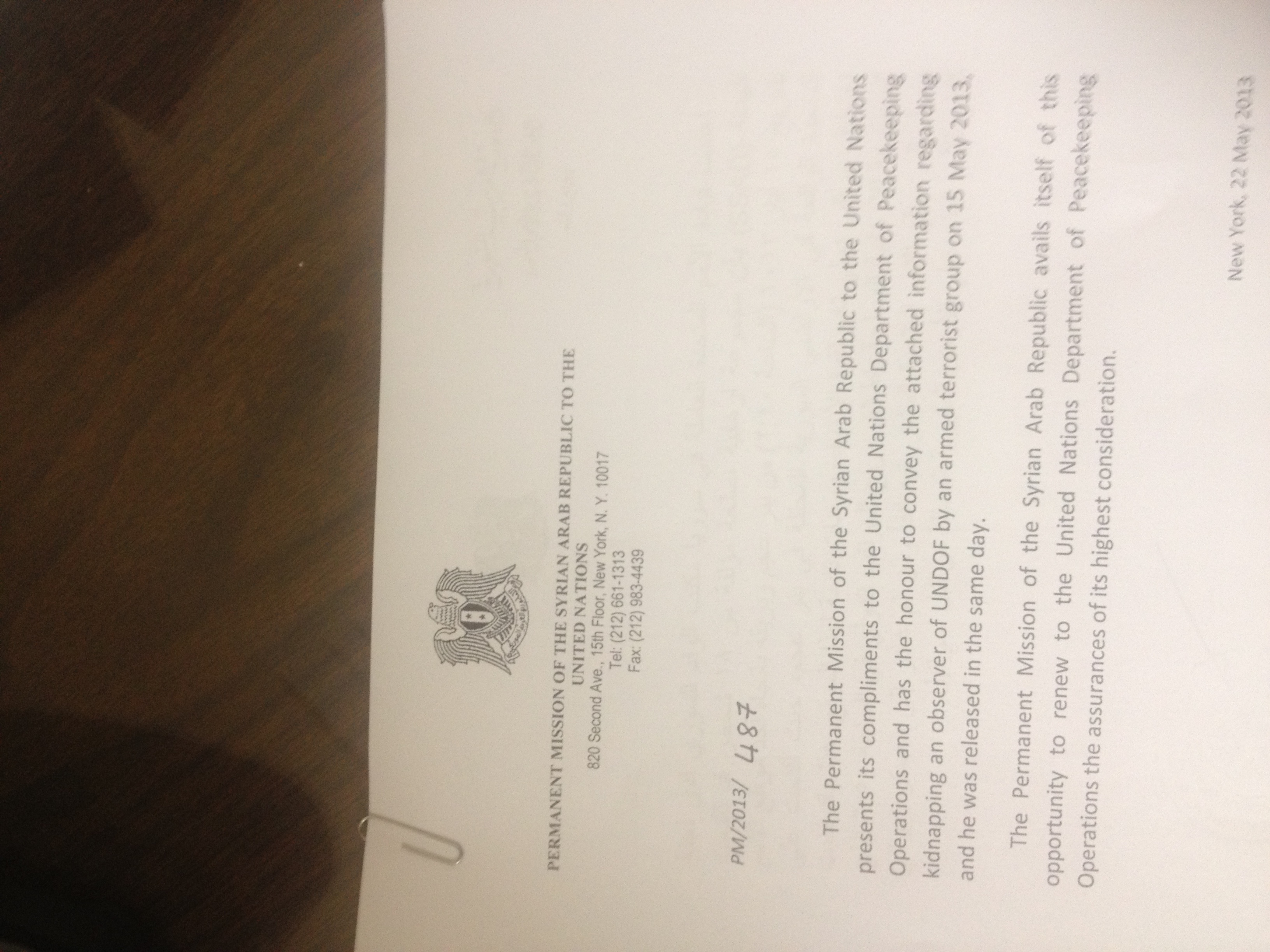
In this last kidnapping, DPKO chief Herve Ladsous did not make an announcement in the usual fashion of his predecessors, also French, Alain Le Roy, Jean-Marie Guehenno and Bernard Miyet.
Rather Ladsous confined the news to a "conversation" with scribes friendly to him, who did not ask or write about the charge, made in the General Assembly on May 14, that senior UN Secretariat officials know of involvement from Qatar in the kidnapping.
Now, Ladsous' DPKO have been provided with more information, and for now the cover letter is public. Inner City Press on the morning of May 22 asked DPKO spokespeople about what Syria's Permanent Representative Bashar Ja'afari had informed DPKO of.
The response was one of unawareness of any incident since May 15, and we appreciate it. But of the May 15 incident, which Ladsous confined to friendly scribes, what now?
What now that Austrian defense minister Gerald Klug says his country with withdraw its 380 peacekeepers from the Golan if the EU arms embargo is left to provide weapons to rebels?
Have the Fijians finished their "recce"? These are questions that Ladsous should be answering: publicly, not only in conversations friendly scribes. Watch this site.
Friday, May 17, 2013
Exclusive: On Third Golan Kidnapping, Syria PR Ja'afari Told Ladsous He Must Investigate, Secretariat "Is Involved," Stonewalling
By Matthew Russell Lee, Exclusive
Inner City Press spoke with Ja'afari exclusively on Friday morning and got his read-out of his meeting with Ladsous.
But before publishing this story, Inner City Press asked Ladsous's Department of Peacekeeping Operations twice for its side, and asked Secretary General Ban Ki-moon's deputy spokesman Eduardo Del Buey, who refused to answer.Video here.
While Ladsous is almost pathologically adverse to answering Press questions -- video here -- the defensiveness of the UN Secretariat, according to Ja'afari, springs from the fact that in the kidnappings, "some people are involved in the Secretariat... it's a big scandal."
Ja'afari told Inner City Press that when he met with Ladsous on May 16, Ladsous "tried not to give the impression he is aware of what I said, but he is."
What Ja'afari said, in the General Assembly on May 15, was that e-mail shows that the UN was aware of the involvement of Doha, Qatar in the kidnappings, including a planning role of the Syrian opposition "ambassador" to whom Qatar has given Syria's embassy.
Ja'afari told Inner City Press that this went up to the "high level of DPKO." Inner City Press asked Ban's spokesman Del Buey about this at the May 16 noon briefing, but has yet to get an answer.
Inner City Press asked DPKO in writing one last time, after Del Buey refused on camera, here, to provide its own read out of Ladsous' meeting with Ja'afari. DPKO replied, "Regarding the read-out of USG Ladsous’ meeting with Syria’s Permanent Representative, DPKO does not provide read outs of the USGs meetings."
Ja'afari told Inner City Press that at his May 16 meeting with Ladsous, "I insisted on him to investigate, I told him, the ball is in your court, go and investigate, otherwise it will keep on going on."
But if the past is any guide, Ladsous DPKO does NOT investigate. It never investigated its own role in the killing in Cote d'Ivoire of internally displaced people perceived as Gbagbo supporters in the Nahibly camp.
It has yet to investigate its role in the killings, including of a peacekeeper, in Abyei. DPKO was asking this again on Friday, and has yet to provide answers, insteading wishing a good weekend. Watch this site.
Subscribe to:
Posts (Atom)