Showing posts with label moscow. Show all posts
Showing posts with label moscow. Show all posts
Monday, February 29, 2016
On Syria, Annexes to Last Minute, France Wanted In, Sources Tell Inner City Press
By Matthew Russell Lee
UNITED NATIONS, February 26 -- When the UN pulled the plug on the Intra-Syrian Talks, or as envoy Staffan de Mistura said merely pushed them back, de Mistura said that the UN "is not prepared to hold talks for the sake of talks."
Then de Mistura was scheduled after delay to brief the Security Council on Friday, February 26 at 3 pm, in connection with a vote on a US - Russian draft Inner City Press had seen.
After a delay described below, de Mistura briefed by video, saying he intends to re-convene Intra-Syrian talks on March 7.
The Council approved the resolution 15-0, Russia's Gatilov spoke of strict implementation, and the need for "immediate" talks.
At 2:40 pm, UK Ambassador Matthew Rycroft was in the hall outside the Council, talking heatedly into his cell phone. Another Council diplomat, on background, said there would be a delay of at least 30 minutes or an hour - someone didn't agree.
Inner City Press was told by sources it was to renegotiate the annex of groups.
Now Inner City Press has been informed of more. In the public session, UK Matthew Rycroft said "The HNC represents a broad sweep of the opposition forces fighting in Syria against the tyranny of Asad. They deserve our whole-hearted support, which regrettably was not reflected in this resolution."
Other changes were to the Cairo and Moscow platforms. But, the sources tell Inner City Press, the country which occasioned the delay was.... France.
France was miffed to have been left on the sidelines by the Russian - US bilateral negotiations. Similarly miffed to have been left on the sidelines of the US - China negotiations on North Korea? Strange how when elected members complain, for example about their exclusion from the so-called "Group of Friends on Western Sahara," France is unconcerned or happy. Now, they feel excluded... We'll have more on this.
On February 19, Russia convened a UN Security Council meeting and proposed a draft resolution on the sovereignty and territorial integrity of Syria. Western powers, as they're called, were dismissive the draft.
Here's some of what Turkey's Permanent Representative said, as fast transcribed by InnerCityPro.com:
"The fighting, it’s not only bombing militarily, hospitals, schools, medical facilities, are being bombed, after the Russian Federation’s intervention in the war, the majority of the civilian casualties are caused by this intervention. So it is, the resolution is there, so why do we need another resolution in that regard? When I see the text I found it... silent on the humanitarian issue.
"For us, any terrorist organization is a terrorist organization, full stop. For PYD they seem to try to get legitimacy by seeming fighting with Daesh. Actually this is not the case... For us, fighting against another terrorist organization does not give legitimacy to any terrorist organization."
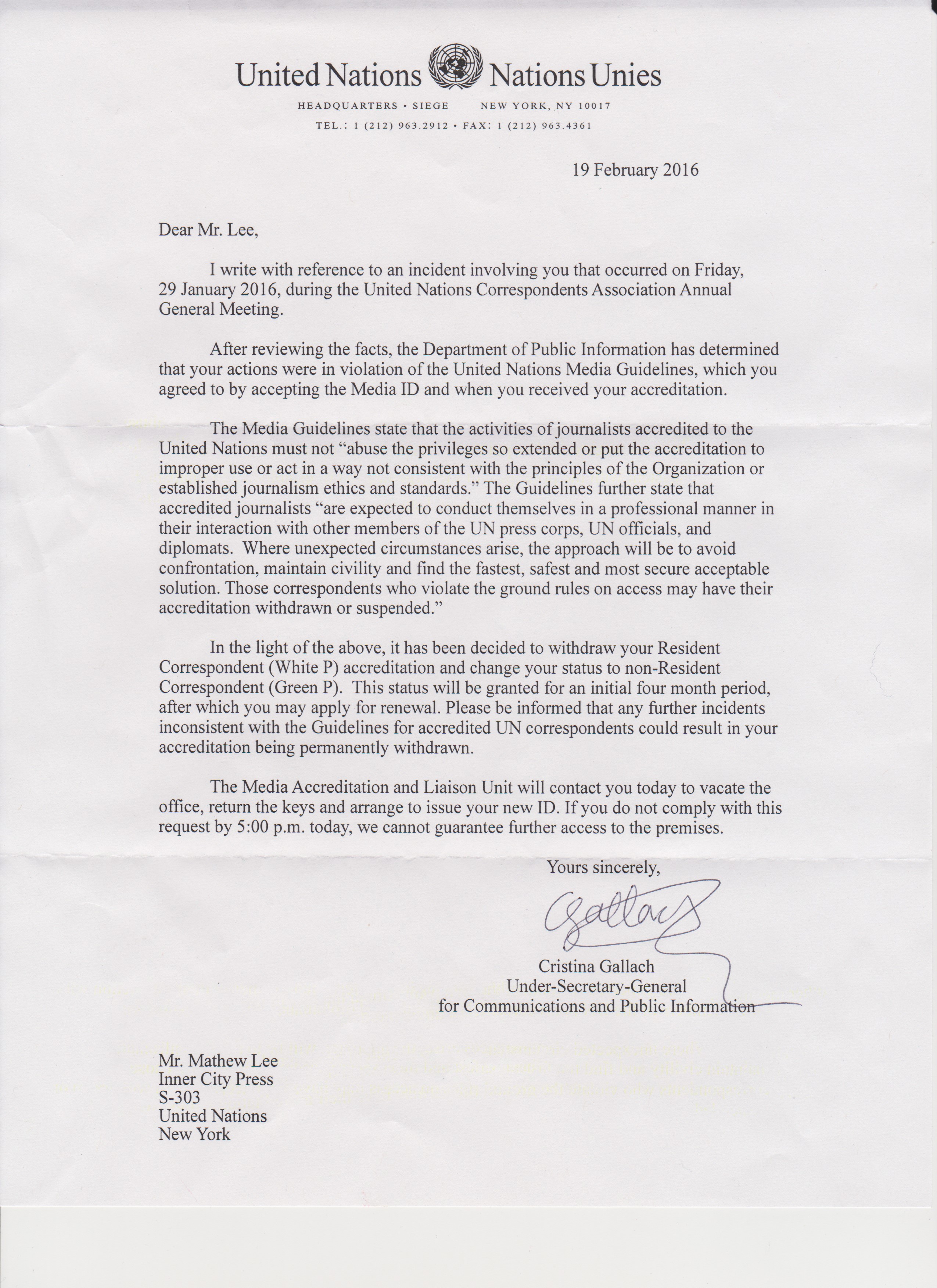
Here is what US Ambassador Samantha Power said, as transcribed by the US Mission - which is aware of the UN trying to eject investigative Inner City Press for covering a meeting in the UN Press Briefing Room, UN letter here:
"Quick comment in my own right, which is that what’s really important is that rather than trying to distract the world with the resolution they just laid down, it would be really great if Russia would implement the resolution it’s already agreed to. We have Resolution 2254, we all came together in the Council before the end of the year, we all united around its provisions, and our emphasis should be on implementation.
Right now, we have a bombing campaign in the northern part of Syria that is hitting hospitals, that has caused mass displacement, more than 70,000 people gathering now at the border – huge suffering. We need to focus on implementing 2254. It’s incredibly important that there’s de-escalation, that all parties use restraint and show restraint.
But this is a distraction from the core fact, which is that 2254 needs to be implemented. We have a resolution on the books. It’s the right resolution. We’ve committed ourselves to it, and we need Russia to do the same."
Inner City Press -- in the middle of being thrown out of the UN for seeking to covering meetings in the building, click here for that -- talked its way through a UN Security block at the Council stakeout and asked Turkey's Permanent Representative Cevic if his country would send in ground troops. He said only if part of a multinational force.
Also at the stakeout - with a UN Security "minder" still trailing Inner City Press, like one of Ban Ki-moon's thought police as one wag put it -- Inner City Press asked the President of the Council for February, Venezuela's Rafael Ramirez, if he would convene and emergency meeting if Turkey or Saudi Arabia were to send in ground troops. He said yes, he would convene such a meeting.
But as things stands, even with Ban Ki-moon's censor Cristina Gallach receiving calls to delay and reverse her decision, Inner City Press could not cover such an emergency Security Council meeting.
We'll have more on all this.
On February 16, Inner City Press asked Syrian Ambassador Bashar Ja'afari about de Mistura's and Ban Ki-moon's explanations of why those talks ended - and about the UN saying Ban was misquoted in or misinterpreted by the Financial Times.
Ja'afari said that the UN would rather blame itself than the opposition, because then the UN would get push-back from “Westerners.” Ja'afari said that de Mistura's deputy only provided him with a partial list of the opposition delegations as the talks were ending. Ja'afari called them badly organized.
Before Ja'afari spoke, the Security Council's president for February Rafael Ramirez of Venezuela told reporters that the Council's members agreed to tell Turkey to comply with international law. Associated Press - click here for AP's UN rape reporting on Feb 15 - asked if that meant all members. All to different degrees, was the answer.

Saturday, May 9, 2015
Despite Calls for Competitive Next UN Secretary General Race, Ban Ki-moon & Irina Bokova Trip Noted, Second Row
By Matthew Russell Lee
UNITED NATIONS, May 9 -- How should the next UN Secretary General be selected, to improve the Organization? That was the question on the afternoon of April 27 in what was called a "closed" meeting in the Trusteeship Council Chamber. The meeting being labeled closed, and not on UN webcast, is a bad beginning, theFree UN Coalition for Access believes. So it reported on it, see below.
But what does current Secretary General Ban Ki-moon think? On May 6 his deputy spokesperson Farhan Haq was asked if Ban "has ever weighed in on this debate."
Haq replied, "He has, in fact. And he's said in several public venues that he thinks it's high time for a Secretary-General to be a woman. Of course, it's not in his hands to determine who that person will be, and he's not going to offer any opinions about who should be selected, but certainly, the time for a female Secretary-General has come."
Haq replied, "He has, in fact. And he's said in several public venues that he thinks it's high time for a Secretary-General to be a woman. Of course, it's not in his hands to determine who that person will be, and he's not going to offer any opinions about who should be selected, but certainly, the time for a female Secretary-General has come."
Three days later in Moscow, while some noted that Ban was put in the second row, others noticed in that photograph that Ban had taken with him not only his (American) chief political adviser Jeff Feltman but also Bulgarian UNESCO chief and next SG wannabe Irina Bokova - some told Inner City Press this was Ban presenting and endorsing Bokova. What was the UNESCO connection?
And why hasn't Bokova's UNESCO spoken on the destruction of cultural heritage in Sana'a, Yemen by the Saudi led coalition's airstrikes? We'll have more on this.
And why hasn't Bokova's UNESCO spoken on the destruction of cultural heritage in Sana'a, Yemen by the Saudi led coalition's airstrikes? We'll have more on this.
But amid calls for an open, transparent and competitive process, how Ban be favoring or helping any candidate? We'll have more on this.
For his part, Ban is head to South Korea (some noting he may run for office there.) Inner City Press asked on May 8
Spokesman Stephane Dujarric: You had country-specific questions?
Inner City Press: The country is South Korea. I just want to know, since it's out there and it has been reported in The Korea Times, can you confirm that the Secretary-General is going to South Korea for four days in and around 22 May?
Spokesman: I cannot confirm at this point, but I encourage you to attend the briefings next week.
Inner City Press: The country is South Korea. I just want to know, since it's out there and it has been reported in The Korea Times, can you confirm that the Secretary-General is going to South Korea for four days in and around 22 May?
Spokesman: I cannot confirm at this point, but I encourage you to attend the briefings next week.
We'll be there.
Inner City Press did its reporting about the UNGA meeting, from India urging that there be more than one - a panel - of candidates proposed, to Moldova emphasizing that the next SG should come from Eastern Europe.
Canada said regional rotation should inform but not determine the selection. The UK to its credit released a copy of the speech by new Permanent Representative Matthew Rycroft - but how to square its proposals with David Cameron nominating Andrew Lansley to replace Valerie Amos as Emergency Relief Coordinator, then insisting that the UK should have the post, now in the person of Stephen O'Brien.
Update: With only a few dozen states choosing to speak, the chair decided to try to finish them all -- five states in twelve minutes? -- to end the debate on April 27. This too may not be the right spirit.
Update II: And when the rushed session ended, the next one was announced for May 12, on the "institutional memory" of the Office of the President of the General Assembly.
Earlier in a 10 am press conference by the campaign called "1 for 7 Billion: Find the Best UN Leader."
At the April 27 UN noon briefing, Inner City Press asked Ban Ki-moon's deputy spokesperson for Ban's views on needed reforms. Apparently there are none: it is up to member states, he said, adding that selecting a women would be good. What about pay to play?
Inner City Press asked the panel if, as happened last time, increase trade and aid funding by a candidates' country should at least be disclosed, if not prohibited. William Pace of WFM replied not only about countries spending hundreds of million of Euros, but also about the heads of international agencies using their posts to campaign.
Since UNDP's Helen Clark is known to have told associates and underlings she would like to be the next SG, Inner City Press asked the panel for comment. They were diplomatic, including on the UK, said to be a reformer on the SG post, having insisted it retain the Emergency Relief Coordinator positioon, albeit in the person of Stephen O'Brien and not Cameron's first nominee (and National Health Service destroyer) Andrew Lansley.
Natalie Samarasinghe of UNA-UK said the campaign around (well, against) Lansley was a positive step forward; she said that social media makes secret processes less possible. (But see the replacement at Yemen envoy of Jamal Benomar by a Mauritanian official who has not made public financial disclosure).
Yvonne Terlingen, now Senior Policy Adviser at WFM, also cited the OCHA process or campaign. WFM's Pace seemed to conflate the entire UN press corps with the UN Correspondents Association, a group that for example tried to censor Press coverage of how Under Secretary General Herve Ladsous got the job, then tried to get the Press thrown out.
The new Free UN Coalition for Access seeks to open the UN and these processes - watch this site.
Friday, July 18, 2014
In UNSC on MH17, Feltman Says Ban Ki-moon Slams "Apparently Deliberate Downing of a Civilian Aircraft” - Mind Reader?
By Matthew Russell Lee
UNITED NATIONS, July 18 -- In the UN Security Council just after 10 am on July 18 Jeffrey Feltman, former a US official now UN political affairs chief, read-out a four page briefing.
Feltman said “the UN has at this point no independent verification of the circumstances regarding the tragic crash.” But, he added, UN Secretary General Ban Ki-moon “strongly condemns this apparently deliberate downing of a civilian aircraft.”
Feltman said “the UN has at this point no independent verification of the circumstances regarding the tragic crash.” But, he added, UN Secretary General Ban Ki-moon “strongly condemns this apparently deliberate downing of a civilian aircraft.”
This gave rise to a question: is Feltman or Ban Ki-moon saying the shooters-down of the MH17 plane KNEW it was a civilian aircraft?
Feltman recited that “on July 13, the Ministry of Foreign Affairs of the Russian Federation issued a statement noting that one Russian national died and two were seriously injured when a Ukrainian army shell hit a residential house. Ukraine has rejected this claim.”
The news, such as there was, in Feltman's briefing was that Ban has asked him to travel to Kyiv and Moscow. Is he viewed as impartial? At this point, perhaps the UN thinks, does it matter?
Earlier on July 18 the Security issued a Press Statement; here is the text, now as sent out by the Rwandan presidency of the Council, still not (as of 10:42 am) by the UN Spokesperson's Office:
"The members of the Security Council expressed their deepest sympathies and condolences to the families of the victims, and to the people and Governments of all those killed in the crash in Eastern Ukraine on 17 July of Malaysia Airlines Flight MH17 from Amsterdam to Kuala Lumpur.
The members of the Security Council called for a full, thorough and independent international investigation into the incident in accordance with the international civil aviation guidelines and for appropriate accountability.
The members of the Security Council further stressed the need for all parties to grant immediate access by investigators to the crash site to determine the cause of the incident"
The members of the Security Council called for a full, thorough and independent international investigation into the incident in accordance with the international civil aviation guidelines and for appropriate accountability.
The members of the Security Council further stressed the need for all parties to grant immediate access by investigators to the crash site to determine the cause of the incident"
Meanwhile earlier on July 18 tthe Syrian Coalition rebels put out a press release that they should be given "advanced weapons."
Here is what the Syrian Coalition, until recently headed by Saudi backed Ahmad Al Jarba and now headed by Saudi backed Hadi Al Bahra, said:
“Louay Safi, spokesman for the Syrian Coalition, said earlier that the connection between the Assad regime and ISIS has never been so intimately interwound as it is today with the progress being made by regime forces near Aleppo and that of ISIS in Deir Ezzor. These advancement have not been interrupted by a single clash between regime forces and ISIS, which proves the existence of full coordination between them.” Safi attributes the setbacks suffered by Syrian rebels to the reluctance of the friends of Syria group to provide the rebels with the advanced weapons that can tip the balance on the ground.”
What about, “in the air”? The Syrian Coalition continues:
“Furthermore, Safi agrees with the former U.S. ambassador to Syria Robert Ford, who blames the rise of extremist groups in Syria on the Obama administration’s hesitation to support the moderate opposition forces. The military situation is very critical, as regime forces are about to laid siege on Aleppo. But even if Assad’s forces recapture Aleppo, the crisis will not be over. (Source: Syrian Coalition)”
So, what of the US announced plan for $500 million to “vetted” Syrian rebels?
Also on Syria, on July 14 when the UN Security Council adopted a resolution on humanitarian access to Syria, its Operative Paragraph 11 said the Council “affirms that it will take further measures in the event of non-compliance with this resolution or resolution 2139 (2014) by any Syrian party.”
Afterward, Australia's Permanent Representative to the UN Gary Quilan emphasized at the media stakeout that resolutions are binding, that the Council had affirmed that it will take measures if not complied with by the parties. Video here, from Minute 2:10
Inner City Press sought to ask a question about a statement inside the Security Council by Russia's Vitaly Churkin, and Quinlan agreed to take the question. Inner City Press asked Quinlan to respond to Churkin saying that the resolution “doesn't plan for automatism” in sanctions or the use of force, that any such steps would require the specific consideration of the Security Council and “convincing evidence.” Video of Churkin's statement here, from Minute 25.
Quinlan replied that what Churkin said was correct, then said that while there would have to be a further decision by the Security Council about what measures to take, the decision that some measures would be taken has already been made. Video here from Minute 18.
Readers can draw their own conclusion how meaningful it is to claim that a decision to definitely act has been made, if another vote including veto powers is required.
Footnote: Asking this question was not easy. The first question was given to Voice of America; the second taken by the whip of the UN Correspondents Association's president, sometimes writing for the Huffington Post. She then tried to keep the UN Television boom microphone operator for giving the microphone to Inner City Press -- even as Ambassador Quinlan said, “Matthew... what Ambassador Churkin said was correct.”
This UNCA, becoming the UN's Censorship Alliance,seems to believe it can block questions (as well as having tried to get Inner City Press thrown out after its reporting about Sri Lanka, here). The new (and resulting) Free UN Coalition for Access opposes this.
To come full circle, acknowledging deft diplomacy by Australia and its co-leads Jordan and Luxembourg on this resolution, it is sometimes hard not to note the contradiction of Australia returning asylum seekers from Sri Lanka after only “reviewing” their claims on a ship. Inner City Press has asked Ambassador Quinlan about this, and we hope to have a story on the topic soon. Watch this site.
Thursday, March 20, 2014
As Turkey Blocks Twitter, Erdogan Tactics Echo Banning from Google's Search of Anti-Press Complaints to UN, With Its Turkish Lounge
By Matthew Russell Lee
UNITED NATIONS, March 20 -- Turkey has now blocked Twitter citing a court order, after Prime Minister Recep Tayyip Erdogan in order to get his leaked phone calls removed from Google's YouTube has reportedly "copyrighted" his calls.
Both censorship moves have echoes in the United Nations, which as part of its renovation accepted money and named an area by the Security Council previously open to all accredited journalists the "Turkish Lounge."
As set forth below, an anti-Press complaint to the UN's Stephane Dujarric, now Secretary General Ban Ki-moon's spokesperson, has been banned from Google's Search by an invocation of copyright similar to Erdogan's.
And as to Twitter, Dujarric in his previous post in charge of UN Media Accreditation grilled Inner City Press about a tweet mentioning World War Two - the basis for example of France's veto power in the Security Council, which it parlayed into essentially permanent ownership of the top post in UN Peacekeeping, now though Herve Ladsous (coverage of whom Dujarric tried to dictate, or advise, Inner City Press about.)
Dujarric is French, and his now bipolar tweeting has intersected with a recently revived anonymous trolling campaign which originated in the UN Correspondents Association, in support of the Sri Lankan government, alleging that any coverage of the abuse of Tamils must be funded by the now defunct Tamil Tigers.
These outright attempts to censor are echoed, more genteelly, even as part of the UN press briefings these says. When Dujarric took eight questions on March 20 on Ban's essentially failed trip to Moscow, fully half went to representatives of UNCA's 15 member executive committee, including state media from Turkey, France and the United States. Other questions -- by Twitter -- were not answered, except those from explicitly pro-UN sources. These are the UN's circles.
Google has accepted and acted on DMCA complaints about leaked e-mails, for example from Reuters to the United Nations seeking to get the investigative Press thrown out, and has then blocked access to the leaked documents from its search.
Of this abuse of the Digital Millennium Copyright Act, theElectronic Frontier Foundation's Intellectual Property Director Corynne McSherry told Inner City Press about the Reuters case:
"Unfortunately, it is all too easy for a copyright holder (assuming that the person that sent this notice actually held copyright in the email) to abuse the DMCA to take down content and stifle legitimate speech. As countries outside the US consider adopting DMCA-like procedures, they must make sure they include strong protections for free speech, such as significant penalties for takedown abuse."
In this case, copyright is being (mis) claimed for an email from Reuters' Louis Charbonneau to the UN's chief Media Accreditation official Stephane Dujarric -- since March 10 Ban Ki-moon's new spokesperson -- seeking to get Inner City Press thrown out of the UN.
Access to the document has been blocked from Google's search based on a cursory take-down request under the Digital Millennium Copyright Act.
If this remains precedent, what else could come down?
Why not an email from Iran, for example, to the UN's International Atomic Energy Agency? Why not a sanctions filing by a country? Here is Reuters logic, accepted if only automatically by Google:
The copyrighted material is a private email I wrote in April 2012 and for which I never gave permission to be published. It has been published on a blog and appears in on the first page of search results for my name and the firm I work for, Reuters. It can be seen here: http://www.innercitypress.com/reutersLC3unmalu.pdf
But this is true of ANY leaked document: it can be said that the entity or person exposed "never gave permission [for it] to be published." Does that mean Google can or should block search access to it?
Can a complaint to a Media Accreditation official against a competitor legitimately be considered "private"? In any event, the DMCA is not about protecting privacy.
Iran or North Korea could say a filing or status report they make with the IAEA is "private" and was not intended to be published. Would Google, receiving a DMCA filing, block access to the information on, say, Reuters.com?
Charbonneau's bad-faith argument says his complaint to the UN was "published on a blog." Is THAT what Reuters claims makes it different that publication in some other media?
The logic of Reuters' and Charbonneau's August 14, 2013 filing with Google, put online via the ChillingEffects.org project, is profoundly anti free press.
The fact that Google accepts or didn't check, to remain in the DMCA Safe Harbor, the filing makes it even worse. The request to take-down wasn't made to InnerCityPress.com or its server -- it would have been rejected. But banning a page from Search has the same censoring effect.
The US has a regime to protect freedom of the press, and against prior restraint. But this is a loophole, exploited cynically by Reuters. What if a media conducted a long investigation of a mayor, fueled by a leaked email. When the story was published, could the Mayor make a Reuters-like filing with Google and get it blocked?
Here is the text of Charbonneau's communication to the UN's top Media Accreditation and Liaison Unit official Stephane Dujarric and MALU's manager, to which he claimed "copyright" and for now has banned from Google's Search:
Hi Isabelle and Stephane,
I just wanted to pass on for the record that I was just confronted by Matt Lee in the DHL auditorium in very hostile fashion a short while ago (there were several witnesses, including Giampaolo). He's obviously gotten wind that there's a movement afoot to expel him from the UNCA executive committee, though he doesn't know the details yet. But he was going out of his way to be as intimidating and aggressive as possible towards me, told me I "disgust" him, etc.
In all my 20+ years of reporting I've never been approached like that by a follow journalist in any press corps, no matter how stressful things got. He's become someone who's making it very hard for me and others in the UN press to do our jobs. His harassment of fellow reporters is reaching a new fever pitch.
I just thought you should know this.
Cheers,
Lou
Louis Charbonneau
Bureau Chief. United Nations
Reuters News Thomson Reuters reuters. com
Louis Charbonneau
Bureau Chief. United Nations
Reuters News Thomson Reuters reuters. com
This email was sent to you by Thomson Reuters, the global news and information company.
The fool of Reuters to the UN
by Mahesh - 12/27/2013 -calls for the removal of a letter from the head of his bureau at the United Nations, pursuing a copyright infringement on the part of the competition
Try to make out a small competitor from the UN press room and then, when these publish proof of intrigue, invokes the copyright to release a letter from compromising the network.
MOLESTA-AGENCY Inner City Press is a small non-profit agency covering the work of the United Nations for years, with an original cut, which become distasteful to many. Unlike other matching its founder master sent never tires of asking account of inconsistencies and contradictions and often refers to unpleasant situations involving colleagues and their reportage, too often twisted to obvious political contingencies.
THE LAST CAVITY – In this case the clutch is born when Matthew Lee, Inner City Press ever since he founded and made famous in the 90 's, challenged the screening of "Lies Agreed Upon" in the auditorium of the United Nations, a filmaccio of propaganda in which the Sri Lankan regime tries to deny the now tested massacres (and destroyed by International Crisis Group). In the piece, in which denounced the incident, Lee also announced that the screening was organized by the President of the United Nations Correspondents (UNCA), Italian Giampaolo Pioli, skipping the normal consultation procedure for this kind of events. Pioli then, was also accused of being in a conflict of interest, given that he rented an apartment in New York an apartment to the Deputy Permanent Representative to the UN in Sri Lanka, named Palitha Kohona and is suspected of war crimes.
TRY WITH THE COPYRIGHT- So he comes to the letter with which Louis Charbonneau, Reuters bureau chief at the United Nations, wrote to the Media Accreditation and Liaison Unit (MALU) calling for the ouster of Lee, which the UN being there for years as his colleagues, but we see that this was not done. Lee, however, comes into possession of the letter and publish it, and then writes to Google millantando Charbonneau the copyright on the letter and asking for removal pursuant to the Digital Millennium Copyright Act. That is a bit like if a company request the removal of a compromising document from a journalistic investigation, in the name of copyright, a claim clearly absurd and disingenuous.
HARASSMENT AND THREATS- In the letter published, Charbonneau complained about the aggressive behavior of Lee and cited among the witnesses to cases where Lee had been "aggressive" towards him even Pioli.Lee with that piece has gained throughout a hail of protests from Sri Lanka and an investigation by the UNCA, along with death threats and other well-known amenities the refugees away from the clutches of the regime, but it is still there. Behold then the brilliant idea of Charbonneau, improperly used copyright law to censor the objectionable publications to a colleague and competitor. Pity that Lee has already resisted successfully in similar cases, in 2008 was the same Google to remove your site from being indexed in the news in its search engines, it is unclear what impetus behind, only to regret it soon after that even Fox News had cried scandal.
On Ukraine, US Sanctions Bank Rossiya, Urges on IMF, As Ban Ki-moon Fails in Moscow, Hides From Questions
By Matthew Russell Lee
UNITED NATIONS, March 20 -- New US sanctions on Russia were described on March 20 by four Senior Administration Officials, including on what they called the "cronies' bank" Bank Rossiya which they said will be prevented from operating to the greatest extend possible.
Another US Senior Administration Official spoke of restrictions on goods from Ukraine and said this might violate Russia's World Trade Organization obligations. But what about the unilateral sanctions?
The US said it wants the International Monetary Fund to move fast, and during the background call the IMF put out a press release, that its review is going well and its mission will wrap up on March 25.
UN Secretary General Ban Ki-moon's race to Russia for relevance didn't work as he'd hoped. Just after his meetings with Vladimir Putin and Sergey Lavrov, Lavrov went to the Duma for the next step on Crimea.
Then Ban's spokesperson did a call-in Q&A to the UN press briefing room in New York where only questions pointing one way were selected and allowed. Thus, there were no questions to Ban's spokesperson Stephane Dujarric about the new unilateral sanctions, or the trade embargo allegations.
On March 19 after US Ambassador Samantha Power said Russia's Vitaly Churkin was creative like Tolstoy or Chekhov, Churkin asked for a right of reply or additional statement at the end of the March 19 UN Security Council meeting on Ukraine.
Churkin said that from these two literary references, Power has stooped to tabloids, and that this should change if the US expected Russian cooperation. The reference, it seemed, was to Syria and Iran, and other UN issues.
One wanted to explore this at the stakeout, but neither Power nor Churkin spoke there. In fact, no one did: even Ukraine's Yuriy Sergeyev left, down the long hallways with his leather coat and spokesperson. One wondered why.
There were many questions to ask. Why did Ivan Simonovic's UN human rights report not mention the Svoboda Party MPs beating up the head of Ukrainian national television? Will France, despite its Gerard Araud's speech, continue selling Mistral warships to Russia? What of France's role in the earlier referendum splitting Mayotte from the Comoros Islands?
Araud exchanged a few words with those media he answers to while on the stairs, then left. The UK's Mark Lyall Grant spoke longer, but still left. Why didn't Simonovic at least come and answer questions? Perhaps he will, later in the week.
When Security Council session began at 3 pm on March 19, Russia was listed as the tenth speaker, after other Council members including not only the US but France. (The order, however, would soon change: Argentina and Russia switched spots.)
Speaking first, Deputy Secretary General Jan Eliasson recounted dates and events, such as the US and European Union sanctions of Marcy 17. Inner City Press asked UN spokesperson Stephane Dujarric if there was any UN comment on or view of such unilateral sanctions. There was no comment.
UN human rights deputy Ivan Simonovic spoke next, saying that attacks on ethnic Russians have been neither widespread nor systematic. Simonovic did not mention the widely publicized assault on a national TV executive by Svoboda Party MPs.
Ukraine's Yuriy Sergeyev mocked the referendum, saying that those who didn't vote were visited at home.
France's Gerard Araud said that if there are fascists in this story, it is not where they're said to be -- but he did not address the Svoboda Party and its attack on the TV executive. Nor has he addressed the analogy to the referendum France pushed to split Mayotte from Comoros, nor France's ongoing sale of Mistral warships to Russia.
After Nigeria spoke, Argentina's listed place was taken by Russia, in what has been confirmed to Inner City Press as an exchange. Russia's Vitaly Churkin zeroed in on Simonovic not mentioning the Svoboda MPs' assault, nor evidence that the same snipers should police and protesters in Kyiv.
US Ambassador Samantha Power called this an assault on Simonovic's report, and said Churkin had been as imaginative as Tolstoy or Chekhov, echoing an earlier US State Department Top Ten list. So what is the US, one wag mused, John Updike or Thomas Pynchon? It was a session meant for words.
Now that UN Secretary General Ban Ki-moon races to Russia for relevance, the news was handed out selectively by UN Moscow three hours before Ban's new spokesperson, after a request, confirmed it.
It's worth remembering Moscow's anger at who called Ban's tune on Kosovo. What will be different now? After Russia, Ban will head to Kyiv to meet Yatsenyuk and the UN human rights monitors.
But no announcement by Ban's Office of the Spokesperson, which has repeatedly refused to confirm Ban trips even when the country visited has already disclosed it.
And so the Free UN Coalition for Access wrote to Ban's new spokesperson Stephane Dujarric:
"Will you confirm what BBC says UN Moscow told it, that the Secretary General is traveling to Russia tomorrow to meet President Putin and FM Lavrov -- and is so, can you explain why and how this UN news was distributed in that way first, and not through your office, to all correspondents at once? The latter part of the question is on behalf of the Free UN Coalition for Access as well."
Forty five minutes later, after a mass e-mail, Dujarric replied:
"Matthew, The official announcement was just made. The UN office in moscow did not announce anything before we did. I did see some leaked reports this morning from various sources but nothing is official until it's announced by this office."
But it wasn't a "leaked report" -- BBC said that UN Moscow hadCONFIRMED it. We'll have more on this. For now it's worth reviewing Ban Ki-moon's response to Abkhazia and South Ossetia in 2008...
The day after the Crimea referendum, the US White House announced new sanctions and Russia said Ukraine should adopt a federal constitution.
Inner City Press asked UN Secretary General Ban Ki-moon's spokesperson Stephane Dujarric for Ban's or the UN's comment on either, if Ban thinks sanctions should ideally be imposed through the UN and not unilaterally, and if this might lead to a tit for tat.
Dujarric said Ban's focus is on encouraging the parties to "not add tensions;" on Russia's federal constitution proposal he said the UN is "not going to get into judging every step." Video here.
With Serry gone from Crimea and Simonovic called unbalanced by Russia, what is the UN's role? Is it UNrelevant?
On the US sanctions earlier on March 17, self-described Senior Administration Official (SAO) 1 described sanctions on individuals in the Russian arms sector. One had and has to wonder: how does this relate to the sale of Mistral warships to Russia by US ally France? Inner City Pressasked at the State Department on March 14, click here for that.
SAO 2 said the US can now impose sanctions on "Russian government cronies." Also on the list: Viktor Yanukovych. Another SAO offered "fun facts" about the referendum, including pre-marked ballots. It was repeatedly noted that the EU list of sanctions individuals, not to be publicly released until March 18, overlaps somewhat but is different from the US list.
Notably, a Senior Administration Official said that "we" - presumably meaning the US, are moving forward with IMF negotiations. But what is the US' direct role in what the IMF says is an entire independent process?
SAO 1 acknowledged this will impact the US' bilateral relations with Russia, noting the G8, but saying that Russia is "invested" in the Iran P5+1 process, and in the removal of Syria's chemical weapons. What about Afghanistan, the subject of the UN Security Council's meeting on March 17?
Going into the meeting, UK Ambassador Mark Lyall Grant said that the plan is to have a General Assembly briefing on Ukraine on March 20.
Even as the Crimea referendum vote was taking place, US Senators returned from a whirlwind trip to Kyiv to appear on the US Sunday morning television shows.
Senator Bob Corker R-TN said that the Obama administration created a "permissive" atmosphere that led to this; he slammed Secretary of State John Kerry's "wishy-washiness" and gifts with Sergey Lavrov.
But in the Senate committee mark-up last week, Corker was all bipartisan sweetness and light. What changed?
Also on Fox News Sunday, Senator Bob Menendez D-NJ insisted that for the International Monetary Fund to help Ukraine, the long-stalled reforms must be passed by Congress.
But when Inner City Press put this question directly to IMF spokesperson Gerry Rice on March 13, Rice declined to confirm the connection. See video here, at from Minute 12:05.
Over on CBS' Face the Nation, former US National Security Adviser Tom Donilon bragged how sanctions on Iran showed what could be done to pressure Russia.
But on NBC's Meet the Press, Senator Jeff Flake R-AZ said it's going to be difficult to "reverse" Crimea with economic sanctions.
Here's something that should and will be pursued this week: France's continued sale of Mistral warships to Russia, even as its UN AmbassadorGerard Araud rails about Russia losing a rook and chess game in Ukraine. Who's playing games?
On Ukraine, on March 15 after the UN Security Council vote on a US-drafted resolution calling the Crimea refendum invalid failed with Russia vetoing and China abstaining, Urkaine's Yuriy Sergeyov told the press there are Russian troops on the mainland.
He said there will be more action next week, mentioning a debate on "revitalization," presumably of the UN General Assembly, aimed at the UN Security Council veto system.
Little mentioned in Saturday's proceedings is that the US vetos resolutions on Israel, in settlements for example, and votes against non-binding resolution in the General Assembly about the embargo on Cuba, for example.
Sergeyev is deft, but he refused to answer a question about how the expansion of NATO impacts on this. "Don't provoke me," he said.
The Free UN Coalition for Access objects to speakers at the UN picking which questions to answer. There are worse cases: France's Gerard Araud for example refused to answer on his country's sale of Mistral warships to Russia. Herve Ladsous of UN Peacekeeping went so far as to direct his spokesman to grab the UN microphone so a question couldn't be asked. Video here and here.
The US to its credit in terms of a single standard has questioned, at least implicitly, the French Mistral sale to Russia. Inner City Press on March 14 asked US State Department deputy spokesperson Marie Harf about the sale:
Inner City Press: on Ukraine, one question that’s come up is, in terms of sanctions is France has this big deal where it’s selling Mistral warships to Russia, and it’s said that it’s going forward. What does the United States think of that sale of military hardware?
MS. HARF: Well, decisions about these kind of sales are obviously a matter for each sovereign state to take into account including a host of factors – obviously, international law, regional stability. We would hope that any country would exercise judgment and restraint when it comes to transferring military equipment that could exacerbate tensions in any conflict region. In general, I think that certainly applies here. Video here, from Minute 20:13.
Operative Paragraph 5 of the vetoed resolution, which even the UK Mission to the UN put online before the UN itself did, provided
"OP5 Declares that this referendum can have no validity, and cannot form the basis for any alteration of the status of Crimea; and calls upon all States, international organizations and specialized agencies not to recognize any alteration of the status of Crimea on the basis of this referendum and to refrain from any action or dealing that might be interpreted as recognizing any such altered status"
So, the Crimea resolution scheduled for March 16 would have no validity. But, as Russian foreign minister Lavrov asked in London on March 14, couldn't the same be said of the French-organized referendum splitting Mayotte from the Cosmoros?
Inner City Press asked US State Department deputy spokesperson Marie Harf about both the resolution and the Mayotte analogy on March 14. From the US transcript:
Inner City Press: on Ukraine, there’s talk of the Security Council resolution – seems pretty clear that Russia would veto it, but there’s some discussion of trying – is it the U.S.’s intention to try to get a vote on a resolution declaring the referendum illegal before Sunday?
And also, Lavrov mentioned, and also Churkin as well, this example of Mayotte. They used – I mean, they’ve come up with different examples – Kosovo and others – but one in particular. Both of them raised an island of Comoros where France organized an referendum to break Comoros off – to break Mayotte off from Comoros, and said that this wasn’t authorized by the UN or the African Union. So I just wondered – I mean, maybe you’ll slap it down, but what’s the response to their argument?
MS. HARF: Well, in general, I think that it’s very clear under Ukraine’s constitution that governs Ukraine how this kind of referendum legally could take place. And that would involve a country-wide referendum, basically relying on the premise that any decisions about Ukraine’s territory need to be made by all of the people of Ukraine. So setting aside any comparisons, there are very clear rules in Ukraine’s constitution, which is in effect, that lay out how this kind of referendum could take place. That’s not what we see here. So any comparisons aside, they just don’t have relevancy here.
On the first question, I don’t have anything on a potential Security Council resolution. We’ve been very clear that there will be costs. I don’t have anything to outline for you in terms of what that might look like, but we as the United States, independently, have a number of tools at our disposal that we can use if and when we need to make clear those costs with this referendum going forward. Video here from Minute 18:34.
Back on March 13 when Churkin took the Council floor he had a flourish of analogies: the US Declaration of Independence, the Falkland (or Malvinas) Islands, Puerto Rico, and the recognition by some of Kosovo without even a referendum, he said, only an act of the legislature.
Churkin said that France organized a referendum to break Mayotte away from the Comoros, in violation of UN resolution and using their veto, he said. Click here for some background.
Would French Amabassador Gerard Araud respond?
Of late at the UN, his spokesperson Frederic Jung has called only on friendly journalists; Araud refused for example to answer why France is still selling Mistral warships to Russia, and claimed that Navi Pillay has not reported that France put Muslims at risk in the Central African Republic. The jokes, some say, are getting stale.
Speaking after former US, now UN official Jeffrey Feltman, Yatsenyuk said if Russia persists, no country will ever again give up nuclear weapons, as Ukraine did.
Yatsenyuk shifted into Russian to speak directly to Ambassador Vitaly Churkin, just as Ambassador Sergeyev has done. But Russia wasn't listed to speak and reply until the 14th of 17 slots. After Luxembourg as Council President for March, the next three speakers were the US, UK and France.
US Ambassador Samantha Power cited the draft UNSC resolution, but didn't opine if China might abstain rather than join Russia in a veto.
When French Ambassador Gerard Araud spoke, the question in the air which he refused to answer is why France is going forward with the sale of Mistral warships to Russia. Rather than answer it, Araud made stale jokes about Kosovo.
While in Washington, Yatsenyuk said he knows the International Monetary Fund program is "not the sweet candy." Inner City Press covers the IMF and can only say: ask Greece.
Here is video of the IMF's March 13 briefing, see Minutes 12:05 and 31:12.
Asked about allowing any referendum in Crimea, Yatsenyuk said the legislature in Kyiv would have to permit it; he said there could be dialogue about increased autonomy from Crimea, on taxes and language rights.
He was asked about Jihadis going to Crimea and he answered about the Tatars. He bragged that a deputy prime minister in the new government "represents the Jewish community." But what about Right Sector?
The US State Department announced for example that the Department of Defense will be giving Meals Ready to Eat or MREs to the Ukrainian Armed Forces.
Over on Capitol Hill, the US Senate Foreign Relations Committee marked-up the "Support for the Sovereignty, Integrity, Democracy, and Economic Stability of Ukraine Act of 2014."
Absent on jury duty, Senator Marco Rubio had a proposed amendment about the G8 and not invading your neighbor read out; it was agreed to.
Senator Rand Paul proposed an amendment to remove loan guarantees and the International Monetary Fund from the bill. He said the loans would go to back Russia back and noted that the proposed IMF reforms would raise Russia's power in the IMF from 2.5% to 2.71%
Senator Bob Menendez replied that the IMF wouldn't give a dime unlesss Ukraine commits to changes. Can you say, austerity? Watch this site.
Subscribe to:
Posts (Atom)