Showing posts with label Mkapa. Show all posts

Monday, March 7, 2016

In Burundi, Torture in Mutakura, Poisoning Even VP of Tax, Waiting for Mkapa


By Matthew Russell Lee

UNITED NATIONS, March 6 -- After UN Secretary General Ban Ki-moon on New Year's Eve issued a statement surreally praising the Burundi “talks” held in Entebbe, Uganda, multiple sources told Inner City Press these not really talks but rather a photo op. The January 6 session announced for Arusha did not happen.  Inner City Press requested to cover the UNSC's trip to Burundi, but was UNtransparently rejected.

Ban Ki-moon took no press with him to Burundi - and then praised Pierre Nkurunziza's decision on the media, after having decided, through his Under Secretary General Cristina Gallach and Spokesman Stephane Dujarric, to throw Inner City Press out of the UN. Petition here. Video of 1st protest here (in Tamil).

In Burundi the killings continue, including it seems by poison. An Inner City Press source provides this update:

"Lt. colonel Darius IKURAKURE head of Muzinda and some of his followers in his regiment are on the top list of people who torture and kill anyone believed to be part of opposition in Mutakura. A private house occupied by his soldiers on 3rd avenue no:20 Mutakura zone to be a place of torture and execution of anyone who protested against Pierre Nkurunziza."

  Meanwhile others say that Burundi's Kiki Ndimaso and Edmomd Bizabigomba, Vice President of the Tax Authority died of poisoning and that their families are afraid to talk. In that context, we publish these dispatches; we will have more.

On March 4, Inner City Press asked Ban's deputy spokesperson Farhan Haq, UN transcript here:

Inner City Press: I wanted to ask you, it's been announced that the EAC (East African Community) has replaced a… the mediator on the Burundi talks and put Mr. [Benjamin] Mkapa, former Tanzanian president, in charge.  And I wanted to know, one, will Mr. [Jamal] Benomar be working with him?  Presumably, yes.  But do you have any comment on this change of mediator, and is there any renewed hope for more than took place under the Ugandan mediation?

Deputy Spokesman:  Well, we certainly hope that the mediator will work to help resolve the problems that Burundi has been facing.  We have our utmost faith in President Mkapa that he can help in his capacity as mediator.  And, yes, Mr. Benomar will work with him.

Inner City Press asks, if this just deck chairs on the Titanic?

On March 2, Inner City Press asked Ban's Haq, UN transcript here:

Inner City Press: In Burundi, the Government itself has acknowledged and is putting on display what it says is a mass grave in Mutakura with 30 bodies in it, recent… you know, recently and hurriedly buried.  And I wanted to know, given the discussion… I know that Mr. [Ivan] Šimonovic had said that he wanted to have people present.  I know that the experts are there.  I'm not sure if they're going to go to this site.  What is the UN. what is the response to the finding of this mass grave?  And what is the UN team being assembled by Mr. [Jamal] Benomar going to do as it's looked into?

Deputy Spokesman Haq:  Well, we're concerned about any allegations of mass graves.  There is a team there, and they are going about their work, and they will report back on their findings.  But, right now, what we're looking for is for them to be able to go about their work, to meet officials in the Government of Burundi, and follow up on whatever information they think is important.

  Three experts, for all these corpses? 

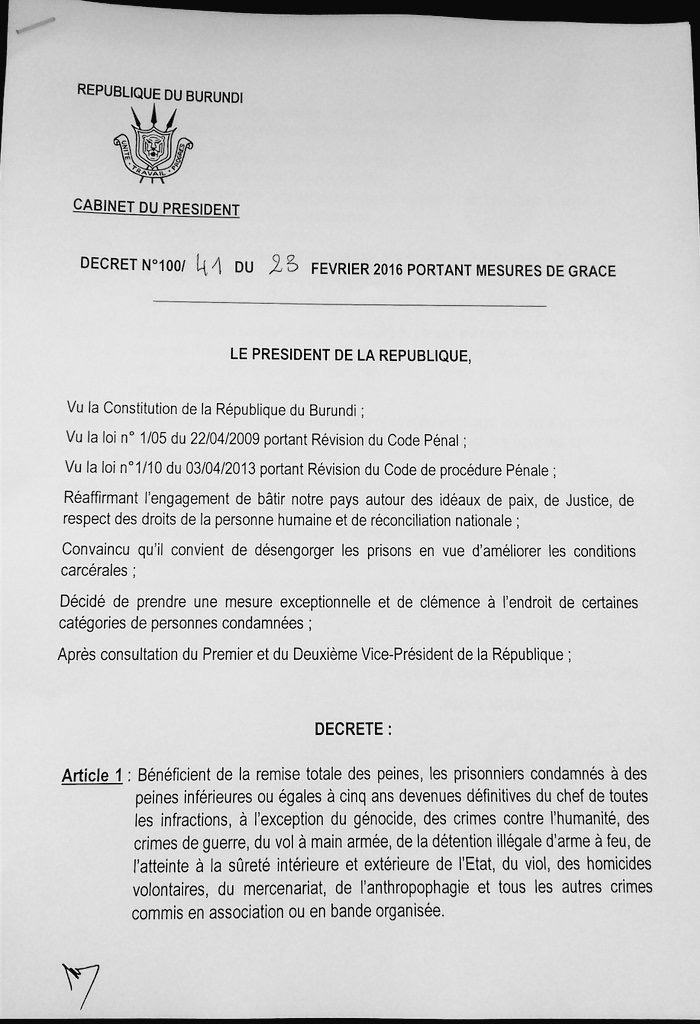
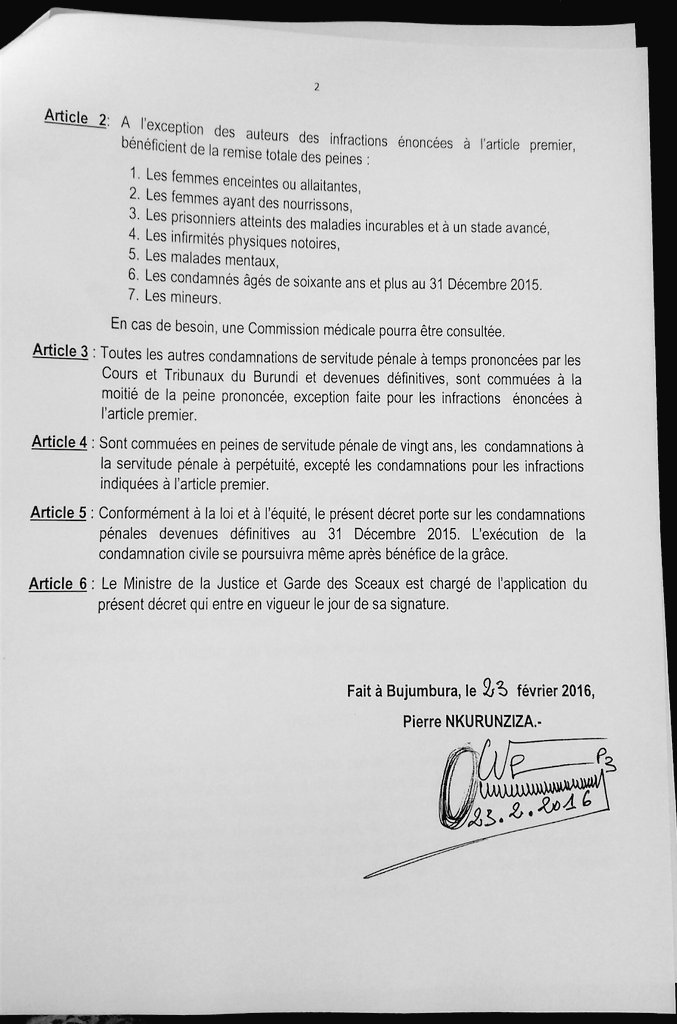
  On the other end of the human rights spectrum, Ban made much of Nkurunziza's ostensible commitment to release political prisoners and meet with "the opposition." But which opposition? And which prisoner? Inner City Press while ousted from the UN published what Nkurunziza signed, here and here, and on February 25, filing a lawyer's letter directing the UN to not touch its office or files, entered and asked UN Spokesman Stephane Dujarric these questions, UN transcript:

Inner City Press: I wanted to ask you about Burundi first.  I saw the statement by the Secretary-General praising the reopening of some radio stations and the release of prisoners.  And I wanted to ask you two questions about that.  One is, is he aware, and what do you say that two… two of five radio stations have opened and they've been forced to sign pledges to not undermine the country's security?  Is that… does he think that that type of pledge is legitimate?  And on the prisoners, most people are saying that the… this document signed by President [Pierre] Nkurunziza doesn't involve the release of any political opponents, FNL [National Liberation Front] members or anything else.  It's sort of a… it's one of those fake releases where these are people that have nothing to do with the unrest.

Spokesman:  I think what the Secretary-General did yesterday was to welcome these as initial steps and said that it was not enough and he would want to see more.  I don't have any particular reports on pledges that were signed.  Obviously, as a matter of the principle, radio stations in Burundi should be able to broadcast freely and fairly any news that they want.  And, as for the detainees, I don't have the details of who they were.  Obviously, there are different reports.  But as I said, we would want to see more people released.

Inner City Press:  Well, the document that the President signed, it's been published and it's clear that it doesn't cover the people that are part of the opposition.

Spokesman:  I think it's… as I said, we welcome this as an initial step, and we'd like to see more.

Inner City Press:  And will there be follow-up?  What follow-up is the UN going to give having…?

Spokesman:  Mr. [Jamal] Benomar has an expanded team there.  They are in constant contact with the Government.

  Compare Dujarric's canned answers to this critique from ICP's sources on the ground:

Article 1 mentioned categories of those who are supposed to be realized. The common fact is that those mentioned in the article do not have any relation with the Ongoing political unrest. Actually, we were excepting the realise of FNL, MSD, and all political prisoners such as insurgents, and the above mentioned opponents to the regime. But none of them would fall under the categories evoked by the article.

 On Ban Ki-moon's meeting with Nkurunziza: Is the dialogue going inclusive. We shall be able to see it if Nkurunziza says that is going to meet key opposition figures and the civil society leaders, including Nyangoma (CNARED), Sinduhije (Red Tabara), Nininahazwe Pacifique, etc. When? And where? Remember Nkurunziza said that he'll never seat on same table with co-plotters, protest and insurgent leaders as well. So, what is the guarantee that he changed is mind? We'll have more on this.

In Bujumbura on February 23, Ban said:

"I welcome the decision by His Excellency President Nkurunziza to withdrawal some media bans, cancel the arrest warrants and release detainees as good will gestures. President Nkurunziza told me this morning that he will release a list of twelve hundred detainees and take other measures. I have asked him, while I welcome these generous support and measures but I would expect that additional measures should be taken. This is an encouraging step. I hope again additional measures will be taken."

  On February 19, Ban's guards and DPI threw Inner City Press out of the UN, physically, and have yet to restore its Resident Correspondents pass.

But even from the park in front of the UN on 43rd Street in Manhattan, Inner City Press interviewed Security Council ambassadors about Ban's trip, which despite his typical lack of transparency has in fact begun on February 22.

Inner City Press tweeted a photo, here, and reports from sources that already, five men have been killed in Bujumbura and Gisozi while Ban was in the country.

Echoing again  Ban's "victory tour" of Sri Lanka in 200. That one, Inner City Press covered - and things have proceeded.

At the February 5 UN noon briefing, Inner City Press asked Ban's Deputy Spokesperson Farhan Haq about Burundi, video heretranscript here.  

  Handpicked to go and memorialize the trip was Reuters, which barely reported what happened. There is a history, of Reuters UN bureau hereand here; on February 3, Reuters correspondent Michelle Nichols went so far as to cut off Inner City Press' questions to the UN, Vine here.

  On February 3 Reuters' UN bureau chief Lou Charbonneau, a censor,  channeled a UN (DRC) report -- note not only the former Reuters official turned Eritrea sanctions “experts” exposed by Inner City Presshere, but also that this same now discredited Reuters / UN individual was previously ON the DR Congo panel. Typically, Reuters did not actually put the report online.

  Inner City Press in the spirit of transparency is publishing the (update) report, dated January 15, 2016, signed by Coordinator Gaston Gramajo, and its two paragraphs about 18 Burundian combatants, here


Readers can draw their own conclusions, including about the mandate and motivation, and if these 18 is really the way it would go.

 On January 28, Inner City Press asked UN spokesman Stephane Dujarric about a meeting held but not televised on January 27, at which it was urged that mass grave sites in Burundi be preserved as evidence,video here, transcript here.

On January 29, Inner City Press asked Dujarric again, transcript here.
 

  So it's all on Zeid, nothing from Ban Ki-moon, who appears to be playing this like he did Sri Lanka...

 At the UN Security Council stakeout, Inner City Press waited -- including through two North Korea questions, and softballs -- then asked if this UN use of Burundian troops makes sense. There has yet to be an answer, although there are indications one might be forthcoming. (More than 24 hours later, no).  Here for now is about the US training Burundian troops. Watch this site.

Inner City Press asked Ban's spokespeople about the trip on January 20, 21 and 22 - including asking why the UN was not providing a video or at least audio stream of the January 22 press encounters, says it has a  "UN Information Center" in Bujumbura, which produced a smiling photo of the French deputy ambassador Alexis Lamek on the tarmac. The UN said it couldn't.

  Local media in Burundi put online a video in which Lamek spoke at length; afterward a pro-government Burundian media quoted Lamek that "we" take seriously the question of interference by Rwanda to destabilize Burundi and will be working on it.

  But the four scribes handpicked to accompany the Security Council trip, including Agence France Presse, it seems, for some reasons didn't cover it. Why? We'll have more on this. Instead, AFP, Reuters andVoice of America (which saw "Liberians" then cited auto-correct) filed near-identical stories with no quotes from opposition figures or attacked journalists. None of the three even tweeted on January 23, other than Reuters as a robot: talk about Old Media.

  How could "Agence France Presse," handpicked to publicize the UNSC trip co-led by France, not even cover the controversy?

  We note that the French Mission to the UN said that Lamek was being misrepresented (the same French Mission has tried to shield Lamek from critical Press questions, which here on Vine Lamek has refused to answer even when entirely audible). Later an AFP quote emerged of Lamek saying that any AU force, even the 100 human rights observers, should significantly focus on the Rwandan border.

  On the evening of January 23 the UN has put up select clips including a mere 16 seconds of French deputy ambassador Lamek, much less than the local Burundian media present at the same press encountered had.  If the UN filmed the press encounters, why did it so selectively edit them?

  More specifically, now, who decided on the edits?

Inner City Press, which is the media which on January 22 asked for the live-stream, has asked the UN, publicly on Twitter, here, and in more detail by e-mail to three top UN spokespeople:

"having just seen that your Office put online edited video from Burundi, must ask: why did UN edit the footage it has, with no Burundi government speaker, and only 16 seconds of France, penholder in the UNSC on Burundi? Please provide the full footage, in response to this request and, separately, online. Would also still like answers to questions below" on Burundi.

 And still no answers at all, the next day. Watch this site.

  The UN spokespeople refused to say, but beyond the pro-government "religious leaders" that they cited, the Council also met with at least some of the concerned members of civil society, and some journalists who inevitably raised the issue of attacks and censorship. This was not mentioned by the UN.

  We're told that Ambassador Albert Shingiro, who blocks the Press on Twitter, told the scribes that US Power said she would send “a strong message to the government of Rwanda." Again, Shingiro blocks the Press on Twitter: some diplomat.

   On January 22, Inner City Press asked UN Deputy Spokesperson Farhan Haq for the UN's response to Pierre Nkurunziza denying the existence of his party's youth militia, and why there was no video or even audio stream of the Security Council's - and Nkurunziza's -- press statements. Video here.

  Haq replied that "the facilities are difficult," that the UN Spokesperson's Office had reached out to the traveling party for information but hadn't gotten any. The Free UN Coalition for Accesscalls this a failure.

 On January 21 Inner City Press in New York learned both of Pierre Nkurunziza plans to parade "community work" for the Security Council members on January 22 and has been provided with a letter promoting same, here.

  On January 21, Inner City Press and the Free UN Coalition for Accessasked UK Permanent Representative Matthew Rycroft about his stop-over on Addis Ababa, "will you as UK meet with AU before heading to Burundi? About AU's proposed deployment?"

   Rycroft replied, "Yes! Looking forward to meeting @AU_Chergui today. Will also return to Addis with whole UNSC after Burundi."

  In Addis, Chergui had filed the Concept of Operation for the MAPROBU peacekeeping mission. We'll have more on this.

  Burundian civil society has written to Ban seeking the repatriation of the country's peacekeepers. Inner City Press has put the letter from Vital Nshimirimana to Ban online here, and will be asking the UN about it. Watch this site.

  On December 30 Nkurunziza threatened to have his forces attack peacekeepers proposed for the country.


Obtained by Inner City Press

Ladsous' lack of vetting was criticized in the recently released report into the cover up of peacekeepers' rapes in the Central African Republic. Earlier, Inner City Press exclusive reported on Ladsous in his October 1, 2015 meeting with Burundi's vice president saying that he is "pragmatic" on human rights.

 On December 16 Inner City Press was banned from questions to Secretary General Ban Ki-moon, but learned from the mission MINUSCA that Baratuza was already in Entebbe. Inner City Press asked several Security Council members, then Ban's spokesman Stephane Dujarric on December17.

Dujarric told Inner City Press Baratuza's deployment is suspended and he is being repatriated: "based on the information we've received regarding the Lieutenant Colonel, his deployment has been suspended, and he will be repatriated back to Burundi." Video here. Dujarric told Inner City Press this shows the UN system working - on a day when a report on rapes was issued showing UN Peacekeeping under Herve Ladsous not sufficiently vetting for human rights. We'll have more on this.


 Amid the escalating killings in Burundi, summary executions in neighborhoods opposed to Pierre Nkurunziza's third term stand out. But Burundi Army spokesman Gaspard Baratuza was quoted on December 12 blaming all of the deaths on attempts to steal weapons to free prisoners.

   Inner City Press heard that Mr. Baratuza was already in the process of being deployed to the UN Peacekeeping mission in the Central African Republic (MINUSCA) even when he was giving these quotes, issuing statements and speaking to state-owned radio, and so asked MINUSCA's acting spokesperson, “Is Gaspard Baratuza of Burundi's army getting a MINUSCA job?” Ultimately, after the questioning, he didn't.
 
   But the UN should have to say more. Inner City Press has repeatedly asked the UN how its Department of Peacekeeping Operations under Herve Ladsous vets those who deploy to UN missions; Inner City Pressexclusively reported on an October 1, 2015 meeting in which Ladsous told Burundi's Vice President Joseph Butare that he is “pragmatic” on human rights.
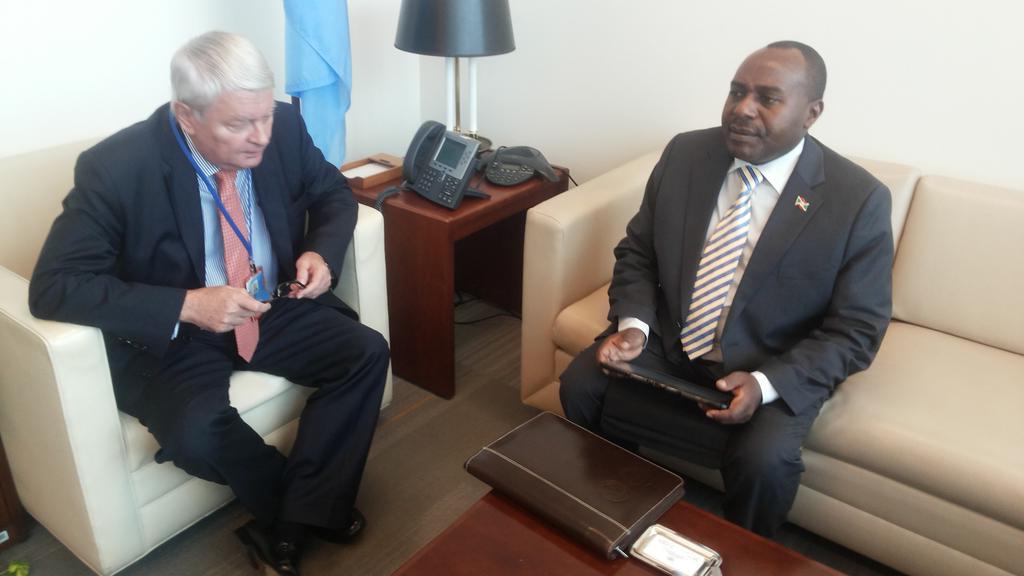


 Ban Ki-moon and his spokesman declined to take Inner City Press' questions on December 16, as they did on December 14. Vine here.  Watch this site.

Saturday, December 4, 2010

On S. Sudan Vote & Ban's Panel, UN Dodges Questions of Payment, Diaspora Visits

By Matthew Russell Lee

UNITED NATIONS, November 26 -- With questions mounting about the registration process for the Southern Sudan secession referendum scheduled for January 9, the UN is withholding basic information about the Panel to which Secretary General Ban Ki-moon “outsourced” key parts of the UN's role.

At media briefings by Ban's spokesperson, Inner City Press has asked about how the Panel is funded, which registration sites they have visited in the United States, Canada, Ethiopia and Kenya, and whether they are implicitly trying to blame the SPML for under-registration of Southern Sudanese in the Northern part of the country and/or in the eight “diapora” countries in which polling would be held.

UN acting Deputy Spokesman Farhan Haq has declined to answer many of these questions, referring instead to a separate spokesperson's office set up for the panel. While Inner City Press has sent this “outsourced” office two recent rounds of questions, only one has been answered, and then only partially.

This seems to be a pattern at the UN -- to name a Panel and then refuse to answer questions about the subject matter outsourced to the Panel.

Left unanswered for example is when the registration site in four of the diaspora countries -- Australia, Egypt, Uganda and the United Kingdom -- will be visited and by whom, how much Panel chair Benjamin Mkapa has been paid and by whom, and what he meant when he blamed “some Southerners” for blocking registration in the North of Southern Sudanese.

Herebelow in order are Inner City Press' two rounds of question, both of which were copied to Ban Ki-moon's two top spokespeople without response, the UN Panel spokesman's partial response to the first round, and the second round un-responded to for more than 24 hours:

Hi. I would like responses on deadline to the following questions, as well as those I asked at the OSSG's noon briefings on November 22 and November 19:

How many people work for the Panel?

How much has thus far been paid to these people and to each of the three Panelists?

How much of this has come from the Basket Fund, and how much through UNMIS?

What is the status for each donor or pledger to the Basket Fund?

As asked November 19, has a vote by the Basket Fund group been taken regarding funding the Panel? If not, why not?

How much has been paid from the Basket Fund (or UNMIS) to IOM?

In which of the eight diaspora states have registration sites actually been visited?

Please provide updated registration figures or estimates for each diaspora country, as well as the number and location of registration (and polling) sites in each.

As asked November 22, on the statement “made from the Secretary-General’s Panel on the referendum. There seems to be a lot of controversy about the low numbers of Southern registrants in the North. Some people are putting the number as low as 9,000. So it seemed like, in your statement, you are saying some Southerners are encouraging other Southerners — I just want to understand, because the SPLM [Sudan People’s Liberation Movement] blames it all on Khartoum.”

When the Panel chair referred to “a campaign by some Southern leaders to encourage people not to register and vote outside Southern Sudan” was he referring to any SPLM role or not?

Separately, why is there no Office of the Spokesperson for the Secretary-General briefing on November 26?

These were partially responded to by the Panel's spokesman:

Matthew, The Panel will have 38 staff when it reaches full deployment, which is expected by the end of this month. They are paid regular salaries just like any other UN staff members.

Any questions about the basket fund should be directed to UNDP.

Registration sites have been visited in Canada, Ethiopia, Kenya and the United States. Staff are about to visit sites in Australia, Egypt, Uganda and the United Kingdom as well.

IOM is conducting registration in the diaspora countries, so it will have the figures on the number of people registering and the number of sites. The Southern Sudan Referendum Commission will have the equivalent information for within Sudan.

The Panel chair was referring to Southern leaders and not to any specific SPLM role.

This response openly evaded the question for example of how much Benjamin Mkapa has been paid, as well as declining to answer questions about the Basket Fund to which the spokesman, and the Office of the Spokesman for Ban Ki-moon, has repeatedly made reference. And so these follow ups were submitted more than 24 hours ago to both UN offices:

Thanks but I again ask, with emphasis: How much has thus far been paid to each of the three Panelists? What you sent implies that they are “like any other UN staff members.” Are the three Panelists paid “When Actually Employed”? When have they so far been actually employed? How much have they been paid and by / through which mechanism: UNMIS or Basket Fund?

Please specify (with address) the registration sites the Panel has already visited in Canada, Ethiopia, Kenya and the United States, and will visit in Australia, Egypt, Uganda and the United Kingdom including date and who visit(ed).

And I am still asking for your (and OSSG/UNMIS) response or update on para 14 ofUnited Nations A/65/571 of 12 November 2010, Financing arrangements for the United Nations Mission in the Sudan for the period from 1 July 2010 to 30 June 2011, Report of the Advisory Committee on Administrative and Budgetary Questions

14. Concerning the requirements for the Secretary-General’s Panel, the Committee noted that, in paragraph 78 of his report to the Security Council on the Sudan (S/2010/528), the Secretary-General had indicated that it was expected that UNDP would contribute an amount of $0.9 million. Upon enquiry, the Committee was informed that the provision of those funds was uncertain, as the UNDP project documents for the referenda in the Sudan did not include the activities of the Panel and it would, therefore, require a decision by the basket fund steering committee. As such, no immediate disbursements could be made to facilitate the deployment of Panel support staff. The Committee was informed that should UNDP succeed in mobilizing resources for supporting the Panel, reimbursement to UNMIS would be made. The Advisory Committee is of the view that the Mission should continue to pursue this issue with UNDP and requests that further information on the status of the contribution be included in the context of the performance report.”

What is the status? What has UNMIS / DPKO / the Secretariat done? On deadline, thanks.

And after 24 hours and counting, no answer at all. Watch this site.

From the UN's November 22 transcript:

Inner City Press: I want to ask about Sudan on the statement that you made from the Secretary-General’s Panel on the referendum. There seems to be a lot of controversy about the low numbers of Southern registrants in the North. Some people are putting the number as low as 9,000. So it seemed like, in your statement, you are saying some Southerners are encouraging other Southerners — I just want to understand, because the SPLM [Sudan People’s Liberation Movement] blames it all on Khartoum.

Acting Deputy Spokesperson Haq: Well, that was just a summary of a press conference that President Mkapa held in Khartoum, and I’d just refer you to the transcript of that. We have that available in our office.

Inner City Press: And does the Secretary-General’s Panel have any role in overseeing these sites, these eight Diaspora voting sites in Africa, the United States, Australia? Are they going to visit any of those sites? And there is some controversy now about the IOM [International Organization for Migration] role in it. It’s not exactly clear to me who is funding the IOM for that work, but what is the Panel’s role on these other sites?

Acting Deputy Spokesperson: No, you can check with the Panel itself about the sites. It’s looking at the whole referenda process, which includes sites for Southerners to vote in the North.

Inner City Press: But isn’t his Panel — I have had some problem in the past getting responses from the Panel, so I just wanted to know, it’s the Secretary-General, he set up the terms of reference, it’s his delegated Panel, right?

Saturday, October 30, 2010

UN Panel on Sudan Vote Said “Independent from UNMIS,” Which Pays It $4.3 Million

By Matthew Russell Lee

UNITED NATIONS, October 29 -- When UN Secretary General Ban Ki-moon named a three person panel on the South Sudan referendum, it was said that the panel would be independent from the UN Mission in Sudan, UNMIS.

When Inner City Press asked panel members Benjamin Mkapa, Antonio Monteiro, Bhojraj Pokharel and their staff “are being compensated or having their expenses paid,” UNMIS spokesman Ashraf Eissa replied that “the SG's Panel is a totally independent panel from UNMIS. It reports directly to the SG in NY. The Panel Spokesperson can be contacted for such information.”

After some delay, the Panel Spokesperson told Inner City Press that “the Panel, including the salaries of its staff, is being funded from the budget of UNMIS.”

What then about the panel being independent from UNMIS, if its members and their staff are being paid by UNMIS? How can the UN and UNMIS be credible, including in reporting on troops build ups on the border, if they call something independent from UNMIS when it is getting paid by UNMIS?

In fact, in the Secretariat's current budget submission A/65/509 it is said in Paragraphs 9-10 that

the Secretary-General’s Panel on the Referenda in the Sudan has been established. This monitoring body will be an instrument for building trust in the process and acceptance of the outcomes of the referenda.... The Panel is independent from the rest of UNMIS, to distinguish it from the Mission and its role in the implementation of the Comprehensive Peace Agreement and other mandated activities, including support for the referenda and planning for the following period.

The Panel, which has been established for a period of six months, effective September 2010, involves 41 temporary positions, including one Under-Secretary-General and two Assistant Secretary-General positions comprising the Panel itself, supported by 38 international staff (1 D-1, 6 P-5, 21 P-4 and 10 P-3). Given the urgent need for these additional staff, 41 temporary positions have been approved for a period of six months, on an exceptional basis, to enable the Panel to commence its operations. The cost is estimated at $4.3 million, including $4.1 million in staff related costs and $0.2 million in travel costs.”

How can one square this statement that “the Panel is independent from the rest of UNMIS” with the later admission that the Panel members and their staff are paid by UNMIS?

Inner City Press, in writing on October 28, asked both the Panel Spokesman and Ban Ki-moon's spokesman Martin Nesirky. By noon on October 29, neither had responded, or even confirmed receipt.

At the October 29 noon briefing, Inner City Press asked Nesirky how the Panel could be described -- as in the Secretariat's budget submission, above -- as independent from UNMIS, if its members and staff are being piad by UNMIS. Video here from Minute 12:26.

Nesirky replied that “it's a question of financing and funding... at the end of the day its by [the UN Department of Political Affairs] that this is being handled.”

Inner City Press asked why then isn't DPA paying the Panel members and staff, and how can the UN say the Panel is “independent” from UNMIS if its members and staff are being paid by UNMIS?

Nesirky cut Inner City Press off, saying “Next question.” But the questions will continue. Watch this site.

Saturday, October 23, 2010

In Sudan, UNMIS Dodges on Panel and Exclusions from UN Jobs & UN Plane

By Matthew Russell Lee

UNITED NATIONS, October 14 -- Upon arriving in South Sudan a week ago, the UN Security Council was met by two separate demonstrations.

The reported one was pro-secession, in the run up with the referendum scheduled for January 9. Also in the crowd, noted by more than one journalist but at the time not reported, were signs and chants of “workers rights are human rights.”

The following day the Sudanese media on the UN flight from Juba to Darfur were thrown off the plane. This was first reported by Inner City Press, then by Sudanese publications and others.

From the US early on October 13, Inner City Press directed three questions to the UNMIS spokesman in Khartoum. Twenty four hours later, responses were provided.

But each was a model of evasion, explicitly not providing the basis information requested and in one case simply referring the question back to spokesman for Secretary General Ban Ki-moon in New York, Martin Nesirky, to whom it has been re-directed four hours before his October 13 noon briefing.

Here are Inner City Press' three questions among with explanation, and UNMIS spokesman Ashraf Eissa's responses:

“Please provide by email asap what UNMIS put out about the incident with the Sudanese journalist(s) on the tarmac in Juba in the Security Council delegation's plane.”

The basis of this question was a journalist on the trip referring to a canned UNMIS statement put out in writing in the UN Spokesperson's Office in New York. It was no longer there when Inner City Press checked. So Inner City Press asked UNMIS. But after 24 hours, Eissa replied:

“UNMIS has received formal complaints re the incident from the two institutions with which four journalists who traveled with the SC group are affiliated. UNMIS has formally responded to these complaints.”

Why not say what the “formal response” was? Security Council members, including a Permanent Five member whom Inner City Press spoke with about it, saw and then read out the ejection of the Sudanese media. What is UNMIS' response? The Council meets on Thursday morning about its Sudan trip - will it exclude this aspect?

Inner City Press also asked:

“Please provide the response of UNMIS / the UN to the "The Southern Sudanese Drivers and Mechanics Association... cit[ing] UNDP, UNMIS and Kenya Commercial Bank among the organizations that continue to employ foreigners in positions that many unemployed indiginous should hold, rendering local drivers redundant.”

To this, Eissa responded:

“On employment. It is for other organisations to answer, but as far as UNMIS is concerned, All national staff jobs are exclusively for Sudanese nationals.”

While Inner City Press was told, while at Juba airport, that much (but not all) of the protest of the UN was directed UNDP, the UN Development Program, and not only at UNMIS, doesn't UNMIS have some role to speak for the UN system, at least in South Sudan?

For example, the UN system's Humanitarian Coordinator and Resident Representative Georg Charpentier is, he seemed to say in El Fasher, an employee of UNDP. But still he purports to speak for the wider UN system. (Inner City Press has posed these and other questions to UNDP).

Cannot a formal spokesman like Eissa do the same?


UNMIS' stated mandate includes “promoting understanding of the peace process and the role of UNMIS by means of an effective public information campaign, targeted at all sectors of society... promoting the rule of law, including an independent judiciary, and the protection of human rights of all people of Sudan” -- including, presumably, those Sudanese protesting their exclusion from jobs of the UN system, including UNDP.

While the Council and media were in Sudan, UNMIS one-year chief Haile Menkerios did not speak with the press, despite requests made to the UN. Media based in Sudan say Menkerios rarely provides responses to reporters. What about “promoting understanding of the peace process and the role of UNMIS by means of an effective public information campaign" ?

Inner City Press third questions, not related to what it saw first hand in South Sudan, was

“Please describe how Benjamin Mkapa, António Monteiro, Bhojraj Pokharel and their staff are being compensated or having their expenses paid.”

To this factual and financial question, UNMIS' Eissa has responded:

“The SG's Panel is a totally independent panel from UNMIS. It reports directly to the Secretary-General in NY.”

The work of this panel in South Sudan and Abyei until October 15 is breathlessly reported on UNMIS' website, so Eissa's response seems too legalistic. Even though answers promised by Secretary General Ban Ki-moon's Spokesperson in New York Martin Nesirky back on October 11 have still not been provided, Inner City Press is re-directing this and other questions to Nesirky. Watch this site.