Showing posts with label Matthew Rycroft. Show all posts

Thursday, August 10, 2017

On Cameroon, UN's Mohammed Tells ICP Biya Trio Informed What's Not Kosher, Further Dialogue?

By Matthew Russell Lee

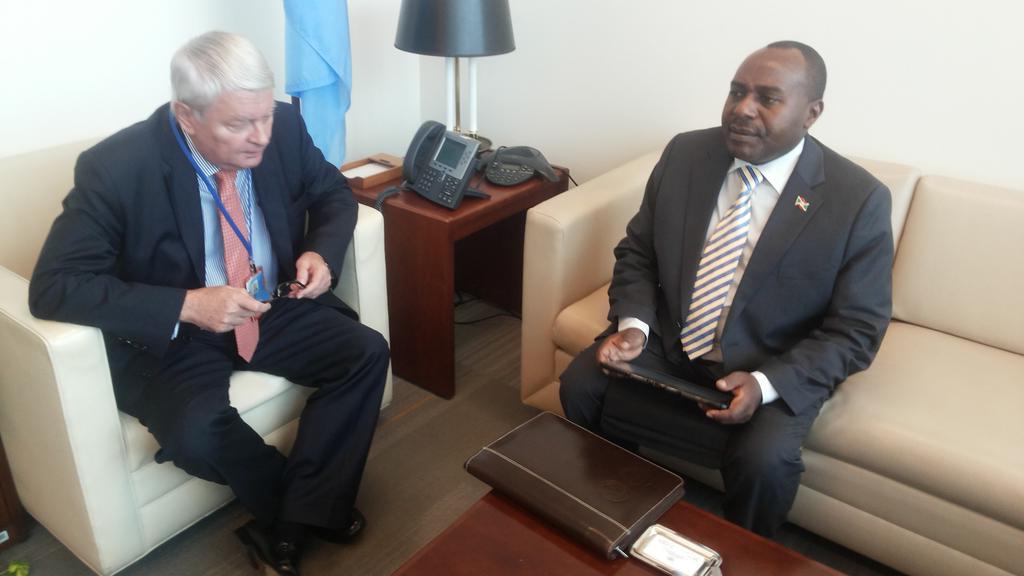
UNITED NATIONS, August 10 – After a delegation from Cameroon's Paul Biya government met with UN Deputy Secretary General Amina J. Mohammed on August 8, Inner City Press waited in the UN lobby and asked them if for example the detention of former UN legal adviser Felix Agbor Balla had come up in the meeting. 

They said no - then the delegation led by Paul Ghogomu proceeded to a part of the UN building that they and other journalists, but not Inner City Press, could go.

On August 10, after managing to ask UK Ambassador Matthew Rycroft about Deputy Secretary General Mohammed meeting (see here and below), Inner City Press waited again in the lobby to ask Mohammed herself.  

When she emerged from the elevator, near the UN's 7 pm “witching hour” for Inner City Press since the UN evicted it for pursuing the John Ashe / Ng Lap Seng corruption story, Inner City Press asked if she would answer one question. 

She said yes. So Inner City Press first asked about Agbor Balla, since he was a former UN legal adviser in Afghanistan and elsewhere, now imprisoned and facing the death penalty. 
Amina Mohammed replied, "All the issues came up in the context of why it was they were responding the way they were, whether it was heavy handed or otherwise. So it was a general bring-up, of those who were accused of human rights abuses, those who were burning flags." 

Inner City Press pointed out that even the country's former Supreme Court justice is imprisoned. 

Amina Mohammed continued, “For us, what was important was the delegation came, we engaged with them, and we told them where we were concerned about issues. Now we have a basis to open up further dialogue and push. And that's my approach. My approach is not to just whack them with a sledgehammer but it's to say firmly, this is not kosher. And so, how can we engage with you and continue to do the right thing.” We'll see - the answer was appreciated.

   As was UK Ambassador Rycroft's response, earlier on August 10, video here. Inner City Press: Amina Mohammed also on Tuesday met with this delegation from Cameroon. I just wanted to get your thoughts on whether the UN should be doing more, could be doing more? Have you seen a read out? 

Amb Rycroft: Obviously I wasn’t in the meeting myself but I was very glad to hear that the delegation were here and they had a meeting with Amina Mohammed. I think that demonstrates that the UN is keeping it on their radar as they should and I support that.  
Earlier in the year Inner City Press asked the International Monetary Fund, where it is also accredited and which unlike the UN allows it the same access as all other journalists there, about the impact of the Biya government's 94-day cut off of the Internet in the Anglophone regions of the country. The IMF said this was a financial risk factor. On IMF site, here, from 34:56. IMF transcript
It has been surprising that it took so long for the UN system, and its country team, to speak out even against the blatant censorship represented by the Internet cut off. But as Amina Mohammed and Secretary General Antonio Guterres, due back in the UN on August 14, have been informed in detail, the UN in 2016 without any hearing or appeal evicted Inner City Press, assigning its long time office to an Egyptian state media which rarely comes in, even during this month's Egyptian presidency of the UN Security Council, and never asks questions. 

Without its office, Inner City Press is unable to access much of the second floor of the UN, is unable to access the building after 7 pm, and is hindered from covering not only the Cameroon delegation but, for example, a meeting about Lebanon earlier on August 10. Inner City Press and the Free UN Coalition for Access have asked Mohammed, or Guterres upon his return, to reverse this censorship. 


There is a petition with over 2,000 signatures to this effect. FUNCA has offered to help find another more appropriate space for the rarely present Egyptian Akhbar al Yom, now in August, well before the UN General Assembly week and resolving the issue before the fresh-start arrival of new DPI chief Alison Smale. We are awaiting a response, and resolution. We'll have more on all this.

Monday, February 29, 2016

On Syria, Before de Mistura 3 pm briefing, UK Rycroft on the Phone, Delay


By Matthew Russell Lee

UNITED NATIONS, February 26 -- When the UN pulled the plug on the Intra-Syrian Talks, or as envoy Staffan de Mistura said merely pushed them back, de Mistura said that the UN "is not prepared to hold talks for the sake of talks."

  Then de Mistura was scheduled after delay to brief the Security Council on Friday, February 26 at 3 pm, in connection with a vote on a US - Russian draft Inner City Press has seen.

 But at 2:40 pm, UK Ambassador Matthew Rycroft was in the hall outside the Council, talking heatedly into his cell phone. Another Council diplomat, on background, said there would be a delay of at least 30 minutes or an hour - someone didn't agree.

  The outgoing President of the Security Council for February, Venezuela's Rafael Ramirez, told reporters he thought it would be done - de Mistura briefing, vote, then closed session, and that the North Korea resolution will "probably" be put to a vote on Saturday. We'll see.

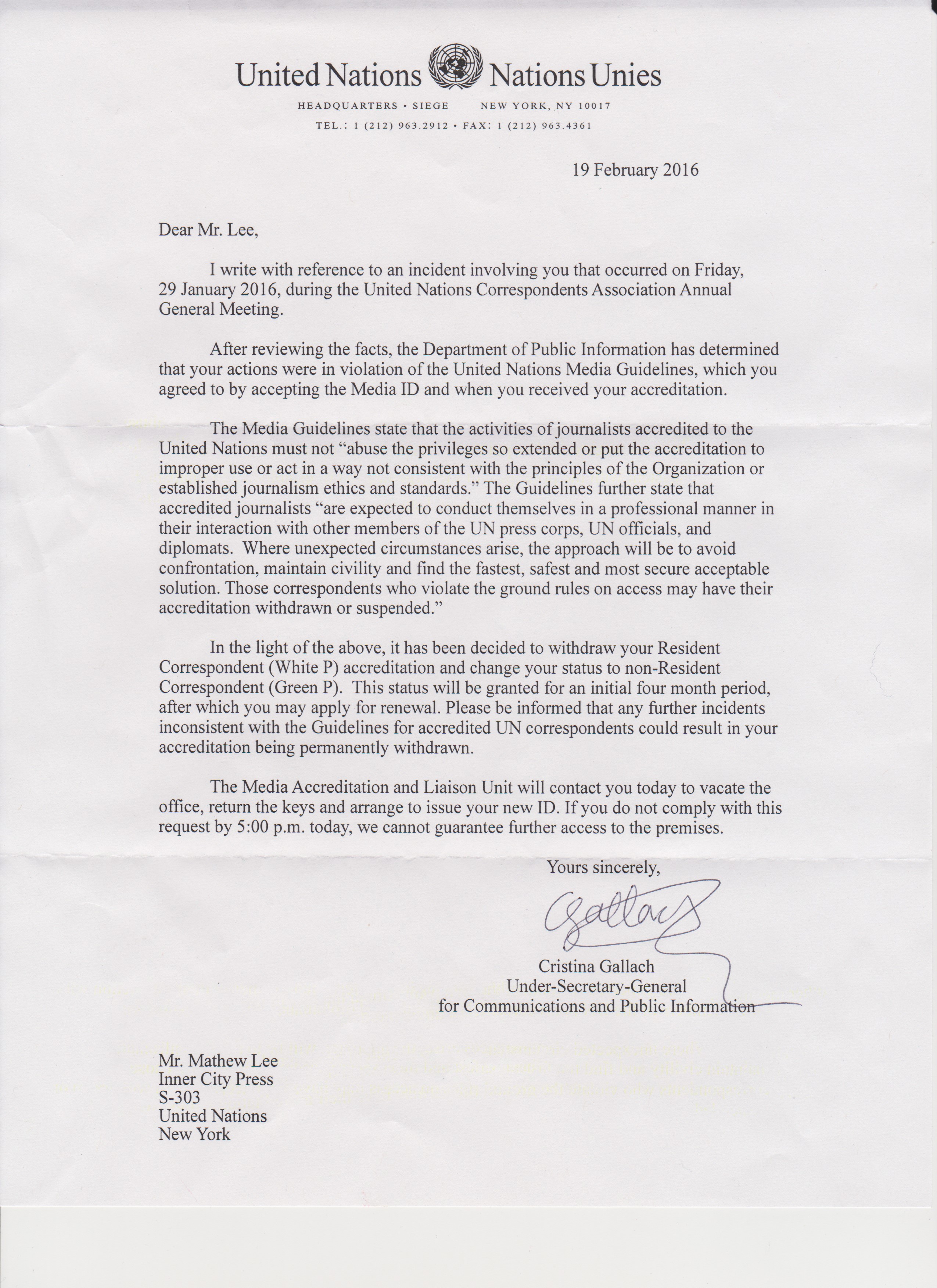
 It seems Inner City Press will have to cover it, as it did UN Relief Chief Stephen O'Brien's speech on air drops to Deir ez-Zor, from the park across First Avenue from the UN, having been ousted from the UN on two hours notice,petition here.

  Virtually the only thing the scribes at UN Spokesman Stephan Dujarric's Coffee Klatch briefing on February 24 asked was about air-drops to Deir ez-Zor (which Dujarric outrageously refused to admit is controlled by ISIS or Daesh). So we'll cover UNRWA and its blankets, or the thermal blankets of those UNRWA serves:

"Today, Wednesday 24 February, UNRWA concluded the distribution of thermal blankets after four consecutive days of operation in the Damascus suburb of Yalda. We provided 5,000 blankets to an additional estimated 1,160 Palestine refugee and other civilian families from the besieged and hard to reach communities of Yarmouk, Yalda, Babila and Beit Saham.

A total of 19,160 blankets have been distributed to approximately 5,700 families since the distribution operation started on Sunday 21 February.

UNRWA was able to resume operations in Yalda on February 14 for the first time in over six months, distributing 5,700 food parcels to families from Yarmouk, Yalda, Babila and Beit Saham over a 5-day operation. UNRWA seeks to bring a mobile health team in the coming week, to provide much-needed basic primary healthcare to civilians from the area."

  The above from UNRWA spokesperson Chris Gunness.

 On February 19, Russia convened a UN Security Council meeting and proposed a draft resolution on the sovereignty and territorial integrity of Syria. Western powers, as they're called, were dismissive the draft.

  Here's some of what Turkey's Permanent Representative said, as fast transcribed by InnerCityPro.com:

"The fighting, it’s not only bombing militarily, hospitals, schools, medical facilities, are being bombed, after the Russian Federation’s intervention in the war, the majority of the civilian casualties are caused by this intervention. So it is, the resolution is there, so why do we need another resolution in that regard? When I see the text I found it... silent on the humanitarian issue.

 "For us, any terrorist organization is a terrorist organization, full stop. For PYD they seem to try to get legitimacy by seeming fighting with Daesh. Actually this is not the case... For us, fighting against another terrorist organization does not give legitimacy to any terrorist organization."

 Here is what US Ambassador Samantha Power said, as transcribed by the US Mission - which is aware of the UN trying to eject investigative Inner City Press for covering a meeting in the UN Press Briefing Room, UN letter here:

"Quick comment in my own right, which is that what’s really important is that rather than trying to distract the world with the resolution they just laid down, it would be really great if Russia would implement the resolution it’s already agreed to. We have Resolution 2254, we all came together in the Council before the end of the year, we all united around its provisions, and our emphasis should be on implementation.

Right now, we have a bombing campaign in the northern part of Syria that is hitting hospitals, that has caused mass displacement, more than 70,000 people gathering now at the border – huge suffering. We need to focus on implementing 2254. It’s incredibly important that there’s de-escalation, that all parties use restraint and show restraint.

But this is a distraction from the core fact, which is that 2254 needs to be implemented. We have a resolution on the books. It’s the right resolution. We’ve committed ourselves to it, and we need Russia to do the same."

 Inner City Press -- in the middle of being thrown out of the UN for seeking to covering meetings in the building, click here for that -- talked its way through a UN Security block at the Council stakeout and asked Turkey's Permanent Representative Cevic if his country would send in ground troops. He said only if part of a multinational force.

  Also at the stakeout - with a UN Security "minder" still trailing Inner City Press, like one of Ban Ki-moon's thought police as one wag put it -- Inner City Press asked the President of the Council for February, Venezuela's Rafael Ramirez, if he would convene and emergency meeting if Turkey or Saudi Arabia were to send in ground troops. He said yes, he would convene such a meeting.

  But as things stands, even with Ban Ki-moon's censor Cristina Gallach receiving calls to delay and reverse her decision, Inner City Press could not cover such an emergency Security Council meeting.

  We'll have more on all this.

 On February 16, Inner City Press asked Syrian Ambassador Bashar Ja'afari about de Mistura's and Ban Ki-moon's explanations of why those talks ended - and about the UN saying Ban was misquoted in or misinterpreted by the Financial Times.

  Ja'afari said that the UN would rather blame itself than the opposition, because then the UN would get push-back from “Westerners.” Ja'afari said that de Mistura's deputy only provided him with a partial list of the opposition delegations as the talks were ending. Ja'afari called them badly organized.

  Before Ja'afari spoke, the Security Council's president for February Rafael Ramirez of Venezuela told reporters that the Council's members agreed to tell Turkey to comply with international law. Associated Press - click here for AP's UN rape reporting on Feb 15 - asked if that meant all members.  All to different degrees, was the answer.

Wednesday, February 10, 2016

On Syria Talks, ICP Asks UK Rycroft of Kuridish PYD Exclusion, He Won't 2d Guess Co-Chairs


By Matthew Russell Lee

UNITED NATIONS, February 10 -- When the UN pulled the plug on the Intra-Syrian Talks, or merely as envoy Staffan de Mistura said pushed them back to February 25, de Mistura said that the UN "is not prepared to hold talks for the sake of talks."

  Inner City Press on February 10 asked UK Ambassador to the UN Matthew Rycroft about the exclusion of the Kurdish PYD from the talks. Video here.

  Rycroft, one of the few Security Council Ambassadors who still speaks to the media gaggle on his way into the Council, told Inner City Press he didn't want to second-guess the co-chairs of the talks, de Mistura, John Kerry and Sergey Lavrov.

  Back on February 5, the UN Security Council met to hear from de Mistura by video, behind closed doors. Afterward, Inner City Press asked three of the Permanentn Representatives in attendance why the Kurdish PYD had been excluded from the talks.

 Security Council President for February Rafael Ramirez of Venezuela said, Yes, this had been discussed. Russia's Ambassador Vitaly Churkin said since Kurds at 15% of Syria, they should be included - and that if Turkey supports Syria's territorial integrity, it should stop blocking the PYD.

  But after French Ambassador Francois Delattre speechified at the UNTV microphone and had taken two questions, Inner City Press asked quite audibly about the PYD. Video here.  Delattre's spokesman directed that the UNTV microphone be given to Reuters for a vague question, then Delattre said, C'est fini.

  Inner City Press asked again, loudly, about the PYD. Delatte walked away, indicating as he has before, I will have to get back to you. But he has not, for eaxmple on Burundi. Later Inner City Press heard rumblings about the use of Periscope -- see here for acts of Voice of America -- which, ironically, a number of Security Council delegations use and follow Inner City Press on. But what ABOUT the PYD? Watch this site.

On the way in, UK Ambassador Matthew Rycroft stopped and took five questions from four media, largely blaming Russia for the pause in the talks. Video here.

  Inner City Press tried asking, third time until it worked, what about the “petty procedural issues” that Secretary General Ban Ki-moon had also blamed in his post-pause statement. A definition has yet to be given; Rycroft replied to Inner City Press' question on what the opposition should do on February 25 by saying that the opposition needs to be shown it is supported.

   For balance, Russia's Ambassador Vitaly Churkin was asked about this accusation and called it “in bad taste.” Churkin added, “They should blame those who support the terrorists. It's not a Russian escalation, it's intensified efforts by the government to fight the terrorists.”

 On February 4 in front of the UN Security Council, Inner City Press asked Rycroft's Deputy Peter Wilson what Ban Ki-moon meant by "petty procedural" and other issues stalling the talks. Video here, and see below.

 Later on February 4 the UN Mission of Venezuela, President of the Security Council for February, issued a statement that, on February 5 the Security Council will hold a meeting to evaluate the political situation in Syria after the talks were suspended for three weeks by the Special Envoy of the Secretary General Staffan de Mistura.

  Venezuela's Ambassador Rafael Ramirez said in his national capacity, “We are in favor of dialogue without any preconditions, and the most important thing is that the countries that have influence with the government or the opposition are committed to and confident in the negotiations.”

  Inner City Press asked Ramirez if Sudan will speak on the debate on sanctions on February 11; Ramirez said yes. On February 1 Inner City Press for the Free UN Coalition for Access (FUNCA) asked Ramirez to hold such Q&A stakeouts after closed door meetings: and on February 4, he did. Tweeted photo here.

  The UK's Peter Wilson said the London Conference is "our" (UK) focus, and to pay attention to the speech Ban gave. On that way to the UN Security Council stakeout, another country's diplomat told Inner City Press there would be a session with de Mistura on February 5.

  As Inner City Press was filming the Q&A with Wilson, the correspondent from Voice of America took two photographs... of Inner City Press' phone. The gola, we surmise for past and recent experience, may be to Ban filming and whole technologies at the UN Security Council stakeout and even elsewhere in the UN, which the old UN Correspondents Association has tried to do in the past.

 The new Free UN Coalition for Access (FUNCA) would oppose that - watch this site, and note that many Security Council delegations use Periscope, and the UN itself purports to promote social media.

  Notably, de Mistura's statement did not cast blame for the failure - but hours later, Reuters channeled a "senior UN official" it allowed to remain unnamed:

"A senior U.N. official told Reuters on condition of anonymity that de Mistura called a halt to the talks after Russia increased air strikes to help the government of Syrian President Bashar al-Assad, undermining the negotiating process. 'I think the special envoy decided to suspend the talks because the (United Nations) did not want to be associated with the Russian escalation in Syria, which risks undermining the talks completely,' the official said."

  Reuters did not explain WHY it granted anonymity to this described "senior UN official." But since even this source said he or she "thinks" de Mistura decided, it called into question, what kind of source is this? UN Political chief Feltman, whom Reuters UN bureau chief has previously used, would not "think" what de Mistura decided. 

 But now Ban Ki-moon has said, or read, what the unnamed senior UN official said, albeit without naming any country, see below.

 Does Reuters grant (more) anonymity to Ban Ki-moon?

 At the UN in New York on February 3, Reuters' correspondent actively cut off Inner City Press questioning about UN corruption, saying "you're grasping at straws." Vine herestory here.


  Meanwhile the UN bureau chief promoted himself appearing at aVienna UN event, top-heavy with Reuters connections

Friday, February 5, 2016

UK Blames Pause in Syria Talks on Russia, Whose Ambassador Churkin Says That's "In Bad Taste"


By Matthew Russell Lee

UNITED NATIONS, February 5 -- When the UN pulled the plug on the Intra-Syrian Talks, or merely as envoy Staffan de Mistura said pushed them back to February 25, de Mistura said that the UN "is not prepared to hold talks for the sake of talks" and concluded, "Mr. de Mistura will leave tomorrow to attend the London conference."

 On February 5, the UN Security Council met to hear from de Mistura by video, behind closed doors. On the way in, UK Ambassador Matthew Rycroft stopped and took five questions from four media, largely blaming Russia for the pause in the talks. Video here.

  Inner City Press tried asking, third time until it worked, what about the “petty procedural issues” that Secretary General Ban Ki-moon had also blamed in his post-pause statement. A definition has yet to be given; Rycroft replied to Inner City Press' question on what the opposition should do on February 25 by saying that the opposition needs to be shown it is supported.

   For balance, Russia's Ambassador Vitaly Churkin was asked about this accusation and called it “in bad taste.” Churkin added, “They should blame those who support the terrorists. It's not a Russian escalation, it's intensified efforts by the government to fight the terrorists.”

 On February 4 in front of the UN Security Council, Inner City Press asked Rycroft's Deputy Peter Wilson what Ban Ki-moon meant by "petty procedural" and other issues stalling the talks. Video here, and see below.

 Later on February 4 the UN Mission of Venezuela, President of the Security Council for February, issued a statement that, on February 5 the Security Council will hold a meeting to evaluate the political situation in Syria after the talks were suspended for three weeks by the Special Envoy of the Secretary General Staffan de Mistura.

  Venezuela's Ambassador Rafael Ramirez said in his national capacity, “We are in favor of dialogue without any preconditions, and the most important thing is that the countries that have influence with the government or the opposition are committed to and confident in the negotiations.”

  Inner City Press asked Ramirez if Sudan will speak on the debate on sanctions on February 11; Ramirez said yes. On February 1 Inner City Press for the Free UN Coalition for Access (FUNCA) asked Ramirez to hold such Q&A stakeouts after closed door meetings: and on February 4, he did. Tweeted photo here.

  The UK's Peter Wilson said the London Conference is "our" (UK) focus, and to pay attention to the speech Ban gave. On that way to the UN Security Council stakeout, another country's diplomat told Inner City Press there would be a session with de Mistura on February 5.

  As Inner City Press was filming the Q&A with Wilson, the correspondent from Voice of America took two photographs... of Inner City Press' phone. The gola, we surmise for past and recent experience, may be to Ban filming and whole technologies at the UN Security Council stakeout and even elsewhere in the UN, which the old UN Correspondents Association has tried to do in the past.

 The new Free UN Coalition for Access (FUNCA) would oppose that - watch this site, and note that many Security Council delegations use Periscope, and the UN itself purports to promote social media.

  Notably, de Mistura's statement did not cast blame for the failure - but hours later, Reuters channeled a "senior UN official" it allowed to remain unnamed:

"A senior U.N. official told Reuters on condition of anonymity that de Mistura called a halt to the talks after Russia increased air strikes to help the government of Syrian President Bashar al-Assad, undermining the negotiating process. 'I think the special envoy decided to suspend the talks because the (United Nations) did not want to be associated with the Russian escalation in Syria, which risks undermining the talks completely,' the official said."

  Reuters did not explain WHY it granted anonymity to this described "senior UN official." But since even this source said he or she "thinks" de Mistura decided, it called into question, what kind of source is this? UN Political chief Feltman, whom Reuters UN bureau chief has previously used, would not "think" what de Mistura decided. 

 But now Ban Ki-moon has said, or read, what the unnamed senior UN official said, albeit without naming any country, see below.

 Does Reuters grant (more) anonymity to Ban Ki-moon?

 At the UN in New York on February 3, Reuters' correspondent actively cut off Inner City Press questioning about UN corruption, saying "you're grasping at straws." Vine herestory here.


  Meanwhile the UN bureau chief promoted himself appearing at aVienna UN event, top-heavy with Reuters connections.

 On February 4, Ban said this:

"It is deeply disturbing that the initial steps of the talks have been undermined by the continuous lack of sufficient humanitarian access, and by a sudden increase of aerial bombings and military activities within Syria.  The focus on the people of Syria is also being lost amid petty procedural matters."

  Ban Ki-moon and petty? Say it ain't so.

Back on December 18 in the Lotte New York Palace Hotel, ministers Lavrov and Gentiloni, Fabius and Kerry passed through with entourages; UN Secretary General Ban Ki-moon left early typically without answering any questions, as Inner City Press Periscoped andreported. Hours later, the draft resolution was agreed to, then adopted 15-0 by the UN Security Council, here.

 On December 26, the UN issued this for its envoy Staffan de Mistura:

"Further to resolution 2254 (2015) of the Security Council, unanimously adopted on 18 December 2015, United Nations Special Envoy for Syria, Mr. Staffan de Mistura, has intensified efforts towards convening representatives of the Syrian Government and the broadest possible spectrum of the Syrian opposition and others to engage in a political process leading towards implementation of the objectives and principles for a political solution to the Syrian conflict as contained in the Geneva Communique of 30 June 2012, and the Vienna Statements of 30 October and 14 November 2015.

"In line with the clear parameters outlined in Security Council resolution 2254 (2015), the Special Envoy intends to complete his consultations in early January, with a view to initiating intra-Syrian talks on a target date of 25 January 2016 in Geneva. He counts on full cooperation of all the relevant Syrian parties in this process. Continuing developments on the ground should not be allowed to derail it. The Special Envoy also relies on the continued crucial support of the International Syria Support Group.

The people of Syria have suffered enough. Their tragedy is now felt throughout the region and beyond. They deserve the full attention and commitment from all their Syrian representatives, who should now show leadership and vision to overcome differences for the sake of Syria."

 The day before, on December 25, on Syria UNRWA's spokesman Chris Gunness said:

"UNRWA welcomes any developments that could end the armed conflict in and around Yarmouk, and ease the inhuman conditions that Palestine refugees and other civilians are in Yarmouk continue to endure. Over the past three months, there have been persistent reports of negotiations for some form of truce or evacuation arrangement in Yarmouk.  These reports are credible and UNRWA is taking them seriously, although they have not been officially or formally confirmed, and details have been vague. There are several thousands of civilians living in deeply abject conditions in Yarmouk. As UNRWA is deeply concerned about their well-being, the Agency is seeking from the Syrian government further details of any negotiated arrangements that will affect the humanitarian situation of civilians in Yarmouk. In particular, UNRWA demands that any arrangements being negotiated in and around Yarmouk must include guarantees for a durable cessation of hostilities, for the protection of civilians, and for safe, uninterrupted humanitarian access for UNRWA and other humanitarian actors. UNRWA is redoubling its strong appeals to the Government of Syria and relevant actors to allow and facilitate humanitarian access to Yarmouk.  This is urgently needed to enable UNRWA to   deliver food, clean water, winter supplies,  healthcare,  and other humanitarian assistance and services to civilians in Yarmouk. UNRWA stands ready immediately to respond to the humanitarian needs of the entire civilian population of Yarmouk."

  Meanwhile the head of Jaysh al Islam Zahran Alloush was killed al Ghouta.

  Back on December 18 at the UN the US day ended in a bilateral meeting between Iranian minister Zarif and John Kerry -- a photo spray was canceled -- and a low key meeting on Iraq and Turkey that we asked about and reported on here.

  Kerry and Lavrov, joined by UN envoy Staffan de Mistura, held this three-question press conference. Kerry said the negotiations should begin in mid to late January (in contrast to the early January in the resolution). Lavrov said only the “patriotic opposition” should be involved in negotiations. Staffan de Mistura said very little.

  That Kerry's spokesman John Kirby, who ran the press conference, gave the second question to the Washington Post, and the third to Russian media, was perhaps understandable. But the first question, Kirby set aside for “Al Arabiya.”  The question quickly turned into three, after being branded for “UNCA,” now the UN Corruption Association, a group which sold seats with UN Secretary General Ban Ki-moon for $6000 only earlier this week.

 We now add: UNCA gave one of its prizes, a free trip to Turkey, to one of its Vice Presidents, from Agence France Presse. Even Kellogg's prohibits its employees from competing for its prizes. But not UNCA, which ignoring the Iraq - Turkey meeting in the Security Council was trying to buy people with Prosecco on December 18, after selling seats with Ban for $6,000.

  Several other UN-based journalists -- not (only) this one -- complained afterward that the first question and attempted follow up were a “Saudi circus” which made the UN press corps look bad -- as did attempt to throw out certain journalists, photographers, from the front row at the beginning.

   Afterward a photo spray of a meeting between Kerry and Iran's Zarif was declared “by invitation only” and then canceled. In the Security Council, with very few journalists still at the stakeout, the US presidency began the meeting on Iraq's complaint against Turkey being in its territory. We'll have more on this.

After the vote inside the Council Lavrov said, “The unanimous adoption today on the Council has created a broad front on the basis of the UN Charter, on the basis of all of those who are pushing back against terror, including the Syrian army, [some] armed militias, parts of the Syrian opposition, and the Russian air forces, in response to the legitimate request of the Syrian government."

Inside as Nasser Judeh of Jordan spoke, UN TV cut repeatedly to Syria's Bashar Ja'afari, looking more and more skeptical. France's Fabius spoke briefly and left. Outside at the stakeout, talk turned to a Kerry press conference, open to all.

 Italy's Paolo Gentiloni, by contrast, scheduled a press availability only for Italian media. A wag from the Free UN Coalition for Access asked, Isn't Gentiloni the foreign and not interior minister? Isn't he running for a Security Council seat? We'll have more on this.

In the  hotel lobby in the late morning a Permanent Five member of the Security Council's spokesperson briefed a gaggle of journalists in the lobby amid hissed that it was “off the record.”

  There was a gingerbread model of the NY Palace hotel which, the sign said, took 300 hours to make. All that was lacking, one wag - this one - snarked on Twitter, was a little gingerbread Laurent Fabuis.

 Back that UN, the 1 pm stakeout by the EU's Mogherini was postponed and then canceled. The Security Council scheduled for 3 pm got pushed back to 4.  Inner City Press asked Ban's spokesman Stephane Dujarric if Ban had spoken, what would he have said? Vine here.

On December 17, the day before Syria talks resumed at the New York Palace Hotel in Manhattan, finance ministers spoke in the UN Security Council about cutting off financing for ISIS. French finance minister Michel Sapin spoke darkly of the use of pre-paid cards for the November 13 Paris attacks; Russia's Ambassador Churkin named two Turkish companies as involved in ISIS oil sale.

  Inner City Press asked Syria's Ambassador Bashar Ja'afari, who came to take questions at the Council stakeout, about ISIS' oil. He named Turkey, then want on to name Qatar and Saudi Arabia, slamming its “Sunni coalition” recently announced.

  When US Treasury Secretary Jacob Lew, along with Sapin and the UK's George Osborne held a short press conference in the UN briefing room, Inner City Press hoped to asked Sapin about pre-paid cards, and Lew and Osborne about Bitcoin. But the question, just four, were limited to Reuters, the Wall Street Journal, the New York and Financial Times. So it goes.

   It seems there will be no Press access at the New York Palace; Ja'afari has said he will speak, at the UN, and whatever ISSG press availability there is should be at the UN, with a 3 pm meeting on December 18 scheduled. Watch this site.

Back on December 8, Inner City Press put thee questions to  Turkey's Ambassador Cevic. Video here.   Here's fast transcript byInnerCityPro.com:

Inner City Press: On Syria, do you think the Vienna process meeting should take place in New York on the 18th? Are you satisfied with the Saudi process for choosing the opposition?

Amb Cevik: The plans, I don’t know how fixed, I mean how clear it is, but we are making our preparations for the meeting.

Inner City Press: Are there any groups invited to Saudi Arabia that you think shouldn’t be part of the opposition delegation?

Amb Cevik: I think so far, in our view, they are working on the right concept. Let’s see if they succeed. Having a coalition group that would be able to take part in the process is one of the most important things.
Inner City Press: [Russia] said the group that killed their pilot should be put on the terror list. Do you have any view on that?

Amb Cevik: If they know the specifics, I don’t know. But to our knowledge, there was no terrorist organization, no extreme Daesh, Nusra, in that area. They are the Turkomens, and we know them, they are moderate people.

  This may be an issue. Watch this site.

Thursday, January 21, 2016

On Burundi, Inner City Press Asks UK Ambassador Matthew Rycroft of AU Visit, MAPROBU Concept Filed


By Matthew Russell Lee

UNITED NATIONS, January 21 -- After UN Secretary General Ban Ki-moon on New Year's Eve issued a statement praising the Burundi “talks” held in Entebbe, Uganda, multiple sources told Inner City Press these not really talks but rather a photo op. The January 6 session announced for Arusha did not happen.  Inner City Press requested to cover the UNSC's trip to Burundi, but was rejected.

On January 19 at the UN, Inner City Press asked Uruguay's Vice Minister for Foreign Affairs Jose Luis Cancela, chairing the Security Council debate on Protection of Civilians, about Burundi and the Council's trip. Video here.

  On January 21, Inner City Press and the Free UN Coalition for Accessasked UK Permanent Representative Matthew Rycroft about his stop-over on Addis Ababa, "will you as UK meet with AU before heading to Burundi? About AU's proposed deployment?"

   Rycroft replied, "Yes! Looking forward to meeting @AU_Chergui today. Will also return to Addis with whole UNSC after Burundi."

  In Addis, Chergui had filed the Concept of Operation for the MAPROBU peacekeeping mission. We'll have more on this.

  Burundian civil society has written to Ban seeking the repatriation of the country's peacekeepers. Inner City Press has put the letter from Vital Nshimirimana to Ban online here, and will be asking the UN about it. Watch this site.

  On December 30 Nkurunziza threatened to have his forces attack peacekeepers proposed for the country.


Obtained by Inner City Press

Ladsous' lack of vetting was criticized in the recently released report into the cover up of peacekeepers' rapes in the Central African Republic. Earlier, Inner City Press exclusive reported on Ladsous in his October 1, 2015 meeting with Burundi's vice president saying that he is "pragmatic" on human rights.

 On December 16 Inner City Press was banned from questions to Secretary General Ban Ki-moon, but learned from the mission MINUSCA that Baratuza was already in Entebbe. Inner City Press asked several Security Council members, then Ban's spokesman Stephane Dujarric on December17.

Dujarric told Inner City Press Baratuza's deployment is suspended and he is being repatriated: "based on the information we've received regarding the Lieutenant Colonel, his deployment has been suspended, and he will be repatriated back to Burundi." Video here. Dujarric told Inner City Press this shows the UN system working - on a day when a report on rapes was issued showing UN Peacekeeping under Herve Ladsous not sufficiently vetting for human rights. We'll have more on this.


 Amid the escalating killings in Burundi, last weekend's summary executions in neighborhoods opposed to Pierre Nkurunziza's third term stand out. But Burundi Army spokesman Gaspard Baratuza was quoted on December 12 blaming all of the deaths on attempts to steal weapons to free prisoners.

   Inner City Press had heard that Mr. Baratuza was already in the process of being deployed to the UN Peacekeeping mission in the Central African Republic (MINUSCA) even when he was giving these quotes, issuing statements and speaking to state-owned radio, and so asked MINUSCA's acting spokesperson, “Is Gaspard Baratuza of Burundi's army getting a MINUSCA job?”

  On December 16, hours before UN Secretary General Ban Ki-moon held a rare press conference, MINUSCA's acting spokesperson sent this to Inner City Press:

"To: Matthew.Lee [at] InnerCityPress.com
From: Vladimir MONTEIRO [at] UN.org
Date: Wed, Dec 16, 2015
Subject: ICP question: Gaspard Baratuza of Burundi's army getting a MINUSCA-related post?
Cc: FUNCA [at] funca.info

"No decision related to Lt Col Baratuza's deployment can be taken before we finish looking into the matter. We can confirm that Lt Col Baratuza is in Entebbe but he has not yet deployed to MINUSCA.  Regards. VNM"

There are some questions about Baratuza, a Colonel in Burundi's Army, being listed by the UN as “Lt. Col.”

  Despite multiple follow-up questions by Inner City Press, Mr. Monteiro - previously a spokesperson for the UN electoral mission in Burundi - replied that “This is what we can say about this issue.”

   But the UN should have to say more. Inner City Press has repeatedly asked the UN how its Department of Peacekeeping Operations under Herve Ladsous vets those who deploy to UN missions; Inner City Pressexclusively reported on an October 1, 2015 meeting in which Ladsous told Burundi's Vice President Joseph Butare that he is “pragmatic” on human rights.


 Ban Ki-moon and his spokesman declined to take Inner City Press' questions on December 16, as they did on December 14. Vine here.  Watch this site.

Monday, November 30, 2015

In November, UK Held 11 UNSC Stakeouts, Less than Lyall Grant's 14 But Higher-Tech: FUNCA Review


By Matthew Russell Lee
UNITED NATIONS, November 30 -- When the UK and its UN Ambassador Matthew Rycroft took over the presidency of the UN Security Council at the beginning of November, Inner City Press for the Free UN Coalition for Access asked that question and answer stakeouts be held after closed-door consultations meetings. Rycroft said he would, and lived up to it. 
  In November, Rycroft did eight question and answerstakeouts as well as two sit-down press conferences; his Deputy Peter Wilson did another three stakeouts for a total of 11. 
 If one adds in the stakeouts of Philip Hammond (ostensibly on Somalia but with Somalia Press questions not taken) and Justine Greening (mostly Syria and refugees and not development), it comes to 13 -- still less than predecessor Mark Lyall Grant's 14 stakeouts in June 2013, below.
  The UK mission has gotten higher or newer-tech since Lyall Grant, Periscoping the stakeouts alongside@InnerCityPress and using other social media platforms. Are they, though, more accessible, more even-handed? Rycroft himself seems to be. On November 30 Inner City Press asked him about both Burundi and Yemen. As fast-transcribed by InnerCityPro.com:
ICP: On Burundi, beyond the lack of dialogue, seems like since the resolution the government closed down 10 civil society organizations and there’s reports today of neighborhoods being blockaded and searches of homes. Did this come up? In that context, is a trip enough?
And on Yemen, since there were supposed to be talks in the middle of the months and they didn’t happen, it’s now the end of the month and you’re the pen holder. Where is that process going?
Rycroft: "On Burundi, no one is saying that a Security Council visit on its own would be enough to solve a problem as difficult and complex as Burundi. But those of us who support it – and actually all countries support it, the debate is about when, exactly – all of us think there should be a visit, and it should play a helpful role in shining an international spot light on Burundi and demonstrating the importance of all the parties doing everything we’ve been calling on them to do, including having dialogue about the future.
Now, the issue about the NGOs and civil society came up very quickly in consultations this afternoon. When you look at the picture of what is happening in Burundi, it is significant that there continues to be violence and oppression and civil society is by no means free. And these are worrying indicators for us, which require us to do as much preventative diplomacy as we can.
On Yemen, it’s not been a particularly prominent issue in the month of November but I think it will get more prominent in the month of December. The reason it hasn’t been prominent is that the UN’s special envoy has been preparing the ground carefully with the talks, with the backing of the SC. But the talks themselves haven’t happened yet. The latest indications is that he is hoping to begin those talks in the first week or so of December, and the Council will be keeping a very close oversight of those talks and will be having some discussion with him during the US presidency."
  Regarding a proposed trip to Burundi, Inner City Press understands that questions of timing were raised by Angola, and that Burundi stands poised to take over chairmanships in December at the African Union and the East African Community. Does that make a Council trip more or less likely? Watch this site.
  Back on June 27, 20133 when the UK's then UN Ambassador Mark Lyall Grant took media questions at the end of his month's presidency of the UN Security Council, predictably most of them dealt with Syria and relatedly the Golan Heights.
But at least three of the 14 press stakeouts he did in June were about Somalia, not least about the deadly attack on the UN compound in Mogadishu. So on Thursday Inner City Press asked Lyall Grant three questions about Somalia.
First, how did he view Kenya's role in the Kismayo / Jubaland fighting? Second, would he acknowledge that the way the Security Council drafted the new UNSOM mandate has resulted in Somaliland ordering UNSOM out?
Finally, Inner City Press asked Lyall Grant if he thought the UN and its Department of Peacekeeping Operations should offer a substantive response, and a confirmation or denial, of a Mogadishu whistleblower's allegation that David Bax of the UN Mine Action Service shares information with UN intelligence?
Inner City Press first reported on the allegation on June 22.Despite direct requests to DPKO, UNMAS and even via Twitter to UN envoy to Somalia Nicholas Kay (clearly busy after the bombing, but the question is related), all the UN has said is they won't discuss what the whistleblower sent to Herve Ladsous. But what about the charges, a simple yes or no?
  Lyall Grant did not answer this last, but did offer a lengthy answer on federalism -- like in the UK -- as the solution to Somalia's problems. We will add the transcript.See below.
  At the end of the press conference, Lyall Grant listed steps toward transparency, including the 14 stakeouts for which the new Free UN Coalition for Access had thanked him. Inner City Press asked about one of the demands in the past of the “Small Five,” and now of ACT -- that the Council not make final decisions in open debates until it hears from the non-Council members.
  In fact, on topics on which the Council deigns to hear from the non-members, why not give them some role in drafting and negotiating the thematic resolution? Lyall Grant replied that the UK is flexible, even to “radical” ideas like non-Council members at times speaking before Council members.
Reform is slow in the UN -- but a response should be given to the troubling allegations of the Mogadishu whistleblower. Updates should be given on accountability for the 135 rapes in Minova by the Congolese Army, and now on all steps Chad takes to get off the UN child soldier recruiters list, while it is getting paid for peacekeeping in Mali. Watch this site.
Here is the UK Mission to the UN's transcription:

Inner City Press: On behalf of the Free UN Coalition for Access, thanks, not only for this briefing, but that you did fourteen stakeouts so it may be a new record, so that was a good in terms of after consultations. I wanted to ask you about Somalia. Three of the fourteen having been about Somalia and also, not just the bombing, but it seems like, although there’s, I know Mr Feltman’s there and he is saying things are the most positive they’ve been in two decades, it seems like in Kismayo, first I wanted to ask you whether you think that Kenya has some role in the sense of supporting at least one of the parties that wants to make a Jubaland there and also, in Somalialand, whether the Council, in writing the new mandate, may have – obviously there’s been a lot of push back. And finally, I’ve learned that the UN Mine Action Service in Somalia, in Mogadishu, there seems to be allegations that somehow they shared information with US intelligence. And this is something that the UN has failed to deny, despite UN whistleblower there with pretty serious information so I wonder... I don’t know what to say to that. I know that you are a person that, you’re a Permanent Member and you look at the Secretariat a lot. Do you think that this is the type of thing that the Secretariat should either come out and confirm or deny and do you think that there is any way in which a UN agency should share information with the intelligence of a Permanent 5 Member. Thanks.

Amb Lyall Grant: Thank you. I can’t comment at all really on that last question, Matthew, because I am not aware of the facts of that... I wasn’t even aware of the allegation that you referred to. On the role of Kenya: I mean Kenya has been part of the AMISOM force for some time. It wasn’t there originally in Somalia as part of AMISOM of course. They went across the border into Somalia for their own reasons, but they have been integrated into AMISOM and therefore they take instructions from the AMISOM force commander. What is important, in our view, is that there should be a proper dialogue between the centre and the regions. We believe in the territorial integrity of Somalia but it needs to have a federal constitution. It needs to have a proper relationship between the centre and the regions. Many countries, including my own, do have such a system and I think that’s the sort of constitution Somalia will need if it is to hold together, so we want Jubaland, we want Somilaland, we want Puntland, we want all the different regions of Somalia to be constituent parts of the state of federal Somalia, so that is still to be worked out. The government is new. The transition has passed, but it is still a new government and those issues need to be worked through. Now we strongly support the President. He recognises what needs to be done. He is trying to work on the Kismayo issue, but it’s not easy. After twenty years of civil war and conflict in Somalia, where large parts of the country are still being occupied and run by Al-Shabaab, it is not easy for the President and the federal authorities to make progress on the sort of political dialogue and constitutional arrangements that we think is going to be necessary, but there is, as I mentioned before, strong Security Council unity on this issues and there is a lot of international support that is going into Mogadishu, so I think, I’m optimistic. The situation fragile, but I’m optimistic that Somalia has seen... the worst of the history is behind it.

After Burundi Meeting of UNSC, UK's Matthew Rycroft Tells Inner City Press That Closed-Down Civil Society Organizations Were Discussed, Trip Timing


By Matthew Russell Lee

UNITED NATIONS, November 30 -- As killings in Burundi increased, on November 12, the Security Council adopted a belated resolution on Burundi. (Inner City Press put the full text online here, and here in French.) The resolution called for the UN Secretariat to report back to the Council, on November 30.

Some time after that closed-door meeting ended, outgoing UN Security Council president Matthew Rycroft of the UK gave a short summary of the meeting and then took questions. Inner City Press asked about the suspension of ten civil society organizations, and the blockades of neighborhoods (today, Jabe and Kinama). Rycroft said the CSO closures had been much discussed in the closed consultations. For a possible Council trip to Burundi, he said there is a significant minority which says December may be too soon. (Inner City Press understands this is Angola's view.)

  Rycroft said there is, essentially, no dialogue. What was hoped for from Uganda's Museveni, how ever unrealistically given his President Forever slogan, hasn't materialized.

  Inner City Press also asked Rycroft why the talks on Yemen, projected for mid November by the UN envoy, haven't taken place. He said the talks may take place in the first week(s) of December. We'll see.

  At the November 30 UN noon briefing, Inner City Press asked UN Spokesman Stephane Dujarric about the blockading of the Jabe neighborhood, and Presidential Adviser Willy Nyamitwe linking the opposition to "Islamists," see below. Now indicative of the atmosphere, the US has put this warning online:

"Security Message for U.S. Citizens: Bujumbura (Burundi), Heightened Security Situation

11/30/2015

U.S. Embassy Bujumbura has become aware that Burundian National Police searched at least two residences of U.S. citizens associated with NGOs on Saturday, November 28, 2015.  Because of this, Embassy Bujumbura reissues the following information on cooperating with police in a residential search.

 The Embassy recommends U.S. citizens cooperate with Burundian police if asked to enter their residence for the purpose of a search. If subject to a police search, U.S. citizens should notify the Embassy at +257-22-20-7000 or after-hours at +257-79-938-841. A legal document regulating police searches of private residences mentions the following requirements:

·         Only officers of the Public Prosecutor's Office or agents of the Judicial Police are entitled to proceed with searches. An officer must identify himself with a card before entering the house.

·         Before entering the house the police have to present a search warrant, signed by the appropriate authority."

Both Burundi governmental spokespeople and the UN's Department of Political Affairs put out photographs of Pierre Nkurunziza and Ban's Special Adviser Jamal Benomar smiling (some questioned, about what?)

 Meanwhile, at the same time Pope Francis tried to salve real splits in the Central African Republic between the Christian anti-Balaka and the Muslim ex-Seleka, Nkurunziza's spokesperson Willy Nyamitwe equated opponents to the third term with Islamist extremists. Even some Nkurunziza supporters said this was going too far; Nkurunziza has said nothing.

 Inner City Press noted it and Nyamitwe said it was wrong.


 Inner City Press' question about who was referred to by the phrase, directed by an Islamist, has not been answered.

  So while on the one hand Nkurunziza's government tried to project an image of cooperating with the UN system -- and today's constellation of the UN is amenable to this image, for a variety of reasons -- that same Burundian government is closing down civil society organizations and trying to equate opponents with jihadists. What will be said to the UN Security Council, and what will the Council do? There is talk of a visit to Burundi during the US' December presidency. Watch this site.

On November 12, Inner City Press asked UK Ambassador Rycroft, the President of the Council for November what steps would actually be needed to send any peacekeepers from MONUSCO in DR Congo (he said there are discussions).

Inner City Press managed to ask French Permanent Representative Francois Delattre why UN Peacekeeping keeping using and paying for Burundian troops and police in the Central African Republic (a Press question both the UK and US Ambassador Samantha Power have seen fit to respond to.) Delattre declined to answer - but more politely than his deputy had, here.

In Burundi, the Pierre Nkurunziza government has taken to suspending and freezing the bank accounts of civil society groups, not only political but even medical ones. Earlier, Inner City Press published this:

"Declaration of Civil Society Organizations on freezing civil society organizations’ assets and suspension of activities of associations ACAT BURUNDI, AMINA, APRODH, FOCODE, FONTAINE ISOKO, FORSC, MAISON SHALOM, PARCEM, RCP and SPPDF

Civil Society Organizations condemn the serious violation of the right of association, sabotage of Burundi Civil society and the abject threats directed against human rights defenders.

Since April 26, 2015, peaceful demonstrations were held to protest against the third term of Pierre Nkurunziza, which project was regarded as the very seriously violation of the constitution and the Arusha agreement for peace and reconciliation. Ever since, fierce repression against protesters was organized and carried out in the opposing neighbourhoods and areas...

Civil society organizations:

- Urge immediate and unconditional cancellation of measures take to freeze accounts and suspend activities of associations ACAT Burundi, AMINA, APRODH, FOCODE, FONTAINE ISOKO, FORSC, MAISON SHALOM, PARCEM, RCP and SPPDF;

- Will file cases against Mr Valentin Bagorikunda and Mr Pascal Barandagiye for abuse of authority should they refuse to cancel arbitrary and unlawful measures that they took against civil society organizations;

- Commit to engage the various human rights mechanisms for serious violation of the right of association, as well as for direct and despicable attack against human rights defenders by the state of Burundi;

4. Commit to participate in the peaceful resolution of the Burundian crisis by dialogue and loudly declare that they will never agree to negotiate their rights and freedoms, the lifting of the proceedings against them or the closure of their offices

5. Denounce again the resort to violence by any party whatsoever;

6. Undertake to continue their struggle for the dignity, rights and freedoms for all

Done at Bujumbura, November 25, 2015

On behalf of the Campaign Halte au troisième mandat

Me Vital Nshimirimana

Délégué Général du FORSC."

On November 24, before new reports on prison sentences, Inner City Press asked the UN about this again, video heretranscript here:

Inner City Press: the question that I asked you yesterday on Burundi, one had to do with this free… it turns out it’s now more than freezing bank accounts; it’s actual suspension of these NGO’s (non-governmental organizations) and also the… the… the… the imposition by the U.S. on these sanctions on four individuals, one of whom I’d asked you about before about possible involvement UN peacekeeping.  Is there any, like, involvement of Mr. Benomar… [Cross talk]

Spokesman:  Mr. Benomar is currently in Bujumbura meeting with various parties.  We hope to have some details of his meetings.  He’s also been in Addis meeting with the AU (African Union) and in Uganda, preparing to report back to the Security Council on the options they asked for, looking at various aspects of the conflict, including contingency planning.  Obviously, anything that limits the legitimate rights of civil society in any country is of concern to the United Nations.

 On November 23 the Press asked the US State Department about Burundi's move, but its deputy spokesperson had no comment at the time or in response to that and another written question.

On November 24, State Department Deputy Spokesperson Mark Toner returned with this: "We can confirm that the government of Burundi has suspended the activities and frozen the accounts of multiple local civil society organizations in what is a clear step backward in pursuit of peace and dialogue in Burundi. We want to see an open, unfettered and comprehensive political dialogue take place there in which all voices are heard. That remains the only credible route to stability and and effort to achieve consensus and forge a peaceful path forward for Burundi's people.

"As the crisis deepens, and media outlets of course continue to be shuttered and repression of civil society is the exact opposition of what needs to happen."

Also on November 24, Inner City Press asked the UN again about the CSOs' suspensions; the UN spokesman's reply was about Ban Ki-moon's special adviser traveling to the African Union and elsewhere before returning to advise the Security Council.

On November 23, Inner City Press asked UN Spokesman Stephane Dujarric,video heretranscript here:

Inner City Press: in Burundi, the Government has suspended and frozen the bank accounts of a number of civil society organizations, including the one run by Pierre Claver Mbonimpa, who you’ve spoken about from this podium before.  What’s the UN’s response to basically shutting down civil society and…?

Spokesman:  I think it’s clear that every society needs a healthy civil society, needs room for civil society.  The Secretary-General has spoken out on that repeatedly.  As for Burundi, Mr. [Jamal] Benomar is arriving in Burundi today, or as we speak.  He will have meetings there, which we hope to be able to report back [to] you.  And this is part of the mandate given to the Secretariat by the Security Council to report back, which we will in due course.

Inner City Press:  And I don’t know if you’ll comment on this, but this morning, the Obama administration announced targeted sanctions on those contributing to the ongoing crisis in Burundi, unquote.  Do you think that’s a useful move?

Spokesman:  I haven’t seen that report.

  When the UN Peacebuilding Commission Burundi Configuration met on November 18 it was it was to hear from Swiss Permanent Representative Lauber about his trip to the region, including three days in Bujumbura. He described a climate of fear -- while adding that Burundians are resilient -- and of a 10 pm curfew. He quoted the World Bank that the government has cut health spending; he said he aim to return to the country in January or February. What will the situation be them?

  Burundi's Permanent Representative Shingiro responded that the problems are caused by opposition outside of the country and “the media” within. He stated that Lauber had a meeting of confident with Pierre Nkurunziza, November 11 at noon for 45 minutes. He said the specter of genocide is a “tactic of the radical opposition abroad.”

   US Deputy Permanent Representative David Pressman called out authorities' hate speech in the country, as did UK Deputy Permanent Representative Peter Wilson. When it came the turn of France, the penholder on Burundi in the Security Council, to speak, neither Permanent Representative Francois Delattre nor his Deputy Alexis Lamek was there. There are two explanations, not mutual exclusive.

  At the day's noon briefing, Inner City Press asked the UN about those trying to flee not being allowed to leave the country and, on behalf of the Free UN Coalition for Access, about Shingiro's comment about the media. During the briefing, a statement came in from civil society on Burundi, signed by Vital Nshimirimana, naming hate speech and even the training of the ruling party's militia the Imbonerakure at Kiliba -Ondes in Eastern DRC, on which Herve Ladsous' UN Peacekeeping never acted. Plus ca change.

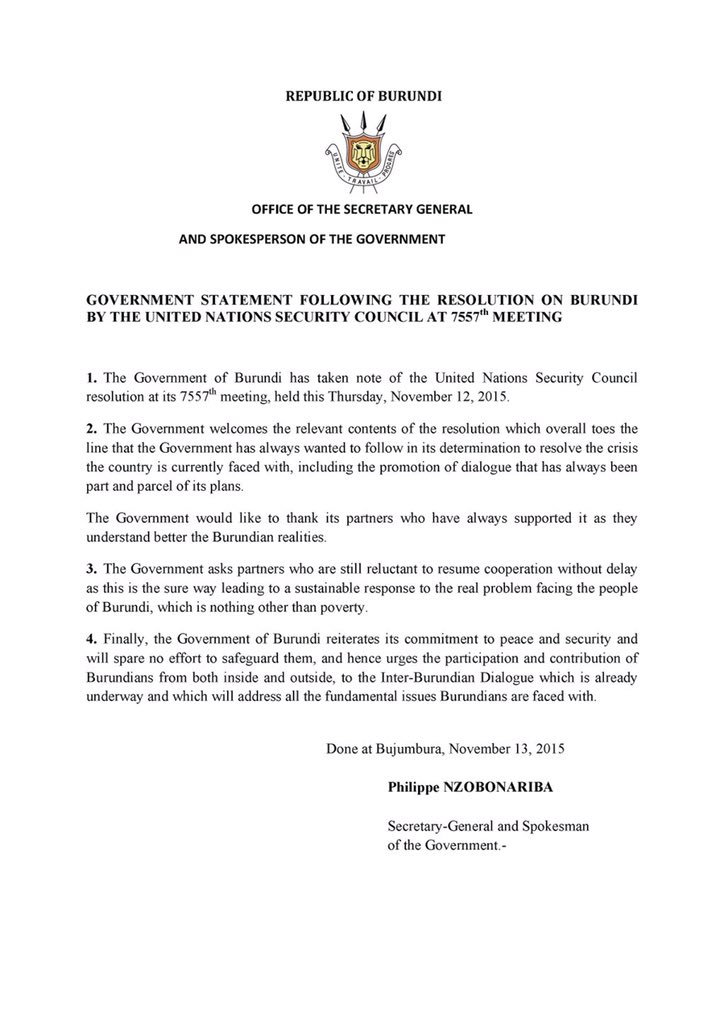
On November 13, the spokesperson for the Pierre Nkurunziza's government issued a response to the resolution, saying that it "toes the line" of the Government and that the problems in the country are "nothing other than poverty," here.


  On the evening of November 11, the UN Spokesperson's office announced that there would be a formal Security Council meeting on Burundi at 12:15 pm on November 12, that would be to approve the draft resolution. An unnamed official of Herve Ladsous UN Peacekeeping -- wonder who that could be -- got Reuters to retype without analysis the idea the UN would send peacekeepers from "Congo" - that would be DRC -- into Burundi.

 UNasked by Reuters, actively covered up, is that Ladsous' MONUSCO has been unable or unwilling to protect civilians in parts of the Eastern DRC, and has refused to neutralize the Hutu FDLR militia. So it would take on Pierre Nkurunziza's forces and youth wing in Burundi?

  This youth wing was allowed by MONUSCO to train in Eastern Congo; nothing was said by MONUSCO when DRC detained a Burundian journalist. None of this in the Reuters, or AFP, or even more derivative Voice of America story. But to retain this "access," these media do not report when the UN's Herve Ladsous, on camera, links peacekeeper rapes to "R&R." Video here. This is a scam. Watch this site.

  While the November 9 meeting was still ongoing, the UN announced that French Permanent Representative Francois Delattre would address the press in ten minutes. But when it happened it was the French Mission's deputy Alexis Lamek, moderated by the Mission's spokesman Thierry Caboche.

After bragging about a draft resolution French belatedly circulated, Lamek and his spokesperson twice refused to take a Press question about UN Peacekeeping still using the same Bururdian forces accused of the abuses. NewVine here. New video, with UK contrast, here.

 The French mission spokesperson, after calling on Reuters, called on Agence France Presse. Inner City Press said, please answer why Herve Ladsous - the fourth French head of UN Peacekeeping in a row - uses Burundian troops in Central African Republic, giving them extensions to bring the right equipment (the government, sources say, takes the money.)

 "Ask him," Lamek said off camera, referring to Ladsous who repeatedlyrefuses Press questions on this (and on covering up French Sangaris forces rapes in CAR.)


  Moments later when Inner City Press asked UK Deputy Ambassador Peter Wilson if the UN should keep using Burundian troops or vet them, Wilson called this a "big issues" that "needs to be looked at." Audio including Elements to the Press, here. Fast transcript by InnerCityPro.com, here:

Inner City Press asked, the UN uses Burundian peacekeepers in CAR. Is there, or could there be, some review of that?

UK Deputy Peter Wilson: "on peacekeepers, I think this is a big issue, and I think it’s something certainly that needs to be looked at in a wider context of what response we take to the events in Burundi right now. I wouldn’t urge precipitate action on that, but I think it’s one of the issues that we need collectively to consider."

 Strange then, that the penholding on Burundi and controller of UN Peacekeeping wouldn't even take the questions. The history of the Great Lakes runs deep. More recently, Inner City Press is informed is belated discussion among Security Council Permanent Five members that Ladsous is a liability, should or can he even be allowed to stay on to the end of Ban Ki-moon's term.

 On November 10, Inner City Press asked UN spokesman Stephane Dujarric,video heretranscript here:

Inner City Press: I'll do Burundi first as a follow-up to that.  Yesterday at the stakeout, Peter Wilson of the UK said that the issue of continued or… or service of Burundian peacekeepers, particularly those involved in the violence in UN peacekeeping, is a big issue, is something that needs to be looked at in the wider context of the response to the events in Burundi right now.  Since… I think I've previously asked you about… my understanding is the Under-Secretary-General of Peacekeeping waived Burundi not having the right equipment twice in a row in CAR.  I wanted you to describe, if you could, what is the process, one, for vetting individuals that come out of the… what you described as a… big violence in Burundi, but also of giving these waivers.  Is this something that's done unilaterally by the Secretariat?

Spokesman:  I'm not… I can't speak to the waivers because I can't… I don't know if what you say is, in fact, a fact.

Inner City Press:  Can… can… is the meeting in September…? [Inner City Press actually referred to Ladsous' September meeting with Burundi, on which it reported.]

Spokesman:  As far as… as far as Burundian troops, they continue to serve in the Central African Republic and other missions, if I'm not mistaken.  They are rotated through the standard human rights vetting process, which involves the UN, which involves the government, which involves the High Commissioner for Human Rights, and which involves the more… the broader human rights community.

Inner City Press:  What about the issue of… there have been several complaints by the peacekeepers themselves of not getting paid leaving some in Burundi to say, in fact, this is a way in which the UN is subsidizing the Government and the very activities that Mr. Zeid was condemning yesterday?  What steps are taken to ensure that the money reaches the peacekeepers?

Spokesman:  Obviously, it is critical whether it's in the case of Burundi if it, in fact, happens or other countries that individual peacekeepers receive the monies that are owed to them.

Inner City Press:  But Mr. [Hervé] Ladsous right here in September said that he's… that he's not sure whether this money reaches soldiers.  So what steps does the UN take, particularly in a case like Burundi, where you're accusing the Government of cracking down on the people, what steps are taken?

Spokesman:  As I said, I think it's incumbent on the governments to ensure that their soldiers get paid.  Did you have another question?


 At the November 9 meeting, Burundi's Nyamitwe droned on by video by Bujumbura, even as Security Council President Matthew Rycroft asked him to bring it to an end. He continued speaking as the other speakers on video -- Prince Zeid, Adama Dieng, Swiss Ambassador Lauber -- squirmed, seeming like the audience to wonder if Rycroft would just cut his mic (he didn't.)

  Inner City Press immediately put online that speech, and that of Uganda's Ambassador Nduhuura and the African Union's Tete Antonio, here.

 On November 7 came reports of killings, including it was said a UN system staff member. This has been confirmed by UNDP - but only the local Buurndi office. Still from the UN, nothing. The Security Council issued a Press Statement on November 7... about Libya.

  Burundian journalist Blaise Célestin Ndihokubwayo has been arrested and sent to the Service national de renseignement (SNR). Where is UNESCO and its director, who wants to be the next UN Secretary General?

On October 23 Inner City Press asked UN Ambassador Matthew Rycroft about the status of the draft Presidential Statement in the UN Security Council. He said there are differing views, but the UK is concerned about the "threat of genocide." Video here.  On November 3, Inner City Press again put a Burundi questions to Rycroft, now President of the Security Council for November. Video herestory here.

The son of human rights defender Pierre Claver Mbonimpa has reportedly been murdered, after Pierre Nkurunziza tweeted that "No one living abroad should consider himself superior to those who stayed in Burundi, since most of them have left their families here."

 On November 6, a belated Security Council meeting on Burundi was announced -- from Paris, by French foreign ministry spokesperson Romain Nadal. Why the delay? Why announced in that way?

Later on November 6, UN Secretary General Ban Ki-moon (whose spokesman could not tell Inner City Press if Ban will have any representative in the Security Council's meeting on Monday) put out this statement.

 Inner City Press at the November 6 UN noon briefing asked how these concerns were consistent with Ban deferring to the Ugandan Defense Minister (for the EAC, Ban's spokesman pointed out), and asked if Ban will even have a representative briefing the UN Security Council on Monday. UNclear. Video here.

  The US' Tom Perriello, filmed at the State Department, noted the weekend deadline. But why then was the UN Security Council meeting left until after the deadline?

  US Ambassador Samantha Power put out this statement, here.

  Behind the continued killing, here's an issue: Inner City Press is informed that a number of Burundian civil society leaders and journalists have improperly been flagged to Interpol as if their passports had been stolen. This has made it impossible, for example, for Vital Nshimirimana to travel to a speak about the crisis in Burundi at a conference in (Ban Ki-moon's native) South Korea.

  Inner City Press on November 4 asked the UN Office of the High Commissioner for Human Rights' Ivan Simonovic and UN spokesman Stephane Dujarric about this.  Interpol often brags at the UN how it is useful on the issue of foreign fighters. It's Secretary General Jurgen Stock spoke before the UN Security Council on May 29, 2015. But what about when Interpol is misused by a government like Pierre Nkurunziza? What do it, the Security Council and its members do that? Watch this site.

 On November 2 Inner City Press asked UN Spokesman Stephane Dujarric about two speeches given in Burundi (the full text of one is below). Video hereUN transcript here:

Inner City Press: In Burundi, there was a speech by the President of the Senate [Révérien Ndikuriyo] saying that opposition neighborhoods may be razed [or raided. Some] people are calling it a genocide speech.  There's also a speech by the President, saying anyone who doesn't disarm within the next five days will be treated as an enemy of the State.  So, I'm wondering, not to overdo it, but things seem pretty serious.  I wanted to know:  what is the UN doing?

Spokesman:  "It's clear that those in position of power, whether in Government or in the opposition, have a responsibility not to incite fear or hate of any kind.  I think that's very important and that whatever security measures the Government takes fully comply with international law and respect for the right of people to freely assemble and protest."

 After Burundi was elected to the UN Human Rights Council with 162 votes on October 28, on October 31 security forces in Burundi opened fire on a funeral procession in Buringa, killing many.  These are the Burundian forces that UN Peacekeeping under Herve Ladsous keeps in service, offering waivers while the Government keeps the payments?

  It is reported the Burundian authorities are accusing a medical NGO of offering treatment to insurgents, and are ready to attack. Frankly, the weak UN Security Council Presidential Statement which France belatedly proffered in the Council, then didn't even hold a question and answer stakeout about, is woefully insufficient, as is the UN Secretariat's response.

 Now from Burundi this speech

https://soundcloud.com/journ-burundi/reverien-ndikuriyo-le-pdt-du-senat-illegitime-promet-de-raser-des-quartiers-de-la-capitale

 On October 28, Inner City Press asked UN spokesman Stephane Dujarric about another threat. From the UN transcript:

Inner City Press: this is a tweet from the official account of Pierre Nkurunziza, President of Burundi:  "No one living abroad should consider himself superior to those who stayed in Burundi since most of them have left their families here."  So people see this as an open-source threat to retaliate against the families of those who have fled the country.  And I'm wondering…

Spokesman:  I haven't seen the tweet.  I shall look at it.

 Inner City Press showed it to him on his way out. Earlier on October 28, Burundi got 162 votes for the UN Human Rights Council, less than the other also unopposed candidates, but still enough to get on the Council. The UN Security Council had just issued a Presidential Statement, here, which gave weight to the Museveni "mediation," and which the US later "welcomed."Usually it's the penholder (France) which speaks. But not here, not on Burundi (see Ladsous, below).

  On October 28 Burundi was poised for election to the UN Human Rights Council, as one of five African Group candidates for five seats. Meanwhile on October 26, the European Union adopted the letter to President Pierre Nkurunziza that Inner City Press asked the UN about last week, here.

  Can EU members on October 28 not vote against Burundi's "Human Rights" Council candidacy at this time? And other Western NGOs coming to the UN early this week to set forth their positions, will they just phone it in with regard to Burundi? Watch this site.

 Also on October 23, Inner City Press asked UN Secretary General Ban Ki-moon:

Inner City Press: I wanted to ask on Burundi, just this morning the UK Ambassador said that the UK is concerned of a threat of genocide, is the word that he used, so I'm wondering under Rights Up Front what are your thoughts about Burundi and what the UN or the Secretariat can do.

SG Ban: "On this genocide issues, I hope there should be some creative investigations by the relevant experts and there should be, first of all, a clear understanding and investigations.  And if the conclusion is that there were such kind of genocide issues, then there should be accountability, justice must prevail and perpetrators must be brought to justice."

  But what is the UN Secretariat DOING about it?


  On October 16 Inner City Press asked Haq if the UN thinks the government can investigate itself. This was based on UN Secretary General Ban Ki-moon's October 15 statement that

"The Secretary-General condemns the killing of nine civilians and two police officers in Bujumbura on 13 October... He urges Burundian authorities to undertake a rigorous and prompt investigation into the circumstances and motives behind these despicable crimes in order to ensure that their perpetrators are brought to justice."

  So can the Nkurunziza government investigate itself (as the UN purports to be investigating or "auditing" itself in the wake of corruption revelation about former Presidnet of the General Assembly John Ashe among others)? Inner City Press asked this question (video here) as well as following up on this, from October 13:

Inner City Press: the Burundi question is one that maybe you can check with DPKO [Department of Peacekeeping Operations].  Burundian human rights activists say that an officer, Jerome Ntibogora, N-t-i-b-o-g-o-r-a, who was accused of being involved in killing people in a… in a hospital after they fled from the Government, has now been deployed to MINUSMA [United Nations Multidimensional Integrated Stabilization Mission] in Mali.  So I wanted to…

Spokesman Dujarric:  Let's see what we can find out.

  Dujarric did not come back with an answer, by this deputy when Inner City Pres asked again on October 16 said he, Ntibogora is not being deployed. We'll see - watch this site.

Amid crackdowns in Burundi by security forces, and allegations of sexual abuse by Burundian peacekeepers serving under the UN flag, UN Peacekeeping chief Herve Ladsous on October 1 held a meeting with Burundian Vice President Joseph Butore.

  Inner City Press has already tweeted a photograph of the meeting, but has now received the complete UN read-out, which raises more questions about Ladsous.

   On the crackdown, Ladsous assured Butore that he has a “pragmatic approach” and is of no mind to question what happens in any country, does not involve himself in "domestic affairs."

   On the sexual abuse allegations, Ladsous spoke only in platitudes, without requiring or even inquiring into any actions taken by the Burundians on the alleged abuse.

   Even though Burundi was already given a “grace period” to bring appropriate equipment into the Central African Republic for the MINUSCA mission, they have not done so. In the meeting, according to the read-out, Butore "acknowledged" the substandard equipment.

   Butore requested, and Ladsous for now granted, yet another extension to bring the requirement equipment -- until March 2016 for light equipment, and to June 2016 for heavy equipment.


  Is this safe - even for the Burundian soldiers at issue? While speaking through press releases, Ladsous' spokespeople, far from answering questions, go so far as to direct UNTV boom microphone operators to avoid Inner City Press, even preventing the Press from asking any questions to Mali's Foreign Minister Abdulaye Diop. We'll have more on all this.