Showing posts with label new zealand. Show all posts

Thursday, January 14, 2016

On Burundi, UN Tells Inner City Press Only Other Media Can Cover UNSC Trip, Won't Say How Selected, ICP Asks NZ and UK of Trip


By Matthew Russell Lee

UNITED NATIONS, January 14 -- After UN Secretary General Ban Ki-moon's mere a one-line mention of Burundi in his long Priorities fo 2016 speech on January 14, when Ban took questions in front of the General Assembly Inner City Press five times began, "On Burundi." Inner City Press similarly requested to cover the UNSC's trip to Burundi.

  But of the five questions picked, fully four were on Syria; none on Yemen much less Burundi. So as Ban began walking away from his personal rostrum, Inner City Press asked him how his Under Secretary General Herve Ladsous could have written, here, that UN Peacekeeping is limited in its ability to address significant violence against civilians, even violence that amounts to genocide.

  The question was clearly audible, but Ban did not answer it, typically.Vine here. Moments later, Inner City Press got an answer about Ladsous' memo from an Ambassador of a Permanent Five member of the Security Council. Video here. UK Deputy Ambassador Peter Wilson said the goal of the UNSC trip to to have a proper talk with Nkurunziza, for a proper dialogue and change of course. New Zealand's lead ambassador is also going -- but Inner City Press is not.

 Earlier in the week when the decision was made for a Security Council trip, Inner City Press immediately replied to Ban's spokesperson's office that it was very interesting in going, as it previously covered Ban's trip to Sri Lanka and Council trips to Sudan, DR Congo and Cote d'Ivoire.

  Even Nkurunziza's adviser, facetiously or not, told Inner City Press on Twitter that he hoped Inner City Press would be on the trip. At 3 pm on January 14, Reuters' correspondent bragged at the UNSC stakeout they are going. And at 4:30 pm, Inner City Press got this, from Ban's spokesman:

"Due to space limitation in the UN flight accompanying the Security Council mission to Burundi, we regret to inform you that we will not be able to accommodate your request to travel. "

  So how / by whom is it decided which media can go? Inner City Press asked the UN Spokesman, Stephane Dujarrice, and another, this:

"Please describe how / by whom the decision on which media can accompany this trip was made, and which media have been allowed to go. Also, please explain why not one of the six questions Inner City Press submitted on January 12 and 13, including about Burundi, were answered, or even acknowledged."

 And these are not answered. Dujarric's office called "lid" to end the day. Some transparency. We'll have more on this.

  Note that Ban's Office of the Spokesperson refused to answer any of Inner City Press' questions in the past two days, including two on Burundi, another on Ethiopia / Oromo, etc. What is WRONG with Ban's UN? Watch this site.

On January 6 UN Peacekeeping chief Herve Ladsous wrote to the UN Security Council how his Department couldn't or wouldn't stop genocide, if it were to progress, in Burundi. VICE and RFI have written on it; Inner City Press is putting the entire Ladsous document online here. We'll have more on this.

On January 11, Inner City Press asked UN Spokesman Stephane Dujarric about the killing over the weekend of cameraman Alfred Baranburiya, and what the UN Office of the High Commissioner for Human Rights staff in Burundi are doing. There was no update.

 Nor on Inner City Press' question about Burundian troops in AMISOM in Somalia not getting correctly paid and, it's said, being ordered not to use the Internet. Dujarric called this too “granular” to answer.

Now Burundian civil society has written to Ban seeking the repatriation of the country's peacekeepers. Inner City Press has put the letter from Vital Nshimirimana to Ban online here, and will be asking the UN about it. Watch this site.

 On January 8, Inner City Press asked Ban's spokesman Stephane Dujarric for Ban's view, video here from Min 1:07, transcript here:

Inner City Press: On Burundi… there was a press conference by the Ugandan mediation of the Burundi crisis today, and they seen… or they… they… among other things, it appears that the Burundi side, the Government side, is asking for a change of venue, and the real issue seems to be whether anyone that the Government says was in any way involved in the events of May should not be part of the talks.  And I just wondered, is Mr. Benomar involved at all in this process?  It seems like the key point is, who's going to participate?  And also, what, what does the UN know about this desired change of venue?

Spokesman:  Sure.  Let me, I'll check with Mr. Benomar's team.

 Six hours later and counting, nothing. 
 On January 4, Inner City Press asked Ban's spokesman Stephane Dujarric about the threats to peacekeepers, the challenged deployments to the UN mission in the Central African Republic and reports of rapes largely in opposition neighborhoods.

  The UN Spokesman had no comment on the rapes, or the threats; he said "I've mentioned the case of the Lt. Colonel, I have no further update from that, or on the other two officials you've mentioned.... The Secretary General's Special Adviser is in New York and I believe you'll probably hear from the Security Council President that they will hear from him at some point in the coming days."

 On January 7, with the UN still not having responded on the rapes, Inner City Press for the Free UN Coalition for Access asked Dujarric about a Burundian minister's threat against the RFI journalist who compiled the rape report. The minister said, "the authorized government services will take the necessary measures to deal with this journalist’s disruptive activities."

  Inner City Press read this quote to the UN spokesman, who replied the UN is against intimidation. He still had nothing on the rapes. Video here, transcript here:

Inner City Press:  On Burundi.  On Monday I'd asked you about this story about rapes by the Government militia in opposition neighbourhoods by an RFI (Radio France Internationale) reporter.  And now basically the Government has said that they will… will… I'm going to read the direct quote because it's pretty troubling… crack down on or… or take care of this reporter.  They said… they said, the authorized Government services will take the necessary measures to deal with this journalist's disruptive activities.  So many press freedom groups are saying this is a threat by the Government, and I wanted to know, one, what do you think of that?  What does the UN system think or do about that?  And also what about the underlying report of an increase in rapes targeted at opposition neighbourhoods?

Spokesman:  "I don't have anything specific on your second question.  Obviously, those kinds of reports of increases of sexual violence are extremely disturbing and need to be investigated.  On your first part, it is vital, as we've always said from here, that there is… that the media be allowed to report freely and free from harassment and especially free from personal harassment."

  Meanwhile whole parts of the UN system say little to nothing at all. Last week Inner City Press asked for the comment of Ban's Secretariat (UNlikely) or, specifically, UN Women on this cartoon in pro-government media. Nothing. Total silence.

  RFI reports in detail on rapes in Burundi, particularly in "opposition neighborhoods." While government spokespeople -- and wannabe government spokespeople -- attack the messengers, where is UN Women on this? Where is the UN Office of the High Commissioner for Human Rights?

  OHCHR has an office and ostensibly a presence in Burundi. But even as High Commissioner Zeid cranks out statements on other topics, OHCHR in Burundi has been unable or unwilling to confirm and speak on, for example, the rounds-ups in Mugamba.

 On January 2, Inner City Press asked four UN spokespeople this Burundi, along with two questions on Saudi Arabia and Yemen:

"On Burundi, does the UN have any knowledge of the rounding up of young men by the government in Mugamba & Matana (Bururi)? Is the UN doing anything?"

 A day later, while the UN issued a statement on Saudi Arabia, there was no answer at all from the UN about Burundi.
  
   Tellingly, sources tell Inner City Press that while at the end of the Entebbe “photo op” it was announced that a next meeting in Arusha on January 6 had been agreed to, in fact this hadn't even been discussed. Some pro-government sources tell Inner City Press their side is therefore “not wrong” to say they never agreed to go to Arusha.
  
   They say that with Ugandan President Yoweri Museveni clearly occupied “in yellow t-shirt” with his run for re-re-election, those running the talks “are the same who profited off the M23 talks.” We'll have more on this.

  But this is part of why Inner City Press questioned Ban Ki-moon's canned December 31 statement, issued after Ban's spokespeople refused to answer actual Press questions submitted to them, about deployments to the Central African Republic and Pierre Nkurunziza's threat to peacekeepers.

Amid criticism that Burundi's Pierre Nkurunziza seeks only to negotiate with himself and not the real opposition to his third term, and of the mediation process as a mere photo-op as the UN deploys abusers into its peacekeeping missions, Inner City Press on December 28, 29, 30 and 31 asked the UN questions. See below for (non) answers.

 After refusing to comment or even respond to Press questions about Nkurunziza's threats against peacekeepers and deployment of alleged human rights abusers to UN Peacekeeping missions under Herve Ladsous, who also refuses Press questions, after 4 pm on New Year's Eve Ban issued this.

 Meanwhile here are Inner City Press' December 30 (unanswered) and December 31 questions to four separate spokespeople for Ban Ki-moon:

December 30: "Burundi's Pierre Nkurunziza in a press conference threatened attacks on peacekeepers. What is Ban Ki-moon's response to this?" No answer.

December 31: "On Burundi, beyond the still unresponded to questions, what is the comment of Ban Ki-moon and, separately, of UN Women tothis cartoon in pro-government media this week?

 In response to that question, the UN Office of the Spokesperson sent a press release about another question (Haiti), but nothing at all on Burundi.

 Watch this site.

  On December 30 Nkurunziza threatened to have his forces attack peacekeepers proposed for the country. Inner City Press asked, if attacks on international peacekeepers are called violations of international law by the UN and its Security Council, what will the UNSC or Ban Ki-moon say about this threat?

  Ban's spokespeople have declined Press questions on Burundi for two days, and now Ban is on leave in Vienna. Will the UNSC penholder, France, be proposing any Press Statement or meeting, as some said would happen this week?

  As to next month, incoming UNSC President Uruguay has set its Program of Work press conference for January 4. We'll be there.

 On the morning of December 29, Inner City Press asked three separate UN Spokespeople Burundi questions including these:

"On Burundi, what is the Secretary General's or its Special Adviser's view of the inclusiveness of the CNARED group “representing” the opposition for the talks? In light for example of (1) this civil society critique, here and (2) Alain Nyamitwe statement that 'what happened was that the opposition was given only one slot, and of course we were not happy about the group which was selected, we do not believe that it is a legitimate group'?

"On UN deployments by alleged human rights abusers, beyond Majors Niyonzima and Rusheshe, please state whether the following are or will be deploying: Major / Lt. Col Casimir Nihankura and Captain / Major Eliezer Ndihokubwayo."

  This last is on a documented trend of the Nkurunziza mis-stating the rank of those it tries to deploy ("as rewards") - but the UN as since last week with Niyonzima and Rusheshe offered no answer.

 Of the five questions Inner City Press submitted to three UN Spokespeople on the morning of December 29, a partial response was received only to this one: "On Puerto Rico, please confirm (or deny) receip of the Governor Alejandro Garcia Padilla's letter to Ban Ki-moon and response to the position that the US is reversing a decades-old understanding that Puerto Rico, while a U.S. commonwealth, governs through its own constitution."

Near 4 pm on December 29, the UN spokesman answered:

"From: Stephane Dujarric [at] un.org
Date: Tues, Dec 29, 2015 at 3:53 PM
Subject: Press Qs in lieu of a Dec 29 UN noon briefing: Burundi, South Sudan, Puerto Rico/US, UNHQ, Jordan, still UN scandals / reforms, Yemen; thanks in advance
To: Matthew Lee [at] InnerCityPress.com
Cc: FUNCA [at] funca.org

"Matthew--on Puerto Rico, we can confirm that we have received the letter from Governor Garcia Padilla. On the rest, if we have updates, we will share them with you."

 So, nothing at all on the Burundi questions.

  On the morning of December 28, Inner City Press asked the UN four questions, including: "On Burundi, any comment or update on the talks, or demonstrations including militia inside Burundi? And, as ICP asked before Christmas, what is the status of the deployment to MINUSCA for Burundian Majors Niyonzima and Rusheshe?"

 At 2 pm on December 28 the UN Spokesman replies with only this:

"From: Stephane Dujarric [at] un.org
Date: Mon, Dec 28, 2015 at 2:11 PM
Subject: Re: Press Qs in lieu of a UN noon briefing: South Sudan, Burundi, UN scandals / reforms, Yemen; thanks in advance
To: Matthew Lee [at] InnerCityPress.com
Cc: FUNCA [at] funca.org

"Dear Matthew, On Burundi, Mr Benomar is currently in Entebbe for the ceremony, having been in Bujumbura, Kigali, and Kampala before. On the other issues, if we have an update to share with you, we will."

  So even on the deployment, nothing on the two Majors involved in the hospital killings in Bujumbura in May -- even as the previous answer about (Lt) Col Baratuza is being questioned by some there. Nothing on the militia: just the photo op. And nothing on the other questions.

 By contrast, on December 28 the US State Department said this:

"we think today’s reopening of this dialogue, regionally mediated dialogue between parties to the Burundi crisis, is an important yet preliminary step towards putting Burundi back on the road to peace. I think it’s imperative that all Burundians renounce violence and intimidation and support peaceful, productive engagement and dialogue as a key to reestablishing in Burundi an atmosphere of openness and trust. We certainly appreciate the efforts of the Government of Uganda as well as President Museveni in hosting today’s session in Entebbe."

  So the US had 80+ words, while UN offered only the location(s) of its envoy. This as a time when Secretary General Ban Ki-moon, after rejecting Press questions in the run-up to the holiday, did a one on one interview with AP promoting himself for a possible Nobel Prize on climate change. On December 28, Ban issued a statement congratulating South Korea for its agreement with Japan on the comfort women issue. And on Burundi? We'll have more on this.

 Burundi's Pierre Nkurunziza government with the agreement of UN Peacekeeping chief Herve Ladsous has undertaken to deploy officers allegedly involved in human rights abuses into Ladsous' Central African Republic mission, MINUSCA, see below. Also below, civil society statement in advance of the talks in Kampala on December 28.

  Nkurunziza's Imbonerakure militia was quoted by AP that "We would like to warn African Union troops that the majority of Burundians don't want them and they should not impose themselves on the people of Burundi." Here is a video of the ruling party demonstrations, on Facebook
  - and now, a second video, on Twitter.

  Also on Facebook (but not Twitter), Burundi's Permanent Representative to the UN Albert Shingiro -- who blocks Inner City Press from his Twitter feed -- tried to mock a protest by follow Burundians which Inner City Press covered on December 23, here. (Shingiro, like the presidential adviser and his alter-ego(s) liked to channel Bill Gates.) Some diplomacy: banning the Press from his statements, mocking rather than seeking to dialogue with his countrymen. To this has Burundi sunk.

 And so, we publish today this Statement of the Campaign “Halte au troisième mandat” on the occasion of the official opening of negotiations between  stakeholders in the Burundi conflict:

"On the occasion of the opening ceremonies of the negotiations between stakeholders in the Burundi conflict, in Kampala-Uganda on December 28, 2015, Civil society organizations members of the Campaign “Halte au troisième mandat” release the following statement:

1. They welcome the beginning of negotiations between Burundi stakeholders for their objective is to find a solution to the Burundian crisis since they will now take place outside Burundi; the same allowing stakeholders to negotiate in conditions that guarantee their safety;

2. However, they regret that the mediation has accused a huge delay in the fulfillment of its mission and that prior consultations as well as the official opening of negotiations are conducted under conditions that ignore the Campaign Halte au troisième mandat, yet widely known as leading group in defending the dignity of the people of Burundi through peaceful protests that started on April 26, 2015.

3. They take the opportunity to reaffirm their support to various groups defending the agenda of the restoration and respect for the Arusha Agreement for peace and reconciliation and the constitution; including CNARED;

4. They rejoice that the CNARED received and accepted the invitation to attend the opening ceremonies of the negotiations. Following due assessment of the achievements of the citizenry movement CNARED and bearing in mind the pressing responsibility to focus and limit mainly on the defense of democratic principles and the fight against impunity in the Supreme interest of the people of Burundi, the Campaign “Halte au troisième mandat” decides to withdraw from CNARED. They will from now on defend the positions and proposals of civil society contained in the document entitled " Burundi Crisis: Diagnosis and proposed solutions by civil society" that was made public;

6. They pledge to keep committed to the fight against the violation of the Arusha Agreement for Peace and Reconciliation and the Constitution and reaffirm their determination to continue the struggle until the restoration of citizens' constitutional legality;

7. They reiterated their willingness and readiness to fully participate in the negotiations and that civil society group should be represented on a same basis as the government of Nkurunziza and the political opposition;

8. Finally, they warn all the stakeholders against any attempt to a deal maintaining Nkurunziza in the position he has usurped and any arrangement likely to provide an opportunity for some to enjoy impunity for crimes committed. Done at Bujumbura, December 27, 2015"

  This last has resonance in other mediations: we'll have more on this.

 On December 24, Inner City Press asked for the second time, video here:

Inner City Press: whether you have any... first, any readout of Mr. Benomar's travels and attempts to speak with the Government in the region.  I'm asking you... yesterday there was… you may have seen it; you may not have seen it… there was a protest outside the building by Burundians, and in speaking with them, they judge the performance of the Secretariat as weak.

And I wanted to know, just to get, I guess, your response to that, and if there's any update on the deployment of these two, Pierre Niyonzima and Jimmy Rusheshe, both of whom have been linked to the hospital killings in May…

Spokesman Stephane Dujarric:  On your second part, no, I have no update than what was given.  I know there are discussions going on.  I don't have an update to share with you.  On your first part, I think we can all agree on the frustration of the Burundian people as they see the violence increase in their country.  The Secretary-General, through the work of his Special Envoy, is very much focused on finding ways to move the political dialogue forward and to obviously see an end to the current violence that we're seeing.  He is currently in Kampala in Uganda meeting with local officials, and I believe there will be talks there early next week.

Inner City Press:  Will your office be sending stuff out during this break?

Spokesman:  Obviously, as I said, we'll be fully staffed.  If there are updates to share, we will share them with you.

   Back on December 17 Inner City Press was told, the third time it asked, that the Burundi's Army spokesman Gaspard Baratuza's deployment to the UN mission in CAR had been suspended, and Baratuza was being repatriated. UN spokesman Stephane Dujarric, who has shielded Secretary General Ban Ki-moon from such Press questions, said "it's an example of the [vetting] policy working."

 But Inner City Press has obtained the Burundi government document for the deployment not only of Baratuza but other officers in Ladsous' MINUSCA. Today we focus and ask about Major Pierre Niyonzima.

According to Inner City Press' sources, Niyonzima not only defended extrajudicial executions, he participated in them.  On May 14, they say, Major Niyonzima was the Senior army officer who led the attack on the hospital where those accused of involvement in the attempted coup were slaughtered.  They say Niyonzima reports to Guillaume Bunyoni and has been involved in killings in Musaga, Nyakabiga and Mutakura. We'll have more on this, and on other deployees to Ladsous' MINUSCA, including  Jimmy Rusheshe.

On December 21 Inner City Press asked the UN's Deputy Spokesperson Farhan Haq about these deployments, and the Burundian government's rejection of the African Union's proposed deployment, video here,transcript here:

Inner City Press: on Burundi, as you know, the African Union Peace and Security Council has made this proposal 5,000 peacekeepers and set a 96-hour deadline for the Government to respond.  The assembly has met and rejected it and said it would be a violation of the sovereignty of the country.  So, I wanted to know, what is the Secretariat… Mr. [Jamal] Benomar, what do they… you think of both the [African Union Peace and Security Council] taking a seemingly fairly aggressive protection of civilian stance and the Government rejecting it? 

Deputy Spokesman:  Well, first of all, regarding that, I believe that the discussions will continue with the African Union and the Government of Burundi.  But, we certainly support the efforts by the African Union and its Peace and Security Council to deal with the protection of civilians in Burundi.  We've made clear our alarm at recent developments and the need for there to be additional steps to bring the tensions on the ground to a halt.  As you know, the Security Council itself has been apprised by the Secretary-General of various options for the way forward, and we await their guidance on that.  Meanwhile, Mr. Benomar has started some of his travels.  I believe he was in Washington, D.C., in the last few days, and he is expected to head to the region shortly.

Correspondent:  And then… thanks a lot.  I wanted… something a little more specific.  It has to do with this vetting of troops from Burundi, but I guess you could say elsewhere.  I know it was said last week that Gaspard Baratuza, a Deputy Spokesman of the army, was being repatriated.

Deputy Spokesman:  Yes.

Inner City Press:  But, I've since seen a letter… it was his deployment letter, but it also involved two other majors in the army who are said to have been involved in the… the assault on a hospital in May, right after the coup attempt in which people were killed in their beds, and these involve Mr. Pierre Niyonzima and Jimmy Rusheshe.  And both of them, according to a letter from the Burundian Army, are… were being deployed to the UN in the Central African Republic.  So, I wanted… I guess I want to ask you, like, what does the vetting consist of?  What was the vetting that Mr. Baratuza failed that these two individuals apparently don't fail, given their involvement in extrajudicial executions?

Deputy Spokesman:  As we get information… if any information causes us to have concerns about deployment, it is reviewed in that light.  In that light, Mr. Baratuza, his suspension was first delayed, and then he was repatriated.  And so, depending upon the information, as we get it, we'll act upon it.

Inner City Press:  So, does… I guess what I'm saying is does the… either the human rights presence of the UN in Burundi have information about those who commanded the assault on this hospital, it's called Bumerec Hospital, in May and the connection to the people that were being deployed?

Deputy Spokesman:  Like I said, we… yes, we do have a human rights presence in Burundi.  As we get information, we act upon, and that includes anyone being deployed.


Obtained by Inner City Press

Ladsous' lack of vetting was criticized in the recently released report into the cover up of peacekeepers' rapes in the Central African Republic. Earlier, Inner City Press exclusive reported on Ladsous in his October 1, 2015 meeting with Burundi's vice president saying that he is "pragmatic" on human rights.

 On December 16 Inner City Press was banned from questions to Secretary General Ban Ki-moon, but learned from the mission MINUSCA that Baratuza was already in Entebbe. Inner City Press asked several Security Council members, then Ban's spokesman Stephane Dujarric on December17.

Dujarric told Inner City Press Baratuza's deployment is suspended and he is being repatriated: "based on the information we've received regarding the Lieutenant Colonel, his deployment has been suspended, and he will be repatriated back to Burundi." Video here. Dujarric told Inner City Press this shows the UN system working - on a day when a report on rapes was issued showing UN Peacekeeping under Herve Ladsous not sufficiently vetting for human rights. We'll have more on this.


 Amid the escalating killings in Burundi, last weekend's summary executions in neighborhoods opposed to Pierre Nkurunziza's third term stand out. But Burundi Army spokesman Gaspard Baratuza was quoted on December 12 blaming all of the deaths on attempts to steal weapons to free prisoners.

   Inner City Press had heard that Mr. Baratuza was already in the process of being deployed to the UN Peacekeeping mission in the Central African Republic (MINUSCA) even when he was giving these quotes, issuing statements and speaking to state-owned radio, and so asked MINUSCA's acting spokesperson, “Is Gaspard Baratuza of Burundi's army getting a MINUSCA job?”

  On December 16, hours before UN Secretary General Ban Ki-moon held a rare press conference, MINUSCA's acting spokesperson sent this to Inner City Press:

"To: Matthew.Lee [at] InnerCityPress.com
From: Vladimir MONTEIRO [at] UN.org
Date: Wed, Dec 16, 2015
Subject: ICP question: Gaspard Baratuza of Burundi's army getting a MINUSCA-related post?
Cc: FUNCA [at] funca.info

"No decision related to Lt Col Baratuza's deployment can be taken before we finish looking into the matter. We can confirm that Lt Col Baratuza is in Entebbe but he has not yet deployed to MINUSCA.  Regards. VNM"

There are some questions about Baratuza, a Colonel in Burundi's Army, being listed by the UN as “Lt. Col.”

  Despite multiple follow-up questions by Inner City Press, Mr. Monteiro - previously a spokesperson for the UN electoral mission in Burundi - replied that “This is what we can say about this issue.”

   But the UN should have to say more. Inner City Press has repeatedly asked the UN how its Department of Peacekeeping Operations under Herve Ladsous vets those who deploy to UN missions; Inner City Pressexclusively reported on an October 1, 2015 meeting in which Ladsous told Burundi's Vice President Joseph Butare that he is “pragmatic” on human rights.
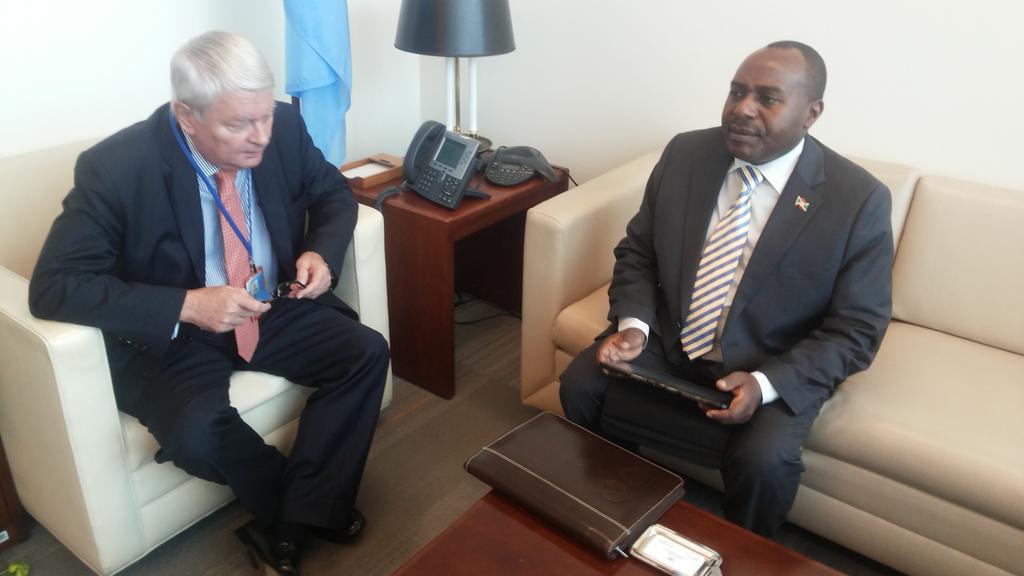


 Ban Ki-moon and his spokesman declined to take Inner City Press' questions on December 16, as they did on December 14. Vine here. But concerned members of the UN Security Council have now been asked about Baratuza by Inner City Press. Watch this site.

Friday, November 20, 2015

On French Paris Attacks Resolution, Amendments & Delay UNexplained by French Mission, Including to Diplomats


By Matthew Russell Lee
UNITED NATIONS, November 20, updated -- After France circulated in the UN Security Council the post-Paris Attacks resolution repeatedly talked about by French President Francois Hollande, it immediately on November 19 put it "in blue" for voting, which would then take place as early as November 20. And UNTV - and the French Mission spokesperson to favored scribes - aid the vote would occur, at 3 pm.
But when 3 o'clock came, while UNTV was at the Security Council stakeout, there was no vote. Exiting the Council were the Permanent Representatives of Jordan, New Zealand and Spain, along with Staffan de Mistura and UN OCHA's Stephen O'Brien: an UNrelated humanitarian meeting.
  Other diplomats milled around; there were complaints against the French mission. One said, I shouldn't be learning this from (your) Twitter. Others said there had been amendments, adding an explanation of Article 51 for Russia, so explain post-Libya how the resolution should not be misused. We'll have more on this. For now, UNTV sent this: "Time yet to be decided pm   LIVE   Security Council 7564th meeting:  Adoption: Resolution on counterterrorism"
 In the morning when French Ambassador Francois Delattre entered the Security Council for a regularly scheduled meeting about Peacekeeping Operations featuring Herve Ladsous, the fourth Frenchman in a row atop UN Peacekeeping, Delattre spoke about the French draft resolution.Periscope video here. As fast transcribed by InnerCityPro.com:
“We hope for a vote the sooner the better, I cannot tell you when exactly, but it is one week after the attacks... There is no reason frankly there is only good spirit and good vibes so to speak around the table... I am cautious by nature, the mood is really good.
 “We try to have something that can unite everyone at the Security Council the Russians included. We think we should not waste time, we have a good partnership with Ambassador Churkin with all the other ambassadors... it's a question of the last mile, I will tell you more as soon as I know.”
  Inner City Press and others asked about Mali and the attack on the Radisson Hotel there. Delattre said, “We are closely watching the situation with great concern of course but no particular comment at this stage.” No comment? Shouldn't a terrorist attack in sub-Saharan Africa be added to the French draft? Some say the vote might be as early at 1 pm. 
Update: the French mission spokesperson doled this out later to favored correspondents Update II: UNTV says 3 pm: 
 "3:00pm   LIVE   Security Council 7564th meeting: Adoption: Resolution on counterterrorism"
  Russian Ambassador Vitaly Churkin on Thursday afternoon told reporters he saw nothing "offensive in it," that a couple of days could have improved it but that perhaps both resolutions could be adopted,citing 9/11/01 as a precedent.
 On his way into the Security Council's regularly scheduled meeting on Kosovo, Churkin stopped and told the press that “Theirs is much more narrow draft, ours is broader, more fundamental so basically I don't see much of a contradiction. We're studying it. I don't [see] anything particularly offensive. This is a good draft, we are looking at it. Maybe if they took a day or two more to work on it they could have improved a thing or two.”
   On if both draft resolutions could be adopted, Churkin said, “I think they could, because if you think back to events after 9/11, first there was a short draft then a couple of weeks later there was a more comprehensive draft.”
The day before on November 18 after Russia circulatedits resolution, French Permanent Representative Francois Delattre came out to talk to the media, not on UNTV but by the steps. He said, as fast transcribed by InnerCityPro:
"Russia requested this meeting on the issue of terrorism, and introduced once again this September 30th draft resolution... I repeated our total determination to fight Daesh, a fight which requires a united response from the whole international community. As you know French President Francois Hollande announced that the Security Council must adopt as soon as possible a resolution on the fight against Daesh. We are actively working to prepare a text that will be short, strong, and focused on the fight against our common enemy, Daesh. Short, strong, and focused on the fight against Daesh. And in this respect we consider the Russian proposal is a contribution that will be carefully studied.
 "I think we have two different texts here. The text we have in mind, and that we are working on very closely, strongly, following President Hollande’s statement, is a text that is strong, short, that is Daesh-centered, and that has one goal after the tragic Paris attack, which is to make sure that the international community is united, finally united, in the fight against Daesh. We all know the threat. The threat is still here. So this is our political responsibility asa the Security Council to have this text adopted, not for long, or endless negotiations about the niceties, but one, simple, clear political message. We need, and this is our responsibility, to have a text which all key actors of the international community can unite in order to act, and to act together." 
Together?

"  On November 17 UN Secretary General Ban Ki-moon's spokesman Stephane Dujarric announced that Ban would sign the condolence book at the French Mission to the UN that afternoon.
  After 2 pm, the UN emailed out “*SG PHOTO-OP ADDED*” so Inner City Press went to the French Mission to cover it.
  In the lobby of 245 East 47th Street, also known as One Dag, the security officer said he would call upstairs to French Mission, on the 44th floor, and get the OK. The guard handed the photo to Inner City Press, which explained why it was here, that the UN has announced this photo-op. The guard took the phone back. Video here.
  “They say no,” the guard said. France 24 was upstairs, and others who did not even report on it. Inner City Press waited in the lobby, exchanging pleasantries with a half dozen diplomats including the Permanent Representative of Palau; passers-by in the One Dag lobby included the Permanent Representative of a country France has criticized for, ironically, freedom of the press. Video here.

  Ban Ki-moon and French Ambassador Francois Delattre came down,accompanied by Ban's spokesman Stephane Dujarric. The UN convoy pulled out onto Second Avenue. Later Dujarric's office would send out Ban's remarks -- Ban refused the only question asked -- and UNTV would distribute video of Ban and Mrs. Ban signing, even shots of the French hand-picked scribes in attendance. Would Charlie Hebdo have made the cut?
 On November 18, Inner City Press asked UN Spokesman Dujarric:
Inner City Press: You announced yesterday at this signing of the condolence book at the French Mission by the Secretary-General.  So I wanted to know, it seemed like I tried to go to your office.  You weren't there.  I went to MALU [Media Accreditation and Liaison Unit].  It seems like it's a UN thing, so I went to cover it, but I was unable to cover it when they called upstairs from the downstairs…

Spokesman Dujarric:  If it's a UN thing, if it happens in the UN.

Inner City Press:  Right.  Is it the Secretary-General's position where space exists for his outside events that UN journalists should be able to cover it or not?

Spokesman:  We rely on our hosts.
Back on September 28, 2015, the day of the UN Peacekeeping summit at the UN, Inner City Press managed to ask French President Francois Hollande about alleged rapes by French troops in the Central African Republic (CAR) and about French head of UN Peacekeeping Herve Ladsous having linked rapes to “recreation” and R&R. Video here.
  Hollande replied that when French troops are charged -- as they have been, in CAR -- France pushes for prosecutions, but also due process. Does that explain the one-year delay in the Sangaris CAR case?  The question was not taken.

  Later on September 28, Inner City Press went to cover the High Level Meeting on Peacekeeping, and found Ladsous slouched in his hair, wanly applauding pledges then glaring up at the photographers booth where Inner City Press was. Something is very wrong at the top of UN Peacekeeping - until it is addressed, the various commitments ring hollow.
A year after French President Francois Hollande tried to privatize the UN Press Briefing Room by having non-French journalists removed, his team on September 27, 2015 adopted a different strategy for the same result. At 8:40 am the UN said there would be a press conference by Hollande in just five minutes, at 8:45 am. Call it innovation.
  Apparently in his press conference, Hollande had many of the seats in the front of the UN Press Briefing Room “reserved” - because Brazil cited this as a precedent for their 11:30 am press conference by Dilma Rousseff (that's another story).  France, returning with Hollande for a session scheduled for 2:15 pm, again tried to control spaces in the front rows, as did the old UN Correspondents Association, which ejected a visiting journalist from “its” seat.
 And the question for Hollande? For Inner City Press, it would be what actions have been taken on the French soldiers alleged to have raped children in the Central African Republic. Watch this site.
Update: After Hollande came in, two people who had sat next to Inner City Press through the entire Japanese briefing from 1:30 pm got up, to give their seat to Laurent Fabuis and Royale. Then a lady approached Inner City Press, in full view of UN Spokesperson Stephane Dujarric, and told Inner City Press to move, she's a "minister." Inner City Press for the Free UN Coalition for Access said Non, je suis journaliste, je veux poser ma question.
Meanwhile Ban Ki-moon said Peru's President Humala regretted not being present. But he WAS present, next to Hollande. Inner City Press asked Humala about the Trans Pacific Partnership on September 27: watch this site.
Back on September 23, 2014 the entourage of French President Francois Hollande repeatedly ordered the UN accredited Press to leave the UN's Press Briefing Room.
  A briefing by Hollande had been scheduled for 11 am, then was canceled. But at 10:55 am as a previous briefing about climate change was ending, Inner City Press was told to leave the room.
  The question, On whose orders? was not answered. Instead a woman in the French delegation said the room was "reserved." 
   This is not a restaurant, Inner City Press replied, now on behalf of the new Free UN Coalition for Access, which advocates for the rights of journalists and for a Freedom of Information Act covering the UN.
  Another member of the French delegation said loudly, "They'll take away his accreditation." It was not necessarily an idle threat: the UN Spokesperson Stephane Dujarric had looked into the room as this happened. 
   Inner City Press said, if UN Media Accreditation -- or UN Security -- tell me to leave, I will. But not before. Video here.
  Meanwhile the representative of the old UN Correspondents Alliance meekly left; previously, UNCA did nothing when previous French Permanent Representative Gerard Araud in this room told a Lebanese reporter, "You are not a journalist, you are an agent."
  After a time, the woman from Hollande's entourage said that the chief of UN Media Accreditation, whom she made a point of saying she knows well, was not answering the phone. A French security guard told Inner City Press to leave. But this is not their role, in the UN briefing room.
  Finally the French foreign minister Laurent Fabius and the new Permanent Representative to the UN came and sat in the front room with Inner City Press and FUNCA.  Hollande appeared from the doorway Spokesman Dujarric had looked out of.
  Hollande said he had come mostly about climate change, but that a French citizen had been taken hostage in Algeria by a group linked with ISIL or "Da'ech," as he called the group. He said arms deliveries would continue; he noted the previous night's air strikes, by others, on Syria.

  Hollande said he would meet in the afternoon with the Syrian Opposition Coalition's Hadi al Bahra, who he called the only legitimate leader of Syria. Then he left without taking questions.

  The day before, UNCA hosted al Bahra (as they had his predecessor Ahmad Jarba) in the clubhouse the UN gives this group, publicized only to those which pay it dues. Given that UNCA did nothing when Araud told the Lebanese reporter "you are not a journalist, you are an agent," why didn't Hollande hold his press conference in the club of UNCA, the UN's Censorship Alliance?

Tuesday, October 20, 2015

As UN Security Council Talks Working Methods, New PGA Lykketoft Speaks As Old PGA John Ashe Is Indicted


By Matthew Russell Lee

UNITED NATIONS, October 20 -- When Spain as Security Council President for October held its “Working Methods” debate it tried to practice what it preaches: it did not propose an outcome to be adopted before hearing the 64 speakers.

   UK Ambassador Matthew Rycroft posed questions, including “How can we bring more transparency, how can we improve participation?” (Inner City Press replied, “Fewer closed consultations, let UNSC hear from broader range of briefers, require USG Q&A #Ladsous,” the last being a reference to Peacekeeping chief Herve Ladsous who refuses Press questions, then linked rapes to R&R, here.)

   Russia's Vitaly Churkin questioned why the US, UK and France are allowed to “usurp” (as UN translated) the top UN posts for Political and Humanitarian Affairs and Peacekeeping. He called some Arria formula meeting little but propaganda, paid for by all the UN's members.

  France's Francois Delattre talked up his country's proposal on veto restraint; he did not address what was called earlier this month France's “implicit veto” for example against any human right monitoring by its Ladsous' DPKO in Western Sahara.

   Angola delivered a joint statement for itself and five other members (Chile, Jordan, Malaysia, New Zealand and Spain); Venezuela, like incoming Uruguay, called for a more inclusive Council process. (Venezuela added that the threat of the veto has kept Palestine from full membership.)

  Rwanda near the end asked why those impacted - Africans - can't at least share penholding duties; the pens France holds, for example at Burundi, are striking.

  Nepal suggested that elections for Council seats be held a full year in advance, to allow time to prepare. One of those running, now in June 2016, is the Netherlands, whose Ambassador was asked online for this country's view of the UN's response to date to the John Ashe, Ng Lap Seng and Global Sustainability Foundation (GSF) scandal.

  There was a lot of talk about the process for selecting the next Secretary General, but it remains unclear when a joint letter will go out from the Presidents of the Council and of the General Assembly, who spoke, including that a woman SG should be considered. That's good; Irina Bokova for example should explain her role in a GSF event giving out awards to businesspeople, just last month in the UN Delegates Dining Room.

  As the debate ended without any rights of reply, news broke of the formal indictment of John Ashe, Francis Lorenzo and Ng Lap Seng, who provided funds not only to South South News but through them to the UN Correspondents Association. The need for reform runs throughout the UN. We'll have more on this.


Monday, August 31, 2015

Nigeria's UN Security Presidency in August Had Six Stakeouts, 2 Shakespeare Cites, E10


By Matthew Russell Lee
UNITED NATIONS, August 31 -- During the UN Security Council's wrap-up session on Monday morning, nearly every Council member cited the revelation of new allegations of sexual abuse by UN Peacekeepers during the month, in Central African Republic. 
  On August 13 there was a closed door briefing on the topic, after which Council president Joy Ogwu waited patiently to provide a summary to the media. But the microphone, as she told Inner City Press the next day, was occupied. She did it on the 14th.
  Ambassador Ogwu did six question and answer stakeouts during August, down from nine during her previous presidency in April 2014 but still more than most presidencies, including by Permanent Five members.
   Perhaps because of her presidency, a number of other Elected Ten members spoke up during the month about the need for a more inclusive Council: not only Venezuela and Chad but also New Zealand. Angola spoke out on the respect due to the African Union, as did Ambassador Ogwu. There was a quiet dignity to the month, and at least two references to Shakespeare.
  Inner City Press for the Free UN Coalition for Access thanked Ogwu for this erudition at Nigeria's August 31 end of presidency reception in the UN's Delegates Dining Room; she countered with descriptions of each of the dishes, including beans and beef.
  During the wrap up session, Ogwu's four presidencies total was referred to by US Deputy David Pressman; another praised her for following up on what she did in April 2014. So, that review is below:

Back on April 20, 2014 when Nigeria's Ambassador to the UN Joy Ogwu came to the Security Council stakeout after tat month as Council president, she paraphrased Shakespeare. All the world is a stage, or the Council is at the center of the play.
  She certainly did her best during the month, in terms of accessibility: she did nine question and answer stakeouts. Including one by foreign minister Aminu Wali on April 28, Nigeria did ten, on topics ranging from Western Sahara, toSyria and the Central African Republic, Darfur, South Sudan and genocide.
  On Western Sahara, to take that example, Ogwu to her credit came out and said that she had pushed the African Union position, that there should be a human rights monitoring mechanism in the MINURSO mission.

  But the MINURSO resolution is written by a "Group of Friends on Western Sahara" that does not include any African Union members, and no mechanism was included.
  On April 30 Inner City Press asked Ogwu about something France's Ambassador Gerard Araud, who once held a mere three question and answer stakeouts in a month as president, had said: that "The UN has never been a place for 'real' negotiation.  It legitimizes or implements agreements reached elsewhere."
   Ogwu said she disagreed, saying that the elected members of the Security Council have sought and obtained a global mandate. It is good, then, that it is Araud set to leave the Council, in July, and not Nigeria.
  In the run-up to Nigeria's end of presidency reception, multiple sources describe angry communications from the old UN Correspondents Association led by Pamela Falk of CBS demanding to know why they weren't at least initially invited. When it was mentioned that Inner City Press was actually at the stakeout during the month, from within the UNCA Executive Committee came an e-mail described as absurd, from a person whose first name begins with "M," on which we may have more. 
 The new Free UN Coalition for Access is not just about free food, and 4:30 pm cocktail receptions as UNCA held on April 30 as Iraq's Ambassador spoke at the stakeout - along with Nigeria's Joy Ogwu. Good month.
  And good end of presidency reception, complete with a short and heartfelt speech by Joy Ogwu, again citing Shakespeare. Talk turned to Burundi - off the record - and to the departure of the Under Secretary General for Public Information (DPI), widely known but on which FUNCA out of respect has sought comment.
  Meanwhile on the fourth floor bulletin board which DPI agreed to after FUNCA advocacy, the FUNCA flier aboutAraud telling a correspondent "you are not a journalist, you are an agent" had been torn down. This is the UN.
  Back on April 2 when Ogwu assumed the UN Security Council presidency Inner City Press asked her about Ukraine being a footnote in the month's Program of Work, and about the predicted fast approval of a new mandate for the MINURSO mission in Western Sahara. Video here, from Minute 21:21
  In the Program of Work the "consultations" on Western Sahara are set for April 17 and adoption of the resolution on April 23. Inner City Press asked if this means it is in the hands of the "Group of Friends," which does not include any African member.
Ogwu replied, "we expect to be fully involved." Given that the African Union position on Western Sahara, will that mean that a human rights monitoring mechanism for MINURSO, as exists in other peacekeeping missions, will be seriously considered? 
  Will the US, which proposed such a mechanism last year, push forward again? Secretary of State John Kerry is visiting both Morocco and Algeria early in April. We'll see.
  On Ukraine, Inner City Press asked if the expect report of UN human rights deputy Ivan Simonovic will trigger a meeting or consultation of the Security Council. Ogwu replied, with due regard for strategic planning, that bridge will be crossed when reached.
  As the second question -- why there is a claim of tradition of UNCA, often the UN's Censorship Alliance trying to get others thrown out of the UN and blocking access to documents on the Internet, automatically getting the first question is and will be addressed elsewhere -- the new Free UN Coalition for Access encouraged Ambassador Ogwu to hold question and answer stakeouts, even brief ones, after closed door consultations, as Luxembourg did (14) in March.
  Ogwu noted the invitation. With agenda items on the Middle East, Central African Republic, Darfur, South Sudan and it seems North Korea, in Arria formula style, such stakeout should be useful. Watch this site.


Wednesday, August 19, 2015

Inner City Press Asks Yemen and NZ Ambassadors of UN Saying Saudi Arabia Hasn't Paid


By Matthew Russell Lee
UNITED NATIONS, August 19 -- The UN Secretariat's bungling of Yemen mediation has become ever more clear, according to multiple sources and documents exclusively seen by Inner City Press, see below. 
   New UN Relief Chief Stephen O'Brien on August 19 told the UN Security Council, "To date only 18 percent, some $282 million, of the $1.6 billion requested through the Yemen Humanitarian Response Plan has been received. UN agencies have still not received the funding from Saudi Arabia of $274 million pledged in April."
  After O'Brien said that, Inner City Press asked Yemen's Permanent Representative at the UN, down the hall toward the Trusteeship Council Chamber, about it. He told Inner City Press, among other things, that explains the request for a UN "liaison" in Riyadh. 
  After the Security Council's triplet of meetings on Yemen, Syria and South Sudan ended late Wednesday, Inner City Press asked New Zealand's Permanent Representative Gerard van Bohemen "On Yemen. Mr O’Brien said that Saudi Arabia haven’t paid the pledge and that there was some dispute about the UN sending maybe somebody to be a liaison, what was said about actually getting aid unblocked?"
 
  Ambassador van Bohemen replied, "I think you need to talk to him about it. What he explained was there’s been quite a complicated discussion going with the Saudi government about the terms on which the money will be made available, but he knows the detail about it, I don’t."
  We hope to have more on this.
  On August 7 Inner City Press was informed that as Houthis and Saleh's GPC headed to Oman for consultations on August 8 and 9, the UN's replacement envoy Ismail Ould Cheikh Ahmed was not even initially invited. He had to beg to get included, which after sweating has been allowed, in the run-up to his briefing on August 12 to the Security Council.
 On August 12, Inner City Press asked Yemen Permanent Representative, outside the Council meeting, questions ranging from the destruction of schools and health care facilities in Sa'ada by Saudi airstrikes to when, according to him, the Houthis might be "driven" out of Sa'ana. Video here. He said in a few weeks - and added that the Oman talks were "not UN."
 So how then might the parties negotiate? UN spokesman Stephane Dujarric said Ismail Ould Cheikh Ahmed was headed back to Riyadh. That seems to be his base, where he works from - and for? Watch this site.

  Oman has received murky thanks for France for facilitating the release of a hostage, who was working for the Social Development Fund there. Did Oman pay for France? Or will others be released, as France brought about in Mali?
  Amid hoopla about reported travel of sanctioned Qasem Soleimani, what about the open travel and sojourn of sanctions Sheikh El Zindani in Saudi Arabia?
On August 7, US Ambassador Samantha Power said, "Qasem Soleimani is subject to the United Nations travel ban. And this travel ban requires all states to prohibit Qasem Soleimani from traveling to their nation. And the only exception to that is if the Iran sanctions committee grants an exemption. And to our knowledge, no such exemption was granted – and we would know."
  So what ABOUT Sheikh El Zintani in Riyadh? We'll have more on this.
  On July 28, Inner City Press asked Saudi Arabia's Permanent Representative about Mokha or Mocha; he replied that previous allegations about Saudi airstrikes on Old City Sana'a and on a palace in Aden once used by Queen Elizabeth had been proven untrue. We'll have more on this.
  Inner City Press asked Yemen's representative about the talks in Cairo involving the United Arab Emirates, allies of former president Saleh and, it's said, the US and UK. He replied that the Yemeni government - in exile - deals through formal channels, the GCC or UN.
  He might have been asked, which foreign minister is he reporting to: the one named by Hadi, or the one - his predecesor - named by Bahah? We'll have more on this as well. 
  Inner City Press asked the president of the Security Council for July, Gerard von Bohemen of New Zealand:
Inner City Press: did any of the members, talk about discussions taking place in Cairo, between the UAE, US, UK and supporters of the former president Saleh? Did US or UK bring up any of these talks?
A: We were talking mostly about, only about the humanitarian situation.
  On that, Inner City Press is informed that a Latin member of the Council asked for a breakdown of casualties between (Saudi) airstrikes and others' ground offensives and was told that data only distinguishes between civilians and non-civilians. Why? 
  The Saudis themselves announced a five day pause. UN envoy Ismail Ould Cheikh Ahmed as exposed by Inner City Press has been on vacation, as has his deputy Gluck, so the UN is uninvolved in this pause. But, Inner City Press asked in a July 25 article, how long until UN Secretary General Ban Ki-moon issues a statement welcoming and implicitly taking some credit for the announcement?
  More than 24 hours after that, Ban did in fact issue a statement, welcoming the Saudi announcement - already being violated - while referring only obliquely to "reports of civilian deaths in Mokha on Friday evening." But who might have caused those, more than 48 hours earlier? Here's Ban's statement:
"The Secretary-General welcomes the announcement by the Saudi-led Coalition of a unilateral five-day, renewable humanitarian pause set to commence on Sunday, 26 July, at 23:59 (GMT+3).  He urges the Houthis, the General People’s Congress and all other parties will agree to and maintain the humanitarian pause for the sake of all the Yemeni people, and that all act in good faith throughout the pause. The growing number of civilian casualties, including the disturbing reports of civilian deaths in Mokha on Friday evening, in the unfolding humanitarian catastrophe make a pause and an eventual extension an imperative.

"The Secretary-General calls on all parties to the conflict to suspend military operations during the pause and refrain from exploiting the pause to move weapons or seize territory. He appeals to all parties to exercise maximum restraint in cases of isolated violations and to avoid escalation.

"The Secretary-General urges all parties to facilitate the urgent delivery of humanitarian assistance to all parts of Yemen, as well as rapid, safe, and unhindered access for humanitarian actors to reach people in need of humanitarian assistance, including medical assistance.

"The Secretary-General calls on the parties to the conflict to comply fully with their obligations under international humanitarian law to protect civilians and to urgently work with the United Nations and humanitarian aid organizations to bring assistance to millions in need throughout the country.
  On the dozens killed in Mocha, Inner City Press linked here to this video -- Ban waited 48 hours to vaguely reference them, despite having in the past quickly condemned the killing of two Saudi police officers. The UN has become more and more irrelevant on Yemen, and subject to protest as "betrayers" in Sana'a. 
  While the party of former president Saleh meets with the United Arab Emirates and others, the UN's replacement envoy to Yemen, Ismail Ould Cheikh Ahmed, after his failed humanitarian pause, is not involved. He had, as Inner City Press was exclusively told and report, gone on vacation. 
 On July 24, Inner City Press asked UN Associate Spokesperson Eri Kaneko:
Inner City Press: There have been a lot of reports and quotes about a process taking place between the party of former President [Ali Abdullah] Saleh and the [United Arab Emirates), [United States], [United Kingdom] and Cairo.  I wanted to know: Is the UN aware of that?  Is the UN in any way taking part in that?  And how does it relate to Ismail Ould Cheikh Ahmed's trip to Riyadh?

Associate Spokesperson Kaneko:  I had the same question myself.  My understanding is that we were not involved in those talks, but we've seen the same reports you have and we would welcome any type of dialogue that would bring the… that would bring the parties closer together towards discussions to resume dialogue on a democratic transition.
  So, the UN's envoy was not involved, just as he was not involved in Oman other than to write them a desperate letter. To this has the UN fallen.
   After publishing its multi-sourced story, Inner City Press on July 22 asked the UN's Associate Spokesperson about new APC and weapons in Aden, and if Ismail Ould Cheikh Ahmed is on vacation. Video here. She replied that she would check - but did not revert with any response either way.
  So on July 23, amid reports that without Cheikh Ahmed or any UN presence talks were occurring about Yemen in Cairo, Inner City Pressasked:
Inner City Press: on Yemen, yesterday you'd said you would check on Mr. Ould Cheikh Ahmed, whether, in fact, he is on vacation at this time.  Did you?

Associate Spokesperson:  No.

Inner City Press: You said leave is a good thing.  In the transcript, you said, I'll check on his vacation.  But yes, people do take leave, it is a good thing, although there are people in Yemen who say, given that the humanitarian pause failed, it seemed a strange time to do it.  So I just wanted to know, factually, is it, in fact, the case?

Associate Spokesperson:  Is it the fact…?

Inner City Press:  That he's on vacation after the failure of the humanitarian pause.

Associate Spokesperson:  I don't know specifically for the Special Envoy, but I can tell you that, you know, most people at that level at the UN, all people at that level at the UN continue to work on their portfolios wherever they are and whatever they're doing.  These are portfolios that you can't just drop.  And I'm sure that's the case also with the Special Envoy.  As far as leave goes, you know, I'm not going to get into a “who's on leave when”, blah, blah, blah, with you.  I just… I don't want to do that…

[cross talk]

Inner City Press:  I'm just saying because yesterday, you said, "I'll check".

Associate Spokesperson:  Because as you mentioned… as you mentioned yourself, you know, leave is part of working life.

Inner City Press:  Okay.  Was he also on leave when UN staff had to leave Libya and he was the deputy SRSG in Libya?  Because that's what I'm told by the people…

Associate Spokesperson:  He was also on leave when what…?

Inner City Press:  On leave when the people were evacuated from Libya that were the staff members of the UNSMIL mission.

Associate Spokesperson:  Well, I just said I'm not going to go and check his attendance sheet.
 So much for checking. 

  Inner City Press asked the UN where Cheikh Ahmed is. UN Deputy Spokesperson Farhan Haq told Inner City Press that he has been "planning his travels," soon to Riyadh. Yeah, Inner City Press was told by another less constrained but at least as knowledgeable source: planning his future travels while already on vacation. Another source compared it to then UN envoy to Pakistan Jean-Maurice Ripert going on vacation amid national disasters in Pakisan and then losing his post. 
   The buzz in Sana'a, where Hadi has named a governor in exile described as an Islamist, is that Cheikh Ahmed may well have known of the plans to bring in APC and weapons to those fighting the Houthis in Aden, and so "misleadingly" urged a pause. Another compared this to the UN luring out surrendering rebel leaders in Sri Lanka - to their deaths.
  And so from Aden, photographs of brand new light brown vehicles, American-made, brought in. Will they end up in the hands of Al Qaeda?
On July 20, Inner City Press asked UN deputy spokesperson Farhan Haq:
Inner City Press: I wanted to check first if you have anything on Yemen and the activities of Ismail Ould Cheikh Ahmed.  What's he been doing in the last few days, amid reports of continued death and destruction in the country?

Deputy Spokesman:  Yes, Mr. Ould Cheikh Ahmed has been planning his onward travels.  The only one to confirm at this stage is that he does plan very shortly to travel to Riyadh, where he is to meet with Saudi authorities, authorities of the Gulf Cooperation Council, and with President [Abd Rabbuh Mansour] Hadi and Vice-President [Khaled] Bahah.  And so, he is going to try to talk to them.  He's continuing with his efforts to see what can be done to secure a humanitarian pause, even following the end of Ramadan and Eid.  And so, he's going to continue with those efforts and travel more broadly in the region after that.  We'll try and inform you of other stops as that progresses.
Inner City Press: There's some talk of, if not Mr. Hadi, other ministers trying to return to Aden.  Is the UN aware of that?  Do they have any comment on that?

Deputy Spokesman Haq:  It's not for me to discuss what the Government of Yemen is trying to do.  Regarding Aden, we have been concerned about the humanitarian situation on the ground.  Our humanitarian colleagues have been continuing even in the absence of a humanitarian pause on the ground to try to provide supplies.  I believe that, even though the pause did not go forward as we had wanted, about 60 per cent of the humanitarian activities that we had been planning did, in fact, take place.  And so we were able to provide some aid, although not nearly enough.  And, of course, we continue to be concerned about the fighting in Aden.
  Back on July 9, UN Secretary General Ban Ki-moon proudly announced a humanitarian pause to start on July 10 at midnight.
  When the supposed pause failed, Inner City Press was told on July 14, it took Ban Ki-moon more than two days to speak with Saudi Arabia, through its foreign and defense ministers. Ban, it was said, was "in the air."
 On July 14, Inner City Press asked Ban's spokesman Stephane Dujarric:
Inner City Press: Something on Yemen.  Yesterday, you said the Secretary-General was very, very disappointed.  So, I wanted to ask, if you can say, starting, I guess it would be, Saturday morning, right after midnight, it became pretty clear that there was no pause.  Did he make any… did he make any actual, like, calls, meaning like telephone calls or in some… did he reach out?  And can you confirm or deny that some within DPA [Department of Political Affairs] had suggested that he not put out that statement that seemed to imply that there was a pause agreed to as…?

Spokesman Dujarric:  No, I… listen, I'm not… Secretary-General was in the air a large part of the weekend.  He's also attending the Addis conference.  People at various levels were having various contacts.  The Secretary-General spoke to both the Defence Minister of Saudi Arabia and the Foreign Minister yesterday, in addition to other contacts that were had in the previous… you know, on Monday and over the weekend.  As to the deliberation… the internal deliberations of different opinions expressed within the UN Secretariat, I'm not going to go into that.  At the end of the day, it's the Secretary-General's call, and the statement he issued was clear.
  The day before on July 13 at the UN noon briefing Inner City Press asked Ban's spokesman  Dujarric why the UN had made another "call" for a pause sound like a commitment to a pause, at least by the Saudi led coalition. Video here.
  Dujarric answered that envoy Ismail Ould Cheikh Ahmed had told the Suadis of his desire for a pause. But that's not what the UN said on July 9.

  Dujarric, who has still to issue any written statement, said this at the July 13 briefing:
  “Obviously the Secretary General is very, very much disappointed that the humanitarian pause did not take hold over the weekend in Yemen. We are continuing with contacts at various levels.
“Despite the continued airstrikes, despite the fighting our humanitarian partners were able to distribute some vital aid to the desperate people of Yemen where ever they can and how ever they an. Obviously the security situation makes it that much more difficult for critical human aid to be delivered.
“We continue to reiterate our call for unconditional humanitarian pause  h p and the Secretary General reminds all parties to the conflict in Yemen, from both inside and outside the country of their obligations under international human rights and humanitarian law.”
  Even this wasn't issued as a statement or Note to Correspondents. Ban was in Addis Ababa for the Financing for Development conference; here are his UN's "messaging" points in the run-up to that conference (andhere an Inner City Press story about it; we'll have more). But isn't the UN responsible to say something after a humanitarian pause it announced doesn't happen, and people are killed? 
  It quickly became clear that some of key parties had not been spoken with or agreed; the pause's midnight beginning came and passed amid airstrikes.
  Inner City Press is informed by sources that Ban Ki-moon was urged to not make the dubious pause announcement, including from within the UN's own Department of Political Affairs -- but Ban announced it anyway.
  At best, it was rolling the dice. At worse, on the very day that UN is rightly criticizing itself for making false promises of protection in Srebrenica 20 years ago, in this case Yemenis were told there would be a pause, and some perhaps relied on it, to their detriment. And still the UN had said nothing.
  After the July 9 announcement, Inner City Press asked Ban's spokesman if the Saudis had been spoken with. The answer was, Hadi told the Saudis his position. But did Hadi ever agree to the pause, or just to the conditions set forth in his letter to UN? What of Hadi's responsibilities to the Yemeni people?
Now Saudi Al Arabiya has said Saudi Arabia never received any communication from Hadi to stop airstrikes, here. Someone is lying.
  Where is the UN's replacement envoy Ismail Ould Cheikh Ahmed? Headed to Ethiopia, Ban's spokesman said, to meet with Ban on the sidelines of the Financing for Development conference there. Does IOCA harbor ambitions for another UN system post, or back in his own country? What sort of a track record is this? Watch this site.
 At the July 10 UN noon briefing in New York, Inner City Press asked Ban Ki-moon's spokesman Stephane Dujarric if the UN had spoken with those in Yemen opposing the Houthis but not supporting or in contact with Hadi. Video here. From Dujarric's answer, it seems no such contact has been made.
  So, Inner City Press asked, if such a group fires on the Houthis and they fire back, is the pause over, has it been violated? We'll see what happens.

Back on July 9, Inner City Press asked UN Spokesman Stephane Dujarric, transcript here:
Inner City Press: can you, one, characterize not the communications with Mr. Hadi, but with Saudi Arabia that's running the coalition, the Saudi-led coalition.  And does this mean the Secretary-General's understanding is no airstrikes during this time period, and no further advances or use of heavy weapons by the Houthis?  Does the pause mean no firing? What does it mean to each of those two sides?

Spokesman Dujarric:  What it means is that, if you read the statement, the President… Secretary-General notes that the President, President Hadi, has communicated his acceptance of the pause to the coalition to ensure their support.  A humanitarian pause means no fighting.  It means no bombing.  It means no shooting.  It means no fighting.  It means exactly that:  a humanitarian pause in the fighting that we've seen, to enable our humanitarian colleagues to get the aid to where it's needed, to preposition, and stockpile, and to reach the millions that need it.

Inner City Press:  Right.  But just for example, policing, who's doing policing in these various cities?  Things happen.

Spokesman Dujarric:  Obviously I think… [cross talk] In any area in the country, there is a… there is de facto control and, obviously, there is a need to ensure safety and security.  What we're talking about is a humanitarian pause in the fighting that we've been witnessing for weeks on end now.

Inner City Press:  So just one last thing on this.  So the commitment on airstrikes is through President Hadi to the UN?

Spokesman:  You know, the… [cross talk] Obviously, President Hadi is a critical interlocutor with the coalition.  And as I've said, we've taken note of the fact that he's conveyed to the coalition his acceptance.  We expect everyone involved in this conflict to honor this humanitarian pause.
 On July 7 the UN's Office of the High Commissioner for Human Rights upped its estimate of civilians killed since March 27 to 1,528, adding that one million people have been displaced since the beginning of this round of the conflict. To the Saudi airstrike on UNDP in Khormaksar, Aden, OHCHR added that "IOM’s Migrant Response Centre in Basateen, also in Aden, was struck by a mortar and an airstrike damaged IOM’s office in Harad."
   IOM, as Inner City Press reported, had earlier paused its evacuation by air of those seeking to flee Yemen due to some party, which it left unnamed, demanding information about those fleeing BEFORE the flights could leave. Inner City Press has asked others in the UN about this and has been told IOM should have done the screening after the people were able to flee. IOM refused a direct question about caused it to violate this best practice, then stopped sending the Press any information.
   There are countries, normally vocal about civilian deaths, which are selling military equipment to Saudi Arabia and its Gulf allies. Ban Ki-moon, now in Oslo, is relying entirely on Saudi-selected replacement envoy Ismael Ould Cheikh Ahmed, who was unable to even get the parties in the same room in Geneva, much less reach an agreement. There remain, for now, OHCHR's body counts.
  On June 24, Inner City Press asked the UN's replacement envoy Ismail Ould Cheikh Ahmed about the request by the Houthis and others to meet not with him but with Secretary General Ban Ki-moon, who did not meet with them in Geneva. Transcribed here. 
  On June 25 Inner City Press asked Ban's deputy spokesperson Farhan Haq to confirm receipt of the letter and if Ban will meet them. Haq said Cheikh Ahmed is the envoy, and Ban's headed to San Francisco. The UN Security Council issued a Press Statement, here.
 Also on June 25, Inner City Press asked new UN aid chief Stephen O'Brien three questions about Yemen: cholera, the destruction of ambulances in Sa'ada and about international staff. Video here.
  O'Brien replied that cholera is a risk; he had no information on WHO it was that destroyed the ambulances in Sa'ada (we can guess.) On international staff, which the UN evacuated earlier, he spoke of a rise from 17 to 70, with the goal of getting to 200. He would not say if they are anywhere in the country outside of Sana'a, citing security. But at least he spoke - the Free UN Coalition for Access thanked him.

Here's from the June 24 stakeout, as fast transcribed by Inner City Press:
Inner City Press: On the parties in Sanaa requesting to meet the Secretary General – what’s your response?
Cheikh Ahmed: "This question was raised during our discussion with the Houthis, the GPC and their allies. The Secretary General had delayed twice his travel in order to be there for the parties. We have sent twice a plane from Sanaa which the delegation from Sana'a could not take..  Therefore the Secretary General had a major engagement, which was the election of the new president of the General Assembly which takes place only once a year , and he had to attend it. But the Secretary General will continue being engaged on this."
  The ceremonial elevation of the President of the GA who will take over in September was not an election at all - no vote was taken. At the top, Cheikh Ahmed said (again, as fast transcribed by Inner City Press)
"I just briefed the Security Council on the latest developments in Yemen, with a particular focus on the Geneva Consultation. I informed the Council that the Geneva intra-Yemeni Consultations are a milestone... Despite the raging battles and ongoing violence, and the dramatic humanitarian situation, Yemenis accepted the Secretary General’s invitation and participated in the consultations.
"The personal presence of the Secretary General was an indication of the primary importance attached by the United Nations and the international community, and in particular the Secretary General himself on the Yemeni situation. I deeply regret the deep division between the parties and the lack of compromise that prevented an agreement that was within reach. The holding of the Geneva consultation was itself a great achievement in light of the extreme violence unleashed in Yemen.
"While the government came to Geneva to seek the implementation of Security Council Resolution 2216, the government acted in a positive and constructive spirit. Both sides showed signs of constructive engagement. There is an emerging common ground upon which we can build to achieve a ceasefire coupled with a withdrawal.
"While we pursue a long term cessation of violence, I call on all relevant parties to agree without delay to the humanitarian truce, especially during Ramadan. We should not forget that Yemenis are living under dire conditions and it pains me to witness this ongoing suffering. I call on all stakeholders to spare no effort to help us achieve a temporary respite for the Yemeni people.
"I am aware that reviving the political process will not be easy. The Secretary General and I have been clear from the outset that this consultation was only a stepping stone towards the long inclusive political process. All the parties affirmed their commitment to remain engaged with the UN in search of a peaceful solution of the conflict. I have no doubt that it is possible to build upon this positive spirit in the forthcoming consultation.
"I strongly believe that the UN facilitated intra-Yemeni consultations offer the best chance for moving towards a de-escalation of the crisis and a return to the political process. I personally believe there is no military answer to this conflict. I therefore remain committed and will spare no effort to achieve a cease fire and the swift return to a peaceful, inclusive political process."
 Before the meeting, UK Ambassador Matthew Rycroft stopped and told the press of the danger of famine in the country, and of his hope for a Yemen Press Statement from the UNSC, in which the UK is the "penholder" on Yemen.  Periscope video here, replay including on desktop for 24 hours.
 Inner City Press was digging into the letter from political parties IN Yemen, asking for a meeting with Ban Ki-moon, NOT with replacement envoy Cheikh Ahmed. These parties, including but not limited to the Houthis, were delayed in getting to Geneva so that they could not meet with Ban (who while there DID meet with a US-listed Al Qaeda terrorist).
  While some are sure to argue that Ban now meeting with the parties would undercut Cheikh Ahmed, others point out the the underlying resolution speaks of the Secretary General's Good Offices INCLUDING his Envoy. The envoy is not the only game in town - nor, given his lack of disclosure, raised by Inner City Press, should he be. We'll have more on this.