Showing posts with label Paolo Gentiloni. Show all posts

Tuesday, June 28, 2016

For UNSC, Sweden Wins With 134 Votes; Netherlands and Italy in Run-Off


By Matthew Russell Lee


UNITED NATIONS, June 27 -- In the contested race for two UN Security Council seats, Sweden won the first seat in the first round with 134. Netherlands got 125 to Italy's 113, but neither had enough to win in the first round. So: a run-off.

Ethiopia and Bolivia won seats unopposed.

After the first rounds voting, while the ballots were being counted, Paolo Gentiloni worked the crowd, as captured by Inner City Press on Periscope. Dutch Koeners spend a long time with Benin. Uruguay passed out letters for a Rights of the Child candidate.

In the days before the vote, Italy gave out gelato, the Netherlands played soccer, Sweden did a mid-summer festival, Thailand did  a lot including meeting with African Ambassadors and Kazakhstan had a live singer at the Plaza Hotel, Inner City Press Periscope video here. What would it come to?

On the way in, Inner City Press asked Next SG candidate Vuk Jeremic how it's going. He said no one can compete with Helen Clark's resources from UNDP, not to mention New Zealand, but reminded Inner City Press of his answer, that he would defend whistleblowers. That would set him apart from the current administration.

Earlier on June 27, prosecutors in Federal court downtown described South South News as a vehicle of bribery. The UN treats it with kids gloves, while evicting Inner City Press. This is today's UN.

On May 24, the second day of UN Security Council election debates featured three states - Sweden, the Netherlands and Italy - on May 24 vying for two seats, with the voting set for June 28. Inner City Press is informed that most states have already committed their votes, and it is unclear if anything said during the debate would sway such a decision.

  Italy said it is at the crossroads of East and West; it has been on the Security Council six times since joining the UN in 1955, the most recent in 2007.
 Sweden, by contrast, has been on the Council three times, and also the further back in time, in 1997. For the Netherlands it's been five times, the most recent in 1999.

   Sweden noted that it has recognized Palestine - perhaps offsetting for some its dust-up with Saudi Arabia. Netherlands candidly brought up Srebrenica, as a dark mark on its past; it said as it had set up meetings with states beyond the Security Council for now Foreign Minister Bert Koenders when he was un envoy in Mali and Cote d'Ivoire, it would do the same in the future. Italy cited the theft and sale of cultural heritage by terrorists.

   Among the questions, UK Ambassador Matthew Rycroft asked the three, who would come onto the just as the Next SG will, how they would work with her. Italy said it has not spend so much on its campaign, it's all part of foreign policy. A contested application in the NGO Committee beckoned, and so it was time to go. What remained constant was that due to UN eviction and censorship, Inner City Press was required to have a minder to reach the stakeout.

The day before on May 23 when Kazakhstan and Thailand debated, such as it was, for the Asia Pacific seat on the UN Security Council, Inner City Press again could only reach the stakeout with a minder, thanks to Ban Ki-moon's and Cristina Gallach's censorship. Still, while canned questions were posed by DPA and others inside, outside diplomats told Inner City Press this “reform” was more illusory than real.

  “We've already made up our mind,” as one diplomat put it. Or as another specified, votes for Security Council seats are traded early among nations; no debate a few weeks out can change it. Still, Amnesty International asked about about Morocco and Western Sahara, South Sudan and Malakal.

Kazakhstan pointed out no Central Asian country has yet served on the Council. Thailand cited its pedigree. Inner City Press tweeted these and got push back. So, somebody was watching. Next up is Sweden, Netherlands and Italy. Watch this site.

As Inner City Press reported long ago, Susana Malcorra is a candidate to replace her former boss Ban Ki-moon as UN Secretary General.

 Early on May 20 she told Argentine media that President Macri will nominate her later in the day. She herself is in China, after earlier trips to other P5 capitals.

Sources tell Inner City Press of attempts to address in advance the Malvinas / Falkland Islands issues, to "put it in the freezer," as one source put it.

 Where does she stand on freedom of the press - generally and in the UN? We'll have more on this, and on Slovakia, etc.

On May 10 before the UN's Peace and Security meeting, General Assembly President Mogens Lykketoft said he's scheduling informal with new Next Secretary General candidates for June 7.

  The session ended with Ethiopia's Foreign Minister proposing that the Security Council submit at least three names to the General Assembly and Ecuador saying it should be done by vote, not "acclamation."

  Walking by, working the crowd, was Argentina's Foreign Minister (and former UN chief of staff) Susana Malcorra. Sigrid Kaag was present, saying (correctly) that today's UN over promises and under delivers. Campaigning online was Italy, with a photo of Leo DiCaprio; Dutch Foreign Minister Burt Koenders was working the halls.

 Swedish Foreign Minister Margot Wallstrom brought up sexual violence in conflict; the elephant in and out of the room, with a man in a suit with a red file was UN Peacekeeping chief Herve Ladsous, who has linked rapes to R&R.

With Burundi troops accused of raping children as part of UN Peacekeeping chief Herve Ladsous' MINUSCA mission in the Central African Republic, as well as accused of abuses in Burundi itself, a new funding question has arisen, involving Commerbank.

  And the UN of Ban Ki-moon moved to evict Inner City Press, which is asking the question. It happened on April 16, video here and here (Periscope).

On May 10, Inner City Press asked UN General Assembly President Mogens Lykketoft, just before his thematic debate on Peace and Security, what the General Assembly is doing about peacekeepers' sexual abuse and exploitation, and about UN Peacekeeping's Herve Ladsous saying it would take 18 months to deploy 3,000 troops to Burundi.

 Lykketoft acknowledged that 18 months is too long -- some think Ladsous overstated it, to take the option off the table -- and on sexual abuse he said beyond the GA punishment is up to the Troop Contributing Countries.

  Even getting to the stakeout to ask Lykketoft this question was hindered by Ban Ki-moon's and Cristina Gallach's UN. Now Inner City Press can only access the Conference Building's second floor with a Media Accreditation and Liaison Unit minder or escort. But on May 10 there was none available.

  Inner City Press, needing to cover the stakeout, asked the UN Spokesperson's office, which had just announced the stakeout over the same public address system it announced the January 29 event in the UN Press Briefing Room for which Inner City Press was thrown out.

 But UN Security said only MALU minders can escort Inner City Press. This is called targeting, and is UN censorship.

 On May 4, Inner City Press at noon asked UN Spokesman Stephane Dujarric to confirm or deny that Herve Ladsous told the Security Council it would take 18 months to deploy 3,000 to Burundi.

 Inner City Press sources on this say it is troubling it would take the UN that long. Others surmise the Ladsous is trying to undermine the proposal by making it take so long, or saying it would take so long.

On May 3, Inner City Press asked UN Spokesman Stephane Dujarric, UN transcript here:

Inner City Press: on Burundi, various countries have spoken about the postponement of the talks that were supposed to begin in Arusha under ex-President [Benjamin] Mkapa.  Does the UN have no involvement in them or no view of whether it's a good or bad thing that they were postponed?

Spokesman Dujarric:  I don't have anything on Burundi.

 That's an understatement.

On May 2, the US issued this:

"
While the United States strongly supports the regionally mediated Burundi dialogue, led by former President Mkapa under the auspices of the East African Community, we are disappointed the scheduled dialogue did not resume today.
Postponement of this dialogue only serves to worsen a crisis that has already resulted in hundreds of lives lost, thousands injured, more than 260,000 Burundian refugees displaced, and a worsening economic situation. 
We call upon all stakeholders to ensure the dialogue resumes immediately and to commit to participating without preconditions or redlines.
Burundi’s political leaders owe it to their citizens to take concrete steps to resolve this crisis as soon as possible within the framework of the Arusha Accords, the foundation for peace and stability in Burundi.  Now is the time for all parties to cease all violence and exercise restraint and engage in an inclusive and peaceful dialogue."

But will the US propose anything in the UN Security Council, or encourage the "penholder," France, to? On April 29, Inner City Press asked Ban's spokesman, video here, UN transcript here:

Inner City Press: I've asked you several times about the reported non-payment of Burundian peacekeepers.  I have now seen a document that more than $4 million has been transferred by DPKO (Department of Peacekeeping Operations) to the Commerce Bank account in Paris that I'd also asked you about.  Have they gotten back to you about the multiple reports that this money, in fact, doesn't go to the peacekeepers?

Spokesman Stephane Dujarric:  You know, we pay the Governments, and we expect the Governments to ensure that the peacekeepers are given the money that is owed to them.

Inner City Press:  And if you hear that they don't or find that they don't, what would you do?

Spokesman Dujarric:  We would expect that they do, and I'm sure the issue would then be raised.

  Since the UN and Ban Ki-moon are embroiled in their own bribery and corruption scandal, the issue was raised to Commerzbank, which replied:

"Please report potentially fraudulent activities to [Link]"

  But Commerzbank's link to report fraud returns, "The document you requested does not exist on this server."

 For a bank with legal duties, this is a problem, as is opening an account to receive the UN's Herve Ladsous' payments to Pierre Nkurunziza for troops accused of rape in the Central African Republic. We'll have more on this.

Update: after this Inner City Press story and complaint, Commerzbank belatedly fixed it s "Fraud" link. But what about the substantive behavior?

 On April 22, after three separate screenings by UN security, Inner City Press was allowed to the photo op of Ban with Alain Aime Nyamitwe. Albert Shingiro was there too, taking his own smart phone photo. There was Jamal Benomar, and David Nabarro. Tweeted photo here. Periscope video here.
Outside there was Edmond Mulet, Ban's chief of staff who has received correspondence about the eviction of Inner City Press.

 What would they discuss? Mugamba? (Since Ban's meeting, General Athanase Kararuza who spoke against the killing in Mugamba had been assassinated). Even more UNlikely, press freedom?

 From the read-out below, it seems they did not discuss crimes against humanity, much less genocide. But here's what the International Criminal Court's Prosecutor Fatou Bensouda said on April 25, opening a preliminary examination -- note that the FIFA post offer to Pierre Nkurunziza, which Inner City Press exclusively reported in May 2015, here, well before Sepp Blatter's book, may be looking better and better to him)

On April 21, amid published reports of up to 150 people detained in Mugamba, Inner City Press asked Ban's spokesman Stephane Dujarric about it. He said he hadn't heard of it but would check.

An hour after the briefing, this was sent to Inner City Press:

From: UN Spokesperson - Do Not Reply un.org
Date: Thu, Apr 21, 2016 at 1:46 PM
Subject: Your question on Burundi
To: Matthew.Lee [at] innercitypress.com
Cc: Stephane Dujarric [at] un.org

"Regarding your question at the noon briefing: Our human rights office was informed that on 20 April 2016, following a security incident that occurred in Mugamba commune, Bururi province (an exchange of gunfire between unidentified armed men and military elements, during which two people including a military lost their lives), three persons, including a teacher, were arrested by the police and detained in Mugamba police station. No charges were retained against them and they were finally released on 21 April 2016 following an intervention by the Regional police commissioner."

 Is that all that happened?

Dujarric also at the April 21 briefing, when Inner City Press asked why its office has been seized - to be resold, it seems - while that of South South News, named in October 2015 in the U.S. District Court for the Southern District of New York as Ng Lan Seng's vehicle to bribe the UN, still has its office, said “You have been afforded quite a lot of courtesies.”  Like ouster by eight UN DSS guards? Five boxes of files dumped out onto First Avenue?

 On April 20, Inner City Press asked UN spokesman Stephane Dujarric about hate speech, UN transcript here.

  Inner City Press' sources say many opposition leaders are worried about Ban Ki-moon's typically waffling three-option report because "the report is a proposition to a dictator rather than being a decision against him... The corpse of Jean De Dieu Ndayikungurukiye who was stabbed and killed by Imbonerakure four months ago in Nairobi, is still in detention. According to family members and other Burundian Refugees in Nairobi, Burundian Embassy in Nairobi recommended this detention."

On April 12, Inner City Press asked Ban's deputy spokesperson Farhan Haq, video here, UN transcript here.

  Hours after these claims, and in retaliation, the UN sent Inner City Press an eviction notice for April 16, which despite push back they implemented.
   Even as the European Union considers changes to it payments for Burundi peacekeepers in AMISOM in Somalia, so that less of the money is taken by the Nkurunziza government for repression, UN Peacekeeping under Ladsous and Maria Costa have made their pay-out to Nkurunziza's government - no longer through the Burundi National Bank but through a bank account in Paris, at Commerzbank.

 On April 11, Inner City Press asked UN spokesman Stephane Dujarric about this: why is the money not being paid to the Burundi Central Bank? Would Ladsous pay to an offshore bank, in Antigua and Barbuda or Panama for example, without looking into it?

  Dujarric said he does not have details on member states banking relations; he did not answer on offshore banks. Here are some photos,here.
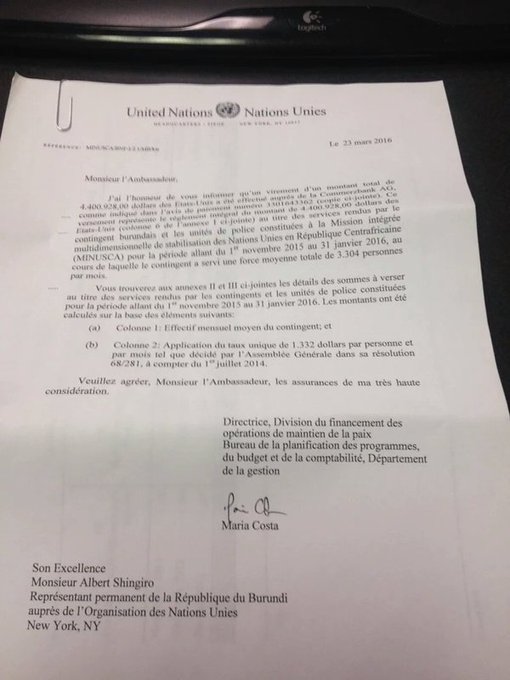
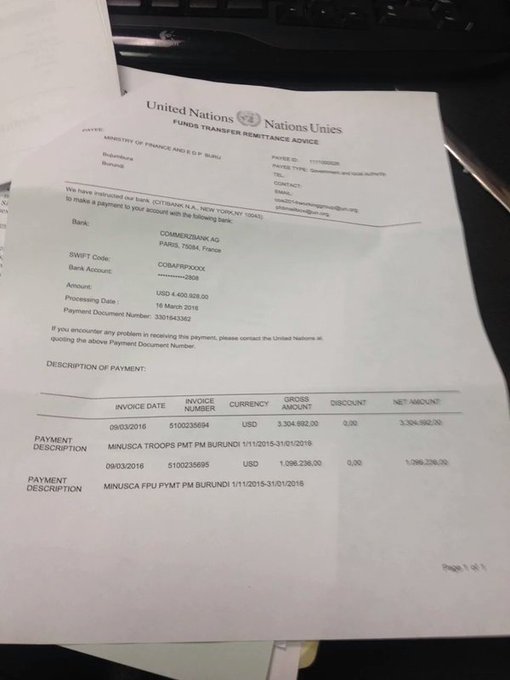

View image on TwitterView image on Twitter

On , ICP asked UN of  paying bank in Paris, concerns of civil society, h/t photos
  Meanwhile some also say that those repatriated from CAR under allegations of abuse, for example First Major Srgt Zepherin, are just re-sent by the Nkurunziza government for “service” with AMISOM in Somalia. We'll have more on this, too.

On Burundi Inner City Press asked UN Spokesman Stephane Dujarric on March 31 about the death in prison of Jacques Bihozagara.

Unlike several member states, but not the Security Council's penholder France, the UN had only this: "We obviously would hope that his death will be investigated in as much of a public manner as possible."

Now the inadequacy of the UN's response is even more clear in light of this report: "During his detention, Bihozagara was visited by several diplomats who were assured he was in safe custody. On Saturday night, reports indicated that Burundi official demanded that the deceased’s family sign documents indicating that he died of natural causes or forget asking for the body."

On April 5, Inner City Press asked UN deputy spokesperson Farhan Haq about it, UN transcript here.

 We'll have more on the UN's actual position on that sort of practice, or these type of offers.

 In a smaller but similar way, the UN on February 19 told Inner City Press that if it did not move eight years of investigative files out of its UN office, even the offer of a reduced non-Resident Correspondent accreditation would be withdrawn.

  Now while threatening to throw or move everything out, the UN is making even more troubling "offers." Perhaps this is why the UN Secretariat cannot criticize Pierre Nkurunziza's Burundi; instead Ban Ki-moon praised Nkurunziza for half re-opening a mere two of four radio stations he closed. New low for the UN.

 Ban Ki-moon, his deputy and chief of staff have received this sample letter to reverse Gallach's outrageous decisions, concluding, "Your decision to restore ICP's full accreditation and office will be highly appreciated by many Burundians crying out for peace and protection while promoting the freedom of press in Burundi." As of this writing, still no response from Ban.


On March 25, Inner City Press' sources reported to it that "Around 4 am today, heavily armed police surrounded the zone of Musaga, searched homes without warrants, arrested around five young men and killed an old man by shooting him purposeful on First Avenue Musaga. Among the arrested young men, two are related as a sister and a brother -- the shocking story behind these two is that the old brother Arnaud was shot and killed by the police during the demonstration."

  Meanwhile to cut off further protests, the government is regulating SIM cards - and, some say, the French firm SG2 may be engaged in wire tapping in Burundi:  "several technicians of local companies have confided that: 'We were obliged to provide SG2 with some 200 free numbers and to authorize their technicians to access our networks. They connected their own systems. We are sure that they have the technology to carry out phone-tapping.' Since the introduction of this system, international calls to Burundi have become very expensive, and Burundians in the diaspora now choose to use Skype or other calling systems (Viber, WhatsApp, etc). Soon people will do this for local calls as well, to avoid being tapped."

  Again, no UN comment on surveillance? Well, this is from an Organization which got its favored correspondents to give it their cell phone footage to try to eject the Press on a pretext.

When Burundi was belatedly discussed at the UN Human Rights Council in Geneva on March 22, the UN Special Rapporteur on extrajudicial, summary or arbitrary executions Christof Heyns urged the government of Pierre Nkurunziza against reprisals on those who talk with the UN Panel of Experts. But how will that be enforced?


  The United States for its part said Burundi should "lift all undue restrictions on the media." It's a fine sentiment - but the US Mission to the UN has been asked, by the DC-based Government Accountability Project, to ensure that the UN lifts restrictions on Inner City Press which covers, along with UN corruption, Western Sahara and Burundi. GAP Letter here.

 On March 22, Inner City Press was entirely unnecessarily restricted from reaching the UN Security Council stakeout to cover a meeting on Western Sahara, Periscope on YouTube here. What will the US Mission do?

  In Geneva, Heyns had to leave; Rwanda and South Africa were added to the speakers' list, but only for the afternoon session. Watch this site.

A week ago Inner City Press asked UN Spokesman Stephane Dujarric, about UN (in) action in Burundi. UN transcript here.

 A week later from Dujarric, who threw Inner City Press out of the UN Press Briefing Room, there has been no answer, as on so many Press questions to Ban Ki-moon's UN on Burundi. So on March 21, Inner City Press asked Dujarric's deputy Farhan Haq, UN transcript here.

As Burundi's Pierre Nkurunziza government stepped up the killing and censorship of opponents, its lobbyists in the U.S. capital, Scribe Strategies, were paid $60,000 to among other things set up interviews with US-government broadcaster Voice of America and the French government's France 24.

  Nkurunziza's party the CNDD-FDD paid Scribe Strategies $59,980 on November 10, 2015. Scribes has this month disclosed, for the six month period ending January 31, 2016, that in exchange for this money it arranged for example for Nkurunziza's adviser to be "interviewed" on Voice of America and France 24.

  Scribe Strategies also, during the reporting period, was paid to arrange for Sam Kutesa, a former President of the General Assembly who was involved with many of the same donors named in the corruption case against his predecessor John Ashe, to be "interviewed" by Voice of America about his tenure as PGA, during which he was as now foreign minister of Uganda.

  Inner City Press has covered not only the John Ashe / Ng Lap Seng / Frank Lorenzo / Sheri Yan corruption case, but also Kutesa's dealings with the highest reaches of Ban Ki-moon's UN Secretariat, for example here and here.

 On February 19, Inner City Press was thrown out of the UN on two hours notice. Audio and petition here. On February 22 Inner City Press was told it was Banned from all UN premises. After three days reporting on the UN from the park in front of it, and stories in BuzzFeed andBusiness Insider, Inner City Press re-entered the UN on a more limited "non-resident correspondent" pass, under which on March 10 UN Security ordered it to leave the UN as it worked in the UN lobby at 8 pm. Video here; UN Spokesman Stephane Dujarric's March 11 justification here.

  The underlying UN rule only says that non-resident correspondents can only come into the UN up until 7 pm. But the UN's goal, it seems, is to prevent or hinder coverage of UN corruption, which usually doesn't take place in the UN Press Briefing Room. (January 29, 2016 and September 8, 2011 -- Frank Lorenzo, UNdisclosed -- are notably exceptions.)

  Lobbying the deciding UN official, Under Secretary General for Public Information Cristina Gallach, were the honchos of the UN Correspondents Association, including France 24 and, as in 2012, Voice of America.

  Scribes Strategies' disclosures do not (have to) mention the Nkurunziza government's lobbying in and around the UN. We'll have more on this.

  Back on March 9 when the Burundi configuration of the UN Peacebuilding Commission met, the conference room was too small and the meeting was not televised, at least not to the outside world (see below). There was talk of Burundi's Pierre Nkurunziza have allowed two of four closed radio stations to re-open.

But Special Adviser Jamal Benomar said these two stations were not critical of the government; beyond that, it has emerged that the stations' directors had to sign a commitment about their future coverage. Some in the UN, it is clear, would like to do just this - in fact, that's why Inner City Press could not watch the meeting on UN in-house TV in its shared office the UN has seized, and so came to the meeting.

  In Conference Room 8, the Permanent Representatives of Tanzania, Belgium, Burundi, Norway, The Netherlands, and others, and Deputies from France, Rwanda and others. France was given the floor first in the debate; its Deputy Alex Lamek after a bland speech left the meeting, his seat taken by another French mission staffer. Belgium called for a re-opening of all media without restriction.

  There were other speeches, but Inner City Press had to go upstairs, with its its currently reduced access pass, and ask the UN's Deputy Spokesperson why Ban had praised the re-opening, with restrictions, of only two of the four radio stations closed. Vine here; UN transcript here

Deputy Spokesman Haq:  Ultimately, what we want is for the media to be free to do their work unconditionally.

  This is ironic: audio here, petition here. We'll have more on this.
 On January 28, Inner City Press asked UN spokesman Stephane Dujarric about a meeting held but not televised on January 27, at which it was urged that mass grave sites in Burundi be preserved as evidence,video here, transcript here.


Obtained by Inner City Press

Ladsous' lack of vetting was criticized in the recently released report into the cover up of peacekeepers' rapes in the Central African Republic. Earlier, Inner City Press exclusive reported on Ladsous in his October 1, 2015 meeting with Burundi's vice president saying that he is "pragmatic" on human rights.

 On December 16 Inner City Press was banned from questions to Secretary General Ban Ki-moon, but learned from the mission MINUSCA that Baratuza was already in Entebbe. Inner City Press asked several Security Council members, then Ban's spokesman Stephane Dujarric on December17.

Dujarric told Inner City Press Baratuza's deployment is suspended and he is being repatriated: "based on the information we've received regarding the Lieutenant Colonel, his deployment has been suspended, and he will be repatriated back to Burundi." Video here. Dujarric told Inner City Press this shows the UN system working - on a day when a report on rapes was issued showing UN Peacekeeping under Herve Ladsous not sufficiently vetting for human rights. We'll have more on this.


 Amid the escalating killings in Burundi, summary executions in neighborhoods opposed to Pierre Nkurunziza's third term stand out. But Burundi Army spokesman Gaspard Baratuza was quoted on December 12 blaming all of the deaths on attempts to steal weapons to free prisoners.

   Inner City Press heard that Mr. Baratuza was already in the process of being deployed to the UN Peacekeeping mission in the Central African Republic (MINUSCA) even when he was giving these quotes, issuing statements and speaking to state-owned radio, and so asked MINUSCA's acting spokesperson, “Is Gaspard Baratuza of Burundi's army getting a MINUSCA job?” Ultimately, after the questioning, he didn't.

   But the UN should have to say more. Inner City Press has repeatedly asked the UN how its Department of Peacekeeping Operations under Herve Ladsous vets those who deploy to UN missions; Inner City Pressexclusively reported on an October 1, 2015 meeting in which Ladsous told Burundi's Vice President Joseph Butare that he is “pragmatic” on human rights.
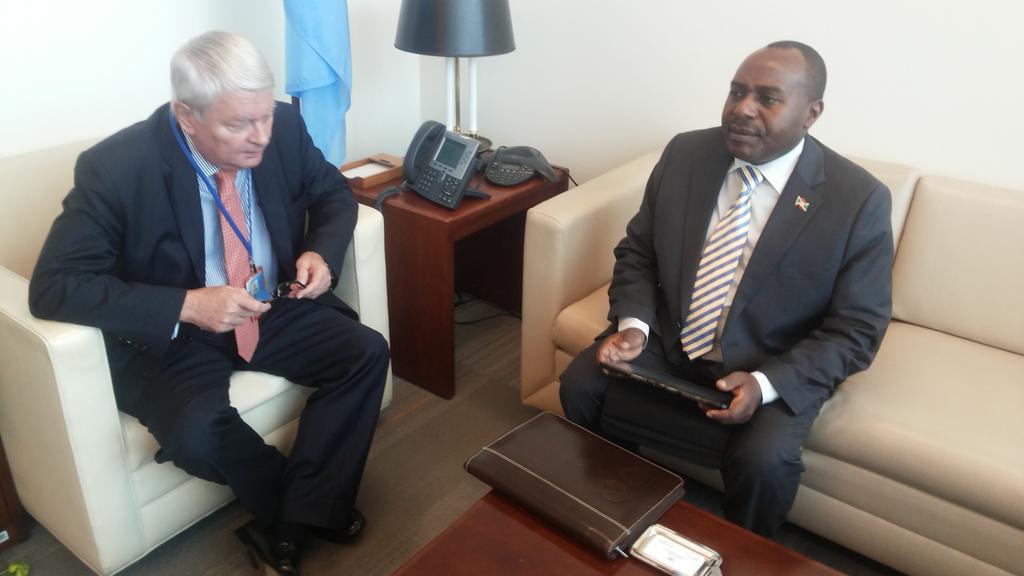


 Ban Ki-moon and his spokesman declined to take Inner City Press' questions on December 16, as they did on December 14. Vine here.  Watch this site.

Saturday, December 19, 2015

Syria Resolution 15-0, Lavrov Shouts Out Some Militias, Italian Interior?


By Matthew Russell Lee

UNITED NATIONS, December 18 -- In the Lotte New York Palace Hotel on December 18, ministers Lavrov and Gentiloni, Fabius and Kerry passed through with entourages; UN Secretary General Ban Ki-moon left early without answering any questions. Hours later, the text was agreed to, then adopted 15-0 by the UN Security Council.

After the vote Russian Foreign Minister Sergey Lavrov said, “The unanimous adoption today on the Council has created a broad front on the basis of the UN Charter, on the basis of all of those who are pushing back against terror, including the Syrian army, [some] armed militias, parts of the Syrian opposition, and the Russian air forces, in response to the legitimate request of the Syrian government."

Inside as Nasser Judeh of Jordan spoke, UN TV cut repeatedly to Syria's Bashar Ja'afari, looking more and more skeptical. France's Fabius spoke briefly and left. Outside at the stakeout, talk turned to a Kerry press conference, open to all.

 Italy's Paolo Gentiloni, by contrast, scheduled a press availability only for Italian media. A wag from the Free UN Coalition for Access asked, Isn't Gentiloni the foreign and not interior minister? Isn't he running for a Security Council seat? We'll have more on this.

In the  hotel lobby in the late morning a Permanent Five member of the Security Council's spokesperson briefed a gaggle of journalists in the lobby amid hissed that it was “off the record.”

  There was a gingerbread model of the NY Palace hotel which, the sign said, took 300 hours to make. All that was lacking, one wag - this one - snarked on Twitter, was a little gingerbread Laurent Fabuis.

 Back that UN, the 1 pm stakeout by the EU's Mogherini was postponed and then canceled. The Security Council scheduled for 3 pm got pushed back to 4.  Inner City Press asked Ban's spokesman Stephane Dujarric if Ban had spoken, what would he have said? Vine here.

Here's what was agreed to:

The Security Council,

PP1.  Recalling its resolutions 2042 (2012), 2043 (2012), 2118 (2013), 2139 (2014), 2165 (2014), 2170 (2014), 2175 (2014), 2178 (2014), 2191 (2014), 2199 (2015), 2235 (2015), and 2249 (2015) and Presidential Statements of 3 August 2011 (S/PRST/2011/16), 21 March 2012 (S/PRST/2012/6), 5 April 2012 (S/PRST/2012/10), 2 October 2013 (S/PRST/2013/15), 24 April 2015 (S/PRST/2015/10) and 17 August 2015 (S/PRST/2015/15), 

PP2.  Reaffirming its strong commitment to the sovereignty, independence, unity and territorial integrity of the Syrian Arab Republic, and to the purposes and principles of the Charter of the United Nations,

PP3.  Expressing its gravest concern at the continued suffering of the Syrian people, the dire and deteriorating humanitarian situation, the ongoing conflict and its persistent and brutal violence, the negative impact of terrorism and violent extremist ideology in support of terrorism, the destabilizing effect of the crisis on the region and beyond, including the resulting increase in terrorists drawn to the fighting in Syria, the physical destruction in the country, and increasing sectarianism, and underscoring that the situation will continue to deteriorate in the absence of a political solution,

PP4.  Recalling its demand that all parties take all appropriate steps to protect civilians, including members of ethnic, religious and confessional communities, and stresses that, in this regard, the primary responsibility to protect its population lies with the Syrian authorities,

PP5.  Reiterating that the only sustainable solution to the current crisis in Syria is through an inclusive and Syrian-led political process that meets the legitimate aspirations of the Syrian people, with a view to full implementation of the Geneva Communiqué of 30 June 2012 as endorsed by resolution 2118 (2013), including through the establishment of an inclusive transitional governing body with full executive powers, which shall be formed on the basis of mutual consent while ensuring continuity of governmental institutions,

PP6.  Encouraging, in this regard, the diplomatic efforts of the International Syria Support Group (ISSG) to help bring an end to the conflict in Syria,

PP7.  Commending the commitment of the ISSG, as set forth in the Joint Statement on the outcome of the multilateral talks on Syria in Vienna of 30 October 2015 and the Statement of the ISSG of 14 November 2015 (hereinafter the “Vienna Statements”), to ensure a Syrian-led and Syrian-owned political transition based on the Geneva Communiqué in its entirety, and emphasizing the urgency for all parties in Syria to work diligently and constructively towards this goal,

PP8.  Urging all parties to the UN-facilitated political process to adhere to the principles identified by the ISSG, including commitments to Syria’s unity, independence, territorial integrity, and non-sectarian character, to ensuring continuity of governmental institutions, to protecting the rights of all Syrians, regardless of ethnicity or religious denomination, and to ensuring humanitarian access throughout the country,

PP9.  Encouraging the meaningful participation of women in the UN-facilitated political process for Syria,

PP10.  Bearing in mind the goal to bring together the broadest possible spectrum of the opposition, chosen by Syrians, who will decide their negotiation representatives and define their negotiation positions so as to enable the political process to begin, taking note of the meetings in Moscow and Cairo and other initiatives to this end, and noting in particular the usefulness of the meeting in Riyadh on 9-11 December 2015, whose outcomes contribute to the preparation of negotiations under UN auspices on a political settlement of the conflict, in accordance with the Geneva Communique and the “Vienna Statements”, and looking forward to the Secretary-General's Special Envoy for Syria finalizing efforts to this end,

OP1.  Reconfirms its endorsement of the Geneva Communiqué of 30 June 2012, endorses the “Vienna Statements” in pursuit of the full implementation of the Geneva Communiqué, as the basis for a Syrian-led and Syrian-owned political transition in order to end the conflict in Syria, and stresses that the Syrian people will decide the future of Syria;
OP2.  Requests the Secretary-General, through his good offices and the efforts of his Special Envoy for Syria, to convene representatives of the Syrian government and the opposition to engage in formal negotiations on a political transition process on an urgent basis, with a target of early January 2016 for the initiation of talks, pursuant to the Geneva Communiqué, consistent with the 14 November 2015 ISSG Statement, with a view to a lasting political settlement of the crisis;
OP3.  Acknowledges the role of the ISSG as the central platform to facilitate the United Nations’ efforts to achieve a lasting political settlement in Syria;
OP4.  Expresses its support, in this regard, for a Syrian-led political process that is facilitated by the United Nations and, within a target of six months, establishes credible, inclusive and non-sectarian governance and sets a schedule and process for drafting a new constitution, and further expresses its support for free and fair elections, pursuant to the new constitution, to be held within 18 months and administered under supervision of the United Nations, to the satisfaction of the governance and to the highest international standards of transparency and accountability, with all Syrians, including members of the diaspora, eligible to participate, as set forth in the 14 November 2015 ISSG Statement;
OP5.  Acknowledges the close linkage between a ceasefire and a parallel political process, pursuant to the 2012 Geneva Communiqué, and that both initiatives should move ahead expeditiously, and in this regard expresses its support for a nationwide ceasefire in Syria, which the ISSG has committed to support and assist in implementing, to come into effect as soon as the representatives of the Syrian government and the opposition have begun initial steps towards a political transition under UN auspices, on the basis of the Geneva Communiqué, as set forth in the 14 November 2015 ISSG Statement, and to do so on an urgent basis;
OP6.  Requests the Secretary-General to lead the effort, through the office of his Special Envoy and in consultation with relevant parties, to determine the modalities and requirements of a ceasefire as well as continue planning for the support of ceasefire implementation, and urges Member States, in particular members of the ISSG, to support and accelerate all efforts to achieve a ceasefire, including through pressing all relevant parties to agree and adhere to such a ceasefire;
OP7.  Emphasizes the need for a ceasefire monitoring, verification and reporting mechanism, requests the Secretary-General to report to the Security Council on options for such a mechanism that it can support, as soon as possible and no later than one month after the adoption of this resolution, and encourages Member States, including members of the Security Council, to provide assistance, including through expertise and in-kind contributions, to support such a mechanism;
OP8.  Reiterates its call in resolution 2249 (2015) for Member States to prevent and suppress terrorist acts committed specifically by Islamic State in Iraq and the Levant (ISIL, also known as Da’esh), Al-Nusra Front (ANF), and all other individuals, groups, undertakings, and entities associated with Al Qaeda or ISIL, and other terrorist groups, as designated by the Security Council, and as may further be agreed by the ISSG and determined by the Security Council, pursuant to the Statement of the ISSG of 14 November 2015, and to eradicate the safe haven they have established over significant parts of Syria, and notes that the aforementioned ceasefire will not apply to offensive or defensive actions against these individuals, groups, undertakings and entities, as set forth in the 14 November 2015 ISSG Statement;

OP9.  Welcomes the effort of the government of Jordan to help develop a common understanding within the ISSG of individuals and groups for possible determination as terrorists and will consider expeditiously the recommendation of the ISSG for the purpose of determining terrorist groups;

OP10.  Emphasizes the need for all parties in Syria to take confidence building measures to contribute to the viability of a political process and a lasting ceasefire, and calls on all states to use their influence with the government of Syria and the Syrian opposition to advance the peace process, confidence building measures and steps towards a ceasefire;
OP11.  Requests the Secretary-General to report to the Council, as soon as possible and no later than one month after the adoption of this resolution, on options for further confidence building measures;

OP12.  Calls on the parties to immediately allow humanitarian agencies rapid, safe and unhindered access throughout Syria by most direct routes, allow immediate, humanitarian assistance to reach all people in need, in particular in all besieged and hard-to-reach areas, release any arbitrarily detained persons, particularly women and children, calls on ISSG states to use their influence immediately to these ends, and demands the full implementation of resolutions 2139 (2014), 2165 (2014), 2191 (2014) and any other applicable resolutions;

OP13.  Demands that all parties immediately cease any attacks against civilians and civilian objects as such, including attacks against medical facilities and personnel, and any indiscriminate use of weapons, including through shelling and aerial bombardment, welcomes the commitment by the ISSG to press the parties in this regard, and further demands that all parties immediately comply with their obligations under international law, including international humanitarian law and international human rights law as applicable;

OP14.  Underscores the critical need to build conditions for the safe and voluntary return of refugees and internally displaced persons to their home areas and the re-habilitation of affected areas, in accordance with international law, including applicable provisions of the Convention and Protocol Relating to the Status of Refugees, and taking into account the interests of those countries hosting refugees, and urges Member States to provide assistance in this regard, and looks forward to the London Conference on Syria in February 2016, hosted by the United Kingdom, Germany, Kuwait, Norway and the United Nations, as an important contribution to this endeavor, and further expresses its support to the post-conflict reconstruction and rehabilitation of Syria;

OP15.  Requests that the Secretary-General report back to the Security Council on the implementation of this resolution, including on progress of the UN-facilitated political process, within 60 days;

OP16.  Decides to remain actively seized of the matter.

On December 17, the day before Syria talks resumed at the New York Palace Hotel in Manhattan, finance ministers spoke in the UN Security Council about cutting off financing for ISIS. French finance minister Michel Sapin spoke darkly of the use of pre-paid cards for the November 13 Paris attacks; Russia's Ambassador Churkin named two Turkish companies as involved in ISIS oil sale.

  Inner City Press asked Syria's Ambassador Bashar Ja'afari, who came to take questions at the Council stakeout, about ISIS' oil. He named Turkey, then want on to name Qatar and Saudi Arabia, slamming its “Sunni coalition” recently announced.

  When US Treasury Secretary Jacob Lew, along with Sapin and the UK's George Osborne held a short press conference in the UN briefing room, Inner City Press hoped to asked Sapin about pre-paid cards, and Lew and Osborne about Bitcoin. But the question, just four, were limited to Reuters, the Wall Street Journal, the New York and Financial Times. So it goes.

   It seems there will be no Press access at the New York Palace; Ja'afari has said he will speak, at the UN, and whatever ISSG press availability there is should be at the UN, with a 3 pm meeting on December 18 scheduled. Watch this site.

Back on December 8, Inner City Press put thee questions to  Turkey's Ambassador Cevic. Video here.   Here's fast transcript byInnerCityPro.com:

Inner City Press: On Syria, do you think the Vienna process meeting should take place in New York on the 18th? Are you satisfied with the Saudi process for choosing the opposition?

Amb Cevik: The plans, I don’t know how fixed, I mean how clear it is, but we are making our preparations for the meeting.

Inner City Press: Are there any groups invited to Saudi Arabia that you think shouldn’t be part of the opposition delegation?

Amb Cevik: I think so far, in our view, they are working on the right concept. Let’s see if they succeed. Having a coalition group that would be able to take part in the process is one of the most important things.
Inner City Press: [Russia] said the group that killed their pilot should be put on the terror list. Do you have any view on that?

Amb Cevik: If they know the specifics, I don’t know. But to our knowledge, there was no terrorist organization, no extreme Daesh, Nusra, in that area. They are the Turkomens, and we know them, they are moderate people.

  This may be an issue. Watch this site.


On Syria after coy comments by the UN's Ban Ki-moon if the next meeting would be in New York, John Kerry in Washington at the Saban Forum in Washington on December 5 said:

"the governments involved are going to meet later in this month in New York in order to continue to move this process forward.  Our goal is to facilitate a transition that all parties have stated that they support: a unified Syria...The purpose of this transition will be to establish a credible, inclusive governance within six months.  The process would include the drafting of a new constitution and arrangements for internationally supervised elections within 18 months...Meanwhile, a nationwide ceasefire will go into effect between the government and the responsible opposition, assuming they come to the table and they begin this initial process."

  But who is this "responsible opposition"? Does it include Al Qaeda affiliates? Can last-minute mergers cleanse these groups? Watch this site.

 Back on November 14 in the shadow of the November 13 Paris attacks, the International Syria Support Group met and issued a statement in Vienna, follow by statements by US John Kerry, Russia's Sergey Lavrov and the UN's Staffan de Mistura, flashing his pince-nez and the highlighted document below.

  But what will happen when a group said to be linked to Al Nusra is hit by an airstrike, and the Free Syrian Army says it's them, not Nusra?

Meeting in Vienna on November 14, 2015 as the International Syria Support Group (ISSG), the Arab League, China, Egypt, the EU, France, Germany, Iran, Iraq, Italy, Jordan, Lebanon, Oman, Qatar, Russia, Saudi Arabia, Turkey, United Arab Emirates, the United Kingdom, the United Nations, and the United States to discuss how to accelerate an end to the Syrian conflict.  The participants began with a moment of silence for the victims of the heinous terrorist attacks of November 13 in Paris and the recent attacks in Beirut, Iraq, Ankara, and Egypt.  The members unanimously condemned in the strongest terms these brutal attacks against innocent civilians and stood with the people of France.

Subsequently, the participants engaged in a constructive dialogue to build upon the progress made in the October 30 gathering. The members of the ISSG expressed a unanimous sense of urgency to end the suffering of the Syrian people, the physical destruction of Syria, the destabilization of the region, and the resulting increase in terrorists drawn to the fighting in Syria.

The ISSG acknowledged the close linkage between a ceasefire and a parallel political process pursuant to the 2012 Geneva Communique, and that both initiatives should move ahead expeditiously.  They stated their commitment to ensure a Syrian-led and Syrian-owned political transition based on the Geneva Communique in its entirety.  The group reached a common understanding on several key issues.
The group agreed to support and work to implement a nationwide ceasefire in Syria to come into effect as soon as the representatives of the Syrian government and the opposition have begun initial steps towards the transition under UN auspices on the basis of the Geneva Communique.  The five Permanent Members of the UN Security Council pledged to support a UNSC resolution to empower a UN-endorsed ceasefire monitoring mission in those parts of the country where monitors would not come under threat of attacks from terrorists, and to support a political transition process in accordance with the Geneva Communique.   
All members of the ISSG also pledged as individual countries and supporters of various belligerents to take all possible steps to require adherence to the ceasefire by these groups or individuals they support, supply or influence.  The ceasefire would not apply to offensive or defensive actions against Da’esh or Nusra or any other group the ISSG agrees to deem terrorist.
The participants welcomed UN Secretary General Ban’s statement that he has ordered the UN to accelerate planning for supporting the implementation of a nationwide ceasefire.  The group agreed that the UN should lead the effort, in consultation with interested parties, to determine the requirements and modalities of a ceasefire.  
The ISSG expressed willingness to take immediate steps to encourage confidence-building measures that would contribute to the viability of the political process and to pave the way for the nationwide ceasefire.  In this context, and pursuant to clause 5 of the Vienna Communique, the ISSG discussed the need to take steps to ensure expeditious humanitarian access throughout the territory of Syria pursuant to UNSCR 2165 and called for the granting of the UN’s pending requests for humanitarian deliveries.   The ISSG expressed concern for the plight of refugees and internally displaced persons and the imperative of building conditions for their safe return in accordance with the norms of international humanitarian law and taking into account the interests of host countries.  The resolution of the refugee issue is important to the final settlement of the Syrian conflict.  The ISSG also reaffirmed the devastating effects of the use of indiscriminate weapons on the civilian population and humanitarian access, as stated in UNSCR 2139.  The ISSG agreed to press the parties to end immediately any use of such indiscriminate weapons.
The ISSG reaffirmed the importance of abiding by all relevant UN Security Council resolutions, including UNSCR 2199 on stopping the illegal trade in oil, antiquities and hostages, from which terrorists benefit.
Pursuant to the 2012 Geneva Communique, incorporated by reference in the Vienna statement of October 30, and in U.N. Security Council Resolution 2118, the ISSG agreed on the need to convene Syrian government and opposition representatives in formal negotiations under UN auspices, as soon as possible, with a target date of January 1.  The group welcomed efforts, working with United Nations Special Envoy for Syria Staffan de Mistura and others, to bring together the broadest possible spectrum of the opposition, chosen by Syrians, who will decide their negotiating representatives and define their negotiating positions, so as to enable the political process to begin.  All the parties to the political process should adhere to the guiding principles identified at the October 30 meeting, including a commitment to Syria’s unity, independence, territorial integrity, and non-sectarian character; to ensuring that State institutions remain intact; and to protecting the rights of all Syrians, regardless of ethnicity or religious denomination.   ISSG members agreed that these principles are fundamental.
The ISSG members reaffirmed their support for the transition process contained in the 2012 Geneva Communique.  In this respect they affirmed their support for a ceasefire as described above and for a Syrian-led process that will, within a target of six months, establish credible, inclusive and non-sectarian governance, and set a schedule and process for drafting a new constitution.  Free and fair elections would be held pursuant to the new constitution within 18 months. These elections must be administered under UN supervision to the satisfaction of the governance and to the highest international standards of transparency and accountability, with all Syrians, including the diaspora, eligible to participate.   
Regarding the fight against terrorism, and pursuant to clause 6 of the Vienna Communique, the ISSG reiterated that Da’esh, Nusra, and other terrorist groups, as designated by the UN Security Council, and further, as agreed by the participants and endorsed by the UN Security Council, must be defeated.  The Hashemite Kingdom of Jordan agreed to help develop among intelligence and military community representatives a common understanding of groups and individuals for possible determination as terrorists, with a target of completion by the beginning of the political process under UN auspices.
The participants expect to meet in approximately one month in order to review progress towards implementation of a ceasefire and the beginning of the political process.


When the Chair of the UN's Syria Commission of Inquiry Paulo Sergio Pinheiro took questions after a closed door meeting with the Security Council, Inner City Press asked him about airstrikes in Syria, particularly by members of the Council. Periscope video here.

   Pinheiro replied that, not having been to Syria (except once as an individual, he told Inner City Press afterward, second Periscope here), he could not determine the facts of the airstrikes. But he said he had urged the Council members involved to comply with international humanitarian and human rights law.

Here fast transcription by InnerCityPro.com:

Inner City Press: For the 2 commissioners: with the increasing airstrikes by many parties now inside Syria, how is the commission able to collect, are you able to collect information about the airstrikes that occur and to figure out who’s doing what? And did you have any guidance to, there’s some members of the Security Council who are involved in these strikes, in terms of how to conduct them or how to coordinate more? I’d just like to know how you’re dealing with this new change.

Pinheiro: As you know, we investigate violations of human rights law and breaches of international and humanitarian law from – by all warring parties, by government, by the armed groups, by the terrorist groups... Yes, we had said this to the Security Council in the formal meeting, that we have received delegations about casualties, about results of those airstrikes that you have mentioned. But at this point, we are not in a position to attribute what was the responsible, the member state responsible for this airstrikes. We hope by March when, or in February when we release our report, to be in a better position to elaborate on that. What we have done, it was what we said at the human rights council, that our roles is to remind member states involved in these airstrikes the necessity of respecting the protection of the civilian population in terms of human rights and humanitarian law.

   It was said the Commission would share information with countries -- or rather, prosecutors or courts -- looking into their own nationals, as victims or perpetrators. Afterward, only on Periscope, Inner City Press asked Pinheiro if this every implicated the type of privacy concerns the UN and its Herve Ladsous cite as a basis to go after OHCHR's Anders Kompass, who blew the whistle on French troops' rapes in the Central African Republic, alleged violating victims' privacy.

  Pinheiro said disclosure would require the consent of the victims, but said that is most often given. He summoned over the Commission's Coordinator James Rodehaver, who previously did similar work on Afghanistan. It was Rodehaver who clarified that it is not countries but prosecutors and courts which can request information. He noted that a court in Sweden has cited the Commission's work, to show the conditions in a particular place and time in Syria.

  Pinheiro added that the Commission's work should make the type of “Mapping” exercises as was done in Eastern Congo unnecessary. The information has been collected. Now what? Watch this site.

Thursday, March 19, 2015

On Fishermen Shot, Italy FM Says "New Intervention" by Ban, UN Says Position Same


By Matthew Russell Lee
UNITED NATIONS, March 19 -- After UN Secretary General Ban Ki-moon met with Italian foreign minister Paolo Gentiloni on March 18, Gentiloni told the Italian media that he had raised the case of two Italian marines on trial in India for murder to Ban.
 Gentiloni said "he had sought new intervention by UN Secretary General Ban Ki-moon, who 'intends to do it in the coming weeks.'"
  Inner City Press at the March 19 UN noon briefing asked Ban Ki-moon's deputy spokesperson if it's true that Ban intends some "new intervention" in the coming weeks.
 Haq said the issue was raised in the meeting with Ban, but that Ban's position "remains the same."  That is, from more than a  year ago, that it requires a "mutually agreeable" solution. So, what "new intervention"?
  This is a pattern of sleight of hand, and misleading reporting.
  With Italy already beginning a campaign against Sweden and the Netherlands for two UN Security Council seats of the WEOG group, could a win be used on this issue, if it takes that long? Or does using the UN in this way impact on the campaign? 
 Back on January 6 with an India trip for UN Secretary General Ban Ki-moon just announced, there was another off-camera comment by Ban's spokesman Stephane Dujarric, that India's prosecution of Italian sailor who killed Indian fishermen is an unresolved issued that requires a mutual solution.

  While this was reported in Italian and other media as a new fear, a new position, when Inner City Press asked on January 9, Ban's deputy spokesperson Farhan Haq confirmed it was only a statement from February 2014, re-read and re-heated. Video here. 

Sunday, December 21, 2014

On Death Penalty, Italy Brags Of 171 Votes in UN General Assembly But Silent on 11 Executions by Jordan (Which Abstained)


By Matthew Russell Lee

UNITED NATIONS, December 21 -- In the UN General Assembly on a resolution for a moratorium on the death penalty on December 18, 171 members states voted yes, 34 no and 37 abstained. (The United States didn't vote at all.)

  Among the abstainers was Jordan - which since then has executed 11 people. 
  Italian Foreign Minister Paolo Gentiloni congratulated his own country and ministry of foreign affairs for its success: "#Onu in assemblea 117 voti per la moratoria sulla pena di morte, 6 in più che in Commissione. Un successo per Italia e diritti umani."
  But Gentiloni has had nothing to say about these new executions by Jordan, a Security Council member. (Inner City Press for the Free UN Coalition for Access has asked.)  If these 11 new executions were elsewhere, things would perhaps be different. We'll see - watch this site.
  Also in the UN General Assembly, on December 19, 170 UN member states voted for Israel to compensate Lebanon for the oil slick off its shores caused in 2006. 
  A predictable six voted "no" -- United States, Israel, Canada, Australia, Micronesia and the Marshall Islands.
 But as with the Palestine self-determination vote on December 18, the abstentions were noteworthy: Cameroon, Tonga and Papua New Guinea. (Cameroon abstained on Palestine self-determination too).
  Also noteworthy: Australia, which is leaving the Security Council in 11 days, voted "No" on compensation by Israel, while New Zealand, which is coming onto the Council in its place voted "yes." Along with Malaysia replacing South Korea, does this portent another vote-gain for the Palestinian UNSC resolution?
 Amid reports that if the Palestine resolution fails this month in the UN Security Council, Palestine will immediately join the International Criminal Court, Inner City Press on December 11 asked the State of Palestine's Permanent Observer to the UN Riyad Mansour about it.Video here.
 On December 18 in the UN General Assembly, a resolution on the "Right of the Palestinian People to Self Determination" was adopted with 180 votes in favor, seven against and four abstentions.
  The seven against were predictable: Israel, the US, Canada and four islands: Nauru, Palau, Micronesia and the Marshall Islands. 
 The four abstentions, however, were more surprising, including the country most recently accepted by the UN as a new member state, South Sudan. 
 Also abstaining were Cameroon, Tonga and Paraguay.  
  On December 17, after an afternoon meeting of the Arab Group in the UN, Mansour spoke again. He announced that a modified draft resolution would be "put in blue" - that is, prepared for a vote in as little as 24 hours. But he did not say when a vote would be called: in 2015, or in January when the composition of the Security Council changes in Palestine's favor, for example with Malaysia replacing South Korea.
   The text of the draft put "in blue" is below:
Draft Resolution (17 December 2014)
Reaffirming its previous resolutions, in particular resolutions 242 (1967); 338 (1973), 1397 (2002), 1515 (2003), 1544 (2004), 1850 (2008), 1860 (2009) and the Madrid Principles,
Reiterating its vision of a region where two democratic states, Israel and Palestine, live side by side in peace within secure and recognized borders,
Reaffirming the right of the Palestinian people to self-determination,
Recalling General Assembly resolution 181 (II) of 29 November 1947,
Reaffirming the principle of the inadmissibility of the acquisition of territory by force and recalling its resolutions 446 (1979), 452 (1979) and 465 (1980), determining, inter alia, that the policies and practices of Israel in establishing settlements in the territories occupied since 1967, including East Jerusalem, have no legal validity and constitute a serious obstruction to achieving a comprehensive, just and lasting peace in the Middle East,
Affirming the imperative of resolving the problem of the Palestine refugees on the basis of international law and relevant resolutions, including resolution 194 (III), as stipulated in the Arab Peace Initiative,
Underlining that the Gaza Strip constitutes an integral part of the Palestinian territory occupied in 1967, and calling for a sustainable solution to the situation in the Gaza Strip, including the sustained and regular opening of its border crossings for normal flow of persons and goods, in accordance with international humanitarian law,
Welcoming the important progress in Palestinian state-building efforts recognised by the World Bank and the IMF in 2012 and reiterating its call to all States and international organizations to contribute to the Palestinian institution building programme in preparation for independence,
Reaffirming that a just, lasting and peaceful settlement of the Israeli-Palestinian conflict can only be achieved by peaceful means, based on an enduring commitment to mutual recognition, freedom from violence, incitement and terror, and the two-State solution, building on previous agreements and obligations and stressing that the only viable solution to the Israeli-Palestinian conflict is an agreement that ends the occupation that began in 1967, resolves all permanent status issues as previously defined by the parties, and fulfills the legitimate aspirations of both parties, Condemning all violence and hostilities directed against civilians and all acts of terrorism, and reminding all States of their obligations under resolution 1373 (2001),
Recalling the obligation to ensure the safety and well-being of civilians and ensure their protection in situations of armed conflict,
Reaffirming the right of all States in the region to live in peace within secure and internationally recognized borders,
Noting with appreciation the efforts of the United States in 2013/14 to facilitate and advance negotiations between the parties aimed at achieving a final peace settlement, 
Aware of its responsibilities to help secure a long-term solution to the conflict,
1. Affirms the urgent need to attain, no later than 12 months after the adoption of this resolution, a just, lasting and comprehensive peaceful solution that brings an end to the Israeli occupation since 1967 and fulfills the vision of two independent, democratic and prosperous states, Israel and a sovereign, contiguous and viable State of Palestine living side by side in peace and security within mutually and internationally recognized borders;
2. Decides that the negotiated solution will be based on the following parameters:
- borders based on 4 June 1967 lines with mutually agreed, limited, equivalent land swaps;
- security arrangements, including through a third-party presence, that guarantee and respect the sovereignty of a State of Palestine, including through a full and phased withdrawal of Israeli security forces which will end the occupation that began in 1967 over an agreed transition period in a reasonable timeframe, not to exceed the end of 2017, and that ensure the security of both Israel and Palestine through effective border security and by preventing the resurgence of terrorism and effectively addressing security threats, including emerging and vital threats in the region.
- A just and agreed solution to the Palestine refugee question on the basis of Arab Peace Initiative, international law and relevant United Nations resolutions, including resolution 194 (III); 
- Jerusalem as the shared capital of the two States which fulfills the legitimate aspirations of both parties and protects freedom of worship;
- an agreed settlement of other outstanding issues, including water;
3. Recognizes that the final status agreement shall put an end to the occupation and an end to all claims and lead to immediate mutual recognition;
4. Affirms that the definition of a plan and schedule for implementing the security arrangements shall be placed at the center of the negotiations within the framework established by this resolution;
5. Looks forward to welcoming Palestine as a full Member State of the United Nations within the timeframe defined in the present resolution;
6. Urges both parties to engage seriously in the work of building trust and to act together in the pursuit of peace by negotiating in good faith and refraining from all acts of incitement andprovocative acts or statements, and also calls upon all States and international organizations to support the parties in confidence-building measures and to contribute to an atmosphere conducive to negotiations;
7. Calls upon all parties to abide by their obligations under international humanitarian law, including the Geneva Convention relative to the Protection of Civilian Persons in Time of War of 12 August 1949;
8. Encourages concurrent efforts to achieve a comprehensive peace in the region, which would unlock the full potential of neighborly relations in the Middle East and reaffirms in this regard the importance of the full implementation of the Arab Peace Initiative;
9. Calls for a renewed negotiation framework that ensures the close involvement, alongside the parties, of major stakeholders to help the parties reach an agreement within the established timeframe and implement all aspects of the final status, including through the provision of political support as well as tangible support for post-conflict and peace-building arrangements, and welcomes the proposition to hold an international conference that would launch the negotiations; 
10. Calls upon both parties to abstain from any unilateral and illegal actions, including settlement activities, that could undermine the viability of a two-State solution on the basis of the parameters defined in this resolution;
11. Calls for immediate efforts to redress the unsustainable situation in the Gaza Strip, including through the provision of expanded humanitarian assistance to the Palestinian civilian population via the United Nations Relief and Works Agency for Palestine Refugees in the Near East and other United Nations agencies and through serious efforts to address the underlying issues of the crisis, including consolidation of the ceasefire between the parties; 
12. Requests the Secretary-General to report on the implementation of this resolution every three months;
13. Decides to remain seized of the matter.

  On December 16, a Senior State Department official said:
"Today, Secretary Kerry met in London separately with Palestinian chief negotiator Saeb Erekat, and with Arab League Secretary General Nabil El Araby and members of the Arab League Special Committee. In both meetings, the Secretary exchanged thoughts about the situation in the region, ongoing deliberations related to possible UN Security Council action, and the United States' interest in finding a path forward to reduce tensions and de-escalate the situation on the ground. All the parties agreed to continue their consultations going forward."
  So what does this mean, on the resolution(s)? Inner City Press on December 11 asked Palestine's Observer Riyad Mansour if the US was engaged in any negotiations on the resolutions proffered by Jordan or France. He said no, then added "you are a smart journalist," asking if France would do this work without coordination with or against the interests of the US. Afterward another journalist joked this meant, "French puppet." So what's up?
  Back on December 11, Inner City Press asked Mansour about the relation between the resolution(s) and Palestine joining the International Criminal Court.
  Mansour said the two are not conditional, and that Palestine wants to join the ICC, as is being urged at the current session of the ICC Assembly of State Parties at which Palestine is now a non-member state. Video here.
  Meanwhile the US Continuing Resolution / Omnibus on Capital Hill has this to say:
"None of the funds appropriated under the heading ‘‘Economic Support Fund’’ in this Act may be made available for assistance for the Palestinian Authority, if after the date of enactment of this Act—
"(I) the Palestinians obtain the same standing as member states or full membership as a state in the United Nations or any specialized agency thereof outside an agreement negotiated between Israel and the Palestinians; or
"(II) the Palestinians initiate an International Criminal Court judicially authorized investigation, or actively support such an investigation, that subjects Israeli nationals to an investigation for alleged crimes against Palestinians."
  Earlier this week, Palestine's Riyad Mansour was in UN Conference Room 1, with Palestine a non-member state, which no one opposed when proposed. Now this.
  Earlier this month Palestine and the Arab League said Jordan would be pushing in the UN Security Council for a vote in December on a draft resolution which would set a timeline to end Israel's occupation, now January is being mentioned.
  At first the commitment was to have a vote in November, when Australia was president of the Security Council. It didn't happen. On December 2, Inner City Press asked the Council president for December, Chadian Ambassador Mahamat Zene Cherif, why only a "Middle East debate" and not a vote on a Palestine resolution is on the Program of Work for December.
  Ambassador Cherif said he is not yet seized of any Palestine resolution. Amid talk of a French resolution -- French foreign ministry spokesman Romain Nadal said on December 2 there is "no rush" on a resolution -- now Jordan's Ambassador Dina Kawar says "We're going to try to make it before Christmas. If not, it will be in January."
  As Inner City Press exclusively reported, based on Security Council communications, Chad was pressured to not schedule any meetings after December 19. It pushed back, and scheduled one for December 22. But that's it.
  Already, the delay has been long. It was cold, for example, at the UNRWA event held just outside the UN on December 2, photographed by the Free UN Coalition for Access, here. In one month's time, Venezuela and Spain join the Security Council, along with Angola, Malaysia and New Zealand. Wouldn't the draft get more "yes" votes in January 2015 than in December 2014?
   Rather than analyze this, Reuters for example again vaguely reports that "some diplomats have described the Palestinian-drafted text as 'unbalanced.'" For whom? Now Reuters adds, "some Western Council diplomats." So helpful.
 Back on October 21 as the Palestine debate of the UN Security Council went on in the Council chamber, Inner City Press conferred with a range of Council sources about the pending draft resolution to set a time frame to end Israel's occupation.
Negotiations were held on the draft last week but only at the “expert” level, not of Permanent Representatives of the Council's 15 members. Supporters of the current draft, according to Inner City Press' sources, include China and Russia, Argentina and Chile, Chad and it was assumed Nigeria, although sources say Nigeria in consultations said they didn't yet have instructions.
France was described as more excited by the draft than either the US or the UK, as not have a problem with a time frame to end the Occupation but wanting unstated changes to the draft. France did not put forth amendments, a source told Inner City Press, guessing that France didn't want to “embarrass” the US Administration before the November mid-term elections.
The UK was described as less enthusiastic, but as somehow “softened” by the recent vote in Parliament favoring recognizing Palestine as a state.
Talk turned to the new members of the Security Council coming in on January 1, with Malaysia instead of South Korea seen as a shift in favor of Palestine as a state. (This reporter's Security Council elections coverage is collected here.) Angola and Venezuela are seen as supportive and “even Spain,” as one source put it to Inner City Press. But what about New Zealand? We'll have more on this. Watch this site.