Showing posts with label al qaeda. Show all posts
Showing posts with label al qaeda. Show all posts
Saturday, December 5, 2015
On Syria As Kerry Says New York Meeting in December, "Responsible Opposition" Questions, Al Qaeda Cleansed by Mergers?
By Matthew Russell Lee
UNITED NATIONS, December 5 -- On Syria after coy comments by the UN's Ban Ki-moon if the next meeting would be in New York, John Kerry in Washington at theSaban Forum in Washington on December 5 said:
"the governments involved are going to meet later in this month in New York in order to continue to move this process forward. Our goal is to facilitate a transition that all parties have stated that they support: a unified Syria...The purpose of this transition will be to establish a credible, inclusive governance within six months. The process would include the drafting of a new constitution and arrangements for internationally supervised elections within 18 months...Meanwhile, a nationwide ceasefire will go into effect between the government and the responsible opposition, assuming they come to the table and they begin this initial process."
But who is this "responsible opposition"? Does it include Al Qaeda affiliates? Can last-minute mergers cleanse these groups? Watch this site.
Back on November 14 in the shadow of the November 13 Paris attacks, the International Syria Support Group met and issued a statement in Vienna, follow by statements by US John Kerry, Russia's Sergey Lavrov and the UN's Staffan de Mistura, flashing his pince-nez and the highlighted document below.
But what will happen when a group said to be linked to Al Nusra is hit by an airstrike, and the Free Syrian Army says it's them, not Nusra?
Meeting in Vienna on November 14, 2015 as the International Syria Support Group (ISSG), the Arab League, China, Egypt, the EU, France, Germany, Iran, Iraq, Italy, Jordan, Lebanon, Oman, Qatar, Russia, Saudi Arabia, Turkey, United Arab Emirates, the United Kingdom, the United Nations, and the United States to discuss how to accelerate an end to the Syrian conflict. The participants began with a moment of silence for the victims of the heinous terrorist attacks of November 13 in Paris and the recent attacks in Beirut, Iraq, Ankara, and Egypt. The members unanimously condemned in the strongest terms these brutal attacks against innocent civilians and stood with the people of France.
Subsequently, the participants engaged in a constructive dialogue to build upon the progress made in the October 30 gathering. The members of the ISSG expressed a unanimous sense of urgency to end the suffering of the Syrian people, the physical destruction of Syria, the destabilization of the region, and the resulting increase in terrorists drawn to the fighting in Syria.
The ISSG acknowledged the close linkage between a ceasefire and a parallel political process pursuant to the 2012 Geneva Communique, and that both initiatives should move ahead expeditiously. They stated their commitment to ensure a Syrian-led and Syrian-owned political transition based on the Geneva Communique in its entirety. The group reached a common understanding on several key issues.
The group agreed to support and work to implement a nationwide ceasefire in Syria to come into effect as soon as the representatives of the Syrian government and the opposition have begun initial steps towards the transition under UN auspices on the basis of the Geneva Communique. The five Permanent Members of the UN Security Council pledged to support a UNSC resolution to empower a UN-endorsed ceasefire monitoring mission in those parts of the country where monitors would not come under threat of attacks from terrorists, and to support a political transition process in accordance with the Geneva Communique.
All members of the ISSG also pledged as individual countries and supporters of various belligerents to take all possible steps to require adherence to the ceasefire by these groups or individuals they support, supply or influence. The ceasefire would not apply to offensive or defensive actions against Da’esh or Nusra or any other group the ISSG agrees to deem terrorist.
The participants welcomed UN Secretary General Ban’s statement that he has ordered the UN to accelerate planning for supporting the implementation of a nationwide ceasefire. The group agreed that the UN should lead the effort, in consultation with interested parties, to determine the requirements and modalities of a ceasefire.
The ISSG expressed willingness to take immediate steps to encourage confidence-building measures that would contribute to the viability of the political process and to pave the way for the nationwide ceasefire. In this context, and pursuant to clause 5 of the Vienna Communique, the ISSG discussed the need to take steps to ensure expeditious humanitarian access throughout the territory of Syria pursuant to UNSCR 2165 and called for the granting of the UN’s pending requests for humanitarian deliveries. The ISSG expressed concern for the plight of refugees and internally displaced persons and the imperative of building conditions for their safe return in accordance with the norms of international humanitarian law and taking into account the interests of host countries. The resolution of the refugee issue is important to the final settlement of the Syrian conflict. The ISSG also reaffirmed the devastating effects of the use of indiscriminate weapons on the civilian population and humanitarian access, as stated in UNSCR 2139. The ISSG agreed to press the parties to end immediately any use of such indiscriminate weapons.
The ISSG reaffirmed the importance of abiding by all relevant UN Security Council resolutions, including UNSCR 2199 on stopping the illegal trade in oil, antiquities and hostages, from which terrorists benefit.
Pursuant to the 2012 Geneva Communique, incorporated by reference in the Vienna statement of October 30, and in U.N. Security Council Resolution 2118, the ISSG agreed on the need to convene Syrian government and opposition representatives in formal negotiations under UN auspices, as soon as possible, with a target date of January 1. The group welcomed efforts, working with United Nations Special Envoy for Syria Staffan de Mistura and others, to bring together the broadest possible spectrum of the opposition, chosen by Syrians, who will decide their negotiating representatives and define their negotiating positions, so as to enable the political process to begin. All the parties to the political process should adhere to the guiding principles identified at the October 30 meeting, including a commitment to Syria’s unity, independence, territorial integrity, and non-sectarian character; to ensuring that State institutions remain intact; and to protecting the rights of all Syrians, regardless of ethnicity or religious denomination. ISSG members agreed that these principles are fundamental.
The ISSG members reaffirmed their support for the transition process contained in the 2012 Geneva Communique. In this respect they affirmed their support for a ceasefire as described above and for a Syrian-led process that will, within a target of six months, establish credible, inclusive and non-sectarian governance, and set a schedule and process for drafting a new constitution. Free and fair elections would be held pursuant to the new constitution within 18 months. These elections must be administered under UN supervision to the satisfaction of the governance and to the highest international standards of transparency and accountability, with all Syrians, including the diaspora, eligible to participate.
Regarding the fight against terrorism, and pursuant to clause 6 of the Vienna Communique, the ISSG reiterated that Da’esh, Nusra, and other terrorist groups, as designated by the UN Security Council, and further, as agreed by the participants and endorsed by the UN Security Council, must be defeated. The Hashemite Kingdom of Jordan agreed to help develop among intelligence and military community representatives a common understanding of groups and individuals for possible determination as terrorists, with a target of completion by the beginning of the political process under UN auspices.
The participants expect to meet in approximately one month in order to review progress towards implementation of a ceasefire and the beginning of the political process.
When the Chair of the UN's Syria Commission of Inquiry Paulo Sergio Pinheiro took questions after a closed door meeting with the Security Council, Inner City Press asked him about airstrikes in Syria, particularly by members of the Council. Periscope video here.
Pinheiro replied that, not having been to Syria (except once as an individual, he told Inner City Press afterward,second Periscope here), he could not determine the facts of the airstrikes. But he said he had urged the Council members involved to comply with international humanitarian and human rights law.
Here fast transcription by InnerCityPro.com:
Inner City Press: For the 2 commissioners: with the increasing airstrikes by many parties now inside Syria, how is the commission able to collect, are you able to collect information about the airstrikes that occur and to figure out who’s doing what? And did you have any guidance to, there’s some members of the Security Council who are involved in these strikes, in terms of how to conduct them or how to coordinate more? I’d just like to know how you’re dealing with this new change.
Pinheiro: As you know, we investigate violations of human rights law and breaches of international and humanitarian law from – by all warring parties, by government, by the armed groups, by the terrorist groups... Yes, we had said this to the Security Council in the formal meeting, that we have received delegations about casualties, about results of those airstrikes that you have mentioned. But at this point, we are not in a position to attribute what was the responsible, the member state responsible for this airstrikes. We hope by March when, or in February when we release our report, to be in a better position to elaborate on that. What we have done, it was what we said at the human rights council, that our roles is to remind member states involved in these airstrikes the necessity of respecting the protection of the civilian population in terms of human rights and humanitarian law.
It was said the Commission would share information with countries -- or rather, prosecutors or courts -- looking into their own nationals, as victims or perpetrators. Afterward, only on Periscope, Inner City Press asked Pinheiro if this every implicated the type of privacy concerns the UN and its Herve Ladsous cite as a basis to go after OHCHR's Anders Kompass, who blew the whistle on French troops' rapes in the Central African Republic, alleged violating victims' privacy.
Pinheiro said disclosure would require the consent of the victims, but said that is most often given. He summoned over the Commission's Coordinator James Rodehaver, who previously did similar work on Afghanistan. It was Rodehaver who clarified that it is not countries but prosecutors and courts which can request information. He noted that a court in Sweden has cited the Commission's work, to show the conditions in a particular place and time in Syria.
Pinheiro added that the Commission's work should make the type of “Mapping” exercises as was done in Eastern Congo unnecessary. The information has been collected. Now what? Watch this site.

Thursday, August 27, 2015
In Syria, Amid Terrorist Water Cuts & Government Airstrikes, UN Dodging on "Besieged"
By Matthew Russell Lee
UNITED NATIONS, August 27 -- When UN Relief Chief Stephen O'Brien briefed the UN Security Council about the humanitarian situation in Syria on August 27, he cited Government airstrikes and shelling and water cuts by "non-State armed groups and designated terrorist groups."
Where the line between these two is was not drawn. Syria's Permanent Representative Bashar Ja'afari criticized the UN reports for calling Al Qaeda a "non-State armed group."
O'Brien said, among other things, “On 12 and 16 August, Government airstrikes hit a market place in Duma killing over [one] hundred people and injuring many more. This attack took place just a few days after the indiscriminate shelling of Damascus by non-State armed groups. Despite the outrage and condemnations, there has since been at least one further, similar attack. According to reports, since mid-August approximately 200 people have been killed and 400 injured in eastern Ghutah. Shelling of Damascus has also continued, reportedly killing over 30 people on 23-24 August only. This tit-for-tat approach by the warring parties is causing devastation to the ordinary women, men and children of Syria and it must stop.
"Non-State Armed Groups and designated terrorist groups deliberately cut access to essential services such as water and electricity. Such acts violate international humanitarian law and must be stopped immediately. In Aleppo City, water supply was cut from 2 to 18 July and again in early August -- during the hottest month of the year -- affecting an estimated 1.7 million people. Similarly in Dar'a City and the surrounding villages, active fighting disrupted the supply of water and electricity for more than ten days affecting some 300,000 people. The city of Damascus was also affected by water cuts as non-State armed group cut off the supply from the Wadi Barada Springs which provide water to Damascus. It is unconscionable for anyone to live under these conditions."
O'Brien said "UNRWA was able to access Yalda on 18 August and again on 19 and 24 August as well as today, to provide life-saving healthcase consultations for 1000 people and 200,000 water purification tablets." He did not say "typhoid," nor "Yarmouk." If it wasn't accessible from June 8 to August 18, is that not "besieged"? We hope to have more on this.
On August 17 after the UN Security Council's Syria Presidential Statement was adopted on August 17 with Venezuela disassociating itself from Paragraphs 8 and 10 (speech online here), Inner City Press asked the Permanent Representatives of Venezuela and New Zealand, then France's deputy, about the process.
Inner City Press asked Venezuela's Rafael Ramirez about the Elected Ten members of the Security Council being consulted only at the end:
Inner City Press: Do you think the elected 10 members should have been involved earlier?
Amb Ramirez: We haven't been involved in the negotiation. Just the P5, they prepared a consensus, and then come here, to everybody for support. We are here elected... The idea is supposed to be a democratic body, but it’s not.
New Zealand's Permanent Representative, when Inner City Press asked if he shared this view said yes, that he had expressed it.
By contrast when Inner City Press asked France's Deputy Permanent Representative Alexis Lamek about the views not only of Venezuela but also New Zealand and others, characterized this as merely process,video here. Isn't France the one talking about (some) reforms in the Security Council?
Back on August 14, Inner City Press asked Nigeria's Ambassador Joy Ogwu about this, if the Elected Ten members of the Security Council should be brought into negotiating documents earlier, Video here, from 2:43.
Ambassador Ogwu said, on UNTV camera, “That’s an aspiration of the ten elected members. There should be more participation.”
In this case, until Venezuela objected, they were given a mere 18 hours. What is the point of running for a seat on the Security Council if rubber stamping is all that's expected of you?
This paragraph, and its compliance or non-compliance with Syria's constitution, was at issue:
“10. The Security Council demands that all parties work urgently towards the comprehensive implementation of the Geneva Communiqué, aimed at bringing an end to all violence, violations and abuses of human rights and violations of international humanitarian law and the launching of a Syrian-led political process leading to a political transition that meets the legitimate aspirations of the Syrian people and enables them independently and democratically to determine their future, including through the establishment of an inclusive transitional governing body with full executive powers, which shall be formed on the basis of mutual consent while ensuring continuity of governmental institutions.”
Disassociation, allowing it to be adopted as unanimous while a member can disavow it, may solve a problem for this particular text. But other ongoing dysfunctions of the Security Council continue. Watch this site.
Back on August 7 the Security Council on August 7 a resolution to establish a so-called accountability mechanism for the use of chemical weapons in Syria. Outside the Council before and after the unanimous vote on August 7, Russia's ambassador Vitaly Churkin referred to a Presidential Statement he said may be adopted early next week, to support UN envoy Staffan de Mistura's work.
Inside the Council after the vote, Syria's Ambassador Bashar Ja'afari began his speech with a reference to the 70th anniversary of the US dropping the atomic bomb on Hiroshima. He went to to say the UN never investigated the use of chemical weapons, by rebels he said, in Khan al Asal.
In its resolution the Security Council “recalls that in its resolution 2118, it decided that the Syrian Arab Republic and all parties in Syria shall cooperate fully with the OPCW and the United Nations.” It seems doubtful that ISIS will cooperate.
Churkin in his post-vote speech inside the Council said that “the existing mechanics of the UN and OPCW do not have a mandate to identify those participating in such acts. Moreover, we became witnesses of the many politicized statements in this regard, which were clearly meant to be propaganda. It was necessary to eliminate this gap, which was done with the adoption of today’s resolution... Any efforts in the Syrian area must be in line with assisting a search for a political solution to the conflict.”
Inside the Council, US Samantha Power delivered this speech. At the stakeout, questions were given to Reuters, Al Hurra (really, France 24, by mistake), and Voice of America. (We'll have a separate piece on Power's response to the Press' final question about Burundi. For now, here's previous stakeout, sit-down.
After the meeting ended, on the steps leading out from the UNSC stakeout, Churkin said “I hope it will translate into our continued joint work on the political front. We are working, I think very well, on a PRST [Presidential Statement] in support of Staffan de Mistura’s efforts. I hope it will be adopted...” More on InnerCityPro.com.
Thursday, July 2, 2015
On Yemen, Ban Ki-moon at Midnight Reheats Ceasefire Call Amid Saudi Dalliance
By Matthew Russell Lee
UNITED NATIONS, July 1 -- The UN Secretariat's bungling of Yemen mediation has become ever more clear, according to multiple sources and documents exclusively seen by Inner City Press, see below.
Now on July 1 past 11 pm in New York UN Secretary General Ban Ki-moon has put out this statement. The question is, why now? And why was Ban so pro-Saudi, to the point to meeting with a US listed Al Qaeda terrorist in Geneva? Here's the statement:
"The Secretary-General repeats his call for an immediate end to the fighting in Yemen to help stem the unfolding humanitarian catastrophe in the country.
He calls on the parties to agree, at the very minimum, on an immediate pause in hostilities until the end of the holy month of Ramadan so that humanitarian aid can be delivered into and across Yemen and reach people cut off from vital supplies for months.
In the past three months, some 3,000 Yemenis have been killed, half of them civilians, and 14,000 injured. Over a million people have had to flee their homes and 21 million need immediate help. Close to 13 million people are unable to meet their food needs, 15 million people have no healthcare and outbreaks of dengue and malaria are raging unchecked.
Humanitarian partners have reached 4.4 million people with aid in the past three months, but this is a fraction of those in need. The United Nations, the Red Cross/Red Crescent movement and international NGOs working together have now activated the highest level of emergency response. But without access to all parts of the country, children, women and men will continue to die for lack of food, clean water and healthcare.
The Secretary-General emphasizes that the parties to the conflict must adhere to their obligations under international humanitarian law, protecting civilians and enabling humanitarian workers to deliver life-saving assistance.
The Secretary-General reaffirms the commitment of the United Nations, as expressed through the efforts of his Special Envoy, Ismail Ould Sheikh Ahmed, to support Yemen in the search for a political solution — the only viable solution — to the conflict."
He calls on the parties to agree, at the very minimum, on an immediate pause in hostilities until the end of the holy month of Ramadan so that humanitarian aid can be delivered into and across Yemen and reach people cut off from vital supplies for months.
In the past three months, some 3,000 Yemenis have been killed, half of them civilians, and 14,000 injured. Over a million people have had to flee their homes and 21 million need immediate help. Close to 13 million people are unable to meet their food needs, 15 million people have no healthcare and outbreaks of dengue and malaria are raging unchecked.
Humanitarian partners have reached 4.4 million people with aid in the past three months, but this is a fraction of those in need. The United Nations, the Red Cross/Red Crescent movement and international NGOs working together have now activated the highest level of emergency response. But without access to all parts of the country, children, women and men will continue to die for lack of food, clean water and healthcare.
The Secretary-General emphasizes that the parties to the conflict must adhere to their obligations under international humanitarian law, protecting civilians and enabling humanitarian workers to deliver life-saving assistance.
The Secretary-General reaffirms the commitment of the United Nations, as expressed through the efforts of his Special Envoy, Ismail Ould Sheikh Ahmed, to support Yemen in the search for a political solution — the only viable solution — to the conflict."
On June 29, the UN has issued a statement by or about Secretary General Ban Ki-moon concerned at a Coalition airstrike on UNDP in Aden. Here is the full text:
"The Secretary-General deplores the Coalition airstrikes on a UN compound in Aden on 28 June, which resulted in serious damage to the UNDP office and injured a guard.
International humanitarian law requires protection by all parties of civilians and civilian facilities, including UN staff and UN premises. The inviolability of UN premises and the important work of all United Nations staff must be respected at all times. The Secretary-General urges a full investigation into this incident and that anyone found to be responsible for any breaches be held to account. Ensuring accountability is indispensable in preventing such incidents.
The Secretary-General strongly believes that this incident only underscores the imperative that all the parties to the conflict must end the fighting and return to the negotiation table as the only possible way to achieve a durable peace in Yemen."
International humanitarian law requires protection by all parties of civilians and civilian facilities, including UN staff and UN premises. The inviolability of UN premises and the important work of all United Nations staff must be respected at all times. The Secretary-General urges a full investigation into this incident and that anyone found to be responsible for any breaches be held to account. Ensuring accountability is indispensable in preventing such incidents.
The Secretary-General strongly believes that this incident only underscores the imperative that all the parties to the conflict must end the fighting and return to the negotiation table as the only possible way to achieve a durable peace in Yemen."
On June 24, Inner City Press asked the UN's replacement envoy Ismail Ould Cheikh Ahmed about the request by the Houthis and others to meet not with him but with Secretary General Ban Ki-moon, who did not meet with them in Geneva. Transcribed here.
On June 25 Inner City Press asked Ban's deputy spokesperson Farhan Haq to confirm receipt of the letter and if Ban will meet them. Haq said Cheikh Ahmed is the envoy, and Ban's headed to San Francisco. The UN Security Council issued a Press Statement, here.
Also on June 25, Inner City Press asked new UN aid chief Stephen O'Brien three questions about Yemen: cholera, the destruction of ambulances in Sa'ada and about international staff. Video here.
O'Brien replied that cholera is a risk; he had no information on WHO it was that destroyed the ambulances in Sa'ada (we can guess.) On international staff, which the UN evacuated earlier, he spoke of a rise from 17 to 70, with the goal of getting to 200. He would not say if they are anywhere in the country outside of Sana'a, citing security. But at least he spoke - the Free UN Coalition for Access thanked him.
Here's from the June 24 stakeout, as fast transcribed by Inner City Press:
Inner City Press: On the parties in Sanaa requesting to meet the Secretary General – what’s your response?
Cheikh Ahmed: "This question was raised during our discussion with the Houthis, the GPC and their allies. The Secretary General had delayed twice his travel in order to be there for the parties. We have sent twice a plane from Sanaa which the delegation from Sana'a could not take.. Therefore the Secretary General had a major engagement, which was the election of the new president of the General Assembly which takes place only once a year , and he had to attend it. But the Secretary General will continue being engaged on this."
The ceremonial elevation of the President of the GA who will take over in September was not an election at all - no vote was taken. At the top, Cheikh Ahmed said (again, as fast transcribed by Inner City Press)
"I just briefed the Security Council on the latest developments in Yemen, with a particular focus on the Geneva Consultation. I informed the Council that the Geneva intra-Yemeni Consultations are a milestone... Despite the raging battles and ongoing violence, and the dramatic humanitarian situation, Yemenis accepted the Secretary General’s invitation and participated in the consultations.
"The personal presence of the Secretary General was an indication of the primary importance attached by the United Nations and the international community, and in particular the Secretary General himself on the Yemeni situation. I deeply regret the deep division between the parties and the lack of compromise that prevented an agreement that was within reach. The holding of the Geneva consultation was itself a great achievement in light of the extreme violence unleashed in Yemen.
"While the government came to Geneva to seek the implementation of Security Council Resolution 2216, the government acted in a positive and constructive spirit. Both sides showed signs of constructive engagement. There is an emerging common ground upon which we can build to achieve a ceasefire coupled with a withdrawal.
"While we pursue a long term cessation of violence, I call on all relevant parties to agree without delay to the humanitarian truce, especially during Ramadan. We should not forget that Yemenis are living under dire conditions and it pains me to witness this ongoing suffering. I call on all stakeholders to spare no effort to help us achieve a temporary respite for the Yemeni people.
"I am aware that reviving the political process will not be easy. The Secretary General and I have been clear from the outset that this consultation was only a stepping stone towards the long inclusive political process. All the parties affirmed their commitment to remain engaged with the UN in search of a peaceful solution of the conflict. I have no doubt that it is possible to build upon this positive spirit in the forthcoming consultation.
"I strongly believe that the UN facilitated intra-Yemeni consultations offer the best chance for moving towards a de-escalation of the crisis and a return to the political process. I personally believe there is no military answer to this conflict. I therefore remain committed and will spare no effort to achieve a cease fire and the swift return to a peaceful, inclusive political process."
Before the meeting, UK Ambassador Matthew Rycroft stopped and told the press of the danger of famine in the country, and of his hope for a Yemen Press Statement from the UNSC, in which the UK is the "penholder" on Yemen. Periscope video here, replay including on desktop for 24 hours.
Inner City Press was digging into the letter from political parties IN Yemen, asking for a meeting with Ban Ki-moon, NOT with replacement envoy Cheikh Ahmed. These parties, including but not limited to the Houthis, were delayed in getting to Geneva so that they could not meet with Ban (who while there DID meet with a US-listed Al Qaeda terrorist).
While some are sure to argue that Ban now meeting with the parties would undercut Cheikh Ahmed, others point out the the underlying resolution speaks of the Secretary General's Good Offices INCLUDING his Envoy. The envoy is not the only game in town - nor, given his lack of disclosure, raised by Inner City Press, should he be. We'll have more on this.
Wednesday, April 15, 2015
On Rape & War, UN Security Council Debate Ends With Russia & Ukraine, Jordan on Syria, Of Sudan & Roerichs
By Matthew Russell Lee
UNITED NATIONS, April 15 -- Amid the speeches on Sexual Violence and Conflict in the UN Security Council on April 15, there were many who supported the “recommendation that the Al Qaeda / ISIL Sanctions Committee includes sexual violence as part of its designation criteria."
Argentina's Ambassador Perceval quoted Eduardo Galleano, so recently deceased. ASEAN through Viet Nam said reports should be thoroughly vetted, a theme echoed understandably by Sudan, which claimed that UN Peacekeeping under Herve Ladsous has cleared them of rape charges.
Jordan's Dina Kawar spoke in her national capacity, replying to what Syria's representative had said about refugee camps in Jordan, before adjourning the meeting.
Just before that, in the only rights of reply, Ukraine and Russia traded statements about the plight of women in Eastern Ukraine. Russia accused Ukraine of misusing the Council session; Ukraine said its theme was "Women, Peace and Security." Russia said the blockade of Donbas by Kiev is the problem.
After the meeting there was a Russian Mission-sponsored event in the Delegates' Entrance about the Roerich Centers, complete with the head of DPI, Permanent Representatives such as that of India (with a Roerich connection) - but, Inner City Press was told, the head of the Roerichs, due to visa issues with the host country.
During the Security Council's debate on sexual violence in conflict, abuses by and covered up by the UN's own peacekeepers were barely mentioned. The principle of "Doctor Heal Thyself," as soon often at the UN, was ignored.
On November 9, 2014, peacekeepers went to Tabit in Darfur where hundreds of rapes are alleged to have occurred, then issued a press release that the residents got along well with Sudanese security forces.
The press release has never been retracted, and the UN has not regained access to Tabit. Inner City Press has repeated asked UN Peacekeeping chief Herve Ladsous about it, as about his previous cover up of rapes by the Congolese Army in Minova, but Ladsous openly refuses to answer Press questions.
Relatedly, Ladsous refused to answer on a damning internal UN report on sexual abuse BY peacekeepers which was leaked this year by AIDS Free World.
Inner City Press asked the UN's Zainab Bangura about both on April 14.
Bangura to her credit does answer questions. On Tabit, she seemed genuine engaged, having for example raised the issue to a Sudanese minister who came to the UN for the Status of Women meetings recently. But once Ladsous' UNAMID did the first cover-up, the decision had been made.
This made Bangura's second answer all the more troubling. The damning internal UN report went ONLY to Ladsous' DPKO, and DFS which he dominated, and not to Bangura's office.
How can the UN have an Office on Sexual Violence and Conflict which does NOT cover abuses by its own peacekeepers and personnel? Well, it's like the UN impunity for bringing cholera to Haiti: do what I say, not what I do. The problem is, more and more people see what is going on. Watch this site.
As Inner City Press has exposed this year, UN Peacekeeping positions in Haiti and the DR Congo were sold by the Deputy Permanent Representative of Cote d'Ivoire, who remains in his position in UN Headquarters with no punishment, even a promotion to charge d'affaires. That OIOS report was put online by Inner City Press here.
On March 16 AIDS-Free World leaked a November 2013 report on Sexual Abuse and Exploitation in four UN missions under the control of Herve Ladsous, including those in Haiti and DR Congo, as well as South Sudan and Liberia. That report is online here.
The person ultimately responsible for both scandals, Herve Ladsous, refused to answer the Press' question about the sexual abuse report, video here. Inner City Press asked the UN's deputy spokesperson about it, too, transcript below.
When Ladsous on March 17 came to the UN Security Council stakeout, it was ostensibly to answer questions. Before he even arrived, his spokesman told the UN Television boom microphone operator "Follow my directions" - a way used by Ladsous to avoid critical Press questions, compilation here.
On March 17, Inner City Press asked Ladsous directly about the sexual abuse report, video here. He walked away and up the stairs - merci!
While Ladsous refused to answer for scandals under his watch -- whilepoised for an unmerited 10% raise, click here for that -- Inner City Press asked UN deputy spokesperson Farhan Haq for now about the sexual abuse report. From the UN's transcript:
Inner City Press: I'm hoping you have something on this. In connection with the Secretary-General's report on sexual abuse and exploitation in UN peacekeeping missions, the group Aids-Free World run by former UN official Stephen Lewis has released the expert team report which sort of underlies and is referred to in the Secretary-General's report and which seems to say that impunity is more the rule. It talks about particular missions and a culture of impunity and disdain, for example, in Haiti. And I just wonder what… basically Aids-Free World is pointing out and saying that the public report is inconsistent with the underlying private report which is now distributed to Member States. What is the response of the Secretariat to that?
Deputy Spokesman Haq: Well, it's not a question of a public report and a private report so much as it is two different documents going to two different audiences. The Secretary-General's special report about sexual exploitation and sexual abuse is… has… is prepared by the Department of Management. It has input, significant input from the Department of Field Support, and it goes out as a document, as it has done. The other report that Mr. Lewis was referring to, the report of the team of experts, was prepared at the request of and for the use of the Department of Peacekeeping Operations and the Department of Peacekeeping… Department of Field Support. And that was an internal document that went to them. They're two different things. The team of experts report is an internal document that was intended to serve as one element of information and would help to provide some lessons learned and some best practices from within the Organization. And then it could be drawn on by the two Departments in their own work, and in fact, they have been drawing on that, trying to get some valuable information out of that and then help feed in that into other reports including the one that the Secretary-General has put out.
Inner City Press: Right. But, it seems like the one the Secretary-General puts out says that the underlying report has been addressed and Aids-Free World points out to at least six things that haven't been addressed, as the first example, that the internal report says that there's fear due to a stigmatizing of whistle-blower, that there's a reason that the numbers are low and they go through various reasons. So, what was done to address that… in terms of giving whistle-blowers greater assurance that if they come forward, they can speak? That's just one example.
Deputy Spokesman Haq: There's a number of follow-up activities. So, each recommended proposal requires some level of consultation and engagement with Member States and other stakeholders, and we're in the process of doing that. But, the whole idea is to take all the various recommendations and follow up on all of them so we actually can move ahead on all the various issues. And in terms of being able to help make sure that people will be free to speak out, we have also tried to take different steps to safeguard those who do speak out, and we do have whistle-blower protections in place and we'll continue to strengthen them and we rely on reports like this to give us the sort of information we need to improve how that… how those mechanisms are implemented, so that they can be as strong as possible for potential whistle-blowers.
Inner City Press: One last thing. They seem to say that the failure to kind of name names, basically that the punishment for sexual abuse is simply repatriation with no public reporting on what happens back home, is a major problem and basically doesn't create enough disincentive to engage in this abuse. What has the Secretary-General done on this longstanding problem since this was announced… and I'll just ask as one sample case: there was this Canadian gentleman that was sent back from MINUSTAH [United Nations Stabilization Mission in Haiti] to Canada and there was no… I asked in this room UNPOL and DPKO whatever happened, and they have been unwilling. Is there a policy of not saying if someone was disciplined or not, or if they were cleared, if that was the case?
Deputy Spokesman: No, no, we try to follow up on cases. It takes time ,of course, for different cases to be resolved so that's part of the process itself. But, at the same time, we try to deal with individual troop-contributing countries and other people who provide us with personnel to make sure that if anyone is culpable for any offence, that there is accountability in their cases, and we do have follow-through to make sure that the individual States follow up on their various personnel.
Deputy Spokesman Haq: Well, it's not a question of a public report and a private report so much as it is two different documents going to two different audiences. The Secretary-General's special report about sexual exploitation and sexual abuse is… has… is prepared by the Department of Management. It has input, significant input from the Department of Field Support, and it goes out as a document, as it has done. The other report that Mr. Lewis was referring to, the report of the team of experts, was prepared at the request of and for the use of the Department of Peacekeeping Operations and the Department of Peacekeeping… Department of Field Support. And that was an internal document that went to them. They're two different things. The team of experts report is an internal document that was intended to serve as one element of information and would help to provide some lessons learned and some best practices from within the Organization. And then it could be drawn on by the two Departments in their own work, and in fact, they have been drawing on that, trying to get some valuable information out of that and then help feed in that into other reports including the one that the Secretary-General has put out.
Inner City Press: Right. But, it seems like the one the Secretary-General puts out says that the underlying report has been addressed and Aids-Free World points out to at least six things that haven't been addressed, as the first example, that the internal report says that there's fear due to a stigmatizing of whistle-blower, that there's a reason that the numbers are low and they go through various reasons. So, what was done to address that… in terms of giving whistle-blowers greater assurance that if they come forward, they can speak? That's just one example.
Deputy Spokesman Haq: There's a number of follow-up activities. So, each recommended proposal requires some level of consultation and engagement with Member States and other stakeholders, and we're in the process of doing that. But, the whole idea is to take all the various recommendations and follow up on all of them so we actually can move ahead on all the various issues. And in terms of being able to help make sure that people will be free to speak out, we have also tried to take different steps to safeguard those who do speak out, and we do have whistle-blower protections in place and we'll continue to strengthen them and we rely on reports like this to give us the sort of information we need to improve how that… how those mechanisms are implemented, so that they can be as strong as possible for potential whistle-blowers.
Inner City Press: One last thing. They seem to say that the failure to kind of name names, basically that the punishment for sexual abuse is simply repatriation with no public reporting on what happens back home, is a major problem and basically doesn't create enough disincentive to engage in this abuse. What has the Secretary-General done on this longstanding problem since this was announced… and I'll just ask as one sample case: there was this Canadian gentleman that was sent back from MINUSTAH [United Nations Stabilization Mission in Haiti] to Canada and there was no… I asked in this room UNPOL and DPKO whatever happened, and they have been unwilling. Is there a policy of not saying if someone was disciplined or not, or if they were cleared, if that was the case?
Deputy Spokesman: No, no, we try to follow up on cases. It takes time ,of course, for different cases to be resolved so that's part of the process itself. But, at the same time, we try to deal with individual troop-contributing countries and other people who provide us with personnel to make sure that if anyone is culpable for any offence, that there is accountability in their cases, and we do have follow-through to make sure that the individual States follow up on their various personnel.
While the leaked report speaks for itself -- and will be further inquired into by Inner City Press -- several things jump out. Only the the atmosphere of armed conflict in Eastern Congo and South Sudan keep the sexual abuse by peacekeeper numbers down, as there is distance from the local population.
In Haiti by contrast there is a perception of it as a “vacation location;” what the report called a “sovereignty sensitivity” only makes things more explosive.
Things are even worse than the report describes: UN Peacekeeping under Herve Ladsous covered up rapes by its partners in Minova in the DRC (see videos here) and now in Tabit in Darfur, which increases the atmosphere of impunity.
The report accurately describes the UN Office of Internal Oversight Services as too slow; it uses the phrase, “Blue Helmet Children.” Where is Jane Holl Lute now? Why, she's flacking for Ladsous' drone plan, without even hold an open press conference.
UN Peacekeeping has hit a new low -- see SEA here and IPS here(including joining the campaign for a Freedom of Information Act for the UN, see Free UN Coalition for Access here), sale of positions here, and watch this site.
In UN Peacekeeping under Herve Ladsous, positions in missions in the Democratic Republic of the Congo and Haiti were corruptly put up for sale, a 49-page “Strictly Confidential” UN Office of Internal Oversight Services (OIOS) report obtained and exclusively published by Inner City Press on February 7 shows.
Despite the various UN answers to Inner City Press set forth below, the Cote d'Ivoire diplomat Bafetegue Ouattara depicted by OIOS soliciting and accepting the bribe is still inside UN headquarters -- now, as Inner City Press asked UN spokesman Stephane Dujarric without response, as "Charge d'Affaires" on charge of the mission.
In a March 13 report (in French), BBC links former Permanent Representative Bamba's ouster to the Ivorian Mission saying Western Sahara is the last colony in Africa in a meeting of the UN General Assembly's Fourth Committee back on October 13, 2014. (That was, of course, the Cote d'Ivoire government's position under Laurent Gbagbo, contrary to France's position.)
Unlike, for example, The Independent (here, crediting Inner City Press), BBC entirely misses the scandal of DPR Ouattara being exposed for selling UN positions but having more support in President Ouattara's inner circle, Ibrahim Ouattara (known as "photocopie" due to his resemblance to his brother, President Alassane Ouattara) and two ministers, Mamadi Diane and Roland Adjo-Lessing, see below.
On March 6, when Michaëlle Jean, Secretary-General of the Organisation Internationale de la Francophonie, held a press conference, she said her organization is involved in UN Peacekeeping missions.
Inner City Press ran from the Security Council stakeout to the UN Press Briefing Room and asked if this Francophone connection in UN Peacekeeping should be cleaned up. Video here.
Ms. Jean said it did not have to do with language. Perhaps not language - though other diplomats at the UN have asked why the damning OIOS report was only in French. But will it be cleaned up?
In fact, he has gotten a promotion, to "charge d'affaires" with his putative boss Permanent Representative Yousoufou Bamba said on his way out. The question arises: why is Bamba and not the bribe-taker being removed?
Who is protecting Bafetegue Ouattara?
Inner City Press is infromed that Bafetegue Ouattara's defenders include Ibrahim Ouattara (known as "photocopie" due to his resemblance to his brother, President Alassane Ouattara) and two ministers, Mamadi Diane and Roland Adjo-Lessing.
But what does all this mean for Ouattara's stated commitment to accountability, even for those in his party?
What also is the position of France, which has run UN Peacekeeping the last four times in a row and holds the presidency of the UN Security Council this month -- though Ambassador Francois Delattre has said "I have to run" the first two times Inner City Press asked a question, on Burundi and Mali; video here, Vine here. This will be a good one to answer. Watch this site.
As to Bafetegue Ouattara, despite its own evidence showing the bribes and sale of UN posts, the UN's OIOS didn't make any recommendation about him, nor recommend any changes so it or the UN could.
Now Inner City Press has learned that a replacement for the head of OIOS Carman Lapoint is being sought. The process to select the next holder of this lone UN oversight position should be transparent, so that real oversight can begin. We'll have more on this.
On February 16 The Independent followed up, crediting Inner City Press and quoting an unnamed UN spokesman that "we cannot and should not pre-judge the results of the national investigation" and that "there are 36 UN police officers from the Ivory Coast deployed to the mission in the Democratic Republic of the Congo and 60 to the operation in Haiti."
On February 17, Inner City Press asked UN deputy spokespersonFarhan Haq:
Question: I wanted to ask about the OIOS [Office for Internal Oversight Services] report about acceptance of bribes for UN police posts that I asked about last week, yesterday The Independent published a story on it. They quoted a UN spokesman. I don't know if it was you or Stéphane [Dujarric]. But, what I wanted to ask you about was the substance of it. It said, “We cannot and should not prejudge the international investigation.” Since the OIOS report has bank records and you've already taken action, apparently, and repatriated 10 police officers, doesn't the UN think its own report is true? So, what does it mean to say that… is Côte d’Ivoire supposed to reinvestigate the case before taking action on the Deputy Permanent Representative? And, finally, they also mention there are 36 Ivoirian police officers in MONUSCO and 60 in MINUSTAH [United Nations Stabilization Mission in Haiti]. How many have actually been repatriated? Thanks.
Deputy Spokesman Haq: Well, regarding that, basically, once the OIOS report was received, we took decisive measures, including ordering the repatriation of all the UN police officers who were involved. All those officers involved are either gone or in the process of leaving the peacekeeping operations on which they served, which is to say MONUSCO and MINUSTAH. Beyond that, no police from Côte d’Ivoire will be extended beyond their current assignments and deployment of any subsequent Ivoirian police to UN operations has been suspended until confirmation from Côte d’Ivoire that action has been taken on the OIOS investigation. And regarding… and regarding the quotes that you had referred to, yes, we're not going to prejudge the results of the national investigation, which the UN has asked the Member State to conduct. We've insisted that the investigation be very thorough and comprehensive. We've stressed that the UN should be kept fully informed of the results of the Member State’s investigation and that necessary action should be taken as a result. But, saying that, now, of course, it's up to them to do it and we won't prejudge the results of their actions.
Inner City Press: I guess it's actions versus investigation. You stand behind your own report since you've already sent police officers home based on it, right?
Deputy Spokesman Haq: Yes, of course. The people who were found in the internal investigation to have received improper assistance in getting their jobs, those are… like I said, I've either all left or in the process of leaving.
Deputy Spokesman Haq: Well, regarding that, basically, once the OIOS report was received, we took decisive measures, including ordering the repatriation of all the UN police officers who were involved. All those officers involved are either gone or in the process of leaving the peacekeeping operations on which they served, which is to say MONUSCO and MINUSTAH. Beyond that, no police from Côte d’Ivoire will be extended beyond their current assignments and deployment of any subsequent Ivoirian police to UN operations has been suspended until confirmation from Côte d’Ivoire that action has been taken on the OIOS investigation. And regarding… and regarding the quotes that you had referred to, yes, we're not going to prejudge the results of the national investigation, which the UN has asked the Member State to conduct. We've insisted that the investigation be very thorough and comprehensive. We've stressed that the UN should be kept fully informed of the results of the Member State’s investigation and that necessary action should be taken as a result. But, saying that, now, of course, it's up to them to do it and we won't prejudge the results of their actions.
Inner City Press: I guess it's actions versus investigation. You stand behind your own report since you've already sent police officers home based on it, right?
Deputy Spokesman Haq: Yes, of course. The people who were found in the internal investigation to have received improper assistance in getting their jobs, those are… like I said, I've either all left or in the process of leaving.
On the last line, we're left assuming that "I've either all left" means "they've either all left." But how many have left?
And why has the Cote d'Ivoire Deputy Permanent Representative who sold UN Peacekeeping posts not been declared Persona Non Grata by the US, which says it cares about peacekeeping and UN reform?
The UN strip searched and PNG-ed Indian diplomat Khobragade for an employment dispute. Here an Ivorian diplomat has sold posts in UN Peacekeeping. Where's the PNG?
Tellingly, after the Press' exclusive February 7 exposure of corruption in Herve Ladsous' UN Peacekeeping, its asking about it at the February 9 UN noon briefing and even the UN's long statement in spin and response at the February 10 noon briefing, UN insiders and Ladsous corruption enablers like Reuters and Agence France Presse reported not a word about the corruption.
Reuters has been spoonfed lines about Ladsous MONUSCO refusing to act against the FDLR in the DRC, which is passes through with no analysis of Ladsous and MONUSCO's history, much less corruption. We'll have more on this.
On February 12, despite the UN investigative report depicting in detail Cote d'Ivoire's Deputy Permanent Representative Bafetegue Ouattara soliciting and taking bribes to sell posts in Ladsous' MONUSCO and MINUSTAH missions, Inner City Press ran into Bafetegue Ouattara in the basement of the UN, by the garage. After an exchange of words, including a demand to know who leaked the report to Inner City Press (demand rejected), at noon Inner City Press asked, video here:
Inner City Press: the corruption one is as follows: It has to do with that OIOS [Office of Internal Oversight Services] report that was leaked showing the payment of bribes for peacekeeping posts. I’d asked Farhan, but I wanted to ask you more because, this morning, I actually ran into the named deputy representative of Côte d’Ivoire, Bafetegue Ouattara, in the building, and since this report, which began in 2013 and was finalized in 2014, has banking records proof of the payment of bribes for peacekeeping posts, I just wondered what does the UN do? I understand that the peacekeepers have been asked to return home, but the person who solicited and took bribes… does the UN have no recourse at all?
Spokesman Dujarric: You know, as you well know… As you well know, diplomats are sent here by their Governments. We have no authority over them. It is up to national Governments to take action against these, against individuals.
Inner City Press: Is there nothing that a diplomat could do even inside this building that the UN would take action on? This was soliciting bribes for UN posts.
Spokesman: As I said, this person works for the Government of the Côte d’Ivoire, it would be up to them to take appropriate action.
Spokesman Dujarric: You know, as you well know… As you well know, diplomats are sent here by their Governments. We have no authority over them. It is up to national Governments to take action against these, against individuals.
Inner City Press: Is there nothing that a diplomat could do even inside this building that the UN would take action on? This was soliciting bribes for UN posts.
Spokesman: As I said, this person works for the Government of the Côte d’Ivoire, it would be up to them to take appropriate action.
So again - there is NOTHING that a diplomat couldn't do at the UN? It cannot be said that this UN has zero tolerance for corruption - far from it. Later on February 12, UN Peacekeeping chief Ladsous, who refuses to answer any Press questions, was hobnobbing with diplomats in the Delegates' Entrance to the UN General Assembly. We'll have more on this.
On February 10 there was a partial answer, video here; transcript here, including
Inner City Press: Do you think that this… the panel on peacekeeping operations under [José] Ramos-Horta, is this the type of obviously kind of hole in the system that was exploited for personal gain that should be reviewed?
Deputy Spokesman Haq: This is a clear-cut case of corruption which was found by our Office for Internal Oversight Services, and we're following up on that. Clearly, quite a good measure of the follow-up also needs to be handled by the Member State involved.
Inner City Press: Do you think that this… the panel on peacekeeping operations under [José] Ramos-Horta, is this the type of obviously kind of hole in the system that was exploited for personal gain that should be reviewed?
Deputy Spokesman Haq: This is a clear-cut case of corruption which was found by our Office for Internal Oversight Services, and we're following up on that. Clearly, quite a good measure of the follow-up also needs to be handled by the Member State involved.
But there are many unresolved questions; watch this site.
Two days after that exclusive, on February 9 Inner City Press asked UN Deputy Spokesperson Farhan Haq for the response of UN Peacekeeping, whose chief Herve Ladsous since Inner City Press raised corruption has refused all Press questions, specifically what Ladsous has done in the ten months he has been on notice of this corruption, as shown by the leaked documents. February 9 video here.
On February 10, UN deputy spokesperson Haq came to the noon briefing with a prepared answer, which he read out. February 10 video here. He said that further recruitment of UN Police for Cote d'Ivoire has been suspended pending that country taking action.
Inner City Press asked if all ten police described as paying bribes have been repatriated, for the status of the Deputy Permanent Representative Ouattara shown taking bribes, and if inquiries have been made with other countries which send soldiers or police to the UN.
Haq said that the ten have left or are in the process of leaving. Six months after the final report? "In the process of leaving"?
Haq said that the ten have left or are in the process of leaving. Six months after the final report? "In the process of leaving"?
Worse, Haq said it is up to Cote d'Ivoire if the Deputy Permanent Representative remains in his post at and in the UN. Isn't collective bribes for UN posts a crime? And not only in Cote d'Ivoire?
Inner City Press asked Haq if this obvious loophole allowing corruption will be reviewed by Ban Ki-moon's panel of Peace Operations, to which Inner City Press has already forwarded the OIOS report. Video here.
Another question that has been raised to Inner City Press by diplomats after reading the exclusive is whether Ladsous had a duty, at least before the UN Security Council's trip to Haiti last month led by Chile and the US to tell Council members that bribes had been collected for positions in the MINUSTAH mission there.
Inner City Press has raised the question to MINUSTAH's chief and spokesperson, as to DR Congo mission MONUSCO's chief Martin Kobler, separate story here (as Kobler runs to be Ladsous' peer atop UN aid agency OCHA.)
Haq told Inner City Press that "this was corruption found by our own internal oversight." But the report says the UN's OIOS "received" information about these possibly corrupt practices on July 24, 2013. We'll have more on this.
Thursday, September 18, 2014
Amid Afghan Showdown, Jan Kubis Stepping Down, UNDP Probe Ongoing, No Results Released Yet
By Matthew Russell Lee
UNITED NATIONS, September 18, more here – When Jan Kubis spoke to the Security Council by video from Afghanistan on September 18, he said it would be his last briefing as UN envoy.
He said only one or two days remained for Abdullah Abdullah and Ashraf Ghani to reach a deal on a government of national unity. The results of the audit of the July run-off election are due within days.
Back in April, Inner City Press listed Kubis as among the candidates to replace Ban Ki-moon as UN Secretary General, here. What he does between now and the election will increase or lower his odds.
Kubis told the Council “the drawdown of international military personnel appears to have emboldened some hardline elements who still -- wrongly -- believe that there can be a military victory.” He said that “in the first eight months of this year civilian casualties rose by 15 percent on the same period in 2013 -- with 2,312 killed and 4,533 injured.”
Russian Ambassador Vitaly Churkin criticized the UN's most recent report on Afghanistan for not even mentioned Al Qaeda, as if they are no longer there.
Inner City Press yesterday reported on a draft Presidential Statement in the Security Council about the Golan Heights which didn't name the Al Nusra Front, which now has UN Peacekeepers' weapons, vehicle and even uniforms.
Afghan sources tell Inner City Press that in the upcoming UN General Debate, either Ghani will speak as (new) president, or a lower minister will come.
Kubis in his swansong offered thanks to the UN system, singling out the Department of Political Affairs and the UN Development Program. On the latter, for what?
In August 2014, following up on Inner City Pressexclusive publication of UN Development Program audits of its Law and Order Trust Fund Afghanistan, including double payments and other irregularities, whistleblowers exclusively provided Inner City Press with yet more damning documents.
On August 15, UNDP belatedly specified that "there is an ongoing investigation related to issues raised in documents published by Inner City Press" - but again uses this as a rationale for the lack of response not only by UNDP but also the UNAMA mission and UN Department of Safety and Security.
As to what the documents and "issues raised" are, see for now here, here, here and here, exclusively provided to Inner City Press by now-former UNDP staff. There are more documents, one more of which was published today, here.
In it, the same Colonel Bashary who threatened he would not tolerate these accusation turns up on the list of double payments.
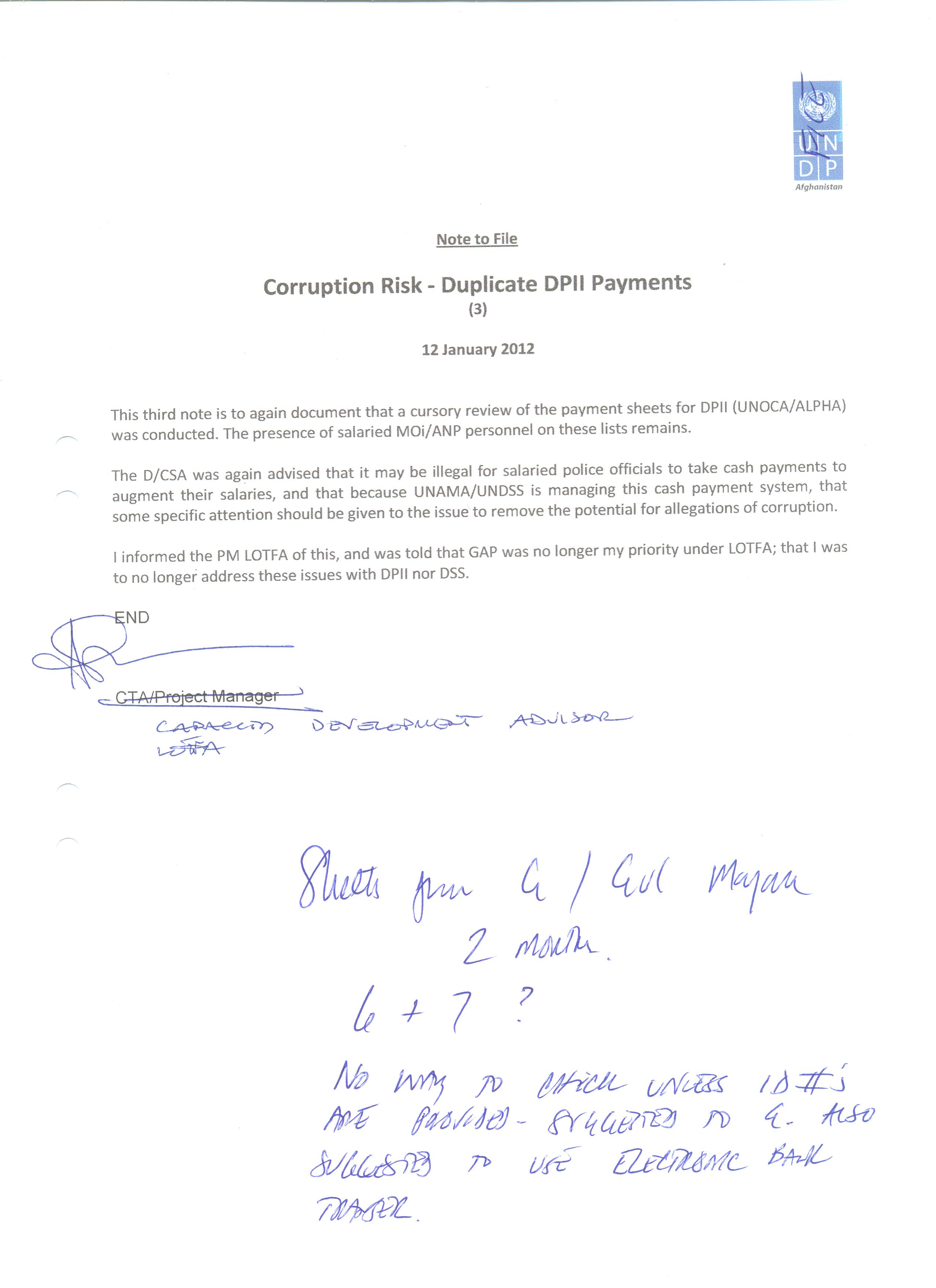
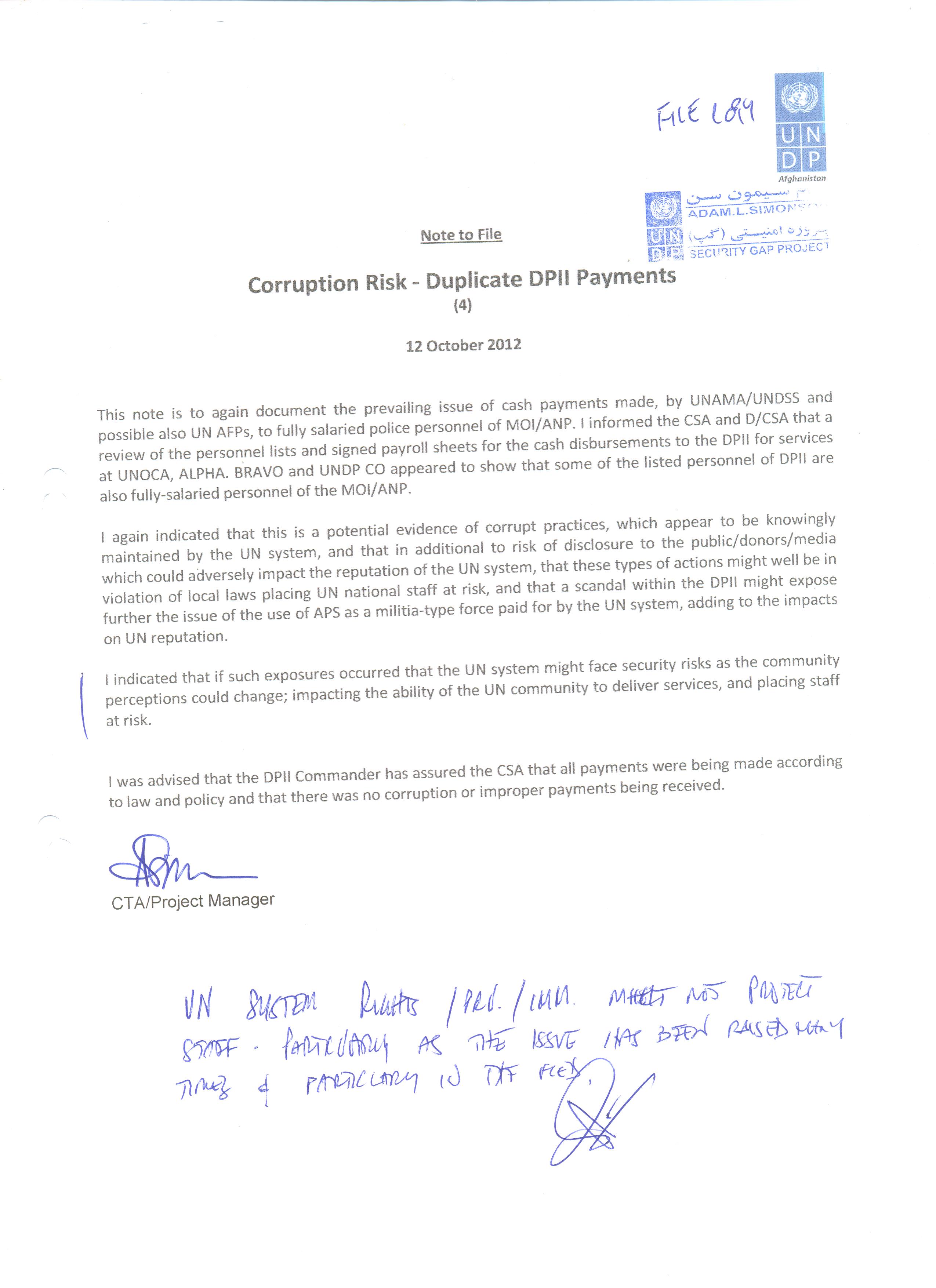

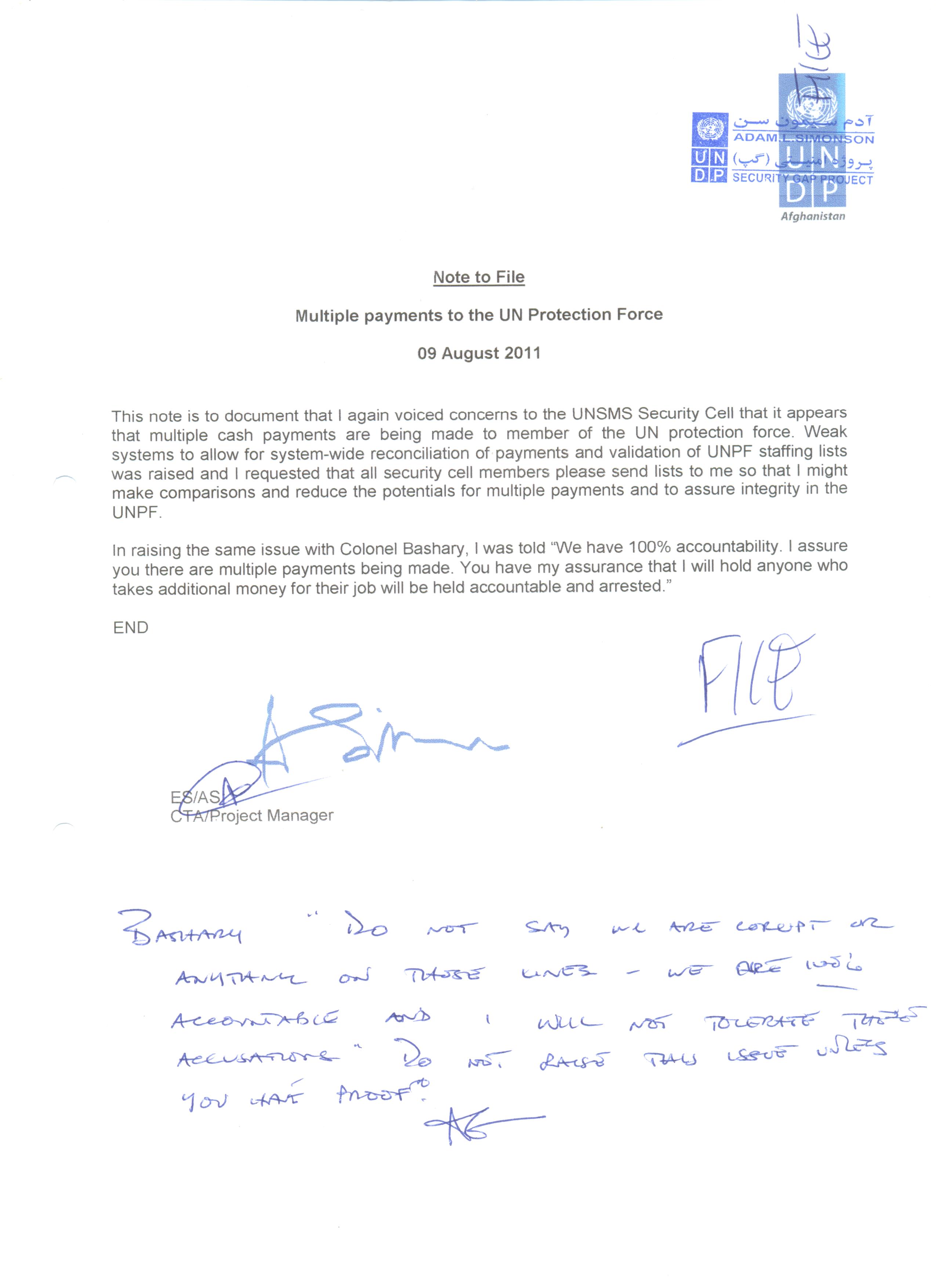
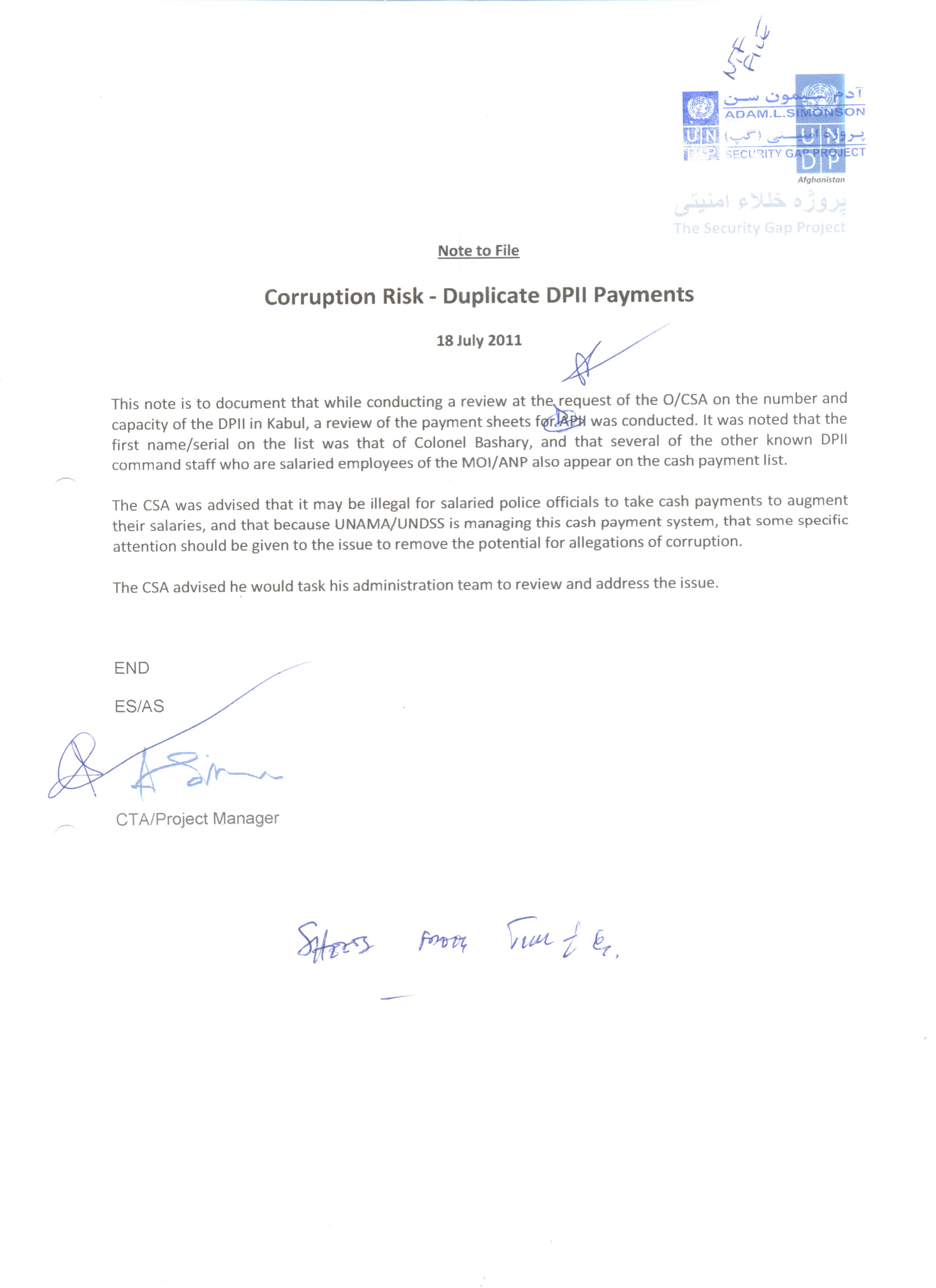
In it, the same Colonel Bashary who threatened he would not tolerate these accusation turns up on the list of double payments.
This publication follows four days in which UN spokesman Stephane Dujarric, formerly UNDP's spokesman, had not said whether an audit cited as a justification for not answering is the troubling audit completed in February 2014.
After Inner City Press asked again on August 15, UNDP's Dylan Lowthian provided this response, which we publish in full:
The 'Security Gap Project' (SGAP) which you have previously referred to was established to enhance security for all United Nations personnel working in Afghanistan. SGAP supported the Government to develop dedicated protection services to the United Nations to enable reconstruction, development and humanitarian activities to be carried out.
SGAP closed at the end of 2013. An audit of the project was carried out by Grant Thornton beginning in October 2013 and was completed in January 2014. Upon completion, the audit was issued in February 2014 and in-keeping with our commitment to transparency and accountability, was subsequently published on the UNDP global website, where it is publicly available to download. Audits are an essential part of our control mechanisms. They are conducted in order to identify both strengths and weaknesses in our programs as a way to increase our overall performance.
There is no second audit of the SGAP project.
As outlined by the Deputy Spokesperson at the briefing on Friday 8 August, there is an ongoing investigation related to issues raised in documents published by Inner City Press. In order to avoid jeopardizing the investigation process, the details of investigations are kept confidential and very limited information is made available to offices outside the UNDP Independent Office of Audit and Investigation, until the process of gathering relevant evidence and fact-finding has been completed. Should the matter be substantiated, the evidence gathered by the Office of Audit and Investigation will form the basis of remedial action.
We'll have more on this. For now, Inner City Press is informed that now "the heat is on at the Kabul office" -- this is called a cover-up, and retaliation against (the wrong) whistleblowers.
The UNDP Independent Office of Audit and Investigation COMPLETED an audit of this Closing the Security Gap on February 12, 2014, Report Number 1251, here.
That report noted "incomplete recording of expenditure incurred in 2012. Salaries were not charged to the Project for the first
five months of 2012; lack of appropriate audit evidence on fuel charges amounting to $60,715 and rent expenses of $13,589; overstatement of indirect program support costs by $21,737."
five months of 2012; lack of appropriate audit evidence on fuel charges amounting to $60,715 and rent expenses of $13,589; overstatement of indirect program support costs by $21,737."
First, it was and is unacceptable for this UN to say it will not respond to troubling documents because it is conducting its own audit or "investigation," with no completion date named and no commitment to make it public. The new Free UN Coalition for Access is opposing and seeking to reverse this UN descent into obfuscation and stonewalling.
Inner City Press asked Dujarric on August 11:
Inner City Press: last week there was some back and forth about the UNDP (United Nations Development Programme) programmes in Afghanistan that resulted in Farhan [Haq] on Friday saying that an audit is ongoing, and while the audit is ongoing, there will be no comment. At least that’s how I interpreted it. But, I’ve looked into it and it turns out that there was an audit that was completed of this very program called “Closing the Security Gap” project, finished in February of this year by Grant Thorton. It made a lot of negative findings, but… it wasn’t clear to me, since UNDP never directly answered the questions, is this audit that’s being cited the old audit? Is there a new audit? If there’s a new audit of the same programme, how much was paid for the former audit? And can you explain how it’s appropriate for the Secretariat to not answer questions about DSS [Department of Safety and Security] and UNAMA [United Nations Assistance Mission in Afghanistan] by referring to a UNDP audit that may already be completed?
Spokesman Dujarric: My short answer is, show me what you have, what you’re referring to and I’m happy to look into it because I’m a little confused by the number of audits myself.
Spokesman Dujarric: My short answer is, show me what you have, what you’re referring to and I’m happy to look into it because I’m a little confused by the number of audits myself.
Inner City Press immediately emailed the audit to Dujarric, along with these three questions:
1) is this the audit Farhan / UNDP were referring to at Friday's noon briefing and justifying not answering questions about DSS and UNAMA?
2) if a second audit of the Closing the Security Gap Project is underway, why? And, either way, how much was paid for the Grant Thorton Audit?
3) This is a requests for the Secretariat to respond to the references to DSS and UNAMA in the documents Farhan was responding to on Friday.
There was no answer. Inner City Press asked Dujarric again on August 13:
Inner City Press: I’d asked you on Monday about this UNDP audit that was cited as a reason they were not answering a questions about [Department of Safety and Security] and UNAMA [United Nations Assistance Mission in Afghanistan]. Have you been able to find out from them whether this February 2014 audit was the one that they’re citing now or is there a new audit?
Spokesman Dujarric: I haven’t had a chance to actually follow-up but I will.
Spokesman Dujarric: I haven’t had a chance to actually follow-up but I will.
Two day later, nothing. So Inner City Press asked yet again.
Before publishing any of the documents, Inner City Press posed questions to five UNDP spokespeople. But none even confirmed receipt -- including Abdel-Rahman Ghandour, the spokesperson who belatedly responded to Inner City Press' previous LOTFA exclusives.
What changed, other than Inner City Press' subsequent reporting on UNDP Administrator Helen Clark's layoff campaign, and these new troubling questions?
The questions were sent on August 5 to the following, without response for 72 hours: lead spokesperson Dheepa Pandian (out of the office from August 1 to 18), Mila Rosenthal and Helen Clark's personal spokesperson Christina Lo Nigro.
After Inner City Press asked UN Deputy Spokesperson Farhan Haq to reply about the UN Secretariat's own role, Haq on August 8 read a statement from UNDP -- there will be no answer pending a UNDP audit. Video here.
This is pure stonewalling. And can Ban Ki-moon's UN Secretariat's Department of Safety and Security and UNAMA Mission hide behind a UNDP investigation that may never be public?
After Haq refused another Inner City Press question, after the UNTV cameras turned off, Haq told Inner City Press that UNDP refused to answer the August 5 questions, below, due to "your people skills." Inner City Press deals perfectly well with numerous diplomats at the UN and many others -- but UNDP and some UN officials don't like hard questions and think they can simply stonewall, in the UN's Zone of Impunity.
Seventy two hours in, while the UN Secretariat of Ban Ki-moon said it wouldn't answer about the role of its own Department of Safety and Security and UNAMA mission while UNDP answers, August 6 and 7 video here -- UNDP had provided no answer at all.
This despite UNDP Administrator Helen Clark having been subject to formal governmental requests about related UNDP irregularities in Afghanistan in May. Is this any way to run for UN Secretary General?
The fourth document, exclusively published here, makes even more clear why Bann Ki-moon's Secretariat must respond. The document describes double payments then introduces one "Colonel Bashary," who threatens not to talk about corruption, "I will not tolerate these accusations." Click here to view.
In Afghanistan as Inner City Press exclusively dug into, UN Security official Louis Maxwell was killed, presumptively by Afghan Forces -- and the UN has obtained zero accountability for this killed staff member. Inner City Press has put questions about Louis Maxwell toDeputy Secretary General Jan Eliasson, who to his credit responded, and to current Syria envoy Staffan de Mistura, here.
Now: why would the UN be telling a whistle-blower to "just let it be," then refusing to answer?
The third document, exclusively published here, concerns "'Ghost Staffing' at the UN Protective Force," about which the UN Department of Safety and Security said, "Just let it be for now." Click here to view.
On August 5, Inner City Press exclusively published this one, linking it to the LOTFA scandal: an official "was again advised that it may be illegal for salaried police officials to take cash payments to augment their salaries" but the adviser was told it was "no longer my priority under LOTFA and that I was no longer to address these issues with DPII or DSS."
This and the other documents indicate that little was fixed, that UNDP goes after whistleblowers, and does not follow up even when for example it is involved in visa fraud.
Inner City Press on morning of August 5 asked no fewer than four spokespeople at UNDP, including the personal spokesperson for UNDP Administrator (and UNSG candidate) Helen Clark for their response to the below.
There had been no answers. Inner City Press exclusively published the second document, here: about payments by UNAMA / UNDSS to fully salaried Afghan forces. Click here.
Both UNAMA and UNDSS are run by Ban Ki-moon's Secretariat, so Ban's spokespeople must answer. UNDP's Helen Clark herself has refused official inquiry about these irregularities. So on August 6 Inner City Press asked UN deputy spokesperson Farhan Haq:
Inner City Press: The payments by UNDSS (Department of Safety and Security) and UNAMA (United Nations Assistance Mission in Afghanistan) in Afghanistan to members of the Ministry of Interior and other Afghan forces that are already under full salary by the Government. Various documents have come out that show an internal UNDP (United Nations Development Programme) whistle blower seeking to raise these issues within UNDP because, I guess, because as the country team, or whatever. But the documents list, they name UNDSS, they name UNAMA, and basically the person was told, “Don’t raise this anymore.” So, I was anticipating you to say “Ask UNDP”. And I have more than 24 hours ago. I don’t have any answer from them. But I want to ask you, because the documents are not just about UNDP, but about DSS and UNAMA, is it… what are the rules? Is it UN’s, DPKO’s (Department of Peacekeeping Operations), DPA’s (Department of Political Affairs) and DSS’s understanding that Afghan forces shouldn’t receive out double payments. If this information came to light, I think it did, what was done about it? That’s my question to you. I don’t know if you get an answer today. Is it possible?
Deputy Spokesman Haq: As I’m sure you’ve anticipated, and indeed you said you anticipated, yes, I’m aware that UN Development Programme is in touch with you on this. They’ve informed you that they will get back to you. And so, we will first have to wait for what their reply is. First ask them.
Inner City Press: How long --
Deputy Spokesman: No, no. It’s no use trying to get the two of us talk at cross purposes with each other. UNDP will get back to you.
That UNDP "is in touch with you" was and is not true: there has been no response at all. The statement UNDP "will get to you" remains unfulfilled. This is today's UN system -- even when UN system staff unions wrote to Ban Ki-moon about Helen Clark, and Inner City Press repeated asked about the letter, there has been no response.
Here is what Inner City Press asked on August 5, no answer:
This is an Inner City Press Press request on deadline for UNDP's comment / response to the following narrative provided to us by UNDP whistleblowers:
UNDP purchased $100,000 in fuel for a special police unit and it was discovered that some or all of the fuel was stolen by the police. The project manager - chief technical adviser for the project refused to purchase another allocation of fuel due to this reported corruption. Refusing to purchase this additional fuel caused problems between the project manager - chief technical adviser and the chief of UN security in Afghanistan.
This followed with reports that several vehicles purchased by this same UNDP project and given to this same special police unit were not being used for the unit but had instead been given as political gifts or other reasons to other offices of the Afghan government. After giving these vehicles to higher ranking officials the Colonel of this special police unit was promoted to General.
The project manager - chief technical adviser reported this and nothing happened. As part of the review which discovered this the corruption of payments made by the UN security office in Afghanistan to the special police unit was also discovered and reported.
This is also a request for UNDP response / comment on another issue, of visa overstay, also on deadline:
UNDP's staff from Afghanistan have not returned to their duty station after being granted visas to attend/participate in the recent UN Games in the USA. UNDP supported the official/G4 visas for all of these Afghan nationals and now they have remained behind in the USA... How can the organization justify sending a dozen people half-way around the world to compete in 'UN Games'? How many of them were given business class tickets since the travel exceeds the 9 hour standard? Is this a proper use of public monies? How can an office so critical to the development of Afghanistan in this time of change see it as beneficial for a dozen of their staff to go on a paid junket to the USA?
[Names voluntarily redacted by Inner City Press.]
This is on deadline. This is also a request for UNDP's response to thestaff survey and the critique(s) of the restructuring / layoffs.
On the visas we can for now add: There are 3 more from ELECT Project and 3 to 4 from Information Communications and Technology Unit whom whistleblowers say have also overstayed their visas. We plan to have more. Watch this site.
Subscribe to:
Posts (Atom)