Sunday, February 17, 2008

On Kosovo, UK Says "No Country" Supports Russia, Council President Says Some Do; UNMIK's Ruecker Does Not Disclose Finances

Byline: Matthew Russell Lee of Inner City Press at UN
www.innercitypress.com/sc3kosovo021708.html

UNITED NATIONS, February 17 -- At the Security Council on Sunday, there were wildly divergent interpretations of the Council's 1999 Resolution 1244 on Kosovo, and no court to decide which interpretation is correct. Russia says that Kosovo's declaration of independence, and collaterally any country's recognition of it, is contrary to Resolution 1233 and therefore violates international law. The U.S. and European Union members disagree. UK Ambassador John Sawers said that no Council member agreed with Russia's request to deemed Kosovo's declaration of independence null and void. Video here, from Minute 0:25. Then the president of the Council, Ricardo Arias of Panama, said that "some members" deem it illegal. Video here, from Minute 2:37. Inner City Press asked Amb. Arias to confirm the obvious, that "some" means more than one. But Amb. Arias said he would not say more. Video here, from Minute 4:17.

Inner City Press asked Russian Ambassador Vitaly Churkin, who does he expect to rule on the legal argument about Resolution 1244. Churkin replied that he hoped Secretary-General Ban Ki-moon would instruct his representative in Kosovo, Joachim Ruecker, to announce that the declaration of independence is contrary to Resolution 1244. Video here. But Ruecker has already said that he views the current situation of Kosovo as untenable. And Ban Ki-moon has dodged questions about Kosovo since he took office, and continued to do so on Sunday. In fact, he did not even dodge: he simply announced that he would not be taking questions until after Monday afternoon's Council debate, at which Serbia's president will speak. By then, it is predicted, most European Union countries and the U.S. may already have granted recognition to Kosovo.

An aside on Ban and Ruecker: while Ban has urged all of his senior officials, including Ruecker, to voluntarily make public financial disclosure, Ruecker has declined, checking his form that "I have chosen to maintain the confidentiality of the information disclosed by me." Click here to view.

Sources told Inner City Press that Russia had for some reason really hoped that Ban Ki-moon would on Sunday issue some statement useful to their cause. Summoned by a Permanent Five member of the Council, Ban clearly had to come. (Whether he wished he was out of New York, as he so often is, drives speculation among the press corps.) And his staff installed a full wooden rostrum, seen for the first time at the Council stakeout, for Ban to rest his prepared remarks on. The rostrum came with its own blue fabric cover, apparently hand-sewn in the UN, and was whisked away before Russia's Ambassador Churkin spoke.

The press corps grumbled about returning on Monday afternoon, a U.S. holiday and technically one for the UN. Some opined that the only purpose of the Serbian president appearing would be to create video footage to be shown in Serbia: "Look, I did everything I could." The matter of precedent will last longer. Inner City Press asked U.S. Ambassador Alejandro Wolff what the U.S. would say if Russia recognized, for example, Georgia's break-away regions of Abkhazia and South Ossetia as independent. Video here, from Minute 1:02. Amb. Wolff maintained that Kosovo is unique; he has said that Russia had essentially agreed as much by voting for Resolution 1244 back in 1999. When Inner City Press asked Amb. Churkin about this, he replied that the word "unique" is nowhere in the resolution.

And if resolutions allowing the UN to administer a troubled region temporarily play out later this way, will it be any surprise that in the future, other countries will not consent to such administration, or even to increased UN presence? UN-intended consequences...

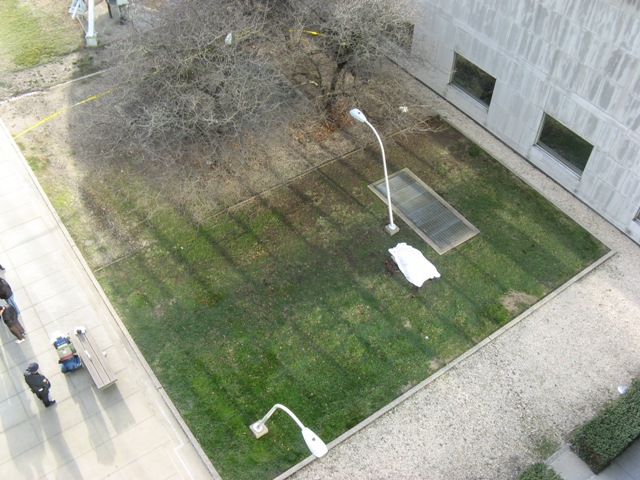
Also on Sunday at UN Headquarters, just after noon, a body was removed from the South Lawn just outside the Council's windows, a UN worker in her 40s who reportedly jumped from the 19th floor, click here for Inner City Press' story.

And see www.innercitypress.com/sc3kosovo021708.html

Woman's Death on UN's South Lawn Leaves Questions Unanswered, Photos Unexplained

Byline: Matthew Russell Lee of Inner City Press at UN
www.innercitypress.com/un2death021708.html

UNITED NATIONS, February 17 -- Following the discovery of the dead body of a woman in her 40s on the South Lawn behind the UN Headquarters on Sunday morning, what appeared to be attempts to downplay the incident occurred throughout the day. Police tape which had surrounded where her body fell was taken down before the UN Security Council's 1 p.m. meeting about Kosovo. By early afternoon, the noticeable imprint on the lawn where she landed had been filled in with sand. UN Deputy Spokesperson Marie Okabe was quoted that the UN would not be disclosing the identify of the deceased, even after her next of kin were notified. Ms. Okabe issued a written statement that "a UN agency staff member died after falling from the 19th-floor of the UN Secretariat building."

While the term "UN agency" would tend to mean one of the funds or programs of the UN system, such as the UN Development Program or UNICEF, both of these agencies have their offices across the street from the UN Headquarters, not beside the East River where the body was found. An Inner City Press source who ventured to the 19th-floor found there rather dreary computer units entitled Systems Management Section and Service Co-ordination Section. Two staffers, there on a Sunday, confirmed that the deceased was a co-worker, but referred all other questions to a man they called their boss, who declined comment.

A photograph which Inner City Press is publishing today shows the body of the deceased with what appear to be bags taped over her hands, see www.innercitypress.com/IMG_4470.JPG

An earlier photograph, in which her body is covered by a blanket, shows a hand, clenched into a fist, not bagged. See, www.innercitypress.com/IMG_4457.JPG

A police source consulted by Inner City Press noted that sometimes hands are bagged to preserve any evidence of a struggle. When Inner City Press called the New York Police Department's DCPI at 1 p.m. on Sunday, the response was that a 44-year old white female was found at 8:09 a.m., and "no criminality is suspected at this time." The UN's statement, issued later, says that "at this time there is no suspicion of foul play."

While by all accounts this lack of suspicious continues and will continues, it seems fair to ask not only about the bagging of the hands, shown in the photo, but also what time the deceased arrives at the UN, and how this is known. There are public-record statements that she arrived early for work. The UN has an electronic pass system, whereby staff members, correspondents and diplomats swipe in and the information is recorded. As first reported by Inner City Press last April, in paragraph 27 of a little noticed resolution on the "security management system," the General Assembly "decide[d] that data related to representatives of Member States... shall automatically be deleted from the standardized access control system after... 24 hours." For anyone other than members of countries' missions to the UN, they can keep the data as long as they want, and apparently use it for any purpose whatsoever. But is it being used in this case?

In fact, one close observer consulted by Inner City Press wondered out loud about the lack of public information about this staff member and death in the UN's important computer unit. While consciously seeking to remain with the bounds of good taste and decorousness, silence from the UN, including as projected even after next of kin is notified, should and will be contested. Watch this site.

And see, www.innercitypress.com/un2death021708.html

(c) Inner City Press 2008, All rights reserved.

UNDP's Top Official for Africa Gilbert Houngbo Refuses Any Public Financial Disclosure, As Burundi Procurement Cover-Up Is Dodged

Byline: Matthew Russell Lee of Inner City Press at UN
www.innercitypress.com/undp1findisclosed021608.html

UNITED NATIONS, February 16 -- The UN Development Program, which preaches transparency to developing countries, has a Director for Africa who has rebuffed UN Secretary-General Ban Ki-moon's request to make public financial disclosure. Gilbert Houngbo, who oversees 1500 UNDP staff members and 43 sub-Saharan African counties, has written on his form filed with the UN Ethics Office that "I have chosen to maintain the confidentiality of the information disclosed by me." Click here to view.

The stated purpose of the UN's financial disclosure program is to "demonstrate that UN staff members understand the importance of the general public and UN Member States being assured that, in the discharge of their official duties and responsibilities, staff members will not be influenced by any consideration associated with his/her private interests." It would seem that Mr. Hougbo disputes the importance of provide any such assurance to the public or even to Member States and funders.

Controversies have surrounded UNDP's Africa operations in recent months, from Kenya to Sierra Leone to Zimbabwe. On these topics and others, on October 16, 2007, Inner City Press questioned UNDP Administrator Kemal Dervis and Mr. Houngbo about UNDP's relative paucity of funding for Africa, which receives significantly less than Latin America. Video here. More recently, last month Inner City Press published leaked documents showing that UNDP in Burundi gave one bidder's information to another, then refused to inform two funders of the underlying medical equipment purchase, the UK and Belgian, of the specifics of what UNDP after the report acknowledged as the "non-transparent procurement process." Click here for Inner City Press' January 17 story, which detailed how UNDP's affiliate the UN Office of Project Services, headed by another non-filer Jan Mattsson, quickly offered a senior post to Geert Vansintjan, the Belgian member of the joint UNDP / UNOPS Executive Board who had demanded information. UNDP on February 12 uploaded its own online spin, that

"UNDP's office in Burundi submitted a request for procurement of $2.3 million worth of medical supplies from Hospital Services (Burundi). After looking into the matter, the request was rejected by UNDP's corporate procurement review due to a perceived non-transparent procurement process. Contrary to recent allegations, UNDP's own internal controls identified the shortcomings and halted the procurement action."

Even assuming that were true -- in fact, the bidder whose information was improperly shown to another filed a protest -- UNDP has not even purported to address the obvious conflict of interest of its affiliate UNOPS hiring the Executive Board member who was asking questions about UNDP. Click here for the Jan. 17 Inner City Press story, which also noted that a request had been made for the UK's comment on demonstrably not getting the information. On February 15, a UK diplomat told Inner City Press that his government is not interested in speaking publicly about the "non-transparent procurement process" in Burundi, although it involved UK money. Asked what UK minister Mark Malloch Brown, previously the head of UNDP (when Gilbert Houngbo was his chief of staff), was doing in UN Headquarters, he listed three initiatives, including disarmament, Darfur and the millennium development goals.

While Kenya was not listed, that is another locus of UNDP controversy. Despite spending funds in the recent disputed election, including on monitoring and "improving" the media, UNDP afterwards downplayed any role in the election's problems, and even claimed the World Bank was misquoting UNDP officials as saying behind closed doors that Mwai Kibaki won and should continue to be supported. In Kenya itself, which Malloch Brown visited, the UK like UNDP is notably closer even post-election with Kibaki than other donors like Canada and Australia. UNDP's near-slavish praise of and provision of irregular services to governments in power, whether North Korea's Kim Jong-il or, as recently noted by the UN's own public information office in Freetown, Sierra Leone's Ernest Koroma. And still, UNDP's top official for Africa refuses to make any public financial disclosure.

UNDP's retaliation against whistleblowers has extended to Africa, where after protesting the no-bid diversion of funds for the environment in Africa to Canadian and European-based firms, Mathieu Koumoin was fired and has since twice been rebuffed by the UN Ethics office, based on UNDP's argument that it should review its own ethics. Click here for last story on this. Since then, Koumoin has urged the UN's Joint Appeals Board to speed up its review. We'll continue to follow this, JAB case 2007-015, set for April, not March, as this UN Ethics Office letter has it, also adding that "the Ethics Office does not have jurisdiction over staff of UNDP."

UNDP's senior official for Africa Gilbert Houngbo was quoted by China's Xinhua news service on May 3, 2007 that "reforming the United Nations is not an end by itself." Clearly not, to UNDP. It's easier just to seek to retaliate against those who raise questions. Developing.

And see, www.innercitypress.com/undp1findisclosed021608.html

Rare Focus on UN General Assembly President's Finances Finds Dinners in Naples, Florida, Funding by Hosts, Forthcoming Latin America Mysteries

Byline: Matthew Russell Lee of Inner City Press at UN
www.innercitypress.com/un1kerim021408.html

UNITED NATIONS, Feb. 14, updated Feb. 17 -- Srgjan Kerim, president of the General Assembly, traveled to Naples last Friday on a diplomatic mission. The venue was a restaurant, the host a restaurant owner, and the Naples was not in Italy but Florida. The only media coverage, until Inner City Press asked about it, was in the metro section of the Naples News, whose lead was "a little bit of Eastern Europe is coming to Southwest Florida." The article went on to explain that "along with President Kerim, more than 125 people attended Friday's luncheon event at Vergina restaurant... Friday's events also marked the official recognition of Naples resident Lou Vlasho's appointment as Honorary Consul of the [Former Yugoslav] Republic of Macedonia," FYROM. Vlasho, as it turns out, is the owner of the restaurant where the celebration was held. One imagines a glad-handing photograph already up on the wall over the bar.

Inner City Press asked Kerim's tireless spokesman Janos Tisovszky who paid for the trip, and on February 11 was told that it was paid for by "the hosts." Would that be Vlasho? Or FYROM? The question has yet to be answered. On Thursday, after Tisovszky announced another Kerim trip, this one to Latin America, Inner City Press was compelled to ask about the financial arrangements for the tour. Tisovszky answered that "as I think I've mentioned to you at least on a one-on-one, that when it comes to official trips of the President, these are covered by the budget of the Office of the President, which is roughly about $280,000 per year... some of the costs may be covered by the host."

Inner City Press asked, for this particular trip, which hosts would pick up which costs. Video here, from Minute 33:31. Tisovszky bristled that "I will try to brief you on the substance because, to be quite honest from our point of view, that's a little bit more important than the actual cost. I understand that, from your point of view, you're looking for transparency. You want to see where every dime and nickel is spent. But I'll try to get that for you, both the substantive part, and also the cost part."

While we'll await and report on the substantive part of the trip -- for the record, Inner City Press was the only media outlet that remained outside the General Assembly chamber on the night of February 13 to ask Kerim about his two day climate change debate -- the question about costs seems eminently reasonable. The president of the General Assembly, often called the PGA, is at the pinnacle of the UN system, at least according to the Charter. But the office is accorded much less scrutiny and press coverage than the Secretary-General or the president or even elected members of the Security Council. Still, Inner City Press has covered Kerim's views on UN ethics, the budget, climate change and vows of transparency. Based on concerns raised by former staff members, who say Kerim's tenure reminds them of PGA Samir Shihabi, of financial demands from the PGA, Inner City Press asked Tisovszky to confirm or deny some of these demands. In context, the response was not denials but explanations:

"The existing practice is that the living costs of the GA President is covered by his/her own government -- so that's the case with President Kerim as well... As regards the credit card issue: no, the President has not requested a credit card, he inquired about how to facilitate access to the use of the budget available to his Office especially when away from Headquarters...The President prior to assuming his office inquired about his entitlements including also any entitlements and obligations covering family members. He has not made any request for car and security for his wife."

While the comprehensiveness of Tisovszky's answers stand out, some of the questions raised remained outstanding, for example, "to Srgjan Kerim's lodging in New York, reportedly in a hotel, is his government covering the cost?" Subsequently, it was confirmed that the FYROM government is paying, for an apartment, not a hotel room. The need to modernize and increase UN funding to the Office of the GA presidency was stressed, and going forward, will be assessed.

And what of the trip through five Latin American countries? As Tisovszky noted on Thursday, the next PGA will come from the so-called GRULAC Latin group. Who will Kerim meet with? For the Secretary-General, a list of meetings is issued - why not for the President of the General Assembly? As of Feb. 17, due to illness, the PGA has not left on trip, may do so Wednesday or postpone the Latin tour. Watch this site.

And see, www.innercitypress.com/un1kerim021408.html

Friday, February 15, 2008

Waiting for Kosovo, Russia Speaks of 200 Precedents, Serbia of State Secrets

Byline: Matthew Russell Lee of Inner City Press at UN
www.innercitypress.com/sc1kosovo021408.html

UNITED NATIONS, February 14 -- With Kosovo widely expected to declare independence this month, the Security Council met behind closed doors on Thursday, at the request of Serbia and Russia. The room was packed with representatives of countries who petitioned to attend, a number of them citing their concerns about the precedent of perceived Council inaction in the face of separatism. Afterwards, UK Ambassador John Sawers told reporters that Kosovo would not be a precedent, that its situation is unique. Russian Ambassador Vitaly Churkin quickly countered that only the United States and members of the European Union were giving the green light for Kosovo's unilateral declaration of independence. Inner City Press asked Amb. Churkin about the UK's position that there are no analogies to Kosovo. "I can see two hundred situations with complicated histories," Churkin answered, "some geographically close." Video here, from Minute 4:24.

Abkhazia and South Ossentia are two regions where desire is expressed to break-away from Georgia. Transdniestria has in many ways already split off from Moldova. The fate of Western Sahara has hung on the balance for decades. But even if, based on the name, one were to count Nagorno-Karabakh as two, where are Churkin's 200 situations? That is a map we'd like to see, and one that the UN's Department of Political Affairs might be expected to have.

Serbia's foreign minister Vuk Jeremic spoke at length of Serbia's earnestness in wanting to continue negotiations, under "the roof of sovereignty." Asked what Serbia will do if and when independence is declared by Kosovo, Jeremic said he would not answer, it is a "state secret." He said it would not include violence, but everything else is on the table, including presumably reductions in electricity, blockades and other trade actions. He was asked if he would be staying in New York to the weekend, since Kosovo is expected to declare independence on Sunday. Jeremic said that unfortunately he cannot stay in New York for the weekend, but that he would expect the Council to meet if independence is declared, and that meeting to have Serbian representation at a "high level." Asked the same question about Sunday, Churkin advised the press not to make other plans.

Inner City Press asked Amb. Churkin if Russia has spoken with Ban Ki-moon or the head of UN peacekeeping, Jean-Marie Guehenno, about the controversy surrounding whether Security Council approval is needed to shift any of the work of the UN Mission in Kosovo, UNMIK, to European forces. "We have had extensive contacts with the Secretariat, and they understand our position," Churkin answered. Inner City Press followed-up, but what is their position? Video here, from Minute 9:19. "They understand the strength of our legal message," Churkin answered. We'll see.

Also on www.innercitypress.com/sc1kosovo021408.html

Google, Asked About Censorship at the UN, Moved to Censor the Questioner, Sources Say, Blaming UN Development Program

Byline: Matthew Russell Lee of Inner City Press at UN
www.innercitypress.com/un1google021408.html

UNITED NATIONS, February 14 -- Google, after being publicly questioned at the UN about not signing on to the human rights and anti-censorship principles of the Global Compact, responded not by joining the Compact and forswearing from censorship but by moving to de-list from its Google News service the media organization which raised the question. More than two years after Inner City Press was included into Google News, in a February 8 message referring to the receipt of a complaint, Google said it would be removing Inner City Press from the news database.

In late 2007, Google's chief technologist Michael T. Jones took questions at a UN press conference with UN Secretary General Ban Ki-moon and UN Development Program chief Kemal Dervis promoting Google's involvement in mapping the UN's anti-poverty Millennium Development Goals. Inner City Press, accredited media at the UN, asked Mr. Jones if Google was a member of the UN Global Compact, through which corporations sign up to principles of human rights including non-censorship. Video here, from Minute 30:21.

Google's Jones at first delayed answering the questions, noting that Google was the third of Inner City Press' three questions -- the first two were to the UN Development Program's Kemal Dervis about the absence of North Korea from the data base, the second to Cisco about censorship. Then, on camera, Jones said he did not know of Google was a member of the UN Global Compact, that he would reply later. Video here, from Minute 32:37.

While Google is said to have a contract with UNDP, Google was not a member of the Global Compact then, and is not one as of this writing. Rather, Inner City Press was notified by "Google Team," with no further attribution, that it would be de-listed from the Google News service, in which it had been included since 2005. Google's notification referred to "user complaints." Inner City Press immediately asked to be informed of the identity of any institutional complainant, including Google itself. Beyond that, certainly, there are others with complaints about Inner City Press' investigative coverage, at the UN, in Myanmar, UNDP and elsewhere.

In fact, UNDP sources describe communications from the UN system to Google executives, asking that Inner City Press be de-listed from Google News, and that a well-read blog, UNDP-Watch, be striken from that data base. Recently a whistleblower in UNDP's legal department had his office computer impounded and was told, you have visited InnerCityPress.com multiple times. While the interrogation reflected contempt for the freedom to read and freedom of the press, the issue goes far beyond the corporate culture at UNDP, to that of Google.

Google's Sergey Brin and Larry Page have each been quoted dodging the question of Google's participation in the Chinese government's censorship of the Internet, saying only that Google contacted Beijing and came to an understanding. It now appears that after getting a taste of censorship in China -- and in Egypt, by some accounts -- Google has in this case brought the practice home to the United States.

Inner City Press, alongside requesting the name of institutional complainants and to be maintained in Google News, sought comment by e-mail from press [at] google.com and from Google's Michael T. Jones, whom it questioned at the UN. The latter has not responded. From press [at] google.com came a series of questions, which once answered, resulted in a vague assurance that indexing would continue.

But Inner City Press' two stories datelined Wednesday night, about a lack of transparency at the UN and its soft approach to Myanmar's military regime, were not included in Google News. Thursday afternoon, Nancy Ngo of Google's office of Global Communications stated that "Inner City Press has been verified as a source" and would be included "in a few weeks." But why was it removed? Developing.

And see, www.innercitypress.com/un1google021408.html

UN Has List of Ban's Calls, But It Can't Be Seen, Only Guessed At, No Freedom of Information

Byline: Matthew Russell Lee of Inner City Press at UN
www.innercitypress.com/ban1calllist021308.html

UNITED NATIONS, February 13 -- Each day the UN Secretary-General's spokesperson carries to the press briefing a list of calls he's made. If a reporter asks about a call, or if referring to a call seems like a good answer to a question, the call and topic are disclosed. But when Inner City Press asked if calls, like the Secretary-General's and Deputy Secretary-General's meetings, could routinely be listed for correspondents, the answer that came back was no. What is the difference between a meeting and a call?

On Wednesday away from New York, on Myanmar's border with Thailand, a just-escaped democracy activist described continued repression, saying of the Burmese government that UN envoy Ibrahim "Gambari may tell them to stop arresting people but they just carry on." At the UN's noon briefing, Inner City Press asked Ban Ki-moon's spokesperson Michele Montas for a reaction to this. Ms. Montas replied that Ban has called the president of Indonesia and the foreign ministers of China and India, then went on to give the time of the Indian call -- 7:45 in the morning -- and to add that Ban had called Tony Blair. Inner City Press asked if this last call, disclosed for the first time and seemingly by a fluke at the noon briefing, had included climate change, since Blair recently took a two million pound job with Zurich Financial to advise on climate change. (That this might be another conflict of interest or require some safeguards was raised by Inner City Press, but not answered for the second time by the UN.)

Wednesday afternoon, Inner City Press asked Ban's spokesperson's office if they have "a daily log of work-related calls that Mr. Ban makes, might that list either be put out in the spokesperson's office like the list of his meetings, or be read out at the noon briefing?" A well-crafted answer from Ban's spokesperson's office ensued, quoted now in full:

"In order to properly discharge his functions, the Secretary-General has a number of tools at his disposal, including reaching out to specific people by phone. While some the Secretary-General's contacts are public, he must retain the ability to have confidential communication with whomever he wishes in order to effectively conduct diplomatic business, especially when it involves his good offices. The list of his daily telephone contacts and daily appointments will continue to be released to the press when appropriate."

So Wednesday it was appropriate, but other days it may not be?

Even the list of meetings is not complete. Earlier this week, environment envoy Yvo de Boer told Inner City Press he had met "in the flesh" with Ban, but that never showed up on the list. But as to calls, why can't even an incomplete list, or as complete as that for meetings, be made available to the press? The response shows why the UN's long-promise, long-delayed freedom of information scheme should be implemented now. Most recently, Under Secretary General for Management Alicia Barcena said the policy is "almost ready," to go to the General Assembly this May or in the Fall. Transparency, transparency. We'll have more on this.

And see, www.innercitypress.com/ban1calllist021308.html

As Myanmar Cracks Down, Some See Glass Half-Full, Do Not See Rambo IV or Financial Disclosure

Byline: Matthew Russell Lee of Inner City Press at UN
www.innercitypress.com/un1myanmar021308.html

UNITED NATIONS, February 13 -- While at the UN the Group of Friends on Myanmar met behind closed doors, the Burmese government confined democracy activist Tin Oo to another year of house arrest. This came days after the announcement of a referendum, which will apparently exclude the opposition parties. From Myanmar's border with Thailand a just-escaped democracy activist described continued repression, saying of the Burmese government that UN envoy Ibrahim "Gambari may tell them to stop arresting people but they just carry on." At UN headquarters on Wednesday, Inner City Press asked Ban Ki-moon's spokesperson Michele Montas for a reaction to this, from Mr. Gambari or the Secretary-General. Ms. Montas replied that Ban has called not only Indonesia's president, but also the foreign ministers of China and India, two of the members of the Group of Friends on Myanmar. Friends *of* Myanmar, one wag observed, noting that China's state-owned CNOOC recent swapped stakes in Burmese gas projects with its equivalent from Thailand, which is another of the Friends.

Later in the UN's basement, before the 5 p.m. meeting of this Group of Friends, Inner City Press asked France's Deputy Permanent Representative Jean-Pierre Lacroix about the purpose of the meeting. "It is important that we meet," he simply said. As Mr. Ban entered the meeting, Inner City Press asked him if he will visit Myanmar, as requested by Thailand and others, if so-directed by the Group of Friends. Ban smiled but did not answer. Next to him, envoy Gambari when asked when he will go to Myanmar said, "As soon as possible."

Nearly two hours later as the meeting ended, several attendees viewed as more sympathetic to the Burmese government told Inner City Press that the referendum may be a good thing. Gambari summarized the meeting as focused on the referendum, rather than on when he will go to Myanmar. Some see the glass as half full, he said, barely bothering to finish with those who see it as half empty. Inner City Press asked Gambari about the continued confinement of Tin Oo, and Gambari said, "It is not helpful."

When Inner City Press asked Mr. Gambari what he thought of Myanmar being the topic of the new Rocky film, Gambari said that he hadn't been aware. Since Sylvester Stallone claims that it was the UN who told him that Myanmar is the most forgotten humanitarian crisis on Earth, one wonder to whom Stallone / Rocky spoke. We'll see.

Footnote on financial disclosure: while Ban Ki-moon urged all Under Secretaries General, of which Gambari is one, to make public some financial disclosure, a call Ban reiterated at the Security Council stakeout when asked by Inner City Press, as of February 13, the list of disclosers still does not include Gambari. Surely he's busy, but as UN Ethics Office chief Robert Benson told Inner City Press, it does not take too long. So when will this glass be filled? Watch this site, and this one too.

And see, www.innercitypress.com/un1myanmar021308.html

At UN, Political Affairs Plan Slated to Shrink, Development Plan Missing, Along with Budget Officials

Byline: Matthew Russell Lee of Inner City Press at UN
www.innercitypress.com/un1dpa021208.html

UNITED NATIONS, February 12 -- With much fanfare last Fall, UN management proposed to member states that 103 new hires would be needed to strengthen the Department of Political Affairs. A lengthy report was issued, but the General Assembly did not act on it in its December 21 all-night budget session. Now, the Advisory Committee on Administrative and Budgetary Questions has opined that DPA needs, at most, sixty posts, and not the proposed 103. ACABQ suggests that fully $8 million of the Secretariat's requested $21 million for DPA is not necessary.

While the deeper scuttlebutt is that the Assembly will refuse to act even on this until a similar strengthening of the Department of Economic and Social Affairs is proposed, Inner City Press on Tuesday asked Spokesperson Michele Montas for a response to the shrinking of DPA plans recommended by ACABQ. Video here; transcript here. Ms. Montas said she would look into it, and also into Inner City Press' question about reports of dozens of recent murders in Southern Sudan by the Lord's Resistance Army, a group with which the Department of Political Affairs is engaged and on which, it would seem, it should be reporting.

Later on Tuesday, a full-paragraph response arrived, also inserted into the day's UN transcript:

"The ACABQ's report (A/62/7/Add.32) on the Secretary-General's proposals for Strengthening of the Department of Political Affairs (DPA) supported the concept and rationale of the Secretary-General and recommended approval of approximately two-thirds of the resources proposed. The issue now goes to the Fifth Committee. It is the Member States who ultimately have the say over the budget, but as this discussion continues the Secretariat will continue to make the case for the full funding of the Secretary-General's proposals, which were developed based on a careful assessment of what DPA needs to carry out its mandated work. The Secretary-General remains strongly convinced that strengthening DPA is a modest investment with a potentially big payoff in that the UN will be in a better position use diplomatic means to prevent and resolve conflicts before they turn into larger and costlier tragedies."

While some UN insiders say that where DPA falters, it is more for lack of will than lack of resources -- they point not only to the UN's recent silence on the Lord's Resistance Army but also to Myanmar as the best current example -- the more concrete question is who will make the Secretariat's case?

UN Comptroller Warren Sach is said to be on vacation -- he is also said to be leaving, that's been in the air for a while -- while another high budget official, Sharon Van Buerle, is also out. The head of the Department of Management Alicia Barcena, who on February 4 candidly told Inner City Press that the glitzy event on the UN's North Lawn, which she had approved, had become inappropriate, soon after that had a broken arm from which she is recovering, away from the UN. (We wish her luck and health.) So who is running the show? And, relatedly, where is the DESA restructuring plan that developing countries have demanded? We will continue to follow this issue.

And see, www.innercitypress.com/un1dpa021208.html

Sanctions on Child Soldier Recruiters Debated at UN, Some Accused Question Report's Fairness

Byline: Matthew Russell Lee of Inner City Press at UN
www.innercitypress.com/un2caac021208.html

UNITED NATIONS, February 12 -- The UN report on children and armed conflict was debated for eight hours Tuesday in the Security Council, with sixty separate countries each putting their own tweak upon the problem. The United Kingdom honed in on Myanmar, which it still calls Burma. But Myanmar responded that the report is one-sided, and that there is information the release of which the UN is blocking. The Russian Federation chided the report for not including the impacts of private military contractors, such as those used by the U.S. in Iraq. U.S. Ambassador Alejandro Wolff praised the report, except its recommendations opposing cluster bombs and favoring referring the recruiters of child soldiers for prosecution by the International Criminal Court. Afterwards Inner City Press asked Amb. Wolff about the U.S. position, which he explained as opposing the automatic referral of recruiters to the ICC. The Special Representative behind the report, Radhika Coomaraswamy, explained that the ICC is an essential part of cracking down on child soldier recruiters.

Inner City Press asked UNICEF's Ann Veneman, both in writing and at a stakeout in the hall outside the Council, to address the fact that UNICEF formally counted the child soldiers recruited by Congolese warlord Peter Karim -- some 42 in just that last phase of demobilization -- but that Karim remains free and in the Congolese Army. At the stakeout, Ms. Veneman did not answer the question.* Video here, from Minute 4:59. Rather, French foreign minister Bernard Kouchner answered, but with respect to another part of the Congo and other rebel, Laurent Nkunda, perceived as aligned with the government of Rwanda.

Rwanda's Ambassador Joseph Nsengimana spoke last, at 8 p.m., and afterwards Inner City Press asked if his government favored sanctions on and referrals to the ICC for recruiters of child soldiers. Yes, he said, but only if the underlying reporting is fair and even-handed. Amb. Nsengimana said that the report focused on Nkunda but not the FDLR rebels, who he said were worse.

Indonesia's Ambassador Marty Natalegawa, too, told Inner City Press that he is not so much against sanctions as concerned that Ms. Coomaraswamy's office have the resources to provide even-handed research. Council members Libya and Vietnam were not so nuanced in their opposition to sanctions. China, too, expressed concerns. Other Permanent Five diplomats opined to Inner City Press that China often follows the lead of the Council's African members on such issues, and that the Council's make-up now is more anti-sanctions than before, particularly with Libya's inclusion. Ms. Coomaraswamy said it is up to member states, and it is up to her office to convince them that sanctions are needed.

Canada testified that equal focus should be put on countries which are on and not on the Security Council agenda. It is the latter group -- including Colombia, Sri Lanka, Chad, Uganda and the Philippines -- which gives rise to the most controversy, an issue previously covered by Inner City Press. These countries do not want to slip only the Council's agenda indirectly. They complain, they issue counter-charges, they pull to get off the list. Sri Lanka, for example, accused Ms. Coomaraswamy of bias, and made the same accusation of her Canadian special envoy Allan Rock, when a photograph of him purportedly with Tamil Tiger sympathizers surfaced. Monitoring child soldier recruitment is a tough business. Listening through eight hours of UN debate is the least of it -- but not the last of it. We'll will continue to follow this issue.

And see, for update, www.innercitypress.com/un2caac021208.html

UNICEF Pays Consultants Up To $600 a Day, Its US Fund Twice That, Audits and Veneman Still Withheld

Byline: Matthew Russell Lee of Inner City Press at UN
www.innercitypress.com/un1unicef021108.html

UNITED NATIONS, February 11 -- UNICEF pays consultants up to $625 a day, but the National Committees which used UNICEF's name to raise money apparently pay up to $1200 a day. As UNICEF Germany is engulfed in scandal, repeated requests for UNICEF chief Ann Veneman to answer questions were met Monday with a series of terse written responses. Asked to confirm or deny KPMG's report that UNICEF Germany spent 18% of the funds it raised on administration, spokesman Christopher de Bono responded that "it is the responsibility of each National Committee, overseen by its governing board, to manage these costs." But do the costs in Germany represent 18% of the money contributed? Mr. de Bono says that further response will have to await a review conducted by a senior UNICEF fundraising official, Philip O'Brien, and that these issues were not even discussed at UNICEF's Executive Board meeting held at UN Headquarters in late January.

Inner City Press' thrice-repeated request that Ann Veneman answer questions, about UNICEF Germany, compensation, and her role in the Gucci-sponsored event on February 6 which Gucci publicly claimed "celebrated" the opening of its store on Fifth Avenue, was met Monday by the following written response by Mr. de Bono, that Ms. Veneman "participated in a briefing in Room 226 in December 2007... Decisions regarding her engagement with the media are based on the issues concerned and the many other important matters on her schedule."

So a scandal in which the Chancellor of Germany has demanded greater transparency from UNICEF, director Dietrich Garlichs has been forced to resign and funders are walking away in droves is not an "important matter"? In all of 2007, Ms. Veneman did a total of two press conferences in the UN's briefing room, both time participating in the launch of a report with two or three other briefers. Between October 12, 2006 and October 17, 2007 -- more than year -- Ms. Veneman did not appear once in the UN's briefing room. This did not allow for any questions about UNICEF's actual operations. It should be noted that even Kemal Dervis of the UN Development Program, when questions arose about his agency's operations away from headquarters, came to the Security Council stakeout to take questions from the press. Apparently that is beneath Ms. Veneman.

Non-responsiveness makes a difference. Whereas UNDP has now proposed at least a mechanism by which member states could see internal audits, if not copy them, when Inner City Press asked for UNICEF's policy in this regard, he responded that UNICEF's "current policy is that we do not make these audits available. However, UNICEF is currently working with the inter-agency process on a joint policy that will allow UN entities to share this information with Member States in a consistent manner."

This is an old and recycled answer, one superseded by UNDP, one of the agencies that UNICEF claims to be working with. While UNICEF acknowledges that KPMG "identified problems in internal business processes that must be addressed," UNICEF apparently is comfortable not showing audits of these business processes even to the countries which fund UNICEF's work. While a new policy was brought up by management at UNDP's Executive Board meeting last month, at UNICEF's meeting, the issues was not raised, including by management. Asked why by Inner City Press, de Bono did not answer. Nor have questions about UNICEF's operations in Sri Lanka and the Democratic Republic of the Congo, parts of which has long been pending, being answered. The DR Congo questions involve UNICEF's seeming participation in impunity for recruiters of child soldiers, a topic to be discussed Tuesday by the Security Council. Watch this site.

And see, www.innercitypress.com/un1unicef021108.html

UN's de Boer Explains Bali Tears and Comma's Silent Impact, Branson Dodges, Steiner's Secrecy

Byline: Matthew Russell Lee of Inner City Press at UN
www.innercitypress.com/ga1climate021108.html

UNITED NATIONS, February 11 -- "You can't hear a comma," UN climate change point-man Yvo de Boer told Inner City Press on Monday. He'd been asked about the negotiations in Bali in December, specifically about his widely-seen but little understood crying jag near the end of the conference. While the voice-over on a number of global television broadcasts of his tears had ascribed them to the tenseness of the talks or the state of the planet, de Boer on Monday confirmed that he'd been accused by China of holding two sets of negotiations over two sets of documents. He said there had been confusion about when the informal talks ended, and the formal ones began. The rest, he said, "will be for my book." Video here.

Afterwards, off-camera, de Boer said he "felt bad" for the Americans, who were "put in an uncomfortable position" by a comma not enunciated by the Indian delegation at the talks. As de Boer recounts it, the talk was of a sentence providing that developing countries should take real, measurable and verifiable actions ... but should be provided with real, measurable and verifiable financial resources into order do that. The question left unanswered by the reading, according to de Boer, was whether "real, measurable and verifiable" referred only to money, or related to other provisions. The U.S. was left out on a limb, and Yvo de Boer regrets it.

Asked about coal by Inner City Press, de Boer said that moratorium on coal use is not realistic, but there are still legitimate questions about whether carbon buried via "capture and store" technology will in fact stay buried. At least de Boer answered this question. An hour earlier, in the same room but with many more journalists present, Sir Richard Branson of Virgin Airways dodged the identical coal question from Inner City Press, answering instead about biofuels. After saying that corn ethanol does not, on balance, reduce dirty energy emissions, Branson admitted that he is invested in corn biofuel. Daryl Hannah, shrugging off the UN press corps' jokes about mermaids -- based, it seems, on her appearance in the 1980s movie "Splash" -- answered that biofuels are best when made from waste, or even algae. Video here.

In the Trusteeship Council chamber as afternoon turned to dusk, Sha Zukang of the UN Department of Economic and Social Affairs concluded with what he called, to some laughter, "propaganda from DESA." Kemal Devis of the UN Development Program -- and formerly of the World Bank -- said that the World Bank has a role in middle income countries. While the director of the UN Environment Program Aichem Steiner speechified, UN correspondents with time on their hands noted that Steiner is not listed as participating in any way in the UN's financial disclosure program. We'll have more on this.

And see, www.innercitypress.com/ga1climate021108.html

On Climate Change's Margins, Biofuels Cause Food Price Rise for Poor, Bloomberg and WFP Agree

Byline: Matthew Russell Lee of Inner City Press at the UN: News Analysis
www.innercitypress.com/un1wfpbloomberg021108.html

UNITED NATIONS, February 11 -- The subsidy for corn ethanol "raises food costs in the United States and around the world," New York Mayor Michael Bloomberg told Inner City Press on Monday, saying that inevitably "people die" from increased food prices. Outside a UN climate change event, Bloomberg specifically criticized the "last energy bill" passed by Congress and signed by President Bush as having this impact. Video here, second question. He said that while subsidized corn ethanol does not generate more energy than it uses, sugar ethanol does, and yet "we tariff it."

The head of the UN World Food Program, Josette Sheeran, asked by Inner City Press about the more global impact of biofuels, said they "present an opportunity and a challenge to the most vulnerable." While some farmers in Africa, she said, as happened before in Brazil, can grow income-producing crops on land not appropriate for food, it has an effect on global food costs. "It's the pricing of foodstuffs at fuel prices," she said, calling it "the new face of hunger." Asked what the UN can or should do about the issue, she said that WFP for now is just trying to raise awareness about the rise in food prices. "When I was on the High Level Panel" on the UN's so-called systemwide coherence, she said, she coined a phrase, "Nothing gets between WFP and a hungry child." But might biofuels?

Ms. Sheeran also agreed to answer questions about the use of French and now Danish ships to defend WFP food deliveries to Somalia. It's not ideal, she said, but "an environmental where ships are taken and people are killed" left WFP down to one company to do business with when Ms. Sheeran took the reigns at WFP. Inner City Press asked, what company? "The one that did it," Ms. Sheeran answered.

She said that while WFP is managing to deliver needed food inside Kenya itself, reports that she reviews daily show continued threat to Kenya's status as a delivery hub, for WFP, for the Democratic Republic of the Congo, Somalia and Southern Sudan. Things are piled up at the port, she said, leading to a search for a back-up. Asked where, she said Tanzania, adding that it too is almost at full capacity.

Ms. Sheeran has yet to hold a press conference at UN Headquarters since the controversies that surrounded her nomination by the Bush administration in late 2006. While her answers Monday were appreciated, regular question-and-answer with the heads of UN funds and programs is need now more than ever.

And see, www.innercitypress.com/un1wfpbloomberg021108.html

Monday, February 11, 2008

UN's Jane Holl Lute Admits No-Bid Lockheed Martin Deal Caused "Confusion," Says No Conflict of Interest In Iraq and Afghan Overlap with Husband's Role

Byline: Matthew Russell Lee of Inner City Press at UN
www.innercitypress.com/un2lockheed020708.html

UNITED NATIONS, February 7 -- One hundred days after Lockheed Martin was granted a $250 million no-bid contract by the UN, the main proponent of the contract, the American officer-in-charge of the Department of Field Support, Jane Holl Lute, acknowledged that the lack of competition had caused confusion. While the UN General Assembly by a vote of 142 to 1, with only the United States dissenting, voted to express concern about the no-bid contract, Ms. Lute on Thursday claimed that the process had been transparent. Inner City Press asked, How so? "You have it in your hand," Ms. Lute replied, referring to documents that became public only after being leaked to Inner City Press by whistleblowers.

Following the UN's claim that the sole source process began only after the Security Council's July 31 resolution authorizing the hybrid UN-African Union Darfur force, UNAMID, Inner City Press obtained an April 2007 memo from Ms. Lute pushing Lockheed's Pacific Architects & Engineers subsidiary for a sole source contract. Is that confusion or contradiction? Ms. Lute replied at some length, to her credit, that the April no-bid contract was for the so-called Heavy Support Package, but has ended up being regularized by a Ban Ki-moon edict waving all procurement rules for the UNAMID mission. The General Assembly heard this story, behind closed doors, in December and still voted to express concern and call for an investigation into the waiving of procurement and hiring rules. "If the member states have questions in this regard," Ms. Lute said, she'll be happy to answer them. But where?

In fact, the push to give Lockheed the sole-source Darfur contract stretches even further back, to late 2006. Inner City Press has obtained copies of letters to this effect from U.S. Secretary of State Condoleezza Rice and from DPKO's Jean-Marie Guehenno. Ms. Lute's February 7 story does not appear to account for these documents, nor for what Inner City Press is hearing about a "bridge" $10 million payment to Lockheed, ostensibly from the African Union but actually paid out by the United Nations. We'll have more on this.

Ms. Lute was asked if she wants to remain as Under Secretary General of DFS, a post that the UN's budget says should go to a developing country. Lute said she would like the job, but it is not up to her. Asked to state her understanding of the budget provision, she said "I have no understanding other than what the reality is." Video here, from Minute 40:34. But reality is apparently whatever you say it is. Inner City Press asked if it wasn't a conflict of interest that her husband serves of President Bush's war czar for Afghanistan and Iraq. "I absolutely deny that there is any conflict... There is absolutely no overlap," she said.

(The UN's write-up's pat summary is that Ms. Lute "dismissed a reporter's concern that she had a possible conflict of interest in her United Nations role because her husband, Lt. General Douglas Lute, was the United States' Deputy National Security Advisor for Iraq and Afghanistan." But the concern is not only this reporter's -- it is frequently expressed by diplomats, though Lute has apparently never before been asked about it.)

Inner City Press asked about her recent trip to Afghanistan, a country for which her husband is the U.S. war czar. Are the UN's and U.S.'s position so in sync that there is not even the appearance of a conflict of interest? Ms. Lute acknowledged the trip, which was little publicized other than by a U.S. military photographer. She went on to say that, in one of the few differences with the Department of Peacekeeping Operations from which DFS was with so much fanfare split off, DFS is responsible for the the logistics for all 23 of the UN's "Special Political Missions." But one of the largest SPM's is that in Iraq, including the proposal, slated to be considered this Spring, that the UN spend $180 million to construct a UN "bunker" in the Green Zone in Baghdad. No appearance of conflict?

On DFS, Ms. Lute predicted that the decision on who will be Under Secretary General will be made neither in hours nor in months. UN sources, including military advisers at Permanent Five members of the Security Council, cast their bets on the Argentine logistics expert of the UN World Food Program. "There is a Pakistani," one military adviser told Inner City Press, "but it is not their UN Ambassador Munir Akram." Would another head of DFS not push so hard for sole-source Lockheed contracts? "I have no understanding, only what the reality is." We will continue to follow this.

And see, www.innercitypress.com/un2lockheed020708.html

As One Congo Warlord Is Arrested, Peter Karim and Others Are Off the Hook, in Uganda and Sudan, ICC Silent on Kenya

Byline: Matthew Russell Lee of Inner City Press at UN
www.innercitypress.com/icc1ituri020708.html

UNITED NATIONS, February 7 -- The International Criminal Court's registrar Bruno Catala spoke at the UN on Thursday, bragging about the ICC's arrest of Congolese warlord Mathieu Ngudjolo Chui, identified as a former leader of the National Integrationist Front (FNI), for war crimes. Inner City Press asked Catala why it took the ICC eight months from indictment until arrest, if the delay involved any negotiations with the Congolese government. Catala responded that the ICC does not negotiate. He responded similarly when asked about the immunity deal given to rebel general Laurent Nkunda in the Kivus in the DR Congo -- the ICC was not part of the negotiation of that immunity which, Catala claims, did not include war crimes or other ICC-relevant crimes.

Catala quoted the ICC's deputy prosecutor Fatou Bensouda that the ICC's phase of investigation in Ituri is now over, and it will turn its attention to the Kivus. But Ngudjolo's co-warlord Peter Karim is still in the Congolese Army, despite additionally having kidnapped and killed UN peacekeepers. Since Karim ultimately released some of the peacekeepers, it appears that he got some deal, that Ngudjolo has been indicted and arrested, but not Karim.

Another pending deal, pushed by U.S. envoys Tim Shortly and Makita James, would have the LRA indictees turn themselves over to national justice in Uganda, thus sidestepping the ICC. Catala called the continued freedom of the LRA indictees "not a good example."

Catala said the ICC cannot confirm that Lord's Resistance Army indictee Vincent Otti is dead, even though that has been confirmed by South Sudan's Riek Machar. Nor would he confirm that the ICC has received a complaint from Raila Odinga's ODM in Kenya. He said that attempts continue to arrest the two Sudanese indictees. Whether and how the UN Secretariat is actually raising that issue to Sudan is not clear. But the day's arrest are worth noting, for international criminal justice.

And see, www.innercitypress.com/icc1ituri020708.html

World Health Organization Criticizes UN's Acceptance of Smoking and Tobacco Firms in Global Compact

Byline: Matthew Russell Lee of Inner City Press at UN
www.innercitypress.com/who1tobacco020708.html

UNITED NATIONS, February 7 -- The World Health Organization on Thursday took the wider UN system to task for allowing smoking in its buildings, for not barring all tobacco-related corporations from the UN Global Compact, and for allowing senior UN officials to accept money or rent from cigarette companies. WHO's Douglas Bettcher said that tobacco firms could not credibly be part of any corporate social responsibility initiative like the Global Compact, whose director Georg Kell previously told Inner City Press, after noting WHO's opposition, that since "tobacco is a legal product... we do not see this as an ethical issue." Video here, from Minute 37:51. Bettcher referred to an upcoming UN Task Force meeting, where he hopes that this issue and the issue of the smoking still permitted in UN Headquarters will be addressed. Inner City Press asked if it is WHO's position that that countries' Ambassadors can be made to obey UN administrative rules. Bettcher did not directly answer, but rather said that most smoking bans turn out to be popular even with smokers. Video here, from Minute 31:12. That doesn't seem true into UN headquarters.

Following its exclusive report that UN Deputy Secretary General Asha Rose Migiro receives rent income from the Tanzania Cigarette Company, Inner City Press asked Bettcher if WHO thinks this is appropriate. Perhaps being diplomatic, Bettcher answered that WHO bans its officials from receiving any income or proceeds from tobacco-related firms. Afterwards, Inner City Press asked if WHO makes any of its financial disclosure forms public, and hearing Bettcher answer "no," suggested that this take place.

WHO's report on tobacco, largely funded by New York City mayor Michael Bloomberg, contained a mock cigarette pack filled with magic markers. Earlier Thursday, a reporter asked WHO's Director-General Margaret Chan and she replied -- flustered, some said -- that she hoped for a world in which such packages would all be filled with pencils and the like. Inner City Press asked Bettcher and his co-briefer, Patrick Petit, if WHO opposes for example chocolate cigarettes, as making smoking attractive to children. Yes, they both said, WHO is against this. But, Inner City Press asked, what is the difference between a cigarette pack containing chocolate and one containing magic markets? Petit said, pointing at the markers, "You don't put those in your mouth." Most of the time, at least...

And see, www.innercitypress.com/who1tobacco020708.html

Friday, February 8, 2008

UNICEF's Dodging of Gucci Event Questions Mirrored by German Funding Scandals, Ann Veneman's History

Byline: Matthew Russell Lee of Inner City Press at UN
www.innercitypress.com/un7gucci020608.html

UNITED NATIONS, February 6 -- With UN grounds surrounded by a tall black fence, and private security manning the perimeter ensuring that UN staff and correspondents were thrown out, a Gucci-promoting event half-benefiting an entity that is not even incorporated as a not-for-profit got underway Wednesday night. The UN turned over its land and logo at the request of UNICEF's director Ann Veneman, who unlike Secretary-General Ban Ki-moon was intent on still attending the event. About this, then about a growing scandal about UNICEF's in Germany, Inner City Press asked if Ms. Veneman would be available to answer questions, including on the way in or out of the event. Inner City Press was repeatedly told she would not answer any questions in this fashion. Rather, two terse written answers were provided, "authorized for release" by Ms. Veneman herself.

Amazingly, Veneman answered "no" to the question, "before asking the Secretariat for use of the UN North Lawn, did you or your staff conduct any due diligence on the other beneficiary of the event, including into whether it is a 501(c)3 non-profit organization and the use of funds?" No, was the answer. Earlier in the day, Inner City Press had sought clarification of this lack of due diligence, using the hyperbolic question, "What if the other beneficiary were Al Qaeda?" The answer was that it wouldn't make any difference to UNICEF. An offer of funding was made to UNICEF and they took it, and used the power of their brand to convince the UN Secretariat to cede control over the UN's land, and brand, to Gucci.

Gucci very quickly said that the event was to "celebrate the opening of Gucci's New York 5th Avenue Flagship store" and this offensive claim was trumpeted from the website of the US Fund for UNICEF.

Why did UNICEF allow it? While UNICEF argues that to stop this exploitation of the UN was the job of the UN's Office of Legal Affairs or of the US Fund for UNICEF, since it was UNICEF and its director Ann Veneman which requested the use of the UN's North Lawn and stood to make money from its use, UNICEF had a responsibility to act. Why didn't it? While UNICEF seems to believe that its staffers have no right to an opinion, several insiders tell Inner City Press the director Veneman is enamored with celebrity, and thus with association with this event.

Strangely or perhaps tellingly, an online site about airline passengers with senses of entitlement reports that "Anne Veneman (former US Secretary of Agriculture) [was] very mean and rude as was her security detail. She demanded Pepsi when we only had Coke, and she stated that she made the request for Pepsi to be on board when she made the reservation."

During her tenure as Agriculture Secretary -- she still prefers to be called the honorific "Secretary" rather than her UNICEF title -- Ms. Veneman oversaw scandals concerning mad cow disease. Before that she worked for the corporate law and lobbying firm Patton Boggs. In the process of being placed at UNICEF by President Bush in 2005, "Ms. Veneman was asked if she would continue to emphasize primary and secondary education for girls. 'I don't come with any broad agenda with regard to those or any other social issue,' she said. 'I don't believe these issues are relevant to the mission of UNICEF.'" But a glitzy auction and dinner of wild striped bass and seared salmon "celebrating" the opening of a Gucci store on Fifth Avenue is "relevant to the mission of UNICEF"?

The second of her terse written answers belatedly acknowledged that Gucci's "statement was not in keeping with our understanding of the nature and purpose of the event, and this was communicated to the organizers." Written follow-up questions about how, when and to whom this was communicated have yet to be answered. While Veneman managed to avoid any Q&A in the run-up to Wednesday's misconceived Gucci-fest, thus undermining the import of any after-provided answers, it seems clear that Veneman will have to take questions, herself, about the growing scandal surrounding her agency in Germany. Click here for Deutsche Welle's article entitled "Donors Flee, Criticisms Mount Amid Germany's UNICEF Crisis."

Already the national chairwoman of UNICEF Germany, Heidi Simonis, quit in protest this month "after blowing the whistle late last year on the alleged waste of donor funds collected by the body." Tellingly, mainstream critics point out that UNICEF's Dietrich Garlichs is simultaneously the chief of UNICEF Germany and also sits on its supervisory board. Can you say, conflict of interest? But at the recent opening of UNICEF's Executive Board meeting here, which few other journalists attended much less covered, Inner City Press waited to see if issues of audit availability to member states, or safeguards and rules for corporate partnerships, or the brewing Germany scandal would be addressed -- none were. Now even German Chancellor Angela Merkel has joined the call for action on UNICEF's mismanagement. And where is Ann Veneman? Partying with Madonna, Tom Cruise and Donald Trump and refusing to appear at a press availability and take any questions. We'll see.

And see, www.innercitypress.com/un7gucci020608.html