Tuesday, July 5, 2016

On Yemen, With Kuwait Talks Progress In Doubt, Where Did The Money Go?


By Matthew Russell Lee

UNITED NATIONS, July 2 -- The UN Secretariat of Ban Ki-moon's bungling of Yemen mediation has become ever more clear, according to multiple sources and documents exclusively seen by Inner City Press, see below.

Now Ban's bungling and worse have become more public. He put Saudi Arabia on the annex to his Children and Armed Conflict report, for what it has done in Yemen. Then he reversed course - and when slammed by human rights groups and others, had first his officials, then on June 9 did himself, spin scribes about how he had been blackmailed, how he had only sold out in order to help Palestinians who would be left without aid.

Now, another money issue: where did the funds for the expenses of the parties in Kuwait, particuarly for those from Sanaa, go? Members of the delegation from Sanaa speak of having to borrow money, unlike for previous rounds in Geneva.  Inner City Press has spoken with members of the UN's previous team in Geneva voicing these and other doubts about Ismael Ould Cheikh Ahmed.

Meanwhile Ban's envoy Ismael Ould Cheikh Ahmed has or had a larger and larger team - and is failing. Even the Riyadh delegation disagrees with the rosy picture IOCA and Ban's spokesman painted, of a mere hiatus in progress to be resumed July 15.  The UN often mouths the platitude there can be no peace without justice. Now in the wake of Ban's sell out of justice, his UN is unintentionally proving the point.

In the short period of time between Ban publicly listing Saudi Arabia and then reversing course and removing them from the Annex, what happened? Inner City Press is informed that Saudi Arabia's foreign minister Adel al-Jubeir repeatedly called the former (and perhaps future) U.S. State Department official who is Ban's head of Political Affairs, Jeffrey Feltman, and told him of an upcoming cabinet meeting. Feltman told Ban to drop Saudi from the list. The US, of course, supports the Saudi led coalition.

 Meanwhile, Inner City Press' sources tell it, Houthis are negotiating directly with Saudi, making the UN talks in Kuwait essentially a sideshow, now suspended.

On June 27, Inner City Press asked Ban's deputy spokesman Farhan Haq, UN Transcript here :

 Inner City Press: Sure, I wanted to ask you about Yemen and the Secretary-General's stop in Kuwait.  Obviously, the talks have now been suspended, and I wanted to know what… and there's talk… I wanted to know, is the UN aware of talks continuing outside of the UN process between the Saudis and the Houthis?  And are they aware of reported airstrikes by the Saudi-led Coalition even as Ban was… Mr. Ban was in Kuwait that killed up to seven civilians?

Deputy Spokesman:  Well, regarding the air operations and the violence, we, of course, have spoken out about the violence in Yemen.  The Secretary-General and his Special Envoy, Ismail Ould Cheikh Ahmed, have weighed in against the continuation of such attacks.  And, as you know, we've been pleading for the parties to respect the cessation of hostilities, and we continue to do so.  Regarding the talks, I don't have any suspension of talks to inform you about.  At this stage, the Special Envoy, Mr. Ould Cheikh Ahmed, continues his work with the various parties, and we'll continue to provide updates as we get them from him.

Inner City Press::  I think both sides have been quoted by wire services as saying it's suspended until mid-July.

Deputy Spokesman:  We're aware of what the parties are saying.  Like I said, from Mr. Ould Cheikh Ahmed's standpoint, he is continuing with his work.  If there's anything further to say from his end, we'll share that with you.  But he has continued to work… meet at various levels with parties, and he will continue to do that.  There's a lot of work that can be done outside of face-to-face talks by the leader of the delegations, and as you know, the Secretary-General himself met the leaders of the delegations just yesterday.  So he himself has also continued with those efforts and urged them to continue to meet with each other and be willing to make concessions in the interests of the Yemeni people. 

On June 23, Inner City Press asked Ban's deputy spokesperson Farhan Haq about Ban's meeting, with his deputy, chief of staff and spokesman, with the Saudi Crown Prince Mohammed bin Salman bin Abdulaziz Al Saud. UN transcript: 

Inner City Press:  I read it several times, and it seemed to… it seemed to say, if you provide positive information, then the text of the report or what's presented to the Council could be modified from what it says.

Deputy Spokesman:  No.

Inner City Press:  All right.  So, then… explain to me, because it doesn't say specifically… the understanding was when he temporarily took them off the annex was that, if they don't provide positive information, they will go back on the annex.  Is that the case?

Deputy Spokesman:  What we said at the time was that they're off pending review, and that remains the case right now.  They were removed from the list pending review.  We made it clear, in the discussions and as the readout says, that we're open to receiving any new elements from Saudi Arabia.  And, again, we hope that discussions would take place soon.

Inner City Press:  Is there a deadline for them, either providing this information or not, have them going back on the list?

Deputy Spokesman:  Well, as… as the readout makes clear, we're… we have expressed the hope that, by the time the Secretary-General presents the Children and armed conflict report to the Security Council, which is in August, that he can point to some progress on the issue of protecting civilians.

Inner City Press:  Does that mean that they would go back on the list if they don't provide anything by August?

Deputy Spokesman:  I'm not going to make any predictions beyond what we've said here.  What we've said here makes clear that what we want is a sign of progress by August.

Back on June 10, Inner City Press asked Ban's spokesman Stephane Dujarric to confirm that Bangladesh also “demarched” or pressure the UN to drop Saudi Arabia from the annex -- Dujarric said yes, the foreign minister demarched -- then asked if the country, now or in the past, threatened Ban with the withdrawal of its troops from UN peacekeeping missions. UN Transcript: 

Inner City Press: you had said from here that Jordan and the UAE [United Arab Emirates] had also démarchéd, and then you said “and others.”  I'm going to ask you to say a bit more on the others.  Can you say if Bangladesh, particularly Sheikh Hasina contacted the UN?  And if in that case the threat or leverage perceived or expressed orally was the contribution of peacekeepers to the UN as leverage?  Because of the interest in this, if Ban Ki-moon is saying this is a pattern, are there other instances that you can name in which a Member State either financial or peacekeeper withdrawal threat has led him or forced him to take actions that he wishes he had not had to take?

Spokesman:  On your last part, I will let the Secretary-General's word from yesterday stand.  There was a phone call, I believe, from the Foreign Minister of Bangladesh to the Secretary-General expressing their concern at the placement of the Saudi-led coalition on the list.

Inner City Press:  And on Bangladesh, it was repeated there were many people who earlier perceived when the Secretary-General had been speaking out about Bangladesh and then seemed to stop that a threat was made to withdraw the Bangladeshi peacekeepers from South Sudan.

Spokesman:  I'm not aware of statements being made to the UN, and I think the Secretary-General has continued and will continue to speak out when we see journalists or others being killed on the streets of Bangladesh.

Inner City Press:  Have you seen the Lancet thing?

Spokesman:  I have not. 

   Many in Bangladesh noticed Ban's already-weak criticism go dormant, at a time when Ban needed or wanting Bangladeshi peacekeepers in South Sudan. Inner City Press asked Dujarric, who had just described his boss Ban as transparent, to provide a list of times Ban has changed or modified position based on threats to withdraw funding or peacekeepers.

 He declined, just as he has refused to provide or even take a question about the UN Handbook for Security and Safety Personnel alleged violation of which the UN uses as justification for evicting and censoring Inner City Press. Ah, transparency.

  Earlier on June 10, the UN Media Accreditation and Liaison Unit told Inner City Press it could not attend a Western Sahara briefing in the UN Delegates Lounge to which it had been invited. This is censorship.

  On June 9-10, Inner City Press was interviewed about Ban and his Saudi flip flop on BBC World Services Newsday, here from Min 6:18.

At a June 9 stakeout where Ban did not take Press question on peacekeepers' rapes and Team Ban's retaliation, Ban said "my decision to temporarily remove the Saudi-led Coalition countries from the report’s annex... had to consider the very real prospect that millions of other children would suffer grievously if, as was suggested to me, countries would de-fund many UN programmes.  Children already at risk in Palestine, South Sudan, Syria, Yemen and so many other places would fall further into despair." Vine here.

 This means that countries with money can, at least under Ban, buy their way off UN blacklists.

  Soon after Ban rushed off, leaving the audibly "thrown" Press question on retaliation unanswered, Saudi Arabia's Ambassador showed up. Inner City Press asked him to disclose what he had said to Ban's Deputy. He would not, while denying the threats Ban attributed to Saudi Arabia to explain his sell-out.

  Inner City Press asked Saudi Arabia's Ambassador, for the second time this week, about Saudi use of cluster bombs in Yemen. The first time, he flatly denied it, without equivocation.

 On June 9, when Inner City Press cited an admission by the Coalition's spokesperson, Saudi's Ambassador acknowledged use of cluster bombs "early" in the conflict, on  military targets. He said Saudi Arabia is free to use
cluster bombs, like the US. Video here.

Inner City Press asked him to confirm the Obama administration is halting transfers of cluster bombs to Saudi Arabia; he said that's not his understanding. Vine here.
On June 8, Inner City Press asked Ban's spokesman Stephane Dujarric, if he couldn't deny that Saudi monetary threats led to its deletion from the annex (he did not deny that), to explain how this doesn't discredit UN human rights blacklists. Those on them just can't afford to buy their way off.

Dujarric said, without explaining, that he disagreed, then disallowed Inner City Press questions later in the briefing, finally outright refusing to take one about refugees. This is Ban's UN. 

   At 1 pm on June 6, Dujarric told the press the report was "done" and wouldn't be changed. Vine here, below from the UN transcript. Then at 4:08 pm, Dujarric's office said Ban was dropping the Saudi led coalition from the Annex. What changed?

On June 7, Inner City Press asked Dujarric, Video here,

UN transcript here:

Inner City Press: yesterday you'd said we had received demarche from Saudi Arabia and others regarding the inclusion of the Saudi-led Coalition in the Annex.  Who are those others?  Have you received demarches from any other countries or entities that are on the Annex?  And can you just describe, between 1 p.m.  or whenever the briefing was and when you said it stands and your statement at 4 p.m., what exactly happened?  Just to understand how the office operates to have a complete, pretty serious reversal of policy.

Spokesman:  I don't think it's a reversal of policy.  It's… the world turns.  The situation evolves.  And that was the decision that was taken.  There have been contacts from… from Jordan, from the UAE and others.

Question:  U.S? [United States]?

Spokesman:  Not that I'm aware.  And we have not been contacted by anyone else who is in… who's listed in other parts of the report.

Inner City Press:  And if they… they'd get the same treatment and hearing.

Spokesman:  As I said, I'm not going to speculate, but as I said, we've not been contacted by anyone else. 

  As to Jordan, once wonders what (Jordanian) Prince Zeid thinks of it. As to the UAE, they hired / bought Ban's Libya envoy Bernardino Leon.

From the June 6 transcript:

Spokesman Dujarric: "The report, I think, speaks for itself.  It's out... Ms. Zerrougui has done a lot of work on the report.  She does so every year.  And there are mechanisms that are outlined in the report, monitoring mechanisms that follow General Assembly resolutions, and those… that was followed.  And the result is… is the report as it stands... Whenever a report comes out, a UN report comes out, there is debating. There's discussion within the house.  The report is done when it's issued.  And it has been issued.  And it is done." 

  It sounded definitive. Then three hours later at 4 pm Dujarric' office announced that Ban took the Saudis off the list, ostensibly pending a review.

By contrast, despite the total collapse and exposure of the stated reasons for throwing Inner City Press into the street outside the UN on February 19, evicting its filed on April 14 and now seeking to give its office to Egyptian state media Akhbar Elyom which asks no questions, Ban has stood pat, said "That is not my decision." This while South South News, used as a vehicle for bribery after infusion by Macau based businessman Ng Lap Seng with $12 million, keeps its UN office.

  So, money talks. What does Ban's reversal on and for Saudi Arabia portend, for example, for what for now his call to return 80 some members of the MINURSO mission to Western Sahara?

   At the UN Security Council stakeout on June 6 after Ban's spokesman's statement, Saudi Arabia's Permanent Representative to the UN crowed that he was sure the removal was also permanent.

   Inner City Press asked him about the evidence the Saudi-led Coalition has dropped cluster bombs on Yemen. He flatly denied it. Video here. Then Inner City Press asked him about others on the list -- most with many fewer resources -- who would like to get off the list or get due process. He said, We're off.

Here's Ban's statement, it might be contrasted with standing beyond this decision, on this flimsy basis, here

Statement attributable to the Spokesman for the Secretary-General on the Annual Report of the Secretary-General on Children and Armed Conflict

The Secretary-General has stated repeatedly his alarm at the civilian casualties caused by all parties to the fighting in Yemen. He has reminded all parties of the need to avoid civilian casualties and move immediately toward a lasting cease-fire. On the CAAC report, he accepts a proposal by Saudi Arabia that the United Nations and the Saudi-led Coalition review jointly the cases and numbers cited in the text. The Secretary-General shares the objective that the report reflect the highest standards of accuracy possible.


In this regard, the Secretary-General invites the Coalition to send a team to New York as soon as possible for detailed discussions, ahead of the Security Council's discussion of the report currently scheduled for August. Pending the conclusions of the joint review, the Secretary-General removes  the listing of the Coalition in the report's annex.

After the UN of Ban Ki-moon and his envoy Ismail Ould Cheikh Ahmed said nothing about the Saudi bombing of a rally in Sanaa on May 24, now on June 4 Ban Ki-moon has issued this:

"The Secretary-General condemns the attacks with heavy weapons, including rockets, mortars and artillery in Taiz. Rocket fire reportedly hit a busy market in the city. Attacks directed against civilians and populated areas, including markets, are strictly prohibited. He underscores to all parties that targeting civilian areas is a violation of international humanitarian law and urges them to fully respect their obligations in this regard. The Secretary General calls for an independent investigation to ensure that perpetrators are hold accountable.

The Secretary-General continues to urge all parties to the conflict to cease all military activities in accordance with the nationwide cessation of hostilities. He further calls on them to refrain from any actions that could result in further civilian casualties. It is particularly regrettable that Taiz continues to pay a heavy toll in civilian losses despite the cessation of hostilities.

The Secretary-General calls on those participating in the peace talks in Kuwait to negotiate in good faith and urgently work with his Special Envoy, Ismail Ould Cheikh Ahmed, to bring a peaceful end to this devastating conflict. In this same spirit, he also urges the importance of the immediate release of prisoners and detainees.

The Secretary-General expresses his sincere condolences and sympathies to the families of the victims and wishes a speedy recovery to those injured."

 On May 9, Inner City Press asked Ban Ki-moon's spokesman Stephane Dujarric about Saudi-led Coalition air strikes on Amran, and if the UN would admit that the Houthis have controlled the base there since 2014. "Not for us to say, "was the answer from Dujarric, who as it happens blocks Inner City Press on Twitter just as the UN Envoy blocks journalists in Yemen. Video here. From the UN Transcript:

Inner City Press:  does the UN believe that this base was already controlled by the Houthis…  [inaudible]

Spokesman:  That’s not for us to say.

But see below.  On May 24, Inner City Press asked Ban Ki-moon's deputy spokesperson Farhan Haq, UN transcript here:

Inner City Press: I wanted to ask, on Yemen, it's reported that the side of President [Abd Rabbuh Mansur] Hadi has told the envoy, Ismail Ould Cheikh Ahmed, that not only [Ali Abdullah] Saleh but also Houthi leader Abdul-Malik al-Houthi should be excluded from any settlement so the… I wanted to know, what is the UN's head mediator, its position, particularly on the Houthi role?  And also it's said that some of the envoys or the UN's teams in the country is supposed to be observing the ceasefire or finding their work have informed the envoy that their work has become impossible due to attacks in Marib and elsewhere.

Deputy Spokesman:  Well, first of all, regarding the situation on the ground, as the Special Envoy, Mr. Ismail Ould Cheikh Ahmed has made clear the cessation of hostilities has… is not fully holding, but it has largely been holding in most areas.  And we are working with the parties and with the committees that have been set up to make sure that the cessation of hostilities will continue to hold and, indeed, will be more pervasively observed even than it is right now.  Regarding negotiations, I can't give details of the negotiations as they continue.  What I can say is, regardless of what each side wants, what the Special Envoy and the UN are trying to do is find a workable plan that will bring the parties together.  We are trying to be as inclusive as possible, and as I just mentioned, he did meet over the past day with both the Government delegation and the delegation representing Ansar Allah and the General People's Congress, and he will continue with his talks with all the various participants.
Earlier, Inner City Press asked Ban Ki-moon's spokesman Stephane Dujarric to explain Ismail Ould Cheikh Ahmed's repeated trips to Dubai, without answer. Now we've heard: IOCA has been importing luxury cars from there into his native Mauritania. 
 Kicking the tires, indeed. He has STILL not released the public financial disclosure that Ban claims he urges from his senior officials. Then again, Ban and his officials like USG Cristina Gallach are embroiled in the UN bribery scandal, and respond by evicting the files of the critical Press, video and petition, and trying to hinder reporting. We'll have more on this.
 On April 27, Inner City Press asked UN spokesman Stephane Dujarric about complaints to his envoy about violations of the cessation of hostilities by Saudi Arabia, and if a "plenary" had been canceled. Video here, UN transcript here.
 A month before the one year anniversary of the Saudi-led Coalition's campaign of airstrikes on Yemen, Inner City Press exclusively published, not for the first time, an email leaked to it between UN envoy Ismail Ould Cheikh Ahmed and UN Department of Political Affairs chief Jeff Feltman.
  As Inner City Press subsequently reported, Feltman conducted questioning -- some called it a witch hunt -- of DPA staff to try to find out who had leaked it to Inner City Press. And then the UN moved to evict Inner City Press from the UN, video here and here. 
But still, the UN is supposed to send out its Yemen news or statement beyond its own "UN News Center." On April 20, Inner City Press asked,UN transcript here.
   Over the April 23-24 weekend, Ismail Ould Cheikh Ahmed and the / his UN News Center did it again, here:
"Ismail Ould Cheikh Ahmed, UN Special Envoy for Yemen, said in a press release that 'significant differences in the delegations' points of view remain but nonetheless there is consensus on the need to make peace and to work intensively towards an agreement.'"
The UN's media practices have moved from evicting independent critical media to controlling like state media their own UN "scoops."
On April 21, Inner City Press asked Ban Ki-moon's spokesman Stephane Dujarric, video here, UN transcript here.
 On April 19, Inner City Press asked Ban Ki-moon's spokesman Stephane Dujarric, Vine here, UN transcript here.
  On April 15, the eve of eviction, Inner City Press asked Ismail Ould Cheikh Ahmed to respond to Ali Abdullah Saleh, to a large rally on March 26, saying he would not work with the UN on anything. Ismail Ould Cheikh Ahmed replied he does not comment on public statements, just the presence of Saleh party members in the negotiations. 
 On March 28, after Secretary General Ban Ki-moon's deputy spokesperson Farhan Haq had refused to let Inner City Press ask Ismail Ould Cheikh Ahmed a single question at his length press conference at the UN, Ban's top lawyer issued a threat of imminent eviction threat to Inner City Press.
  Not surprisingly, particularly given Feltman's witch hunt, some viewed the UN's escalation against Inner City Press as a response to its publication of UN leaks. 
 On March 29, Feltman wrote to Inner City Press and we publish it in full:
"Dear Matthew,

On Yemen:  Your job is to publish what you consider to be news.  My job includes the protection of what is UN sensitive information.  So we are naturally going to be at odds over things such as leaked e-mails; that's just part of the respective roles we play.  I don't blame you for publishing what you had -- were I a journalist, I would likely do the same -- but you are surely sophisticated enough not to be surprised that I would try to stop leaks.  

As for your status at the UN, you are of course welcome to continue to send e-mails to me, but, as I expect you know, others, not DPA, have the appropriate responsibilities in this case.  DPA is not involved.

Jeffrey Feltman
Under-Secretary-General for Political Affairs
United Nations, New York"
 Feltman cc-ed his spokesman, who ironically used to work at Amnesty International. Feltman's statement that the retaliation against Inner City Press is only attributable to Cristina Gallach's DPI does not wash. While not absolving Gallach, it goes to the top. We'll have more on this.

Monday, July 4, 2016

In Burundi, Nkurunziza Awards Baratuza, Ladsous Set to Reward CNDD-FDD, Ban Ki-moon's Spokesman Dujarric Stonewalls


By Matthew Russell Lee

UNITED NATIONS, July 4 -- The UN of Ban Ki-moon and Herve Ladsous plans to accept 800 more soldiers from Burundi for "service" in the Central African Republic, Inner City Press was exclusively informed and got the UN to confirm on June 23. But why?

On June 30, Inner City Press asked Ban's spokesman Stephane Dujarric,video here, UN transcript here and below.

On July 1 in Burundi, Pierre Nkurunziza used the "celebration day to appreciate the National Defense forces and National police commands including promoting some of them to senior ranks. In a Decree dated 1 July 2016, Army Chief of Staff, General Prime Niyongabo was promoted to the highest level in the Army of Burundi as Lieutenant General, his Deputy, General Joseph Ndayishimiye was promoted to the rank of Major General. The National Intelligence Service (NIS) Administrator General, General Etienne Ntakirutimana was promoted to the rank of Major General. The Director General of the National Police André Ndayambaje was awarded a prize for protecting national integrity. Army Spokesperson Colonel Gaspard Baratuza1 Pierre Nkurikiye were also awarded a prize."

It was noted, "Following an active rights activist’s campaign Col Gaspard Baratuza was prevented to deploy as peacekeeper in the MINUSCA because the UN had to verify the allegations that he issued a wrong and contradictory report."

So even the UN thought the better of Baratuza; Nkurunziza gives him an award. Now Ladsous wants to award / reward Nkurunziza with global taxpayers money for "peacekeepers" while the current contingent is charged with rape, and Ban Ki-moon's spokesman Stephane Dujarric withholds the nationality of new accuseds in the Central African Republic.

On July 1, Dujarric said the nationality information would be released later that afternoon - then left at 3 pm. Inner City Press inquired with Ban Ki-moon's spokesperson's office; Dujarric was emailed. Nothing, for three Vive La France days now, as Ladsous prepares to pay Nkurunziza more, via Commerzbank in Paris. This is today's UN.

From June 30:

Inner City Press:  yesterday, at the Human Rights Council, High Commissioner Zeid gave his presentation on Burundi, and he reported on… on several hundred extrajudicial executions, various things committed by the Government.  So I wanted to know, you previously said or it's been said that the continued deployment of the Burundian peacekeepers in CAR [Central African Republic] is going forward.  And I wanted to know, does this change anything, that the UN itself is reporting instances of torture, extrajudicial… you know, things done by Government forces…?

Spokesman:  I think all deployments are constantly under review.  If we have an update, I will share that with you.

 Five hours later, nothing, as Dujarric left the UN after arranging some B-roll for a profile. We'll have more on this

On June 29, Inner City Press asked UN spokesman Farhan Haq about Mugamba, UN transcript here: 

Inner City Press:  On Burundi, I just wanted to know if you have anything on Mugamba.  This was the place where the President had said disarmament was required or there would be a crackdown, and now there are reports that there is, in fact, a crack… you know, fighting and a number of people dead.  And I wanted to know, since especially the UN sort of had advanced notice this would take place, given the threat, is the UN present in any way?  Does it have any estimate of casualties?  What's going on?

Deputy Spokesman:  Well, we've made our concerns known about Burundi, including about Mugamba, in past weeks.  So I'd refer you back to that.  If there's anything further to say at this point, I'll check and see whether there's anything.

  When the Burundi UN Peacebuilding Configuration met on June 20, Pierre Nkurunziza's Ambassador Albert Shingiro said his government will not talk with “putschist and their allies.” It was unclear how this applies to human rights defenders such as Pierre-Claver Mbonimpa. Shingiro's claims about press freedom, too, rang false. He was tweeting hate speech uner another name. And he mentioned the M23.

Now Inner City Press hears that troops from the Burundi military - well, some part of it, CNDD FDD and Imbonerakure  -- are being sent into Eastern DR Congo, to hunt down opponents. Whose uniform will they be wearing? What does Ladsous' UN Peacekeeping know - and say?

On June 27, Inner City Press asked Ban's spokesman Farhan Haq, UN transcript here:

Inner City Press:  In Burundi, there… people are saying that there have been a deployment or is being a deployment of the… of army soldiers from certain units into Eastern DRC (Democratic Republic of the Congo) to hunt down perceived opponents or push… putschists.  And given this and given that MONUSCO (United Nations Organization Stabilization Mission in the Democratic Republic of the Congo) is there, is MONUSCO aware of any deployment by Burundian military to conduct operations with FARDC (Armed Forces of the Democratic Republic of the Congo) in Eastern Congo?

Deputy Spokesman:  I'm not aware of anything from that.  I'll check with MONUSCO whether they've seen anything more recent, but I'm not aware of any incursions by Burundian troops.

Inner City Press:  But would they… it may be at the invitation of the Government.  Would MONUSCO be informed of that?

Deputy Spokesman:  If it's at the invitation of the Government, you also need to check with the Government of the DRC.  It’s ultimately… that's for them to answer.  I can see what information MONUSCO has, but for that, you really do need the DRC Government's information.

On human trafficking, which Inner City Press has reported on, "Deputy Public Prosecutor Liévin Ndayisenga, in a letter n°555/111/688/2016 dated 23 June 2016 addressed to four companies including Royal Services, International Recruiting Company, Burundi Recruiting Company and Burundi General Services, under RMP 155809/NLI urged the four companies to stop their activities and 'help repatriate girls and women sent abroad illegally.'"

Meanwhile even Saudi Arabia has called for a pause in the human trafficking. The UN, typically, has done nothing. Watch this site.

  On DRC, Shingiro quoted UN experts that the “M23” in DRC are trying to overthrow Nkurunziza. He did not reply to a quote from his party's Imbonerakure youth wing, “We will rape and impregnate our enemy's women and girls” to create more Imbonerakure. This phrase hung in the air of Conference Room 7, unresponded to.

Shingiro, it now appears, has been living at least a double life online. On June 21 his photograph with UN official Mogens Lykketoft and Under Secretary General for Public Information Cristina Gallach was tweeted, not from @AShingiro but rather from @jabaga70, one which many in Burundi have long associated with hate speech. See below.

So it was fitting that Shingiro was told by the UN's Herve Ladsous, with his own history, here, that unlike the Burundi Police being repatriated from CAR as first reported by Inner City Press and confirmed by UN Police's Stefan Feller, Ladsous plans to take 800 soldiers from Burundi to replace those leaving in September.

On June 24, Inner City Press asked Ban's deputy spokesman Farhan Haq, video here, UN transcript here: 

Inner City Press: yesterday, you'd said that DPKO [Department of Peacekeeping Operations] is, in fact, considering bringing these 800 Burundian soldiers in.  I'm just using this as an example.  How would you describe… at what level are they going to vet people?  Only at the level of commanders, at the level of individuals, at the level of battalions?  How does it work?

Deputy Spokesman:  The standard vetting procedure applies, and it applies for all officials.  There are, as you know, many times when we have rejected specific individuals because they did not meet our standards in terms of vetting.  In the case of the Burundian police, you'll have seen that we have also decided that there's a larger problem at work, so we're at present not accepting police contributions… further police contributions from Burundi.  At the same time, we review the records of all countries, and if there are concerns about other sorts of countries or other sorts of contingents, that would be shown.  But, I think the very fact that we took this action that we did shows that we are taking very seriously the human rights concerns that are associated with those particular police.

Inner City Press:  I guess I’m just saying that there seem to be some people in Burundi who don't understand this distinction between police and military.  Is it in writing somewhere, the basis on which this determination is made?

Deputy Spokesman:  This is something that's being reviewed constantly.  If there's any need to adjust our pattern, that will happen.  But, we already looked at concern at that particular record.

Given how contradictory this is - repatriation of police but not soldiers - Inner City Press on June 23 asked Ban Ki-moon's deputy spokesman Farhan Haq to confirm it. Video here, UN transcript here: 

Inner City Press: I'd asked before Stéphane [Dujarric], and now I have a little bit more.  On the Burundians that are in CAR [Central African Republic], the police contingent, we were told, will return in July and not be replaced in Burundi.  There are 800 troops that are supposed to run… their term runs out in September.  And I've been told that now Mr. Ladsous has met with Mr. Shingiro, and it seems that they're going to be replaced from Burundi, that he's asked them for names and commanders of those who would return in September.  Is it accurate to say that the police are not being ret… are not coming back to CAR, but the troops, in fact, are?  And, if so, what's the difference in terms of the human rights decision?

Deputy Spokesman:  There is a difference in terms of the relative positions of responsibility regarding the human rights problems that we have determined in Burundi.  As a result of that, it was believed that it would not be appropriate to have Burundian police, and so they are being sent back without replacement.

Question:  Right.  So, the finding is that the soldiers are not implicated in the human rights problems in Burundi.

Deputy Spokesman:  There's a difference in terms of what was found to be the responsibility.  This is something that we believe is a problem applying to the use of Burundian police.  This is the UN of Ban and Ladsous. We'll have more on this.

  At the June 22 noon briefing, Inner City Press asked Secretary General Ban Ki-moon's deputy spokesman Farhan Haq what the UN will do about an ambassador found to be moonlighting in hate speech. Video here, UN Transcript here:

Inner City Press: I wanted to ask you something about Burundi and how the UN responds to statements by diplomats.  There’s a growing controversy that the ambassador of Burundi to the UN, Albert Shingiro, yesterday, tweeted a photograph of himself at the International Day of Yoga but through an account.... that says things about the number of Tutsis in the Government should be reduced; the number of Tutsis should be reduced.  So it’s clear from the way it’s phrased that he is the other account.  And so people… what I’m wondering is, you have Albert… you have Mr. Dieng issuing statements about, you know, threats of genocide in different places.  Is the UN aware that the ambassador of Burundi is responsible for an account, which has tweeted what can be described as nothing but hate speech?

Deputy Spokesman:  Well, I wouldn’t be able to make the inference about different tweets that you’re making.  Ultimately, it would be up to the Permanent Mission of Burundi to see how its communications are being handled.  Certainly, we expect all Member States to abide by the basic norms in their communications, including an avoidance of any sort of rhetoric of hate.

  Yes, there are. Next to Shingiro sat the UN's Gallach, who earlier this year ousted and evicted Inner City Press without once speaking to it,citing rules and a handbook that is not even public.  She told Special Rapporteur on Freedom of Expression David Kaye there was an "altercation," disproved by video.

This came after Inner City Press questioned Gallach about her role in the Ng Lap Seng / ex-PGA John Ashe scandal, including the UN's own Office of Internal Oversight Services has found that Gallach's DPI did no due g of Ng's entities sponsorship of the UN's slavery memorial, and of an illegal one-person art show in the GA lobby featuring Ban Ki-moon. Audit here, at Paragraphs 37-40 and 20(b).

  Now Gallach and ultimately Ban are giving Inner City Press' long time shared office to an Egypt state media which rarely comes to the UN - in violation of DPI policy - and leaving Inner City Press confined to minders, often Banned from covering even Security Council events. We'll have more on this.

On June 10, UN spokesman Stephane Dujarric refused to take Inner City Press' Burundi question, justifying it as opening the podium to French Foreign Minister Ayrault, who did not begin for another 20 minutes anddid not once mention or take Press question on Burundi. 

Outright human trafficking is among the issues. Inner City Press on June 13 asked Ban Ki-moon's Spokesman Stephane Dujarric, UN transcript here and below. On June 17, Iner City Press asked Dujarric why the logic for repatriating the Burundian police in CAR doesn't apply to the 800 Burundian soldiers in CAR, video here , UN Transcript here:

Inner City Press: it was said in this room that the police contingent of the Burundians in CAR, when they leave, will not be replaced from Burundi, but the question has arisen, there's also a military soldier, non-police of 800 soldiers, and so does the… doesn't the same logic apply?  What is the plan of DPKO [Department of Peacekeeping Operations] when these 800 soldiers' term runs out?  Will they be replaced from within…?

Spokesman:  When we have something to update you on that, I will.

We'll see. On June 16, after getting not even confirmation of receipt from Dujarric and his deputy to questions on Burundi submitted in writing, Inner City Press asked Dujarric, UN Transcript here:

Inner City Press: I wanted to ask you about Burundi.  I'd sent you this yesterday, but I'll ask it again.  And what I wanted to ask you is, of the students that were now… there are now several hundred students that have been expelled, and there's one that's been photographed as having been tortured for defacing the photograph… allegedly defacing the photograph of Pierre Nkurunziza.  And so, I'm wondering, again, given you'd mentioned this million dollars, what exactly is the UN doing about that and about the outstanding threat to… to crack down on Mugamba, a Tutsi… largely Tutsi community?  People are fleeing…

Spokesman:  I think it's important the Government uphold its responsibilities to protect its people to ensure that there is freedom of expression and freedom of speech.  The Special Envoy has a team on the ground, and they continue to engage.

Inner City Press: to tie what you announced in the top of this million dollars, how will this actually help protect people…?

Spokesman:  Well, I think this will enhance the capacity of Mr. Benomar's office on the ground.

We'll have more on this. Since he said he hadn't seen the report, Inner City Press asked him about it again on June 14 along with two other Burundi issues. UN transcript here: 

Inner City Press: on Burundi.  First, there's a report of a soldier that was throwing a grenade into a crowd.  It exploded, killed him and others.  And I wanted to know, I guess, you know, both on this, on the sort of ongoing violence, on 230 students now expelled from school for drawing on the President's picture and on the human trafficking thing that I asked you about yesterday that's actually… I mean, there've been… there's a Bloomberg story about it.  There's various public reports about the allegations and pictures of people in the airport.  What is the UN, the Burundi team or Secretariat doing?

Spokesman:  You know, the… our team remains on the ground.  We're trying to work towards a political solution to the current crisis.  I don't have anything else with any more detail to give you.

Inner City Press:  UNICEF put out a statement some weeks ago about students, I think it was referring to the same…

Spokesman:  No, no, we've expressed our concern about different parts of the current situation in Burundi, including limits on freedom of the press and limits on freedom of expression.

Inner City Press:  Just one thing.  Who in the UN system deals with human trafficking?  I know it's something the UN is against.  If, in a country where there is a human rights team on the ground, there are photographs of… of dozens of girls in the airport…

Spokesman:  I think it goes around human rights, UNHCR, and other parts and UNICEF, as well.  Okay.

Not okay. From June 13:

 Inner City Press: I wanted to ask you about Burundi.  I wanted to ask you this on Friday, but I'll ask it to you now.  There's fairly well-documented reports of what seems to be human trafficking, i.e., women and girls being flown from Bujumbura to Saudi Arabia and Oman.  The President has bragged about contracts he has to provide workers.  The Minister for Health has provided certificates, and people are saying they're going under false names, and it may… it's exactly what the UN's been condemning.  Was the UN aware of it, and what does it say about it?

Spokesman:  The UN may be aware of it.  I'm not personally aware of it.  I haven't seen the reports.  I do know, however, that three of the… three human rights experts are on their way to Burundi.  In fact, they're scheduled to arrive today.  They will be there through 17 June.  They will obviously meet with the usual actors, the Government, national civil society, victims of human rights violations, humanitarian organizations, and other parties operating in Burundi.  And the report… they are scheduled to issue their final report, I think, later this summer in Geneva.

But what about human trafficking of "young Burundian girls to Saudi Arabia and Oman. Over the reporting period, more than 110 girls flew to Oman and Saudi Arabia. Many were allegedly granted passports under fake names and age. Recruitments are being conducted by a large network of CNDD-FDD members. In a press conference held on 30 December 2015, President Nkurunziza stated that a country that he did not name had asked Burundi to supply 120 000 workers; but he said that the same will be done in accordance with the law of the land. Josiane Nijimbere authorized the request of Salah Alder Feeri to proceed with medical tests for recruited clients to collect their passports at the national immigration office."

 Things have come to this. Meanwhile in terms of covering this, the UN after ousting Inner City Press, evicting its office and moving to give it to Egyptian state media Akhbar Elyom which targets independent journalists, now while exposed in mis-statements refuses to return access or office, click here for that.

Back on May 31 Inner City Press was informed by sources that Burundi's forces deployed to Central African Republic are slated this summer to be returned to Burundi, and there are no plan to replace them.

Inner City Press was exclusively told by UN sources, and exclusively reported, that Burundi is NOT invited to this week's UN Police event at UN headquarters, despite a protest by the Nkurunziza government. (Then there were Nkurunziza's threat in Mugamba, which Reuters said were against "criminal gangs.")

After Inner City Press exclusively reported and asked about both of these (May 31 video here), the UN confirmed both. See below. Inner City Press also asked about the arrest of students for drawing on the photograph of Pierre Nkurunziza.  On June 6, Inner City Press asked Ban Ki-moon spokesman Stephane Dujarric, UN transcript here and below.

On June 8, having obtained the repatriation letter, Inner City Press asked Dujarric to confirm it. He refused (so we published it here), and later refused a question about what the UN told a U.S. Senate Committee was its justification for evicting Inner City Press. Video here, UN transcript here: 

Inner City Press:  this has come up in here, and it has to do with the, I guess, described repatriation of the Burundian police in MINUSCA (United Nations Integrated Stabilization Mission in the Central African Republic) and CAR.  There were some doubts expressed in Burundi, and I want to ask about a letter.  I've now seen the letter of repatriation, and it seems to say that this will take place on 31 July, that it was based on an 22 April meeting held with the Burundian Foreign Minister and other… so I want you to confirm those two things and also that Burundi was actively disinvited from the UNCOPS (United Nations Chiefs of Police Summit) event that was held last week.

Spokesman:  What I can tell you about UNCOPS is that Burundi, with a long record of service in UN peace operations, for which we remain grateful; however, given the current allegations of serious and ongoing human rights violations in Burundi, a decision was made here at UN Headquarters to postpone engaging Bujumbura in decisions on future deployment of their national police force and peace operations.  As for the other dates, I'm not in a position to confirm.

Inner City Press:  And just on UNCOPS, that event, it says repeat… in a number of places, that there were 100 countries represented, but nowhere did I find a list of the countries.  Is there some… can I ask you to, like… who would have that?

Spokesman:  We can try to find the list. [He issued the list of participants following the briefing.]

The UN inserted that it issued the list - but it did not issue or provide the "Handbook" it told the Senate Inner City Press violated. And on the UNCOPS list was Saudi Arabia, we'll have more on that.

From the June 6 transcript:

Inner City Press: On Burundi, I'd asked on Friday of Farhan whether this incident in which teenager students are being… now they've been arrested.  It's actually developed since then and face five to ten years in jail for drawing an X on the forehead of Pierre Nkurunziza, the President.  And he said he wasn't aware of it, but he'd look into it.  So, I wanted to know, have you now verified this, and… and do you have any comment on that?  And also on the detention of… of a Bonesha F.M. journalist, Egide Ndayisenga?

Spokesman:  On your first one, no, I have nothing… nothing on that.  On the second one, I think, as we've repeatedly said, it's important that media in Burundi and other places be allowed to operate… operate freely without harassment.

Question:  Yeah.  Is the country team there and the human rights observers… I'm guess I'm saying these things are taking place…

Spokesman:  The fact that I have nothing to say doesn't mean nothing is happening.  And that's a general rule.

On June 6, this was reported:

"On 3 June 2016, national intelligence agents in Muramvya (Centre of Burundi) arrested 18 pupils of Muramvya Communal School for defacing President Nkurunziza’s photo. Spontaneous protests against the arrests was followed by police crackdown resulting in 3 being wounded as police used live ammunitions to disperse protesters. Eleven of the eighteen were detained at Muramvya prison as the Prosecutor initiated a criminal case against them over insulting outrage to the President. The schoolchildren, mainly teenagers (aged 14-17 years), if convicted will be sentenced to 5-10 years of imprisonment."

There is also, from Bonesha FM, the arrest of journalist Egide Ndayisenga. We'll have more on this.

On June 2 Inner City Press asked Ban Ki-moon's spokesman Stephane Dujarric, UN transcript here:

Inner City Press: Did you get an answer on whether… two things that I'd asked, one, whether, when the Burundians leave the mission in the Central African Republic, there will be any more Burundians to return.  And also if Burundi sought to attend this… UN COPS event.

Spokesman:  They are not attending.  Whether or not they sought to attend, I think, is a question for them.

And on the… their presence in Central African Republic, I should have something later for you.

On June 3, Duajrric's deputy Farhan Haq said: "On Burundi, we have been asked about the 15-day ultimatum given by the President to armed groups to surrender. We stress once again that the crisis in Burundi is a political crisis, which will be resolved only through a political solution.

The Secretary-General urges all stakeholders to commit to a genuine, inclusive dialogue, in order to move forward with resolving this crisis.

And in response to other questions regarding the Burundian police units currently serving in the Central African Republic, we have the following to say:  In light of the current situation in Burundi, a decision has been taken at UN Headquarters not to replace the units serving in the country when their tour of duty ends.

This decision has been communicated to the Burundian Permanent Mission to the UN in New York."

Inner City Press asked Haq, UN transcript here:

Inner City Press: Thanks for the answer on the Burundian police decision.  I just wanted, in order to understand it, when you say in light of the situation, is this because the police would be needed back in Burundi given unrest, or is it because of the alleged human rights violations of the Burundian police in Burundi?

Deputy Spokesman:  It's the latter.  This was done after a study of the issue, including by our own Office of the High Commissioner for Human Rights.

  After this and the response Inner City Press got from UN Police, video here and see below, Agence France Presse wrote up a story - with no credit whatsoever.

 Inner City Press asked UN Police's Stefan Feller if the decision to not replace the Burundians in CAR was due to the allegation there against them for sexual abuse or exploitation, or for acts in Burundi. Video here.Feller said it was for acts in Burundi.

Inner City Press asked Feller to confirm that Burundi was not allowed to be one of the 100 member states at the UN Police conference. He confirmed it, saying the decision was made to not engage with Burundi about future deployments.

Back on May 31 Inner City Press asked Ban Ki-moon's Dujarric about press freedom in Burundi, video here, UN transcript here:

Inner City Press: on Burundi, on press freedom, there was… on 30 May, the Minister of Public Safety put out a statement basically accusing various journalists, some by name, of promoting of crime and violence.  And so I wonder whether the Secretary-General’s statements that he made in Korea about free… freedom of expression, etc., apply there and also in Egypt.  I’m waiting for a statement there…  [inaudible]

Spokesman:  They apply across the board.  We, obviously, have seen the reports of new charges being brought against the Union of Journalists in Egypt.  We remain concerned at the situation.  We’re following it closely.  Nizar?

So, no answers on Burundi. On May 30 the Minister of Public Security Alain Guillaume Bunyoni issued an order denouncing journalist Esdras Ndikumana and unnamed social media users. And what has the UN of Ban Ki-moon said? Nothing. This even as Ban Ki-moon, campaigning in South Korea, purported to support press freedom. (Korean article here, robo-translation here.) We'll have more on this.

The new Secretary General of the East African Community Liberat Mfumukeko is also, now, an Ambassador of Pierre Nkurunziza's government. It is, even some participants tell Inner City Press, "a joke." But it is no joke.

Now the Mouvement Citoyen Halte au troisième mandat(HTM) has said:

"By virtue of the underlying conflict of interest arising from the involvement of the Secretary General of the East African Community East in the process; in as much as he was appointed by one party to the conflict as Ambassador Extraordinary and Plenipotentiary by the government led by Pierre Nkurunziza, the HTM movement requires his recusal for the rest of the process.

- Given the existence of a case regarding the illegality of the third term of Pierre Nkurunziza filed with the East African Court of Justice in July 2015 (Ref 2 of 2015, EACSOF Vs Attorney General of Burundi & the Secretary General) which involves directly the Secretary General of the community; and the inability for the Summit of Heads of States to resolve in time the Burundian issue despite the conclusion of the Ministers of Justice and Constitutional Affairs of 15 May 2015 which has clearly found M. Pierre Nkurunziza ineligible for a third term, the HTM Movement:

- Requires the recusal of Mr. Libérat Mfumukeko for the rest of the process;

-Requires replacement of the EAC Secretariat team of which Dr. Anthony Kafumbe is a member because he defends the above-mentioned case on behalf of the Secretary General of the EAC."

Where is the UN on this? The UN seems not to understand the most basic concepts of recusal, which have been requested at the UN in light of the OIOS audio of the ongoing Ng Lap Seng UN bribery scandal. More on this to follow.

On May 25, Inner City Press asked Ban Ki-moon's deputy spokesman Farhan Haq about another assassination, of Lucien Rufyiri. UN transcript here: 

Inner City Press: there are photographs of a colonel… retired colonel in the army, high profile, Mr. [Lucien] Rufyiri having been assassinated today in front of his house.  There's… and there's also reports on some of the few independent radio stations of weapons being distributed to the youth militia.  So now that this… you'd said yesterday that the human rights observers of the UN are on the ground.  One, do they have anything… have they looked into this idea of the distribution of weapons?  And two, does the UN have any response to yet another assassination of a military figure on a seemingly partisan or ethnic basis?

Deputy Spokesman:  Well, we have expressed, as you know, our concerns about all of the violence that has been affecting the population in Burundi.  We want to see the attacks against anyone for any reason to cease.  And, as you know, we do have human rights monitors on the ground following up on the various reports and various allegations.  So we do have our concerns.  At the same time, like I said, we'll continue to offer our support for President Mkapa and his efforts as facilitator.

On May 23, Inner City Press asked Ban Ki-moon's spokesman Stephane Dujarric, video here, UN transcript here:

Inner City Press: on Burundi, I wanted to...obviously, the talks have started again.  I've seen pictures of Mr. [Jamal] Benomar there, but there are a lot of... you know, the... the... many people in the opposition including the CNA Red Coalition, Mr. Pierre Claver Mbonimpa, who've spoken in this room, none of them were invited.  So does the UN think the invitations made... turns out the Secretary-General of the East African community is a Burundian ambassador?  So people are looking at the process and saying it's not an open one.   Is the UN giving its blessing by Mr. Benomar being there or is he protesting the limitations?

Spokesman:  I think it's not about blessings or not blessings.  These talks are an important first step in trying to deal with the current tensions in... in Burundi.  It's obviously important that any dialogue, any talks be inclusive and fully representative and that the Burundians have a prime responsibility in finding a way forward for a peaceful and stable future in which human rights are respected.

Question:  Just one follow-up. I want to ask specifically about Mr. Mbonimpa, because he's a guy that's won human rights awards.  He's clearly a nonviolent opposition figure.  Has the UN asked...

Spokesman:  I think... as I said, talks need to be fully inclusive.

Later on May 23, Inner City Press asked the joint UNSC - African Union stakeout if the talks in Arusha are inclusive enough. The African Union representative said one party is missing, but (somehow) they are inclusive. Video here. We'll have more on this.
With Burundi troops accused of raping children as part of UN Peacekeeping chief Herve Ladsous' MINUSCA mission in the Central African Republic, as well as accused of abuses in Burundi itself, a new funding question has arisen, involving Commerbank.

  And the UN of Ban Ki-moon moved to evict Inner City Press, which is asking the question. It happened on April 16, video here and here (Periscope). The New York Times covered it on May 14, here.

On May 17, Inner City Press asked Ban's spokesman Stephane Dujarric this question about Audace Nduwumusi -- a name conveniently left out of the UN transcript here. 

On May 18, Inner City Press asked again, and Dujarric said, "I failed to get… I failed… I probably asked and I didn't have the answer.  So, I will try to get you something tomorrow."

But the next day, May 19, Dujarric announced nothing. So Inner City Press asked for a third time, video here, UN transcript here: 

Inner City Press: Third day in a row on this deployment of Mr. [Audace] Nduwumusi to AMISOM [African Union Mission in Somalia].  You'd said that you would look into what the role is of the UN support to AMISOM given that this individual was in the leaked memo and there's now a second individual, Francois Niyonzima, who's said to have been involved in the Mugamba killings of late in Burundi.  What is the UN's position…

Spokesman:  I don't have any information on the two individuals you gave me.  What I was told is that under the UN human rights due diligence policy, UN support to non-UN security forces must be consistent with the UN's purpose and principles.  Support cannot be provided when there's a real risk of the receiving entity coming… committing grave violations of International Humanitarian Law or Human Rights Law.  The policy outlines the following steps the UN takes when it is requested to provide support, assess the risk and identify mitigation measures of the recipient committing violations, ongoing monitoring of the recipient support, establish procedures for intervention when violated… violations are reported, and in the case of AMISOM, risk assessments are regularly updated and the UN presence on the ground monitors AMISOM and is implementing a number of mitigating measures to prevent violations and ensure accountability when violations occur.

Inner City Press:  Sure.  And I… and thanks for reading that out.  My question is, if Mr. Nduwumusi appears in a UN-written leaked cable as a person that was distributing weapons to the youth wing of the ruling party in Burundi, doesn't his deployment to AMISOM to receive UN support…?

Spokesman:  I'm not debating your question, but I have no information or confirmation on the personnel issues.  So, I will try to find out, and I will let you know.

  Dujarric didn't say anything about it on May 20, So Inner City Press asked again, video here, UN transcript here: 

Inner City Press:  it sounds from what you said yesterday that the human rights due diligence policy may be different as to AMISOM [African Union Mission in Somalia] than as to, for example, the Central African Republic.  I ask because the Burundian military official I have asked you about is in a UN-written cable as distributing weapons to the youth wing.  So if that isn't foreseeable harm if the UN provides support… do you have an answer on this personnel question?

Spokesman:  Well, the information I have on General [Audace] Nduwumusi is that he departed in 2012, having previously served in the position of deputy force commander.  We're not currently aware of any plans for him to return.

Inner City Press:  And Francois [Inaudible]? [That's Niyonzima] Because there's a list.  I published it.

Spokesman:  I don't disagree with you.  I’m just telling you, in my binder…

 Inner City Press previously published the leaked cable naiming Nduwumusi, here - and has been evicted by the UN, NYT here.

On May 11, Inner City Press asked UN Spokesman Dujarric, Vine here,UN transcript here:

 Inner City Press: given the interest of the UN system in Burundi, I’m hoping that you have something on this.  There were yesterday and today some 250 people arrested reportedly in Musaga, which is a… perceived to be an opposition neighbourhood.  And there are pictures all over the internet.  People are saying it’s another crackdown.  And so I just wanted to know what is the status of the UN’s, I guess, monitoring, speaking, and engaging in this crisis?

Spokesman:  We continue to have people on the ground.  We’re also eagerly awaiting a decision by the Security Council on the way forward for an increased UN presence.  I think as the crisis grows every day, our concern grows about the need to have a political horizon and to ensure that Burundi moves in the right direction, that people’s rights are respected and their freedom of expression is also respected.

  Waiting for the Security Council, in which Ban Ki-moon's Herve Ladsous undermined proposal with a statement of delay the UN won't even confirm?

 On May 4, Inner City Press at noon asked UN Spokesman Stephane Dujarric to confirm or deny that Herve Ladsous told the Security Council it would take 18 months to deploy 3,000 to Burundi.

 Inner City Press sources on this say it is troubling it would take the UN that long. Others surmise the Ladsous is trying to undermine the proposal by making it take so long, or saying it would take so long.

On May 3, Inner City Press asked UN Spokesman Stephane Dujarric, UN transcript here:

Inner City Press: on Burundi, various countries have spoken about the postponement of the talks that were supposed to begin in Arusha under ex-President [Benjamin] Mkapa.  Does the UN have no involvement in them or no view of whether it's a good or bad thing that they were postponed?

Spokesman Dujarric:  I don't have anything on Burundi.

 That's an understatement.

On May 2, the US issued this:

"
While the United States strongly supports the regionally mediated Burundi dialogue, led by former President Mkapa under the auspices of the East African Community, we are disappointed the scheduled dialogue did not resume today.
Postponement of this dialogue only serves to worsen a crisis that has already resulted in hundreds of lives lost, thousands injured, more than 260,000 Burundian refugees displaced, and a worsening economic situation. 
We call upon all stakeholders to ensure the dialogue resumes immediately and to commit to participating without preconditions or redlines.
Burundi’s political leaders owe it to their citizens to take concrete steps to resolve this crisis as soon as possible within the framework of the Arusha Accords, the foundation for peace and stability in Burundi.  Now is the time for all parties to cease all violence and exercise restraint and engage in an inclusive and peaceful dialogue."

But will the US propose anything in the UN Security Council, or encourage the "penholder," France, to? On April 29, Inner City Press asked Ban's spokesman, video here, UN transcript here:

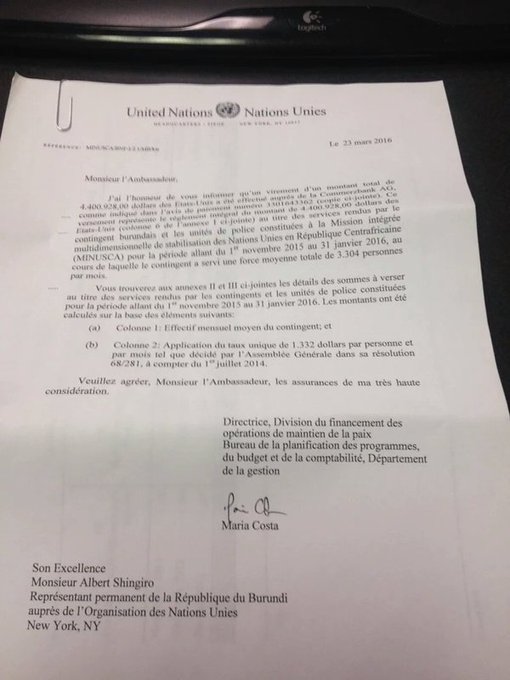
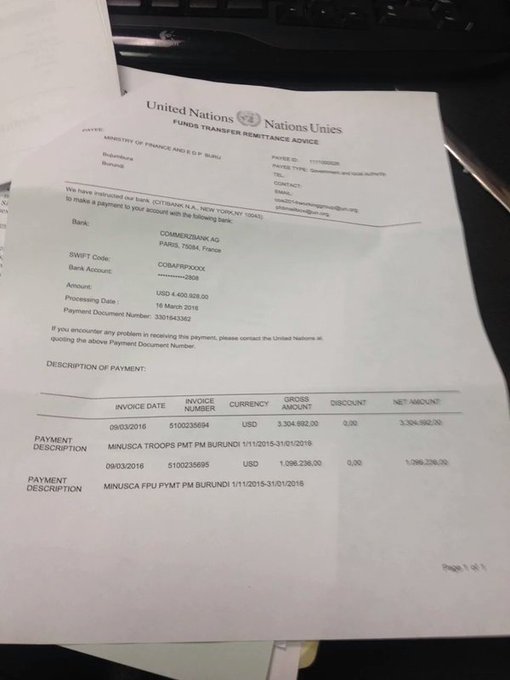
Inner City Press: I've asked you several times about the reported non-payment of Burundian peacekeepers.  I have now seen a document that more than $4 million has been transferred by DPKO (Department of Peacekeeping Operations) to the Commerce Bank account in Paris that I'd also asked you about.  Have they gotten back to you about the multiple reports that this money, in fact, doesn't go to the peacekeepers?

Spokesman Stephane Dujarric:  You know, we pay the Governments, and we expect the Governments to ensure that the peacekeepers are given the money that is owed to them.

Inner City Press:  And if you hear that they don't or find that they don't, what would you do?

Spokesman Dujarric:  We would expect that they do, and I'm sure the issue would then be raised.

  Since the UN and Ban Ki-moon are embroiled in their own bribery and corruption scandal, the issue was raised to Commerzbank, which replied:

"Please report potentially fraudulent activities to [Link]"

  But Commerzbank's link to report fraud returns, "The document you requested does not exist on this server."

 For a bank with legal duties, this is a problem, as is opening an account to receive the UN's Herve Ladsous' payments to Pierre Nkurunziza for troops accused of rape in the Central African Republic. We'll have more on this.

Update: after this Inner City Press story and complaint, Commerzbank belatedly fixed it s "Fraud" link. But what about the substantive behavior?

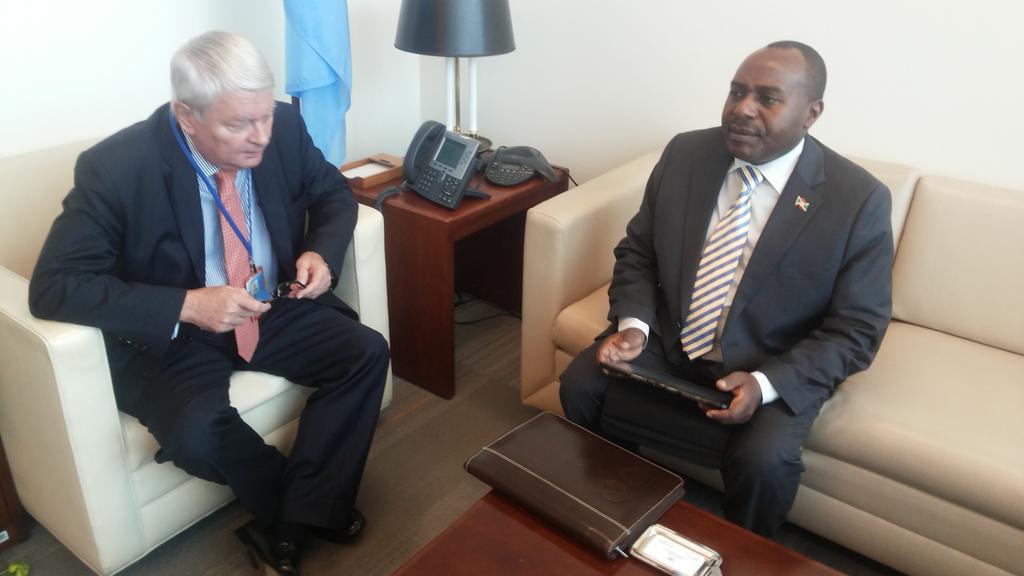
 On April 22, after three separate screenings by UN security, Inner City Press was allowed to the photo op of Ban with Alain Aime Nyamitwe. Albert Shingiro was there too, taking his own smart phone photo. There was Jamal Benomar, and David Nabarro. Tweeted photo here. Periscope video here.
Outside there was Edmond Mulet, Ban's chief of staff who has received correspondence about the eviction of Inner City Press.

 What would they discuss? Mugamba? (Since Ban's meeting, General Athanase Kararuza who spoke against the killing in Mugamba had been assassinated). Even more UNlikely, press freedom?

 From the read-out below, it seems they did not discuss crimes against humanity, much less genocide. But here's what the International Criminal Court's Prosecutor Fatou Bensouda said on April 25, opening a preliminary examination -- note that the FIFA post offer to Pierre Nkurunziza, which Inner City Press exclusively reported in May 2015, here, well before Sepp Blatter's book, may be looking better and better to him)

On April 21, amid published reports of up to 150 people detained in Mugamba, Inner City Press asked Ban's spokesman Stephane Dujarric about it. He said he hadn't heard of it but would check.

An hour after the briefing, this was sent to Inner City Press:

From: UN Spokesperson - Do Not Reply un.org
Date: Thu, Apr 21, 2016 at 1:46 PM
Subject: Your question on Burundi
To: Matthew.Lee [at] innercitypress.com
Cc: Stephane Dujarric [at] un.org

"Regarding your question at the noon briefing: Our human rights office was informed that on 20 April 2016, following a security incident that occurred in Mugamba commune, Bururi province (an exchange of gunfire between unidentified armed men and military elements, during which two people including a military lost their lives), three persons, including a teacher, were arrested by the police and detained in Mugamba police station. No charges were retained against them and they were finally released on 21 April 2016 following an intervention by the Regional police commissioner."

 Is that all that happened?

Dujarric also at the April 21 briefing, when Inner City Press asked why its office has been seized - to be resold, it seems - while that of South South News, named in October 2015 in the U.S. District Court for the Southern District of New York as Ng Lan Seng's vehicle to bribe the UN, still has its office, said “You have been afforded quite a lot of courtesies.”  Like ouster by eight UN DSS guards? Five boxes of files dumped out onto First Avenue?

 On April 20, Inner City Press asked UN spokesman Stephane Dujarric about hate speech, UN transcript here.

  Inner City Press' sources say many opposition leaders are worried about Ban Ki-moon's typically waffling three-option report because "the report is a proposition to a dictator rather than being a decision against him... The corpse of Jean De Dieu Ndayikungurukiye who was stabbed and killed by Imbonerakure four months ago in Nairobi, is still in detention. According to family members and other Burundian Refugees in Nairobi, Burundian Embassy in Nairobi recommended this detention."

On April 12, Inner City Press asked Ban's deputy spokesperson Farhan Haq, video here, UN transcript here.

  Hours after these claims, and in retaliation, the UN sent Inner City Press an eviction notice for April 16, which despite push back they implemented.
   Even as the European Union considers changes to it payments for Burundi peacekeepers in AMISOM in Somalia, so that less of the money is taken by the Nkurunziza government for repression, UN Peacekeeping under Ladsous and Maria Costa have made their pay-out to Nkurunziza's government - no longer through the Burundi National Bank but through a bank account in Paris, at Commerzbank.

 On April 11, Inner City Press asked UN spokesman Stephane Dujarric about this: why is the money not being paid to the Burundi Central Bank? Would Ladsous pay to an offshore bank, in Antigua and Barbuda or Panama for example, without looking into it?

  Dujarric said he does not have details on member states banking relations; he did not answer on offshore banks. Here are some photos,here.


View image on TwitterView image on Twitter

On , ICP asked UN of  paying bank in Paris, concerns of civil society, h/t photos
  Meanwhile some also say that those repatriated from CAR under allegations of abuse, for example First Major Srgt Zepherin, are just re-sent by the Nkurunziza government for “service” with AMISOM in Somalia. We'll have more on this, too.

On Burundi Inner City Press asked UN Spokesman Stephane Dujarric on March 31 about the death in prison of Jacques Bihozagara.

Unlike several member states, but not the Security Council's penholder France, the UN had only this: "We obviously would hope that his death will be investigated in as much of a public manner as possible."

Now the inadequacy of the UN's response is even more clear in light of this report: "During his detention, Bihozagara was visited by several diplomats who were assured he was in safe custody. On Saturday night, reports indicated that Burundi official demanded that the deceased’s family sign documents indicating that he died of natural causes or forget asking for the body."

On April 5, Inner City Press asked UN deputy spokesperson Farhan Haq about it, UN transcript here.

 We'll have more on the UN's actual position on that sort of practice, or these type of offers.

 In a smaller but similar way, the UN on February 19 told Inner City Press that if it did not move eight years of investigative files out of its UN office, even the offer of a reduced non-Resident Correspondent accreditation would be withdrawn.

  Now while threatening to throw or move everything out, the UN is making even more troubling "offers." Perhaps this is why the UN Secretariat cannot criticize Pierre Nkurunziza's Burundi; instead Ban Ki-moon praised Nkurunziza for half re-opening a mere two of four radio stations he closed. New low for the UN.

 Ban Ki-moon, his deputy and chief of staff have received this sample letter to reverse Gallach's outrageous decisions, concluding, "Your decision to restore ICP's full accreditation and office will be highly appreciated by many Burundians crying out for peace and protection while promoting the freedom of press in Burundi." As of this writing, still no response from Ban.


On March 25, Inner City Press' sources reported to it that "Around 4 am today, heavily armed police surrounded the zone of Musaga, searched homes without warrants, arrested around five young men and killed an old man by shooting him purposeful on First Avenue Musaga. Among the arrested young men, two are related as a sister and a brother -- the shocking story behind these two is that the old brother Arnaud was shot and killed by the police during the demonstration."

  Meanwhile to cut off further protests, the government is regulating SIM cards - and, some say, the French firm SG2 may be engaged in wire tapping in Burundi:  "several technicians of local companies have confided that: 'We were obliged to provide SG2 with some 200 free numbers and to authorize their technicians to access our networks. They connected their own systems. We are sure that they have the technology to carry out phone-tapping.' Since the introduction of this system, international calls to Burundi have become very expensive, and Burundians in the diaspora now choose to use Skype or other calling systems (Viber, WhatsApp, etc). Soon people will do this for local calls as well, to avoid being tapped."

  Again, no UN comment on surveillance? Well, this is from an Organization which got its favored correspondents to give it their cell phone footage to try to eject the Press on a pretext.

When Burundi was belatedly discussed at the UN Human Rights Council in Geneva on March 22, the UN Special Rapporteur on extrajudicial, summary or arbitrary executions Christof Heyns urged the government of Pierre Nkurunziza against reprisals on those who talk with the UN Panel of Experts. But how will that be enforced?


  The United States for its part said Burundi should "lift all undue restrictions on the media." It's a fine sentiment - but the US Mission to the UN has been asked, by the DC-based Government Accountability Project, to ensure that the UN lifts restrictions on Inner City Press which covers, along with UN corruption, Western Sahara and Burundi. GAP Letter here.

 On March 22, Inner City Press was entirely unnecessarily restricted from reaching the UN Security Council stakeout to cover a meeting on Western Sahara, Periscope on YouTube here. What will the US Mission do?

  In Geneva, Heyns had to leave; Rwanda and South Africa were added to the speakers' list, but only for the afternoon session. Watch this site.

A week ago Inner City Press asked UN Spokesman Stephane Dujarric, about UN (in) action in Burundi. UN transcript here.

 A week later from Dujarric, who threw Inner City Press out of the UN Press Briefing Room, there has been no answer, as on so many Press questions to Ban Ki-moon's UN on Burundi. So on March 21, Inner City Press asked Dujarric's deputy Farhan Haq, UN transcript here.

As Burundi's Pierre Nkurunziza government stepped up the killing and censorship of opponents, its lobbyists in the U.S. capital, Scribe Strategies, were paid $60,000 to among other things set up interviews with US-government broadcaster Voice of America and the French government's France 24.

  Nkurunziza's party the CNDD-FDD paid Scribe Strategies $59,980 on November 10, 2015. Scribes has this month disclosed, for the six month period ending January 31, 2016, that in exchange for this money it arranged for example for Nkurunziza's adviser to be "interviewed" on Voice of America and France 24.

  Scribe Strategies also, during the reporting period, was paid to arrange for Sam Kutesa, a former President of the General Assembly who was involved with many of the same donors named in the corruption case against his predecessor John Ashe, to be "interviewed" by Voice of America about his tenure as PGA, during which he was as now foreign minister of Uganda.

  Inner City Press has covered not only the John Ashe / Ng Lap Seng / Frank Lorenzo / Sheri Yan corruption case, but also Kutesa's dealings with the highest reaches of Ban Ki-moon's UN Secretariat, for example here and here.

 On February 19, Inner City Press was thrown out of the UN on two hours notice. Audio and petition here. On February 22 Inner City Press was told it was Banned from all UN premises. After three days reporting on the UN from the park in front of it, and stories in BuzzFeed andBusiness Insider, Inner City Press re-entered the UN on a more limited "non-resident correspondent" pass, under which on March 10 UN Security ordered it to leave the UN as it worked in the UN lobby at 8 pm. Video here; UN Spokesman Stephane Dujarric's March 11 justification here.

  The underlying UN rule only says that non-resident correspondents can only come into the UN up until 7 pm. But the UN's goal, it seems, is to prevent or hinder coverage of UN corruption, which usually doesn't take place in the UN Press Briefing Room. (January 29, 2016 and September 8, 2011 -- Frank Lorenzo, UNdisclosed -- are notably exceptions.)

  Lobbying the deciding UN official, Under Secretary General for Public Information Cristina Gallach, were the honchos of the UN Correspondents Association, including France 24 and, as in 2012, Voice of America.

  Scribes Strategies' disclosures do not (have to) mention the Nkurunziza government's lobbying in and around the UN. We'll have more on this.

  Back on March 9 when the Burundi configuration of the UN Peacebuilding Commission met, the conference room was too small and the meeting was not televised, at least not to the outside world (see below). There was talk of Burundi's Pierre Nkurunziza have allowed two of four closed radio stations to re-open.

But Special Adviser Jamal Benomar said these two stations were not critical of the government; beyond that, it has emerged that the stations' directors had to sign a commitment about their future coverage. Some in the UN, it is clear, would like to do just this - in fact, that's why Inner City Press could not watch the meeting on UN in-house TV in its shared office the UN has seized, and so came to the meeting.

  In Conference Room 8, the Permanent Representatives of Tanzania, Belgium, Burundi, Norway, The Netherlands, and others, and Deputies from France, Rwanda and others. France was given the floor first in the debate; its Deputy Alex Lamek after a bland speech left the meeting, his seat taken by another French mission staffer. Belgium called for a re-opening of all media without restriction.

  There were other speeches, but Inner City Press had to go upstairs, with its its currently reduced access pass, and ask the UN's Deputy Spokesperson why Ban had praised the re-opening, with restrictions, of only two of the four radio stations closed. Vine here; UN transcript here

Deputy Spokesman Haq:  Ultimately, what we want is for the media to be free to do their work unconditionally.

  This is ironic: audio here, petition here. We'll have more on this.
 On January 28, Inner City Press asked UN spokesman Stephane Dujarric about a meeting held but not televised on January 27, at which it was urged that mass grave sites in Burundi be preserved as evidence,video here, transcript here.


Obtained by Inner City Press

Ladsous' lack of vetting was criticized in the recently released report into the cover up of peacekeepers' rapes in the Central African Republic. Earlier, Inner City Press exclusive reported on Ladsous in his October 1, 2015 meeting with Burundi's vice president saying that he is "pragmatic" on human rights.

 On December 16 Inner City Press was banned from questions to Secretary General Ban Ki-moon, but learned from the mission MINUSCA that Baratuza was already in Entebbe. Inner City Press asked several Security Council members, then Ban's spokesman Stephane Dujarric on December17.

Dujarric told Inner City Press Baratuza's deployment is suspended and he is being repatriated: "based on the information we've received regarding the Lieutenant Colonel, his deployment has been suspended, and he will be repatriated back to Burundi." Video here. Dujarric told Inner City Press this shows the UN system working - on a day when a report on rapes was issued showing UN Peacekeeping under Herve Ladsous not sufficiently vetting for human rights. We'll have more on this.


 Amid the escalating killings in Burundi, summary executions in neighborhoods opposed to Pierre Nkurunziza's third term stand out. But Burundi Army spokesman Gaspard Baratuza was quoted on December 12 blaming all of the deaths on attempts to steal weapons to free prisoners.

   Inner City Press heard that Mr. Baratuza was already in the process of being deployed to the UN Peacekeeping mission in the Central African Republic (MINUSCA) even when he was giving these quotes, issuing statements and speaking to state-owned radio, and so asked MINUSCA's acting spokesperson, “Is Gaspard Baratuza of Burundi's army getting a MINUSCA job?” Ultimately, after the questioning, he didn't.

   But the UN should have to say more. Inner City Press has repeatedly asked the UN how its Department of Peacekeeping Operations under Herve Ladsous vets those who deploy to UN missions; Inner City Pressexclusively reported on an October 1, 2015 meeting in which Ladsous told Burundi's Vice President Joseph Butare that he is “pragmatic” on human rights.


 Ban Ki-moon and his spokesman declined to take Inner City Press' questions on December 16, as they did on December 14. Vine here.  Watch this site.