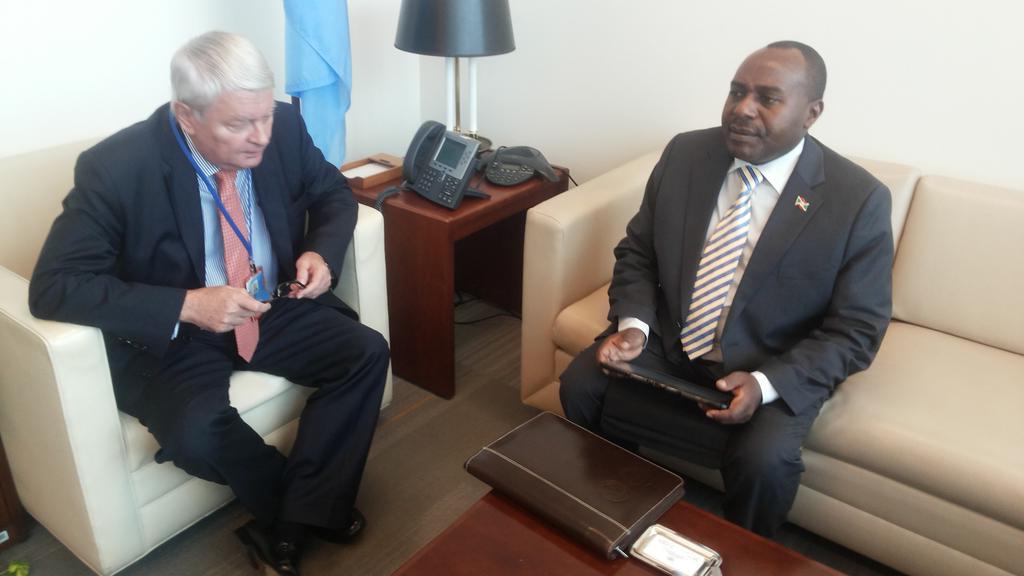
UNITED NATIONS, October 30 -- As killings in Burundi increase, on October 23 Inner City Press asked UN Ambassador Matthew Rycroft about the status of the draft Presidential Statement in the UN Security Council. He said there are differing views, but the UK is concerned about the "threat of genocide." Video here.
On October 30, US President Barack Obama issued this:
"TO THE CONGRESS OF THE UNITED STATES:
In accordance with section 506A(a)(3)(B) of the African Growth and Opportunity Act, as amended (AGOA) (19 U.S.C. 2466a(a)(3)(B)), I am providing notification of my intent to terminate the designation of the Republic of Burundi (Burundi) as a beneficiary sub-Saharan African country under AGOA.
I am taking this step because I have determined that the Government of Burundi has not established or is not making continual progress toward establishing the rule of law and political pluralism, as required by the AGOA eligibility requirements outlined in section 104 of the AGOA (19 U.S.C. 3703). In particular, the continuing crackdown on opposition members, which has included assassinations, extra-judicial killings, arbitrary arrests, and torture, have worsened significantly during the election campaign that returned President Nkurunziza to power earlier this year. In addition, the Government of Burundi has blocked opposing parties from holding organizational meetings and campaigning throughout the electoral process. Police and armed youth militias with links to the ruling party have intimidated the opposition, contributing to nearly 200,000 refugees fleeing the country since April 2015. Accordingly, I intend to terminate the designation of Burundi as a beneficiary sub-Saharan African country under AGOA as of January 1, 2016."
On October 28, Inner City Press asked UN spokesman Stephane Dujarric about another threat. From the UN transcript:
Inner City Press: this is a tweet from the official account of Pierre Nkurunziza, President of Burundi: "No one living abroad should consider himself superior to those who stayed in Burundi since most of them have left their families here." So people see this as an open-source threat to retaliate against the families of those who have fled the country. And I'm wondering…
Spokesman: I haven't seen the tweet. I shall look at it.
Inner City Press showed it to him on his way out. Earlier on October 28, Burundi got 162 votes for the UN Human Rights Council, less than the other also unopposed candidates, but still enough to get on the Council. The UN Security Council had just issued a Presidential Statement, here, which gave weight to the Museveni "mediation," and which the US later "welcomed." Usually it's the penholder (France) which speaks. But not here, not on Burundi (see Ladsous, below).
On October 27, the UN said Secretary General Ban Ki-moon called the AU (below); Inner City Press asked Ban's spokesman Stephane Dujarric is any closer to naming the envoy he called "immanent" months ago. Dujarric said he should have used another word.
Inner City Press asked Dujarric of reports that Burundian police in the UN's MINUSCA mission in Bangui have not received benefits in months, and of a letter sent to Ban and Herve Ladsous about the Burundian troops. Dujarric said he would check on both. Here is the full text of the UN's read-out:
"Today, the Secretary-General called H.E. Dr. Nkosazana Dlamini Zuma, Chairperson of the African Union Commission, to discuss the situation in Burundi.
The Secretary-General welcomed the decision made by the African Union’s Peace and Security Council on 17 October to address the political impasse and deteriorating security situation in Burundi. He noted that such comprehensive and resolute action could offer Burundi the opportunity to put an end to the continuing violence and find a consensual political solution on the way forward.
The Secretary-General assured the Chairperson of the African Union Commission that the United Nations stands ready to provide any support necessary to advance the implementation of the measures agreed upon by the members of the African Union Peace and Security Council. "
On October 28 Burundi is poised for election to the UN Human Rights Council, as one of five African Group candidates for five seats. Meanwhile on October 26, the European Union adopted the letter to President Pierre Nkurunziza that Inner City Press asked the UN about last week, here.
Can EU members on October 28 not vote against Burundi's "Human Rights" Council candidacy at this time? And other Western NGOs coming to the UN early this week to set forth their positions, will they just phone it in with regard to Burundi? Watch this site.
Inner City Press: I wanted to ask on Burundi, just this morning the UK Ambassador said that the UK is concerned of a threat of genocide, is the word that he used, so I'm wondering under Rights Up Front what are your thoughts about Burundi and what the UN or the Secretariat can do.
SG Ban: "On this genocide issues, I hope there should be some creative investigations by the relevant experts and there should be, first of all, a clear understanding and investigations. And if the conclusion is that there were such kind of genocide issues, then there should be accountability, justice must prevail and perpetrators must be brought to justice."
But what is the UN Secretariat DOING about it?
On October 22, Inner City Press asked Ban's deputy spokesperson Haq:
Inner City Press: I wanted to ask you a question about Burundi. The EU is preparing a letter to invite the Burundian parties to Brussels to have a discussion about diffusing the situation. And I wanted to know, not just what does the UN think about it, but is there any UN role in this? And, if not, what does it say about the UN sort of action on Burundi? It's one thing to defer maybe to the AU but this is the UE. What is the UN doing about this?
Deputy Spokesman: We are following up with all the various initiatives by regional parties including the African Union and the European Union and, of course, our Envoy dealing with the Great Lakes Region has been appraised of this so we are continuing to follow-up.
ICP: But, I mean, is the EU really, can you… it is a regional organization but is it a regional organization with respect to Burundi?
Deputy Spokesman: That is question for the European Union, not for me.
ICP: Have you been contacted I guess is my question?
Deputy Spokesman: But regarding this, we have been in touch with a variety of regional bodies including through the office of the Special Envoy for the Great Lakes Region but also through our Department of Political Affairs and will keep appraised of all the various actors in this.
Back on October 20, Ban's deputy spokesperson Haq cited back to a written statement by Secretary General Ban Ki-moon more than a week ago; he said generally that MONUSCO like all UN mission affirms the right of freedom of the press. Really?
Later on October 20 after Inner City Press asked UN rapporteur on torture Juan Mendez about Guantanamo and US prisons, in the hall after waiting through a number of questions in Spanish Inner City Press asked him if he'd received complaints about, or acted on, Burundi. No, he said, not yet. Really?
Update: later on October 20 it was announced that the UN's Jeff Feltman will briefing the Security Council behind closed doors on October 21. But what outcome with the Council's penholder, France, even ask for?
On October 16 Inner City Press asked Haq if the UN thinks the government can investigate itself. This was based on UN Secretary General Ban Ki-moon's October 15 statement that
"The Secretary-General condemns the killing of nine civilians and two police officers in Bujumbura on 13 October... He urges Burundian authorities to undertake a rigorous and prompt investigation into the circumstances and motives behind these despicable crimes in order to ensure that their perpetrators are brought to justice."
So can the Nkurunziza government investigate itself (as the UN purports to be investigating or "auditing" itself in the wake of corruption revelation about former Presidnet of the General Assembly John Ashe among others)? Inner City Press asked this question (video here) as well as following up on this, from October 13:
Inner City Press: the Burundi question is one that maybe you can check with DPKO [Department of Peacekeeping Operations]. Burundian human rights activists say that an officer, Jerome Ntibogora, N-t-i-b-o-g-o-r-a, who was accused of being involved in killing people in a… in a hospital after they fled from the Government, has now been deployed to MINUSMA [United Nations Multidimensional Integrated Stabilization Mission] in Mali. So I wanted to…
Spokesman Dujarric: Let's see what we can find out.
Dujarric did not come back with an answer, by this deputy when Inner City Pres asked again on October 16 said he, Ntibogora is not being deployed. We'll see - watch this site.
Amid crackdowns in Burundi by security forces, and allegations of sexual abuse by Burundian peacekeepers serving under the UN flag, UN Peacekeeping chief Herve Ladsous on October 1 held a meeting with Burundian Vice President Joseph Butore.
Inner City Press has already tweeted a photograph of the meeting, but has now received the complete UN read-out, which raises more questions about Ladsous.
On the crackdown, Ladsous assured Butore that he has a “pragmatic approach” and is of no mind to question what happens in any country, does not involve himself in "domestic affairs."
On the sexual abuse allegations, Ladsous spoke only in platitudes, without requiring or even inquiring into any actions taken by the Burundians on the alleged abuse.
Even though Burundi was already given a “grace period” to bring appropriate equipment into the Central African Republic for the MINUSCA mission, they have not done so. In the meeting, according to the read-out, Butore "acknowledged" the substandard equipment.
Butore requested, and Ladsous for now granted, yet another extension to bring the requirement equipment -- until March 2016 for light equipment, and to June 2016 for heavy equipment.
Is this safe - even for the Burundian soldiers at issue? While speaking through press releases, Ladsous' spokespeople, far from answering questions, go so far as to direct UNTV boom microphone operators to avoid Inner City Press, even preventing the Press from asking any questions to Mali's Foreign Minister Abdulaye Diop last week. We'll have more on all this.
UNITED NATIONS, July 2 -- As in Burundi the crackdown on those opposing or even questioning a third term for Pierre Nkurunziza continued through the boycotted parliamentary elections on June 29, on July 2 the United States issues this statement:
"Burundian President Pierre Nkurunziza’s continued disregard for the Arusha Agreement has resulted in dozens of deaths, the exodus of over 144,000 Burundians to neighboring countries, and a freefall in the Burundian economy causing suffering to millions of Burundians. The Burundian Government’s decision to push forward with the June 29 parliamentary elections despite the complete absence of the necessary conditions for credible elections and widespread calls, including from the African Union and United Nations, to delay the voting further exacerbated an already dire situation.
"With presidential elections now scheduled for July 15, the United States joins with the African Union, the United Nations, the European Union, and other regional bodies and leaders in urging President Nkurunziza to place the welfare of Burundi’s citizens above his own political ambitions and participate in dialogue with the opposition and civil society to identify a peaceful solution to this deepening crisis. This solution should include the delay of the July 15 presidential elections until conditions are in place for free, fair, and peaceful elections.
"Due to the precarious political and security situation in Burundi and the Government of Burundi’s unwillingness to engage in good faith efforts to negotiate a solution, the United States has today suspended several security assistance programs on which it has cooperated with Burundi. In response to the abuses committed by members of the police during political protests, we are suspending all International Law Enforcement Academy and Anti-Terrorism Assistance training that we provide to Burundian law enforcement agencies.
"Recognizing that Burundi’s National Defense Force has generally acted professionally in protecting civilians during protests, the United States continues to value our partnership with the Burundian military and urges them to maintain professionalism and respect for the rule of law. However, due to the instability caused by the Burundian Government’s disregard for the Arusha Agreement and its decision to proceed with flawed parliamentary elections, the United States is unable to conduct peacekeeping and other training in Burundi. As a result, the United States has suspended upcoming training for the Burundian military under the Department of Defense’s Section 1206 Train and Equip program, as well as training and assistance under the Africa Military Education Program. We remain deeply concerned that the current crisis will further hamper our ability to support the important contribution of the Burundian military to international peacekeeping.
"Finally, during our upcoming review of Burundi’s eligibility for the trade preferences available to it under the African Growth and Opportunity Act, we will be taking into consideration ongoing violence and instability and the Government of Burundi’s lack of respect for the rule of law in determining their eligibility for these trade preferences moving forward."
Earlier on July 2 UN deputy spokesperson Farhan Haq at the noon briefing announced that the UN's observer MENUB mission's report "is available in my Office."
Inner City Press, which has been asking for and about the report for two days, immediately went there. But it was NOT in the Spokesperson's Office. Back in the briefing room, Inner City Press asked why not, and if UN human rights official Ivan Simonovic would make public his Office's findings about killings in Burundi. "It's a closed meeting," Haq replied, of the Security Council proceedings.
Later the MENUB report did become available, in hard copy. Inner City Press tweeted a photo and the conclusion that on June 29 "the environment was not conducive to free, credible and inclusive elections.”
But as Inner City Press asked Haq, doesn't that apply to the presidential election still set for July 15? Inner City Press asked if Ban thinks it should be postponed; there was no clear answer. Will the UN be represented at the East African Community meeting on July 6 or 7? UNclear. Here's more of the MENUB report:
MENUB “observed media freedom restrictions, violations of human rights and other fundamental freedoms;" it was in “50 municipalities out of 119... polling procedures were not respected in all cases.”
Inner City Press continues to ask, if MENUB and Burundi were so important to the UN, why was the mission's chair Cassam Uteem not replaced upon departure?
Inner City Press asked Haq who in the UN system is monitoring or even simply counting the people killed in Cibitoke and elsewhere.
Haq mentioned the Office of the High Commissioner for Human Rights, whose New York deputy Ivan Simonovic will brief on July 2, and whose Prince Zeid is slated to brief the Security Council next week. That Office is bound up in a scandal about not reporting sexual abuse of children in the Central African Republic. And here?
As Inner City Press reported on June 30, a coalition of civil society groups has written to the African Union urging sanctions on Nkurunziza. Inner City Press has obtained the letter and put it online here.
This comes as the United States proposes UN sanctions against at least six individuals in South Sudan, and after the US State Department on June 29 put out this statement:
"The United States supports the AU’s decision not to send electoral observers in recognition that free, fair and credible elections are impossible given the current security situation and the closure of political and media space. We share the AU’s concern about the hardships facing the people of Burundi and urge President Nkurunziza to cooperate fully with the AU and regional organizations to resolve the current crisis and enable credible elections to go forward at a later date."
If the US supports the AU position, what of the UN's UNclear position?
On June 30, Inner City Press asked UN Deputy Spokesperson Farhan Haq where the observation(s) of MENUB are. Tomorrow, he said. We'll see.
On June 28, both UN Secretary General and the UN's MENUB said that the MENUB mission IS observing the legislative election, unlike the African Union which announced that it would not, due to conditions not being met.
But in a parallel universe, on June 29 the head of the UN Development Program Helen Clark tweeted that "UN is not observing and has withdrawn from support to the conduct of the election." Then after Inner City Press noted it, Clark deleted it. Thus does the UN try to have it both ways.
Later on June 29 along with a question about climate change Inner City Press asked Ban Ki-moon about Burundi, and if the UN is observing. Video here. From the UN's own transcript:
Inner City Press: Because it is the day of the election in Burundi, I have to ask this, where does it stand for the international community for an election that is taking place without any observers, what can be done? What is the next step forward?
SG Ban Ki-moon: "Let me briefly answer your question about the current situation in Burundi. Yesterday, all day long, I have been speaking to some African leaders in the region, including President Kikwete of Tanzania who is acting as President of the East African Community. I have also spoken to AU Chairperson Madame Zuma, as well as President Zuma of South Africa. They are the leaders who have been constantly engaging in this. I have been expressing my serious concern that while all the opposition political parties have boycotted - and even the Vice-President and the Parliamentary speakers – they have all condemned and criticized President Nkurunziza and left their country because of their serious concern. While UNDP and the United Nations have withdrawn our electoral support there, our United Nations observation team is now observing this election process. Now it seems that the election has been continuing. I reiterated my appeal to all Burundian political leaders to consider the wider interest of the people of their country and to resolve political issues through dialogue in order to preserve peace and strengthen national reconciliation. I also emphasize the responsibility of the Government of Burundi to ensure that the elections take place in a secure environment and also to guarantee the safety and security of UN observers, so that they can perform their mandated responsibilities free from intimidation and harassment. This is mandated by the Security Council. This is what I can tell you at this time. I am very closely observing and watching and coordinating and consulting with African leaders. Thank you."
While the answer is appreciated, it remained unclear what Clark had meant, and the UN's stance on the elections and observing them. Inner City Press asked for a yes or no answer, was Clark wrong in saying the UN is not observing - and no clear answer was given.
We also note that while Laurent Fabius of France, the UN Security Council penholder on Burundi, was doing this as a joint press encounter with Ban, Fabius did not answer on Burundi at all. We'll have more on this.
Update: in classic UN fashion, after being caught trying to have it both ways on Burundi, Helen Clark's tweet simply "disappeared" - but here is a cell phone photograph of it
Even when the UN purports to answer on its role, it does so quietly and selectively, while remaining too quiet about local radio stations shut down. Then Ban Ki-moon speaks in a statement, UNclear as usual: this time saying that the UN's MENUB mission WILL observe the elections, and not even adding that observation doesn't validate the voting. This while the African Union has said it will NOT observe on June 29, here.
On June 28, Ban Ki-moon issued a this statement:
"The Secretary-General is concerned about the Government of Burundi's insistence on going ahead with elections on 29 June despite the prevailing political and security environment.
"The International Facilitation Team in Bujumbura has been working hard to assist the Burundian parties to reach a consensus on the way forward for holding free, fair inclusive and peaceful elections. The Secretary-General deplores the intransigence of the parties that caused those important efforts to be inconclusive.
"The Secretary-General recalls the decisions of the Security Council, including resolution 2137 (2014), which mandated the United Nations Observer Mission in Burundi (MENUB) to observe the elections. In fulfilling its mandate, MENUB will continue to work in a professional and impartial manner, in accordance with national laws applicable to electoral matters and international instruments, principles and rules of election observation. The Secretary-General emphasizes the responsibility of the Government of Burundi to ensure that elections take place in a secure environment and also to guarantee the safety and security of UN observers so that they can perform their mandated responsibilities free from intimidation or harassment.
"The Secretary-General reiterates his appeal to all Burundian political leaders to consider the wider interest of the people of their country and to resolve political issues through dialogue in order to preserve peace and strengthen national reconciliation. Condemning recent attacks reported in the country, he appeals to all Burundians to refrain from violent acts, in line with the Charter of Non-Violence agreed by all parties."
What about not validating?
On June 27, the UN's replacement envoy Bathily held a press conference in Bujumbura which the UN did not live-stream, nor provide an audio feed or file from (unlike in Mali), nor any transcript (unlike in DR Congo).
Now the UN's MENUB mission has put out a press release arguing that it is not legitimating Nkurunziza's elections. But this press release was not distributed by the UN Spokesperson's Office, to which Inner City Press has directed multiple questions about what, if anything, MENUB is doing.
“MENUB was put in place in accordance with UN Security Council resolution 2137 (2014). MENUB is mandated to follow the electoral process in Burundi before, during and after the elections, to to report to the Secretary General of the UN who, for his part, will report to the Security Council. The implementation of this mandate began on January 1, 2015. To this end, MENUB operates in a neutral and impartial manner. Its observation is carried out by professionals and is based on national laws, international instruments and all the applicable rules and principles of election observation. The first time of MENUB observers were deployed across Burundi starting in January 2015.
“The observation of elections by MENUB cannot and should not be interpreted as support to any party or as a validation of the process.
“MENUB invites all relevant parties to respect the neutrality of the observers deployed on the ground and gives heartfelt thanks to the support afforded to it in the execution of its mandate.”
Is it true, that MENUB's now murky role CANNOT be interpreted as validating or legitimating Nkurunziza's elections? Especially now that Ban Ki-moon has "spoken" without saying anything about not validating?
A coalition of civil society groups in Burundi issued a call for a systematic boycott of the parliamentary election set for June 29. (If held, these elections could be a set up to further change the constitution.)
So when the UN's replacement envoy to Burundi, UNOCA's Bathily, held a press conference in Bujumbura on June 27, one would have expect the UN to find a way to live-stream or at least audio-stream it. At least the Free UN Coalition for Access had and has such an expectation.
But it did not happen. Only second and third hand did Bathily's bon mots come out, including that the UN is not there to impose its views but to facilitate. So it has said nothing about the third term -- and, Inner City Press understands, favors the opposition just accepting the third term.
Why wasn't the Bujumbura press conference at least Periscoped, or audio streamed? We'll have more on this.
The Security Council on June 26 agreed to and adopted a version of France's draft Presidential Statement which Inner City Press exclusively published earlier this week; then Burundi's representative gave a speech vowing elections will take place on June 29 and to avoid the situations of Burkina Faso and Cote d'Ivoire, and saying that opposition is "childlike" with demands from "outside the Continent." Here is the UNSC Presidential Statement:
"The Security Council reiterates its deep concern regarding the grave security and political situation in Burundi against the backdrop of the forthcoming, communal, presidential and senatorial elections and for the impact of the crisis in the region. The Security Council strongly condemns all acts of violence and human rights violations and abuses and recalls that those responsible for such violence should be held accountable and brought to justice.
The Security Council welcomes the regional and sub-regional efforts aimed at addressing the crisis, and in this regard takes note of the conclusions of the East African Community (EAC) summits held on 13 May and 31 May 2015 in Dar-es-Salaam, of the communiquÿ issued by the African Union Peace and Security Council (AU PSC) after its Summit held on 13 June 2015 in Johannesburg, South Africa, and of the letters sent by the Government of Burundi to the Security Council.
The Security Council pays tribute to the relentless efforts of the Special Envoy of the Secretary-General (SESG) for the Great Lakes Region, Safd Djinnit and recalls that Burundian stakeholders had made some progress in a difficult dialogue thanks to SESG Djinnit's able facilitation,
The Security Council takes note of the African Union's statement that the political dialogue has not produced expected results and that the current situation could jeopardize the important gains recorded following the signing of the Arusha Agreement for Peace and Reconciliation in Burundi and the Global Ceasefire agreement of 2003, and affect the stability of the region,
The Security Council welcomes the resumption of the dialogue between all the Burundian parties, under the facilitation of the AU, the UN, the EAC and the ICGLR. In this regard, the Security Council welcomes the appointment of Professor Ibrahima Fall by the AU, Special Representative of the chairperson of the Commission for the Great Lakes Head of the AU Liaison office in Bujumbura. The Security Council also welcomes the arrival in Bujumbura of United Nations SRSG for Central Africa and Head of UNOCA, Abdoulaye Bathily, which allows for the international mediation to immediately assist all parties to expedite the search for a consensual political solution to the crisis. While acknowledging that further steps must continue to be taken by parties to adhere to the decisions taken by the EAC and the AU PSC, the Council calls on the Burundian parties to urgently participate in an inclusive dialogue which should focus, in the spirit of the Arusha Agreements, and the Constitution, on the measures to be taken to create conditions conducive to the organization of free, fair, transparent and credible elections.
The Council takes note of the statement in the AU PSC Communique of 13 June that the date of the election should be set by consensus between the Burundian parties, in the spirit of the EAC's communiqu6 of 32 May 2025 requesting a postponement of the elections, and on the basis of a technical assessment to be undertaken by the United Nations.
The Security Council emphasizes that the dialogue should address all matters on which the parties disagree. The Security Council further emphasizes that this dialogue should address concerns related to the reinstatement of private media; the protection of human rights and fundamental freedoms, in particular freedoms of expression and of peaceful assembly, including for members of the political opposition to campaign freely, as guaranteed by the Constitution of Burundi; the release of those arbitrarily detained following demonstrations; the respect for the rule of the law; and the urgent disarmament of all armed youth groups allied with political parties, as reflected in the conditions of the EAC communique of 31 May 2025, conditions to be met prior to the holding of elections.
The Security Council welcomes the commitment of the AU and the Chairperson of the AU Commission to fully assume the responsibilities stemming from its role as Guarantor of the Arusha Agreement, as well as that of the region not to stand-by in case the situation deteriorates.
In this regard, the Security Council welcomes the decision of the AU to immediately deploy human rights observers and other civilian personnel; to deploy AU military experts to verify the process of disarming of all armed youth groups allied with political parties, which will submit regular reports on the implementation of the disarmament process, and to deploy an AU election observer mission if conditions for the organization of free, fair, transparent and credible elections are met. The Council urges the Government of Burundi and other relevant actors to extend their full cooperation to these processes.
The Security Council also welcomes the AU PSC's decision to send, by the first week of July, a ministerial delegation including the Commission, to assess the implementation of the conditions required by EAC, the AU and the Council for the holding of the elections.
The Council calls on the Electoral Mission of the United Nations in Burundi (MENUB) to fully and actively pursue the implementation of its mandate in accordance with Resolution 2137 (2014) including to swiftly report to the Security Council before, during and after the elections.
The Security Council reiterates its concern about the difficult situation of the Burundian refugees who fled their country into the neighboring States, commends the host countries (Democratic Republic of Congo, Rwanda and Tanzania), as well as humanitarian agencies, for their support to the affected populations, and calls upon the international community to provide the necessary humanitarian assistance. The Council urges the Government of Burundi to create the conditions conducive to their early return.
The Security Council calls on all actors in the region the preserve the safety and security of populations in the region."
On June 25 at the UN Inner City Press asked UN deputy spokesperson Farhan Haq:
Inner City Press: I wanted to ask, about Burundi, one of the Vice-Presidents, Gervais Rufyikiri, has fled the country, and he said that after he came out in opposition to the current President running for a third term, he left in fear of his life to Belgium. So I wanted know, that seems pretty… he’s an elected official, etc. One, is the UN doing anything to provide protection to people that feel under such threats within the country or trying to arrange for it? And what’s the UN — how does this reflect on the dialogue the UN is trying to create?
Question: Well, first of all, regarding the Vice-President, you’ll have seen, of course, there have been other people who have also fled the country, and you’ll have seen the concerns we expressed at the time and those concerns remain the case. We want all the people of Burundi to be able to live without fear and we want, in particular, for the people who are going to be voting in any forthcoming elections to be able to do so without fear and to have the assurance that any elections will be free and inclusive.
Regarding the dialogue on Burundi, that dialogue, which resumed on 23 June, has, in fact, continued today with the Special Representative Abdoulaye Bathily’s participation. Meanwhile, in New York, the Under-Secretary-General for Political Affairs, Jeffrey Feltman, met this morning with the Permanent Representative of Burundi to discuss the state of the electoral process.
And what is coming of these quiet UN moves?
On June 24 at the UN in New York Inner City Press asked Stephane Dujarric, spokesman for the UN and presumably for UN envoy Bathily,video here:
Inner City Press: on Burundi, I wanted to ask, there was — yesterday it was said that the ruling party of Burundi would not take part in these most recent talks with Mr. [Abdoulaye)] Bathily. Now it's said that the Government is but the ruling party isn't. What's the status of those talks and the CNDD-FDD? And also it was reported that journalists were blocked from going to this Musaga area where a lot of crackdown is taking place. Is Mr. Bathily aware of that, and does he have any comment on it?
Spokesman: I don't know if he's aware of that. We will check. Mr. Bathily is just starting his work. He's having discussions with various parties. I think it's still a very fluid situation, as we all know, but he is continuing — he's continuing his work.
Question: But, I mean, I'm sure you've seen the — like, yesterday they had an event, and [UN PBC chair Seger] said that he spoke with the ambassador here. So it seems to me that the Secretariat is aware of the ruling party's position to not take part in…
Spokesman: No, I understand. But I think those things are being discussed locally. They're being discussed on the ground, I think on, more than on a daily basis, so I don't want to speak for Mr. Bathily at this point.
"On your question on Burundi, I was just handed an update which says that the political dialogue resumed on 23 June, which, by my calendar, is yesterday, and continued today with the facilitation of the African Union, the East African Community, the International Conference of the Great Lakes Region and the United Nations. The Special Representative of the Secretary-General, Mr. Bathily, is representing the UN in the dialogue. Participants who participate in the dialogue previously facilitated attended the meetings with the exception of the ruling party, the CNDD-FDD, its allies in the Copa and Sangwe Pader. Today the Minister of the Interior represented the Government at the meeting. We encourage all political parties that have yet to join the dialogue to join it and help reach consensus on the way forward."
In New York, the International Peace Institute set up for June 23 an event with two UN officials on “lessons learned” from Burundi. Inner City Press went to the event, YouTube here.
At IPI, Inner City Press asked why the UN was so reticent to discuss the Constitutionality of the third term, why it had stayed quiet on the arming of the ruling party's youth wing and, at the level of Ban Ki-moon, on the closing of radio stations and chasing out of the country of journalists. Inner City Press also asked why the UN Peacekeeping of Herve Ladsous keeps using Burundi security forces who have cracked down on unarmed civilians.
Parfait Onanga-Anyanga, Former Special Representative of the UN Secretary-General in Burundi, gave a lengthy and passionate answer.
The IPI event ended up being interesting and Inner City Press is glad it went, and that is has been told, from high up, that this will continue in the future. We'll see.
While UN Deputy Secretary General Jan Eliasson was at the African Union summit in Johannesburg where Burundi was discussed, Burundian independent media wrote to Secretary General Ban Ki-moon about the crackdown against them, sending to a copy to Inner City Press and the Free UN Coalition for Access, which is now online here.
On June 16, after first declining to confirm receipt, the UN said the letter was received or "logged in." But what will be done? FUNCA has asked again, after Ban's own security detail was used to eject Inner City Press from a speech by Ban to UN Peacekeeping, which continues to use security personnel of Burundi which have fired on unarmed demonstrators.
On June 21, Ban issued this statement - Bathily to Bujumbura - no word on the third term, much less freedom of press and assembly:
"The Secretary-General continues to follow with concern the political crisis in Burundi, which threatens to undo more than a decade of work to consolidate peace and reconciliation in the country. In this respect, he welcomes the communiqué of the meeting of the African Union Peace and Security Council held on 13 June at the level of Heads of State and Government. With the communiqué, the African Union provided a clear way forward towards peaceful and credible elections in Burundi.
"The Secretary-General has requested his Special Representative and Head of the UN Regional Office for Central Africa, Abdoulaye Bathily, to offer good offices in Burundi in support of regional efforts to reduce tensions and help Burundians peacefully settle their differences. Special Representative Bathily will work closely with the African Union, the East African Community and the International Conference for the Great Lakes Region. He will arrive in Bujumbura on Sunday, 21 June.
"The Secretary-General wishes to express deep gratitude to his Special Envoy for the Great Lakes Region, Said Djinnit, for his tireless efforts impartially facilitating the dialogue among Burundian stakeholders during May and June of this year.
"As elections draw near, the Secretary-General calls on all Burundian political leaders to address the current political crisis with the highest sense of responsibility. He urges them to resume political dialogue earnestly with a view to creating an environment conducive for peaceful, credible and inclusive elections."
On June 18, Inner City Press asked UN deputy spokesperson Farhan Haq:
Inner City Press: in Burundi, today there was a grenade attack in the capital that injured three and also a deadly grenade attack, I believe, yesterday. And I'm wondering it doesn't seem like things are whatever the UNOCA [United Nations Office in Central Africa] individual is doing… calming down. So, I'm just wondering is there any… what is the UN, what is the current status of the UN and other efforts to bridge the gap prior to an election that will have the current president on the ballot?
Deputy Spokesman: We are continuing with our efforts. As you know, our representative from the UN Office from Central Africa, Abdoulaye Bathily, is in touch with the various parties and he is continuing with these efforts. We are concerned about the violence, including the various incidents that you just mentioned, and we are worried about the situation on the ground, which is why we are continuing to work with the parties and see what can be done to make sure that if elections are held that they will be safe, that they will be inclusive, that people can vote without fear and that the elections will be fair.
But does that assume a run for a third term, and therefor a boycott of the parliamentary elections -- a set up for domination and even (further) constitutional change?
In a June 19 statement, the UN's expert on transitional justice Pablo de Greiff said Burundi's "authorities’ blatant failures to respect freedom of expression and peaceful assembly, the pre-conditions for any credible democratic society.” Again it seems the proposed third term was not directly addressed by the UN.
On June 20 former head of UN Peacekeeping, now Crisis Group director Jean Marie Guehenno tweeted about de Grieff's statement. Inner City Press retweeted Guehenno's statement, asked about the continued use of Burundian security personnel by Guehenno's successor Herve Ladsous. Then Guehenno's tweet disappeared, so far without explanation.
On June 16, Inner City Press asked about reports of the arrest and even torture of MSD leader Leonidas Nimpagaritse. UN Deputy spokesperson Farhan Haq said "we'll check;" Inner City Press asked what the UN's electoral mission is doing and it remains UNclear.
As lead spokesman Stephane Dujarric answered Inner City Press on June 15, Haq said that UNOCA chief Bathily is in a sense replacing Said Djinnit for the UN on Burundi, to coordinate with the African Union.Transcript:
Inner City Press: I wanted to ask you two things on Burundi. One is you had said that the DSG and Mr. [Said] Djinnit would be in the [AU] summit. Do you have… what was the term, what, if any, progress was made particularly on UN involvement in either replacing Mr. Djinnit or trying to address the ongoing disquiet there? And also there was a letter of five or more Burundi media that was directed to the Secretary-General on June 11th. I saw a copy was sent to Ms. [Susanna] Malcorra basically asking for the UN to get involved because they had to flee the country because their stations had been burned and closed and they have been threatened with violence by the Government. What is the response of the UN system?
Spokesman: I will take a look to see if we received that letter. On Burundi, the Secretary-General requested his special representative and Head of UN Mission in Central Africa, Abdoulaye Bathily, to carry out consultations to ensure the effective participation of the UN in the international facilitation called for by the African Union Peace and Security Council to quote “to create conditions conducive to the holding of free, transparent and credible elections in Burundi, as well as on the matters on which the parties disagree” — which is what the African Union Peace and Security Committee issued.
But when Inner City Press asked Haq for the UN's view of the AU sending (military?) observers to Burundi, Haq did not comment. So what of Nimpagaritse?
Ban's UN has said little amid the closing down of independent media in Burundi, other than generalities when FUNCA and Inner City Press have asked about it. Now what will they do?
The letter is from Bob Rugurika of Radio Publique Africaine, Patrick Nduwimana of Radio Bonesha FM, Anne Niyuhire of Radio Isanganiro, Innocent Muhozi of Radi-Tele Renaissance, Alexandre Niyungeko of UBJ and the Association Burundaise de radiodiffuseires, here.
On June 12 Inner City Press asked Ban's spokesman Stephane Dujarric:
Inner City Press: In Burundi, documents emerged, a ruling, legal opinion by the ministers of justice of the East African Community states, and they read very closely the constitution and the Arusha declaration and they say that a third term would be illegal, that he’s not eligible, that it's clear the first term was under the Constitution. I'm wondering, one, is there any response by the Secretariat, that it's been sort of not addressing this question? And was Mr. Djinnit aware of this ruling during the time of this facilitation? And if so, why didn't it speak more clearly on the subject?
Spokesman Dujarric: I think that Mr. Djinnit is one of our more experienced diplomats, experienced negotiator, mediator. I'm sure he was aware of everything he needed to be aware of. I don't have a response to that....
Inner City Press: Is the DSG [Deputy Secretary-General] aware of this document as he goes to the African Union Summit…?
Spokesman: I think the DSG is fully aware of the situation in Burundi and would be looking forward to his discussion with Mr. Djinnit.
We'll see.
Two days after civil society groups in Burundi wrote to UN Secretary General Ban Ki-moon how his envoy Said Djinnit should be removed from the role, here, on June 10 Djinnit issued a press statement "taking note" of this position - and stepping down or back.
On June 11 Inner City Press asked UN spokesman Stephane Dujarric whose decision the resignation was -- Djinnit's, he said -- and if the UN is going to try to replace him as facilitator.
Dujarric said that UN Deputy Secretary General Jan Eliasson is headed to the African Union meeting in South Africa on June 14, along with Djinnit, and will be holding discussion including on Burundi there. Dujarric mentioned it is a question of which organization a facilitator should represented.
Inner City Press has received a copy of the same civil society groups' which requested that Djinnit step down new letter to the East African Community for an emergency summit.
Inner City Press for the Free UN Coalition for Access asked Dujarric about the spokesman for the police and security ministry blaming ongoing demonstrations on journalists, at least 50 of whom have already fled the country.
Back on June 10, Inner City Press and the Free UN Coalition for Access had asked Ban's spokesman Stephane Dujarric about the Nkurunziza government's order banning entry into the studios of five radio and TV stations. Video here. Djinnit's statement claims there was consensus on May 28 on re-opening these:
"commended the Burundian parties, in particular, for the set of recommendations adopted by consensus at the May 28 dialogue session, on the right to information and the reopening of private radio and television stations damaged during the May 13-14 events."
The Special Envoy of the Secretary General for the Great Lakes Region, Said Djinnit, and members of the facilitation team that joined and supported the dialogue between the Burundian parties, met today in Bujumbura with members of the diplomatic corps. During this meeting, the Special Envoy briefed the participants on the dialogue who [sic] he facilitated starting from 5 May 2015, at the request of the Burundian parties who had agreed, by themselves, on the agenda as well as the list of participants.
The Special Envoy recalled that during the dialogue, the parties maintained diverging views on the candidature of President Nkurunziza for a third term. He highlighted the progress made on the four agenda items, namely: the appeasement measures and mutual commitments; the management of the electoral calendar; guarantees for the holding of free, transparent, inclusive and peaceful elections; and protection of Constitutional rights and freedoms. The conclusions of the dialogue are reflected in the attached May 29 press communique.
The Special Envoy commended the Burundian parties, in particular, for the set of recommendations adopted by consensus at the May 28 dialogue session, on the right to information and the reopening of private radio and television stations damaged during the May 13-14 events. He encourages the parties to implement these recommendations without delay.
The Special Envoy takes this opportunity to thanks all the Burundian parties for their cooperation during the dialogue that he facilitated with impartiality and, on which he reported faithfully to the Emergency Summit of the East African Community which took place in Dar-es-Salaam on May 31, and the relevant UN organs. The Special Envoy expresses his deep gratitude for the support extended to him in his role as facilitator by the East African Community, the International Conference for the Great Lakes region, the African Union and the UN including the Secretary General, the Security Council and the Peace Building Commission. He also thanks the external partners of Burundi including the European Union, the United States, France, Belgium and many others who came forth to help during the dialogue process.
Mr. Said Djinnit thanks all the Burundian parties for the facilitation role they entrusted to him on May 5. He duly takes note of the position expressed a few days ago, on his role as facilitator by some Burundian parties. In his capacity as the UN Secretary General's Special Envoy for the Great Lakes Region, Mr. Djinnit remains committed, in collaboration with relevant regional organizations, to continue to work toward preserving and consolidating peace, democracy and stability in Burundi in accordance with the objectives of the Peace, Security and Cooperation Framework for the Democratic Republic of the Congo and the region, signed in Addis Ababa on February 24, 2013.
The Special Envoy encourages the Burundian parties to continue their dialogue with a view to create conditions conducive to holding free, fair, inclusive and peaceful elections. He stresses the importance of preserving the legacy of teh Arusha Peace and Reconciliation Agreement as enshrined in the Constitution. He reiterates his appeal to all parties to exercise restraint and to refrain from any acts likely to increase tension and violence.
After the UN Security Council, the United States and the UN Peacebuilding Configuration on Burundi on May 15 issued statements urging calm in the country given the return of Pierre Nkurunziza to presumably run for a third term, on May 29 Inner City Press asked UN spokesman Stephane Dujarric about UN Peacekeeping under Herve Ladsous accepting an allegedly abusive Burundian police officer Godefroid Bizmama into his MINUSMA mission in Mali. Video here, and embedded below.
On June 9, Inner City Press asked Dujarric about civil society opposition to the electoral commission proposing presidential polls for July 15, including it seems for a possible third term. What does UN envoy Said Djinnit think of a third term? Video here.
Dujarric again refused to answer directly, while calling on Burundians to follow Djinnit. Follow him where?
Inner City Press asked about Italy suspending inclusion of Burundian forces in its training program, see below: Inner City Press has learned that Jérôme NTIBIBOGORA was rejected by vetting even in 2014.
Dujarric replied that this is up to the Italian government. But what is the UN doing, including with respect to 1000 Burundian police slated to begin "peacekeeping" in Somalia on June 11? We'll see.
Amid calls to replace UN enovy Said Djinnit as "pro-Nkurunziza," which Inner City Press has asked the UN about, on June 8 another letter went in, signed by Vital Nshimirimana. Inner City Press is putting itonline here (it is in French, and translated by the Free UN Coalition for Access here); it explains the demand that Djinnit be replaced.
Some note that Ban Ki-moon, now on travel in Central Asia but still quiet on human rights there too, gave in to requests to replace his Yemen mediator Jamal Benomar and ask, why not here? But those requests were from Saudi Arabia. Watch this site.
On June 8, Inner City Press asked Maman S. Sidikou, Special Representative of the Chairperson of the AU Commission for Somalia, about Burundian forces serving in AMISOM.
Sidikou replied that their "morale" remains high, and that one thousand are coming into Somalia from June 11 to 18. So is there no human rights due diligence for this?
The UN claims due diligence but gives no details at all. On June 8 Inner City Press asked UN Spokesman Stephane Dujarric:
Inner City Press: On Burundi, I asked you before about Godefroid Bizimana. Now I'm going to ask about Jérôme Ntibibogora, who is a Burundian police officer who, civil society there, say was involved in an attack against a hospital and firing at protesters. He's set for deployment in the Central African Republic after being trained by an Italian centre known as CoESPU, a Centre of Excellence for Stability Police Units.
Spokesman Dujarric: As much as I have everybody's files and names under my fingertips, I will check…
Inner City Press: I've actually heard from the Italian mission that they've put some of their training on hold, but likewise has the UN put anything on hold of deployment of police officers from Burundi?
Spokesman: I think we'll… you know, there is a Human Rights Due Diligence Policy and people are being screened.
Inner City Press: But, Godefroid seems to…
Spokesman: Has he been appointed?
Inner City Press: That's why I'm asking [about Jérôme]..
Early on June 8, based on more information from Inner City Press' sources in Burundi, Inner City Press asked Italy's Mission to the UN:
"In covering the crisis in Burundi, multiple sources there have informed Inner City Press that a Burundian police officer named Jérôme NTIBIBOGORA, implicated in the crackdown in Bujumbura, is now set to be deployed to the UN Peacekeeping mission in the Central African Republic, MINUSCA -- but only after he is “trained” by / in Italy.
"This a Press request for your Mission to confirm or deny that Jérôme NTIBIBOGORA / NTIBIBOGORA Jérôme or any other Burundian police or military personnel involved in putting down protests to Pierre Nkurunziza's attempted third term is scheduled or considered for training or any preparatory work in Italy prior to a deployment with UN Peacekeeping.
"For your information in responding on deadline to this, Inner City Press' sources in Burundi said that Jérôme NTIBIBOGORA / NTIBIBOGORA Jérôme has so far been involved in at least two recent troubling incidents: killings at the hospital of BUMEREC (in Bujumbura) on May 14, 2015 and firing live ammunition at unarmed protesters on June 5, 2015, resulting in the death of a protester named Theogène who was a student at University of Burundi. Overall, what due diligence does Italy do in its work with UN Peacekeeping?"
The UN Mission of Italy, running for a seat on the UN Security Council against Sweden and the Netherlands, answered also on the morning of June 8:
"Dear Mr. Lee, while at this stage I do not have any information on specific officers from Burundi, I can nevertheless confirm that any training activity by the COESPU (Center of Excellence for Stability Police Units) in Vicenza, Italy, with officers from that country, is currently on hold, due to the ongoing situation in Burundi.
Giovanni Davoli, Spokesperson, Italian Mission to the UN"
It's appreciated. But are there Burundian officers "in the pipeline"? Inner City Press asked: "Does “on hold” mean there are no Burundian personnel in the pipeline of your training program, to be deployed to peacekeeping missions? And, once you check in across the Atlantic, can the state the status of any of the individual named, and describe Italy's due diligence policy more generally?"
Italian Mission spokesperson Davoli replied:
"Dear Matthew, in general, single participants, before being accepted into the courses, are screened trough the resources available to us and to our partners in COESPU, to make sure they are compatible with the values of the Center.
On this particular individual, we are checking with Italy if we have any record, which means we won’t get any more details before tomorrow. In any instances, the participation of officers from this particular country is on hold, therefore there is no Burundian in the pipeline, until further notice.
Giovanni Davoli, Spokesperson, Italian Mission to the UN"
Inner City Press renewed its questions on June 9, and got this reply:
"Dear Matthew, I can confirm that Jérôme NTIBIBOGORA has never attended nor is expected to attend courses at CoESPU. His candidature was submitted twice and rejected twice by COESPU. On the first occasion, in 2014, this officer did not pass the vetting in place for these courses (as per mail yesterday); on the second occasion, already in 2015, all Burundi candidatures were already on freeze.
Giovanni Davoli, Spokesperson, Italian Mission to the UN"
UNITED NATIONS, December 23 -- A year into the new civil conflict in South Sudan, US President Barack Obama on December 23 issued a statement declaring the country, along with The Gambia, ineligible for continuing benefits under the African Growth and Opportunities Act, starting January 1, 2015:
"4. In Proclamation 8921 of December 20, 2012, I designated the Republic of South Sudan (South Sudan) as a beneficiary sub-Saharan African country for purposes of section 506A(a)(1) of the 1974 Act. In Proclamation 7657 of March 28, 2003, the President designated the Republic of The Gambia (The Gambia) as a beneficiary sub-Saharan African country for purposes of section 506A(a)(1) of the 1974 Act.
"5. Section 506A(a)(3) of the 1974 Act (19 U.S.C. 2466a(a)(3)), authorizes the President to terminate the designation of a country as a beneficiary sub-Saharan African country for purposes of section 506A, if he determines that the country is not making continual progress in meeting the requirements described in section 506A(a)(1) of the 1974 Act.
"6. Pursuant to section 506A(a)(3) of the 1974 Act, I have determined that South Sudan and The Gambia are not making continual progress in meeting the requirements described in section 506A(a)(1) of the 1974 Act. Accordingly, I have decided to terminate the designation of South Sudan and The Gambia as beneficiary sub-Saharan African countries for purposes of section 506A of the 1974 Act, effective on January 1, 2015."
Ouch.
When the UN's Deputy Emergency Relief Coordinator Kyung-wha Kang took questions about South Sudan on December 4, Inner City Press asked her about Juba's role in restricting humanitarian flights, in challenging the flow of funds from Oslo to aid groups.
Kyung-wha Kang acknowledged some restrictions and some talk that the SPLA-Juba has a right to control the funds committed to in Oslo.
After the briefing Inner City Press provided her office with such a report and was told it might be better to asked the UN Department of Peacekeeping Operations. But that is dubious, given that its chief Herve Ladsous on the same December 4 would not answer a simple question about the UNAMID mission covering up rapes in Darfur. YouTube video here.
Back on October 22 after the UN's envoy to South Sudan Ellen Loj spoke to the Security Council on October 22, she came to take questions from the media.
Inner City Press asked Loj to explain two separate lines from her statement to the Council, and one thing that was not mentioned: the deadly downing of a UN helicopter on August 26, allegedly after the UN was told by rebel Peter Gadet that it would be shot down.
The first line Inner City Press asked about was Loj's statement that "UNMISS is looking into ways to support the efforts of national authorities to end the violence." Inner City Press asked, would the UN provide the Salva Kiir / SPLA forces military support?
Loj asked to be shown the line, coming out from behind the UN microphone stand to take a copy of her own statement from Inner City Press. Video here. Finally she said this might involve UNMISS conducting its own street patrols -- why would that be "supporting the national authorities" as opposed to the opposition, where it controls the streets -- or setting up a rape-help desk in police stations.
When Inner City Press sought to remind Loj of the second line it has asked about, two national staffers "detained" since August, the moderator attempted to move the questioning on. Loj still replied that the UN doesn't know who has these two national staff members detained.
On the helicopter, Loj said that a UN Board of Inquiry was in South Sudan last week and she doesn't know the outcome. The helicopter was shot down on August 26, and transcripts of taped called between Gadet and UN officials have emerged. We'll have more on this.
(A Voice of America scribe tried to take the first question, and then after a softball question made social banter with Loj to the side of the stakeout.)
Back on October 20 when Sexual Violence in Conflict expert Zainab Bangura spoke about South Sudan, Inner City Press asked of her meeting with Riek Machar and whether she thinks he controls Peter Gadet, under sanctions by the US and suspected of shooting down a UN helicopter. Video here.
Bangura called her talks with Machar "decent" including "very detailed information on where he is in command." Apparently, Machar is responsible or accepts responsibility for Gadet. But where are the results of the helicopter probe? Another UN cover-up?
Inner City Press also asked Bangura of the 130 rapes in Minova by the DR Congo Army in November 2012, after which only two soldiers have been convicted while UN Peacekeeping under Herve Ladsous continues supporting the rapist units.
Bangura said she couldn't speak to that part of the UN, and linked the lack of justice for Minova to the government's delay in investigating.Video here. But doesn't the government, and Ladsous' DPKO and MONUSCO, know which DRC Army units were in Minova during the rapes, and who was in charge of them? Impunity continues.
While South Sudan President Salva Kiir was in New York, he did not attend the UN's “High Level” event about his country on September 25.
A Senior US State Department Official, speaking on background, said that “there was a lot of disappointment expressed in the meeting that Salva Kiir who is here in New York did not attend the meeting. He sent his Minister of Foreign Affairs and some of his ministers to the meeting and several of the attendees made a point of noting that Salva Kiir was not at the meeting.”
Inner City Press asked the Senior State Department Official if the US know who was behind the recent shooting down of a UN helicopter, if it could confirm that forces under the control of Peter Gadet, already under US sanctions, did it.
The US official said “we know that the UN is investigating it, we are waiting for the results of that investigation. Gadet has been put on the sanctions list even before that happened.”
The official called the shoot-down “evidence of how difficult it is to work in South Sudan,” and added that South Sudan's foreign minister had said the government is committed to not blocking NGOs and the UN from providing aid. “We have to hold them to that commitment,” the official concluded, “people are suffering.”
MODERATOR: Great. Thank you. Our next question is from the other Matt Lee, Matthew Russell Lee of Inner City Press. Go ahead.
QUESTION: Great. Thanks a lot, [Moderator]. I wanted to ask, there was a – it was said that in Security Council consultations at the UN that senior government officials were named in a radio broadcast prior to the attacks in Bor on the UN compound in killing the civilians. I just wonder if you can say are these people – is that the case? Do you know the names of people that sort of called for that attack, and in which case, why aren’t they on this list?
And I also – this might for Senior Administration Official Number Two. Secretary Kerry was talking about a legitimate force to help make peace. And I just wanted to know, is the UN – is the U.S. thinking of that as part of UNMISS mission or as the IGAD force? And if so, would it require a Security Council approval? Thanks.
SENIOR ADMINISTRATION OFFICIAL ONE: On the first, I mean, we typically do not comment on actors against whom we are – we have not yet – we have not yet acted, a clunky way of saying we don’t comment on those who are not part of our designation. But anyone who is contributing to the violence, whether that’s by directing violence, whether that’s by funding it, fueling it, contributing arms, can be a subject of designation in the future. And I’ll leave it to my State Department colleague to answer the second question.
SENIOR ADMINISTRATION OFFICIAL TWO: Yeah. On the question about the regional force and on UNMISS, we – it is something that conversations and discussions are ongoing between countries of IGAD, with New York, with ourselves and others on how best to create this additional force presence that we are working very much with UNMISS and see this as part of the same effort. But we do think it’s very important that the regional forces are able to join this effort in larger numbers and appreciate the efforts of, particularly, the governments of Ethiopia and Kenya, who are leading the mediation and who are seeking to work with UNMISS in this regard.