Showing posts with label grenada. Show all posts

Monday, February 15, 2016

At UN Charter Debate, Inner City Press Asks Venezuela FM Delcy Rodriguez About Yemen, Live Blog


By Matthew Russell Lee

UNITED NATIONS, February 15 -- When the UN Charter was debated in the Security Council, chaired by Venezuela's Foreign Minister Delcy Rodriguez, she brought up Syria, the State of Palestine and eight armed conflicts in Africa.
  Inner City Press, when she did a question and answer stakeout, asked her about Yemen as well, a conflict decidedly less spoken about in the Security Council amid continuing airstrikes. Periscope video of Q&A here.
   Inside the Chamber, Spain's Ignacio Ybanez brought up Burundi, as did France's Ambassador Francois Delattre (along with CAR and Mali, North Korea, Syria, Libya and yes, Yemen) - but what has been done about Burundi? 
 New Zealand's Ambassador Gerard van Bohemen said the delay of the Council's visit to Burundi by six months blunted its impact. The Free UN Coalition for Access would add, and the lack of transparency.
  Russia's speech went old school, back to the UK bombing Yemen in 1964, the US in Grenada and Nicaragua. It was unclear if the US would invoke a right of reply: 68 countries were signed up to speak. Number 65 was Turkey, as signs across from the UN said “Turkey, ISIS, Stop Killing Kurds!”
  India's Permanent Representative said that peacekeeping Troop Contributing Countries are not consulted enough, and criticized that there must be consensus to list groups as terrorist.
 There will be more...
On February 12, when Venezuela's Permanent Representative Rafael Ramirez held a breakfast Q&A, Inner City Press asked him about Yemen, Western Sahara, the next UN Secretary General, Haiti and UNSC transparency.
  On Yemen, Ramirez said there is a need for more open meeting, citing February 16 and 17 and the request for weekly meetings going forward. He said the media doesn't cover Yemen anything like Syria.
 On Western Sahara Ramirez told Inner City Press that Ban Ki-moon and his envoy Ross should be able to visit before April. When Inner City Press asked about the so-called "Group of Friends on Western Sahara" which, without any African members, drafts the UNSC's resolutions on the topic, he said, "I don't now what kind of friends are these."
 Ramirez said he was next meeting with the President of the General Assembly Mogens Lykketoft, that the UNSC should propose more than one candidate to the GA. Inner City Press asked for his view on possible candidate Susana Malcorra; he said running is a personal decision.
  On Haiti, Ramirez said he is worried about the parliamentary coup, citing the example of Honduras; he said he would wait to see what CELAC could accomplish.
 Inner City Press for the Free UN Coalition for Access suggested that Presidents of the UNSC, starting with Ramirez, should publish online their daily schedule of meetings. Ramirez to his credit said it is a good idea. We will be following this. 
 Back on February 1 Inner City Press asked then-incoming President of the Security Council Ramirez about Yemen. Video here. As transcribed by InnerCityPro.com:
Matthew Lee, Inner City Press. On behalf of the Free UN Coalition for Access, we are hoping you will do question and answer stakeouts after Security Council consultations... On Yemen – there’s a lot of talks about the Syrian peace talks. On Yemen we hear a lot less. What’s your understanding of the status of the envoy, Ismail Ould Cheikh Ahmed, bringing the parties together? Do you think the report on possible war crimes by the Saudi-led coalition airstrikes will be taken up at any point by the Council? And do you think that the US, UK, others that are assisting that coalition – is there enough oversight of the civilian harm that’s taking place in the air campaign on Yemen?

Amb Ramirez: Thank you. Before anything else, I hope as president of the Security Council to interact with the press, because each time we come out of a meeting of the Security Council , there’s a healthy practice, we’ve always done it that way so we’ll do what’s possible without taking too much time.
On Yemen, in my capacity as president of the Security Council  I can say that all Security Council members are closely following the events which have been escalating and have been affecting the civilian population, which finds itself in an awful situation, in the bombing campaign and the action on the ground of the two parties to the conflict.
It’s our hope that Mr. Ahmed, when he gives the briefing, will give a better picture of what’s happening there. As president of the Security Council I can’t say in advance what the positions will be of the various members fo the Security Council. This will be in closed consultations. 
But I can say that there is a growing concern on this question, and what you say, that the issue of Syria is being dealt with in a constant basis and the issue of Yemen not, is not the case with Yemen, this is something that we have raised. There is a lack of balance in terms of the way the Security Council deals with some issues. Sometimes some issues are pushed forward for political notice, and therefore they’re high on the agenda, they’re always discussed, and then there are others which are on the back burner, which  are reserved.
So today we proposed that in the Yemen briefing the consultations on Yemen should be in the form of a briefing, so that we can hear about the situation from the Special Envoy of the Secretary General, and that everybody can hear, and we can get a picture of the situation over there, what’s the actual situation, and Mr. O’Brien, we’re also asking that he should take part in that briefing, so on behalf of OCHA he would be able to explain what the situation is, what is the humanitarian situation in Yemen.
 We'll be there, on February 17, covering it. On January 29, the UN Spokesman threw Inner City Press out of the UN Press Briefing Room then on February 1 made this threat, here.
 On January 27, Inner City Press asked UN Spokesman Stephane Dujarric, transcript here:
Inner City Press: on Yemen, on this recommendation for a commission of inquiry into war crimes, has the, has envoy... I've been looking at his Twitter feed, but has the envoy, Ismail Ould Cheikh Ahmed, does he have any response to this report of, you know, dozens of war crimes [inaudible]?
  Note: the reference was to Saudi airstrikes -- a/k/a inaudible, at the UN.
Spokesman Dujarric:  Whether it's the Special Envoy or the Secretary-General, I think they've all been calling for any crimes against humanity, any violation of international law to be fully investigated.
 Back on January 19, Inner City Press asked Uruguay's Vice Minister for Foreign Affairs Jose Luis Cancela, chairing the day's Security Council debate on Protection of Civilians, if the Council does enough to protect civilians in Yemen, including monitoring the effects of airstrikes by the Saudi-led coalition. Video here.
 Cancela diplomatically replied that he was not there to comment on specific countries -- inside the Council, there was much talk of Syria, a smattering on Burundi -- but turned the question toward not hitting schools and hospitals, both of which have happened in Yemen.
 According to IOCA's ground rules published by Inner City Press, there will be no press access, other than photographs with the Special Envoy at the start. Delegates shall not use social media. Only the Special Adviser can speak publicly, and he is supposed to be seen has neutral. There are “Ground Rules,” also put online by Inner City Press here.  
The ground rules include that the delegations should not speak with the media, or use social media. On December 4, Inner City Press asked UN Deputy Spokesperson Farhan Haq about these proposals: are they normal for the UN? Haq said he would not comment on leaks. Video here.
On June 25, Inner City Press asked new UN aid chief Stephen O'Brien three questions about Yemen: cholera, the destruction of ambulances in Sa'ada and about international staff. Video here.
  O'Brien replied that cholera is a risk; he had no information on WHO it was that destroyed the ambulances in Sa'ada (we can guess.) On international staff, which the UN evacuated earlier, he spoke of a rise from 17 to 70, with the goal of getting to 200. He would not say if they are anywhere in the country outside of Sana'a, citing security. But at least he spoke - the Free UN Coalition for Access thanked him.

Thursday, September 3, 2015

IMF Tells ICP of Lagarde on SDGs, Q of Financial Inclusion, Indonesia, Nepal, Grenada


By Matthew Russell Lee

UNITED NATIONS, September 3 -- When the International Monetary Fund resumed its biweekly embargoed media briefings on September 3, Inner City Press submitted four questions. Inner City Press asked:

"Who from the IMF is coming to the UN General Assembly (and SDGs, etc) week in late September, and what is their program? What meeting will they participate in? What do they hope to accomplish?"

IMF Deputy Spokesperson William Murray answered, as fast transcribed by InnerCityPro:

“Matthew, and others, the Managing Director is scheduled to attend the UNGA particularly the SDGs segment in late September. There was a previous meeting in Addis Ababa we participated in at a high level that dealt with the SDGs... The IMF's Executive Board recently endorsed a 50% increase in access to all the funds concessional lending facilities and to maintain a 0% rate for low income countries that struggle with disasters and conflict. The Executive Board of the Fund has endorsed IMF's engagement in sustainable inclusive growth, on which we'll be elaborating in the weeks and months to come.”

  One focus should be financial inclusion, on which we'll have more during UNGA week.

 In the meanwhile, Murray also said Managing Director Christine Lagarde is about to arrive in Ukraine for "opportunistic" meetings with the authorities, and an IMF mission team will go there on September 22.

  On September 3, Inner City Press also submitted questions about Nepal and Grenada, as well as this:

"In Indonesia the Vice Speaker of the House of Representatives Taufik Kurniawan recently said, 'We do not ask for IMF support in crisis;' at the UN in NY on Sept 2, the Vice Chairman of the House of Representatives of Indonesia H. Fadli Zon told Inner City Press much the same thing. What is the IMF's response to these criticisms or resistance to the IMF, from elected representatives of the country where the IMF now plans its 2018 Annual Meetings?"

  We hope to receive answers.

  Back on July 8 when the International Monetary Fund released reviews and papers about the United States, complete with support of the Dodd Frank Act and mentions of anti money laundering protection Inner City Press asked about the proposal to raise the definition of Systemically Important Financial Institution from $50 billion up to $500 billion and if tight AML strictures are to blame for cutting off remittances to Somalia.

  Aditya Narain, IMF mission chief for the Financial Sector Assessment Program and deputy director, Monetary and Capital Markets department, told Inner City Press that the IMF believes such definition should give predictability, but should be based on risk and not necessarily only asset size.

  Narain told Inner City Press, "On the first one, our general belief is that supervisory approaches should be risk based, and therefore the materiality and proportionality of institutions should be taken into account for to develop supervisory frameworks. At the same time, we also recognize that it’s important to have some clear rules, regarding a unit, in this case size of institutions, because not only does it set a baseline of expectations, but it also provides a useful framework for people to anchor their expectations on. So that’s why, in a sense we would agree that it’s important to make these approaches risk based and therefore not dependent on size alone. I should add also, that our only political ideology is financial stability, for the purpose of this exercise.

  But will this be used FOR the Senator Richard Shelby draft bill?

  On remittances, Aditya Narain said it is an important question but one that the IMF is dealing with in other venues; it apparently wasn't raised to the US during this process. Why not?

 Narain told Inner City Press, "On the regulatory question, this is an issue which is being discussed in several forums where the IMF has been participating, and this is an issue not just for the US, although it has been most discussed in the context of the US, but the effects of the AML on remittances and the result, the stringent adherence to standards has led to a concern more globally that might be affecting the flow of remittances to those jurisdictions... where such remittances and the channels through which they flow are more important. We have not discussed this... there is work ongoing in the Fund, including in collaboration with other institutions like the World Bank... and we expect to be able to have more information on this in a few months time."

   In the embargoed media conference call, two questions in a row went to the Financial Times, which opined that the IMF report takes the side of the Democratic Party. The IMF disagreed. The IMF said, in writing, “As the epicenter of the global financial crisis that began in 2008, the United States passed a major law in 2010, the Dodd-Frank Act, to reform its financial system. Officials need to complete the rulemaking under the law, while parts of reform agenda face legislative proposals to water them down.”

   Central Banking asked two questions and Reuters one, on federal insurance regulation.  Watch this site.

Monday, October 6, 2014

On Sovereign Debt and Argentina, Inner City Press Asks IMF of UN General Assembly Vote, Lack of Quota Reform, Of Kazakh Bonds & Grenada Litigation


By Matthew Russell Lee

UNITED NATIONS, October 6 -- With the dispute between Argentina and hedge or vulture funds more and more discussed, the International Monetary Fund on October 6 released a paper and held an embargoed press call on the topic of "Strengthening the Contractual Framework to Address Collective Action Problems in Sovereign Debt Restructuring."

  Inner City Press asked the IMF's Sean Hagan, General Counsel and Director of the IMF's Legal Department, how his "market based" approach relates to the vote take last month in the UN General Assembly and to respond to the critique that the lack of quota reform at the IMF undermines the legitimacy of its approach.

   Hagan said the UNGA's approach is "treaty based," and that "there was insufficient support in our members to support that approach, there has been in no change in the attitude of our members when we discussed this last year.”

  But in essence the membership of the IMF is the same as the UN General Assembly -- it's just that in the IMF votes are weighed to wealth, measured in the past. The UN is controlled by five permanently veto-wielding Security Council members. At the IMF for now there is one veto: the US.

  Hagan made much of Kazakhstan including some of the IMF supported language in its most recent bond issuance. He mentioned copycat litigation, already pending in Grenada. He said it seems the issue will be discussed at the upcoming IMF and World Bank Annual Meetings in a session involving "civil society organizations." We'll have more on this.

 For now, the IMF on October 6 said "Directors acknowledged that the recent New York court decisions with respect to Argentina may exacerbate collective action problems, although most felt that the extent of their impact on the restructuring process is still unclear. Directors welcomed the recent modification of pari passu clauses in certain sovereign bond issuances to explicitly exclude the obligation to effect ratable payments."

 So beyond the cited Kakastan, how prevalent is this?

 The IMF also on October 6 discussed "the inclusion of an enhanced collective action clause (CAC) that includes a more robust 'aggregation' feature to address collective action problems more effectively."

  Back on September 11, two days after 124 nations in the UN General Assembly voted to start a process on sovereign debt restructuring, Inner City Press asked the International Monetary Fund, "What is the IMF's comment on the “sovereign debt restructuring” resolution adopted by the UN General Assembly on September 9? The resolution cites the IMF's work on the issues, in 2003."

  At the IMF's embargoed briefing that day, IMF spokesperson William Murray provided a long answer, including that the IMF is working on a "market based" solution, particularly on debt contractual terms to prevent "hold out" problems. He mentioned, as he had to, Argentina, which has had it own contentious relation with the IMF.

  Clearly, Argentina -- and Bolivia as chair of the Group of 77 -- were aware of these IMF efforts when they pursued the issue in the UN General Assembly. But it's a power game.

When Argentina's foreign minister Héctor Timerman held a press conference at the UN at 5:30 pm on September 9, he was flanked not only by Argentina's ambassador to the UN Maria Cristina Perceval but also the chair of the Group of 77, Sacha Llorenti of Bolivia.

  They spoke of 11 countries opposing their resolution on sovereign debt and vultures funds, or sovereign debt restructuring, including the United States. Timerman took the high road, saying that Argentina would present a project with the G77 and speak with all opponents.

  He asked how the UN General Assembly, which he called the most democratic forum, could be involved in so many fields but not this one. Why indeed.

   Back in June, Inner City Press thanked Timerman and his finance minister Axel Kicillof on behalf of the Free UN Coalition for Access, then asked if Elliott Management and Aurelius Capital hold stakes in other G77 members, and if the case shows the need for reform, that countries should have at least the same debt restructuring rights as corporations.

  Kicillof added, states and the people (pueblos) they represented. He said that in the G77 meeting, Peru had spoken. An attentive Inner City Press reader chimed in with a question about Ecuador, which sold bonds just this week.

  But in that case, new language tried to avoid the Argentina decision of the US Supreme Court, just as Belize and Armenia have also done on their debt. Watch this site.


Saturday, March 31, 2012

In UN GA on Slavery, Israel But Not Maged in the House, Colonial Budget Fight?

By Matthew Russell Lee

UNITED NATIONS, March 26 -- When the UN on Monday commemorated those who fought the Transatlantic slave trade, who paid attention? While inside the General Assembly Hall the Permanent Representative of Grenada Dessima Williams praised liberators and maroons like the Garifuna, outside another Caricom Perm Rep told Inner City Press, "Great but the turn out is disappointing."

Others agreed. Just as one example, Secretary General Ban Ki-moon's new Special Adviser on Africa Maged Abdelaziz of Egypt was not in attendance.

By contrast, whatever the motives, Israel's Ron Prosor was there. The CARICOM Perm Rep said that he had noticed. There was a joke about need friends, that "even" North Korea might come. In fact, DPRK was in the house. So, Inner City Press noted, was Permanent Observer of Palestine Riyad Mansour. So where was Maged?

From a Nordic country a junior staff stopped and told Inner City Press, we thought we should have our seat filled so they sent me. At least they did.

Jamaica's Permanent Representative Wolf was there, in the mix raising funds for a memorial to the transatlantic slave trade. US Deputy Permanent Representative Rosemary Dicarlo was there, politely referring a question about Sudan to "Jeff," who doesn't answer. Venezuela's Perm Rep was in the house, and Cuba's too. Is combating slavery a uniquely ALBA issue?

Perhaps it is the symbolic nature of the GA. Back in the North Lawn building, a hard working representative from the Horn of Africa scoffed, the GA is just a talk shop. The work in the North Lawn was about the budget, with "the Europeans," according to the Horn, trying to appoint "eminent people" to change the scales of assessment. "We are supposed to do that," the African representative said, not without logic. A response has been sought from the US. Watch this site.

Sunday, February 5, 2012

Move to ICJ of Transboundary Harm Was Questioned by US, Grenada Says; No Comment on "Concern" by Rice

By Matthew Russell Lee

UNITED NATIONS, February 3 -- With the climate change battle veering into a push for an International Court of Justice advisory opinion on "transboundary harm," largely by Pacific and Caribbean islands, what is the United States' position?

Palau's President Johnson Toribiong in September 2011 detailed "three pernicious types of 'transboundary harms' -- the state of the global fisheries; nuclear radiation; and especially climate change. Click here for his speech.

Inner City Press has been told that when a group of representatives of such island states met with Susan Rice, US Ambassador to the UN, Rice expressed concern about the push to the ICJ, which the islands say is a matter of the "rule of law."

Grenada's articulate Ambassador to the UN Dessima Williams on Friday told Inner City Press that after the islands' meeting with Rice, which she did not attend, Grenada received a "demarche" from the US asking questions about the proposal.

She and Palau's President Toribiong and UN Ambassador Stuart Beck all said the goal is to work in collaboration with the big polluters. But how will this work?

Inner City Press asked the US Mission to the UN a few questions, for example to simply confirm that Rice met with a group of other Permanent Representatives and expressed concern about their plan to take the Transboundary Harm issue to the International Court of Justice for an advisory opinion, and that US State Department sent a communication to Grenada asking questions about the push to take the Transboundary Harm issue to the ICJ.

The US Mission to the UN through its spokesman responded, "No comment- especially on private diplomatic discussions."


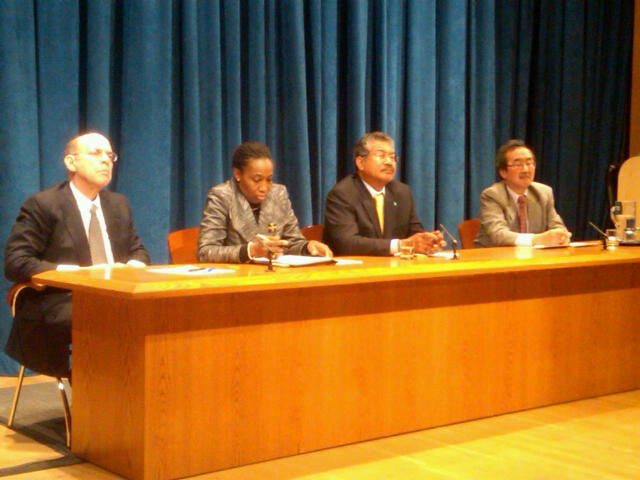
The panel at UN Feb 4: Palau, Grenada, DPI; Ambassador Rice not shown

So what is the US' position on Transboundary Harm? In fairness, Palau's Permanent Representative quoted Rice as having called the failure to address climate change "pathetic," in connection with a UN Security Council debate on climate change.

Inner City Press asked Palau's representative Stuart Beck, an able New York lawyer, about what some call a split in the developing world groupings at the UN about whether climate change should be pursued through the Security Council, where the US and others have veto power, or the General Assembly where they don't.

Beck said the strategy is to get the General Assembly to request the advisory opinion.

There is a growing group of lawyers working on the proposal, including longtime environmental and administrative law expert Michael Gerard, known as "Mister Environmental Impact Statement," conferring only by e-mail to save costs. "E-mails against the Empire," one wag dubbed it. How will it work? Watch this site.

Footnote: many of the Permanent Representative who have previously spoken of their encounter with US Ambassador Rice are, as of this writing, in Australia hearing first hand that country's case to be voted onto the UN Security Council next year. For this travel, are there carbon offsets? We'll see.