Showing posts with label TPP. Show all posts

Saturday, January 9, 2016

Online Censorship Opposed by Inner City Press, Under EU "Privacy" & Digital Millennium Copyright Act in US, Examples Here


By Matthew Russell Lee

UNITED NATIONS, January 9 -- What is censorship? Late on January 8, 2016, Inner City Press received a notice from Google that a page on its website, an article concerned Kosovo, would henceforth be blocked from Search from Europe. The notice is published below, along with Inner City Press' response.

  While still seeing this as censorship, at least in this case Google provided notice of what it had done, and a form to petition for the page's reinstatement. By contrast, when Reuters' UN bureau chief Louis Charbonneau ex parteclaimed to Google that his email to the UN, seeking to get Inner City Press thrown out of the UN, was somehow copyrighted, Google did not provide any notice, but simply blocked access to the leaked document, from everywhere.

  Inner City Press only learned of this censorship by a fluke, and by the notice put up by the Chilling Effects project of the Electronic Frontier Foundation (EFF, hat-tip).

   That experience has led Inner City Press, alongside its reporting on the UN and IMF and on predatory lending by banks, under-regulation by the Federal Reserve and others, to dig into the ways in which the Trans Pacific Partnership could globalize the type of censorship the Reuters bureau chief got Google to do, using the US Digital Millennium Copyright Act, DMCA. This has become a project of the new Free UN Coalition for Access.
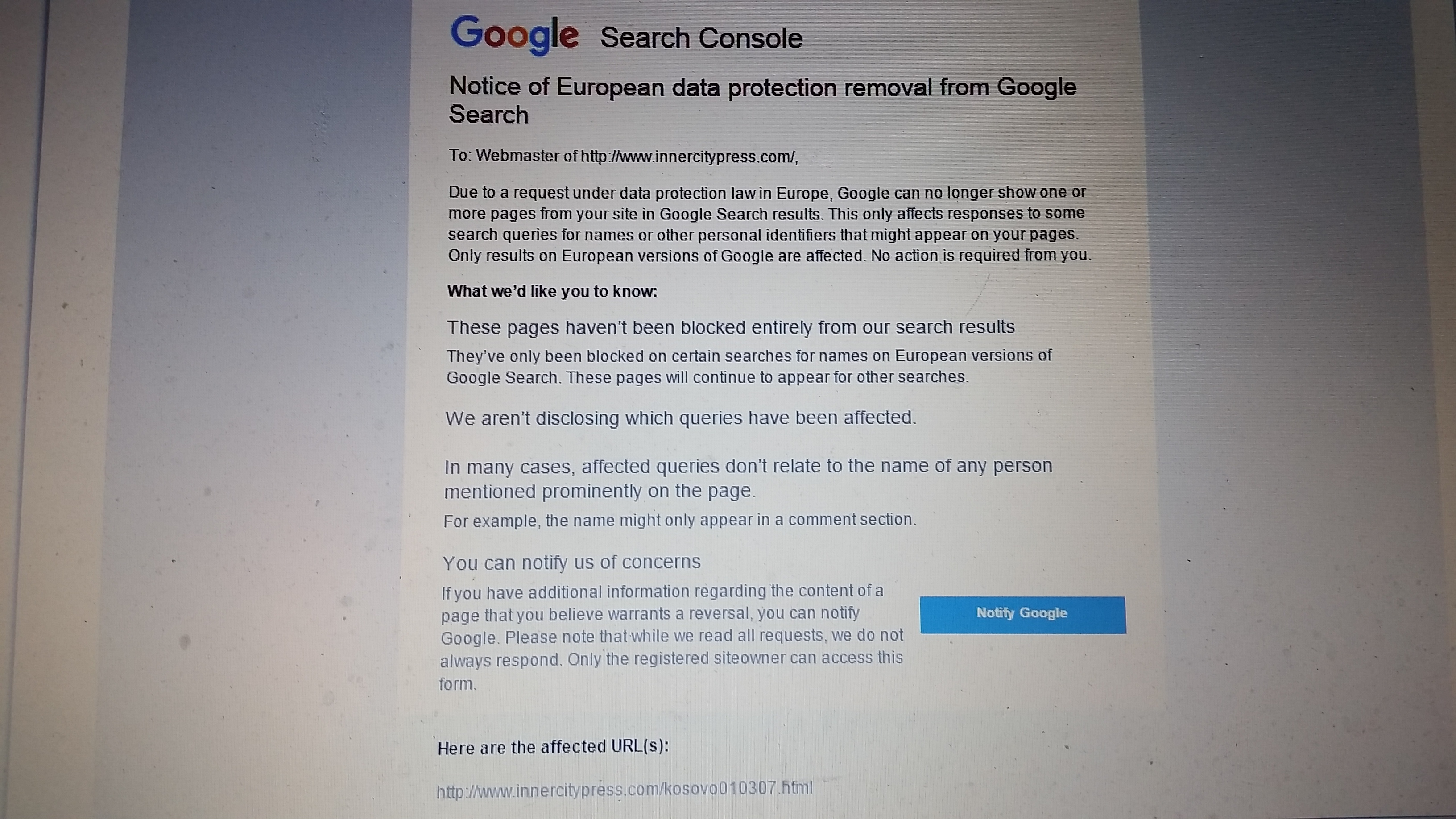


  In this January 2016 case, here is what Google sent to Inner City Press:

"Notice of European data protection removal from Google Search

To: Webmaster of http://www.innercitypress.com/,

Due to a request under data protection law in Europe, Google can no longer show one or more pages from your site in Google Search results. This only affects responses to some search queries for names or other personal identifiers that might appear on your pages. Only results on European versions of Google are affected. No action is required from you.

What we’d like you to know: These pages haven’t been blocked entirely from our search results

They’ve only been blocked on certain searches for names on European versions of Google Search. These pages will continue to appear for other searches.

We aren’t disclosing which queries have been affected.
In many cases, affected queries don’t relate to the name of any person mentioned prominently on the page.

For example, the name might only appear in a comment section.
You can notify us of concerns

If you have additional information regarding the content of a page that you believe warrants a reversal, you can notify Google. Please note that while we read all requests, we do not always respond. Only the registered siteowner can access this form.
Here are the affected URL(s):

http://www.innercitypress.com/kosovo010307.html

  And here is what Inner City Press, confined to 250 characters per box, has sent to Google:

This article concerns Kovoso. Most individuals it it are public figures. Perhaps 1 individual in it filed a spurious request to censor. But see, for example,http://uk.reuters.com/article/uk-serbia-kosovo-corruption-idUKL0314562220070103, online.

  Then

"Reporting on contested areas such as Kosovo is in the public interest and should not be censored, particularly not based on an anonymous complaint. This is a request for Google's response to  what we see as a form of censorship.

Inner City Press reports on the UN, and here, Kosovo. We note previously unexplained censorship and false invocation of copyright:http://www.chillingeffects.org/notice.cgi?sID=1117933We request reversal of both, and an explanation."


  Watch this site.

Monday, October 26, 2015

On Trans Pacific Partnership, Inner City Press Asks UN's Tauli-Corpuz & De Zayas of Lawsuits, John Ashe Scandal


By Matthew Russell Lee
UNITED NATIONS, October 26 -- When UN Special Rapporteurs Victoria Tauli-Corpuz and Alfred De Zayas held a press conference at the UN on October 26, Inner City Press asked them about the Trans Pacific Partnership, specifically the ability of corporations to sue countries for undermining their profits with regulations. Tweeted photo here.
   Victoria Tauli-Corpuz said litigation has begun, and will be made easier by what she called the US' online summary of provisions of the TPP. Inner City Press asked Alfred De Zayas if the advisory opinion of the International Court of Justice that he seeks requires a referral from the General Assembly or can otherwise be triggered. He said the ILO could request the opinion, or WHO (which he also said should seek an opinion on Philip Morris' litigation against Uruguay and Australia.)
  Inner City Press also asked Victoria Tauli-Corpuz about the indictment of previous President of the General Assembly John Ashe, as it had discussed Ashe's performance with her on indigenous issues while he was in office. She said his indictment calls into question the outcome document and show a need for more oversight. We'll have more on this.
Back on September 27 when Peru's President Ollanta Humala Tasso held a UN stakeout to present his country's climate change Intended Nationally Determined Contribution document to UNFCCC chief Figueres, Inner City Press asked Humala about the impact on the INDC of the pending Trans Pacific Partnership, particularly corporate suing of government provision. Video here.
  Humala said TPP is 90% finished, and that Peru is committed to the environment. But what about corporations suing regulations that “hinder” them? This wasn't answered. 


 And the next day, UN Secretary General Ban Ki-moon when on a podium with Humala and French President Hollande told the Press that Humala regretted not being there. But he WAS there. Respect.
  Back on June 29 alongside the UN's “high level meeting on climate change," Inner City Press asked Janos Pasztor and Amina Mohammed of the UN about the critique by Brazil, South Africa, India and China (BASIC) that the developed world is not moving toward $100 billion a year in climate finance by 2020. Also, Inner City Press asked the Cardinal on the panel, what does the Pope think of it?
  Pasztor said the key is credible measuring of financing, and that Ban Ki-moon has spoken to the G-7. The Cardinal said the Pope's two principles are solidarity and subsidiarity. The SDG connection will become clear when the UN uploads the briefing video. 
  But -- this press conference at least was substantive. Two hours later, the UN presented Robert Redford, solo, taking questions ranging from his movies to Obama and called it climate change. The UN Correspondents Assocation, which didn't even have a question for Ban on climate change earlier in the day, was given the first question to Redford; it was sloppily asked and is almost sure not to be written up. No one asked, or was permitted to ask, about fracking or the Trans Pacific Partnership. And so it goes at the UN.
  Back on June 18 when the UN gave a climate change briefing by UNDP's Cassie Flynn, and Jo Scheuer, on June 18 Inner City Press asked about the under-funding of the Least Development Countries Fund, and if South Korea is backsliding in its Intended Nationally Determined Contributions. Video here.

  The answers, on film, were to promote other funding vehicles, and to say that South Korea has still yet to file its INDC.

Back on June 4 the UN's Assistant Secretary-General on Climate Change Janos Pasztor held a press conference and Inner City Press asked him about unspent funds at the Clean Development Mechanism in Bonn, and about reported backsliding by South Korea on its Intended Nationally Determined Contributions on greenhouse gas reduction.
  Pasztor said that the CDM is still needed; he said country have committed not to backslide. Video here. 
Back on May 5, Inner City Press asked him about criticism of the Green Climate Fund, including at the recent Permanent Forum on Indigenous Issues. Video here and embedded below.
  Specifically, why will the "Green" Climate Fund provide financial for coal-powered plants? Pasztor replied that some felt that an exclusion for coal would have been divisive. On statements at the PFII that the UN is helping to "monetize" nature, Pasztor replied that most states feel differently. But what about the indigenous?
  
  Pasztor in his opening statement had praised the UN Pension Fund for now investing in "green equities" and "green bonds." Since the UN has responded to Press questions about irregularities alleged at the Pension Fund by emphasizing how separate and independent it is, Inner City Press asked Pazstor if the UN Secretariat had brought about this Pension Fund decision.
 Pazstor replied that the Pension Fund answers to the Secretary General and that "she" - Carolyn Boykin, presumably - had made this decision. We'll have more on this, after noting Pasztor by no means the least responsive UN official...

 When last September 21 the People's Climate March assembled at Manhattan's Columbus Circle, there were anti-corporate puppets in front of the Trump International Hotel and Tower, speeches by coal miners and from the Marshall Islands.
   Many called on the UN to do better. But UN Secretary General Ban Ki-moon joined the march mid-way, at Radio City Musical Hall with New York Mayor Bill de Blasio. Senator Chuck Schumer was on hand, walking by a Bronx contingent chanting how Fresh Direct has broken its promises.
  Inner City Press' 90 second video of the march is here.
  The UN's or "BKM" (Ban Ki-moon) Climate Summit will feature Cargill and Walmart, Credit Agricole and Bank of America. The last of these is the first, in terms of funding mountain top coal removal. These are the contradiction. Inner City Press tweeted photos on@InnerCityPress. More to follow.
  The night before the People's Climate March, the UN buildings on First Avenue lit up with photos and footage of trees and fish and written messages. It is called "illUmiNations." Inner City Press video here.

   Inner City Press late on September 19, after covering the Ukraine,IraqEbola and Iran nuclear meetings inside the UN, went out and found a sort of trial run for the screening taking place on First Avenue, alreadylined with NYPD cement blocksPhoto here.

   Looking back at the UN's press release for the upcoming "VIP Press Screening" -- hard to know how they could exclude non-VIPs from it, or why they would want to -- there were laudatory quotes about UN Secretary General Ban Ki-moon, and: 
Obscura Digital has staged similar large-scale architectural mapping projection events on the Sydney Opera House, the Guggenheim Museum, and the Sheikh Zayed Grand Mosque. For examples of previous work, please visit the following link http://wdrv.it/1tx7Emd.
 In that video compilation, well worth watching, there are also corporate projects for Coca-Cola and YouTube owned by Google, with history at the UN
  A message Inner City Press photographed on September 19, here,  was "In nature's economy, the currency is not money but life." Is this true of Coca-Cola?
   There are questions about the UN's UNcritical approach to corporations and corporate "partnerships."
   In the run up to the UN's September 23 Climate Summit, the UN put out a media advisory promoting the participation of 14 corporations ranging from Saudi Aramco through Cargill, McDonald's and Walmart to Bank of America and Credit Agricole. 
  Inner City Press on September 16 asked Summit promoter Robert Orr how these 14 were selected for listing in the media advisory, and if the UN had reviewed their wider record. For example, the recent court decision involving Cargill and child slavery in Cote d'Ivoire, or Saudi Aramco not allowing employees in Saudi Arabia to protest.
   Orr mentioned a luncheon during the summit about carbon pricing and the UN Global Compact, a branch of the UN which repeatedly says it does not enforce substantive standards, only encourages reporting and dialogue.  Well, Saudi Aramco did not respond to the complaint about “employees allegedly dismissed after being detained for participation in civil rights protests in Saudi Arabia.”
   And what of the environment? Bank of America has been the number one funder of mountain-top removal coal mining, but Ban Ki-moon made it chairman the chief of his Sustainable Energy for All initiative.
  On behalf of the Free UN Coalition for Access, Inner City Press asked that those making commitments, like the 14 corporations named, hold question and answer sessions during the summit. We'll see.


Monday, September 28, 2015

ICP Asked Peru's Humala If TPP Investors' Rights Provision Undercut Environment and Peru's INDC


By Matthew Russell Lee
UNITED NATIONS, September 27 -- When Peru's President Ollanta Humala Tasso held a UN stakeout to present his country's climate change Intended Nationally Determined Contribution document to UNFCCC chief Figueres, Inner City Press asked Humala about the impact on the INDC of the pending Trans Pacific Partnership, particularly corporate suing of government provision. Video here.
  Humala said TPP is 90% finished, and that Peru is committed to the environment. But what about corporations suing regulations that “hinder” them? This wasn't answered. 


 And the next day, UN Secretary General Ban Ki-moon when on a podium with Humala and French President Hollande told the Press that Humala regretted not being there. But he WAS there. Respect.
  Back on June 29 alongside the UN's “high level meeting on climate change," Inner City Press asked Janos Pasztor and Amina Mohammed of the UN about the critique by Brazil, South Africa, India and China (BASIC) that the developed world is not moving toward $100 billion a year in climate finance by 2020. Also, Inner City Press asked the Cardinal on the panel, what does the Pope think of it?
  Pasztor said the key is credible measuring of financing, and that Ban Ki-moon has spoken to the G-7. The Cardinal said the Pope's two principles are solidarity and subsidiarity. The SDG connection will become clear when the UN uploads the briefing video. 
  But -- this press conference at least was substantive. Two hours later, the UN presented Robert Redford, solo, taking questions ranging from his movies to Obama and called it climate change. The UN Correspondents Assocation, which didn't even have a question for Ban on climate change earlier in the day, was given the first question to Redford; it was sloppily asked and is almost sure not to be written up. No one asked, or was permitted to ask, about fracking or the Trans Pacific Partnership. And so it goes at the UN.
  Back on June 18 when the UN gave a climate change briefing by UNDP's Cassie Flynn, and Jo Scheuer, on June 18 Inner City Press asked about the under-funding of the Least Development Countries Fund, and if South Korea is backsliding in its Intended Nationally Determined Contributions. Video here.

  The answers, on film, were to promote other funding vehicles, and to say that South Korea has still yet to file its INDC.

Back on June 4 the UN's Assistant Secretary-General on Climate Change Janos Pasztor held a press conference and Inner City Press asked him about unspent funds at the Clean Development Mechanism in Bonn, and about reported backsliding by South Korea on its Intended Nationally Determined Contributions on greenhouse gas reduction.
  Pasztor said that the CDM is still needed; he said country have committed not to backslide. Video here. 
Back on May 5, Inner City Press asked him about criticism of the Green Climate Fund, including at the recent Permanent Forum on Indigenous Issues. Video here and embedded below.
  Specifically, why will the "Green" Climate Fund provide financial for coal-powered plants? Pasztor replied that some felt that an exclusion for coal would have been divisive. On statements at the PFII that the UN is helping to "monetize" nature, Pasztor replied that most states feel differently. But what about the indigenous?
  
  Pasztor in his opening statement had praised the UN Pension Fund for now investing in "green equities" and "green bonds." Since the UN has responded to Press questions about irregularities alleged at the Pension Fund by emphasizing how separate and independent it is, Inner City Press asked Pazstor if the UN Secretariat had brought about this Pension Fund decision.
 Pazstor replied that the Pension Fund answers to the Secretary General and that "she" - Carolyn Boykin, presumably - had made this decision. We'll have more on this, after noting Pasztor by no means the least responsive UN official...

 When last September 21 the People's Climate March assembled at Manhattan's Columbus Circle, there were anti-corporate puppets in front of the Trump International Hotel and Tower, speeches by coal miners and from the Marshall Islands.
   Many called on the UN to do better. But UN Secretary General Ban Ki-moon joined the march mid-way, at Radio City Musical Hall with New York Mayor Bill de Blasio. Senator Chuck Schumer was on hand, walking by a Bronx contingent chanting how Fresh Direct has broken its promises.
  Inner City Press' 90 second video of the march is here.

Tuesday, May 19, 2015

On the Trans Pacific Partnership, Inner City Press Asks UN's Pingfan Hong, He Calls TPP & T-TIP “Discriminatory, A Step Backward”


By Matthew Russell Lee
UNITED NATIONS, May 19 -- Just as US Secretary of State John Kerry gave a speech in Washington State promoting the proposed Trans Pacific Partnership, Inner City Press in New York asked UN official Pingfan Hong for the UN's view of the TPP.
  Pingfan Hong said that TPP would be a step backward from the multilateral process, and that it would be discriminatory against countries in the developing world. Video here. 
  It was a rare "stand up to the US" moment in today's UN.  Earlier this month, as exclusively reported by Inner City Press, when Kerry told UN Secretary General Ban Ki-moon not to try to hold a Yemen talks in Geneva including the Houthis, Ban immediately acquiesced. But Pingfan Hong spoke his mind, here
  We have transcribed it:
Inner City Press: On trade policy, the big one right now is TPP, John Kerry is giving a speech about it, what is DESA's view, impact on US economy and world economy, should it be modified or disclosed?
UN's Pingfan Hong: About the TPP, from a UN or a DESA point of view, we don’t consider that as a single issue. We analyze that issue from the perspective of the multilateral treaty system. That is, compare that with the WTO. From that point of view, it’s kind of at best, TPP, it’s paradoxical. For example, if you see those 20 areas covered, in this TPP, from e-commerce to other services, intellectual property rights, labor standards, environmental standards, indeed TPP sets a much higher standard than WTO negotiations.
From that you’ll probably say it’s a little bit forward looking, or it’s more advanced. On the other hand you see, from a developing country’s point of view, both this Trans Pacific Partnership as well as this trans Atlantic, they are US and EU centric. So it's a set back actually, the progress made in multilateral trading system after World War Two it's backward from that point of view, means that your developing countries, they don’t have much voice or bargaining power in this two, major, developed economy driven, this regional trade, the largest two trade agreements.
From UN point of view we are still in favor of the multilateral trading system of WTO, because any regional trade agreement, including these two biggest ones, definitely they do, they are discriminatory for a large number of non member countries. And to a large extent they are also undermining this multilateral treaty system in terms of they’re working, not only trade, from other regions, but also divert the political efforts for many countries to work on this WTO trade negotiations, Doha round. 
 Trade is just a means. It’s a means for development. So from a development point of view, we should focus on whether treaty negotiation can contribute to the development or not. Not just how much trade it would generate. So in that sense it’s more complicated than just look at the single... I mean, we don’t want to pay too much attention to the political debate, like now it’s still ongoing, in the US on this issue. 
 Meanwhile in Renton, Washington Kerry praised TPP with no acknowledgement of flaws such as the globalization of censorship under the Digital Millennium Copyright Act, example here.
  That example, ironically, is by Reuters - a news wire one might think would oppose censorship.
 Back on January 15, 2014 on Capitol Hill, Fast Track for the proposed Trans Pacific Partnership was promoted in the guise of a twenty-year review of NAFTA. 
  The US Chamber of Commerce, Carla Hills and former Congressman David Dreier were among the pro Fast Track for TPP witnesses before the House Committee on Foreign Affairs, Subcommittee on the Western Hemisphere. 
  As Chairman Salman's introduction put it, "NAFTA has been the impetus for the regional bilateral trade agreements reached since then, and has provided important lessons as the U.S. seeks to build closer ties to trade and investment partners through the much anticipated Trans Pacific Partnership."
  After some perfunctory praise of NAFTA, and some unanswered questions about free trade agreements with Colombia and South Korea, things quickly turned to promotion of the TPP. The bill was introduced in Congress on January 9; it has been protested including in Harlem on January 4, 2014, here
  The Senate Finance Committee press release is here, the bill is here, their summary here. It would globalize schemes like the pro-corporate Digital Millennium Copyright Act, misused by Reuters UN bureau chief to get a leaked document banned from Google's search.
   While free press protections are in some ways advanced in the United States, as the Free UN Coalition for Access has begun highlighting, theUS Digital Millennium Copyright Act can be and has been used as an end-run attack on freedom of the press.
   Leaked documents used in an investigative story can be blocked, as the Reuters' complaint to Google blocked from Google's search its bureau chief's e-mail to the UN seeking to get Inner City Press thrown out. This is a perversion of the concept of copyright (as well as a contradictory argument for Reuters or anyone in journalism to be making, that such documents should be taken down or blocked.)
   In Chile, for example, any such take-down requires the requester to get a court order. But DMCA provides, and Google allowed, blocking based on a non-reviewed, bad faith complaint.
  As the Electronic Frontier Foundation's Intellectual Property Director Corynne McSherry told Inner City Press about the case:
"Unfortunately, it is all too easy for a copyright holder (assuming that the person that sent this notice actually held copyright in the email) to abuse the DMCA to take down content and stifle legitimate speech. As countries outside the US consider adopting DMCA-like procedures, they must make sure they include strong protections for free speech, such as significant penalties for takedown abuse."
  Along with other pro-corporate provisions, TPP would internationalize this abuse of copyright to undermine freedom of the press.  
 If this remains precedent, what else could come down?
  Why not an email from Iran, for example, to the UN's International Atomic Energy Agency? Why not a sanctions filing by a country? Here is Reuters logic, accepted if only automatically by Google:
The copyrighted material is a private email I wrote in April 2012 and for which I never gave permission to be published. It has been published on a blog and appears in on the first page of search results for my name and the firm I work for, Reuters. It can be seen here: http://www.innercitypress.com/reutersLC3unmalu.pdf
  But this is true of ANY leaked document: it can be said that the entity or person exposed "never gave permission [for it] to be published." Does that mean Google can or should block search access to it?
  Can a complaint to a Media Accreditation official against a competitor legitimately be considered "private"? In any event, the DMCA is not about protecting privacy.
  Iran or North Korea could say a filing or status report they make with the IAEA is "private" and was not intended to be published. Would Google, receiving a DMCA filing, block access to the information on, say, Reuters.com?
  The logic of Reuters' August 14, 2013 filing with Google, put online via the ChillingEffects.org project, is profoundly anti free press.
  The fact that Google accepts or didn't check, to remain in the DMCA Safe Harbor, the filing makes it even worse. The request to take-down wasn't made to InnerCityPress.com or its server -- it would have been rejected. But banning a page from Search has the same censoring effect.
  The US has a regime to protect freedom of the press, and against prior restraint. But this is a loophole, exploited cynically by Reuters. What if a media conducted a long investigation of a mayor, fueled by a leaked email. When the story was published, could the Mayor make a Reuters-like filing with Google and get it blocked?
  Here is the text of Reuters' communication to the UN's top Media Accreditation and Liaison Unit official Stephane Dujarric and MALU's manager, to which it claimed "copyright" and for now has banned from Google's Search:
Hi Isabelle and Stephane,
I just wanted to pass on for the record that I was just confronted by Matt Lee in the DHL auditorium in very hostile fashion a short while ago (there were several witnesses, including Giampaolo). He's obviously gotten wind that there's a movement afoot to expel him from the UNCA executive committee, though he doesn't know the details yet. But he was going out of his way to be as intimidating and aggressive as possible towards me, told me I "disgust" him, etc.
In all my 20+ years of reporting I've never been approached like that by a follow journalist in any press corps, no matter how stressful things got. He's become someone who's making it very hard for me and others in the UN press to do our jobs. His harassment of fellow reporters is reaching a new fever pitch.
I just thought you should know this.
Cheers,
Lou
Louis Charbonneau
Bureau Chief. United Nations
Reuters News Thomson Reuters reuters. com
This email was sent to you by Thomson Reuters, the global news and information company.
"UNCA" in the for-now banned e-mail is the United Nations Correspondents Association. The story developed here, as to Sri Lanka;here is a sample pick-up this past weekend in Italian, to which we link and give full credit, translated into English (NOT for now by Google) --

The fool of Reuters to the UN

by Mahesh - 12/27/2013 -calls for the removal of a letter from the head of his bureau at the United Nations, pursuing a copyright infringement on the part of the competition
Try to make out a small competitor from the UN press room and then, when these publish proof of intrigue, invokes the copyright to release a letter from compromising the network.
MOLESTA-AGENCY  Inner City Press is a small non-profit agency covering the work of the United Nations for years, with an original cut, which become distasteful to many. Unlike other matching its founder master sent never tires of asking account of inconsistencies and contradictions and often refers to unpleasant situations involving colleagues and their reportage, too often twisted to obvious political contingencies.
THE LAST CAVITY – In this case the clutch is born when Matthew Lee, Inner City Press ever since he founded and made famous in the 90 's, challenged the screening of "Lies Agreed Upon" in the auditorium of the United Nations, a filmaccio of propaganda in which the Sri Lankan regime tries to deny the now tested massacres (and destroyed by International Crisis Group)In the piece, in which denounced the incident, Lee also announced that the screening was organized by the President of the United Nations Correspondents (UNCA), Italian Giampaolo Pioli, skipping the normal consultation procedure for this kind of events. Pioli then, was also accused of being in a conflict of interest, given that he rented an apartment in New York an apartment to the Deputy Permanent Representative to the UN in Sri Lanka, named Palitha Kohona and is suspected of war crimes.
TRY WITH THE COPYRIGHT- So he comes to the letter with which Louis Charbonneau, Reuters bureau chief at the United Nations, wrote to the Media Accreditation and Liaison Unit (MALU) calling for the ouster of Lee, which the UN being there for years as his colleagues, but we see that this was not done. Lee, however, comes into possession of the letter and publish it, and then writes to Google millantando Charbonneau the copyright on the letter and asking for removal pursuant to the Digital Millennium Copyright ActThat is a bit like if a company request the removal of a compromising document from a journalistic investigation, in the name of copyright, a claim clearly absurd and disingenuous.
HARASSMENT AND THREATS- In the letter published, Charbonneau complained about the aggressive behavior of Lee and cited among the witnesses to cases where Lee had been "aggressive" towards him even Pioli. Lee with that piece has gained throughout a hail of protests from Sri Lanka and an investigation by the UNCA, along with death threats and other well-known amenities the refugees away from the clutches of the regime, but it is still there. Behold then the brilliant idea of Charbonneau, improperly used copyright law to censor the objectionable publications to a colleague and competitor. Pity that Lee has already resisted successfully in similar cases, in 2008 was the same Google to remove your site from being indexed in the news in its search engines, it is unclear what impetus behind, only to regret it soon after that even Fox News had cried scandal.


Saturday, February 28, 2015

Of Corrections: On Nemtsov As UN's Ban Ki-moon Shifts from "Saddened" to Condemns, Reuters Follows AFP on Mis-Reporting Martin Bouygues Dead


By Matthew Russell Lee
UNITED NATIONS, February 28 -- Everybody makes mistakes. On February 28 the UN's Office of the Spokesperson first said Secretary General Ban Ki-moon was “saddened” by the murder of Boris Nemtsov -- then 50 minutes later correcting it to “condemns.”  Agence France Presse misreporting that Martin Bouygues was dead.
    The former correction gives rise to the question whether the UN received a complaint about Ban not condemning the killing, leading to the issuance of the correction. It merits coverage.
  But Reuters, for example, simply retyped the “corrected” Ban Ki-moon statement, putting Ban in the same light as was done by Ban's in-house UN News Service.
   The backstory here is the Reuters at the UN has tried to get other, more critical media thrown out of the UN -- and has then gone so far as to censor from the Internet leaked copies of the Reuters “for the record” complaint
  Here was the complainthere via the Electronic Frontier Foundation's Chilling Effects project is the notice that the leaked complaint by Reuters has been blocked from Google's Search as a copyrighted book, under the Digital Millennium Copyright Act (set to be globalized by the proposed Trans Pacific Partnership.)
   That initial Reuters campaign culminated in a letter, also leaked, by Voice of America to the UN asking for Inner City Press' accreditation to be “reviewed,” here
   A subsequent Inner City Press request under the Freedom of Information Act to VOA's Broadcasting Board of Governors yield documents showing that not only Reutersbut also Agence France Presse coordinated with the VOA request
  To come full circle, since Ban Ki-moon's statement are most often crafted within the UN Department of Political Afffairs, that DPA chief Jeffrey Feltman is currently in Sri Lanka may have played a role in the vacillation from “saddened” to “condemns.” We'll have more on this.
For now, a UN footnote: the new Free UN Coalition for Access notes that the Agence France Presse and Reuters pitch to expel was based on their wires having editors - did that stop the Bouygues mis-reporting, or the craven retyping and quid pro quo at the UN? FUNCA is against censorship, and for the rights of journalists.


Sunday, November 16, 2014

In Brisbane G20 Conclusion, Obama Mostly Domestic, Opposes Meddling Only If for Separatists in Democracies


By Matthew Russell Lee
UNITED NATIONS, November 16 -- When the G20 summit ended and after Australia's Tony Abbott mouthed support for the fight against climate change, Obama took the stage in Brisbane.
  He was asked about Ukraine and said that it is impermissible to finance proxies to break up countries which have mechanisms for democratic elections. 
  It is a phrase that needs unpacking.
  Obama did not say countries should not interfere, militarily, in other countries. If a country is not a democracy, apparently, one can intervene, as long as it is not to stoke separatism. Are those the new rules?
 The US "train and equip mission" on Syria came to mind. Those are proxies, but are they allowed under Obama's new rules? On Syria Obama said that eventually there will have to be a political solution including Syria's neighbors like Turkey and Iran, and "Assad's patron," Russia.
  Abbott, like the UK's Cameron after him, spoke for his home audience. And to Obama, the pre-selected questions beginning with Reuters were about Keystone, health care, immigration and executive orders. It's a long way to fly for this.

In Brisbane for the G20, US President Barack Obama announced a $3 billion commitment to the Green climate fund, to applause at the University of Queenland. He did not mention Australia's anti-immigrant policies or Manus Island.
  Obama claimed that the US never puts its principles in the back seat, referring to China -- with no mention of Saudi Arabia or its neighbors Bahrain and Qatar. He praised Myanmar, saying he spoke there about how journalism can be responsible, without mentioned Aung Naing, killed in custody.
  Back in Beijing on November 10, US President Barack Obama is promoting the "Transpacific Partnership," which would among other things export pro-corporate (and pro-censorship) laws like the US Digital Millennium Copyright Act. 
  After telling the media to hurry up and get out of the room, "we have some work to do," a statement emerged on November 10, that 
"We, the Leaders of Australia, Brunei Darussalam, Canada, Chile, Japan, Malaysia, Mexico, New Zealand, Peru, Singapore, United States, and Vietnam, welcome the significant progress in recent months, as reported to us by our Ministers, that sets the stage to bring these landmark Trans-Pacific Partnership (TPP) negotiations to conclusion."
   But if the TPP is so good, why would an organization like the Electronic Frontier Foundation be sounding the alarm? And why and how can the UN be promoting and praising this TPP?
 The UN has a joint agency with the World Trade Organization, and on March 6, 2014, at the UN the director of the joint agency the International Trade Centre Arancha Gonzalez, formerly of the WTO, spoke at the UN and praised the pending Trans Pacific Partnership.
Inner City Press when able asked Gonzalez to explain working on the TPP as a UN project, given the range of groups opposed to the TPP, including for example the Electronic Frontier Foundation. Click here.
  As the Free UN Coalition for Access is pursuing, TPP would essentially globalize the US Digital Millennium Copyright Act, which can be used for censorship -- not only has used by Reuters UN bureau chief to ban from Google's Search an anti-Press complaint he filed with the UN, but more recently to take-down videos of protests.Click here.
  Gonzalez gave a lengthy answer, that trade deals are up to member state, but added that the ICT works so that rules are consistent and not fragmented.  To some this sounds like "race to the bottom."
  Since the press conference was billed as concerning the Commission on the Status of Women, Inner City Press asked Gonzalez which countries ban women from having bank accounts. Saudi Arabia came to mind, but Gonzalez cited Asia and sub-Saharan Africa. We hope to have more on this issue.
   Back on March 4 another UN agency UN HABITAT unveiled "The City We Need" booklet on Tuesday at the UN, in advance of an event at the nearby Ford Foundation. 
After thanking the panel including HABITAT's Joan Clos on behalf of the new Free UN Coalition for Access, Inner City Press asked: how were these corporate sponsored vetted?
  The answer, from Nick Yu of the World Urban Campaign, was as is so often the case at the UN that the private sector is important, is a stakeholder. Yes, but what about these particular companies? What is the process? And what is their involvement, beyond paying to be listed in promotional materials?
A goal of the campaign seems to be to try to get a holistic "Cities" Sustainable Development Goal. Inner City Presshas reported on a similar move, involving Palau, to get an Oceans SDG. The list is growing.
A panelist who was also a New Yorker, Eugenie Birch, answered Inner City Press question about the last and the current New York City mayors. Bill de Blasio, Birch said, is a corrective on issues of affordable housing and free kindergarten (what about pre-K?). Michael Bloomberg, whose meeting with US Secretary of State John Kerry has yet to be summarized by the UN as Inner City Press has requested, will be at the Ford Foundation. Watch this site.