Showing posts with label Slovakia. Show all posts

Monday, January 18, 2016

For Next SG, At Slovakia Event Talk of Miroslav Lajcak and Jan Kubis, Susana Malcorra in Wings


By Matthew Russell Lee
UNITED NATIONS, January 18 -- How should the next UN Secretary General be selected, to improve the Organization? 
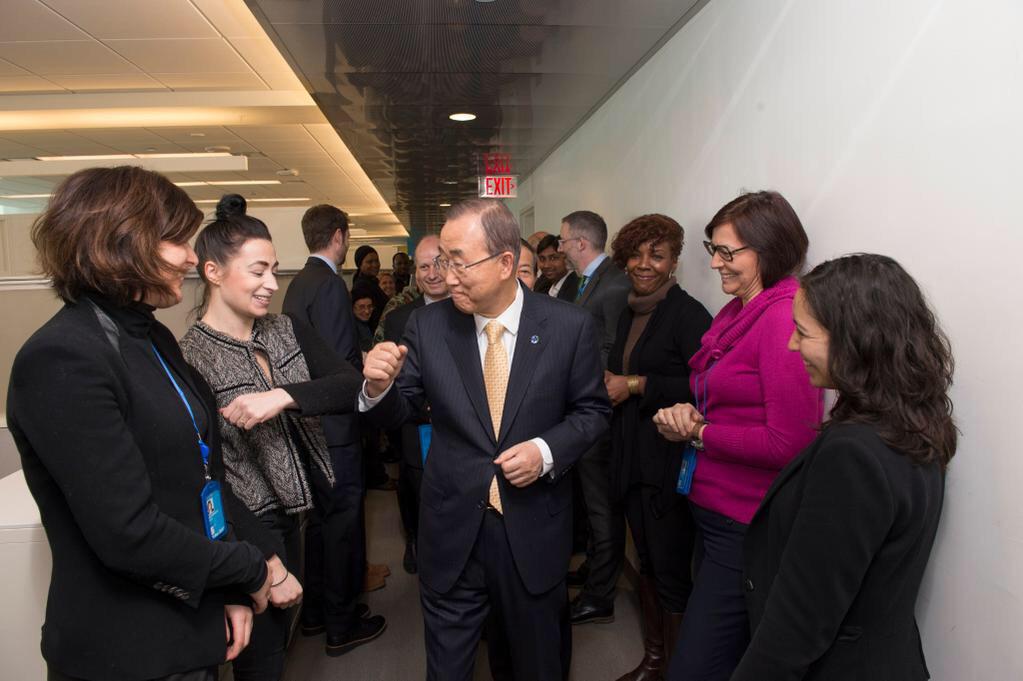
 On January 18 at an event marking Slovakia's 70th year of membership in the UN, reference was made to the country's candidate(s) for the position: both foreign minister Miroslav Lajcák and, as Inner City Press has previously asked about and reported, Ján Kubiš, currently the UN's envoy to Iraq. 
After the event, with speeches by Ban Ki-moon's chief of staff Edmond Mulet, the head of DPI and Professor Stephen Schlesinger, a cynic opined to Inner City Press that despite or because of all the Eastern European Group candidates, maybe Mulet's predecessor Susana Malcorra, now being “seasoned” in Argentina, will return and get the job. We'll have more on this.
On December 15, after President of the General Assembly Mogens Lykketoft as well as US Ambassador Samantha Power co-signed a letter to all states and Observer States to put forward candidates, Lykketoft took questions. 
 On January 15, Lykketoft's office put online a third nomination letter, that of Montenegro for Igor Luksic, joining FYROM's Srgjan Kerim and Croatia's Pusic. Here.
And when, we ask, might Slovakia put in a nomination for Jan Kubis? And would Czech Republic make a nomination, while its Deputy Prime Minister says "no more refugees"? 
 Earlier on January 15, Inner City Press asked Lykketoft who is paying for his trips to the United Arab Emirates, Davos and Jordan. Video here. Later Lykketoft's spokesperson replied, "The PGAs trip to Abu Dhabi is being funded by Govt of UAE and the rest of the trip by the Office of the PGA." The answer is appreciated; we'll have more on this.
 On Next SG, back on December 15 Inner City Press asked Lykketoft if the General Assembly's “dialogues” with candidates will be open -- yes -- and if he thought a candidate currently heading a UN agency should step down to run. (He did not answer this.)
  Lykketoft said so far there are two formal candidates: Croatia's foreign minister Vesna Pusic and former PGA Srgjan Kerim of FYROM. Inner City Press asked, during the press conference, how for example a person like ex-PGA Vuk Jeremic, without the support of his government at present, could run. Lykketoft said that another state could nominate him.
(An aside: if it's true that neither Pusic nor Kerim are on Twitter, what does that say about the place of technology and social media in the current Next SG race?)
  Minutes later, on Periscope (speaking of transparency), Inner City Press asked Lykketoft of a nomination from a non-state would even be processed. No, he indicated. So much for “We the Peoples.” And so much, perhaps, for Eastern Europe, if Crimea becomes a litmus test.
On December 11, Inner City Press asked the foreign ministers of both Ukraine and Lithuania, both members of the Eastern European Group, about who should be next SG. Video here. 
From the answers, it seems at least these two countries will demand a candidate which would condemn a P5 Security Council member's violation of the UN Charter. Since p5 members have a veto over the SG, maybe the post will move beyond the group. We'll be covering this, watch this site. 
F On November 18, after the UN Security Council met behind closed doors on the issue, the month's UN Security Council President Matthew Rycroft of the UK emerged and read a short Elements to the Press on “the issue of the letter that will be written shortly by the President of the Security Council and the President of the General Assembly, on the selection process for the appointment of the next secretary general, and an exchange of views on the basis of a draft letter from the UK and we agreed to do further work, both on the letter and to keep in touch with each other on the timing of that, in order to fulfill our side of the work of the security council. The General Assembly has already begun with their resolution 69/321.”
  But less than an hour before, Russia's Ambassador Vitaly Churkin had told the press that “I’m sure the President of the Council is going to speak. And what I proposed, half-jokingly I must admit, that we should set a working group which will have weekly meetings until the end of next year on a draft letter by the President of the General Assembly and the President of the Security Council. In fact, if we stick to the resolution of the General Assembly, it says that they are asking for a joint letter, which is going to describe the process and invite candidates. The process is described in the Charter and inviting candidates is saying yes please, submit your candidates. But if you try to turn it into a lengthy negotiation, some kind of a fancy document, then it will take 12 months for us to achieve this draft letter. So my pitch, which was shared by some colleagues, let’s not over-complicate things. Come on. And if we don’t over-complicated things, then I think it can be done.
   France 24 asked Churkin, You have a candidate? Churkin replied there are seven or eight candidates from Eastern Europe, but France 24 insisted, “From Russia?”
  Churkin explained that Permanent members of the Security Council don't submit UNSG candidates. And so it goes. We note that at the increasingly corrupt UN Correspondents Association, there are no term limits and this year, all six officers are running without opposition, headed by Giampaolo Pioli who previously rented one of his apartments to Sri Lanka's ambassador then screened his war crimes denial film, and now sells seats with Ban Ki-moon for $6,000. Let's hope this process can lead to an SG who can clear the UN up.
 On September 22, after the Permanent Representatives of Estonia and Costa Rica announced a high level meeting on the topic on September 26; Estonia's Sven Jürgenson said his priority is the best candidate, not necessarily from the Eastern European group. 
   Inner City Press asked if this same push for transparency applies to the current murky process of selecting the new High Commissioner for Refugees, of which it is said Ban Ki-moon alone choose (Danish UNGA President Mogens Lykketoft told Inner City Press he “favors” the Danish ex-Prime Minister but plays no role.)
  Costa Rica's Juan Carlos Mendoza Garcia told Inner City Press that reforms in Secretary General selection could help reform other selections in the UN system. Inner City Press - and the Free UN Coalition for Access -- ask, isn't the refugee top post something of a test case?
  Tellingly, the old UN Correspondents Association demanded to ask - and largely waste - the first question, the time of meritless hierarchy that is precisely what's wrong with the UN. We'll have more on this, and on the September 26 high level meeting.
  Back on July 22 the subject was discussed behind closed doors by the UN Security Council. Afterward UK Ambassador Matthew Rycroft emerged and described the meeting as a first step, adding that the UK intends to convene a so-called Arria formula meeting of the Council once candidates come forward.
  Inner City Press asked Rycroft if the issue of regional rotation - that is, the the Next SG post belongs to the Eastern European Group -- came up. He said that it did, adding among other things that the UK does not think that is the most important factor. Periscope video here, for now.
  It was argued to Inner City Press that while the UN Charter in English assumes that the Secretary General is male, that is not the case in the Chinese (or Russian) versions - for what it's worth.
Update: as to Russian, an astute reader notes that
Within Chapter XV of the Charter (“The Secretariat”), in the third sentence of Article 97, where the English version of the Charter says of the Secretary-General, “He shall . . .”, the Russian version instead uses the name “TheSecretary-General shall . . .”, thus avoiding specifying the SG’s gender.  But in Article 99, where the English says, “The Secretary-General may bring to the attention of the Security Council any matter which in his opinion may threaten . . .”, the Russian also uses, “. . . in his opinion”.
h/t/ SC Procedure
Статья 97
Секретариат состоит из Генерального Секретаря и такого персонала, который может потребоваться для Организации. Генеральный Секретарь назначается Генеральной Ассамблеей по рекомендации Совета Безопасности. Генеральный Секретарь является главным административным должностным лицом Организации.
Статья 98
Генеральный Секретарь действует в этом качестве на всех заседаниях Генеральной Ассамблеи, Совета Безопасности, Экономического и Социального Совета и Совета по Опеке и выполняет такие другие функции, какие возлагаются на него этими органами. Генеральный Секретарь представляет Генеральной Ассамблее ежегодный отчет о работе Организации.
Статья 99
Генеральный Секретарь имеет право доводить до сведения Совета Безопасности о любых вопросах, которые, по его мнению, могут угрожать поддержанию международного мира и безопасности. 
  The Security Council's President for July, Gerard von Bohemen of New Zealand, spoke at the UNTV stakeout after the consultations. Inner City Press asked him as well about the regional rotation issue. Periscope video for now here. He said he had come up; he said that New Zealand's position is consistent with that of the ACT - Accountability, Coherence and Transparency - group, see background below. Here's from July 22 transcriptio by the NZ UN Mission:
"On the Secretary General appointment, this was the first time the Council had discussed the issue, there was a reference made to the ACT letter and the processes suggested in that, but it was a more general conversation than that. I was very encouraged by both the spirit of the discussion, also by the relative convergence of views, although there was no specific agreement on any outcome, there was a recognition that transparency is an important consideration, and clarity and recognition that the General Assembly membership is very interested in this issue and that the Council should be responding to it. So we agreed that this was the first of a number of conversations we would have as to any specific action that might be taken, that’s for the future."

Inner City Press: How would you characterize the issue of regional rotation in the Eastern European Group, just to give some sense of what people said or what the view is?

A: Well, a number of speakers referred to it, no one disagreed with it, but it wasn’t seen as being inconsistent with the processes, some of the processes that were being recommended.
Background: on June 30, UN Conference Room 11 was full to discuss the Next SG question, in an event organized by the 27 member states (so far) making up ACT (Accountability, Coherence, Transparency). 
  Surprising to some, on the panel was UK Permanent Representative Matthew Rycroft, who said among other things that the Next SG should not necessarily be from the Eastern European Group.
  The room was full -- Inner City Press stood by the door,broadcasting by Periscope and live-tweeting with laptop in hand -- but with a notable contingent of Eastern European representatives. One question identified herself as such: a woman, and Eastern European. Just saying.
   William Pace of WFM reminisced how Boutros Boutros Ghali's second term was vetoed in a deal between the (Bill) Clinton adminstration and then-Senator Jesse Helms, to release dues payments to the UN. 
 The proposal now is for a single seven year term. Mary Robinson says she knows of another P5 country, beyond the UK, which is open to a single seven year term.
  When it was open for questions, Inner City Press (also on behalf of the new Free UN Coalition for Access, which unlike the older correspondents grouping actually fights for more transparency by the UN) asked why not have a debate among prospective candidates? 
  Why not require disclosure of how much is spend on each candidates campaign, including banning or requiring the disclosure of spending of the funds of UN Programmes (UNDP) or Organizations (UNESCO) for their chiefs to campaign to replace Ban Ki-moon?
   The UK's Rycroft said that prohibitions are not the answer -- agreed -- but did not answer on requiring financial disclosures. (He said we don't want massive spending, one isn't running for president. Which raises another question: what about some form of matching funds for candidates from lower income countries?)
  While much of the focus seems to be on arranging letters from the President of the Security Council to the President of the General Assembly, as Inner City Press asked at the ACT event and asked the new PGA Mogens Lykketoft himself, twice (video), can't the PGA call a high level meeting and invite candidates to present themselves? In this way, the wider world outside the UN could get engaged, and put on some pressure. The anonymous polling of which candidates are “discouraged” by the P5 members should not, FUNCA contends, be repeated.
  Costa Rica's Permanent Representative Juan Carlos Mendoza-García wrapped up, and the event was over. It was promising, but moves for reform and opening up should begin as soon as possible. Watch this site.
  Back on June 1, after several press conference on the topic and a closed door General Assembly session on April 27, the ACT group of 27 states (Accountability, Coherence and Transparency) submitted their page and a half set of proposals to the Presidents of the Security Council and of the General Assembly. 
  Even before these proposals are debated, candidates are edging for an advantage; dark horses are positioning themselves for it the post slips away from the Eastern European Group. Inner City Press has mentioned Helen Clark, using the UN Development Program post to campaign (staff who cross her on Twitter are reprimanded, as Inner City Press reported here.)
 Another "dark horse" candidate, Inner City Press is told, is Swedish foreign minister and former UN official Margot Wallstrom. We'd like to hear from her what she thnks of the UN's handling of allegations of sexual abuse by French "peacekeepers" in the Central African Republic, including the role of another reputed dark horse candidate, or at least candidate to head the UN in Geneva, Susana Malcorra. And what did Ban know, and when did he know it?
  The Free UN Coalition for Access agrees, there should be formal candidacies, platforms -- and adds, why not debates?
  We'd like to hear the Swiss view on this - from today forward, from a new mission spokesperson, Simone Eymann. Her predecessor Adrian Sollberger at his farewell reception on June 1 joked how being an elections officer is like speed dating. He is remaining with the the Foreign Department of Switzerland working in the Cabinet of the Secretary of State, in Berne.
  So why NOT some debates among candidates for Secretary General, when they declare? We'll have more on this.
 How to pick the next UNSG: that was the question on the afternoon of April 27 in what was called a "closed" meeting in the Trusteeship Council Chamber. The meeting being labeled closed, and not on UN webcast, is a bad beginning, the Free UN Coalition for Access believes.
 To counter-act this Inner City Press did its reporting about the meeting, from India urging that there be more than one - a panel - of candidates proposed, to Moldova emphasizing that the next SG should come from Eastern Europe.
 Canada said regional rotation should inform but not determine the selection. The UK to its credit released a copy of the speech by new Permanent Representative Matthew Rycroft - but how to square its proposals with David Cameron nominating Andrew Lansley to replace Valerie Amos as Emergency Relief Coordinator, then insisting that the UK should have the post, now in the person of Stephen O'Brien.
Update: With only a few dozen states choosing to speak, the chair decided to try to finish them all -- five states in twelve minutes? -- to end the debate on April 27. This too may not be the right spirit.
Update II: And when the rushed session ended, the next one was announced for May 12, on the "institutional memory" of the Office of the President of the General Assembly.
  Earlier in a 10 am press conference by the campaign called "1 for 7 Billion: Find the Best UN Leader."
  At the April 27 UN noon briefing, Inner City Press asked Ban Ki-moon's deputy spokesperson for Ban's views on needed reforms. Apparently there are none: it is up to member states, he said, adding that selecting a women would be good. What about pay to play?
  Inner City Press asked the panel if, as happened last time, increase trade and aid funding by a candidates' country should at least be disclosed, if not prohibited. William Pace of WFM replied not only about countries spending hundreds of million of Euros, but also about the heads of international agencies using their posts to campaign.
  Since UNDP's Helen Clark is known to have told associates and underlings she would like to be the next SG, Inner City Press asked the panel for comment. They were diplomatic, including on the UK, said to be a reformer on the SG post, having insisted it retain the Emergency Relief Coordinator positioon, albeit in the person of Stephen O'Brien and not Cameron's first nominee (and National Health Service destroyer) Andrew Lansley.
  Natalie Samarasinghe of UNA-UK said the campaign around (well, against) Lansley was a positive step forward; she said that social media makes secret processes less possible. (But see the replacement at Yemen envoy of Jamal Benomar by a Mauritanian official who has not made public financial disclosure).
  Yvonne Terlingen, now Senior Policy Adviser at WFM,  also cited the OCHA process or campaign. WFM's Pace seemed to conflate the entire UN press corps with the UN Correspondents Association, a group that for example tried to censor Press coverage of how Under Secretary General Herve Ladsous got the job, then tried to get the Press thrown out.
  The new Free UN Coalition for Access seeks to open the UN and these processes - watch this site.

Saturday, November 28, 2015

As 2 Guineans and 1 Burkinabe Serving UN in Mali Are Killed, Two Tier Peacekeeping?


By Matthew Russell Lee
UNITED NATIONS, November 28 -- In Northern Mali an attack claimed by Ansar Dine has killed two UN Peacekeepers from Guinea and a UN contractor from Burkina Faso. The UN mission MINUSMA and now the Security Council have condemned the attack. 
 Among the questions that arises is whether those coming to Mali to fill in for the French -- from Germany and Slovakia, for example -- will serve under the UN's blue flag, or separately as the French have in Mali, and do in the Central African Republic and Cote d'Ivoire. 
  The arrangement has always seemed strange to some, particularly given that France has controlled UN Peacekeeping for more than fifteen years. (There is also the matter of the French Sangaris troops being accused of child rape in CAR.) 
  But in Mali, where African troops serving MINUSMA have complained about being cannon fodder, it is particularly stark: better armed European troops housed separately than the African peacekeepers who are being targeted. It's called the European Union Training Mission. What's wrong with serving with UN Peacekeeping?
  Back on October 1 when Mali's Foreign Minister Abdulaye Diop came to the UN General Assembly stakeout, Inner City Press was prepared to ask him about the International Criminal Court case about the destruction of cultural heritage in Timbuktu.
  But the head of UN Peacekeeping Herve Ladsous, who even earlier on October 1 openly refused to answer Inner City Press questions about UN Peacekeeping rapes and Ladsous having linked them to "R&R," here, acted like he owned the UN and its stakeout, and not the member state(s).
  Ladsous had his spokesperson order the UN Television boom microphone operator to keep the mic away from Inner City Press; he solicited another questioner to ask. Vine here.


But does Ladsous have the right to make it impossible to ask a question to a member state's foreign minister?
  Not only are Ladsous' comments on the rape an embarrassment to the UN and to several Troop Contributing Countries -- now Ladsous' defensiveness is putting the UN Secretariat at odds with, essentially censoring, member states, at least those from Africa.
  One observer asked, afterward, would Ladsous does this with the Foreign Minister of Ukraine? Of Slovakia? Is Ladsous' strange entitlement limited to (Francophone) African countries? We'll have more on this.

When UN Peacekeepers are determined, by the UN itself, to have killed three civilians in Mali by using excessive force, what accountability is there?  None - and UN Peacekeeping chief Herve Ladsous on April 2 refused to answer questions about his own responsibility. Video hereVine here.  
 On June 23, Inner City Press asked Mali's foreign minister Diop to confirm that the UN is going to pay compensation to the families of those its peacekeepers killed in Gao. He told Inner City Press to "ask the UN."
  And so Inner City Press did ask, at the June 23 noon briefing:
Inner City Press: This is something that the Malian Foreign Minister said to ask you.  So, I want to say that in advance before asking you.  And it has to do with whether… I asked him whether the UN is in fact going to pay monetary compensation to civilians that were killed by peacekeepers in Gao in that report that was issued some time ago.  And he said:  You should ask the UN.  So, I'm asking you.  Is the…

Spokesman:  Okay.  I will… let me check on what we'd announced at the time, and I'll get back to you.  [He later added that a compensation fund had been set up by the Department of Field Support.]
 The bracketed material, Dujarric's Office added to the transcript, after emailing Inner City Press this:
"Regarding your question on compensation for casualties in Gao, Mali, we would like to recall that a compensation fund has been set up by the Department of Field Support."
  Inner City Press has been told - NOT by the Spokesperson's Office -- that the UN is calculating how much to pay each family in Mali. But why has the UN paid NOTHING to the families of those killed by the cholera the UN brought to Haiti? Inner City Press asked the UN's Mali envoy Mongi Hamdi, who gamely tried to distinguish the two cases, focusing on the UN exonerating itself in Haiti. We'll have more on this.
  On June 11, the day after an attack against Malian military posts in the south of the country that killed one soldier and injured two, MINUSMA issued a statement which the Free UN Coalition for Access translates here:

  “MINUSMA firmly condemns the cowardly terrorist attack  against posts of the Malian military and security forces in Misseni / Kadiolo, in the south of Mali. The attack early on the morning of June 10 killed one soldier and injured two, as well as causing physical damage. MINUSMA offers its condolence to the Government and Armed Forces of Mali as well as to the soldier's family. The Mission wishes a fast recovery for the two wounded soldiers. MINUSMA again underlines the urgency of advancing the peace process to ensure that the Government and the stakeholders can combine their efforts and act in unity to put an end to the terrorism which threatens Mali and its people.”
  That the attack happened in southern and not northern Mali may be a bad omen.
After his May 16 press conference in Bamako, Ladsous saidthe UN's report about its killings in Gao will never be released; follow up question here. During the press conference, tellingly, Ladsous berated Malians for not sufficiently thanking... France and its Force Serval. Audio here, Minute 27:52.  
  Ladsous said, referring to criticism of him and his mission by Mali's president and others at the signing ceremony the day before, "Did I hear a single word of thanks for France and its Operation Serval? No." (Translation by Free UN Coalition for Access.)
   In this use of his UN post to serve France, for which he was a (most undiplomatic) diplomat for decades, this is similar to Ladsous' much worse intervention into the process of the UN Office of High Commissioner for Human Rights in trying to get fired OHCHR whistleblower Anders Kompass, who exposed reports of French Sangaris Force soldiers raping children.
  This appears in the UN Dispute Tribunal ruling reinstating Kompass, at Paragraph 9. It was not contested by OHCHR.  Ladsous, breaking with his striking refusal to answer Press questions, told Inner City Press, "I deny that." Video here.
 But Ladsous has not explained or answered what he is denying: getting involved in l'affaire Kompass at all, or just the wording? Ladsous was not asked this question in Bamako.
 On May 18, Inner City Press asked the UN's deputy spokesperson Farhan Haq who Ladsous was speaking for:
Inner City Press: Mr. [Hervé] Ladsous of DPKO held a press conference in Bamako over the weekend.  There was some criticism, by actually the President of Mali, of the mission.  But, I wanted to ask specifically, in his press conference, he said that he sort of chided, he said:  Was there even a word of thanks for its operation in Sangaris?  No.  Isn't that curious?  And I wanted to know, in what capacity was he saying that?  Is the UN?  Does the UN have a position on Malians not being sufficiently grateful to France or was he speaking in some other capacity?

Deputy Spokesman:  I don't have any real comment.  I would just refer you to the text of his statements.  And if you have anything further, you can ask our colleagues in peacekeeping.
  Later on May 18, a well placed African Permanent Representative said "Ladsous should resign."
 On May 10, two UN Peacekeepers were wounded in Mopti in Mali, see below.

 Now Ladsous is under fire for appearing in a UN Dispute Tribunal ruling as urging the firing of the whistleblower who exposed rapes by French soldiers in the Central African Republic. Ladsous denied it - to Inner City Press - but the Office of the High Commissioner for Human Rights did not dispute it. Accountability?
 On May 10 "around 1 pm, the forces of MINUSMA on patrols hit a mine or an improvised explosive device 25 kilometers from Tenenkou, in the region of Mopti,” MISUMSA said in a statement.
  “Two blue helmets were seriously injured by the explosion and their evacuation to the MINUSMA hospital in Timbuktu was underway, MINUSMA said.
   “The head of MINUSMA Mongi Hamdi strongly the attack against the peacekeepers and emphasized that MINUSMA remains more determined than ever to implement its mandate in support of Mali and its people.”
 On May 8, the UN announced what the Press already knew, that Mbaranga Gasarabwe, a Rwandan national, is moving from the Department of Safety and Security in New York to become Hamdi's deputy in Mali. We wish her well.
Tellingly, Ladsous refused an invitation to attend a "protection of civilians" high level event in Rwanda in May,click here for that scoop.
 Back on April 27 the MINUSMA mission issued a statement that the Platforme group attacked the town of Manaka, loosely translated by Inner City Press below. But how does UN Peacekeeping killing civilians, then its boss refusing to answer or even take questions about it, impact the UN's credibility?
 Here is our loose translation of the MINUSMA press release of April 27:
SRSG Mongi Hamdi called for the armed groups to immediately cease hostilities and return to their positions. “This resurgence of tension puts in jeopardy all efforts to restore durable peace in Mali,” Hamdi said. MINUSMA said that on Monday near noon the mission learned of an attack launched by the MAA-Platform and GATIA groups on the town of Menaka, held by elements of the Coordination of Movement of Azawad (CMA). MINUSMA said it deployed helicopters to evaluate the situation.
Hamdi went to Nouakchott on April 26 to meet the representatives of the CMA, who reaffirmed their adherence to the peace process under way, and confirmed their intention to initial the agreement.
Two months of intense negotiations involving all of the parties with a view to put an end to the Malian crisis could be threatened. These actions are a grave violation of the ceasefire accords reiterated in the declaration of February 19, 2105,” Hamdi said in his statement.
Hamdi also cited the UN Security Council's statement of February 6 which threatened the imposition of targeted sanctions on anyone who returned to hostilities and violated the ceasefire.
I therefore appeal for calm and reason for the benefit of all Malians. The only solution to this crisis is through the route of dialogue. I remain convinced that all the parties will show wisdom and reason and sign this historic peace agreement,” Hamdi said.
  Here's what Inner City Press asked the UN about Darfur on April 27:
Inner City Press: on Darfur, I saw the clarification put out by UNAMID [African Union-United Nations Hybrid Operation in Darfur], but the Government of Sudan is saying that the UNAMID peacekeepers killed seven civilians, and I wonder, what… beyond just UNAMID putting out a press release, some of which in the past have been press releases that the UN has ultimately walked away from, is there an intention to do the type of report that was done in Mali when people were killed or in Haiti when people… when people were shot at?

Deputy Spokesman Frahan haq:  On that, I actually expect that we will have a statement from the Spokesman for the Secretary-General responding to the latest events in Darfur.  So, I'll wait until… until we get that.

Inner City Press:  But, is the protocol if a Member State alleges that UN peacekeepers have killed civilians to do such a report, or is there no such protocol?

Deputy Spokesman:  Like I said… first of all, I… as you know, you're aware of the press release from UNAMID, which is their clarification of the situation, and then beyond that, we do expect to have a statement attributable to the Spokesperson.
  But when the statement came it did not even mention the government's allegations. Khartoum's credibility may be low - but what about Ladsous'? We'll have more on this.

Wednesday, August 19, 2015

UNRWA Announces Schools Will Open, Thanks Donors Including Basque Government


By Matthew Russell Lee
UNITED NATIONS, August 19 -- Back on June 29,UNRWA announced "a deficit to the end of the year of 101 million USD...  UNRWA’s school system for half a million children across the Middle East in Jordan, Lebanon, the occupied Palestinian territory and Syria are essential but some difficult decisions may be needed in coming weeks if the deficit is not filled."
 Now on August 19, UNRWA announced the school year will in fact open. “I am pleased to declare the 2015/16 UNRWA school year open. Students will return to school according to plan in Palestine on 24 August, in Jordan on 1 September, in Lebanon on 7 September and in Syria on 13 September,” UNRWA Director General Pierre Krähenbühl said in a statement that included this donors' list:
Donations (US$):
·         Kingdom of Saudi Arabia: 19 million (confirmed on 12 August)
·         State of Kuwait: 15 million (confirmed on 17 August)
·         United Arab Emirates: 15 million (confirmed on 18 August)
·         United States of America: 15 million (confirmed on 18 August)
·         Switzerland: 5.15 million (confirmed on 30 July)
·         United Kingdom: 4.69 million (confirmed on 12 August)
·         Norway: 2.44 million (confirmed on 6 August)
·         Sweden: 1.7 million (confirmed on 19 August)
·         Slovak Republic : 0.05 million (confirmed on 25 July)
In addition (US$):
·         Al-Khair Foundation: 0.72 million (confirmed on 20 July)
·         Basque Government: 0.11 million (confirmed on 30 July)
   Basques!
   Back on April 6 amid news that ISIS has taken over most of the UN's Yarmouk camp for Palestinian refugees in Syria, the UN Security Council scheduled an urgent meeting on April 6 at 11:30 am, to get a briefing by video from Pierre Krähenbühl, the Commissioner General of the United Nations Relief and Works Agency for Palestine Refugees in the Near East, UNRWA.
   Inner City Press arrived early, and saw going into the Council the UN's head of Political Affairs, Jeffrey Feltman. The State of Palestine's Permanent Observer to the UN Riyad Mansour spoke outside the Security Council, saying “we are concerned about the safety and well-being of our people,  About 2000 were able to run to safety away from the camp on their own. We hope that the Security Council will adopt a position to secure a safety passage through UN agencies to save and protect the 16,000 now in the refugee camp and we hope that all countries will help in securing this objective of safety passage, security passage and for the refugees to be safe.”
  Inner City Press asked Mansour whether he expects a Security Council resolution on the question of Palestine this month. He answered -- video here -- always ready, but that the key is the political will to implement such a resolution. He said that the independence of Palestine would eliminate sixty to seventy percent of extremist recruitment in the Middle East.
  Later, Inner City Press asked UNRWA's Krähenbühl if UNRWA is in contact with ISIS (no) and who he thinks might influence them. His reply -- video here -- cited the “broad spectrum” including of religious leaders. 
 Inner City Press asked where the displaced refugees have gone. He said there are an additional 44,000 Palestinian refugees in Lebanon, not all from Yarmouk. Overall, he said that of 560,000 Palestinians in Syria before, now 460 to 470,000 remain, with half of them having been displaced.
  The Security Council agreed to what's called “Elements to the Press,” which the Council's president for April Dina Kawar of Jordan read out; here's the hard copy, which Inner City Press tweeted in real time:
"The members of the Security Council expressed deep concern regarding the grave situation in the Yarmouk refugee camp in Syria.
The members condemned in the strongest terms the grave crimes committed by Daesh and Jabhet al Nusra against 18,000 civilians in the camp and emphasized the need that such crimes do not go unpunished.
The members called for the protection of civilians in the camp, for ensuring humanitarian access to the area including by providing life-saving assistance, and ensure safe passage and evacuation of the civilians.
The members welcomed UNRWA's efforts in protecting and assisting Palestinian refugees and the need for providing UNRWA with the necessary resources to carry out its mandate in Syria, provide providing the necessary life-saving assistance and evacuate civilians.
 The members reminded all parties of their obligations to work toward the safety, security and protections of the civilians in the camp.
The members called on all parties to immediately implement the relevant Security Council resolutions including SCRs 2139, 2165 and 2191 and in line with the international humanitarian law.
The members recalled SCR 2139 which inter alia calls upon all parties to lift the siege of populated areas, demands all parties allow delivery of humanitarian access and enable rapid, safe and unhindered evacuation of civilians.
The members will look into further measures that can be taken to help in providing the necessary protection and assistance."


Wednesday, January 7, 2015

Attack on Charlie Hebdo in Paris Echoes in UN, Ban Ki-moon Speaks in Private Clubs of Censors


By Matthew Russell Lee
UNITED NATIONS, January 7, updated -- In the hours after the deadly attack on the French satirical publication Charlie Hebdo in Paris, statements rolled in from the UK's David Cameron, Canada's Harper, the White House and Scandinavian countries. France 24 linked this last to the Danish newspaper against which this seeming trend began. But three hours in, where was the UN?
 At 10 am -- while Ban Ki-moon had still said nothing -- High Commissioner for Human Rights Prince Zeid Ra’ad Al Hussein said, “I utterly condemn the appalling and ruthless attack on media workers and police officers in Paris earlier today, and urge anyone who has information that could help to locate the individuals who planned or carried out this hideous crime to immediately bring it to the attention of the French authorities, before other lives are lost."
   A range of countries' Ambassadors to the UN spoke out on Twitter:
The UN Mission of Chile, president this month of the Security Council, said "Chile condemns terrorist attacks to weekly paper Charlie Hebdo in París http://www.minrel.gov.cl/chile-condena-ataque-a-semanario-charlie-hebdo-en-paris/minrel/2015-01-07/114053.html"
At 10:22 am it was announced 11:30am LIVE Stakeout 2nd floor outside the Security Council Chamber Ambassador Cristián Barros Melet, Permanent Representative of Chile and President of the Security Council statement on Paris shooting
 (There was still no similar announcement for Ban Ki-moon)
Then, after complaint, this: "10:45am or later    TAPE FEED     SG Remarks Secretary-General Ban Ki-Moon will make a statement on the Paris shooting."
Why "tape feed"? Why not do it in the UN Press Briefing Room?
Update: The UNCA president told Inner City Press, citing "English and Italian," that despite only sending notice of Ban's remarks to those who pay his UNCA money, all were "invited." Inner City Press asked why Ban's remarks were not in the UN Media Alert. We have nothing to do with the Media Alert, the UNCA president said. Exactly: a private club.
At the January 7 noon briefing, Inner City Press for FUNCA asked Ban's spokesman Stephane Dujarric why it wasn't put in the UN Media Alert. Rather than explain, he said it was announced on the UN's in-house "squawk" system at 9:45 am. This is rarely heard, certainly not to media not physically inside the UN building, and in any event left a full hour for the remarks on Charlie Hebdo to be issued widely in the UN Media Alert email. It is very telling that it wasn't. We'll have more on this.
Italy's mission to the UN, meanwhile, tweeted and promoted a photo of Ban and the (Italian) UNCA president.
The UN's special rapporteur on freedom of expression David Kaye tweeted, "some will urge satirists to exercise caution after horrific #CharlieHebdo attack. wrong. right: broad support for free expression/press."
The US Embassy in Paris said, "“Despite misleading press reports, there are no plans to close or limit access to the U.S. Embassy in Paris or other diplomatic facilities in France. We are open for business as usual.”
Lithuania's Ministry of Foreign Affairs said it "strongly condemn horrible terrorist attack in #Paris, CharlieHebdo. Express solidarity with France, condolences to the families of victims."
Jordan's Ambassador Dina Kawar tweeted, "Saddened by the horrific attack in Paris. Our deep condolences to the families of the victims and to the people & Government of France."
Slovakia's Frantisek Ruzicka, chair of the UN's Fifth (Budget) Committee, said "terrifying start of 2015!"
The Netherlands said its foreign minister (and former UN envoy to Cote d'Ivoire and Mali) Bert Koenders is "horrified by attack on #CharlieHebdo. Shares grief of victims, expresses solidarity with French people."
Israel's UN mission said that FM Avigdor Liberman "sends condolences to French nation, says free world must stand determined & united in face of terror threat."
The UK re-tweeted Philip Hammond: "Appalled to hear news of apparent terrorist attack in Paris. My thoughts are with the family and friends of those killed."
   That the UN Security Council will issue a statement is near inevitable. The Office of Secretary General Ban Ki-moon can or should be able to move faster, since fewer approvals are needed. But where was Ban Ki-moon?
    Ban's office put out a statement two hours after the Charlie Hebdo attack, but it was to “clarify” Ban's acceptance of Palestine's papers to join the International Criminal Court.
   Before that, Ban's office had put out photos of him smiling with staff members -- some grumbled that the UN Staff Union has essentially been broken during Ban's tenure -- and a January 7 similar or worse photo op with correspondents was planned, or selectively announced only to those who pay dues money to a group whose Board tried to get the investigative Press thrown out of the UN.
   Are such stunts appropriate? Will they simply go forward?  Watch this site.