Showing posts with label Simonovic. Show all posts
Showing posts with label Simonovic. Show all posts
Monday, March 14, 2016
On South Sudan, Inner City Press Asks UN's Ivan Simonovic of UNMISS Failure, Ouster, He Got Mail about Gallach's Ouster of Press, Will Respond
By Matthew Russell Lee
UNITED NATIONS, March 11 -- In the UN's continued withholding of news and answers about South Sudan, the reports of the UN's own knowledge of abuses are now being withheld from its own impacted national staff. So Inner City Press has published below multiple leaked documents from inside UNMISS.
Amid or because of this reporting on what the UN knows but doesn't say, on February 19 at the demand of UN Under Secretary General for Public Information Cristina Gallach, Inner City Press was thrown out of the UN. Audio here;petition here.
Inner City Press' UN Pass was confiscated and its files seized. Questions sent to Gallach and Secretary General Ban Ki-moon's spokesman Stephane Dujarric have still not been answered. A new ouster occurred on March 10, video here.
On March 11, the UN released a report on South Sudan -- given to insider scribes under embargo, apparently in exchange for coverage not critical of UNMISS -- which while detailing many of the abuses was silent, at least in Prince Zeid's gloss, on the UN's many failings.
It concludes, without apparent irony, by urging "that the freedoms of opinion and expression are guaranteed" -- this while Ban's and Gallach's UN throw the Press into the street, repeatedly, as it reports on the UN's failings.
Inner City Press asked UN officials Ivan Simonovic and David Marshall about this, including the UN's ouster without due process, on March 11, video here from Minute 22:20.
Inner City Press asked if the UN's ouster undermines its credibility or consistency in raising press freedom issues. (As Inner City Press asked, the two UNCA representatives present cut in, video here at Minute 23:40; spokesman Dujarric did nothing despite the "civility" rule USG Gallach cited against Inner City Press, to oust it.)
Simonovic replied, I got your mail and I will respond, after checking facts.
Simonovic, on Inner City Press' Malakal question, said it is good it is being investigated, asking why arms were in the camp, how uniformed men penetrated the camp and what the UN did about property burned down. (He did not mention reports that the UN Peacekeepers SHOT civilians.)
Marshall said the score of the report was violations by the state and non-state actors. Why not the UN?
Here are some of the omissions in the report:
Sexual assault in UNMISS camp;
Upper Nile: No mention of chemical agent aerial bombardment by UPDF air assets on civilians in IO territory which Inner City Press raised late last year;
CES : No real coverage of use of chemical agents used in Wonduruba. JMEC’s MVM denied entry via Juba-Yei road,
Ransacking of parts of Yambio town by SPLA and no UNMISS patrols. etc.
On March 8 Inner City Press asked UN Spokesman Stephane Dujarric about more UN cover up, including in Pibor and meeting with governors of the 28 "new" states.UN transcript.
On March 9, Inner City Press asked Dujarric's Deputy Farhan Haq about more fighting, in Nasir. From the UN transcript:
Inner City Press: On South Sudan, I'd asked Stéphane yesterday about reported fighting in Pibor and people fleeing, seeking protection. Now there's a report in the town of Nasir of significant fighting between SPLA [Sudan People’s Liberation Army] and SPLA in Opposition and maybe a third force there. What is UNMISS' [United Nations Mission in South Sudan] knowledge? I saw they did a press conference, but it seems like all of the questions were about International Women's Day. What's the state of their knowledge of the fighting in Pibor, Nasir and elsewhere in the country?
Deputy Spokesman: Well, we certainly were informed that they're looking into the reports of fighting in Pibor. I don't have any details to give yet, but they are looking into it. And if they have details about the latest reported fighting, we'll share that with you in subsequent days.
But when Dujarric returning with a canned statement on March 10, it was to cover up Pibor; nothing on Nasir.
A group of community leaders in Malakal sent UNMISS a detailed complaint about the killings there, including that UNMISS did nothing despite being told in advance to impose preventive measures. See here and here and here, as exclusively published by Inner City Press.
The letter says that UNMISS shot five people seeking safety in the UN "Protection of Civilians" site, and some died.
At the March 3 noon briefing, Inner City Press asked UN Deputy Spokesperson Farhan Haq about this, UN transcript here:
Inner City Press: I want to ask you about Malakal since you mentioned something at the top about it. There's a letter from the UNMISS [United Nations Mission in South Sudan] IDP [internally displaced person] representatives and community leaders in Malakal directed to the deputy SRSG [Special Representative of the Secretary-General], also to the troika, and to the EU, which says that… that the threat of violence was communicated to UNMISS along with certain requests before the killings took place and that nothing was done. And they also say that UNMISS itself shot five individuals who were trying to enter the Protection of Civilians sites, and some number of those died. And I wanted to know, is that the case? What is… what's been UNMISS' response to this letter from the representatives of the IDPs? And… and if UNMISS shot people entering, why did they do it?
Deputy Spokesman Haq: Well, we've already described what the UN Mission in South Sudan, UNMISS, did in terms of trying to make sure that the Protection of Civilians site was… was kept safe. I… that doesn't include any information about deaths. If I have any information on that, we'll let you know. But, certainly, we've already shared when this incident happened last week, the details about their actions.
Inner City Press: Is UNMISS… I guess I'm saying, in response to a letter from community, Nuer and other leaders in the camp, is UNMISS doing an investigation of itself for possibly shooting at and killing IDPs?
Deputy Spokesman: Well, first of all, I have no confirmation that that’s what's happened.
Inner City Press: No, I'm saying…
Deputy Spokesman: If… if there's anything to those allegations, we'll let you know, but I've already disclosed… or Stéphane [Dujarric] already disclosed about a week ago what their actions were. And we'll have to see what their follow-up is after that.
In the hours after, nothing.
UN Assistant Secretary-General for Humanitarian Affairs and Deputy Emergency Relief Coordinator, Kyung-wha Kang went on to Malakal and on February 26 said:
“I am outraged by what I have seen in Malakal. Civilians who had sought safety in the PoC have been attacked, killed, traumatised and displaced once more, with whole sections of the PoC completely and systematically burnt down and destroyed, including medical clinics and schools. Those responsible for these heinous acts must be held to account.”
Would that include UNMISS, for negligence, not search for weapons smuggled in, and covering up initially for the SPLA?
On UNMISS' failure to search for weapons, entirely ignored or covered up at the UN Security Council on February 19, here is a first-hand account exclusively provided to Inner City Press:
"“Peacekeepers were given info 2 days ago as was info passed out raising concerns. IDPs (Shilluk and Nuer elders raised this direct with UNMISS at the time of being aware of info. UN sat on it until first incident erupted. That came about as Padiang dinka 'IDP' walked passed UN contracted gate guards (Warrior Security I think) with significant volume of ammunition for weapons and was stopped by Shilluk IDPs. Fight broke out, Padiang dinka killed and ammunition given to UN.
According to the information obtained from the camp, this problem started day before yesterday when UNMISS Protection Security Officers received sufficient security report that Dinka Internally Displaced Persons staying in Malakal UNMISS Protection Camp received illegal weapons smuggled from main town center into IDPs camp by their tribe security agents controlling the town since first week of July 2015 when SPLA- IO withdrew tactically from Malakal town. UNMISS protection soldiers wanted to conduct the search for illegal weapons smuggled inside the protection camp but Dinka Internally Displaced Persons refused to allow UNMISS Security to conduct the search for weapons then the attack happened last night at 8:00pm.”
Here is another internal email exclusively leaked to and published by Inner City Press, with names redacted for obvious reasons:
"From FAO Wau
From Wau: Subject: Serious Security Situation in Wau
Dear XXX
I hereby wish inform you about a serious security situation we are currently experiencing in Wau since yesterday evening.
Indeed security has been recently shaky in Wau and vicinity, but yesterday it worsened to the extent that many of our staff members had to seek for a refuge at night at the UNMISS compound.
Since this morning, all the vehicles are grounded at the office, as no driver could move and there is no authorization for any vehicle to move out of the UNMISS compound.
We are in contact with the FSCO, although no information has been circulated so far. With regards, XXXX”"
The full document we have put online here. A quote:
In March 2014, a labelling error was discovered whilst transporting containers loaded with duty equipment for the UN Ghanaian peacekeepers in Unity State which brought strained relations to even a lower point. The error was exploited to galvanise hostility towards the UN in favour of the government by falsely presenting the UN as supplying weaponry to the opposition. It took elaborate interventions, investigations
and communications to clear the false impression that this created.
[ICP note: the same type of "labeling" or "clerical" error occure this months with weapons headed to MONUSCO. This is what UN Peacekeeping has become under Herve Ladous, who linked peacekeepers' rapes to "R&R, here.]
We'll have more on this.

Thursday, March 3, 2016
On Burundi, Inner City Press Asks UN of New Mass Graves, UN Says 3 Experts Will Handle
By Matthew Russell Lee
UNITED NATIONS, March 2 -- After UN Secretary General Ban Ki-moon on New Year's Eve issued a statement surreally praising the Burundi “talks” held in Entebbe, Uganda, multiple sources told Inner City Press these not really talks but rather a photo op. The January 6 session announced for Arusha did not happen. Inner City Press requested to cover the UNSC's trip to Burundi, but was UNtransparently rejected.
Ban Ki-moon took no press with him to Burundi - and then praised Pierre Nkurunziza's decision on the media, after having decided, through his Under Secretary General Cristina Gallach and Spokesman Stephane Dujarric, to throw Inner City Press out of the UN. Petition here. Video of 1st protest here (in Tamil).
On March 2, Inner City Press asked Ban's deputy spokesperson Farhan Haq, UN transcript here:
Inner City Press: In Burundi, the Government itself has acknowledged and is putting on display what it says is a mass grave in Mutakura with 30 bodies in it, recent… you know, recently and hurriedly buried. And I wanted to know, given the discussion… I know that Mr. [Ivan] Šimonovic had said that he wanted to have people present. I know that the experts are there. I'm not sure if they're going to go to this site. What is the UN. what is the response to the finding of this mass grave? And what is the UN team being assembled by Mr. [Jamal] Benomar going to do as it's looked into?
Deputy Spokesman Haq: Well, we're concerned about any allegations of mass graves. There is a team there, and they are going about their work, and they will report back on their findings. But, right now, what we're looking for is for them to be able to go about their work, to meet officials in the Government of Burundi, and follow up on whatever information they think is important.
Three experts, for all these corpses? On February 29, the UN in Geneva announced:
"Three United Nations independent experts appointed to investigate human rights violations in Burundi are scheduled to conduct their first country visit from 1 to 8 March...
Mr. Christof Heyns (South Africa), the United Nations Special Rapporteur on Extrajudicial, Summary or Arbitrary Executions, is working with Ms. Maya Sahli-Fadel (Algeria), the African Union Special Rapporteur on Refugees, Asylum Seekers, Migrants and Internally Displaced Persons, and Mr. Pablo de Greiff (Colombia), the United Nations Special Rapporteur on the Promotion of Truth, Justice, Reparation and Guarantees of Non-Recurrence...
On 21 March 2016, one of the three experts will update the Human Rights Council on its initial findings and conclusions. In September 2016, the experts will issue their final report to the Council. "
On the other end of the human rights spectrum, Ban made much of Nkurunziza's ostensible commitment to release political prisoners and meet with "the opposition." But which opposition? And which prisoner? Inner City Press while ousted from the UN published what Nkurunziza signed, here and here, and on February 25, filing a lawyer's letter directing the UN to not touch its office or files, entered and asked UN Spokesman Stephane Dujarric these questions, UN transcript:
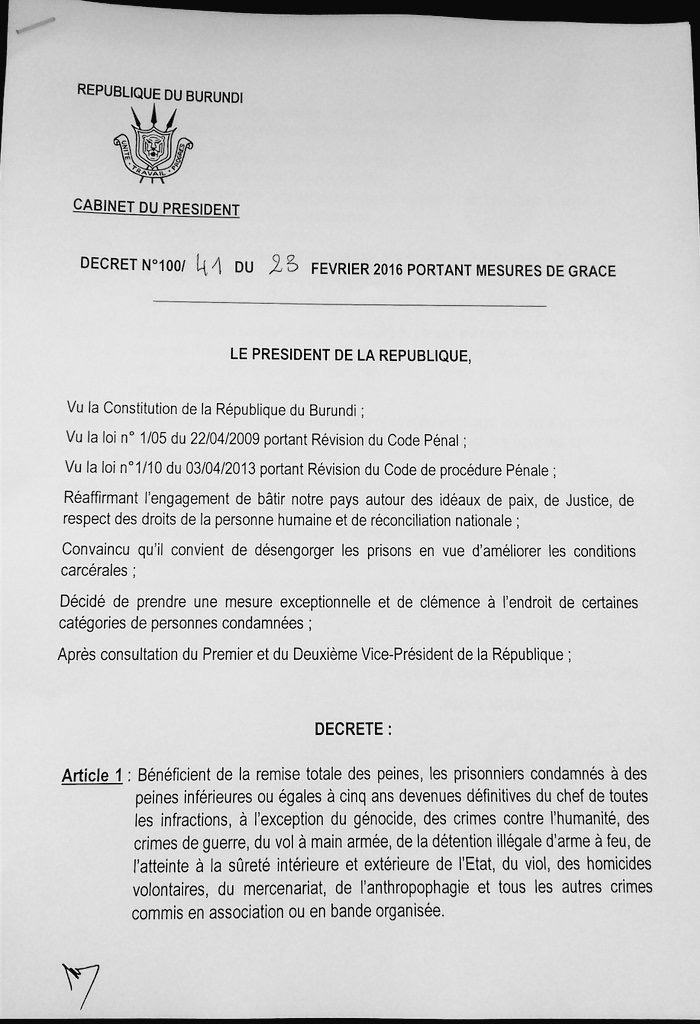
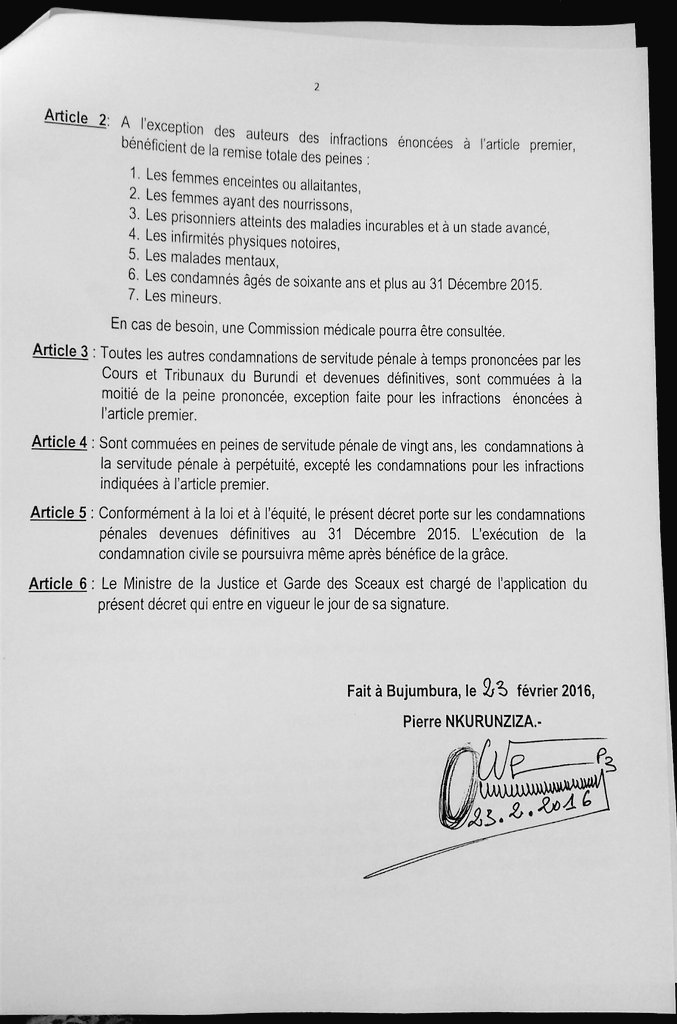
Inner City Press: I wanted to ask you about Burundi first. I saw the statement by the Secretary-General praising the reopening of some radio stations and the release of prisoners. And I wanted to ask you two questions about that. One is, is he aware, and what do you say that two… two of five radio stations have opened and they've been forced to sign pledges to not undermine the country's security? Is that… does he think that that type of pledge is legitimate? And on the prisoners, most people are saying that the… this document signed by President [Pierre] Nkurunziza doesn't involve the release of any political opponents, FNL [National Liberation Front] members or anything else. It's sort of a… it's one of those fake releases where these are people that have nothing to do with the unrest.
Spokesman: I think what the Secretary-General did yesterday was to welcome these as initial steps and said that it was not enough and he would want to see more. I don't have any particular reports on pledges that were signed. Obviously, as a matter of the principle, radio stations in Burundi should be able to broadcast freely and fairly any news that they want. And, as for the detainees, I don't have the details of who they were. Obviously, there are different reports. But as I said, we would want to see more people released.
Inner City Press: Well, the document that the President signed, it's been published and it's clear that it doesn't cover the people that are part of the opposition.
Spokesman: I think it's… as I said, we welcome this as an initial step, and we'd like to see more.
Inner City Press: And will there be follow-up? What follow-up is the UN going to give having…?
Spokesman: Mr. [Jamal] Benomar has an expanded team there. They are in constant contact with the Government.
Compare Dujarric's canned answers to this critique from ICP's sources on the ground:
Article 1 mentioned categories of those who are supposed to be realized. The common fact is that those mentioned in the article do not have any relation with the Ongoing political unrest. Actually, we were excepting the realise of FNL, MSD, and all political prisoners such as insurgents, and the above mentioned opponents to the regime. But none of them would fall under the categories evoked by the article.
On Ban Ki-moon's meeting with Nkurunziza: Is the dialogue going inclusive. We shall be able to see it if Nkurunziza says that is going to meet key opposition figures and the civil society leaders, including Nyangoma (CNARED), Sinduhije (Red Tabara), Nininahazwe Pacifique, etc. When? And where? Remember Nkurunziza said that he'll never seat on same table with co-plotters, protest and insurgent leaders as well. So, what is the guarantee that he changed is mind? We'll have more on this.
In Bujumbura on February 23, Ban said:
"I welcome the decision by His Excellency President Nkurunziza to withdrawal some media bans, cancel the arrest warrants and release detainees as good will gestures. President Nkurunziza told me this morning that he will release a list of twelve hundred detainees and take other measures. I have asked him, while I welcome these generous support and measures but I would expect that additional measures should be taken. This is an encouraging step. I hope again additional measures will be taken."
On February 19, Ban's guards and DPI threw Inner City Press out of the UN, physically, and have yet to restore its Resident Correspondents pass.
But even from the park in front of the UN on 43rd Street in Manhattan, Inner City Press interviewed Security Council ambassadors about Ban's trip, which despite his typical lack of transparency has in fact begun on February 22.
Inner City Press tweeted a photo, here, and reports from sources that already, five men have been killed in Bujumbura and Gisozi while Ban was in the country.
Echoing again Ban's "victory tour" of Sri Lanka in 2009 . That one, Inner City Press covered - and things have proceeded.
At the February 5 UN noon briefing, Inner City Press asked Ban's Deputy Spokesperson Farhan Haq about Burundi, video here, transcript here.
Handpicked to go and memorialize the trip was Reuters, which barely reported what happened. There is a history, of Reuters UN bureau hereand here; on February 3, Reuters correspondent Michelle Nichols went so far as to cut off Inner City Press' questions to the UN, Vine here.
On February 3 Reuters' UN bureau chief Lou Charbonneau, a censor, channeled a UN (DRC) report -- note not only the former Reuters official turned Eritrea sanctions “experts” exposed by Inner City Presshere, but also that this same now discredited Reuters / UN individual was previously ON the DR Congo panel. Typically, Reuters did not actually put the report online.
Inner City Press in the spirit of transparency is publishing the (update) report, dated January 15, 2016, signed by Coordinator Gaston Gramajo, and its two paragraphs about 18 Burundian combatants, here.
Readers can draw their own conclusions, including about the mandate and motivation, and if these 18 is really the way it would go.
On January 28, Inner City Press asked UN spokesman Stephane Dujarric about a meeting held but not televised on January 27, at which it was urged that mass grave sites in Burundi be preserved as evidence,video here, transcript here.
On January 29, Inner City Press asked Dujarric again, transcript here.
So it's all on Zeid, nothing from Ban Ki-moon, who appears to be playing this like he did Sri Lanka...
At the UN Security Council stakeout, Inner City Press waited -- including through two North Korea questions, and softballs -- then asked if this UN use of Burundian troops makes sense. There has yet to be an answer, although there are indications one might be forthcoming. (More than 24 hours later, no). Here for now is about the US training Burundian troops. Watch this site.
Inner City Press asked Ban's spokespeople about the trip on January 20, 21 and 22 - including asking why the UN was not providing a video or at least audio stream of the January 22 press encounters, says it has a "UN Information Center" in Bujumbura, which produced a smiling photo of the French deputy ambassador Alexis Lamek on the tarmac. The UN said it couldn't.
Local media in Burundi put online a video in which Lamek spoke at length; afterward a pro-government Burundian media quoted Lamek that "we" take seriously the question of interference by Rwanda to destabilize Burundi and will be working on it.
But the four scribes handpicked to accompany the Security Council trip, inlcuding Agence France Presse, it seems, for some reasons didn't cover it. Why? We'll have more on this. Instead, AFP, Reuters andVoice of America (which saw "Liberians" then cited auto-correct) filed near-identical stories with no quotes from opposition figures or attacked journalists. None of the three even tweeted on January 23, other than Reuters as a robot: talk about Old Media.
How could "Agence France Presse," handpicked to publicize the UNSC trip co-led by France, not even cover the controversy?
We note that the French Mission to the UN said that Lamek was being misrepresented (the same French Mission has tried to shield Lamek from critical Press questions, which here on Vine Lamek has refused to answer even when entirely audible). Later an AFP quote emerged of Lamek saying that any AU force, even the 100 human rights observers, should significantly focus on the Rwandan border.
On the evening of January 23 the UN has put up select clips including a mere 16 seconds of French deputy ambassador Lamek, much less than the local Burundian media present at the same press encountered had. If the UN filmed the press encounters, why did it so selectively edit them?
More specifically, now, who decided on the edits?
Inner City Press, which is the media which on January 22 asked for the live-stream, has asked the UN, publicly on Twitter, here, and in more detail by e-mail to three top UN spokespeople:
"having just seen that your Office put online edited video from Burundi, must ask: why did UN edit the footage it has, with no Burundi government speaker, and only 16 seconds of France, penholder in the UNSC on Burundi? Please provide the full footage, in response to this request and, separately, online. Would also still like answers to questions below" on Burundi.
And still no answers at all, the next day. Watch this site.
The UN spokespeople refused to say, but beyond the pro-government "religious leaders" that they cited, the Council also met with at least some of the concerned members of civil society, and some journalists who inevitably raised the issue of attacks and censorship. This was not mentioned by the UN.
We're told that Ambassador Albert Shingiro, who blocks the Press on Twitter, told the scribes that US Power said she would send “a strong message to the government of Rwanda." Again, Shingiro blocks the Press on Twitter: some diplomat.
One of the four handpicked pass-throughs opined that "the fact that Council members presented Nkurunziza with a largely unified message on the different issues was seen as a positive sign that they had come closer to a common position." So they traveled to Burundi to work on their own issues? We'll have more on this - and on the Council's junket-ending meetings in Addis, if not on Oromo protests, than this we've asked about. Watch this site.
On January 22, Inner City Press asked UN Deputy Spokesperson Farhan Haq for the UN's response to Pierre Nkurunziza denying the existence of his party's youth militia, and why there was no video or even audio stream of the Security Council's - and Nkurunziza's -- press statements. Video here.
Haq replied that "the facilities are difficult," that the UN Spokesperson's Office had reached out to the traveling party for information but hadn't gotten any. The Free UN Coalition for Accesscalls this a failure.
On January 21 Inner City Press in New York learned both of Pierre Nkurunziza plans to parade "community work" for the Security Council members on January 22 and has been provided with a letter promoting same, here.
On January 22, even after the Council's meeting with Nkurunziza was over, when Inner City Press asked the UN for a read-out there was none, nor any good explanation of why the UN with its country team could not arrange at least an audio stream of the Council's (and Nkurunziza's) press statements.
Tellingly, IWACU reports that bike taxi and motorcycle taxi drivers offered money to protest in favor of Nkurunziza weren't, after the fact, paid: here.
On January 19 at the UN, Inner City Press asked Uruguay's Vice Minister for Foreign Affairs Jose Luis Cancela, chairing the Security Council debate on Protection of Civilians, about Burundi and the Council's trip. Video here.
On January 21, Inner City Press and the Free UN Coalition for Accessasked UK Permanent Representative Matthew Rycroft about his stop-over on Addis Ababa, "will you as UK meet with AU before heading to Burundi? About AU's proposed deployment?"
Rycroft replied, "Yes! Looking forward to meeting @AU_Chergui today. Will also return to Addis with whole UNSC after Burundi."
In Addis, Chergui had filed the Concept of Operation for the MAPROBU peacekeeping mission. We'll have more on this.
Burundian civil society has written to Ban seeking the repatriation of the country's peacekeepers. Inner City Press has put the letter from Vital Nshimirimana to Ban online here, and will be asking the UN about it. Watch this site.
On December 30 Nkurunziza threatened to have his forces attack peacekeepers proposed for the country.

Obtained by Inner City Press
Ladsous' lack of vetting was criticized in the recently released report into the cover up of peacekeepers' rapes in the Central African Republic. Earlier, Inner City Press exclusive reported on Ladsous in his October 1, 2015 meeting with Burundi's vice president saying that he is "pragmatic" on human rights.
On December 16 Inner City Press was banned from questions to Secretary General Ban Ki-moon, but learned from the mission MINUSCA that Baratuza was already in Entebbe. Inner City Press asked several Security Council members, then Ban's spokesman Stephane Dujarric on December17.
Dujarric told Inner City Press Baratuza's deployment is suspended and he is being repatriated: "based on the information we've received regarding the Lieutenant Colonel, his deployment has been suspended, and he will be repatriated back to Burundi." Video here. Dujarric told Inner City Press this shows the UN system working - on a day when a report on rapes was issued showing UN Peacekeeping under Herve Ladsous not sufficiently vetting for human rights. We'll have more on this.
Amid the escalating killings in Burundi, summary executions in neighborhoods opposed to Pierre Nkurunziza's third term stand out. But Burundi Army spokesman Gaspard Baratuza was quoted on December 12 blaming all of the deaths on attempts to steal weapons to free prisoners.
Inner City Press heard that Mr. Baratuza was already in the process of being deployed to the UN Peacekeeping mission in the Central African Republic (MINUSCA) even when he was giving these quotes, issuing statements and speaking to state-owned radio, and so asked MINUSCA's acting spokesperson, “Is Gaspard Baratuza of Burundi's army getting a MINUSCA job?” Ultimately, after the questioning, he didn't.
But the UN should have to say more. Inner City Press has repeatedly asked the UN how its Department of Peacekeeping Operations under Herve Ladsous vets those who deploy to UN missions; Inner City Pressexclusively reported on an October 1, 2015 meeting in which Ladsous told Burundi's Vice President Joseph Butare that he is “pragmatic” on human rights.
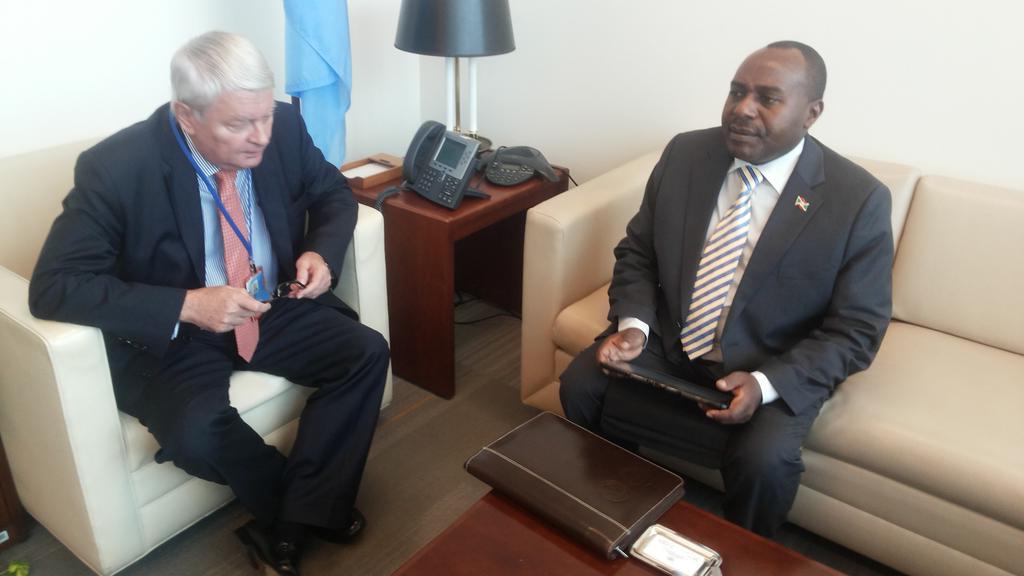
Ban Ki-moon and his spokesman declined to take Inner City Press' questions on December 16, as they did on December 14. Vine here. Watch this site.
Saturday, February 13, 2016
In Burundi, UN Tells Its Staff To Be Careful of Ruling Party's Rally, Quietly
By Matthew Russell Lee, Exclusive publication, credited here
UNITED NATIONS, February 13 -- After UN Secretary General Ban Ki-moon on New Year's Eve issued a statement surreally praising the Burundi “talks” held in Entebbe, Uganda, multiple sources told Inner City Press these not really talks but rather a photo op. The January 6 session announced for Arusha did not happen. Inner City Press requested to cover the UNSC's trip to Burundi, but was UNtransparentlyrejected.
Transparently, Inner City Press published the DR Congo Group of Experts Update Report including about 18 Burundian combatants, here(credited here) and see below.
For February 13, the UN in Burundi has issued a warning to its own staff to be careful ("prudent") about a demonstration organized by Pierre Nkurunziza's ruling party. Inner City Press is putting it online, here.

On February 10, AFP's English language reporter, not even at the UN Security Council stakeout for the February 10 meeting on Burundi, laterchanneled a "senior UN official" speaking "to reporters" that the UN is really pushing to go and investigate mass graves. Inner City Press put in a question -- on the record -- and, getting no good answer, asked the UN Spokesman on February 11, UN transcript here:
Inner City Press: on Burundi, I've seen that Mr. Šimonovic apparently yesterday said that the UN wants to be present when mass graves are examined. And I wanted to know a little bit more about that. Has that request been made? Has there been a response by the Government? And also why Mr. Šimonovic, ASG [Assistant Secretary-General], doesn't say it in a more public way?
Spokesman: I think Mr. Šimonovic has been here quite a few times at the briefings. We'll try to get him here some more. As you know, I think the High Commissioner for Human Rights had talked about satellite photos and traces of potential mass graves. A prosecutor was named in Burundi, tasked to investigate those reports. As part of our support, we have offered… the High Commissioner for Human Rights has offered technical support, including to the Government of Burundi to help with that investigation, including forensic experts. I've not heard that we have gotten a response back from the Government of Burundi.
Inner City Press: Just one last thing on this, because he seems to be quoted: "We would like to be present when this is done." And, obviously, there are many people or at least some people in Burundi that would be somewhat suspect of a Government investigation if the Government is the one…
Spokesman: I think that's in the vein of asking, offering to the Government to have UN experts there.
On February 8, Inner City Press asked UN Secretary General Ban Ki-moon's Spokesman Stephane Duajarric about more deaths in Burundi and a speech attributed to Pierre Nkurunziza in which he likened himself to Jesus,and those who visited trying to forestall more killing to “Satan,” making offers.
Dujarric said he would have no comment on the “very colorful statements made,” video here.
(On Burundi, ICP has been exclusively informed that a FIFA post for Nkurunziza was floated to try to avoid this ill-fated third term.
On February 8, Inner City Press also asked Dujarric for any Ban Ki-moon response to Sri Lanka's Gotabaya Rajapaksa calling the visit of UN High Commissioner for Human Rights Zeid “a big joke;” there was no comment, video here.)
At the February 5 UN noon briefing, Inner City Press asked Ban's Deputy Spokesperson Farhan Haq about Burundi, video here, transcript here.
Handpicked to go and memorialize the trip was Reuters, which barely reported what happened. There is a history, of Reuters UN bureau hereand here; on February 3, Reuters correspondent Michelle Nichols went so far as to cut off Inner City Press' questions to the UN, Vine here.
On February 3 Reuters' UN bureau chief Lou Charbonneau, a censor, channeled a UN (DRC) report -- note not only the former Reuters official turned Eritrea sanctions “experts” exposed by Inner City Presshere, but also that this same now discredited Reuters / UN individual was previously ON the DR Congo panel. Typically, Reuters did not actually put the report online.
Inner City Press in the spirit of transparency is publishing the (update) report, dated January 15, 2016, signed by Coordinator Gaston Gramajo, and its two paragraphs about 18 Burundian combatants, here.
Readers can draw their own conclusions, including about the mandate and motivation, and if these 18 is really the way it would go.
At the African Union Summit in Addis Ababa, Ban Ki-moon barely if at all pushed for peacekeepers for Burundi; his or France's head of UN Peacekeeping Herve Ladsous had largely undercut the idea with a memo than Inner City Press published in full.
(Inner City Press has reported the UN Peacebuilding Configuration will visit February 15-19, click here for that.)
Inner City Press on February 3 asked Ban's Deputy Spokesperson Farhan Haq, transcript here.
On February 2, Inner City Press similarly asked the UN's Haq, transcript here.
Meanwhile, on January 29, the UN Spokesman threw Inner City Press out of the UN Press Briefing Room then on February 1 made this threat, here. This was echoed on February 2.
On January 28, Inner City Press asked UN spokesman Stephane Dujarric about a meeting held but not televised on January 27, at which it was urged that mass grave sites in Burundi be preserved as evidence,video here, transcript here.
On January 29, Inner City Press asked Dujarric again, transcript here.
So it's all on Zeid, nothing from Ban Ki-moon, who appears to be playing this like he did Sri Lanka...
At the UN Security Council stakeout, Inner City Press waited -- including through two North Korea questions, and softballs -- then asked if this UN use of Burundian troops makes sense. There has yet to be an answer, although there are indications one might be forthcoming. (More than 24 hours later, no). Here for now is about the US training Burundian troops. Watch this site.
Inner City Press asked Ban's spokespeople about the trip on January 20, 21 and 22 - including asking why the UN was not providing a video or at least audio stream of the January 22 press encounters, says it has a "UN Information Center" in Bujumbura, which produced a smiling photo of the French deputy ambassador Alexis Lamek on the tarmac. The UN said it couldn't.
Local media in Burundi put online a video in which Lamek spoke at length; afterward a pro-government Burundian media quoted Lamek that "we" take seriously the question of interference by Rwanda to destabilize Burundi and will be working on it.
But the four scribes handpicked to accompany the Security Council trip, inlcuding Agence France Presse, it seems, for some reasons didn't cover it. Why? We'll have more on this. Instead, AFP, Reuters andVoice of America (which saw "Liberians" then cited auto-correct) filed near-identical stories with no quotes from opposition figures or attacked journalists. None of the three even tweeted on January 23, other than Reuters as a robot: talk about Old Media.
How could "Agence France Presse," handpicked to publicize the UNSC trip co-led by France, not even cover the controversy?
We note that the French Mission to the UN said that Lamek was being misrepresented (the same French Mission has tried to shield Lamek from critical Press questions, which here on Vine Lamek has refused to answer even when entirely audible). Later an AFP quote emerged of Lamek saying that any AU force, even the 100 human rights observers, should significantly focus on the Rwandan border.
On the evening of January 23 the UN has put up select clips including a mere 16 seconds of French deputy ambassador Lamek, much less than the local Burundian media present at the same press encountered had. If the UN filmed the press encounters, why did it so selectively edit them?
More specifically, now, who decided on the edits?
Inner City Press, which is the media which on January 22 asked for the live-stream, has asked the UN, publicly on Twitter, here, and in more detail by e-mail to three top UN spokespeople:
"having just seen that your Office put online edited video from Burundi, must ask: why did UN edit the footage it has, with no Burundi government speaker, and only 16 seconds of France, penholder in the UNSC on Burundi? Please provide the full footage, in response to this request and, separately, online. Would also still like answers to questions below" on Burundi.
And still no answers at all, the next day. Watch this site.
The UN spokespeople refused to say, but beyond the pro-government "religious leaders" that they cited, the Council also met with at least some of the concerned members of civil society, and some journalists who inevitably raised the issue of attacks and censorship. This was not mentioned by the UN.
We're told that Ambassador Albert Shingiro, who blocks the Press on Twitter, told the scribes that US Power said she would send “a strong message to the government of Rwanda." Again, Shingiro blocks the Press on Twitter: some diplomat.
One of the four handpicked pass-throughs opined that "the fact that Council members presented Nkurunziza with a largely unified message on the different issues was seen as a positive sign that they had come closer to a common position." So they traveled to Burundi to work on their own issues? We'll have more on this - and on the Council's junket-ending meetings in Addis, if not on Oromo protests, than this we've asked about. Watch this site.
On January 22, Inner City Press asked UN Deputy Spokesperson Farhan Haq for the UN's response to Pierre Nkurunziza denying the existence of his party's youth militia, and why there was no video or even audio stream of the Security Council's - and Nkurunziza's -- press statements. Video here.
Haq replied that "the facilities are difficult," that the UN Spokesperson's Office had reached out to the traveling party for information but hadn't gotten any. The Free UN Coalition for Accesscalls this a failure.
On January 21 Inner City Press in New York learned both of Pierre Nkurunziza plans to parade "community work" for the Security Council members on January 22 and has been provided with a letter promoting same, here.
On January 22, even after the Council's meeting with Nkurunziza was over, when Inner City Press asked the UN for a read-out there was none, nor any good explanation of why the UN with its country team could not arrange at least an audio stream of the Council's (and Nkurunziza's) press statements.
Tellingly, IWACU reports that bike taxi and motorcycle taxi drivers offered money to protest in favor of Nkurunziza weren't, after the fact, paid: here.
At the January 21 UN noon briefing, Inner City Press asked UN deputy spokesperson Farhan Haq about the "community works" and meeting(s). Video here, UN transcript here:
Inner City Press: I wanted to ask you this just because I'm trying to cover it, and I know that you'd said yesterday that the Special Adviser, Jamal Benomar, is in Burundi in part of the trip. So what I wanted to ask you is, I've seen documents that show that the… the… the… tomorrow, the meeting with the President, [Pierre] Nkurunziza, will involve a demonstration of “community work”, i.e., people have been asked to go and I don't know if it's to show how happy they are — Gitega and Karuzi. Does the Special Adviser… not the Security Council, does the Special Adviser of the Secretary-General believe that this type of… of… of show is the right one and will they be meeting with UPRONA and other opposition groups or prisoners currently in jail?
Deputy Spokesman Haq: Well, we'll be able to provide details of the meetings once they've taken place. As you know, the expectation is for the members of the Council to meet with President Nkurunziza. That hasn't happened so far, but once that's happened, we'll see what the circumstances are and what the views of Mr. Benomar are.

This is reminiscent of the type of dog-and-pony show Sri Lanka's then President Mahinda Rajapaksa put on for visiting UN Secretary General Ban Ki-moon and that Inner City Press accompanied and covered(apparently not to the UN's and its allies' liking - it has been Banned from trips since.) But will the UNSC, unlike Ban, have the fortitude or leverage to reject a dog and pony show? Watch this site.
On January 19 at the UN, Inner City Press asked Uruguay's Vice Minister for Foreign Affairs Jose Luis Cancela, chairing the Security Council debate on Protection of Civilians, about Burundi and the Council's trip. Video here.
On January 21, Inner City Press and the Free UN Coalition for Accessasked UK Permanent Representative Matthew Rycroft about his stop-over on Addis Ababa, "will you as UK meet with AU before heading to Burundi? About AU's proposed deployment?"
Rycroft replied, "Yes! Looking forward to meeting @AU_Chergui today. Will also return to Addis with whole UNSC after Burundi."
In Addis, Chergui had filed the Concept of Operation for the MAPROBU peacekeeping mission. We'll have more on this.
Burundian civil society has written to Ban seeking the repatriation of the country's peacekeepers. Inner City Press has put the letter from Vital Nshimirimana to Ban online here, and will be asking the UN about it. Watch this site.
On December 30 Nkurunziza threatened to have his forces attack peacekeepers proposed for the country.
Obtained by Inner City Press
Ladsous' lack of vetting was criticized in the recently released report into the cover up of peacekeepers' rapes in the Central African Republic. Earlier, Inner City Press exclusive reported on Ladsous in his October 1, 2015 meeting with Burundi's vice president saying that he is "pragmatic" on human rights.
On December 16 Inner City Press was banned from questions to Secretary General Ban Ki-moon, but learned from the mission MINUSCA that Baratuza was already in Entebbe. Inner City Press asked several Security Council members, then Ban's spokesman Stephane Dujarric on December17.
Dujarric told Inner City Press Baratuza's deployment is suspended and he is being repatriated: "based on the information we've received regarding the Lieutenant Colonel, his deployment has been suspended, and he will be repatriated back to Burundi." Video here. Dujarric told Inner City Press this shows the UN system working - on a day when a report on rapes was issued showing UN Peacekeeping under Herve Ladsous not sufficiently vetting for human rights. We'll have more on this.
Amid the escalating killings in Burundi, last weekend's summary executions in neighborhoods opposed to Pierre Nkurunziza's third term stand out. But Burundi Army spokesman Gaspard Baratuza was quoted on December 12 blaming all of the deaths on attempts to steal weapons to free prisoners.
Inner City Press had heard that Mr. Baratuza was already in the process of being deployed to the UN Peacekeeping mission in the Central African Republic (MINUSCA) even when he was giving these quotes, issuing statements and speaking to state-owned radio, and so asked MINUSCA's acting spokesperson, “Is Gaspard Baratuza of Burundi's army getting a MINUSCA job?”
On December 16, hours before UN Secretary General Ban Ki-moon held a rare press conference, MINUSCA's acting spokesperson sent this to Inner City Press:
"To: Matthew.Lee [at] InnerCityPress.com
From: Vladimir MONTEIRO [at] UN.org
Date: Wed, Dec 16, 2015
Subject: ICP question: Gaspard Baratuza of Burundi's army getting a MINUSCA-related post?
Cc: FUNCA [at] funca.info
"No decision related to Lt Col Baratuza's deployment can be taken before we finish looking into the matter. We can confirm that Lt Col Baratuza is in Entebbe but he has not yet deployed to MINUSCA. Regards. VNM"
There are some questions about Baratuza, a Colonel in Burundi's Army, being listed by the UN as “Lt. Col.”
Despite multiple follow-up questions by Inner City Press, Mr. Monteiro - previously a spokesperson for the UN electoral mission in Burundi - replied that “This is what we can say about this issue.”
But the UN should have to say more. Inner City Press has repeatedly asked the UN how its Department of Peacekeeping Operations under Herve Ladsous vets those who deploy to UN missions; Inner City Pressexclusively reported on an October 1, 2015 meeting in which Ladsous told Burundi's Vice President Joseph Butare that he is “pragmatic” on human rights.
Ban Ki-moon and his spokesman declined to take Inner City Press' questions on December 16, as they did on December 14. Vine here. Watch this site.
Monday, December 7, 2015
On Burundi, Inner CIty Press Asks UN's Ivan Simonovic How Mere Support Team Is "Rights Up Front"
By Matthew Russell Lee
UNITED NATIONS, December 5 -- As killings in Burundi increased, on November 12, the Security Council adopted a belated resolution on Burundi. (Inner City Press put the full text online here, and here in French.) The resolution called for the UN Secretariat to report back to the UNSC, on November 30.
On November 30, Secretary General Ban Ki-moon made proposals to the UN -- two versions, here -- both centered on a mere support team to the Special Adviser. On December 7, when UN Human Rights official Ivan Simonovic spoke of a presentation on Human Rights Day on December 10 about Ban's “Rights Up Front” program, Inner City Press asked him if it had involved at least checking with the Office of the High Commissioner for Human Rights before issuing this weak Burundi plan. Video here.
Simonovic said he had been consulted, then added that he viewed the support team as only the first step, if needed. If needed? (If Burundi's mission to the UN has an answer, Inner City Press does not know: its Ambassador Albert Shingiro has blocked Inner City Press from his Twitter feed: Digital Diplomacy in action.)
Inner City Press also asked about a Human Rights Day event in Cambodia being canceled due to a crackdown on NGOs (in Burundi, more than ten CSOs have been suspended), and about Saudi Arabia moving to stone to death a Sri Lankan maid. After asking, still during the briefing, Inner City Press emailed information on all of these issues to Simonovic. We'll have more on this.
On November 30, then UNSC President Matthew Rycroft said he would speak to the media at 5:30. Inner City Press tweeted this; Burundi's ambassador to the UN Albert Shingiro retweeted Inner City Press. After that, Inner City Press covered inconsistencies in the UN's and some Burundi officials' communications.
On December 5, when directed to one of Burundi's Ambassador's tweets, Inner City Press discovered that Ambassador Shingiro, a diplomat, hadblocked Inner City Press from reading his tweets.
Why?
Inner City Press was sent one of Shingiro's tweets, in which he claimed that oppositition to Pierre Nkurunziza's third terms was like a staged “Arab Spring” rebellion. He said, blocked, that the insecurity in some section of Bujumbura is one of the consequences of the arabic spring [sic] operation targeting regime change in Burundi."
Burundi's officials have started mixing metaphors, and apparently they don't want the press that covers the UN to see what they are saying. We'll have more on this.
Some time after the November 30 closed-door meeting ended, outgoing UN Security Council president Matthew Rycroft of the UK gave a short summary of the meeting and then took questions. Reuters intoned that Secretary General Ban Ki-moon had proposed three options and was recommending the third, a support team for the Special Adviser. Since this “three options” is different than the two-option letter that is Ban's formal proposal, where did it come from?
Particularly because the proposal(s) are so weak, the question is important.
On a piece of furniture in the UN Spokesperson's office which is called the Grey Lady there was a signed letter from Ban Ki-moon to the Council, setting out three options. As Inner City Press and the Free UN Coalition for Access have previously detailed, the UN Spokesperson's office uses this Grey Lady to give information without attribution; often Reuters has been informed of such a “dump” just before the Spokesperson's Office closes, and then claims an exclusive or says, “seen by Reuters.”
But here, what the UN put out in the Grey Lady, though signed by Ban, was not the real or right letter. Inner City Press asked on December 4 for an explanation. Video here. Ban's Deputy Spokesperson said that the letter, signed by Ban, was a draft. Then why was it signed? Why had his office put it out in the Grey Lady?
Inner City Press asked if the signed letter was changed AFTER the stakeout by then-Council President Matthew Rycroft of the UK. Haq did not answer this. We'll have more on this, and on Burundi.
Back on November 30, Inner City Press asked Rycroft about the suspension of ten civil society organizations, and the blockades of neighborhoods (today, Jabe and Kinama). Rycroft said the CSO closures had been much discussed in the closed consultations. For a possible Council trip to Burundi, he said there is a significant minority which says December may be too soon. (Inner City Press understands this is Angola's view.)
Rycroft said there is, essentially, no dialogue. What was hoped for from Uganda's Museveni, how ever unrealistically given his President Forever slogan, hasn't materialized.
Inner City Press also asked Rycroft why the talks on Yemen, projected for mid November by the UN envoy, haven't taken place. He said the talks may take place in the first week(s) of December. We'll see.
At the November 30 UN noon briefing, Inner City Press asked UN Spokesman Stephane Dujarric about the blockading of the Jabe neighborhood, and Presidential Adviser Willy Nyamitwe linking the opposition to "Islamists," see below. Now indicative of the atmosphere, the US has put this warning online:
"Security Message for U.S. Citizens: Bujumbura (Burundi), Heightened Security Situation
11/30/2015
U.S. Embassy Bujumbura has become aware that Burundian National Police searched at least two residences of U.S. citizens associated with NGOs on Saturday, November 28, 2015. Because of this, Embassy Bujumbura reissues the following information on cooperating with police in a residential search.
The Embassy recommends U.S. citizens cooperate with Burundian police if asked to enter their residence for the purpose of a search. If subject to a police search, U.S. citizens should notify the Embassy at +257-22-20-7000 or after-hours at +257-79-938-841. A legal document regulating police searches of private residences mentions the following requirements:
· Only officers of the Public Prosecutor's Office or agents of the Judicial Police are entitled to proceed with searches. An officer must identify himself with a card before entering the house.
· Before entering the house the police have to present a search warrant, signed by the appropriate authority."
Both Burundi governmental spokespeople and the UN's Department of Political Affairs put out photographs of Pierre Nkurunziza and Ban's Special Adviser Jamal Benomar smiling (some questioned, about what?)
Meanwhile, at the same time Pope Francis tried to salve real splits in the Central African Republic between the Christian anti-Balaka and the Muslim ex-Seleka, Nkurunziza's spokesperson Willy Nyamitwe equated opponents to the third term with Islamist extremists. Even some Nkurunziza supporters said this was going too far; Nkurunziza has said nothing.
Inner City Press noted it and Nyamitwe said it was wrong.
Inner City Press' question about who was referred to by the phrase, directed by an Islamist, has not been answered.
So while on the one hand Nkurunziza's government tried to project an image of cooperating with the UN system -- and today's constellation of the UN is amenable to this image, for a variety of reasons -- that same Burundian government is closing down civil society organizations and trying to equate opponents with jihadists. What will be said to the UN Security Council, and what will the Council do? There is talk of a visit to Burundi during the US' December presidency. Watch this site.
On November 12, Inner City Press asked UK Ambassador Rycroft, the President of the Council for November what steps would actually be needed to send any peacekeepers from MONUSCO in DR Congo (he said there are discussions).
Inner City Press managed to ask French Permanent Representative Francois Delattre why UN Peacekeeping keeping using and paying for Burundian troops and police in the Central African Republic (a Press question both the UK and US Ambassador Samantha Power have seen fit to respond to.) Delattre declined to answer - but more politely than his deputy had, here.
In Burundi, the Pierre Nkurunziza government has taken to suspending and freezing the bank accounts of civil society groups, not only political but even medical ones. Earlier, Inner City Press published this:
"Declaration of Civil Society Organizations on freezing civil society organizations’ assets and suspension of activities of associations ACAT BURUNDI, AMINA, APRODH, FOCODE, FONTAINE ISOKO, FORSC, MAISON SHALOM, PARCEM, RCP and SPPDF
Civil Society Organizations condemn the serious violation of the right of association, sabotage of Burundi Civil society and the abject threats directed against human rights defenders.
Since April 26, 2015, peaceful demonstrations were held to protest against the third term of Pierre Nkurunziza, which project was regarded as the very seriously violation of the constitution and the Arusha agreement for peace and reconciliation. Ever since, fierce repression against protesters was organized and carried out in the opposing neighbourhoods and areas...
Civil society organizations:
- Urge immediate and unconditional cancellation of measures take to freeze accounts and suspend activities of associations ACAT Burundi, AMINA, APRODH, FOCODE, FONTAINE ISOKO, FORSC, MAISON SHALOM, PARCEM, RCP and SPPDF;
- Will file cases against Mr Valentin Bagorikunda and Mr Pascal Barandagiye for abuse of authority should they refuse to cancel arbitrary and unlawful measures that they took against civil society organizations;
- Commit to engage the various human rights mechanisms for serious violation of the right of association, as well as for direct and despicable attack against human rights defenders by the state of Burundi;
4. Commit to participate in the peaceful resolution of the Burundian crisis by dialogue and loudly declare that they will never agree to negotiate their rights and freedoms, the lifting of the proceedings against them or the closure of their offices
5. Denounce again the resort to violence by any party whatsoever;
6. Undertake to continue their struggle for the dignity, rights and freedoms for all
Done at Bujumbura, November 25, 2015
On behalf of the Campaign Halte au troisième mandat
Me Vital Nshimirimana
Délégué Général du FORSC."
On November 24, before new reports on prison sentences, Inner City Press asked the UN about this again, video here, transcript here:
Inner City Press: the question that I asked you yesterday on Burundi, one had to do with this free… it turns out it’s now more than freezing bank accounts; it’s actual suspension of these NGO’s (non-governmental organizations) and also the… the… the… the imposition by the U.S. on these sanctions on four individuals, one of whom I’d asked you about before about possible involvement UN peacekeeping. Is there any, like, involvement of Mr. Benomar… [Cross talk]
Spokesman: Mr. Benomar is currently in Bujumbura meeting with various parties. We hope to have some details of his meetings. He’s also been in Addis meeting with the AU (African Union) and in Uganda, preparing to report back to the Security Council on the options they asked for, looking at various aspects of the conflict, including contingency planning. Obviously, anything that limits the legitimate rights of civil society in any country is of concern to the United Nations.
On November 23 the Press asked the US State Department about Burundi's move, but its deputy spokesperson had no comment at the time or in response to that and another written question.
On November 24, State Department Deputy Spokesperson Mark Toner returned with this: "We can confirm that the government of Burundi has suspended the activities and frozen the accounts of multiple local civil society organizations in what is a clear step backward in pursuit of peace and dialogue in Burundi. We want to see an open, unfettered and comprehensive political dialogue take place there in which all voices are heard. That remains the only credible route to stability and and effort to achieve consensus and forge a peaceful path forward for Burundi's people.
"As the crisis deepens, and media outlets of course continue to be shuttered and repression of civil society is the exact opposition of what needs to happen."
Also on November 24, Inner City Press asked the UN again about the CSOs' suspensions; the UN spokesman's reply was about Ban Ki-moon's special adviser traveling to the African Union and elsewhere before returning to advise the Security Council.
On November 23, Inner City Press asked UN Spokesman Stephane Dujarric,video here, transcript here:
Inner City Press: in Burundi, the Government has suspended and frozen the bank accounts of a number of civil society organizations, including the one run by Pierre Claver Mbonimpa, who you’ve spoken about from this podium before. What’s the UN’s response to basically shutting down civil society and…?
Spokesman: I think it’s clear that every society needs a healthy civil society, needs room for civil society. The Secretary-General has spoken out on that repeatedly. As for Burundi, Mr. [Jamal] Benomar is arriving in Burundi today, or as we speak. He will have meetings there, which we hope to be able to report back [to] you. And this is part of the mandate given to the Secretariat by the Security Council to report back, which we will in due course.
Inner City Press: And I don’t know if you’ll comment on this, but this morning, the Obama administration announced targeted sanctions on those contributing to the ongoing crisis in Burundi, unquote. Do you think that’s a useful move?
Spokesman: I haven’t seen that report.
When the UN Peacebuilding Commission Burundi Configuration met on November 18 it was it was to hear from Swiss Permanent Representative Lauber about his trip to the region, including three days in Bujumbura. He described a climate of fear -- while adding that Burundians are resilient -- and of a 10 pm curfew. He quoted the World Bank that the government has cut health spending; he said he aim to return to the country in January or February. What will the situation be them?
Burundi's Permanent Representative Shingiro responded that the problems are caused by opposition outside of the country and “the media” within. He stated that Lauber had a meeting of confident with Pierre Nkurunziza, November 11 at noon for 45 minutes. He said the specter of genocide is a “tactic of the radical opposition abroad.”
US Deputy Permanent Representative David Pressman called out authorities' hate speech in the country, as did UK Deputy Permanent Representative Peter Wilson. When it came the turn of France, the penholder on Burundi in the Security Council, to speak, neither Permanent Representative Francois Delattre nor his Deputy Alexis Lamek was there. There are two explanations, not mutual exclusive.
At the day's noon briefing, Inner City Press asked the UN about those trying to flee not being allowed to leave the country and, on behalf of the Free UN Coalition for Access, about Shingiro's comment about the media. During the briefing, a statement came in from civil society on Burundi, signed by Vital Nshimirimana, naming hate speech and even the training of the ruling party's militia the Imbonerakure at Kiliba -Ondes in Eastern DRC, on which Herve Ladsous' UN Peacekeeping never acted. Plus ca change.
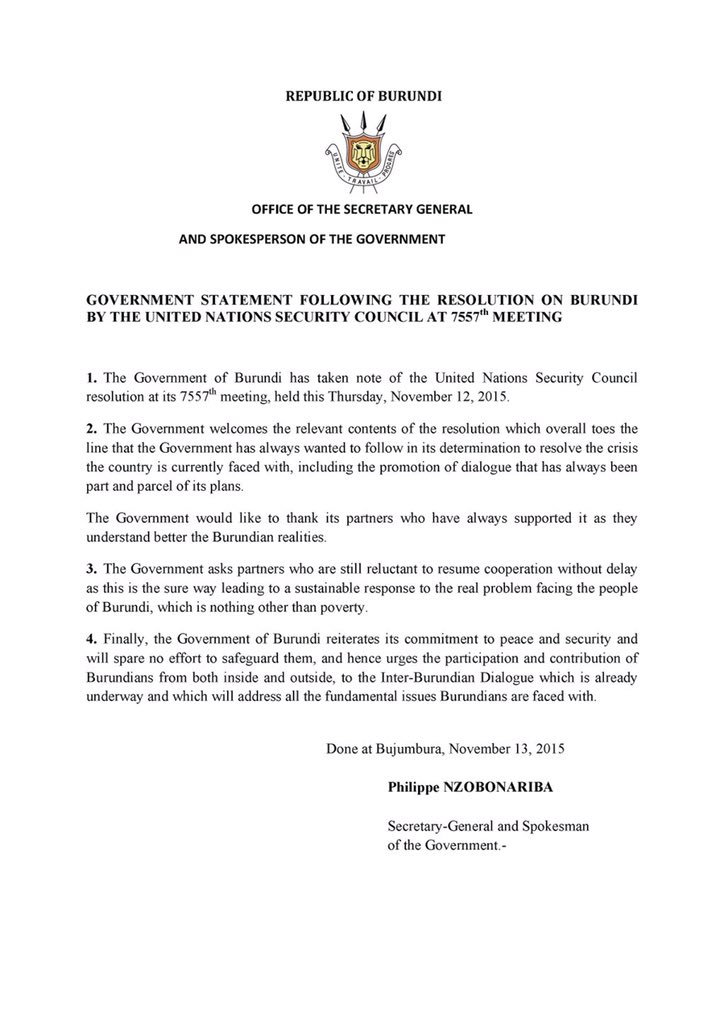
On November 13, the spokesperson for the Pierre Nkurunziza's government issued a response to the resolution, saying that it "toes the line" of the Government and that the problems in the country are "nothing other than poverty," here.
On the evening of November 11, the UN Spokesperson's office announced that there would be a formal Security Council meeting on Burundi at 12:15 pm on November 12, that would be to approve the draft resolution. An unnamed official of Herve Ladsous UN Peacekeeping -- wonder who that could be -- got Reuters to retype without analysis the idea the UN would send peacekeepers from "Congo" - that would be DRC -- into Burundi.
UNasked by Reuters, actively covered up, is that Ladsous' MONUSCO has been unable or unwilling to protect civilians in parts of the Eastern DRC, and has refused to neutralize the Hutu FDLR militia. So it would take on Pierre Nkurunziza's forces and youth wing in Burundi?
This youth wing was allowed by MONUSCO to train in Eastern Congo; nothing was said by MONUSCO when DRC detained a Burundian journalist. None of this in the Reuters, or AFP, or even more derivative Voice of America story. But to retain this "access," these media do not report when the UN's Herve Ladsous, on camera, links peacekeeper rapes to "R&R." Video here. This is a scam. Watch this site.
While the November 9 meeting was still ongoing, the UN announced that French Permanent Representative Francois Delattre would address the press in ten minutes. But when it happened it was the French Mission's deputy Alexis Lamek, moderated by the Mission's spokesman Thierry Caboche.
After bragging about a draft resolution French belatedly circulated, Lamek and his spokesperson twice refused to take a Press question about UN Peacekeeping still using the same Bururdian forces accused of the abuses. NewVine here. New video, with UK contrast, here.
The French mission spokesperson, after calling on Reuters, called on Agence France Presse. Inner City Press said, please answer why Herve Ladsous - the fourth French head of UN Peacekeeping in a row - uses Burundian troops in Central African Republic, giving them extensions to bring the right equipment (the government, sources say, takes the money.)
"Ask him," Lamek said off camera, referring to Ladsous who repeatedlyrefuses Press questions on this (and on covering up French Sangaris forces rapes in CAR.)
Moments later when Inner City Press asked UK Deputy Ambassador Peter Wilson if the UN should keep using Burundian troops or vet them, Wilson called this a "big issues" that "needs to be looked at." Audio including Elements to the Press, here. Fast transcript by InnerCityPro.com, here:
Inner City Press asked, the UN uses Burundian peacekeepers in CAR. Is there, or could there be, some review of that?
UK Deputy Peter Wilson: "on peacekeepers, I think this is a big issue, and I think it’s something certainly that needs to be looked at in a wider context of what response we take to the events in Burundi right now. I wouldn’t urge precipitate action on that, but I think it’s one of the issues that we need collectively to consider."
Strange then, that the penholding on Burundi and controller of UN Peacekeeping wouldn't even take the questions. The history of the Great Lakes runs deep. More recently, Inner City Press is informed is belated discussion among Security Council Permanent Five members that Ladsous is a liability, should or can he even be allowed to stay on to the end of Ban Ki-moon's term.
On November 10, Inner City Press asked UN spokesman Stephane Dujarric,video here, transcript here:
Inner City Press: I'll do Burundi first as a follow-up to that. Yesterday at the stakeout, Peter Wilson of the UK said that the issue of continued or… or service of Burundian peacekeepers, particularly those involved in the violence in UN peacekeeping, is a big issue, is something that needs to be looked at in the wider context of the response to the events in Burundi right now. Since… I think I've previously asked you about… my understanding is the Under-Secretary-General of Peacekeeping waived Burundi not having the right equipment twice in a row in CAR. I wanted you to describe, if you could, what is the process, one, for vetting individuals that come out of the… what you described as a… big violence in Burundi, but also of giving these waivers. Is this something that's done unilaterally by the Secretariat?
Spokesman: I'm not… I can't speak to the waivers because I can't… I don't know if what you say is, in fact, a fact.
Inner City Press: Can… can… is the meeting in September…? [Inner City Press actually referred to Ladsous' September meeting with Burundi, on which it reported.]
Spokesman: As far as… as far as Burundian troops, they continue to serve in the Central African Republic and other missions, if I'm not mistaken. They are rotated through the standard human rights vetting process, which involves the UN, which involves the government, which involves the High Commissioner for Human Rights, and which involves the more… the broader human rights community.
Inner City Press: What about the issue of… there have been several complaints by the peacekeepers themselves of not getting paid leaving some in Burundi to say, in fact, this is a way in which the UN is subsidizing the Government and the very activities that Mr. Zeid was condemning yesterday? What steps are taken to ensure that the money reaches the peacekeepers?
Spokesman: Obviously, it is critical whether it's in the case of Burundi if it, in fact, happens or other countries that individual peacekeepers receive the monies that are owed to them.
Inner City Press: But Mr. [Hervé] Ladsous right here in September said that he's… that he's not sure whether this money reaches soldiers. So what steps does the UN take, particularly in a case like Burundi, where you're accusing the Government of cracking down on the people, what steps are taken?
Spokesman: As I said, I think it's incumbent on the governments to ensure that their soldiers get paid. Did you have another question?
At the November 9 meeting, Burundi's Nyamitwe droned on by video by Bujumbura, even as Security Council President Matthew Rycroft asked him to bring it to an end. He continued speaking as the other speakers on video -- Prince Zeid, Adama Dieng, Swiss Ambassador Lauber -- squirmed, seeming like the audience to wonder if Rycroft would just cut his mic (he didn't.)
Inner City Press immediately put online that speech, and that of Uganda's Ambassador Nduhuura and the African Union's Tete Antonio, here.
On November 7 came reports of killings, including it was said a UN system staff member. This has been confirmed by UNDP - but only the local Buurndi office. Still from the UN, nothing. The Security Council issued a Press Statement on November 7... about Libya.
Burundian journalist Blaise Célestin Ndihokubwayo has been arrested and sent to the Service national de renseignement (SNR). Where is UNESCO and its director, who wants to be the next UN Secretary General?
On October 23 Inner City Press asked UN Ambassador Matthew Rycroft about the status of the draft Presidential Statement in the UN Security Council. He said there are differing views, but the UK is concerned about the "threat of genocide." Video here. On November 3, Inner City Press again put a Burundi questions to Rycroft, now President of the Security Council for November. Video here, story here.
The son of human rights defender Pierre Claver Mbonimpa has reportedly been murdered, after Pierre Nkurunziza tweeted that "No one living abroad should consider himself superior to those who stayed in Burundi, since most of them have left their families here."
On November 6, a belated Security Council meeting on Burundi was announced -- from Paris, by French foreign ministry spokesperson Romain Nadal. Why the delay? Why announced in that way?
Later on November 6, UN Secretary General Ban Ki-moon (whose spokesman could not tell Inner City Press if Ban will have any representative in the Security Council's meeting on Monday) put out this statement.
Inner City Press at the November 6 UN noon briefing asked how these concerns were consistent with Ban deferring to the Ugandan Defense Minister (for the EAC, Ban's spokesman pointed out), and asked if Ban will even have a representative briefing the UN Security Council on Monday. UNclear. Video here.
The US' Tom Perriello, filmed at the State Department, noted the weekend deadline. But why then was the UN Security Council meeting left until after the deadline?
US Ambassador Samantha Power put out this statement, here.
Behind the continued killing, here's an issue: Inner City Press is informed that a number of Burundian civil society leaders and journalists have improperly been flagged to Interpol as if their passports had been stolen. This has made it impossible, for example, for Vital Nshimirimana to travel to a speak about the crisis in Burundi at a conference in (Ban Ki-moon's native) South Korea.
Inner City Press on November 4 asked the UN Office of the High Commissioner for Human Rights' Ivan Simonovic and UN spokesman Stephane Dujarric about this. Interpol often brags at the UN how it is useful on the issue of foreign fighters. It's Secretary General Jurgen Stock spoke before the UN Security Council on May 29, 2015. But what about when Interpol is misused by a government like Pierre Nkurunziza? What do it, the Security Council and its members do that? Watch this site.
On November 2 Inner City Press asked UN Spokesman Stephane Dujarric about two speeches given in Burundi (the full text of one is below). Video here, UN transcript here:
Inner City Press: In Burundi, there was a speech by the President of the Senate [Révérien Ndikuriyo] saying that opposition neighborhoods may be razed [or raided. Some] people are calling it a genocide speech. There's also a speech by the President, saying anyone who doesn't disarm within the next five days will be treated as an enemy of the State. So, I'm wondering, not to overdo it, but things seem pretty serious. I wanted to know: what is the UN doing?
Spokesman: "It's clear that those in position of power, whether in Government or in the opposition, have a responsibility not to incite fear or hate of any kind. I think that's very important and that whatever security measures the Government takes fully comply with international law and respect for the right of people to freely assemble and protest."
After Burundi was elected to the UN Human Rights Council with 162 votes on October 28, on October 31 security forces in Burundi opened fire on a funeral procession in Buringa, killing many. These are the Burundian forces that UN Peacekeeping under Herve Ladsous keeps in service, offering waivers while the Government keeps the payments?
It is reported the Burundian authorities are accusing a medical NGO of offering treatment to insurgents, and are ready to attack. Frankly, the weak UN Security Council Presidential Statement which France belatedly proffered in the Council, then didn't even hold a question and answer stakeout about, is woefully insufficient, as is the UN Secretariat's response.
Now from Burundi this speech
https://soundcloud.com/journ-burundi/reverien-ndikuriyo-le-pdt-du-senat-illegitime-promet-de-raser-des-quartiers-de-la-capitale
On October 28, Inner City Press asked UN spokesman Stephane Dujarric about another threat. From the UN transcript:
Inner City Press: this is a tweet from the official account of Pierre Nkurunziza, President of Burundi: "No one living abroad should consider himself superior to those who stayed in Burundi since most of them have left their families here." So people see this as an open-source threat to retaliate against the families of those who have fled the country. And I'm wondering…
Spokesman: I haven't seen the tweet. I shall look at it.
Inner City Press showed it to him on his way out. Earlier on October 28, Burundi got 162 votes for the UN Human Rights Council, less than the other also unopposed candidates, but still enough to get on the Council. The UN Security Council had just issued a Presidential Statement, here, which gave weight to the Museveni "mediation," and which the US later "welcomed."Usually it's the penholder (France) which speaks. But not here, not on Burundi (see Ladsous, below).
On October 28 Burundi was poised for election to the UN Human Rights Council, as one of five African Group candidates for five seats. Meanwhile on October 26, the European Union adopted the letter to President Pierre Nkurunziza that Inner City Press asked the UN about last week, here.
Can EU members on October 28 not vote against Burundi's "Human Rights" Council candidacy at this time? And other Western NGOs coming to the UN early this week to set forth their positions, will they just phone it in with regard to Burundi? Watch this site.
Also on October 23, Inner City Press asked UN Secretary General Ban Ki-moon:
Inner City Press: I wanted to ask on Burundi, just this morning the UK Ambassador said that the UK is concerned of a threat of genocide, is the word that he used, so I'm wondering under Rights Up Front what are your thoughts about Burundi and what the UN or the Secretariat can do.
SG Ban: "On this genocide issues, I hope there should be some creative investigations by the relevant experts and there should be, first of all, a clear understanding and investigations. And if the conclusion is that there were such kind of genocide issues, then there should be accountability, justice must prevail and perpetrators must be brought to justice."
But what is the UN Secretariat DOING about it?
On October 16 Inner City Press asked Haq if the UN thinks the government can investigate itself. This was based on UN Secretary General Ban Ki-moon's October 15 statement that
"The Secretary-General condemns the killing of nine civilians and two police officers in Bujumbura on 13 October... He urges Burundian authorities to undertake a rigorous and prompt investigation into the circumstances and motives behind these despicable crimes in order to ensure that their perpetrators are brought to justice."
So can the Nkurunziza government investigate itself (as the UN purports to be investigating or "auditing" itself in the wake of corruption revelation about former Presidnet of the General Assembly John Ashe among others)? Inner City Press asked this question (video here) as well as following up on this, from October 13:
Inner City Press: the Burundi question is one that maybe you can check with DPKO [Department of Peacekeeping Operations]. Burundian human rights activists say that an officer, Jerome Ntibogora, N-t-i-b-o-g-o-r-a, who was accused of being involved in killing people in a… in a hospital after they fled from the Government, has now been deployed to MINUSMA [United Nations Multidimensional Integrated Stabilization Mission] in Mali. So I wanted to…
Spokesman Dujarric: Let's see what we can find out.
Dujarric did not come back with an answer, by this deputy when Inner City Pres asked again on October 16 said he, Ntibogora is not being deployed. We'll see - watch this site.
Amid crackdowns in Burundi by security forces, and allegations of sexual abuse by Burundian peacekeepers serving under the UN flag, UN Peacekeeping chief Herve Ladsous on October 1 held a meeting with Burundian Vice President Joseph Butore.
Inner City Press has already tweeted a photograph of the meeting, but has now received the complete UN read-out, which raises more questions about Ladsous.
On the crackdown, Ladsous assured Butore that he has a “pragmatic approach” and is of no mind to question what happens in any country, does not involve himself in "domestic affairs."
On the sexual abuse allegations, Ladsous spoke only in platitudes, without requiring or even inquiring into any actions taken by the Burundians on the alleged abuse.
Even though Burundi was already given a “grace period” to bring appropriate equipment into the Central African Republic for the MINUSCA mission, they have not done so. In the meeting, according to the read-out, Butore "acknowledged" the substandard equipment.
Butore requested, and Ladsous for now granted, yet another extension to bring the requirement equipment -- until March 2016 for light equipment, and to June 2016 for heavy equipment.
Is this safe - even for the Burundian soldiers at issue? While speaking through press releases, Ladsous' spokespeople, far from answering questions, go so far as to direct UNTV boom microphone operators to avoid Inner City Press, even preventing the Press from asking any questions to Mali's Foreign Minister Abdulaye Diop. We'll have more on all this.
Subscribe to:
Posts (Atom)