Showing posts with label dujaric. Show all posts

Friday, November 20, 2015

On Burundi, Inner City Press Asks UN of Restricted Movement of Its Staff in Bujumbura, Herve Ladsous Cover Up


By Matthew Russell Lee

UNITED NATIONS, November 20 -- As killings in Burundi have increased, on November 12, the Security Council adopted a belated resolution on Burundi. (Inner City Press put the full text online here, and here in French.) Afterward Inner City Press asked UK Ambassador Rycroft, the President of the Council for November what steps would actually be needed to send any peacekeepers from MONUSCO in DR Congo (he said there are discussions).

Inner City Press managed to ask French Permanent Representative Francois Delattre why UN Peacekeeping keeping using and paying for Burundian troops and police in the Central African Republic (a Press question both the UK and US Ambassador Samantha Power have seen fit to respond to.) Delattre declined to answer - but more politely than his deputy had, here.

On November 20, Inner City Press asked UN Spokesman Stephane Dujarric,transcript here:

Inner City Press: about Burundi, people are saying that the UN has told its staff to restrict their movements in light of planned demonstrations and the two, both the French and Belgian I guess embassies there have said the same.  There is also this spat between the ruling party, the CNDD-FDD and the Belgians where the Belgians said the people should leave and the party said you are a bunch of colonialists and if you don’t leave we will hurt you.  What has happened in terms of the UN’s involvement?

Spokesman Dujarric:  Obviously in any place where the security situation is tense, it’s the responsibility of the senior UN official on the ground to recommend whatever measures he or she deems necessary, so I’m not going to comment on that.  We are obviously following the situation closely.  As I mentioned to you earlier, Mr. Benomar is on his way to the region.  We hope to have an update from him as soon as he starts his round of consultations.  The situation on the ground remains of grave concern to us.  I think we have seen an increase of violence and it’s clear that the Government has the responsibility to ensure the safety of people within, obviously, international human rights norms.

Then later in the November 20 briefing:

Inner City Press: In the DRC, the UN’s own or affiliated Radio Okapi has reported that the FDLR has essentially held people - in Walikale which is well-known for a previous mass rape and Lubero - hostage, they’re not allowing people to make phone calls and I could go on.  But what I’m saying is, if the UN’s own Radio Okapi is aware of essentially taking hostage of people by the longstanding FDLR militia group, what are they doing about it?

Spokesman:  I don’t have that information.  I don’t have an update sitrep from MONUSCO today.  You are free to call the Mission to see if they have anything to share with you but I don’t have information here.

Inner City Press:  Yesterday there was a story saying that an unnamed UN peacekeeping official here in New York said that the DRC didn’t, wasn’t properly vetting its troops that were sent to Central African Republic.  And I wanted to see, I guess, it seems like a big announcement, whether DPKO has something in writing on that.  And I wanted to ask, it also seems strange there are also allegations of sexual abuse by a number of other contingents and including by the Sangaris force.  Does DPKO or the UN believe that Sangaris appropriately vets its people?  I mean…  I’m trying to understand since the announcement was made anonymously…

Spokesman:  I think first of all I don’t have any specific announcement.  As you know, we have no authority over Sangaris troops.  We are obviously all very well aware of the allegations against it and we are we look forward to the continuing French investigation to see that if crimes were committed by the Sangaris soldiers, those soldiers are brought to justice.  And we have full confidence that the soldiers are being – that the right policies are in place but obviously we are very much focused on the judicial investigation.  On the DRC what I can tell you is that the UN, DPKO is in discussions with the DRC authorities about the future of the Congolese contingent in the Central African Republic.  And we will have more when we have a little bit more official to announce; but, obviously, it’s clear that the results of the assessment and the vetting of the unit was not satisfactory.

Inner City Press:  The reason I ask this, and you will remember this, I’ve asked you a couple times here about the vetting of the Burundian contingent CAR and I’ve actually seen a document where Mr. Ladsous gave them a waiver and said give them an extension until March 2016 to even bring the right equipment to the country, so you didn’t comment on that one but this one…

Spokesman:  Listen, I have not seen the document you’re referring to.  I think there is different, in general terms, different issues between equipment and obviously human rights vetting.  The vetting of troops for human rights issues is, you know, there are three real components to it:  there is the Government itself, there is the UN and different parts of the UN, and also key groups that we share information with.  So that is it.

Inner City Press:  What do you mean public with the vetting, that is what I’m asking about?

Spokesman:  If there is an issue obviously with the DRC, with the DRC contingent, I do expect to have something a little more official to say later.

  When the UN Peacebuilding Commission Burundi Configuration met on November 18 it was it was to hear from Swiss Permanent Representative Lauber about his trip to the region, including three days in Bujumbura. He described a climate of fear -- while adding that Burundians are resilient -- and of a 10 pm curfew. He quoted the World Bank that the government has cut health spending; he said he aim to return to the country in January or February. What will the situation be them?

  Burundi's Permanent Representative Shingiro responded that the problems are caused by opposition outside of the country and “the media” within. He stated that Lauber had a meeting of confident with Pierre Nkurunziza, November 11 at noon for 45 minutes. He said the specter of genocide is a “tactic of the radical opposition abroad.”

   US Deputy Permanent Representative David Pressman called out authorities' hate speech in the country, as did UK Deputy Permanent Representative Peter Wilson. When it came the turn of France, the penholder on Burundi in the Security Council, to speak, neither Permanent Representative Francois Delattre nor his Deputy Alexis Lamek was there. There are two explanations, not mutual exclusive.

  At the day's noon briefing, Inner City Press asked the UN about those trying to flee not being allowed to leave the country and, on behalf of the Free UN Coalition for Access, about Shingiro's comment about the media. During the briefing, a statement came in from civil society on Burundi, signed by Vital Nshimirimana, naming hate speech and even the training of the ruling party's militia the Imbonerakure at Kiliba -Ondes in Eastern DRC, on which Herve Ladsous' UN Peacekeeping never acted. Plus ca change.

On November 17, Inner City Press asked UN Spokesman Stephane Dujarric,video here, transcript here:

Inner City Press: on Burundi, it seems overnight there were these raids on a number of neighborhoods thought to be anti-third term – Musaga, Cibitoke et cetera, and people, you know, led out.  So I'm wondering, with all this talk about UN presence on the ground, does the UN have any readout on these mass arrests?

Spokesman:  Obviously, we're continuing to watch the situation through our country office there.  And, as I mentioned yesterday, Jamal Benomar is on his way… is on his way to the region.

Inner City Press:  I saw him on 42nd Street this morning.

Spokesman:  Well, if he's heading… he's probably heading…

Inner City Press:  Maybe he was walking to the airport…?

Spokesman:  …towards the airport.  There you go.  Thank you

 On November 16, Inner City Press ask Dujarric, video here, transcript here:

Spokesman Dujarric: Mr. Lee?

Inner City Press: In Burundi, the last remaining independent media, Iwacu, the director was summoned in to be asked by the police if he’s connected to the previous coup attempt.  What’s the UN… what’s your response to that? And, two, what has the UN been doing since naming of the Special Adviser?

Spokesman:  Obviously, as we’ve been saying, the Secretary-General is extremely concerned by the continued violence that we’ve seen in Burundi, especially the violence we’ve seen over the weekend, where at least six people were killed in these grenade attacks at various locations in the capital.  The Secretary-General once again calls on the violence to stop. On the case of the head of the Iwacu press group, we’re obviously following… the UN is following the closely the court proceedings, which I think took place before the Supreme Court in Bujumbura this morning, if I’m not mistaken.  You know, obviously, Iwacu remains an important independent voice in Burundi, and the United Nations urges national authorities to safeguard the freedom of expression for all media in the country and will continue to monitor the developments in the region.  As for the political track, Jamal Benomar, who is the Secretary-General’s Special Adviser — as we’ve said, Burundi is one of his files — and he will be traveling to the Great Lakes region later this week.

 So at least the UN had an if-asked ready on Burundi. But what will it come to?

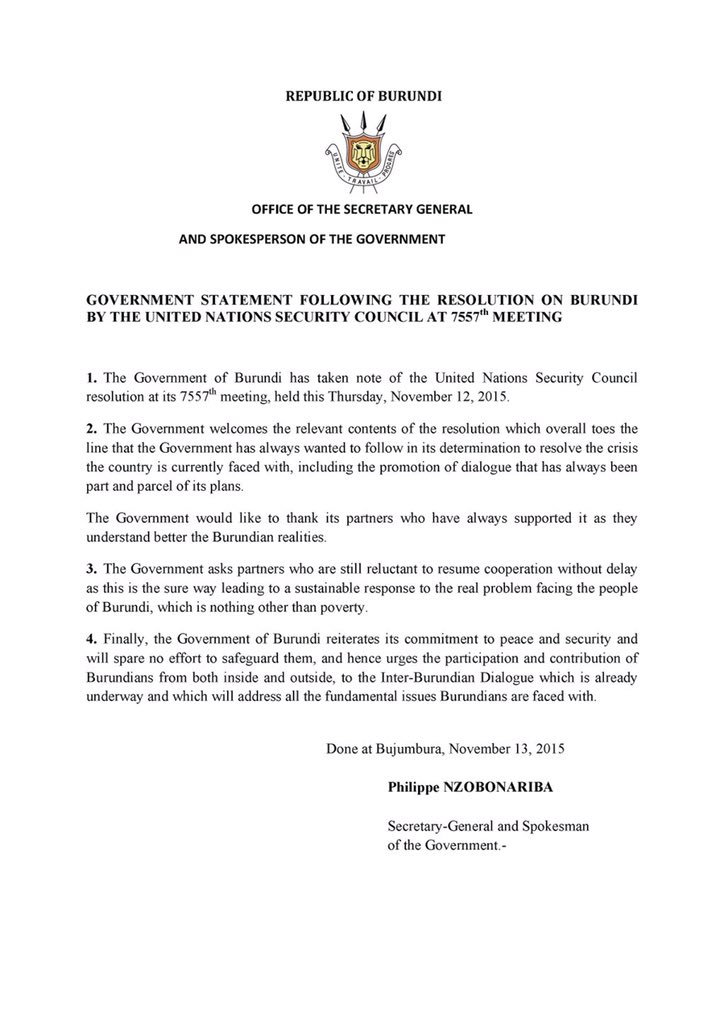
On November 13, the spokesperson for the Pierre Nkurunziza's government issued a response to the resolution, saying that it "toes the line" of the Government and that the problems in the country are "nothing other than poverty," here.


  On the evening of November 11, the UN Spokesperson's office announced that there would be a formal Security Council meeting on Burundi at 12:15 pm on November 12, that would be to approve the draft resolution. An unnamed official of Herve Ladsous UN Peacekeeping -- wonder who that could be -- got Reuters to retype without analysis the idea the UN would send peacekeepers from "Congo" - that would be DRC -- into Burundi.

 UNasked by Reuters, actively covered up, is that Ladsous' MONUSCO has been unable or unwilling to protect civilians in parts of the Eastern DRC, and has refused to neutralize the Hutu FDLR militia. So it would take on Pierre Nkurunziza's forces and youth wing in Burundi?

  This youth wing was allowed by MONUSCO to train in Eastern Congo; nothing was said by MONUSCO when DRC detained a Burundian journalist. None of this in the Reuters, or AFP, or even more derivative Voice of America story. But to retain this "access," these media do not report when the UN's Herve Ladsous, on camera, links peacekeeper rapes to "R&R." Video here. This is a scam. Watch this site.

  While the November 9 meeting was still ongoing, the UN announced that French Permanent Representative Francois Delattre would address the press in ten minutes. But when it happened it was the French Mission's deputy Alexis Lamek, moderated by the Mission's spokesman Thierry Caboche.

After bragging about a draft resolution French belatedly circulated, Lamek and his spokesperson twice refused to take a Press question about UN Peacekeeping still using the same Bururdian forces accused of the abuses. NewVine here. New video, with UK contrast, here.

 The French mission spokesperson, after calling on Reuters, called on Agence France Presse. Inner City Press said, please answer why Herve Ladsous - the fourth French head of UN Peacekeeping in a row - uses Burundian troops in Central African Republic, giving them extensions to bring the right equipment (the government, sources say, takes the money.)

 "Ask him," Lamek said off camera, referring to Ladsous who repeatedlyrefuses Press questions on this (and on covering up French Sangaris forces rapes in CAR.)


  Moments later when Inner City Press asked UK Deputy Ambassador Peter Wilson if the UN should keep using Burundian troops or vet them, Wilson called this a "big issues" that "needs to be looked at." Audio including Elements to the Press, here. Fast transcript by InnerCityPro.com, here:

Inner City Press asked, the UN uses Burundian peacekeepers in CAR. Is there, or could there be, some review of that?

UK Deputy Peter Wilson: "on peacekeepers, I think this is a big issue, and I think it’s something certainly that needs to be looked at in a wider context of what response we take to the events in Burundi right now. I wouldn’t urge precipitate action on that, but I think it’s one of the issues that we need collectively to consider."

 Strange then, that the penholding on Burundi and controller of UN Peacekeeping wouldn't even take the questions. The history of the Great Lakes runs deep. More recently, Inner City Press is informed is belated discussion among Security Council Permanent Five members that Ladsous is a liability, should or can he even be allowed to stay on to the end of Ban Ki-moon's term.

 On November 10, Inner City Press asked UN spokesman Stephane Dujarric,video here, transcript here:

Inner City Press: I'll do Burundi first as a follow-up to that.  Yesterday at the stakeout, Peter Wilson of the UK said that the issue of continued or… or service of Burundian peacekeepers, particularly those involved in the violence in UN peacekeeping, is a big issue, is something that needs to be looked at in the wider context of the response to the events in Burundi right now.  Since… I think I've previously asked you about… my understanding is the Under-Secretary-General of Peacekeeping waived Burundi not having the right equipment twice in a row in CAR.  I wanted you to describe, if you could, what is the process, one, for vetting individuals that come out of the… what you described as a… big violence in Burundi, but also of giving these waivers.  Is this something that's done unilaterally by the Secretariat?

Spokesman:  I'm not… I can't speak to the waivers because I can't… I don't know if what you say is, in fact, a fact.

Inner City Press:  Can… can… is the meeting in September…? [Inner City Press actually referred to Ladsous' September meeting with Burundi, on which it reported.]

Spokesman:  As far as… as far as Burundian troops, they continue to serve in the Central African Republic and other missions, if I'm not mistaken.  They are rotated through the standard human rights vetting process, which involves the UN, which involves the government, which involves the High Commissioner for Human Rights, and which involves the more… the broader human rights community.

Inner City Press:  What about the issue of… there have been several complaints by the peacekeepers themselves of not getting paid leaving some in Burundi to say, in fact, this is a way in which the UN is subsidizing the Government and the very activities that Mr. Zeid was condemning yesterday?  What steps are taken to ensure that the money reaches the peacekeepers?

Spokesman:  Obviously, it is critical whether it's in the case of Burundi if it, in fact, happens or other countries that individual peacekeepers receive the monies that are owed to them.

Inner City Press:  But Mr. [Hervé] Ladsous right here in September said that he's… that he's not sure whether this money reaches soldiers.  So what steps does the UN take, particularly in a case like Burundi, where you're accusing the Government of cracking down on the people, what steps are taken?

Spokesman:  As I said, I think it's incumbent on the governments to ensure that their soldiers get paid.  Did you have another question?


 At the November 9 meeting, Burundi's Nyamitwe droned on by video by Bujumbura, even as Security Council President Matthew Rycroft asked him to bring it to an end. He continued speaking as the other speakers on video -- Prince Zeid, Adama Dieng, Swiss Ambassador Lauber -- squirmed, seeming like the audience to wonder if Rycroft would just cut his mic (he didn't.)

  Inner City Press immediately put online that speech, and that of Uganda's Ambassador Nduhuura and the African Union's Tete Antonio, here.

 On November 7 came reports of killings, including it was said a UN system staff member. This has been confirmed by UNDP - but only the local Buurndi office. Still from the UN, nothing. The Security Council issued a Press Statement on November 7... about Libya.

  Burundian journalist Blaise Célestin Ndihokubwayo has been arrested and sent to the Service national de renseignement (SNR). Where is UNESCO and its director, who wants to be the next UN Secretary General?

On October 23 Inner City Press asked UN Ambassador Matthew Rycroft about the status of the draft Presidential Statement in the UN Security Council. He said there are differing views, but the UK is concerned about the "threat of genocide." Video here.  On November 3, Inner City Press again put a Burundi questions to Rycroft, now President of the Security Council for November. Video here, story here.

The son of human rights defender Pierre Claver Mbonimpa has reportedly been murdered, after Pierre Nkurunziza tweeted that "No one living abroad should consider himself superior to those who stayed in Burundi, since most of them have left their families here."

 On November 6, a belated Security Council meeting on Burundi was announced -- from Paris, by French foreign ministry spokesperson Romain Nadal. Why the delay? Why announced in that way?

Later on November 6, UN Secretary General Ban Ki-moon (whose spokesman could not tell Inner City Press if Ban will have any representative in the Security Council's meeting on Monday) put out this statement.

 Inner City Press at the November 6 UN noon briefing asked how these concerns were consistent with Ban deferring to the Ugandan Defense Minister (for the EAC, Ban's spokesman pointed out), and asked if Ban will even have a representative briefing the UN Security Council on Monday. UNclear. Video here.

  The US' Tom Perriello, filmed at the State Department, noted the weekend deadline. But why then was the UN Security Council meeting left until after the deadline?
 
  US Ambassador Samantha Power put out this statement, here.

  Behind the continued killing, here's an issue: Inner City Press is informed that a number of Burundian civil society leaders and journalists have improperly been flagged to Interpol as if their passports had been stolen. This has made it impossible, for example, for Vital Nshimirimana to travel to a speak about the crisis in Burundi at a conference in (Ban Ki-moon's native) South Korea.

  Inner City Press on November 4 asked the UN Office of the High Commissioner for Human Rights' Ivan Simonovic and UN spokesman Stephane Dujarric about this.  Interpol often brags at the UN how it is useful on the issue of foreign fighters. It's Secretary General Jurgen Stock spoke before the UN Security Council on May 29, 2015. But what about when Interpol is misused by a government like Pierre Nkurunziza? What do it, the Security Council and its members do that? Watch this site.

 On November 2 Inner City Press asked UN Spokesman Stephane Dujarric about two speeches given in Burundi (the full text of one is below). Video here, UN transcript here:

Inner City Press: In Burundi, there was a speech by the President of the Senate [Révérien Ndikuriyo] saying that opposition neighborhoods may be razed [or raided. Some] people are calling it a genocide speech.  There's also a speech by the President, saying anyone who doesn't disarm within the next five days will be treated as an enemy of the State.  So, I'm wondering, not to overdo it, but things seem pretty serious.  I wanted to know:  what is the UN doing?

Spokesman:  "It's clear that those in position of power, whether in Government or in the opposition, have a responsibility not to incite fear or hate of any kind.  I think that's very important and that whatever security measures the Government takes fully comply with international law and respect for the right of people to freely assemble and protest."

 After Burundi was elected to the UN Human Rights Council with 162 votes on October 28, on October 31 security forces in Burundi opened fire on a funeral procession in Buringa, killing many.  These are the Burundian forces that UN Peacekeeping under Herve Ladsous keeps in service, offering waivers while the Government keeps the payments?

  It is reported the Burundian authorities are accusing a medical NGO of offering treatment to insurgents, and are ready to attack. Frankly, the weak UN Security Council Presidential Statement which France belatedly proffered in the Council, then didn't even hold a question and answer stakeout about, is woefully insufficient, as is the UN Secretariat's response.

 Now from Burundi this speech

https://soundcloud.com/journ-burundi/reverien-ndikuriyo-le-pdt-du-senat-illegitime-promet-de-raser-des-quartiers-de-la-capitale

 On October 28, Inner City Press asked UN spokesman Stephane Dujarric about another threat. From the UN transcript:

Inner City Press: this is a tweet from the official account of Pierre Nkurunziza, President of Burundi:  "No one living abroad should consider himself superior to those who stayed in Burundi since most of them have left their families here."  So people see this as an open-source threat to retaliate against the families of those who have fled the country.  And I'm wondering…

Spokesman:  I haven't seen the tweet.  I shall look at it.

 Inner City Press showed it to him on his way out. Earlier on October 28, Burundi got 162 votes for the UN Human Rights Council, less than the other also unopposed candidates, but still enough to get on the Council. The UN Security Council had just issued a Presidential Statement, here, which gave weight to the Museveni "mediation," and which the US later "welcomed."Usually it's the penholder (France) which speaks. But not here, not on Burundi (see Ladsous, below).

  On October 28 Burundi was poised for election to the UN Human Rights Council, as one of five African Group candidates for five seats. Meanwhile on October 26, the European Union adopted the letter to President Pierre Nkurunziza that Inner City Press asked the UN about last week, here.

  Can EU members on October 28 not vote against Burundi's "Human Rights" Council candidacy at this time? And other Western NGOs coming to the UN early this week to set forth their positions, will they just phone it in with regard to Burundi? Watch this site.

 Also on October 23, Inner City Press asked UN Secretary General Ban Ki-moon:

Inner City Press: I wanted to ask on Burundi, just this morning the UK Ambassador said that the UK is concerned of a threat of genocide, is the word that he used, so I'm wondering under Rights Up Front what are your thoughts about Burundi and what the UN or the Secretariat can do.

SG Ban: "On this genocide issues, I hope there should be some creative investigations by the relevant experts and there should be, first of all, a clear understanding and investigations.  And if the conclusion is that there were such kind of genocide issues, then there should be accountability, justice must prevail and perpetrators must be brought to justice."

  But what is the UN Secretariat DOING about it?


  On October 16 Inner City Press asked Haq if the UN thinks the government can investigate itself. This was based on UN Secretary General Ban Ki-moon's October 15 statement that

"The Secretary-General condemns the killing of nine civilians and two police officers in Bujumbura on 13 October... He urges Burundian authorities to undertake a rigorous and prompt investigation into the circumstances and motives behind these despicable crimes in order to ensure that their perpetrators are brought to justice."

  So can the Nkurunziza government investigate itself (as the UN purports to be investigating or "auditing" itself in the wake of corruption revelation about former Presidnet of the General Assembly John Ashe among others)? Inner City Press asked this question (video here) as well as following up on this, from October 13:

Inner City Press: the Burundi question is one that maybe you can check with DPKO [Department of Peacekeeping Operations].  Burundian human rights activists say that an officer, Jerome Ntibogora, N-t-i-b-o-g-o-r-a, who was accused of being involved in killing people in a… in a hospital after they fled from the Government, has now been deployed to MINUSMA [United Nations Multidimensional Integrated Stabilization Mission] in Mali.  So I wanted to…

Spokesman Dujarric:  Let's see what we can find out.

  Dujarric did not come back with an answer, by this deputy when Inner City Pres asked again on October 16 said he, Ntibogora is not being deployed. We'll see - watch this site.

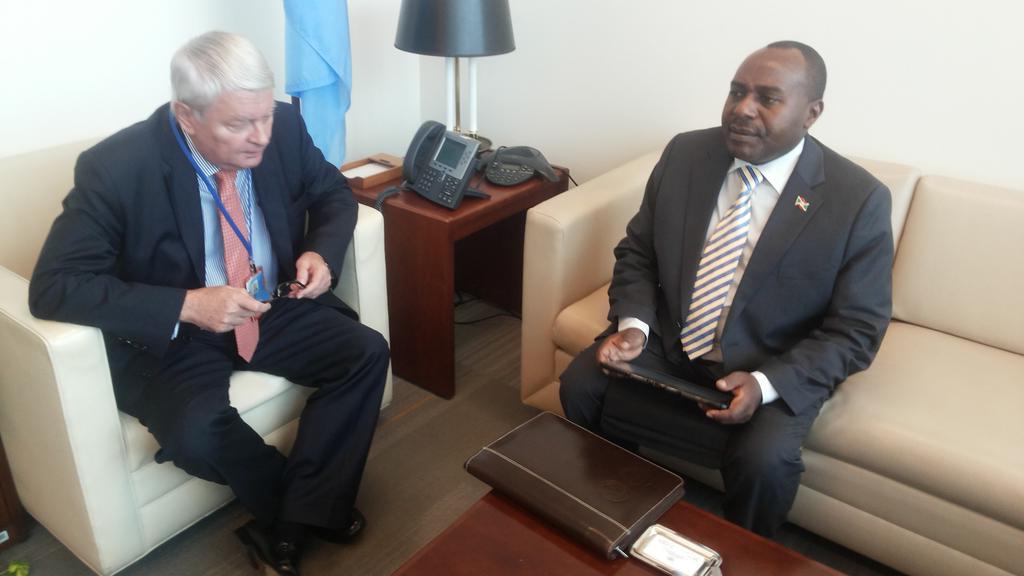
Amid crackdowns in Burundi by security forces, and allegations of sexual abuse by Burundian peacekeepers serving under the UN flag, UN Peacekeeping chief Herve Ladsous on October 1 held a meeting with Burundian Vice President Joseph Butore.

  Inner City Press has already tweeted a photograph of the meeting, but has now received the complete UN read-out, which raises more questions about Ladsous.

   On the crackdown, Ladsous assured Butore that he has a “pragmatic approach” and is of no mind to question what happens in any country, does not involve himself in "domestic affairs."

   On the sexual abuse allegations, Ladsous spoke only in platitudes, without requiring or even inquiring into any actions taken by the Burundians on the alleged abuse.

   Even though Burundi was already given a “grace period” to bring appropriate equipment into the Central African Republic for the MINUSCA mission, they have not done so. In the meeting, according to the read-out, Butore "acknowledged" the substandard equipment.

   Butore requested, and Ladsous for now granted, yet another extension to bring the requirement equipment -- until March 2016 for light equipment, and to June 2016 for heavy equipment.


  Is this safe - even for the Burundian soldiers at issue? While speaking through press releases, Ladsous' spokespeople, far from answering questions, go so far as to direct UNTV boom microphone operators to avoid Inner City Press, even preventing the Press from asking any questions to Mali's Foreign Minister Abdulaye Diop. We'll have more on all this.

Wednesday, November 11, 2015

Exclusive: To Ng Lap Seng's Macau Conference, Ng Paid for 38 UN Staffers' Flights and Hotel: Ongoing Series


By Matthew Russell Lee, Exclusive

UNITED NATIONS, November 11 -- While the UN has been extensively corrupted by Ng Lap Seng and his Sun Kian Ip Foundation and South South News, his proposed Macau convention center and the South South event held in Macau in late August 2015 provide a snapshot which the UN has yet to explain.

  Inner City Press submitted written questions to the UN Office for South South Cooperation on October 29. Press requests for a press conference by the Office's (new) director and auditor have gone unanswered. Now Ban Ki-moon's UN Secretariat is again referring questions about itself to UNDP.

  On November 11, Inner City Press received this response:

From: [at] UNDP.org
Date: Wed, Nov 11, 2015 at 11:58 AM
Subject: Re: Press questions regarding "South South" event in Macau, documents signed by UNDP personnel [Dominica], re-request for list of UNDP attendees and Q&A press conference, etc
To: Matthew Lee [at] InnerCityPress.com

"Mr. Lee, Some text that you can use on the record. My sincere apologies for the delay in responding, and please do not hesitate to contact us with any follow-up.

TO BE ATTRIBUTED TO: UN Office for South-South Cooperation (UNOSSC)

Travel and DSA of 49 attendees were funded by UNOSSC, 38 of these were funded with resources from the SKIG Foundation. The remainder were funded with resources from other UNOSSC projects.

UNOSSC provided participants return air fare and a reduced daily subsistence allowance of 20 per cent during the conference as meals and accommodations were provided. This is in-keeping with rules and procedures on travel-related expenses for staff on mission.

Electronic devices containing copies of conference materials were provided to conference attendees by the SKIG Foundation.

UNOSSC and UNDP staff were instructed to return the devices to the SKIG Foundation through UNOSSC in accordance with UN rules and regulations."

  On October 22 Inner City Press published the invitation letter to the Macau conference, here, which notably said that “all local expenses will be covered by the host.” Attendees tell Inner City Press that those present were given iPads with the name of Ng's company emblazoned on them: where have these gone?

   While there were many attendees, over 170, those from Ban Ki-moon's Secretariat, some of them mis-described, standout. So too does the UN Correspondents Association's Vice President, the same correspondent who took the first set-aside question to Hillary Clintonduring her “email-gate” stakeout in front of the UN Security Council, and asks if questions about the private server were only being pursued because she's a woman. (Ng's previous interaction with the Clintons is well-documented.)

  Given that UNCA's Presideng Giampaolo Pioli accepted funds from Ng's South South News, which was then given an UNCA award while Ng got a photo op with Ban Ki-moon at UNCA's Award Dinner at Cipiani on 42nd Street, the question arises: what was UNCA's Vice President doing on the attendee list at Ng's Macau confab in August 2015? We'll have more on this.

 On October 22, Inner City Press asked UN Deputy Spokesperson Farhan Haq about the UN Secretariat staff who traveled to Macau - and was told, paradoxically, that (only) UNDP could or would answer. From the UN transcript:
Inner City Press: there was this big South-South event that took place in Macau in late August.  Here is what I want to ask you about it: I see now the invitation letter that went out and it said that it was sponsored by a UN agency and other strategic partners, and it also says that, quote, all local expenses will be covered by the host.  And the participant list includes a number people from the Secretariat, DFS, Global Compact, some Secretariat staff, at least one Secretariat staff member listed as a member of his country’s, his native country's delegation, which is a little strange.  So I wanted to know what are the rules, what rules apply to travel by UN staff, taking, accepting expenses from hosts and traveling as a part of the delegation of their native country?

Deputy Spokesman:  Well, regarding that particular visit, I believe the Office on South-South Cooperation has information on that, so I'll have them get back to you with that.

Inner City Press:  Can they do a press conference? Because I put in the question 10 days ago.

Deputy Spokesman:  They have been answering questions from reporters fairly rigorously and so that will continue.

Inner City Pres:  What are the UN Secretariat rules?  That is my question to you.  I'm not asking about UNDP.  I can name the individuals, but there was an individual from DFS, there was an individual from the Global Compact who attended and host covered all costs?

Deputy Spokesman:  Like I said, there is relevant information on this by the Office for South-South Cooperation, so I'll have them share that with you.

 Five hours later and counting: nothing.


Background: As the scandal unveiled in the corruption charges against former UN General Assembly President John Ashe, Ng Lap Seng, Francis Lorenzo of South South News and others continues to expand, the compromised position of the UN Correspondents Association has come to the fore.

 In 2011 until now, Inner City Press has exposed UNCA for taking funds from Ng Lap Seng vehicles, to which it gave awards, and arranging Ng Lap Seng photo op(s) with UN Secretary General Ban Ki-moon. UNCA has not provided any explanation; the UN through Ban's spokesman has said for example that many people get photographs with Ban. But people like Ng previously found in US Senate reports to have made irregular campaign contributions, and co-owning hotels links to prostitution?

 On October 20, Inner City Press asked UN deputy spokesperson Farhan Haq about Ng, and about how much money the Global Sustainability Foundation gave for the UN's “Ark of Return” (anti) slavery memorial. Haq wouldn't give the dollar figure - it's at least $60,000 -- and seemed to says it doesn't matter where the UN takes money from, only how the UN uses it. Video here.

Inner City Press:  Okay.  I want to ask you another question.  Mr. Ng Lap Seng, who's now out on $50 million bail, it seemed he sort of penetrated the UN system, including several photo ops with Ban Ki-moon against a blue background in Cipriani's, I wanted to ask you, a major financial newspaper, just on cursory research, said he's a co-owner of the Fortuna Hotel, which has… quote, this is all from their promotional material, table dancing by strippers, boasted attractive and attentive hostesses from China, Singapore and Korea, and erotic girls from Europe and Russia.  And I wanted to know, given, given everything that's said from this podium about UN Women and the need to take these issues seriously, how is it possible… how is it possible that this, an individual engaged in these activities, came… came to such a position of prominence and, and, and closeness to the Secretary-General?

Deputy Spokesman:  Matthew, we do not speak for David Ng Lap Seng or his group or his business holdings.  Any questions on that have to go to his organizations.  The United Nations does not deal with any of the, of the entities, with entities like the ones that you've described.

Inner City Press:  The money from it was donated to various UN causes.  That’s why I'm asking you to respond to this pending, this unending audit, what do you think of this?

Deputy Spokesman:  The nature of corporations is that any corporation can have many, many different holdings.  I'm not going to comment on all of the holdings of different groups, depending upon what they do with the UN.  What we're trying to monitor is how the funds from these groups affected the UN and the dealings with the two entities that we've been talking about.  That's being audited, and we'll follow up on that.  But the group's activities as a whole, that's an issue for other authorities.  It's not…

It's not an issue for the United Nations…

Inner City Press:  I understand what the audit is…

Deputy Spokesman:  It has nothing, it actually has no actual relevance to the work we've done.

Question:  It's just how the money is spent by the UN, not where the money came from?

Deputy Spokesman:  The audit is designed to follow up on what effect, what impact, the activities the groups and of the monies that they spent have and that's what we're following up on... 

Inner City Press: Is it, are you, is the Secretariat yet viewing the… Secretariat viewing the charges of the Southern District of New York as mostly or entirely related to the PGA [President of the General Assembly]?  I guess I'm asking this because things like South-South News...  Yesterday, I'd asked Stéphane at the founding of the Global Sustainability Foundation, there was Mr. Nambiar.  There was the spouse of the Secretary-General.  There was not Mr. Ashe anywhere to be seen.  So I just want to be clear.  Is this an audit about two… merely two entities, but as relates to the UN Secretariat or just to the PGA's office?

Deputy Spokesman:  No, no, it's as we have, it's as we described in the statement before.  It's about the UN as a whole.

Background: Ng Lap Seng was found to have brought the same bags of cash later deployed at the UN into the US earlier, in the late 90s, when his Fortuna hotel was linked to organized crime and even human trafficking.  From the WSJ:

“Who is Ng Lap Seng, and what did he want? According to several well-informed sources in Hong Kong and Macau, Mr. Ng is a mysterious figure with extensive business in China, where he also held a minor post as a member of the Chinese People's Political Consultative Conference in his hometown of Nan Hai in Guangdong province. In Macau, his most visible interest is his ownership of the Fortuna Hotel, a garish high-rise in the gambling district, featuring a 20,000-square-foot nightclub with 'table dancing' by strippers, as well as a massage parlor and, according to its brochure, 'over 30 independent karaoke rooms, all luxuriously decorated with the most advanced sound system for any one interested in performing his favorite songs.' The brochure also boasts 'attractive and attentive hostesses from China, Korea, Singapore, Malaysia, Vietnam, Indonesia and Burma together with erotic girls from Europe and Russia, certainly offer you an exciting and unforgettable evening with friends or business associates.'”

So what does UN Women, which has still to comment on UN Peacekeeping chief Herve Ladsous linking rapes to “R&R,” same about Ban's UN (through UNCA) accepting “pimp and trafficker” Ng Lap Seng into the UN, and into UNCA's Cipriani ball for photos with Ban and his spouse? We'll have more on this.

 Just as UNCA "leaders" from Voice of America and Reuters(censorship bid here) tried to use the UN to get the investigative Press out, now the UN responds to questions about UNCA selling Secretary General Ban Ki-moon photo ops to Ng Lap Seng by suggesting that the questioner, because present, "condoned" the sale.

  Now, with UNCA still silent on its links with South South News and other Ng Lap Seng vehicles, here is video Inner City Press published in December 2011 of UNCA's murky photo ops for Ban at Cipriani, which UNCA seeks to reproduce this coming December.

  
  Even then in December 2011, Inner City Press' accompanying story reported that it

"filmed what it could of the photo op -- those arranging it kept telling the Press it had to leave -- and afterward several in Ban's circle said they had no idea who the businessmen had been. There was dark talk about one David Ng, a businessman who has bankrolled 'vanity' media projects given awards that night -- people funded by Ng used the word "vanity," so we use it here."

 Inner City Press published that in December 2011 about Ng and South South News; it quit UNCA and with another Executive Committee member who quit in disgust co-founded FUNCA, the Free UN Coalition for Access. UNCA continued taking funds from South South News. We'll have more on this.

While UNCA does not represent all journalists accredited to cover the UN -- Inner City Press for example quit the group in 2012 with another Executive Committee member and co-founded the new Free UN Coalition for Access -- the UN gives it a privileged position, a large clubhouse on the third floor of the UN and, automatically, the first question at press conferences.

  But is that appropriate, given that UNCA received money from South South News, “NGO 1” in the filing against Ashe? Not only did UNCA receive money from South South News: it gave the group an “UNCA award” at a ceremony at the high-ceilinged Cipriani's restaurant on December 15, 2011.

  Inner City Press, which did not quit UNCA in fully ripened disgust in 2012, was present in December 2011 and witnessed, when Secretary General Ban Ki-moon came into Cipriani's, him being shepherded into a side room for photographs with Asian men in business suits who Inner City Press did not then recognize -- but now does.

 UN Spokesman Stephane Dujarric, when Inner City Press asked on October 13 about what it had seen, said perhaps Inner City Press had "condoned" it. Video here. But Inner City Press quit UNCA afterfinding conflicts of interest in it, and being "ordered" to not report on this.  From the October 13 transcript:

Inner City Press: I want to ask inevitably about the revelations about Mr. [John] Ashe and Frank Lorenzo and others.  And just as you… as the lead Spokesman, a person that travels around with the Secretary-General, how… what would you say to the photos that exist of the Secretary-General with David Ng, who was since indicted, and Frank Lorenzo and, particularly, in instances where it appears that groups that receive contributions from the two and then put them in a room to have photographs with the Secretary-General?  Is this something that… how does the Secretary-General view this in retrospect, and what's going to be done in the future?

Spokesman:  First of all, a photo of the Secretary-General with any individual should in no way be interpreted as a sponsorship or agreement.  It's just a photo.  The Secretary-General is very much a public figure, attends a lot of public events where there are a lot of people.  Sometimes people come up to him and ask to have their photo taken.  And it's done within the… within, obviously, the security constraints that need to be had.  I think whether it's the Secretary-General of the United Nations or anyone in leadership position, you will find when you travel with them that a lot of people want to have their photo taken with them.  Inasmuch as that is… we try to control that, sometimes it's difficult to do so.  I think the Secretary-General is as shocked as anyone in this building at the charges that were levelled at these two individuals.  And he's very disappointed at the accusations towards the United Nations.

Inner City Press:  obviously, to business interests having an actual kind of formal handshaking one, I guess I'll just say that that is worth something to them.  That's why they…

Spokesman:  I'm not… I'm not debating that point… [cross talk]  I'm just saying that having a picture of the Secretary-General with any individual should in no way be seen as a sponsorship, approval, making them BFF's or anything.

Inner City Press:  I guess I just want to be more specific.  If an event… and there's one that actually, as it turns out, I witnessed in Cipriani.  If the Secretary-General enters a large space and is then taken to a smaller space for such photographs, what's the basis for that, as opposed to people with selfies?  I mean, I understand what you're saying…

Spokesman:  I think, you know, if you were there, then maybe you condoned the event as well.  The issue is the Secretary-General attends a lot of events.  Sometimes there is a VIP reception.  None of it should be construed as anything as the Secretary-General having his picture taken with anyone.

Inner City Press: it's been a number of days now; I'm assuming that, if not you, OLA [Office of Legal Affairs], someone has read through this long FBI [Federal Bureau of Investigation] affidavit.  And I want to just ask you again, because in it, it says that, after the… the… the official UN document about the Macau centre was procured, there was a separate payment to Mr. Ashe, separate communications with a UN official number one, who reissued the document as a… amended… revised for technical reasons, with the name of the company in it.  And it seems to me, even before you waiting for an OIOS [Office of Internal Oversight Services] investigation, the scope of which wouldn't touch that, who in the UN is actually… how does it work, first of all?  Who… which part of the UN amends documents after they're released?  Is it DGACM [Department for General Assembly and Conference Management]…?

Spokesman:  Listen, I'm not going to talk about the specifics of the case.  But it is clear that if the President of one of the legislative bodies in this Organization which controls the agenda, or a sponsoring country for resolution, asks the Secretary-General to amend a text, we serve as the Secretariat.  It's not… it's… it doesn't entail sponsoring of what's inside that text. 

  While Inner City Press' answer to the spokesman's "if you were there, then maybe you condoned the event as well," is that Inner City Press quit UNCA
 after finding conflicts of interest in it, and being "ordered" to not report on this, we'll have more on this.


On October 13, Inner City Press asked this follow up:

Inner City Press: I just want to directly ask you about the idea that it's sort of people struggling to get photos with the UN officials.  There was a… there was a peacekeeping day concert that was… for which solicitation of… you know, sponsorship was sought by a group called World Harmony Alliance, and it had nothing… the group has nothing to do with peacekeeping, but they paid for day.  They… they… in fact, the funder complained that he didn't get the promised photograph with Ban Ki-moon, but I wonder, what was… what's the UN's understanding when they take outside financial sponsorship for such a day?  I mean, former UN official [Ibrahim] Gambari was seen with the same group taking photographs on the fourth floor in the Millennium Hotel.  What's it all about?  What’s happening?

Spokesman:  What former officials do in hotels is really not of my purview.

Inner City Press:  Sure.  What about UN peacekeeping?

Spokesman:  I would take a look at that actual programme, but I would expect every part of the UN to do due diligence when it partners with an outside organization.  And just…  I'll leave it at that.

   On October 12, Inner City Press asked Ban's deputy spokesperson Farhan Haq, video here, transcript here:

Inner City Press: in light of these charges against John Ashe, Frank Lorenzo, and others, it's emerging that the Secretary-General, if not met, had staged photo opportunities with a number of the individuals charged.  And I wanted to know, in looking at this, do you have some kind of a comment on how these occurred, particularly in instances where they may have been arranged by a third party, been arranged by an organization that invited Ban Ki-moon and then received funds from South-South News or others and then put the two together on photograph?  Was that appropriate?  And what would be your response to… to OIOS [Office of Internal Oversight Services] looking at that or otherwise?

Deputy Spokesman:  Well, regarding that, as you're aware, the Office of Internal Oversight Services will do an audit.  They've been requested to do that, and so we'll be able to see whether there was any effect from either the relationship with these various groups, these two groups, the Sun Kian Ip Group and the Global Sustainability Foundation, and any of the monies received.  So, we'll await what they have to say about any of this.

Inner City Press:  But, given that Mr. Frank Lorenzo has been charged and he's now out on $2 million bail, he was head of South-South News, which spread $12 million, according to the documents, throughout the UN system.  So, what was, how, what was the criteria used to choose these two NGOs and not either South-South News or International Organization for South-South Cooperation or South South Steering Committee on Sustainable Development?  It seems like it's a very limited inquiry and…

Deputy Spokesman:  It's not really an inquiry.  It's an audit, and this is initial step.  If OIOS feels like there is something… there's a direction which they need to go as a result of these initial results, they're certainly free to do that, but we needed to get the ball rolling and have an initial step forward so that we can look into what exactly is the impact of the monies and the relationship with these groups.


John Ashe at UNCA with former president, after and before Pioli
click photo for source / credit

  Back in December 2011, shepherding Ban for this (compensated) photo op with dubious businessmen was Giampaolo Pioli, then as now the president of UNCA. South South News interviewed Pioli that night, bragging of the UNCA award it got / paid for, screenshot from video here.

    (For context it must be noted too that Pioli rented one of his Manhattan apartments to Palitha Kohona then granted Kohona's request as Sri Lanka's Ambassador to screen his government's war crimes denial film “Lies Agreed To” in the UN's Dag Hammarskjold Library Auditorium: this precipitated Inner City Press quitting UNCA, in full disclosure.)

   How can UNCA be given first questions to ask about a scandal involving South South News, from which UNCA took more then to which it gave an award? And what are the other implications?

  (In terms of Mr. Ng's desire for photo ops, Inner City Press is informed that he separately wanted a photo with US President Obama, and paid six figures to a middleman - who disappeared with the money. UNCA on the other hand, one wag noted, delivered Ban Ki-moon for photos at Cipriani's.)

  UNCA, it should be noted, has been and is open to business interested beyond Mr. Ng and South South News. Another UNCA awards ceremony was sponsored by a company called “Acoona;” the Italian oil company ENI pays the group money.

But UNCA's South South News connection, given what has been disclosed and charged this week, should at a minimum and as a first step disqualify UNCA from first questions from the UN, and from the continuation of its role.

 Consider: if it gave rise to criminal charges that South South News paid Ashe to get a GA document for Ng to show off in Macau, who about South South News paying UNCA, and UNCA delivering Ban for a photo op with Ng, that Ng could use for related purposes? We'll have more on this.

Wider, and going forward in this series, limiting UN investigation to OIOS - whose director of investigations Stefanovic has resigned, Inner City Press hereby exclusively reported on October 9 - looking at only two NGOs is laughable. The scandal is expanding: there is a pattern here, pattern and practice. Watch this site.

Tuesday, June 2, 2015

On Central African Republic Rapes, Inner City Press Asks UN What Ban Ki-moon DID After He Knew, Why Zeid Used Private Email


By Matthew Russell Lee
UNITED NATIONS, June 2 -- French soldiers in the Central African Republic allegedly sexually abused children, as exposed in a UN Office of the High Commissioner for Human Rights report leaked to the French government by longtime OHCHR staffer Anders Kompass.
  The UN did not, however, give the report to the host country authorities in CAR. And according to UN documents -- on May 29 released in more detail by Code Blue naming Ladsous directly, here -- UN Peacekeeping chief Herve Ladsous then urged that the whistleblower Kompass be forced to resign.

  The documents also implicate a number of other UN officials, and French government inaction, see below. UN staff advocates have written to Secretary General Ban Ki-moon, his chief of staff and Ladsous, among others, demanding resignations. On June 2 Inner City Press asked UN spokesman Stephane Dujarric, who Banned any Inner City Press question to Ladsous on May 29, what Ban Ki-moon DID, once he learned in March about the rapes. Video here and embedded below.

 Dujarric said he had nothing to add to his previous answers. Huh?

 Inner City Press asked Dujarric, in light of OHCHR Zeid using a private email address for UN business, what the UN's record retention policy is. Dujarric said the policy must be available somewhere. To this has the UN descended.

  Dujarric said the investigation by Lapointe's OIOS, discredited in the leaked emails, will "lead where it will lead." But Lapointe has told OIOS invstigators to not go beyond what they are asked to look at -- in this case, only the whistleblower. This is called a cover up.

On June 1, Inner City Press asked Ban's deputy spokesperson Farhan Haq:

Inner City Press: this is about the alleged sexual abuse in the Central African Republic.  I’ve seen an email from the staff union to the Secretary-General and other high officials saying that the now leaked documents concerning OIOS [Office of Internal Oversight Services] and the Ethics Office being directed by Ms. [Susana] Malcorra to meet with Prince Zeid and his deputy call into question the entire protection of whistle-blowers and… by the Ethics Office and asking basically for resignations of a number of officials.  I wanted to confirm that the Secretary-General has gotten it.  I'd like to know what he thought of it.  And I wanted to return to what was said on Friday, that the Secretary-General knew “in the spring” of the alleged sexual abuse since… given the gravity of the charges, when did he know?  And what did he do when he became aware of it and was it in turn in March?  And what steps did he take after he learned of these extremely troubling charges?  Thanks.

Deputy Spokesman:  Well, we've actually talked about what the Secretary-General and the UN system have done.  That's been the case of the briefings that we've had in the past month or so.  As you're aware, part of that response has been to make sure that we know what happened to the documents, that we're aware of follow-up.  Some of the follow-up, as you know, is happening from the Office of the High Commissioner for Human Rights (OHCHR), as I just said a few minutes ago, in terms of looking at any additional problems or charges that may be out there.  Some of that is to make sure that the French authorities did follow up, which they are doing with the information that they got from the Office of the High Commissioner for Human Rights.  And then some of this, as you know, is part of an investigation by the Office of Internal Oversight Services.  Regarding your initial question, of course, the Secretary-General has full confidence in the work of the Office of Internal Oversight Services, and we trust it will proceed.

Inner City Press:  Given that, often from this podium, you point to OIOS and you say they're independent; we can't answer for them; they're investigating; they're totally independent, how can you explain Susana Malcorra, the Chief of Staff of Ban Ki-moon, summoning the head of OIOS and the head of the Ethics Office to meet what many people say to basically go after Mr. [Anders] Kompass, the whistle-blower?  How independent is it if Ms. Malcorra can tell them who to meet with?

Deputy Spokesman:  I believe that's a mischaracterization of what happened.  Part of what needs to happen when people are dealing with any sort of situation is to understand which office needs to handle it, whether it's a case for the Ethics Office to follow up or whether it's a case for the Office of Internal Oversight Services to follow up.  That's a sample managerial decision of trying to figure out where a case belongs and that was — as far as I'm aware from the Office of Internal Oversight Services, that's what their issue.

Inner City Press:  What the staff union is asking is:  why would any staff member go to the Ethics Office with a complaint of retaliation if it's clear that the Ethics Office immediately meets with the high officials being complained of?  And they're saying… the final thing I want to ask is that the US law that triggers the cut of funding for failure to protect whistle-blowers may well be triggered by that e-mail.  That's why I'm asking for your response.

Deputy Spokesman:  As we said at the start, this is not regarded as a case necessarily of whistle-blowing.  That is something where I… you know, we're perfectly willing to see what the system itself says about this, but whistle-blowing is not just any act of disclosing a document.  There's a certain… there's a certain standard set of procedures, and we'll have to see whether this applies in this case or not.  But, certainly, there are whistle-blower protections put in place.  There is an office, the Ethics Office, that can be relied on this.  I don't think it's particularly helpful to look at this one case as an example of the system as a whole, because the system… every case has its unique attributes, and this is certainly a case that does have its unique attributes, and it may not qualify as a whistle-blowing case.  I think we need to have an open mind about how that proceeds.  Yes?

Question:  On the same issue, did I get that right that Ban Ki-moon heard about this case in March of this year?

Deputy Spokesman:  I believe we were aware of this in March, in the spring, yes.

Question:  You believe or you know?

Deputy Spokesman:  I… this is what I… this is what I… you know, this is what the officials in his office knew, in March of this year.  And that's certainly the chronology that I have of it.

  We'll have more on this.

Many are asking why UN High Commissioner for Human Rights Zeid, while emailing with the UN Ethics Office and OIOS, was using a private Gmail address, and not his work account.

 When Hillary Clinton used the UN Security Council stakeout to belatedly answer questions about her own use of private email while US Secretary of State, it was described as an accident of scheduling, or attempt to use the UNSC backdrop to convey gravitas. But the echo now with Prince Zeid also using private email for presumably public business raises similar questions.

  But will the questions be asked, much less answered? Reuters, typically, ran a piece on May 30 repeating Zeid's press release, withlittle analysis of his role, or use of private email, or Herve Ladsous, who has now been emailed staff advocates' call for resignations.

  Anders Kompass was asked to send his side of the story -- to a private email address, but wisely declined.

Beyond the treatment of Kompass himself, the documents show pressure brought to bear on lower-level staff to make and thereby launder the high officials' desire for an investigation of Kompass.

  Most directly, it is asked, what UN staff member will now report fraud or misconduct, knowing that OIOS and the Ethics Office will then discuss the accusations with their boss? This is a question Inner City Press on May 29 asked UN Spokesman Staphen Dujarric, who BannedInner City Press from putting a single question to Ladsous - the question has yet to be answered.

    UN staff advocates have written directly to Ban Ki-moon and his deputy, Ladsous and Atul Khare and others, demanding resignations. They are offended by the exposure of lack of independence at the UN Office of Internal Oversight Services and UN Ethics Office, and question whether the US should cut off funding under the

"2014 U.S. Consolidated Appropriation Act. That Act, which contains the Department of State, Foreign Operations, and Related Programs Appropriations Act, states that 15% of funds appropriated for contribution to the United Nations or its agencies “may not be obligated for such organization or agency until the Secretary of State reports to the Committees on Appropriations that the organization or agency is … implementing best practicesfor the protection of whistle-blowers from retaliation.” Section 7048(a)(1)(B). The Act also states that the organization / agency’s policies must include “(i) protection against retaliation for internal and lawful public disclosures; (ii) legal burdens of proof; (iii) statutes of limitation for reporting retaliation; (iv) access to independent adjudicative bodies, including external arbitration; and (v) results that eliminate the effects of proven retaliation.” After reading those leaked documents, how exactly can the U.S. Secretary of State (or anybody else) certify that the UN's whistle-blower policy fulfils the Act's requirements? Is there any "independent adjudicative body" in this chain? Evidently the Ethics Office and OIOS are not."

  How will Ban Ki-moon respond? Other UN staff advocates will be chiming in, and we will be covering all of it. The staff notice Ban's appearance at another softball soccer game, among those who are supposed to hold him and the UN accountable. The call for Ladsous to resign out be fired has spread from the African Group to Latin America and GRULAC. Watch this site.

On May 30, OHCHR for Prince Zeid issued a statement beginning, "In the wake of the revelations of alleged serious sexual abuse of children."

  But Zeid was told of the allegations long before their "revelation" via leaks. And tellingly, he continued to mistakenly think and say the rapes were in Mali and not CAR.

 Likewise, both UN Peacekeeping's Herve Ladsous -- listed as urging the whistleblower to resign, which he denies while refusing to take questions on -- and Secretary General Ban Ki-moon both knew of the alleged child rapes by "the Spring," but did nothing.

  This requires an investigation, and not by the UN's Office of Internal Oversight Services, shown to not be independent, told to meet Zeid and the UN Ethics Office by Ban's chief of staff Susan Malcorra.

  Zeid also cites the "International Commission of Inquiry on the Central African Republic, which reported on a range of violations by international forces in December 2014." As Inner City Press reported and asked in January 2015, that report at least mentioned abuses by Ladsous' MINUSCA and the French Sangaris force for whom he covered up (by contrast Human Rights Watch, notably quiet on this scandal, Ban Ki-moon and Ladsous) blamed only the African Union,click here for that.

  As to Zeid, he needs to explain several "revelations" in the document he filed with the UN Dispute Tribunal, on which we will have more.

  Inner City Press reported on some of the documents and went to Ladsous' rare press conference on May 29 (International Day of UN Peacekeepers) in order to ask some questions. Video here.

  But Secretary General Ban Ki-moon's spokesman Stephane Dujarric, choosing who could ask questions, refused to call on Inner City Press, even for Ladsous to say, as he did under Dujarric's predecessor Martin Nesirky, "I don't respond to you, Mister."

  So Inner City Press objected, on behalf of the new Free UN Coalition for Access (the old UNCA has become part of the problem) and asked questions, video here, transcript here:

Inner City Press:  I want to just object.  I’ve asked you 12 or more times about the CAR case in this room and I wanted to ask Mr. [Hervé] Ladsous.  So as you said, noted, but your predecessor Martin Nesirky used to at least ask the question, if he would deny it.  My question is as follows:  this morning or last night, a series of documents were released by AIDS Free World and Code Blue including, as one example, a 5 August 2014  e-mail from MINUSCA, the peacekeeping mission run by Mr. Ladsous, showing full knowledge of the sexual abuse allegations.  The question is:  if DPKO knew in August 2014, how is any of the statements about zero tolerance and acting on abuse correct?  And also I want to ask you about one other document before — there are a series of e-mails between Ms. [Carman] Lapointe, Ms. [Joan] Dubinsky, basically the entire supposed ethics structure here at the UN, including Ms. [Susana] Malcorra, about basically how to deal with Kompass.  None of these people went public ever with the sexual child abuse.

And what I’m wondering is, did the Secretary-General himself become aware of these discussions at Turin at the staff retreat which are all throughout these documents?

Spokesman Dujarric:  You know, we’ve seen the narrative put out by Code Blue today, which is obviously their own version of —

Inner City Press:  Their documents —

Spokesman:  —of a narrative.  They’ve put out what they claim to be documents.  I’m not going to go into comment on documents that may or may not be leaked, that may or may not be authentic.  I think Mr. Ladsous said himself that he only became aware of these issues in the spring.  There is an OIOS [Office of Internal Oversight Services] investigation going on that will look — that will be pulling at the strings and looking at the process and how this — how this whole issue was handled.

Inner City Press:  Since it’s alleged that he asked Prince Zeid to get the whistle-blower fired in a meeting in the spring here in New York, could you ask Mr. Ladsous on what day he became aware of it and whether he discussed the firing of the whistle-blower with Prince Zeid as alleged in the documents --

Spokesman:  I think he said himself, in person, in front of a camera, denied making that—

Inner City Press:  That’s why I’ve asked—

[inaudible]

Spokesman:  He’s denied—

Inner City Press:  What has he denied?

Spokesman:  He’s denied—

[inaudible]

Calling for the firing of Mr. Kompass.

Inner City Press:  [inaudible]

Spokesman:  I think all… I think no one is pleased how this whole case was handled, and it is being investigated and looked at and how it was handled.

Inner City Press:  Who is being investigated?  Is Mr. Ladsous being investigated?

Spokesman:  The whole issue is being investigated.

   But the documents also call into serious question the claims of "independence" from the office of Ban Ki-moon of the Office of Internal Oversight Services and the UN Ethics Office.

  Consider this: OIOS head Carman Lapointe, writing to James Finness (still in charge of the "investigation" spokesman Stephane Dujarric continues to use as an excuse to not answer question), noted that at the UN staff retreat in March "I received an urgent email from the CdC [Ban's Chef de Cabinet Susana Malcorra] to meet with Zeid, Flavia and Joan."

  So OIOS is not independent - it can to told, by Ban's chief of staff, to meet with collaborate with the Ethics Office as well as OHCHR's Zeid and Pansieri.

 Inner City Press previously reported on and asked Dujarric about OIOS' flawed process and a high profile recusal, see below.

  Embarrassingly, Lapointe says for fully 20 minutes they were told the rapes occurred in Mali, not CAR -- the same mistake Zeid made. How can a mere OIOS investigation be accepted? We'll have more on this.

 As noted, Inner City Press reported on some of the documents and went to Ladsous' rare press conference on May 29 (International Day of UN Peacekeepers) in order to ask some questions.

  But Secretary General Ban Ki-moon's spokesman Stephane Dujarric, choosing who could ask questions, refused to call on Inner City Press, even for Ladsous to say, as he did under Dujarric's predecessor Martin Nesirky, "I don't respond to you, Mister."

So why did Nesirky allow Press questions to Ladsous, and Dujarric didn't?

  Dujarric set the first question aside for "UNCA" -- but called on an individual who was not elected to their board, who lost the election; her question was a vague softball offering Ladsous a chance to comment on Central African Republic. He said, it was one nation, not under blue helmet.

  But Ladsous' MINUSCA mission knew of the sexual abuse since at latest August 5, 2014. Inner City Press said, "Follow up on CAR?" Dujarric called on Reuters, which previously wrote to him trying to get Inner City Press thrown out of the UN (then filed to get his leaked complaint blocked or Banned from Google's Search, here.) Reuters did not even aske about the CAR sexual abuse.

  What emerged is that both Ladsous -- and, troublingly, Ban Ki-moon -- were formally informed of the sexual abuse of children in CAR "in the spring."  What date? And what did they do?

  Dujarric said, "last question;" as Ladsous left the room Inner City Press asked Ladsous about him speaking about the whistleblower Kompass with OHCHR's Zeid, also a subject of the new documents -- no answer.

  Inner City Press objected to Dujarric, who has fielded or dodged a dozen Inner City Press questions about the CAR rapes and Ladsous' role, not even being allowed to ask a question. Dujarric said, "Noted."Video here.

 And what? Again, Dujarric's predecessor Nesirky, and his deputy Del Buey, allowed Inner City Press to put questions to Ladsous. What if the difference? We'll have more on this.

On July 30, 2014, Ambassador Nicolas Niemtchinow, Permanent Representative of France to the UN in Geneva wrote to
Kompass that action was being taken. But then, nothing.

 On August 5, 2014 the Human Rights Officer in CAR of OHCHR wrote to Renner Onana of the already-then UN mission MINUSCA; DPKO's SRSG Babacar Gaye was referenced.

   So when did Gaye or MINUSCA tell DPKO chief Ladsous?  We'll have more on this.


Tellingly, even the UN's cover up was delayed by High Commissioner Prince Zeid thinking he heard of French troops' sexual abuse in MINUSMA (Mali) and not MINUSCA (CAR).

  Zeid asked his predecessor Navi Pillay if she met with French representatives about rapes in Mali -- the answer was no -- then much later asked her if she'd met with the French about CAR (the answer was yes.)

  It was Zeid's Deputy Flavia Pansieri who conveyed Ladsous' directive to Kompass to resign. Zeid in his statement makes much of Pansieri meeting with a Swedish diplomat in the street, in casual clothes, after Sweden raised l'affaire Kompass at a dinner in honor of Ban Ki-moon's Deputy Jan Eliasson. THe UN's move now seems to be to try to lay all blame on Pansieri, whose term was expiring anyway. We'll have more on this.

   From Kompass' March 29, 2015 narrative, here:

"On 12 March 2015 meeting with the Deputy High Commissioner I was informed that the High Commissioner requested my resignation for the way I dealt with the reports of paedophilia in the Central African Republic. I was told that the High Commissioner had been asked for my resignation by Mr. Ladsous, Under Secretary-General for the Department of Peacekeeping Operations in New York, during a visit of the High Commissioner to New York."

  Ladsous curtly denied this to Inner City Press, video here, then again refused to answer questions -- as he has outright refused to answer Press questions on rapes in the DR Congo and Darfur.

   On May 27, Inner City Press asked UN spokesman Stephane Dujarric:

Inner City Press: On the Central African Republic, President [Catherine] Samba-Panza is in Paris, and she has said “We regret not being informed earlier that this investigation was taking place”, she told reporters after the meeting with the president.  So, I wanted to know, I… you… well, first of all, is there a UN response to that?

Spokesman:  Well, I think, you know, obviously, as I said before, there is an internal look as to how all these allegations were handled from an administrative point of view, who knew what and when and that is being… what is being looked at.

Inner City Press:  Because that is… that's my second question.  I've heard from people in OIOS [Office of Internal Oversight Services] that the terms of reference of the investigation that you've repeatedly referred to here are essentially Mr. [Andres] Kompass.  There's an OIOS investigation as to why Mr. Kompass gave an unredacted report to the French.  So, are the terms of reference to which you keep referring…?

Spokesman:  I've said what I said.  If I have more to say, I will share it with you

   We'll be waiting. Follow up stories in the New York Times and on AP managed to not mention Ladsous, despite Paragraph 9 of the UN Dispute Tribunal reinstatement order. On May 26, Inner City Press asked UN spokesman Stephane Dujarric:

Inner City Press: something on Yemen, but I wanted to ask you on that, to ask you specifically on this because, since the UN is mostly saying that Mr. [Anders] Kompass was suspended because he gave the names of witnesses and victims to the French Government, the statement by Ms. [Flavia] Pansieri says that the names in the report were fake ones, and there was no risk, therefore, for witnesses.  So, this… I understand there's an ongoing investigation, but this sort of goes to the heart of the apparent retaliation against the whistle-blower.  So, I'm wondering, is there no reaction to that?  And she also says that he felt that the mission, the then-UN mission in Bangui, MINUSCA, would not take any action.  And there's a New York Times report that says that the Mission there did not tell "his boss", UN peacekeeping here in this building.  So, there… outside of the investigation, can you get a clear yes or no whether the Mission in Bangui told DPKO [Department of Peacekeeping Operations], i.e., Mr. [Hervé] Ladsous, who then reappears in the UN Dispute Tribunal trying to get Kompass fired…

Spokesman:  On your last point, I think we've gone through this.  You're taking as fact one side of papers that were submitted.  I think Mr. Ladsous clearly denied the accusation that he called for Mr. Kompass to be fired.  As I said, there's an internal investigation which will look at how the whole UN system handled the issue, including the peacekeeping mission.  The report was handled through the human rights channel in Geneva, and I think it's important that all these reports of sexual abuse be handled properly through the right channel, in order to protect the victims and the witnesses.

Inner City Press:  But, just one thing.  If you're using the OIOS investigation as basically the response to all of these troubling things that come out, this seems to imply that the OIOS report, when finished, will be public, that there will be an answer to these questions at some point.

Spokesman:  I think very much… I think the OIOS reports are handled in the way they are handled, but we hope to be able to share, obviously, more information.  I think we also, very importantly, would want to learn from the way this issue was handled and to improve the way we handle these kinds of cases.

  Also otherwise unreported:
 on the afternoon of May 18 some in the UN's Ban Ki-moon administration were summoned into the Fifth (Budget) Committee to answer questions, including about the investigation by the UN Office of Internal Oversight Services.


 Inner City Press, which reported exclusively on that meeting, on May 22 asked UN deputy spokesperson Farhan Haq about the probe, video here:

Inner City Press: ...Miranda Brown in Geneva, she was a WIPA whistleblower, then she worked with Mr. [Anders] Kompass in the Office of the High Commissioner for Human Rights.  Anyway, she was terminated yesterday, left service of the UN, the day before she was to be interviewed by OIOS [Office of Internal Oversight Services] about the Kompass matter.  So she's put out a statement saying she believes in part she was fired because she has witnessed evidence on Kompass' matter.  She says he shouldn't have been suspended because there are… many countries have mandatory reporting of paedophilia charges.  This is what he she claims that he did.  And that the Government accountability project has asked the Secretary-General to reinstate her given if he's interested in getting to the bottom of the Kompass/Central African Republic sexual abuse allegations.

So I wanted to know, what is the response and what's the interrelation between firing somebody that's a witness in what's said to be a very important case for the UN?

Deputy Spokesman Haq:  I wouldn't have any comments on the Kompass case while the information is proceeding.  We're going to allow it to continue to proceed.  And I wouldn't be able to comment at that point.

Regarding the case of… that you just mentioned, I believe Stéphane [Dujarric] commented on it just about a week or so ago.  I don't have anything to add to what Stéphane has said.

Inner City Press:  Do you still expect her to testify?  I've seen the request from OIOS for her to speak.  It seems like if you're firing her she's not going to speak.

Deputy Spokesman:  I would hope and expect if the Office for Internal Oversight Services needs some of this information for their investigation that it will be provided to them.
  But once terminated, there is no immunity. We'll have more on this.


Back on May 21 Inner City Press asked Haq: 
Inner City Pres: I'd asked Gordon Brown about the alleged sexual abuse in Central African Republic, and he said there's a report.  So I wanted to ask you something.  Become aware that the OIOS's [Office of Internal Oversight Services] director Michael Stefanovic has informed the Secretary-General that he's recusing himself from the investigation.  A number of Member States have questions on this that they raised to Ms. [Carman] Lapointe, and I think that her response was, "Ask the Secretary-General."  So I'd like to know, can you confirm that the director of OIOS, Mr. Stefanovic, has recused himself?  And can you say why he recused himself?  Some say he — well, I'd just rather get your reasoning for it.  And some say it makes the reporting — how does it impact the report that apparently was what Mr. Brown was referring to as the UN's response to these events?

Deputy Spokesman Haq:  I believe Mr. Brown was also referring to the fact that this is being investigated, the actual allegations — the substance of the allegations is being investigated by the French authorities.  That's where the investigation into the alleged crimes is taking place.  What this investigation is about is about the handling of documents, as you're aware.  And I wouldn't be able to comment on the [Office] of Internal Oversight Services' review of this and its own investigation until that process has concluded.  So at this stage, that process is continuing, and we'll have to wait for that process to be ended.
  Since the UN won't answer this basic question, Inner City Press now reports more. Absent from the UN Fifth (Budget) Committee's May 18 meeting was not only embattled Peacekeeping chief Ladsous,, but also OIOS' Carman Lapointe.
 In her stead for OIOS was Michael Stefanovic, who told the Fifth Committee that he has recused himself from the investigation and has written to Secretary General Ban Ki-moon as to why. 
  This is highly irregular. If the recusal was made on a personal connection between Stefanovic and the whistleblower Anders Kompass, Stefanovic would have recused himself from the earlier investigation - but he didn't. If it were such a recusal, he would have written to Lapointe, and not to the S-G.
   For now we add this -- if OIOS Director Stefanovic has a conflict of interest, how can the UN be asking others to rely on an OIOS investigation? Inner City Press has asked a Permanent Member of the Security Council -- not France -- if an OIOS investigation would be sufficient, and has been told "No." 
 Now we have this, from the Fifth Committee's May 20 meeting:
Lapointe, summoned to the meeting via her Byun-kun Min, was asked
-When did OIOS/ID start the investigation into Anders Kompass?
-Why did Mr. Stefanovic recuse himself from the Kompass investigation?
-In view of Mr. Stefanovic recusing himself, did Ms. Lapointe see any impediments for the scope of the investigation, especially as it appeared to implicate an ASG or USG in misconduct?
  Note - this is a reference to UN Peacekeeping USG Ladsous.
 Multiple sources tell Inner City Press Lapointe replied that Stefanovic told only the Secretary General, not her, that he recused himself, and that the Deputy Director of OIOS in Vienna is now "overseeing" the investigation.
So those now on the case are James Finniss, Kanja and Margaret Gichanga -- who has been asking to interview WIPO whistleblower Miranda Brown, who worked alongside Kompass for a time. We'll have more on this. It is a new low for the UN.
Back on May 18, Inner City Press, staking out the Budget Committee meeting, spoke with Ban's chief of staff Susana Malcorra when she left the meeting. Here is a transcript, followed by an exclusive summary of what happened inside the closed meeting.
Inner City Press: How did it go in there? Are their questions answered?
CdC Malcorra: Well I hope, yes. Some of them still have questions that will be answered by my colleague. I think I’ve made a point of what it is that we’re discussing here. This investigation is a UN investigation. It was led by the UN in the field when they had allegations handed to them. It was the human rights cell in the mission that led this investigation. It looks like we were absent, but it was us...
And this investigation could, at least prima facie, there were places clear enough to further investigate by the member state. And as such, the information was provided to a member state. On a separate front, is how the information is provided. And we cannot accept the irresponsibility of the names of the victims, the witnesses and the investigators shared with the member states ... it’s inacceptable. It may look like a bureaucratic approach. It’s not a bureaucratic approach...
Inner City Press: What about not telling Central African Republic authorities?
CdC Malcora: They are discussing that now.
   After the meeting ended, and Inner City Press spoke with numerous attendees - a common refrain was that the UN leadership is "in denial" - we have pieced together this summary of the meeting, and the totally insufficient answer on UN Peacekeeping chief Ladsous' role, a lack of recognition of his UNAMID mission's previous cover up of rapes in Tabit in Darfur, which the US and UK and other say they care about, and lack of follow up on whistleblowers.
Attendees' summary of Ban Ki-moon chief of staff Malcorra:
"Malcorra said she had no idea the session would go into the specifics of CAR, she thought it was to touch upon general Sexual Abuse and Exploitation policy (several attendees were dubious and angry about this approach.)
  Malcorra said that in the case of misconduct by UN staff the procedures were in place. In this case, even when it was not UN peacekeepers the human rights cell in Bangui was there and they were the ones that initiated the investigation. It is thanks to the UN that allegations were substantiated and it was enough to decide to proceed with a further investigation.
  The wrongdoing of the UN staffer Anders Kompass was to have shared the information without it being redacted putting the victims, witnesses and investigators lives in danger. She repeated many times this was a serious breach and that she disagreed with anyone that didn’t view this conduct wrong.
   According to Malcorra the UN investigation lasted three months which allowed them to substantiate the allegations.  When that finding was final it went to the two lines of command: The head of mission in CAR and the OHCHR.  But, several asked, why didn't either of these tell the CAR authorities?
Malcorra said she would have preferred this case hadn't surfaced in the media and that it is regrettable member states have had to learn matters from the press. But that, Malcorra said, member states have to be aware that the press manipulates everything. Several states talked about the UN image and credibility to which Malcorra said she was very sad with those comments because if not for the UN these troops could have gotten away with these disturbing acts. She also said this was a clear case of damned if you do damned if you don’t. But what about the cover up? What about Ladsous?
  Malcorra said that “no other element had been taken into account” for Kompass' firing. But member states were aware of Paragraph 9 of the UN Dispute Tribunal ruling reinstating Kompass. As noted, one Permanent Representatives (and several other diplomats) told Inner City Press that Ladsous should resign.
  Tellingly, the sources say, Malcorra claimed didn’t recall any UNAMID coverup allegations. Tabit?
   Malcorra didn’t even address the Otis report on whistleblowers - which Inner City Press has been asking Ban's spokesman about, repeatedly -- but assured member states that due protections are in place and that an adequate policy exists.
  Malcorra said she looks forward to working further on the UN convention in paragraph 57 of the SG report on SEA and agrees that there are systemic flaws, and therefore there will be a review of all the processes.
  According to sources in the meeting -- Inner City Press asked and was told to inquiry with member states -- the  Legal Counsel and head of OLA qualified as excellent the cooperation with the French Authorities and that the lifting of immunity so far hasn’t been necessary because at this stage its very general requests of information that the UN promptly has given to the French authorities. For the sake of efficiency hasn’t gone through the lifting of immunity process but if a trial or judge becomes involved they will do it quickly at a later stage. Several member states were dubious. The EU, Inner City ress is informed, said “accountability starts at the top.”
 Malcorra left unanswered why the host state, the CAR, was not involved. She is said to have ignored the specific question on the status of the OIOS investigation. She ignored the complaints about under-reporting saying that the trend of decrease was very clear and that the USG of DFS would go into details (what he did, genially, was repeat the Secretary General's report).
  An impartial investigation was called for, from both sides of the Atlantic and elsewhere. There was a refrain afterward: Ladsous should resign."
  Herve Ladsous is conveniently out of town, on Mali over the weekend he chided Malians for not sufficiently thanking France for the French Operation Serval. Would he say the say in Bangui, about Operation Sangaris?
  A well-placed African Permanent Representative before the meeting told Inner City Press before the meeting that Ladsous should resign. But with him conveniently absent, would others be left holding the bag, trying to explain why he, Ladsous, appears in the UN Dispute Tribunal ruling as urging that the whistleblower resign?
  Back on May 8, Inner City Press asked US Ambassador Samantha Power about both issues - the UN's failure to tell the CAR authorities, and Ladsous' "surprising" role, as High Commissioner Zeid put it earlier in the day. Video here and embedded below. Then Inner City Press asked the UN Spokesman, Stephane Dujarric, about the contradiction; for the first time, he gave a timeline. From the UN transcript:
Inner City Press: Iwant to ask you about these alleged rapes in the Central African Republic.  Prince Zeid [Ra’ad al-Hussein] held a press conference today.  Just as an aside, I would have liked to have seen it announced from here on this very topic.  And he said… he was asked directly about what I've been asking you about, the statement in the UN Dispute Tribunal ruling that the Under-Secretary-General of Peacekeeping asked the whistle-blower to resign.  And it was said, and this is why I want to ask you, because I know you said you don't agree with it, but this was a statement that was not contested at the time by the respondent.  So, this means that the UN… the people involved saw the claim and didn't have any problem with it.  I'm not saying that that means it's true.  When you say you don't agree with it, is that a personal position or a UN position?

Spokesman Dujarric:  I don't think I said I didn't agree with it.  I said you're taking it as fact.  It's his position.

Inner City Press:  Which the UN didn't disagree with.

Spokesman:  I'm just saying it's his position.

Inner City Press:  My question on this is, he said he'd like to say more, but would say it to some forthcoming, apparently, investigative commission.  Ambassador [Samantha] Power at the stakeout said the same thing, that all of this needs to be looked at independently.  So, what's the status of that?  Is the Secretariat having any role in that?

Spokesman Dujarric:  There's obviously the OIOS [Office of Internal Oversight Services] inquiry going on into Mr. [Andres] Kompass and into everything related to that.  You know, I think the aim right now is to ensure accountability for the victims of these alleged rapes and horrendous abuse [that] these young children suffered at the hands the soldiers.  That's… that should be everyone's aim.  Obviously, there will come a time I think when we will need to take a look at how this issue was handled, but I will also add that there is obviously an internal investigation through OIOS and looking at Mr. Kompass.  At this point, I don't have anything to add.

Inner City Press:  The other thing… something you said yesterday was about this, there was no harm to the French investigation by not lifting immunity because they were written questions that were answered.  There's an article in Le Monde today that says that, yeah, written answers were provided seven months after the questions were proffered and was provided on 29 April, which just happened to be the date on which the exposé was first published.  I'm wondering… you can read Le Monde.  I can read it to you.  But, that's what they are saying, basically.

Spokesman:  You know, I think that there are different timelines going on here.  The prosecutor in Paris has his own timeline.  What I can tell you is that on 10 October, the Permanent Mission of France of the UN sent a note verbale to the Secretary-General, to the Office of Legal Counsel with a request from the… from a French judicial authority, a vice-prosecutor, confirming they had a hard copy of the report, which obviously had gone from Mr. Kompass, requesting for us to waive the immunity of the investigator, the OHCHR [Office of the High Commissioner for Human Rights] investigator, who authored the report and allowed him to be interviewed.

Following consultations internally, which obviously involve the Mission in the Central African Republic, which involved OLA [Office of Legal Affairs], which involved UNICEF, which involved the Office of High Commissioner for Human Rights, we wrote back, saying that we will fully cooperate, that we are offering to send them a copy of the redacted report.  And again, here, I can't stress enough the importance of shielding the identities of the victims.  I mean, there are a number of countries in Europe, for example, where it is illegal to share the names of rape victims or of minors who have gone under child abuse, so I think that the issue of protecting the names of the witnesses and those who have been abused is primary.

We also told them that the chief investigator was right now serving in a post in Chile and will provide responses in writing to any questions put forward by French investigators.  We stressed that this cooperation was done on a voluntary basis without any prejudice to the issues of privileges and immunity. That was a letter that we wrote to the French authorities on 5 November.  On 6 February of 2015, we received a letter from the French mission transmitting, obviously, documents that had gone from their own judicial authorities, the written questionnaire and which was for the investigator and reiterating the request to lift the investigator's… the investigator's immunity.  That was on 6 February.

On 30 March, we reiterated our full cooperation to the French.  We provided them with a copy of the redacted report.  We transmitted to them the copies of her… the questions and answers, with the answers provided by the investigator.  We confirmed, yet again, that there was no need to lift immunity because this cooperation would be done on a voluntary basis without any prejudice to the investigation… to our immunities.  I think it serves to remind people… you know, the issue of immunity, I think, is one that is not always fully grasped by those that don't cover the UN on a regular basis.  The UN lifts the immunities of its staff members in a number of cases when they need to testify in front of judges, in front of courts.  We do that.  The immunity is not there to stand in the way of justice being served.  At this point, if there's no need to lift the immunity, it's not lifted.  If there is a need to lift the immunity to provide testimony before a judge or a court in a legal proceeding, it is studied.  It is very often done.

So, I think we're looking at different timelines.  I think different bureaucracies have different timelines.  I've given you ours.  The prosecutor clearly has his or her own; I don't know the gender of the prosecutor.  That's where we are.

Inner City Press:  Just one follow-up.  I appreciate that.  This will be the… there's one date you didn't mention there, which is 12 March 2015, in which the whistle-blower was summoned in and told to resign.  He said and was uncontested by High Commissioner of the Office of Human Rights at the request of the Under-Secretary-General of Peacekeeping.  So, my question is, what was the problem… I understand everything about protecting witnesses.  If the information presumably is provided to prosecutors, like there are rules against it, but it's not illegal for one investigative authority to share the information that could bring about a prosecution with that prosecuting authorities; what's the problem with that?

Spokesman:  I think, again, on Mr. [Hervé] Ladsous, I think he spoke to it… he spoke to it at the stakeout.  I've said what I've had to say about Mr. Kompass's allegations.  I think the High Commissioner spoke at length and eloquently this morning, so I have nothing to add.  I think it is vital for the work of the human rights organs of this Organization that, when people give us testimony with the understanding that it will be kept confidential, that it is in fact kept confidential.  I think the High Commissioner said clearly that the investigative responsibility, the criminal investigative responsibility, is in this case with the French soldiers with the French authorities.  It is with national authorities.

The human rights mechanisms in this organization conduct a lot of commissions of inquiry.  We have ones going on on Syria, on the [Democratic People’s Republic of Korea], to name just two.  People give us testimonies with the understanding that we will be… we will guarantee that this… their names will be kept confidential.  I think that is exactly the issue here, is that when people give us testimony with the understanding that it be kept confidential, we have a responsibility to keep that confidential.  The handling of Mr. Kompass' case administratively, what was said, what was done is being reviewed internally.
  Here is the video of Inner City Press questions to US Ambassador Power:

Inner City Press: One issue that has arisen that may not even need to wait for an investigation is that the Central African Republic says that they were never told of this, and given that these were their citizens, I wonder if you—does the U.S. think that when the UN system becomes aware of charges such as these, that the host country should be told? There’s also this issue, in the UN Dispute Tribunal ruling, that the Under Secretary General of Peacekeeping was reported, and the UN didn’t seem to dispute it, to have said that the whistleblower should resign or be suspended. And I wonder, this seems like a pretty serious charge. What do you think of that? Do you think that that is appropriate? What do you think of the treatment of the whistleblower who brought it to light?

Ambassador Power: "I think, on a lot of these issues, we’re all going to be better off if we allow an impartial investigation to take hold. And, I think, you raise a really, really important issue about host country involvement, and we’d want to, again, get the facts on that. Certainly, it is the case that the host country itself, of course, has the sovereign responsibility for the protection of its citizens, and so, looking at what role Central African Republic authorities played or didn’t play has to be part of this.

"And then, in terms of the individual who disclosed the allegations, who worked for the Office of the High Commissioner for Human Rights, again, it’s extremely important that any individual who comes into possession of allegations of this gravity acts swiftly. It is also extremely important that victim and witness safety be a very significant, a primary consideration as well. And so again, the impartial investigation will look at the handling and how both the issue of speed and the issue of victim and witness protection—how those issues were handled."
  It is an answer that may move things forward. Ladsous, it should be noted, just this week snubbed a Joe Biden-linked Hemispheric peacekeeping conference in Uruguay, wasting an $8,000 first class plane ticket and angering many troop contributing countries. He refuses to answer Press question, for example on rapes in Minova, DRC and Tabit in Darfur.
   As noted, on May 8, High Commissioner Zeid held a press conference, and twice refused to comment on why Ladsous was said to have pressured to fire or suspend the whistleblower.
  Inner City Press has covered Ladsous' role from the beginning, and highlighted his appearance in Paragraph 9 of the UN Dispute Tribunal ruling reinstating Kompass. On May 7, Ladsous told Inner City Press, "I deny that" - then refused to take questions.
 Zeid was asked, and first time said he should first give his view of the pressure to the investigator, not the media.
 The second time, he said he was surprised to read it -- his Office did not contest that part of the ruling, effectively admitting it -- and that the head of UN Peacekeeping should not have been intervening about a non-UN force.  Video here.
 Neither he nor the questioners in the room in Geneva said the obvious: Ladsous is a longtime French diplomat; it is not rocket science to read Paragraph 9 as him (inappropriately) still working for "his" country.

 Zeid said other things we'll report later; he alluded to the need for a Commission of Inquiry. Some ask, will Ladsous quit before then? Or after?
 For more than nine months, no action was taken -- no interviews of victims or alleged perpetrators were done -- other than the UN suspending Kompass for the leak, on which the UN Dispute Tribunal ruling recites that UN Peacekeeping chief Ladsous requested Kompass' resignation. (See Paragraph 9, here.) Ladsous told Inner City Press he denies it - then refused questions.
  Early on May 8, UN system staff complained to Inner City Press that UN High Commissioner for Human Rights Prince Zeid of Jordan, in a closed staff meeting on May 8, tried to downplay the scandal, going so far as to blame imams in Bangui for not playing their role.
  But it was OHCHR which didn't even give the report of the rape of CAR children to CAR authorities, only to the French.
  In places, Zeid appeared to try to use his record ten years ago on sexual abuse to shift the blame to imams.  Inner City Press has shown a failure by his Office to act on past leaking, to Morocco. We'll have more on this.
  On May 7, Inner City Press asked more questions about this - including to Herve Ladsous himself.
  After a long closed-door consultation meeting of the Security Council, Ladsous emerged. Inner City Press asked him, based on Paragraph 9 of the UNDT ruling, Why did you ask Kompass to resign?"
  Ladsous stopped and said, "I deny that." Inner City Press put the handheld video online, here.