Showing posts with label resolution. Show all posts

Thursday, November 12, 2015

On Burundi, UN Security Council Adopts Belated Resolution 15-0, Text Here; Chimera of Protection by Ladsous' DPKO


By Matthew Russell Lee

UNITED NATIONS, November 12 -- As killings in Burundi have increased, a November 9 UN Security Council meeting was belated announced, from Paris, on Friday November 6. But even on November 10, basic questions about the use of Burundian "peacekeepers" by Herve Ladsous' DPKO were not answered, see below.

 On November 12, the Security Council adopted a belated resolution on Burundi, 15-0. (Inner City Press put the full text online here, and here in French.) Afterward Inner City Press asked UK Ambassador Rycroft, the President of the Council for November what steps would actually be needed to send any peacekeepers from MONUSCO in DR Congo (he said there are discussions).

Inner City Press managed to ask French Permanent Representative Francois Delattre why UN Peacekeeping keeping using and paying for Burundian troops and police in the Central African Republic. He declined to answer - but politely.

  On the evening of November 11, the UN Spokesperson's office announced that there would be a formal Security Council meeting on Burundi at 12:15 pm on November 12, that would be to approve the draft resolution. An unnamed official of Herve Ladsous UN Peacekeeping -- wonder who that could be -- got Reuters to retype without analysis the idea the UN would send peacekeepers from "Congo" - that would be DRC -- into Burundi.

 UNasked by Reuters, actively covered up, is that Ladsous' MONUSCO has been unable or unwilling to protect civilians in parts of the Eastern DRC, and has refused to neutralize the Hutu FDLR militia. So it would take on Pierre Nkurunziza's forces and youth wing in Burundi?

  This youth wing was allowed by MONUSCO to train in Eastern Congo; nothing was said by MONUSCO when DRC detained a Burundian journalist. None of this in the Reuters, or AFP, or even more derivative Voice of America story. But to retain this "access," these media do not report when the UN's Herve Ladsous, on camera, links peacekeeper rapes to "R&R." Video here. This is a scam. Watch this site.

  While the November 9 meeting was still ongoing, the UN announced that French Permanent Representative Francois Delattre would address the press in ten minutes. But when it happened it was the French Mission's deputy Alexis Lamek, moderated by the Mission's spokesman Thierry Caboche.

After bragging about a draft resolution French belatedly circulated, Lamek and his spokesperson twice refused to take a Press question about UN Peacekeeping still using the same Bururdian forces accused of the abuses. NewVine here. New video, with UK contrast, here.

 The French mission spokesperson, after calling on Reuters, called on Agence France Presse. Inner City Press said, please answer why Herve Ladsous - the fourth French head of UN Peacekeeping in a row - uses Burundian troops in Central African Republic, giving them extensions to bring the right equipment (the government, sources say, takes the money.)

 "Ask him," Lamek said off camera, referring to Ladsous who repeatedlyrefuses Press questions on this (and on covering up French Sangaris forces rapes in CAR.)


  Moments later when Inner City Press asked UK Deputy Ambassador Peter Wilson if the UN should keep using Burundian troops or vet them, Wilson called this a "big issues" that "needs to be looked at." Audio including Elements to the Press, here. Fast transcript by InnerCityPro.com, here:

Inner City Press asked, the UN uses Burundian peacekeepers in CAR. Is there, or could there be, some review of that?

UK Deputy Peter Wilson: "on peacekeepers, I think this is a big issue, and I think it’s something certainly that needs to be looked at in a wider context of what response we take to the events in Burundi right now. I wouldn’t urge precipitate action on that, but I think it’s one of the issues that we need collectively to consider."

 Strange then, that the penholding on Burundi and controller of UN Peacekeeping wouldn't even take the questions. The history of the Great Lakes runs deep. More recently, Inner City Press is informed is belated discussion among Security Council Permanent Five members that Ladsous is a liability, should or can he even be allowed to stay on to the end of Ban Ki-moon's term.

 On November 10, Inner City Press asked UN spokesman Stephane Dujarric,video heretranscript here:

Inner City Press: I'll do Burundi first as a follow-up to that.  Yesterday at the stakeout, Peter Wilson of the UK said that the issue of continued or… or service of Burundian peacekeepers, particularly those involved in the violence in UN peacekeeping, is a big issue, is something that needs to be looked at in the wider context of the response to the events in Burundi right now.  Since… I think I've previously asked you about… my understanding is the Under-Secretary-General of Peacekeeping waived Burundi not having the right equipment twice in a row in CAR.  I wanted you to describe, if you could, what is the process, one, for vetting individuals that come out of the… what you described as a… big violence in Burundi, but also of giving these waivers.  Is this something that's done unilaterally by the Secretariat?

Spokesman:  I'm not… I can't speak to the waivers because I can't… I don't know if what you say is, in fact, a fact.

Inner City Press:  Can… can… is the meeting in September…? [Inner City Press actually referred to Ladsous' September meeting with Burundi, on which it reported.]

Spokesman:  As far as… as far as Burundian troops, they continue to serve in the Central African Republic and other missions, if I'm not mistaken.  They are rotated through the standard human rights vetting process, which involves the UN, which involves the government, which involves the High Commissioner for Human Rights, and which involves the more… the broader human rights community.

Inner City Press:  What about the issue of… there have been several complaints by the peacekeepers themselves of not getting paid leaving some in Burundi to say, in fact, this is a way in which the UN is subsidizing the Government and the very activities that Mr. Zeid was condemning yesterday?  What steps are taken to ensure that the money reaches the peacekeepers?

Spokesman:  Obviously, it is critical whether it's in the case of Burundi if it, in fact, happens or other countries that individual peacekeepers receive the monies that are owed to them.

Inner City Press:  But Mr. [Hervé] Ladsous right here in September said that he's… that he's not sure whether this money reaches soldiers.  So what steps does the UN take, particularly in a case like Burundi, where you're accusing the Government of cracking down on the people, what steps are taken?

Spokesman:  As I said, I think it's incumbent on the governments to ensure that their soldiers get paid.  Did you have another question?

  On the way into the Security Council, Inner City Press asked both UK Ambassador Matthew Rycroft and French Deputy Ambassador Alexis Lamek about the UN staffer killed in Bujumbura, along with others, over the weekend: would there be a Press Statement. Lamek said there'll be more.Video here.

From the UK transcript:

Inner City Press: A UN staffer was killed over the weekend. Do you expect any outcome from this meeting? A press statement or something to mark that?

Amb. Rycroft: I’m sure that will come up in some way and we’re ready to work with our SC colleagues on whatever product we find most useful.

 At the November 9 meeting, Burundi's Foreign Minister Nyamitwe droned on by video by Bujumbura, even as Security Council President Matthew Rycroft asked him to bring it to an end. He continued speaking as the other speakers on video -- Prince Zeid, Adama Dieng, Swiss Ambassador Lauber -- squirmed, seeming like the audience to wonder if Rycroft would just cut his mic (he didn't.)

  Inner City Press immediately put online that speech, and that of Uganda's Ambassador Nduhuura and the African Union's Tete Antonio, here.

 On November 7 came reports of killings, including it was said a UN system staff member. This has been confirmed by UNDP - but only the local Buurndi office. Still from the UN, nothing. The Security Council issued a Press Statement on November 7... about Libya.

  Burundian journalist Blaise Célestin Ndihokubwayo has been arrested and sent to the Service national de renseignement (SNR). Where is UNESCO and its director, who wants to be the next UN Secretary General?

On October 23 Inner City Press asked UN Ambassador Matthew Rycroft about the status of the draft Presidential Statement in the UN Security Council. He said there are differing views, but the UK is concerned about the "threat of genocide." Video here.  On November 3, Inner City Press again put a Burundi questions to Rycroft, now President of the Security Council for November. Video herestory here.

The son of human rights defender Pierre Claver Mbonimpa has reportedly been murdered, after Pierre Nkurunziza tweeted that "No one living abroad should consider himself superior to those who stayed in Burundi, since most of them have left their families here."

 On November 6, a belated Security Council meeting on Burundi was announced -- from Paris, by French foreign ministry spokesperson Romain Nadal. Why the delay? Why announced in that way?

Later on November 6, UN Secretary General Ban Ki-moon (whose spokesman could not tell Inner City Press if Ban will have any representative in the Security Council's meeting on Monday) put out this statement.

 Inner City Press at the November 6 UN noon briefing asked how these concerns were consistent with Ban deferring to the Ugandan Defense Minister (for the EAC, Ban's spokesman pointed out), and asked if Ban will even have a representative briefing the UN Security Council on Monday. UNclear. Video here.

  The US' Tom Perriello, filmed at the State Department, noted the weekend deadline. But why then was the UN Security Council meeting left until after the deadline?

  US Ambassador Samantha Power put out this statement, here.

  Behind the continued killing, here's an issue: Inner City Press is informed that a number of Burundian civil society leaders and journalists have improperly been flagged to Interpol as if their passports had been stolen. This has made it impossible, for example, for Vital Nshimirimana to travel to a speak about the crisis in Burundi at a conference in (Ban Ki-moon's native) South Korea.

  Inner City Press on November 4 asked the UN Office of the High Commissioner for Human Rights' Ivan Simonovic and UN spokesman Stephane Dujarric about this.  Interpol often brags at the UN how it is useful on the issue of foreign fighters. It's Secretary General Jurgen Stock spoke before the UN Security Council on May 29, 2015. But what about when Interpol is misused by a government like Pierre Nkurunziza? What do it, the Security Council and its members do that? Watch this site.

 On November 2 Inner City Press asked UN Spokesman Stephane Dujarric about two speeches given in Burundi (the full text of one is below). Video hereUN transcript here:

Inner City Press: In Burundi, there was a speech by the President of the Senate [Révérien Ndikuriyo] saying that opposition neighborhoods may be razed [or raided. Some] people are calling it a genocide speech.  There's also a speech by the President, saying anyone who doesn't disarm within the next five days will be treated as an enemy of the State.  So, I'm wondering, not to overdo it, but things seem pretty serious.  I wanted to know:  what is the UN doing?

Spokesman:  "It's clear that those in position of power, whether in Government or in the opposition, have a responsibility not to incite fear or hate of any kind.  I think that's very important and that whatever security measures the Government takes fully comply with international law and respect for the right of people to freely assemble and protest."

 After Burundi was elected to the UN Human Rights Council with 162 votes on October 28, on October 31 security forces in Burundi opened fire on a funeral procession in Buringa, killing many.  These are the Burundian forces that UN Peacekeeping under Herve Ladsous keeps in service, offering waivers while the Government keeps the payments?

  It is reported the Burundian authorities are accusing a medical NGO of offering treatment to insurgents, and are ready to attack. Frankly, the weak UN Security Council Presidential Statement which France belatedly proffered in the Council, then didn't even hold a question and answer stakeout about, is woefully insufficient, as is the UN Secretariat's response.

 Now from Burundi this speech

https://soundcloud.com/journ-burundi/reverien-ndikuriyo-le-pdt-du-senat-illegitime-promet-de-raser-des-quartiers-de-la-capitale

 On October 28, Inner City Press asked UN spokesman Stephane Dujarric about another threat. From the UN transcript:

Inner City Press: this is a tweet from the official account of Pierre Nkurunziza, President of Burundi:  "No one living abroad should consider himself superior to those who stayed in Burundi since most of them have left their families here."  So people see this as an open-source threat to retaliate against the families of those who have fled the country.  And I'm wondering…

Spokesman:  I haven't seen the tweet.  I shall look at it.

 Inner City Press showed it to him on his way out. Earlier on October 28, Burundi got 162 votes for the UN Human Rights Council, less than the other also unopposed candidates, but still enough to get on the Council. The UN Security Council had just issued a Presidential Statement, here, which gave weight to the Museveni "mediation," and which the US later "welcomed."Usually it's the penholder (France) which speaks. But not here, not on Burundi (see Ladsous, below).

 On October 27, the UN said Secretary General Ban Ki-moon called the AU (below); Inner City Press asked Ban's spokesman Stephane Dujarric is any closer to naming the envoy he called "immanent" months ago. Dujarric said he should have used another word.

 Inner City Press asked Dujarric of reports that Burundian police in the UN's MINUSCA mission in Bangui have not received benefits in months, and of a letter sent to Ban and Herve Ladsous about the Burundian troops. Dujarric said he would check on both. Here is the full text of the UN's read-out:

"Today, the Secretary-General called H.E. Dr. Nkosazana Dlamini Zuma, Chairperson of the African Union Commission, to discuss the situation in Burundi.

The Secretary-General welcomed the decision made by the African Union’s Peace and Security Council on 17 October to address the political impasse and deteriorating security situation in Burundi. He noted that such comprehensive and resolute action could offer Burundi the opportunity to put an end to the continuing violence and find a consensual political solution on the way forward.

The Secretary-General assured the Chairperson of the African Union Commission that the United Nations stands ready to provide any support necessary to advance the implementation of the measures agreed upon by the members of the African Union Peace and Security Council. "

  On October 28 Burundi is poised for election to the UN Human Rights Council, as one of five African Group candidates for five seats. Meanwhile on October 26, the European Union adopted the letter to President Pierre Nkurunziza that Inner City Press asked the UN about last week, here.

  Can EU members on October 28 not vote against Burundi's "Human Rights" Council candidacy at this time? And other Western NGOs coming to the UN early this week to set forth their positions, will they just phone it in with regard to Burundi? Watch this site.

 Also on October 23, Inner City Press asked UN Secretary General Ban Ki-moon:

Inner City Press: I wanted to ask on Burundi, just this morning the UK Ambassador said that the UK is concerned of a threat of genocide, is the word that he used, so I'm wondering under Rights Up Front what are your thoughts about Burundi and what the UN or the Secretariat can do.

SG Ban: "On this genocide issues, I hope there should be some creative investigations by the relevant experts and there should be, first of all, a clear understanding and investigations.  And if the conclusion is that there were such kind of genocide issues, then there should be accountability, justice must prevail and perpetrators must be brought to justice."

  But what is the UN Secretariat DOING about it?

 On October 22, Inner City Press asked Ban's deputy spokesperson Haq:

Inner City Press: I wanted to ask you a question about Burundi.  The EU is preparing a letter to invite the Burundian parties to Brussels to have a discussion about diffusing the situation.  And I wanted to know, not just what does the UN think about it, but is there any UN role in this?  And, if not, what does it say about the UN sort of action on Burundi?  It's one thing to defer maybe to the AU but this is the UE.  What is the UN doing about this?

Deputy Spokesman:  We are following up with all the various initiatives by regional parties including the African Union and the European Union and, of course, our Envoy dealing with the Great Lakes Region has been appraised of this so we are continuing to follow-up.

ICP:  But, I mean, is the EU really, can you… it is a regional organization but is it a regional organization with respect to Burundi?

Deputy Spokesman:  That is question for the European Union, not for me.

ICP:  Have you been contacted I guess is my question?

Deputy Spokesman:  But regarding this, we have been in touch with a variety of regional bodies including through the office of the Special Envoy for the Great Lakes Region but also through our Department of Political Affairs and will keep appraised of all the various actors in this.

  Back on October 20, Ban's deputy spokesperson Haq cited back to a written statement by Secretary General Ban Ki-moon more than a week ago; he said generally that MONUSCO like all UN mission affirms the right of freedom of the press. Really?

  Later on October 20 after Inner City Press asked UN rapporteur on torture Juan Mendez about Guantanamo and US prisons, in the hall after waiting through a number of questions in Spanish Inner City Press asked him if he'd received complaints about, or acted on, Burundi. No, he said, not yet. Really?

Update: later on October 20 it was announced that the UN's Jeff Feltman will briefing the Security Council behind closed doors on October 21. But what outcome with the Council's penholder, France, even ask for?

  On October 16 Inner City Press asked Haq if the UN thinks the government can investigate itself. This was based on UN Secretary General Ban Ki-moon's October 15 statement that

"The Secretary-General condemns the killing of nine civilians and two police officers in Bujumbura on 13 October... He urges Burundian authorities to undertake a rigorous and prompt investigation into the circumstances and motives behind these despicable crimes in order to ensure that their perpetrators are brought to justice."

  So can the Nkurunziza government investigate itself (as the UN purports to be investigating or "auditing" itself in the wake of corruption revelation about former Presidnet of the General Assembly John Ashe among others)? Inner City Press asked this question (video here) as well as following up on this, from October 13:

Inner City Press: the Burundi question is one that maybe you can check with DPKO [Department of Peacekeeping Operations].  Burundian human rights activists say that an officer, Jerome Ntibogora, N-t-i-b-o-g-o-r-a, who was accused of being involved in killing people in a… in a hospital after they fled from the Government, has now been deployed to MINUSMA [United Nations Multidimensional Integrated Stabilization Mission] in Mali.  So I wanted to…

Spokesman Dujarric:  Let's see what we can find out.

  Dujarric did not come back with an answer, by this deputy when Inner City Pres asked again on October 16 said he, Ntibogora is not being deployed. We'll see - watch this site.

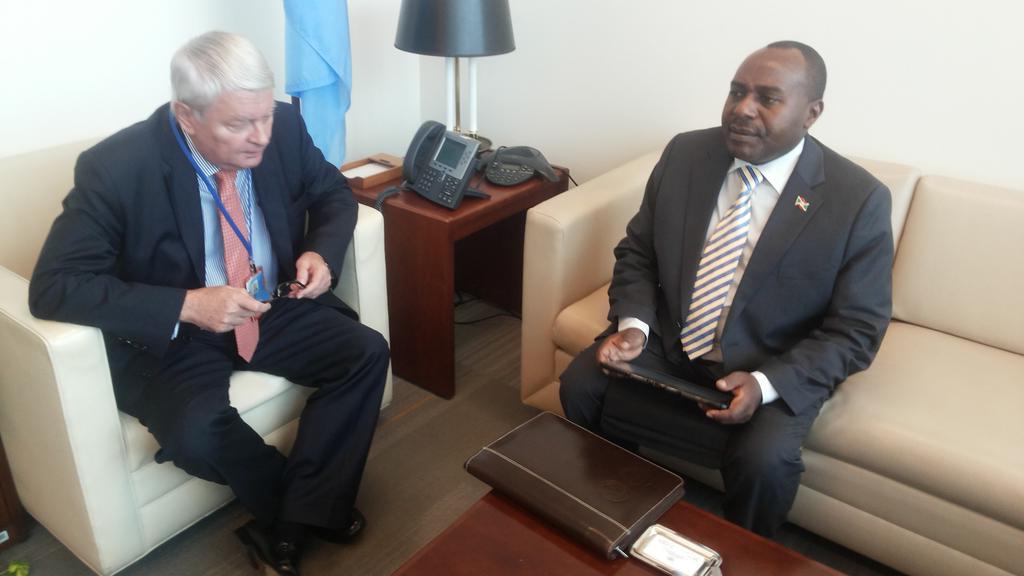
Amid crackdowns in Burundi by security forces, and allegations of sexual abuse by Burundian peacekeepers serving under the UN flag, UN Peacekeeping chief Herve Ladsous on October 1 held a meeting with Burundian Vice President Joseph Butore.

  Inner City Press has already tweeted a photograph of the meeting, but has now received the complete UN read-out, which raises more questions about Ladsous.

   On the crackdown, Ladsous assured Butore that he has a “pragmatic approach” and is of no mind to question what happens in any country, does not involve himself in "domestic affairs."

   On the sexual abuse allegations, Ladsous spoke only in platitudes, without requiring or even inquiring into any actions taken by the Burundians on the alleged abuse.

   Even though Burundi was already given a “grace period” to bring appropriate equipment into the Central African Republic for the MINUSCA mission, they have not done so. In the meeting, according to the read-out, Butore "acknowledged" the substandard equipment.

   Butore requested, and Ladsous for now granted, yet another extension to bring the requirement equipment -- until March 2016 for light equipment, and to June 2016 for heavy equipment.


  Is this safe - even for the Burundian soldiers at issue? While speaking through press releases, Ladsous' spokespeople, far from answering questions, go so far as to direct UNTV boom microphone operators to avoid Inner City Press, even preventing the Press from asking any questions to Mali's Foreign Minister Abdulaye Diop. We'll have more on all this.

Tuesday, February 17, 2015

On Ukraine, UNSC Resolution on Minsk Deal Adopted Just After Press Statement on Debaltseve, New Diplomatic Two-Step Technique?


By Matthew Russell Lee
UNITED NATIONS, February 17 -- Three days into the stated ceasefire in Eastern Ukraine, and  half an hour before a vote on Russian-drafted resolution, the UN Security Council issued a Press Statement. Then it adopted a resolution, 15-0. 
When Security Council president Liu Jieyi of China read the Press Statement out, Inner City Press asked him if it was linked to votes on the resolution. He replied he expected that to be unanimous -- and it was. Lyall Grant of the UK telegraphed it, saying that  he would be voting for it (he asked if the Press Statement had been read out). A new technique?
In the resolution the Security Council, “reaffirming its full respect for the sovereignty, independence and territorial integrity of Ukraine,” says it “endorses the 'Package of measures for the implementation of the Minsk Agreements,' adopted and signed in Minsk on 12 February 2015.”
The resolution “welcomes the Declaration by the President of the Russian Federation, the President of Ukraine, the President of the French Republic and the Chancellor of the Federal Republic of Germany in support of the 'Package of measures for the Implementation of the Minsk Agreements", adopted on 12 February 2015 in Minsk and their continuing commitment therein to the implementation of the Minkk Agreements.”
Referring to the earlier resolution about downed Malaysia Airways flight MH17, the resolution notes it is “reaffirming its Resolution 2166 (2014).”
In the Press Statement, by contrast, "the members of the Security Council expressed grave concern at the continued fighting in and around Debaltseve, Ukraine, which has resulted in numerous civilian casualties.

The members of the Security Council regretted that, despite the announcement of a ceasefire on 15 February, violence has continued in recent days in some parts of eastern Ukraine.

The members of the Security Council called on all parties to immediately cease hostilities and abide by commitments agreed in Minsk, including facilitating access for the OSCE Special Monitoring Mission to monitor and verify compliance with the Minsk Agreements. 

The members of the Security Council further called on all parties to treat detained individuals humanely."
   And so it goes at the UN.
On February 16 the US State Department said
"The United States is gravely concerned by the deteriorating situation in and around Debaltseve in eastern Ukraine.  The OSCE Special Monitoring Mission confirms that attacks continue in this area as well as other locations, including Sievierodonetsk, Luhansk, and Donetsk city.  The Government of Ukraine reports that its forces have been fired on 129 times in the last 24 hours by Russia-backed separatists, killing 5 and wounding 25, including attacks on a convoy evacuating the wounded from Debaltseve.  The separatists have publicly declared that they refuse to observe the ceasefire in Debaltseve, and OSCE monitors have not been provided security guarantees for access."
On this last, the OSCE also said that "The SMM encountered two restrictions to their freedom of movement on 15 February in Donetsk region: on the outskirts of Debaltseve by members of the “Donetsk People’s Republic” (“DPR”) and near Vynohradne (101km south-south-west of Donetsk) by Ukrainian Armed Forces personnel."
  So what of this second denial of access? And what of the pending draft UN Security Council resolution? On February 15 Malaysia's Ambassador said he has requested an amendment about MH17; some said the response would come on February 16. 
 But by 5 pm, the UN was quiet but for a North Korea press conference, here. Watch this site.
  Back when the midnight ceasefire deadline approached, Ukraine's President Poroshenko broadcast from Kiev, and CNN from Mariupol, praising the Azov Battalion. 
  Some in the media seems disappointed the ceasefire wasn't immediately broken. Al Jazeera put on an analyst from the Rand Corporation prediction Russia would break it.
   Twenty two hours later -- with the UN Security Council yet to act on a draft resolution about the deal in Minsk, see below -- UN Secretary General Ban Ki-moon put out this statement:
"The Secretary-General welcomes the start of a cease-fire in eastern Ukraine as agreed on 12 February under the package of measures for implementation of the Minsk accords.

"He notes that the cease-fire appears to be largely holding, giving a desperately needed respite to civilians trapped in the area and contributing to a swift and peaceful resolution of the conflict. However, the Secretary-General is seriously concerned over reports of continued instances of hostilities including in Debaltseve and reiterates his call for all parties to abide by the cease-fire without exception.

"The Secretary-General reminds all of the significance of the cease-fire, which forms the basis for the broader implementation of the Minsk accords and to restore peace and stability to Ukraine."
  At the UN Security Council on Sunday, February 15, there was a vote on Yemen, here, but not on Ukraine. Why not? Malaysia's Permanent Representative told the Press that he had proposed adding language about downed flight MH17 and was waiting for a response from Moscow. Some said this would come on Monday - also a holiday -- at 10 am. We'll see.
  Late on February 14, a Senior US State Department Official provided this read-out:
"In a conversation with FM Lavrov today, the Secretary [Kerry] underscored the importance of full implementation of the Minsk agreements, beginning with a full ceasefire at midnight tonight local time. He also expressed concern about the fierce fighting around Debaltseve, and efforts by Russia and the separatists to cut off the town in advance of the ceasefire. They also discussed negotiations in New York on a draft UNSCR welcoming  the Minsk agreements, as well as Syria."
  The Russian proposed resolution on the "Package of measures for the implementation of the Minsk agreements" is "in blue," and could be voted on Sunday, February 15 at 10 am in New York, as Inner City Press and the Free UN Coalition for Access reported on Friday, here. There is also a (GCC drafted) resolution on Yemen.
On February 13, Inner City Press asked Ukraine's Ambassador Yuriy Sergeyev about the IMF deal and the border, video here.
Back on January 23 the Office of the High Commissioner for Human Rights spoke, belatedly, on pension and travel restrictions imposed by the authorities in Kiev.
  On January 30, Inner City Press asked Ukrainian Permanent Representative to the UN Yuriy Sergeyev about the OHCHR and UN High Commissioner for Refugees' criticisms, about Kiev's requests to the International Monetary Fund and its relationship with the Syriza party in Greece.
  Sergeyev started with this last, saying he understands Syriza has changed its position and will be visiting Kiev. Sergeyev referred to maintaining EU "solidarity." On the IMF, he said Ukraine's new Finance Minister has predicted the country will receive a new tranche from the IMF by the end of February.
  On pensions, Sergeyev said they were cut off because money cannot be delivered into zones not under government control; he said pensioners can receive their money if they leave the zone. But aren't there restrictions?
 On January 23 the OHCHR on pension and benefit payments, on which Inner City Press has reported on since November, said 
"the impact on civilians of the recent decision by the National Security and Defence Council of Ukraine to restrict movement in and out of the areas controlled by armed groups. As of 21 January, people traveling to and from these areas need to obtain special passes and provide documents to justify the need to travel. These limitations are worrying, especially in light of the escalating hostilities. It adds to concerns created by the Government decision in November 2014 to discontinue providing State services in the territories controlled by armed groups. The introduction of such restrictions will likely have a severe effect on the most vulnerable groups, such as older people, mothers with children and people with disabilities who may depend heavily on social benefits. We urge Ukrainian authorities to take immediate steps to redress this situation."
  But will they? UNHCR, the UN's refugee agency, added on January 23 that
  “New security clearance procedures are put in place and specific documentation is now required to pass through checkpoints in the east of Ukraine. These new procedures apply to Ukrainian nationals, the United Nations, NGOs, national and some other international humanitarian organizations.
   “These restrictions on movements within Donetsk and Luhansk regions in the east of the country further complicates an already difficult situation for those forcibly displaced and made worse by the intensified fighting we have seen in recent days,” the UNHCR briefing notes said. “These practices restrict access to non-government controlled areas and limit the delivery of needed humanitarian assistance into the conflict zones. The Ukrainian government has reportedly adopted this resolution which entered into force yesterday (Thursday 22 January) limiting all movements in and out of the conflict zones."
   Christine Lagarde has announced that "the Ukrainian authorities have requested a multi-year arrangement with the Fund, supported by the Extended Fund Facility, to replace the existing Stand-By Arrangement."
   Back on November 12, UN Assistant Secretary General Jens Toyberg-Frandzen said, among other things, that "on November 5, Prime Minister Yatsenyuk announced that pensions would be halted to areas under rebel control."
  Inner City Press, covering the meeting from just outside the Council chamber, spoke to a range of passing diplomats and was left with this question: isn't the halting of pensions to rebel held areas a form of collective punishment?
 Once posed, with the words "accrued pensions," two defenses of the practice came in. First, that pensions in Ukraine are not accrued but are based on taxes collected and none are being collected in Donbas. Second, that trucks with pension payments were being robbed.  The word "Western Union" was bandied around.
  Last October, Ukraine was scheduled to speak at the UN about its “Committee on Information” on October 21, but as UN speeches usually go longer than allowed, its turn was postponed until October 22.
That didn't stop the “UN Radio” Russian service from reporting on the speech on October 21 as if it had in fact been given that day. As translated, UN Radio on October 21 reported
The representative of Ukraine accused Russia of using the information strategy of the Cold War
One of the main prerequisites of violence in Ukraine became a propaganda information. This was stated by the representative of the Mission of Ukraine to the United Nations, speaking at a meeting of the Fourth Committee of the UN General Assembly.”
  The UN's Fourth Committee did meet on October 21 - but Ukraine didn't speak. Instead it was the first speaker on the afternoon of October 22. Its speech, delivered in perfect French including the word “rigolo,” linked Russia to Joseph Goebbels.
  In reply, the Russian mission's spokesman brought up the recent Human Rights Watch report of the Ukrainian government using cluster bombs in and against Donetsk, and the lack of clarity on who called the snipers shots in Maidan Square.
  Later in the Fourth Committee meeting, Bolivia slammed “powers” who use information technology to intervene and violate privacy, bringing to mind USAID's “Cuban Twitter” and, of course, the NSA.
  Then Jordan said it was first among Arab nations to enact an Access to Information law, in 2007. The Free UN Coalition for Access has been pressing for a Freedom of Information Act at the UN, click here and here for that.
  FUNCA covers the Fourth Committee, including on Decolonization, and the Committee on Information, where at least theoretically the UN's descent into censorship could be raised and resolved. The old UN Correspondents Association, a part of this trend toward privatization of briefings and even censorship -- ordering Press articles off the Internet, getting leaked copies of their complaints to the UN's MALU banned from Google's search, here -- was nowhere to be seen. We'll have more on this.


Wednesday, December 3, 2014

For Afghanistan in 2015, Is A New UN Security Council Resolution Needed by Some Countries?


By Matthew Russell Lee

UNITED NATIONS, December 3, more here -- Given the new bilateral agreements between Afghanistan with NATO, and separately with the US, is a new UN Security Council resolution needed?

  Back on October 9, German Defense Minister Thomas de Maiziere said, “We would want to have a UN resolution, a resolution of the U.N. Security Council.”

   Now as the deadline draws near, and it emerges that contrary to what was previously announced the US does envision conducting some combat operations in Afghanistan after the end of the year, the question is whether a resolution will be adopted in the UN Security Council.

   Inner City Press on December 3 asked the ambassadors of both Russia and the United Kingdom about it. Russia's Vitaly Churkin told Inner City Press, “there is anther complicating element. The American operations in Afghanistan on basis of the bilateral agreement with Afghanistan are not covered by this NATO Afghanistan arrangement, and therefore will not be covered by this possible Security Council resolution.”

   He said, “the American seem to have changed their minds. Originally they announced that after this year they would not engage in combat operations. Now there are reports that after all they do envision the possibility of some combat operations. I think that in that context there also needs to be a concern, will NATO be able to stay within announced scope of just training and supporting the Afghani forces?”

 Churkin said that some in NATO now says that a resolution is not absolutely necessary but that “this is required by some counties, both members of NATO and non members of NATO who theoretically would like to participate. But they have their requirements and we have our requirements on the Security Council,” including a substantive end of mission report, and future reporting to the Security Council.

  He concluded that there are too many unanswered questions to say with certainty that the Security Council will be able to adopt a resolution. He said, “there are curtain requirements, we believe, which need to be met. The first requirement is that before we encourage in any way a new operation we need to be updated on the results of the previous operation. At this point there is no assurance that we’ll receive a substantive report. Not just a short sentence that they have completed their mission, but one containing an analysis of what has been accomplished and what has not. This is the first requirement. Another requirement is that we believe that the Security Council cannot simply produce a text of a resolution and let the process go into the blue. We need reports to the SC. And for some reason NATO countries are reluctant to give us assurance that they are going to report their activities to the SC. Without periodic reports to the SC we believe it’s rather strange to endorse something and than to forget all about it.”

  Moments later, Inner City Press asked UK Ambassador Mark Lyall Grant about it, as he headed to the Permanent Five members' meeting room, into which his Australian counterpart Gary Quinlan had already gone in. Lyall Grant told Inner City Press that some do want such a resolution, and that there'll be a discussion. Watch this site.


Saturday, July 19, 2014

As UN's Ban Ki-moon Starts Tour, OIC's Madani Says Gaza's the Key Stop: So Will Ban Go?


By Matthew Russell Lee

UNITED NATIONS, July 19, more here -- On the day UN Secretary General Ban Ki-moon is to "travel to the region" of Israel and Palestine, the following call issued from Jeddah:

"The Secretary General of the Organization of Islamic Cooperation (OIC), Iyad Ameen Madani, asked the Secretary General of the United Nations, Ban Ki-moon to visit the Gaza Strip during his current tour of the region in order to observe first hand the severe damage to innocent human lives, the destructions of homes and infrastructure caused by the unrelenting Israeli raids on Gaza, that have also claimed the lives of hundreds of mostly defenseless Palestinian elderly and children."

  So will Ban go to Gaza?

  On July 18 after the Gaza meeting of the UN Security Council, the Press was sent "the revised draft resolution that will be put before the Members of the Security Council by the Hashemite Kingdom of Jordan, in its capacity as the Arab representative on the Security Council."
  Inner City Press put the document online, here, explicitlycomparing it to Resolution 1860 (2009), which passed because the US abstained but did not veto, as it would later do on settlements. We will stay on this.
  Earlier on July 18 In his briefing to the Security Council, Under Secretary General Jeffrey Feltman droned on for five pages until he said Secretary General Ban Ki-moon “will leave for the region tomorrow, to express solidarity with Israelis and Palestinians and to help them, in coordination with regional and international actors, end the violence and find a way forward.”

 At that very moment, Ban was upstairs meeting with an Italian official. Downstairs, former US official Feltman said that the the UN Relief and Works Agency, UNRWA, “is stretched to the limit, raising fears that further civilians warned of IDF operations could not be accommodated.” 
  Feltman left until the end of his speech to the Council Ban's plan to travel to the region, starting on Saturday.
  But will Ban be going to Gaza?
  Meanwhile the French government has banned a demonstration planned for July 19 about the situation of Palestinians in Gaza. 
  Inner City Press asked UN Secretary General Ban Ki-moon's deputy spokesperson Farhan Haq for the UN's position. Haq said "our general point of view on this is that people have a right to peaceful protest.... We'd have to see how this proceeds, you're talking about something to happen in the future."
  But the ban is already in place.
  While the French government predicts that Saturday's demonstration would be violent, that's akin to prior restraint or profiling. There are have peaceful protests about Palestine in France, for example on July 16.
  But from Niger -- appropriately -- Francois Hollande said “we cannot allow the conflict to be imported into France." 
 Is Ban's UN criticizing France? Is a man biting a chien? Whether a formal statement comes out may be the test.
  So how is a statement of UN Secretary General Ban Ki-moon produced? The question was raised by those, both in the real / outside world and even inside the UN who were surprised by this Ban statement of July 13:
The Secretary-General, abhorring the images of Israeli families hovering in shelters in fear for their children's safety, repeats his condemnation of Palestinian rockets fired from Gaza and demands an immediate cessation of these indecent attacks. The Secretary-General is also deeply worried about the impact on Palestinian families of Israeli military action.”
   Several UN officials expressed surprise or even "disgust... at putting Israel first despite no deaths versus 180 in Palestine, abhorring the first but only 'deeply worried' about Gazans."
  And so based on complaints and reporting, Inner City Press can say that such statements are said to originate with a desk officer in UN Department of Political Affairs, run by former US diplomat Jeffrey Feltman.

  Then they are reviewed, on the Middle East, by Antonella Caruso, then Feltman, then in Ban's office one Andrew Gilmour. That's how this statement was issued, Inner City Press is informed.
  On July 12 at noon the UN Security Council issued a press statement on Gaza, after several rounds of back and forth. After that, nothing stopped -- nothing at all. 
  Just past noon in New York Inner City Press asked the State of Palestine's Observer Riyad Mansour of the status of the (stronger) draft resolution, and if he expects US Secretary of State John Kerry to mediate or facilitate.
  Mansour said if Israel does not stop, other steps will be taken including in the Security Council.
  Hours later, the Israel Defense Force itself confirmed to Ha'aretz and others that "Israel Navy's Shayetet 13 (Flotilla 13) commando unit raided a target in the Gaza Strip."
  Now what?
  A Gulf media demanded an explanation of the three hour delay, then asked another question to Mansour and the Saudi Ambassador beside him.
  Tellingly, hours later that same Gulf media posted online a story about the UN Security Council press statement quoting Reuters, not present at the stakeout, about the statement.
  Meanwhile, Reuters claimed a (compensated) "exclusive" about Jordan and the US on Syria -- without even mentioning the two countries' negotiations about the Gaza output(s) of the UN Security Council. 
  Informed sources told Inner City Press that while the US, or "Washington," initially said they would accept no Security Council action at this point, once an emergency meeting of the Arab Group moved for a draft resolution, the US changed tack.
  "The US doesn't want to have to veto, so they can continue to point the finger at Russia and China on Syria," as one source put it.  So the US agreed - or was said to agree -- to a press statement calling for a ceasefire.
 
  The source went on "If Israel disregards it and continues, what will the Council do?" What, indeed. 
.
  Inside the Security Council on July 10, Israel's Ron Prosor told BanKi-moon that while he had given his speech, five rockets had been fired at Israel (Prosor played a rocket warning siren on his phone, to make his point.) At the stakeout, on-camera, Prosor raised the number of rockets to six.
  While Palestine's Riyad Mansour spoke on camera, the stakeout was nearly full with journalists. But when Prosor spoke there were far fewer -- one of whom told Inner City Press, “This is a question for FUNCA,” the Free UN Coalition for Access. Again Prosor played the rocket siren warning, and used the line “From Abuja to Falluja.”
  Inner City Press asked Prosor about those who say Hamas is not formally part of the unity government; he replied, “Hamas is Hamas.”
  On Palestine joining or complaining to the International Criminal Court, Inner City Press' question which Ban Ki-moon dodged on July 9, Prosor did not answer. Yet.
  Watch this site.


Wednesday, February 13, 2013

On North Korea, China Tells ICP Process May Not Move Fast, DPRK Feels Threatened


By Matthew Russell Lee

UNITED NATIONS, February 12 – After the Security Council on Tuesday morning issued a press statement about North Korea's nuclear test, many predicted a quick and straightforward process toward adopted a full Council resolution.

   Inner City Press, as it did on the January resolution, sought the views of the Chinese delegation. 

  Asked about the comments made by the US' Susan Rice, the response, exclusive to Inner City Press, was that it does not depend on one side, it depends on 15 members. You have some positions, let's adopt a resolution as soon as possible. You can say that, but it depends on many factors: what you propose, what's the content of resolution? How we can conduct our negotiations?

Then a perspective of Pyongyang was proffered: they have their concerns, they feel they are threatened by certain countries.

 How does a resolution such as appears is being asked for address that? Have the current sanctions against North Korea been effective? Not enough to stop this third test, that much is clear.
  
Will South Korea holding the Security Council presidency this month, beyond being seemingly linked to North Korea's test or at least its timing, allow them to better impact a resolution? 
  
They have sent a lot of staff to the Council. But if the last resolution is any guide, it is largely a game between the US and China, with Russia having some say at the end.

The US' Susan Rice was asked about the difference between this time and the past two nuclear tests. 

 She said, “North Korea continues to violate repeated Security Council resolutions and that in itself makes this different.. they are not acceptable, they will not be tolerated, and they will be met with North Korea's increasing isolation and pressure under United Nations sanctions.”

   More than eight hours after the press statement and stakeouts, speeches continued in the Security Council on the topic of the Protection of Civilians. But the Presidential Statement on that had already been adopted, and most of the Permanent Representatives, other than those speaking were long gone. And so it goes at the UN.