Showing posts with label rycroft. Show all posts

Saturday, October 7, 2017

As Cameroon Kills Civilians, ICP Asks UN & UK, Crackdown Continues, Failing Fall


By Matthew Russell Lee, Photovideo


UNITED NATIONS, October 7 – When Cameroon's President for the past 30-plus years Paul Biya came to meet Antonio Guterres on September 22, before he went back to the Hotel Inter-Continental in Geneva, he was accompanied by his state media and... Inner City Press. Biya, still in Geneva, directed his forced to use water cannons and more in Buea, as they shoot to kill from helicopters in North-West and South-West Cameroon. 

Now on October 7-8, despite belated calls from Geneva and an unapologetic Guterres, restrictions on movement and free association are being extended, for example in Manyu Division, Mamfe Town and elsewhere, see here. Will there be any follow through by the UN on its statements, or just more "welcoming" of Biya? When will the already postponed visit by the UN's Francois Fall occur, to where and with whom, and what will it accomplish? 

On October 5 Inner City Press asked UK Ambassador Matthew Rycroft, who earlier this year told Inner City Press the UK did not view the situation in Cameroon as a threat to international peace and security but would continue to monitor it, if the threshold has been reached and the UK will ask for a UN Security Council meeting. Periscope video here. He said no one has asked and the UK continues to weigh thpro and con of putting it on the Council's agenda (along with Myanmar, Guinea Bissau, Haiti, Colombia and others). Earlier Inner City Press asked Francois Delattre, the UN Ambassador of France and President of the UN Security Council for October, why he has not yet convened a Security Council meeting amid the killings of civilians and cutting off of social networks in Cameroon. Periscope video here. Delattre said the French Foreign Ministry's spokesperson has spoken earlier in the day, again calling for dialogue. We'll have more on this. Guterres' spokespeople have three times refused Inner City Press' request for the UN's estimate of how many people have been killed by Paul Biya's forces since Guterres offered him praise on September 22. Now, the US State Department through its spokesperson Heather Nauert has said, "The United States is deeply concerned about violence and the loss of human life in protests that have taken place in the Northwest and Southwest regions of Cameroon since October 1.  The Cameroonian government’s use of force to restrict free expression and peaceful assembly, and violence by protestors, are unacceptable.  We urge the Government of Cameroon to respect human rights and freedom of expression, including access to the internet.  We call on all sides to exercise restraint from further violence, and engage in dialogue for a peaceful, durable resolution." Tellingly, the Secretary General of the Francophonie Michaëlle Jean has while expressing "concern" said that "Violence should never be a means of expressing grievances." So Biya, who is killing, is doing so to express grievances? Or "pour se fair entendre"? We'll have more on this. UN High Commissioner for Human Rights Zeid Ra'ad Al Hussein said nothing. Nothing, from a man who issued a statement about critical tweets directed at a UN official. His New York representative, as Inner City Press reported at the time, was not (invited to be?) present at Guterres' now infamous grip and grin meet with Biya on September 22, 2017. What has been the role of the totally untransparent UN Department of Political Affairs, under Jeffrey Feltman? Today's UN system is hypocritical, and failing. In Mamfe and elsewhere, Republique du Cameroun forces are reportedly shooting people in the feet and legs to prevent their peaceful protest, while Guterres tells Anglophones to take advantage of this "opportunity" and be sure to stay with the LRC Constitution. Tell that to, as only one of many examples, Benjamin Amin, a young tech-savvy Anglophone who returned from studies in India only to be shot and killed by Biya's forces in Kumba on October 1. Inner City Press on the morning of October 3 again asked Guterres top three spokespeople, "what is the UN's estimate of the number of civilians killed since September 27? And what is the UN's awareness of the Cameroon government's restrictions on the media and other attempts to restrict freedom of association, speech and belief? Where does the UN understand President Paul Biya to be, and his role in these restrictions? On deadline." Lead spokesman Dujarric replied, "On Cameroon, we have nothing to add to what I said at today’s briefing" - which, beyond the previous night's canned statement, below, was: "the issue of Special Rapporteurs is one that the Secretary-General… that's outside of the authority of the Secretary-General.  I think we've had a number of diplomatic contacts at various levels with the Cameroonian authorities.  We've expressed our concern at the ongoing situation, especially at the violence and at the loss of life that we've seen.  We've seen that the authorities have called for dialogue, and we encourage those leaders in the anglophone community to seize that opportunity." Who is seizing whom? Previously with the UN silent for more than a day after Inner City Press submitted written questions to it on Cameroon  - its High Commissioner for Human Rights Prince Zeid spoke on Catalonia but not Cameroon - Amnesty International issued a statement that "the reported unlawful killing of several people in the Anglophone regions by the security forces coupled with the blocks on Facebook and WhatsApp represent an extremely worrying escalation of the government’s on-going campaign to silence any form of dissent in the West and South-West regions of Cameroon." At the UN's October 2 noon briefing, lead UN Spokesman Stephane Dujarric wasn't there; his deputy Farhan Haq had nothing at the top, vaguely alluded to statements, no answer. Haq emailed Inner City Press: "On Cameroon, we are awaiting a statement, which should come out shortly; maybe not by noon, though." By 10 pm, still nothing. Finally at 10:30 pm, 29 hours after Inner City Press asked the UN how many civilians it acknowledged Biya has killed, the UN issues this with no estimate: "Further to his statement of 28 September, the Secretary-General remains deeply concerned about the situation in Cameroon and strongly condemns the acts of violence reported in the South-West and North-West regions of the country on 1 October, including reported loss of life. He calls on the Cameroonian authorities to investigate these incidents and urges political leaders on both sides to appeal to their followers to refrain from any further acts of violence, and to unequivocally condemn all actions that undermine the peace, stability and unity of the country. The Secretary-General takes note of the calls by the authorities for dialogue and encourages representatives of the Anglophone community to seize the opportunity in their quest for solutions to the community’s grievances, within the framework of the Cameroonian constitution. The Secretary-General reiterates the support of the United Nations for such efforts, through the United Nations Regional Office for Central Africa (UNOCA)." Pathetic. Or to be more charitable, too little too late. Meanwhile the UN's Resident Coordinator in Cameroon was robo-tweeting pablum about World Non-Violence Day, and France's Ambassador Gilles Thibault was expressing support to Yaounde (for flora and fauna). Inner City Press asked the UN Resident Coordinator Allegra Baiocchi for her response - none yet - noted the similarity to the UN's silence in Myanmar and emailed the UN's top three spokespeople: " In light of the government crackdown on communications and unarmed civilians in North-West and South-West Cameroon, after the UN's readout of September 22 and subsequent statement of concern, this is a request for the UN's already belated response to the government's killing. How many people does the UN acknowledge have been killed? What is the UN, both the country team and the wider UN, doing?" The lead spokesman provided this interim response: "We will try but may not have answers until tomorrow." Inner City Press has asked that any and all information be emailed to it as soon as available. More than 12 hours later, from the UN, nothing. Watch this site. According to the UN read-out, the September 22 conversation was entirely positive and did not mention Biya's abuse of Anglophones, or human rights in any way. Now on October 1 Biya's forces have opened fire from Buea to Ikiliwindi, Mamfe to Nkwen, Ndu to Nguti. Still, grainy footage has been sent to Inner City Press of Ambazonia independence celebrations in Bamenda despite the orders against freedom of association and movement, and ultimately freedom of speech and of belief. Biya has again undermined the Internet and rights to communicate in Southern Cameroons, to which Inner City Press after asking the UN  four days in a row until exclusion now turns. Here is a letter sent not only to Inner City Press, but to the UN Office of the Spokesperson: "I am writing from Southern Cameroons. I am pleading you should use your high office to stop the genocide that President Biya wants to exercise on the English speaking Cameroonians. a lot of people have lost their lives already and yet the President of Cameroons is seriously planning to shed more blood.  The truth is clear, the people of southern Cameroons (English speaking ) was a country  of its own that legally voted to joint La Republic of Cameroon. But now La Republic of Cameroon are treating these people as if they colonize them or conquered them in a war. sir use your conscience, it could have been your family going through what we are going through. Where is human rights in the 21st Century where people of a particular nation turns to treat their fellow brothers and sisters as slaves and the whole world is reacting as if there is nothing happening Does it mean that if tomorrow if I'm in one top position in the world that has to deal with the society i will give deaf ears to a situation that has to do with millions of lives ? what is wrong with the world today? where is human right? there is no justice at all? is it that human lives no longer matters? Please kindly react to stop the genocide that is about to happen in 48 hours." No response from the UN. Here is another letter: "Dear Matthew Russell Lee, Inner City Press: Accept my greetings and that of those who can't write to you. I am writing to you from Buea, Southern Cameroons. Am reacting to your articles on September 28 concerning the crisis in Southern Cameroons. The approach of the UN concerning the Southern Cameroons and it people, proves time and again that the UN must be very corrupt, and have turned it back against in commitment to protect human rights freedoms, and states sovereignty. How can the Secretary General be talking of his to consolidate peace and the Territorial integrity of Cameroon, when knows very well that, the UN holds no legal treaty that binds the British Southern Cameroons with LA Republique DU Cameroun? I hereby want to inform you that, I, as well as an overwhelming majority have chosen to separate from la Republique DU Cameroun because of what we have gone through in 56 of forced union. If the government of la République du Cameroun, considered us Southern Cameroonians as a people with the same rights as Francophones, if the government wanted to make peace and resolve this problem from it core, I think the repression taking place now won't have been. While you published on the Cameroon crises yesterday, the government of la Republique DU Cameroun became violently repressive and attacked and beating people their homes, taking seizing money and smart phones, and taking them to jail. As am writing to you now, six people were shot yesterday in the town of Ekona, and a grandmother was killed by the military in her home. 14 years old kids are being arrested and detained in jails under very cruel conditions. Since the beginning of this crises since November last year, 112 people have been killed by the military of la Republique DU Cameroun. The la République du Cameroun's government have been using terrorism blackmail the peaceful protests. I hereby call on the Secretary General to read the the UN charter on human right and freedoms, and the right for self governance." Biya's renewed attacks on the Internet have ranged from Bamenda to Kumbo and Kumba, but are being circumvented by VPNs. Meanwhile Inner City Press is receiving video of protests in front of the Inter-Continental Hotel in Geneva where Biya is staying. Guterres praised Biya, then belatedly called on him to dialogue: while Biya is not even in the country. His landing in Geneva: "VP-CAL used by #PaulBiya, President of Cameroon (Boeing 777) on 2017/09/26 at 08:56:46." We ran this sample letter to Inner City Press: " woke up this morning and discovered Internet Services in Cameroon have somehow been limited. I am suspected the regime of Paul Biya have tampered with the internet service and Facebook, Twitter,  WhatsApp, VPNs, Vcontact  aren't working. I am sure many other social media have been cut off as well.
There have been plans to celebrate the symbolic independence of this region 'the Former British Southern Cameroons' on the 1st of October 2017. That is on Sunday and the region have been heavily militarized by the Biya regime, Homes of people invaded, beaten , some killed, many kidnapped and with this shutdown to major social media to  which it is where most of these crimes are exposed, many have been fearing a total Genocide that can be perpetrated on the people of that region. There were rumors that, the internet will be shutdown come 30th September. The Minister of Communications made a public communique two days ago to say, the internet won't be shutdown but I guess it was just a ploy as through some websites are working, major social medias ( Facebook, Whatsapp, Twitter) have been cut off. Please, make the world know what is happening in this region. This is a sly move to blackout to the world what atrocities the Biya's regime is/will be perpetrating in these regions."  In Fiango, Biya's security forces have killed, reportedly Enogene Basile, following their September 28 killings in Ekona. Watch this site. Inner City Press on September 26, 27 and 28 asked Guterres' spokesman Stephane Dujarric about these glaring omissions. The first time, Dujarric alluded to "private" diplomacy. Then on September 27 when Inner City Press asked ask, video here, Dujarric said that UN envoy Francois Fall will be going to Cameroon "next week." On September 28, Inner City Press asked Dujarric deputy Farhan Haq if this would be before or after October 1, and Haq said he didn't know. Hours later, Dujarric's office put out a statement of concern below, which many see as too little, too late, with its emphasis on territorial integrity. On September 29, Inner City Press asked Dujarric not only about the UN's surveillance of the Press, on which he refused to answer referring to the question to the UN Department of Public Information whose chief Alison Smale has refused to answer basic questions for a month (now keeping a close eye on Catalonia, if not blatant crackdowns in Cameroon), but also if Guterres' concern is at threats to those in Anglophone Cameroon to stay indoors or be treated as "terrorists," for citing UN General Assembly Resolution 1608. Video here. Dujarric replied that he doesn't have "granularity" about what's being done and said. But he put this out: "The Secretary-General is deeply concerned about the situation in Cameroon, including with regard to the recent security incidents in Bamenda and in Douala, and mounting tensions in the South-West and North-West regions related to planned events on 1 October. The Secretary-General has encouraged the Cameroonian authorities to continue their efforts to address the grievances of the Anglophone community. He urges the authorities to promote measures of national reconciliation aimed at finding a durable solution to the crisis, including by addressing its root causes. The Secretary-General supports upholding the unity and territorial integrity of Cameroon and urges all parties to refrain from acts that could lead to an escalation of tension and violence. The Secretary-General believes that genuine and inclusive dialogue between the Government and the communities in the South-West and North-West regions is the best way to preserve the unity and stability of the country.  The Secretary-General stands ready to support these efforts, including through the United Nations Regional Office for Central Africa (UNOCA). " We'll see. On September 26, Dujarric replied that Guterres would say there is a time for public diplomacy, and a time for private diplomacy. Video here. Some wonder, how many people have to die, or what kind of people, for it to be time for UN "public" diplomacy? Earlier on September 22 Inner City Press interviewed Southern Cameroonians out on 47th Street, then asked Guterres' spokesman Stephane Dujarric about people killed that very day. UN transcript here and below. The crackdown is also financial: Biya's Minister of Finance has threatened the National Frincne Credit Bank in Bamenda with loss of its license for taking part in the "Ghost Town" expression of desire for independence, or in the first instance a referendum. See letter here. This politicization should trigger action by the "decision making phere" [sic] written about by Biya's state media, the kind of media that the UN and now its new head of Public Information favor over independent press. From the September 22 UN transcript: Inner City Press:  there’s a protest right now of Southern Cameroonians on 47th Street, but more importantly, there’s one in Southern Cameroon where five people have been killed today, as Paul Biya gave his speech, so I’m wondering…  I know the Deputy Secretary-General had some interest in the issue.  There’s Mr. [Francois Lonseny] Fall.  Are they aware of these protests? Spokesman:  "We’ve seen the reports I think we would definitely… we would call on the authorities to show restraint and ensure that people have the right to demonstrate freely." But on the UN's 27th floor, it was all smiles. And much later the UN put this read-out on its website: "The Secretary-General met today with H.E. Mr. Paul Biya, President of the Republic of Cameroon. The Secretary-General appreciated Cameroon’s hospitality towards the refugees.
They discussed the latest political developments in the country, as well as regional issues, including Boko Haram and the situation in the Central African Republic. The Secretary commended Cameroon for its efforts to combat Boko Haram, and reiterated the readiness of the United Nations to support the Government in all areas." No mention of the Anglophone areas, much less the day's killings. This is a new low, even for today's UN. UN Department of Political Affairs chief Jeffrey Feltman had left the floor with the Australian delegation; it was unclear if any UN Human Rights official was present. One of Biya's handlers even signed the UN visitors book in advance for him. When Guterres greeted his next visitor he did so in French then apologized, the last meeting was in French. Back September 19. Guterres ended with two photo ops. The first was Paraguay's President Horacio Manuel Cartes Jara, who spent a long time writing in the UN's visitors' book, followed by a short meeting. Alamy photos here. Next and last was Uzbekistan's President Shavkat Mirziyoyev. Guterres said pointedly, just the signature. But something was lost in translation: he still started writing. Alamy photos here. Then the Press was ushered out. Already on the way in before the Paraguay photo op, the Media Entrance on 47th Street was locked. The questions about double standards of media access, including retaliatory restrictions still in place on the investigative Press 
while no-show, no-question state media like Egypt's Akhbar al Yom have full access have yet to be answered by the official now responsible, Alison Smale. According to a photographer allowed into the smaller "G-200" room, Smale was there to greet "her" Prime Minister, Theresa May. 

Monday, February 29, 2016

On Syria, Annexes to Last Minute, France Wanted In, Sources Tell Inner City Press


By Matthew Russell Lee

UNITED NATIONS, February 26 -- When the UN pulled the plug on the Intra-Syrian Talks, or as envoy Staffan de Mistura said merely pushed them back, de Mistura said that the UN "is not prepared to hold talks for the sake of talks."

  Then de Mistura was scheduled after delay to brief the Security Council on Friday, February 26 at 3 pm, in connection with a vote on a US - Russian draft Inner City Press had seen.

 After a delay described below, de Mistura briefed by video, saying he intends to re-convene Intra-Syrian talks on March 7.

  The Council approved the resolution 15-0, Russia's Gatilov spoke of strict implementation, and the need for "immediate" talks.

 At 2:40 pm, UK Ambassador Matthew Rycroft was in the hall outside the Council, talking heatedly into his cell phone. Another Council diplomat, on background, said there would be a delay of at least 30 minutes or an hour - someone didn't agree.

 Inner City Press was told by sources it was to renegotiate the annex of groups.

Now Inner City Press has been informed of more. In the public session, UK Matthew Rycroft said "The HNC represents a broad sweep of the opposition forces fighting in Syria against the tyranny of Asad. They deserve our whole-hearted support, which regrettably was not reflected in this resolution."

  Other changes were to the Cairo and Moscow platforms. But, the sources tell Inner City Press, the country which occasioned the delay was.... France.

  France was miffed to have been left on the sidelines by the Russian - US bilateral negotiations. Similarly miffed to have been left on the sidelines of the US - China negotiations on North Korea? Strange how when elected members complain, for example about their exclusion from the so-called "Group of Friends on Western Sahara," France is unconcerned or happy. Now, they feel excluded...  We'll have more on this.


 On February 19, Russia convened a UN Security Council meeting and proposed a draft resolution on the sovereignty and territorial integrity of Syria. Western powers, as they're called, were dismissive the draft.

  Here's some of what Turkey's Permanent Representative said, as fast transcribed by InnerCityPro.com:

"The fighting, it’s not only bombing militarily, hospitals, schools, medical facilities, are being bombed, after the Russian Federation’s intervention in the war, the majority of the civilian casualties are caused by this intervention. So it is, the resolution is there, so why do we need another resolution in that regard? When I see the text I found it... silent on the humanitarian issue.

 "For us, any terrorist organization is a terrorist organization, full stop. For PYD they seem to try to get legitimacy by seeming fighting with Daesh. Actually this is not the case... For us, fighting against another terrorist organization does not give legitimacy to any terrorist organization."

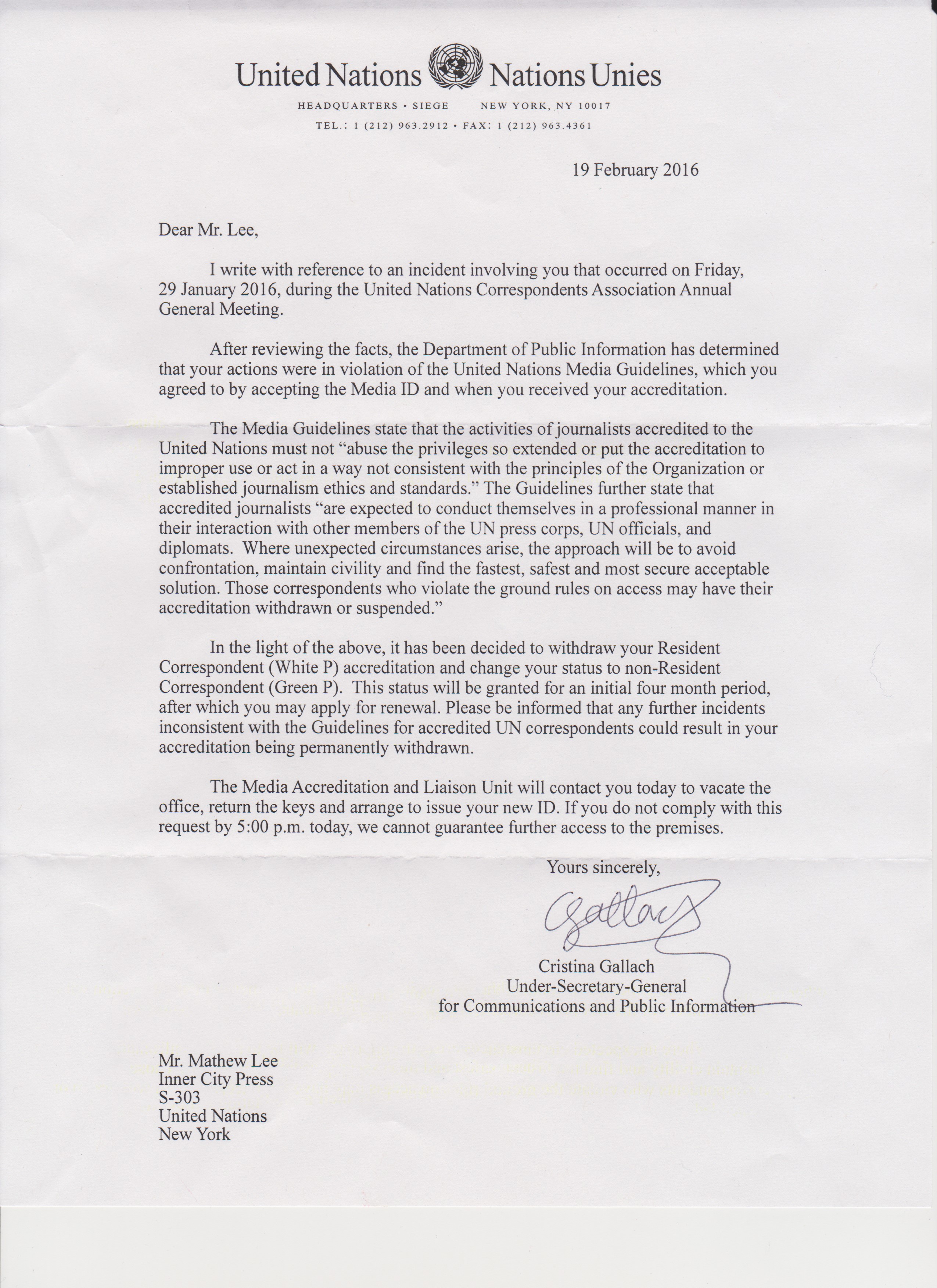
 Here is what US Ambassador Samantha Power said, as transcribed by the US Mission - which is aware of the UN trying to eject investigative Inner City Press for covering a meeting in the UN Press Briefing Room, UN letter here:

"Quick comment in my own right, which is that what’s really important is that rather than trying to distract the world with the resolution they just laid down, it would be really great if Russia would implement the resolution it’s already agreed to. We have Resolution 2254, we all came together in the Council before the end of the year, we all united around its provisions, and our emphasis should be on implementation.

Right now, we have a bombing campaign in the northern part of Syria that is hitting hospitals, that has caused mass displacement, more than 70,000 people gathering now at the border – huge suffering. We need to focus on implementing 2254. It’s incredibly important that there’s de-escalation, that all parties use restraint and show restraint.

But this is a distraction from the core fact, which is that 2254 needs to be implemented. We have a resolution on the books. It’s the right resolution. We’ve committed ourselves to it, and we need Russia to do the same."

 Inner City Press -- in the middle of being thrown out of the UN for seeking to covering meetings in the building, click here for that -- talked its way through a UN Security block at the Council stakeout and asked Turkey's Permanent Representative Cevic if his country would send in ground troops. He said only if part of a multinational force.

  Also at the stakeout - with a UN Security "minder" still trailing Inner City Press, like one of Ban Ki-moon's thought police as one wag put it -- Inner City Press asked the President of the Council for February, Venezuela's Rafael Ramirez, if he would convene and emergency meeting if Turkey or Saudi Arabia were to send in ground troops. He said yes, he would convene such a meeting.

  But as things stands, even with Ban Ki-moon's censor Cristina Gallach receiving calls to delay and reverse her decision, Inner City Press could not cover such an emergency Security Council meeting.

  We'll have more on all this.

 On February 16, Inner City Press asked Syrian Ambassador Bashar Ja'afari about de Mistura's and Ban Ki-moon's explanations of why those talks ended - and about the UN saying Ban was misquoted in or misinterpreted by the Financial Times.

  Ja'afari said that the UN would rather blame itself than the opposition, because then the UN would get push-back from “Westerners.” Ja'afari said that de Mistura's deputy only provided him with a partial list of the opposition delegations as the talks were ending. Ja'afari called them badly organized.

  Before Ja'afari spoke, the Security Council's president for February Rafael Ramirez of Venezuela told reporters that the Council's members agreed to tell Turkey to comply with international law. Associated Press - click here for AP's UN rape reporting on Feb 15 - asked if that meant all members.  All to different degrees, was the answer.

Wednesday, January 27, 2016

Missing Persons Meeting of UN Security Council Had Burundi and Sri Lanka, Renditions and North Korea


By Matthew Russell Lee

UNITED NATIONS, January 27 -- With “Missing Persons” the topic of the UN Security Council's Arria formula meeting held in UN Conference Room 3 on January 27, Inner City Press expected the disappeared in countries such as Sri Lanka and Burundi to be brought up.

But the meeting, while called “open to the press,” was not on UN Webcast or in-house TV.  So Inner City Press went down and broadcast it live on Periscope, here, in the spirit of the new Free UN Coalition for Access: open the UN.  

UN High Commissioner for Human Rights Zeid brought up disappearance in Burundi; the deputy representative of New Zealand said that (mass) graves in Burundi should be preserved.

  US Ambassador Samantha Power focused on the disappeared in Sri Lanka and Mexico. On the former she cited a mother in Jaffna whose daughter was taken away by men in military garb. One wondered why there is so much praise of new president Sirisena even as he bans “foreign” or international involvement in looking into war crimes including disappearances.

  Japan brought up its abductees in North Korea. Malaysia cited “rendition” - there was no reply - and Senegal said it has had or prosecuted no cases of enforced disappearances, citing Casamance. France bought up Syria.

  Ukraine cited Donbas; Russia replied that the meeting went beyond the mandate of the Security Council, consider not only missing people in conflicts but also migrants and others, politicized.

  There was little time for the 178 member states not on the Security Council, much less for the impacted public. Inner City Press' Periscope stream triggered a sample question about Burundi, on whether the responsible government could be trusted to preserve (its mass) graves. Luxembourg spoke, then Italy emphasized that those missing on its territory are not Italians.

   Cyprus was asked, apologetically by the chair, the UK's Matthew Rycroft, to say a final line. Still on the list were Belgium, Serbia and Chile -- and last of which was until recently on the Council. Still it was interesting: thePeriscope, at least for the next 23 hours, is here.

Monday, January 25, 2016

On Burundi, Inner City Press Asks PR Rycroft Of UK Minister James Duddridge Pushing for EU Sanctions, Rycroft on 3 Ds


By Matthew Russell Lee

UNITED NATIONS, January 25 -- After UN Secretary General Ban Ki-moon on New Year's Eve issued a statement praising the Burundi “talks” held in Entebbe, Uganda, multiple sources told Inner City Press these not really talks but rather a photo op. The January 6 session announced for Arusha did not happen.  Inner City Press requested to cover the UNSC's trip to Burundi, but was UNtransparently rejected.

  On January 25, with the Security Council having returned from a trip widely called “disappointing,” Inner City Press asked UK Ambassador Matthew Rycroft about a written statement by the UK Minister for Africa James Duddridge that if Burundians continues to refuses to come to the negotiating table, the UK will push for EU sanctions against those blocking progress toward peace. Letter herehere.

  Rycroft said the focus of the trip has been on the three Ds -- dialogue, de-escalation and deployment, adding that the deployment wouldn't have to be exactly what was first proposed and mentioning the (blocked) observers. Video here. Here's UK transcript:

Inner City Press: does the UK favour sanctions if the Burundi government doesn’t move towards talks? A UK Minister was quoted to that effect.

PR Rycroft: What we were talking about on the visit was the 3 D’s, for dialogue, de-escalation and some form of deployment of an international presence. And that’s what we are focusing on at the moment. And unfortunately we didn’t get a huge amount back on the visit. I think there are a few openings on each of those. But it is absolutely crucial that the government of Burundi takes the initiative to de-escalate, takes the initiative to reach out, not just to its friends but to its enemies as well to begin a genuine dialogue with international mediation and is open to some form of deployment of an international presence. It doesn’t have to be exactly what was first proposed by the African Union, but it does need to be something, including as a first phase observers, monitors to really improve the human rights situation and other areas of concerned.

  We'll have more on this.

Inner City Press asked the UN about the trip on January 20, 21 and 22. The UN spokespeople refused to provide Press-requested information, but the Council also met with at least some of the concerned members of civil society, and some journalists who inevitably raised the issue of attacks and censorship.

  Inner City Press has interviewed attendees of the Council's meeting with journalists, where the closures of radio stations RPA, Isanganiro and
Renaissance were raised, leaving the journalists to use social media (unlike the three scribes from Reuters, VOA and AFP handpicked to accompany the Council). Invitations to the meeting and information went out from the Communication Officer of the US Embassy in Bujumbura. Interviews were conducted, too, with representatives of Uprona and Frodebu parties.

 Attacks by the Imbonerakure youth militia, the existence of which was denied by Pierre Nkurunziza, were raised. But the accompanying the Council scribes barely covered this. We'll have more on it.

  The UN Country Team in Burundi is now led by Paolo Lembo, who also served in Yemen where Special Adviser Jamal Benomar did. Neither Lembo nor the shadowy "UNIC Bujumbura," however, arranged for a video or even audio steam of the Council's and Burundian government's press statements. We're told that Ambassador Albert Shingiro, who blocks the Press on Twitter, told the scribes that US Power said she would send “a strong message to the government of Rwanda." Again, Shingiro blocks the Press on Twitter: some diplomat.

  One of the four handpicked pass-throughs opined that "the fact that Council members presented Nkurunziza with a largely unified message on the different issues was seen as a positive sign that they had come closer to a common position." So they traveled to Burundi to work on their own issues? We'll have more on this - and on the Council's junket-ending meetings in Addis, if not on Oromo protests, than this we've asked about. Watch this site.

On January 22 -- at 4:32 pm in New York, four minutes before Inner City Press then publshed it -- the UN has issued this Note to Correspondents:

"Security Council members just departed Bujumbura less than an hour ago. The delegation is headed to Addis to meet with the Peace and Security Council of the African Union tomorrow.

"Council members met with a range of stakeholders during their visit to Burundi, including the President, First Vice President, Foreign Minister and representatives from political parties, the media, and civil society organizations. The Council also met with religious leaders.

Special Adviser Jamal Benomar is in Burundi. The core group of his team called for in Resolution 2248 deployed to Bujumbura and will be engaged with all stakeholders to support dialogue and address security concerns."

 How?

   On January 22, Inner City Press asked UN Deputy Spokesperson Farhan Haq for the UN's response to Pierre Nkurunziza denying the existence of his party's youth militia, and why there was no video or even audio stream of the Security Council's - and Nkurunziza's -- press statements. Video here.

  Haq replied that "the facilities are difficult," that the UN Spokesperson's Office had reached out to the traveling party for information but hadn't gotten any. The Free UN Coalition for Accesscalls this a failure.

 On January 21 Inner City Press in New York learned both of Pierre Nkurunziza plans to parade "community work" for the Security Council members on January 22 and has been provided with a letter promoting same, here.

  On January 22, even after the Council's meeting with Nkurunziza was over, when Inner City Press asked the UN for a read-out there was none, nor any good explanation of why the UN with its country team could not arrange at least an audio stream of the Council's (and Nkurunziza's) press statements.

  Inner City Press asked the head of the Campaign Against the Third Term (“Halte au troisième mandat”) Vital Nshimirimana about the UNSC visit, and why the AU human rights observers are not yet in place. His answers to Inner City Press:

"As for the deployment of the AU Human rights observers, I would recall that the same was decided back in June following the June 13, 2015 Johannesburg Summit on Burundi. Initially, the number was to be about 70 observers but the government refused and allowed a narrow team.

"My thought over the issue is that Nkurunziza has chosen to humiliate everybody in as much as he does not care about any principle or value. So, the AU and other bodies as well choose to deal with him very carefully for he is a man (and a regime) "irrational," likely to commit whatever crime, insult whomever.....

"With regard to the UNSC visit, I hope this is the very last warning towards a kind of regime likely to commit genocide. They are expected to dually and objectively assess the situation and especially the strength and presence of Imbonerakure, the CNDD-FDD militia.... And this was shown through a huge anti- peacekeeping mission mission to Burundi, MAPROBU rhetoric.
Burundians expect the UNSC support the deployment of such a mission in line with the responsibility to protect (Pillar III) since Burundi is no longer able and is unwilling to protect citizens from crimes against humanity (ongoing from April 2015) and genocide (of which dozens of signs suggest that it is likely to happen and some acts are already undertaken).

Lastly, the UNSC is expected to talk with Nkurunziza and the AU as well regarding peace talks. They should assess Museveni's performance, after what conclude that he should be assigned AU and UN teams (to enhance his capacity) or change him.... I commend your endeavors to keep the world informed about the Burundi crisis."

 We'll have more on this -- including in light the UN Deputy Spokesperson's response to Inner City Press that transcripts may be provided.

  Here are parts of an Inner City Press interview with a journalist attacked by the Nkurunziza government and for that reason anonymous:

In English: "It would be better if the Security Council met for example UPRONA leader Nditije Charles, with the non-governmental branch of the UPRONA party) or his Spokesman Thacien Sibomana. The Council should try to meet civil society but  there is almost no one left to really speak with now in Bujumbura. All those still in Bujumbura, they can't say anything about the abuses of authorithies. If it was possible, they should ask to meet the young men in prison. They should see themselves how the government abuses those young men, with tortures... Tell them visit to the prisoners in Gitega (those who are accused to attempting a coup d'etat) UN has the right to visit prisoners."

  Inner City Press note: another source says "the government moved several detainees from the SNR jails. I highly doubt they'd allow a visit to detainees."

 More, in French:  "Oui, ils ont déjà mobilisé beaucoup de personnes (jeunes, femmes, taxis velos et taxi motos pour aller accueillir the UNSC pour leur montrer qu'il y a la paix et qu'ils n'ont pas besoin de force de maintien de la paix. Ils manipulent la Population sur base de menaces comme quoi celui ou celle qui n'ira pas au rassamblement sera considéré comme ennemi national.
malheureusement c'est ce qu'ils ont fait depuis des années."

 Tellingly, IWACU reports that bike taxi and motorcycle taxi drivers offered money to protest in favor of Nkurunziza weren't, after the fact, paid: here.
    At the January 21 UN noon briefing, Inner City Press asked UN deputy spokesperson Farhan Haq about the "community works" and meeting(s). Video here, UN transcript here:

Inner City Press:  I wanted to ask you this just because I'm trying to cover it, and I know that you'd said yesterday that the Special Adviser, Jamal Benomar, is in Burundi in part of the trip.  So what I wanted to ask you is, I've seen documents that show that the… the… the… tomorrow, the meeting with the President, [Pierre] Nkurunziza, will involve a demonstration of “community work”, i.e., people have been asked to go and I don't know if it's to show how happy they are — Gitega and Karuzi.  Does the Special Adviser… not the Security Council, does the Special Adviser of the Secretary-General believe that this type of… of… of show is the right one and will they be meeting with UPRONA and other opposition groups or prisoners currently in jail?

Deputy Spokesman Haq:  Well, we'll be able to provide details of the meetings once they've taken place.  As you know, the expectation is for the members of the Council to meet with President Nkurunziza.  That hasn't happened so far, but once that's happened, we'll see what the circumstances are and what the views of Mr. Benomar are.


 This is reminiscent of the type of dog-and-pony show Sri Lanka's then President Mahinda Rajapaksa put on for visiting UN Secretary General Ban Ki-moon and that Inner City Press accompanied and covered(apparently not to the UN's and its allies' liking - it has been Banned from trips since.) But will the UNSC, unlike Ban, have the fortitude or leverage to reject a dog and pony show? Watch this site.

On January 19 at the UN, Inner City Press asked Uruguay's Vice Minister for Foreign Affairs Jose Luis Cancela, chairing the Security Council debate on Protection of Civilians, about Burundi and the Council's trip. Video here.

  On January 21, Inner City Press and the Free UN Coalition for Accessasked UK Permanent Representative Matthew Rycroft about his stop-over on Addis Ababa, "will you as UK meet with AU before heading to Burundi? About AU's proposed deployment?"

   Rycroft replied, "Yes! Looking forward to meeting @AU_Chergui today. Will also return to Addis with whole UNSC after Burundi."

  In Addis, Chergui had filed the Concept of Operation for the MAPROBU peacekeeping mission. We'll have more on this.

  Burundian civil society has written to Ban seeking the repatriation of the country's peacekeepers. Inner City Press has put the letter from Vital Nshimirimana to Ban online here, and will be asking the UN about it. Watch this site.

  On December 30 Nkurunziza threatened to have his forces attack peacekeepers proposed for the country.


Obtained by Inner City Press

Ladsous' lack of vetting was criticized in the recently released report into the cover up of peacekeepers' rapes in the Central African Republic. Earlier, Inner City Press exclusive reported on Ladsous in his October 1, 2015 meeting with Burundi's vice president saying that he is "pragmatic" on human rights.

 On December 16 Inner City Press was banned from questions to Secretary General Ban Ki-moon, but learned from the mission MINUSCA that Baratuza was already in Entebbe. Inner City Press asked several Security Council members, then Ban's spokesman Stephane Dujarric on December17.

Dujarric told Inner City Press Baratuza's deployment is suspended and he is being repatriated: "based on the information we've received regarding the Lieutenant Colonel, his deployment has been suspended, and he will be repatriated back to Burundi." Video here. Dujarric told Inner City Press this shows the UN system working - on a day when a report on rapes was issued showing UN Peacekeeping under Herve Ladsous not sufficiently vetting for human rights. We'll have more on this.


 Amid the escalating killings in Burundi, last weekend's summary executions in neighborhoods opposed to Pierre Nkurunziza's third term stand out. But Burundi Army spokesman Gaspard Baratuza was quoted on December 12 blaming all of the deaths on attempts to steal weapons to free prisoners.

   Inner City Press had heard that Mr. Baratuza was already in the process of being deployed to the UN Peacekeeping mission in the Central African Republic (MINUSCA) even when he was giving these quotes, issuing statements and speaking to state-owned radio, and so asked MINUSCA's acting spokesperson, “Is Gaspard Baratuza of Burundi's army getting a MINUSCA job?”

  On December 16, hours before UN Secretary General Ban Ki-moon held a rare press conference, MINUSCA's acting spokesperson sent this to Inner City Press:

"To: Matthew.Lee [at] InnerCityPress.com
From: Vladimir MONTEIRO [at] UN.org
Date: Wed, Dec 16, 2015
Subject: ICP question: Gaspard Baratuza of Burundi's army getting a MINUSCA-related post?
Cc: FUNCA [at] funca.info

"No decision related to Lt Col Baratuza's deployment can be taken before we finish looking into the matter. We can confirm that Lt Col Baratuza is in Entebbe but he has not yet deployed to MINUSCA.  Regards. VNM"

There are some questions about Baratuza, a Colonel in Burundi's Army, being listed by the UN as “Lt. Col.”

  Despite multiple follow-up questions by Inner City Press, Mr. Monteiro - previously a spokesperson for the UN electoral mission in Burundi - replied that “This is what we can say about this issue.”

   But the UN should have to say more. Inner City Press has repeatedly asked the UN how its Department of Peacekeeping Operations under Herve Ladsous vets those who deploy to UN missions; Inner City Pressexclusively reported on an October 1, 2015 meeting in which Ladsous told Burundi's Vice President Joseph Butare that he is “pragmatic” on human rights.


 Ban Ki-moon and his spokesman declined to take Inner City Press' questions on December 16, as they did on December 14. Vine here.  Watch this site.

Saturday, December 12, 2015

On Libya, Inner City Press Asks UK of Critique, Dabbashi on Deal, Power's Press Elements


By Matthew Russell Lee
UNITED NATIONS, December 11more here -- Before the UN Security Council met about Libya, hearing a briefing from new envoy Martin Kobler on December 11, Inner City Press asked UK Ambassador Matthew Rycroft about a critique of the pending "foreign-dominated" deal. Rycroft said the deal was not rushed, among other things.Periscope here.  
After the open meeting, Inner City Press asked Libya's loing time diplomat Ibrahim Dabbashi if the deal would be signed. He said yes, but wondered if it would be endorsed by the GNC. He said the Libyan Army should still be supported.
  After the Council's closed meeting, US Ambassador Samantha Power as Council president for December read these Press Elements: 
“The members of the Security Council welcomed the announcement by the representative of the Libyan political dialogue on the 16th of December target date for the signature of the Libyan political agreement. The members of the SC underlined their support for Special Representative of the Secretary General Kobler, and the UN-facilitated Libyan-led political process, and the effort to reach a rapid agreement on an inclusive and representative government of national accord.
  “Members of the Security Council expressed their concern over Libya’s ongoing political security, humanitarian and institutional crises and urged all Libyan parties to unite around a government of national accord, as it prepares to begin the hard work of restoring stability and enabling Libya to take its rightful place in the international community.
  “The members of the Security Council expressed grave concern about the expansion of ISIL in Libya, and its threat to the country and the region. They stressed that a unity government must be formed swiftly to counter this threat and they called on all Libyans to unite their efforts to this end. The members of the Security Council noted that the Rome ministerial on Sunday 13th December will constitute a further opportunity to demonstrate international support for the Libyan political agreement and the formation of a government of national accord. The members of the Security Council noted that the Council remains prepared to designate those who threaten Libya’s peace, stability and security or who undermine the successful completion of its political transition. The members of the Security Council reaffirmed their strong commitment to the sovereignty, independence, territorial integrity and national unity of Libya.”
 
When Bernardino Leon, set for a $1500 a day job with the United Arab Emirates, came to the UN Security Council for the final time on November 5, Inner City Press asked him if he had sought approval from the UN Ethics Office before pursuing the UAE job, if he acknowledged the conflict of interest and thought it will impact intra-Libya talks. Video here.
Leon did not answer about the UN Ethics office, but conceded that the “optics” were badVideo here.
  On December 7, AP quoted a Libyan-American group quoting an unnamed UN Office of Internal Oversight Services that the UN has assigned an investigator to l'affaire Leon. Excusing double hearsay for a moment, how much credibility does OIOS have? It helped to cover up rape allegations in the Central African Republic against French and UN peacekeepers.
  More recently OIOS is supposed to be auditing the UN's interactions with two foundations founded by now indicted lobbyists of the UN, Ng Lap Seng's Sun Kian Ip Group and Sheri Yan's Global Sustainability Foundation. Not only have there been no results: senior UN system officials have, as Inner City Press reported, continued cavorting with special advisers to Yan's GSF. So Libyans shouldn't hold their collective breath, for OIOS at least... 
 Back on November 6, the day after Leon said "I have decided to request a full clarification of the issue, including from the United Arab Emirates," Inner City Press asked UN Deputy Spokesperson Farhan Haq to WHOM Leon is seeking the clarification: the UN? The UN Security Council Libya Sanctions Committee? Video here.
 Haq replied that the sentence should be viewed as comprising the view of the Special Representative: Leon. So the UN, contrary to Reuters' headline, has not asked the UAE for anything.
 On November 16, Inner City Press asked the UN's lead spokesman Stephane Dujarricvideo here, transcript here:
Inner City Press: I want to ask something about Burundi.  But, since you mentioned the CEB meeting, I want to ask something first on that.  It was said after it was revealed that Bernardino León had sought this job with the UAE [United Arab Emirates] that the Secretary-General was going to be informing his other envoys, orally and in writing, reminding them of their ethical duties.  And Farhan [Haq] said it’s supposed to come up at the CEB, nothing about the letter.  Number one, is any written reminder or something going out to envoys?  And, two, are these envoys part of the CEB meeting?  What’s the purpose of raising it at the CEB?

Spokesman:  It’s an issue that will be raised at the CEB.  It’s an issue that will be raised also at the Secretary-General’s next meeting with his senior management group.  It’s a message that will be put out through various channels for everyone, not just envoys, to ensure that they abide by the letter and by the spirit of the UN’s ethics regulations and guidelines.

Inner City Press
:  And the note to correspondents that was sent out for or by Bernardino León saying he sought clarification from the UAE, is there a timeline on that?  And is there any connection, given that, I mean, it’s put out as a UN note to correspondents, is the information that comes back from the UAE supposed to be for some… anyone other than Bernardino León personally…?

Spokesman:  I don’t have…  I think, obviously, that’s something we would hope the UAE shares publicly, but I have nothing to add to that.

Inner City Press:  And on Burundi…?

Spokesman:  I’ll come back to you. 
 Inner City Press asked Haq if Ban has yet to remind his envoys in writing about ethics, as lead spokesman Stephane Dujarric said Ban would. Haq replied that the issue will come up at the next UN Chief Executives Board and Senior Management Gorup meetings. (AFP asked, what are those?)
 But that is not putting anything in writing to envoys like Ismail Ould Cheikh Ahmed on Yemen, on whose outside interests Inner City Prress has exclusively reported. Nor would Haq answer Inner City Press what USG Feltman did from August 27, when he learned of Leon's dealings with the UAE.
  Leon's predecessor as UN envoy to Libya Tarek Mitri, however, got a formal "Note" from Secretary General Ban Ki-moon, signed by Ban's chief of staff Susana Malcorra and cc-ed to Under Secretaries GeneralJeffrey Feltman (Political Affairs), Yukio Takasu (Management) andJoan Dubinksy (Ethics Office) approving outside activity for Mitri, which Inner City Press is putting online hereand embedded below.
  Among the continuing outside engagements approved by Ban Ki-moon were for Mitri to be on the Board of the Arab Center for Research and Policy Studies, in Beirut and Doha.
  Did Leon get, or even seek, such a Note from Ban? The leaked emails show that Feltman knew of Leon's job search with the UAE by August 27, at latest. 
  Now after more leaked emails, of the UAE about embargo / sanctions violations and that the UN's Jeff Feltman knew of Leon's UAE job search as of August 27 at latest, Leon on the evening of November 12 issued this:
"I am aware of the report today in the New York Times about Libya and alleged activities in contravention of United Nations Security Council resolutions. In light of this report, I have decided to request a full clarification of the issue, including from the United Arab Emirate (UAE) authorities, as I take time to reflect on the next steps in my professional career."
 While Leon said that "I" have decided to request clarification from the UAE, Reuters reported that the UN is seeking an explanation. But Leon did not say he will share the UAE's explanation with the UN, much less with the public. And shouldn't the UN Security Council's Libya sanctions committee be seeking the explanation, or asking for action against the UAE?
 So is Leon no longer taking the UAE job? What about Feltman and what he knew? We'll have more on this.

  For Leon, it's about more than optics. Inner City Press has researched and compared Bernardino Leon's conduct, as reflected by the emails he does not dispute, to the UN Charter and UN staff rules which apply to him. And after publishing the rules, Inner City Press on November 6 asked UN Spokesman Stephane Dujarric about them. Video here.
  Leon wrote to the UAE: "all my movements and proposals have been consulted with (and in many cases designed by) the HOR and Aref Nayed and Mahmud Jibril (with whom I speak on a daily basis) following Your request."
 UN Charter Article 100 provides that "In the performance of their duties, the Secretary-General and the staff shall not seek or receive instructions from any Government or from any other authority external to the Organization. They shall refrain from any action which might reflect on their position as international officials responsible only to the Organization."
  But Leon told the UAE took and obeyed "Your request" - and got the UAE job. Also relevant was Leon's oath: "(b) Staff members shall make the following written declaration witnessed by the Secretary-General or his or her authorized representative:

'I solemnly declare and promise to exercise in all loyalty, discretion and conscience the functions entrusted to me as an international civil servant of the United Nations, to discharge these functions and regulate my conduct with the interests of the United Nations only in view, and not to seek or accept instructions in regard to the performance of my duties from any Government or other source external to the Organization.'" From the Staff Rules:
 "Rule 1.2 Basic rights and obligations of staff
Conflict of interest

(m) A conflict of interest occurs when, by act or omission, a staff member’s personal interests interfere with the performance of his or her official duties and responsibilities or with the integrity, independence and impartiality required by the staff member’s status as an international civil servant. When an actual or possible conflict of interest does arise, the conflict shall be disclosed by staff members to their head of office, mitigated by the Organization and resolved in favour of the interests of the Organization;

Specific instances of prohibited conduct

(k) Staff members shall neither offer nor promise any favour, gift, remuneration or any other personal benefit to another staff member or to any third party with a view to causing him or her to perform, fail to perform or delay the performance of any official act. Similarly, staff members shall neither seek nor accept any favour, gift, remuneration or any other personal benefit from another staff member or from any third party in exchange for performing, failing to perform or delaying the performance of any official act."
  We'll have more on this.
On November 5, Leon also said that the GNC, which has written to the UN complaining about Leon's new job, has its own problems to solve. After Leon argued that his new job is not really a conflict because it is “academic,” Inner City Press without the UN microphone asked him to confirm it is the UAE government that will be paying him. It is.
  Inner City Press asked Leon if he thought there should be some “cooling off” period during which a UN mediator cannot go work for one of the parties to the conflict. Leon said he is just a civil servant and has to work somewhere. 
  It seemed a strange defense of the UAE job, and give rise to an idea, only half in jest: a UN “Trust Fund” to support mediators so they don't sell out to parties to the conflicts they work on. It's similar to the idea that former President of the General Assembly John Ashe had to take hundreds of thousands of dollars in bribes because he comes from a small country.
   Leon appeared to say that no one from the UN has raised any question about him negotiating for and taking the UAE job. Inner City Press asked the Security Council's president for November, Matthew Rycroft of the UK, if the issue came up in consultations and did not receive a “yes” answer. Instead, Rycroft told Inner City Press that the UN must have a lot of rules about this.
  But does it?d
  At noon, with Leon still inside the Security Council, UN Spokesman Stephane Dujarric declined to tell the Press if Leon has even sought UN Ethics Office clearance to negotiate with the UAE for a $1,500 a day job while purportedly serving the UN in Libya. 
 Dujarric said again and again that Leon had worked hard and had been subject to criticism from all side -- like the UN's (also dubious) Yemen envoy. Dujarric told one reporter that he was not asking a question -- suddenly rules are important, one wag remarked -- and tried to distinguish the analogies, raised by Inner City Press earlier, to Tony Blair's business interests while Quartet Envoy, and Alexander Downer on Cyprus.
   Inner City Press asked, in light of the other UN scandals, if Ban Ki-moon saw the need to implement rules before he leaves. Dujarric's reply was that each case is different; on the CAR rapes he said wait for the (delayed) report. Can this scandal similarly be put on ice? Watch this site.
  But Leon taking money from the UAE, which has a stake in the Libya conflict he purported to mediate, is not a one-off in today's UN. Not only is there the concurrent John Ashe - Frank Lorenzo - Ng Lap Seng scandal, and the yet to be addressed cover up of peacekeeper rapes in Central African Republic involving UN Peacekeeping chief Herve Ladsous - there have been other conflict envoys.
  Tony Blair did business in the region while envoy of the Middle East Quartet, Inner City Press Q&A video here.
Alexander Downer continued with the consultancy Bespoke Approach while UN envoy on Cyprus, story by Inner City Press here. There are more. So there is a systemic problem that must be addressed.
  But in part these scandals are not linked together not only due to lassitude on the part of those who also want jobs with the UN, but of the UN Correspondents Association, which not only took funds from Ng's South South News, gave it an award and photos for Ng with Ban at Cipriani -- it is now offering seats with Ban at Cipriani Wall Street for $6,000. But shocked at Leon.
  Back on July 15 after Leon briefed the UN Security Council about his political agreement without the Tripoli-based General National Congress, Inner City Press asked him what plan he may have to get the GNC to sign, and about long-time Libyan ambassador Ibrahim Dabbashi's criticism in the Security Council of its Sanctions Committee.Video here.
  On the latter, Leon said that that first step is to form a unity government, THEN to listen to what it asks for. On the GNC, Leon seems to say they agree in principle, only differing on timing or sequencing. 
  The same two questions, nearly identically, were repeated by a Gulf media; an Italian journalist asked about the flow of migrants to Europe. This, Leon seized on, asking rhetorically what “we” can tell the British, whose people were killed in Tunisia by a guy reportedly trained in Libya.
  The answer again reflected Leon's at least dual allegiances or constituencies. He was the EU's envoy, then put in to replace UN enovy Tarek Mitri. Recently former IAEA El Baradei said Leon was involved in the “coup” in Egypt. (Leon said he hasn't seen that You Tube and doubts El Baradei said it.)
  The UN, after ousting Tarek Mitri as envoy in favor of Bernardino Leon, has been promoting its good works in Geneva and in the country. 
  Back on February 18, speaking before the foreign ministers of Libya (Tobruk) and Egypt, Leon again cited his own work: "given the sense of urgency, I have called for the next meeting of the political dialogue to finalize discussions initiated in Geneva on the formation of government of national unity and security arrangements to pave the way for a formal and comprehensive cessation of hostilities.”
  At the Security Council stakeout before the Jordan-requested meeting began, UK Ambassador Lyall Grant said the meeting would provide a chance to hear from Libya and Egypt; he said he hadn't yet seen the draft resolution. (Another non-Arab Permanent Representative said they HAD seen the draft.)
 After Leon, Libya's foreign minister said he is not requesting an international intervention, only wants Egypt's help.
 Egypt's Foreign Minister Shoukry, citing the killing of the US Ambassador in Benghazi, said that too little was done after the parliament was chased to Tobruk. He said he is counting on Jordan to distribute the draft resolution. Some of the Council say they have a different line of thinking. Watch this site.
 Bernardino Leon, as Inner City Press exclusively reported, was installed as head of UNSMIL after then-head Tarek Mitri declined to make the UN mission a mere appendage of European / UK diplomacy. Is it working?
  UNSMIL's former deputy Ismail Ould Cheikh Ahmed of Mauritania has been moved to head UNMEER, the UN's Ebola mission. Sources in Yemen say Ould Cheikh Ahmed was the UN's “designated security official” when a UNICEF staffer was taken hostage while traveling to the Sana'a airport without the required (and needed) security detail. Some say Ould Cheikh Ahmed was distracted, in Yemen and later in Libya, by side business interests. 
  But a check of Ban Ki-moon's Public Disclosure website, where his officials are supposed to make rudimentary disclosure of the finances and outside business interests, does not even list Ismail Ould Cheikh Ahmed (while numerous other Deputy SRSGs are listed). His is not in the most recent database, for 2013 - and may escape any disclosure by become an Under Secretary General with a mere nine month stint at UNMEER. Then what? We'll stay on this.
  When the UN Security Council met about Mali on January 6, it was Malian Foreign Minister Abdoulaye Diop, and not UN Peacekeeping official Herve Ladsous, who distributed his speech and came to take Press questions. (Ladsous has a policy against it, here and here.)
  Inner City Press asked Diop about the Mali talks in Algiers, and about the impact of Libya. On the latter, Diop said that “in 2012 the Mali crisis started when the war started in Libya and many Malian elements who were part of the Libyan army decided to come back home with the arms and ammunition. This started the destabilization of Mali.”
   Diop added, "In the southern part of Libya there is a group that has declared allegiance to the Islamic State.” (When asked to name the group he could not or would not.)
On Leon: To try to counter Libya's lawless power struggle, the UN engaged in one of its own. 
  And unlike most of the member states that make up the UN, and most other inter-governmental organizations, this UN does not answer questions, at least not directly.
  After Inner City Press repeated asked about it, including at the UN's noon briefings on August 11 and 13, on August 14 the UN said Bernardino Leon will take over as its Libya envoy on September 1.
  When Inner City Press asked if that is really Leon's starting day, given that he's said he'll go to Tripoli as early as next week representing the UN, Ban Ki-moon's deputy spokesperson Farhan Haq said Leon is merely "familiarizing" himself with the work he will be, and Mitri remains in place until September 1. Really?
  Ignoring the previous questions and the power-play, wire services likeReuters merely retyped ("reported") the UN's August 14 announcement that Leon will start September 1. And now?
 Back on August 1, Inner City Press exclusively reported that UN envoy to Libya Tarek Mitri was being "pushed out" of the post, including by UK envoy to Libya Jonathan Powell, and cited his brother Lord Powell's extensive business in Libya through Magna Holdings.
  The UK mission, usually responsive, did not provide comment on written Press questions on this; at UN Ambassador Mark Lyall Grant's August 4 press conference Inner City Press asked about Powell's and Mitri's relationship, without direct answer, see here.
  Then the UK's Ambassador to Libya Michael Aron has announced, on Twitter no less,  that Mitri is out and Ban Ki-moon has installed a new UN envoy, former Zapatero diplomat Bernardino Leon Gross.
  The UN, at least at its August 8 noon briefing and in emails since, has not announce anything about replacing Mitri, much less by whom.
  In 2011 when France had already gotten its Jerome Bonnafont in place to replace its Alain Le Roy atop UN Peacekeeping, Bonnafont's bragging about it in India, where he was French Ambassador, led to Ban rescinding the "offer."

  France countered with three time loser Herve Ladsous, Inner City Press reported each step -- including Bonnafont in July 2011 being tapped for the post, and even congratulation cards to Bonnafont, here, and threats from AFP then the UN Correspondents Association -- and the rest is, well, a type of history (coverage in UK New Statesman, here).
  Ladsous refuses all Inner City Press questions, video compilation here; Ban Ki-moon's deputy spokesperson Farhan Haq on August 8, alluding to Ladsous and now UNDPsaid it is because of "people skills." Or reporting?
  So Ban has accepted or done nothing to stop this P3 power grab to oust Mitri. But can "his" successor be pre-announced and Ban accept that too? 
Footnote: Inner City Press is exclusively informed that UNSMIL deputy Ismail Ould Cheikh Ahmed also has business, literally: fisshing business. Ban and those in control of this play accept that too? Watch this site.
Background: Inner City Press on August 1 asked UN spokesman Stephane Dujarric what UN envoy Tarek Mitri is doing; Dujarric said he was not aware but would check.
  Inner City Press had reported that Mitri, unlike the other UN international staff who relocated to Tunis, went back to his native Lebanon. Sources in the region exclusively told Inner City Press that Mitri had been hoping for a government post in Lebanon, describing him as less than committed to remaining with the UN.
   Now we can report more. These knowledgeable sources say that Mitri is being "pushed out," mostly they say by the UK's envoy to Libya, former Tony Blair aide Jonathan Powell.
  "Mitri was expected to take on a mostly support function," one source told Inner City Press. "He stood up and said no, headquarters didn't back him up and now he's being pushed out." We'll have more on this.
  It was nine days after Libya's foreign minister Mohamed Abdel Aziz at the UN Security Council stakeout told the Press his country wanted international help to protect oil fields and ports, including airports, that the US announced it had relocated its Tripoli embassy staff out of the country to Tunisia.
  Inner City Press asked, where is UN envoy to Libya Tarek Mitri? He briefed the Security Council from Beirut -- sources tell Inner City Press he has been on vacation there, and this deputy, too, was out of the country.
  Back on July 17 when Libya's foreign minister Mohamed Abdel Aziz emerged from the UN Security Council to take questions from the media, Inner City Press asked him to be more specific about what type of “support” force he is asking for.
  Mohamed Abdel Aziz replied that the request is not for a “military” force -- but then went on to say say the force should protect oil fields and ports. If that's not military, what is it?
  Inner City Press also asked Mohamed Abdel Aziz for Libya's current position on the US arresting Abu Khatallah. Compared to the complaints of others, Mohamed Abdel Aziz said that even though under international law it is unacceptable, since Libya can't protect witnesses, maybe it is okay.
  Given the current state of affairs, what is “Libya's” position?
  Meanwhile on July 17 the UN's envoy to Libya Tarek Mitri told the Security Council -- by video from his native Lebanon, while other UN international staff are in Tunisia -- that the fighting has “cast a shadow over the election on 25 June of the 200 member Council of Representatives.” Ya don't say.
 Mitri said that barely forty percent of the 1.5 million registered Libyans went to the polls. He said 12 seats will remain vacant; 41 candidates were disqualified under the post-Gaddafi Law on Political and Administrative Isolation. Final results are supposed to be announced on July 20. Watch this site.