Showing posts with label museveni. Show all posts

Friday, November 24, 2017

On UN Bribery Case, ICP Asked of Guterres Use of CEFC Funds, Kutesa Travel, UN Half-Answers


By Matthew Russell Lee, Video , ICP in Hong King, here

UNITED NATIONS, November 24 – On November 20, the US Attorney for the Southern District of New York issued an indictment against former Senegal foreign minister Cheikh Gadio as well as against the head of the China Energy Fund Committee Patrick Ho, who is accused of bribing former UN President of the General Assembly Sam Kutesa, now as then the foreign minister of Uganda. Contrary to the indictment which says Kutesa stepped down as Foreign Minister during his year as UN PGA, Inner City Press asked him on September 14, 2015 and Kutesa said, "I am still foreign minister." Scoop here, video here

While the UN of Secretary General Antonio Guterres, even after the indictment and Inner City Press' public questions went forward on November 21 with CEFC's money, see below, in Kampala members of Parliament are calling for Kutesa to resign as foreign minister. On November 24, Inner City Press asked three of Guterres' spokespeople questions, including: "in light of the indictment announced Nov 20 involving Patrick Ho of CEFC, Cheikh Gadio and alleging acts by former UN PGA Sam Kutesa and others, please provide a list of all funds received by the UN or any of its funds, programs or agencies from CEFC or its affiliates, the use of those funds and how much remains, and all information regarding selection processes for disbursement of the funds. Please provide dates and details of CEFC's sponsorship of events in the UN, and interactions with ECOSOC, for the past five years. Also please state the status of Cheikh Gadio's entry into the UN, whether via the OIC or otherwise. Regarding the year in which Sam Kutesa was UN PGA, please provide a list of all UN funds used for his travel, including but not limited to China or Uganda, the composition of his delegation(s) and any and all Special Advisers to the PGA that he named. There will be more questions." 

There certainly will be. Because this is the entirety of the UN's response to the above: "On the CEFC, we have the following information: The decision to grant consultative status lies with Member States and is exercised through the Economic and Social Council and its Committee on Non-Governmental Organizations. Under the resolution, consultative status may be established with organizations a) concerned with matters falling within the competence of ECOSOC and its subsidiary bodies; b) whose aims and purposes are in conformity with the spirit, purpose and principles of the Charter of the United Nations and c) that can contribute to the work of the UN in accordance with their own aims and purposes and the nature and scope of their competence and activities. Special consultative status is conferred to organizations that have a special competence in or are concerned with a limited number of fields of activity covered by the Council and its subsidiary bodies. Regarding questions concerning Sam Kutesa, please address those to the Government of Uganda, for which he was working, including during his time as President of the General Assembly." 

That is, there is no explanation of Guterres' DESA using CEFC's funds after the indictment, no information about UN spending on Kutesa's trip(s) to China. A total cover-up.

 Meanwhile the UN, implicated, canceled Guterres' photo op involving the CEFC money but went forward and used it, while the event remained on the schedule of Guterres' Deputy SG Amina J. Mohammed, embroiled in a scandal involving the signing of 4,000 certificates for rosewoodillegal logged in Cameroon and Nigeria and already in China. Ironically, she will be delivering the "Nelson Mandela" address. We'll have more on this.   On Thanksgiving eve November 22 at 4 pm in an otherwise empty courthouse at 500 Pearl Street, bail was sought for Gadio, so he could spend Thanksgiving in Maryland. Federal Defender - assigned counsel - Sabrina Shroff lambasted the prosecutors for delaying. She said that unlike Ng Lap Seng, the billionaire Macau-based businessman now still under house arrest despite six guilty verdicts in connection with UN bribery, her client is not a billionaire. Notably, he has said he is financially unable to retain counsel. Judge Marrero did not set him free on bail, setting the matter over for Monday after Thanksgiving. On the elevator down the prosecution was accused of "white man-splaining;" reference was made to Daniel Richenthal, prosecutor in the Ng Lap Seng trial as well, and to the UN International School. We'll have more on this - and another of Gadio's roles that brought him to the UN Press Briefing Room in October 2015, as "Special Envoy of the Organization of the Islamic Cooperation (OIC) for the Central African Republic." The UN, increasingly, is corrupt. It is alleged that Chadian president Deby took bribes for oil concessions in Chad, and that 2014-15 UN President of the General Assembly Sam Kutesa took bribes for oil concessions in Uganda. Kutesa's predecessor John Ashe died under indictment; the depths of the UN's corruption extend into 2017 with the signing of dubious rosewood export certificates in Nigeria by Secretary General Antonio Guterres' Deputy Amina J. Mohammed and set-aside UN employment for the German Ambassador's wife, via Guterres' chief of staff. At noon on November 21 Inner City Press asked Guterres spokesman Farhan Haq about the indictment and CEFC and its $5 million grant program with UN DESA, transcript here and below. Guterres had a 5:45 pm photo op with the "Winners of the Annual Award of the UN Grant on Sustainable Energy" - which seems to have been funded by China Energy Fund Committee, under the heading "Powering the Future We Want."  He "canceled," photos here, but his Deputy Amina J. Mohammed was still listed giving remarks for / at the event at 1 pm, though at 5:30 pm those remarks were not on her website unlike later 2:30 pm remarks. On November 22 Inner City Press asked their spokesman Farhan Haq, who argued that the indictment is only of "Doctor Patrick Ho" personally, so it was fine to keep and go forward with CEFC's money. (He said Amina J. Mohammed did not speak.) But Ho founded and chairs CEFC, here is a photograph of Ho with UN DESA's former chief. Apparently things are more and more lax under Guterres: even Ng Lap Seng's Sun Kian Ip Foundation's money was returned. (Kutesa was also in the Ng Lap Seng case). Is the UN more hard up? The corruption is not past but current. From the UN's November 21 noon briefing transcript: Inner City Press: there was an indictment yesterday by the US Attorney for the Southern District of New York that's very… I would say… call it UN related.  A company called China Energy Fund Committee was… as alleged, funnelled $500,000 bribes to Sam Kutesa, former President of the General Assembly.  The indictment describes the meetings taking place not… on this very floor, on the second floor, setting up these bribes.  And so I have a couple of questions.  One is… and these were… these… mentioned in the indictment is the President of Uganda, Yoweri Museveni, who is… as you know, is a mediator on the Burundi file.  So, I wanted to know, number one, after this indictment, what is the UN's office of OIOS [Office of Internal Oversight Services] doing to look at the… the… the UN persons that may… that… implicated in it?  Two, is China Energy Fund Committee still affil… accredited by ECOSOC [Economic and Social Council]?  And they seem to have a project with DESA [Department of Economic and Social Affairs], a $5 million project with DESA.  And, three, what does this mean for… for the… Mr. [Michel] Kafando's and the Secretary-General's view of the Museveni role in the Burundi mediation? Spokesman:  Well, regarding the question of Burundi mediation, obviously, he has a role separate and apart from the work of our envoy, Michel Kafando.  You just heard a briefing from Mr. Kafando yesterday about what his work is on that.  Regarding Mr. Kutesa, we don't have anything particular to say about his dealings as the Foreign Minister of Uganda.  Obviously, he has served as a General Assembly President, and we want to make sure that all officials of the UN, including the General Assembly President, abide strictly by norms avoiding corruption and bribery.  Obviously, how that is enforced is an issue for the specific Member States, so we would refer you, in this case, to the Member State of Uganda, which is responsible for Mr. Kutesa.  And regarding the CEFC that you just mentioned, yes, they have accreditation at ECOSOC.  We're checking with our colleagues in the Department of Economic and Social Affairs about the nature of their projects and what the status of that is. Inner City Press: There's a $5 million project that's online, which I guess… what I'm saying is, coming after the Ng Lap Seng/John Ashe case, it seems some sort of consonant with it.  Basically, you have a big NGO [non-governmental organization] using UN access to purchase a… if the allegations are true, a PGA [President of the General Assembly].  And so, I guess I'm wondering, from the UN side, beyond referring to the Ugandan mission or whatever else, are there any reflections, number one, on how this process… what due diligence did DESA do before… before linking up with this NGO that's clearly a subsidiary of a Chinese oil company that was paying bribes in Chad, as well? Spokesman:  "Well, the information about them paying bribes is something that's come out today.  The ECOSOC accreditation came out sometime prior to all of this.  So, that's a separate issue.  Regarding the sort of probity we expect from officials, including General Assembly presidents, of course, we know that they belong to Member States, but we want them to uphold the high standards.  This is something we made clear during John Ashe's time.  This is something we're making clear now.  And, of course, I believe my colleague Brenden will have more to say about the presidency of the General Assembly regarding this.  But, again, these are issues that the Member States themselves will need to take responsibility for.  These are officials of Member States.  These are not staff of the United Nations. " The Kutesa scam began in long meetings in the UN PGA's office on the UN's second floor - where the UN now requires investigative Inner City Press to have a minder, unlike other correspondents - between Kutesa and China-based NGO China Energy Fund Committee led by Patrick C.P. Ho. The scheme involved Kutesa naming Ho a "Special Adviser to the PGA," and hosting an NGO meeting in the UN in April 2015. Kutesa traveled as PGA to China as part of the scheme. Ho's approach was through Kutesa's chief of staff Arthur Kafeero, whom as Inner City Press exclusively reported in August 2015 Kutesa tried to plant in the UN's Department of Political Affairs. See Inner City Press scoop here; note that the UN evicted Inner City Press for its corruption coverage in early 2016 and has kept it restricted since, even as UN corruption continues, even grows. And what do the member states do? On November 20 Inner City Press asked UK Permanent Representative Matthew Rycroft about the scandal and he said, "I'll look into that and get back to you." Video here. Update (no comment, cite to SDGs, here). From the US Attorney: "HO caused a $500,000 bribe to be paid, via wires transmitted through New York, New York, to an account designated by the Minister of Foreign Affairs of Uganda, who had recently completed his term as the President of the UN General Assembly (the “Ugandan Foreign Minister”).  HO also provided the Ugandan Foreign Minister, as well as the President of Uganda, with gifts and promises of future benefits, including offering to share the profits of a potential joint venture in Uganda involving the Energy Company and businesses owned by the families of the Ugandan Foreign Minister and the President of Uganda.  These payments and promises were made in exchange for assistance from the Ugandan Foreign Minister in obtaining business advantages for the Energy Company, including the potential acquisition of a Ugandan bank." We'll have more on this. Sam Kutesa had offshore accounts in the Seychelles, to receive funds from Enhas, a company of which despite the UN denying it to Inner City Press is listed as doing business with the UN's mission in the Congo, MONUSCO. The accounts, but not the UN / MONUSCO connection, have been revealed the leaked Appleby / Paradise Papers. Inner City Press on November 7 asked the spokesman for the President of the General Assembly about it, yielding only an answer that the current PGA is striving to make public his disclosure form but will not speak to former (or clearly, past) PGAs. Video here. But how then can the UN be said to have cleaned up after PGA John Ashe, RIP, was indicted for bribery? We'll have more on this. For now, this: it is telling that the new pro-UN book "A Worldly Affair," though copyrighted 2017, does not even mention the 2016 UN bribery scandal of former President of the General Assembly John Ashe, much less now convicted briber Ng Lap Seng. It does however praise Antonio Guterres, who came in as Secretary General in 2017, and acknowledge Maher Nasser, who moderated an event promoting the book, and shouting down the Press which asked about Ashe and Ng. Haiti is mentioned in connection with Brooklyn - diplomats living there, and "Albanians in The Bronx." It is an essentially elitist book, with a sidebar o the UN's mansion at 3 Sutton Place, bought in 1972 for Kurt Waldheim and renovated at a cost of $4.5 million for Ban Ki-moon. It derides the cheap construction of Uganda House, and laughs at the penthouse in Libya House shown by Ali "Treiki." For weeks the UN promoted its book event featuring author Pamela Hanlon. 
But when Inner City Press went and asked about the UN having brought cholera to Haiti and paid nothing, and whether Haitians in Brooklyn had been able to get any accountability from the UN, there was no answer. 
A heckler in the audience said loudly that the question was not appropriate. Video here. So Inner City Press followed up on Ms. Hanlon's statement that the land under the UN is still US territory. If so, what of John Ashe selling diplomatic posts from inside his UN General Assembly President's office, and Inner City Press for covering the scandal being thrown out onto First Avenue by eight UN Security officers? Audio here. (NYPD told Inner City Press it has no jurisdiction to take criminal complaints, even for assault, for anything east of the First Avenue curb.) 


That question wasn't answered, either, including by Penny Abeywardena, Commissioner of Mayor Bill de Blasio’s Office for International Affairs. 
Instead Maher Nasser, in charge of the UN Department of Public Information for months this year said “it's always about you” and ended the event, encouraging those present to buy books for signing. Then on October 20, Nasser brought about a Kafka-esque threeat to Inner City Press' accreditation. And so it goes at the UN.

Tuesday, September 19, 2017

At UN, Uganda's Museveni Stuck in Traffic, Zuma Takes His Place for SG Grip & Grin


By Matthew Russell Lee, PhotosVideo


UNITED NATIONS, September 18 –  UN Secretary General Antonio Guterres was to have met Ugandan President  Yoweri Kaguta Museveni, trying to get Presidential age limits in his country removed, at 4:40 pm on September 18. Inner City Press went, with UN Security, to the 27th floor for the photo op. But moment before, the Security said to change the flag from Uganda to Denmark, or really just UN blue. Then they said to switch it to South Africa for Jacob Zuma. This was attributed to New York City traffic. Alamy photos here. UN Department of Political Affairs official Taye Brook Zerihoun, there for the Uganda meeting, stayed on as he has in his post. Would he stay for Denmark, or South Korea's Moon? Periscope video here. When Italy's Foreign Minister Angelino Alfano took media questions at the UN on September 18, they were all in Italian except for a final chosen question about Donald Trump. Inner City Press insisted and asked, in English, if Italy funds militia in Libya to detain migrants and refugees. Alfano's answer was in Italian, but a handler from the Italian Mission offered a translation: that Italy has denied it. So what due diligence does Italy do, over the funds it gives to the UN-propped up government in Libya? We'll have more on this. Alamy photos here. When US President Donald Trump gave his UN reform speech on September 18, he noted that UN staff have doubled since 2000, but we haven't seen the results. He could have said more: what HAS been seen includes inaction on mass killings in Sri Lanka and Yemen, Myanmar and Cameroon. Not mentioned in Secretary General Antonio Guterres' speech, nor in his answers the two times Inner City Press has asked him, is the UN bribery guilty verdicts in the case of Ng Lap Seng / John Ashe. The UN was shown, only this summer, to be for sale. And nothing has changed. As UN General Assembly week started up on Sunday, the US announced that Secretary of State Rex Tillerson would meet with his Russian counterpart Sergey Lavrov at 9 pm, at Russia's Mission to the UN. Inner City Press after asking Cote d'Ivoire president Alassane Ouattara a question about Myanmar - without answer - biked up to that Mission on 67th Street. There in the half light were dozens of reporters and photographers, waiting for Tillerson to leave. In the street were US body guards with machine guns. Tillerson emerged and said nothing, driving away. Video here. Most of the Western wire service correspondents, one a photographer who'd been at the UN photo op with Ouattara but not the stakeout with Ivorian media, turned and left. Then the spokesman for Lavrov, and before him for now deceased Ambassador Vitaly Churkin, emerged and briefed in Russia. Inner City Press was informed second hard that she said the topics had been Syria, Ukraine and Minsk implementation, and “North Africa.” Later the US State Department said, “U.S. Secretary of State Rex Tillerson and Russian Foreign Minister Sergey Lavrov met this evening in New York on the sidelines of the United Nations General Assembly. The two recommitted to deconflicting military operations in Syria, reducing the violence, and creating the conditions for the Geneva process to move forward, pursuant to United Nations Security Council Resolution 2254.” So what about North Africa? Peacekeepers in Ukraine? Watch this site.

Monday, November 30, 2015

After Burundi Meeting of UNSC, UK's Matthew Rycroft Tells Inner City Press That Closed-Down Civil Society Organizations Were Discussed, Trip Timing


By Matthew Russell Lee

UNITED NATIONS, November 30 -- As killings in Burundi increased, on November 12, the Security Council adopted a belated resolution on Burundi. (Inner City Press put the full text online here, and here in French.) The resolution called for the UN Secretariat to report back to the Council, on November 30.

Some time after that closed-door meeting ended, outgoing UN Security Council president Matthew Rycroft of the UK gave a short summary of the meeting and then took questions. Inner City Press asked about the suspension of ten civil society organizations, and the blockades of neighborhoods (today, Jabe and Kinama). Rycroft said the CSO closures had been much discussed in the closed consultations. For a possible Council trip to Burundi, he said there is a significant minority which says December may be too soon. (Inner City Press understands this is Angola's view.)

  Rycroft said there is, essentially, no dialogue. What was hoped for from Uganda's Museveni, how ever unrealistically given his President Forever slogan, hasn't materialized.

  Inner City Press also asked Rycroft why the talks on Yemen, projected for mid November by the UN envoy, haven't taken place. He said the talks may take place in the first week(s) of December. We'll see.

  At the November 30 UN noon briefing, Inner City Press asked UN Spokesman Stephane Dujarric about the blockading of the Jabe neighborhood, and Presidential Adviser Willy Nyamitwe linking the opposition to "Islamists," see below. Now indicative of the atmosphere, the US has put this warning online:

"Security Message for U.S. Citizens: Bujumbura (Burundi), Heightened Security Situation

11/30/2015

U.S. Embassy Bujumbura has become aware that Burundian National Police searched at least two residences of U.S. citizens associated with NGOs on Saturday, November 28, 2015.  Because of this, Embassy Bujumbura reissues the following information on cooperating with police in a residential search.

 The Embassy recommends U.S. citizens cooperate with Burundian police if asked to enter their residence for the purpose of a search. If subject to a police search, U.S. citizens should notify the Embassy at +257-22-20-7000 or after-hours at +257-79-938-841. A legal document regulating police searches of private residences mentions the following requirements:

·         Only officers of the Public Prosecutor's Office or agents of the Judicial Police are entitled to proceed with searches. An officer must identify himself with a card before entering the house.

·         Before entering the house the police have to present a search warrant, signed by the appropriate authority."

Both Burundi governmental spokespeople and the UN's Department of Political Affairs put out photographs of Pierre Nkurunziza and Ban's Special Adviser Jamal Benomar smiling (some questioned, about what?)

 Meanwhile, at the same time Pope Francis tried to salve real splits in the Central African Republic between the Christian anti-Balaka and the Muslim ex-Seleka, Nkurunziza's spokesperson Willy Nyamitwe equated opponents to the third term with Islamist extremists. Even some Nkurunziza supporters said this was going too far; Nkurunziza has said nothing.

 Inner City Press noted it and Nyamitwe said it was wrong.


 Inner City Press' question about who was referred to by the phrase, directed by an Islamist, has not been answered.

  So while on the one hand Nkurunziza's government tried to project an image of cooperating with the UN system -- and today's constellation of the UN is amenable to this image, for a variety of reasons -- that same Burundian government is closing down civil society organizations and trying to equate opponents with jihadists. What will be said to the UN Security Council, and what will the Council do? There is talk of a visit to Burundi during the US' December presidency. Watch this site.

On November 12, Inner City Press asked UK Ambassador Rycroft, the President of the Council for November what steps would actually be needed to send any peacekeepers from MONUSCO in DR Congo (he said there are discussions).

Inner City Press managed to ask French Permanent Representative Francois Delattre why UN Peacekeeping keeping using and paying for Burundian troops and police in the Central African Republic (a Press question both the UK and US Ambassador Samantha Power have seen fit to respond to.) Delattre declined to answer - but more politely than his deputy had, here.

In Burundi, the Pierre Nkurunziza government has taken to suspending and freezing the bank accounts of civil society groups, not only political but even medical ones. Earlier, Inner City Press published this:

"Declaration of Civil Society Organizations on freezing civil society organizations’ assets and suspension of activities of associations ACAT BURUNDI, AMINA, APRODH, FOCODE, FONTAINE ISOKO, FORSC, MAISON SHALOM, PARCEM, RCP and SPPDF

Civil Society Organizations condemn the serious violation of the right of association, sabotage of Burundi Civil society and the abject threats directed against human rights defenders.

Since April 26, 2015, peaceful demonstrations were held to protest against the third term of Pierre Nkurunziza, which project was regarded as the very seriously violation of the constitution and the Arusha agreement for peace and reconciliation. Ever since, fierce repression against protesters was organized and carried out in the opposing neighbourhoods and areas...

Civil society organizations:

- Urge immediate and unconditional cancellation of measures take to freeze accounts and suspend activities of associations ACAT Burundi, AMINA, APRODH, FOCODE, FONTAINE ISOKO, FORSC, MAISON SHALOM, PARCEM, RCP and SPPDF;

- Will file cases against Mr Valentin Bagorikunda and Mr Pascal Barandagiye for abuse of authority should they refuse to cancel arbitrary and unlawful measures that they took against civil society organizations;

- Commit to engage the various human rights mechanisms for serious violation of the right of association, as well as for direct and despicable attack against human rights defenders by the state of Burundi;

4. Commit to participate in the peaceful resolution of the Burundian crisis by dialogue and loudly declare that they will never agree to negotiate their rights and freedoms, the lifting of the proceedings against them or the closure of their offices

5. Denounce again the resort to violence by any party whatsoever;

6. Undertake to continue their struggle for the dignity, rights and freedoms for all

Done at Bujumbura, November 25, 2015

On behalf of the Campaign Halte au troisième mandat

Me Vital Nshimirimana

Délégué Général du FORSC."

On November 24, before new reports on prison sentences, Inner City Press asked the UN about this again, video heretranscript here:

Inner City Press: the question that I asked you yesterday on Burundi, one had to do with this free… it turns out it’s now more than freezing bank accounts; it’s actual suspension of these NGO’s (non-governmental organizations) and also the… the… the… the imposition by the U.S. on these sanctions on four individuals, one of whom I’d asked you about before about possible involvement UN peacekeeping.  Is there any, like, involvement of Mr. Benomar… [Cross talk]

Spokesman:  Mr. Benomar is currently in Bujumbura meeting with various parties.  We hope to have some details of his meetings.  He’s also been in Addis meeting with the AU (African Union) and in Uganda, preparing to report back to the Security Council on the options they asked for, looking at various aspects of the conflict, including contingency planning.  Obviously, anything that limits the legitimate rights of civil society in any country is of concern to the United Nations.

 On November 23 the Press asked the US State Department about Burundi's move, but its deputy spokesperson had no comment at the time or in response to that and another written question.

On November 24, State Department Deputy Spokesperson Mark Toner returned with this: "We can confirm that the government of Burundi has suspended the activities and frozen the accounts of multiple local civil society organizations in what is a clear step backward in pursuit of peace and dialogue in Burundi. We want to see an open, unfettered and comprehensive political dialogue take place there in which all voices are heard. That remains the only credible route to stability and and effort to achieve consensus and forge a peaceful path forward for Burundi's people.

"As the crisis deepens, and media outlets of course continue to be shuttered and repression of civil society is the exact opposition of what needs to happen."

Also on November 24, Inner City Press asked the UN again about the CSOs' suspensions; the UN spokesman's reply was about Ban Ki-moon's special adviser traveling to the African Union and elsewhere before returning to advise the Security Council.

On November 23, Inner City Press asked UN Spokesman Stephane Dujarric,video heretranscript here:

Inner City Press: in Burundi, the Government has suspended and frozen the bank accounts of a number of civil society organizations, including the one run by Pierre Claver Mbonimpa, who you’ve spoken about from this podium before.  What’s the UN’s response to basically shutting down civil society and…?

Spokesman:  I think it’s clear that every society needs a healthy civil society, needs room for civil society.  The Secretary-General has spoken out on that repeatedly.  As for Burundi, Mr. [Jamal] Benomar is arriving in Burundi today, or as we speak.  He will have meetings there, which we hope to be able to report back [to] you.  And this is part of the mandate given to the Secretariat by the Security Council to report back, which we will in due course.

Inner City Press:  And I don’t know if you’ll comment on this, but this morning, the Obama administration announced targeted sanctions on those contributing to the ongoing crisis in Burundi, unquote.  Do you think that’s a useful move?

Spokesman:  I haven’t seen that report.

  When the UN Peacebuilding Commission Burundi Configuration met on November 18 it was it was to hear from Swiss Permanent Representative Lauber about his trip to the region, including three days in Bujumbura. He described a climate of fear -- while adding that Burundians are resilient -- and of a 10 pm curfew. He quoted the World Bank that the government has cut health spending; he said he aim to return to the country in January or February. What will the situation be them?

  Burundi's Permanent Representative Shingiro responded that the problems are caused by opposition outside of the country and “the media” within. He stated that Lauber had a meeting of confident with Pierre Nkurunziza, November 11 at noon for 45 minutes. He said the specter of genocide is a “tactic of the radical opposition abroad.”

   US Deputy Permanent Representative David Pressman called out authorities' hate speech in the country, as did UK Deputy Permanent Representative Peter Wilson. When it came the turn of France, the penholder on Burundi in the Security Council, to speak, neither Permanent Representative Francois Delattre nor his Deputy Alexis Lamek was there. There are two explanations, not mutual exclusive.

  At the day's noon briefing, Inner City Press asked the UN about those trying to flee not being allowed to leave the country and, on behalf of the Free UN Coalition for Access, about Shingiro's comment about the media. During the briefing, a statement came in from civil society on Burundi, signed by Vital Nshimirimana, naming hate speech and even the training of the ruling party's militia the Imbonerakure at Kiliba -Ondes in Eastern DRC, on which Herve Ladsous' UN Peacekeeping never acted. Plus ca change.

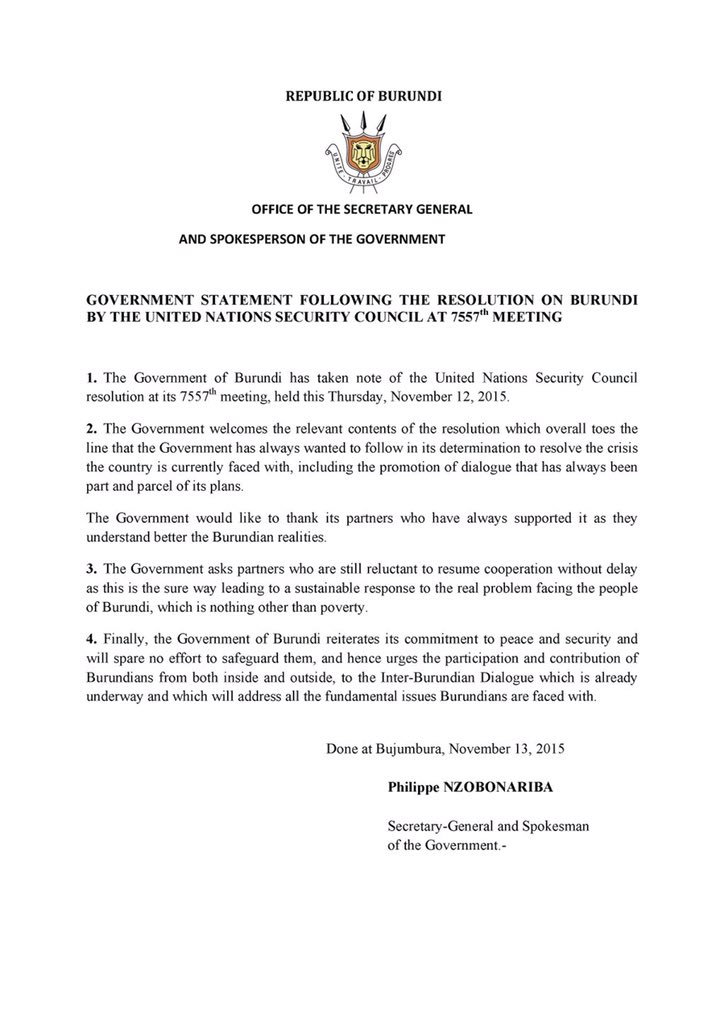
On November 13, the spokesperson for the Pierre Nkurunziza's government issued a response to the resolution, saying that it "toes the line" of the Government and that the problems in the country are "nothing other than poverty," here.


  On the evening of November 11, the UN Spokesperson's office announced that there would be a formal Security Council meeting on Burundi at 12:15 pm on November 12, that would be to approve the draft resolution. An unnamed official of Herve Ladsous UN Peacekeeping -- wonder who that could be -- got Reuters to retype without analysis the idea the UN would send peacekeepers from "Congo" - that would be DRC -- into Burundi.

 UNasked by Reuters, actively covered up, is that Ladsous' MONUSCO has been unable or unwilling to protect civilians in parts of the Eastern DRC, and has refused to neutralize the Hutu FDLR militia. So it would take on Pierre Nkurunziza's forces and youth wing in Burundi?

  This youth wing was allowed by MONUSCO to train in Eastern Congo; nothing was said by MONUSCO when DRC detained a Burundian journalist. None of this in the Reuters, or AFP, or even more derivative Voice of America story. But to retain this "access," these media do not report when the UN's Herve Ladsous, on camera, links peacekeeper rapes to "R&R." Video here. This is a scam. Watch this site.

  While the November 9 meeting was still ongoing, the UN announced that French Permanent Representative Francois Delattre would address the press in ten minutes. But when it happened it was the French Mission's deputy Alexis Lamek, moderated by the Mission's spokesman Thierry Caboche.

After bragging about a draft resolution French belatedly circulated, Lamek and his spokesperson twice refused to take a Press question about UN Peacekeeping still using the same Bururdian forces accused of the abuses. NewVine here. New video, with UK contrast, here.

 The French mission spokesperson, after calling on Reuters, called on Agence France Presse. Inner City Press said, please answer why Herve Ladsous - the fourth French head of UN Peacekeeping in a row - uses Burundian troops in Central African Republic, giving them extensions to bring the right equipment (the government, sources say, takes the money.)

 "Ask him," Lamek said off camera, referring to Ladsous who repeatedlyrefuses Press questions on this (and on covering up French Sangaris forces rapes in CAR.)


  Moments later when Inner City Press asked UK Deputy Ambassador Peter Wilson if the UN should keep using Burundian troops or vet them, Wilson called this a "big issues" that "needs to be looked at." Audio including Elements to the Press, here. Fast transcript by InnerCityPro.com, here:

Inner City Press asked, the UN uses Burundian peacekeepers in CAR. Is there, or could there be, some review of that?

UK Deputy Peter Wilson: "on peacekeepers, I think this is a big issue, and I think it’s something certainly that needs to be looked at in a wider context of what response we take to the events in Burundi right now. I wouldn’t urge precipitate action on that, but I think it’s one of the issues that we need collectively to consider."

 Strange then, that the penholding on Burundi and controller of UN Peacekeeping wouldn't even take the questions. The history of the Great Lakes runs deep. More recently, Inner City Press is informed is belated discussion among Security Council Permanent Five members that Ladsous is a liability, should or can he even be allowed to stay on to the end of Ban Ki-moon's term.

 On November 10, Inner City Press asked UN spokesman Stephane Dujarric,video heretranscript here:

Inner City Press: I'll do Burundi first as a follow-up to that.  Yesterday at the stakeout, Peter Wilson of the UK said that the issue of continued or… or service of Burundian peacekeepers, particularly those involved in the violence in UN peacekeeping, is a big issue, is something that needs to be looked at in the wider context of the response to the events in Burundi right now.  Since… I think I've previously asked you about… my understanding is the Under-Secretary-General of Peacekeeping waived Burundi not having the right equipment twice in a row in CAR.  I wanted you to describe, if you could, what is the process, one, for vetting individuals that come out of the… what you described as a… big violence in Burundi, but also of giving these waivers.  Is this something that's done unilaterally by the Secretariat?

Spokesman:  I'm not… I can't speak to the waivers because I can't… I don't know if what you say is, in fact, a fact.

Inner City Press:  Can… can… is the meeting in September…? [Inner City Press actually referred to Ladsous' September meeting with Burundi, on which it reported.]

Spokesman:  As far as… as far as Burundian troops, they continue to serve in the Central African Republic and other missions, if I'm not mistaken.  They are rotated through the standard human rights vetting process, which involves the UN, which involves the government, which involves the High Commissioner for Human Rights, and which involves the more… the broader human rights community.

Inner City Press:  What about the issue of… there have been several complaints by the peacekeepers themselves of not getting paid leaving some in Burundi to say, in fact, this is a way in which the UN is subsidizing the Government and the very activities that Mr. Zeid was condemning yesterday?  What steps are taken to ensure that the money reaches the peacekeepers?

Spokesman:  Obviously, it is critical whether it's in the case of Burundi if it, in fact, happens or other countries that individual peacekeepers receive the monies that are owed to them.

Inner City Press:  But Mr. [Hervé] Ladsous right here in September said that he's… that he's not sure whether this money reaches soldiers.  So what steps does the UN take, particularly in a case like Burundi, where you're accusing the Government of cracking down on the people, what steps are taken?

Spokesman:  As I said, I think it's incumbent on the governments to ensure that their soldiers get paid.  Did you have another question?


 At the November 9 meeting, Burundi's Nyamitwe droned on by video by Bujumbura, even as Security Council President Matthew Rycroft asked him to bring it to an end. He continued speaking as the other speakers on video -- Prince Zeid, Adama Dieng, Swiss Ambassador Lauber -- squirmed, seeming like the audience to wonder if Rycroft would just cut his mic (he didn't.)

  Inner City Press immediately put online that speech, and that of Uganda's Ambassador Nduhuura and the African Union's Tete Antonio, here.

 On November 7 came reports of killings, including it was said a UN system staff member. This has been confirmed by UNDP - but only the local Buurndi office. Still from the UN, nothing. The Security Council issued a Press Statement on November 7... about Libya.

  Burundian journalist Blaise Célestin Ndihokubwayo has been arrested and sent to the Service national de renseignement (SNR). Where is UNESCO and its director, who wants to be the next UN Secretary General?

On October 23 Inner City Press asked UN Ambassador Matthew Rycroft about the status of the draft Presidential Statement in the UN Security Council. He said there are differing views, but the UK is concerned about the "threat of genocide." Video here.  On November 3, Inner City Press again put a Burundi questions to Rycroft, now President of the Security Council for November. Video herestory here.

The son of human rights defender Pierre Claver Mbonimpa has reportedly been murdered, after Pierre Nkurunziza tweeted that "No one living abroad should consider himself superior to those who stayed in Burundi, since most of them have left their families here."

 On November 6, a belated Security Council meeting on Burundi was announced -- from Paris, by French foreign ministry spokesperson Romain Nadal. Why the delay? Why announced in that way?

Later on November 6, UN Secretary General Ban Ki-moon (whose spokesman could not tell Inner City Press if Ban will have any representative in the Security Council's meeting on Monday) put out this statement.

 Inner City Press at the November 6 UN noon briefing asked how these concerns were consistent with Ban deferring to the Ugandan Defense Minister (for the EAC, Ban's spokesman pointed out), and asked if Ban will even have a representative briefing the UN Security Council on Monday. UNclear. Video here.

  The US' Tom Perriello, filmed at the State Department, noted the weekend deadline. But why then was the UN Security Council meeting left until after the deadline?

  US Ambassador Samantha Power put out this statement, here.

  Behind the continued killing, here's an issue: Inner City Press is informed that a number of Burundian civil society leaders and journalists have improperly been flagged to Interpol as if their passports had been stolen. This has made it impossible, for example, for Vital Nshimirimana to travel to a speak about the crisis in Burundi at a conference in (Ban Ki-moon's native) South Korea.

  Inner City Press on November 4 asked the UN Office of the High Commissioner for Human Rights' Ivan Simonovic and UN spokesman Stephane Dujarric about this.  Interpol often brags at the UN how it is useful on the issue of foreign fighters. It's Secretary General Jurgen Stock spoke before the UN Security Council on May 29, 2015. But what about when Interpol is misused by a government like Pierre Nkurunziza? What do it, the Security Council and its members do that? Watch this site.

 On November 2 Inner City Press asked UN Spokesman Stephane Dujarric about two speeches given in Burundi (the full text of one is below). Video hereUN transcript here:

Inner City Press: In Burundi, there was a speech by the President of the Senate [Révérien Ndikuriyo] saying that opposition neighborhoods may be razed [or raided. Some] people are calling it a genocide speech.  There's also a speech by the President, saying anyone who doesn't disarm within the next five days will be treated as an enemy of the State.  So, I'm wondering, not to overdo it, but things seem pretty serious.  I wanted to know:  what is the UN doing?

Spokesman:  "It's clear that those in position of power, whether in Government or in the opposition, have a responsibility not to incite fear or hate of any kind.  I think that's very important and that whatever security measures the Government takes fully comply with international law and respect for the right of people to freely assemble and protest."

 After Burundi was elected to the UN Human Rights Council with 162 votes on October 28, on October 31 security forces in Burundi opened fire on a funeral procession in Buringa, killing many.  These are the Burundian forces that UN Peacekeeping under Herve Ladsous keeps in service, offering waivers while the Government keeps the payments?

  It is reported the Burundian authorities are accusing a medical NGO of offering treatment to insurgents, and are ready to attack. Frankly, the weak UN Security Council Presidential Statement which France belatedly proffered in the Council, then didn't even hold a question and answer stakeout about, is woefully insufficient, as is the UN Secretariat's response.

 Now from Burundi this speech

https://soundcloud.com/journ-burundi/reverien-ndikuriyo-le-pdt-du-senat-illegitime-promet-de-raser-des-quartiers-de-la-capitale

 On October 28, Inner City Press asked UN spokesman Stephane Dujarric about another threat. From the UN transcript:

Inner City Press: this is a tweet from the official account of Pierre Nkurunziza, President of Burundi:  "No one living abroad should consider himself superior to those who stayed in Burundi since most of them have left their families here."  So people see this as an open-source threat to retaliate against the families of those who have fled the country.  And I'm wondering…

Spokesman:  I haven't seen the tweet.  I shall look at it.

 Inner City Press showed it to him on his way out. Earlier on October 28, Burundi got 162 votes for the UN Human Rights Council, less than the other also unopposed candidates, but still enough to get on the Council. The UN Security Council had just issued a Presidential Statement, here, which gave weight to the Museveni "mediation," and which the US later "welcomed."Usually it's the penholder (France) which speaks. But not here, not on Burundi (see Ladsous, below).

  On October 28 Burundi was poised for election to the UN Human Rights Council, as one of five African Group candidates for five seats. Meanwhile on October 26, the European Union adopted the letter to President Pierre Nkurunziza that Inner City Press asked the UN about last week, here.

  Can EU members on October 28 not vote against Burundi's "Human Rights" Council candidacy at this time? And other Western NGOs coming to the UN early this week to set forth their positions, will they just phone it in with regard to Burundi? Watch this site.

 Also on October 23, Inner City Press asked UN Secretary General Ban Ki-moon:

Inner City Press: I wanted to ask on Burundi, just this morning the UK Ambassador said that the UK is concerned of a threat of genocide, is the word that he used, so I'm wondering under Rights Up Front what are your thoughts about Burundi and what the UN or the Secretariat can do.

SG Ban: "On this genocide issues, I hope there should be some creative investigations by the relevant experts and there should be, first of all, a clear understanding and investigations.  And if the conclusion is that there were such kind of genocide issues, then there should be accountability, justice must prevail and perpetrators must be brought to justice."

  But what is the UN Secretariat DOING about it?


  On October 16 Inner City Press asked Haq if the UN thinks the government can investigate itself. This was based on UN Secretary General Ban Ki-moon's October 15 statement that

"The Secretary-General condemns the killing of nine civilians and two police officers in Bujumbura on 13 October... He urges Burundian authorities to undertake a rigorous and prompt investigation into the circumstances and motives behind these despicable crimes in order to ensure that their perpetrators are brought to justice."

  So can the Nkurunziza government investigate itself (as the UN purports to be investigating or "auditing" itself in the wake of corruption revelation about former Presidnet of the General Assembly John Ashe among others)? Inner City Press asked this question (video here) as well as following up on this, from October 13:

Inner City Press: the Burundi question is one that maybe you can check with DPKO [Department of Peacekeeping Operations].  Burundian human rights activists say that an officer, Jerome Ntibogora, N-t-i-b-o-g-o-r-a, who was accused of being involved in killing people in a… in a hospital after they fled from the Government, has now been deployed to MINUSMA [United Nations Multidimensional Integrated Stabilization Mission] in Mali.  So I wanted to…

Spokesman Dujarric:  Let's see what we can find out.

  Dujarric did not come back with an answer, by this deputy when Inner City Pres asked again on October 16 said he, Ntibogora is not being deployed. We'll see - watch this site.

Amid crackdowns in Burundi by security forces, and allegations of sexual abuse by Burundian peacekeepers serving under the UN flag, UN Peacekeeping chief Herve Ladsous on October 1 held a meeting with Burundian Vice President Joseph Butore.

  Inner City Press has already tweeted a photograph of the meeting, but has now received the complete UN read-out, which raises more questions about Ladsous.

   On the crackdown, Ladsous assured Butore that he has a “pragmatic approach” and is of no mind to question what happens in any country, does not involve himself in "domestic affairs."

   On the sexual abuse allegations, Ladsous spoke only in platitudes, without requiring or even inquiring into any actions taken by the Burundians on the alleged abuse.

   Even though Burundi was already given a “grace period” to bring appropriate equipment into the Central African Republic for the MINUSCA mission, they have not done so. In the meeting, according to the read-out, Butore "acknowledged" the substandard equipment.

   Butore requested, and Ladsous for now granted, yet another extension to bring the requirement equipment -- until March 2016 for light equipment, and to June 2016 for heavy equipment.


  Is this safe - even for the Burundian soldiers at issue? While speaking through press releases, Ladsous' spokespeople, far from answering questions, go so far as to direct UNTV boom microphone operators to avoid Inner City Press, even preventing the Press from asking any questions to Mali's Foreign Minister Abdulaye Diop. We'll have more on all this.

Thursday, November 12, 2015

On Burundi, Joint UN-AU-EU Statement, UNSC to Vote 12:15 pm, Chimera of Protection


By Matthew Russell Lee

UNITED NATIONS, November 12 -- As killings in Burundi have increased, a November 9 UN Security Council meeting was belated announced, from Paris, on Friday November 6. But even on November 10, basic questions about the use of Burundian "peacekeepers" by Herve Ladsous' DPKO were not answered, see below.

 On November 12, the UN Deputy Secretary General Jan Eliasson, African Union Chairperson Nkosazana Dlamini-Zuma and European Union High Representative for Foreign Affairs and Security Policy Federica Mogherini issued this statement on Burundi:

"Participating in the Valetta Summit on migration, we discussed Burundi. Alarmed by the widening divisions, the threat for many more lives and a deep regional crisis, we pledged to work closely together and to mobilise all our means and instruments to prevent a further deterioration of the situation. We agreed on the urgency to convene a meeting of the Burundian government and opposition representatives in Addis Ababa, or Kampala under the chairmanship of President Museveni.  No effort can be spared to achieve an end to the violence and to foster a political solution."

   Museveni?

  On the evening of November 11, the UN Spokesperson's office announced that there would be a formal Security Council meeting on Burundi at 12:15 pm on November 12, that would be to approve the draft resolution. An unnamed official of Herve Ladsous UN Peacekeeping -- wonder who that could be -- got Reuters to retype without analysis the idea the UN would send peacekeepers from "Congo" - that would be DRC -- into Burundi.

 UNasked by Reuters, actively covered up, is that Ladsous' MONUSCO has been unable or unwilling to protect civilians in parts of the Eastern DRC, and has refused to neutralize the Hutu FDLR militia. So it would take on Pierre Nkurunziza's forces and youth wing in Burundi?

  This youth wing was allowed by MONUSCO to train in Eastern Congo; nothing was said by MONUSCO when DRC detained a Burundian journalist. None of this in the Reuters, or AFP, or even more derivative Voice of America story. But to retain this "access," these media do not report when the UN's Herve Ladsous, on camera, links peacekeeper rapes to "R&R." Video here. This is a scam. Watch this site.

  While the November 9 meeting was still ongoing, the UN announced that French Permanent Representative Francois Delattre would address the press in ten minutes. But when it happened it was the French Mission's deputy Alexis Lamek, moderated by the Mission's spokesman Thierry Caboche.

After bragging about a draft resolution French belatedly circulated, Lamek and his spokesperson twice refused to take a Press question about UN Peacekeeping still using the same Bururdian forces accused of the abuses. NewVine here. New video, with UK contrast, here.

 The French mission spokesperson, after calling on Reuters, called on Agence France Presse. Inner City Press said, please answer why Herve Ladsous - the fourth French head of UN Peacekeeping in a row - uses Burundian troops in Central African Republic, giving them extensions to bring the right equipment (the government, sources say, takes the money.)

 "Ask him," Lamek said off camera, referring to Ladsous who repeatedlyrefuses Press questions on this (and on covering up French Sangaris forces rapes in CAR.)


  Moments later when Inner City Press asked UK Deputy Ambassador Peter Wilson if the UN should keep using Burundian troops or vet them, Wilson called this a "big issues" that "needs to be looked at." Audio including Elements to the Press, here. Fast transcript by InnerCityPro.com, here:

Inner City Press asked, the UN uses Burundian peacekeepers in CAR. Is there, or could there be, some review of that?

UK Deputy Peter Wilson: "on peacekeepers, I think this is a big issue, and I think it’s something certainly that needs to be looked at in a wider context of what response we take to the events in Burundi right now. I wouldn’t urge precipitate action on that, but I think it’s one of the issues that we need collectively to consider."

 Strange then, that the penholding on Burundi and controller of UN Peacekeeping wouldn't even take the questions. The history of the Great Lakes runs deep. More recently, Inner City Press is informed is belated discussion among Security Council Permanent Five members that Ladsous is a liability, should or can he even be allowed to stay on to the end of Ban Ki-moon's term.

 On November 10, Inner City Press asked UN spokesman Stephane Dujarric,video heretranscript here:

Inner City Press: I'll do Burundi first as a follow-up to that.  Yesterday at the stakeout, Peter Wilson of the UK said that the issue of continued or… or service of Burundian peacekeepers, particularly those involved in the violence in UN peacekeeping, is a big issue, is something that needs to be looked at in the wider context of the response to the events in Burundi right now.  Since… I think I've previously asked you about… my understanding is the Under-Secretary-General of Peacekeeping waived Burundi not having the right equipment twice in a row in CAR.  I wanted you to describe, if you could, what is the process, one, for vetting individuals that come out of the… what you described as a… big violence in Burundi, but also of giving these waivers.  Is this something that's done unilaterally by the Secretariat?

Spokesman:  I'm not… I can't speak to the waivers because I can't… I don't know if what you say is, in fact, a fact.

Inner City Press:  Can… can… is the meeting in September…? [Inner City Press actually referred to Ladsous' September meeting with Burundi, on which it reported.]

Spokesman:  As far as… as far as Burundian troops, they continue to serve in the Central African Republic and other missions, if I'm not mistaken.  They are rotated through the standard human rights vetting process, which involves the UN, which involves the government, which involves the High Commissioner for Human Rights, and which involves the more… the broader human rights community.

Inner City Press:  What about the issue of… there have been several complaints by the peacekeepers themselves of not getting paid leaving some in Burundi to say, in fact, this is a way in which the UN is subsidizing the Government and the very activities that Mr. Zeid was condemning yesterday?  What steps are taken to ensure that the money reaches the peacekeepers?

Spokesman:  Obviously, it is critical whether it's in the case of Burundi if it, in fact, happens or other countries that individual peacekeepers receive the monies that are owed to them.

Inner City Press:  But Mr. [Hervé] Ladsous right here in September said that he's… that he's not sure whether this money reaches soldiers.  So what steps does the UN take, particularly in a case like Burundi, where you're accusing the Government of cracking down on the people, what steps are taken?

Spokesman:  As I said, I think it's incumbent on the governments to ensure that their soldiers get paid.  Did you have another question?

  On the way into the Security Council, Inner City Press asked both UK Ambassador Matthew Rycroft and French Deputy Ambassador Alexis Lamek about the UN staffer killed in Bujumbura, along with others, over the weekend: would there be a Press Statement. Lamek said there'll be more.Video here.

From the UK transcript:

Inner City Press: A UN staffer was killed over the weekend. Do you expect any outcome from this meeting? A press statement or something to mark that?

Amb. Rycroft: I’m sure that will come up in some way and we’re ready to work with our SC colleagues on whatever product we find most useful.

 At the November 9 meeting, Burundi's Foreign Minister Nyamitwe droned on by video by Bujumbura, even as Security Council President Matthew Rycroft asked him to bring it to an end. He continued speaking as the other speakers on video -- Prince Zeid, Adama Dieng, Swiss Ambassador Lauber -- squirmed, seeming like the audience to wonder if Rycroft would just cut his mic (he didn't.)

  Inner City Press immediately put online that speech, and that of Uganda's Ambassador Nduhuura and the African Union's Tete Antonio, here.

 From other senior UN sources the Press was told on November 6 that Secretary General Ban Ki-moon would speak on Burundi inside the Council, along with Prince Zeid and the chair of the UN Peacebuilding Confirmation by video from Burundi. Ban Ki-moon canceled, to go to Saudi Arabia.

His replacement Jeffrey Feltman said "in the coming days the Secretary General will announce the appointment of a Special Adviser who will lead and coordinate UN efforts in support Burundi. The Special Adviser will work closely with the AU, EAC and other partners to prevent further escalation of the conflict and build peace in Burundi."

 But when, mid-meeting, the UN announced Ban has named Jamal Benomar Special Adviser, the announcement did not even use the word "Burundi." Such is the power, for now, of Pierre Nkurunziza.

  As the closed door meeting continued, the UN said that it would be UK Deputy Peter Wilson would would address the press afterward. Watch this site.

 On November 7 came reports of killings, including it was said a UN system staff member. This has been confirmed by UNDP - but only the local Buurndi office. Still from the UN, nothing. The Security Council issued a Press Statement on November 7... about Libya.

  Burundian journalist Blaise Célestin Ndihokubwayo has been arrested and sent to the Service national de renseignement (SNR). Where is UNESCO and its director, who wants to be the next UN Secretary General?

On October 23 Inner City Press asked UN Ambassador Matthew Rycroft about the status of the draft Presidential Statement in the UN Security Council. He said there are differing views, but the UK is concerned about the "threat of genocide." Video here.  On November 3, Inner City Press again put a Burundi questions to Rycroft, now President of the Security Council for November. Video herestory here.

The son of human rights defender Pierre Claver Mbonimpa has reportedly been murdered, after Pierre Nkurunziza tweeted that "No one living abroad should consider himself superior to those who stayed in Burundi, since most of them have left their families here."

 On November 6, a belated Security Council meeting on Burundi was announced -- from Paris, by French foreign ministry spokesperson Romain Nadal. Why the delay? Why announced in that way?

Later on November 6, UN Secretary General Ban Ki-moon (whose spokesman could not tell Inner City Press if Ban will have any representative in the Security Council's meeting on Monday) put out this statement.

 Inner City Press at the November 6 UN noon briefing asked how these concerns were consistent with Ban deferring to the Ugandan Defense Minister (for the EAC, Ban's spokesman pointed out), and asked if Ban will even have a representative briefing the UN Security Council on Monday. UNclear. Video here.

  The US' Tom Perriello, filmed at the State Department, noted the weekend deadline. But why then was the UN Security Council meeting left until after the deadline?
 
  US Ambassador Samantha Power put out this statement, here.

  Behind the continued killing, here's an issue: Inner City Press is informed that a number of Burundian civil society leaders and journalists have improperly been flagged to Interpol as if their passports had been stolen. This has made it impossible, for example, for Vital Nshimirimana to travel to a speak about the crisis in Burundi at a conference in (Ban Ki-moon's native) South Korea.

  Inner City Press on November 4 asked the UN Office of the High Commissioner for Human Rights' Ivan Simonovic and UN spokesman Stephane Dujarric about this.  Interpol often brags at the UN how it is useful on the issue of foreign fighters. It's Secretary General Jurgen Stock spoke before the UN Security Council on May 29, 2015. But what about when Interpol is misused by a government like Pierre Nkurunziza? What do it, the Security Council and its members do that? Watch this site.

 On November 2 Inner City Press asked UN Spokesman Stephane Dujarric about two speeches given in Burundi (the full text of one is below). Video hereUN transcript here:

Inner City Press: In Burundi, there was a speech by the President of the Senate [Révérien Ndikuriyo] saying that opposition neighborhoods may be razed [or raided. Some] people are calling it a genocide speech.  There's also a speech by the President, saying anyone who doesn't disarm within the next five days will be treated as an enemy of the State.  So, I'm wondering, not to overdo it, but things seem pretty serious.  I wanted to know:  what is the UN doing?

Spokesman:  "It's clear that those in position of power, whether in Government or in the opposition, have a responsibility not to incite fear or hate of any kind.  I think that's very important and that whatever security measures the Government takes fully comply with international law and respect for the right of people to freely assemble and protest."

 After Burundi was elected to the UN Human Rights Council with 162 votes on October 28, on October 31 security forces in Burundi opened fire on a funeral procession in Buringa, killing many.  These are the Burundian forces that UN Peacekeeping under Herve Ladsous keeps in service, offering waivers while the Government keeps the payments?

  It is reported the Burundian authorities are accusing a medical NGO of offering treatment to insurgents, and are ready to attack. Frankly, the weak UN Security Council Presidential Statement which France belatedly proffered in the Council, then didn't even hold a question and answer stakeout about, is woefully insufficient, as is the UN Secretariat's response.

 Now from Burundi this speech

https://soundcloud.com/journ-burundi/reverien-ndikuriyo-le-pdt-du-senat-illegitime-promet-de-raser-des-quartiers-de-la-capitale

 On October 28, Inner City Press asked UN spokesman Stephane Dujarric about another threat. From the UN transcript:

Inner City Press: this is a tweet from the official account of Pierre Nkurunziza, President of Burundi:  "No one living abroad should consider himself superior to those who stayed in Burundi since most of them have left their families here."  So people see this as an open-source threat to retaliate against the families of those who have fled the country.  And I'm wondering…

Spokesman:  I haven't seen the tweet.  I shall look at it.

 Inner City Press showed it to him on his way out. Earlier on October 28, Burundi got 162 votes for the UN Human Rights Council, less than the other also unopposed candidates, but still enough to get on the Council. The UN Security Council had just issued a Presidential Statement, here, which gave weight to the Museveni "mediation," and which the US later "welcomed."Usually it's the penholder (France) which speaks. But not here, not on Burundi (see Ladsous, below).

 On October 27, the UN said Secretary General Ban Ki-moon called the AU (below); Inner City Press asked Ban's spokesman Stephane Dujarric is any closer to naming the envoy he called "immanent" months ago. Dujarric said he should have used another word.

 Inner City Press asked Dujarric of reports that Burundian police in the UN's MINUSCA mission in Bangui have not received benefits in months, and of a letter sent to Ban and Herve Ladsous about the Burundian troops. Dujarric said he would check on both. Here is the full text of the UN's read-out:

"Today, the Secretary-General called H.E. Dr. Nkosazana Dlamini Zuma, Chairperson of the African Union Commission, to discuss the situation in Burundi.

The Secretary-General welcomed the decision made by the African Union’s Peace and Security Council on 17 October to address the political impasse and deteriorating security situation in Burundi. He noted that such comprehensive and resolute action could offer Burundi the opportunity to put an end to the continuing violence and find a consensual political solution on the way forward.

The Secretary-General assured the Chairperson of the African Union Commission that the United Nations stands ready to provide any support necessary to advance the implementation of the measures agreed upon by the members of the African Union Peace and Security Council. " 

  On October 28 Burundi is poised for election to the UN Human Rights Council, as one of five African Group candidates for five seats. Meanwhile on October 26, the European Union adopted the letter to President Pierre Nkurunziza that Inner City Press asked the UN about last week, here.

  Can EU members on October 28 not vote against Burundi's "Human Rights" Council candidacy at this time? And other Western NGOs coming to the UN early this week to set forth their positions, will they just phone it in with regard to Burundi? Watch this site.

 Also on October 23, Inner City Press asked UN Secretary General Ban Ki-moon:

Inner City Press: I wanted to ask on Burundi, just this morning the UK Ambassador said that the UK is concerned of a threat of genocide, is the word that he used, so I'm wondering under Rights Up Front what are your thoughts about Burundi and what the UN or the Secretariat can do.

SG Ban: "On this genocide issues, I hope there should be some creative investigations by the relevant experts and there should be, first of all, a clear understanding and investigations.  And if the conclusion is that there were such kind of genocide issues, then there should be accountability, justice must prevail and perpetrators must be brought to justice."

  But what is the UN Secretariat DOING about it?

 On October 22, Inner City Press asked Ban's deputy spokesperson Haq:

Inner City Press: I wanted to ask you a question about Burundi.  The EU is preparing a letter to invite the Burundian parties to Brussels to have a discussion about diffusing the situation.  And I wanted to know, not just what does the UN think about it, but is there any UN role in this?  And, if not, what does it say about the UN sort of action on Burundi?  It's one thing to defer maybe to the AU but this is the UE.  What is the UN doing about this?

Deputy Spokesman:  We are following up with all the various initiatives by regional parties including the African Union and the European Union and, of course, our Envoy dealing with the Great Lakes Region has been appraised of this so we are continuing to follow-up.

ICP:  But, I mean, is the EU really, can you… it is a regional organization but is it a regional organization with respect to Burundi?

Deputy Spokesman:  That is question for the European Union, not for me.

ICP:  Have you been contacted I guess is my question?

Deputy Spokesman:  But regarding this, we have been in touch with a variety of regional bodies including through the office of the Special Envoy for the Great Lakes Region but also through our Department of Political Affairs and will keep appraised of all the various actors in this.

  Back on October 20, Ban's deputy spokesperson Haq cited back to a written statement by Secretary General Ban Ki-moon more than a week ago; he said generally that MONUSCO like all UN mission affirms the right of freedom of the press. Really?

  Later on October 20 after Inner City Press asked UN rapporteur on torture Juan Mendez about Guantanamo and US prisons, in the hall after waiting through a number of questions in Spanish Inner City Press asked him if he'd received complaints about, or acted on, Burundi. No, he said, not yet. Really?

Update: later on October 20 it was announced that the UN's Jeff Feltman will briefing the Security Council behind closed doors on October 21. But what outcome with the Council's penholder, France, even ask for?

  On October 16 Inner City Press asked Haq if the UN thinks the government can investigate itself. This was based on UN Secretary General Ban Ki-moon's October 15 statement that

"The Secretary-General condemns the killing of nine civilians and two police officers in Bujumbura on 13 October... He urges Burundian authorities to undertake a rigorous and prompt investigation into the circumstances and motives behind these despicable crimes in order to ensure that their perpetrators are brought to justice."

  So can the Nkurunziza government investigate itself (as the UN purports to be investigating or "auditing" itself in the wake of corruption revelation about former Presidnet of the General Assembly John Ashe among others)? Inner City Press asked this question (video here) as well as following up on this, from October 13:

Inner City Press: the Burundi question is one that maybe you can check with DPKO [Department of Peacekeeping Operations].  Burundian human rights activists say that an officer, Jerome Ntibogora, N-t-i-b-o-g-o-r-a, who was accused of being involved in killing people in a… in a hospital after they fled from the Government, has now been deployed to MINUSMA [United Nations Multidimensional Integrated Stabilization Mission] in Mali.  So I wanted to…

Spokesman Dujarric:  Let's see what we can find out.

  Dujarric did not come back with an answer, by this deputy when Inner City Pres asked again on October 16 said he, Ntibogora is not being deployed. We'll see - watch this site.

Amid crackdowns in Burundi by security forces, and allegations of sexual abuse by Burundian peacekeepers serving under the UN flag, UN Peacekeeping chief Herve Ladsous on October 1 held a meeting with Burundian Vice President Joseph Butore.

  Inner City Press has already tweeted a photograph of the meeting, but has now received the complete UN read-out, which raises more questions about Ladsous.

   On the crackdown, Ladsous assured Butore that he has a “pragmatic approach” and is of no mind to question what happens in any country, does not involve himself in "domestic affairs."

   On the sexual abuse allegations, Ladsous spoke only in platitudes, without requiring or even inquiring into any actions taken by the Burundians on the alleged abuse.

   Even though Burundi was already given a “grace period” to bring appropriate equipment into the Central African Republic for the MINUSCA mission, they have not done so. In the meeting, according to the read-out, Butore "acknowledged" the substandard equipment.

   Butore requested, and Ladsous for now granted, yet another extension to bring the requirement equipment -- until March 2016 for light equipment, and to June 2016 for heavy equipment.


  Is this safe - even for the Burundian soldiers at issue? While speaking through press releases, Ladsous' spokespeople, far from answering questions, go so far as to direct UNTV boom microphone operators to avoid Inner City Press, even preventing the Press from asking any questions to Mali's Foreign Minister Abdulaye Diop. We'll have more on all this.

Wednesday, August 26, 2015

UNanswered Questions as Museveni Disses UN, UN Peacekeeping No Answers on Iraq, Herve Ladsous & FDLR


By Matthew Russell Lee

UNITED NATIONS, August 26 -- A week after the UN through its Spokesperson's Office refused to release a copy of Secretary General Ban Ki-moon's speech to 150 bankers, calling it "private," the same UN has so far provided responses to four of fifteen questions submitted by Inner City Press. One answer, it seems, it contradicted from elsewhere in the UN system.

 On August 26, Inner City Press submitted five questions, including of the type that would have had to be responded to at an in-person briefing: the UN being dissed by Yoweri Museveni, to whom Ban is deferring on Burundi, Ban's trip to Nigeria and Paris - did he raised rapes and Ladsous? - and UN Peacekeeping issues in DR Congo and Iraq. But four hours later, no answers.

  Here were the five questions Inner City Press submitted:

Aug 26 (1) At the signing in Juba, Uganda's President Museveni said that to invite the UN to your country is a vote of non-confidence in yourselves.The UN specializes in conserving terrorism. What is the UN system's response?

Aug 26 (2) Relatedly, what is the status of the SG naming an envoy to Burundi? Is the SG still deferring to President Museveni, now in light of the comments above made in Juba?

Aug 26 (3) On SG's trip: while in France, did the SG or his team raise to ANY French official the issue of the alleged sexual abuse of children in the Central African Republic by France's Sangaris peacekeepers? If so, to whom and what was said? While in Abuja, please confirm or deny that the SG received the petition from concerned citizens of Plateau State and attacks on villages there, and if confirm, state the SG's response. Same question again on letter from organizations of unpaid UN interns.

Aug 26 (4) On DRC, please state what steps the UN is taking to ensure that its cut off of aid to surrendered FDLR fighters will not result in attacks on civilians; please confirm that Taz Greyling, the chief of MONUSCO's demobilization, disarmament and reinsertion, said "We hope that FDLR will let them leave and have a chance at a normal life," and state the basis of that hope.

Aug 26 (5) Please state what UN DPKO is doing on Fiji's request that it expedite visa for Iraq for Fijian peacekeepers there.

 There is a sixth, about a(nother) UN junket, but it must wait to be asked until at least some answers arrive.

   On August 25, Inner City Press submitted five questions, one of which for the third time -- this one got a response, the only one of five August 25 noon briefings answerd on August 25:

"please state the status of Mr. Baumann at UMOJA, as asked twice. Here is USG Takasu's email [of August 13, asked of twice]

"I wish to inform you that ASG Franz Baumann will be stepping down from his position as Umoja Senior Deployment Coordinator for New York, effective immediately. Mr Baumann has held this position since the inception of the Headquarters Deployment Group (HDG) in New York in September of 2014, and brought to it his considerable experience and expertise over a long career with the United Nations. The HDG was created to secure an effective transition to Umoja 'Cluster 4' this coming November, recognising the particular complexity associated with preparing New York to deploy the new common administrative support model.

"I am grateful to Mr Baumann for his leadership over the past year in establishing and overseeing the HDG, which is an ad hoc arrangement that co-locates from across HQ Departments and Offices administrative staff central to the preparations for Umoja. The HDG exists to prepare for and support the deployment of Umoja in New York, leading the readiness activities to enable an effective transition.

"Going forward, I will assume personal responsibility for the success of the HDG in my role as Umoja Project Owner. Mr Christian Saunders, the Director of my Office will act as New York Deployment Coordinator, to build upon the good work to date and take us through Umoja 'Go Live' on 1 November.
This one is on deadline."

 On August 24, the UN Spokesperson's Office told Inner City Press its understanding was Baumann was still there.Video here. But beyond the August 13 "immediate" email, other sources tell Inner City Press different, even of Mr. Baumann over at the UN Pension Fund.

 At 5 pm on August 25, this UN response was received:

"On your question on Umoja: The next phase of the deployment of Umoja involves its implementation on 1 November this year in more than 70 entities in Headquarters duty stations in New York, Geneva, Vienna, the Regional Commissions, as well as additional functionality in field missions. This is a significant milestone in the overall deployment plan and requires continued efforts and focus for it to be achieved smoothly. We remain confident, however, that this next step can be achieved on schedule. Progress in the deployment of Umoja has been the result of the hard work and dedication of many staff, both in headquarters in the field. USG Takasu, the Umoja project Owner, recognising the particular complexity associated with preparing New York to deploy decided the time had come for him to assume personal responsibility for the deployment in New York. We would like to thank ASG Baumann for his efforts during the past 11 months as the Senior Deployment Coordinator for New York. That being said, in line with long standing practice, we will not comment on the status of individual staff members."

 Clear?

 Here are other questions Inner City Press posed in writing to the UN Spokesperson's Office on August 25, not answered on August 25:

"Aug 25 (1) In South Sudan, what is the UN's response to MSF citing disease caused by lack of shelter and sanitation in the camps positioned within the United Nations base in Malakal? What is UNMISS and its UN partners doing? Also, please state UNMISS' and DPKO's awareness of an impending assault on Panyijjar county, Unity State.

"Aug 25 (2) On the Secretary General's trip, please explain why the SG refused to meet with the Bring Back Our Girls groups. If necessary, here is a report: “members of the group who thronged to Transcorp Hilton Hotel, Abuja, in anticipation of a meeting with the UN scribe at 6:30pm, were left dejected as he failed to show up for the meeting. It was learnt that 45 minutes after the group sent out e-mails inviting media houses to cover a proposed meeting with Mr. Ki-moon, they were told it will no longer hold.” Please explain, on deadline. [We say dissed, they say "snubbed."]

"Aug 25 (3) Also on the Secretary General's trip, and the UN read-out for the SG's meeting with President Francois Hollande, please explain what the SG meant by his "commitment in addressing issues of misconduct, including sexual exploitation and abuse, by UN peacekeepers,” including as regards the USG for Peacekeeping Mr Herve Ladsous, and explain why sexual abuse by French “peacekeepers” in the Sangaris force was not mentioned or included in the UN read-out.

"Aug 25 (4) On Legionnaires Disease, please state whether testing was conducted in the UN by the August 20 New York deadline."  Tweeted photo here.

Here is a question answered on August 24:

Q Aug 24 (1) In Sudan, it is reported that North Darfur authorities banned UNAMID flights. Please confirm or deny this, when it happened and the UN's understanding of why, and the UN's response.

Answer: "On 22 August, the Government of Sudan denied authorization for UNAMID flights to and from El Fasher, North Darfur, with the exception of one flight from Khartoum. Media reports thereafter alleged that this decision followed accusations by North Darfur authorities that UNAMID did not adequately coordinate the visit of the African Union Peace and Security Council (AUPSC) with them, on 21 and 22 August. 

"UNAMID rejects these allegations and confirms that the Government of Sudan, including the authorities in North Darfur, was fully involved in preparing, coordinating and participating in the AUPSC visit to Darfur."

  While appreciated, what was the impact of banning flights to and from North Darfur? The UN answered Inner City Press' follow up question on the status of the Ban by saying its "understanding is that the flights are running now."

  Since then, UNAMID has told local media that there was no hinderance of flights. Is this covering up, like UN Peacekeeping under Herve Ladsous did on rapes in Tabit in Darfur, and in Minova in DR Congo before that?

 Here are the four other August 24 questions, two responded to on August 25, the other two still unanswered:

Aug 24 (2) In Somalia, now that AMISOM (which is supported by UNSOA) has admitted killing civilians at Merka (or Marka) in late July, what is the UN's response and how will the UN human rights due diligence policy be implemented?

[Inner City Press on August 25 asked UK Ambassador Matthew Rycroft about this; we hope to have more.]

Aug 24 (3) While in France, does the Secretary General or his team intend to inquire into the belated French investigation into the child sexual abuse alleged against French Sangaris forces in the Central African Republic?

Aug 24 (4) In DRC, it is reported that in Kinshasa earlier this month the authorities rounded up copies of the C-News newspaper (censorship) and that in July the director of Full Contact Radio station broadcasting in Kananga was taken into custody after a broadcast alleging governmental dysfunctions... In Uvira, in South Kivu province, in August 2015, there was the arrest of Brinal Nundun, a journalist from Channel 7 TV, who was reporting on Burundian refugees in Uvira at the headquarters of the NGO "Action Ku  Sidon." His equipment was seized. What is the UN, DPKO or MONUSCO response to this?

 On August 25 at 5 pm, this UN response was received: "On your question on the DRC: MONUSCO continues to monitor closely the human rights situation in the DRC, including the situation with regard to  journalists. Using its good offices to facilitate an environment conducive to a peaceful electoral process, the Mission continues to encourage the Government to uphold fundamental freedoms, including freedom of speech and freedom of the press. For example, the advocacy efforts of the Mission contributed recently to the release of a journalist who was in police custody in Uvira territory, South Kivu."

Aug 24 (5) It is said that Burundi police or security forces are to be deployed to MINUSMA in Mali. Please confirm or deny, and if confirm, state what screening would be in place given recent events in Burundi. Also, what is the UN's response to Amnesty International's report of Burundi security forces using torture?

  On August 25 at 5 pm the response below was received, and Inner City Press separately reported it as well:

"On your question on Burundi: There are currently no Military troops from Burundi in the UN mission in Mali (MINUSMA). As of 31 July, there were 14 Police officers from Burundi serving as individual police officers in MINUSMA police component. No deployment of Burundi police officers to MINUSMA is planned for the foreseeable future. Following reports alleging human rights abuses on the part of some elements of the Burundian police, a decision has been taken to suspend the deployment of Burundian police officers to peacekeeping missions."

   A follow up has been asked.

Update: on August 26, Inner City Press told Inner City Press, "On the 14 Burundian police officers, they will be rotated out of MINUSMA in the coming months according to the end of their respective terms (this rotation will be completed by March 2016)."
 
  With the UN embroiled in rape scandals, exposed as playing host to spying for the US National Security Agency while its Secretary General Ban Ki-moon gave a speech to 150 bankers later deemed “private,” is this dysfunction a product of the press not wanting answers or the UN not wanting to give them?

  On August 17, Inner City Press asked the UN's spokesperson for the day, Vannina Maestracci, about UN rapes in the Central African Republic and the Democratic Republic of the Congo before it, about the spying for the NSA and about Ban's speech on August 14 to 150 people at the Buffalo headquarters of M&T Bank, subject to government charges on unfair lending and on money laundering. Video here.

   UN Associate Spokesperson Maestracci began by saying that the UN's contracts with AT&T, which turned over all information to the US, would not be made public. From the UN transcript:
Inner City Press: Would it be fair to assume that UN contractors paid by the UN are assumed not to be spying on people inside the UN?

Associate Spokesperson Maestracci:  I don't know what the procurement contract entails, and I don't like assuming as a general rule.  Oleg.

Inner City Press:  Can we get a copy of the contract?

Associate Spokesperson Maestracci:  I doubt it.  Oleg.

 Inner City Press has since researched this and found a UN written policy militating for release of the contracts. Former UN Office of Internal Oversight Services chiefInga Britt Ahlenius, when she left, wrote to Ban that “I see no visible effort to deliver on your stated commitment to increased transparency.”

   Next on the UN rapes in CAR, on which Maestracci had read out a statement that UNICEF was providing the victim legal advice, Inner City Press asked

Inner City Press: You read out on UNICEF that they purport to be providing legal advice to the victim.  And I guess I just wonder, given that the… that the legal problem is caused by the UN system's own invocation of immunity, what advice are they giving, to sue those responsible or… it just seems like… isn't it kind of a conflict for the UN system to be the one providing, purporting to provide legal advice to a person victimized by the UN system who can't get justice because of UN immunity.  So, what's the advice, I guess I'm saying…?

Associate Spokesperson:  I'm not sure what the advice is because I'm here, not with UNICEF in the [Central African Republic], but I think they are showing all the possible avenues that she has and what she can do.  I mean, I think it's fairly… people might not know what these avenues are.  And it's important…

Inner City Press:  Can she sue UN?

Associate Spokesperson:  Can I speak?  And it's important for people to raise awareness and to make sure that they do know where to go.

Inner City Press: Where should she go?  I mean, I'm just saying it seems… it's a contradiction because if she tries to sue…
Associate Spokesperson:  And where…

Inner City Press:  …she's told that it's immune, that the UN is immune.

Associate Spokesperson:  That's not true.  There's an investigation going on.  And that, you know, it is going on.  Why don't we let it go on and see what it comes up with?

Inner City Press:  That's the second question I wanted to ask.
Associate Spokesperson:  You are so not interested in the answers.

Inner City Press: Yeah, I am interested. I wasn't getting an answer.  That's the problem.

Associate Spokesperson:  Erol, please.

 Vine here.

   So, for the second time Maestracci cut off the question, this time with the statement, “You are so not interested in the answers.” But even when Inner City Press emailed questions after the briefing to Maestracci and Ban's lead spokesman, no answers were received. This is today's UN.

  Further on the UN rapes, now in the DRC Congo, Inner City Press asked:

Inner City Press: Just for the record, the answer I was asking for is what legal advice UNICEF gave.  But, I hear… since you said to wait, I wanted to ask you this.  In 2012… I don't know if it was in this room or a previous UN briefing room… there was discussion of the rape of two girls in the DRC [Democratic Republic of the Congo] by three… they believe they're from Uruguay but three peacekeepers in the DRC.  This was alleged by Dr. Victoria Fontan of the UN University of Peace in Costa Rica.  It was said there would be an investigation, but nothing has ever been said of either the peacekeepers being held responsible or the SRSG [Special Representative of the Secretary-General] of the Mission at the time or DPKO [Department of Peacekeeping Operations].  So, I wanted to know… I'm asking you, I don't expect you necessarily to know from the podium, but this is an answer I'm extremely interested in — what happened?

Associate Spokesperson:  I don't know about the specific case obviously from 2012.  But, I think you've heard what the Secretary-General has been saying all of last week and what he's, what he's been pushing when it comes to both misconduct and… including… sorry, misconduct including sexual exploitation and abuse.  I mean, he's been very strong.  He has shown his resolve to push this forward and to make sure that there is, you know, institutional accountability, responsibility, but also that Member States provide us with the information that we ask because, as you know, there is a limit, some things are up to Member States.  But, obviously, he's very determined to make progress in this, in this area for the victims of misconduct.

Inner City Press:  But, what happened in this case?

Associate Spokesperson:  I don't know.  I just said that.
Inner City Press: I'm asking, can you ask DPKO?  The two victims’ names were Gisele and Esperanz…

Associate Spokesperson:  Sure.  Why don't you send me an e-mail rather than saying everything here.  Oleg.

   Another cut off. And to the detailed email sent after the briefing, no answer at all. This is today's or Ban's UN. Here was the final exchange of the day, about Ban Ki-moon's speech to bankers:

Inner City Press: there was an article in The Buffalo News saying that the Secretary-General had gone to Buffalo and given a speech in front of 150 people in the M&T Bank headquarters for a couple of reasons.  One… I'm interested because M&T Bank has a bank merger that's been stalled out for three years due to allegations of money-laundering and lending discrimination, but mostly I wanted to know, did he give such a speech?  Can we get the text of the speech?  Why wasn't it given in advance?  And did he raise these issues about lending fairness and money laundering in his discussions with the CEO of the bank?

Associate Spokesperson:  So this was mainly a private visit.  He went to visit Buffalo and Niagara Falls, actually, and he was invited by someone he's known for a long time to address this… this group of people that you've mentioned.  We didn't put it out, again, because it was mostly, mainly, largely, a private visit.  He was with his family over the weekend.

Inner City Press: Were the people there all employees of the bank?  Was…

Associate Spokesperson:  No, I think it was community leaders from all over Buffalo, if I understand correctly.

Inner City Press: Do you have the remarks?

Associate Spokesperson:  I'll check, but, again:  mainly private visit and I don't think we'd be sharing them.  Anything else?  Great.  Have a good afternoon.

   No answers. This is today's or Ban's UN, UNtransparent and worse - and the Free UN Coalition for Access opposes it. Watch this site.