Showing posts with label transparency. Show all posts

Monday, March 4, 2019

In SDNY Bronx Millbrook Houses Case Jury Note Is Shown To Counsel But Not Read Into Record


By Matthew Russell Lee

SDNY COURTHOUSE, March 4 – The jury in a week-long Bronx gang case in the U.S. District Court for the Southern District of New York passed a note on March 4 to Judge Robert W. Sweet, who said it indicted a lack of unanimity, but not necessarily division. But should he read the note into the record? Initially the prosecutors from the U.S. Attorney's office said yes, and provided Judge Sweet a citation. But when he re-emerged from his chambers agreeing to show both sides the note, he asked why he should read it into the record. Now the prosecutors said they would defer to the lawyers for the defendant, Christopher Howard, and not read it into the record. Which meant, and still for now means, that the press and public have no way to know what it says. 
  Isn't there's an interest in the public, separate from the government's interest, in knowing of this process? The interest was cited recently in this SDNY to release some of what was seized in the raid on Michael Cohen's home. Why does that logic not apply to this? And how does the Press, entering each day from the metal detectors, go about asserting and pursuing that interest? Inner City Press, on this day and in this case the only media in the courtroom, last month covered the decision by SDNY Judge Pauley 
From the SDNY decision in U.S. v. Cohen, 18-cr-00602: "the presumption of access is at its core tethered to the need for public monitoring of the federal courts and their exercise of judicial power. Cf. SEC v. Van Waeyenberghe, 990 F.2d 845, 847 (5th Cir. 1993) (explaining that “[t]he public’s right to information does not protect the same interests that the right of access is designed to protect”). As the Second Circuit explained, Monitoring both provides judges with critical views of their work and deters arbitrary judicial behavior. Without monitoring, moreover, the public could have no confidence in the conscientiousness, reasonableness, or honesty of judicial proceedings. Such monitoring is not possible without access to testimony and documents that are used in the performance of Article III functions. Amodeo II, 71 F.3d at 1050." 
  The same question has been raised in another SDNY case, this one civil and involving the employment practices of the Qatari royals who live in a mansion on 72nd Street. There, Judge Oetken told the parties to agree among themselves how much to seal. But this is a criminal case. 

On March 1 with the jury already out, defendant Howard upon returning to the courthouse at 2 pm had to jump to the front of the security line to ensure arrival in the courtroom on time. So did others. This case in ongoing - watch this site. How guns eject shell casings was the subject of expert testimony in this case on February 27. An ATF agent traced a bullet back to Illinois; under cross examination he said a shell casing might eject feet rather than yards unless it bounced on something. The next day on February 28 the defense's failure to cross examine this testimony was emphasized in the government's summation; that the bullet was made in Illinois was presented as a basis to find that these half-block gangs impact inter-state commerce. A Facebook official testified, and the defendant's messages were shown, aiming to "peter roll that birch ass 'N-word.'" Judge Sweet in his March 1 lengthy charge to the jury said that "the defendant is not even required to cross examine witness." He told the jurors to disregard any questions he had asked witnesses, add that he didn't remember asking any (unlike for example Judge Hellerstein in the other racketeering trial still ongoing in the SDNY, of Joe Cammarano.) The differing demographics of the two courtrooms, and the lack of any other media in the Bronx case, were striking. 

Friday, February 12, 2016

Inner City Press Asks Venezuela's Rafael Ramirez About Yemen, Western Sahara, Next SG, Haiti and Transparency


By Matthew Russell Lee 


UNITED NATIONS, February 12 -- When the UN Security Council president for February Rafael Ramirez of Venezuela held a breakfast Q&A session on February 12, Inner City Press asked him about Yemen, Western Sahara, the next UN Secretary General, Haiti and UNSC transparency.
  On Yemen, Ramirez said there is a need for more open meeting, citing February 16 and 17 and the request for weekly meetings going forward. He said the media doesn't cover Yemen anything like Syria.
 On Western Sahara Ramirez told Inner City Press that Ban Ki-moon and his envoy Ross should be able to visit before April. When Inner City Press asked about the so-called "Group of Friends on Western Sahara" which, without any African members, drafts the UNSC's resolutions on the topic, he said, "I don't now what kind of friends are these."
 Ramirez said he was next meeting with the President of the General Assembly Mogens Lykketoft, that the UNSC should propose more than one candidate to the GA. Inner City Press asked for his view on possible candidate Susana Malcorra; he said running is a personal decision.
  On Haiti, Ramirez said he is worried about the parliamentary coup, citing the example of Honduras; he said he would wait to see what CELAC could accomplish.
 Inner City Press for the Free UN Coalition for Access suggested that Presidents of the UNSC, starting with Ramirez, should publish online their daily schedule of meetings. Ramirez to his credit said it is a good idea. We will be following this. 
 Back on February 1 Inner City Press asked then-incoming President of the Security Council Ramirez about Yemen. Video here. As transcribed by InnerCityPro.com:
Matthew Lee, Inner City Press. On behalf of the Free UN Coalition for Access, we are hoping you will do question and answer stakeouts after Security Council consultations... On Yemen – there’s a lot of talks about the Syrian peace talks. On Yemen we hear a lot less. What’s your understanding of the status of the envoy, Ismail Ould Cheikh Ahmed, bringing the parties together? Do you think the report on possible war crimes by the Saudi-led coalition airstrikes will be taken up at any point by the Council? And do you think that the US, UK, others that are assisting that coalition – is there enough oversight of the civilian harm that’s taking place in the air campaign on Yemen?

Amb Ramirez: Thank you. Before anything else, I hope as president of the Security Council to interact with the press, because each time we come out of a meeting of the Security Council , there’s a healthy practice, we’ve always done it that way so we’ll do what’s possible without taking too much time.
On Yemen, in my capacity as president of the Security Council  I can say that all Security Council members are closely following the events which have been escalating and have been affecting the civilian population, which finds itself in an awful situation, in the bombing campaign and the action on the ground of the two parties to the conflict.
It’s our hope that Mr. Ahmed, when he gives the briefing, will give a better picture of what’s happening there. As president of the Security Council I can’t say in advance what the positions will be of the various members fo the Security Council. This will be in closed consultations. 
But I can say that there is a growing concern on this question, and what you say, that the issue of Syria is being dealt with in a constant basis and the issue of Yemen not, is not the case with Yemen, this is something that we have raised. There is a lack of balance in terms of the way the Security Council deals with some issues. Sometimes some issues are pushed forward for political notice, and therefore they’re high on the agenda, they’re always discussed, and then there are others which are on the back burner, which  are reserved.
So today we proposed that in the Yemen briefing the consultations on Yemen should be in the form of a briefing, so that we can hear about the situation from the Special Envoy of the Secretary General, and that everybody can hear, and we can get a picture of the situation over there, what’s the actual situation, and Mr. O’Brien, we’re also asking that he should take part in that briefing, so on behalf of OCHA he would be able to explain what the situation is, what is the humanitarian situation in Yemen.
 We'll be there, on February 17, covering it. On January 29, the UN Spokesman threw Inner City Press out of the UN Press Briefing Room then on February 1 made this threat, here.
 On January 27, Inner City Press asked UN Spokesman Stephane Dujarric, transcript here:
Inner City Press: on Yemen, on this recommendation for a commission of inquiry into war crimes, has the, has envoy... I've been looking at his Twitter feed, but has the envoy, Ismail Ould Cheikh Ahmed, does he have any response to this report of, you know, dozens of war crimes [inaudible]?
  Note: the reference was to Saudi airstrikes -- a/k/a inaudible, at the UN.
Spokesman Dujarric:  Whether it's the Special Envoy or the Secretary-General, I think they've all been calling for any crimes against humanity, any violation of international law to be fully investigated.
 Back on January 19, Inner City Press asked Uruguay's Vice Minister for Foreign Affairs Jose Luis Cancela, chairing the day's Security Council debate on Protection of Civilians, if the Council does enough to protect civilians in Yemen, including monitoring the effects of airstrikes by the Saudi-led coalition. Video here.
 Cancela diplomatically replied that he was not there to comment on specific countries -- inside the Council, there was much talk of Syria, a smattering on Burundi -- but turned the question toward not hitting schools and hospitals, both of which have happened in Yemen.
 According to IOCA's ground rules published by Inner City Press, there will be no press access, other than photographs with the Special Envoy at the start. Delegates shall not use social media. Only the Special Adviser can speak publicly, and he is supposed to be seen has neutral. There are “Ground Rules,” also put online by Inner City Press here.  
The ground rules include that the delegations should not speak with the media, or use social media. On December 4, Inner City Press asked UN Deputy Spokesperson Farhan Haq about these proposals: are they normal for the UN? Haq said he would not comment on leaks. Video here.


 Meanwhile on November 2 the US Statement Department was referring questions to this UNresponsive UN: "We’re aware of those reports. Due to privacy considerations, I’m not going to comment on them...  I would direct your questions to the UN."
  After Inner City Press' October 26 report and October 30 noon briefing questions, on October 31 Reuters "reported" a piece citing an unnamed UN spokesperson about two "contractors," with no mention of the Houthis claim they work with US intelligence, which by now had also been reported, along with Inner City Press' October 30 Q&A with Dujarric, by Al-Akhbar.
  But it's worse. Reuters initially (mis) reported that "'Two contractors have been detained and the Deputy Secretary-General (Jan Eliasson) is looking into it,' a U.N. spokesman said without elaborating or confirming if the two were American citizens."
  Then a day after that, Reuters blamed the UN for its correction to "'Two contractors have been detained and DSS (Department of Safety and Security) is looking into it,' said a U.N. spokesman."
  It would seem the UN spokesman, left unnamed by Reuters, said "DSS" and Reuters mis-heard it as "DSG," didn't note it would be strange for the UN's second highest official to be on two contractors when lower official Herve Ladsous is the one who made a call for 13 contractors in South Sudan.
 But Reuters, including the Thomson Reuters Foundation Trust.org,running its correction, says "UN corrects source of information in second paragraph." So the UN made the mistake?
 This is the same Reuters which on Friday regurgitated a UN report which Inner City Press had reported and asked the UN about fully two weeks earlier, same Reuters which refused to make public its policies, and tries to censor its anti Press complaints to the UN, here. We'll have more on this. 

 We'll have more on this.
On June 25, Inner City Press asked new UN aid chief Stephen O'Brien three questions about Yemen: cholera, the destruction of ambulances in Sa'ada and about international staff. Video here.
  O'Brien replied that cholera is a risk; he had no information on WHO it was that destroyed the ambulances in Sa'ada (we can guess.) On international staff, which the UN evacuated earlier, he spoke of a rise from 17 to 70, with the goal of getting to 200. He would not say if they are anywhere in the country outside of Sana'a, citing security. But at least he spoke - the Free UN Coalition for Access thanked him.

Friday, October 10, 2014

On Afghan Scandals, UNDP Promises Audit by End of Year, Others Not Provided


By Matthew Russell Lee
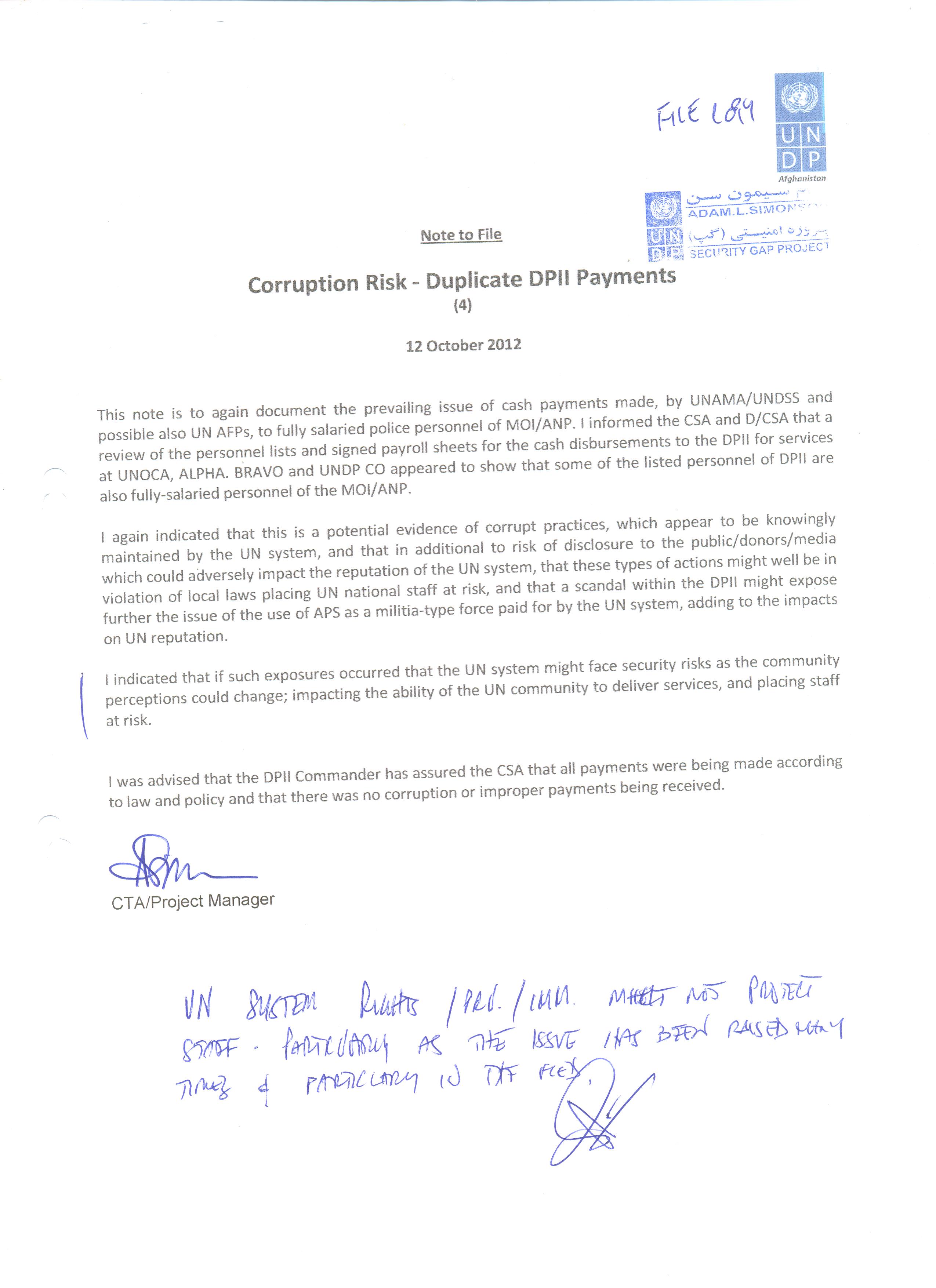
UNITED NATIONS, October 10, more here – Following up on Inner City Press exclusive publication of UN Development Program audits of its Law and Order Trust Fund Afghanistan, including double payments and other irregularities, whistleblowers this past summer exclusively provided Inner City Press with yet more damning documents. 
   On August 15, UNDP belatedly specified that "there is an ongoing investigation related to issues raised in documents published by Inner City Press" - but again uses this as a rationale for the lack of response not only by UNDP but also the UNAMA mission and UN Department of Safety and Security.
  On fifty five days later, despite two more requests from Inner City Press, UNDP has nothing on any results of its investigation. It has provided its response to the October 6 release by the US Special Inspector General for Afghanistan Reconstruction -- which says (other) audits will be released by the end of the year.
  When will any of these audits, including one promised in early September about Rwanda ghost consultancies, be released? 
  Inner City Press asked at the October 10 noon briefing, then in writing: "this is a request for UNDP's response to SIGAR's allegations -- and for the results of the probes UNDP answered on August 15 then in early September, about Afghanistan and Rwanda."
  The latter two have yet to be answered, other than "let me check and I will get back to you." On SIGAR, UNDP says "we will make publicly available an audit of our oversight of the monitoring agent before the end of this year." (The rest should go here.)
  On Rwanda ghost consultancies, UNDP told Inner City Press on September 3, "The results of the investigation will be available once it is complete." It has not been made available; nor has any update yet been provided. 
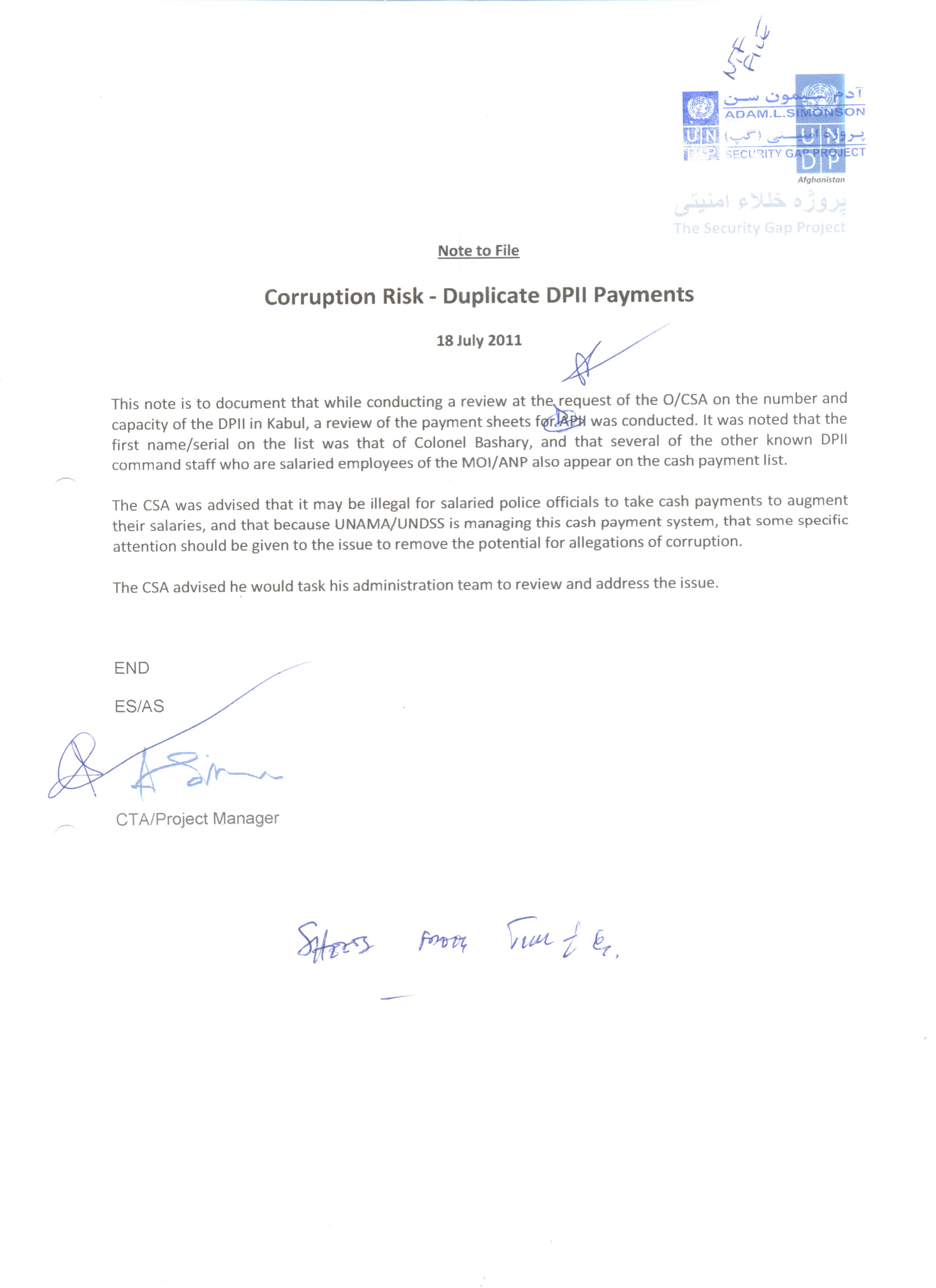
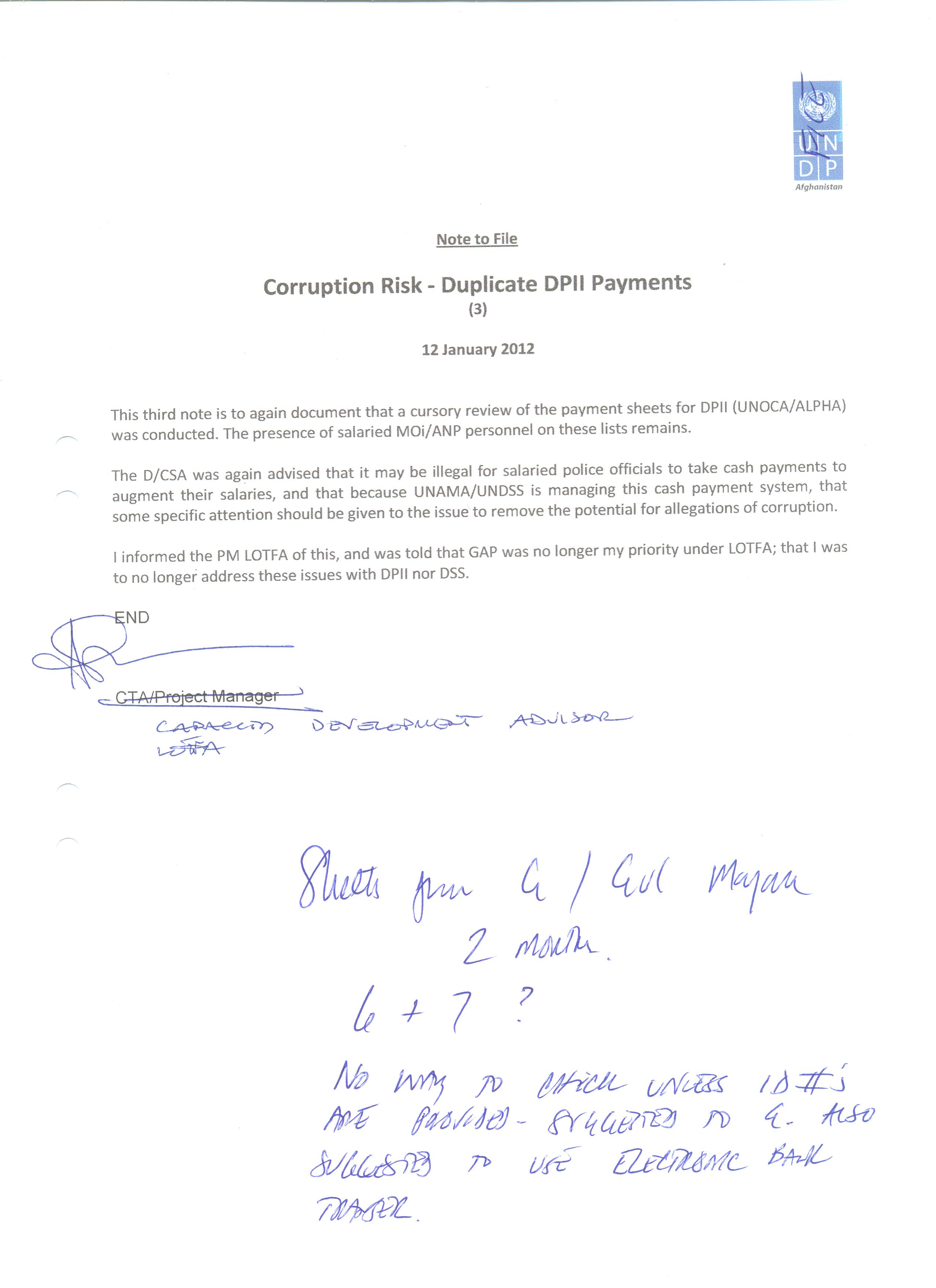
   As to what the documents and "issues raised" regarding Afghanistan are, see for now hereherehere and here, exclusively provided to Inner City Press by now-former UNDP staff. There are more documents, one more of which was published today, here.

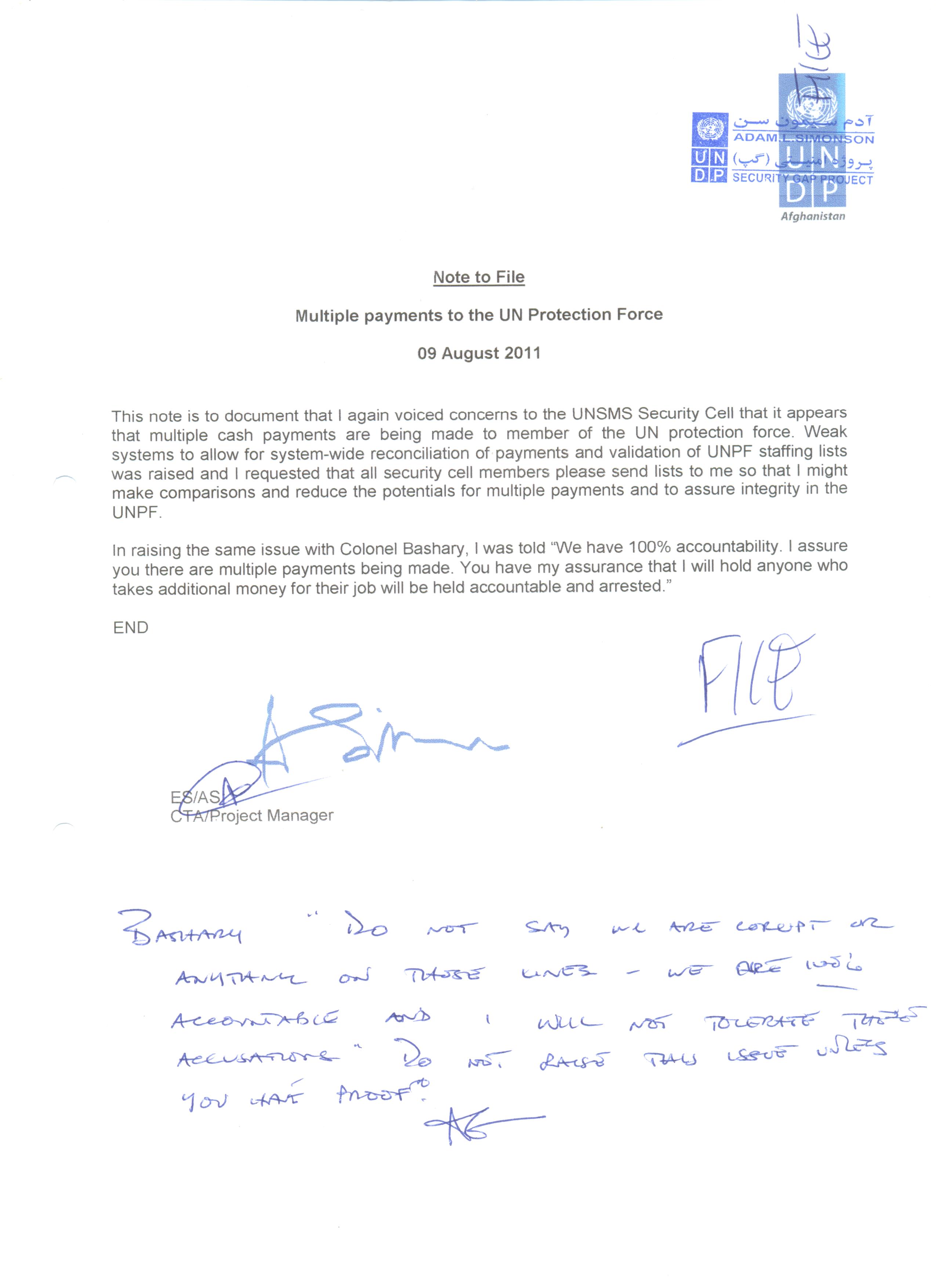
In it, the same Colonel Bashary who threatened he would not tolerate these accusation turns up on the list of double payments. 
  This publication follows four days in which UN spokesman Stephane Dujarric, formerly UNDP's spokesman, had not said whether an audit cited as a justification for not answering is the troubling audit completed in February 2014
  After Inner City Press asked again on August 15, UNDP's Dylan Lowthian provided this response, which we publish in full:
The 'Security Gap Project' (SGAP) which you have previously referred to was established to enhance security for all United Nations personnel working in Afghanistan. SGAP supported the Government to develop dedicated protection services to the United Nations to enable reconstruction, development and humanitarian activities to be carried out.
SGAP closed at the end of 2013. An audit of the project was carried out by Grant Thornton beginning in October 2013 and was completed in January 2014. Upon completion, the audit was issued in February 2014 and in-keeping with our commitment to transparency and accountability, was subsequently published on the UNDP global website, where it is publicly available to download. Audits are an essential part of our control mechanisms. They are conducted in order to identify both strengths and weaknesses in our programs as a way to increase our overall performance.
There is no second audit of the SGAP project.
As outlined by the Deputy Spokesperson at the briefing on Friday 8 August, there is an ongoing investigation related to issues raised in documents published by Inner City Press. In order to avoid jeopardizing the investigation process, the details of investigations are kept confidential and very limited information is made available to offices outside the UNDP Independent Office of Audit and Investigation, until the process of gathering relevant evidence and fact-finding has been completed. Should the matter be substantiated, the evidence gathered by the Office of Audit and Investigation will form the basis of remedial action.
  We'll have more on this. For now, Inner City Press is informed that now "the heat is on at the Kabul office" -- this is called a cover-up, and retaliation against (the wrong) whistleblowers.
 The UNDP Independent Office of Audit and Investigation COMPLETED an audit of this Closing the Security Gap on February 12, 2014, Report Number 1251, here.
  That report noted "incomplete recording of expenditure incurred in 2012. Salaries were not charged to the Project for the first
five months of 2012; lack of appropriate audit evidence on fuel charges amounting to $60,715 and rent expenses of $13,589; overstatement of indirect program support costs by $21,737."
   First, it was and is unacceptable for this UN to say it will not respond to troubling documents because it is conducting its own audit or "investigation," with no completion date named and no commitment to make it public. The new Free UN Coalition for Access is opposing and seeking to reverse this UN descent into obfuscation and stonewalling.

  Inner City Press asked Dujarric on August 11:
Inner City Press: last week there was some back and forth about the UNDP (United Nations Development Programme) programmes in Afghanistan that resulted in Farhan [Haq] on Friday saying that an audit is ongoing, and while the audit is ongoing, there will be no comment.  At least that’s how I interpreted it.  But, I’ve looked into it and it turns out that there was an audit that was completed of this very program called “Closing the Security Gap” project, finished in February of this year by Grant Thorton.  It made a lot of negative findings, but… it wasn’t clear to me, since UNDP never directly answered the questions, is this audit that’s being cited the old audit?  Is there a new audit?  If there’s a new audit of the same programme, how much was paid for the former audit?  And can you explain how it’s appropriate for the Secretariat to not answer questions about DSS [Department of Safety and Security] and UNAMA [United Nations Assistance Mission in Afghanistan] by referring to a UNDP audit that may already be completed?

Spokesman Dujarric:   My short answer is, show me what you have, what you’re referring to and I’m happy to look into it because I’m a little confused by the number of audits myself.
  Inner City Press immediately emailed the audit to Dujarric, along with these three questions:
1) is this the audit Farhan / UNDP were referring to at Friday's noon briefing and justifying not answering questions about DSS and UNAMA?
2) if a second audit of the Closing the Security Gap Project is underway, why? And, either way, how much was paid for the Grant Thorton Audit?
3) This is a requests for the Secretariat to respond to the references to DSS and UNAMA in the documents Farhan was responding to on Friday.
  There was no answer. Inner City Press asked Dujarric again on August 13:
Inner City Press: I’d asked you on Monday about this UNDP audit that was cited as a reason they were not answering a questions about [Department of Safety and Security] and UNAMA [United Nations Assistance Mission in Afghanistan].  Have you been able to find out from them whether this February 2014 audit was the one that they’re citing now or is there a new audit?

Spokesman Dujarric:  I haven’t had a chance to actually follow-up but I will. 
 Two day later, nothing. So Inner City Press asked yet again.
 Before publishing any of the documents, Inner City Press posed questions to five UNDP spokespeople. But none even confirmed receipt -- including Abdel-Rahman Ghandour, the spokesperson who belatedly responded to Inner City Press' previous LOTFA exclusives.
 What changed, other than Inner City Press' subsequent reporting on UNDP Administrator Helen Clark's layoff campaign, and these new troubling questions?
 The questions were sent on August 5 to the following, without response for 72 hours: lead spokesperson Dheepa Pandian (out of the office from August 1 to 18), Mila Rosenthal and Helen Clark's personal spokesperson Christina Lo Nigro.
  After Inner City Press asked UN Deputy Spokesperson Farhan Haq to reply about the UN Secretariat's own role, Haq on August 8 read a statement from UNDP -- there will be no answer pending a UNDP audit. Video here.
   This is pure stonewalling. And can Ban Ki-moon's UN Secretariat's Department of Safety and Security and UNAMA Mission hide behind a UNDP investigation that may never be public? 
   After Haq refused another Inner City Press question, after the UNTV cameras turned off, Haq told Inner City Press that UNDP refused to answer the August 5 questions, below, due to "your people skills." Inner City Press deals perfectly well with numerous diplomats at the UN and many others -- but UNDP and some UN officials don't like hard questions and think they can simply stonewall, in the UN's Zone of Impunity.
   Seventy two hours in, while the UN Secretariat of Ban Ki-moon said it wouldn't answer about the role of its own Department of Safety and Security and UNAMA mission while UNDP answers, August 6 and 7 video here -- UNDP had provided no answer at all.
   This despite UNDP Administrator Helen Clark having been subject to formal governmental requests about related UNDP irregularities in Afghanistan in May. Is this any way to run for UN Secretary General?
  The fourth document, exclusively published here, makes even more clear why Bann Ki-moon's Secretariat must respond. The document describes double payments then introduces one "Colonel Bashary," who threatens not to talk about corruption, "I will not tolerate these accusations." Click here to view.
  In Afghanistan as Inner City Press exclusively dug into, UN Security official Louis Maxwell was killed, presumptively by Afghan Forces -- and the UN has obtained zero accountability for this killed staff member. Inner City Press has put questions about Louis Maxwell toDeputy Secretary General Jan Eliasson, who to his credit responded, and to current Syria envoy Staffan de Mistura, here.
Now: why would the UN be telling a whistle-blower to "just let it be," then refusing to answer? 
  The third document, exclusively published here, concerns "'Ghost Staffing' at the UN Protective Force," about which the UN Department of Safety and Security said, "Just let it be for now." Click here to view.
    On August 5, Inner City Press exclusively published this one, linking it to the LOTFA scandal: an official "was again advised that it may be illegal for salaried police officials to take cash payments to augment their salaries" but the adviser was told it was "no longer my priority under LOTFA and that I was no longer to address these issues with DPII or DSS."
  This and the other documents indicate that little was fixed, that UNDP goes after whistleblowers, and does not follow up even when for example it is involved in visa fraud. 
   Inner City Press on morning of August 5 asked no fewer than four spokespeople at UNDP, including the personal spokesperson for UNDP Administrator (and UNSG candidate) Helen Clark for their response to the below. 
 There had been no answers. Inner City Press exclusively published the second document, here: about payments by UNAMA / UNDSS to fully salaried Afghan forces. Click here.
  Both UNAMA and UNDSS are run by Ban Ki-moon's Secretariat, so Ban's spokespeople must answer. UNDP's Helen Clark herself has refused official inquiry about these irregularities. So on August 6 Inner City Press asked UN deputy spokesperson Farhan Haq:
Inner City Press: The payments by UNDSS (Department of Safety and Security) and UNAMA (United Nations Assistance Mission in Afghanistan) in Afghanistan to members of the Ministry of Interior and other Afghan forces that are already under full salary by the Government. Various documents have come out that show an internal UNDP (United Nations Development Programme) whistle blower seeking to raise these issues within UNDP because, I guess, because as the country team, or whatever. But the documents list, they name UNDSS, they name UNAMA, and basically the person was told, “Don’t raise this anymore.” So, I was anticipating you to say “Ask UNDP”. And I have more than 24 hours ago. I don’t have any answer from them. But I want to ask you, because the documents are not just about UNDP, but about DSS and UNAMA, is it… what are the rules? Is it UN’s, DPKO’s (Department of Peacekeeping Operations), DPA’s (Department of Political Affairs) and DSS’s understanding that Afghan forces shouldn’t receive out double payments. If this information came to light, I think it did, what was done about it? That’s my question to you. I don’t know if you get an answer today. Is it possible?
Deputy Spokesman Haq: As I’m sure you’ve anticipated, and indeed you said you anticipated, yes, I’m aware that UN Development Programme is in touch with you on this. They’ve informed you that they will get back to you. And so, we will first have to wait for what their reply is. First ask them.
Inner City Press: How long --
Deputy Spokesman: No, no. It’s no use trying to get the two of us talk at cross purposes with each other. UNDP will get back to you.
  That UNDP "is in touch with you" was and is not true: there has been no response at all. The statement UNDP "will get to you" remains unfulfilled. This is today's UN system -- even when UN system staff unions wrote to Ban Ki-moon about Helen Clark, and Inner City Press repeated asked about the letter, there has been no response.
  Here is what Inner City Press asked on August 5, no answer:
This is an Inner City Press Press request on deadline for UNDP's comment / response to the following narrative provided to us by UNDP whistleblowers:
UNDP purchased $100,000 in fuel for a special police unit and it was discovered that some or all of the fuel was stolen by the police. The project manager - chief technical adviser for the project refused to purchase another allocation of fuel due to this reported corruption. Refusing to purchase this additional fuel caused problems between the project manager - chief technical adviser and the chief of UN security in Afghanistan.
This followed with reports that several vehicles purchased by this same UNDP project and given to this same special police unit were not being used for the unit but had instead been given as political gifts or other reasons to other offices of the Afghan government. After giving these vehicles to higher ranking officials the Colonel of this special police unit was promoted to General.
The project manager - chief technical adviser reported this and nothing happened. As part of the review which discovered this the corruption of payments made by the UN security office in Afghanistan to the special police unit was also discovered and reported.
 This is also a request for UNDP response / comment on another issue, of visa overstay, also on deadline:
UNDP's staff from Afghanistan have not returned to their duty station after being granted visas to attend/participate in the recent UN Games in the USA. UNDP supported the official/G4 visas for all of these Afghan nationals and now they have remained behind in the USA... How can the organization justify sending a dozen people half-way around the world to compete in 'UN Games'? How many of them were given business class tickets since the travel exceeds the 9 hour standard? Is this a proper use of public monies? How can an office so critical to the development of Afghanistan in this time of change see it as beneficial for a dozen of their staff to go on a paid junket to the USA?
1. Lailuma Shirzad (procurement) - overstay in USA.

2. Abdul Hamid Karimi (procurement) - presumably in UK

3. Idrees Sherzai (HR) - went to US, but crossed the border and is now in Canada

4. Shahkhalid Yousafzai - went to US, but crossed the border and is now in Canada
This is on deadline. This is also a request for UNDP's response to thestaff survey and the critique(s) of the restructuring / layoffs
  On the visas we can for now add: There are 3 more from ELECT Project and 3 to 4 from Information Communications and Technology Unit whom whistleblowers say have also overstayed their visas. We plan to have more. Watch this site.



Friday, August 29, 2014

As UN Hosts NGO Conference, Talk of Transparency for IMF But Not UN Itself, Pressed by Free UN Coalition for Access


By Matthew Russell Lee

UNITED NATIONS, August 29, updated September 2, below -- The UN hosted non-governmental organizations from all over the world from August 27 to 29 for the 65th Annual United Nations DPI/NGO Conference.

  After the Outcome Document was agreed to, Inner City Press asked if there had been discussion of the UN's transparency, given for example that unlike many governments the UN does not have any Freedom of Information law or procedure.

 Panelist Maruxa Cardama of Communitas said no written recommendation had been made on that; there were critiques of the International Monetary Fund and World Bank.

 As an issue of access, on behalf of the Free UN Coalition for Access, Inner City Press asked about complaints FUNCA received from NGOs who waited up to five hours to register. It was explained that on August 26 the computer system had problems, but it was fixed after that.  The panel was not able to say what percentage of attendees came from the United States.

  The outcome document is here. FUNCA is still seeking answers to the question it asked two days before the conference started: what does the UN do to defend and ensure access for NGOs?

   On August 25, Inner City Press put these and other questions to Maher Nasser, the Acting Head of the UN Department of Public Information. Video here. Earlier this summer, for example, the government of Sri Lanka ordered NGOs to stop holding press conferences or otherwise interacting with the media. Click here for that.

  Inner City Press asked Nasser what the UN, whose UN Information Center in Colombo has been promoting this week's New York conference, actually does for NGOs in Sri Lanka amid this crackdown. Nasser cited UNESCO and the UN's human rights entities.

  Given the UN's troubling silence in Sri Lanka amid mass killings in 2009, which has given rise to Secretary General Ban Ki-moon's “Rights Up Front” initiative, perhaps DPI where applicable should speak up on such restrictions put on NGOs.
Background: After Sri Lanka's Minister of "Defense and Urban Development" issued an order banning all non-governmental organizations from press conferences, workshops, training for journalists, and dissemination of press releases which is beyond their mandate," and the UN declined comment or passed the buck, the US and the human rights group FIDH has expressed concern.
   On July 7,  Inner City Press  asked UN Deputy Spokesperson Farhan Haq about it. Video here, on Inner City Press' YouTube channel.
  Inner City Press asked, since UN envoy Oscar Fernandez Taranco was recently in Sri Lanka, had he spoken to the Rajapaksa government about this crack-down, or did he have any comment now?
  Haq replied, "We'll have to study what this particular injunction was... we'll have to evaluate that."  Apparently the evaluation is still ongoing.
 Regarding Sri Lanka the UN has essentially stonewalled Press questions about the White Flag killings report and the light it sheds on current UN official Vijay Nambiar and former UN official, now Sri Lankan Ambassador Palitha Kohona.
  It was about a past financial relationship between Kohona and the president of the UN Correspondents Association, who then agreed to an UNCA screening of a Rajapaksa government movie denying war crimes that UNCA tried to censor.
When Inner City Press reported on the background to Kohona getting the Rajapaksa government's denial of war crimes, “Lies Agreed To,” screened in the Dag Hammarjkold Library auditorium, the reaction from the then-president and executive committee of the United Nations Correspondents Association are summarized here.
   Now starting September 3, this UNCA says it will use the large room the UN gives it to host "diplomats" and the journalists which pay it money.  The first guest, at the same time as a Press Briefing Room session about the Security Council's work for September, is not named or disclosed. Given the past, might it be Kohona, whose financial relationship with UNCA's president the UNCA Executive Committee tried to censor?

Update of September 2: After publication of the above, this year's president of the UN Censorship Alliance told those paying money that in deference to the briefing on the Security Council's program, the time would be pushed back to 1:30. So a half-hour schmooze-fest. But with whom? Kohona? 
  The new Free UN Coalition for Access opposes all of this, and attacks on media work both inside the UN both further afield and as close at 47th Street, west of First Avenue. Watch this site.


Sunday, June 1, 2014

Cut-Backs at UN Develoment Program While Helen Clark in Belarus, Transparency Part I


By Matthew Russell Lee

UNITED NATIONS, May 31, more here -- For many weeks there have been rumblings about “Helen Clark's cut backs” at UNDP, the UN Development Program. 
   This week the rumbling spiked, with the UNDP staff union holding a meeting in the UN's basement on May 29 to discuss the loss of up to 30% of UNDP's jobs in New York.
  So on May 31 when Helen Clark re-tweeted praise of her visit to Belarus from her representative in the country, Sri Lankan national Sanaka Samarasinha, Inner City Pressreplied: "What about the UNDP layoffs?"
   The response came not from Helen Clark -- who rarely if ever holds question and answer press availabilities at the UN in New York -- but from Samarasinha, that the UNDP layoffs "must always be transparent & being fit for purpose. We strive toward that end."
  Inner City Press thanked Samarasinha, adding it will try to make the proposed layoffs transparent. In that spirit, we now publish Helen Clark's May 19 letter to staff:
Dear Colleagues,
Last year the Executive Board approved a new Strategic Plan for UNDP, and since then the whole organization has been making the changes necessary to fully implement that plan. One of the three pillars of that plan was improving institutional effectiveness. To that end the organization has conducted significant reviews of its performance and we have all been involved in planning and implementing changes. At the country office level most of you are well on your way to completing the financial sustainability exercise which has led to many changes. Also, over recent months we have been going through a structural change exercise at the headquarters and regional levels to achieve a number of efficiency gains.
We committed to:
· Moving more of our policy and support services to the regional level so that we are closer to our country offices.
· Removing unnecessary duplication between bureau
· Ensuring our functions are properly aligned through the organization to improve accountability and professional standards
· Improving our span of control so that we have better career paths for younger staff.
· Reducing our spending on staff salaries so that we can stay within the integrated budget limits set by the Board in September.
· Ensuring we free up resources to invest in new areas required to deliver on the Strategic Plan
All Bureaux have been working hard on how to reorganize functions and reduce costs. This has not been an easy exercise and I must commend both my management and the many staff involved for their commitment to coming up with solutions.
We are now at the stage where we are ready to release new organograms for all bureau. This will happen on Wednesday this week (NY time). These organograms will reflect a much different UNDP from what we now have. Our services will be much more focused in the regions and we will be leaner. We will have significantly fewer D grade positions relative to other professional and general services grades.
This means that many peoples jobs are affected, and we will be embarking on a realignment process aimed at being as fair and transparent as possible to fill the new positions.
Details of the new organograms will be released on Wednesday 21 May, and managers in all bureaux will be available to discuss with staff what the implications are for their bureau.
I understand, however, that some staff may wish to take the opportunity to leave UNDP, rather than compete for new positions. To facilitate this we will be making available a limited number of voluntary separation packages. The details associated with this are attached to this email, and if affected staff members are interested in taking this option they should discuss this with their manager.
All organograms will be made available on a dedicated intranet site, and at that time all staff at headquarters and working at regional level centres will receive formal notification that they are within the definition of affected staff. Bureau managers will then work with individual staff members to confirm the status of their existing position. Information will also be available on the processes which will be used for the realignment exercises which will have to follow. Let me assure you that these exercises will be designed to be as fair and transparent as possible and will ensure that existing rights under staff rules are respected.
Finally let me say to you all that I recognize that this is not an easy time for staff. I also know that we can be a stronger more effective development organization which can make real differences in millions of peoples’ lives. By demonstrating that to the world, I have no doubt that there are many exciting opportunities out there for UNDP to build on .
Helen Clark
UNDP Administrator
  Another source told Inner City Press that Clark wants to “force people, many women, many who are head of household, to be deported after one month [when their G-4 visas would expire], and force many staff who are just 2, 3, 4 years from early retirement age out, so they will miss out on their after-service health insurance. If they get away with this at UNDP, it will quickly spread to the rest of the UN system. Oh, and by the way, the men and women at D1, D2 and ASGs are unaffected.”
  This, Secretariat staff say, is similar to current Secretary General Ban Ki-moon's mobility or “5 year rule” - now imposed on regular staff, but seemingly not applied Ban's higher ranking friends. UNease is growing. Another description here, from IPS.
  The connection is that Helen Clark wants to replace Ban Ki-moon as Secretary General, despite the the post as his successor said to be reserved for the Eastern European group which has never held it. Clark is banking on gender trumping geography, and job cutting seems to be her campaign issue for Western, donor countries.
  A well placed source tells Inner City Press Clark told management currently employed at UNDP to “drop what they are doing and work on her campaign” for S-G, they would be rewarded with a higher post in the Secretariat if she comes to replace Ban.
Footnote: In the Secretariat, the hold-over staff union which barely fought Ban during its time in power now presents itself as supporting UNDP worker, and as... still the staff union, despite the December vote and controversy since.
  
   This rift only benefits those pushing for lay-off, just like the UN's Censorship Alliance getting the first question and big room results in softball coverage of the UN, here. We'll and the Free UN Coalition for Access will have more on this.