Showing posts with label Radio Tamazuj. Show all posts

Thursday, May 21, 2015

UN Is OK with Censorship In Burkina Faso, Silent on Killed Journalist in South Sudan, UN's Censorship Alliance


By Matthew Russell Lee
UNITED NATIONS, May 21 -- At the UN there is much talk about the protection of journalists in conflict situations, and about freedom of the press. But when Inner City Press for the Free UN Coalition for Access on May 21 asked the UN about a journalist killed in South Sudan, where the UN has a mission, there was nothing:

Inner City Press / FUNCA: In South Sudan, a journalist of Radio Tamazuj, Pow James Raeth, is reported to have been killed by gunfire in Akobo.  And I wanted to know whether UNMISS, which I believe still has a facility in Akobo, is aware of it, if they have any comment on it, and what they think is behind the killing of this journalist.

Deputy Spokesman Farhan Haq:  We'll have to check with UNMISS whatever details there are of that incident. 

  Seven hours later, there was no answer. The day before, on May 20, Inner City Press for FUNCA asked about Burkina Faso:
Inner City Press / FUNCA: Burkina Faso has announced that it's banning live political broadcasts for three months in the run-up to elections, and a number of press organizations have been critical of it.  Given DPA (Department of Political Affairs) and the UN's kind of involvement in different stages in Burkina Faso, do you have any view of that banning of live political broadcasts?

Deputy Spokesman Haq:  I don't know whether it's a banning or whether it's restrictions.  There are a number of countries that restrict political broadcasts in the run-up to elections, and sometimes that's designed to lessen the threat of electoral violence, so that's a more complicated issue.  So at this stage, we wouldn't have anything to say about that.  If there are concerns about actual harassment of journalists, that would be a case for concern.
 What about the killing of a journalist in South Sudan? Next week the UN Security Council under its Lithuania presidency has a meeting on the protection of journalists, and we will cover it. But we will not cover the RSF side event with Christophe Deloire held in the clubhouse of UNCA, which typically did not ask about the journalist killing in South Sudan or censorship in Burkina Faso. In fact, UNCA board members tried to get the investigative Press thrown out of the UN, for its reporting, becoming the UN Censorship Alliance.
Many organizations like to "launch" their reports at or in the United Nations, and so ask few questions about UN. The Committee to Protect Journalists did one earlier this year.
  Tellingly, while CPJ spoke out against the censorship in Burkina Faso, it has said nothing about the UN's defense of it. What is the likelihood of Burkina reversing itself, when it now has UN endorsement?
 On February 14, 2013, Inner City Press asked CPJ about the UN Correspondents Association's board members trying to censor its reporting about Sri Lanka and trying to get its UN accreditation "reviewed."
 The CPJ response was no comment on the "internal dynamics of the UN's accreditation process," saying its focus is "international press freedom issues." Isn't censorship at the UN international?
  Now it gets worse - the above quoted Q&A was at least in the open UN Press Briefing Room. Now CPJ intends to take its report launch behind closed doors in clubhouse the UN gives UN, its UN Censorship Alliance, publicized only to those who pay UNCA money. 
  The new Free UN Coalition for Access challenges all this - and CPJ's corporate and selective advocacy for only some journalism. It is a tuxedo approach such as on display in DC.
   Back on February 14, 2013 when CPJ came to the UN Press Briefing Room to “launch” its annual report on press freedom Inner City Press asked them, not for the first time, about the UN's own treatment of the full range of journalists, their right to access the UN and to due process if challenged. Video here, from Minute 29:12.
  As example, Inner City Press noted the UN limiting accreditation by geography and to those who abide by the “principles of the Organization,” and total lack of due process rules for journalists on complaints as those filed against Inner City Press in 2012 by Voice of America,ReutersLouis Charbonneau and the “UN Correspondents Association” for which he spoke on Thursday. Video here, from Minute 12:04.
  Rob Mahoney of CJP, who had begun the press conference by saying “we look to the UN” on these issues, declined to comment on the "internal dynamics of the UN's accreditation process," saying he doesn't know enough about it since he focuses on "international press freedom issues." Video here, from Minute 30:40.
  But aren't unfair rules of the UN worldwide in denying access to journalists "international press freedom issues"? And how can you "look to the UN" to help if you don't first look AT the UN?
  While Charbonneau's UNCA in mid-2012 initiated a process against Inner City Press citing an article it wrote about Sri Lanka (and UNCA, see here), Inner City Press received death threats from supporters of the Rajapaksa government in Sri Lanka.
  Inner City Press asked UNCA to stop or at least suspend its process; this was refused, including by Charbonneau, who told Inner City Press to “go to the NYPD.”
Remembering CPJ's Bob Dietz' focus on Sri Lanka, Inner City Press wrote to him and CPJ's Joel Simon. The response came from CPJ's Americas Research Associate Sara Rafsky:
Thank you very much for alerting us about your situation. At the moment, the Americas program is swamped with urgent cases... Thus it will most likely be some time before I can look into your case.”
  These was no follow up by CPJ. The New York Civil Liberties a month later, citing the complaint against Inner City Press, asked the UN to state its due process rules, which the UN has yet to do.
   The  Free UN Coalition for Access, on behalf of which Inner City Press thanked Mahoney and his largely silent panel for coming, is pursuing changes to the UN's archaic and exclusionary accreditation rules and Media Access Guidelines.
   UNCA's, and Charbonneau's, response was to tear down flyers on the topic. Atop UNCA again is Giampaolo Pioli the past president who, after renting one of his apartments to Palitha Kohona, later granted Kohona's request as Sri Lanka's ambassador to screen that government's war crimes denial film "Lies Agreed To" inside the UN, under the UNCA banner. Inner City Press reported on it, was told to remove the article from the Internet or face expulsion from the UN. That is censorship, and CPJ was informed: but partners with UNCA. This is not press freedom.
   Then on February 12, 2014  when CPJ its "Attacks on the Press" report online, under the heading Africa there were pages on Tanzania and Swaziland, for example, but none on South Sudan or Mali.
  CPJ's Joel Simon began the February 12, 2014 "launch" press conference by explaining why it was held at the United Nations (he cited countries trying to use the UN to control the Internet). Inner City Press when called on asked if CPJ thinks the UN Peacekeeping missions in South Sudan and Mali do enough to combat crackdowns on the press there, for example the Salva Kiir government seizing a complete issue of the Juba Monitor, and theats against MaliActu.. 
 Now we wonder, including on behalf of the Free UN Coalition for Access, what CPJ thinks of the UN bureau chief of Reuters, with essentially a permanent seat on UNCA board, mis-using the Digital Millennium Copyright Act to get Google to block access to a leaked anti-Press complaint to the UN from its search. Isn't that censorship? 

CPJ & Reuters current and former, Feb 14, 2013 (c) MRLee
   The problem here is that groups like CPJ like to use the UN to “launch” their reports. Mahoney joked with two separate Reuters reporters: click herehere and here for three (of many) documents obtained under the Freedom of Information Act reflecting Reuters and the UN.
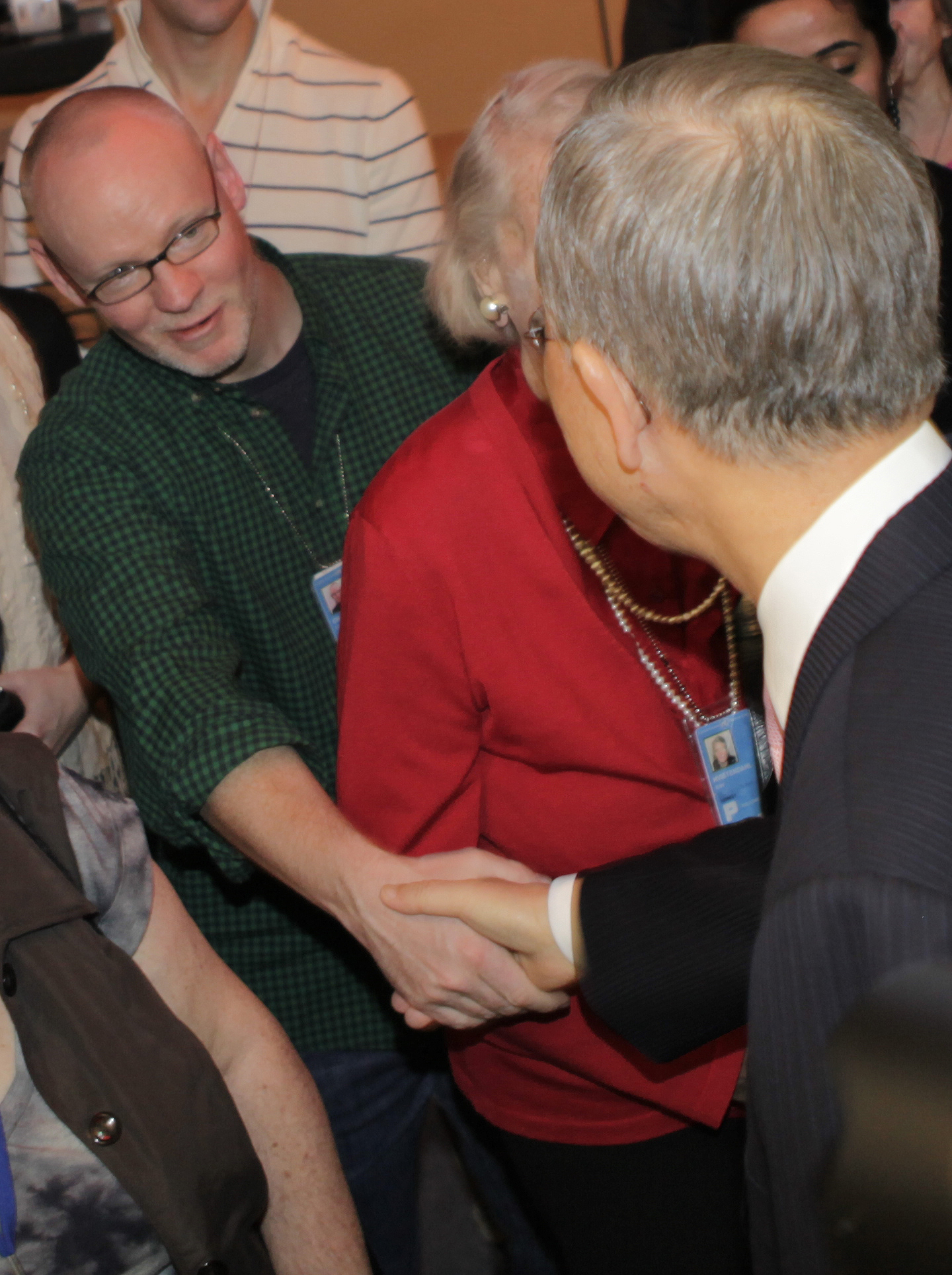
Reuter's Charbonneau shakes with Ban: on what? (c) Luiz Rampelloto

  CPJ or at least Mahoney seem to assume that Big Media like Reuters (and Agence France Presseclick here) can do no wrong. But that is not the case. Watch this site.

Friday, February 27, 2015

On South Sudan, UN Still Murky On Who Shot Copter Down, Who Kidnapped Children as Soldiers; Inner City Press Asks


By Matthew Russell Lee
UNITED NATIONS, February 27 -- When a draft resolution was circulated on February 24 to the UN Security Council which would set up a South Sudan sanctions committee, wire reports focused on the views of the Western Permanent Three members of the Council -- the US, France and UK -- and did not make available to the public the actual nine-page draft.
   Inner City Press in an exclusive dispatch on the morning of February 25 published the full draft, here and embedded below.
  Now on February 27 after UN Spokesman Stephane Dujarric read out a vague summary of the UN's investigation into the deadly downing of one of its helicopters in South Sudan last August, Inner City Pressasked for specifics:
Inner City Press: you said that they were unable to determine who did it, that it came from an area between In Opposition and the Government.  But there was this audiotape of Peter Gadet threatening the UN to shoot down helicopters that was… you know, days before it was shot down.  So, can you say or find out whether these Board of Inquiry people listened to the audio and whether they found it not credible or… why it's not part of the report?

Spokesman Dujarric:  They had all the information that was available to them.  As a general point, a threat is a threat.  I think what they were looking at is for hard evidence to figure out who had shot the helicopter, they were not able to come in with any conclusive information.

Inner City Press: Do they use a different standard of proof than even a court because usually like it seems like --

Spokesman:  A Board of Inquiry tries to establish what happened.  Obviously, they looked at the helicopter and all the information they had.  That's the conclusion they came up with. 
  But why? Beyond Gadet, the International Crisis Group, for example, implies that the government itself shot the copter down: 
"an UNMISS helicopter was shot down on 26 August, killing three. Although the results of its investigation have not been released, initial reports suggest this was done from territory controlled by the government and by a weapons system know to be in the hands of the government [n. 100:  Crisis Group interviews, UN officials, Nairobi, November 2014; defence and security adviser, Nairobi, December 2014.]"
  For UN Peacekeeping under Herve Ladsous to remain silent is consistent with its approach to the Tabit rapes in Darfur, the Minova rapes in November 2012 by the DR Congo Army, and the shooting at unarmed protesters in Haiti (to say nothing of the killing by cholera there.)
  On the draft sanctions resolution, Inner City Press reported that that of the Elected Ten or E10, African members Chad and Angola, as well as Latin America members Venezuela and Chile, urged that the African Union and the regional body Intergovernmental Authority should take the lead before any Security Council’s decision.
  Sources tell Inner City Press that in this view, decision should only be taken on the draft after the Security Council meets with IGAD and the African Union Peace and Security Council, scheduled the sources tell Inner City Press for March 12 during a French-organized Security Council trip also including, the sources say, the Central African Republic and Burundi. We'll have more on this.
  On an abuse in South Sudan on which the UN was slow and partial in reporting, Inner City Press on February 24 asked UN Spokesman Stephane Dujarric:
Inner City Press: I wanted to ask first about South Sudan.  There was this very kind of high-profile kidnapping of dozens of children, and what I really wanted to ask you about is, although it was initially said it was unclear who did it, there are now reports that the militia that is responsible for it is basically part of the army of South Sudan.  And I wanted to know what Ellen Løj or the human rights component of UNMISS, what they say about those allegations that seem to be serious?
Spokesman Dujarric:  We’ve seen increased reports of kidnapping of children and forced enrollment into units, whether it’s the report you stated which our colleagues at UNICEF have flagged for us, or other reports, and I know it’s something that is of concern to all of us here.  It is being looked at both by the Mission and by different departments here.  But it’s obviously a big concern.  We have worked very hard to ensure that children are freed from such activity, and we will continue do so.
Inner City Press:  But do you expect the UN system to say who is responsible?
Spokesman Dujarric:  I know they’re looking into these — we’ve seen these reports.  We’re looking into them.
 Now Radio Tamazuj reports on this, citing Inner City Press' questions under the headline, "UN refuses to name abductors of 1000+ men and children in South Sudan."
  We'll have more on that, as well. Inner City Press has put the full text online here:

  The full draft we are publishing, in the public interest, above.  Reuters typically said they "obtained" it but did not publish it; Voice of America said they saw it, and mechanically quoted HRW on Russia and China, with nothing about the view of the African and Latin American members of the Security Council. Watch this site.


Tuesday, February 17, 2015

As South Sudan Threatens UN Radio Mireya, Inner City Press and FUNCA Ask But UN Silent As on Tabit Rapes, Mali Casualties, Inaction on FDLR


By Matthew Russell Lee
UNITED NATIONS, February 17 -- After South Sudan's Minister of Information and Broadcasting Michael Makuei threatened to shut down the UN's Radio Mireya, Inner City Press for the new Free UN Coalition for Access asked UN Deputy Spokesperson Farhan Haq on February 17 if the UN accepts censorship.
  Haq said no - but will Radio Mireya going forward not broadcast interviews of exiled politicians? What has the UN said about the shuttering of Nation Mirror, which Makuei defended, here courtesy of Radio Tamazuj? Haq did not respond on this, apparently not having heard of it. 
  Under Herve Ladsous, UN Peacekeeping stays silent on many things, for example on injured peacekeepers in Mali in recent days -- Inner City Press asked Haq about them, with no response at the noon briefing -- toinaction on the FDLR in the DR Congo to the mass rapes in Tabit (despite which some sanctions were eased on Sudan today, click here for Inner City Press story on that). But direct censorship by a host government? We'll have more on this.
On South Sudan, when UN Assistant Secretary General for Human Rights Ivan Simonovic took questions on February, Inner City Press asked him about the withholding of the African Union / Obansanjo report, and whether the UN views Peter Gadet, accused of shooting down a UN helicopter, as under the control of Riek Machar. Video here.
 Simonovic said in his last visit to South Sudan he spoke with Peter Gadet by phone, but not during this visit. He said he hopes the Obasanjo reported will be released very shorting. But will it be?
Back on December 4 when the UN's Deputy Emergency Relief Coordinator Kyung-wha Kang took questions about South Sudan, Inner City Press asked her about Juba's role in restricting humanitarian flights, in challenging the flow of funds from Oslo to aid groups.
  Kyung-wha Kang acknowledged some restrictions and some talk that the SPLA-Juba has a right to control the funds committed to in Oslo.
  After the briefing Inner City Press provided her office with such a report and was told it might be better to asked the UN Department of Peacekeeping Operations. But that is dubious, given that its chief Herve Ladsous on the same December 4 would not answer a simple question about the UNAMID mission covering up rapes in Darfur. YouTube video here.
  Still, Kyung-wha Kang is better in that she answers questions and seems genuinely interested in hearing where the UN could do better. This makes reports that the top job in OCHA could go to a FOC - Friend of Cameron - Andrew Lansley all the more troubling. Inner City Press and the Free UN Coalition for Access, which push for transparency, are on this. Watch this site.
 Back on October 22 after the UN's envoy to South Sudan Ellen Loj spoke to the Security Council on October 22, she came to take questions from the media.
  Inner City Press asked Loj to explain two separate lines from her statement to the Council, and one thing that was not mentioned: the deadly downing of a UN helicopter on August 26, allegedly after the UN was told by rebel Peter Gadet that it would be shot down.
  The first line Inner City Press asked about was Loj's statement that "UNMISS is looking into ways to support the efforts of national authorities to end the violence." Inner City Press asked, would the UN provide the Salva Kiir / SPLA forces military support?
  Loj asked to be shown the line, coming out from behind the UN microphone stand to take a copy of her own statement from Inner City Press. Video here.  Finally she said this might involve UNMISS conducting its own street patrols -- why would that be "supporting the national authorities" as opposed to the opposition, where it controls the streets -- or setting up a rape-help desk in police stations.
   When Inner City Press sought to remind Loj of the second line it has asked about, two national staffers "detained" since August, the moderator attempted to move the questioning on. Loj still replied that the UN doesn't know who has these two national staff members detained. 

    On the helicopter, Loj said that a UN Board of Inquiry was in South Sudan last week and she doesn't know the outcome. The helicopter was shot down on August 26, and transcripts of taped called between Gadet and UN officials have emerged. We'll have more on this.
    (A Voice of America scribe tried to take the first question, and then after a softball question made social banter with Loj to the side of the stakeout.)
      Back on October 20 when Sexual Violence in Conflict expert Zainab Bangura spoke about South Sudan, Inner City Press asked of her meeting with Riek Machar and whether she thinks he controls Peter Gadet, under sanctions by the US and suspected of shooting down a UN helicopter. Video here.
  Bangura called her talks with Machar "decent" including "very detailed information on where he is in command." Apparently, Machar is responsible or accepts responsibility for Gadet. But where are the results of the helicopter probe? Another UN cover-up?
 Inner City Press also asked Bangura of the 130 rapes in Minova by the DR Congo Army in November 2012, after which only two soldiers have been convicted while UN Peacekeeping under Herve Ladsous continues supporting the rapist units.
  Bangura said she couldn't speak to that part of the UN, and linked the lack of justice for Minova to the government's delay in investigating.Video here. But doesn't the government, and Ladsous' DPKO and MONUSCO, know which DRC Army units were in Minova during the rapes, and who was in charge of them? Impunity continues.

  While South Sudan President Salva Kiir was in New York, he did not attend the UN's “High Level” event about his country on September 25.
A Senior US State Department Official, speaking on background, said that “there was a lot of disappointment expressed in the meeting that Salva Kiir who is here in New York did not attend the meeting. He sent his Minister of Foreign Affairs and some of his ministers to the meeting and several of the attendees made a point of noting that Salva Kiir was not at the meeting.”
Inner City Press asked the Senior State Department Official if the US know who was behind the recent shooting down of a UN helicopter, if it could confirm that forces under the control of Peter Gadet, already under US sanctions, did it.
The US official said “we know that the UN is investigating it, we are waiting for the results of that investigation. Gadet has been put on the sanctions list even before that happened.”
The official called the shoot-down “evidence of how difficult it is to work in South Sudan,” and added that South Sudan's foreign minister had said the government is committed to not blocking NGOs and the UN from providing aid. “We have to hold them to that commitment,” the official concluded, “people are suffering.”
Background: back on May 6, 2014, when the US imposed sanctions on Gadet, Inner City Press asked:
MODERATOR: Great. Thank you. Our next question is from the other Matt Lee, Matthew Russell Lee of Inner City Press. Go ahead.
QUESTION: Great. Thanks a lot, [Moderator]. I wanted to ask, there was a – it was said that in Security Council consultations at the UN that senior government officials were named in a radio broadcast prior to the attacks in Bor on the UN compound in killing the civilians. I just wonder if you can say are these people – is that the case? Do you know the names of people that sort of called for that attack, and in which case, why aren’t they on this list?
And I also – this might for Senior Administration Official Number Two. Secretary Kerry was talking about a legitimate force to help make peace. And I just wanted to know, is the UN – is the U.S. thinking of that as part of UNMISS mission or as the IGAD force? And if so, would it require a Security Council approval? Thanks.
SENIOR ADMINISTRATION OFFICIAL ONE: On the first, I mean, we typically do not comment on actors against whom we are – we have not yet – we have not yet acted, a clunky way of saying we don’t comment on those who are not part of our designation. But anyone who is contributing to the violence, whether that’s by directing violence, whether that’s by funding it, fueling it, contributing arms, can be a subject of designation in the future. And I’ll leave it to my State Department colleague to answer the second question.
SENIOR ADMINISTRATION OFFICIAL TWO: Yeah. On the question about the regional force and on UNMISS, we – it is something that conversations and discussions are ongoing between countries of IGAD, with New York, with ourselves and others on how best to create this additional force presence that we are working very much with UNMISS and see this as part of the same effort. But we do think it’s very important that the regional forces are able to join this effort in larger numbers and appreciate the efforts of, particularly, the governments of Ethiopia and Kenya, who are leading the mediation and who are seeking to work with UNMISS in this regard.