Showing posts with label Bonesha FM. Show all posts

Wednesday, May 27, 2015

At UN, Protection of Some Journalists, Silence on South Sudan, Burundi, UN Censorship Alliance


By Matthew Russell Lee

UNITED NATIONS, May 27, updated 7:40 pm -- At the UN there is much talk about the protection of journalists in conflict situations, and about freedom of the press. But when Inner City Press for the Free UN Coalition for Access on May 21 asked the UN about a journalist killed in South Sudan, where the UN has a mission, there was nothing. Nor in the week since: nothing.

 Likewise in Burundi, the statements of the UN Security Council and Secretary General Ban Ki-moon have not mentioned journalists Bireha of Bonesha FM, wounded along with an opposition party leader and now reportedly in hiding like other journalists there, for example from Radio Publique Africaine.

  So the Security Council's May 27 event of the Protection of Journalists is, at best, incomplete: perhaps they mean, protection of SOME journalists. 

 Tellingly, UN correspondents from Reuters and Voice of America, both of whom tried to get the investigative Press thrown out of the UN, threw softball questions outside the Security Council - not on Burundi. Their UN Censorship Alliance, UNCA, is promoting its own side event at the same time of the Security Council's belated meeting on Burundi. The head of UNCA Giampaoli Pioli tried to get Inner City Press thrown out for its reporting on Sri Lanka.We'll have more on this, in these live reports:

Update: Mariane Pearl cited "mass surveillance by some UNSC members." Some wonder, why not just say, USA, NSA spying?

Update: Spain's Ignacio Ybfifiez said independent radio is off-air in Burundi. Later, US Ambassador Samantha Power also mentioned Burundi, quoting an unnamed journalist there; New Zealand's new Permanent Representative Gerard van Bohemen also cited Burundi. But why then wasn't Bonesha FM, RPA and others in UNSC's statements? If attempts to include were blocked, why not speak out on it as on some other issues?

Update: Pakistan's Ambassador Dr. Maleeha Lodhi, herself a former journalist, said that embedded reporters raise questions about impartiality. 

Update: Australia's Gillian Bird, to her credit, cited the killing of Radio Tamazuj's Pow James Raeth, on which UNMISS and the UN said nothing, despite questions from Inner City Press and the Free UN Coalition for Access.

Update of 7:40 pm -- there were fewer rights of reply than expected. 
The first was Iran, firing back at Israel for “defamation,” calling it a “pro-apartheid occupier."

(Meanwhile, UN third floor with entrance to UNSC gallery was by then locked. #FreeMedia indeed. FUNCA objected.)

The second reply was by Jordan, to Syria's “unsuccessful attempts to distract attention from regime."

The third reply was by Russia to Ukraine, which it called a leader in killing of journalists, six in 2014.

In sur-reply there was Israel to Iran, which it called “absurd,” calling the UNSC that “appropriate forum” for this “disturbing reality. Ukraine's spokesperson told Russia “don't waste your time, resolve problems in your own country." Then Lithuania's Permanent Representative gaveled it shut.

  "Do you call that a jab?" one of the repliers asked Inner City Press. Well, it passes for one at the UN.

 From the UN's May 21 transcript:

Inner City Press / FUNCA: In South Sudan, a journalist of Radio Tamazuj, Pow James Raeth, is reported to have been killed by gunfire in Akobo.  And I wanted to know whether UNMISS, which I believe still has a facility in Akobo, is aware of it, if they have any comment on it, and what they think is behind the killing of this journalist.

Deputy Spokesman Farhan Haq:  We'll have to check with UNMISS whatever details there are of that incident. 
  Seven hours later, there was no answer. Nor six days later. The day before, on May 20, Inner City Press for FUNCA asked about Burkina Faso:
Inner City Press / FUNCA: Burkina Faso has announced that it's banning live political broadcasts for three months in the run-up to elections, and a number of press organizations have been critical of it.  Given DPA (Department of Political Affairs) and the UN's kind of involvement in different stages in Burkina Faso, do you have any view of that banning of live political broadcasts?

Deputy Spokesman Haq:  I don't know whether it's a banning or whether it's restrictions.  There are a number of countries that restrict political broadcasts in the run-up to elections, and sometimes that's designed to lessen the threat of electoral violence, so that's a more complicated issue.  So at this stage, we wouldn't have anything to say about that.  If there are concerns about actual harassment of journalists, that would be a case for concern.
 What about the killing of a journalist in South Sudan? Now the UN Security Council under its Lithuania presidency has a meeting on the protection of journalists, and we are here. But we will not go to the RSF side event with Christophe Deloire held in the clubhouse of UNCA, which typically did not ask about the journalist killing in South Sudan or censorship in Burkina Faso. In fact, UNCA board members tried to get the investigative Press thrown out of the UN, for its reporting, becoming the UN Censorship Alliance.
Many organizations like to "launch" their reports at or in the United Nations, and so ask few questions about UN. The Committee to Protect Journalists did one earlier this year.
  Tellingly, while CPJ spoke out against the censorship in Burkina Faso, it has said nothing about the UN's defense of it. What is the likelihood of Burkina reversing itself, when it now has UN endorsement?
 On February 14, 2013, Inner City Press asked CPJ about the UN Correspondents Association's board members trying to censor its reporting about Sri Lanka and trying to get its UN accreditation "reviewed."
 The CPJ response was no comment on the "internal dynamics of the UN's accreditation process," saying its focus is "international press freedom issues." Isn't censorship at the UN international?
  Now it gets worse - the above quoted Q&A was at least in the open UN Press Briefing Room. Now CPJ intends to take its report launch behind closed doors in clubhouse the UN gives UN, its UN Censorship Alliance, publicized only to those who pay UNCA money. 
  The new Free UN Coalition for Access challenges all this - and CPJ's corporate and selective advocacy for only some journalism. It is a tuxedo approach such as on display in DC.
   Back on February 14, 2013 when CPJ came to the UN Press Briefing Room to “launch” its annual report on press freedom Inner City Press asked them, not for the first time, about the UN's own treatment of the full range of journalists, their right to access the UN and to due process if challenged. Video here, from Minute 29:12.
  As example, Inner City Press noted the UN limiting accreditation by geography and to those who abide by the “principles of the Organization,” and total lack of due process rules for journalists on complaints as those filed against Inner City Press in 2012 by Voice of America,ReutersLouis Charbonneau and the “UN Correspondents Association” for which he spoke on Thursday. Video here, from Minute 12:04.
  Rob Mahoney of CJP, who had begun the press conference by saying “we look to the UN” on these issues, declined to comment on the "internal dynamics of the UN's accreditation process," saying he doesn't know enough about it since he focuses on "international press freedom issues." Video here, from Minute 30:40.
  But aren't unfair rules of the UN worldwide in denying access to journalists "international press freedom issues"? And how can you "look to the UN" to help if you don't first look AT the UN?
  While Charbonneau's UNCA in mid-2012 initiated a process against Inner City Press citing an article it wrote about Sri Lanka (and UNCA, see here), Inner City Press received death threats from supporters of the Rajapaksa government in Sri Lanka.
  Inner City Press asked UNCA to stop or at least suspend its process; this was refused, including by Charbonneau, who told Inner City Press to “go to the NYPD.”
Remembering CPJ's Bob Dietz' focus on Sri Lanka, Inner City Press wrote to him and CPJ's Joel Simon. The response came from CPJ's Americas Research Associate Sara Rafsky:
Thank you very much for alerting us about your situation. At the moment, the Americas program is swamped with urgent cases... Thus it will most likely be some time before I can look into your case.”
  These was no follow up by CPJ. The New York Civil Liberties a month later, citing the complaint against Inner City Press, asked the UN to state its due process rules, which the UN has yet to do.
   The  Free UN Coalition for Access, on behalf of which Inner City Press thanked Mahoney and his largely silent panel for coming, is pursuing changes to the UN's archaic and exclusionary accreditation rules and Media Access Guidelines.
   UNCA's, and Charbonneau's, response was to tear down flyers on the topic. Atop UNCA again is Giampaolo Pioli the past president who, after renting one of his apartments to Palitha Kohona, later granted Kohona's request as Sri Lanka's ambassador to screen that government's war crimes denial film "Lies Agreed To" inside the UN, under the UNCA banner. Inner City Press reported on it, was told to remove the article from the Internet or face expulsion from the UN. That is censorship, and CPJ was informed: but partners with UNCA. This is not press freedom.
   Then on February 12, 2014  when CPJ its "Attacks on the Press" report online, under the heading Africa there were pages on Tanzania and Swaziland, for example, but none on South Sudan or Mali.
  CPJ's Joel Simon began the February 12, 2014 "launch" press conference by explaining why it was held at the United Nations (he cited countries trying to use the UN to control the Internet). Inner City Press when called on asked if CPJ thinks the UN Peacekeeping missions in South Sudan and Mali do enough to combat crackdowns on the press there, for example the Salva Kiir government seizing a complete issue of the Juba Monitor, and theats against MaliActu.. 
 Now we wonder, including on behalf of the Free UN Coalition for Access, what CPJ thinks of the UN bureau chief of Reuters, with essentially a permanent seat on UNCA board, mis-using the Digital Millennium Copyright Act to get Google to block access to a leaked anti-Press complaint to the UN from its search. Isn't that censorship? 

CPJ & Reuters current and former, Feb 14, 2013 (c) MRLee
   The problem here is that groups like CPJ like to use the UN to “launch” their reports. Mahoney joked with two separate Reuters reporters: click herehere and here for three (of many) documents obtained under the Freedom of Information Act reflecting Reuters and the UN.
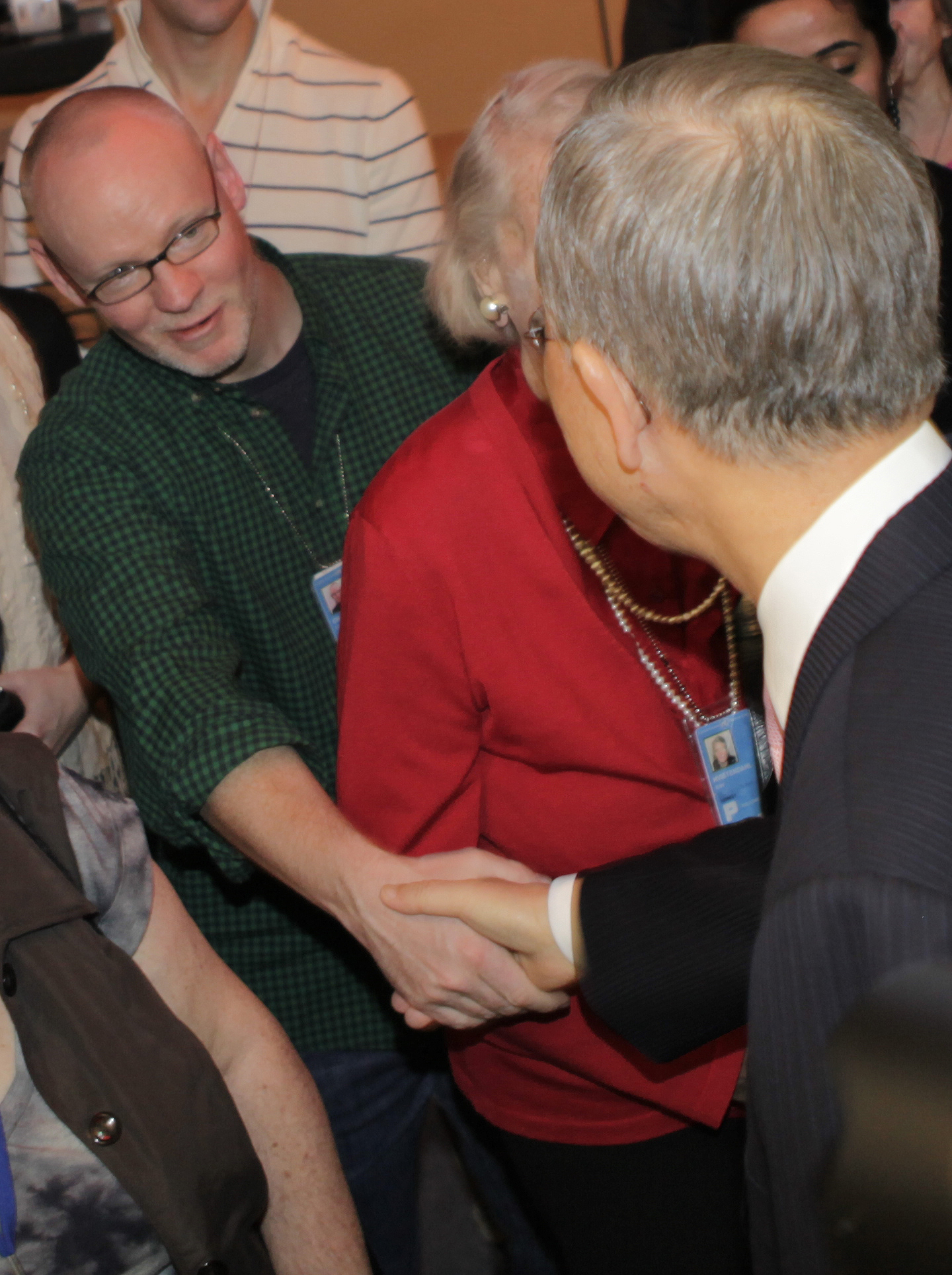
Reuter's Charbonneau shakes with Ban: on what? (c) Luiz Rampelloto
  CPJ or at least Mahoney seem to assume that Big Media like Reuters (and Agence France Presseclick here) can do no wrong. But that is not the case. Watch this site.

Tuesday, May 26, 2015

On Burundi, UN Rights Commissioner Zeid Speak to Human Rights Council, UNSC Still Silent on Journalist Bireha


By Matthew Russell Lee
UNITED NATIONS, May 26 -- Thirteen days after the UN Security Council, the United States and the UN Peacebuilding Configuration on Burundi on May 15 issued statements urging calm in the country given the return of Pierre Nkurunziza to presumably run for a third term, on May 26 UN High Commissioner for Human Rights Prince Zeid said this in Geneva:

"During my mission to Burundi last month I was alarmed by the violence of the Imbonerakure militia, which is a strong supporter of President Nkurunziza’s government, and by politically motivated harassment, threats, and hate speech. The attempted coup of 13 May, and the assassination of opposition leader Zedi Feruzi on Saturday, have further intensified tension. Opposition politicians, journalists, prominent human rights defenders, and indeed many ordinary people still fear for their lives. When I left Burundi, on 15 April, 6,000 Burundians had fled the country due to fear of political violence and intimidation.  Five weeks later, that number has swelled by a further 110,000 frightened people.

"This is a country with deep and terrible knowledge of the potential consequences of outbreaks of violence. Following a decade of growing recovery, and prosperity, these recent events are a significant setback. But we can still avoid the path that could lead back to past tragedies. I am encouraged by the mobilisation of the African Union, the International Conference on the Great Lakes region, the East African Community, the European Union and the United Nations, and by the priority they have given to human rights concerns. The Special Envoy for the Great Lakes is making a tremendous effort to draw all actors to the negotiating table, and OHCHR's country office continues to work with the Government, civil society, the National Independent Human Rights Commission and the Ombudsman to protect human rights and the rule of law. I hope the Council can send a strong message to national actors and the international community to stop the wave of violence."


The UN Security Council hasn't met on the topic in nearly two weeks; despite an upcoming "Protection of Journalists" event, the UNSC's most recent statement did not mention the journalist who was with them who was gravely injured, Jean Baptiste Bireha of Bonesha FM. Here's the UN Security Council's full text:
"The members of the Security Council condemned in the strongest terms the killing of Mr. Zedi Feruzi, leader of the opposition Union pour la paix et le développement (UPD) Zigamibanga party in Burundi, and his bodyguard, on 23 May 2015 in Bujumbura. The members of the Security Council also condemned the grenade attack in Bujumbura’s central market on 22 May 2015 that left two dead and many others injured.

"The Security Council expressed their deepest condolences to the families of those killed and wished a speedy recovery to the injured. They urged the Burundian authorities to swiftly bring the perpetrators of these crimes to justice.

"The members of the Security Council reiterated their call on all Burundian stakeholders to demonstrate their sense of responsibility and exercise calm and restraint in the interest of peace and reconciliation in Burundi. They called on the Burundian authorities to take concrete steps to prevent further violence, whilst respecting fundamental freedoms of expression and peaceful assembly.

"The members of the Security Council called on all Burundian stakeholders to pursue the consultative political dialogue facilitated by the Special Envoy for the Secretary-General for the Great Lakes region, Mr Said Djinnit, and representatives of the African Union, the East African Community, the Common Market for Eastern and Southern Africa and the International Conference on the Great Lakes Region, to create an environment conducive to peaceful, credible and inclusive elections in Burundi, in the spirit of the Arusha Agreements.

The members of the Security Council reiterated their intent to respond to violent acts which threaten peace and security in Burundi."
  Wait - "intent to respond" -- meaning this assassination is notnot enough? Or that a mere Press Statement is the extent of the Security Council's response? We'll have more on this.
  And here is Secretary General Ban Ki-moon's statement, also sans journalist, and artfully dodging Arusha and the third term:
"The Secretary-General condemns the killing of Mr. Zedi Feruzi, leader of the opposition Union pour la paix et le développement (UPD) Zigamibanga party in Burundi, and his bodyguard today in Bujumbura.

This crime, as well as the despicable grenade attack in Bujumbura’s central market on 22 May that left two dead and many others injured, threaten to entrench mistrust and trigger further violence.  The Secretary-General urges the Burundian authorities to swiftly bring the perpetrators of these crimes to justice. He extends his deepest sympathies to the families of those killed and wishes a quick recovery to the injured.

These acts of violence constitute a stark reminder of the need for all Burundian political leaders to address the current political crisis with the highest sense of responsibility and to place peace and national reconciliation above partisan interests.

The Secretary-General reiterates his calls for calm and restraint. He calls on the Burundian authorities to uphold the human rights of all Burundians, including the freedoms of assembly, association and expression, and to take concrete steps to prevent political killings and violence.

The Secretary-General encourages Burundian stakeholders to pursue the consultative political dialogue facilitated by his Special Envoy Said Djinnit and representatives of the African Union, the East African Community, the Common Market for Eastern and Southern Africa and the International Conference on the Great Lakes Region. He calls on the parties to the consultative political dialogue not to be deterred by those who, through violence, seek to prevent the creation of an environment conducive to peaceful, credible and inclusive elections in Burundi."
On May 22 Ban said he was encouraged by the dialogue since and concerned about refugees. 
  Ban said nothing about demonstrators shot, or the crack down on media.
Here is the full text:
"The Secretary-General is encouraged by the ongoing political dialogue in Bujumbura.  This involves representatives of civil society, political parties, religious organizations and the Government with the facilitation of Special Envoy Said Djinnit and representatives of the African Union, the East African Community, the Common Market for Eastern and Southern Africa and the International Conference on the Great Lakes Region.

"The Secretary-General applauds the participants for the progress achieved so far in the discussions, especially on measures to reduce tensions and create propitious conditions for free, fair, inclusive and peaceful elections. He is concerned, however, about the ongoing humanitarian crisis involving refugees. He expresses appreciation to the neighbouring countries for their hospitality to the refugees and urges the Government of Burundi to create conditions for their return.

"The Secretary-General encourages the stakeholders to pursue the ongoing dialogue with a view to reaching a comprehensive agreement on all the issues they have identified. He reiterates the availability of the United Nations to accompany the people of Burundi and the region during this process."
  What about the demonstrators shot? Ban's silence on the crackdown on media is a pattern, as Inner City Press and the Free UN Coalition for Access reported yesterday, here.
  On May 19 the International Committee of the Red Crossissued a carefully worded press release that did not directly say people were dragged out of hospitals:
"The International Committee of the Red Cross (ICRC) is extremely concerned about the tense pre-election atmosphere in Burundi and its humanitarian impact on the people of that country. The organization is appealing for calm among all parties involved and asks that health-care staff be allowed to do their work safely and that medical facilities not be interfered with.

"We are very troubled by the repercussions of the violence that has taken place in Burundi," said Georgios Georgantas, head of the ICRC delegation in the country. "People must remember that human life and dignity have to be respected at all times, and that health-care staff and medical centres must be spared from, and protected against, acts of violence and vandalism," said Mr Georgantas. The ICRC is also requesting that the orders issued to police comply with prevailing standards and regulations so that the use of force will be kept to an absolute minimum.

"The crisis has given rise to humanitarian needs in the capital Bujumbura and in neighbouring countries, forcing the ICRC to step up its efforts. In Burundi, ICRC delegates visit those who have been arrested to ensure their living conditions and the treatment they are receiving are in line with international standards. The organization also provides medicines and medical equipment to the prison authorities as needed."
   What of people dragged out of hospitals? Now there's medical equipment to jails.
 On May 19 the UN spokesperson Farhan Haq said UN envoy Said Djinnit would briefing the Security Council and, he hoped, the media on May 20. But it did not happened; the Council's penholder, when asked, did not say when it might happen.
  Meanwhile Inner City Press was multiply informed of an offer that had been made to Nkurunziza, to ween him from the third term dream: a high but honorary post in FIFA, the football federation, as a sort of goodwill ambassador.
  Nkurunziza turned it down, Inner City Press is informed by Permanent Representatives at the UN and other diplomatic sources. Now he has sacked ministers and said it is him or Al Shabaab. What could have been, FIFA. (Inner City Press also asked on May 18 about Qatar detaining a BBC journalist while he reported on the situation of migrant workers preparing there for the FIFA World Cup.)
  On Burundi, from the UN's May 18 noon briefing transcript 


Sunday, May 24, 2015

In Burundi, After UPD's Zedi Feruzi Killed, UNSC Speaks, But Not on Bonesha FM Journalist Bireha


By Matthew Russell Lee
UNITED NATIONS, May 23 -- Ten days after the UN Security Council, the United States and the UN Peacebuilding Configuration on Burundi on May 15 issued statements urging calm in the country given the return of Pierre Nkurunziza to presumably run for a third term, on May 24 the UN Security Council issued a Press Statement on the killing of an opposition political figure and his guard.
 Despite an upcoming "Protection of Journalists" event, the statement did not mention the journalists who was with them who was gravely injured and, it's said, later died, Jean Baptiste Bireha of Bonesha FM. Here's the UN Security Council's full text: 
"The members of the Security Council condemned in the strongest terms the killing of Mr. Zedi Feruzi, leader of the opposition Union pour la paix et le développement (UPD) Zigamibanga party in Burundi, and his bodyguard, on 23 May 2015 in Bujumbura. The members of the Security Council also condemned the grenade attack in Bujumbura’s central market on 22 May 2015 that left two dead and many others injured.

"The Security Council expressed their deepest condolences to the families of those killed and wished a speedy recovery to the injured. They urged the Burundian authorities to swiftly bring the perpetrators of these crimes to justice.

"The members of the Security Council reiterated their call on all Burundian stakeholders to demonstrate their sense of responsibility and exercise calm and restraint in the interest of peace and reconciliation in Burundi. They called on the Burundian authorities to take concrete steps to prevent further violence, whilst respecting fundamental freedoms of expression and peaceful assembly.

"The members of the Security Council called on all Burundian stakeholders to pursue the consultative political dialogue facilitated by the Special Envoy for the Secretary-General for the Great Lakes region, Mr Said Djinnit, and representatives of the African Union, the East African Community, the Common Market for Eastern and Southern Africa and the International Conference on the Great Lakes Region, to create an environment conducive to peaceful, credible and inclusive elections in Burundi, in the spirit of the Arusha Agreements.

The members of the Security Council reiterated their intent to respond to violent acts which threaten peace and security in Burundi."
  Wait - "intent to respond" -- meaning this assassination is notnot enough? Or that a mere Press Statement is the extent of the Security Council's response? We'll have more on this.
  And here is Secretary General Ban Ki-moon's statement, also sans journalist, and artfully dodging Arusha and the third term:
"The Secretary-General condemns the killing of Mr. Zedi Feruzi, leader of the opposition Union pour la paix et le développement (UPD) Zigamibanga party in Burundi, and his bodyguard today in Bujumbura.

This crime, as well as the despicable grenade attack in Bujumbura’s central market on 22 May that left two dead and many others injured, threaten to entrench mistrust and trigger further violence.  The Secretary-General urges the Burundian authorities to swiftly bring the perpetrators of these crimes to justice. He extends his deepest sympathies to the families of those killed and wishes a quick recovery to the injured.

These acts of violence constitute a stark reminder of the need for all Burundian political leaders to address the current political crisis with the highest sense of responsibility and to place peace and national reconciliation above partisan interests.

The Secretary-General reiterates his calls for calm and restraint. He calls on the Burundian authorities to uphold the human rights of all Burundians, including the freedoms of assembly, association and expression, and to take concrete steps to prevent political killings and violence.

The Secretary-General encourages Burundian stakeholders to pursue the consultative political dialogue facilitated by his Special Envoy Said Djinnit and representatives of the African Union, the East African Community, the Common Market for Eastern and Southern Africa and the International Conference on the Great Lakes Region. He calls on the parties to the consultative political dialogue not to be deterred by those who, through violence, seek to prevent the creation of an environment conducive to peaceful, credible and inclusive elections in Burundi."
On May 22 Ban said he was encouraged by the dialogue since and concerned about refugees. 
  Ban said nothing about demonstrators shot, or the crack down on media.
Here is the full text:
"The Secretary-General is encouraged by the ongoing political dialogue in Bujumbura.  This involves representatives of civil society, political parties, religious organizations and the Government with the facilitation of Special Envoy Said Djinnit and representatives of the African Union, the East African Community, the Common Market for Eastern and Southern Africa and the International Conference on the Great Lakes Region.

"The Secretary-General applauds the participants for the progress achieved so far in the discussions, especially on measures to reduce tensions and create propitious conditions for free, fair, inclusive and peaceful elections. He is concerned, however, about the ongoing humanitarian crisis involving refugees. He expresses appreciation to the neighbouring countries for their hospitality to the refugees and urges the Government of Burundi to create conditions for their return.

"The Secretary-General encourages the stakeholders to pursue the ongoing dialogue with a view to reaching a comprehensive agreement on all the issues they have identified. He reiterates the availability of the United Nations to accompany the people of Burundi and the region during this process."
  What about the demonstrators shot? Ban's silence on the crackdown on media is a pattern, as Inner City Press and the Free UN Coalition for Access reported yesterday, here.
  On May 19 the International Committee of the Red Crossissued a carefully worded press release that did not directly say people were dragged out of hospitals:
"The International Committee of the Red Cross (ICRC) is extremely concerned about the tense pre-election atmosphere in Burundi and its humanitarian impact on the people of that country. The organization is appealing for calm among all parties involved and asks that health-care staff be allowed to do their work safely and that medical facilities not be interfered with.

"We are very troubled by the repercussions of the violence that has taken place in Burundi," said Georgios Georgantas, head of the ICRC delegation in the country. "People must remember that human life and dignity have to be respected at all times, and that health-care staff and medical centres must be spared from, and protected against, acts of violence and vandalism," said Mr Georgantas. The ICRC is also requesting that the orders issued to police comply with prevailing standards and regulations so that the use of force will be kept to an absolute minimum.

"The crisis has given rise to humanitarian needs in the capital Bujumbura and in neighbouring countries, forcing the ICRC to step up its efforts. In Burundi, ICRC delegates visit those who have been arrested to ensure their living conditions and the treatment they are receiving are in line with international standards. The organization also provides medicines and medical equipment to the prison authorities as needed."
   What of people dragged out of hospitals? Now there's medical equipment to jails.
 On May 19 the UN spokesperson Farhan Haq said UN envoy Said Djinnit would briefing the Security Council and, he hoped, the media on May 20. But it did not happened; the Council's penholder, when asked, did not say when it might happen.
  Meanwhile Inner City Press was multiply informed of an offer that had been made to Nkurunziza, to ween him from the third term dream: a high but honorary post in FIFA, the football federation, as a sort of goodwill ambassador.
  Nkurunziza turned it down, Inner City Press is informed by Permanent Representatives at the UN and other diplomatic sources. Now he has sacked ministers and said it is him or Al Shabaab. What could have been, FIFA. (Inner City Press also asked on May 18 about Qatar detaining a BBC journalist while he reported on the situation of migrant workers preparing there for the FIFA World Cup.)
  On Burundi, from the UN's May 18 noon briefing transcript 


In Burundi, UPD's Zedi Feruzi Killed, Ban Speaks, Not on Journalist Wounded, Jean Baptiste Bireha of Bonesha FM


By Matthew Russell Lee
UNITED NATIONS, May 23 -- Nine days after the UN Security Council, the United States and the UN Peacebuilding Configuration on Burundi on May 15 issued statements urging calm in the country given the return of Pierre Nkurunziza to presumably run for a third term, on May 23 UN Secretary General Ban Ki-moon issued a statement on the killing of an opposition political figure and his guard (he did not mention the journalists who was with them who was gravely injured, Jean Baptiste Bireha of Bonesha FM ). Here's the UN's full text: 
"The Secretary-General condemns the killing of Mr. Zedi Feruzi, leader of the opposition Union pour la paix et le développement (UPD) Zigamibanga party in Burundi, and his bodyguard today in Bujumbura.

This crime, as well as the despicable grenade attack in Bujumbura’s central market on 22 May that left two dead and many others injured, threaten to entrench mistrust and trigger further violence.  The Secretary-General urges the Burundian authorities to swiftly bring the perpetrators of these crimes to justice. He extends his deepest sympathies to the families of those killed and wishes a quick recovery to the injured.

These acts of violence constitute a stark reminder of the need for all Burundian political leaders to address the current political crisis with the highest sense of responsibility and to place peace and national reconciliation above partisan interests.

The Secretary-General reiterates his calls for calm and restraint. He calls on the Burundian authorities to uphold the human rights of all Burundians, including the freedoms of assembly, association and expression, and to take concrete steps to prevent political killings and violence.

The Secretary-General encourages Burundian stakeholders to pursue the consultative political dialogue facilitated by his Special Envoy Said Djinnit and representatives of the African Union, the East African Community, the Common Market for Eastern and Southern Africa and the International Conference on the Great Lakes Region. He calls on the parties to the consultative political dialogue not to be deterred by those who, through violence, seek to prevent the creation of an environment conducive to peaceful, credible and inclusive elections in Burundi."
On May 22 Ban said he was encouraged by the dialogue since and concerned about refugees. 
  Ban said nothing about demonstrators shot, or the crack down on media.
Here is the full text:
"The Secretary-General is encouraged by the ongoing political dialogue in Bujumbura.  This involves representatives of civil society, political parties, religious organizations and the Government with the facilitation of Special Envoy Said Djinnit and representatives of the African Union, the East African Community, the Common Market for Eastern and Southern Africa and the International Conference on the Great Lakes Region.

"The Secretary-General applauds the participants for the progress achieved so far in the discussions, especially on measures to reduce tensions and create propitious conditions for free, fair, inclusive and peaceful elections. He is concerned, however, about the ongoing humanitarian crisis involving refugees. He expresses appreciation to the neighbouring countries for their hospitality to the refugees and urges the Government of Burundi to create conditions for their return.

"The Secretary-General encourages the stakeholders to pursue the ongoing dialogue with a view to reaching a comprehensive agreement on all the issues they have identified. He reiterates the availability of the United Nations to accompany the people of Burundi and the region during this process."
  What about the demonstrators shot? Ban's silence on the crackdown on media is a pattern, as Inner City Press and the Free UN Coalition for Access reported yesterday, here.
  On May 19 the International Committee of the Red Crossissued a carefully worded press release that did not directly say people were dragged out of hospitals:
"The International Committee of the Red Cross (ICRC) is extremely concerned about the tense pre-election atmosphere in Burundi and its humanitarian impact on the people of that country. The organization is appealing for calm among all parties involved and asks that health-care staff be allowed to do their work safely and that medical facilities not be interfered with.

"We are very troubled by the repercussions of the violence that has taken place in Burundi," said Georgios Georgantas, head of the ICRC delegation in the country. "People must remember that human life and dignity have to be respected at all times, and that health-care staff and medical centres must be spared from, and protected against, acts of violence and vandalism," said Mr Georgantas. The ICRC is also requesting that the orders issued to police comply with prevailing standards and regulations so that the use of force will be kept to an absolute minimum.

"The crisis has given rise to humanitarian needs in the capital Bujumbura and in neighbouring countries, forcing the ICRC to step up its efforts. In Burundi, ICRC delegates visit those who have been arrested to ensure their living conditions and the treatment they are receiving are in line with international standards. The organization also provides medicines and medical equipment to the prison authorities as needed."
   What of people dragged out of hospitals? Now there's medical equipment to jails.
 On May 19 the UN spokesperson Farhan Haq said UN envoy Said Djinnit would briefing the Security Council and, he hoped, the media on May 20. But it did not happened; the Council's penholder, when asked, did not say when it might happen.
  Meanwhile Inner City Press was multiply informed of an offer that had been made to Nkurunziza, to ween him from the third term dream: a high but honorary post in FIFA, the football federation, as a sort of goodwill ambassador.
  Nkurunziza turned it down, Inner City Press is informed by Permanent Representatives at the UN and other diplomatic sources. Now he has sacked ministers and said it is him or Al Shabaab. What could have been, FIFA. (Inner City Press also asked on May 18 about Qatar detaining a BBC journalist while he reported on the situation of migrant workers preparing there for the FIFA World Cup.)
  On Burundi, from the UN's May 18 noon briefing transcript