Showing posts with label APRODH. Show all posts

Wednesday, November 25, 2015

After Burundi Freezes Accounts, Civil Society Organizations Speak Out, Here, Threaten Lawsuits


By Matthew Russell Lee

UNITED NATIONS, November 25 -- As killings in Burundi have increased, on November 12, the Security Council adopted a belated resolution on Burundi. (Inner City Press put the full text online here, and here in French.) Afterward Inner City Press asked UK Ambassador Rycroft, the President of the Council for November what steps would actually be needed to send any peacekeepers from MONUSCO in DR Congo (he said there are discussions).

Inner City Press managed to ask French Permanent Representative Francois Delattre why UN Peacekeeping keeping using and paying for Burundian troops and police in the Central African Republic (a Press question both the UK and US Ambassador Samantha Power have seen fit to respond to.) Delattre declined to answer - but more politely than his deputy had, here.

In Burundi, the Pierre Nkurunziza government has taken to suspending and freezing the bank accounts of civil society groups, not only political but even medical. Now this November 25 statement, which Inner City Press publishes:

"Declaration of Civil Society Organizations on freezing civil society organizations’ assets and suspension of activities of associations ACAT BURUNDI, AMINA, APRODH, FOCODE, FONTAINE ISOKO, FORSC, MAISON SHALOM, PARCEM, RCP and SPPDF

Civil Society Organizations condemn the serious violation of the right of association, sabotage of Burundi Civil society and the abject threats directed against human rights defenders.

Since April 26, 2015, peaceful demonstrations were held to protest against the third term of Pierre Nkurunziza, which project was regarded as the very seriously violation of the constitution and the Arusha agreement for peace and reconciliation. Ever since, fierce repression against protesters was organized and carried out in the opposing neighbourhoods and areas...

Civil society organizations:

- Urge immediate and unconditional cancellation of measures take to freeze accounts and suspend activities of associations ACAT Burundi, AMINA, APRODH, FOCODE, FONTAINE ISOKO, FORSC, MAISON SHALOM, PARCEM, RCP and SPPDF;

- Will file cases against Mr Valentin Bagorikunda and Mr Pascal Barandagiye for abuse of authority should they refuse to cancel arbitrary and unlawful measures that they took against civil society organizations;

- Commit to engage the various human rights mechanisms for serious violation of the right of association, as well as for direct and despicable attack against human rights defenders by the state of Burundi;

4. Commit to participate in the peaceful resolution of the Burundian crisis by dialogue and loudly declare that they will never agree to negotiate their rights and freedoms, the lifting of the proceedings against them or the closure of their offices

5. Denounce again the resort to violence by any party whatsoever;

6. Undertake to continue their struggle for the dignity, rights and freedoms for all

Done at Bujumbura, November 25, 2015

On behalf of the Campaign Halte au troisième mandat

Me Vital Nshimirimana

Délégué Général du FORSC."

On November 24, before new reports on prison sentences, Inner City Press asked the UN about this again, video here, transcript here:

Inner City Press: the question that I asked you yesterday on Burundi, one had to do with this free… it turns out it’s now more than freezing bank accounts; it’s actual suspension of these NGO’s (non-governmental organizations) and also the… the… the… the imposition by the U.S. on these sanctions on four individuals, one of whom I’d asked you about before about possible involvement UN peacekeeping.  Is there any, like, involvement of Mr. Benomar… [Cross talk]

Spokesman:  Mr. Benomar is currently in Bujumbura meeting with various parties.  We hope to have some details of his meetings.  He’s also been in Addis meeting with the AU (African Union) and in Uganda, preparing to report back to the Security Council on the options they asked for, looking at various aspects of the conflict, including contingency planning.  Obviously, anything that limits the legitimate rights of civil society in any country is of concern to the United Nations.

 On November 23 the Press asked the US State Department about Burundi's move, but its deputy spokesperson had no comment at the time or in response to that and another written question.

On November 24, State Department Deputy Spokesperson Mark Toner returned with this: "We can confirm that the government of Burundi has suspended the activities and frozen the accounts of multiple local civil society organizations in what is a clear step backward in pursuit of peace and dialogue in Burundi. We want to see an open, unfettered and comprehensive political dialogue take place there in which all voices are heard. That remains the only credible route to stability and and effort to achieve consensus and forge a peaceful path forward for Burundi's people.

"As the crisis deepens, and media outlets of course continue to be shuttered and repression of civil society is the exact opposition of what needs to happen."

Also on November 24, Inner City Press asked the UN again about the CSOs' suspensions; the UN spokesman's reply was about Ban Ki-moon's special adviser traveling to the African Union and elsewhere before returning to advise the Security Council.

On November 23, Inner City Press asked UN Spokesman Stephane Dujarric,video here, transcript here:

Inner City Press: in Burundi, the Government has suspended and frozen the bank accounts of a number of civil society organizations, including the one run by Pierre Claver Mbonimpa, who you’ve spoken about from this podium before.  What’s the UN’s response to basically shutting down civil society and…?

Spokesman:  I think it’s clear that every society needs a healthy civil society, needs room for civil society.  The Secretary-General has spoken out on that repeatedly.  As for Burundi, Mr. [Jamal] Benomar is arriving in Burundi today, or as we speak.  He will have meetings there, which we hope to be able to report back [to] you.  And this is part of the mandate given to the Secretariat by the Security Council to report back, which we will in due course.

Inner City Press:  And I don’t know if you’ll comment on this, but this morning, the Obama administration announced targeted sanctions on those contributing to the ongoing crisis in Burundi, unquote.  Do you think that’s a useful move?

Spokesman:  I haven’t seen that report.

  When the UN Peacebuilding Commission Burundi Configuration met on November 18 it was it was to hear from Swiss Permanent Representative Lauber about his trip to the region, including three days in Bujumbura. He described a climate of fear -- while adding that Burundians are resilient -- and of a 10 pm curfew. He quoted the World Bank that the government has cut health spending; he said he aim to return to the country in January or February. What will the situation be them?

  Burundi's Permanent Representative Shingiro responded that the problems are caused by opposition outside of the country and “the media” within. He stated that Lauber had a meeting of confident with Pierre Nkurunziza, November 11 at noon for 45 minutes. He said the specter of genocide is a “tactic of the radical opposition abroad.”

   US Deputy Permanent Representative David Pressman called out authorities' hate speech in the country, as did UK Deputy Permanent Representative Peter Wilson. When it came the turn of France, the penholder on Burundi in the Security Council, to speak, neither Permanent Representative Francois Delattre nor his Deputy Alexis Lamek was there. There are two explanations, not mutual exclusive.

  At the day's noon briefing, Inner City Press asked the UN about those trying to flee not being allowed to leave the country and, on behalf of the Free UN Coalition for Access, about Shingiro's comment about the media. During the briefing, a statement came in from civil society on Burundi, signed by Vital Nshimirimana, naming hate speech and even the training of the ruling party's militia the Imbonerakure at Kiliba -Ondes in Eastern DRC, on which Herve Ladsous' UN Peacekeeping never acted. Plus ca change.

On November 13, the spokesperson for the Pierre Nkurunziza's government issued a response to the resolution, saying that it "toes the line" of the Government and that the problems in the country are "nothing other than poverty," here.
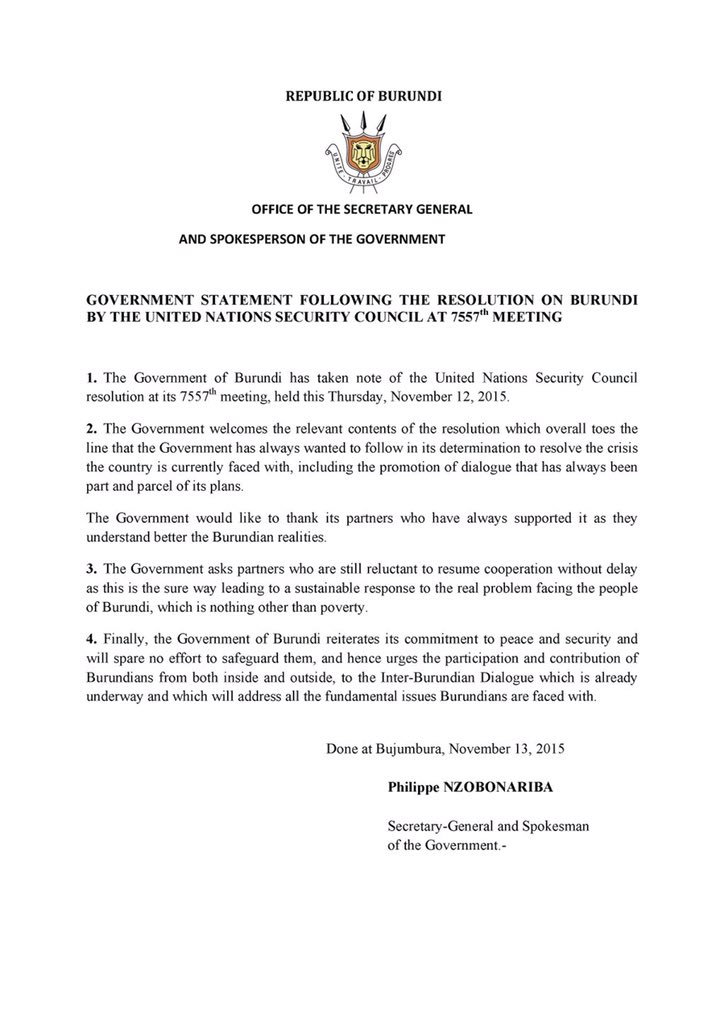


  On the evening of November 11, the UN Spokesperson's office announced that there would be a formal Security Council meeting on Burundi at 12:15 pm on November 12, that would be to approve the draft resolution. An unnamed official of Herve Ladsous UN Peacekeeping -- wonder who that could be -- got Reuters to retype without analysis the idea the UN would send peacekeepers from "Congo" - that would be DRC -- into Burundi.

 UNasked by Reuters, actively covered up, is that Ladsous' MONUSCO has been unable or unwilling to protect civilians in parts of the Eastern DRC, and has refused to neutralize the Hutu FDLR militia. So it would take on Pierre Nkurunziza's forces and youth wing in Burundi?

  This youth wing was allowed by MONUSCO to train in Eastern Congo; nothing was said by MONUSCO when DRC detained a Burundian journalist. None of this in the Reuters, or AFP, or even more derivative Voice of America story. But to retain this "access," these media do not report when the UN's Herve Ladsous, on camera, links peacekeeper rapes to "R&R." Video here. This is a scam. Watch this site.

  While the November 9 meeting was still ongoing, the UN announced that French Permanent Representative Francois Delattre would address the press in ten minutes. But when it happened it was the French Mission's deputy Alexis Lamek, moderated by the Mission's spokesman Thierry Caboche.

After bragging about a draft resolution French belatedly circulated, Lamek and his spokesperson twice refused to take a Press question about UN Peacekeeping still using the same Bururdian forces accused of the abuses. NewVine here. New video, with UK contrast, here.

 The French mission spokesperson, after calling on Reuters, called on Agence France Presse. Inner City Press said, please answer why Herve Ladsous - the fourth French head of UN Peacekeeping in a row - uses Burundian troops in Central African Republic, giving them extensions to bring the right equipment (the government, sources say, takes the money.)

 "Ask him," Lamek said off camera, referring to Ladsous who repeatedlyrefuses Press questions on this (and on covering up French Sangaris forces rapes in CAR.)


  Moments later when Inner City Press asked UK Deputy Ambassador Peter Wilson if the UN should keep using Burundian troops or vet them, Wilson called this a "big issues" that "needs to be looked at." Audio including Elements to the Press, here. Fast transcript by InnerCityPro.com, here:

Inner City Press asked, the UN uses Burundian peacekeepers in CAR. Is there, or could there be, some review of that?

UK Deputy Peter Wilson: "on peacekeepers, I think this is a big issue, and I think it’s something certainly that needs to be looked at in a wider context of what response we take to the events in Burundi right now. I wouldn’t urge precipitate action on that, but I think it’s one of the issues that we need collectively to consider."

 Strange then, that the penholding on Burundi and controller of UN Peacekeeping wouldn't even take the questions. The history of the Great Lakes runs deep. More recently, Inner City Press is informed is belated discussion among Security Council Permanent Five members that Ladsous is a liability, should or can he even be allowed to stay on to the end of Ban Ki-moon's term.

 On November 10, Inner City Press asked UN spokesman Stephane Dujarric,video here, transcript here:

Inner City Press: I'll do Burundi first as a follow-up to that.  Yesterday at the stakeout, Peter Wilson of the UK said that the issue of continued or… or service of Burundian peacekeepers, particularly those involved in the violence in UN peacekeeping, is a big issue, is something that needs to be looked at in the wider context of the response to the events in Burundi right now.  Since… I think I've previously asked you about… my understanding is the Under-Secretary-General of Peacekeeping waived Burundi not having the right equipment twice in a row in CAR.  I wanted you to describe, if you could, what is the process, one, for vetting individuals that come out of the… what you described as a… big violence in Burundi, but also of giving these waivers.  Is this something that's done unilaterally by the Secretariat?

Spokesman:  I'm not… I can't speak to the waivers because I can't… I don't know if what you say is, in fact, a fact.

Inner City Press:  Can… can… is the meeting in September…? [Inner City Press actually referred to Ladsous' September meeting with Burundi, on which it reported.]

Spokesman:  As far as… as far as Burundian troops, they continue to serve in the Central African Republic and other missions, if I'm not mistaken.  They are rotated through the standard human rights vetting process, which involves the UN, which involves the government, which involves the High Commissioner for Human Rights, and which involves the more… the broader human rights community.

Inner City Press:  What about the issue of… there have been several complaints by the peacekeepers themselves of not getting paid leaving some in Burundi to say, in fact, this is a way in which the UN is subsidizing the Government and the very activities that Mr. Zeid was condemning yesterday?  What steps are taken to ensure that the money reaches the peacekeepers?

Spokesman:  Obviously, it is critical whether it's in the case of Burundi if it, in fact, happens or other countries that individual peacekeepers receive the monies that are owed to them.

Inner City Press:  But Mr. [Hervé] Ladsous right here in September said that he's… that he's not sure whether this money reaches soldiers.  So what steps does the UN take, particularly in a case like Burundi, where you're accusing the Government of cracking down on the people, what steps are taken?

Spokesman:  As I said, I think it's incumbent on the governments to ensure that their soldiers get paid.  Did you have another question?


 At the November 9 meeting, Burundi's Nyamitwe droned on by video by Bujumbura, even as Security Council President Matthew Rycroft asked him to bring it to an end. He continued speaking as the other speakers on video -- Prince Zeid, Adama Dieng, Swiss Ambassador Lauber -- squirmed, seeming like the audience to wonder if Rycroft would just cut his mic (he didn't.)

  Inner City Press immediately put online that speech, and that of Uganda's Ambassador Nduhuura and the African Union's Tete Antonio, here.

 On November 7 came reports of killings, including it was said a UN system staff member. This has been confirmed by UNDP - but only the local Buurndi office. Still from the UN, nothing. The Security Council issued a Press Statement on November 7... about Libya.

  Burundian journalist Blaise Célestin Ndihokubwayo has been arrested and sent to the Service national de renseignement (SNR). Where is UNESCO and its director, who wants to be the next UN Secretary General?

On October 23 Inner City Press asked UN Ambassador Matthew Rycroft about the status of the draft Presidential Statement in the UN Security Council. He said there are differing views, but the UK is concerned about the "threat of genocide." Video here.  On November 3, Inner City Press again put a Burundi questions to Rycroft, now President of the Security Council for November. Video here, story here.

The son of human rights defender Pierre Claver Mbonimpa has reportedly been murdered, after Pierre Nkurunziza tweeted that "No one living abroad should consider himself superior to those who stayed in Burundi, since most of them have left their families here."

 On November 6, a belated Security Council meeting on Burundi was announced -- from Paris, by French foreign ministry spokesperson Romain Nadal. Why the delay? Why announced in that way?

Later on November 6, UN Secretary General Ban Ki-moon (whose spokesman could not tell Inner City Press if Ban will have any representative in the Security Council's meeting on Monday) put out this statement.

 Inner City Press at the November 6 UN noon briefing asked how these concerns were consistent with Ban deferring to the Ugandan Defense Minister (for the EAC, Ban's spokesman pointed out), and asked if Ban will even have a representative briefing the UN Security Council on Monday. UNclear. Video here.

  The US' Tom Perriello, filmed at the State Department, noted the weekend deadline. But why then was the UN Security Council meeting left until after the deadline?
 
  US Ambassador Samantha Power put out this statement, here.

  Behind the continued killing, here's an issue: Inner City Press is informed that a number of Burundian civil society leaders and journalists have improperly been flagged to Interpol as if their passports had been stolen. This has made it impossible, for example, for Vital Nshimirimana to travel to a speak about the crisis in Burundi at a conference in (Ban Ki-moon's native) South Korea.

  Inner City Press on November 4 asked the UN Office of the High Commissioner for Human Rights' Ivan Simonovic and UN spokesman Stephane Dujarric about this.  Interpol often brags at the UN how it is useful on the issue of foreign fighters. It's Secretary General Jurgen Stock spoke before the UN Security Council on May 29, 2015. But what about when Interpol is misused by a government like Pierre Nkurunziza? What do it, the Security Council and its members do that? Watch this site.

 On November 2 Inner City Press asked UN Spokesman Stephane Dujarric about two speeches given in Burundi (the full text of one is below). Video here, UN transcript here:

Inner City Press: In Burundi, there was a speech by the President of the Senate [Révérien Ndikuriyo] saying that opposition neighborhoods may be razed [or raided. Some] people are calling it a genocide speech.  There's also a speech by the President, saying anyone who doesn't disarm within the next five days will be treated as an enemy of the State.  So, I'm wondering, not to overdo it, but things seem pretty serious.  I wanted to know:  what is the UN doing?

Spokesman:  "It's clear that those in position of power, whether in Government or in the opposition, have a responsibility not to incite fear or hate of any kind.  I think that's very important and that whatever security measures the Government takes fully comply with international law and respect for the right of people to freely assemble and protest."

 After Burundi was elected to the UN Human Rights Council with 162 votes on October 28, on October 31 security forces in Burundi opened fire on a funeral procession in Buringa, killing many.  These are the Burundian forces that UN Peacekeeping under Herve Ladsous keeps in service, offering waivers while the Government keeps the payments?

  It is reported the Burundian authorities are accusing a medical NGO of offering treatment to insurgents, and are ready to attack. Frankly, the weak UN Security Council Presidential Statement which France belatedly proffered in the Council, then didn't even hold a question and answer stakeout about, is woefully insufficient, as is the UN Secretariat's response.

 Now from Burundi this speech

https://soundcloud.com/journ-burundi/reverien-ndikuriyo-le-pdt-du-senat-illegitime-promet-de-raser-des-quartiers-de-la-capitale

 On October 28, Inner City Press asked UN spokesman Stephane Dujarric about another threat. From the UN transcript:

Inner City Press: this is a tweet from the official account of Pierre Nkurunziza, President of Burundi:  "No one living abroad should consider himself superior to those who stayed in Burundi since most of them have left their families here."  So people see this as an open-source threat to retaliate against the families of those who have fled the country.  And I'm wondering…

Spokesman:  I haven't seen the tweet.  I shall look at it.

 Inner City Press showed it to him on his way out. Earlier on October 28, Burundi got 162 votes for the UN Human Rights Council, less than the other also unopposed candidates, but still enough to get on the Council. The UN Security Council had just issued a Presidential Statement, here, which gave weight to the Museveni "mediation," and which the US later "welcomed."Usually it's the penholder (France) which speaks. But not here, not on Burundi (see Ladsous, below).

  On October 28 Burundi was poised for election to the UN Human Rights Council, as one of five African Group candidates for five seats. Meanwhile on October 26, the European Union adopted the letter to President Pierre Nkurunziza that Inner City Press asked the UN about last week, here.

  Can EU members on October 28 not vote against Burundi's "Human Rights" Council candidacy at this time? And other Western NGOs coming to the UN early this week to set forth their positions, will they just phone it in with regard to Burundi? Watch this site.

 Also on October 23, Inner City Press asked UN Secretary General Ban Ki-moon:

Inner City Press: I wanted to ask on Burundi, just this morning the UK Ambassador said that the UK is concerned of a threat of genocide, is the word that he used, so I'm wondering under Rights Up Front what are your thoughts about Burundi and what the UN or the Secretariat can do.

SG Ban: "On this genocide issues, I hope there should be some creative investigations by the relevant experts and there should be, first of all, a clear understanding and investigations.  And if the conclusion is that there were such kind of genocide issues, then there should be accountability, justice must prevail and perpetrators must be brought to justice."

  But what is the UN Secretariat DOING about it?


  On October 16 Inner City Press asked Haq if the UN thinks the government can investigate itself. This was based on UN Secretary General Ban Ki-moon's October 15 statement that

"The Secretary-General condemns the killing of nine civilians and two police officers in Bujumbura on 13 October... He urges Burundian authorities to undertake a rigorous and prompt investigation into the circumstances and motives behind these despicable crimes in order to ensure that their perpetrators are brought to justice."

  So can the Nkurunziza government investigate itself (as the UN purports to be investigating or "auditing" itself in the wake of corruption revelation about former Presidnet of the General Assembly John Ashe among others)? Inner City Press asked this question (video here) as well as following up on this, from October 13:

Inner City Press: the Burundi question is one that maybe you can check with DPKO [Department of Peacekeeping Operations].  Burundian human rights activists say that an officer, Jerome Ntibogora, N-t-i-b-o-g-o-r-a, who was accused of being involved in killing people in a… in a hospital after they fled from the Government, has now been deployed to MINUSMA [United Nations Multidimensional Integrated Stabilization Mission] in Mali.  So I wanted to…

Spokesman Dujarric:  Let's see what we can find out.

  Dujarric did not come back with an answer, by this deputy when Inner City Pres asked again on October 16 said he, Ntibogora is not being deployed. We'll see - watch this site.

Amid crackdowns in Burundi by security forces, and allegations of sexual abuse by Burundian peacekeepers serving under the UN flag, UN Peacekeeping chief Herve Ladsous on October 1 held a meeting with Burundian Vice President Joseph Butore.

  Inner City Press has already tweeted a photograph of the meeting, but has now received the complete UN read-out, which raises more questions about Ladsous.

   On the crackdown, Ladsous assured Butore that he has a “pragmatic approach” and is of no mind to question what happens in any country, does not involve himself in "domestic affairs."

   On the sexual abuse allegations, Ladsous spoke only in platitudes, without requiring or even inquiring into any actions taken by the Burundians on the alleged abuse.

   Even though Burundi was already given a “grace period” to bring appropriate equipment into the Central African Republic for the MINUSCA mission, they have not done so. In the meeting, according to the read-out, Butore "acknowledged" the substandard equipment.

   Butore requested, and Ladsous for now granted, yet another extension to bring the requirement equipment -- until March 2016 for light equipment, and to June 2016 for heavy equipment.
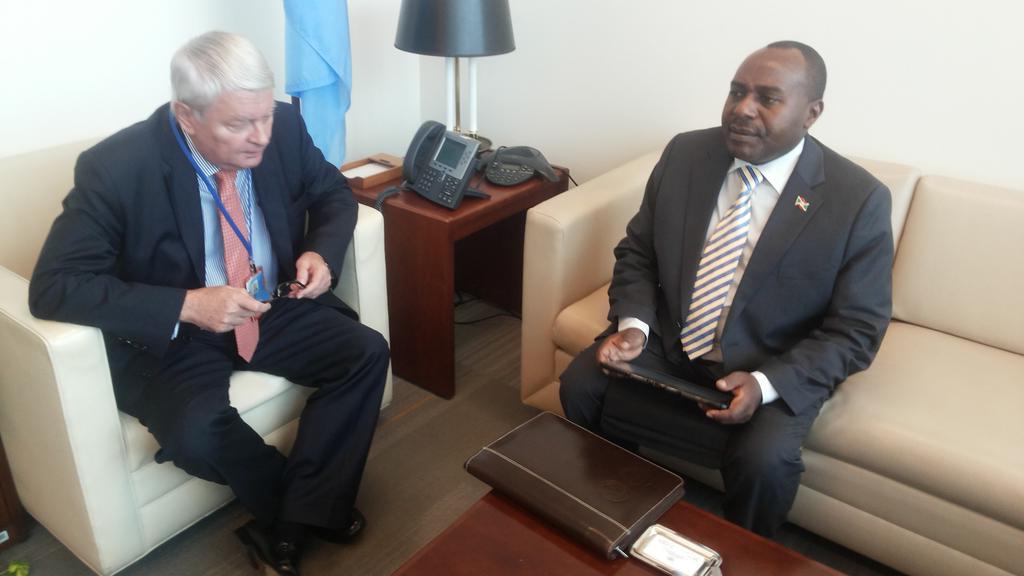


  Is this safe - even for the Burundian soldiers at issue? While speaking through press releases, Ladsous' spokespeople, far from answering questions, go so far as to direct UNTV boom microphone operators to avoid Inner City Press, even preventing the Press from asking any questions to Mali's Foreign Minister Abdulaye Diop. We'll have more on all this.

Monday, November 23, 2015

In Burundi, Nkurunziza Freezing Bank Accounts of Civil Society Organizations, Where's UN?


By Matthew Russell Lee

UNITED NATIONS, November 23 -- As killings in Burundi have increased, on November 12, the Security Council adopted a belated resolution on Burundi. (Inner City Press put the full text online here, and here in French.) Afterward Inner City Press asked UK Ambassador Rycroft, the President of the Council for November what steps would actually be needed to send any peacekeepers from MONUSCO in DR Congo (he said there are discussions).

Inner City Press managed to ask French Permanent Representative Francois Delattre why UN Peacekeeping keeping using and paying for Burundian troops and police in the Central African Republic (a Press question both the UK and US Ambassador Samantha Power have seen fit to respond to.) Delattre declined to answer - but more politely than his deputy had, here.

In Burundi, the Pierre Nkurunziza government has taken to freezing the bank accounts of civil society groups, not only political but even medical. Here's from Iwacu:

"The accounts of Maison Shalom, the local NGO founded by Marguerite Barankitse were frozen. Maison Shalom is very active in humanitarian and development projects in particular. Thus, thanks to the Maison Shalom, Ruyigi has a modern hospital, open to all. This "jewel", unique to Burundi, will therefore close after the freezing of accounts of the NGOs, to punish "Maggy" accused, among others, to be opposed to third term. She was forced into exile.

"Iwacu reporters traveled to Ruyigi, they discovered a completely stunned population by the decision. The hospital will close in the neonatal unit, the only one in the region, there are still two babies and then it will be the cessation of activities. The peak unemployment, projects initiated by the Maison Shalom in development will stop. It's desperation for tens of thousands of people.

Here there is no question of third term but sick, premature babies, people operated.
There is reason to question the appropriateness of such a decision. Let's just say Maggy hatred has blinded the people who took an inhumane decision. A premature baby incubator victim of the third mandate ... It is difficult to understand."

 Where is the UN on this? On FORSC, FOCODE and APRODH we aim to have more.

Where is Nkurunziza taking Burundi?

On November 20, Inner City Press asked UN Spokesman Stephane Dujarric,transcript here:

Inner City Press: about Burundi, people are saying that the UN has told its staff to restrict their movements in light of planned demonstrations and the two, both the French and Belgian I guess embassies there have said the same.  There is also this spat between the ruling party, the CNDD-FDD and the Belgians where the Belgians said the people should leave and the party said you are a bunch of colonialists and if you don’t leave we will hurt you.  What has happened in terms of the UN’s involvement?

Spokesman Dujarric:  Obviously in any place where the security situation is tense, it’s the responsibility of the senior UN official on the ground to recommend whatever measures he or she deems necessary, so I’m not going to comment on that.  We are obviously following the situation closely.  As I mentioned to you earlier, Mr. Benomar is on his way to the region.  We hope to have an update from him as soon as he starts his round of consultations.  The situation on the ground remains of grave concern to us.  I think we have seen an increase of violence and it’s clear that the Government has the responsibility to ensure the safety of people within, obviously, international human rights norms.

Then later in the November 20 briefing:

Inner City Press: In the DRC, the UN’s own or affiliated Radio Okapi has reported that the FDLR has essentially held people - in Walikale which is well-known for a previous mass rape and Lubero - hostage, they’re not allowing people to make phone calls and I could go on.  But what I’m saying is, if the UN’s own Radio Okapi is aware of essentially taking hostage of people by the longstanding FDLR militia group, what are they doing about it?

Spokesman:  I don’t have that information.  I don’t have an update sitrep from MONUSCO today.  You are free to call the Mission to see if they have anything to share with you but I don’t have information here.

Inner City Press:  Yesterday there was a story saying that an unnamed UN peacekeeping official here in New York said that the DRC didn’t, wasn’t properly vetting its troops that were sent to Central African Republic.  And I wanted to see, I guess, it seems like a big announcement, whether DPKO has something in writing on that.  And I wanted to ask, it also seems strange there are also allegations of sexual abuse by a number of other contingents and including by the Sangaris force.  Does DPKO or the UN believe that Sangaris appropriately vets its people?  I mean…  I’m trying to understand since the announcement was made anonymously…

Spokesman:  I think first of all I don’t have any specific announcement.  As you know, we have no authority over Sangaris troops.  We are obviously all very well aware of the allegations against it and we are we look forward to the continuing French investigation to see that if crimes were committed by the Sangaris soldiers, those soldiers are brought to justice.  And we have full confidence that the soldiers are being – that the right policies are in place but obviously we are very much focused on the judicial investigation.  On the DRC what I can tell you is that the UN, DPKO is in discussions with the DRC authorities about the future of the Congolese contingent in the Central African Republic.  And we will have more when we have a little bit more official to announce; but, obviously, it’s clear that the results of the assessment and the vetting of the unit was not satisfactory.

Inner City Press:  The reason I ask this, and you will remember this, I’ve asked you a couple times here about the vetting of the Burundian contingent CAR and I’ve actually seen a document where Mr. Ladsous gave them a waiver and said give them an extension until March 2016 to even bring the right equipment to the country, so you didn’t comment on that one but this one…

Spokesman:  Listen, I have not seen the document you’re referring to.  I think there is different, in general terms, different issues between equipment and obviously human rights vetting.  The vetting of troops for human rights issues is, you know, there are three real components to it:  there is the Government itself, there is the UN and different parts of the UN, and also key groups that we share information with.  So that is it.

Inner City Press:  What do you mean public with the vetting, that is what I’m asking about?

Spokesman:  If there is an issue obviously with the DRC, with the DRC contingent, I do expect to have something a little more official to say later.

  When the UN Peacebuilding Commission Burundi Configuration met on November 18 it was it was to hear from Swiss Permanent Representative Lauber about his trip to the region, including three days in Bujumbura. He described a climate of fear -- while adding that Burundians are resilient -- and of a 10 pm curfew. He quoted the World Bank that the government has cut health spending; he said he aim to return to the country in January or February. What will the situation be them?

  Burundi's Permanent Representative Shingiro responded that the problems are caused by opposition outside of the country and “the media” within. He stated that Lauber had a meeting of confident with Pierre Nkurunziza, November 11 at noon for 45 minutes. He said the specter of genocide is a “tactic of the radical opposition abroad.”

   US Deputy Permanent Representative David Pressman called out authorities' hate speech in the country, as did UK Deputy Permanent Representative Peter Wilson. When it came the turn of France, the penholder on Burundi in the Security Council, to speak, neither Permanent Representative Francois Delattre nor his Deputy Alexis Lamek was there. There are two explanations, not mutual exclusive.

  At the day's noon briefing, Inner City Press asked the UN about those trying to flee not being allowed to leave the country and, on behalf of the Free UN Coalition for Access, about Shingiro's comment about the media. During the briefing, a statement came in from civil society on Burundi, signed by Vital Nshimirimana, naming hate speech and even the training of the ruling party's militia the Imbonerakure at Kiliba -Ondes in Eastern DRC, on which Herve Ladsous' UN Peacekeeping never acted. Plus ca change.

On November 17, Inner City Press asked UN Spokesman Stephane Dujarric,video here, transcript here:

Inner City Press: on Burundi, it seems overnight there were these raids on a number of neighborhoods thought to be anti-third term – Musaga, Cibitoke et cetera, and people, you know, led out.  So I'm wondering, with all this talk about UN presence on the ground, does the UN have any readout on these mass arrests?

Spokesman:  Obviously, we're continuing to watch the situation through our country office there.  And, as I mentioned yesterday, Jamal Benomar is on his way… is on his way to the region.

Inner City Press:  I saw him on 42nd Street this morning.

Spokesman:  Well, if he's heading… he's probably heading…

Inner City Press:  Maybe he was walking to the airport…?

Spokesman:  …towards the airport.  There you go.  Thank you

 On November 16, Inner City Press ask Dujarric, video here, transcript here:

Spokesman Dujarric: Mr. Lee?

Inner City Press: In Burundi, the last remaining independent media, Iwacu, the director was summoned in to be asked by the police if he’s connected to the previous coup attempt.  What’s the UN… what’s your response to that? And, two, what has the UN been doing since naming of the Special Adviser?

Spokesman:  Obviously, as we’ve been saying, the Secretary-General is extremely concerned by the continued violence that we’ve seen in Burundi, especially the violence we’ve seen over the weekend, where at least six people were killed in these grenade attacks at various locations in the capital.  The Secretary-General once again calls on the violence to stop. On the case of the head of the Iwacu press group, we’re obviously following… the UN is following the closely the court proceedings, which I think took place before the Supreme Court in Bujumbura this morning, if I’m not mistaken.  You know, obviously, Iwacu remains an important independent voice in Burundi, and the United Nations urges national authorities to safeguard the freedom of expression for all media in the country and will continue to monitor the developments in the region.  As for the political track, Jamal Benomar, who is the Secretary-General’s Special Adviser — as we’ve said, Burundi is one of his files — and he will be traveling to the Great Lakes region later this week.

 So at least the UN had an if-asked ready on Burundi. But what will it come to?

On November 13, the spokesperson for the Pierre Nkurunziza's government issued a response to the resolution, saying that it "toes the line" of the Government and that the problems in the country are "nothing other than poverty," here.


  On the evening of November 11, the UN Spokesperson's office announced that there would be a formal Security Council meeting on Burundi at 12:15 pm on November 12, that would be to approve the draft resolution. An unnamed official of Herve Ladsous UN Peacekeeping -- wonder who that could be -- got Reuters to retype without analysis the idea the UN would send peacekeepers from "Congo" - that would be DRC -- into Burundi.

 UNasked by Reuters, actively covered up, is that Ladsous' MONUSCO has been unable or unwilling to protect civilians in parts of the Eastern DRC, and has refused to neutralize the Hutu FDLR militia. So it would take on Pierre Nkurunziza's forces and youth wing in Burundi?

  This youth wing was allowed by MONUSCO to train in Eastern Congo; nothing was said by MONUSCO when DRC detained a Burundian journalist. None of this in the Reuters, or AFP, or even more derivative Voice of America story. But to retain this "access," these media do not report when the UN's Herve Ladsous, on camera, links peacekeeper rapes to "R&R." Video here. This is a scam. Watch this site.

  While the November 9 meeting was still ongoing, the UN announced that French Permanent Representative Francois Delattre would address the press in ten minutes. But when it happened it was the French Mission's deputy Alexis Lamek, moderated by the Mission's spokesman Thierry Caboche.

After bragging about a draft resolution French belatedly circulated, Lamek and his spokesperson twice refused to take a Press question about UN Peacekeeping still using the same Bururdian forces accused of the abuses. NewVine here. New video, with UK contrast, here.

 The French mission spokesperson, after calling on Reuters, called on Agence France Presse. Inner City Press said, please answer why Herve Ladsous - the fourth French head of UN Peacekeeping in a row - uses Burundian troops in Central African Republic, giving them extensions to bring the right equipment (the government, sources say, takes the money.)

 "Ask him," Lamek said off camera, referring to Ladsous who repeatedlyrefuses Press questions on this (and on covering up French Sangaris forces rapes in CAR.)


  Moments later when Inner City Press asked UK Deputy Ambassador Peter Wilson if the UN should keep using Burundian troops or vet them, Wilson called this a "big issues" that "needs to be looked at." Audio including Elements to the Press, here. Fast transcript by InnerCityPro.com, here:

Inner City Press asked, the UN uses Burundian peacekeepers in CAR. Is there, or could there be, some review of that?

UK Deputy Peter Wilson: "on peacekeepers, I think this is a big issue, and I think it’s something certainly that needs to be looked at in a wider context of what response we take to the events in Burundi right now. I wouldn’t urge precipitate action on that, but I think it’s one of the issues that we need collectively to consider."

 Strange then, that the penholding on Burundi and controller of UN Peacekeeping wouldn't even take the questions. The history of the Great Lakes runs deep. More recently, Inner City Press is informed is belated discussion among Security Council Permanent Five members that Ladsous is a liability, should or can he even be allowed to stay on to the end of Ban Ki-moon's term.

 On November 10, Inner City Press asked UN spokesman Stephane Dujarric,video here, transcript here:

Inner City Press: I'll do Burundi first as a follow-up to that.  Yesterday at the stakeout, Peter Wilson of the UK said that the issue of continued or… or service of Burundian peacekeepers, particularly those involved in the violence in UN peacekeeping, is a big issue, is something that needs to be looked at in the wider context of the response to the events in Burundi right now.  Since… I think I've previously asked you about… my understanding is the Under-Secretary-General of Peacekeeping waived Burundi not having the right equipment twice in a row in CAR.  I wanted you to describe, if you could, what is the process, one, for vetting individuals that come out of the… what you described as a… big violence in Burundi, but also of giving these waivers.  Is this something that's done unilaterally by the Secretariat?

Spokesman:  I'm not… I can't speak to the waivers because I can't… I don't know if what you say is, in fact, a fact.

Inner City Press:  Can… can… is the meeting in September…? [Inner City Press actually referred to Ladsous' September meeting with Burundi, on which it reported.]

Spokesman:  As far as… as far as Burundian troops, they continue to serve in the Central African Republic and other missions, if I'm not mistaken.  They are rotated through the standard human rights vetting process, which involves the UN, which involves the government, which involves the High Commissioner for Human Rights, and which involves the more… the broader human rights community.

Inner City Press:  What about the issue of… there have been several complaints by the peacekeepers themselves of not getting paid leaving some in Burundi to say, in fact, this is a way in which the UN is subsidizing the Government and the very activities that Mr. Zeid was condemning yesterday?  What steps are taken to ensure that the money reaches the peacekeepers?

Spokesman:  Obviously, it is critical whether it's in the case of Burundi if it, in fact, happens or other countries that individual peacekeepers receive the monies that are owed to them.

Inner City Press:  But Mr. [Hervé] Ladsous right here in September said that he's… that he's not sure whether this money reaches soldiers.  So what steps does the UN take, particularly in a case like Burundi, where you're accusing the Government of cracking down on the people, what steps are taken?

Spokesman:  As I said, I think it's incumbent on the governments to ensure that their soldiers get paid.  Did you have another question?


 At the November 9 meeting, Burundi's Nyamitwe droned on by video by Bujumbura, even as Security Council President Matthew Rycroft asked him to bring it to an end. He continued speaking as the other speakers on video -- Prince Zeid, Adama Dieng, Swiss Ambassador Lauber -- squirmed, seeming like the audience to wonder if Rycroft would just cut his mic (he didn't.)

  Inner City Press immediately put online that speech, and that of Uganda's Ambassador Nduhuura and the African Union's Tete Antonio, here.

 On November 7 came reports of killings, including it was said a UN system staff member. This has been confirmed by UNDP - but only the local Buurndi office. Still from the UN, nothing. The Security Council issued a Press Statement on November 7... about Libya.

  Burundian journalist Blaise Célestin Ndihokubwayo has been arrested and sent to the Service national de renseignement (SNR). Where is UNESCO and its director, who wants to be the next UN Secretary General?

On October 23 Inner City Press asked UN Ambassador Matthew Rycroft about the status of the draft Presidential Statement in the UN Security Council. He said there are differing views, but the UK is concerned about the "threat of genocide." Video here.  On November 3, Inner City Press again put a Burundi questions to Rycroft, now President of the Security Council for November. Video here, story here.

The son of human rights defender Pierre Claver Mbonimpa has reportedly been murdered, after Pierre Nkurunziza tweeted that "No one living abroad should consider himself superior to those who stayed in Burundi, since most of them have left their families here."

 On November 6, a belated Security Council meeting on Burundi was announced -- from Paris, by French foreign ministry spokesperson Romain Nadal. Why the delay? Why announced in that way?

Later on November 6, UN Secretary General Ban Ki-moon (whose spokesman could not tell Inner City Press if Ban will have any representative in the Security Council's meeting on Monday) put out this statement.

 Inner City Press at the November 6 UN noon briefing asked how these concerns were consistent with Ban deferring to the Ugandan Defense Minister (for the EAC, Ban's spokesman pointed out), and asked if Ban will even have a representative briefing the UN Security Council on Monday. UNclear. Video here.

  The US' Tom Perriello, filmed at the State Department, noted the weekend deadline. But why then was the UN Security Council meeting left until after the deadline?
 
  US Ambassador Samantha Power put out this statement, here.

  Behind the continued killing, here's an issue: Inner City Press is informed that a number of Burundian civil society leaders and journalists have improperly been flagged to Interpol as if their passports had been stolen. This has made it impossible, for example, for Vital Nshimirimana to travel to a speak about the crisis in Burundi at a conference in (Ban Ki-moon's native) South Korea.

  Inner City Press on November 4 asked the UN Office of the High Commissioner for Human Rights' Ivan Simonovic and UN spokesman Stephane Dujarric about this.  Interpol often brags at the UN how it is useful on the issue of foreign fighters. It's Secretary General Jurgen Stock spoke before the UN Security Council on May 29, 2015. But what about when Interpol is misused by a government like Pierre Nkurunziza? What do it, the Security Council and its members do that? Watch this site.

 On November 2 Inner City Press asked UN Spokesman Stephane Dujarric about two speeches given in Burundi (the full text of one is below). Video here, UN transcript here:

Inner City Press: In Burundi, there was a speech by the President of the Senate [Révérien Ndikuriyo] saying that opposition neighborhoods may be razed [or raided. Some] people are calling it a genocide speech.  There's also a speech by the President, saying anyone who doesn't disarm within the next five days will be treated as an enemy of the State.  So, I'm wondering, not to overdo it, but things seem pretty serious.  I wanted to know:  what is the UN doing?

Spokesman:  "It's clear that those in position of power, whether in Government or in the opposition, have a responsibility not to incite fear or hate of any kind.  I think that's very important and that whatever security measures the Government takes fully comply with international law and respect for the right of people to freely assemble and protest."

 After Burundi was elected to the UN Human Rights Council with 162 votes on October 28, on October 31 security forces in Burundi opened fire on a funeral procession in Buringa, killing many.  These are the Burundian forces that UN Peacekeeping under Herve Ladsous keeps in service, offering waivers while the Government keeps the payments?

  It is reported the Burundian authorities are accusing a medical NGO of offering treatment to insurgents, and are ready to attack. Frankly, the weak UN Security Council Presidential Statement which France belatedly proffered in the Council, then didn't even hold a question and answer stakeout about, is woefully insufficient, as is the UN Secretariat's response.

 Now from Burundi this speech

https://soundcloud.com/journ-burundi/reverien-ndikuriyo-le-pdt-du-senat-illegitime-promet-de-raser-des-quartiers-de-la-capitale

 On October 28, Inner City Press asked UN spokesman Stephane Dujarric about another threat. From the UN transcript:

Inner City Press: this is a tweet from the official account of Pierre Nkurunziza, President of Burundi:  "No one living abroad should consider himself superior to those who stayed in Burundi since most of them have left their families here."  So people see this as an open-source threat to retaliate against the families of those who have fled the country.  And I'm wondering…

Spokesman:  I haven't seen the tweet.  I shall look at it.

 Inner City Press showed it to him on his way out. Earlier on October 28, Burundi got 162 votes for the UN Human Rights Council, less than the other also unopposed candidates, but still enough to get on the Council. The UN Security Council had just issued a Presidential Statement, here, which gave weight to the Museveni "mediation," and which the US later "welcomed."Usually it's the penholder (France) which speaks. But not here, not on Burundi (see Ladsous, below).

  On October 28 Burundi was poised for election to the UN Human Rights Council, as one of five African Group candidates for five seats. Meanwhile on October 26, the European Union adopted the letter to President Pierre Nkurunziza that Inner City Press asked the UN about last week, here.

  Can EU members on October 28 not vote against Burundi's "Human Rights" Council candidacy at this time? And other Western NGOs coming to the UN early this week to set forth their positions, will they just phone it in with regard to Burundi? Watch this site.

 Also on October 23, Inner City Press asked UN Secretary General Ban Ki-moon:

Inner City Press: I wanted to ask on Burundi, just this morning the UK Ambassador said that the UK is concerned of a threat of genocide, is the word that he used, so I'm wondering under Rights Up Front what are your thoughts about Burundi and what the UN or the Secretariat can do.

SG Ban: "On this genocide issues, I hope there should be some creative investigations by the relevant experts and there should be, first of all, a clear understanding and investigations.  And if the conclusion is that there were such kind of genocide issues, then there should be accountability, justice must prevail and perpetrators must be brought to justice."

  But what is the UN Secretariat DOING about it?


  On October 16 Inner City Press asked Haq if the UN thinks the government can investigate itself. This was based on UN Secretary General Ban Ki-moon's October 15 statement that

"The Secretary-General condemns the killing of nine civilians and two police officers in Bujumbura on 13 October... He urges Burundian authorities to undertake a rigorous and prompt investigation into the circumstances and motives behind these despicable crimes in order to ensure that their perpetrators are brought to justice."

  So can the Nkurunziza government investigate itself (as the UN purports to be investigating or "auditing" itself in the wake of corruption revelation about former Presidnet of the General Assembly John Ashe among others)? Inner City Press asked this question (video here) as well as following up on this, from October 13:

Inner City Press: the Burundi question is one that maybe you can check with DPKO [Department of Peacekeeping Operations].  Burundian human rights activists say that an officer, Jerome Ntibogora, N-t-i-b-o-g-o-r-a, who was accused of being involved in killing people in a… in a hospital after they fled from the Government, has now been deployed to MINUSMA [United Nations Multidimensional Integrated Stabilization Mission] in Mali.  So I wanted to…

Spokesman Dujarric:  Let's see what we can find out.

  Dujarric did not come back with an answer, by this deputy when Inner City Pres asked again on October 16 said he, Ntibogora is not being deployed. We'll see - watch this site.

Amid crackdowns in Burundi by security forces, and allegations of sexual abuse by Burundian peacekeepers serving under the UN flag, UN Peacekeeping chief Herve Ladsous on October 1 held a meeting with Burundian Vice President Joseph Butore.

  Inner City Press has already tweeted a photograph of the meeting, but has now received the complete UN read-out, which raises more questions about Ladsous.

   On the crackdown, Ladsous assured Butore that he has a “pragmatic approach” and is of no mind to question what happens in any country, does not involve himself in "domestic affairs."

   On the sexual abuse allegations, Ladsous spoke only in platitudes, without requiring or even inquiring into any actions taken by the Burundians on the alleged abuse.

   Even though Burundi was already given a “grace period” to bring appropriate equipment into the Central African Republic for the MINUSCA mission, they have not done so. In the meeting, according to the read-out, Butore "acknowledged" the substandard equipment.

   Butore requested, and Ladsous for now granted, yet another extension to bring the requirement equipment -- until March 2016 for light equipment, and to June 2016 for heavy equipment.


  Is this safe - even for the Burundian soldiers at issue? While speaking through press releases, Ladsous' spokespeople, far from answering questions, go so far as to direct UNTV boom microphone operators to avoid Inner City Press, even preventing the Press from asking any questions to Mali's Foreign Minister Abdulaye Diop. We'll have more on all this.

Saturday, May 24, 2014

US Power Now Says Burundi Didn't Release Rights Defender Mbonimpa Whose Letter UN Denies Receiving


By Matthew Russell Lee

UNITED NATIONS, May 24, more here -- After the UN's Burundi cable of April 3, detailing the ruling CNDD party arming its youth wing, was published and asked about by Inner City Press, the UN has been stonewalling.  And it appears the Burundi government has been dissembling.

  Inner City Press has asked the UN a dozen times about the cable, yielding answers more and more surreal. US Ambassador to the UN Samantha Power, when Inner City Press asked her at the Security Council stakeout,provided a more substantive Burundi answer, here.

  Even as human rights defender Pierre Claver Mbonimpa of theAssociation pour la protection des droits humains et des personnes détenues (APRODH) was arrested, the UN denied it received his and others letters, and stonewalled on letters from opposition parties. Mbonimpa is 23rd on this letter given to BNUB but still denied by the UN,click here as Inner City Press first published it.
 On May 23 at 7:30 pm in New York, US Ambassador to the UN Samantha Power announced that she "welcome[s] Burundi's release of human rights activist Pierre Mbonimpa."
   It was good news. But in the sixteen hours after, no on else confirmed it, least of all the Burundian government. Questions mounted, and at 11:25 am on Saturday in New York, Inner City Press reported them.
  An hour later Ambassador Power said, "Now word Burundi's government has not in fact freed Pierre Mbonimpa." 
  And still the UN has said nothing.
  On May 22 UN spokesman Stephane Duarric still denied even receiving Mbonimpa's letter, and the letter of opposition political parties that Inner City Press is reliably informed was given to the BNUB mission.
  On May 21, Inner City Press asked Dujarric, video here:
Inner City Press: I’m sorry to ask this again, but I wanted to ask about Burundi again, in the sense that the opposition parties there have affirmed and re-affirmed that they sent to a letter to Secretary-General about this leaked cable of the arming of the youth wing of the CNDD (National Council for the Defence of Democracy) Party.  And so, I asked and Vannina said the NGO (non-governmental organization) letter wasn’t received and she’ll check on the letter of the Opposition Party that was the seventh [of May].  I asked you on the sixteenth [of May]. Who should I ask?  I mean, it seems like if the UN is [covering up]

Spokesman Dujarric:  I will check again all the possible recipients of the letter.

Inner City Press: There was a speech or press conference held by the SRSG (Special Representative of the Secretary-General) in Burundi, essentially apologizing to the Government for the leak of the cable, but not in any way… I mean, I’ve asked here a number of times, like people there seem to believe it’s true.  The human rights defender has named the camp… a camp where he says there are being trained in the DRC.  Has MONUSCO (United Nations Organization Stabilization Mission in the Democratic Republic of Congo) even gone to that camp?  Is there any coordination?

Spokesman Dujarric:  If I have something new on Burundi, I will share with you, but I don’t at this point. 
  On May 22 Dujarric announced "Yesterday, Matthew, you asked about two letters from NGOs [non-governmental organizations] and political parties.  We’ve checked again this morning for you and we cannot ascertain that we have received such letters at the Secretariat." 
  When Inner City Press asked for a follow up, about their receipt by BNUB, Dujarric did not take the question:
Inner City Press: I wanted to ask you two questions, one about Sri Lanka, one about Burundi; a follow up to your response which I appreciated.  On Sri Lanka, I wanted to know, particularly since the Secretary-General recently met and I’ve seen the photographs of him sitting, smiling with Mahinda Rajapaksa.  In the day after that, two further news websites were blocked by the Regulatory Commission of Sri Lanka.  One of the Sri Lanka Mirror, specifically for the content of the coverage, and I wondered, one, does the Secretary-General have any view of that and how should the… the… the readout be compared to that happening?  And two, just to be clear, does the Secretary-General fully support the Human Rights Council’s probe that, you know, was recently voted on because it’s his comments about the LLRC are being perceived as undermining it?

Spokesman Dujarric:  I think, on the Human Rights Council, I think we’ve spoken to that in the past and I’ll see if we can get anything on the other part.  Thank you and we’ll see you at 1 o’clock
  So UN spokesman Dujarric never took the questions on Burundi. But they will continue.
Inner City Press: I wanted to ask about Burundi. There are two letters that have emerged that were sent to the Secretary-General, people say they were sent. One was from a group of [non-governmental organizations] in Burundi and now, a group of 12 political parties, including the major, all the major opposition parties wrote to the Secretary-General asking for UN investigation of the 3 April cable saying that the Government was arming the youth wing… to remain in power. And, I wanted to know, one, maybe you won’t have it here, but can you, today, confirm or deny that these two letters were received and say whether… what the response has been? Whether, in fact, the UN is, itself, investigating the contents of the cable?
Associate Spokesperson Vannina Maestracci: Okay, let me check first if we did, indeed, receive these two letters and we’ll start there. Okay?
On May 7, Inner City Press asked again - and receipt of the NGOs' letter was denied:
Inner City Press: Burundi?
Associate Spokesperson Vannina Maestracci: No. We checked on Burundi. You asked about two letters, is that right? There’s one by the NGOs (non-governmental organizations) that we did not receive. We’re still waiting for an answer on the other one. So that’s one thing.
  Finally on May 16, Inner City Press asked the UN's main spokesman Stephane Dujarric:
Inner City Press: On Burundi, there were these letters that at least the major opposition parties in Burundi say that they gave to the UN, I’m not sure if they did or not but they’ve put it out. There’s also NGOs that all of these asking for investigation of that cable so I had asked Vannina [Maestracci] and she’d said NGO letter wasn’t received and I really didn’t get an answer on the other one. I just want to make sure were these letters received and if so…
Spokesman Stephane Dujarric: We’ll check with the political office if they’ve been received. Have a wonderful weekend.
   Pierre Claver Mbonimpa has been arrested. Belatedly, Human Rights Watch has spoken -- but in a statement that doesn't even MENTION the April 3 UN cable. Why not? Well, HRW has a history of not criticizing the UN.
  In fact, when Inner City Press asked HRW to simply summarize what issues its Ken Roth raised to the UN's Ban Ki-moon -- Haiti cholera impunity? Minova rapes by the UN's partners in the Congolese Army? UN Peacekeeping's Herve Ladsous' use of drones? -- HRW's lobbyist at the UN Philippe Bolopion, a former France 24 and Le Monde scribe at the UN, replied that such summaries are not public (apparently only for funders), in order to retain HRW's access:
"Hi Matthew: To preserve our ability to have frank discussions with UN officials and advance our advocacy goals, we don't typically communicate on the content of discussions we have with them." Click here for that.
   Here, to not speak of the UN cable and the UN's shameful silence on the expulsion of its author -- is irresponsible.
    Back on May 14the issue was expected to be addressed in the Security Council's May 14 meeting.
  But UN envoy Parfait Onanga-Anyanga lavishly praised the government, with Interior Minister Edouard Nduwimana sitting at his side. He referred vaguely to a propensity to confrontation between youths affiliated to the political parties, adding that this phenomenon is particularly preoccupying when it also touches youths affiliated to the party in power. 
   Ah, diplomacy. (The Swiss chair for the Peacebuilding Configuration's speech was somewhat more frank; we have uploaded it here. But under current, unACTed on Council rules, he cannot enter the Council's consultations.)
  Burundi threw out of the country the UN Security Chief quoted in the cable; Secretary General Ban Ki-moon's Office of the Spokesperson told Inner City Press that a letter from civil society organizations was not received, and never answered Inner City Press' question on a letter from opposition parties. This is not diplomacy, some say: this is a cover-up.

Background: the UN has been asked to investigate the April 3 cable, first by Burundian civil society organizations and then by 12 political parties. Inner City Press has obtained the letter of the 12 parties, including Uprona and Frodebu, and today puts it online here. 
   What will the UN do?
  When Inner City Press asked at the UN noon briefing and of US Ambassador Samantha Power at the UN Security Council stakeout, the UN came up with an interim answer. 
  (Also, as set forth below, 23 civil society organizations wrote to UN Secretary General Ban Ki-moon to request a full international and independent investigation of the cable: letter here, annex here.)
  UN spokesman Stephane Dujarric announced that the UN had sent its Special Adviser on the Prevention of Genocide Adama Dieng to Burundi. But it was not possible to ask Dieng about his visit and findings, either when he appeared at a think tank across from the UN at a genocide
commemoration or inside the UN building. Until on May 2 when Dieng took questions after briefing the Security Council about South Sudan, and Inner City Press asked him about his Burundi visit and the cable, video here.
   Significantly, in terms of the UN using Dieng's visit as evidence of action on the cable, Dieng answered that his visit was planned before the cable was "released." But he ran through a litany of concerns: rampant impunity, people "around" the president who are trying to hold on to power, and the arrest of opposition leader  Alexis Sinduhije.
    Beyond putting the video online, Inner City Press is also today putting online the Burundi NGOs' letter and annex, here. How has the UN responded? 
   While sources in the UN Security Council told Inner City Press on April 24 that they want an investigation of the April 3 leaked UN cable about the party in power in Burundi arming its youth wing, it was the media that first reached one of the Generals at issue, Nduwumunsi.
 The cable, as published by Inner City Press, stated that "General Nduwumunsi (currently Director General of former Combatants) and General - Major Niyungeko Jevenal aka KIROHO (currently head of the Office of military Cooperation) would be supervisors of these activities (distributions of weapons and military and police uniforms)."
  Now IWACU runs quotes from Nduwumunsi but concludes, "Pour les autres accusations des Nations unies sur une distribution d’armes, il a promis de s’exprimer ultérieurement." ("For other charges UN distribution of weapons, he promised to speak later.")
  Speak to whom - the UN? Apparently not: Inner City Press asked UN Spokesman Stephane Dujarric on April 25:
Inner City Press: I wanted to ask you about Burundi. There was a consultation yesterday of the Security Council; Mr. [Jeffrey] Feltman went, some other people from DPA [Department of Political Affairs]. I was told afterwards that basically there’s a call to investigate that same cable, 3 April cable about distribution of weapons to the youth wing of the Government party in power. So I wanted to know what is, one, can you say whether the persona non grata DSS [Department of Safety and Security] chief…actually who left the country or if the protest has worked? And what is UN’s task from this in terms of investigating the contents of the cable?
Spokesman Dujarric: The DSS person, the person that was declared persona non grata, when that happened, was out of the country. He has not returned to Burundi. Can you rephrase the first part of your question?
Inner City Press: It was said afterwards by a participant in the consultations that there’s been a request by the Council that the contents of it be investigated. If DSS chief is not there, what is the role of either the country team, DSS or DPA to actually, more than expressing concern, actually look into the facts alleged in that cable?
Spokesman Dujarric: You know, obviously, this allegation of arms distribution… that allegation has taken more and more of a centre stage in political discourse in Burundi. We’ve noted the Government’s public statements rejecting the allegations and we welcome them. But we still call on the Government to investigate, to embark on a credible and transparent investigation into these allegations. We’ve offered assistance to assist in this credible and transparent investigation and we stand ready, but we have not been asked, but it is the primary responsibility of the Government to lead such an investigation.
  So the UN "welcomes" the government's statements on the cable - a vituperative denial? 
   Meanwhile journalists in Burundi face demands to name and give up their sources: "Alexis Nkeshimana et Eloge Niyonzima, respectivement correspondants de Bonesha FM et RPA à Bubanza comparaissaient devant le substitut du procureur de la République à Bubanza, ce jeudi 24 avril, sur plainte du Cndd-Fdd" -- that is, a complain by the same CNDD-FDD party.
   Alongside our coverage of attacks on free press in Egypt and Ethiopia, along with the Free UN Coalition for Access, we hope to pursue this.
     Back on on April 24, a week after Burundi ordered out of the country the UN security chief who authored a leaked cable reporting the President arming his youth wing, a team from the UN Department of Political Affairs rushed into an unscheduled Security Council meeting. A Permanent Representative told Inner City Press the topic was Burundi.
   But afterward, despite the UN's claims about "Rights Up Front" and sounding the alarm, no one spoke at the UN Television stakeout to even summarize the meeting on Burundi.
   Off camera, a source who had been in the closed door meeting told Inner City Press, "their main concern was about the leak" of the cable. Inner City Press first published the cable; the full text is below.
Update of 7 pm -- After publication of the above, a proponent of the Security Council's performance on this told Inner City Press that while it's being kept quiet, there are requests that not only the leak but the substance of the cable be investigated.  Another questioned why all that the Council's "pen-holder" on Burundi belatedly put out about the April 24 was a tweet by its political coordinator. Inner City Press has posed questions. We'll see.
   On April 21, Inner City Press asked UN spokesman Stephane Dujarric if the "PNG-ed" UN staffer left, and about the president now meeting with his youth wing, video here:
Inner City Press: On Burundi, you’d said on Thursday that the UN was troubled by the “PNG” letter. I wanted to know, one, the head of security, has he complied with the letter from the Government and left. And does the UN have any comment on the President of Burundi since Thursday having done a meeting or a rally with his youth wing. The same youth wing that the UN memo said was being handed weapons.
Spokesman Stephane Dujarric: No. I have… I don’t know what the status of the staff member who was “PNG-ed”. We can check. And on Burundi, I think what we had to say last week stands.
   Is that good enough, to simply stand on a past statement as new fact unfold? On April 21 the Banque de la Republic de Burundi - the nation's central bank - was enveloped in smoke. The excuse? Burning bills. Meanwhile staff say there are threats. But old UN statements "stand."
  So Inner City Press asked the US State Department spokesperson, albeit in a Twitter Q&A, for a comment on the President meeting with the youth wing, and if the government did in fact ask US intelligence to help investigate the cable. So far, no answer: review here.

   Twenty years after the "genocide fax" from Rwanda to the UN in New York was largely ignored, for a week earlier this month there was little visible reaction to a strikingly similar cable from Burundi, about AK-47s being distributed to the youth-wing of the Hutu aligned CNDD party.
  And now one of the authors of the cable has been ordered to leave Burundi in 48 hours, see below.
  Inner City Press on April 9 put the cable online, submitting questions about it to UN spokesperson Stephane Dujarric and on April 10 online and at the Security Council stakeout to Ambassador Gerard Araud of France, pen-holder on Burundi in the Council. 
   But it was US Ambassador Samantha Power who took and answered the question, telling Inner City Press that it is very troubling, that there have been fast trials of 21 young opposition figures and a threat to change the constitution and now, these reports. Video here and embedded below. 
  At the April 10 noon briefing, UN spokesperson Stephane Dujarric who had sent Inner City Press a wan response to its April 9 questions about the cable (and about actions by one of the three addressees, Herve Ladsous of UN Peacekeeping) read out a list of contacts the UN had made.
  Inner City Press asked if the UN, whose cable it was and is, had done anything to check into the weapons given to the youth-wing: pistols in February, AK-47s since. Dujarric said he didn't understand the question and had nothing to add. Video here.
  Hours later, the UN Security Council issued a press statement, here. 
  And now, a week later, one of the UN authors, Paul Dobbie of the UN Department of Safety and Security ("UN Burundi Chief Security Adviser") has been told to leave Burundi within 48 hours of April 17. 

How will Ban Ki-moon's UN react? Inner City Press asked on April 17,video here.
    That the cable was in fact sent from the UN in Burundi to three top UN officials -- Jeffrey Feltman of the Department of Political Affairs, Herve Ladsous of UN Peacekeeping and Great Lakes envoy Mary Robinson -- was reliably confirmed. Inner City Press and the new Free UN Coalition for Access put this photo online here and here. Below, the full text of the cable is published.

  On April 9, UK Mission to the UN spokesperson Iona Thomas replied to Inner City Press that "I can confirm that Feltman raised this issue in the Council discussion on Burundi yesterday and members of the Council expressed their concern at the reports."
  UN Spokesperson Stephane Dujarric, in response to Inner City Press' request for confirmation that Ladsous, who was France's Deputy Permanent Representative at the UN during the 1994 Rwanda genocide against the Tutsis, had received the Burundi cable merely pointed to a read-out of Secretary General Ban Ki-moon's April 6 meeting with Burundi's First Vice-President of the Republic of Burundi Prosper Bazombanza.
  That UN read-out says that "the Secretary-General expressed strong concerns about reports concerning activities of Burundian youth groups and urged the relevant national authorities to investigate these reports." 
  But it is the government itself that is accused of distributing pistols, uniforms and AK-47s to the "youth groups," which the UN read-out leaves unnamed. Is this "Rights Up Front"?
  US Ambassador Samantha Power traveled from Rwanda to Burundi andissued a statement that the "United States will provide $7.5 million in assistance for the Burundian electoral process" and expressing concerns, here. It did not directly mention the alleged distribution of weapons to theImbonerukure or the cable.
  France, in the same week that it snubbed the Rwanda genocide commemoration and called any suggestion it was complicit in the 1994 killings "disgraceful," holds the pen on Burundi in the Security Council.
   That is to say, it was up to France after Feltman came and raised the memo to then pen and push for fast adoption some output: a resolution or Statement. But this did not happen -- until a week after the cable.
  Instead, when at the end of a higher profile consultation with High Commissioner on Human Rights Navi Pillay including on Syria, where France is pushing a referral to the International Criminal Court, April's Council president Joy Ogwu of Nigeria emerged to speak to the press, there were only two journalists there including Inner City Press. She mentioned Feltman's briefing, but not the cable or its contents.
  Nine hours later, Australia's Ambassador to the UN Gary Quinlan tweeted, "#UNSC discussed deteriorating situation in #Burundi for 2nd time in 2 weeks - signs of political exclusion & oppression deeply concerning."
The French Mission to the UN -- the penholder on Burundi -- was even less specific: "Under Secretary General Jeffrey Feltman has briefed #UNSC on current political tensions in #Burundi."
  So is the main difference in 20 years since the Rwanda genocide the speed of leaks and of social media?
  Other questions are pending. Here is the full text of the April 3, 2014 cable:
CONFIDENTIAL
OUTGOING CODE CABLE
TO: FELTMAN, UNATIONS, NEW YORK
INFO: LADSOUS, UNATIONS, NEW YORK
ROBINSON, O-SESG-GL, NAIROBI
FROM: [for] ONANGA-ANYANGA, BNUB, BUJUMBURA
DATE: 3 April 2014
REFERENCE: CDN-037
SUBJECT: Reports of alleged distribution of weapons to the Imbonerakure
Summary: Informs on reports of alleged distribution of weapons [to] ruling CNDD-youth wing and actions taken by BNUB.
1. "This follows my cable CND-022 of 26 February in which I informed of allegations of distribution of weapons to the ruling CNDD-FCC youth wing the "Imbonerakure."
2. Yesterday UN Chief Security Adviser (CSA) in Burundi conveyed the following message from the DSS daily sitrep:
"After information gathered from key informants, there was distribution of weapons and outfits military and police during the months of January and February for youth affiliated to the CNDD - FDD (IMBONERAKURE) party and the demobilized ex-AIMP Rumonge. An ad-hoc meeting was held in a hotel call[ed] KUKANYAMUENZA belonging to a "General de Brigade" located Nduwumunsi in Rumonge. A night training for the handling of these weapons would be located on the side of the central prison of Rumonge (KUMUREMBWE) and the surrounding population would have heard gunfire. These same activities (distribution of weapons) would be considered to take place in the commune of Nyzana-Laca, Kibago and Mabanda in Makamba province. Another face which tends to confirm the news, these are the statements of people who participated in these meetings but refused to receive weapons.
Two generals originating in the province of BURURI ex-AIMP whose names follow: Bde General Nduwumunsi (currently Director General of former Combatants) and General - Major Niyungeko Jevenal aka KIROHO (currently head of the Office of military Cooperation) would be supervisors of these activities (distributions of weapons and military and police uniforms). In this meeting they emphasized especially, that the beneficiaries of these weapons must remain vigilant and that when there is a trigger that each take care of their opponents in their proximity / neighbourhood."
3. I have undertaken consultations with key embassies including United States, Belgium and the Netherlands, all involved in security sector support activities, to corroborate the information and plan to raise the matter with the relevant ministers. The ambassadors informed have confirmed the grave nature of the allegations which if confirmed may have implications for bi-lateral assistance programmes.
Observations
4. CSA in Burundi confirmed the reliability of the sources.
5. The Imbonerakure actions have been on the rise since the beginning of the year and are one of the major threats to peace in Burundi and to the credibility of the 2015 elections as they are responsible for most politically motivated violence against opposition. BNUB has documented 27 cases implicating the Imbonerakure so far in 2014, 23 of which have been politically motivated.
6. The Imbonerakure act in collusion with the local authorities and with total impunity. In the country side they have replaced the law enforcing agencies and act as a militia over and above the police, the army and the judiciary. Opposition parties have repeatedly complaint [sic] about the Imbonerakure violence.
7. One can only speculate about the purpose of the distribution of weapons and uniforms in Bururi which is a traditional stronghold of the UPRONA. However the last sentence of the message indicated a highly decentralized chain of command which is consistent with reliable information on Imbonerakure modus operandi on the ground.
8. In February BNUB had informed of the disappearance of 500 uniforms from military and police installations as well as the distribution of 9mm pistols. Although not confirmed there are indications that the weapons distributed this time can be AK-47 assault rifles. DSS has also informed in the past of radio messages for the population "to be ready."
9. We will continue to closely monitor the situation and keep you informed.
Now what? Watch this site.