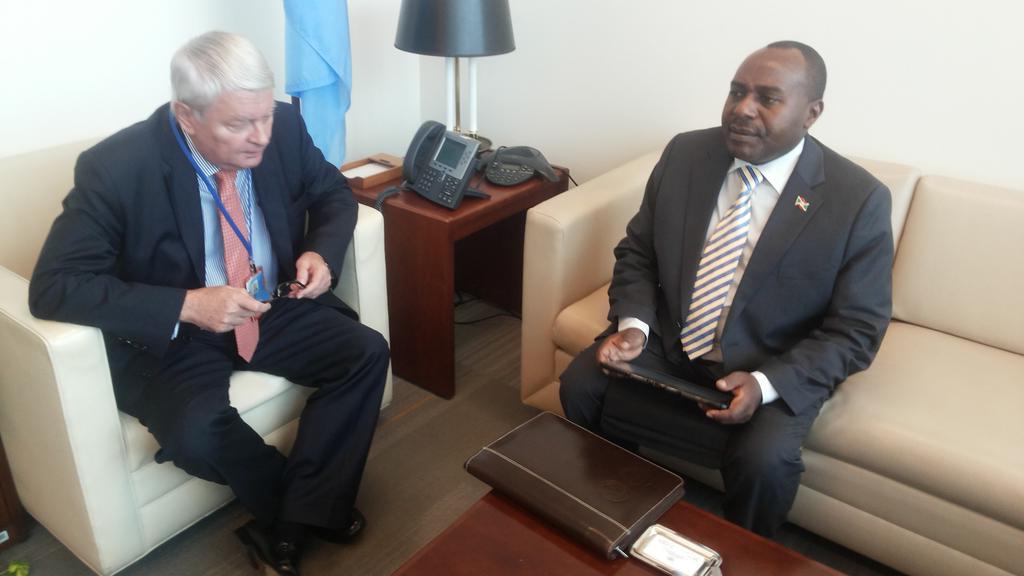
UNITED NATIONS, January 26 -- After UN Secretary General Ban Ki-moon on New Year's Eve issued a statement surreally praising the Burundi “talks” held in Entebbe, Uganda, multiple sources told Inner City Press these not really talks but rather a photo op. The January 6 session announced for Arusha did not happen. Inner City Press requested to cover the UNSC's trip to Burundi, but was UNtransparentlyrejected.
On January 26, the UN Office of the High Commissioner for Human Rights announced that even after the UNSC trip, its three experts were unable to deploy to Burundi due to a lack of response from the Nkurunziza government.
So at the UN's January 26 noon briefing Inner City Press asked Ban's spokesman Stephane Dujarric, video here, transcript here:
Inner City Press: on Burundi, they read out in Geneva that the experts that were supposed to go there under the Human Rights Council resolution, including Mr. [Christof] Heyns, Mr. [Pablo] de Greiff, have not been able to get in. Is the Special Adviser involved in this issue at all given that he has a team that was announced on the ground? What has been the response he's gotten from the Burundian authorities to this Human Rights Council team going?
Spokesman: Obviously, the Human Rights Council team is an independent team. That being said, it is incumbent on every Member State to cooperate with Special Rapporteurs, investigators from ad hoc investigative commissions set up by the Human Rights Council as part of the broader UN human rights architecture. So we would expect that they be allowed in.
Question: But does Mr. [Jamal] Benomar's mission have a human rights component to it or no?
Spokesman: There are Human Rights… the Office of the High Commissioner for Human Rights has representatives on the ground. And obviously, as part of the broader mission of Mr. Benomar, human rights are an important factor.
On January 25, Inner City Press asked UN Spokesman Dujarric why when the UN belatedly put online video of press encounters during the Security Council's mission to Burundi, it trimmed a longer stakeout by French Deputy Alexis Lamek, which gave rise to controversy, down to a mere 16 seconds.
Dujarric replied this was how the video were received from "our colleagues in Bujumbura." Video here. Which colleagues? Who decided to selectively cut the video and why? And to omit an encountered between US Power and Bururndian security that even the US Special Envoy on the Great Lakes found significant?
Inner City Press asked Ban's spokespeople about the trip on January 20, 21 and 22 - including asking why the UN was not providing a video or at least audio stream of the January 22 press encounters, says it has a "UN Information Center" in Bujumbura, which produced a smiling photo of the French deputy ambassador Alexis Lamek on the tarmac. The UN said it couldn't.
Local media in Burundi put online a video in which Lamek spoke at length; afterward a pro-government Burundian media quoted Lamek that "we" take seriously the question of interference by Rwanda to destabilize Burundi and will be working on it.
But the four scribes handpicked to accompany the Security Council trip, inlcuding Agence France Presse, it seems, for some reasons didn't cover it. Why? We'll have more on this. Instead, AFP, Reuters andVoice of America (which saw "Liberians" then cited auto-correct) filed near-identical stories with no quotes from opposition figures or attacked journalists. None of the three even tweeted on January 23, other than Reuters as a robot: talk about Old Media.
How could "Agence France Presse," handpicked to publicize the UNSC trip co-led by France, not even cover the controversy?
We note that the French Mission to the UN said that Lamek was being misrepresented (the same French Mission has tried to shield Lamek from critical Press questions, which here on Vine Lamek has refused to answer even when entirely audible). Later an AFP quote emerged of Lamek saying that any AU force, even the 100 human rights observers, should significantly focus on the Rwandan border.
On the evening of January 23 the UN has put up select clips including a mere 16 seconds of French deputy ambassador Lamek, much less than the local Burundian media present at the same press encountered had. If the UN filmed the press encounters, why did it so selectively edit them?
More specifically, now, who decided on the edits?
Inner City Press, which is the media which on January 22 asked for the live-stream, has asked the UN, publicly on Twitter, here, and in more detail by e-mail to three top UN spokespeople:
"having just seen that your Office put online edited video from Burundi, must ask: why did UN edit the footage it has, with no Burundi government speaker, and only 16 seconds of France, penholder in the UNSC on Burundi? Please provide the full footage, in response to this request and, separately, online. Would also still like answers to questions below" on Burundi.
And still no answers at all, the next day. Watch this site.
The UN spokespeople refused to say, but beyond the pro-government "religious leaders" that they cited, the Council also met with at least some of the concerned members of civil society, and some journalists who inevitably raised the issue of attacks and censorship. This was not mentioned by the UN.
We're told that Ambassador Albert Shingiro, who blocks the Press on Twitter, told the scribes that US Power said she would send “a strong message to the government of Rwanda." Again, Shingiro blocks the Press on Twitter: some diplomat.
One of the four handpicked pass-throughs opined that "the fact that Council members presented Nkurunziza with a largely unified message on the different issues was seen as a positive sign that they had come closer to a common position." So they traveled to Burundi to work on their own issues? We'll have more on this - and on the Council's junket-ending meetings in Addis, if not on Oromo protests, than this we've asked about. Watch this site.
On January 22 -- at 4:32 pm in New York, four minutes before Inner City Press then published it -- the UN has issued this Note to Correspondents:
"Security Council members just departed Bujumbura less than an hour ago. The delegation is headed to Addis to meet with the Peace and Security Council of the African Union tomorrow.
"Council members met with a range of stakeholders during their visit to Burundi, including the President, First Vice President, Foreign Minister and representatives from political parties, the media, and civil society organizations. The Council also met with religious leaders.
Special Adviser Jamal Benomar is in Burundi. The core group of his team called for in Resolution 2248 deployed to Bujumbura and will be engaged with all stakeholders to support dialogue and address security concerns."
How?
On January 22, Inner City Press asked UN Deputy Spokesperson Farhan Haq for the UN's response to Pierre Nkurunziza denying the existence of his party's youth militia, and why there was no video or even audio stream of the Security Council's - and Nkurunziza's -- press statements. Video here.
Haq replied that "the facilities are difficult," that the UN Spokesperson's Office had reached out to the traveling party for information but hadn't gotten any. The Free UN Coalition for Accesscalls this a failure.
On January 21 Inner City Press in New York learned both of Pierre Nkurunziza plans to parade "community work" for the Security Council members on January 22 and has been provided with a letter promoting same, here.
On January 22, even after the Council's meeting with Nkurunziza was over, when Inner City Press asked the UN for a read-out there was none, nor any good explanation of why the UN with its country team could not arrange at least an audio stream of the Council's (and Nkurunziza's) press statements.
Inner City Press asked the head of the Campaign Against the Third Term (“Halte au troisième mandat”) Vital Nshimirimana about the UNSC visit, and why the AU human rights observers are not yet in place. His answers to Inner City Press:
"As for the deployment of the AU Human rights observers, I would recall that the same was decided back in June following the June 13, 2015 Johannesburg Summit on Burundi. Initially, the number was to be about 70 observers but the government refused and allowed a narrow team.
"My thought over the issue is that Nkurunziza has chosen to humiliate everybody in as much as he does not care about any principle or value. So, the AU and other bodies as well choose to deal with him very carefully for he is a man (and a regime) "irrational," likely to commit whatever crime, insult whomever.....
"With regard to the UNSC visit, I hope this is the very last warning towards a kind of regime likely to commit genocide. They are expected to dually and objectively assess the situation and especially the strength and presence of Imbonerakure, the CNDD-FDD militia.... And this was shown through a huge anti- peacekeeping mission mission to Burundi, MAPROBU rhetoric. Burundians expect the UNSC support the deployment of such a mission in line with the responsibility to protect (Pillar III) since Burundi is no longer able and is unwilling to protect citizens from crimes against humanity (ongoing from April 2015) and genocide (of which dozens of signs suggest that it is likely to happen and some acts are already undertaken).
Lastly, the UNSC is expected to talk with Nkurunziza and the AU as well regarding peace talks. They should assess Museveni's performance, after what conclude that he should be assigned AU and UN teams (to enhance his capacity) or change him.... I commend your endeavors to keep the world informed about the Burundi crisis."
We'll have more on this -- including in light the UN Deputy Spokesperson's response to Inner City Press that transcripts may be provided.
Here are parts of an Inner City Press interview with a journalist attacked by the Nkurunziza government and for that reason anonymous:
In English: "It would be better if the Security Council met for example UPRONA leader Nditije Charles, with the non-governmental branch of the UPRONA party) or his Spokesman Thacien Sibomana. The Council should try to meet civil society but there is almost no one left to really speak with now in Bujumbura. All those still in Bujumbura, they can't say anything about the abuses of authorithies. If it was possible, they should ask to meet the young men in prison. They should see themselves how the government abuses those young men, with tortures... Tell them visit to the prisoners in Gitega (those who are accused to attempting a coup d'etat) UN has the right to visit prisoners."
Inner City Press note: another source says "the government moved several detainees from the SNR jails. I highly doubt they'd allow a visit to detainees."
Tellingly, IWACU reports that bike taxi and motorcycle taxi drivers offered money to protest in favor of Nkurunziza weren't, after the fact, paid: here. At the January 21 UN noon briefing, Inner City Press asked UN deputy spokesperson Farhan Haq about the "community works" and meeting(s). Video here, UN transcript here:
Inner City Press: I wanted to ask you this just because I'm trying to cover it, and I know that you'd said yesterday that the Special Adviser, Jamal Benomar, is in Burundi in part of the trip. So what I wanted to ask you is, I've seen documents that show that the… the… the… tomorrow, the meeting with the President, [Pierre] Nkurunziza, will involve a demonstration of “community work”, i.e., people have been asked to go and I don't know if it's to show how happy they are — Gitega and Karuzi. Does the Special Adviser… not the Security Council, does the Special Adviser of the Secretary-General believe that this type of… of… of show is the right one and will they be meeting with UPRONA and other opposition groups or prisoners currently in jail?
Deputy Spokesman Haq: Well, we'll be able to provide details of the meetings once they've taken place. As you know, the expectation is for the members of the Council to meet with President Nkurunziza. That hasn't happened so far, but once that's happened, we'll see what the circumstances are and what the views of Mr. Benomar are.
This is reminiscent of the type of dog-and-pony show Sri Lanka's then President Mahinda Rajapaksa put on for visiting UN Secretary General Ban Ki-moon and that Inner City Press accompanied and covered(apparently not to the UN's and its allies' liking - it has been Banned from trips since.) But will the UNSC, unlike Ban, have the fortitude or leverage to reject a dog and pony show? Watch this site.
On January 19 at the UN, Inner City Press asked Uruguay's Vice Minister for Foreign Affairs Jose Luis Cancela, chairing the Security Council debate on Protection of Civilians, about Burundi and the Council's trip. Video here.
On January 21, Inner City Press and the Free UN Coalition for Accessasked UK Permanent Representative Matthew Rycroft about his stop-over on Addis Ababa, "will you as UK meet with AU before heading to Burundi? About AU's proposed deployment?"
Rycroft replied, "Yes! Looking forward to meeting @AU_Chergui today. Will also return to Addis with whole UNSC after Burundi."
In Addis, Chergui had filed the Concept of Operation for the MAPROBU peacekeeping mission. We'll have more on this.
Burundian civil society has written to Ban seeking the repatriation of the country's peacekeepers. Inner City Press has put the letter from Vital Nshimirimana to Ban online here, and will be asking the UN about it. Watch this site.
On December 30 Nkurunziza threatened to have his forces attack peacekeepers proposed for the country.
On December 16 Inner City Press was banned from questions to Secretary General Ban Ki-moon, but learned from the mission MINUSCA that Baratuza was already in Entebbe. Inner City Press asked several Security Council members, then Ban's spokesman Stephane Dujarric on December17.
Dujarric told Inner City Press Baratuza's deployment is suspended and he is being repatriated: "based on the information we've received regarding the Lieutenant Colonel, his deployment has been suspended, and he will be repatriated back to Burundi." Video here. Dujarric told Inner City Press this shows the UN system working - on a day when a report on rapes was issued showing UN Peacekeeping under Herve Ladsous not sufficiently vetting for human rights. We'll have more on this.
Amid the escalating killings in Burundi, last weekend's summary executions in neighborhoods opposed to Pierre Nkurunziza's third term stand out. But Burundi Army spokesman Gaspard Baratuza was quoted on December 12 blaming all of the deaths on attempts to steal weapons to free prisoners.
Inner City Press had heard that Mr. Baratuza was already in the process of being deployed to the UN Peacekeeping mission in the Central African Republic (MINUSCA) even when he was giving these quotes, issuing statements and speaking to state-owned radio, and so asked MINUSCA's acting spokesperson, “Is Gaspard Baratuza of Burundi's army getting a MINUSCA job?”
On December 16, hours before UN Secretary General Ban Ki-moon held a rare press conference, MINUSCA's acting spokesperson sent this to Inner City Press:
"To: Matthew.Lee [at] InnerCityPress.com From: Vladimir MONTEIRO [at] UN.org Date: Wed, Dec 16, 2015 Subject: ICP question: Gaspard Baratuza of Burundi's army getting a MINUSCA-related post? Cc: FUNCA [at] funca.info
"No decision related to Lt Col Baratuza's deployment can be taken before we finish looking into the matter. We can confirm that Lt Col Baratuza is in Entebbe but he has not yet deployed to MINUSCA. Regards. VNM"
There are some questions about Baratuza, a Colonel in Burundi's Army, being listed by the UN as “Lt. Col.”
Despite multiple follow-up questions by Inner City Press, Mr. Monteiro - previously a spokesperson for the UN electoral mission in Burundi - replied that “This is what we can say about this issue.”
But the UN should have to say more. Inner City Press has repeatedly asked the UN how its Department of Peacekeeping Operations under Herve Ladsous vets those who deploy to UN missions; Inner City Pressexclusively reported on an October 1, 2015 meeting in which Ladsous told Burundi's Vice President Joseph Butare that he is “pragmatic” on human rights.
Ban Ki-moon and his spokesman declined to take Inner City Press' questions on December 16, as they did on December 14. Vine here. Watch this site.
UNITED NATIONS, January 26 -- After UN Secretary General Ban Ki-moon on New Year's Eve issued a statement surreally praising the Burundi “talks” held in Entebbe, Uganda, multiple sources told Inner City Press these not really talks but rather a photo op. The January 6 session announced for Arusha did not happen. Inner City Press requested to cover the UNSC's trip to Burundi, but was UNtransparently rejected.
On January 26, the UN Office of the High Commissioner for Human Rights announced that even after the UNSC trip, its three experts were unable to deploy to Burundi due to a lack of response from the Nkurunziza government. See below. Some trip.
On January 25, Inner City Press asked UN Spokesman Stephane Dujarric why when the UN belatedly put online video of press encounters during the Security Council's mission to Burundi, it trimmed a longer stakeout by French Deputy Alexis Lamek, which gave rise to controversy, down to a mere 16 seconds.
Dujarric replied this was how the video were received from "our colleagues in Bujumbura." Video here. Which colleagues? Who decided to selectively cut the video and why? And to omit an encountered between US Power and Bururndian security that even the US Special Envoy on the Great Lakes found significant?
On January 26, OHCHR spokesperson Cécile Pouilly announced:
"In accordance with a resolution* adopted by the Human Rights Council on 17 December requesting the High Commissioner “to urgently organize and dispatch on the most expeditious basis possible a mission by independent existing experts”, we set up a team comprising two UN Special Rapporteurs and a member of the African Commission on Human and Peoples’ Rights.
The experts have been mandated by the Council to swiftly investigate violations and abuses of human rights in Burundi, make recommendations on the improvement of the human rights situation and to engage in a dialogue with the authorities and other relevant actors of the ongoing crisis.
Given the rapidly deteriorating human rights situation in Burundi and the request for an oral update to the Council at its next session in March, the High Commissioner had requested the Government of Burundi to allow the team to start its first mission to Burundi yesterday (25 January). However the team was not able to deploy due to the lack of response to date from the Burundian authorities.
We regret this delay and fear that it might hamper the ability of the team to fulfil its mandate and report in an appropriate and timely manner to the Council. We hope the Burundian authorities will take all the necessary steps, including granting of visas, to allow for the prompt deployment of the experts on the ground.
The three experts are:
· Mr Christof Heyns (South Africa), UN Special Rapporteur on extrajudicial, summary and arbitrary executions;
· Ms. Maya Sahli Fadel (Algeria), Member of the African Commission on Human and Peoples’ Rights and Special Rapporteur on refugees, asylum seekers, internally displaced persons and migrants of the same institution; and
· Mr Pablo de Greiff (Colombia), UN Special Rapporteur on the promotion of truth, justice, reparation and guarantees of non-recurrence. "
Inner City Press asked Ban's spokespeople about the trip on January 20, 21 and 22 - including asking why the UN was not providing a video or at least audio stream of the January 22 press encounters, says it has a "UN Information Center" in Bujumbura, which produced a smiling photo of the French deputy ambassador Alexis Lamek on the tarmac. The UN said it couldn't.
Local media in Burundi put online a video in which Lamek spoke at length; afterward a pro-government Burundian media quoted Lamek that "we" take seriously the question of interference by Rwanda to destabilize Burundi and will be working on it.
But the four scribes handpicked to accompany the Security Council trip, inlcuding Agence France Presse, it seems, for some reasons didn't cover it. Why? We'll have more on this. Instead, AFP, Reuters andVoice of America (which saw "Liberians" then cited auto-correct) filed near-identical stories with no quotes from opposition figures or attacked journalists. None of the three even tweeted on January 23, other than Reuters as a robot: talk about Old Media.
How could "Agence France Presse," handpicked to publicize the UNSC trip co-led by France, not even cover the controversy?
We note that the French Mission to the UN said that Lamek was being misrepresented (the same French Mission has tried to shield Lamek from critical Press questions, which here on Vine Lamek has refused to answer even when entirely audible). Later an AFP quote emerged of Lamek saying that any AU force, even the 100 human rights observers, should significantly focus on the Rwandan border.
On the evening of January 23 the UN has put up select clips including a mere 16 seconds of French deputy ambassador Lamek, much less than the local Burundian media present at the same press encountered had. If the UN filmed the press encounters, why did it so selectively edit them?
More specifically, now, who decided on the edits?
Inner City Press, which is the media which on January 22 asked for the live-stream, has asked the UN, publicly on Twitter, here, and in more detail by e-mail to three top UN spokespeople:
"having just seen that your Office put online edited video from Burundi, must ask: why did UN edit the footage it has, with no Burundi government speaker, and only 16 seconds of France, penholder in the UNSC on Burundi? Please provide the full footage, in response to this request and, separately, online. Would also still like answers to questions below" on Burundi.
And still no answers at all, the next day. Watch this site.
The UN spokespeople refused to say, but beyond the pro-government "religious leaders" that they cited, the Council also met with at least some of the concerned members of civil society, and some journalists who inevitably raised the issue of attacks and censorship. This was not mentioned by the UN.
We're told that Ambassador Albert Shingiro, who blocks the Press on Twitter, told the scribes that US Power said she would send “a strong message to the government of Rwanda." Again, Shingiro blocks the Press on Twitter: some diplomat.
One of the four handpicked pass-throughs opined that "the fact that Council members presented Nkurunziza with a largely unified message on the different issues was seen as a positive sign that they had come closer to a common position." So they traveled to Burundi to work on their own issues? We'll have more on this - and on the Council's junket-ending meetings in Addis, if not on Oromo protests, than this we've asked about. Watch this site.
On January 22 -- at 4:32 pm in New York, four minutes before Inner City Press then published it -- the UN has issued this Note to Correspondents:
"Security Council members just departed Bujumbura less than an hour ago. The delegation is headed to Addis to meet with the Peace and Security Council of the African Union tomorrow.
"Council members met with a range of stakeholders during their visit to Burundi, including the President, First Vice President, Foreign Minister and representatives from political parties, the media, and civil society organizations. The Council also met with religious leaders.
Special Adviser Jamal Benomar is in Burundi. The core group of his team called for in Resolution 2248 deployed to Bujumbura and will be engaged with all stakeholders to support dialogue and address security concerns."
How?
On January 22, Inner City Press asked UN Deputy Spokesperson Farhan Haq for the UN's response to Pierre Nkurunziza denying the existence of his party's youth militia, and why there was no video or even audio stream of the Security Council's - and Nkurunziza's -- press statements. Video here.
Haq replied that "the facilities are difficult," that the UN Spokesperson's Office had reached out to the traveling party for information but hadn't gotten any. The Free UN Coalition for Accesscalls this a failure.
On January 21 Inner City Press in New York learned both of Pierre Nkurunziza plans to parade "community work" for the Security Council members on January 22 and has been provided with a letter promoting same, here.
On January 22, even after the Council's meeting with Nkurunziza was over, when Inner City Press asked the UN for a read-out there was none, nor any good explanation of why the UN with its country team could not arrange at least an audio stream of the Council's (and Nkurunziza's) press statements.
Inner City Press asked the head of the Campaign Against the Third Term (“Halte au troisième mandat”) Vital Nshimirimana about the UNSC visit, and why the AU human rights observers are not yet in place. His answers to Inner City Press:
"As for the deployment of the AU Human rights observers, I would recall that the same was decided back in June following the June 13, 2015 Johannesburg Summit on Burundi. Initially, the number was to be about 70 observers but the government refused and allowed a narrow team.
"My thought over the issue is that Nkurunziza has chosen to humiliate everybody in as much as he does not care about any principle or value. So, the AU and other bodies as well choose to deal with him very carefully for he is a man (and a regime) "irrational," likely to commit whatever crime, insult whomever.....
"With regard to the UNSC visit, I hope this is the very last warning towards a kind of regime likely to commit genocide. They are expected to dually and objectively assess the situation and especially the strength and presence of Imbonerakure, the CNDD-FDD militia.... And this was shown through a huge anti- peacekeeping mission mission to Burundi, MAPROBU rhetoric. Burundians expect the UNSC support the deployment of such a mission in line with the responsibility to protect (Pillar III) since Burundi is no longer able and is unwilling to protect citizens from crimes against humanity (ongoing from April 2015) and genocide (of which dozens of signs suggest that it is likely to happen and some acts are already undertaken).
Lastly, the UNSC is expected to talk with Nkurunziza and the AU as well regarding peace talks. They should assess Museveni's performance, after what conclude that he should be assigned AU and UN teams (to enhance his capacity) or change him.... I commend your endeavors to keep the world informed about the Burundi crisis."
We'll have more on this -- including in light the UN Deputy Spokesperson's response to Inner City Press that transcripts may be provided.
Here are parts of an Inner City Press interview with a journalist attacked by the Nkurunziza government and for that reason anonymous:
In English: "It would be better if the Security Council met for example UPRONA leader Nditije Charles, with the non-governmental branch of the UPRONA party) or his Spokesman Thacien Sibomana. The Council should try to meet civil society but there is almost no one left to really speak with now in Bujumbura. All those still in Bujumbura, they can't say anything about the abuses of authorithies. If it was possible, they should ask to meet the young men in prison. They should see themselves how the government abuses those young men, with tortures... Tell them visit to the prisoners in Gitega (those who are accused to attempting a coup d'etat) UN has the right to visit prisoners."
Inner City Press note: another source says "the government moved several detainees from the SNR jails. I highly doubt they'd allow a visit to detainees."
Tellingly, IWACU reports that bike taxi and motorcycle taxi drivers offered money to protest in favor of Nkurunziza weren't, after the fact, paid: here. At the January 21 UN noon briefing, Inner City Press asked UN deputy spokesperson Farhan Haq about the "community works" and meeting(s). Video here, UN transcript here:
Inner City Press: I wanted to ask you this just because I'm trying to cover it, and I know that you'd said yesterday that the Special Adviser, Jamal Benomar, is in Burundi in part of the trip. So what I wanted to ask you is, I've seen documents that show that the… the… the… tomorrow, the meeting with the President, [Pierre] Nkurunziza, will involve a demonstration of “community work”, i.e., people have been asked to go and I don't know if it's to show how happy they are — Gitega and Karuzi. Does the Special Adviser… not the Security Council, does the Special Adviser of the Secretary-General believe that this type of… of… of show is the right one and will they be meeting with UPRONA and other opposition groups or prisoners currently in jail?
Deputy Spokesman Haq: Well, we'll be able to provide details of the meetings once they've taken place. As you know, the expectation is for the members of the Council to meet with President Nkurunziza. That hasn't happened so far, but once that's happened, we'll see what the circumstances are and what the views of Mr. Benomar are.
This is reminiscent of the type of dog-and-pony show Sri Lanka's then President Mahinda Rajapaksa put on for visiting UN Secretary General Ban Ki-moon and that Inner City Press accompanied and covered(apparently not to the UN's and its allies' liking - it has been Banned from trips since.) But will the UNSC, unlike Ban, have the fortitude or leverage to reject a dog and pony show? Watch this site.
On January 19 at the UN, Inner City Press asked Uruguay's Vice Minister for Foreign Affairs Jose Luis Cancela, chairing the Security Council debate on Protection of Civilians, about Burundi and the Council's trip. Video here.
On January 21, Inner City Press and the Free UN Coalition for Accessasked UK Permanent Representative Matthew Rycroft about his stop-over on Addis Ababa, "will you as UK meet with AU before heading to Burundi? About AU's proposed deployment?"
Rycroft replied, "Yes! Looking forward to meeting @AU_Chergui today. Will also return to Addis with whole UNSC after Burundi."
In Addis, Chergui had filed the Concept of Operation for the MAPROBU peacekeeping mission. We'll have more on this.
Burundian civil society has written to Ban seeking the repatriation of the country's peacekeepers. Inner City Press has put the letter from Vital Nshimirimana to Ban online here, and will be asking the UN about it. Watch this site.
On December 30 Nkurunziza threatened to have his forces attack peacekeepers proposed for the country.
On December 16 Inner City Press was banned from questions to Secretary General Ban Ki-moon, but learned from the mission MINUSCA that Baratuza was already in Entebbe. Inner City Press asked several Security Council members, then Ban's spokesman Stephane Dujarric on December17.
Dujarric told Inner City Press Baratuza's deployment is suspended and he is being repatriated: "based on the information we've received regarding the Lieutenant Colonel, his deployment has been suspended, and he will be repatriated back to Burundi." Video here. Dujarric told Inner City Press this shows the UN system working - on a day when a report on rapes was issued showing UN Peacekeeping under Herve Ladsous not sufficiently vetting for human rights. We'll have more on this.
Amid the escalating killings in Burundi, last weekend's summary executions in neighborhoods opposed to Pierre Nkurunziza's third term stand out. But Burundi Army spokesman Gaspard Baratuza was quoted on December 12 blaming all of the deaths on attempts to steal weapons to free prisoners.
Inner City Press had heard that Mr. Baratuza was already in the process of being deployed to the UN Peacekeeping mission in the Central African Republic (MINUSCA) even when he was giving these quotes, issuing statements and speaking to state-owned radio, and so asked MINUSCA's acting spokesperson, “Is Gaspard Baratuza of Burundi's army getting a MINUSCA job?”
On December 16, hours before UN Secretary General Ban Ki-moon held a rare press conference, MINUSCA's acting spokesperson sent this to Inner City Press:
"To: Matthew.Lee [at] InnerCityPress.com From: Vladimir MONTEIRO [at] UN.org Date: Wed, Dec 16, 2015 Subject: ICP question: Gaspard Baratuza of Burundi's army getting a MINUSCA-related post? Cc: FUNCA [at] funca.info
"No decision related to Lt Col Baratuza's deployment can be taken before we finish looking into the matter. We can confirm that Lt Col Baratuza is in Entebbe but he has not yet deployed to MINUSCA. Regards. VNM"
There are some questions about Baratuza, a Colonel in Burundi's Army, being listed by the UN as “Lt. Col.”
Despite multiple follow-up questions by Inner City Press, Mr. Monteiro - previously a spokesperson for the UN electoral mission in Burundi - replied that “This is what we can say about this issue.”
But the UN should have to say more. Inner City Press has repeatedly asked the UN how its Department of Peacekeeping Operations under Herve Ladsous vets those who deploy to UN missions; Inner City Pressexclusively reported on an October 1, 2015 meeting in which Ladsous told Burundi's Vice President Joseph Butare that he is “pragmatic” on human rights.
Ban Ki-moon and his spokesman declined to take Inner City Press' questions on December 16, as they did on December 14. Vine here. Watch this site.
UNITED NATIONS, October 30 -- When the UN's Special Rapporteur on Extrajudicial, Summary or Arbitrary Executions Christof Heyns held a press conference on October 30, his topics were foreign nationals facing the death penalty and best practices in investigations. Inner City Press asked Heyns about Sri Lankans and others executed in Saudi Arabia, and the shrinking of the promised investigation into killings in Sri Lanka in 2009. Video here.
Heyns said he had a case or cases about Sri Lankans in Saudi Arabia; he was generally upbeat about the process in Sri Lanka, saying there will be Commonwealth judges. Inner City Press might ask, what about Shavendra Silva? What about the UN's own role in the White Flag killings? Secretary General Ban Ki-moon almost reflexively calls for investigations. But what does the UN actually do?
Inner City Press also asked Heyns about the (Stop) Killer Robots issues, specifically about the US and UK only agreeing to talk about “emerging” - that is, future - technologies, and not “existing” ones.Video here. (From Minute 4:36.) Heyns said yes that is the issue. We'll have more on this.
On October 22 when UN Rapporteur of Freedom of Expression David Kaye held a press conference before his appearance before the UN's Third Committee, his topic was whistleblower protection, on which the UN itself is particularly weak.
When called on, Inner City Press asked Kaye about retaliation against UN official Anders Kompass for blowing the whistle on alleged child rapes by French troops in the Central African Republic. Video here and embedded below.
Free speech ironies at the UN were on display right in Kaye's press conference. The representative of the UN Correspondents Association, which among other things took funds from now-indicted David Ng's South South News and then give it an award, and gave Ng a photo op with Ban Ki-moon at Cipriani, demanded to ask the first question, even claiming that the UN Department of Public Information has granted this “right” in writing. Where?
UNITED NATIONS, July 16 -- As in Burundi the crackdown on those opposing or even questioning a third term for Pierre Nkurunziza continued through the boycotted parliamentary elections on June 29, Nkurunziza dismissed the UN's replacement mediator Abdoulaye Bathily, ostensibly because he wasn't sufficiently deferential to Nkurunziza (with whom UN Secretary General Ban Ki-moon has been unable to speak for some time.)
On July 16, a group of UN experts -- independent, to be sure -- issued a call for action by the UN Security Council, where the "penholder" on Burundi has been notably quiet. The experts among other things said:
“The world is witnessing an escalating pattern of politically motivated violence in Burundi, enabled by the country’s decades-long tradition of impunity. The international community must not simply stand by and wait for mass atrocities to unfold, thereby risking a major conflict of regional proportions before it finally decides to act... We also witness efforts to coerce the judiciary, some of whose highest members have fled the country claiming their lives were at risk. In the meantime, armed militias, with the collaboration of authorities, exercise violence against civilians. In these circumstances, it is not surprising that the results of the 29 June elections have generally not been endorsed.
“The absence of independent media and a climate of repression and fear to exercise civil rights and express opinions, notably by peacefully taking to the streets, have marred the recent elections and will also be defining the forthcoming presidential elections, now scheduled for 21 July. The postponement by six days of the presidential elections does not remedy this blatant deficiency.
“If the government persists in holding presidential elections under the current circumstances – something even the former first Vice-President objected to after also having fled the country – they will in no way confer any legitimacy on the to-be-elected authorities. On the contrary, the elections are highly likely to result in major instability and confrontations in Burundi, with the potential to spread to the region.
“The Security Council has a unique role for peace and security and for preventing conflicts worldwide. This is a crisis that is eminently preventable – everyone can see the risks. What is lacking is action.Given the painful history of Burundi and the region, the long engagement of the United Nations in the country to re-build peace, the Security Council must be all the more alerted to the increasing potential of an escalation of massive violence. Burundians, who live in the world’s third poorest country must be spared another cycle of violence, with the misery and destruction that violence always leave on its wake. They look to the Security Council to live up to its unique role in the prevention of mass atrocities.”
They noted, as Inner City Press has, that it was a full week ago, on July 9, that “the situation on Burundi was most recently discussed by the Security Council.” The experts included the UN Special Rapporteur on the promotion of truth, justice, reparation and guarantees of non-recurrence, Pablo de Greiff; Special Rapporteur on extrajudicial, summary or arbitrary executions, Christof Heyns; Special Rapporteur on the independence of judges and lawyers, Gabriela Knaul; Special Rapporteur on the situation of human rights defenders; Michel Forst; Special Rapporteur on the promotion and protection of freedom of opinion and expression, David Kaye; Special Rapporteur on the rights to freedom of peaceful assembly and of association, Maina Kiai; and the Chairperson of the Working Group on Arbitrary Detention, Seong-Phil Hong.
Inner City Presss: on Burundi, President [Yoweri] Museveni has left the country, his proposal was not accepted. He's left his defence minister there. One, did the UN stand behind those proposals? Did they have any idea what proposals he was going to make? Are they now working with the defence minister? It's okay. I have another one on this, but it's up to you.
Spokesman Dujarric: As I said, the UN supported the mediation process put forward by the East Africa Community, which is being led by Museveni. I don't have any more details from what is actually…
Inner City Press: How did the UN support it?
Spokesman: We're supporting… we're supportive of the facilitation effort.
Inner City Press: There are also reports there that the authorities are declining to give death certificates to people killed by either police or militia. And I wanted to know… you'd said that the human rights mechanism of the UN that's there is there… is recording and routinely reports. So where are the reports?
Spokesman: I will check when they're next scheduled to report.
Inner City Press: On Burundi, now President [Yoweri] Museveni is in Bujumbura. They say he's holding these talks in the Hotel Bel Air residence. Is Mr. [Abdoulaye] Bathily or any UN representative taking part, and do you have anything on a possible FDLR presence on the border?
Spokesman: I don't believe Mr. Bathily is there. I know the Secretary-General and President Museveni spoke briefly yesterday, if I'm not mistaken. They are scheduled to speak before the day is over. I have nothing on the Burundi border.
Moments later Inner City Press asked the UN's envoy to the DR Congo Martin Kobler about the FDLR, both in DRC and as regards Burundi.Video here. First, the Security Council's president for July Gerard von Bohemen indicated that the only discussion of Burundi on July 14 was as a source of refugees to DRC, which Kobler said the DRC could handle.
In the Security Council chamber, Kobler had said, "I have been monitoring the situation in Burundi very closely, as the country has descended into violence over the last two months. Today, over 140,000 people have fled into neighboring countries, including 12,800 to the DRC. I highlight these events to remind us again of the importance of respecting the constitution, and of creating the necessary political space for a national consensus around elections."
Inner City Press asked Kobler if by this he meant that a third term for Pierre Nkurunziza would violate the constitution of Burundi, or Arusha Agreements. But Kobler didn't answer this. (Reuters cut in, and didn't report a word of what Kobler said about Burundi).
On July 13, Inner City Press asked Ban's spokesman Stephane Dujarric:
Inner City Press: On Burundi, you said that the UN human rights team there is recording... when are they going to report that? There are these pictures of people described as rebels being arrested by the Government that many people are saying are just farmers who happened to belong to opposition parties. There's also pictures of corpses. When is the UN actually going to report on what it's witnessed in the last day?
Spokesman Dujarric: I'll check with them, but our human rights colleagues tend to report on a regular basis.
So when will that be? Inner City Press on July 13 also asked Dujarric:
Inner City Press: MONUSCO [United Nations Organization Stabilization Mission in the Democratic Republic of the Congo], ist said there are forces on the border now with Burundi gathered. So I'm asking you this now, because there's some concern coming from both directions, interventions. Is it anything to your knowledge that MONUSCO, DRC or DPA is aware of?
Spokesman: Let me check. Thank you, all. Have great day.
To this has the UN been reduced.
From the July 10 transcript:
Inner City Press: I wanted to ask you in Burundi, they're now, you know, in the last hours, there's reports of heavy gunfire on border with Rwanda. There's been grenade attacks in the capital, and some are saying that people seeking to flee are not being allowed to by the ruling party's militia. So what's the status of the UN both observing these things? Does the UN acknowledge that things have actually gotten heated up since even yesterday's Security Council meeting?
Spokesman: No, clearly. I think we very much strongly condemn any type of violent action, any action that is meant to destabilize the already tense and fragile situation in Burundi. We've taken note, as you mentioned, very recently there have been clashes, reported clashes between Burundi's national defence forces and unidentified armed groups in the country's north on the Rwandan border, and we're following the situation closely. And we're trying to verify the authenticity of these reports.
Inner City Press: Given that… I mean it seems like there's no real public accounting or reporting about the Museveni facilitation and there obviously… there's some issues in Uganda at present, so maybe these occupied by those. But what's the UN doing in terms of…
Spokesman: I think we're there to support this facilitation, which is organized by the East African Community under the blessing of the African Union. So you should also address your questions to them.
After the Security Council's last meeting of July 9, about Syria, Inner City Press asked the Council's president for July, Gerard van Bohemen of New Zealand, if the idea of postponing Burundi's election for a mere week to July 22 was discussed in closed door consultations. He replied that Constitutional issues were discussed but no decision or conclusion reached. Video here.
Earlier in the day at the UN noon briefing on July 9, Inner City Press asked UN Secretary General Ban Ki-moon's spokesman Stephane Dujarric for the UN's or Ban's position on a delay of a mere week, to July 22, transcript here:
Inner City Press: in Tayé Brook Zerihoun’s briefing to the Council about Burundi, he said that there's been no formal forum for dialogue since 26 June, and then the permanent representative of Burundi said that there is some discussion of moving back the election a week to 21-22 July, he said, consistent with the Constitution. So I wanted to know, is Mr. [Abdoulaye] Bathily part of these discussions? And what does the UN think? Does the UN think that a one-week extension is… addresses the issues that were raised by…
Spokesman Dujarric: I think the issues of the political climate and to create a political climate is conducive to elections in Burundi will be discussed through the facilitation mechanism, which will be led by Mr. [Yoweri] Museveni and supported by the UN.
Inner City Press: But since he's saying… as of today, he said there is no mechanism, so it's going to begin between now and the 15th or now and…
Spokesman Dujarric: Again, this will be led by President Museveni, so I would urge you to ask questions in that direction.
(Before the Security Council meeting started, the questions or chatter outside was unrelated to Burundi.)
Inner City Press: In the Srebrenica debate just now, Prince Zeid said the UN must be resolute. Had this been in the case in Sri Lanka in 2009 or now in Sudan, Syria, Central African Republic or even Burundi and Myanmar, the consequences would have been different. I have questions about a number of those countries, but I wanted to ask you, on Burundi, where he says "even Burundi", I wanted to know, one, does the UN have any response now that the ruling party has announced its whopping win on 29 June? And, two, people are coming forward with names of victims and names of alleged killers, including victim Serge Bizimana, and they say police officer [UN says inaudible, ICP said JM Havugayezu] killed him. They have a picture of him.. I'm just wondering: What is the UN doing on the ground to… either to look into these cases after the fact or prevent them going forward?
Spokesman Dujarric: Well, I think on… on the political situation, as I said yesterday, we fully support the work of the facilitation, which will now be led by Mr. [Yoweri] Museveni. And obviously, the Secretary-General fully supports the work of the High Commissioner for Human Rights, his team, and the human rights situation in Burundi is of concern, as we've often stated.
Inner City Press: But, just one follow-up. If… if as the report that was read out from this podium last week was that the elections held on 29 June didn't have the conditions of fairness or freedom and… so what's your response to the results that are announced? Does the UN recognize those results?
Spokesman Dujarric: It's not up to the UN to recognize or not recognize the results. We did not participate in the election, as I understand it. It is clear that all Burundian parties need to support the facilitation to create the right political atmosphere.
Inner City Press: What was MENUB (United Nations Electoral Mission in Burundi] doing if not participating and observing? I mean, there's this…
Spokesman Dujarric: I understand. I do not believe they were involved in these particular elections.
Again we ask: so MENUB was NOT observing the June 29 elections, just as UNDP's Helen Clark tweeted then deleted? This is a new low for the UN. On July 9, Zeid and Tayé-Brook Zerihoun are set to brief the Security Council. Watch this site.
On July 7, Inner City Press asked Ban's spokesman Stephane Dujarric:
Inner City Press: I wanted to ask you on Burundi, I know that Mr. [Abdoulaye] Bathily did go to the EAC (East African Community) meeting. They basically named Yoweri Museveni as the facilitator between the Government and the opposition in Burundi and asked the Government to delay the presidential election at least until the end of July. I wanted to know, one, does the UN play any role in this Museveni mediation? Two, does the UN, DPA (Department of Political Affairs) or Mr. Bathily, do they support this call to postpone the election?
Spokesman Dujarric: Sure. I think… yes, Mr. Bathily took part in the EAC meeting. He briefed on his role as part of the international facilitation. We've taken note of what has come out of the summit, of the East African Summit. And we very much welcome the appointment of Ugandan President Museveni as the facilitator of the dialogue in Burundi. Obviously, we will see how President Museveni intends to take this new format forward. But what is clear is that the UN will support this facilitation effort in a way that helps create the right atmosphere for elections in Burundi.
Inner City Press: Given that it's now the 7th and the election is… and President Nkurunziza is campaigning and the date is set for the 15th, can you imagine this facilitation somehow creating the conditions that… that the UN… the MENUB (United Nations Electoral Mission in Burundi) report said should be required by the 15th?
Spokesman Dujarric: You know, obviously, I think it's… the situation in Burundi has been challenging, to say the least. We have a new facilitation format, I think, led by a regional President. We'll support that, and, obviously, it's up to Mr. Museveni to take it forward. But the UN very much will support his action. We hope they do get under way as quickly as possible.
Inner City Press: And last, has the Secretary-General made any call since your last listing, where he spoke to President [Jakaya] Kikwete? Does he intend to speak with President Museveni or anyone else on this topic?
Spokesman: The Secretary-General and his aides remain in contact with regional leaders. Obviously, the Secretary-General will be out of pocket, basically for the next 24 hours. But as soon as we can update you the phone list, we will.
In the eight hours after, no updates were given. The "out of pocket" Ban Ki-moon managed to issue a statement, about Boko Haram. Inner City Press asked the president of the Security Council for July, Gerard van Bohemen, is last week's draft press statement is dead. He replied it was decided that the previous Presidential Statement was strong. But that was before the June 29 election, no? The Security Council is scheduled to meet about Burundi again on July 9; we'll be there.
The day before on July 6, Inner City Press asked Ban's deputy spokesperson Farhan Haq about it. (This was before the East African Community urged postponement until July 30 and named Yoweri Museveni as the mediator, and UN DPA did not respond with its position). From the July 6 UN transcript:
Inner City Press: over the weekend or even now a couple of days ago, it seems like the Government in Burundi has said that they reject Mr. [Abdoulaye] Bathily as the mediator, saying he wasn't sufficiently deferential, or they didn't actually kind of register or meet with him. One, I wanted to know what your response is to their critique of what he's done. But, also, what's the next step? Is it the case that he's no longer mediating there? Who's representing the UN at the EAC [East African Community] meeting? And what… what's the Secretary-General's thoughts as we approach 15 July? Thanks.
Deputy Spokesman Haq: Okay. Well, first of all, on the question of these remarks that you saw over the weekend in the media, the Secretary-General expresses his deep appreciation for the work done so far by Special Representative Abdoulaye Bathily as a member of the Joint International Facilitation Team. The Joint International Facilitation Team, of which Special Representative Bathily is a member, was established by a Summit of the African Union Peace and Security Council. The conclusions reached by the Facilitation Team were endorsed by all the organizations forming the team. We reiterate our full support for the diplomatic initiatives that Special Representative Bathily has conducted with professionalism and integrity, and in coordination with the other members of the Joint International Facilitation Team. You asked what he's doing right now. Mr. Bathily attended the East African Community, the EAC Summit today in Dar-es-Salaam at the invitation of the EAC Chair, President Jakaya Kikwete of Tanzania. We will await the report from the EAC summit before considering further actions to facilitate political dialogue among Burundian stakeholders. The UN is committed to helping the Burundian parties create the conditions for peaceful and credible elections. This requires a corresponding commitment from the parties, acting in good faith, to achieve this goal.
Inner City Press: Can you see the election going forward on the 15… given the report that came out last Thursday and the impending presidential election with Mr. [Pierre] Nkurunziza running, can the UN foresee that as being even possibly fair, free and without violence?
Deputy Spokesman Haq: Well, this is ultimately a question that's up to the Burundian parties themselves. You'll have seen what we have been saying in recent days, and we stand by what we've said. And, regarding further steps, of course, again, we'll await a report from the EAC summit before we consider further actions
Meanwhile Burundian civil society organizations have said they "condemn the electoral forcing made by President Nkurunziza in as much as it is a dead-end path taken in total disregard of the Arusha Agreement, the Constitution and the relevant decisions taken by the East African Community and the African Union."
Back on July 2 UN deputy spokesperson Farhan Haq at the noon briefing announced that the UN's observer MENUB mission's report "is available in my Office."
Inner City Press, which has been asking for and about the report for two days, immediately went there. But it was NOT in the Spokesperson's Office. Back in the briefing room, Inner City Press asked why not, and if UN human rights official Ivan Simonovic would make public his Office's findings about killings in Burundi. "It's a closed meeting," Haq replied, of the Security Council proceedings.
Haq in response to Inner City Press' question read out a short summary of the MENUB report. Reuters reported Haq's if-asked AS the UN's findings, and later another global media couched the UN's position on Burundi as something that spokesperson Haq "told Reuters." This is the UN, & Reuters.
Later the MENUB report did become available, in hard copy. Inner City Press tweeted a photo and the conclusion that on June 29 "the environment was not conducive to free, credible and inclusive elections.”
But as Inner City Press asked Haq, doesn't that apply to the presidential election still set for July 15? Inner City Press asked if Ban thinks it should be postponed; there was no clear answer. Will the UN be represented at the East African Community meeting on July 6 or 7? UNclear. Here's more of the MENUB report:
MENUB “observed media freedom restrictions, violations of human rights and other fundamental freedoms;" it was in “50 municipalities out of 119... polling procedures were not respected in all cases.”
Inner City Press continues to ask, if MENUB and Burundi were so important to the UN, why was the mission's chair Cassam Uteem not replaced upon departure?
Inner City Press asked Haq who in the UN system is monitoring or even simply counting the people killed in Cibitoke and elsewhere.
Haq mentioned the Office of the High Commissioner for Human Rights, whose Prince Zeid is slated to brief the Security Council next week. That Office is bound up in a scandal about not reporting sexual abuse of children in the Central African Republic. And here?
As Inner City Press reported on June 30, a coalition of civil society groups has written to the African Union urging sanctions on Nkurunziza. Inner City Press has obtained the letter and put it online here.
This comes as the United States proposes UN sanctions against at least six individuals in South Sudan, and after the US State Department on June 29 put out this statement:
"The United States supports the AU’s decision not to send electoral observers in recognition that free, fair and credible elections are impossible given the current security situation and the closure of political and media space. We share the AU’s concern about the hardships facing the people of Burundi and urge President Nkurunziza to cooperate fully with the AU and regional organizations to resolve the current crisis and enable credible elections to go forward at a later date."
If the US supports the AU position, what of the UN's UNclear position?
On June 30, Inner City Press asked UN Deputy Spokesperson Farhan Haq where the observation(s) of MENUB are. Tomorrow, he said. We'll see.
On June 28, both UN Secretary General and the UN's MENUB said that the MENUB mission IS observing the legislative election, unlike the African Union which announced that it would not, due to conditions not being met.
But in a parallel universe, on June 29 the head of the UN Development Program Helen Clark tweeted that "UN is not observing and has withdrawn from support to the conduct of the election." Then after Inner City Press noted it, Clark deleted it. Thus does the UN try to have it both ways.
Later on June 29 along with a question about climate change Inner City Press asked Ban Ki-moon about Burundi, and if the UN is observing. Video here. From the UN's own transcript:
Inner City Press: Because it is the day of the election in Burundi, I have to ask this, where does it stand for the international community for an election that is taking place without any observers, what can be done? What is the next step forward?
SG Ban Ki-moon: "Let me briefly answer your question about the current situation in Burundi. Yesterday, all day long, I have been speaking to some African leaders in the region, including President Kikwete of Tanzania who is acting as President of the East African Community. I have also spoken to AU Chairperson Madame Zuma, as well as President Zuma of South Africa. They are the leaders who have been constantly engaging in this. I have been expressing my serious concern that while all the opposition political parties have boycotted - and even the Vice-President and the Parliamentary speakers – they have all condemned and criticized President Nkurunziza and left their country because of their serious concern. While UNDP and the United Nations have withdrawn our electoral support there, our United Nations observation team is now observing this election process. Now it seems that the election has been continuing. I reiterated my appeal to all Burundian political leaders to consider the wider interest of the people of their country and to resolve political issues through dialogue in order to preserve peace and strengthen national reconciliation. I also emphasize the responsibility of the Government of Burundi to ensure that the elections take place in a secure environment and also to guarantee the safety and security of UN observers, so that they can perform their mandated responsibilities free from intimidation and harassment. This is mandated by the Security Council. This is what I can tell you at this time. I am very closely observing and watching and coordinating and consulting with African leaders. Thank you."
While the answer is appreciated, it remained unclear what Clark had meant, and the UN's stance on the elections and observing them. Inner City Press asked for a yes or no answer, was Clark wrong in saying the UN is not observing - and no clear answer was given.
We also note that while Laurent Fabius of France, the UN Security Council penholder on Burundi, was doing this as a joint press encounter with Ban, Fabius did not answer on Burundi at all. We'll have more on this.
Update: in classic UN fashion, after being caught trying to have it both ways on Burundi, Helen Clark's tweet simply "disappeared" - but here is a cell phone photograph of it
Even when the UN purports to answer on its role, it does so quietly and selectively, while remaining too quiet about local radio stations shut down. Then Ban Ki-moon speaks in a statement, UNclear as usual: this time saying that the UN's MENUB mission WILL observe the elections, and not even adding that observation doesn't validate the voting. This while the African Union has said it will NOT observe on June 29, here.
On June 28, Ban Ki-moon issued a this statement:
"The Secretary-General is concerned about the Government of Burundi's insistence on going ahead with elections on 29 June despite the prevailing political and security environment.
"The International Facilitation Team in Bujumbura has been working hard to assist the Burundian parties to reach a consensus on the way forward for holding free, fair inclusive and peaceful elections. The Secretary-General deplores the intransigence of the parties that caused those important efforts to be inconclusive.
"The Secretary-General recalls the decisions of the Security Council, including resolution 2137 (2014), which mandated the United Nations Observer Mission in Burundi (MENUB) to observe the elections. In fulfilling its mandate, MENUB will continue to work in a professional and impartial manner, in accordance with national laws applicable to electoral matters and international instruments, principles and rules of election observation. The Secretary-General emphasizes the responsibility of the Government of Burundi to ensure that elections take place in a secure environment and also to guarantee the safety and security of UN observers so that they can perform their mandated responsibilities free from intimidation or harassment.
"The Secretary-General reiterates his appeal to all Burundian political leaders to consider the wider interest of the people of their country and to resolve political issues through dialogue in order to preserve peace and strengthen national reconciliation. Condemning recent attacks reported in the country, he appeals to all Burundians to refrain from violent acts, in line with the Charter of Non-Violence agreed by all parties."
What about not validating?
On June 27, the UN's replacement envoy Bathily held a press conference in Bujumbura which the UN did not live-stream, nor provide an audio feed or file from (unlike in Mali), nor any transcript (unlike in DR Congo).
Now the UN's MENUB mission has put out a press release arguing that it is not legitimating Nkurunziza's elections. But this press release was not distributed by the UN Spokesperson's Office, to which Inner City Press has directed multiple questions about what, if anything, MENUB is doing.
“MENUB was put in place in accordance with UN Security Council resolution 2137 (2014). MENUB is mandated to follow the electoral process in Burundi before, during and after the elections, to to report to the Secretary General of the UN who, for his part, will report to the Security Council. The implementation of this mandate began on January 1, 2015. To this end, MENUB operates in a neutral and impartial manner. Its observation is carried out by professionals and is based on national laws, international instruments and all the applicable rules and principles of election observation. The first time of MENUB observers were deployed across Burundi starting in January 2015.
“The observation of elections by MENUB cannot and should not be interpreted as support to any party or as a validation of the process.
“MENUB invites all relevant parties to respect the neutrality of the observers deployed on the ground and gives heartfelt thanks to the support afforded to it in the execution of its mandate.”
Is it true, that MENUB's now murky role CANNOT be interpreted as validating or legitimating Nkurunziza's elections? Especially now that Ban Ki-moon has "spoken" without saying anything about not validating?
A coalition of civil society groups in Burundi issued a call for a systematic boycott of the parliamentary election set for June 29. (If held, these elections could be a set up to further change the constitution.)
So when the UN's replacement envoy to Burundi, UNOCA's Bathily, held a press conference in Bujumbura on June 27, one would have expect the UN to find a way to live-stream or at least audio-stream it. At least the Free UN Coalition for Access had and has such an expectation.
But it did not happen. Only second and third hand did Bathily's bon mots come out, including that the UN is not there to impose its views but to facilitate. So it has said nothing about the third term -- and, Inner City Press understands, favors the opposition just accepting the third term.
Why wasn't the Bujumbura press conference at least Periscoped, or audio streamed? We'll have more on this.
The Security Council on June 26 agreed to and adopted a version of France's draft Presidential Statement which Inner City Press exclusively published earlier this week; then Burundi's representative gave a speech vowing elections will take place on June 29 and to avoid the situations of Burkina Faso and Cote d'Ivoire, and saying that opposition is "childlike" with demands from "outside the Continent." Here is the UNSC Presidential Statement:
"The Security Council reiterates its deep concern regarding the grave security and political situation in Burundi against the backdrop of the forthcoming, communal, presidential and senatorial elections and for the impact of the crisis in the region. The Security Council strongly condemns all acts of violence and human rights violations and abuses and recalls that those responsible for such violence should be held accountable and brought to justice.
The Security Council welcomes the regional and sub-regional efforts aimed at addressing the crisis, and in this regard takes note of the conclusions of the East African Community (EAC) summits held on 13 May and 31 May 2015 in Dar-es-Salaam, of the communiquÿ issued by the African Union Peace and Security Council (AU PSC) after its Summit held on 13 June 2015 in Johannesburg, South Africa, and of the letters sent by the Government of Burundi to the Security Council.
The Security Council pays tribute to the relentless efforts of the Special Envoy of the Secretary-General (SESG) for the Great Lakes Region, Safd Djinnit and recalls that Burundian stakeholders had made some progress in a difficult dialogue thanks to SESG Djinnit's able facilitation,
The Security Council takes note of the African Union's statement that the political dialogue has not produced expected results and that the current situation could jeopardize the important gains recorded following the signing of the Arusha Agreement for Peace and Reconciliation in Burundi and the Global Ceasefire agreement of 2003, and affect the stability of the region,
The Security Council welcomes the resumption of the dialogue between all the Burundian parties, under the facilitation of the AU, the UN, the EAC and the ICGLR. In this regard, the Security Council welcomes the appointment of Professor Ibrahima Fall by the AU, Special Representative of the chairperson of the Commission for the Great Lakes Head of the AU Liaison office in Bujumbura. The Security Council also welcomes the arrival in Bujumbura of United Nations SRSG for Central Africa and Head of UNOCA, Abdoulaye Bathily, which allows for the international mediation to immediately assist all parties to expedite the search for a consensual political solution to the crisis. While acknowledging that further steps must continue to be taken by parties to adhere to the decisions taken by the EAC and the AU PSC, the Council calls on the Burundian parties to urgently participate in an inclusive dialogue which should focus, in the spirit of the Arusha Agreements, and the Constitution, on the measures to be taken to create conditions conducive to the organization of free, fair, transparent and credible elections.
The Council takes note of the statement in the AU PSC Communique of 13 June that the date of the election should be set by consensus between the Burundian parties, in the spirit of the EAC's communiqu6 of 32 May 2025 requesting a postponement of the elections, and on the basis of a technical assessment to be undertaken by the United Nations.
The Security Council emphasizes that the dialogue should address all matters on which the parties disagree. The Security Council further emphasizes that this dialogue should address concerns related to the reinstatement of private media; the protection of human rights and fundamental freedoms, in particular freedoms of expression and of peaceful assembly, including for members of the political opposition to campaign freely, as guaranteed by the Constitution of Burundi; the release of those arbitrarily detained following demonstrations; the respect for the rule of the law; and the urgent disarmament of all armed youth groups allied with political parties, as reflected in the conditions of the EAC communique of 31 May 2025, conditions to be met prior to the holding of elections.
The Security Council welcomes the commitment of the AU and the Chairperson of the AU Commission to fully assume the responsibilities stemming from its role as Guarantor of the Arusha Agreement, as well as that of the region not to stand-by in case the situation deteriorates.
In this regard, the Security Council welcomes the decision of the AU to immediately deploy human rights observers and other civilian personnel; to deploy AU military experts to verify the process of disarming of all armed youth groups allied with political parties, which will submit regular reports on the implementation of the disarmament process, and to deploy an AU election observer mission if conditions for the organization of free, fair, transparent and credible elections are met. The Council urges the Government of Burundi and other relevant actors to extend their full cooperation to these processes.
The Security Council also welcomes the AU PSC's decision to send, by the first week of July, a ministerial delegation including the Commission, to assess the implementation of the conditions required by EAC, the AU and the Council for the holding of the elections.
The Council calls on the Electoral Mission of the United Nations in Burundi (MENUB) to fully and actively pursue the implementation of its mandate in accordance with Resolution 2137 (2014) including to swiftly report to the Security Council before, during and after the elections.
The Security Council reiterates its concern about the difficult situation of the Burundian refugees who fled their country into the neighboring States, commends the host countries (Democratic Republic of Congo, Rwanda and Tanzania), as well as humanitarian agencies, for their support to the affected populations, and calls upon the international community to provide the necessary humanitarian assistance. The Council urges the Government of Burundi to create the conditions conducive to their early return.
The Security Council calls on all actors in the region the preserve the safety and security of populations in the region."
On June 25 at the UN Inner City Press asked UN deputy spokesperson Farhan Haq:
Inner City Press: I wanted to ask, about Burundi, one of the Vice-Presidents, Gervais Rufyikiri, has fled the country, and he said that after he came out in opposition to the current President running for a third term, he left in fear of his life to Belgium. So I wanted know, that seems pretty… he’s an elected official, etc. One, is the UN doing anything to provide protection to people that feel under such threats within the country or trying to arrange for it? And what’s the UN — how does this reflect on the dialogue the UN is trying to create?
Question: Well, first of all, regarding the Vice-President, you’ll have seen, of course, there have been other people who have also fled the country, and you’ll have seen the concerns we expressed at the time and those concerns remain the case. We want all the people of Burundi to be able to live without fear and we want, in particular, for the people who are going to be voting in any forthcoming elections to be able to do so without fear and to have the assurance that any elections will be free and inclusive.
Regarding the dialogue on Burundi, that dialogue, which resumed on 23 June, has, in fact, continued today with the Special Representative Abdoulaye Bathily’s participation. Meanwhile, in New York, the Under-Secretary-General for Political Affairs, Jeffrey Feltman, met this morning with the Permanent Representative of Burundi to discuss the state of the electoral process.
And what is coming of these quiet UN moves?
On June 24 at the UN in New York Inner City Press asked Stephane Dujarric, spokesman for the UN and presumably for UN envoy Bathily,video here:
Inner City Press: on Burundi, I wanted to ask, there was — yesterday it was said that the ruling party of Burundi would not take part in these most recent talks with Mr. [Abdoulaye)] Bathily. Now it's said that the Government is but the ruling party isn't. What's the status of those talks and the CNDD-FDD? And also it was reported that journalists were blocked from going to this Musaga area where a lot of crackdown is taking place. Is Mr. Bathily aware of that, and does he have any comment on it?
Spokesman: I don't know if he's aware of that. We will check. Mr. Bathily is just starting his work. He's having discussions with various parties. I think it's still a very fluid situation, as we all know, but he is continuing — he's continuing his work.
Question: But, I mean, I'm sure you've seen the — like, yesterday they had an event, and [UN PBC chair Seger] said that he spoke with the ambassador here. So it seems to me that the Secretariat is aware of the ruling party's position to not take part in…
Spokesman: No, I understand. But I think those things are being discussed locally. They're being discussed on the ground, I think on, more than on a daily basis, so I don't want to speak for Mr. Bathily at this point.
"On your question on Burundi, I was just handed an update which says that the political dialogue resumed on 23 June, which, by my calendar, is yesterday, and continued today with the facilitation of the African Union, the East African Community, the International Conference of the Great Lakes Region and the United Nations. The Special Representative of the Secretary-General, Mr. Bathily, is representing the UN in the dialogue. Participants who participate in the dialogue previously facilitated attended the meetings with the exception of the ruling party, the CNDD-FDD, its allies in the Copa and Sangwe Pader. Today the Minister of the Interior represented the Government at the meeting. We encourage all political parties that have yet to join the dialogue to join it and help reach consensus on the way forward."
In New York, the International Peace Institute set up for June 23 an event with two UN officials on “lessons learned” from Burundi. Inner City Press went to the event, YouTube here.
At IPI, Inner City Press asked why the UN was so reticent to discuss the Constitutionality of the third term, why it had stayed quiet on the arming of the ruling party's youth wing and, at the level of Ban Ki-moon, on the closing of radio stations and chasing out of the country of journalists. Inner City Press also asked why the UN Peacekeeping of Herve Ladsous keeps using Burundi security forces who have cracked down on unarmed civilians.
Parfait Onanga-Anyanga, Former Special Representative of the UN Secretary-General in Burundi, gave a lengthy and passionate answer.
The IPI event ended up being interesting and Inner City Press is glad it went, and that is has been told, from high up, that this will continue in the future. We'll see.
While UN Deputy Secretary General Jan Eliasson was at the African Union summit in Johannesburg where Burundi was discussed, Burundian independent media wrote to Secretary General Ban Ki-moon about the crackdown against them, sending to a copy to Inner City Press and the Free UN Coalition for Access, which is now online here.
On June 16, after first declining to confirm receipt, the UN said the letter was received or "logged in." But what will be done? FUNCA has asked again, after Ban's own security detail was used to eject Inner City Press from a speech by Ban to UN Peacekeeping, which continues to use security personnel of Burundi which have fired on unarmed demonstrators.
On June 21, Ban issued this statement - Bathily to Bujumbura - no word on the third term, much less freedom of press and assembly:
"The Secretary-General continues to follow with concern the political crisis in Burundi, which threatens to undo more than a decade of work to consolidate peace and reconciliation in the country. In this respect, he welcomes the communiqué of the meeting of the African Union Peace and Security Council held on 13 June at the level of Heads of State and Government. With the communiqué, the African Union provided a clear way forward towards peaceful and credible elections in Burundi.
"The Secretary-General has requested his Special Representative and Head of the UN Regional Office for Central Africa, Abdoulaye Bathily, to offer good offices in Burundi in support of regional efforts to reduce tensions and help Burundians peacefully settle their differences. Special Representative Bathily will work closely with the African Union, the East African Community and the International Conference for the Great Lakes Region. He will arrive in Bujumbura on Sunday, 21 June.
"The Secretary-General wishes to express deep gratitude to his Special Envoy for the Great Lakes Region, Said Djinnit, for his tireless efforts impartially facilitating the dialogue among Burundian stakeholders during May and June of this year.
"As elections draw near, the Secretary-General calls on all Burundian political leaders to address the current political crisis with the highest sense of responsibility. He urges them to resume political dialogue earnestly with a view to creating an environment conducive for peaceful, credible and inclusive elections."
On June 18, Inner City Press asked UN deputy spokesperson Farhan Haq:
Inner City Press: in Burundi, today there was a grenade attack in the capital that injured three and also a deadly grenade attack, I believe, yesterday. And I'm wondering it doesn't seem like things are whatever the UNOCA [United Nations Office in Central Africa] individual is doing… calming down. So, I'm just wondering is there any… what is the UN, what is the current status of the UN and other efforts to bridge the gap prior to an election that will have the current president on the ballot?
Deputy Spokesman: We are continuing with our efforts. As you know, our representative from the UN Office from Central Africa, Abdoulaye Bathily, is in touch with the various parties and he is continuing with these efforts. We are concerned about the violence, including the various incidents that you just mentioned, and we are worried about the situation on the ground, which is why we are continuing to work with the parties and see what can be done to make sure that if elections are held that they will be safe, that they will be inclusive, that people can vote without fear and that the elections will be fair.
But does that assume a run for a third term, and therefor a boycott of the parliamentary elections -- a set up for domination and even (further) constitutional change?
In a June 19 statement, the UN's expert on transitional justice Pablo de Greiff said Burundi's "authorities’ blatant failures to respect freedom of expression and peaceful assembly, the pre-conditions for any credible democratic society.” Again it seems the proposed third term was not directly addressed by the UN.
On June 20 former head of UN Peacekeeping, now Crisis Group director Jean Marie Guehenno tweeted about de Grieff's statement. Inner City Press retweeted Guehenno's statement, asked about the continued use of Burundian security personnel by Guehenno's successor Herve Ladsous. Then Guehenno's tweet disappeared, so far without explanation.
On June 16, Inner City Press asked about reports of the arrest and even torture of MSD leader Leonidas Nimpagaritse. UN Deputy spokesperson Farhan Haq said "we'll check;" Inner City Press asked what the UN's electoral mission is doing and it remains UNclear.
As lead spokesman Stephane Dujarric answered Inner City Press on June 15, Haq said that UNOCA chief Bathily is in a sense replacing Said Djinnit for the UN on Burundi, to coordinate with the African Union.Transcript:
Inner City Press: I wanted to ask you two things on Burundi. One is you had said that the DSG and Mr. [Said] Djinnit would be in the [AU] summit. Do you have… what was the term, what, if any, progress was made particularly on UN involvement in either replacing Mr. Djinnit or trying to address the ongoing disquiet there? And also there was a letter of five or more Burundi media that was directed to the Secretary-General on June 11th. I saw a copy was sent to Ms. [Susanna] Malcorra basically asking for the UN to get involved because they had to flee the country because their stations had been burned and closed and they have been threatened with violence by the Government. What is the response of the UN system?
Spokesman: I will take a look to see if we received that letter. On Burundi, the Secretary-General requested his special representative and Head of UN Mission in Central Africa, Abdoulaye Bathily, to carry out consultations to ensure the effective participation of the UN in the international facilitation called for by the African Union Peace and Security Council to quote “to create conditions conducive to the holding of free, transparent and credible elections in Burundi, as well as on the matters on which the parties disagree” — which is what the African Union Peace and Security Committee issued.
But when Inner City Press asked Haq for the UN's view of the AU sending (military?) observers to Burundi, Haq did not comment. So what of Nimpagaritse?
Ban's UN has said little amid the closing down of independent media in Burundi, other than generalities when FUNCA and Inner City Press have asked about it. Now what will they do?
The letter is from Bob Rugurika of Radio Publique Africaine, Patrick Nduwimana of Radio Bonesha FM, Anne Niyuhire of Radio Isanganiro, Innocent Muhozi of Radi-Tele Renaissance, Alexandre Niyungeko of UBJ and the Association Burundaise de radiodiffuseires, here.
On June 12 Inner City Press asked Ban's spokesman Stephane Dujarric:
Inner City Press: In Burundi, documents emerged, a ruling, legal opinion by the ministers of justice of the East African Community states, and they read very closely the constitution and the Arusha declaration and they say that a third term would be illegal, that he’s not eligible, that it's clear the first term was under the Constitution. I'm wondering, one, is there any response by the Secretariat, that it's been sort of not addressing this question? And was Mr. Djinnit aware of this ruling during the time of this facilitation? And if so, why didn't it speak more clearly on the subject?
Spokesman Dujarric: I think that Mr. Djinnit is one of our more experienced diplomats, experienced negotiator, mediator. I'm sure he was aware of everything he needed to be aware of. I don't have a response to that....
Inner City Press: Is the DSG [Deputy Secretary-General] aware of this document as he goes to the African Union Summit…?
Spokesman: I think the DSG is fully aware of the situation in Burundi and would be looking forward to his discussion with Mr. Djinnit.
We'll see.
Two days after civil society groups in Burundi wrote to UN Secretary General Ban Ki-moon how his envoy Said Djinnit should be removed from the role, here, on June 10 Djinnit issued a press statement "taking note" of this position - and stepping down or back.
On June 11 Inner City Press asked UN spokesman Stephane Dujarric whose decision the resignation was -- Djinnit's, he said -- and if the UN is going to try to replace him as facilitator.
Dujarric said that UN Deputy Secretary General Jan Eliasson is headed to the African Union meeting in South Africa on June 14, along with Djinnit, and will be holding discussion including on Burundi there. Dujarric mentioned it is a question of which organization a facilitator should represented.
Inner City Press has received a copy of the same civil society groups' which requested that Djinnit step down new letter to the East African Community for an emergency summit.
Inner City Press for the Free UN Coalition for Access asked Dujarric about the spokesman for the police and security ministry blaming ongoing demonstrations on journalists, at least 50 of whom have already fled the country.
Back on June 10, Inner City Press and the Free UN Coalition for Access had asked Ban's spokesman Stephane Dujarric about the Nkurunziza government's order banning entry into the studios of five radio and TV stations. Video here. Djinnit's statement claims there was consensus on May 28 on re-opening these:
"commended the Burundian parties, in particular, for the set of recommendations adopted by consensus at the May 28 dialogue session, on the right to information and the reopening of private radio and television stations damaged during the May 13-14 events."