Showing posts with label eliasson. Show all posts
Showing posts with label eliasson. Show all posts
Tuesday, May 10, 2016
As Eliasson Downplays Dadaab & Kakuma, When Inner City Press Asks, Ban Ki-moon Family Ties, Blind Eyes?
By Matthew Russell Lee
UNITED NATIONS, May 10 -- Many people, particularly those who stand to be most directly impacted, are worried about the Kenyan government's orders about the Dadaab and Kakuma camps. While the First World's approach to refugees and migrants impacts more, in Kenya it is said that the two camps' closure would diplace some 600,000 people.
So when on May 9 Secretary General Ban Ki-moon's report “In Safety and Dignity: Addressing Large Movements of Refugees and Migrants” was presented by Deputy Secretary General Jan Eliasson, Inner City Press asked Eliasson not only about the International Organization for Migration proposal in the report, but mostly about what the UN is doing about the situation on the Dadaab and Kakuma camps.
Eliasson replied that “I just received information about that this morning. I don't think there is anything about turning back or sending back refugees... rather an organizational change inside the Kenyan government.” (Vine here, as Inner City Press is no longer able to practically download full UN video, after being BANned from its long time UN office, see below.)
Many have since contacted Inner City Press angry and amazed at what Eliasson said, asking who could it be who told Eliasson and other UN leadership in New York not to take seriously or to downplay the threats to Dadaab and Kakuma? Some have asked about the UN's Resident Coordinator in Kenya, Siddharth Chatterjee -- who just happens to be Ban Ki-moon's son-in-law.
In full disclosure - and possible explanation of Ban's role or "inaction" on Inner City Press' eviction from the UN -- Inner City Press has reported on Chatterjee in Kenya, and before that in Denmark and in Iraq with Staffan de Mistura (this led, as with Ban's Alliance and Sri Lanka, to demands that information be removed from the Internet). This is the UN's Censorship Alliance.
As in the Sri Lanka case, if there is something to add - for example, if Chatterjee has in fact pushed back against the Dadaab and Kakuma orders -- Inner City Press will be happy to publish it.
Long after the May 9 noon briefing, delay due to Ban's eviction of Inner City Press from its office and high-speed line, here's video:
Eliasson asked if anything had been presented by Spokesman Stephane Dujarric. It hasn't; Inner City Press has noted that Dujarric blocks it on Twitter.
That must have been some Monday morning UN briefing, at which the situation in Dadaab and Kukuma was so dramatically downplayed. Is today's UN living in a dream world or an echo chamber?
When Inner City Press on February 19 was told to leave the UN on two hours notice, after covering the organization for ten years, it came as a surprise. But now we know some of what happened behind the scenes.
The incident used as a pretext in the ouster letter signed by Under Secretary General Cristina Gallach, Inner City Press' attempt to cover a January 29 event in the UN Press Briefing Room which was nowhere listed as closed, was the type of principled disagreement about journalistic rights that led Inner City Press to refuse an order to leave a briefing by French President Francois Hollande ostensibly only for the traveling French press.
Inner City Press wasn't thrown out then. But something had and has changed.
While Secretary General Ban Ki-moon, when asked about the ouster, said “That is not my decision,” those close to him say that this crackdown on the Press was discussed at a meeting of Ban's senior leadership team.
Ban's waning tenure at the UN is embroiled in scandal not only of peacekeeper rapes under Under Secretary General Herve Ladsous but more dangerously for Ban the scandal of bribery at the UN by Macau-based businessman Ng Lap Seng, of former President of the General Assembly John Ashe and members of Ban's Secretariat.
The Office of Internal Oversight Services audit occasioned by the indictment of Ng, Ashe and others who had since pleaded guilty, including Francis Lorenzo of South South News which still under Gallach has its UN office, named Gallach as negligent, at best. See auditat Paragraphs 37-40 and 20(b).
Gallach did no due diligence in allowing Ng's Global Sustainability Foundation to hold a corrupt event in the UN Visitors Lobby, with Ban present. Gallach did no due diligence of Ng's Global Sustainability Foundation sponsoring the UN's slavery memorial.
Gallach, who had found that some under her in the Department of Public Information whom she had ordered to sign the ouster letter refused to, said that Inner City Press had broken the rules and norms. As time has gone on, she had been unable to specify which rules - in fact, when directly asked she refused to provide a copy of the rule she claims to be relying on.
Ban heard about the impending ouster of Inner City Press... and did nothing. His supporters point out to Inner City Press that Ban also did not speak in favor of it. We'll have more on this.
Spain on the other hand, which got Gallach the position, has as part of the leverage it has as a Security Council member during the selection of the next Secretary General decided to drop Gallach and seek to put a different Spanish official in a different, more substantive post: the Office of Disarmament, current run by Ban's senior adviser Kim Won-soo (who, when asked about the ouster of Inner City Press and how it makes Ban looks, said only, “You have to talk with Cristine”).
But even if Spain which unwisely put the under-qualified Gallach in the DPI position now sees the error of its ways, the reality is that Ban Ki-moon's UN, in the midst of a corruption scandal, ousted and evicted the critical Press which is pursuing the story.
As Inner City Press learned more about how Gallach got the position, and how she (mis) used it, the retaliation grew - to the point of throwing Inner City Press' files in the street on April 16, video here. Next, Gallach's staff tore down the sign of the Free UN Coalition for Accesson the door of Room S-303, which opposes censorship, and have until now ignored Inner City Press' formal request regarding its office in S-303. Others said it was on hold, despite French and Moroccan moves. But Gallach is getting more and more desperate and retaliatory, and Ban still claims, despite the above, “That is not my decision.” We'll have more on all this.

Tuesday, January 19, 2016
Protection of Civilians in UN Security Council Cites Cluster Bombs in Yemen, Little on Burundi
By Matthew Russell Lee
UNITED NATIONS, January 19 -- When “Protection of Civilians” was debated all day in the UN Security Council under its Uruguayan presidency for the month on January 19, one expected to hear not only about Syria but also Yemen and Burundi, and even abuses by UN Peacekeepers themselves.
At the UNTV stakeout, Inner City Press managed to ask Uruguay's Vice Minister for Foreign Affairs Jose Luiz Cancela about both Burundi and Yemen, and Deputy Secretary General Jan Eliasson about peacekeepers accused of rape, particularly in the Central African Republic. DSG video here.
Inner City Press also asked Cancela about Ladsous' position that he couldn't or wouldn't stop a genocide in Burundi. Video here.
Cancela, previously his country's Permanent Representative at the UN, replied diplomatically that the consent of host countries is required -- one might say, then “Never Again” means little -- but then focused on the upcoming Council trip to Burundi.
But what will the Security Council accomplish in Burundi? The Council's “penholder” on the country, France, is not even sending its Permanent Representative; scribe-like media was selected, excluding others like the Press, with no transparency.
Meanwhile on Yemen, little is said amid the airstrikes; the UN's envoy is not accountable. The Netherlands' speaker called for accountability by the leadership of UN peacekeeping missions - but what about the head of the Department, Herve Ladsous, who publicly linked the rapes to “R&R”? Video here.
In the Council chamber, João Vale de Almeida of the EU lamented that no compliance with International Humanitarian Law resolution was passed at the Red Cross and Red Crescent meeting in December. Croatia to its credit mentioned cluster bombs not only in Syria but also Yemen.
The session ended with some rights of reply: Azerbaijan and Armenia going one round on Nagorno Karabakh, Israel and Ukraine speaking, and then an abrupt end.
On UN Central African Republic Rapes Report, Inner City Press Asked Deputy SG Eliasson, Who Says Mulet By End of Month
By Matthew Russell Lee
UNITED NATIONS, January 19 -- The UN report on rapes in the Central African Republic, released on December 17, found that UN Peacekeeping's Under Secretary General Herve Ladsous “illustrate[s] the UN's failure to respond to allegations of serious human rights violations in the meaningful way.”
Ladsous has yet to take any questions about the report. On January 5, his mission in CAR issued a press release about yet more allegation of sexual abuse of minors by its peacekeepers, below.
On January 18, Inner City Press managed to ask UN Deputy Secretary General Jan Eliasson about the report -- the UN Deputy Spokesperson appeared intent on not allowing the question, but Eliasson to his credit took it. Video here, UN transcript here:
Inner City Press: The UK Ambassador mentioned sexual abuse.
DSG: Yes.
Inner City Press: He did. And so I wanted to know…
DSG: I did also.
Inner City Press: So, since that report came out about the Central African Republic, what has the Secretariat or the 38th floor done to ensure that in the future if a UN staffer becomes aware of child rape, that it goes to the right people?
DSG Eliasson: This is very serious. As you know, the Special Representative in Central African Republic resigned, was asked to resign. One of the others who were named by the Deschamps group, panel, was considered to have abused authority has left the United Nations, retired. And we have a group set up right now, led by the Chef de Cabinet - Edmond Mulet - that is going to work very, very quickly on following up the recommendations of the panel. Mr. Mulet and his group will report to the Secretary-General by the end of this month.
We will look into both issues of individual responsibility, but also primarily on the systemic problems. This reminded me of my reaction to the Sri Lanka tragedy back in 2009. The panel came to the conclusion that it was systemic failure, so we drew the [conclusion] to that – we need to have a systemic response. That was the origin of Human Rights Up Front. This time also the Deschamps report talks about, almost in the same language – systemic reactions. I also expect, or we also expect, Member States again to draw the conclusions from this. In so many cases we have passed on to the Member States very damning reports, but very little sometimes has been done by Troop Contributing or Police Contributing countries. So we need to have nation states following up these [inaudible].
We will have more, too, on DSG Eliasson's reference to the UN's failure in Sri Lanka. At the January 19 UN noon briefing, Inner City Press asked Deputy Spokesperson Farhan Haq if Mulet's report at the end of January will be made public. Video here. We'll see.
Earlier in the month, Inner City Press asked the Permanent Representative of New Zealand and of Uruguay, President of the Security Council for January, about the report(s). Video here.
Ambassador Gerard van Bohemen of New Zealand expressed concern. Ambassador Rosselli of Uruguay said in his national capacity that allegations should be dealt with has his country had, apparently a reference to Haiti. It appears the Security Council will take up this matter.
Earlier at the January 5 UN noon briefing, Inner City Press asked UN Spokesman Stephane Dujarric if now Ladsous, in the Security Council right then on CAR, would belatedly answer questions, since the firing / scapegoating of former mission chief Babacar Gaye clearly didn't end the rapes. From the transcript:
I wanted to ask but CAR, since you have this new report. One, I guess I’d like to… since Mr. [Hervé] Ladsous is briefing the Security Council today about CAR and has yet to answer any questions on the CAR sexual abuse allegations report… I guess it’s a timely request… can he do a stakeout, take questions on it? Because it seems like Babacar Gaye was fired, but the problems go on. So this is a request. It seems like a reasonable one
But as noted (and Vined, here), Ladsous did not answer.
Back on December 18, Inner City Press asked the UN:
Inner City Press: I wanted to ask you again about yesterday’s released Central African Republic report. What I wanted to ask, in reading it more closely, that given the finding about the now left the UN head of OIOS (Office of Internal Oversight Services)… first of all, can you say… you answered yesterday that Mr. [Anders] Kompass is still under investigation. Given how pretty definitive the report is, is he under investigation in connection with the release of the CAR report or with the Western Sahara allegations or…
Spokesman Stephane Dujarric: I have no… I don’t have those details.
Inner City Press: Given that Miss [Carman] Lapointe’s deputy, Mr. [Michael] Stefanovic, recused himself and spoke out basically against what she was doing and that a Mr. Finness continued, is there any… of Mr. Finness is the third one down…
Spokesman: I don’t think Mr. Stefanovic is her deputy. He’s the investigator chief.
Inner City Press: Exactly. I guess what I’m saying is the finding… I mean, for example, they looked at this chief of staff of Ban Ki-Moon and not Ban Ki-Moon. They looked at her activities at the meeting in Turin, in setting up the meeting, whether if it was appropriate or not. In the case of OIOS, is it… the things that OIOS did, is it entirely contributable to Ms. Lapointe or are they the continuing? Is the continuing of the investigation of Mr. Kompass consistent with the directive of the report?
Spokesman: The investigation, as far as I know, is continuing. And I’m not going to analyse the rest of your question.
Once the report came out from under embargo at the noon briefing Inner City Press asked UN Spokesman Stephane Dujarric what Secretary General Ban Ki-moon will do about the findings against Ladsous, and that he escaped the “abuse of authority” moniker only because “the mandate of the Panel is to assess whether an abuse of authority has occurred in connection with the Allegations.”
Since the abusers Ladsous let into MINUSCA were not the French troops who are accused of rape -- these troops are not in MINUSCA -- Ladsous' malfeasance is not “in connection” with the Allegations. But is it acceptable?
Dujarric seems unfamiliar with the report; he implied that the third person found to have abused authority was the Ethics Officer, when it was a lower level official in CAR. Inner City Press asked what this all says about Ban Ki-moon's management, along with the John Ashe / Ng Lap Seng and Bernardino Leon scandal, a question Dujarric did not allow Inner City Press to asked Ban himself on December 16. “Those are your words,” Dujarric replied. Yes, they are.
When the Panel's three members held their press conference, Inner City Press asked about Ladsous' failure to vet and his linking of rapes to “R&R.” Video here. Marie Deschamps said pointedly she wouldn't comment on Ladsous' remarks; Yasmin Sooka said these are crimes for punishment, not recreation.
As the last question, Inner City Press asked what it had wanted to ask Ban, and tried to ask Dujarric: what does this say about Ban's management? Video of Q&A here. Didn't Ban's chief of staff Malcorra, criticized in the report, do it for Ban? Didn't the “senior official” who ostensibly let the rape information die on the vine in the 38th floor work in an atmosphere created by Ban's nine years? We will pursue this.
And this: if OIOS' Lapointe was wrong, isn't James Finness, who continues the OIOS campaign? While the UK has spoken, where is France, given Sangaris and Ladsous?
As to Ladsous, the finding was made even though the three authors of the report do not mention, and apparently have not yet seen, the notes from Ladsous' October 1, 2015 meeting about the CAR mission withBurundi's Vice President, in which Ladsous said he is “pragmatic” on human rights, in Burundi and by extension elsewhere, nor Ladsous' September 11, 2015 on-camera comments linking the rapes to “R&R,”video here.
But Ladsous still as of December 17 holds the senior UN position into which France, which has chosen the last four heads of UN Peacekeeping, put him in September 2011. How much longer?
By contrast, the former head of OIOS Carman Lapointe, of whom the panel finds an abuse of authority, is conveniently gone, as is Babacar Gaye, who worked for Ladsous at the CAR mission.
Perhaps it was easier for the panel to make the formal finding against people who had already left the UN by the time the report was released.
One wonders: if responses like Ladsous' legalistic (and largely false) November 2 letter were received so long ago by the panel, why did they withhold the report all the way until December 17, the day AFTER Secretary General Ban Ki-moon's rare (and last of the year) press conference?
High Commission Zeid, of whom it is said he was slammed in the report, in fact gets the same treatment -- critical, but no formal abuse of authority -- as Ladsous, who is airbrushed out and conditions access to information and answers about Peacekeeping on positive / false coverage.
The same finding is made with regard to former Chief of Staff Susana Malcorra. Will the critical language hurt what chance she has, as a non Eastern European, to try to follow Ban Ki-moon as Secretary General?
More generally, how does all this criticism reflect on the tenure of Ban Ki-moon? The report does not mention the concurrent scandalsregarding UN Secretariat documents purchased by now indicted Ng Lap Seng through former President of the General Assembly John Ashe, nor Ban Libya envoy taking instruction and a cushy job with the UAE while representing Ban on and in Libya.
In December 2015, Ban allowed those who cover him, at least the UN Correspondents Association, to sell seats with him for $6,000. And it is these same who have airbrushed out Ladsous and others.
The Panelists -- Marie Deschamps, Hassan Jallow and Yasmin Sooka -- leave unnamed a senior officer in Ban Ki-moon's office (finding that he misspoke when he said he had informed Deputy Jan Eliasson), without saying if the officer remains in the same position. We'll have more on this.
Thursday, November 12, 2015
On Burundi, Joint UN-AU-EU Statement, UNSC to Vote 12:15 pm, Chimera of Protection
By Matthew Russell Lee
UNITED NATIONS, November 12 -- As killings in Burundi have increased, a November 9 UN Security Council meeting was belated announced, from Paris, on Friday November 6. But even on November 10, basic questions about the use of Burundian "peacekeepers" by Herve Ladsous' DPKO were not answered, see below.
On November 12, the UN Deputy Secretary General Jan Eliasson, African Union Chairperson Nkosazana Dlamini-Zuma and European Union High Representative for Foreign Affairs and Security Policy Federica Mogherini issued this statement on Burundi:
"Participating in the Valetta Summit on migration, we discussed Burundi. Alarmed by the widening divisions, the threat for many more lives and a deep regional crisis, we pledged to work closely together and to mobilise all our means and instruments to prevent a further deterioration of the situation. We agreed on the urgency to convene a meeting of the Burundian government and opposition representatives in Addis Ababa, or Kampala under the chairmanship of President Museveni. No effort can be spared to achieve an end to the violence and to foster a political solution."
Museveni?
On the evening of November 11, the UN Spokesperson's office announced that there would be a formal Security Council meeting on Burundi at 12:15 pm on November 12, that would be to approve the draft resolution. An unnamed official of Herve Ladsous UN Peacekeeping -- wonder who that could be -- got Reuters to retype without analysis the idea the UN would send peacekeepers from "Congo" - that would be DRC -- into Burundi.
UNasked by Reuters, actively covered up, is that Ladsous' MONUSCO has been unable or unwilling to protect civilians in parts of the Eastern DRC, and has refused to neutralize the Hutu FDLR militia. So it would take on Pierre Nkurunziza's forces and youth wing in Burundi?
This youth wing was allowed by MONUSCO to train in Eastern Congo; nothing was said by MONUSCO when DRC detained a Burundian journalist. None of this in the Reuters, or AFP, or even more derivative Voice of America story. But to retain this "access," these media do not report when the UN's Herve Ladsous, on camera, links peacekeeper rapes to "R&R." Video here. This is a scam. Watch this site.
While the November 9 meeting was still ongoing, the UN announced that French Permanent Representative Francois Delattre would address the press in ten minutes. But when it happened it was the French Mission's deputy Alexis Lamek, moderated by the Mission's spokesman Thierry Caboche.
After bragging about a draft resolution French belatedly circulated, Lamek and his spokesperson twice refused to take a Press question about UN Peacekeeping still using the same Bururdian forces accused of the abuses. NewVine here. New video, with UK contrast, here.
The French mission spokesperson, after calling on Reuters, called on Agence France Presse. Inner City Press said, please answer why Herve Ladsous - the fourth French head of UN Peacekeeping in a row - uses Burundian troops in Central African Republic, giving them extensions to bring the right equipment (the government, sources say, takes the money.)
"Ask him," Lamek said off camera, referring to Ladsous who repeatedlyrefuses Press questions on this (and on covering up French Sangaris forces rapes in CAR.)
Moments later when Inner City Press asked UK Deputy Ambassador Peter Wilson if the UN should keep using Burundian troops or vet them, Wilson called this a "big issues" that "needs to be looked at." Audio including Elements to the Press, here. Fast transcript by InnerCityPro.com, here:
Inner City Press asked, the UN uses Burundian peacekeepers in CAR. Is there, or could there be, some review of that?
UK Deputy Peter Wilson: "on peacekeepers, I think this is a big issue, and I think it’s something certainly that needs to be looked at in a wider context of what response we take to the events in Burundi right now. I wouldn’t urge precipitate action on that, but I think it’s one of the issues that we need collectively to consider."
Strange then, that the penholding on Burundi and controller of UN Peacekeeping wouldn't even take the questions. The history of the Great Lakes runs deep. More recently, Inner City Press is informed is belated discussion among Security Council Permanent Five members that Ladsous is a liability, should or can he even be allowed to stay on to the end of Ban Ki-moon's term.
On November 10, Inner City Press asked UN spokesman Stephane Dujarric,video here, transcript here:
Inner City Press: I'll do Burundi first as a follow-up to that. Yesterday at the stakeout, Peter Wilson of the UK said that the issue of continued or… or service of Burundian peacekeepers, particularly those involved in the violence in UN peacekeeping, is a big issue, is something that needs to be looked at in the wider context of the response to the events in Burundi right now. Since… I think I've previously asked you about… my understanding is the Under-Secretary-General of Peacekeeping waived Burundi not having the right equipment twice in a row in CAR. I wanted you to describe, if you could, what is the process, one, for vetting individuals that come out of the… what you described as a… big violence in Burundi, but also of giving these waivers. Is this something that's done unilaterally by the Secretariat?
Spokesman: I'm not… I can't speak to the waivers because I can't… I don't know if what you say is, in fact, a fact.
Inner City Press: Can… can… is the meeting in September…? [Inner City Press actually referred to Ladsous' September meeting with Burundi, on which it reported.]
Spokesman: As far as… as far as Burundian troops, they continue to serve in the Central African Republic and other missions, if I'm not mistaken. They are rotated through the standard human rights vetting process, which involves the UN, which involves the government, which involves the High Commissioner for Human Rights, and which involves the more… the broader human rights community.
Inner City Press: What about the issue of… there have been several complaints by the peacekeepers themselves of not getting paid leaving some in Burundi to say, in fact, this is a way in which the UN is subsidizing the Government and the very activities that Mr. Zeid was condemning yesterday? What steps are taken to ensure that the money reaches the peacekeepers?
Spokesman: Obviously, it is critical whether it's in the case of Burundi if it, in fact, happens or other countries that individual peacekeepers receive the monies that are owed to them.
Inner City Press: But Mr. [Hervé] Ladsous right here in September said that he's… that he's not sure whether this money reaches soldiers. So what steps does the UN take, particularly in a case like Burundi, where you're accusing the Government of cracking down on the people, what steps are taken?
Spokesman: As I said, I think it's incumbent on the governments to ensure that their soldiers get paid. Did you have another question?
On the way into the Security Council, Inner City Press asked both UK Ambassador Matthew Rycroft and French Deputy Ambassador Alexis Lamek about the UN staffer killed in Bujumbura, along with others, over the weekend: would there be a Press Statement. Lamek said there'll be more.Video here.
From the UK transcript:
Inner City Press: A UN staffer was killed over the weekend. Do you expect any outcome from this meeting? A press statement or something to mark that?
Amb. Rycroft: I’m sure that will come up in some way and we’re ready to work with our SC colleagues on whatever product we find most useful.
At the November 9 meeting, Burundi's Foreign Minister Nyamitwe droned on by video by Bujumbura, even as Security Council President Matthew Rycroft asked him to bring it to an end. He continued speaking as the other speakers on video -- Prince Zeid, Adama Dieng, Swiss Ambassador Lauber -- squirmed, seeming like the audience to wonder if Rycroft would just cut his mic (he didn't.)
Inner City Press immediately put online that speech, and that of Uganda's Ambassador Nduhuura and the African Union's Tete Antonio, here.
From other senior UN sources the Press was told on November 6 that Secretary General Ban Ki-moon would speak on Burundi inside the Council, along with Prince Zeid and the chair of the UN Peacebuilding Confirmation by video from Burundi. Ban Ki-moon canceled, to go to Saudi Arabia.
His replacement Jeffrey Feltman said "in the coming days the Secretary General will announce the appointment of a Special Adviser who will lead and coordinate UN efforts in support Burundi. The Special Adviser will work closely with the AU, EAC and other partners to prevent further escalation of the conflict and build peace in Burundi."
But when, mid-meeting, the UN announced Ban has named Jamal Benomar Special Adviser, the announcement did not even use the word "Burundi." Such is the power, for now, of Pierre Nkurunziza.
As the closed door meeting continued, the UN said that it would be UK Deputy Peter Wilson would would address the press afterward. Watch this site.
On November 7 came reports of killings, including it was said a UN system staff member. This has been confirmed by UNDP - but only the local Buurndi office. Still from the UN, nothing. The Security Council issued a Press Statement on November 7... about Libya.
Burundian journalist Blaise Célestin Ndihokubwayo has been arrested and sent to the Service national de renseignement (SNR). Where is UNESCO and its director, who wants to be the next UN Secretary General?
On October 23 Inner City Press asked UN Ambassador Matthew Rycroft about the status of the draft Presidential Statement in the UN Security Council. He said there are differing views, but the UK is concerned about the "threat of genocide." Video here. On November 3, Inner City Press again put a Burundi questions to Rycroft, now President of the Security Council for November. Video here, story here.
The son of human rights defender Pierre Claver Mbonimpa has reportedly been murdered, after Pierre Nkurunziza tweeted that "No one living abroad should consider himself superior to those who stayed in Burundi, since most of them have left their families here."
On November 6, a belated Security Council meeting on Burundi was announced -- from Paris, by French foreign ministry spokesperson Romain Nadal. Why the delay? Why announced in that way?
Later on November 6, UN Secretary General Ban Ki-moon (whose spokesman could not tell Inner City Press if Ban will have any representative in the Security Council's meeting on Monday) put out this statement.
Inner City Press at the November 6 UN noon briefing asked how these concerns were consistent with Ban deferring to the Ugandan Defense Minister (for the EAC, Ban's spokesman pointed out), and asked if Ban will even have a representative briefing the UN Security Council on Monday. UNclear. Video here.
The US' Tom Perriello, filmed at the State Department, noted the weekend deadline. But why then was the UN Security Council meeting left until after the deadline?
US Ambassador Samantha Power put out this statement, here.
Behind the continued killing, here's an issue: Inner City Press is informed that a number of Burundian civil society leaders and journalists have improperly been flagged to Interpol as if their passports had been stolen. This has made it impossible, for example, for Vital Nshimirimana to travel to a speak about the crisis in Burundi at a conference in (Ban Ki-moon's native) South Korea.
Inner City Press on November 4 asked the UN Office of the High Commissioner for Human Rights' Ivan Simonovic and UN spokesman Stephane Dujarric about this. Interpol often brags at the UN how it is useful on the issue of foreign fighters. It's Secretary General Jurgen Stock spoke before the UN Security Council on May 29, 2015. But what about when Interpol is misused by a government like Pierre Nkurunziza? What do it, the Security Council and its members do that? Watch this site.
On November 2 Inner City Press asked UN Spokesman Stephane Dujarric about two speeches given in Burundi (the full text of one is below). Video here, UN transcript here:
Inner City Press: In Burundi, there was a speech by the President of the Senate [Révérien Ndikuriyo] saying that opposition neighborhoods may be razed [or raided. Some] people are calling it a genocide speech. There's also a speech by the President, saying anyone who doesn't disarm within the next five days will be treated as an enemy of the State. So, I'm wondering, not to overdo it, but things seem pretty serious. I wanted to know: what is the UN doing?
Spokesman: "It's clear that those in position of power, whether in Government or in the opposition, have a responsibility not to incite fear or hate of any kind. I think that's very important and that whatever security measures the Government takes fully comply with international law and respect for the right of people to freely assemble and protest."
After Burundi was elected to the UN Human Rights Council with 162 votes on October 28, on October 31 security forces in Burundi opened fire on a funeral procession in Buringa, killing many. These are the Burundian forces that UN Peacekeeping under Herve Ladsous keeps in service, offering waivers while the Government keeps the payments?
It is reported the Burundian authorities are accusing a medical NGO of offering treatment to insurgents, and are ready to attack. Frankly, the weak UN Security Council Presidential Statement which France belatedly proffered in the Council, then didn't even hold a question and answer stakeout about, is woefully insufficient, as is the UN Secretariat's response.
Now from Burundi this speech
https://soundcloud.com/journ-burundi/reverien-ndikuriyo-le-pdt-du-senat-illegitime-promet-de-raser-des-quartiers-de-la-capitale
On October 28, Inner City Press asked UN spokesman Stephane Dujarric about another threat. From the UN transcript:
Inner City Press: this is a tweet from the official account of Pierre Nkurunziza, President of Burundi: "No one living abroad should consider himself superior to those who stayed in Burundi since most of them have left their families here." So people see this as an open-source threat to retaliate against the families of those who have fled the country. And I'm wondering…
Spokesman: I haven't seen the tweet. I shall look at it.
Inner City Press showed it to him on his way out. Earlier on October 28, Burundi got 162 votes for the UN Human Rights Council, less than the other also unopposed candidates, but still enough to get on the Council. The UN Security Council had just issued a Presidential Statement, here, which gave weight to the Museveni "mediation," and which the US later "welcomed."Usually it's the penholder (France) which speaks. But not here, not on Burundi (see Ladsous, below).
On October 27, the UN said Secretary General Ban Ki-moon called the AU (below); Inner City Press asked Ban's spokesman Stephane Dujarric is any closer to naming the envoy he called "immanent" months ago. Dujarric said he should have used another word.
Inner City Press asked Dujarric of reports that Burundian police in the UN's MINUSCA mission in Bangui have not received benefits in months, and of a letter sent to Ban and Herve Ladsous about the Burundian troops. Dujarric said he would check on both. Here is the full text of the UN's read-out:
"Today, the Secretary-General called H.E. Dr. Nkosazana Dlamini Zuma, Chairperson of the African Union Commission, to discuss the situation in Burundi.
The Secretary-General welcomed the decision made by the African Union’s Peace and Security Council on 17 October to address the political impasse and deteriorating security situation in Burundi. He noted that such comprehensive and resolute action could offer Burundi the opportunity to put an end to the continuing violence and find a consensual political solution on the way forward.
The Secretary-General assured the Chairperson of the African Union Commission that the United Nations stands ready to provide any support necessary to advance the implementation of the measures agreed upon by the members of the African Union Peace and Security Council. "
On October 28 Burundi is poised for election to the UN Human Rights Council, as one of five African Group candidates for five seats. Meanwhile on October 26, the European Union adopted the letter to President Pierre Nkurunziza that Inner City Press asked the UN about last week, here.
Can EU members on October 28 not vote against Burundi's "Human Rights" Council candidacy at this time? And other Western NGOs coming to the UN early this week to set forth their positions, will they just phone it in with regard to Burundi? Watch this site.
Also on October 23, Inner City Press asked UN Secretary General Ban Ki-moon:
Inner City Press: I wanted to ask on Burundi, just this morning the UK Ambassador said that the UK is concerned of a threat of genocide, is the word that he used, so I'm wondering under Rights Up Front what are your thoughts about Burundi and what the UN or the Secretariat can do.
SG Ban: "On this genocide issues, I hope there should be some creative investigations by the relevant experts and there should be, first of all, a clear understanding and investigations. And if the conclusion is that there were such kind of genocide issues, then there should be accountability, justice must prevail and perpetrators must be brought to justice."
But what is the UN Secretariat DOING about it?
On October 22, Inner City Press asked Ban's deputy spokesperson Haq:
Inner City Press: I wanted to ask you a question about Burundi. The EU is preparing a letter to invite the Burundian parties to Brussels to have a discussion about diffusing the situation. And I wanted to know, not just what does the UN think about it, but is there any UN role in this? And, if not, what does it say about the UN sort of action on Burundi? It's one thing to defer maybe to the AU but this is the UE. What is the UN doing about this?
Deputy Spokesman: We are following up with all the various initiatives by regional parties including the African Union and the European Union and, of course, our Envoy dealing with the Great Lakes Region has been appraised of this so we are continuing to follow-up.
ICP: But, I mean, is the EU really, can you… it is a regional organization but is it a regional organization with respect to Burundi?
Deputy Spokesman: That is question for the European Union, not for me.
ICP: Have you been contacted I guess is my question?
Deputy Spokesman: But regarding this, we have been in touch with a variety of regional bodies including through the office of the Special Envoy for the Great Lakes Region but also through our Department of Political Affairs and will keep appraised of all the various actors in this.
Back on October 20, Ban's deputy spokesperson Haq cited back to a written statement by Secretary General Ban Ki-moon more than a week ago; he said generally that MONUSCO like all UN mission affirms the right of freedom of the press. Really?
Later on October 20 after Inner City Press asked UN rapporteur on torture Juan Mendez about Guantanamo and US prisons, in the hall after waiting through a number of questions in Spanish Inner City Press asked him if he'd received complaints about, or acted on, Burundi. No, he said, not yet. Really?
Update: later on October 20 it was announced that the UN's Jeff Feltman will briefing the Security Council behind closed doors on October 21. But what outcome with the Council's penholder, France, even ask for?
On October 16 Inner City Press asked Haq if the UN thinks the government can investigate itself. This was based on UN Secretary General Ban Ki-moon's October 15 statement that
"The Secretary-General condemns the killing of nine civilians and two police officers in Bujumbura on 13 October... He urges Burundian authorities to undertake a rigorous and prompt investigation into the circumstances and motives behind these despicable crimes in order to ensure that their perpetrators are brought to justice."
So can the Nkurunziza government investigate itself (as the UN purports to be investigating or "auditing" itself in the wake of corruption revelation about former Presidnet of the General Assembly John Ashe among others)? Inner City Press asked this question (video here) as well as following up on this, from October 13:
Inner City Press: the Burundi question is one that maybe you can check with DPKO [Department of Peacekeeping Operations]. Burundian human rights activists say that an officer, Jerome Ntibogora, N-t-i-b-o-g-o-r-a, who was accused of being involved in killing people in a… in a hospital after they fled from the Government, has now been deployed to MINUSMA [United Nations Multidimensional Integrated Stabilization Mission] in Mali. So I wanted to…
Spokesman Dujarric: Let's see what we can find out.
Dujarric did not come back with an answer, by this deputy when Inner City Pres asked again on October 16 said he, Ntibogora is not being deployed. We'll see - watch this site.
Amid crackdowns in Burundi by security forces, and allegations of sexual abuse by Burundian peacekeepers serving under the UN flag, UN Peacekeeping chief Herve Ladsous on October 1 held a meeting with Burundian Vice President Joseph Butore.
Inner City Press has already tweeted a photograph of the meeting, but has now received the complete UN read-out, which raises more questions about Ladsous.
On the crackdown, Ladsous assured Butore that he has a “pragmatic approach” and is of no mind to question what happens in any country, does not involve himself in "domestic affairs."
On the sexual abuse allegations, Ladsous spoke only in platitudes, without requiring or even inquiring into any actions taken by the Burundians on the alleged abuse.
Even though Burundi was already given a “grace period” to bring appropriate equipment into the Central African Republic for the MINUSCA mission, they have not done so. In the meeting, according to the read-out, Butore "acknowledged" the substandard equipment.
Butore requested, and Ladsous for now granted, yet another extension to bring the requirement equipment -- until March 2016 for light equipment, and to June 2016 for heavy equipment.
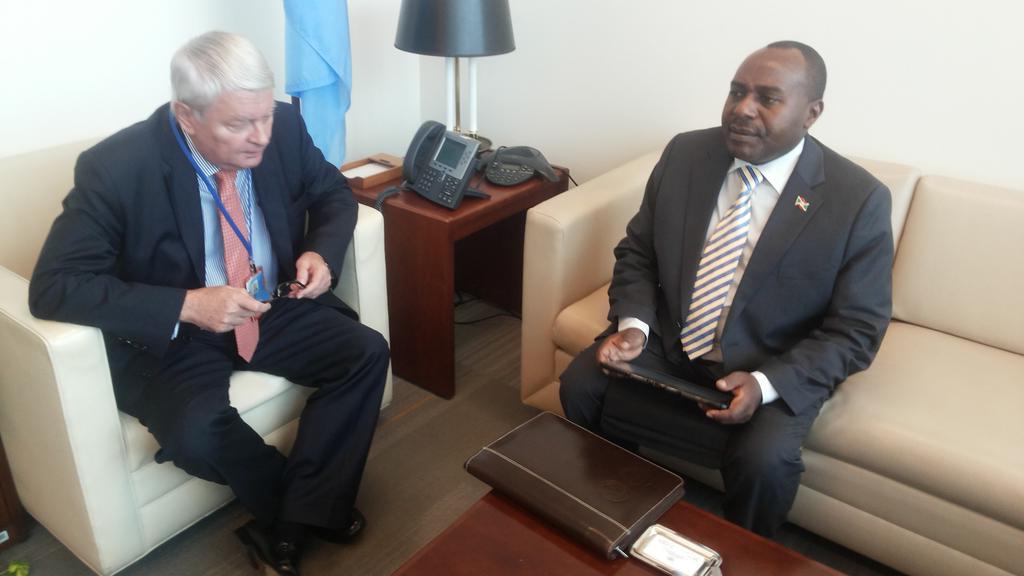
Is this safe - even for the Burundian soldiers at issue? While speaking through press releases, Ladsous' spokespeople, far from answering questions, go so far as to direct UNTV boom microphone operators to avoid Inner City Press, even preventing the Press from asking any questions to Mali's Foreign Minister Abdulaye Diop. We'll have more on all this.
Tuesday, November 10, 2015
On Syria, de Mistura Doesn't Take "No Sane Opposition" Question, Vienna Bound
By Matthew Russell Lee
UNITED NATIONS, November 10 -- The UN's Envoy on Syria Staffan de Mistura is a man in a hurry -- or a man who doesn't want to answer questions. When de Mistura emerged from UN Security Council consultations on November 10, UN deputy spokesperson Farhan Haq said he would only take a few questions, he had to get back to Vienna.
Haq went on to call on three media: Saudi, Qatari and (at least) Kurdish. Still, no much balance, and not many answers.
November's Security Council president Matthew Rycroft of the UK provided more explanation. Inner City Press asked him about a quote attributed to UN Deputy Secretary General Jan Eliasson, that “it is especially important to avoid the destruction of power institutions in Syria due to the fact that in contrast with 2012 the country doesn’t have any sane opposition to negotiate with.”
(This was reported said while Eliasson was in Washington; the UN has not transcribed this Q&A, which the Free UN Coalition for Access believes the UN should do.)
Rycroft responded that those fleeing the recent urging in militarization in Syria are precisely those who will be needed for the Vienna process. (Inner City Press also asked Rycroft about the day's North Korea or DPRK consultation). Rycroft said UN Disarmament acting director Kim Won-soo said his “JIM” mechanism will be operational this Friday and will investigate new uses of chemical weapons.
Then China's Liu Jieyi came out. It could have been foretold: Xinhua's representative on UNCA had been camped out at the stakeout since mid-afternoon and was handed the first question. But then Reuters took not one, but two questions of the half dozen Liu Jieyi answered. Paraphrasing “one country, two systems,” FUNCA believes one media, one question. We'll have more on this.
Back on April 24 when Mistura came to the UN Security Council stakeout, Inner City Press asked him about criticism of how he has run his office to date. De Mistura declined to respond. But see below.
On May 30, the UN Spokesperson's Office issued a statement for de Mistura, condemning "the death of at least 70 civilians in Syria's northern Aleppo province by barrel bombs dropped from government helicopters." The statement, full text here, said that "all evidence shows that the overwhelming majority of the civilian victims in the Syrian conflict have been caused by the use of such indiscriminate aerial weapons." Some were sure to wonder, what about ISIS?
But as de Mistura holds a new round on consultations in Geneva, with all press coverage Banned, he is belatedly replacing his principal political affairs officer with one Stephanie Koury, Inner City Press is informed, who in Iraq headed the UN's Kirkuk office, as well as a stint in another of the UN's failed (or turned-over) mediation missions, in Yemen, see below.
Previously, Inner City Press reported on how de Mistura ingratiated himself to Ban Ki-moon by hiring and promoting Ban's son in law Siddharth Chatterjee while serving as envoy in Iraq. (Some of that reported wascensored, but not on Inner City Press.) This led to push-back from the UN, which continues to the day - something that the new Free UN Coalition for Access opposes.
Last week the UN said of de Mistura's upcoming five to six weeks of talks on Syria in Geneva that there will be no interviews or stakeouts, nor even any photo-sprays, during all that time. FUNCA opposes this closing-down of the UN as well.
A picture has emerged of de Mistura's running of the UN's Syria office, in which "cronies" from his time in Iraq and after that Afghanistan have been favored in jobs, with very little to show for it.
De Mistura's functional political affairs chief, for example, has been Elpida Rouka, who was de Mistura's "Special Assistant" in Iraq. Her i-Phone composed political memos have been exclusively mocked to Inner City Press by close associates of de Mistura, but de Mistura declared her the only authorized channel of "substantive" information to UN Headquarters in New York.
At a key moment in de Mistura's doomed push for a "freeze" in Aleppo, Inner City Presss is exclusively informed that de Mistura went with, over ceasefire expert Julian Hottinger, one Matt Waldman, listed as an adviser not only of de Mistura on Syria but also of the European Institute for Peace, which as Inner City Press has reported de Mistura remains president of the Board of Governors.
(Back in September 2014, Inner City Press asked the UN Office of the Spokesperson, "please confirm or deny that Mr. de Mistura will be (allowed to be) based in Brussels, and separate state his contract status: When Actually Employed? Paid at USG level? Is he being allowed to continue working with / for any non-UN organization, if so which, and what review of possible conflicts of interest was made, and by whom?")
One might think that the UN's Syria envoy position is or should be a full time job, without outside second positions like continuing as president of the board of a group like the European Institute for Peace. But this is the UN, where the special representative on Cyprus Alexander Downer was allowed to work full time at an investment bank or consultancy Bespoke Approach, Tony Blair as Middle East Quartet representative and businessman, and now a similar UNdisclosed arrangement in Yemen.
(Inner City Press has four times asked simple public financial disclosure questions about Ban's new Yemen envoy Ismael Ould Cheikh Ahmed, without answer.)
All of the above said, de Mistura is a pleasant man; while in Afghanistan he pledged to get to the bottom of the murder of UN staffer Louis Maxwell there although he never did (nor did others in today's UN). But Inner City Press - and FUNCA - are committed to a closely-covered and open UN, and the trend, from the top down, is in quite the opposite direction. Here was the UN's "Note to Correspondents" -
The Geneva Consultations on Syria will begin next week Monday, 4 May, at the Palais des Nations and last for an initial period of five to six weeks.
The Special Envoy of the Secretary-General Staffan de Mistura has invited as many of the parties as possible, primarily the Syrian parties (government, opposition and civil society), as well as the regional and international stakeholders, to discuss with the Special Envoy, the dire situation in Syria today and to provide their candid views on where we stand vis-a-vis implementation of the Geneva Communiqué almost three years since it was adopted.
The Special Envoy and the Deputy Special Envoy, Ramzy Ezzeldine Ramzy, will conduct closed and separate consultations with each party.
There will be no photo opportunities, no stakeouts, and no interviews while the consultations are being conducted at the Palais. However, periodic photo and video feeds will be provided by UN Photo and UN Television.
The UNOG Spokesman and Director, a.i., of the UN Information Service in Geneva, and the Office of the Special Envoy's Public Information Officer, will provide periodic updates to the Geneva Press Corps and others, as and when appropriate and necessary.
No major public announcements are expected during, or at the conclusion of, these Consultations. The Special Envoy will assess the progress of his stock-taking at the end of the process and report to the Secretary-General with his findings and recommendations.
Thank you for understanding.
The Special Envoy of the Secretary-General Staffan de Mistura has invited as many of the parties as possible, primarily the Syrian parties (government, opposition and civil society), as well as the regional and international stakeholders, to discuss with the Special Envoy, the dire situation in Syria today and to provide their candid views on where we stand vis-a-vis implementation of the Geneva Communiqué almost three years since it was adopted.
The Special Envoy and the Deputy Special Envoy, Ramzy Ezzeldine Ramzy, will conduct closed and separate consultations with each party.
There will be no photo opportunities, no stakeouts, and no interviews while the consultations are being conducted at the Palais. However, periodic photo and video feeds will be provided by UN Photo and UN Television.
The UNOG Spokesman and Director, a.i., of the UN Information Service in Geneva, and the Office of the Special Envoy's Public Information Officer, will provide periodic updates to the Geneva Press Corps and others, as and when appropriate and necessary.
No major public announcements are expected during, or at the conclusion of, these Consultations. The Special Envoy will assess the progress of his stock-taking at the end of the process and report to the Secretary-General with his findings and recommendations.
Thank you for understanding.
Thank you indeed.
Back on April 24, Inner City Press asked de Mistura if the Saudi-led airstrikes on Yemen changed any of the dynamics on Syria.
In reply, de Mistura told Inner City Press that "everything in the region these days is connected." He added that he is focused on Syria.
Inner City Press also asked de Mistura about criticism made by his former adviser Mouin Rabbani on Qatar's Al Jazeera TV, that Mistura is out of his depth and not up for the task.
De Mistura replied, I will not respond, you would do the same, if one of your ex-colleagues...
Inner City Press asked the question because it hadn't been asked, tellingly.
Dina Kawar said Mistura “mentioned what he will do next month in Geneva, holding separate meetings with the Syrian parties, representatives of the civil society and regional and international actors. He will provide his assessment to the Secretary General and keep the Security Council informed,” Kawar said, taking no questions.
Staffan de Mistura emerged, saying he would take two or three questions. He said, “the only way is to test, a stress test,” a phrase like his previous “freeze.” He said, “by end of June we should be in the position to reassess whether any convergence on substance and report to the Secretary General.”
De Mistura said, “This is not Geneva Three, this is a series of consultation, one to one. We can convene and ask everyone to come and not exclude anyone.. Iran is a member country of the UN, it is a major play in the region, it has influence in Syria. The UN has the right, and will be inviting everyone.”
Unlike Montreux, it was observed by... one wag.
Back on April 16, that the Syrian chemical weapons victim and doctor who briefed the UN Security Council did so behind closed doors, with no UN Television coverage, was a product of the Council's rules.
It was an “Arria formula” meeting, which was not be listed in the UN Journal or even on the blue electronic signs outside it. (The sign said the meeting was about "nutrition.")
Afterward chemical weapons victim Qusai Zakarya took some questions in the hall, before again going behind closed doors of the UN Censorship Alliance, see below.
Inner City Press in this public space asked Qusai Zakarya what he thought of UN envoy on Syria Staffan de Mistura.
Qusai Zakarya said replied to Inner City Press, "I think Staffan de Mistura is a hypocrite. I think his very disgusting attempt to shine up the image of the regime is exposed to the Syrian people and to a nlot of members of the international community. His offer on freezes was a joke. If he really cared about saving lives he would have convinced the regime to stop using its fire power. We have a lot of outrage against his attempts, the deal he was trying to offer, it's just another false attempt to shine up the image of the regime."
Inner City Press asked him if he would meet with any UN official. “I can't answer that questio right now,” he said. Then the convoy went to the clubhouse of the UN Censorship Alliance, which had sent notice only to those who pay it money: "They will have just presented their accounts in front of the UN Security Council at an Arria-formula meeting on Syria Chemical Weapons."
But why would the doctors, in holding a supposed press conference afterward, not do so in the UN Press Briefing Room on UNTV, as can be done by any NGO or individual as long as sponsored by a member state?
Instead, the sequel show was also behind closed door, in the UN Censorship Alliance (UNCA), not on UNTV. This is the same UNCA which hosted former Syrian Coalition head Ahmad al Jarba, allowing him to claim he had a “UN press briefing.” It is a scam.
And so on April 24 Inner City Press asked UN spokesman Dujarric if Jarba's successor, after Hadi al Bahra, Khaled Khoja will hold a Q&A session in the open UN Press Briefing Room. We'll see.
UNCA and its board members have, for example, sought to get other journalists thrown out of the UN, for reporting on the financial relationship of UNCA's then and now president Giampaolo Pioli with an alleged war criminal, accepting rent money from him and later agree to screen his war crimes denial film inside the UN, under the UNCA banner. If one has a case to make, this is not the place to make it.
Even since its outright censorship bid, the way UNCA is run gives less and less confidence. On April 10, the UN Spokesperson's Office announced over its public address system that "in a few short moments in the UNCA room there will be a press conference by a State Department official."
But as Inner City Press immediately reported, it wasn't any "press conference" -- it was off the record spin, typical of this UNCA now known as the UN's Censorship Alliance (the invitation they send to those who pay UNCA money is below.)
Just before 5 pm, the UN Spokesperson's Office made a second public address system announcement: it was NOT a press conference, but rather an off the record presentation by the US State Department.
All this in the big room the UN gives to UNCA, its Censorship Alliance. Why is the UN involved in this in any way at all?
But as Inner City Press immediately reported, it wasn't any "press conference" -- it was off the record spin, typical of this UNCA now known as the UN's Censorship Alliance (the invitation they send to those who pay UNCA money is below.)
Just before 5 pm, the UN Spokesperson's Office made a second public address system announcement: it was NOT a press conference, but rather an off the record presentation by the US State Department.
All this in the big room the UN gives to UNCA, its Censorship Alliance. Why is the UN involved in this in any way at all?
The announcement by UNCA president Giampaolo Pioli, sent only to those who pay UNCA money (then forwarded to Inner City Press along with messages of shock and disgust) said
"For correspondents interested in an informal off-the-record meeting with [the] Deputy Director, Media Hub of the Americas, U.S. Department of State Bureau of Public Affairs, please join us in the UNCA Meeting Room, Friday, April 10th at 3:30pm.
"The meeting will be to explain the work of the State Department Public Affairs bureau that works with international media, to provide assistance in gaining better access to State Department officials and information, in addition to presenting the work done in the Media Hub of the Americas where the Director is the State Department spokesperson in Spanish and Portuguese for regional media and Spain and Portugal.
Thank you,
Giampaolo Pioli
UNCA President"
Pioli's invite linked to a self-description of this US Bureau of Public Affairs, that “PA/IME works in close collaboration with State Department and interagency colleagues to create and manage tools to ensure accurate coverage of U.S. foreign policy by major international media.”
"The meeting will be to explain the work of the State Department Public Affairs bureau that works with international media, to provide assistance in gaining better access to State Department officials and information, in addition to presenting the work done in the Media Hub of the Americas where the Director is the State Department spokesperson in Spanish and Portuguese for regional media and Spain and Portugal.
Thank you,
Giampaolo Pioli
UNCA President"
Pioli's invite linked to a self-description of this US Bureau of Public Affairs, that “PA/IME works in close collaboration with State Department and interagency colleagues to create and manage tools to ensure accurate coverage of U.S. foreign policy by major international media.”
UNCA represents only part of the UN press corps. This writer, for example, quit the group after 2012. UNCA is said by UN Spokesman Stephane Dujarric to receive the first question in the UN Press Briefing Room “by tradition,” even after UNCA's Executive Board tried to get the investigative Press thrown out of the UN for itsreporting about Sri Lanka, UN Peacekeeping and colonialism (Herve Ladsous) among other topics.
UNCA did nothing when Ladsous adopted the policy of refusing to answer any questions from the investigative Press, and having his spokespeople physically grab the UNTV microphone to try to avoid the questions being heard.
Now UNCA wants to facilitate “accurate coverage of U.S. foreign policy.” Does it perform this service for other countries?
Inner City Press, like the new Free UN Coalition for Access which it co-founded after quitting UNCA, is not against "accurate coverage of US foreign policy." Last month, Inner City Press asked the US State Department about Yemen (including the decision not to evacuate Yemeni Americans from the country), Cuba (the US restrictions on its diplomats at the UN), the Maldives,Middle East and the Democratic Republic of the Congo. In each case, Inner City Press reported the answers in full, where possible with video.
But why provide this platform for one country and not others? Earlier on April 10 UNCA will have a presentation by a former US CIA employee who served in Saipan, Korea, Vietnam and "Burma," as the UNCA notice puts it.
What has happened to this UNCA under Pioli and presumably current Executive Committee members fromReuters, the US Broadcast Board of Governors and ANSA? And how now can the UN continue to “partner” with UNCA, exclusively, using this partial group as a proxy for the wider press corps?
Earlier on April 9, when the UN with little notice canceled its question and answer noon briefing in deference to a"press encounter" with Ban Ki-moon at which Dujarric handpicked the questioners and Ban notably did not call for a halt or even pause in airstrikes on Yemen, UNCA said nothing. (They will, however, have a "Prosecco toast" with Ban later in the month.)
The Free UN Coalition spoke up in criticism, as here. We'll have more on and of this.
Sunday, November 1, 2015
In Yemen, Inner City Press on October 26 Reported UN Got 2 "US Spies" Captured, Reuters Said UN Deputy Secretary General Is On It, Then Ran Murky Correction
By Matthew Russell Lee, Exclusive follow up
UNITED NATIONS, November 1 -- The UN Secretariat's bungling of Yemen mediation has become ever more clear, according to multiple sources and documents exclusively seen by Inner City Press, see below. Now either the UN erroneous said its Deputy Secretary General Jan Eliasson is looking into two detainees the UN flew into the country - or Reuters is lying that the UN said DSG when it said "DSS" (Department of Safety and Security.)
On October 26 Inner City Press reported that its sources exclusively told it of a new low, that the UN brought into Sana'a what the Houthis call two members of US intelligence, with the cover identification that they work for the company running the former hotel now occupied by the UN. But, the sources say, security in Sana'a recognized the two and they are now detained.
On October 30, Inner City Press asked UN Spokesman Stephane Dujarric about it, video here, transcript here and below. Dujarric acknowledged he knew about two "contractors."
A full day later Reuters "reported" a piece citing an unnamed UN spokesperson about two "contractors," with no mention of the Houthis claim they work with US intelligence, which by now had also beenreported, along with Inner City Press' October 30 Q&A with Dujarric, by Al-Akhbar.
But it's worse. Reuters initially (mis) reported that "'Two contractors have been detained and the Deputy Secretary-General (Jan Eliasson) is looking into it,' a U.N. spokesman said without elaborating or confirming if the two were American citizens."
Then a day after that, Reuters blamed the UN for its correction to "'Two contractors have been detained and DSS (Department of Safety and Security) is looking into it,' said a U.N. spokesman."
It would seem the UN spokesman, left unnamed by Reuters, said "DSS" and Reuters mis-heard it as "DSG," didn't note it would be strange for the UN's second highest official to be on two contractors when lower official Herve Ladsous is the one who made a call for 13 contractors in South Sudan.
But Reuters, including the Thomson Reuters Foundation Trust.org,running its correction, says "UN corrects source of information in second paragraph." So the UN made the mistake?
This is the same Reuters which on Friday regurgitated a UN report which Inner City Press had reported and asked the UN about fully two weeks earlier, same Reuters which refused to make public its policies, and tries to censor its anti Press complaints to the UN, here. We'll have more on this.
On Yemen, from the October 30 UN transcript:
Inner City Press: maybe you can confirm or deny that two individuals flew in to Sana’a on a UN plane have been detained by the Houthis who accuse them of being US intelligence individuals. What was the protocol for getting on a UN plane to Sana’a? Does the UN have a position of not flying in intelligent members of a UN member state?
Spokesman: I'm aware of two people who I believe are UN contractors and their situation. I don't have an update on it. The protocol for flying on UN planes and on UN humanitarian flights is pretty clear. I can give you the details. We do not, we do not knowingly fly in or out combatants.
Inner City Press: I just wondered, could you maybe say what kind of contractors they are? I heard and reported they were making a building that the UN works in. Is that true?
Spokesman: That's my understanding.
Spokesman: I'm aware of two people who I believe are UN contractors and their situation. I don't have an update on it. The protocol for flying on UN planes and on UN humanitarian flights is pretty clear. I can give you the details. We do not, we do not knowingly fly in or out combatants.
Inner City Press: I just wondered, could you maybe say what kind of contractors they are? I heard and reported they were making a building that the UN works in. Is that true?
Spokesman: That's my understanding.
We'll have more on this.
Meanwhile the Houthis are denouncing UN envoy Ismail Ould Cheikh Ahmad and his (mis) representation to the Security Council regarding what they agreed to. This has happened before and the goal seems to be delay to allow for more air strikes. There's work of mercenaries, in essence, including from Colombia in Aden, joining the troops from ICC-indicted Sudan.
A new level of dysfunction was hit with the deployment in Aden of hundreds of troops from Sudan, putting ICC-indicted Omar al-Bashir on the same side as the US and UK. (Inner City Press is exclusively informed that "UN" envoy Ismail Ould Cheikh Ahmed is working on a similar Saudi deal with his native Mauritania, see below.)
Now Inner City Press is reliably and exclusively informed of a letter, drafted by Saudi Arabia and conveyed to UN Secretary General Ban Ki-moon by envoy Ismail Ould Cheikh Ahmed, which has Ban thanking Hadi and stating that the Houthis have agreed without reservation to implementing UN Security Council Resolution 2216. They have not - this is just another misleading move by the envoy, not a third strike but a fourth.
But more fundamentally, why would Ban Ki-moon even consider signing a letter that was drafted by Saudi Arabia? Ban's Deputy Secretary General Jan Eliasson, arguably undermining the envoy, recently traveled to Saudi Arabia and then Iran.
Inner City Press is reliably and exclusively informed that the Saudis snubbed Eliasson, denying several of his meeting requests and finally providing him only with the Foreign Minister, just before he left. In Iran, complaints against envoy Ismail Ould Cheikh Ahmed were lodged, that he does not have the trust of the Houthis. What kind of envoy is this? What kind of UN?
After the UN Security Council's praise of talks ostensibly committed to UN envoy Ismail Ould Cheikh Ahmed was not updated after Hadi canceled participation in the talks, then the Saudi led coalition bombed Oman's Ambassador's house in Sana'a.
The Saudi Mission to the UN, doling out information selectively as always, tweeted a photo of a meeting between its Ambassador and the deputy ambassadors of Security Council members the UK and US, of the EU - and UN humanitarian deputy Kyung-hwa Kang. What did Kyung-hwa Kang, if not the Ambassadors, say about the airstrikes?
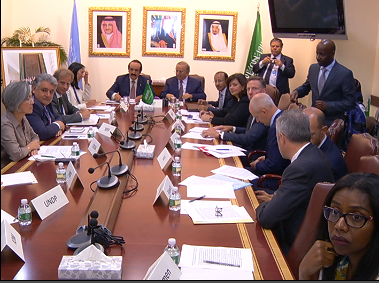
The UN's envoy Ismail Ould Cheikh Ahmed, after complaining about his leaked email showing his marginalization from Yemen talks, that Hadi had committed to come to talks. The Security Council praised him in a Press statement.
Then Hadi canceled. It is similar to the UN's ceasefire-that-wasn't, and the failed "talks" in Geneva in which the UN never gave the Houthis passes to get into the UN building, after allowing them to be delayed along the way so that Ban never met them (while meeting with an individual on the US Al Qaeda sanctions list.)
In many contexts it's "three strikes and you're out," in this case faux ceasefire and two talks that never happened. But the Security Council has not updated its Press Statement of praise; some members apparently simply work around the UN envoy. We'll have more on this.
On September 5 as airstrikes on Sana'a picked up force, there was no comment from the UN or its envoy Ismail Ould Cheihk Ahmed. Nor on September 6. On September 7, the UN finally spoke -- not about the airstrikes but about a leak.
On September 8, Inner City Press asked UN Spokesman Stephane Dujrarric if he was denying the veracity of the UN email Inner City Press published, below. Dujarric did not deny it. Video here. Inner City Press on September 9 asked Dujarric's deputy, below, on September 9 about Ismail Ould Cheikh Ahmed.
Inner City Press exclusively reported the following: on August 27-28 in Muscat, the US and UK, the EU Ambassador to the UN and Saudi intelligence, met with the Houthis -- without the UN and its envoy present, or even sources say aware of the meeting. These sources say that the UN's Ismail Ould Cheikh Ahmed was on vacation in his native Mauritania, and was entirely out of the loop.
On September 10, Inner City Press asked UK Ambassador Matthew Rycroft if the UK had met with the Houthis and GPC in Muscat, without the UN Envoy present. Video here. The answer, as transcribed by the UK Mission:
Inner City Press: There was a letter from the Envoy that seemed to imply that.
Amb Rycroft: There has been a lot of different types of talks in Morocco and different engagements with others. The United Kingdom and other countries are involved in some but not all of those talks – depending on the format. Whether or not we are there or not we are very supportive of Ismail and his work.
Amb Rycroft: There has been a lot of different types of talks in Morocco and different engagements with others. The United Kingdom and other countries are involved in some but not all of those talks – depending on the format. Whether or not we are there or not we are very supportive of Ismail and his work.
Meanwhile Ismail Ould Cheikh Ahmed says the same parties will now meet with him. Replay?
On September 9, Inner City Press asked UN Deputy Spokesperson Farhan Haq, video here, transcript here:
Inner City Press: I saw the statement by the Envoy that leaks may be distorting. But I wanted to ask a factual question, which is that there are reports, and some are confirming, that there were meetings in Muscat by the US, UK, EU [European Union] ambassador to Yemen, the Houthis and Saudi intelligence that took place in August, 27th and 28th. And I wanted to know, it seems that the UN's Envoy wasn't present. Was this by choice? Was he not invited? Was he unaware? What's his role in these talks that are taking place between the parties that I've named in Muscat?
Deputy Spokesman: Well, I wouldn't have any confirmation about any of the meetings that do not involve Ismail Ould Cheikh Ahmed, the Special Envoy. He has been present in Muscat as well as in Riyadh in recent days and has used his time in those two cities to talk to many of the key players representing the Government of Yemen, Ansar Allah and the General People's Congress, and so he is continuing with his efforts to get the parties to talk to each other and to get a halt to the fighting. And beyond that, I wouldn't have any details on any meetings that take place outside of his purview.
Deputy Spokesman: Well, I wouldn't have any confirmation about any of the meetings that do not involve Ismail Ould Cheikh Ahmed, the Special Envoy. He has been present in Muscat as well as in Riyadh in recent days and has used his time in those two cities to talk to many of the key players representing the Government of Yemen, Ansar Allah and the General People's Congress, and so he is continuing with his efforts to get the parties to talk to each other and to get a halt to the fighting. And beyond that, I wouldn't have any details on any meetings that take place outside of his purview.
The September 10 briefing by this envoy to the UNSC was requested by the UK - which, it seems, met with the Houthis without Ismail Ould Cheikh Ahmed.
Sources also note to Inner City Press that the Saudi have "dissed" Ismail Ould Cheikh Ahmed, relegating him only to meeting with Saudi intelligence, not diplomats as was previously the case with the UN. This too is embarrassing to the UN. Hence the Sunday evening statement:
"The Special Envoy for Yemen of the Secretary-General of the United Nations, Ismail Ould Cheikh Ahmed, is disturbed by press reports regarding the leak of internal United Nations correspondence. The content of these reports, especially in some Yemeni media outlets and Internet sites, constitute distortions and misinterpretations. These reports do not reflect the position of the Special Envoy or of the United Nations."
A well placed UN source told Inner City Press that the replacement envoy should never have commented on the leak, especially while remaining silent on the increased airstrikes and Qatar sending troops and Apache helicopters.
Perhaps the discomfort is with the reference to the US National Security Council's "Eric Polovski" (that is, Eric Pelofsky) being "on board." Another source exclusively told Inner City Press that in the Security Council's last meeting on Yemen, those raising the mounting humanitarian toll were Venezuela, Chile and New Zealand. Consider again this, to USg Jeff Feltman:
"Dear Jeff,
Before traveling to Jeddah I held two days of meetings with Ansar Allah and GPC in Muscat in which I tried to convince them to improve upon the 10 points which they had submitted to me earlier. This was necessary to respond to concerns in Riyadh that the commitments to the implementation of 2216 were still inadequate and failed to include recognition of the legitimacy of the government.
AA/GPC agreed to a new wording on UNSC resolution 2216 that states unequivocally that they are committed to the full implementation of 2216, (see document attached) with the exception of article which infringe on Yemeni sovereignty and those related to sanctions.
In addition, the new text includes acceptance of the return of the current government for a period of sixty days during which a new government of national unity shall be formed. They also accepted to remove references to counter-terrorism and the Saudi border to which the GoY had objected, as well as the mandatory support by the international community for reconstruction that was in the earlier version. The latter was particularly opposed by KSA and GCC who did not want it to be interpreted as a form of mandatory compensation. Both Ansar Allah and GPC seemed positive and showed considerable flexibility.
My meetings followed two days of meetings between the Ansar Allah and KSA intelligence officers which were also attended by the US, UK and Oman. The discussions focused on possible confidence building measures such as a pullback from border areas in exchanges for a cessation of airstrikes and agreements in which they would cease operations within Saudi Arabia. This was the first time that Ansar Allah have been open to discuss limited and geographically specific agreement. Although they repeated that the return of President Hadi would be unacceptable, they expressed their openness to the return of the government for a limited time. The US Ambassador, Matt Tueller has been keeping me regularly informed of these discussions, which has been most helpful. The confidence building paper proposed by the Houthis to KSA is attached for reference.
Although US officials were disappointed that Saudis had sent relatively junior representatives, they still felt the meetings were positive, largely friendly and a good way for KSA to sound out Ansar Allah’s intentions. Ansar Allah and KSA agreed that there should be further meetings with hopefully more senior representation although no dates were agreed. The meetings unfortunately shed very little new light on KSA’s strategy in the conflict or their willingness to support a negotiated settlement in the near future.
The meetings in Muscat were of course heavily influenced by the military developments in Yemen. The coalition has not been able to make rapid progress since their successes in Aden, Abyan and Shabwa in August. Taiz remains contested and there are reports that Ansar Allah has regained some territory which had been lost in the past week. The coalition’s difficulties moving northward suggest that an assault on Sanaa would likely be difficult and time-consuming than they had previously expected.
The instability and violence which have plagued Aden following its capture is likely also a source of concern. The mostly pro-independence Hiraak fighters are unwilling to cooperate fully with the GoY in attempts to expand northward. This leaves the coalition dependent on ground troops from Islah, Salafi and AQAP related groups, which UAE is reluctant to support.
Conclusion:
I believe, following my discussions in Muscat, that we now have a strong opportunity to obtain a peace deal, and avoid a violent confrontation in Sanaa, for the following three main reasons:
i) The revised paper (attached) is much stronger and contains serious concessions by the H/GPC. It will be difficult, at this stage, to push them towards further concessions.
ii) The recent slower advance of the GoY affiliated forces around Taez and Maarib could also offer another opportunity.
iii) The on-going insecurity and lawlessness in Aden, and the increased visibility of AQAP in Aden region in the aftermath of the liberation of the city by the GoY and Coalition forces, has started to raise serious concerns for UAE, and in some KSA circles.
In light of the above, I have reached the conclusion that we should now move towards a new round of direct talks, two and half months after our first round in Geneva. My recent shuttling has now reached a point whereby it is becoming somewhat transactional with the Special Envoy obtaining a paper from one side and seeking comments/acceptance by the other side. I do not think we can sustain this and I recommend we move to a more strategic phase. I recommend holding this next round of talks in Oman Sultanate as a first choice, which seems to be acceptable to the Omanis and all parties, especially KSA. My second proposed option would be Kuwait, however the Houthis are still hesitant about this potential venue. Ideally, we should aim at holding this meeting before Eid.
My discussions in Jeddah and Riyadh will be explicitly in favour of moving to peace talks phase as opposed to continuing this shuttling around papers/proposals. I have first indications that Abu Ali and Matt Tueller are supportive of this new approach. In this regard, it was important to time my visit to Jeddah before the meeting between King Salman and President Obama tomorrow. Eric Polovski – White House NSC – who was just recently in Muscat is also fully on board on this.
I am conscious that the implementation of this new proposal depends very much on the GoY's openness and the KSA genuine support (and not only on what I am hearing from Abu Ali). But this proposal is also the only way to keep the UN's efforts at the center of the mediation process and to avoid a fatigue among our various stakeholders, especially the H/GPC. This is why I once again need the support of the SG and the P5.
Best regards. Ismail
Muscat Principles for a Solution to the Political Crisis in Yemen
Commitment by all parties to implement relevant UNSC resolutions including resolution 2216, according to an implementation mechanism to be agreed upon, and without infringing on national sovereignty, and with reservations regarding the sanctions against Yemeni citizens.
Commitment by all parties to implement relevant UNSC resolutions including resolution 2216, according to an implementation mechanism to be agreed upon, and without infringing on national sovereignty, and with reservations regarding the sanctions against Yemeni citizens.
A permanent and comprehensive cease-fire by all parties with the withdrawal of all armed groups and militias from the cities, according to an agreed mechanism to avoid any security and administrative vacuum along with lifting of the land, sea and air blockade.
Agreement on neutral monitoring instrument in order to verify implementation of the mechanisms mentioned above that will be agreed upon, under the auspices of the United Nations.
To respect international humanitarian law, including the elements relating to the protection of civilians and the release of prisoners and detainees from all parties, including those mentioned in UNSC resolution, and to facilitate humanitarian relief and allow the entry of commercial goods, food, medical supplies, oil derivatives and other essential good without restriction.
Kaled Bahah’s government, formed by consensus, returns and performs its tasks as a caretaker government for a period not extending 60 days, during which a government of national unity is formed, in a way that does not violate the constitution.
Kaled Bahah’s government, formed by consensus, returns and performs its tasks as a caretaker government for a period not extending 60 days, during which a government of national unity is formed, in a way that does not violate the constitution.
To resume and accelerate United Nations-brokered negotiations, according to the UNSC resolution.
All parties are obliged to hand over heavy weapons to the State in accordance with the outcomes of the Comprehensive National Dialogue."
Note: the "Eric Polovski" in the above would seem to be Eric Pelofsky. Just saying.
On September 1 the Office of the High Commission for Human Rights raised its estimate of civilians killed to 2,112 (from March 26 to August 27), with 4,519 civilians injured in that period in what OHCHR called a "conservative estimate."
OHCHR cited an airstrike on Taiz on August 20 which killed 53 civilians. OHCHR said "Fifty-three of these civilian deaths occurred on 20 August, reportedly as result of a series of airstrikes by Saudi-led coalition forces that hit 20 homes near Salah Palace in Taiz. According to local reports, active fighters in the Houthi popular committees were believed to be based in the Salah Palace at the time." Believed? Question to OHCHR in this case: what is international law?
Or this one: "attacks by coalition forces on Hodeidah port, which is a key entry point for humanitarian supplies and commercial imports into Yemen."
UN Relief Chief Stephen O'Brien on August 19 told the UN Security Council, "To date only 18 percent, some $282 million, of the $1.6 billion requested through the Yemen Humanitarian Response Plan has been received. UN agencies have still not received the funding from Saudi Arabia of $274 million pledged in April."
After O'Brien said that, Inner City Press asked Yemen's Permanent Representative at the UN, down the hall toward the Trusteeship Council Chamber, about it. He told Inner City Press, among other things, that explains the request for a UN "liaison" in Riyadh.
After the Security Council's triplet of meetings on Yemen, Syria and South Sudan ended on August 19, Inner City Press asked New Zealand's Permanent Representative Gerard van Bohemen "On Yemen. Mr O’Brien said that Saudi Arabia haven’t paid the pledge and that there was some dispute about the UN sending maybe somebody to be a liaison, what was said about actually getting aid unblocked?"
Ambassador van Bohemen replied, "I think you need to talk to him about it. What he explained was there’s been quite a complicated discussion going with the Saudi government about the terms on which the money will be made available, but he knows the detail about it, I don’t."
Ambassador van Bohemen replied, "I think you need to talk to him about it. What he explained was there’s been quite a complicated discussion going with the Saudi government about the terms on which the money will be made available, but he knows the detail about it, I don’t."
We still hope to have more on this.
On August 7 Inner City Press was informed that as Houthis and Saleh's GPC headed to Oman for consultations on August 8 and 9, the UN's replacement envoy Ismail Ould Cheikh Ahmed was not even initially invited. He had to beg to get included, which after sweating has been allowed, in the run-up to his briefing on August 12 to the Security Council.
On August 12, Inner City Press asked Yemen Permanent Representative, outside the Council meeting, questions ranging from the destruction of schools and health care facilities in Sa'ada by Saudi airstrikes to when, according to him, the Houthis might be "driven" out of Sa'ana. Video here. He said in a few weeks - and added that the Oman talks were "not UN."
So how then might the parties negotiate? UN spokesman Stephane Dujarric said Ismail Ould Cheikh Ahmed was headed back to Riyadh. That seems to be his base, where he works from - and for? Watch this site.
Oman has received murky thanks for France for facilitating the release of a hostage, who was working for the Social Development Fund there. Did Oman pay for France? Or will others be released, as France brought about in Mali?
On July 28, Inner City Press asked Saudi Arabia's Permanent Representative about Mokha or Mocha; he replied that previous allegations about Saudi airstrikes on Old City Sana'a and on a palace in Aden once used by Queen Elizabeth had been proven untrue. We'll have more on this.
Inner City Press asked Yemen's representative about the talks in Cairo involving the United Arab Emirates, allies of former president Saleh and, it's said, the US and UK. He replied that the Yemeni government - in exile - deals through formal channels, the GCC or UN.
He might have been asked, which foreign minister is he reporting to: the one named by Hadi, or the one - his predecesor - named by Bahah? We'll have more on this as well.
After publishing its multi-sourced story, Inner City Press on July 22 asked the UN's Associate Spokesperson about new APC and weapons in Aden, and if Ismail Ould Cheikh Ahmed is on vacation. Video here. She replied that she would check - but did not revert with any response either way.
So on July 23, amid reports that without Cheikh Ahmed or any UN presence talks were occurring about Yemen in Cairo, Inner City Pressasked:
Inner City Press: on Yemen, yesterday you'd said you would check on Mr. Ould Cheikh Ahmed, whether, in fact, he is on vacation at this time. Did you?
Associate Spokesperson: No.
Inner City Press: You said leave is a good thing. In the transcript, you said, I'll check on his vacation. But yes, people do take leave, it is a good thing, although there are people in Yemen who say, given that the humanitarian pause failed, it seemed a strange time to do it. So I just wanted to know, factually, is it, in fact, the case?
Associate Spokesperson: Is it the fact…?
Inner City Press: That he's on vacation after the failure of the humanitarian pause.
Associate Spokesperson: I don't know specifically for the Special Envoy, but I can tell you that, you know, most people at that level at the UN, all people at that level at the UN continue to work on their portfolios wherever they are and whatever they're doing. These are portfolios that you can't just drop. And I'm sure that's the case also with the Special Envoy. As far as leave goes, you know, I'm not going to get into a “who's on leave when”, blah, blah, blah, with you. I just… I don't want to do that…
[cross talk]
Inner City Press: I'm just saying because yesterday, you said, "I'll check".
Associate Spokesperson: Because as you mentioned… as you mentioned yourself, you know, leave is part of working life.
Inner City Press: Okay. Was he also on leave when UN staff had to leave Libya and he was the deputy SRSG in Libya? Because that's what I'm told by the people…
Associate Spokesperson: He was also on leave when what…?
Inner City Press: On leave when the people were evacuated from Libya that were the staff members of the UNSMIL mission.
Associate Spokesperson: Well, I just said I'm not going to go and check his attendance sheet.
Associate Spokesperson: No.
Inner City Press: You said leave is a good thing. In the transcript, you said, I'll check on his vacation. But yes, people do take leave, it is a good thing, although there are people in Yemen who say, given that the humanitarian pause failed, it seemed a strange time to do it. So I just wanted to know, factually, is it, in fact, the case?
Associate Spokesperson: Is it the fact…?
Inner City Press: That he's on vacation after the failure of the humanitarian pause.
Associate Spokesperson: I don't know specifically for the Special Envoy, but I can tell you that, you know, most people at that level at the UN, all people at that level at the UN continue to work on their portfolios wherever they are and whatever they're doing. These are portfolios that you can't just drop. And I'm sure that's the case also with the Special Envoy. As far as leave goes, you know, I'm not going to get into a “who's on leave when”, blah, blah, blah, with you. I just… I don't want to do that…
[cross talk]
Inner City Press: I'm just saying because yesterday, you said, "I'll check".
Associate Spokesperson: Because as you mentioned… as you mentioned yourself, you know, leave is part of working life.
Inner City Press: Okay. Was he also on leave when UN staff had to leave Libya and he was the deputy SRSG in Libya? Because that's what I'm told by the people…
Associate Spokesperson: He was also on leave when what…?
Inner City Press: On leave when the people were evacuated from Libya that were the staff members of the UNSMIL mission.
Associate Spokesperson: Well, I just said I'm not going to go and check his attendance sheet.
So much for checking.
Inner City Press asked the UN where Cheikh Ahmed is. UN Deputy Spokesperson Farhan Haq told Inner City Press that he has been "planning his travels," soon to Riyadh. Yeah, Inner City Press was told by another less constrained but at least as knowledgeable source: planning his future travels while already on vacation. Another source compared it to then UN envoy to Pakistan Jean-Maurice Ripert going on vacation amid national disasters in Pakisan and then losing his post.
The buzz in Sana'a, where Hadi has named a governor in exile described as an Islamist, is that Cheikh Ahmed may well have known of the plans to bring in APC and weapons to those fighting the Houthis in Aden, and so "misleadingly" urged a pause. Another compared this to the UN luring out surrendering rebel leaders in Sri Lanka - to their deaths.
And so from Aden, photographs of brand new light brown vehicles, American-made, brought in. Will they end up in the hands of Al Qaeda?
On July 20, Inner City Press asked UN deputy spokesperson Farhan Haq:
Inner City Press: I wanted to check first if you have anything on Yemen and the activities of Ismail Ould Cheikh Ahmed. What's he been doing in the last few days, amid reports of continued death and destruction in the country?
Deputy Spokesman: Yes, Mr. Ould Cheikh Ahmed has been planning his onward travels. The only one to confirm at this stage is that he does plan very shortly to travel to Riyadh, where he is to meet with Saudi authorities, authorities of the Gulf Cooperation Council, and with President [Abd Rabbuh Mansour] Hadi and Vice-President [Khaled] Bahah. And so, he is going to try to talk to them. He's continuing with his efforts to see what can be done to secure a humanitarian pause, even following the end of Ramadan and Eid. And so, he's going to continue with those efforts and travel more broadly in the region after that. We'll try and inform you of other stops as that progresses.
Deputy Spokesman: Yes, Mr. Ould Cheikh Ahmed has been planning his onward travels. The only one to confirm at this stage is that he does plan very shortly to travel to Riyadh, where he is to meet with Saudi authorities, authorities of the Gulf Cooperation Council, and with President [Abd Rabbuh Mansour] Hadi and Vice-President [Khaled] Bahah. And so, he is going to try to talk to them. He's continuing with his efforts to see what can be done to secure a humanitarian pause, even following the end of Ramadan and Eid. And so, he's going to continue with those efforts and travel more broadly in the region after that. We'll try and inform you of other stops as that progresses.
Inner City Press: There's some talk of, if not Mr. Hadi, other ministers trying to return to Aden. Is the UN aware of that? Do they have any comment on that?
Deputy Spokesman Haq: It's not for me to discuss what the Government of Yemen is trying to do. Regarding Aden, we have been concerned about the humanitarian situation on the ground. Our humanitarian colleagues have been continuing even in the absence of a humanitarian pause on the ground to try to provide supplies. I believe that, even though the pause did not go forward as we had wanted, about 60 per cent of the humanitarian activities that we had been planning did, in fact, take place. And so we were able to provide some aid, although not nearly enough. And, of course, we continue to be concerned about the fighting in Aden.
Deputy Spokesman Haq: It's not for me to discuss what the Government of Yemen is trying to do. Regarding Aden, we have been concerned about the humanitarian situation on the ground. Our humanitarian colleagues have been continuing even in the absence of a humanitarian pause on the ground to try to provide supplies. I believe that, even though the pause did not go forward as we had wanted, about 60 per cent of the humanitarian activities that we had been planning did, in fact, take place. And so we were able to provide some aid, although not nearly enough. And, of course, we continue to be concerned about the fighting in Aden.
Back on July 9, UN Secretary General Ban Ki-moon proudly announced a humanitarian pause to start on July 10 at midnight.
When the supposed pause failed, Inner City Press was told on July 14, it took Ban Ki-moon more than two days to speak with Saudi Arabia, through its foreign and defense ministers. Ban, it was said, was "in the air."
On July 14, Inner City Press asked Ban's spokesman Stephane Dujarric:
Inner City Press: Something on Yemen. Yesterday, you said the Secretary-General was very, very disappointed. So, I wanted to ask, if you can say, starting, I guess it would be, Saturday morning, right after midnight, it became pretty clear that there was no pause. Did he make any… did he make any actual, like, calls, meaning like telephone calls or in some… did he reach out? And can you confirm or deny that some within DPA [Department of Political Affairs] had suggested that he not put out that statement that seemed to imply that there was a pause agreed to as…?
Spokesman Dujarric: No, I… listen, I'm not… Secretary-General was in the air a large part of the weekend. He's also attending the Addis conference. People at various levels were having various contacts. The Secretary-General spoke to both the Defence Minister of Saudi Arabia and the Foreign Minister yesterday, in addition to other contacts that were had in the previous… you know, on Monday and over the weekend. As to the deliberation… the internal deliberations of different opinions expressed within the UN Secretariat, I'm not going to go into that. At the end of the day, it's the Secretary-General's call, and the statement he issued was clear.
The day before on July 13 at the UN noon briefing Inner City Press asked Ban's spokesman Dujarric why the UN had made another "call" for a pause sound like a commitment to a pause, at least by the Saudi led coalition. Video here.Spokesman Dujarric: No, I… listen, I'm not… Secretary-General was in the air a large part of the weekend. He's also attending the Addis conference. People at various levels were having various contacts. The Secretary-General spoke to both the Defence Minister of Saudi Arabia and the Foreign Minister yesterday, in addition to other contacts that were had in the previous… you know, on Monday and over the weekend. As to the deliberation… the internal deliberations of different opinions expressed within the UN Secretariat, I'm not going to go into that. At the end of the day, it's the Secretary-General's call, and the statement he issued was clear.
Dujarric answered that envoy Ismail Ould Cheikh Ahmed had told the Suadis of his desire for a pause. But that's not what the UN said on July 9.
Ban was in Addis Ababa for the Financing for Development conference; here are his UN's "messaging" points in the run-up to that conference (and here an Inner City Press story about it; we'll have more). But isn't the UN responsible to say something after a humanitarian pause it announced doesn't happen, and people are killed?
It quickly became clear that some of key parties had not been spoken with or agreed; the pause's midnight beginning came and passed amid airstrikes.
Inner City Press is informed by sources that Ban Ki-moon was urged to not make the dubious pause announcement, including from within the UN's own Department of Political Affairs -- but Ban announced it anyway.
At best, it was rolling the dice. At worse, on the very day that UN is rightly criticizing itself for making false promises of protection in Srebrenica 20 years ago, in this case Yemenis were told there would be a pause, and some perhaps relied on it, to their detriment. And still the UN had said nothing.
After the July 9 announcement, Inner City Press asked Ban's spokesman if the Saudis had been spoken with. The answer was, Hadi told the Saudis his position. But did Hadi ever agree to the pause, or just to the conditions set forth in his letter to UN? What of Hadi's responsibilities to the Yemeni people?
Now Saudi Al Arabiya has said Saudi Arabia never received any communication from Hadi to stop airstrikes, here. Someone is lying.
Where is the UN's replacement envoy Ismail Ould Cheikh Ahmed? Headed to Ethiopia, Ban's spokesman said, to meet with Ban on the sidelines of the Financing for Development conference there. Does IOCA harbor ambitions for another UN system post, or back in his own country? What sort of a track record is this? Watch this site.
At the July 10 UN noon briefing in New York, Inner City Press asked Ban Ki-moon's spokesman Stephane Dujarric if the UN had spoken with those in Yemen opposing the Houthis but not supporting or in contact with Hadi. Video here. From Dujarric's answer, it seems no such contact has been made.
So, Inner City Press asked, if such a group fires on the Houthis and they fire back, is the pause over, has it been violated? We'll see what happens.
Back on July 9, Inner City Press asked UN Spokesman Stephane Dujarric, transcript here:
Inner City Press: can you, one, characterize not the communications with Mr. Hadi, but with Saudi Arabia that's running the coalition, the Saudi-led coalition. And does this mean the Secretary-General's understanding is no airstrikes during this time period, and no further advances or use of heavy weapons by the Houthis? Does the pause mean no firing? What does it mean to each of those two sides?
Spokesman Dujarric: What it means is that, if you read the statement, the President… Secretary-General notes that the President, President Hadi, has communicated his acceptance of the pause to the coalition to ensure their support. A humanitarian pause means no fighting. It means no bombing. It means no shooting. It means no fighting. It means exactly that: a humanitarian pause in the fighting that we've seen, to enable our humanitarian colleagues to get the aid to where it's needed, to preposition, and stockpile, and to reach the millions that need it.
Inner City Press: Right. But just for example, policing, who's doing policing in these various cities? Things happen.
Spokesman Dujarric: Obviously I think… [cross talk] In any area in the country, there is a… there is de facto control and, obviously, there is a need to ensure safety and security. What we're talking about is a humanitarian pause in the fighting that we've been witnessing for weeks on end now.
Inner City Press: So just one last thing on this. So the commitment on airstrikes is through President Hadi to the UN?
Spokesman: You know, the… [cross talk] Obviously, President Hadi is a critical interlocutor with the coalition. And as I've said, we've taken note of the fact that he's conveyed to the coalition his acceptance. We expect everyone involved in this conflict to honor this humanitarian pause.
Spokesman Dujarric: What it means is that, if you read the statement, the President… Secretary-General notes that the President, President Hadi, has communicated his acceptance of the pause to the coalition to ensure their support. A humanitarian pause means no fighting. It means no bombing. It means no shooting. It means no fighting. It means exactly that: a humanitarian pause in the fighting that we've seen, to enable our humanitarian colleagues to get the aid to where it's needed, to preposition, and stockpile, and to reach the millions that need it.
Inner City Press: Right. But just for example, policing, who's doing policing in these various cities? Things happen.
Spokesman Dujarric: Obviously I think… [cross talk] In any area in the country, there is a… there is de facto control and, obviously, there is a need to ensure safety and security. What we're talking about is a humanitarian pause in the fighting that we've been witnessing for weeks on end now.
Inner City Press: So just one last thing on this. So the commitment on airstrikes is through President Hadi to the UN?
Spokesman: You know, the… [cross talk] Obviously, President Hadi is a critical interlocutor with the coalition. And as I've said, we've taken note of the fact that he's conveyed to the coalition his acceptance. We expect everyone involved in this conflict to honor this humanitarian pause.
On July 7 the UN's Office of the High Commissioner for Human Rights upped its estimate of civilians killed since March 27 to 1,528, adding that one million people have been displaced since the beginning of this round of the conflict. To the Saudi airstrike on UNDP in Khormaksar, Aden, OHCHR added that "IOM’s Migrant Response Centre in Basateen, also in Aden, was struck by a mortar and an airstrike damaged IOM’s office in Harad."
IOM, as Inner City Press reported, had earlier paused its evacuation by air of those seeking to flee Yemen due to some party, which it left unnamed, demanding information about those fleeing BEFORE the flights could leave. Inner City Press has asked others in the UN about this and has been told IOM should have done the screening after the people were able to flee. IOM refused a direct question about caused it to violate this best practice, then stopped sending the Press any information.
There are countries, normally vocal about civilian deaths, which are selling military equipment to Saudi Arabia and its Gulf allies. Ban Ki-moon, now in Oslo, is relying entirely on Saudi-selected replacement envoy Ismael Ould Cheikh Ahmed, who was unable to even get the parties in the same room in Geneva, much less reach an agreement. There remain, for now, OHCHR's body counts.
On June 24, Inner City Press asked the UN's replacement envoy Ismail Ould Cheikh Ahmed about the request by the Houthis and others to meet not with him but with Secretary General Ban Ki-moon, who did not meet with them in Geneva. Transcribed here.
On June 25 Inner City Press asked Ban's deputy spokesperson Farhan Haq to confirm receipt of the letter and if Ban will meet them. Haq said Cheikh Ahmed is the envoy, and Ban's headed to San Francisco. The UN Security Council issued a Press Statement, here.
Also on June 25, Inner City Press asked new UN aid chief Stephen O'Brien three questions about Yemen: cholera, the destruction of ambulances in Sa'ada and about international staff. Video here.
O'Brien replied that cholera is a risk; he had no information on WHO it was that destroyed the ambulances in Sa'ada (we can guess.) On international staff, which the UN evacuated earlier, he spoke of a rise from 17 to 70, with the goal of getting to 200. He would not say if they are anywhere in the country outside of Sana'a, citing security. But at least he spoke - the Free UN Coalition for Access thanked him.
Here's from the June 24 stakeout, as fast transcribed by Inner City Press:
Inner City Press: On the parties in Sanaa requesting to meet the Secretary General – what’s your response?
Cheikh Ahmed: "This question was raised during our discussion with the Houthis, the GPC and their allies. The Secretary General had delayed twice his travel in order to be there for the parties. We have sent twice a plane from Sanaa which the delegation from Sana'a could not take.. Therefore the Secretary General had a major engagement, which was the election of the new president of the General Assembly which takes place only once a year , and he had to attend it. But the Secretary General will continue being engaged on this."
The ceremonial elevation of the President of the GA who will take over in September was not an election at all - no vote was taken.
Before the meeting, UK Ambassador Matthew Rycroft stopped and told the press of the danger of famine in the country, and of his hope for a Yemen Press Statement from the UNSC, in which the UK is the "penholder" on Yemen. Periscope video here, replay including on desktop for 24 hours.
Inner City Press was digging into the letter from political parties IN Yemen, asking for a meeting with Ban Ki-moon, NOT with replacement envoy Cheikh Ahmed. These parties, including but not limited to the Houthis, were delayed in getting to Geneva so that they could not meet with Ban (who while there DID meet with a US-listed Al Qaeda terrorist).
While some are sure to argue that Ban now meeting with the parties would undercut Cheikh Ahmed, others point out the the underlying resolution speaks of the Secretary General's Good Offices INCLUDING his Envoy. The envoy is not the only game in town - nor, given his lack of disclosure, raised by Inner City Press, should he be. We'll have more on this.
Subscribe to:
Posts (Atom)