UNITED NATIONS, January 7, updated -- In the hours after the deadly attack on the French satirical publication Charlie Hebdo in Paris, statements rolled in from the UK's David Cameron, Canada's Harper, the White House and Scandinavian countries. France 24 linked this last to the Danish newspaper against which this seeming trend began. But three hours in, where was the UN?
At 10 am -- while Ban Ki-moon had still said nothing -- High Commissioner for Human Rights Prince Zeid Ra’ad Al Hussein said, “I utterly condemn the appalling and ruthless attack on media workers and police officers in Paris earlier today, and urge anyone who has information that could help to locate the individuals who planned or carried out this hideous crime to immediately bring it to the attention of the French authorities, before other lives are lost."
A range of countries' Ambassadors to the UN spoke out on Twitter:
At 10:22 am it was announced 11:30am LIVE Stakeout 2nd floor outside the Security Council Chamber Ambassador Cristián Barros Melet, Permanent Representative of Chile and President of the Security Council statement on Paris shooting
(There was still no similar announcement for Ban Ki-moon)
Then, after complaint, this: "10:45am or later TAPE FEED SG Remarks Secretary-General Ban Ki-Moon will make a statement on the Paris shooting."
Why "tape feed"? Why not do it in the UN Press Briefing Room?
Update: The UNCA president told Inner City Press, citing "English and Italian," that despite only sending notice of Ban's remarks to those who pay his UNCA money, all were "invited." Inner City Press asked why Ban's remarks were not in the UN Media Alert. We have nothing to do with the Media Alert, the UNCA president said. Exactly: a private club.
At the January 7 noon briefing, Inner City Press for FUNCA asked Ban's spokesman Stephane Dujarric why it wasn't put in the UN Media Alert. Rather than explain, he said it was announced on the UN's in-house "squawk" system at 9:45 am. This is rarely heard, certainly not to media not physically inside the UN building, and in any event left a full hour for the remarks on Charlie Hebdo to be issued widely in the UN Media Alert email. It is very telling that it wasn't. We'll have more on this.
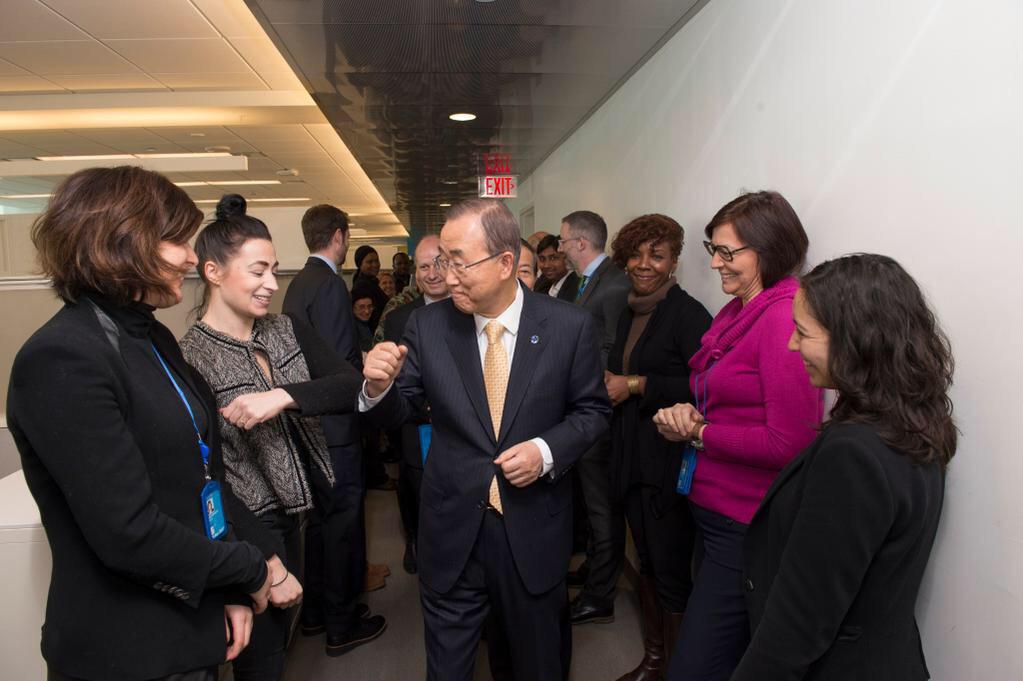
Italy's mission to the UN, meanwhile, tweeted and promoted a photo of Ban and the (Italian) UNCA president.
The UN's special rapporteur on freedom of expression David Kaye tweeted, "some will urge satirists to exercise caution after horrific #CharlieHebdo attack. wrong. right: broad support for free expression/press."
The US Embassy in Paris said, "“Despite misleading press reports, there are no plans to close or limit access to the U.S. Embassy in Paris or other diplomatic facilities in France. We are open for business as usual.”
Lithuania's Ministry of Foreign Affairs said it "strongly condemn horrible terrorist attack in #Paris, CharlieHebdo. Express solidarity with France, condolences to the families of victims."
Jordan's Ambassador Dina Kawar tweeted, "Saddened by the horrific attack in Paris. Our deep condolences to the families of the victims and to the people & Government of France."
Slovakia's Frantisek Ruzicka, chair of the UN's Fifth (Budget) Committee, said "terrifying start of 2015!"
The Netherlands said its foreign minister (and former UN envoy to Cote d'Ivoire and Mali) Bert Koenders is "horrified by attack on #CharlieHebdo. Shares grief of victims, expresses solidarity with French people."
Israel's UN mission said that FM Avigdor Liberman "sends condolences to French nation, says free world must stand determined & united in face of terror threat."
The UK re-tweeted Philip Hammond: "Appalled to hear news of apparent terrorist attack in Paris. My thoughts are with the family and friends of those killed."
That the UN Security Council will issue a statement is near inevitable. The Office of Secretary General Ban Ki-moon can or should be able to move faster, since fewer approvals are needed. But where was Ban Ki-moon?
UNITED NATIONS, January 6, more here-- Days after the UN Security Council rejected Palestine's draft resolution, Palestinian Observer to the UN Riyad Mansour on January 2 delivered to the UN Secretariat documents of accession to the International Criminal Court. Inner City Press story here.
On January 6, UN Secretary General Ban Ki-moon, as ICC depository, said in a letter which Inner City Press published that evening that the ICC's Rome "Statute will enter into force as to the State of Palestine on April 1, 2015." Photo here.
On January 7, Ban's office sought to clarify his letter in response to back-channel questions:
"Many reporters have been asking about the documents transmitted by the Permanent Observer of Palestine to the United Nations relating to the accession of Palestine to 16 multilateral treaties in respect of which the Secretary-General is the depository, including the Rome Statute of the International Criminal Court.
"Inconformity with the relevant international rules and his practice as a depositary, the Secretary-General has ascertained that the instruments received were in due and proper form before accepting them for deposit, and has informed all States concerned accordingly through the circulation of depositary notifications. The information is public and posted on the website of the UN Treaty Section (https://treaties.un.org/pages/CNs.aspx).
"This is an administrative function performed by the Secretariat as part of the Secretary-General’s responsibilities as depositary for these treaties. It is important to emphasize that it is for States to make their own determination with respect to any legal issues raised by instruments circulated by the Secretary-General."
Ok then.
On January 5, Mansour wrote to UN Security Council President Christian Barros of Chile to complain of Israel's decision to withheld Palestinian tax revenue, calling it piracy.
Mansour said “Israel, the Occupying power, has resumed the theft of Palestinian tax revenues in direct retaliation for the legitimate, steps taken by the Palestinian leadership,” including filing to join the International Criminal Court.
Mansour said “we reiterate such such an action constitutes an act of piracy” and asked the UN Security Council members to “uphold their responsibilities toward addressing this illegal situation in all its manifestations.”
Inner City Press on January 5 asked Barros about a new Palestine resolution; he said he hadn't been informed of one, formally or informally, but that he'd read media reports there might be a move "next week."
(At the January 5 US State Department briefing, spokesperson Jen Psaki when asked about the tax withholding said the US discourages any actions -- like this one -- which would raise tensions. She also said that the US "obviously" does not want Palestine to proceed at the ICC.)
Meanwhile in Ramallah Mahmoud Abbas met with Secretary General Madani of the Organization for Islamic Cooperation, which on January 5 issued this read-out:
"Madani stated that the OIC is endeavouring action by its contact group of foreign ministers. This includes visits to the capitals of influential countries to convey the message and demands of the OIC vis-à-vis the Palestinian cause and Al-Quds. He further pointed out that the mission of this team has become more urgent in light of the recent vote of the UN Security Council on the draft resolution to end the Israeli occupation of Palestinian territories."
So do these "influential countries" which have been visited include the five new members of the Security Council -- New Zealand, Spain, Venezuela, Angola and Malaysia -- as well as, for example, Nigeria? Abbas has indicated that preparations are underway for another vote in the Security Council, now with these five new members.
On January 2 just after the UN accepted Palestine's papers to join the ICC, Inner City Press asked Mansour if the decision has been made to ask for action on Israel at the ICC, and about the CRomnibus appropriations bill provision to cut US funding to the Palestinian Authority if it does so. Video here and embedded below.
Mansour said Palestine has already asked the ICC Registrar for retroactivity to cover the last Gaza war in 2014, and that he would met with a representative of the ICC Registrar, who happened to be in New York, in an hour's time.
On the threatened funding cut, which Senator Chuck Schumer issued a press release about, Mansour said it was strange to punish the Palestinians for seeking justice.
Inner City Press also asked Mansour if Nigeria's absention on the Palestine resolution surprised him. He said to focus on the larger power, and that Nigeria's Explanation of Vote sounded like they had voted Yes.
On the afternoon of December 31, the US State Department's Jeff Rathke, Director of Office of Press Relations, put out this statement:
"We are deeply troubled by today’s Palestinian action regarding the ICC. It is an escalatory step that will not achieve any of the outcomes most Palestinians have long hoped to see for their people. Actions like this are not the answer. Hard as it is, all sides need to find a way to work constructively and cooperatively together to lower tensions, reject violence, and find a path forward.
"Today’s action is entirely counter-productive and does nothing to further the aspirations of the Palestinian people for a sovereign and independent state. It badly damages the atmosphere with the very people with whom they ultimately need to make peace.
"As we’ve said before, the United States continues to strongly oppose actions – by both parties – that undermine trust and create doubts about their commitment to a negotiated peace. Our position has not changed. Such actions only push the parties further apart.
"Every month that goes by without constructive engagement between the parties only increases polarization and allows more space for destabilizing actions. Our efforts should focus on creating an environment for meaningful talks.
"While we are under no illusions regarding the difficult road of negotiations, direct negotiations are ultimately the only realistic path for achieving the aspirations of both peoples. All of us would like to see the day when that effort can resume, and can lead to the peace that we all know is the only real, sustainable answer to the underlying causes of this conflict."
The document is supposed to be filed or deposited with UN Secretary General Ban Ki-moon, who is listed as on "annual leave." (Ban's spokespeople have no press briefing scheduled for today.)
The Palestinian resolution which failed on December 30 needed nine "Yes" votes to trigger the expected US veto. It got only eight "Yes" votes, as Nigeria abstained along with the United Kingdom, Lithuania, South Korea and Rwanda.
Afterward, Palestine's Mansour said, "Why have the efforts of the Arab Group, with the full support of the NAM and the OIC and all other friends worldwide, to legislate this consensus through the Council as a contribution towards bringing an end to this conflict through peaceful, political, diplomatic and non-violent means repeatedly blocked?"
The NAM is the Non-Aligned Movement and as Inner City Press noted contemporaneous with the vote, both Rwanda and Nigeria are members of NAM (list here) -- but both of them abstained.
Rwanda's abstention was assumed, including in the Arab Group meeting held earlier on December 30. The abstention of Nigeria, which meant that the United States' "No" vote would not be considered a veto, was something else.
To the surprise of some, Nigeria and its President Goodluck Jonathan were not listed among the calls of US Secretary of State John Kerry. The State Department's spokesperson Jeff Rathke on December 30 said
"In the last 24 to 48 hours the Secretary has made a number of calls to counterparts. Let me give you a list of them. He has spoken with President Kagame of Rwanda; he has spoken on a few occasions with Jordanian Foreign Minister Judeh; he has spoken with the Saudi foreign minister, the Egyptian foreign minister, with Russian Foreign Minister Lavrov, with the UK foreign secretary, with the EU high representative, Chilean Foreign Minister Munoz, Lithuanian Foreign Minister Linkevicius. The – he has spoken, as I mentioned yesterday, with PA President Abbas. He has spoken with the Luxembourg foreign minister, with German Foreign Minister Steinmeier, and with French Foreign Minister Fabius. So by my count, that’s 13 different individuals. Some of them he’s spoken with more than once, so more than 13 calls over the last day or two."
Despite this, it's said that Kerry called Goodluck Jonathan, and that a State Department spokesperson - Rathke? - said it. Where? We continue to wait.
It's reported that while Kerry doesn't list a call to Nigeria, Israeli Prime Minister Netanyau did -- for Goodluck, some say.
Inner City Press after the vote asked Jordan's Ambassador Dina Kawar if the Arab Group intended to put this or another Palestine resolution in front of the new line up of Security Council members entering in two days, with Angola replacing Rwanda and Malaysia replacing South Korea (and New Zealand replacing Australia, which voted no). She said the Arab Group would keep working, but did not say when another resolution will be put forward.
So what comes next? Below, we cover the issue of the International Criminal Court.
A source from inside the Arab Group meeting tells Inner City Press that question - the benefit or not of "making" the US veto - was a major topic in the meeting, but the decision was made by the Arab Group to support the Palestinians' strategy and request for a vote, with the above expectation, at this time.
On December 30 at around 1 pm, Mansour said, “We are happy that the Arab Group on the basis of previous ministerial meetings has considered in a positive and responsible way the request of the Palestinian leadership to put the draft resolution to a vote, possibly this afternoon, if not tomorrow morning, this is related to the readiness of the Secretariat of the Security Council.”
Referring it seems not only to the US but also to the UK, Palestine's Mansour said on Tuesday, “If one party decides for whatever reason that they do not want to go along with this massive support to find a solution to this conflict, to try to save the two-state solution by asking for an end of the Occupation that started in 1967, so that the State of Palestine could enjoy its independence, if a party is not going to go along with this mood, in Europe and in all corners of the globe... it is not for lack of giving time as Arabs, we have been deliberating for almost three and a half months.”
Down in the UN's first basement diplomats from Jordan paced around; the meeting upstairs in the Security Council about Sudan throwing out two more high UN officials was essentially forgotten.
Before the Sudan expulsions meeting on December 30 of the Security Council, for now their last of the year, UK Ambassador Mark Lyall Grant told the press of the Palestine amended draft, “the new text has been circulated but no negotiations have been scheduled and no vote has yet been scheduled, so we wait to see if there will be a vote this year, or next year or not at all.”
On the contents of the resolution, Lyall Grant said “there are difficulties with the text, particularly the language on time scales and the language of refugees. We would have some difficulties with the text. We don't know when the vote will be held.”
Palestine met with the Arab Group at the UN about the pending draft Security Council resolution on December 29. Afterward, Inner City Press asked Palestine's Observer Riyad Mansour and Jordan's Permanent Representative Dina Kawar about US opposition. Video here.
The text of the amended draft is below; six changes include:
New in PP 3 “and to independence in their State of Palestine, with East Jerusalem as its capital,”
New PP6 “Recalling also its relevant resolutions regarding the status of Jerusalem, including resolution 478 (1980) of 20 August 1980, and bearing in mind that the annexation of East Jerusalem is not recognized by the international community,”
New PP8: “Recalling the advisory opinion of the International Court of Justice of 9 July 2004 on the legal consequences of the construction of a wall in the Occupied Palestinian Territory,”
New phrasing in OP2: “a just resolution of the status of Jerusalem as the capital of the two States which fulfils the legitimate aspirations of both parties and protects freedom of worship;”
adding the 2 words “and prisoners;”
New 10bis. "Reiterates its demand in this regard for the complete cessation of all Israeli settlement activities in the Palestinian territory occupied since 1967, including East Jerusalem."
Less than an hour before the Arab Group meeting ended, at the US State Department briefing in Washington, the Department's spokesperson said the US opposes the draft, and others oppose the draft as well, in part because it “fails to account for Israel's legitimate security needs.”
Update from US transcript:
MR. JEFF RATHKE: "We’ve seen reports regarding Palestinian and Jordanian plans to bring their text to a vote at the Security Council. There are discussions still taking place in New York and we are – and with the Secretary, who has spoken with some of his counterparts, and we are therefore engaging with all the relevant stakeholders. As we’ve said before, this draft resolution is not something that we would support and other countries share the same concerns that we have."
Inner City Press asked, and Mansour replied, “There was a telephone conversation between President Mahmoud Abbas and Secretary of State John Kerry yesterday and I'm sure they discussed all the issues.”
Dina Kawar said the amendments concern “the issue of Jerusalem, and others concern prisoners, water, settlements.” She said, “the Arab Group supports, they have now the copy of the new amendments, we are going to submit today to the Secretariat.”
On timing she said, “If I tell you this week and it happens next week you're going to come back and ask" why.
Dina Kawar and Riyad Mansour on Dec 28, 2104, (c) M.R. Lee
Mansour said on the timing of a vote, “realistically it could be tomorrow or the day after.”
UNITED NATIONS, January 6, more here-- Days after the UN Security Council rejected Palestine's draft resolution, Palestinian Observer to the UN Riyad Mansour on January 2 delivered to the UN Secretariat documents of accession to the International Criminal Court. Inner City Press story here.
Now on January 6, UN Secretary General Ban Ki-moon, as ICC depository, says that the ICC's Rome "Statute will enter into force as to the State of Palestine on April 1, 2015." Photo here. So, it's on.
On January 5, Mansour wrote to UN Security Council President Christian Barros of Chile to complain of Israel's decision to withheld Palestinian tax revenue, calling it piracy.
Mansour said “Israel, the Occupying power, has resumed the theft of Palestinian tax revenues in direct retaliation for the legitimate, steps taken by the Palestinian leadership,” including filing to join the International Criminal Court.
Mansour said “we reiterate such such an action constitutes an act of piracy” and asked the UN Security Council members to “uphold their responsibilities toward addressing this illegal situation in all its manifestations.”
Inner City Press on January 5 asked Barros about a new Palestine resolution; he said he hadn't been informed of one, formally or informally, but that he'd read media reports there might be a move "next week."
(At the January 5 US State Department briefing, spokesperson Jen Psaki when asked about the tax withholding said the US discourages any actions -- like this one -- which would raise tensions. She also said that the US "obviously" does not want Palestine to proceed at the ICC.)
Meanwhile in Ramallah Mahmoud Abbas met with Secretary General Madani of the Organization for Islamic Cooperation, which on January 5 issued this read-out:
"Madani stated that the OIC is endeavouring action by its contact group of foreign ministers. This includes visits to the capitals of influential countries to convey the message and demands of the OIC vis-à-vis the Palestinian cause and Al-Quds. He further pointed out that the mission of this team has become more urgent in light of the recent vote of the UN Security Council on the draft resolution to end the Israeli occupation of Palestinian territories."
So do these "influential countries" which have been visited include the five new members of the Security Council -- New Zealand, Spain, Venezuela, Angola and Malaysia -- as well as, for example, Nigeria? Abbas has indicated that preparations are underway for another vote in the Security Council, now with these five new members.
On January 2 just after the UN accepted Palestine's papers to join the ICC, Inner City Press asked Mansour if the decision has been made to ask for action on Israel at the ICC, and about the CRomnibus appropriations bill provision to cut US funding to the Palestinian Authority if it does so. Video here and embedded below.
Mansour said Palestine has already asked the ICC Registrar for retroactivity to cover the last Gaza war in 2014, and that he would met with a representative of the ICC Registrar, who happened to be in New York, in an hour's time.
On the threatened funding cut, which Senator Chuck Schumer issued a press release about, Mansour said it was strange to punish the Palestinians for seeking justice.
Inner City Press also asked Mansour if Nigeria's absention on the Palestine resolution surprised him. He said to focus on the larger power, and that Nigeria's Explanation of Vote sounded like they had voted Yes.
On the afternoon of December 31, the US State Department's Jeff Rathke, Director of Office of Press Relations, put out this statement:
"We are deeply troubled by today’s Palestinian action regarding the ICC. It is an escalatory step that will not achieve any of the outcomes most Palestinians have long hoped to see for their people. Actions like this are not the answer. Hard as it is, all sides need to find a way to work constructively and cooperatively together to lower tensions, reject violence, and find a path forward.
"Today’s action is entirely counter-productive and does nothing to further the aspirations of the Palestinian people for a sovereign and independent state. It badly damages the atmosphere with the very people with whom they ultimately need to make peace.
"As we’ve said before, the United States continues to strongly oppose actions – by both parties – that undermine trust and create doubts about their commitment to a negotiated peace. Our position has not changed. Such actions only push the parties further apart.
"Every month that goes by without constructive engagement between the parties only increases polarization and allows more space for destabilizing actions. Our efforts should focus on creating an environment for meaningful talks.
"While we are under no illusions regarding the difficult road of negotiations, direct negotiations are ultimately the only realistic path for achieving the aspirations of both peoples. All of us would like to see the day when that effort can resume, and can lead to the peace that we all know is the only real, sustainable answer to the underlying causes of this conflict."
The document is supposed to be filed or deposited with UN Secretary General Ban Ki-moon, who is listed as on "annual leave." (Ban's spokespeople have no press briefing scheduled for today.)
The Palestinian resolution which failed on December 30 needed nine "Yes" votes to trigger the expected US veto. It got only eight "Yes" votes, as Nigeria abstained along with the United Kingdom, Lithuania, South Korea and Rwanda.
Afterward, Palestine's Mansour said, "Why have the efforts of the Arab Group, with the full support of the NAM and the OIC and all other friends worldwide, to legislate this consensus through the Council as a contribution towards bringing an end to this conflict through peaceful, political, diplomatic and non-violent means repeatedly blocked?"
The NAM is the Non-Aligned Movement and as Inner City Press noted contemporaneous with the vote, both Rwanda and Nigeria are members of NAM (list here) -- but both of them abstained.
Rwanda's abstention was assumed, including in the Arab Group meeting held earlier on December 30. The abstention of Nigeria, which meant that the United States' "No" vote would not be considered a veto, was something else.
To the surprise of some, Nigeria and its President Goodluck Jonathan were not listed among the calls of US Secretary of State John Kerry. The State Department's spokesperson Jeff Rathke on December 30 said
"In the last 24 to 48 hours the Secretary has made a number of calls to counterparts. Let me give you a list of them. He has spoken with President Kagame of Rwanda; he has spoken on a few occasions with Jordanian Foreign Minister Judeh; he has spoken with the Saudi foreign minister, the Egyptian foreign minister, with Russian Foreign Minister Lavrov, with the UK foreign secretary, with the EU high representative, Chilean Foreign Minister Munoz, Lithuanian Foreign Minister Linkevicius. The – he has spoken, as I mentioned yesterday, with PA President Abbas. He has spoken with the Luxembourg foreign minister, with German Foreign Minister Steinmeier, and with French Foreign Minister Fabius. So by my count, that’s 13 different individuals. Some of them he’s spoken with more than once, so more than 13 calls over the last day or two."
Despite this, it's said that Kerry called Goodluck Jonathan, and that a State Department spokesperson - Rathke? - said it. Where? We continue to wait.
It's reported that while Kerry doesn't list a call to Nigeria, Israeli Prime Minister Netanyau did -- for Goodluck, some say.
Inner City Press after the vote asked Jordan's Ambassador Dina Kawar if the Arab Group intended to put this or another Palestine resolution in front of the new line up of Security Council members entering in two days, with Angola replacing Rwanda and Malaysia replacing South Korea (and New Zealand replacing Australia, which voted no). She said the Arab Group would keep working, but did not say when another resolution will be put forward.
So what comes next? Below, we cover the issue of the International Criminal Court.
A source from inside the Arab Group meeting tells Inner City Press that question - the benefit or not of "making" the US veto - was a major topic in the meeting, but the decision was made by the Arab Group to support the Palestinians' strategy and request for a vote, with the above expectation, at this time.
On December 30 at around 1 pm, Mansour said, “We are happy that the Arab Group on the basis of previous ministerial meetings has considered in a positive and responsible way the request of the Palestinian leadership to put the draft resolution to a vote, possibly this afternoon, if not tomorrow morning, this is related to the readiness of the Secretariat of the Security Council.”
Referring it seems not only to the US but also to the UK, Palestine's Mansour said on Tuesday, “If one party decides for whatever reason that they do not want to go along with this massive support to find a solution to this conflict, to try to save the two-state solution by asking for an end of the Occupation that started in 1967, so that the State of Palestine could enjoy its independence, if a party is not going to go along with this mood, in Europe and in all corners of the globe... it is not for lack of giving time as Arabs, we have been deliberating for almost three and a half months.”
Down in the UN's first basement diplomats from Jordan paced around; the meeting upstairs in the Security Council about Sudan throwing out two more high UN officials was essentially forgotten.
Before the Sudan expulsions meeting on December 30 of the Security Council, for now their last of the year, UK Ambassador Mark Lyall Grant told the press of the Palestine amended draft, “the new text has been circulated but no negotiations have been scheduled and no vote has yet been scheduled, so we wait to see if there will be a vote this year, or next year or not at all.”
On the contents of the resolution, Lyall Grant said “there are difficulties with the text, particularly the language on time scales and the language of refugees. We would have some difficulties with the text. We don't know when the vote will be held.”
Palestine met with the Arab Group at the UN about the pending draft Security Council resolution on December 29. Afterward, Inner City Press asked Palestine's Observer Riyad Mansour and Jordan's Permanent Representative Dina Kawar about US opposition. Video here.
The text of the amended draft is below; six changes include:
New in PP 3 “and to independence in their State of Palestine, with East Jerusalem as its capital,”
New PP6 “Recalling also its relevant resolutions regarding the status of Jerusalem, including resolution 478 (1980) of 20 August 1980, and bearing in mind that the annexation of East Jerusalem is not recognized by the international community,”
New PP8: “Recalling the advisory opinion of the International Court of Justice of 9 July 2004 on the legal consequences of the construction of a wall in the Occupied Palestinian Territory,”
New phrasing in OP2: “a just resolution of the status of Jerusalem as the capital of the two States which fulfils the legitimate aspirations of both parties and protects freedom of worship;”
adding the 2 words “and prisoners;”
New 10bis. "Reiterates its demand in this regard for the complete cessation of all Israeli settlement activities in the Palestinian territory occupied since 1967, including East Jerusalem."
Less than an hour before the Arab Group meeting ended, at the US State Department briefing in Washington, the Department's spokesperson said the US opposes the draft, and others oppose the draft as well, in part because it “fails to account for Israel's legitimate security needs.”
Update from US transcript:
MR. JEFF RATHKE: "We’ve seen reports regarding Palestinian and Jordanian plans to bring their text to a vote at the Security Council. There are discussions still taking place in New York and we are – and with the Secretary, who has spoken with some of his counterparts, and we are therefore engaging with all the relevant stakeholders. As we’ve said before, this draft resolution is not something that we would support and other countries share the same concerns that we have."
Inner City Press asked, and Mansour replied, “There was a telephone conversation between President Mahmoud Abbas and Secretary of State John Kerry yesterday and I'm sure they discussed all the issues.”
Dina Kawar said the amendments concern “the issue of Jerusalem, and others concern prisoners, water, settlements.” She said, “the Arab Group supports, they have now the copy of the new amendments, we are going to submit today to the Secretariat.”
On timing she said, “If I tell you this week and it happens next week you're going to come back and ask" why.
Dina Kawar and Riyad Mansour on Dec 28, 2104, (c) M.R. Lee
Mansour said on the timing of a vote, “realistically it could be tomorrow or the day after.”