Wednesday, July 23, 2008

As UN Charges Indian Peacekeeper of Consorting With Congo Rebels, Discipline Is Questioned

Byline: Matthew Russell Lee of Inner City Press at UN
www.innercitypress.com/un1bosco071608.html

UNITED NATIONS, July 16, updated July 17 -- In the eastern Congo, a UN peacekeeper from India has been caught on tape praising and bonding with rebel fighters led by Tutsi general Laurent Nkunda and Jean Bosco Ntaganda, charged for war crimes by the International Criminal Court. The peacekeeper, identified as Colonel Chand Saroha, was told by Nkunda, "You have helped us a great deal." He in turn gushed, "Officially we are not allowed to meet you. But your good conduct... made us feel we were associated with proud people. We are like brothers."

When faced with evidence that other peacekeepers, also from India, had given weapons to Congolese rebels in exchange for gold, the UN denied and, according to the UN auditor initially on the case, whitewashed the evidence. But since the taped talk with Nkunda is harder to controvert, the UN Mission in the Congo has briefed the government in Kinshasa. MONUC Spokesman Kemal Saiki, slated to shift to perhaps an even more difficult job in Darfur, stated "We have launched an investigation. If confirmed ... this would be personal conduct unbecoming a peacekeeper and is a dereliction of duty."

In the other cases of peacekeeper misconduct, all the UN has done is turn over its evidence to the troop contributing country and hope. In many cases, no discipline has been administered. In this case, the UN or Mr. Saiki seem to be implying that the UN has more power, to declare an act unbecoming and a dereliction of duty, a term of arm associated with courts martial.

On July 15 at UN Headquarters, Inner City Press asked Secretary-General Ban Ki-moon's deputy spokesperson Marie Okabe

Inner City Press: In the Democratic Republic of the Congo, there's a story of this Indian colonel who met with the rebel leader General Nkunda, and he was videotaped saying I support you, you're my brother. It seems that the United Nations Organization Mission in the Democratic Republic of the Congo (MONUC) has been quoted as saying that, if this is true, it would be personal conduct unbecoming a peacekeeper and a dereliction of duty. Does that mean that MONUC itself would remove the peacekeeper or would all they would do be to turn over this tape to the Indian Government?

Deputy Spokesperson Okabe: I’m not familiar with the report you're referring to, so I'll have to look into it after the briefing.

Video here, from Minute 15:49. Some hours later, Inner City Press was told that

"It is a clear violation of the UN's principle of impartiality. The mission contacted the national authorities to reassure them that the remarks made by the peacekeeper in no way represent an official posture. MONUC has asked OIOS to open and investigation and if the facts are proven, the peacekeeper will be sanctioned in accordance with established procedure."

But what is the "established procedure"? Even in the upheld case of peacekeepers from India illegally trading in gold in the Congo, all the UN did was refer the charges to the Indian government, and all they did was issue a warning, no discipline. So what will happen in this case?

Footnote: UNESCO is often seen of the lighter side of the UN, its liberal arts, issue statements about freedom of the press and putting monuments on the list of World Heritage Sites. UNESCO is not supposed to encourage or cause conflict between states. But UNESCO's recent approval of an application by Cambodia alone to grant the World Heritage designation to a temple on the border Cambodia shares with Thailand has caused friction. Thais note that their territory is most often crossed in order to reach the temple; Thailand has reportedly sent hundreds of troops in to Cambodia.

On Wednesday Inner City Press asked Ban Ki-moon's Deputy Spokesperson to confirm the incursion, and why UNESCO didn't require a joint application or otherwise try to avoid foreseeable conflict. "We'll have to ask UNESCO," the spokesperson said. But twelve hours later, there is no response at all. For now we note that UNESCO blithely listed the Preah Vihear Temple at the top of their July 8 press release announcing "new cultural sites inscribed... on UNESCO's World Heritage List."

Update: 23 hours after the question was asked, this from UNESCO --

"UNESCO is not the body that took the decision to inscribe the Preah Vihear site on the World Heritage List. The decision was taken by the World Heritage Committee, an intergovernmental body composed of twenty one members representing as many countries, elected by the General Assembly of all the States that have ratified the World Heritage Convention. UNESCO, and its World Heritage Centre, only serves as the Secretariat to this Committee. The role of the World Heritage Centre during the nomination process has been to try and assist the Cambodian authorities in the technical aspects -- limited to the scientific, archeological, management, and protection issues -- of their nomination proposal."

And, "the U.N. does not monitor the border between these two countries." What was that the UN Secretariat was talking and asking for money for, "preventive diplomacy"?

And see, www.innercitypress.com/un1bosco071608.html
Tuesday, July 22, 2008

At UN, Indictment of Bashir Denounced by S. Africa, France Says "It's Not Too Late"

Byline: Matthew Russell Lee of Inner City Press at UN
www.innercitypress.com/icc1bashir071608.html

UNITED NATIONS, July 16 -- The indictment of Sudan's president for genocide dominated discussion outside the Security Council Wednesday morning, when the peacekeeping mission in Darfur, UNAMID, was on the agenda. South Africa's Ambassador Dumisani Kumalo said "we're concerned by the indictment," especially while "rebels run free without measures against them."

Secretary-General Ban Ki-moon's own report on UNAMID notes "child soldiers among the Justice and Equality Movement combatants in Omdurman" and claimed that "my office is pressing for the release of the children detained by the Government." The children have been held for more than two months, and it is UNICEF, if anyone, which is trying to get them released. In response to Inner City Press' last request, UNICEF provided an update about volleyballs for the child soldiers.

Ambassador Kumalo was asked, "What about Article sixteen" of the International Criminal Court's Rome Statute, which provides that the Council can by vote request a one year suspension of ICC proceedings. "I'm not that educated," Kumalo joked. He pointed to Sudan's Ambassador, who had emerged from the Security Council, and suggested that he be asked the question.

"Article sixteen itself is not enough," he said. He spoke cryptically about stopping the ICC proceeding, which he said has made Omar Al-Bashir more popular in Sudan, "by the Rome Stature or out of the books." How else could it be stopped? He said he had just finished discussions with China's Ambassador Wang, who on July 11 told Inner City Press that the move by ICC prosecutor Luis Moreno-Ocampo to indict Al-Bashir is not helpful.

But any resolution to suspend ICC proceeding would require the vote, or at least abstention, of the U.S., France and UK. While on July 15 U.S. Ambassador Zalmay Khalilzad declined to comment on the issue, French Ambassador Jean-Maurice Ripert said of Al-Bashir, "it is not too late" to cooperate with the ICC, by turning over previous indictees Ali Kushayb and Ahmad Harun. Ocampo's charges against Bashir are not limited to non-cooperation. Is the implicit offer to suspend substantive charges of war crimes in exchange for turning in two underlings? This would turn prosecutorial strategy on its head. The assumption was that Ocampo indicted Harun to see if he would flip on Bashir. Is Bashir now being offered a suspension of proceedings against him if he'll only turn in Harun?

And see, www.innercitypress.com/icc1bashir071608.html

"Johnny Mad Dog" Triggers Child Soldier Debate, Treatment of Africa in Question

Byline: Matthew Russell Lee of Inner City Press at UN
www.innercitypress.com/film1jmd071508.html

UNITED NATIONS, July 15 -- A gang of child soldiers, one dressed in butterfly wings and another carrying a stolen pig on his back, approach a pair of blue helmeted UN peacekeepers and threaten to shoot them, in a scene from Jean-Stephane Sauvaire's film "Johnny Mad Dog." Set and filmed in Liberia, where the UN still maintains a shrinking peacekeeping mission, the movie was screened at the UN before a standing room only crowd on July 15. Sauvaire explained how he spent a full year in Monrovia choosing his cast, and another year living with them while they shot the movie. The UN, he said, helped with the production. But the UN's appearance in the film, outgunned peacekeepers guarding a hospital while civilians are slaughtered all around them, is hardly flattering.

In an early scene, a young boy is recruited by making him shoot his father. Chicken blood is smeared on him. Later he walked through a fire fight carrying only a toy wooden gun, and gets shot. An obscene funeral dirge is sung for him in the dripping lobby of a bombed out Monrovia building. A mourner stares out at the undulating Atlantic -- in today's Liberia, there are attempt to draw surfers to these waves.

The child soldiers help overthrow the president, then mistake a recorded speech of Martin Luther King as being by the president they think they have installed. They are unceremoniously demobilized without getting paid, offered only jobs beating back refugees who surge forward desperately for bags of rice. The details come from the underlying novel, by Emmanuel Dongola, who has attended and gracefully hawked books at the UN screening.

The head of the UN's Children and Armed Conflict Office, Radhika Coomaraswamy, moderated the event, fielding questions ranging from France's colonial history throughout Africa to how the film will be distributed. The latter was easier to address: it will be screened in two weeks in Australia, then in Los Angeles, then Paris. The representative of the French mission to the UN who answered, Ambassador Jean-Maurice Ripert having left just as the film began, did not address colonialism, but rather his government's work on small arms and in creating Ms. Coomaraswamy's office.

Inner City Press followed up on the Africa question, specifically asking Coomaraswamy as well as the International Justice representative of the Open Society Institute, listed as the sponsor of the screening, about why all child soldier recruitment cases, and all of the International Criminal Court's cases so far, have been in Africa. Ms. Coomaraswamy, for example, has named Myanmar as a major governmental recruiter of child soldiers. Apparently answering for both, she noted that most countries in Asia are not members of the ICC. But as is prominently in the news these days, neither has Sudan joined the ICC. Prosecutions there are based on Security Council referrals. So the Council could make referrals on child soldiers and other cases outside of Africa, but hasn't.

Emmanuel Jal, hip hop musician from South Sudan who showed a trailer for his own child soldiering film featuring an endorsement by Andrew Natsios, praised Johnny Mad Dog as you-are-there realism. Charles Rapp, the prosecutor of the Special Court for Sierra Leone, said there is growing interest in pursuing the suppliers of small arms to such conflicts. The Ambassador of Sierra Leone recounted recent UK and U.S. intelligence about a plane flying into Freetown, without permission, full of guns and drugs. The Ambassador of Liberia called small arms "the real weapons of mass destruction," given how many people they have killed.

A disturbing subject like child soldiers lends itself to shocking treatment, as Sauvaire gives it, and do the Patrick Robert war photographs that accompany the credits. There were some in the UN auditorium uncomfortable with a sensational presentation of Africans killing Africans. But perhaps situations such as that in Myanmar are not as easy to present, because governmental control is so great that child soldiers and the killing of civilians can't easily by filmed. One thinks, not a sarcastically as might be expected, of Sylvester Stallone's most recent Rocky film, set in Myanmar, but filmed in Thailand. The government in Bangkok, however, would probably not approve such a film meant to expose Laos. Most of Africa, it's clear, can be filmed with or without its consent. In this case, it's worth it.

And see, www.innercitypress.com/film1jmd071508.html

UN's Ban Slams Zim on Bias, But Lets Slide Russia's Kosovo Critique and N. Korea's Lack of Voting and Human Rights

Byline: Matthew Russell Lee of Inner City Press at UN
www.innercitypress.com/ban1zim071308.html

UNITED NATIONS, July 13 -- Minutes after the UN Security Council's draft resolution to impose sanctions on the Robert Mugabe government failed on July 11, subject to a rare double veto by both Russia and China, Zimbabwe's Ambassador to the UN Boniface Chidyausiku told the Press that the office of Secretary-General Ban Ki-moon has shown it cannot "be an impartial arbiter of the situation in Zimbabwe." Inner City Press asked him why the resolution's proponents had insisted on calling a vote, even once they knew that there would be not only an abstention by Indonesia and five votes against, from South Africa, Viet Nam, Libya and Russia and China with their vetoes. It was "the arrogance of the Americans," Chidyausiku said. Video here, from Minute 2:37.

On the evening of Saturday, July 12, the Spokesperson for the Secretary-General, Michele Montas, issued a statement that "we strongly regret the highly inappropriate and unacceptable comments by the Permanent Representative of Zimbabwe questioning the Secretary-General's impartiality toward events in Zimbabwe." The response was at odds with the usual position, that the Secretary-General defers to and does not comment on the Security Council or member states.

On July 9, about other Council member comments critical of Ban Ki-moon, Inner City Press asked Ms. Montas

Inner City Press: Yesterday at the stakeout, Russian Ambassador Churkin said the Secretary-General had overstepped his bounds in the reconfiguration in Kosovo, and he specifically took issue with this idea that the EULEX force would not be reporting either to UNMIK or to the UN in New York. Is there any response to what Churkin said?

Spokesperson Montas: This is the position, of course, of the Russian Ambassador and he expressed his opinion and that's all I can say.

But when Zimbabwe's Ambassador similarly questioned the Secretariat's actions, this same Spokesperson did not let it go as one Ambassador's opinion and "that's all I can say." Rather, the Zimbabwean's comments were strongly criticized as "highly inappropriate and unacceptable."

The question arises: what's the difference?

Is it, as some close observers opine, that while the U.S. and to a lesser extent UK / European Union shape Ban Ki-moon's policies both on Zimbabwe and Kosovo, it was considered to have less political cost to lash back at Zimbabwe than at Russia? Is it that Russia is a Permanent Five member of the Security Council, with veto power not only over resolutions but over a possible second term for Ban Ki-moon?

Until the vetoes were cast, South Africa's Mbeki was viewed as Mugabe's main supporter, and the U.S. has signalled that with Jacob Zuma waiting in the wings, critique of Mbeki, and in this case of Zimbabwe, can be ratcheted up.

Others contrast Ban Ki-moon's approach to Zimbabwe with, for example, his approach to North Korea, another government which widely violates human rights, and which doesn't even purport to have elections. In the past week, Inner City Press conducted an informal but wide-spread poll in the UN, whether people would rather live in Zimbabwe or North Korea. The results were similar to those in Equatorial Guinea, which Ban Ki-moon has not criticized -- an over 90% win, in this this case for Zimbabwe as a comparatively better place to live than North Korea. But compare the UN's statements.

Here is what Zimbabwe's Ambassador said on July 11:

"We believe that the office of the Secretary-General is good offices for the resolution of any political situation in the world. He must have the perception that, that office is impartial. What we have witnessed in Zimbabwe, all the reports that have come from the Department of Political Affairs, are pro-opposition and they never say anything positive about the government of Zimbabwe. We believe they are partisan and with that type of an approach, there's no way they can be impartial arbiter in the resolution of the situation in Zimbabwe."

The critique is of the Department of Political Affairs and "they," that is, Team Ban. When the Secretariat has been making statements in recent weeks about Zimbabwe, a question was muttered, who is writing this stuff? Some pointed at the nationality of the head of the Department of Political Affairs, Lynn Pascoe, a former U.S. State Department official. Mr. Pascoe was slated, along with fellow American Robert Orr, to appear with Ban Ki-moon at his July 10 press conference.

Perhaps concerned with how it would look, to finally appear for a sit-down press conference flanked by two senior advisers both from the same country, Ban ended up appearing accompanied on the rostrum only by his Spokesperson, who once again controlled the question-asking in such a way that none of these issues, including Kosovo and objectivity, were inquired into or addressed.

Relatedly, in a small but telling detail, the Spokesperson's daily summaries of press converage of the UN and Ban Ki-moon systemically omit certain critical and investigative coverage. In light of an interesting report of Ban reading in the Mugabe-controlled Herald of Harare of Chidyausiku's critique, and laughingly commenting, I guess he doesn't like me much, the shrill Saturday slap-down is all the more surprising.

And see, www.innercitypress.com/ban1zim071308.html

Friday, July 18, 2008

China Opposes Any Sudan Indictments, Would Support Suspending, Darfur Threat Level Raised

Byline: Matthew Russell Lee of Inner City Press at UN
www.innercitypress.com/unsc1iccdarfur071108.html

UNITED NATIONS, July 11 -- With the prospect of Sudan's president being indicted for war crimes as early as July 14, Inner City Press on Friday asked Chinese Ambassador to the UN Wang Guangya if China thinks such an indictment would be helpful to people in Darfur. "I don't think so," Ambassador Wang said. Impunity is part of the problem in Sudan, he said, but "there are more important problems" such as political negotiations, humanitarian access and "peacekeeping modalities." Video here, from Minute 1:43.

This last is a reference to already delayed deployment of peacekeepers in Darfur, which was at least partially suspended on Friday by the UN, as confirmed to Inner City Press by Australia's Defense Minister Joel Fitzgibbon. Sudan's Ambassador to the UN told Inner City Press that the UN has raised its threat level for Darfur to the highest category, Four, and raised the level for Khartoum to Three. He had just met with Secretary-General Ban Ki-moon, telling him "we hold you responsible if our President is indicted." Mr. Ban, he said, remained impassive. The idea of asking the Security Council to suspend any International Criminal Court proceeding against President Omar al Bashir has been broached.

Inner City Press asked Amb. Wang for China's view on this. "There are elements in the [Rome] statute," he said. "It depends on the Council... the Council members have to take up this responsibility." Video here, from Minute 1:43. This last is taken to mean that China supports putting a stop on the ICC and prospector Luis Moreno Ocampo. People were racing around Friday at the UN trying to determine when such a suspension resolution would have to be passed: before Ocampo asks the judges to indict or between the request and the indictment? Or, as Ugandan indictee Joseph Kony of the Lord's Resistance Army has demanded, in exchange for any peace, after the indictment?

Inner City Press ask this month's Vietnamese Security Council president Le Luong Minh if any request had been made to discuss ICC suspension. "Not in the Security Council framework," he replied. Video here.

But, looking forward, would the U.S., France and / or the UK veto any draft resolution to suspend ICC proceedings? Inner City Press asked U.S. Ambassador to the UN Zalmay Khalilzad, but he said, "I don't want to answer that today." In fairness, the U.S. sponsored Zimbabwe sanctions resolution had just be vetoed by both China and Russia, and Amb. Khalilizad wanted to speak about their votes, and that of South Africa, which he called "disturbing" as well as longing for Jacob Zuma to take over, click here for that.

After the Zimbabwe sanctions resolution was voted down on Friday afternoon, French Ambassador Jean-Maurice Ripert, when asked if the proponents miscalculated by calling the vote, pointed out that there were 9 votes for -- including, notably, Burkina-Faso -- and that the EU can continue with its own moves against Zimbabwe.

Inner City Press asked about South Africa's statement that Bernard Kouchner's statement that only a government led by the MDC would be legitimate worked against passage of the resolution. Ripert bristled, saying he was only answering so Inner City Press wouldn't call him unresponsive, and pointing to a July 4 statement referring to the March vote in Zimbabwe. Then he left. Video here, at end.

But the Kouchner quote, by Agence France Presse, was that "the government is illegitimate if it isn't led by opposition leader Mr Tsvangirai."

Would France veto a resolution to suspend an ICC indictment? We will ask the question. Watch this site.

Footnote: Of Burkina-Faso vote in favor of Zimbabwe sanctions, Sudan's Ambassador pointed to the appointment of that countries former former minister Bassole as Darfur mediator and said, "everything must be paid for." He said he no loner favors expansion of the Security Council to include more developing countries, after Burkina-Faso's vote, he prefers to stick with the Permanent Five and their vetoes. "It is better to deal with the Devil than the disciplines," he said.

And see, www.innercitypress.com/unsc1iccdarfur071108.html

UN Admits Losses to Myanmar Junta Through Currency Exchange, NGOs Skirt Through Informal Hawala Money Transfers

Byline: Matthew Russell Lee of Inner City Press at UN
www.innercitypress.com/un9myanmar071108.html

UNITED NATIONS, July 11 -- The question is not "if" but "how much" money Myanmar's military government has taken from the UN aid that has come into the country since Cyclone Nargis hit, it emerged Friday at the UN. John Holmes, the UN Humanitarian Coordinator, told Inner City Press that some level of loss would be acceptable in exchanging dollars for government-issued Foreign Exchange Certificates, which are in turn converted into the local currency, Kyat. "One percent would probably be okay," he said. Video here, from Minute 37:50.

But Inner City Press is informed by multiple sources, both UN personnel and from non-governmental organizations which try to avoid siphoning or "seigniorage" by the military junta, that at least 20% of aid money is lost in converting into Foreign Exchange Certificates. Holmes acknowledged that while the FECs are supposed to be one-to-one with the U.S. dollar, they are often lower. He declined to say how much lower, but sources on the ground but it at 20% or more, with further losses in the FEC to kyat conversion process.

To work around this, some NGOs have taken to using the informal money transfer system known as hawala. While this traditional system, in which money is deposited in one country and paid out in local currency in another with no paper trail, was attacked by the U.S. government after its supposed use to fund the September 11, 2001 plane bombings of the World Trade Towers in New York, in this case it is being used to deny "seigniorage" by a military government the United States condemns.

Inner City Press first reported on June 26 that its "sources say UNDP paid dollars to Myanmar's government, and got local currency back at an artificially low official exchange rate." The spokesman for UNDP said he would look into it, but then provided no information for two weeks. Finally, after Inner City Press published its next article on the topic, UNDP acknowledged it converts dollars into FEC:

"UNDP Funds are remitted into the UNDP US dollar account at Myanmar Foreign Trade Bank. UNDP Myanmar exchanges US dollars for Foreign Exchange Certificates at the Bank, and then converts these into local currency (Kyat). The exchange rate is based on the prevailing [most competitive] rate in the market, which can fluctuate."

NGOs active in Myanmar to whom Inner City Press showed this statement called it ludicrous, the implication that the exchanges are made at "competitive" rates. "The government is the one which creates and determines the value of the FECs," one said. "The UN and UNDP are gettin ripped off by the government, they've known about it but just stayed quiet."

Inner City Press is informed that the UN is now belatedly pushing for some changes to how business has been being done in Myanmar. But future, present and past practices by the UN and UNDP should all now be disclosed. John Holmes said one percent would be OK. His July 10 Revised Appeal for Myanmar states that "$313,704,035 in total has been committed for Myanmar relief operations as of 9 July." One percent of that is over three million dollars, pure profit to the Myanmar military government. A twenty percent loss would amount to over $62 million. The UN should be required now to disclose what exchange rates it has been accepting, and how much has been lost. Future, present and past currency exchange practices by the UN and UNDP should all now be disclosed, and not only in Myanmar.

And see, www.innercitypress.com/un9myanmar071108.html

Tuesday, July 15, 2008

UN's Currency Transactions with Myanmar Regime Questioned, UNDP's Two Week Delay, Press Closed Out

Byline: Matthew Russell Lee of Inner City Press at UN
www.innercitypress.com/un7myanmar070908.html

UNITED NATIONS, July 9 -- While the UN is now full of praise of Myanmar, it has emerged that UN agencies have been exchanging currency at artificially low rates with the Than Shwe government. Sources told Inner City Press that the UN Development Program, for one, was quietly allowing the Myanmar military regime to profit from each exchange made for local currency to distribute to Cyclone Nargis victims.

Two weeks ago, Inner City Press asked UNDP about what currency exchange rates it has been accepting in Myanmar. The agency's new spokesman committed to provide an answer. After 12 days without information, the question was reiterated, and also posed to UNICEF, which usually provides more timely answers. Inner City Press also asked the UN's Coordinator for Humanitarian Affairs John Holmes about what exchange rates are being accepted. "I'll find out," Holmes has answered. Video here, from Minute 4:34. While admitting he didn't know, he said there are no "dodgy deals" in currency exchange in Myanmar. Video here, from Minute 4:34.

Holmes may well be wrong. Inner City Press' sources tell it that the military government is in fact profiting from post-Cyclone aid, including through the Myanmar Foreign Trade Bank, in which both UN and aid agencies, as well as expatriate Burmese who send remittances to their families, must have accounts. The exchange rate this government-controlled bank gives is lower that the actual, free-market rate; the government pockets the difference.

Even pending John Holmes' answer, some humanitarians have argued that it is worth it to allow the Than Shwe government to steal some percentage of aid, in order to reach needy people. But what percentage is acceptable? And if the UN never discloses it, how and by whom is the decision being made? Watch this site.

Also on Myanmar, while the UN Spokesperson was dismissive of Inner City Press' questioning of whether the Than Shwe government had ordered the UN to stop giving its Nargis relief press conference in Bangkok, and limit them to the friendly confines of Yangon, when Inner City Press put the same question to John Holmes later on Wednesday, he acknowledged that he is aware that the Myanmar government would rather the briefings be held in Yangon. Video here, from Minute 9:33.

When Inner City Press asked him what safeguards are in place that independent media can access the briefings in Yangon, Holmes quipped that he briefs in New York and "you are here." But that's not the point. Is the UN giving in to the Than Shwe government's attempts to control not only currency exchange, but also information exchange?

And see, www.innercitypress.com/un7myanmar070908.html

UN Human Rights Post Will Be Awarded Before Any Briefing of General Assembly, President Srgjan Kerim Claims Input and Fight for his Office's Funding

Byline: Matthew Russell Lee of Inner City Press at UN
www.innercitypress.com/un3hrcga070908.html

UNITED NATIONS, July 9 -- With the UN High Commissioner of Human Rights post vacant for more than a week, the President of the UN General Assembly Srgjan Kerim claimed Wednesday that the GA will have input into the selection of the next Commissioner, by being briefed by Secretary-General Ban Ki-moon "in the next ten days" about "the persons who are proposed."

But minutes later Ban's spokesperson Michele Montas, when asked by Inner City Press if this meant Ban will brief the Assembly before announcing a winner, said no, the input has already been taken, the GA briefing will be after the decision has been made. Video here, from Minute 15:05. Input is not in a public forum, Ms. Montas said, although Ban's briefings of the Assembly have throughout the year been closed to the press.

Srgjan Kerim said that he is scheduled to meet with Ban upon his return from the G-8 meetings in Japan, either Thursday or Friday, and that the input briefing of the Assembly will follow that. "The General Assembly will be involved," he said, "that's what we have agreed, it lifts the level of transparency." Video here, from Minute 22:46.

There seem to be differing understandings here between what was agreed, formal input by the General Assembly at a briefing about the "persons" (plural) being considered, or a briefing only after the winner has been selected.

While there has been talk of a short list, the Secretariat has refused to confirm or deny who is on it. Well-placed cynics point out that some of the human rights NGO's criticism of the process was blunted once Amnesty International's director was put on the short list. The president of Timor L'Este announced he might be considered, but that he didn't want to leave his country in the lurch. Ban said he hasn't offered the job to anyone. But from Ms. Montas' answer on Wednesday, it seems the winner is about to be announced, before ten days are up and the GA briefing takes place, perhaps as early as July 10. We'll see.

Update -- The Secretariat added to its transcript of the noon briefing in brackets, "[The Spokesperson later added that the process of interviewing candidates for the post was still ongoing.]"

Srgjan Kerim also said that his position needs to be funded by the UN, that the President of the General Assembly cannot be continue to be "an outsider," to be treated "like a consultant." Since Kerim had earlier, and to his credit, acknowledged that he has been paid this year by non-UN sources, but then refused to confirm or deny that his previously and perhaps future employer WAZ Media has been paying or otherwise compensating him during this year, Inner City Press asked if he will ensure that the General Assembly votes on this proposed reform before he leaves office. He said he wasn't sure, that if not, he will tell the incoming president of the 63rd General Assembly to take the matter up. Will Nicaragua being creating a budget for "it's" GA President? Watch this site.

And see, www.innercitypress.com/un3hrcga070908.html

Monday, July 14, 2008

Russia Brings South Ossetia to UN, Churkin Calls EULEX in Kosovo "Deplorable," Criticizes Ban Ki-moon

Byline: Matthew Russell Lee of Inner City Press at UN
www.innercitypress.com/un1geokos070808.html

UNITED NATIONS, July 8 -- While the other members of the UN Security Council took positions on Zimbabwe, Russia spoke out on two controversies more important to it, in Georgia and Kosovo. After a weekend of explosions to Georgia's two breakaway republics, Abkhazia and South Ossetia, Russia on Tuesday introduced a draft resolution calling on Georgia to commit to the "non-use of violence."

The draft "deplores the recent bombing of the city of Tskhinvali" in South Ossetia. Inner City Press asked Russian Ambassador Vitaly Churkin if this resolution would make Council "seized" of South Ossentia, as it is of Abkhazia. Churkin said there is an "informal division of labor" under which the OSCE is responsible for South Ossetia, but added, "you will understand there is a political interconnection" between shelling of South Ossentia and Abkhazia, which says it too is the target of Georgian "terrorism." Video here, from Minute 9:14.

While UK Ambassador John Sawers minutes later joked about an "informal division of labor" between himself and South African Ambassador Dumisani Kumalo, another Western diplomatic, decidedly not joking, posited that Russia will try to trade not vetoing the pending Zimbabwe sanctions for votes for its Georgia resolution. Amb. Churkin said there is no linkage. He also said that "every military action causes a military response, that is what military people are about."

Scarcely mentioned was the UN's current experts group in the region, led by Bertrand Ramcharan, who met with Georgia's Ambassador to the UN Irakli Alasania. The group's initial mandate has been outstripped by events. Given Ramcharan's recent musings about preventive diplomacy, the group's report-back should be of interest, if it is ever made public. Watch this space.

Amb. Churkin returned to the stakeout to denounce comments by EUFOR in Kosovo that it will report only to Brussels. Churkin called this illegal and deplorable. Inner City Press asked to whom in Russia's view EULEX should report. "EULEX will be supervised in Brussels as well," Churkin said, but it must "recognize the responsibility as UNMIK," the UN Mission. Video here, from Minute 5:20.

Inner City Press asked if Russia thinks UNMIK should engage with the Kosovar Serb institutions emerging in the north part of Kosovo. "Absolutely," Churkin said, "the Serbs are the aggrieved party now, it is the responsibility of UNMIK" to deal with them.

UNMIK's spokesman has been quoted that "We have not started cooperating with parallel structures and we do not plan to cooperate." We'll see. There is also an open question of where the long-promised report on the retaking of the courthouse in North Mitrovica is. Churkin was asked if Russia's unhappiness about moves around Kosovo might cost Ban Ki-moon a second term as Secretary-General. Churkin's answer included noting that "I haven't been able to speak with him." During Ban's extensive travels, most recently five days in South Korea, that's been true on a number of issues, including UN corruption and reform, and some brewing Chad and Sudan issues.

And see, www.innercitypress.com/un1geokos070808.html

On Gold-Trading by UN Peacekeepers in the Congo, Zero Tolerance is Null and Void, Lute as Security Chief?

Byline: Matthew Russell Lee of Inner City Press at UN
www.innercitypress.com/un3oiosmonuc070708.html

UNITED NATIONS, July 7 -- When confronted by scandal, the UN pledges action, that those responsible will be disciplined. But when, months later, there is no discipline but only a warning, the UN has nothing to say. This is what has happened with the involvement by Indian peacekeepers in the gold trade in the Congo.

Even the UN's whitewashed investigation found that three peacekeepers were involved. They were referred to the Indian military for discipline. Over the weekend, it emerged that warnings are all they will get.

Monday at the UN, Inner City Press asked the spokesperson for Secretary-General Ban Ki-moon if he and the UN think these warnings are enough. Inner City Press had previously asked Ban about precisely this UN Mission in the Congo gold (and guns) scandal, and Ban said that the case would be pursued, including by Inga Britt Ahlenius' Office of Internal Oversight Services. One would have expected OIOS and Ban's Office to proactively respond to decision not to discipline. Monday, however, it was only in response to Inner City Press' question that Ban's spokesperson said that "every time we have a disciplinary action, it's taken by the country where the peacekeepers come from."

But in this case, no disciplinary action was taken. Inner City Press followed up, "last time that she was here, Jane Holl Lute said 'we are very encouraged by what the Governments are doing to discipline the people we refer to them.' So this is a kind of a high-profile case involving trading of gold for guns with rebels. Is there anything the UN can do to make sure the peacekeepers get more than a warning?"

The spokesperson did not address Ms. Lute's now dubious comments, rather stating that "except that we keep on talking to Member States about that, the countries contributing troops, there is not much we can do beyond that, beyond putting pressure."

But what pressure? The UN has already publicly implied that it need peacekeepers so badly that it does not want to require disciplinary action.


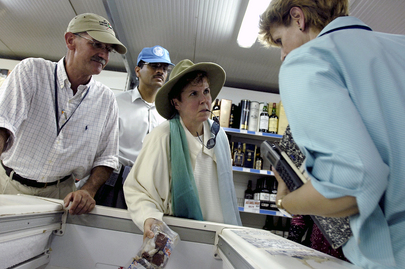
Jane Holl Lute in Juba, discipline for Congo gold trading not shown

Inner City Press asked if the failure to impose any discipline should impact on the UN's future acceptance of peacekeeping from the country that neglects to discipline. The spokesperson finally announced the only ramification of the scandal of UN peacekeepers involved in gold trading: these three individuals will not work for the UN again. Video here, from Minute 12:46.

Is this what is meant by "zero tolerance" at the UN? That was Jane Holl Lute's phrase, at press conference after press conference: zero tolerance. Now, it's said, Ms. Lute is being mentioned to replace David Veness as the head of UN security. Given the lack of follow-through on peacekeeper discipline, and her role in steering a $250 million no-bid contract to Lockheed Martin, such a move would send all the wrong messages. We'll see.

In other UN post news, Inner City Press now reports for the second time the resignation of Assistant Secretary General Yohannes Mengesha. Why the Secretariat has not seen fit to announce the news is not yet known. There are musical chairs afoot. The post vacated by Angela Kane, ASG in the Department of Political Affairs, is said to be lusted after by the wife of USG Terje Roed Larsen, who otherwise faces return to Oslo by the Norwegian foreign ministry.

Others say that the Political ASG slot might be kept empty, in belated response to the outcry when UNCTAD's vacant ASG slot was used to move Jan Beagle from New York to Geneva. Ms. Kane's old slot might now be used to solve, or at least postpone, that previous gaffe.

And see, www.innercitypress.com/un3oiosmonuc070708.html

Saturday, July 12, 2008

Lockheed's UN Darfur Contract Will Not Be Extended But Divided Up Due to Risk, Malcorra Says

Byline: Matthew Russell Lee of Inner City Press at UN
www.innercitypress.com/un3lockheed070708.html

UNITED NATIONS, July 7 -- The UN's ill-fated $250 million no-bid contract with Lockheed Martin for peacekeeping camps in Darfur will not be extended, but rather broken up into smaller pieces for a broader range of vendors including from Sudan, the new head of the UN Department of Field Support Susana Malcorra told Inner City Press last week.

This represents a change from the policy of her predecessor Jane Holl Lute, who pushed to give Lockheed the six-month sole source contract with two possible three-month extensions, then put out the whole contract out to bid when the lack of competition came under attack. Now that re-bid procedure is being jettisoned.

Inner City Press asked Ms. Malcorra when the replacement for Lockheed would be announced. "We are going to take a different approach," Malcorra answered. "The overarching single contractor is something I feel very uncomfortable with. We need to have a multi-tier approach. All eggs in a single basket is something I don't feel comfortable with, operationally and for many reasons."

Both UN Peacekeeping and its Procurement Division, as well as Secretary-General Ban Ki-moon, have been under fire since October 2007, when the no-bid contact with Lockheed was announced. At first, the UN Spokesperson said that Lockheed had been selected through a competitive process, then retracted the claim. It was said that the contract would be made public, but that has still not taken place.

Inner City Press obtained and published letters from Jane Holl Lute, whose husband is U.S. President George W. Bush's war czar for Iraq and Afghanistan, pushing for Lockheed to be given a no-bid contract each before the Security Council approved the Darfur mission in July 2007. Further back, there were inquiries about the contract from Condoleezza Rice, click here for that. These revelations were cited in the General Assembly's budget committee in December when it called for greater use of local vendors and formally demanded an investigation of the Lockheed contract, which the UN Office of Internal Oversight Services has still not completed. Lockheed's PA&E previously overcharged the UN reportedly for airfield services in the Democratic Republic of the Congo, and for breakfasts in Darfur, click here for that.

Ms. Malcorra on July 3 said, "to me, a single vendor or supplier for everything is too big of a risk," with the implication being that this includes reputational risk.

The U.S. government has continued to push for Lockheed. On July 2, Inner City Press asked U.S. envoy to Sudan Richard Williamson what would happen if, as Sudan has vowed, Lockheed's Pacific Architects & Engineers subsidiary is not given the second three-month extension.

"PAE has the experience," Williamson said. "It would be prudent if they are allowed to continue performing the service. There'd be a substantial lag if you tried bring someone else new in," he continued. "I have raised it at the highest level in Sudan, Under-Secretary General [Susana] Malcorra has raised it. Hopefully by July 15 there'll be a sorting out." Video here, from Minute 5:05.

On July 3, Inner City Press asked Ms. Malcorra about what Williamson had said. "I haven't seen it," Malcorra said. "We are not extending, absolutely. Let me make it clear to you. They haven't finalized their work, and won't be July 14. So what I have asked the government, and what I have asked PA&E is to finalize their work, that they finalize their work. If it's going to take 30 more days, I want them to finish what has been committed in the contracts, and that's it. I explained it to them in El Fasher and to the Khartoum government."

This in part explains her spokesman's written statement to Inner City Press last week, that "you are correct that Ms. Malcorra has recently returned from visiting Darfur. No contract extension for PAE has been requested. The Government of Sudan was requested to allow finalization of the works under the contract which will go beyond July 15th, including all equipment being imported."

"The equipment, it's ours," Malcorra said on July 3, adding that "a mission is going to Sudan to have a survey of the market to make sure we can get some of those local contractors. We are going to use some UN agencies, UNOPS being one of them, to do some of the construction. The project management, for the time being, is to be performed by the Mission." She said that later there will "probably be some external project management. I'm going to divide that, that should be part of the approach, to enable and develop local market. If in smaller pieces, there are more chances to have regional or local" contracts.

News analysis: To some UN anti-corruption experts, Ms. Malcorra's still-false notes involve the unqualified use of UNOPS, the UN Office of Project Services, which as Inner City Press has reported has been years-delayed in filing audited financial statements, and Ms. Malcorra's statement that that "system contracts are fine." As Inner City Press has reported, these system contracts suffer from some of the same favoritism which poisoned the Darfur camps contract. We'll close with a few final notes from the field, since it's said a new approach is being taken:

Peacekeepers expressed disgust to Inner City Press at the UN's contact to buy gabions, which they characterized as "fancy sandbags," from a UK supplier for some but not all peacekeeping battalions. These gabions, significantly more expensive than sandbags, they are, are used mostly in camps where troops from Europe are deployed.

In both the Democratic Republic of Congo and Cote d'Ivoire, sources complain of new equipment rotting, unused. There are also significant questions about the use (or misuse / misappropriation) of spare parts from accident vehicles towed back to peacekeeping camps. The list could and will go on, but we'll stop here for now, pending evidence of the promised new approach. Watch this site.

Footnote: Also on July 3, Inner City Press asked outgoing Peacekeeping chief Jean-Marie Guehenno about his next move. "My next move is not to move," he quipped, to the laughter of his accompanying colleague. "I will stay in New York -- I'll go to Europe for a while, then come back to New York in mid-September and then see what I do. Maybe write a bit. Some institution, it's not clear". Inner City Press suggested the International Peace Institute, which has collected, among others, Terje Roed-Larsen and Edward Luck. "He's bigger than that," Guehenno's colleague cut in. How about a book, Inner City Press suggested. Guehenno nodded. When will Alain Le Roy start? "Late August or September, I guess," Guehenno said. To Inner City Press' next question, Guehenno declined to answer. "It's a delicate issue. I still have almost four weeks to make a big blunder," he laughed. Bonne chance.

And see, www.innercitypress.com/un3lockheed070708.html

Wednesday, July 9, 2008

At UN, of Dressed Dogs and Ban's Beef, Nigeria Reviewed under CEDAW, Gambari's Niger Delta Days


Byline: Matthew Russell Lee of Inner City Press at UN
www.innercitypress.com/un748muse070408.html

UNITED NATIONS, July 4 -- There were seventy-two women from Nigeria in a room in the UN's basement in New York, listening as a Moroccan feminist exhorted them, in French, to "defendez vous!" (defend yourselves). Nigeria was being reviewed by the UN's Committee on the Elimination of Discrimination against Women, and the Islamia shari'a law in effect in the northern part of the country was much discussed. "It does not apply to non-Muslims!" a government minister, male, argued. Let's hear from the women, was the sense of the Committee.

But who had paid to fly these seventy women to New York and put them up? The previous record was Saudi Arabia, which brought forty-some to a similar CEDAW review. "It's not necessarily just a shari'a thing," said one wag. "Maybe it's also an oil thing."

On that, the UN allowed its Under Secretary General Ibrahim Gambari to moonlight, on his own time, as a mediator in the Niger Delta. But the rebels there have reportedly not accepted him, noting that he represented the Sani Abacha regime at the UN, including at the time of the killing of Ken Saro Wiwa. Gambari was seen this week back in New York. Next stop Myanmar?

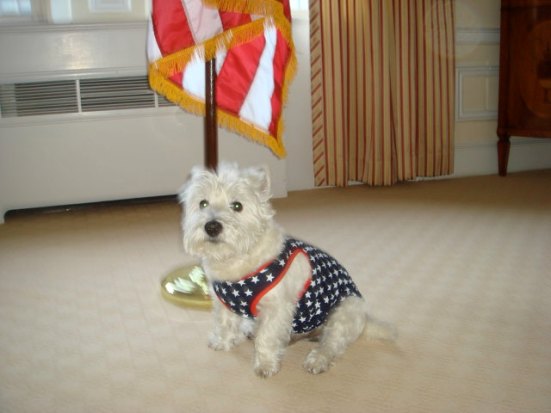
Pushing loudly for inclusion of Myanmar, or Burma, on the Security Council agenda is the United States, represented at the UN by Zalmay Khalilzad. On July 2, Khalilzad invited other Ambassadors and staffers, and select journalists, to his suite in the Waldorff towers for hamburgers and hot dogs. There was the Khalilzads' white dog, dressed in an American flag sweater. There was a heated exchange between the Ambassadors of Sudan and the UK; there was a framed automatic weapon on the wall, and numerous Iraqi artifacts. As Donald Rumsfeld once said, and one attended wag paraphrased, a bit of looting is par for the course.


Speaking of hamburger, or American beef more generally, Inner City Press on July 3 asked Ban Ki-moon's spokesperson for his views on the standoff between South Korea, where he is, and the U.S. on mad cow disease. From the transcript --

Inner City Press: does Mr. Ban, while he is in South Korea, does he have any intention to have American beef? Does he have any view of that whole American beef situation? What’s his view?

Spokesperson: (laughter) I think he will certainly eat American beef. I don't think he has any special theoretical view on it. It is, of course, an issue that has really been taken very seriously in his home country, but he has no specific opinion on that.

Question: But I think the Prime Minister, whom he knows well, bought like 18 kilograms of American beef to somehow show that it is safe, I am just wondering if he wanted to say that it’s safe or does he--

Spokesperson: You mean whether he will eat it? I don't have such details! (laughter) Thank you very much.

But then came an AP article entitled " UN chief tells South Koreans to trust beef imports," quoting Ban that " it is very important for the people to support policies of the government and to actively have trust in the government and to ensure and support the Korean government's desire to act in accordance with international standards and agreements." Where's the beef?

And see, www.innercitypress.com/un748muse070408.html

Monday, July 7, 2008

At UN, Zimbabwe Resolution Unveiled, with Name Games and Notice of Sanctions, Perhaps No Veto

Byline: Matthew Russell Lee of Inner City Press at UN
www.innercitypress.com/un2zimnames070308.html

UNITED NATIONS, July 3 -- As the U.S. Mission to the UN unveiled its draft resolution to impose targeted sanctions on Zimbabwe, the Press was given a version with 11 targeted names, not 12. Missing in the draft the U.S. handed out was Gideon Gono, the central bank governor. But the UK mission said that Gono was and is on the list, and the U.S. later confirmed this. Was his omission, from the U.S. draft, a sign of some alliance between Washington and Harare high finance? "Don't read too much into it," Inner City Press was told.

July's president of the Council, Vietnam's Le Luong Minh, was coaxed to come out to the stakeout. He said that the Council's meeting on Zimbabwe will be Tuesday, something that the U.S. but not he had said the previous day. The format, he said, is still under consideration. Inner City Press asked him if Deputy Secretary General Asha Rose Migiro will brief the Council. The format is still not decided, he repeated, but "of course" Migiro would be invited. Video here.

An African Ambassador complained to Inner City Press that he thinks Migiro's job will be to present the mood at the African Union's Egypt meeting, which she attended, as more anti-Mugabe than in fact it was.

When Inner City Press pointed out to this Ambassador that Kenyan prime minister Odinga, for example, criticized Mugabe, the response was, "but of course, since he too got outside help."

News analysis: while Russian Ambassador Churkin on July 2 said, "We don't like sanctions" and said that the regional SADC process should be allowed to work, it not entirely sure that this resolution would be vetoed. That South Africa would vote against it appears to be nearly certain. But South Africa does not have a veto. Could Russia and China be convinced to abstain rather than veto? A cynic might think that since by publishing the twelve names days in advance of the vote they can just move any money that might be frozen, perhaps abstentions -- even in exchange for this absurd advance notice -- might be expected. We'll see.

And see, www.innercitypress.com/un2zimnames070308.html

Friday, July 4, 2008

On Darfur, While U.S. Lobbies for Lockheed, Sudan Says No, UK On ICC Moves

Byline: Matthew Russell Lee of Inner City Press at UN
www.innercitypress.com/unsc6postafrica070208.html

UNITED NATIONS, July 2, updated July 4 -- On Darfur, some views are easy to hear, others require more work. Wednesday in front of the Security Council chamber, the United States' envoy to Sudan Richard Williamson told the Press that the UN as well as Khartoum are to blame for there being only 600 additional peacekeepers in Darfur since the beginning of the year, rather than the 3,600 the U.S. had called for. He said that the U.S. has expressed its support for the second in command of the mission, Rwandan general Karake Karenzi, despite him being charged with war crimes by a Spanish magistrate in February.

Inner City Press asked about the July 15 expiration of the first of two possible three month extensions of the $250 million no-bid contract with Lockheed Martin's PAE subsidiary, for peacekeeping camps in Darfur. "PAE has the experience," Williamson said. "It would be prudent if they are allowed to continue performing the service. There'd be a substantial lag if you tried bring someone else new in," he continued. "I have raised it at the highest level in Sudan, Under-Secretary General [Susana] Malcorra has raised it. Hopefully by July 15 there'll be a sorting out." Video here, from Minute 5:05.

But when Inner City Press asked the UN, spokesman Nick Birnback replied that " you are correct that Ms. Malcorra has recently returned from visiting Darfur. No contract extension for PAE has been requested. The Government of Sudan was requested to allow finalization of the works under the contract which will go beyond July 15th, including all equipment being imported." From this, it appears that the issue has already been sorted out and decided -- the contract will not be extended, and another contractor will have to be named by July 15.


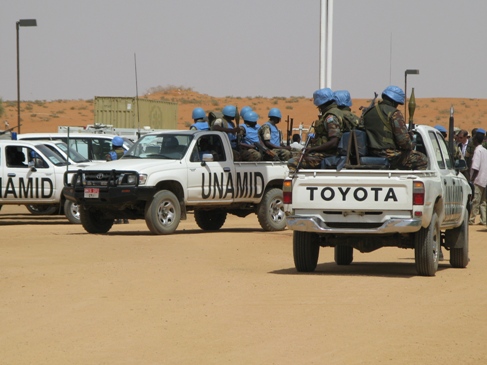
In El Fasher UNAMID Camp, June 2008, (c) Matthew Russell Lee

Likewise while Williamson said the U.S. has conveyed its support for indicted General Karenzi, Inner City Press has learned that the UN Secretariat has written to Rwanda asking them to propose a substitute general. Sudan's Ambassador to the UN Abdalmahmoud Abdalhaleem Mohamed asked Inner City Press, why didn't the Secretary-General consult with the African Union before writing to Rwanda, since it is a hybrid force?

Ironically, Sudan and the United States are on the same side of the issue of indicted General Karenzi continue to serve as deputy commander of the Darfur peacekeeping mission, with the Secretariat taking a different view. Abdalmahmoud Abdalhaleem Mohamed also told Inner City Press that UK Ambassador John Sawers believes that International Criminal Court prosecutor Luis Moreno Ocampo should hold off on any further indictments, at least for now, since there is a new Darfur mediator, Djibrill Yipene Bassole of Burkina Faso. This appeared at odds with Amb. Sawers public positions, including while recently in Sudan, Abdalmahmoud Abdalhaleem Mohamed noted. [Update -- the UK Mission has said that Abdalmahmoud Abdalhaleem Mohamed has "erroneously quoted" Ambassador Sawers, "they did talk about ICC, but John [Sawers] said it was a matter for the court, he didn't say that any new indictments should be delayed." Duly noted, even on the 4th of July. Sawers has appeared ambivalent before, about the ICC, click here for one example.]

On Lockheed Martin and PAE, "they are history," Sudan's Abdalmahmoud Abdalhaleem Mohamed said on July 2, "no extension will be granted." Having since spoken with DFS chief Malcorra, we will have more soon on all this.

Footnote: On July 1 at the UN, Inner City Press asked China's special envoy to Sudan Liu Guijin about his statement, a week previous in Beijing, that some Western media and NGOs misrepresent China's role in Sudan and turn rebel groups against China. Inner City Press asked if he was aware of a statement at the UN on June 17 by John Prendergast, that Chinese oil workers could be targeted. "Yes I have heard of that," Liu Guijin said. But while Western NGOs and countries focus only on the responsibility of Khartoum and of China, on July 2 Chad's president Idriss Deby said he will not speak with Sudan's president, nor with rebels who seek to topple him. Who is criticizing Chad for adopting this stance? Alongside or despite of Francee's inaction, might the UK? We'll see.

And see, www.innercitypress.com/unsc6postafrica070208.html

Iran Calls U.S. Elections Propaganda, Cites U.S. Support for Terror Groups, U.S. Ambassador Khalilzad zaDeclines to Comment on Intelligence Matters

Byline: Matthew Russell Lee of Inner City Press at UN
www.innercitypress.com/un1iran070208.html

UNITED NATIONS, July 2 -- The governments of the United States and UK both support or assist terrorists, Iranian Foreign Minister Manouchehr Mottaki told the Press on Wednesday. He hearkened back to U.S. funding of Osama Bin Ladin and his base in Pakistan, and to the UK parliament's removal of Mujaheddin-e-Khalq from its terror list. Asking Mottaki about the elections in the U.S. and Zimbabwe (video here from Minute 55), Inner City Press asked U.S. Ambassador to the UN Zalmay Khalilzad about the U.S.'s reported support of groups such as Mujaheddin-e-Khalq and Jundallah. Amb. Khalilzad responded that "I do not discuss any intelligence related activities." Video is here.


Here's from U.S. transcript --

Inner City Press: On Iran, Foreign minister Mottaki just criticized the U.S. for supporting what he called terrorist groups including like the Jundallah, there are a number of groups that are in the Seymour Hersh story that's in the New Yorker this week. So he spoke about and talked about the U.S.’s history of supporting such groups [including Mujaheddin-e-Khalq.] Does the U.S. acknowledge the programs that these, covert programs for example to undermine Iran?

Ambassador Khalilzad: Let me say first of all that I do not discuss any intelligence related activities but you should not take that as meaning that I believe something is going on. But it is my general policy not to discuss any intelligence issues. With regard to Mujaheddin-e-Khalq, and others, our policy has got a long history to it. We have no ill will towards the people of Iran and we want to increase our engagement with the people of Iran, this is a great country a great civilization I have personally benefited given that I speak the language from many products of Iranian history and civilization. So the issues are differences, significant differences, important differences with the government the current leadership in Iran. That has to do with the nuclear issue that we have discussed. It has to do with specific policies on the peace process, specific statements calling for the destruction of a sovereign state, support for groups, militant groups, armed groups in some of the neighboring states. Those are some of the specific issues.

I do believe that one can come to terms with an Iran that has reasonable objectives and is in compliance with international law and demands of the Security Council and as I said before we have nothing but the utmost respect and admiration for the people of Iran, we have many fellow citizens here who are of Iranian origin, quite substantial in number. So there shouldn’t be any misunderstanding in terms of where we are.

Mottaki referred to just such Americans of Iranian origin, saying that Iran has hired some to work in its interest section within Pakistan's embassy in Washington. Mottaki expressed frustration that while Iran granted over 150 visas to U.S. journalists last year, Iranian journalists in the U.S. face restrictions. The U.S. Mission to the UN subsequently distinguished between independent journalists and those for state-run media. Iran's spokesman Mansour Sadeghi, at Wednesdays' press conference, pointedly called on a reporter from Voice of America, perhaps for just this reason.

On the U.S. elections, Inner City Press asked Mottaki to comment on the singing of "bomb, bomb, bomb, bomb, bomb Iran" by John McCain, to a Beach Boys melody. "Let me avoid commenting around U.S. presidential candidates," Mottaki began. "For two years within a monopoly or propaganda between two parties alone and nothing outside... we do not look at individuals or parties [but rather] at the implemented policies of the U.S. government. Some previous presidents of the U.S., once they left their office and position, express positions different from they did in the White House."

It seemed clear that this referred, at a minimum, to Jimmy Carter. Mottaki went on to answer Inner City Press' request for Iran's position on the Zimbabwe elections, click here for that.

And see, www.innercitypress.com/un1iran070208.html

At UN, Rapporteur Alston Admits Drone Silence from US, Silent on UN, Calls Methods of Killing a Catch-22

Byline: Matthew Russell Lee of Inner City Press at UN
www.innercitypress.com/un1executions063008.html

UNITED NATIONS, June 30 -- In the face of questions about the killing of civilians by U.S.-controlled unmanned Predator drones, the U.S. has argued that the UN Human Rights Council and its rapporteur Philip Alston have no jurisdiction, and are "irrelevant," Alston told the Press on Monday. Inner City Press asked Alston to characterize the U.S. responses to his inquiries about these killings from the air. "Their response has not been substantive," Alston said, rather only procedural. As set forth in a May 4, 2006 U.S. letter that Alston has put online, the U.S. argues that " inquiries related to allegations stemming from military operations conducted during the course of an armed conflict with Al Qaida do not fall within the mandate of the Special Rapporteur. The conduct of a government in legitimate military operations, whether against Al Qaida operatives or any other legitimate military target, would be governed by the law of armed conflict."

In the more than two years since, the U.S. has simply not responded to Alston's inquiries on the topic, whether about killings in the village Haisori, near the town of Mir Ali, North Waziristan, or Damadola in the Bajaur Agency, North Western Pakistan. Alston says he will include the issue in his "final report." In the briefing he gave Monday, Alston did not address attempt to curtail rapporteurs' mandates, so that any report they do could be their last report.

Alston was clearly running scared, or being wisely cautious. Inner City Press asked for his views on whether particular modes of execution are "cruel and unusual punishing," within the meaning of the 8th Amendment to the U.S. Constitution or otherwise. "I stay away from the question," Alston said. He said his mandate does not allow him to take a position for the abolition of the death penalty -- even though this is the UN position, as Ban Ki-moon learned in his first week on the job -- so he stays about from methods, calling them a "Catch 22."

Inner City Press also asked Alston what responses he has gotten from the UN, about its failure to discipline its peacekeepers after the killing of civilians, in Haiti, Kosovo and the Congo. In October 2007, Alston told the Press he was inquiring into these issues, click here for that. On Monday, Alston said that provide any update on the UN's response was behind the scope of his briefing, and said he would later provide the information. If and when he does, it will be reported on this site.

And see, www.innercitypress.com/un1executions063008.html

UN's Concern About Investors Kept Algeria Threat Level Low Before the Bombing, Some Counter-Terrorism Reforms

Byline: Matthew Russell Lee of Inner City Press at UN
www.innercitypress.com/un2safety063008.html

UNITED NATIONS, June 30 -- Belated describing to the Press his report on the bombing of the UN in Algiers back in December, Lakhdar Brahimi on Monday acknowledged that the UN takes into consideration governments' desire to downplay security threats. "It's a sensitive issue," he said, because when the UN raises threat levels, "investors stop going there... The UN takes that into consideration." Video here, from Minute 9:39.

Since the UN, particularly through its UN Development Program, operates on the premise that the only road to development is by building the capacity and strengths of governments, this runs counter to prioritizing the safety of staff. In this case, there were other conflicts of interest. UK Ambassador to the UN John Sawers told the Press on Monday morning that he is "not sure if the choice of an Algerian" like Brahimi "to investigate a bombing in Algeria was the right way to go. Inner City Press asked Brahimi about the comment. Brahimi replied that he didn't think he was assigned the investigation because he is Algerian, and that Algeria didn't feel it controlled the investigation. Judge me on my work, Brahimi said.

But his report dodged the obvious question, of holding anyone accountable. That task has been assigned to yet another panel, this one headed by Ralph Zacklin, who the UN Staff Union on Monday called "an insider who has served as legal counsel... with repsonsible for some sensitive political issues including the Oil for Food program, where he assisted in some procurement decision criticized by [Paul] Volcker." They question if this is a person who will objectively mete out responsibility.

So far, only David Veness has resigned. Ambassador Sawers sung Veness' praises on Monday, saying he will be hard to replace. Inner City Press is told that Jack Straw sold Veness on the job by saying it could take him to retirement. Who now will wants this hot potato? While word on the street is Russian, it may be Poland's time, we'll see.

Counter-Terrorism Changes Still Fall Short: Following a string of court decisions criticizing the UN's Al Qaeda and Taliban sanctions as violating the due process rights of those put on the lists, the UN Security Council on Monday extended the sanctions with some changes, including committing to review all names on the lists within the next two years. Inner City Press asked UK Ambassador to the UN John Sawers if the reforms in Resolution 1822 are retroactive, and thus might be used to try for better outcomes in the court decisions questioning the sanction. They are not retroactive, Sawers answered, but they will help going forward. Video here, from Minute 2:10. Costa Rica later said that it is not strong enough in providing due process in the listing and delisting of those subject to sanctions. But Costa Rica voted for the resolution, and as Sawers has noted, few reporters cover the sanctions anyway. UN Counter-Terrorism czar Michael Smith has yet to brief the press. Ah, accountability....

And see, www.innercitypress.com/un2safety063008.html

As Thailand Forcibly Returns One Thousand Hmong to Laos, UN Actions Questioned

Byline: Matthew Russell Lee of Inner City Press at UN
www.innercitypress.com/un1hmong062908.html

UNITED NATIONS, June 28 -- In Thailand last week, over 800 ethnic Hmong were forcibly returned to Laos. While outgoing UN Human Rights Commission Louise Arbour issued a statement of concern, Hmong sources tell Inner City Press that the UN's Department of Political Affairs, while polite, has declined to participate in meetings by Hmong leaders seeking to avert these forced returns, and that the UN Development Program has declined to meet with Hmong, saying it is outside of the mandate, which involves engaging only with governments, whether in North Korea, Myanmar, Zimbabwe or Laos.

Sources in the region name, among those returned last week, Mr. Neng Moua, who tried to negotiate with Lao officials before being forcibly returned on June 21. On June 24, 147 more Hmong were returned, and some 5755 remaining in the camp.


At the UN's noon briefing on June 27, spokesperson Michele Montas announced that UNHCR

"has written to the Government of Thailand to express concern over the repatriation of 837 Lao Hmong last Sunday, following a protest by thousands of refugees who broke out of a camp run by the Thai Army. UNHCR says the lack of transparency surrounding the repatriation raises doubt about whether the returns were voluntary. The agency is particularly concerned that a group of eight leaders and their families appear to have been deported against their will without any determination of whether they needed international protection. UNHCR is also concerned that families may have been separated in the process. UNHCR says it stands ready to help both the Lao and Thai Governments."

Inner City Press asked Ms. Montas

Can you find out whether the Hmong representatives have sought to meet with the Department of Political Affairs and been rebuffed? That is what I have heard. That the Hmong on this very problem have asked DPA, and that DPA said we only meet with Governments. If that is not true, I would love to know it. But can you…?

Spokesperson: Of course, we can find out. But I don’t know…

Inner City Press: Here in New York.

Spokesperson: Here in New York. I will ask for you, but I am not aware of this issue at all.

[The reporter was later informed that DPA staff had in fact met with Hmong representatives on many occasions.]

What the Spokesperson's Office sent was more detailed than the denial inserted into the transcript in brackets --

"Regarding your question about whether Hmong representatives tried to meet with staff at the Department for Political Affairs but were rebuffed, I can confirm that information is not correct. I've spoken with DPA staff who have met with Hmong representatives many times over the past several years. In particular, Geir Pedersen, who was at the time the head of the Asia and Pacific Division of DPA, visited the Lao People's Democratic Republic in December 2004, and at that time brought up the situation of the Hmong with the authorities there. Since then, DPA has continued to monitor the situation of the Hmong and has supported the work of the UN country teams in the Lao PDR and Thailand, which are dealing with the situation. DPA staff also continue periodically to meet with Hmong representatives."

But a well-placed source, asked by Inner City Press about the above, states that

"UNDP in NYC did not want not meet Hmong 'leader' delegation ever, to hear the Hmong proposal, or engage with discussing it. The focal point of UNDP said they can't meet and talk directly with Hmong on this initiative - it wouldn't be their 'Mandate'. During the PFII week in April 2008, the Hmong simply went to Anne-Marie Ibanez's office in the Department of Political Affairs without an appointment, to reach her, to encourage her to come to a very important meeting, in which states and UN agencies were hoped to come and participate. After we left, again, no response to the follow up e-mail to remind her to please be there at the joint meeting, nor did she attend the meeting."

Then over 800 Hmong were forcibly returned to Laos. UNHCR put out a statement, but where is UNDP? Where is Ban Ki-moon's Department of Political Affairs?

As to WHY Thailand might be doing this, see
"Controversial EDF Dam in Laos [to send Electricity to Thailand] Is UNDP's Anti-Corruption Example, Panel Claims" at www.innercitypress.com/undp1laosedfdam062508.html