Thursday, March 3, 2016

Ban Ki-moon Gave Rwanda "Residual Mechanism" to Brammertz, African Protest Ignored


By Matthew Russell Lee, Exclusive publication

UNITED NATIONS, March 2 -- Should the UN's "residual mechanism" on Rwanda be given to Serge Brammertz, as other posts go to nationals of Australia and Belgium?

  This question or complaint was exclusively raised to Inner City Press during its three day exile from the UN due to a no due process eviction letter from Cristina Gallach of Spain, the USG of Public Information.Petition here.

 Back in the UN on February 25, Inner City Press was told by an African Permanent Representative, "We will try to stop this." Can Europeans run Africa?

 There was a closed door Any Other Business session about the residual mechanisms (ICTY too) on the evening of February 25. Then Brammertz was approved, with all three African members abstaining. Inner City Press asked Angola, the President of the Council for March -- video delayed by UN - and then Ban Ki-moon's deputy spokesperson Farhan Haq, UN transcript here:

Inner City Press: On this question that I asked you yesterday about assigning Mr. Brammertz as the prosecutor of the residual mechanism, yesterday, after your answer, the President of the Security Council for March from Angola explained his abstention as saying that he does not believe the Secretariat is following this principle of geographical distribution.  So, I wondered, what were the… can you give some… what were the discussions between the Secretariat and either the African group or the African members of the Council where obviously the two sides came to such a different conclusion about this appointment?

Deputy Spokesman Haq:  I don't have anything to add to what I said yesterday about this.  Obviously, we are aware of concerns about geographical representation which are raised from time to time, not just in this case but in other cases, and we do our best to make sure, over the long run, that everyone's regions feel fairly represented.

 Well, all three African members of the Security Council do not agree. And Western wires, too, think they can control:

A mere two paragraphs out of a more than 20-paragraph UN Group of Experts report were trumpeted by Reuters on the evening of February 3: Rwanda is training Burundian opposition fighters, in DRC, citing 18 such combatants.

  Amazingly, BBC Radio then put on air the scribe who was handed the report, Michelle Nichols -- without the BBC apparently even looking for the full report itselfAudio here. Is this what mainstream or British journalisms has come it? BBC presenter Akwasi Sarpong said, "You've seen the report" -- as if he couldn't see it himself, here, merely with Google. Is this incompetence or more propaganda?

   There was, of course, much more to this 12-page UN report, including simply as one example that the UN Peacekeepers from Tanzania was described as meeting / working with the ADF rebels, mis-speaking and getting in a firefight with the Congolese Army. But this lead section of the report was not in Reuters February 3 lead story by its UN bureau chief Lou Charbonneau.

  Later Charbonneau would promote his propaganda protege Michelle Nichols' apparently, only about Rwanda, on BBC Radio - the torch as been passed? Note that it is Reuters, and Nichols, who in a murky process has been handpicked to "memorialize" the Security Council's interactions with the Great Lakes, along with a Voice of America scribe Margaret Basheer who "saw" Liberians while in Burundi last month. 

 Inner City Press, having seen this before, put the entire 12 page UN DRC Group of Experts report online on the morning of February 4, here, and asked about it at the February 4 UN noon briefing, transcript here(some then left the briefing room, on which we'll have more.)  Video here.

Inner City Press asked about it again on February 5, including the Tanzania links, here.

   Only on the afternoon of February 4 did Reuters note the other sections of the report, including the Tanzanians - and then, not by the bureau chief but the correspondent.

For the record, the Reuters bureau chief first tried to get Inner City Press out of the UN -- then asked to have his anti-Press filing with the UNremoved from Google's search as purportedly copyrighted, an abuse of the Digital Millennium Copyright Act and a move at odds with Reuters claimed embrace of freedom of information. His filing, put online by the Electronic Frontier Foundation's Chilling Effects project, is here; his underlying email to the UN's (now spokesman) Stephane Dujarric  is here.

Other at Reuters got involved, a Freedom of Information Act request by Inner City Press revealed: but the company's executives refused to explain their policies as requested.

  Then the Reuters correspondent tried, with a stealth filing with the UN. Less stealth, in the briefing room and on video here, on February 3 this Reuters correspondent tried to cut off Inner City Press questions to the UN deputy spokesperson about corruption involving indicted Ng Lap Seng and the UN Correspondents Association, on whose board Reuters has a seemingly permanent seat, and tried to use to oust the Press. We'll have more on this.

After UN Secretary General Ban Ki-moon on New Year's Eve issued a statement surreally praising the Burundi “talks” held in Entebbe, Uganda, multiple sources told Inner City Press these not really talks but rather a photo op. The January 6 session announced for Arusha did not happen.  Inner City Press requested to cover the UNSC's trip to Burundi, but was UNtransparently rejected.

Transparently, Inner City Press  published the DR Congo Group of Experts Update Report including about 18 Burundian combatants, hereand see below.
  On February 3 Reuters' UN bureau chief Lou Charbonneau, a censor,  channeled a UN (DRC) report -- note not only the former Reuters official turned Eritrea sanctions “experts” exposed by Inner City Presshere, but also that this same now discredited Reuters / UN individual was previously ON the DR Congo panel. Typically, Reuters did not actually put the report online.

  Inner City Press in the spirit of transparency is publishing the (update) report, dated January 15, 2016, signed by Coordinator Gaston Gramajo, and its two paragraphs about 18 Burundian combatants, here


Readers can draw their own conclusions, including about the mandate and motivation, and if these 18 is really the way it would go.

 At the African Union Summit in Addis Ababa, Ban Ki-moon barely if at all pushed for peacekeepers for Burundi; his or France's head of UN Peacekeeping Herve Ladsous had largely undercut the idea with a memo than Inner City Press published in full.

(Inner City Press has reported the UN Peacebuilding Configuration will visit February 15-19, click here for that.)

On January 29, the UN Spokesman threw Inner City Press out of the UN Press Briefing Room then on February 1 made this threat, here. This wasechoed on February 2

 On January 28, Inner City Press asked UN spokesman Stephane Dujarric about a meeting held but not televised on January 27, at which it was urged that mass grave sites in Burundi be preserved as evidence,video here, transcript here.


Inner City Press asked Ban's spokespeople about the trip on January 20, 21 and 22 - including asking why the UN was not providing a video or at least audio stream of the January 22 press encounters, says it has a  "UN Information Center" in Bujumbura, which produced a smiling photo of the French deputy ambassador Alexis Lamek on the tarmac. The UN said it couldn't.

  Local media in Burundi put online a video in which Lamek spoke at length; afterward a pro-government Burundian media quoted Lamek that "we" take seriously the question of interference by Rwanda to destabilize Burundi and will be working on it.

  But the four scribes handpicked to accompany the Security Council trip, inlcuding Agence France Presse, it seems, for some reasons didn't cover it. Why? We'll have more on this. Instead, AFP, Reuters andVoice of America (which saw "Liberians" then cited auto-correct) filed near-identical stories with no quotes from opposition figures or attacked journalists. None of the three even tweeted on January 23, other than Reuters as a robot: talk about Old Media.

  How could "Agence France Presse," handpicked to publicize the UNSC trip co-led by France, not even cover the controversy? What about Reuters?

  We note that the French Mission to the UN said that Lamek was being misrepresented (the same French Mission has tried to shield Lamek from critical Press questions, which here on Vine Lamek has refused to answer even when entirely audible). Later an AFP quote emerged of Lamek saying that any AU force, even the 100 human rights observers, should significantly focus on the Rwandan border.

  On the evening of January 23 the UN has put up select clips including a mere 16 seconds of French deputy ambassador Lamek, much less than the local Burundian media present at the same press encountered had.  If the UN filmed the press encounters, why did it so selectively edit them?

  More specifically, now, who decided on the edits?

  Inner City Press asked the head of the Campaign Against the Third Term (“Halte au troisième mandat”) Vital Nshimirimana about the UNSC visit, and why the AU human rights observers are not yet in place. His answers to Inner City Press:

"As for the deployment of the AU Human rights observers, I would recall that the same was decided back in June following the June 13, 2015 Johannesburg Summit on Burundi. Initially, the number was to be about 70 observers but the government refused and allowed a narrow team.

"My thought over the issue is that Nkurunziza has chosen to humiliate everybody in as much as he does not care about any principle or value. So, the AU and other bodies as well choose to deal with him very carefully for he is a man (and a regime) "irrational," likely to commit whatever crime, insult whomever.....

"With regard to the UNSC visit, I hope this is the very last warning towards a kind of regime likely to commit genocide. They are expected to dually and objectively assess the situation and especially the strength and presence of Imbonerakure, the CNDD-FDD militia.... And this was shown through a huge anti- peacekeeping mission mission to Burundi, MAPROBU rhetoric.
Burundians expect the UNSC support the deployment of such a mission in line with the responsibility to protect (Pillar III) since Burundi is no longer able and is unwilling to protect citizens from crimes against humanity (ongoing from April 2015) and genocide (of which dozens of signs suggest that it is likely to happen and some acts are already undertaken).

Lastly, the UNSC is expected to talk with Nkurunziza and the AU as well regarding peace talks. They should assess Museveni's performance, after what conclude that he should be assigned AU and UN teams (to enhance his capacity) or change him.... I commend your endeavors to keep the world informed about the Burundi crisis."

 We'll have more on this -- including in light the UN Deputy Spokesperson's response to Inner City Press that transcripts may be provided.

  Here are parts of an Inner City Press interview with a journalist attacked by the Nkurunziza government and for that reason anonymous:

In English: "It would be better if the Security Council met for example UPRONA leader Nditije Charles, with the non-governmental branch of the UPRONA party) or his Spokesman Thacien Sibomana. The Council should try to meet civil society but  there is almost no one left to really speak with now in Bujumbura. All those still in Bujumbura, they can't say anything about the abuses of authorithies. If it was possible, they should ask to meet the young men in prison. They should see themselves how the government abuses those young men, with tortures... Tell them visit to the prisoners in Gitega (those who are accused to attempting a coup d'etat) UN has the right to visit prisoners."

  Inner City Press note: another source says "the government moved several detainees from the SNR jails. I highly doubt they'd allow a visit to detainees."

 Tellingly, IWACU reports that bike taxi and motorcycle taxi drivers offered money to protest in favor of Nkurunziza weren't, after the fact, paid: here.
    At the January 21 UN noon briefing, Inner City Press asked UN deputy spokesperson Farhan Haq about the "community works" and meeting(s). Video here, UN transcript here:

Inner City Press:  I wanted to ask you this just because I'm trying to cover it, and I know that you'd said yesterday that the Special Adviser, Jamal Benomar, is in Burundi in part of the trip.  So what I wanted to ask you is, I've seen documents that show that the… the… the… tomorrow, the meeting with the President, [Pierre] Nkurunziza, will involve a demonstration of “community work”, i.e., people have been asked to go and I don't know if it's to show how happy they are — Gitega and Karuzi.  Does the Special Adviser… not the Security Council, does the Special Adviser of the Secretary-General believe that this type of… of… of show is the right one and will they be meeting with UPRONA and other opposition groups or prisoners currently in jail?

Deputy Spokesman Haq:  Well, we'll be able to provide details of the meetings once they've taken place.  As you know, the expectation is for the members of the Council to meet with President Nkurunziza.  That hasn't happened so far, but once that's happened, we'll see what the circumstances are and what the views of Mr. Benomar are.


 This is reminiscent of the type of dog-and-pony show Sri Lanka's then President Mahinda Rajapaksa put on for visiting UN Secretary General Ban Ki-moon and that Inner City Press accompanied and covered(apparently not to the UN's and its allies' liking - it has been Banned from trips since.) But will the UNSC, unlike Ban, have the fortitude or leverage to reject a dog and pony show? Watch this site.

On January 19 at the UN, Inner City Press asked Uruguay's Vice Minister for Foreign Affairs Jose Luis Cancela, chairing the Security Council debate on Protection of Civilians, about Burundi and the Council's trip. Video here.

  On January 21, Inner City Press and the Free UN Coalition for Accessasked UK Permanent Representative Matthew Rycroft about his stop-over on Addis Ababa, "will you as UK meet with AU before heading to Burundi? About AU's proposed deployment?"

   Rycroft replied, "Yes! Looking forward to meeting @AU_Chergui today. Will also return to Addis with whole UNSC after Burundi."

  In Addis, Chergui had filed the Concept of Operation for the MAPROBU peacekeeping mission. We'll have more on this.

  Burundian civil society has written to Ban seeking the repatriation of the country's peacekeepers. Inner City Press has put the letter from Vital Nshimirimana to Ban online here, and will be asking the UN about it. Watch this site.

  On December 30 Nkurunziza threatened to have his forces attack peacekeepers proposed for the country.


Obtained by Inner City Press

Ladsous' lack of vetting was criticized in the recently released report into the cover up of peacekeepers' rapes in the Central African Republic. Earlier, Inner City Press exclusive reported on Ladsous in his October 1, 2015 meeting with Burundi's vice president saying that he is "pragmatic" on human rights.

 On December 16 Inner City Press was banned from questions to Secretary General Ban Ki-moon, but learned from the mission MINUSCA that Baratuza was already in Entebbe. Inner City Press asked several Security Council members, then Ban's spokesman Stephane Dujarric on December17.

Dujarric told Inner City Press Baratuza's deployment is suspended and he is being repatriated: "based on the information we've received regarding the Lieutenant Colonel, his deployment has been suspended, and he will be repatriated back to Burundi." Video here. Dujarric told Inner City Press this shows the UN system working - on a day when a report on rapes was issued showing UN Peacekeeping under Herve Ladsous not sufficiently vetting for human rights. We'll have more on this.


 Amid the escalating killings in Burundi, last weekend's summary executions in neighborhoods opposed to Pierre Nkurunziza's third term stand out. But Burundi Army spokesman Gaspard Baratuza was quoted on December 12 blaming all of the deaths on attempts to steal weapons to free prisoners.

   Inner City Press had heard that Mr. Baratuza was already in the process of being deployed to the UN Peacekeeping mission in the Central African Republic (MINUSCA) even when he was giving these quotes, issuing statements and speaking to state-owned radio, and so asked MINUSCA's acting spokesperson, “Is Gaspard Baratuza of Burundi's army getting a MINUSCA job?”

  On December 16, hours before UN Secretary General Ban Ki-moon held a rare press conference, MINUSCA's acting spokesperson sent this to Inner City Press:

"To: Matthew.Lee [at] InnerCityPress.com
From: Vladimir MONTEIRO [at] UN.org
Date: Wed, Dec 16, 2015
Subject: ICP question: Gaspard Baratuza of Burundi's army getting a MINUSCA-related post?
Cc: FUNCA [at] funca.info

"No decision related to Lt Col Baratuza's deployment can be taken before we finish looking into the matter. We can confirm that Lt Col Baratuza is in Entebbe but he has not yet deployed to MINUSCA.  Regards. VNM"

There are some questions about Baratuza, a Colonel in Burundi's Army, being listed by the UN as “Lt. Col.”

  Despite multiple follow-up questions by Inner City Press, Mr. Monteiro - previously a spokesperson for the UN electoral mission in Burundi - replied that “This is what we can say about this issue.”

   But the UN should have to say more. Inner City Press has repeatedly asked the UN how its Department of Peacekeeping Operations under Herve Ladsous vets those who deploy to UN missions; Inner City Pressexclusively reported on an October 1, 2015 meeting in which Ladsous told Burundi's Vice President Joseph Butare that he is “pragmatic” on human rights.


 Ban Ki-moon and his spokesman declined to take Inner City Press' questions on December 16, as they did on December 14. Vine here.  Watch this site.

North Korea Sanctions Approved 15-0 After Aviation Fuel Exception, Spain Says "Stronger"


By Matthew Russell Lee

UNITED NATIONS, March 2 --  North Korea launched a rocket and satellite, a month after the Security Council tersely condemned the last test, and just before US football's Super Bowl.

  On February 25 in front of the UN Security Council, US Ambassador Samantha Power said, "There must be and there will be accountability for North Korea's actions." (But not for the UN's actions, apparently, see here and here and below).

  After changes were made to the draft -- dropping KOMID's listed representative in Russia, loosening the restrictions on aviation fuel in Paragraph 31 -- it was unanimously approved on March 2.

After the vote, Inner City Press asked Spanish Ambassador Roman Oyarzun Marchesi to explain the amendment on aviation fuel.

Marchesi, who first tried to take no questions, replied to the side of the UNTV stakeout that the new Paragraph 31 is "stronger." Video here.

 But just to check that, here is the new Paragraph 31, which adds an exception:

"decides also that this provision shall not apply with respect to the sale or supply of aviation fuel to civilian passenger aircraft outside the DPRK exclusively for consumption during its flight to the DPRK and its return flight."

  So what to make of the statement that the adopted Paragraph 31 is "stronger" that the original Paragraph 31? We'll have more on this.

Ban rushed out a statement after the unanimous vote on North Korea. He is, wags say, running for President of South Korea. Meanwhile his failures in Sri Lanka are being highlighted again by his USG of DPI Cristina Gallach, Spain's highest UN official, throwing Inner City Press into the street, and trying to seize its desk and Resident Correspondent's accreditation, without any due process. There's been a protest, click here to view.

It is sometimes asked, what is the responsibility of a donor state which places one of its nationals into a politically-appointed job in the UN.  To ensure they answer questions? Non. But at least, to make sure they don't censor, and to do something if they do? We say Si.

 On February 29 (leap year), the following arrived on background:

"The United States has asked that the draft sanctions resolution on the DPRK be put in blue. We have requested that the Angolan presidency schedule the adoption for tomorrow after Security Council consultations on the March program of work, which will start at 3:00 p.m."

But then on March 1, this:

"Subsequent to the United States’ request to place the draft sanctions resolution on DPRK into blue and to schedule a Council vote for this afternoon, Russia invoked a procedural 24-hour review of the resolution, so the vote will be on Wednesday."

  On the afternoon of March 1, when the vote was to have taken place, Russia's ambassador Vitaly Churkin told the press, "Issues to take care of, we discussed them with the US delegation, I think they accommodated some of our concerns. Have they accommodated all of our concerns? not entirely. But you know, we are working for consensus of course.  You never get everything you want. It's very complicated text. It's a resolution that is necessary, which the Security Council need to adopt because of of certain
challenges coming from DRPK. So we'll see what happens tomorrow."

Churkin didn't answer on the coal or fuel provisions; it was unclear but as to one individual he said, “He is not even in Russia. We are surprised he appeared there in the first place.”

   Inner City Press notes, in the annex of the weekend's draft, one Jang Song Chol, listed as KOMID's representative in Russia...

 At a UNSC wrap up session earlier on February 29, Spain as chair of the DPRK sanctions commitee said it hopes for adoption as soon as possible.

 After the February 25 meeting, Power emerged and described the proposed new sanctions. Inner City Press asked, any humanitarian carve-out for example on the aviation fuel ban? No answer. (Japan did answer, below). Power as fast transcribed by InnerCityPro.com:

"Today in response to the DPRK’s recent nuclear test and subsequent proscribed missile launch, the United States tabled a draft security council resolution that, if adopted, would break new ground and represent the strongest set of sanctions imposed by the Security Council in more than two decades.

Let me explain some of the resolution’s major provisions. The first time in history, all cargo going in and out of the DPRK would be subjected to mandatory inspection. For the first time, all small arms and other conventional weapons would be prohibited to be sold to the DPRK.

In addition, this resolution would impose financial sanctions targeting DPRK banks and assets, and ban all who use nuclear and missile-related items. Also for the first time, the Security Council would impose sectoral sanctions on the DPRK, limiting and in some instances banning outright exports from the DPRK of coal, iron, gold, titanium, and rare earth minerals, and banning the supply to the DPRK of aviation fuel, including notably rocket fuel. These measures would also ground DPRK flights suspected of carrying contraband; suspicious vessels carrying illicit items would be denied access to ports.

These sanctions, if adopted, would send an unambiguous and unyielding message to the DPRK regime. The world will not accept your proliferation. There will be consequences for your actions. And we will work relentlessly and collectively to stop your nuclear program. If adopted, and implemented fully, these sanctions would constitute a major increase in pressure compared to the Council’s previous actions on DPRK. They have broader scope, and target more of the DPRK’s pressure points. They also have unprecedented interdiction provisions to make sure the other provisions get enforced. Most notable among them is mandatory inspection of cargo to and from the DPRK.

In addition, these sanctions would make it much harder for the DPRK to raise the funds, import the technology, and acquire the know-how to advance its illicit nuclear and ballistic missile programs. For more than a decade, in spite of the international community’s efforts, DPRK has taken progressive steps toward its declared goal of developing nuclear tipped intercontinental ballistic missiles. The international community cannot allow the DPRK regime to achieve that goal. The United States will not allow that to happen."

  Inner City Press asked Japan's PR Motohide Yoshikawa the same question, if any humanitarian carve outs in the case of famine, for example. He said humanitarian concerns are "embedded" in the resolution, which he said he'd just seen.

 Could the US not have shared the draft with its UNSC ally Japan?

 French PR Francois Delattre, when asked on his way in what the strongest element in the draft is, said You will soon see. So he's seen it, but not Japan?

  And what of the pending free press outrage at the UN?

  As the UN Security Council's 11 am Sunday meeting began, French Ambassador Francois Delattre stood on the entrance steps making points in French and English. China's Ambassdor Liu Jieyi squeezed by the stairs and, when almost into the Council, turned and said, "We are greatly concerned, we are working with the Council." Video here.

After UN (formerly US) official Jeffrey Feltman briefed the Security Council behind closed doors, the Council agreed on a Press Statement, read out at the stakeout by Rafael Ramirez of Venezuela, President for February. Inner City Press tweeted a photo of the Press Statement, here; it says “the Security Council will adopt expeditiously a new Security Council resolution.”

  But on his way out, Russia's Ambassador Vitaly Churkin said, “We haven't seen a text at all.” He said Russia would like to see a re-start of the Six Party Talks abut that “currently the atmosphere is such that the resumption of those talks is unlikely.”

   In a three way stakeout (complete with one question each from US, Japanese and Korean media), US Ambassador Power cited Presidents Obama and Xi Jinping's phone conversation, saying “they agreed on the importance of  a strong and united international response to North Korea’s illegal actions, including through an impactful UN Security Council resolution.”

   South Korea's Ambassador Oh Joon said, “about the missile defense, as you know the Republic of Korea and United States announced yesterday an alliance decision to improve the existing missile defense system. As the terminology first, this is missile defense system, which is defensive in nature. And it shouldn’t worry anyone else because this is focused on North Korea’s provocations and predicated on North Korea’s provocations.”

Before the meeting Japan's Ambassador Yoshikawa said it is time to use the pressure, as fast transcribed by InnerCityPro.com:

Yoshikawa: Good morning. Thank you for coming on Sunday morning. We were very shocked at the DPRK has launched themissile despite the warning coming from many corners of the world. And thisis a clear violation of the past Security Council resolutions,  whether you call it a satellite or what. Using their missile technology is a clear violation of the UN security council resolutions, and it came after, four weeks after the nuclear test. So we hope that today the Council will make ourselves very clear that we cannot condone the acts, the violation of the Security Council resolutions by DORK. And it went over Japan, it landed near the Philippines. This is a clear threat to the lives of many people.

Q: You must be frustrated with China.

A: China was for more dialogue, I think. What we need is no longer the dialogue, but using the pressure to make understood the DPRK.

Q: What do you expect today?
A: We will be asking for expeditious, adoption of the robust Security Council resolution.

  Inner City Press has put the DPRK position online on Scribd, here.

  What about UN Secretary General Ban Ki-moon? Last time he met with his senior advisers -- all male -- then issued a statement. Then on February 5 he told a UNA-UK audience in London how important gender empowerment has been to him.

  If Ban is in fact running for President in South Korea, how will this help him? And any shadow over the US Super Bowl? Any (early) question in the GOP debate? We'll be following this.

Back on January 6 after North Korea announced it had tested a hydrogen bomb, at the UN a Security Council meeting was called for 11 am. Secretary General Ban Ki-moon read a statement at the UNSC stakeout at 10:30 am, taking no question as usual.

 After 1 pm, Security Council President for January Elbio Rosselli of Uruguay emerged and read out a Press Statement below. Japan's Ambassador Motohide Yoshikawa spoke, and Inner City Press asked him of Ban's moves to visit DPRK. He replied that if such a trip emphasized UN resolutions including on human rights, it could be useful. Video here. But what WAS Ban's trip going to be about?

   Earlier, UNTV fed out B-roll of Ban meeting with his advisers -- Kim Won-soo and Jeff Feltman formerly of the US State Department, Vine here -- and Ban canceled a previously scheduled (also “no questions”) appearance that Inner City Press and the Free UN Coalition for Accesscritiqued here.

Back on November 17, 2015 when Ri Hung Sik, Ambassador at-large of the Democratic People's Republic of Korean, held a press conference at the North Korean mission, he said that he had heard nothing, nothing at all, about UN Secretary General Ban Ki-moon visiting North Korea, which Yonhap ascribed to a senior UN source.

Even when asked a leading question about a hypothetical Ban trip, Ri Hung Sik said Ban's UN would have to improve its relations with DPRK. Inner City Press is putting the audio online here, and embedded below.

 Inner City Press ran back to the UN and asked Ban's spokesman Stephane Dujarric, transcript here:

Inner City Press: here was just a press conference at the Democratic People's Republic of Korea (DPRK) mission, and there their minister, Ri Hung Sik, asked about the Secretary-General's possible reported trip, said he's heard nothing about it at all and that there are many rumours on the internet.  He also said that this South Korean national security law that makes it illegal for South Korean citizens to speak positively of the DPRK… that's how he described it… should be looked at by the UN.  So I wanted to know, what is the Secretary-General's view of that law?  And if that's an accurate description, is he bound by it?

Spokesman:  I'm not aware of the law.  As far as Ban Ki-moon, he is the Secretary-General of the United Nations and is doing his duty as such.

   But why did Team Ban play it so coy on Yonhap's report? Now late on November 17, the UN has issued this more specific denial:

"In response to questions asked about a report from Xinhua and the Korean Central News Agency stating that the Secretary-General would be travelling to the Democratic People’s Republic of Korea next week, the Spokesman had the following to say: The Secretary-General will not be travelling to the DPRK next week. He will be in New York most of the week and then travel to Malta for the Commonwealth Summit. From there, he will go to directly to Paris to attend CoP21. The Secretary-General has repeatedly said that he is willing to play any constructive role, including traveling to the DPRK, in an effort to work for peace, stability and dialogue on the Korean Peninsula."

  Before Inner City Press left the DPRK mission on November 17, it asked Ri Hung Sik for his view of UN Special Rapporteur Marzuki Darusman and when or if UN High Commissioner for Human Rights Prince Zeid will visit North Korea.

  Of Darusman, Ri Hung Sik said he met him only once, and that it seems Darusman does not speak his own words, or think his own thoughts. Of Zeid, he said the discussion is of technical cooperation, but no date was given. Video here.

   During the press conference, there was no question, as at a prior DPRK press conference, about Donald Trump...

Inner City Press First Reported South Africa Left Darfur For Tactical Violation, Now SA Ambassador Gets UNAMID Post Deputy


By Matthew Russell Lee, Exclusive Series

UNITED NATIONS, March 2 -- UN Peacekeeping under Herve Ladsous was willing to use Congolese troops in Central African Republic who ended up engaging in child rape and other abuses. Then they were given ample time to repatriate or leave the country; some twenty are still there.

  But there are other inconsistencies in Ladsous' peacekeeping, for example in Darfur. There, Ladsous more forcefully demanded the repatriation of South Africa's troops -- not for sexual abuse, but for “tactical” issues. Inner City Press exclusively learned of this and how last week, just before the UN threw Inner City Press out on February 19, and declared it Banned from all UN premises on February 22. Petition here.

  Here, exclusively, is the outrage. Unlike with “his” Congolese rapists in CAR, Ladsous very much wanted the South African troops to leave Darfur. Inner City Press' sources, on the last day it was able to move freely and without Ban Ki-moon's minders around the UN's second floor, was told the UN accused the South African contingent of a "tactical" violation.

But what could it be? In another seemingly scripted Q&A colloquy, Ban Ki-moon's spokesman Stephane Dujarric lavished praise on South Africa's battalion - even as DPKO threw them out.

  Now here's the possibility: the South Africans in Darfur allowed themselves to be surrounded by the Sudanese Army SANDF when it seemed Omar al Bashir might belatedly be arrested in South Africa on his ICC genocide warrant. See hereh/t.

Now on March 2, even as South Africa is leaving UNAMID, Ban Ki-moon and the AU have named South Africa's UN Ambassador as head of UNAMID: "United Nations Secretary-General Ban Ki-moon and African Union Commission Chairperson Nkosazana Dlamini Zuma announced today the appointment of Jeremiah Nyamane Kingsley Mamabolo of South Africa as Deputy Joint Special Representative for the African Union-United Nations Hybrid Operation in Darfur (UNAMID). "

 This was never done for, for example, earlier South African Ambassador - and sometimes UN skeptic - Kumalo. We'll have more on this.

Ladsous, as Inner City Press has reported, has no problems with war crimes -- see his favors for Burundi's military -- nor even with Bashir, with whom he met without giving any read-out. But with this exposed, and Ladsous unable to open his mouth without, for example, linking rapes to R&R, the answer was to throw the South Africans out for making it clear how weak and craven to Bashir's Sudan Ladsous' DPKO is.

We'll have more on this -- even with the restricted access to which Ban Ki-moon, protested in Sri Lanka today, has confined Inner City Press.

  This is the lack of oversight of UN Peacekeeping, that money can be used this way. Is is the same lack of oversight which allows Ladsous to cover up rapes, from Darfur to CAR, then to openly refuse to answer Inner City Press questions about the cover ups. But this one involves money, public money

  On February 25 after filing a legal letter with the UN to not touch its office and papers, Inner City Press entered and asked UN Spokesman Stephane Dujarric, UN transcript:

Inner City Press: In Darfur, the… South Africa has said that it's re… you know, pulling its entire force back, 1 April, and what I wanted to ask is whether… I've heard and published that it's due to something called a tactical violation by the South African battalion.  And I've also heard that DFS [Department of Field Support] is, unlike in other repatriation cases, stands to pay for the entire repatriation to South Africa.  Can you, one, state why they're being repatriated, and two, why DFS would pay for it?

Spokesman:  I do confirm that they are being repatriated.  I will get you some… I have some detail… I thought I had some details here, but we'll see what I can get you right after the briefing.

Inner City Press:  I guess my question is, given this… although this doesn't appear to be a case of sexual abuse repatriation, does Ban Ki-moon's stated commitment to transparency and repatriations cover repatriations like this?  And I want to insist to know who's paying, and if the UN is paying, why it's paying.

Spokesman:  I will get some… I will get more detail…

  We'll stay on this.

Amid a litany of rape charges against UN Peacekeeping under Herve Ladsous, Inner City Press exclusively obtained and on February 12 published UN emails showing another round of sexual abuse of minors in Ouaka prefecture in the Central African Republic by UN Peacekeepers from the Democratic Republic of the Congo. Click here to view.

 While the story continues, we note that Reuters UN bureau first triest to undermine the story, then stole it without credit - and on February 18 tried to undermine Inner City Press live-streaming Periscope video from the UN Security Council stakeout. Welcome to the UN Censorship Alliance.

  After Inner City Press on February 15 asked about the email its had published - and Reuters' UN bureau chief Louis Charbonneau, notably,tried to dismiss and then stole the story - on February 16 UN Deputy Spokesperson Farhan Haq in the noon briefing read out a statement confirming nearly all of the email Inner City Press had published: that there were four new victims, minors, troops from DR Congo.

 But Haq did not say that two of the victims had children from the statutory rape. So Inner City Press asked Haq to confirm that, and asked who would pay: the UN or the DRC soldiers? Haq said there are meetings in Ban's office to respond to just such issues, after December's Deschamps report. Video here.

 And then Reuters, even while its editor Dan Grebler said the first theft was being looked into, just retyped and stole it again, this time by its UN correspondent Michelle Nichols, here.

  It was this same Nichols who, at the UN Security Council stakeout on February 18 while Inner City Press was live-streaming after asking about a draft statement on Palestine, cut in loudly with "I see you Periscoping!"  And? So what? UN missions and the UN itself are broadcasting inside the UN on Periscope. Why would one media try to censor others?

  On February 15, Reuters first tried to claim these were "old" rapes, here -- then when shown otherwise, simply stole the story with no credit.This is apparently policy.

  So Inner City Press raised the issue of theft of exclusives (and lack of objectivity, at least at the UN) to Reuters itself. For now, we've received this, cc-ed also not only to the (repeat) offender but also to Reuters' genial seeming Brian Moss and Clive McKeef:

"Thank you for bringing this matter to my attention. The appropriate Reuters staff will look into it and get back to you as soon as feasible.

Regards,
Dan Grebler
Desk Editor, Americas Desk"

  But but February 18, still no response. It's not that complicated.  Or was the Reuters correspondent's "intervention" the response? We'll have more on this too.

 The underlying emails, dated February 11, 2016, describe at least four underage victims, two of whom were impregnated by the rapist UN peacekeepers -- "in the locality Ngakobo in the Ouaka prefecture."

  On February 15, after emailing questions for two days to UN spokespeople in CAR and New York, Inner City Press at the UN's noon briefing asked UN Deputy Spokesperson Farhan Haq about the rapes, and the email it published on February 12. Haq answered, dodging on part of the email but not denying it. Video here.

 Then Associated Press asked, what about these new allegations? Video here. Haq answered - and from that, AP wrote its own derivative and belated story -- without credit, and without any mention of the critique of the UN in the emails. This is how it works, or doesn't.

 This too - Reuters UN "bureau chief" on Monday evening first reflexively came to the UN's defense saying that "Alleged Central African Republic rapes UN spox talked about today are same ones UN CAR said Feb 4 it was probing," citing (what else) a Reuters story of February 4 -- about a Human Rights Watch report about rapes in Bambari. But read the February 11 emails Inner City Press exclusively published, here:

“Herewith sharing with you a report I have just received from UNICEF indicating four minor girls aged between 16 and 17 years were victims of sexual exploitation and abuse allegedly committed by members of the DRC battalion in the locality Ngakobo in the Ouaka prefecture.”

  Up the email chain, Mercedes Gervilla in UN headquarters writes that “it would seem that many among the troops concerned, including Commanding officers were well aware of the abuse to which these children were being subjected. I also regret to inform you that in addition to these new 4 cases, there will likely be two more...”.  [We'll have more on this.]

  This is called... spinning for the UN. This is a trend at Reuters, even last week, here.


And there is a history: this same Reuters UN Bureau Chief Lou Charbonneau, when challenged, wrote to Stephane Dujarric, UN Spokesman, trying to get Inner City Press thrown out of the UN, here.

  When this was exposed, Charbonneau cited Reuters to get his email to the UN taken out of Google's search, saying he never meant for it to be public and it was somehow copyrighted. (See his filing here, made public by EFF's ChillingEffects.org). That's censorship... by Reuters.

  This this case, after being shown this reflexive defense of the UN was wrong, Reuters simply re-wrote the story and stole it, with no credit.

 And now we must go back: Charbonneau announced a policy of not crediting Inner City Press, see here.

 This was raised at the time to Reuters, including to Stephen J. Adler. What kind of company is this?

  (Inner City Press previously asked the decaying UN Correspondents Association, while it tried to censor Press coverage of its boss, to promulgate a best practice for media at the UN to credit others' exclusives; it never happened. AP at the UN speaks for this UNCA, and apparently it for AP.)


Having been told by sources of more rapes by peacekeepers in the Central African Republic, Inner City Press on January 26 reported them and on January 27 asked the UN's spokesperson Stephane Dujarric to confirm them - but he wouldn't. UN transcript hereVideo here.


  So what is the protocol of UN Peacekeeping under Herve Ladsous, who linked the rapes to "R&R," here? How many more do they know about?

The UN report on rapes in the Central African Republic, released on December 17, found that UN Peacekeeping's Under Secretary General Herve Ladsous “illustrate[s] the UN's failure to respond to allegations of serious human rights violations in the meaningful way.”

 Ladsous has yet to take any questions about the report...

  When the Panel's three members held their December press conference, Inner City Press asked about Ladsous' failure to vet and his linking of rapes to “R&R.” Video here.  Marie Deschamps said pointedly she wouldn't comment on Ladsous' remarks; Yasmin Sooka said these are crimes for punishment, not recreation.

  As the last question, Inner City Press asked what it had wanted to ask Ban, and tried to ask Dujarric: what does this say about Ban's management? Video of Q&A hereDidn't Ban's chief of staff Malcorra, criticized in the report, do it for Ban? Didn't the “senior official” who ostensibly let the rape information die on the vine in the 38th floor work in an atmosphere created by Ban's nine years? We will pursue this.

  In December 2015, Ban allowed those who cover him, at least the UN Correspondents Association, to sell seats with him for $6,000. And it is these same who have airbrushed out Ladsous and others. We'll have more on this.

On Myanmar, Inner City Press Asks UN's Ging of Landgrabs in Kachin, Shan Statement, Ging Says Nambiar Is On It


By Matthew Russell Lee

UNITED NATIONS, March 2 -- When UN aid official John Ging held a press conference about Myanmar on March 1, Inner City Press asked him about the fighting in Shan State, and land grabs in Kachin. Video here. 

On both issues, Ging said that Secretary General Ban Ki-moon's Special Adviser on Myanmar, Vijay Nambiar, is on the case.

   Inner City Press has covered Vijay Nambiar's role in the UN's response, such as it was, to the killing in Sri Lanka in 2009; more recently, his attendance, along with others (very) close to Ban, at the founding of the Global Sustainability Foundation of now-indicted Sheri Yan. We'll have more on this.

  Back on October 29, 2015, human rights and freedom of expression in Myanmar were the topics of UN Special Rapporteur Yanghee Lee's UN press conference. Inner City Press asked her of reports of possible genocide against Rohingya, of Aung San Suu Kyi's relative silence on the issue, and if she works with UN “Good Office” envoy Vijay Nambiar, also relatively quiet about rights.

    Yanghee Lee answers were highly diplomatic -- too much so, some might say, if it is a genocide that's coming. She said that word is too strong; she praised Aung San Suu Kyi's statements about the rule of law. She said she works closely with Nambiar. Video here.

   Her approach can be contrasted with that of Marzuki Darusman, for example, on North Korea. Does the difference spring from different personalities, or from the positions of major member states, many of whom have been claiming a human rights win in Myanmar as in Sri Lanka, what ever the facts on the ground? We'll have more on this.

On October 22 when UN Rapporteur of Freedom of Expression David Kaye held a press conference before his appearance before the UN's Third Committee, his topic was whistleblower protection, on which the UN itself is particularly weak.

 When called on, Inner City Press asked Kaye about retaliation against UN official Anders Kompass for blowing the whistle on alleged child rapes by French troops in the Central African Republic. Video here and embedded below.

  Kaye said he would avoid speaking about individuals cases, but said that the UN suffers from a lack of transparency. He should know that while UN Peacekeeping chief Herve Ladsous is listed in the Kompass ruling(s) of the UN Dispute Tribunal as trying to get Kompass fired, Ladsous has refused to answer on his role, other than a terse “I deny that.” 

 Likewise, Ladsous has claimed the right to refuse to respond to ANY Press questions, in which the UN Spokesperson's Office has taken to backing him up. (When Ladsous did speak, he linked the peacekeepers' rapes to “R&R,” here.)

  Earlier this month, Inner City Press for the Free UN Coalition for Access asked if UN Peacekeeping's MONUSCU mission had any comment or action on Burundian journalist Egide Mwemero being silenced then arrested in Eastern Congo. So far, none. These are cases Kaye could work on.

  Free speech ironies at the UN were on display right in Kaye's press conference. The representative of the UN Correspondents Association, which among other things took funds from now-indicted David Ng's South South News and then give it an award, and gave Ng a photo op with Ban Ki-moon at Cipriani, demanded to ask the first question, even claiming that the UN Department of Public Information has granted this “right” in writing. Where?

  In fact, UNCA leaders tried to get the Press thrown out of the UN, with missives to DPI, one of which (from Voice of America) was released under the US Freedom of Information Act, another of which Reuters' bureau chief has gotten Banned from Google on the claim that his anti-Press complaint was copyrighted. Is this is whistleblower? UNCA has become the UN's Censorship Alliance. We and the new Free UN Coalition for Access will have more on this, and on free speech issues through the UN system.
 

In Burundi, Litany of Death & Detention While UN Looks Away, Censors


By Matthew Russell Lee

UNITED NATIONS, March 2 -- After UN Secretary General Ban Ki-moon on New Year's Eve issued a statement surreally praising the Burundi “talks” held in Entebbe, Uganda, multiple sources told Inner City Press these not really talks but rather a photo op. The January 6 session announced for Arusha did not happen.  Inner City Press requested to cover the UNSC's trip to Burundi, but was UNtransparentlyrejected.

Ban Ki-moon took no press with him to Burundi - and then praised Pierre Nkurunziza's decision on the media, after having decided, through his Under Secretary General Cristina Gallach and Spokesman Stephane Dujarric, to throw Inner City Press out of the UN. Petition here. Video of 1st protest here (in Tamil).

 On February 29, Inner City Press asked Spokesman Dujarric, UN transcript here:

Inner City Press: Radio Publique Africaine in Burundi has reported in detail in a case, a rape case took place in Burundi in December in the… the jurisdiction of the national police in which they say that people that didn't speak the language of the country, they believe FDLR members brought in from elsewhere mass raped a girl and demanded to know where the rebels were. This was right before the 12/12, you know, mass killings in Bujumbura.

So I'm wondering, this is a media that, from this podium, Ban Ki-moon has said shouldn't have been closed, should be reopened.  They have a very detailed report.  What exactly is the UN going to… to do about this?

Spokesman:  You know, I think, as you may have seen, there are a number of human rights investigators who are on their way and should be arriving in Burundi, and these are exactly the kind of cases they should be looking into it.

  Well how about the following cases:

-On February 22, 2016, the family of Mr. Donald Mutoni was informed that he was under arrest at the national intelligence post service in Bujumbura. He had received telephone calls from people presenting themselves national intelligence service agents before his kidnapping on February 18, 2016. His house was subject of a police search in Mutanga but nothing was found or seized.

- On February 22, 2016, police arrested two young persons in Jabe namely Toyi who is a member of Jamaa Association and Cédrick who was going to a morning prayer at St Sauveur catholic church and another 4 youths were arrested in Nyakabiga at the 4Avenue

- On February 22, 2016, after a grenade attack in Kamenge, Mr. Kennedy Nduwimana a graduate of economic management from the University of Burundi was arrested and tortured. According to eye testimonies, his nails were removed. He resides in Ngagara and works with Sports for Africa in Kamenge.

- On February 22, 2016, in Bikanka in the district Mukike, 3 youths were arrested and one Melchior Baranyitondeye was arrested following a search at his house. Melchior was released thereafter.

- On February 23, 2016, Burundi Army Officer Cadet, Mr. Aristide Mbonicura from the High Institute for Military Officers (ISCAM) was arrested while having a walk in the streets of Bujumbura. He was located a day later, reportedly under arrest in a national intelligence service post near the Catholic Parish Cathédrale Régina Mundi.

- On February 23, 2016, three youths were withdrawn from the House Arrest of Muramvya by the national intelligence service chief in Muramvya and moved to an unknown location. One of the three was Mr. Elvis Arakaza who was arrested on December11, 2015 in Jabe and detained in the national intelligence services stations for 4 days.

- On February 24, 2016, Mr. Egide Nkurunziza aka Gasabo from Nyakabiga III,14 avenue in the district of Mukaza was kidnapped while he was having a walk in Bwiza 9th avenue in the District of Mukaza

- On February 25, 2016, following 3 grenade attacks in Jabe, two youths were arrested namely Yassin (minor) and Landry (suffering for mental illness)

- On February 27, 2016, at least 10 youths were arrested in Musaga, Kamesa and Kinanira. Neighbors identified some of the youths including Kimeneke, Olivier, Bebeto and Jérome

Injuries, murders, assassinations

- February 24, 2016, a policeman known as Shirira shot and wounded a certain Yves Iradukunda in Gitega. According to several testimonies, Shirira is accused of having committed similar acts before.

- On February 25, 2016, Eddy Ntakiyiruta aka Ndayishimiye as student at University Sagesse d’Afrique was killed in the neighborhood of Kanyosha Kakijiji. He was killed by a person wearing civilian cloths during a police patrol around 4 pm. Elvis was in a group of youth who fled when they saw the police and he was not much lucky as he was caught and shot.

- On February 25, 2016, a policeman shot and seriously wounded one Saido in the neighborhood of Nyamugari in the district of Gitega (centre of Burundi). Saido, aged 18 years, was questioning the police’s conduct of mass arrests

- On February 28, 2016, a man slain with throat cut was found at the 14th Avenue in Buyenzi neighborhood, making the 5th of the kind over the two last months. h/t

We'll see.

  On February 29, the UN in Geneva announced:

"Three United Nations independent experts appointed to investigate human rights violations in Burundi are scheduled to conduct their first country visit from 1 to 8 March...

Mr. Christof Heyns (South Africa), the United Nations Special Rapporteur on Extrajudicial, Summary or Arbitrary Executions, is working with Ms. Maya Sahli-Fadel (Algeria), the African Union Special Rapporteur on Refugees, Asylum Seekers, Migrants and Internally Displaced Persons, and Mr. Pablo de Greiff (Colombia), the United Nations Special Rapporteur on the Promotion of Truth, Justice, Reparation and Guarantees of Non-Recurrence...

On 21 March 2016, one of the three experts will update the Human Rights Council on its initial findings and conclusions. In September 2016, the experts will issue their final report to the Council. "

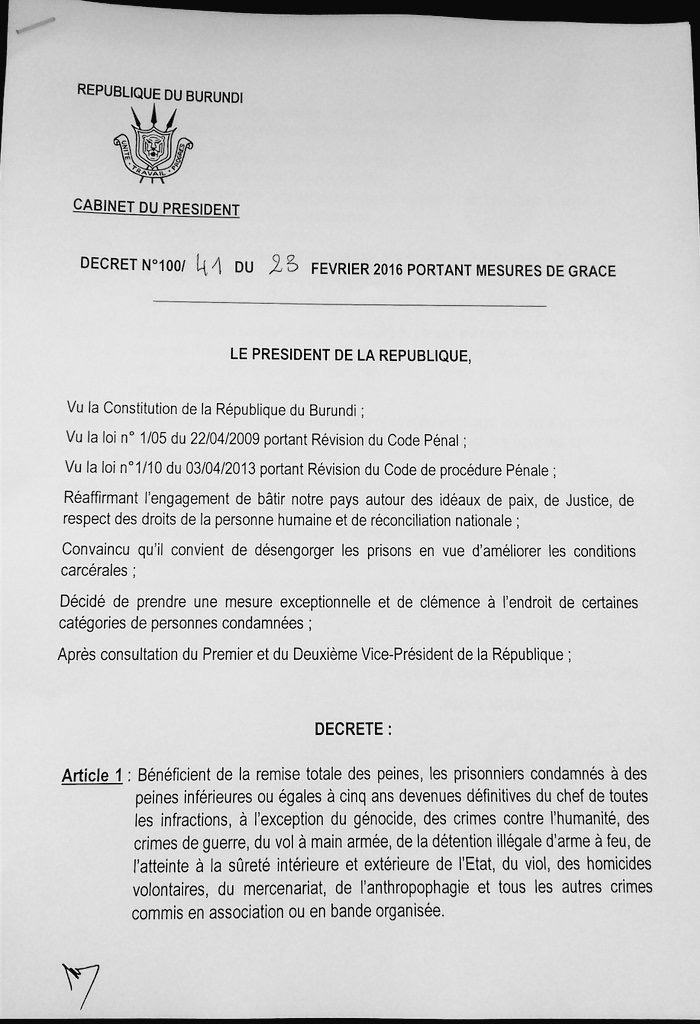
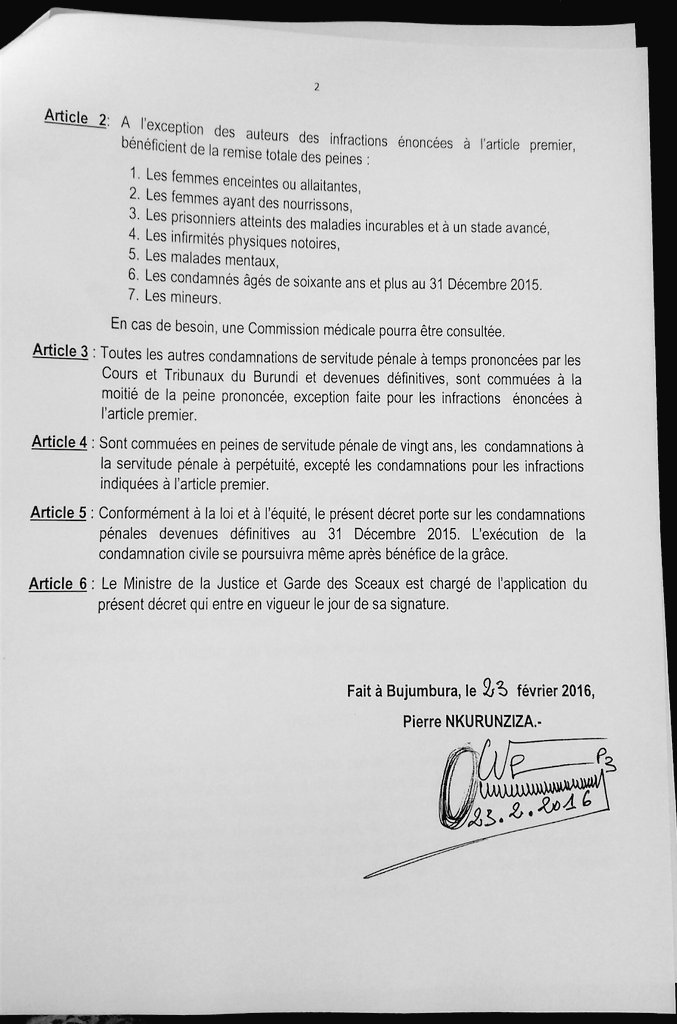
  On the other end of the human rights spectrum, Ban made much of Nkurunziza's ostensible commitment to release political prisoners and meet with "the opposition." But which opposition? And which prisoner? Inner City Press while ousted from the UN published what Nkurunziza signed, here and here, and on February 25, filing a lawyer's letter directing the UN to not touch its office or files, entered and asked UN Spokesman Stephane Dujarric these questions, UN transcript:

Inner City Press: I wanted to ask you about Burundi first.  I saw the statement by the Secretary-General praising the reopening of some radio stations and the release of prisoners.  And I wanted to ask you two questions about that.  One is, is he aware, and what do you say that two… two of five radio stations have opened and they've been forced to sign pledges to not undermine the country's security?  Is that… does he think that that type of pledge is legitimate?  And on the prisoners, most people are saying that the… this document signed by President [Pierre] Nkurunziza doesn't involve the release of any political opponents, FNL [National Liberation Front] members or anything else.  It's sort of a… it's one of those fake releases where these are people that have nothing to do with the unrest.

Spokesman:  I think what the Secretary-General did yesterday was to welcome these as initial steps and said that it was not enough and he would want to see more.  I don't have any particular reports on pledges that were signed.  Obviously, as a matter of the principle, radio stations in Burundi should be able to broadcast freely and fairly any news that they want.  And, as for the detainees, I don't have the details of who they were.  Obviously, there are different reports.  But as I said, we would want to see more people released.

Inner City Press:  Well, the document that the President signed, it's been published and it's clear that it doesn't cover the people that are part of the opposition.

Spokesman:  I think it's… as I said, we welcome this as an initial step, and we'd like to see more.

Inner City Press:  And will there be follow-up?  What follow-up is the UN going to give having…?

Spokesman:  Mr. [Jamal] Benomar has an expanded team there.  They are in constant contact with the Government.

  Compare Dujarric's canned answers to this critique from ICP's sources on the ground:

Article 1 mentioned categories of those who are supposed to be realized. The common fact is that those mentioned in the article do not have any relation with the Ongoing political unrest. Actually, we were excepting the realise of FNL, MSD, and all political prisoners such as insurgents, and the above mentioned opponents to the regime. But none of them would fall under the categories evoked by the article.

 On Ban Ki-moon's meeting with Nkurunziza: Is the dialogue going inclusive. We shall be able to see it if Nkurunziza says that is going to meet key opposition figures and the civil society leaders, including Nyangoma (CNARED), Sinduhije (Red Tabara), Nininahazwe Pacifique, etc. When? And where? Remember Nkurunziza said that he'll never seat on same table with co-plotters, protest and insurgent leaders as well. So, what is the guarantee that he changed is mind? We'll have more on this.

In Bujumbura on February 23, Ban said:

"I welcome the decision by His Excellency President Nkurunziza to withdrawal some media bans, cancel the arrest warrants and release detainees as good will gestures. President Nkurunziza told me this morning that he will release a list of twelve hundred detainees and take other measures. I have asked him, while I welcome these generous support and measures but I would expect that additional measures should be taken. This is an encouraging step. I hope again additional measures will be taken."

  On February 19, Ban's guards and DPI threw Inner City Press out of the UN, physically, and have yet to restore its Resident Correspondents pass.

But even from the park in front of the UN on 43rd Street in Manhattan, Inner City Press interviewed Security Council ambassadors about Ban's trip, which despite his typical lack of transparency has in fact begun on February 22.

Inner City Press tweeted a photo, here, and reports from sources that already, five men have been killed in Bujumbura and Gisozi while Ban was in the country.

Echoing again  Ban's "victory tour" of Sri Lanka in 200. That one, Inner City Press covered - and things have proceeded.

At the February 5 UN noon briefing, Inner City Press asked Ban's Deputy Spokesperson Farhan Haq about Burundi, video heretranscript here.  

  Handpicked to go and memorialize the trip was Reuters, which barely reported what happened. There is a history, of Reuters UN bureau hereand here; on February 3, Reuters correspondent Michelle Nichols went so far as to cut off Inner City Press' questions to the UN, Vine here.

  On February 3 Reuters' UN bureau chief Lou Charbonneau, a censor,  channeled a UN (DRC) report -- note not only the former Reuters official turned Eritrea sanctions “experts” exposed by Inner City Presshere, but also that this same now discredited Reuters / UN individual was previously ON the DR Congo panel. Typically, Reuters did not actually put the report online.

  Inner City Press in the spirit of transparency is publishing the (update) report, dated January 15, 2016, signed by Coordinator Gaston Gramajo, and its two paragraphs about 18 Burundian combatants, here


Readers can draw their own conclusions, including about the mandate and motivation, and if these 18 is really the way it would go.

 On January 28, Inner City Press asked UN spokesman Stephane Dujarric about a meeting held but not televised on January 27, at which it was urged that mass grave sites in Burundi be preserved as evidence,video here, transcript here.

On January 29, Inner City Press asked Dujarric again, transcript here.
 

  So it's all on Zeid, nothing from Ban Ki-moon, who appears to be playing this like he did Sri Lanka...

 At the UN Security Council stakeout, Inner City Press waited -- including through two North Korea questions, and softballs -- then asked if this UN use of Burundian troops makes sense. There has yet to be an answer, although there are indications one might be forthcoming. (More than 24 hours later, no).  Here for now is about the US training Burundian troops. Watch this site.

Inner City Press asked Ban's spokespeople about the trip on January 20, 21 and 22 - including asking why the UN was not providing a video or at least audio stream of the January 22 press encounters, says it has a  "UN Information Center" in Bujumbura, which produced a smiling photo of the French deputy ambassador Alexis Lamek on the tarmac. The UN said it couldn't.

  Local media in Burundi put online a video in which Lamek spoke at length; afterward a pro-government Burundian media quoted Lamek that "we" take seriously the question of interference by Rwanda to destabilize Burundi and will be working on it.

  But the four scribes handpicked to accompany the Security Council trip, inlcuding Agence France Presse, it seems, for some reasons didn't cover it. Why? We'll have more on this. Instead, AFP, Reuters andVoice of America (which saw "Liberians" then cited auto-correct) filed near-identical stories with no quotes from opposition figures or attacked journalists. None of the three even tweeted on January 23, other than Reuters as a robot: talk about Old Media.

  How could "Agence France Presse," handpicked to publicize the UNSC trip co-led by France, not even cover the controversy?

  We note that the French Mission to the UN said that Lamek was being misrepresented (the same French Mission has tried to shield Lamek from critical Press questions, which here on Vine Lamek has refused to answer even when entirely audible). Later an AFP quote emerged of Lamek saying that any AU force, even the 100 human rights observers, should significantly focus on the Rwandan border.

  On the evening of January 23 the UN has put up select clips including a mere 16 seconds of French deputy ambassador Lamek, much less than the local Burundian media present at the same press encountered had.  If the UN filmed the press encounters, why did it so selectively edit them?

  More specifically, now, who decided on the edits?

Inner City Press, which is the media which on January 22 asked for the live-stream, has asked the UN, publicly on Twitter, here, and in more detail by e-mail to three top UN spokespeople:

"having just seen that your Office put online edited video from Burundi, must ask: why did UN edit the footage it has, with no Burundi government speaker, and only 16 seconds of France, penholder in the UNSC on Burundi? Please provide the full footage, in response to this request and, separately, online. Would also still like answers to questions below" on Burundi.

 And still no answers at all, the next day. Watch this site.

  The UN spokespeople refused to say, but beyond the pro-government "religious leaders" that they cited, the Council also met with at least some of the concerned members of civil society, and some journalists who inevitably raised the issue of attacks and censorship. This was not mentioned by the UN.

  We're told that Ambassador Albert Shingiro, who blocks the Press on Twitter, told the scribes that US Power said she would send “a strong message to the government of Rwanda." Again, Shingiro blocks the Press on Twitter: some diplomat.

  One of the four handpicked pass-throughs opined that "the fact that Council members presented Nkurunziza with a largely unified message on the different issues was seen as a positive sign that they had come closer to a common position." So they traveled to Burundi to work on their own issues? We'll have more on this - and on the Council's junket-ending meetings in Addis, if not on Oromo protests, than this we've asked about. Watch this site.

   On January 22, Inner City Press asked UN Deputy Spokesperson Farhan Haq for the UN's response to Pierre Nkurunziza denying the existence of his party's youth militia, and why there was no video or even audio stream of the Security Council's - and Nkurunziza's -- press statements. Video here.

  Haq replied that "the facilities are difficult," that the UN Spokesperson's Office had reached out to the traveling party for information but hadn't gotten any. The Free UN Coalition for Accesscalls this a failure.

 On January 21 Inner City Press in New York learned both of Pierre Nkurunziza plans to parade "community work" for the Security Council members on January 22 and has been provided with a letter promoting same, here.

  On January 22, even after the Council's meeting with Nkurunziza was over, when Inner City Press asked the UN for a read-out there was none, nor any good explanation of why the UN with its country team could not arrange at least an audio stream of the Council's (and Nkurunziza's) press statements.

 Tellingly, IWACU reports that bike taxi and motorcycle taxi drivers offered money to protest in favor of Nkurunziza weren't, after the fact, paid: here.

On January 19 at the UN, Inner City Press asked Uruguay's Vice Minister for Foreign Affairs Jose Luis Cancela, chairing the Security Council debate on Protection of Civilians, about Burundi and the Council's trip. Video here.

  On January 21, Inner City Press and the Free UN Coalition for Accessasked UK Permanent Representative Matthew Rycroft about his stop-over on Addis Ababa, "will you as UK meet with AU before heading to Burundi? About AU's proposed deployment?"

   Rycroft replied, "Yes! Looking forward to meeting @AU_Chergui today. Will also return to Addis with whole UNSC after Burundi."

  In Addis, Chergui had filed the Concept of Operation for the MAPROBU peacekeeping mission. We'll have more on this.

  Burundian civil society has written to Ban seeking the repatriation of the country's peacekeepers. Inner City Press has put the letter from Vital Nshimirimana to Ban online here, and will be asking the UN about it. Watch this site.

  On December 30 Nkurunziza threatened to have his forces attack peacekeepers proposed for the country.


Obtained by Inner City Press

Ladsous' lack of vetting was criticized in the recently released report into the cover up of peacekeepers' rapes in the Central African Republic. Earlier, Inner City Press exclusive reported on Ladsous in his October 1, 2015 meeting with Burundi's vice president saying that he is "pragmatic" on human rights.

 On December 16 Inner City Press was banned from questions to Secretary General Ban Ki-moon, but learned from the mission MINUSCA that Baratuza was already in Entebbe. Inner City Press asked several Security Council members, then Ban's spokesman Stephane Dujarric on December17.

Dujarric told Inner City Press Baratuza's deployment is suspended and he is being repatriated: "based on the information we've received regarding the Lieutenant Colonel, his deployment has been suspended, and he will be repatriated back to Burundi." Video here. Dujarric told Inner City Press this shows the UN system working - on a day when a report on rapes was issued showing UN Peacekeeping under Herve Ladsous not sufficiently vetting for human rights. We'll have more on this.


 Amid the escalating killings in Burundi, summary executions in neighborhoods opposed to Pierre Nkurunziza's third term stand out. But Burundi Army spokesman Gaspard Baratuza was quoted on December 12 blaming all of the deaths on attempts to steal weapons to free prisoners.

   Inner City Press heard that Mr. Baratuza was already in the process of being deployed to the UN Peacekeeping mission in the Central African Republic (MINUSCA) even when he was giving these quotes, issuing statements and speaking to state-owned radio, and so asked MINUSCA's acting spokesperson, “Is Gaspard Baratuza of Burundi's army getting a MINUSCA job?” Ultimately, after the questioning, he didn't.
 
   But the UN should have to say more. Inner City Press has repeatedly asked the UN how its Department of Peacekeeping Operations under Herve Ladsous vets those who deploy to UN missions; Inner City Pressexclusively reported on an October 1, 2015 meeting in which Ladsous told Burundi's Vice President Joseph Butare that he is “pragmatic” on human rights.


 Ban Ki-moon and his spokesman declined to take Inner City Press' questions on December 16, as they did on December 14. Vine here.  Watch this site.

Wednesday, March 2, 2016

UN Used Cristina Gallach To Oust Inner City Press on Feb 19, Now She Says Tweets On It SINCE Feb 19 Justify Ouster: Kafka


By Matthew Russell Lee
UNITED NATIONS, March 2 -- The decision to throw Inner City Press out of the UN on February 19, on only two hours notice, was made by Spain's highest UN official, Under Secretary General of Public Information Cristina Gallach. Audio here.
   With seeming disdain for due process, Gallach never once spoke to Inner City Press before signing the letter to throw it out, to hear its explanation of why it sought to cover an event in the UN Press Briefing Room three weeks earlier onJanuary 29.
 Now on March 2 we can report that Gallach is worse than sources said: not only incompetent, but an outright censor. 
After throwing Inner City Press in the street on February 19 without once asking it about its attempt to cover the January 29 event in the UN Press Briefing Room, Gallach first dissembled to Nobel Prize laureate Jose Ramos Horta, that she'd done nothing to Inner City Press - then came up with a new strategy.
  Gallach would try to use Inner City Press' fight back against being censored as the rationale for what she had done.
  Inner City Press, even after being forcibly thrown out of the UN on Gallach's orders on February 19, and being told it was Banned from all UN premises on February 22, tried to speak with her on the evening of February 22. With witnesses present, Inner City Press urged a creative solution, with flexibility on both sides.
But there was none.
Now, Gallach is telling her interlocutors that it is Inner City Press' fight-back since, including tweets, that justifies what she did before Inner City Press issues a single tweet mentioning her.
This is Kafka-esque, and it is censorship. This should NOT be atop the UN Department of Public Information. 
  Gallach followed and fed an anonymous troll twitter account which more than 150 times parroted her position. But she is not responsible for it? This is the face of UN censorship.

  How was such a decision, contrary to due process and press freedom, made by the UN's communication chief? How did she get this job?
   When Spain put Gallach's name in contention for the USG DPI position, Inner City Press reported on her and two other short-list candidates, then acting chief Maher Nasser of Palestine and Romania's Permanent Representative Simona Miculescu. 
   At the time, many said Nasser was the most qualified. But because Saudi Arabia put forward its Deputy Permanent Representative and used the muscle it is showing on Yemen, Iran and now Lebanon to demand support, Nasser was not about to get the support of the Organization for Islamic Cooperation (OIC) or the Arab Group.
   But many said Gallach was the worst interview, and had the least experience. They say - and Inner City Press has a question pending to confirm or deny - that prior to Spain putting Gallach forward to run the UN Department of Public Information with some 700 staff, the largest team Gallach had run had consisted of one-hundredth of that, more like SEVEN people.
  In most organization, such a person would never get the job. But this is the UN. Spain was about to take a two-year seat on the Security Council, and the Ban Ki-moon administration has a pattern of doling out high jobs to some of the countries coming on to the Council (less so the African countries), as a way of getting support for proposals it will have before the Council.
  And so Gallach, described as underprepared and the “worst interview” of all the candidates, was given the job by Ban Ki-moon.  Miculescu was given a consolation prize with the UN in Serbia. Nasser stayed on as a deputy to Gallach, seemingly not consulted even when Gallach, on February 19, decided to have a long time UN journalist thrown to the curb, on two hours notice.
  Prior to that - and separately requiring Gallach's recusal - Inner City Press had accurately reported the Gallach hobnobbed at the "South South Awards" with Frank Lorenzophoto here, just before he was indicted for bribery at the UN. 
  This is why senior UN officials telling Inner City Press to "stay in touch with Cristina Gallach on this matter. She will keep me informed" is both Kafka-esque and indicative of the UN's inability to clean up or even look into corruption.
  There are a number of connections between those indicted for bribery and DPI and its partner in this, the UN Correspondents Association who event in the UN Press Briefing Room Inner City Press was seeking to cover on January 29, on corruption related issues: how indicted Ng Lap Seng was given a photo op with Ban Ki-moon by UNCA, after UNCA took money from Ng's South South News. This has yet to be answered either. 
  Or perhaps the ouster is the answer.
  When Ban Ki-moon imposed his most recent budget cuts, the Department hardest hit was Gallach's DPI. Staff complained she didn't fight for them; those to whom she made presentations in the UN's budget process called her woefully unprepared, “a joke,” one of them said.
   But to throw an investigative journalist into the street, without even coat or passport, to refuse to reconsider it even when contacted as Gallach was by such people as Nobel Peace Prize winner Jose Ramos Horta (she dissembled to him), a range of Ambassadors and even, privately andpublicly, by the President of the Security Council, is not a joke at all.
  When Business Insider wrote about the ouster, published on February 26, Gallach couldn't (be bothered) to give a quote: an unnamed DPI spokesperson said it was fine to throw out Inner City Press without even speaking with it or allowing an opportunity to be heard:
“When contacted for comment, the Office of the Undersecretary General for Communications and Public Information did not deny that Lee had never been questioned over the incident before his pass was revoked. 'In conducting its investigation into the incident on 29 January, [Department of Public Information] reviewed several videos of what happened, including footage that was taken by Mr. Lee and posted on his website,' a representative of the office wrote in an email to Business Insider. 'DPI also spoke at length with the Office of the Spokesperson for the Secretary-General and officers from the UN Department of Safety and Security who were in attendance on 29 January. These steps were sufficient to determine that Mr. Lee's actions clearly infringed the guidelines that apply to all correspondents at the United Nations.'”
  Inner City Press asked UN Spokesman Stephane Dujarric about this quote; he has yet to answer. In writing, Inner City Press has asked both Dujarric and Gallach about this: but questions submitted back on February 20 have yet to be answered.
  Both Gallach and Dujarric are, however, among the handful of followers of an anonymous troll Twitter accountwhich is defending both of their actions, including interestingly to journalists in Spain.
   Ban Ki-moon is slated to be in Spain on March 1. We'll have more on this.