Sunday, November 1, 2015

In Yemen, Inner City Press on October 26 Reported UN Got 2 "US Spies" Captured, Reuters Said UN Deputy Secretary General Is On It, Then Ran Murky Correction


By Matthew Russell Lee, Exclusive follow up
UNITED NATIONS, November 1 -- The UN Secretariat's bungling of Yemen mediation has become ever more clear, according to multiple sources and documents exclusively seen by Inner City Press, see below. Now either the UN erroneous said its Deputy Secretary General Jan Eliasson is looking into two detainees the UN flew into the country - or Reuters is lying that the UN said DSG when it said "DSS" (Department of Safety and Security.)
  On October 26 Inner City Press reported that its sources exclusively told it of a new low, that the UN brought into Sana'a what the Houthis call two members of US intelligence, with the cover identification that they work for the company running the former hotel now occupied by the UN. But, the sources say, security in Sana'a recognized the two and they are now detained. 
  On October 30, Inner City Press asked UN Spokesman Stephane Dujarric about it, video heretranscript here and below. Dujarric acknowledged he knew about two "contractors."
  A full day later Reuters "reported" a piece citing an unnamed UN spokesperson about two "contractors," with no mention of the Houthis claim they work with US intelligence, which by now had also beenreported, along with Inner City Press' October 30 Q&A with Dujarric, by Al-Akhbar.
  But it's worse. Reuters initially (mis) reported that "'Two contractors have been detained and the Deputy Secretary-General (Jan Eliasson) is looking into it,' a U.N. spokesman said without elaborating or confirming if the two were American citizens."
  Then a day after that, Reuters blamed the UN for its correction to "'Two contractors have been detained and DSS (Department of Safety and Security) is looking into it,' said a U.N. spokesman."
  It would seem the UN spokesman, left unnamed by Reuters, said "DSS" and Reuters mis-heard it as "DSG," didn't note it would be strange for the UN's second highest official to be on two contractors when lower official Herve Ladsous is the one who made a call for 13 contractors in South Sudan.
 But Reuters, including the Thomson Reuters Foundation Trust.org,running its correction, says "UN corrects source of information in second paragraph." So the UN made the mistake?
 This is the same Reuters which on Friday regurgitated a UN report which Inner City Press had reported and asked the UN about fully two weeks earlier, same Reuters which refused to make public its policies, and tries to censor its anti Press complaints to the UN, here. We'll have more on this. 
  On Yemen, from the October 30 UN transcript:
Inner City Press: maybe you can confirm or deny that two individuals flew in to Sana’a on a UN plane have been detained by the Houthis who accuse them of being US intelligence individuals.  What was the protocol for getting on a UN plane to Sana’a?  Does the UN have a position of not flying in intelligent members of a UN member state?

Spokesman:  I'm aware of two people who I believe are UN contractors and their situation.  I don't have an update on it.  The protocol for flying on UN planes and on UN humanitarian flights is pretty clear.  I can give you the details.  We do not, we do not knowingly fly in or out combatants.

Inner City Press:  I just wondered, could you maybe say what kind of contractors they are?  I heard and reported they were making a building that the UN works in.  Is that true?

Spokesman:  That's my understanding. 

 We'll have more on this.
  Meanwhile the Houthis are denouncing UN envoy Ismail Ould Cheikh Ahmad and his (mis) representation to the Security Council regarding what they agreed to. This has happened before and the goal seems to be delay to allow for more air strikes. There's work of mercenaries, in essence, including from Colombia in Aden, joining the troops from ICC-indicted Sudan.
 A new level of dysfunction was hit with the deployment in Aden of hundreds of troops from Sudan, putting ICC-indicted Omar al-Bashir on the same side as the US and UK. (Inner City Press is exclusively informed that "UN" envoy Ismail Ould Cheikh Ahmed is working on a similar Saudi deal with his native Mauritania, see below.)
Now Inner City Press is reliably and exclusively informed of a letter, drafted by Saudi Arabia and conveyed to UN Secretary General Ban Ki-moon by envoy Ismail Ould Cheikh Ahmed, which has Ban thanking Hadi and stating that the Houthis have agreed without reservation to implementing UN Security Council Resolution 2216.  They have not - this is just another misleading move by the envoy, not a third strike but a fourth.
  But more fundamentally, why would Ban Ki-moon even consider signing a letter that was drafted by Saudi Arabia? Ban's Deputy Secretary General Jan Eliasson, arguably undermining the envoy, recently traveled to Saudi Arabia and then Iran.
  Inner City Press is reliably and exclusively informed that the Saudis snubbed Eliasson, denying several of his meeting requests and finally providing him only with the Foreign Minister, just before he left. In Iran, complaints against envoy Ismail Ould Cheikh Ahmed were lodged, that he does not have the trust of the Houthis. What kind of envoy is this? What kind of UN?
  After the UN Security Council's praise of talks ostensibly committed to UN envoy Ismail Ould Cheikh Ahmed was not updated after Hadi canceled participation in the talks, then the Saudi led coalition bombed Oman's Ambassador's house in Sana'a.
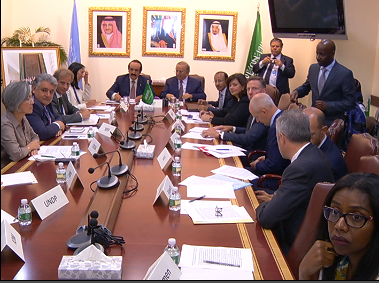
  The Saudi Mission to the UN, doling out information selectively as always, tweeted a photo of a meeting between its Ambassador and the deputy ambassadors of Security Council members the UK and US, of the EU - and UN humanitarian deputy Kyung-hwa Kang. What did Kyung-hwa Kang, if not the Ambassadors, say about the airstrikes?
  The UN's envoy Ismail Ould Cheikh Ahmed, after complaining about his leaked email showing his marginalization from Yemen talks, that Hadi had committed to come to talks. The Security Council praised him in a Press statement.
  Then Hadi canceled. It is similar to the UN's ceasefire-that-wasn't, and the failed "talks" in Geneva in which the UN never gave the Houthis passes to get into the UN building, after allowing them to be delayed along the way so that Ban never met them (while meeting with an individual on the US Al Qaeda sanctions list.)
  In many contexts it's "three strikes and you're out," in this case faux ceasefire and two talks that never happened. But the Security Council has not updated its Press Statement of praise; some members apparently simply work around the UN envoy. We'll have more on this.
  On September 5 as airstrikes on Sana'a picked up force, there was no comment from the UN or its envoy Ismail Ould Cheihk Ahmed. Nor on September 6. On September 7, the UN finally spoke -- not about the airstrikes but about a leak.
  On September 8, Inner City Press asked UN Spokesman Stephane Dujrarric if he was denying the veracity of the UN email Inner City Press published, below. Dujarric did not deny it. Video here. Inner City Press on September 9 asked Dujarric's deputy, below, on September 9 about Ismail Ould Cheikh Ahmed.
  Inner City Press exclusively reported the following: on August 27-28 in Muscat, the US and UK, the EU Ambassador to the UN and Saudi intelligence, met with the Houthis -- without the UN and its envoy present, or even sources say aware of the meeting. These sources say that the UN's Ismail Ould Cheikh Ahmed was on vacation in his native Mauritania, and was entirely out of the loop. 
  On September 10, Inner City Press asked UK Ambassador Matthew Rycroft if the UK had met with the Houthis and GPC in Muscat, without the UN Envoy present. Video here. The answer, as transcribed by the UK Mission:
Inner City Press: There was a letter from the Envoy that seemed to imply that.

Amb Rycroft: There has been a lot of different types of talks in Morocco and different engagements with others. The United Kingdom and other countries are involved in some but not all of those talks – depending on the format. Whether or not we are there or not we are very supportive of Ismail and his work.
  Meanwhile Ismail Ould Cheikh Ahmed says the same parties will now meet with him. Replay?

  On September 9, Inner City Press asked UN Deputy Spokesperson Farhan Haq, video heretranscript here:
Inner City Press: I saw the statement by the Envoy that leaks may be distorting.  But I wanted to ask a factual question, which is that there are reports, and some are confirming, that there were meetings in Muscat by the US, UK, EU [European Union] ambassador to Yemen, the Houthis and Saudi intelligence that took place in August, 27th and 28th.  And I wanted to know, it seems that the UN's Envoy wasn't present.  Was this by choice?  Was he not invited?  Was he unaware?  What's his role in these talks that are taking place between the parties that I've named in Muscat?

Deputy Spokesman:  Well, I wouldn't have any confirmation about any of the meetings that do not involve Ismail Ould Cheikh Ahmed, the Special Envoy.  He has been present in Muscat as well as in Riyadh in recent days and has used his time in those two cities to talk to many of the key players representing the Government of Yemen, Ansar Allah and the General People's Congress, and so he is continuing with his efforts to get the parties to talk to each other and to get a halt to the fighting.  And beyond that, I wouldn't have any details on any meetings that take place outside of his purview. 
  The September 10 briefing by this envoy to the UNSC was requested by the UK - which, it seems, met with the Houthis without Ismail Ould Cheikh Ahmed.
  Sources also note to Inner City Press that the Saudi have "dissed" Ismail Ould Cheikh Ahmed, relegating him only to meeting with Saudi intelligence, not diplomats as was previously the case with the UN. This too is embarrassing to the UN. Hence the Sunday evening statement:
"The Special Envoy for Yemen of the Secretary-General of the United Nations, Ismail Ould Cheikh Ahmed, is disturbed by press reports regarding the leak of internal United Nations correspondence. The content of these reports, especially in some Yemeni media outlets and Internet sites, constitute distortions and misinterpretations. These reports do not reflect the position of the Special Envoy or of the United Nations."
 A well placed UN source told Inner City Press that the replacement envoy should never have commented on the leak, especially while remaining silent on the increased airstrikes and Qatar sending troops and Apache helicopters. 


Perhaps the discomfort is with the reference to the US National Security Council's "Eric Polovski" (that is, Eric Pelofsky) being "on board." Another source exclusively told Inner City Press that in the Security Council's last meeting on Yemen, those raising the mounting humanitarian toll were Venezuela, Chile and New Zealand. Consider again this, to USg Jeff Feltman:
"Dear Jeff,
Before traveling to Jeddah I held two days of meetings with Ansar Allah and GPC in Muscat in which I tried to convince them to improve upon the 10 points which they had submitted to me earlier. This was necessary to respond to concerns in Riyadh that the commitments to the implementation of 2216 were still inadequate and failed to include recognition of the legitimacy of the government.
AA/GPC agreed to a new wording on UNSC resolution 2216 that states unequivocally that they are committed to the full implementation of 2216, (see document attached) with the exception of article which infringe on Yemeni sovereignty and those related to sanctions.
In addition, the new text includes acceptance of the return of the current government for a period of sixty days during which a new government of national unity shall be formed. They also accepted to remove references to counter-terrorism and the Saudi border to which the GoY had objected, as well as the mandatory support by the international community for reconstruction that was in the earlier version. The latter was particularly opposed by KSA and GCC who did not want it to be interpreted as a form of mandatory compensation. Both Ansar Allah and GPC seemed positive and showed considerable flexibility.
My meetings followed two days of meetings between the Ansar Allah and KSA intelligence officers which were also attended by the US, UK and Oman. The discussions focused on possible confidence building measures such as a pullback from border areas in exchanges for a cessation of airstrikes and agreements in which they would cease operations within Saudi Arabia. This was the first time that Ansar Allah have been open to discuss limited and geographically specific agreement. Although they repeated that the return of President Hadi would be unacceptable, they expressed their openness to the return of the government for a limited time. The US Ambassador, Matt Tueller has been keeping me regularly informed of these discussions, which has been most helpful. The confidence building paper proposed by the Houthis to KSA is attached for reference.
Although US officials were disappointed that Saudis had sent relatively junior representatives, they still felt the meetings were positive, largely friendly and a good way for KSA to sound out Ansar Allah’s intentions. Ansar Allah and KSA agreed that there should be further meetings with hopefully more senior representation although no dates were agreed. The meetings unfortunately shed very little new light on KSA’s strategy in the conflict or their willingness to support a negotiated settlement in the near future.
The meetings in Muscat were of course heavily influenced by the military developments in Yemen. The coalition has not been able to make rapid progress since their successes in Aden, Abyan and Shabwa in August. Taiz remains contested and there are reports that Ansar Allah has regained some territory which had been lost in the past week. The coalition’s difficulties moving northward suggest that an assault on Sanaa would likely be difficult and time-consuming than they had previously expected.
The instability and violence which have plagued Aden following its capture is likely also a source of concern. The mostly pro-independence Hiraak fighters are unwilling to cooperate fully with the GoY in attempts to expand northward. This leaves the coalition dependent on ground troops from Islah, Salafi and AQAP related groups, which UAE is reluctant to support.
Conclusion:
I believe, following my discussions in Muscat, that we now have a strong opportunity to obtain a peace deal, and avoid a violent confrontation in Sanaa, for the following three main reasons:
i) The revised paper (attached) is much stronger and contains serious concessions by the H/GPC. It will be difficult, at this stage, to push them towards further concessions.
ii) The recent slower advance of the GoY affiliated forces around Taez and Maarib could also offer another opportunity.
iii) The on-going insecurity and lawlessness in Aden, and the increased visibility of AQAP in Aden region in the aftermath of the liberation of the city by the GoY and Coalition forces, has started to raise serious concerns for UAE, and in some KSA circles.
In light of the above, I have reached the conclusion that we should now move towards a new round of direct talks, two and half months after our first round in Geneva. My recent shuttling has now reached a point whereby it is becoming somewhat transactional with the Special Envoy obtaining a paper from one side and seeking comments/acceptance by the other side. I do not think we can sustain this and I recommend we move to a more strategic phase. I recommend holding this next round of talks in Oman Sultanate as a first choice, which seems to be acceptable to the Omanis and all parties, especially KSA. My second proposed option would be Kuwait, however the Houthis are still hesitant about this potential venue. Ideally, we should aim at holding this meeting before Eid.
My discussions in Jeddah and Riyadh will be explicitly in favour of moving to peace talks phase as opposed to continuing this shuttling around papers/proposals. I have first indications that Abu Ali and Matt Tueller are supportive of this new approach. In this regard, it was important to time my visit to Jeddah before the meeting between King Salman and President Obama tomorrow. Eric Polovski – White House NSC – who was just recently in Muscat is also fully on board on this.
I am conscious that the implementation of this new proposal depends very much on the GoY's openness and the KSA genuine support (and not only on what I am hearing from Abu Ali). But this proposal is also the only way to keep the UN's efforts at the center of the mediation process and to avoid a fatigue among our various stakeholders, especially the H/GPC. This is why I once again need the support of the SG and the P5.
Best regards. Ismail
Muscat Principles for a Solution to the Political Crisis in Yemen
Commitment by all parties to implement relevant UNSC resolutions including resolution 2216, according to an implementation mechanism to be agreed upon, and without infringing on national sovereignty, and with reservations regarding the sanctions against Yemeni citizens.
A permanent and comprehensive cease-fire by all parties with the withdrawal of all armed groups and militias from the cities, according to an agreed mechanism to avoid any security and administrative vacuum along with lifting of the land, sea and air blockade.
Agreement on neutral monitoring instrument in order to verify implementation of the mechanisms mentioned above that will be agreed upon, under the auspices of the United Nations.
To respect international humanitarian law, including the elements relating to the protection of civilians and the release of prisoners and detainees from all parties, including those mentioned in UNSC resolution, and to facilitate humanitarian relief and allow the entry of commercial goods, food, medical supplies, oil derivatives and other essential good without restriction.
Kaled Bahah’s government, formed by consensus, returns and performs its tasks as a caretaker government for a period not extending 60 days, during which a government of national unity is formed, in a way that does not violate the constitution.
To resume and accelerate United Nations-brokered negotiations, according to the UNSC resolution.
All parties are obliged to hand over heavy weapons to the State in accordance with the outcomes of the Comprehensive National Dialogue."
Note: the "Eric Polovski" in the above would seem to be Eric Pelofsky. Just saying.
   On September 1 the Office of the High Commission for Human Rights raised its estimate of civilians killed to 2,112 (from March 26 to August 27), with 4,519 civilians injured in that period in what OHCHR called a "conservative estimate." 
  OHCHR cited an airstrike on Taiz on August 20 which killed 53 civilians. OHCHR said "Fifty-three of these civilian deaths occurred on 20 August, reportedly as result of a series of airstrikes by Saudi-led coalition forces that hit 20 homes near Salah Palace in Taiz. According to local reports, active fighters in the Houthi popular committees were believed to be based in the Salah Palace at the time."  Believed? Question to OHCHR in this case: what is international law?
 Or this one: "attacks by coalition forces on Hodeidah port, which is a key entry point for humanitarian supplies and commercial imports into Yemen."  
   UN Relief Chief Stephen O'Brien on August 19 told the UN Security Council, "To date only 18 percent, some $282 million, of the $1.6 billion requested through the Yemen Humanitarian Response Plan has been received. UN agencies have still not received the funding from Saudi Arabia of $274 million pledged in April."
  After O'Brien said that, Inner City Press asked Yemen's Permanent Representative at the UN, down the hall toward the Trusteeship Council Chamber, about it. He told Inner City Press, among other things, that explains the request for a UN "liaison" in Riyadh. 
  After the Security Council's triplet of meetings on Yemen, Syria and South Sudan ended on August 19, Inner City Press asked New Zealand's Permanent Representative Gerard van Bohemen "On Yemen. Mr O’Brien said that Saudi Arabia haven’t paid the pledge and that there was some dispute about the UN sending maybe somebody to be a liaison, what was said about actually getting aid unblocked?"
 
  Ambassador van Bohemen replied, "I think you need to talk to him about it. What he explained was there’s been quite a complicated discussion going with the Saudi government about the terms on which the money will be made available, but he knows the detail about it, I don’t."
  We still hope to have more on this.
  On August 7 Inner City Press was informed that as Houthis and Saleh's GPC headed to Oman for consultations on August 8 and 9, the UN's replacement envoy Ismail Ould Cheikh Ahmed was not even initially invited. He had to beg to get included, which after sweating has been allowed, in the run-up to his briefing on August 12 to the Security Council.
 On August 12, Inner City Press asked Yemen Permanent Representative, outside the Council meeting, questions ranging from the destruction of schools and health care facilities in Sa'ada by Saudi airstrikes to when, according to him, the Houthis might be "driven" out of Sa'ana. Video here. He said in a few weeks - and added that the Oman talks were "not UN."
 So how then might the parties negotiate? UN spokesman Stephane Dujarric said Ismail Ould Cheikh Ahmed was headed back to Riyadh. That seems to be his base, where he works from - and for? Watch this site.

  Oman has received murky thanks for France for facilitating the release of a hostage, who was working for the Social Development Fund there. Did Oman pay for France? Or will others be released, as France brought about in Mali?
  On July 28, Inner City Press asked Saudi Arabia's Permanent Representative about Mokha or Mocha; he replied that previous allegations about Saudi airstrikes on Old City Sana'a and on a palace in Aden once used by Queen Elizabeth had been proven untrue. We'll have more on this.
  Inner City Press asked Yemen's representative about the talks in Cairo involving the United Arab Emirates, allies of former president Saleh and, it's said, the US and UK. He replied that the Yemeni government - in exile - deals through formal channels, the GCC or UN.
  He might have been asked, which foreign minister is he reporting to: the one named by Hadi, or the one - his predecesor - named by Bahah? We'll have more on this as well. 
   After publishing its multi-sourced story, Inner City Press on July 22 asked the UN's Associate Spokesperson about new APC and weapons in Aden, and if Ismail Ould Cheikh Ahmed is on vacation. Video here. She replied that she would check - but did not revert with any response either way.
  So on July 23, amid reports that without Cheikh Ahmed or any UN presence talks were occurring about Yemen in Cairo, Inner City Pressasked:
Inner City Press: on Yemen, yesterday you'd said you would check on Mr. Ould Cheikh Ahmed, whether, in fact, he is on vacation at this time.  Did you?

Associate Spokesperson:  No.

Inner City Press: You said leave is a good thing.  In the transcript, you said, I'll check on his vacation.  But yes, people do take leave, it is a good thing, although there are people in Yemen who say, given that the humanitarian pause failed, it seemed a strange time to do it.  So I just wanted to know, factually, is it, in fact, the case?

Associate Spokesperson:  Is it the fact…?

Inner City Press:  That he's on vacation after the failure of the humanitarian pause.

Associate Spokesperson:  I don't know specifically for the Special Envoy, but I can tell you that, you know, most people at that level at the UN, all people at that level at the UN continue to work on their portfolios wherever they are and whatever they're doing.  These are portfolios that you can't just drop.  And I'm sure that's the case also with the Special Envoy.  As far as leave goes, you know, I'm not going to get into a “who's on leave when”, blah, blah, blah, with you.  I just… I don't want to do that…

[cross talk]

Inner City Press:  I'm just saying because yesterday, you said, "I'll check".

Associate Spokesperson:  Because as you mentioned… as you mentioned yourself, you know, leave is part of working life.

Inner City Press:  Okay.  Was he also on leave when UN staff had to leave Libya and he was the deputy SRSG in Libya?  Because that's what I'm told by the people…

Associate Spokesperson:  He was also on leave when what…?

Inner City Press:  On leave when the people were evacuated from Libya that were the staff members of the UNSMIL mission.

Associate Spokesperson:  Well, I just said I'm not going to go and check his attendance sheet.
 So much for checking. 

  Inner City Press asked the UN where Cheikh Ahmed is. UN Deputy Spokesperson Farhan Haq told Inner City Press that he has been "planning his travels," soon to Riyadh. Yeah, Inner City Press was told by another less constrained but at least as knowledgeable source: planning his future travels while already on vacation. Another source compared it to then UN envoy to Pakistan Jean-Maurice Ripert going on vacation amid national disasters in Pakisan and then losing his post. 
   The buzz in Sana'a, where Hadi has named a governor in exile described as an Islamist, is that Cheikh Ahmed may well have known of the plans to bring in APC and weapons to those fighting the Houthis in Aden, and so "misleadingly" urged a pause. Another compared this to the UN luring out surrendering rebel leaders in Sri Lanka - to their deaths.
  And so from Aden, photographs of brand new light brown vehicles, American-made, brought in. Will they end up in the hands of Al Qaeda?
On July 20, Inner City Press asked UN deputy spokesperson Farhan Haq:
Inner City Press: I wanted to check first if you have anything on Yemen and the activities of Ismail Ould Cheikh Ahmed.  What's he been doing in the last few days, amid reports of continued death and destruction in the country?

Deputy Spokesman:  Yes, Mr. Ould Cheikh Ahmed has been planning his onward travels.  The only one to confirm at this stage is that he does plan very shortly to travel to Riyadh, where he is to meet with Saudi authorities, authorities of the Gulf Cooperation Council, and with President [Abd Rabbuh Mansour] Hadi and Vice-President [Khaled] Bahah.  And so, he is going to try to talk to them.  He's continuing with his efforts to see what can be done to secure a humanitarian pause, even following the end of Ramadan and Eid.  And so, he's going to continue with those efforts and travel more broadly in the region after that.  We'll try and inform you of other stops as that progresses.
Inner City Press: There's some talk of, if not Mr. Hadi, other ministers trying to return to Aden.  Is the UN aware of that?  Do they have any comment on that?

Deputy Spokesman Haq:  It's not for me to discuss what the Government of Yemen is trying to do.  Regarding Aden, we have been concerned about the humanitarian situation on the ground.  Our humanitarian colleagues have been continuing even in the absence of a humanitarian pause on the ground to try to provide supplies.  I believe that, even though the pause did not go forward as we had wanted, about 60 per cent of the humanitarian activities that we had been planning did, in fact, take place.  And so we were able to provide some aid, although not nearly enough.  And, of course, we continue to be concerned about the fighting in Aden.
  Back on July 9, UN Secretary General Ban Ki-moon proudly announced a humanitarian pause to start on July 10 at midnight.
  When the supposed pause failed, Inner City Press was told on July 14, it took Ban Ki-moon more than two days to speak with Saudi Arabia, through its foreign and defense ministers. Ban, it was said, was "in the air."
 On July 14, Inner City Press asked Ban's spokesman Stephane Dujarric:
Inner City Press: Something on Yemen.  Yesterday, you said the Secretary-General was very, very disappointed.  So, I wanted to ask, if you can say, starting, I guess it would be, Saturday morning, right after midnight, it became pretty clear that there was no pause.  Did he make any… did he make any actual, like, calls, meaning like telephone calls or in some… did he reach out?  And can you confirm or deny that some within DPA [Department of Political Affairs] had suggested that he not put out that statement that seemed to imply that there was a pause agreed to as…?

Spokesman Dujarric:  No, I… listen, I'm not… Secretary-General was in the air a large part of the weekend.  He's also attending the Addis conference.  People at various levels were having various contacts.  The Secretary-General spoke to both the Defence Minister of Saudi Arabia and the Foreign Minister yesterday, in addition to other contacts that were had in the previous… you know, on Monday and over the weekend.  As to the deliberation… the internal deliberations of different opinions expressed within the UN Secretariat, I'm not going to go into that.  At the end of the day, it's the Secretary-General's call, and the statement he issued was clear.
  The day before on July 13 at the UN noon briefing Inner City Press asked Ban's spokesman  Dujarric why the UN had made another "call" for a pause sound like a commitment to a pause, at least by the Saudi led coalition. Video here.
  Dujarric answered that envoy Ismail Ould Cheikh Ahmed had told the Suadis of his desire for a pause. But that's not what the UN said on July 9.

   Ban was in Addis Ababa for the Financing for Development conference; here are his UN's "messaging" points in the run-up to that conference (and here an Inner City Press story about it; we'll have more). But isn't the UN responsible to say something after a humanitarian pause it announced doesn't happen, and people are killed? 
  It quickly became clear that some of key parties had not been spoken with or agreed; the pause's midnight beginning came and passed amid airstrikes.
  Inner City Press is informed by sources that Ban Ki-moon was urged to not make the dubious pause announcement, including from within the UN's own Department of Political Affairs -- but Ban announced it anyway.
  At best, it was rolling the dice. At worse, on the very day that UN is rightly criticizing itself for making false promises of protection in Srebrenica 20 years ago, in this case Yemenis were told there would be a pause, and some perhaps relied on it, to their detriment. And still the UN had said nothing.
  After the July 9 announcement, Inner City Press asked Ban's spokesman if the Saudis had been spoken with. The answer was, Hadi told the Saudis his position. But did Hadi ever agree to the pause, or just to the conditions set forth in his letter to UN? What of Hadi's responsibilities to the Yemeni people?
Now Saudi Al Arabiya has said Saudi Arabia never received any communication from Hadi to stop airstrikes, here. Someone is lying.
  Where is the UN's replacement envoy Ismail Ould Cheikh Ahmed? Headed to Ethiopia, Ban's spokesman said, to meet with Ban on the sidelines of the Financing for Development conference there. Does IOCA harbor ambitions for another UN system post, or back in his own country? What sort of a track record is this? Watch this site.
 At the July 10 UN noon briefing in New York, Inner City Press asked Ban Ki-moon's spokesman Stephane Dujarric if the UN had spoken with those in Yemen opposing the Houthis but not supporting or in contact with Hadi. Video here. From Dujarric's answer, it seems no such contact has been made.
  So, Inner City Press asked, if such a group fires on the Houthis and they fire back, is the pause over, has it been violated? We'll see what happens.

Back on July 9, Inner City Press asked UN Spokesman Stephane Dujarric, transcript here:
Inner City Press: can you, one, characterize not the communications with Mr. Hadi, but with Saudi Arabia that's running the coalition, the Saudi-led coalition.  And does this mean the Secretary-General's understanding is no airstrikes during this time period, and no further advances or use of heavy weapons by the Houthis?  Does the pause mean no firing? What does it mean to each of those two sides?

Spokesman Dujarric:  What it means is that, if you read the statement, the President… Secretary-General notes that the President, President Hadi, has communicated his acceptance of the pause to the coalition to ensure their support.  A humanitarian pause means no fighting.  It means no bombing.  It means no shooting.  It means no fighting.  It means exactly that:  a humanitarian pause in the fighting that we've seen, to enable our humanitarian colleagues to get the aid to where it's needed, to preposition, and stockpile, and to reach the millions that need it.

Inner City Press:  Right.  But just for example, policing, who's doing policing in these various cities?  Things happen.

Spokesman Dujarric:  Obviously I think… [cross talk] In any area in the country, there is a… there is de facto control and, obviously, there is a need to ensure safety and security.  What we're talking about is a humanitarian pause in the fighting that we've been witnessing for weeks on end now.

Inner City Press:  So just one last thing on this.  So the commitment on airstrikes is through President Hadi to the UN?

Spokesman:  You know, the… [cross talk] Obviously, President Hadi is a critical interlocutor with the coalition.  And as I've said, we've taken note of the fact that he's conveyed to the coalition his acceptance.  We expect everyone involved in this conflict to honor this humanitarian pause.
 On July 7 the UN's Office of the High Commissioner for Human Rights upped its estimate of civilians killed since March 27 to 1,528, adding that one million people have been displaced since the beginning of this round of the conflict. To the Saudi airstrike on UNDP in Khormaksar, Aden, OHCHR added that "IOM’s Migrant Response Centre in Basateen, also in Aden, was struck by a mortar and an airstrike damaged IOM’s office in Harad."
   IOM, as Inner City Press reported, had earlier paused its evacuation by air of those seeking to flee Yemen due to some party, which it left unnamed, demanding information about those fleeing BEFORE the flights could leave. Inner City Press has asked others in the UN about this and has been told IOM should have done the screening after the people were able to flee. IOM refused a direct question about caused it to violate this best practice, then stopped sending the Press any information.
   There are countries, normally vocal about civilian deaths, which are selling military equipment to Saudi Arabia and its Gulf allies. Ban Ki-moon, now in Oslo, is relying entirely on Saudi-selected replacement envoy Ismael Ould Cheikh Ahmed, who was unable to even get the parties in the same room in Geneva, much less reach an agreement. There remain, for now, OHCHR's body counts.
  On June 24, Inner City Press asked the UN's replacement envoy Ismail Ould Cheikh Ahmed about the request by the Houthis and others to meet not with him but with Secretary General Ban Ki-moon, who did not meet with them in Geneva. Transcribed here
  On June 25 Inner City Press asked Ban's deputy spokesperson Farhan Haq to confirm receipt of the letter and if Ban will meet them. Haq said Cheikh Ahmed is the envoy, and Ban's headed to San Francisco. The UN Security Council issued a Press Statement, here.
 Also on June 25, Inner City Press asked new UN aid chief Stephen O'Brien three questions about Yemen: cholera, the destruction of ambulances in Sa'ada and about international staff. Video here.
  O'Brien replied that cholera is a risk; he had no information on WHO it was that destroyed the ambulances in Sa'ada (we can guess.) On international staff, which the UN evacuated earlier, he spoke of a rise from 17 to 70, with the goal of getting to 200. He would not say if they are anywhere in the country outside of Sana'a, citing security. But at least he spoke - the Free UN Coalition for Access thanked him.

Here's from the June 24 stakeout, as fast transcribed by Inner City Press:
Inner City Press: On the parties in Sanaa requesting to meet the Secretary General – what’s your response?
Cheikh Ahmed: "This question was raised during our discussion with the Houthis, the GPC and their allies. The Secretary General had delayed twice his travel in order to be there for the parties. We have sent twice a plane from Sanaa which the delegation from Sana'a could not take..  Therefore the Secretary General had a major engagement, which was the election of the new president of the General Assembly which takes place only once a year , and he had to attend it. But the Secretary General will continue being engaged on this."
  The ceremonial elevation of the President of the GA who will take over in September was not an election at all - no vote was taken.
 Before the meeting, UK Ambassador Matthew Rycroft stopped and told the press of the danger of famine in the country, and of his hope for a Yemen Press Statement from the UNSC, in which the UK is the "penholder" on Yemen.  Periscope video here, replay including on desktop for 24 hours.
 Inner City Press was digging into the letter from political parties IN Yemen, asking for a meeting with Ban Ki-moon, NOT with replacement envoy Cheikh Ahmed. These parties, including but not limited to the Houthis, were delayed in getting to Geneva so that they could not meet with Ban (who while there DID meet with a US-listed Al Qaeda terrorist).
  While some are sure to argue that Ban now meeting with the parties would undercut Cheikh Ahmed, others point out the the underlying resolution speaks of the Secretary General's Good Offices INCLUDING his Envoy. The envoy is not the only game in town - nor, given his lack of disclosure, raised by Inner City Press, should he be. We'll have more on this.

In Burundi, Speech Described As Genocide Threat After UK PR Rycrotf Told Inner City Press of Worry


By Matthew Russell Lee

UNITED NATIONS, November 1 -- As killings in Burundi increase, on October 23 Inner City Press asked UN Ambassador Matthew Rycroft about the status of the draft Presidential Statement in the UN Security Council. He said there are differing views, but the UK is concerned about the "threat of genocide." Video here.

 After Burundi was elected to the UN Human Rights Council with 162 votes on October 28, on October 31 security forces in Burundi opened fire on a funeral procession in Buringa, killing many.  These are the Burundian forces that UN Peacekeeping under Herve Ladsous keeps in service, offering waivers while the Government keeps the payments?

  It is reported the Burundian authorities are accusing a medical NGO of offering treatment to insurgents, and are ready to attack. Frankly, the weak UN Security Council Presidential Statement which France belatedly proffered in the Council, then didn't even hold a question and answer stakeout about, is woefully insufficient, as is the UN Secretariat's response.

 Now from Burundi this speech, of which we will run a Google Translate:

I told you that there is no Island in Burundi; you can not say "I hide behind the window and the police pass and then I throw a grenade at them," Do you think that when they take notes and pictures they do not see how these people carry? (...) Do you think it is not well recorded somewhere? As I told, you are the leaders of the District, will give them the message because you know each of you, and if you do not know the people you lead, you are good for nothing! Go warn them so that tomorrow there is no regret. I will say this clearly: intimez orders to your subordinates, say the heads of Groups of 10 households, in the case of guns, collect them; if it grenades, collect them too. (...) I do not know if you enter me! Hein !! Go to Mogadishu first, and you'll know what it is that the National Army. (...)

You will stay here in Bujumbura, you will not go into the bush, and if you try, we will not spare you; the bush is already undermined, reserved for something else; you will stay in homes. You will fall here in homes. We will solve everything right here in homes. (...) And we do not do the feelings when it's time to take action! And I told you clearly. I said the same to common people, and he loves me, citizens do not reproach me so far! If we start this is over. If you hear the signal with an instruction that it must end, emotions and tears have no place! It's like that, you are the Heads of Districts, go talk to the residents of your neighborhood, if someone says "I accept to die", then you say to those who will execute the mission "on this part, we must pulverize "(ie ed exterminate", they are to die for! I order you, come on! You are the Heads of Districts, and you have under your command the heads of Groups of 10 households. Go to this message clearly! (...).

I said something in passing that it is even possible to have more opportunities to get the parcels. Yes, it is possible to get some plots. I do not know if you grasp what I mean! If you really want to have plots (note "work" and) you will have! Go forward the message, and do not say "if they still derive" What are you going to change if they shoot? I know how guerrilla works because I was part of a guerrilla. (...) They come out of the houses and we measure ourselves with them on the heights of the mountains and into the bush. Go to Cibitoke in Bukinanyana! I went there two days later (note saying the attacks of rebel groups), were fired at them even hidden under rocks. (...) You have elected summers, people trust you, tell them the truth! Do not play the game "never mind, we launched a grenade at a police officer" and you start to sing (celebrate). And the message that I give you is light. Go with this message and pass it on!

There are people who induce others into error, saying, "go ahead, all is well, there is no problem, we will join you" and suddenly you see 100 people killed in a short period time Cibitoke, more than one hundred were killed within a period of time. In just two days, more than 100 people on the ground! 70 guns seized! Here.

Mutakura and Cibitoke is what area? What is the length of Cibitoke District? (...) How many meters separate the 1 st and last Avenue? Will measure! Do not behave like children of the city! NO! Do not behave as citizens. Will measure the number of meters (length) between the various Avenues of Cibitoke area! The District has Mutakura how many Avenues? I tell you sincerely, go warn them so they do not come to say "if I had known."

I understand you to say that we know Mogadishu, military aircraft jumped directly to the battlefield, and advanced pulling immediately. And here, now Mogadishu is secure! Let no man therefore mistaken in believing specialist. Parachuter is not a problem. Even if you go into the forest of Kibira parachutists shall go the same way (note that Mogadishu) and only one of you will survive and this is one that will make the report. Even in houses (note in Quarters) it will be poor. (...) If it is decided that a serious operation should be done in a given place, after being thoroughly prepared, it will be perfectly realized. No one will go to Muyinga, Kirundo nobody will go. No! Everything will be resolved even there (in neighborhoods). There is one thing you do not understand, perhaps, when he says (note President Nkurunziza with his maxim "Who will light the fire, it will burn the home itself!) That one who dares, everything will end with him is that if you burn tires, it is yourself that will suck the suffocating smoke; if you start firing bullets, all will end at home. If you sow disorder in the District, it is in your District that all will end and any attempt will be destroyed thereby! (...) The day will be given permission to work and that the current restraint would come to an end, where will you go? If we were to say, "now, work! "Proceed with the kora operation (work)! In the event that either you that we intimate the order to take action, as you continue to float you and to be around these "people", say months how you could do it!

Have you learned so far that an order had been given to work? Have you learned? Wait! The day we say work, you'll see the difference! The police is currently hiding to shelter grenades, but you will see the difference on the day they receive the message to work. (...) The day they receive the order to truly work on behalf of the country and for the safety of Neighbourhoods, they will operate seriously! It will not be like now when we try to be lenient including pulling arms for ... ..huuuummm ... .When they are ordered to work seriously, they will work.

It is not yet ordered them to work. Currently, we are still light (...) The day we let go the people and that the order of work will be given to you station! Even hidden under the bed, you will be evicted. The Day they will be told, "Work! ", too bad for you. I know that even the police are not happy, they say "that lets us do the work as we have learned, we are tired of making us throw grenades from behind!" Now they ask we give them permission to work to put into practice what they have learned and these stories will end.

In areas of peacekeeping missions, they refused to keeping the peace forces to shoot, but after we gave them the order to fire. Initially, we had shot and we lost men, but afterwards, they were told to "take action" and it was finished in zero seconds. Simply give permission to work, the fire draws fire and continue.

With us in the savannas of Kumoso (Ed South East of Burundi in the provinces of Makamba, Rutana and Ruyigi), when there are bush fires extinguish and protect areas not yet reached, we burned some not orientions reached yet and the fire in the direction of the first two fires met in the middle and it was their end! This is how we do in the Kumoso during the dry season. It does not extinguish bush fires with dry banana leaves or with leaves of the trees! NO! If you bring the leaves of trees, they burn before your eyes and there is even the risk that you will leave life. When you see a bushfire surprise you, you give yourself away, you light a second fire, you oriented toward the first and they meet in the middle. That's it.

That is why we often pay visits to people. Populations within the country are awakened. That is why they say that anyone who is not from their local needs. We can not accept to be served a menu which we do not know how it was prepared, we do not eat a food which we know how to prepare. But you, because of the culture and mentality of the city, you accept everything! This then poses a problem.

You did it is said that only the military or police are doing what they are told? We still use the sweetness! (...) Do you think the government will accept its police continue to be killed so that he could allow them to work! At one point he will say NO and order will be given to complete the task. (...) When giving the order to take action, tear gas are no longer a tool. When we realize that there is need to work in a given place and a decision is made to take action, it does not take itself with tear gas. Tear gas is used only when citizens run into the street to stop them ...... but when we say that there is a real mission to carry out somewhere when you have to work working.

It begins by identifying the place of performance of the work. We do not go to work where there is no sufficient volume of work; we go where there is work and I know that in such cases, everything works and successfully.

Then the one who suggested that working with Kamenge and Kinama, that's a point but I think it is not necessary. Is it worth telling residents to get out of these neighborhoods? What would eventually be your role? Should I use whistles? Are you not the Heads of the District? It is not necessary to extract the whole area of ??the world. You do not point the objects, you control people and no person must live in the city without being identified, given that there are administrative structures to the base with Heads of Groups of 10 households. You should not even wait until there is a transaction (note the Kora operation), you should instead, on your own initiative, saying: "In this place there are elements that 1,2,3,4,5 are not in order "and you will be sending you a message by phone to advise those who are to save and you call the police for taking action and you will return afterwards. Do-not I even said there way to be rewarded with plots? Eh ... it's not a game ... I am like that ... do not look at me! I'm used to the war.

https://soundcloud.com/journ-burundi/reverien-ndikuriyo-le-pdt-du-senat-illegitime-promet-de-raser-des-quartiers-de-la-capitale

 On October 28, Inner City Press asked UN spokesman Stephane Dujarric about another threat. From the UN transcript:

Inner City Press: this is a tweet from the official account of Pierre Nkurunziza, President of Burundi:  "No one living abroad should consider himself superior to those who stayed in Burundi since most of them have left their families here."  So people see this as an open-source threat to retaliate against the families of those who have fled the country.  And I'm wondering…

Spokesman:  I haven't seen the tweet.  I shall look at it.

 Inner City Press showed it to him on his way out. Earlier on October 28, Burundi got 162 votes for the UN Human Rights Council, less than the other also unopposed candidates, but still enough to get on the Council. The UN Security Council had just issued a Presidential Statement, here, which gave weight to the Museveni "mediation," and which the US later "welcomed." Usually it's the penholder (France) which speaks. But not here, not on Burundi (see Ladsous, below).

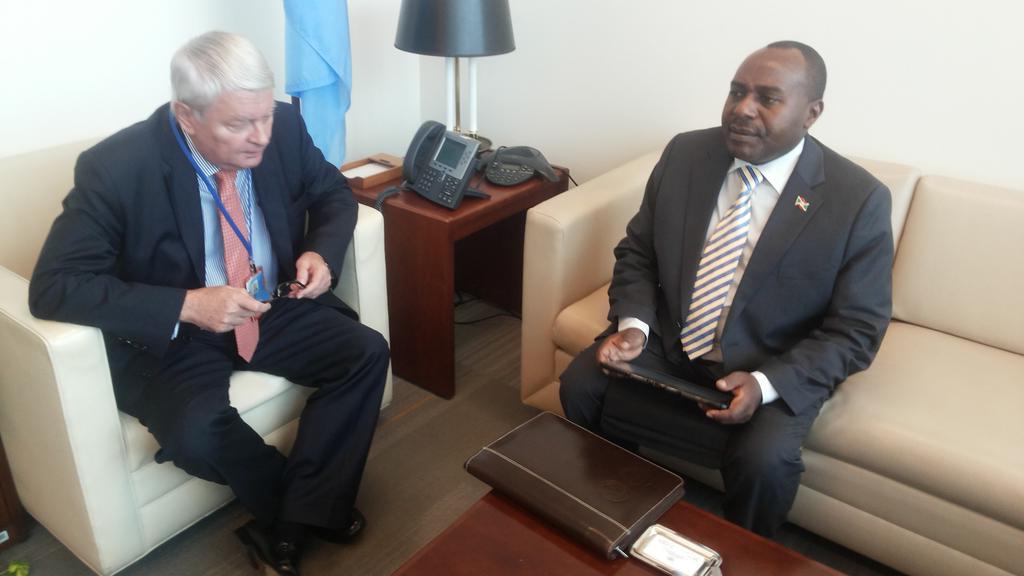
 On October 27, the UN said Secretary General Ban Ki-moon called the AU (below); Inner City Press asked Ban's spokesman Stephane Dujarric is any closer to naming the envoy he called "immanent" months ago. Dujarric said he should have used another word.

 Inner City Press asked Dujarric of reports that Burundian police in the UN's MINUSCA mission in Bangui have not received benefits in months, and of a letter sent to Ban and Herve Ladsous about the Burundian troops. Dujarric said he would check on both. Here is the full text of the UN's read-out:

"Today, the Secretary-General called H.E. Dr. Nkosazana Dlamini Zuma, Chairperson of the African Union Commission, to discuss the situation in Burundi.

The Secretary-General welcomed the decision made by the African Union’s Peace and Security Council on 17 October to address the political impasse and deteriorating security situation in Burundi. He noted that such comprehensive and resolute action could offer Burundi the opportunity to put an end to the continuing violence and find a consensual political solution on the way forward.

The Secretary-General assured the Chairperson of the African Union Commission that the United Nations stands ready to provide any support necessary to advance the implementation of the measures agreed upon by the members of the African Union Peace and Security Council. " 

  On October 28 Burundi is poised for election to the UN Human Rights Council, as one of five African Group candidates for five seats. Meanwhile on October 26, the European Union adopted the letter to President Pierre Nkurunziza that Inner City Press asked the UN about last week, here.

  Can EU members on October 28 not vote against Burundi's "Human Rights" Council candidacy at this time? And other Western NGOs coming to the UN early this week to set forth their positions, will they just phone it in with regard to Burundi? Watch this site.

 Also on October 23, Inner City Press asked UN Secretary General Ban Ki-moon:

Inner City Press: I wanted to ask on Burundi, just this morning the UK Ambassador said that the UK is concerned of a threat of genocide, is the word that he used, so I'm wondering under Rights Up Front what are your thoughts about Burundi and what the UN or the Secretariat can do.

SG Ban: "On this genocide issues, I hope there should be some creative investigations by the relevant experts and there should be, first of all, a clear understanding and investigations.  And if the conclusion is that there were such kind of genocide issues, then there should be accountability, justice must prevail and perpetrators must be brought to justice."

  But what is the UN Secretariat DOING about it?

 On October 22, Inner City Press asked Ban's deputy spokesperson Haq:

Inner City Press: I wanted to ask you a question about Burundi.  The EU is preparing a letter to invite the Burundian parties to Brussels to have a discussion about diffusing the situation.  And I wanted to know, not just what does the UN think about it, but is there any UN role in this?  And, if not, what does it say about the UN sort of action on Burundi?  It's one thing to defer maybe to the AU but this is the UE.  What is the UN doing about this?

Deputy Spokesman:  We are following up with all the various initiatives by regional parties including the African Union and the European Union and, of course, our Envoy dealing with the Great Lakes Region has been appraised of this so we are continuing to follow-up.

ICP:  But, I mean, is the EU really, can you… it is a regional organization but is it a regional organization with respect to Burundi?

Deputy Spokesman:  That is question for the European Union, not for me.

ICP:  Have you been contacted I guess is my question?

Deputy Spokesman:  But regarding this, we have been in touch with a variety of regional bodies including through the office of the Special Envoy for the Great Lakes Region but also through our Department of Political Affairs and will keep appraised of all the various actors in this.

  Back on October 20, Ban's deputy spokesperson Haq cited back to a written statement by Secretary General Ban Ki-moon more than a week ago; he said generally that MONUSCO like all UN mission affirms the right of freedom of the press. Really?

  Later on October 20 after Inner City Press asked UN rapporteur on torture Juan Mendez about Guantanamo and US prisons, in the hall after waiting through a number of questions in Spanish Inner City Press asked him if he'd received complaints about, or acted on, Burundi. No, he said, not yet. Really?

Update: later on October 20 it was announced that the UN's Jeff Feltman will briefing the Security Council behind closed doors on October 21. But what outcome with the Council's penholder, France, even ask for?

  On October 16 Inner City Press asked Haq if the UN thinks the government can investigate itself. This was based on UN Secretary General Ban Ki-moon's October 15 statement that

"The Secretary-General condemns the killing of nine civilians and two police officers in Bujumbura on 13 October... He urges Burundian authorities to undertake a rigorous and prompt investigation into the circumstances and motives behind these despicable crimes in order to ensure that their perpetrators are brought to justice."

  So can the Nkurunziza government investigate itself (as the UN purports to be investigating or "auditing" itself in the wake of corruption revelation about former Presidnet of the General Assembly John Ashe among others)? Inner City Press asked this question (video here) as well as following up on this, from October 13:

Inner City Press: the Burundi question is one that maybe you can check with DPKO [Department of Peacekeeping Operations].  Burundian human rights activists say that an officer, Jerome Ntibogora, N-t-i-b-o-g-o-r-a, who was accused of being involved in killing people in a… in a hospital after they fled from the Government, has now been deployed to MINUSMA [United Nations Multidimensional Integrated Stabilization Mission] in Mali.  So I wanted to…

Spokesman Dujarric:  Let's see what we can find out.

  Dujarric did not come back with an answer, by this deputy when Inner City Pres asked again on October 16 said he, Ntibogora is not being deployed. We'll see - watch this site.

Amid crackdowns in Burundi by security forces, and allegations of sexual abuse by Burundian peacekeepers serving under the UN flag, UN Peacekeeping chief Herve Ladsous on October 1 held a meeting with Burundian Vice President Joseph Butore.

  Inner City Press has already tweeted a photograph of the meeting, but has now received the complete UN read-out, which raises more questions about Ladsous.

   On the crackdown, Ladsous assured Butore that he has a “pragmatic approach” and is of no mind to question what happens in any country, does not involve himself in "domestic affairs."

   On the sexual abuse allegations, Ladsous spoke only in platitudes, without requiring or even inquiring into any actions taken by the Burundians on the alleged abuse.

   Even though Burundi was already given a “grace period” to bring appropriate equipment into the Central African Republic for the MINUSCA mission, they have not done so. In the meeting, according to the read-out, Butore "acknowledged" the substandard equipment.

   Butore requested, and Ladsous for now granted, yet another extension to bring the requirement equipment -- until March 2016 for light equipment, and to June 2016 for heavy equipment.


  Is this safe - even for the Burundian soldiers at issue? While speaking through press releases, Ladsous' spokespeople, far from answering questions, go so far as to direct UNTV boom microphone operators to avoid Inner City Press, even preventing the Press from asking any questions to Mali's Foreign Minister Abdulaye Diop last week. We'll have more on all this.

In Yemen, Inner City Press Reported Oct 26 UN Flew 2 "US Intelligence Officers" Who Got Captured, Now Reuters Late Spin for UN


By Matthew Russell Lee, Exclusive follow up

UNITED NATIONS, November 1 -- The UN Secretariat's bungling of Yemen mediation has become ever more clear, according to multiple sources and documents exclusively seen by Inner City Press, see below. 

  On October 26 Inner City Press reported that its sources exclusively told it of a new low, that the UN brought into Sana'a what the Houthis call two members of US intelligence, with the cover identification that they work for the company running the former hotel now occupied by the UN. But, the sources say, security in Sana'a recognized the two and they are now detained. 
  On October 30, Inner City Press asked UN Spokesman Stephane Dujarric about it, video heretranscript here and below. Dujarric acknowledged he knew about two "contractors."
  Fully two days later on November 1, Reuters "reported" a piece citing an unnamed UN spokesperson about two "contractors," with no mention of the Houthis claim they work with US intelligence, which by now had also been reported, along with Inner City Press' October 30 Q&A with Dujarric, by Al-Akhbar.
 This is the same Reuters which on Friday regurgitated a UN report which Inner City Press had reported and asked the UN about fully two weeks earlier. We'll have more on this. 
  On Yemen, from the October 30 UN transcript:
Inner City Press: maybe you can confirm or deny that two individuals flew in to Sana’a on a UN plane have been detained by the Houthis who accuse them of being US intelligence individuals.  What was the protocol for getting on a UN plane to Sana’a?  Does the UN have a position of not flying in intelligent members of a UN member state?

Spokesman:  I'm aware of two people who I believe are UN contractors and their situation.  I don't have an update on it.  The protocol for flying on UN planes and on UN humanitarian flights is pretty clear.  I can give you the details.  We do not, we do not knowingly fly in or out combatants.

Inner City Press:  I just wondered, could you maybe say what kind of contractors they are?  I heard and reported they were making a building that the UN works in.  Is that true?

Spokesman:  That's my understanding. 

 We'll have more on this.
  Meanwhile the Houthis are denouncing UN envoy Ismail Ould Cheikh Ahmad and his (mis) representation to the Security Council regarding what they agreed to. This has happened before and the goal seems to be delay to allow for more air strikes. There's work of mercenaries, in essence, including from Colombia in Aden, joining the troops from ICC-indicted Sudan.
 A new level of dysfunction was hit with the deployment in Aden of hundreds of troops from Sudan, putting ICC-indicted Omar al-Bashir on the same side as the US and UK. (Inner City Press is exclusively informed that "UN" envoy Ismail Ould Cheikh Ahmed is working on a similar Saudi deal with his native Mauritania, see below.)
Now Inner City Press is reliably and exclusively informed of a letter, drafted by Saudi Arabia and conveyed to UN Secretary General Ban Ki-moon by envoy Ismail Ould Cheikh Ahmed, which has Ban thanking Hadi and stating that the Houthis have agreed without reservation to implementing UN Security Council Resolution 2216.  They have not - this is just another misleading move by the envoy, not a third strike but a fourth.
  But more fundamentally, why would Ban Ki-moon even consider signing a letter that was drafted by Saudi Arabia? Ban's Deputy Secretary General Jan Eliasson, arguably undermining the envoy, recently traveled to Saudi Arabia and then Iran.
  Inner City Press is reliably and exclusively informed that the Saudis snubbed Eliasson, denying several of his meeting requests and finally providing him only with the Foreign Minister, just before he left. In Iran, complaints against envoy Ismail Ould Cheikh Ahmed were lodged, that he does not have the trust of the Houthis. What kind of envoy is this? What kind of UN?
  After the UN Security Council's praise of talks ostensibly committed to UN envoy Ismail Ould Cheikh Ahmed was not updated after Hadi canceled participation in the talks, then the Saudi led coalition bombed Oman's Ambassador's house in Sana'a.
  The Saudi Mission to the UN, doling out information selectively as always, tweeted a photo of a meeting between its Ambassador and the deputy ambassadors of Security Council members the UK and US, of the EU - and UN humanitarian deputy Kyung-hwa Kang. What did Kyung-hwa Kang, if not the Ambassadors, say about the airstrikes?
  The UN's envoy Ismail Ould Cheikh Ahmed, after complaining about his leaked email showing his marginalization from Yemen talks, that Hadi had committed to come to talks. The Security Council praised him in a Press statement.
  Then Hadi canceled. It is similar to the UN's ceasefire-that-wasn't, and the failed "talks" in Geneva in which the UN never gave the Houthis passes to get into the UN building, after allowing them to be delayed along the way so that Ban never met them (while meeting with an individual on the US Al Qaeda sanctions list.)
  In many contexts it's "three strikes and you're out," in this case faux ceasefire and two talks that never happened. But the Security Council has not updated its Press Statement of praise; some members apparently simply work around the UN envoy. We'll have more on this.
  On September 5 as airstrikes on Sana'a picked up force, there was no comment from the UN or its envoy Ismail Ould Cheihk Ahmed. Nor on September 6. On September 7, the UN finally spoke -- not about the airstrikes but about a leak.
  On September 8, Inner City Press asked UN Spokesman Stephane Dujrarric if he was denying the veracity of the UN email Inner City Press published, below. Dujarric did not deny it. Video here. Inner City Press on September 9 asked Dujarric's deputy, below, on September 9 about Ismail Ould Cheikh Ahmed.
  Inner City Press exclusively reported the following: on August 27-28 in Muscat, the US and UK, the EU Ambassador to the UN and Saudi intelligence, met with the Houthis -- without the UN and its envoy present, or even sources say aware of the meeting. These sources say that the UN's Ismail Ould Cheikh Ahmed was on vacation in his native Mauritania, and was entirely out of the loop. 
  On September 10, Inner City Press asked UK Ambassador Matthew Rycroft if the UK had met with the Houthis and GPC in Muscat, without the UN Envoy present. Video here. The answer, as transcribed by the UK Mission:
Inner City Press: There was a letter from the Envoy that seemed to imply that.

Amb Rycroft: There has been a lot of different types of talks in Morocco and different engagements with others. The United Kingdom and other countries are involved in some but not all of those talks – depending on the format. Whether or not we are there or not we are very supportive of Ismail and his work.
  Meanwhile Ismail Ould Cheikh Ahmed says the same parties will now meet with him. Replay?

  On September 9, Inner City Press asked UN Deputy Spokesperson Farhan Haq, video heretranscript here:
Inner City Press: I saw the statement by the Envoy that leaks may be distorting.  But I wanted to ask a factual question, which is that there are reports, and some are confirming, that there were meetings in Muscat by the US, UK, EU [European Union] ambassador to Yemen, the Houthis and Saudi intelligence that took place in August, 27th and 28th.  And I wanted to know, it seems that the UN's Envoy wasn't present.  Was this by choice?  Was he not invited?  Was he unaware?  What's his role in these talks that are taking place between the parties that I've named in Muscat?

Deputy Spokesman:  Well, I wouldn't have any confirmation about any of the meetings that do not involve Ismail Ould Cheikh Ahmed, the Special Envoy.  He has been present in Muscat as well as in Riyadh in recent days and has used his time in those two cities to talk to many of the key players representing the Government of Yemen, Ansar Allah and the General People's Congress, and so he is continuing with his efforts to get the parties to talk to each other and to get a halt to the fighting.  And beyond that, I wouldn't have any details on any meetings that take place outside of his purview. 
  The September 10 briefing by this envoy to the UNSC was requested by the UK - which, it seems, met with the Houthis without Ismail Ould Cheikh Ahmed.
  Sources also note to Inner City Press that the Saudi have "dissed" Ismail Ould Cheikh Ahmed, relegating him only to meeting with Saudi intelligence, not diplomats as was previously the case with the UN. This too is embarrassing to the UN. Hence the Sunday evening statement:
"The Special Envoy for Yemen of the Secretary-General of the United Nations, Ismail Ould Cheikh Ahmed, is disturbed by press reports regarding the leak of internal United Nations correspondence. The content of these reports, especially in some Yemeni media outlets and Internet sites, constitute distortions and misinterpretations. These reports do not reflect the position of the Special Envoy or of the United Nations."
 A well placed UN source told Inner City Press that the replacement envoy should never have commented on the leak, especially while remaining silent on the increased airstrikes and Qatar sending troops and Apache helicopters. 


Perhaps the discomfort is with the reference to the US National Security Council's "Eric Polovski" (that is, Eric Pelofsky) being "on board." Another source exclusively told Inner City Press that in the Security Council's last meeting on Yemen, those raising the mounting humanitarian toll were Venezuela, Chile and New Zealand. Consider again this, to USg Jeff Feltman:
"Dear Jeff,
Before traveling to Jeddah I held two days of meetings with Ansar Allah and GPC in Muscat in which I tried to convince them to improve upon the 10 points which they had submitted to me earlier. This was necessary to respond to concerns in Riyadh that the commitments to the implementation of 2216 were still inadequate and failed to include recognition of the legitimacy of the government.
AA/GPC agreed to a new wording on UNSC resolution 2216 that states unequivocally that they are committed to the full implementation of 2216, (see document attached) with the exception of article which infringe on Yemeni sovereignty and those related to sanctions.
In addition, the new text includes acceptance of the return of the current government for a period of sixty days during which a new government of national unity shall be formed. They also accepted to remove references to counter-terrorism and the Saudi border to which the GoY had objected, as well as the mandatory support by the international community for reconstruction that was in the earlier version. The latter was particularly opposed by KSA and GCC who did not want it to be interpreted as a form of mandatory compensation. Both Ansar Allah and GPC seemed positive and showed considerable flexibility.
My meetings followed two days of meetings between the Ansar Allah and KSA intelligence officers which were also attended by the US, UK and Oman. The discussions focused on possible confidence building measures such as a pullback from border areas in exchanges for a cessation of airstrikes and agreements in which they would cease operations within Saudi Arabia. This was the first time that Ansar Allah have been open to discuss limited and geographically specific agreement. Although they repeated that the return of President Hadi would be unacceptable, they expressed their openness to the return of the government for a limited time. The US Ambassador, Matt Tueller has been keeping me regularly informed of these discussions, which has been most helpful. The confidence building paper proposed by the Houthis to KSA is attached for reference.
Although US officials were disappointed that Saudis had sent relatively junior representatives, they still felt the meetings were positive, largely friendly and a good way for KSA to sound out Ansar Allah’s intentions. Ansar Allah and KSA agreed that there should be further meetings with hopefully more senior representation although no dates were agreed. The meetings unfortunately shed very little new light on KSA’s strategy in the conflict or their willingness to support a negotiated settlement in the near future.
The meetings in Muscat were of course heavily influenced by the military developments in Yemen. The coalition has not been able to make rapid progress since their successes in Aden, Abyan and Shabwa in August. Taiz remains contested and there are reports that Ansar Allah has regained some territory which had been lost in the past week. The coalition’s difficulties moving northward suggest that an assault on Sanaa would likely be difficult and time-consuming than they had previously expected.
The instability and violence which have plagued Aden following its capture is likely also a source of concern. The mostly pro-independence Hiraak fighters are unwilling to cooperate fully with the GoY in attempts to expand northward. This leaves the coalition dependent on ground troops from Islah, Salafi and AQAP related groups, which UAE is reluctant to support.
Conclusion:
I believe, following my discussions in Muscat, that we now have a strong opportunity to obtain a peace deal, and avoid a violent confrontation in Sanaa, for the following three main reasons:
i) The revised paper (attached) is much stronger and contains serious concessions by the H/GPC. It will be difficult, at this stage, to push them towards further concessions.
ii) The recent slower advance of the GoY affiliated forces around Taez and Maarib could also offer another opportunity.
iii) The on-going insecurity and lawlessness in Aden, and the increased visibility of AQAP in Aden region in the aftermath of the liberation of the city by the GoY and Coalition forces, has started to raise serious concerns for UAE, and in some KSA circles.
In light of the above, I have reached the conclusion that we should now move towards a new round of direct talks, two and half months after our first round in Geneva. My recent shuttling has now reached a point whereby it is becoming somewhat transactional with the Special Envoy obtaining a paper from one side and seeking comments/acceptance by the other side. I do not think we can sustain this and I recommend we move to a more strategic phase. I recommend holding this next round of talks in Oman Sultanate as a first choice, which seems to be acceptable to the Omanis and all parties, especially KSA. My second proposed option would be Kuwait, however the Houthis are still hesitant about this potential venue. Ideally, we should aim at holding this meeting before Eid.
My discussions in Jeddah and Riyadh will be explicitly in favour of moving to peace talks phase as opposed to continuing this shuttling around papers/proposals. I have first indications that Abu Ali and Matt Tueller are supportive of this new approach. In this regard, it was important to time my visit to Jeddah before the meeting between King Salman and President Obama tomorrow. Eric Polovski – White House NSC – who was just recently in Muscat is also fully on board on this.
I am conscious that the implementation of this new proposal depends very much on the GoY's openness and the KSA genuine support (and not only on what I am hearing from Abu Ali). But this proposal is also the only way to keep the UN's efforts at the center of the mediation process and to avoid a fatigue among our various stakeholders, especially the H/GPC. This is why I once again need the support of the SG and the P5.
Best regards. Ismail
Muscat Principles for a Solution to the Political Crisis in Yemen
Commitment by all parties to implement relevant UNSC resolutions including resolution 2216, according to an implementation mechanism to be agreed upon, and without infringing on national sovereignty, and with reservations regarding the sanctions against Yemeni citizens.
A permanent and comprehensive cease-fire by all parties with the withdrawal of all armed groups and militias from the cities, according to an agreed mechanism to avoid any security and administrative vacuum along with lifting of the land, sea and air blockade.
Agreement on neutral monitoring instrument in order to verify implementation of the mechanisms mentioned above that will be agreed upon, under the auspices of the United Nations.
To respect international humanitarian law, including the elements relating to the protection of civilians and the release of prisoners and detainees from all parties, including those mentioned in UNSC resolution, and to facilitate humanitarian relief and allow the entry of commercial goods, food, medical supplies, oil derivatives and other essential good without restriction.
Kaled Bahah’s government, formed by consensus, returns and performs its tasks as a caretaker government for a period not extending 60 days, during which a government of national unity is formed, in a way that does not violate the constitution.
To resume and accelerate United Nations-brokered negotiations, according to the UNSC resolution.
All parties are obliged to hand over heavy weapons to the State in accordance with the outcomes of the Comprehensive National Dialogue."
Note: the "Eric Polovski" in the above would seem to be Eric Pelofsky. Just saying.
   On September 1 the Office of the High Commission for Human Rights raised its estimate of civilians killed to 2,112 (from March 26 to August 27), with 4,519 civilians injured in that period in what OHCHR called a "conservative estimate." 
  OHCHR cited an airstrike on Taiz on August 20 which killed 53 civilians. OHCHR said "Fifty-three of these civilian deaths occurred on 20 August, reportedly as result of a series of airstrikes by Saudi-led coalition forces that hit 20 homes near Salah Palace in Taiz. According to local reports, active fighters in the Houthi popular committees were believed to be based in the Salah Palace at the time."  Believed? Question to OHCHR in this case: what is international law?
 Or this one: "attacks by coalition forces on Hodeidah port, which is a key entry point for humanitarian supplies and commercial imports into Yemen."  
   UN Relief Chief Stephen O'Brien on August 19 told the UN Security Council, "To date only 18 percent, some $282 million, of the $1.6 billion requested through the Yemen Humanitarian Response Plan has been received. UN agencies have still not received the funding from Saudi Arabia of $274 million pledged in April."
  After O'Brien said that, Inner City Press asked Yemen's Permanent Representative at the UN, down the hall toward the Trusteeship Council Chamber, about it. He told Inner City Press, among other things, that explains the request for a UN "liaison" in Riyadh. 
  After the Security Council's triplet of meetings on Yemen, Syria and South Sudan ended on August 19, Inner City Press asked New Zealand's Permanent Representative Gerard van Bohemen "On Yemen. Mr O’Brien said that Saudi Arabia haven’t paid the pledge and that there was some dispute about the UN sending maybe somebody to be a liaison, what was said about actually getting aid unblocked?"

  Ambassador van Bohemen replied, "I think you need to talk to him about it. What he explained was there’s been quite a complicated discussion going with the Saudi government about the terms on which the money will be made available, but he knows the detail about it, I don’t."
  We still hope to have more on this.
  On August 7 Inner City Press was informed that as Houthis and Saleh's GPC headed to Oman for consultations on August 8 and 9, the UN's replacement envoy Ismail Ould Cheikh Ahmed was not even initially invited. He had to beg to get included, which after sweating has been allowed, in the run-up to his briefing on August 12 to the Security Council.
 On August 12, Inner City Press asked Yemen Permanent Representative, outside the Council meeting, questions ranging from the destruction of schools and health care facilities in Sa'ada by Saudi airstrikes to when, according to him, the Houthis might be "driven" out of Sa'ana. Video here. He said in a few weeks - and added that the Oman talks were "not UN."
 So how then might the parties negotiate? UN spokesman Stephane Dujarric said Ismail Ould Cheikh Ahmed was headed back to Riyadh. That seems to be his base, where he works from - and for? Watch this site.

  Oman has received murky thanks for France for facilitating the release of a hostage, who was working for the Social Development Fund there. Did Oman pay for France? Or will others be released, as France brought about in Mali?
  On July 28, Inner City Press asked Saudi Arabia's Permanent Representative about Mokha or Mocha; he replied that previous allegations about Saudi airstrikes on Old City Sana'a and on a palace in Aden once used by Queen Elizabeth had been proven untrue. We'll have more on this.
  Inner City Press asked Yemen's representative about the talks in Cairo involving the United Arab Emirates, allies of former president Saleh and, it's said, the US and UK. He replied that the Yemeni government - in exile - deals through formal channels, the GCC or UN.
  He might have been asked, which foreign minister is he reporting to: the one named by Hadi, or the one - his predecesor - named by Bahah? We'll have more on this as well. 
   After publishing its multi-sourced story, Inner City Press on July 22 asked the UN's Associate Spokesperson about new APC and weapons in Aden, and if Ismail Ould Cheikh Ahmed is on vacation. Video here. She replied that she would check - but did not revert with any response either way.
  So on July 23, amid reports that without Cheikh Ahmed or any UN presence talks were occurring about Yemen in Cairo, Inner City Pressasked:
Inner City Press: on Yemen, yesterday you'd said you would check on Mr. Ould Cheikh Ahmed, whether, in fact, he is on vacation at this time.  Did you?

Associate Spokesperson:  No.

Inner City Press: You said leave is a good thing.  In the transcript, you said, I'll check on his vacation.  But yes, people do take leave, it is a good thing, although there are people in Yemen who say, given that the humanitarian pause failed, it seemed a strange time to do it.  So I just wanted to know, factually, is it, in fact, the case?

Associate Spokesperson:  Is it the fact…?

Inner City Press:  That he's on vacation after the failure of the humanitarian pause.

Associate Spokesperson:  I don't know specifically for the Special Envoy, but I can tell you that, you know, most people at that level at the UN, all people at that level at the UN continue to work on their portfolios wherever they are and whatever they're doing.  These are portfolios that you can't just drop.  And I'm sure that's the case also with the Special Envoy.  As far as leave goes, you know, I'm not going to get into a “who's on leave when”, blah, blah, blah, with you.  I just… I don't want to do that…

[cross talk]

Inner City Press:  I'm just saying because yesterday, you said, "I'll check".

Associate Spokesperson:  Because as you mentioned… as you mentioned yourself, you know, leave is part of working life.

Inner City Press:  Okay.  Was he also on leave when UN staff had to leave Libya and he was the deputy SRSG in Libya?  Because that's what I'm told by the people…

Associate Spokesperson:  He was also on leave when what…?

Inner City Press:  On leave when the people were evacuated from Libya that were the staff members of the UNSMIL mission.

Associate Spokesperson:  Well, I just said I'm not going to go and check his attendance sheet.
 So much for checking. 

  Inner City Press asked the UN where Cheikh Ahmed is. UN Deputy Spokesperson Farhan Haq told Inner City Press that he has been "planning his travels," soon to Riyadh. Yeah, Inner City Press was told by another less constrained but at least as knowledgeable source: planning his future travels while already on vacation. Another source compared it to then UN envoy to Pakistan Jean-Maurice Ripert going on vacation amid national disasters in Pakisan and then losing his post. 
   The buzz in Sana'a, where Hadi has named a governor in exile described as an Islamist, is that Cheikh Ahmed may well have known of the plans to bring in APC and weapons to those fighting the Houthis in Aden, and so "misleadingly" urged a pause. Another compared this to the UN luring out surrendering rebel leaders in Sri Lanka - to their deaths.
  And so from Aden, photographs of brand new light brown vehicles, American-made, brought in. Will they end up in the hands of Al Qaeda?
On July 20, Inner City Press asked UN deputy spokesperson Farhan Haq:
Inner City Press: I wanted to check first if you have anything on Yemen and the activities of Ismail Ould Cheikh Ahmed.  What's he been doing in the last few days, amid reports of continued death and destruction in the country?

Deputy Spokesman:  Yes, Mr. Ould Cheikh Ahmed has been planning his onward travels.  The only one to confirm at this stage is that he does plan very shortly to travel to Riyadh, where he is to meet with Saudi authorities, authorities of the Gulf Cooperation Council, and with President [Abd Rabbuh Mansour] Hadi and Vice-President [Khaled] Bahah.  And so, he is going to try to talk to them.  He's continuing with his efforts to see what can be done to secure a humanitarian pause, even following the end of Ramadan and Eid.  And so, he's going to continue with those efforts and travel more broadly in the region after that.  We'll try and inform you of other stops as that progresses.
Inner City Press: There's some talk of, if not Mr. Hadi, other ministers trying to return to Aden.  Is the UN aware of that?  Do they have any comment on that?

Deputy Spokesman Haq:  It's not for me to discuss what the Government of Yemen is trying to do.  Regarding Aden, we have been concerned about the humanitarian situation on the ground.  Our humanitarian colleagues have been continuing even in the absence of a humanitarian pause on the ground to try to provide supplies.  I believe that, even though the pause did not go forward as we had wanted, about 60 per cent of the humanitarian activities that we had been planning did, in fact, take place.  And so we were able to provide some aid, although not nearly enough.  And, of course, we continue to be concerned about the fighting in Aden.
  Back on July 9, UN Secretary General Ban Ki-moon proudly announced a humanitarian pause to start on July 10 at midnight.
  When the supposed pause failed, Inner City Press was told on July 14, it took Ban Ki-moon more than two days to speak with Saudi Arabia, through its foreign and defense ministers. Ban, it was said, was "in the air."
 On July 14, Inner City Press asked Ban's spokesman Stephane Dujarric:
Inner City Press: Something on Yemen.  Yesterday, you said the Secretary-General was very, very disappointed.  So, I wanted to ask, if you can say, starting, I guess it would be, Saturday morning, right after midnight, it became pretty clear that there was no pause.  Did he make any… did he make any actual, like, calls, meaning like telephone calls or in some… did he reach out?  And can you confirm or deny that some within DPA [Department of Political Affairs] had suggested that he not put out that statement that seemed to imply that there was a pause agreed to as…?

Spokesman Dujarric:  No, I… listen, I'm not… Secretary-General was in the air a large part of the weekend.  He's also attending the Addis conference.  People at various levels were having various contacts.  The Secretary-General spoke to both the Defence Minister of Saudi Arabia and the Foreign Minister yesterday, in addition to other contacts that were had in the previous… you know, on Monday and over the weekend.  As to the deliberation… the internal deliberations of different opinions expressed within the UN Secretariat, I'm not going to go into that.  At the end of the day, it's the Secretary-General's call, and the statement he issued was clear.
  The day before on July 13 at the UN noon briefing Inner City Press asked Ban's spokesman  Dujarric why the UN had made another "call" for a pause sound like a commitment to a pause, at least by the Saudi led coalition. Video here.
  Dujarric answered that envoy Ismail Ould Cheikh Ahmed had told the Suadis of his desire for a pause. But that's not what the UN said on July 9.

   Ban was in Addis Ababa for the Financing for Development conference; here are his UN's "messaging" points in the run-up to that conference (and here an Inner City Press story about it; we'll have more). But isn't the UN responsible to say something after a humanitarian pause it announced doesn't happen, and people are killed? 
  It quickly became clear that some of key parties had not been spoken with or agreed; the pause's midnight beginning came and passed amid airstrikes.
  Inner City Press is informed by sources that Ban Ki-moon was urged to not make the dubious pause announcement, including from within the UN's own Department of Political Affairs -- but Ban announced it anyway.
  At best, it was rolling the dice. At worse, on the very day that UN is rightly criticizing itself for making false promises of protection in Srebrenica 20 years ago, in this case Yemenis were told there would be a pause, and some perhaps relied on it, to their detriment. And still the UN had said nothing.
  After the July 9 announcement, Inner City Press asked Ban's spokesman if the Saudis had been spoken with. The answer was, Hadi told the Saudis his position. But did Hadi ever agree to the pause, or just to the conditions set forth in his letter to UN? What of Hadi's responsibilities to the Yemeni people?
Now Saudi Al Arabiya has said Saudi Arabia never received any communication from Hadi to stop airstrikes, here. Someone is lying.
  Where is the UN's replacement envoy Ismail Ould Cheikh Ahmed? Headed to Ethiopia, Ban's spokesman said, to meet with Ban on the sidelines of the Financing for Development conference there. Does IOCA harbor ambitions for another UN system post, or back in his own country? What sort of a track record is this? Watch this site.
 At the July 10 UN noon briefing in New York, Inner City Press asked Ban Ki-moon's spokesman Stephane Dujarric if the UN had spoken with those in Yemen opposing the Houthis but not supporting or in contact with Hadi. Video here. From Dujarric's answer, it seems no such contact has been made.
  So, Inner City Press asked, if such a group fires on the Houthis and they fire back, is the pause over, has it been violated? We'll see what happens.

Back on July 9, Inner City Press asked UN Spokesman Stephane Dujarric, transcript here:
Inner City Press: can you, one, characterize not the communications with Mr. Hadi, but with Saudi Arabia that's running the coalition, the Saudi-led coalition.  And does this mean the Secretary-General's understanding is no airstrikes during this time period, and no further advances or use of heavy weapons by the Houthis?  Does the pause mean no firing? What does it mean to each of those two sides?

Spokesman Dujarric:  What it means is that, if you read the statement, the President… Secretary-General notes that the President, President Hadi, has communicated his acceptance of the pause to the coalition to ensure their support.  A humanitarian pause means no fighting.  It means no bombing.  It means no shooting.  It means no fighting.  It means exactly that:  a humanitarian pause in the fighting that we've seen, to enable our humanitarian colleagues to get the aid to where it's needed, to preposition, and stockpile, and to reach the millions that need it.

Inner City Press:  Right.  But just for example, policing, who's doing policing in these various cities?  Things happen.

Spokesman Dujarric:  Obviously I think… [cross talk] In any area in the country, there is a… there is de facto control and, obviously, there is a need to ensure safety and security.  What we're talking about is a humanitarian pause in the fighting that we've been witnessing for weeks on end now.

Inner City Press:  So just one last thing on this.  So the commitment on airstrikes is through President Hadi to the UN?

Spokesman:  You know, the… [cross talk] Obviously, President Hadi is a critical interlocutor with the coalition.  And as I've said, we've taken note of the fact that he's conveyed to the coalition his acceptance.  We expect everyone involved in this conflict to honor this humanitarian pause.
 On July 7 the UN's Office of the High Commissioner for Human Rights upped its estimate of civilians killed since March 27 to 1,528, adding that one million people have been displaced since the beginning of this round of the conflict. To the Saudi airstrike on UNDP in Khormaksar, Aden, OHCHR added that "IOM’s Migrant Response Centre in Basateen, also in Aden, was struck by a mortar and an airstrike damaged IOM’s office in Harad."
   IOM, as Inner City Press reported, had earlier paused its evacuation by air of those seeking to flee Yemen due to some party, which it left unnamed, demanding information about those fleeing BEFORE the flights could leave. Inner City Press has asked others in the UN about this and has been told IOM should have done the screening after the people were able to flee. IOM refused a direct question about caused it to violate this best practice, then stopped sending the Press any information.
   There are countries, normally vocal about civilian deaths, which are selling military equipment to Saudi Arabia and its Gulf allies. Ban Ki-moon, now in Oslo, is relying entirely on Saudi-selected replacement envoy Ismael Ould Cheikh Ahmed, who was unable to even get the parties in the same room in Geneva, much less reach an agreement. There remain, for now, OHCHR's body counts.
  On June 24, Inner City Press asked the UN's replacement envoy Ismail Ould Cheikh Ahmed about the request by the Houthis and others to meet not with him but with Secretary General Ban Ki-moon, who did not meet with them in Geneva. Transcribed here
  On June 25 Inner City Press asked Ban's deputy spokesperson Farhan Haq to confirm receipt of the letter and if Ban will meet them. Haq said Cheikh Ahmed is the envoy, and Ban's headed to San Francisco. The UN Security Council issued a Press Statement, here.
 Also on June 25, Inner City Press asked new UN aid chief Stephen O'Brien three questions about Yemen: cholera, the destruction of ambulances in Sa'ada and about international staff. Video here.
  O'Brien replied that cholera is a risk; he had no information on WHO it was that destroyed the ambulances in Sa'ada (we can guess.) On international staff, which the UN evacuated earlier, he spoke of a rise from 17 to 70, with the goal of getting to 200. He would not say if they are anywhere in the country outside of Sana'a, citing security. But at least he spoke - the Free UN Coalition for Access thanked him.

Here's from the June 24 stakeout, as fast transcribed by Inner City Press:
Inner City Press: On the parties in Sanaa requesting to meet the Secretary General – what’s your response?
Cheikh Ahmed: "This question was raised during our discussion with the Houthis, the GPC and their allies. The Secretary General had delayed twice his travel in order to be there for the parties. We have sent twice a plane from Sanaa which the delegation from Sana'a could not take..  Therefore the Secretary General had a major engagement, which was the election of the new president of the General Assembly which takes place only once a year , and he had to attend it. But the Secretary General will continue being engaged on this."
  The ceremonial elevation of the President of the GA who will take over in September was not an election at all - no vote was taken.
 Before the meeting, UK Ambassador Matthew Rycroft stopped and told the press of the danger of famine in the country, and of his hope for a Yemen Press Statement from the UNSC, in which the UK is the "penholder" on Yemen.  Periscope video here, replay including on desktop for 24 hours.
 Inner City Press was digging into the letter from political parties IN Yemen, asking for a meeting with Ban Ki-moon, NOT with replacement envoy Cheikh Ahmed. These parties, including but not limited to the Houthis, were delayed in getting to Geneva so that they could not meet with Ban (who while there DID meet with a US-listed Al Qaeda terrorist).
  While some are sure to argue that Ban now meeting with the parties would undercut Cheikh Ahmed, others point out the the underlying resolution speaks of the Secretary General's Good Offices INCLUDING his Envoy. The envoy is not the only game in town - nor, given his lack of disclosure, raised by Inner City Press, should he be. We'll have more on this.