Showing posts with label protest. Show all posts

Wednesday, December 23, 2015

On Burundi, Protesters Tell Inner City Press That UN Response's Weak, 87 Killed in One Day


By Matthew Russell Lee

UNITED NATIONS, December 23 -- After Burundi's Assembly and spokespeople for president Pierre Nkurunziza flatly rejected the African Union's planned deployment of up to 5,000 peacekeepers, Inner City Press on December 21 asked US Ambassador Samantha Power about it.Video here.

  Power said "we hope that's not their final answer," adding that the mediation by Ugandan president Museveni cannot just involve people who tell the government what they want to hear. Video and transcript below.

On December 23, seeing a Burundi flag and signs across First Avenue from the UN Inner City Press ran out there and conducted interviews,video here, in English and (halting) French. Others spokes in Swahili and Kirundi. At least 87 killed in one day, one sign said. The UN's response to date was described as weak. But what will happen next?

 On December 22, after the UN again asked UN Secretary General Ban Ki-moon's spokesperson for Ban's view -- still UNclear -- the US State Department said, "We would strongly prefer that the government in Burundi welcome the AU mission on the timeline set out.  We defer to the African Union on the next steps.  We offer our full support to the AU government.  We have urged Burundi to accept the AU mission.  We will continue to support the deployment of these troops to protect civilians and to allow space for the internationally mediated dialogue to find a sustainable political solution to this crisis.  We remain gravely concerned with the situation on the ground."

 Compare to the UN, on the same day, December 22, video here:

Compare:


From the US Mission transcript:

Inner City Press: I wanted to ask about Burundi: the African Union, they came out with a proposal to send 5,000 peacekeepers and the president’s advisor and now the assembly or parliament there have said no, and that they think it’s a violation of the sovereignty. What do you think the Council – or what will you as the U.S., what would you have the Council do to deal with the crisis there?

Ambassador Power: Well the Council has already spoken to this. We very quickly came together with a press statement backing what the African Union had put out in its communiqué and its decision to send 5,000 troops. Indeed the Council also urged the conversations with potential troop contributing countries to begin immediately – because we all know, whether for a sub-regional force, a regional force, or anything to do with the UN that the start-up time and logistic effort can be very complex.  

So, again, we think it’s very important that a mission like that be in a position to offer civilians confidence, protection, to be able to report out to the African Union and to the broader international community about how things are transpiring. And we understand from our African colleagues here that the conversations with the Burundian government are continuing, so we hope that that’s not the final answer and again it’s just a few days since the African Union issued its communiqué and made its decision, so we’re going to be in close contact with our African friends to determine next steps here.

I do want to draw your attention to the mediation, because fundamentally any protection or prevention presence is dealing with the systems and not the root causes, and the mediation has to get at root causes. It has been – too much time has passed without the Burundian government engaging the opposition, and we understand from President Museveni that he is now very eager to get going toward the end of this month. But the terms of that mediation are also very important. And I draw your attention to both the African Union’s discussion of what that mediation should look like and the Council’s statement from over the weekend, because it is very clear that this has to be a negotiation between the government and a representative sampling, an inclusive sampling of the opposition – not simply handpicked individuals who are there to tell the government what it wants to hear. So progress needs to be made on that in parallel with determining what an international presence in Burundi should and would look like.

  Meanwhile the Nkurunziza government with the agreement of UN Peacekeeping chief Herve Ladsous has undertaken to deploy officers allegedly involved in human rights abuses into Ladsous' Central African Republic mission, MINUSCA.

On December 17 Inner City Press was told, the third time it asked, that the Burundi's Army spokesman Gaspard Baratuza's deployment to the UN mission in CAR had been suspended, and Baratuza was being repatriated. UN spokesman Stephane Dujarric, who has shielded Secretary General Ban Ki-moon from such Press questions, said "it's an example of the [vetting] policy working."

 But Inner City Press has obtained the Burundi government document for the deployment not only of Baratuza but other officers in Ladsous' MINUSCA. Today we focus and ask about Major Pierre Niyonzima.

According to Inner City Press' sources, Niyonzima not only defended extrajudicial executions, he participated in them.  On May 14, they say, Major Niyonzima was the Senior army officer who led the attack on the hospital where those accused of involvement in the attempted coup were slaughtered.  They say Niyonzima reports to Guillaume Bunyoni and has been involved in killings in Musaga, Nyakabiga and Mutakura. We'll have more on this, and on other deployees to Ladsous' MINUSCA, including  Jimmy Rusheshe.

On December 21 Inner City Press asked the UN's Deputy Spokesperson Farhan Haq about these deployments, and the Burundian government's rejection of the African Union's proposed deployment, video here,transcript here:

Inner City Press: on Burundi, as you know, the African Union Peace and Security Council has made this proposal 5,000 peacekeepers and set a 96-hour deadline for the Government to respond.  The assembly has met and rejected it and said it would be a violation of the sovereignty of the country.  So, I wanted to know, what is the Secretariat… Mr. [Jamal] Benomar, what do they… you think of both the [African Union Peace and Security Council] taking a seemingly fairly aggressive protection of civilian stance and the Government rejecting it? 

Deputy Spokesman:  Well, first of all, regarding that, I believe that the discussions will continue with the African Union and the Government of Burundi.  But, we certainly support the efforts by the African Union and its Peace and Security Council to deal with the protection of civilians in Burundi.  We've made clear our alarm at recent developments and the need for there to be additional steps to bring the tensions on the ground to a halt.  As you know, the Security Council itself has been apprised by the Secretary-General of various options for the way forward, and we await their guidance on that.  Meanwhile, Mr. Benomar has started some of his travels.  I believe he was in Washington, D.C., in the last few days, and he is expected to head to the region shortly.

Inner City Press: I wanted… something a little more specific.  It has to do with this vetting of troops from Burundi, but I guess you could say elsewhere.  I know it was said last week that Gaspard Baratuza, a Deputy Spokesman of the army, was being repatriated.

Deputy Spokesman:  Yes.

Inner City Press:  But, I've since seen a letter… it was his deployment letter, but it also involved two other majors in the army who are said to have been involved in the… the assault on a hospital in May, right after the coup attempt in which people were killed in their beds, and these involve Mr. Pierre Niyonzima and Jimmy Rusheshe.  And both of them, according to a letter from the Burundian Army, are… were being deployed to the UN in the Central African Republic.  So, I wanted… I guess I want to ask you, like, what does the vetting consist of?  What was the vetting that Mr. Baratuza failed that these two individuals apparently don't fail, given their involvement in extrajudicial executions?

Deputy Spokesman:  As we get information… if any information causes us to have concerns about deployment, it is reviewed in that light.  In that light, Mr. Baratuza, his suspension was first delayed, and then he was repatriated.  And so, depending upon the information, as we get it, we'll act upon it.

Inner City Press:  So, does… I guess what I'm saying is does the… either the human rights presence of the UN in Burundi have information about those who commanded the assault on this hospital, it's called Bumerec Hospital, in May and the connection to the people that were being deployed?

Deputy Spokesman:  Like I said, we… yes, we do have a human rights presence in Burundi.  As we get information, we act upon, and that includes anyone being deployed.


Obtained by Inner City Press

Ladsous' lack of vetting was criticized in the recently released report into the cover up of peacekeepers' rapes in the Central African Republic. Earlier, Inner City Press exclusive reported on Ladsous in his October 1, 2015 meeting with Burundi's vice president saying that he is "pragmatic" on human rights.

 On December 16 Inner City Press was banned from questions to Secretary General Ban Ki-moon, but learned from the mission MINUSCA that Baratuza was already in Entebbe. Inner City Press asked several Security Council members, then Ban's spokesman Stephane Dujarric on December17.

Dujarric told Inner City Press Baratuza's deployment is suspended and he is being repatriated: "based on the information we've received regarding the Lieutenant Colonel, his deployment has been suspended, and he will be repatriated back to Burundi." Video here. Dujarric told Inner City Press this shows the UN system working - on a day when a report on rapes was issued showing UN Peacekeeping under Herve Ladsous not sufficiently vetting for human rights. We'll have more on this.


 Amid the escalating killings in Burundi, last weekend's summary executions in neighborhoods opposed to Pierre Nkurunziza's third term stand out. But Burundi Army spokesman Gaspard Baratuza was quoted on December 12 blaming all of the deaths on attempts to steal weapons to free prisoners.

   Inner City Press had heard that Mr. Baratuza was already in the process of being deployed to the UN Peacekeeping mission in the Central African Republic (MINUSCA) even when he was giving these quotes, issuing statements and speaking to state-owned radio, and so asked MINUSCA's acting spokesperson, “Is Gaspard Baratuza of Burundi's army getting a MINUSCA job?”

  On December 16, hours before UN Secretary General Ban Ki-moon held a rare press conference, MINUSCA's acting spokesperson sent this to Inner City Press:

"To: Matthew.Lee [at] InnerCityPress.com
From: Vladimir MONTEIRO [at] UN.org
Date: Wed, Dec 16, 2015
Subject: ICP question: Gaspard Baratuza of Burundi's army getting a MINUSCA-related post?
Cc: FUNCA [at] funca.info

"No decision related to Lt Col Baratuza's deployment can be taken before we finish looking into the matter. We can confirm that Lt Col Baratuza is in Entebbe but he has not yet deployed to MINUSCA.  Regards. VNM"

There are some questions about Baratuza, a Colonel in Burundi's Army, being listed by the UN as “Lt. Col.”

  Despite multiple follow-up questions by Inner City Press, Mr. Monteiro - previously a spokesperson for the UN electoral mission in Burundi - replied that “This is what we can say about this issue.”

   But the UN should have to say more. Inner City Press has repeatedly asked the UN how its Department of Peacekeeping Operations under Herve Ladsous vets those who deploy to UN missions; Inner City Pressexclusively reported on an October 1, 2015 meeting in which Ladsous told Burundi's Vice President Joseph Butare that he is “pragmatic” on human rights.
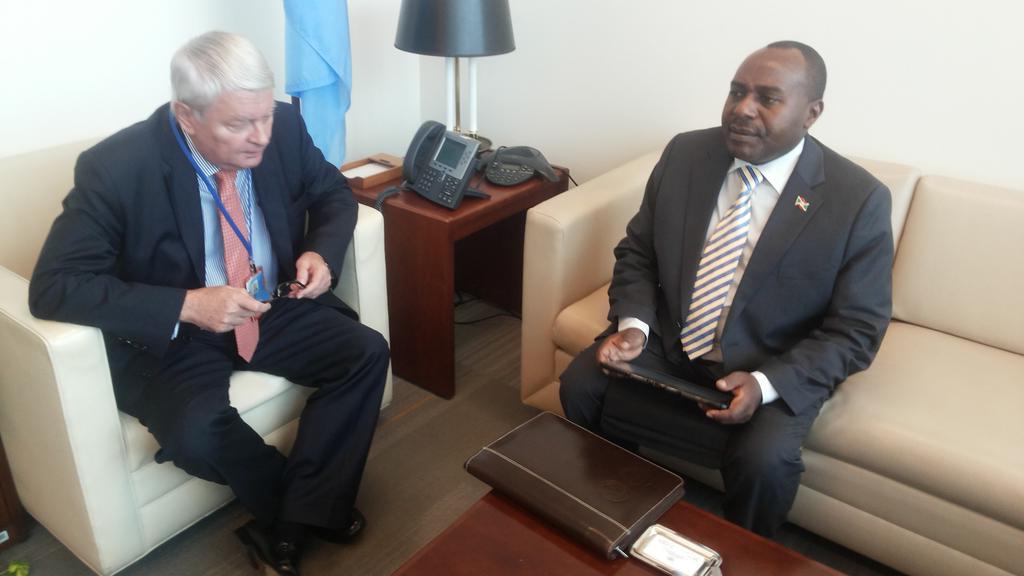


 Ban Ki-moon and his spokesman declined to take Inner City Press' questions on December 16, as they did on December 14. Vine here. But concerned members of the UN Security Council have now been asked about Baratuza by Inner City Press. Watch this site.

Tuesday, November 10, 2015

UNpaid Interns Protesting in UN Are Told Their Signs Are Illegal, As Is Filming


By Matthew Russell Lee
UNITED NATIONS, November 10 -- Amid mounting questions about the UN using only unpaid interns, favoring the most affluent, a group of interns tried to raise the issue inside the UN on November 10. But UN Security first told them they could not display their (small) signs, then tried to prevent photographing and filming of the muted protest by the press. This is today's UN. This too: Inner City Press tweeted a photo, and broadcast live Periscope video.
  The November 10 protest in rainy New York was preceded by one in Brussels, “standing up for those who cannot afford working for free;” in Geneva on this theme shoes were lined up on the street.

This comes at a time when Secretary General Ban Ki-moon's UN is moving to give raises to its Under Secretaries General such as Herve Ladsous, who linked peacekeepers' raping to their lack of “R&R” and “distraction.”
Inner City Press and the Free UN Coalition for Access (FUNCA) havepreviously asked the UN about this issue and covered it, as has VICE News, which was on the scene Nov 10.
Inner City Press on September 4 again asked Secretary General Ban Ki-moon's spokesman Stephane Dujarric about it, video here, transcript here:
Inner City Press: I have been meaning to just follow up on this.  The letter that was written to the Secretary-General by unpaid UN interns in New York and Geneva, seemed like it was responded to by USG [Under-Secretary-General Yukio] Takasu.  It's not clear — I guess I wanted to ask you.  Is the Secretariat saying that it's an administrative instruction some time back that precludes them from paying interns from the developing world, so that the pool can become more diverse?  Or are they really saying that the GA has definitively made it impossible?  Is there any consideration in asking the GA to address the issue?

Spokesperson Dujarric:  It's a valid of question.  I haven't seen the letter.  I need to take a look at it.  Nobody has shared it with me.  Nobody tells me anything here.  You know, I think on the issue of interns, it is also — I think it's also important to remember that the UN has a global presence, not in every country in the world, but almost every country in the world, and we do take interns locally, so I think there's also… obviously there's a greater mass of interns at our Headquarters station, but we do take interns… most UN offices take interns in different places, which doesn't include the need to travel.  Let me look in the letter and I'll get back to you.

Inner City Press:  Can you get data on that?

Spokesman:  Probably not, because I don't think it exists.  
  Really.
Back on August 11, Inner City Press asked Dujarric, video here, UN transcript here:
Inner City Press: I'm sure you've seen this story about the New Zealand intern at the UN in Geneva living in a tent.  I want to ask sort of a more fundamental question, which is that what would the UN say to those who say that by having so many entirely unpaid internship, it basically, it… it limits this possible career step of learning to only the most affluent people…?

Spokesman Dujarric:  I think it's a very valid point.  The debate around the payment of interns is one that's been going on for some time.  We are not in a position to pay our interns.  It's too bad in a way, because I think it does limit the opportunity to those who are able to pay their own way and house themselves.  Unless the General Assembly changes those rules, there is no change in sight.  What's important is that any internship be used as a learning opportunity for the intern and not be used as, you know, as free labour or as a substitute for work done by staff.

Inner City Press:  Okay. Is that something that the Secretary-General has ever raised to the GA [General Assembly] or…?

Spokesman Dujarric:  I'm not aware of that.
    Back in May 2013 an internship in the UN was auctioned off, ultimately for $26,000, in a processextensively covered and questioned by Inner City Press. The UN said it was embarrassed by the auction or the "optics," and resisted Inner City Press' questions about the sale.
After Inner City Press asked several times about it, the description of the internship being auctioned was"amended," as the UN spokesman put it, to read:
"Take advantage of this exclusive opportunity for a 6-week internship in NYC working for Bruce Knotts, Chair of the UN-NGO Committee on Human Rights. You will gain inside knowledge of just how the UN really operates and have tremendous opportunities to make invaluable connections. This truly is the ultimate internship opportunity for any college or graduate student looking to get their foot in the door!"
The auction, on CharityBuzz.com, said it was to benefit the RFK Young Leaders. Press inquiries to that entity and its parent, the RFK Center, did not yield any answers. But today, at least, we have a detailed answers about how such internships or grounds-passes work, from the Director of the UN Department of Public Information's Outreach Division, Maher Nasser.
  Inner City Press, along with another DPI question to which it is still awaiting the answer -- why was UNTV shut off while Palestinian negotiator Saeb Erakat was giving a speech on Monday morning -- asked Nasser, "I heard when you told DPI-NGO orientation that it makes the UN look bad, and that the UN is not obligated to let the person ('m. alam') who purchased the internship into the building. Is that the case? And you could keep me informed on this, when the purchased internship is to begin and what the UN / DPI does?"
  To his credit, Nasser provided Inner City Press with the most detailed UN response to date on the auctioned internship:
Subject: Question re the auctioned internship, thanks
From: Maher Nasser [at] un.org
Date: Mon, May 20, 2013 at 2:38 PM
To: Matthew Russell Lee [at] InnerCityPress.com
Hi Matthew, On the internship issue, as you know from the relevant website, this was for an internship with an NGO, not an internship at the UN. The optics of it and use of the UN's image implied otherwise, which is why I flagged it in the orientation with newly associated NGOs as something that hurts the UN and is not acceptable.
Every NGO associated with DPI is entitled to only six yearly passes, two of which are for youth representatives. The names to whom the passes are issued are provided by the president/head of each NGO. By providing the names, the NGO certifies that these names represent the NGO concerned. Up till now, we have had no reason not to grant a pass to people designated as representing an NGO. An old system of temporary passes issued throughout the year was discontinued by DPI several years ago.
With reference to the six names provided, and as I said above, this has not happened in the past, if we find out that someone had to pay or buy a slot on that list, we would take it up with the concerned NGO and depending on the feedback, not endorse that name for a pass.
In view of the case of the auctioned internship, we are preparing language to be added to the forms to be completed by DPI associated NGOs to avoid such possibilities in the future.
  So at a minimum, the "m. alam" on whose behalf $26,000 was bid for this internship might not be endorsed for a pass to actually enter the UN. Would they get a refund? And what do the UN-NGO Committee on Human Rights and the RFK Center have to say? Watch this site.

Footnote: While we await another division of DPI's promised answer to the Free UN Coalition for Accessabout how and why UNTV shut off during Saeb Erakat's speech, we note complaints received about the press corpsmove-back to the Secretariat building, particularly among broadcasters about special charges, special deals, special inquiries. The DPI official in question is aware of several of these complaints; watch this site.

Wednesday, June 25, 2014

On Sri Lanka, Protest of Rajapaksa and UN Inaction by Muslims & Others, Stonewalling from Ban Ki-Moon & His UN Censorship Alliance, UNCA


By Matthew Russell Lee
UNITED NATIONS, June 25 -- After UN official Oscar Fernandez Taranco visited Sri Lanka but has refused to take Press questions upon his return to New York, Inner City Press asked UN spokesman Stephane Dujarric on June 25 about a protest, video here:
Inner City Press: There’s a protest scheduled for today at 1 p.m. on 47th Street of mostly people from Sri Lanka and elsewhere about the violence there. And they’ve said that they intend to hand a letter to the Secretariat, seeking action against the action there. I wanted to know: is this going to be possible? Is Mr. [Oscar Fernandez-] Taranco... it’s great that Mr. Šimonovic will brief on Burundi. It seems like it’s a kind of a similar situation. And is the UN aware of this? And what has been the reaction to the upswing in violence in Sri Lanka?
Spokesman Dujarric: I think we’ve spoken about this from this podium. We’ve condemned the violence that we’ve seen recently. And obviously, the Secretary-General fully backs the efforts of the High Commissioner for Human Rights. As for the demonstration, I was unaware of it. If I have any information, I will let you know.
Inner City Press: That panel is about war crimes at the end of the conflict on both sides, whereas this is something that’s actually taking place currently. That’s why I’m sort of asking, like, did Mr. Taranco deal with this issue while he was there?
Spokesman Dujarric: As I said, I shared with you what I had on Mr. Taranco’s visit.
   The protest took place: see Inner City Press tweeted photo here.
  In a previous protest by Sri Lankan Tamils, the UN sent a lower level functionary who told the protesters the letter would be rejected if they told the Press about it. Dujarric said he would check. This comes amid much hypocrisy at the UN.  
   With Navi Pillay slated to leave as UN High Commissioner on Human Rights on August 31, on June 25 she made an announcement about the HRC Panel on Sri Lanka.
  Meanwhile amid renewed Buddhist extremist violence in the country and restrictions on media, on June 24 and June 25 Inner City Press asked Secretary General Ban Ki-moon's spokesman Stephane Dujarric about Ban's envoy Oscar Fernandez Taranco's visit.
   Dujarric said Taranco discussed "post war achievements." Inner City Press asked, did he discuss press freedom issues? Apparently not.
    This comes as many big-wigs in the UN use the outrageous detention of three Al Jazeera journalists in Egypt to promote... themselves. What did they say about the killing of five journalists in Eastern Ukraine? What have they said about Sri Lanka? Some in the UN even tried to censor Sri Lanka coverage, here.
    Here's from Pillay announcement:
"Three distinguished experts have agreed to advise and support the team set up to conduct a comprehensive investigation of alleged human rights violations in Sri Lanka, as mandated by the Human Rights Council in March:

Mr Martti Ahtisaari, former President of Finland and Nobel Peace Prize Laureate, who has also served as a UN diplomat and mediator and is renowned for his international peace work;

Ms Silvia Cartwright, former Governor-General and High Court judge of New Zealand, and judge of the Extraordinary Chambers of the Courts in Cambodia, as well as former member of the UN Committee for the Elimination of Discrimination against Women;

Ms Asma Jahangir, former President of Pakistan’s Supreme Court Bar Association and of the Human Rights Commission of Pakistan, previous holder of several Human Rights Council mandates and member of a recent fact-finding body into Israeli settlements."
  But the Rajapaksa government has already indicated it will not cooperate. In fact, it has made threats to go after anyone who does cooperate.
   Secretary General Ban Ki-moon, for whom many say inaction on Sri Lanka has been a low point of his tenure, nominated Jordan's Prince Zeid as Pillay's successor, to begin on September 1.
  As Inner City Press reported, Zeid to his credit was troubled by the inclusion of controversial military figure Shavendra Silva on Ban's and Herve Ladsous' Senior Advisory Group on Peacekeeping Operations.
  Silva remains a figure within the UN, texting in Sri Lanka's seat in the General Assembly. 
 The UN has entirely stonewalled Press questions about thenew White Flag killings report and the light it sheds on current UN official Vijay Nambiar and former UN official, now Sri Lankan Ambassador Palitha Kohona.
  It was about a past financial relationship between Kohona and the president of the UN Correspondents Association, who then agreed to an UNCA screening of a Rajapaksa government movie denying war crimes that UNCA tried to censor.
When Inner City Press reported on the background to Kohona getting the Rajapaksa government's denial of war crimes, “Lies Agreed To,” screened in the Dag Hammarjkold Library auditorium, the reaction from the then-president and executive committee of the United Nations Correspondents Association are summarized here. One wag wondered whether the 2009 Bloodbath on the Beach has now been echoed as Blowhards on the Beach, here.
   In Sri Lanka now the Rajapaksa government blocks websites it doesn't like. The UNCA board asked that Inner City Press articles be removed from the internet. This was refused. One UNCA board member claimed to Google that his “for the record” complaint to the UN trying to get Inner City Press thrown out was in fact private and “copyrighted.”  Here is a response from the Electronic Frontier Foundation.
   This got it banned from Google's Search, under the US Digital Millennium Copyright Act, which threatens to be globalized through the Trans Pacific Partnership. Who said there is not censorship in the UN, and in the United States?
  Now the new Free UN Coalition for Access opposes all of this, and attacks on media work both inside the UN bothfurther afield and as close at 47th Street, west of First Avenue. Watch this site.


Saturday, January 4, 2014

In Harlem's Snow, Protest of Trans-Pacific Partnership and Fast Track, Could Globalize Copyright Abuse of Free Press, Like Reuters' Complaint to Google


By Matthew Russell Lee

UNITED NATIONS, January 4 -- The Trans-Pacific Partnership and any approval of it under Fast Track through the US Congress, was protested this snowy Saturday in front of the Adam Clayton Powell State Office Building in Harlem.Click here for Inner City Press tweeted photograph, embedded below

  Given the historic financial redlining of Harlem and the South Bronx, it was appropriate: TPP would institutionalize across the Pacific the same deregulation which led to predatory lending and the meltdown of 2008. On 125th Street on January 4, it more more than a little ironic to see Morgan Stanley Private Bank advertised beside Carver Federal Savings Bank. In the Bronx, the Third Avenue courthouse is still abandoned.

   As security guards ordered the Press out to the sidewalk, protesters told Inner City Press that Fast Track bills are to be introduced when the US Senate and House of Representatives reconvene in Washington on January 7. They highlighted TPP parties Australia and Chile, whose copyright provisions more respectful of freedom of the press than those of the US would be jeopardized by the TPP.

   While free press protections are in some ways advanced in the United States, as the Free UN Coalition for Access has begun highlighting, the US Digital Millennium Copyright Act can be and has been used as an end-run attack on freedom of the press.
    Specifically, as exemplified by an August 14, 2013 bad faith complaint to Google by Reuters' UN bureau chief Louis Charbonneau, DMCA's provisions for "take-down" or blocking of information with no prior judicial review allow for abuse.
   Leaked documents used in an investigative story can be blocked, as the Reuters' complaint to Google blocked from Google's search its bureau chief's e-mail to the UN seeking to get Inner City Press thrown out. This is a perversion of the concept of copyright (as well as a contradictory argument for Reuters or anyone in journalism to be making, that such documents should be taken down or blocked.)
   In Chile, for example, any such take-down requires the requester to get a court order. But DMCA provides, and Google allowed, blocking based on a non-reviewed, bad faith complaint.
  As the Electronic Frontier Foundation's Intellectual Property Director Corynne McSherry told Inner City Press about the case:
"Unfortunately, it is all too easy for a copyright holder (assuming that the person that sent this notice actually held copyright in the email) to abuse the DMCA to take down content and stifle legitimate speech. As countries outside the US consider adopting DMCA-like procedures, they must make sure they include strong protections for free speech, such as significant penalties for takedown abuse."
  Along with other pro-corporate provisions, TPP would internationalize this abuse of copyright to undermine freedom of the press.  
 If this remains precedent, what else could come down?
  Why not an email from Iran, for example, to the UN's International Atomic Energy Agency? Why not a sanctions filing by a country? Here is Reuters logic, accepted if only automatically by Google:
The copyrighted material is a private email I wrote in April 2012 and for which I never gave permission to be published. It has been published on a blog and appears in on the first page of search results for my name and the firm I work for, Reuters. It can be seen here: http://www.innercitypress.com/reutersLC3unmalu.pdf
  But this is true of ANY leaked document: it can be said that the entity or person exposed "never gave permission [for it] to be published." Does that mean Google can or should block search access to it?
  Can a complaint to a Media Accreditation official against a competitor legitimately be considered "private"? In any event, the DMCA is not about protecting privacy.
  Iran or North Korea could say a filing or status report they make with the IAEA is "private" and was not intended to be published. Would Google, receiving a DMCA filing, block access to the information on, say, Reuters.com?
  Charbonneau's bad-faith argument says his complaint to the UN was "published on a blog." Is THAT what Reuters claims makes it different that publication in some other media?
  The logic of Reuters' and Charbonneau's August 14, 2013 filing with Google, put online via the ChillingEffects.org project, is profoundly anti free press.
  The fact that Google accepts or didn't check, to remain in the DMCA Safe Harbor, the filing makes it even worse. The request to take-down wasn't made to InnerCityPress.com or its server -- it would have been rejected. But banning a page from Search has the same censoring effect.
  The US has a regime to protect freedom of the press, and against prior restraint. But this is a loophole, exploited cynically by Reuters. What if a media conducted a long investigation of a mayor, fueled by a leaked email. When the story was published, could the Mayor make a Reuters-like filing with Google and get it blocked?
  Here is the text of Charbonneau's communication to the UN's top Media Accreditation and Liaison Unit official Stephane Dujarric and MALU's manager, to which he claimed "copyright" and for now has banned from Google's Search:
Hi Isabelle and Stephane,
I just wanted to pass on for the record that I was just confronted by Matt Lee in the DHL auditorium in very hostile fashion a short while ago (there were several witnesses, including Giampaolo). He's obviously gotten wind that there's a movement afoot to expel him from the UNCA executive committee, though he doesn't know the details yet. But he was going out of his way to be as intimidating and aggressive as possible towards me, told me I "disgust" him, etc.
In all my 20+ years of reporting I've never been approached like that by a follow journalist in any press corps, no matter how stressful things got. He's become someone who's making it very hard for me and others in the UN press to do our jobs. His harassment of fellow reporters is reaching a new fever pitch.
I just thought you should know this.
Cheers,
Lou
Louis Charbonneau
Bureau Chief. United Nations
Reuters News Thomson Reuters reuters. com
This email was sent to you by Thomson Reuters, the global news and information company.
"UNCA" in the for-now banned e-mail is the United Nations Correspondents Association. The story developed here, as to Sri Lanka; here is a sample pick-up this past weekend in Italian, 

Thursday, September 26, 2013

Amid Protests at UN For Bringing Cholera to Haiti, UN Credibility Lost Including on Syria, UNanswered Questions


By Matthew Russell Lee

UNITED NATIONS, September 26 -- On a day of protest outside the UN General Assembly for the UN having brought cholera to Haiti and killed over 8,200 people, inside Inner City Press asked Secretary General Ban Ki-moon's spokesperson Martin Nesirky to respond to the protests.

  Nesirky repeated the UN's line that the claims are "not receivable," but then added that the UN is nevertheless trying to raise funds for, for example, water and sanitation projects.

  The protesters are also speaking about reparations -- that is, accountability -- and are not convinced by what the UN has said and done to date.
  In fact, the UN's most recent report on cholera doesn't address who brought the cholera there. Meanwhile the UN demands that its report for example on chemical weapons in Syria be treated seriously, as "overwhelming" and impartial. 
 The UN's actions in Haiti, like for example in Sri Lanka and the Eastern Congo, have undermined the UN's credibility on the issues that Ban says are most important, like Syria.
  There is also now the matter of the Sri Lankan soldier charged with rape in Haiti: where is he? What will be done?
   Inner City Press asked Nesirky in which of Ban Ki-moon's many bilateral meeting he had raised the need to respond to cholera in Haiti. Nesirky said it is being raised. We'll continue to review the read-outs provided of the meetings -- while the protests continue, and grow. The next step, it seems, must be litigation. Watch this site.


Saturday, September 22, 2012

As France Bans Even Peaceful Protest, Ban Ki-moon Has No "Specific" Comment


By Matthew Russell Lee
 
UNITED NATIONS, September 21 -- It has become a commonplace for UN Secretary General Ban Ki-moon or his spokespeople on his behalf to say that people have a right to peaceful protest that governments should respect.
 
But when Inner City Press asked Ban's spokesman Martin Nesirky on September 21 about French Interior Minister Interior Minister Manuel Valls prohibiting any and all protest --"There will be strictly no exceptions. Demonstrations will be banned and broken up," he said -- Nesirky said "no, no specific comment on individual instances or cases." Video here, from Minute 32:40.
 
One wag wondered if this deference was for all specific countries, or specifically for Permanent Five members of the Security Council.
 
Now we have the worst of both worlds: Ban has said that the freedom of expression, of filmmakers or cartoonists, is not absolute, and has declined specific comment on the banning of even peaceful protest.
 
The irony here is that France's Permanent Representative to the UN Gerard Araud said in Security Council consultations, numerous Council sources told Inner City Press, that he is proud to be able to denigrate religion. And apparently proud to be able to ban even peaceful protest to such acts. Watch this site.

Saturday, May 15, 2010

In NY, as Obama Raises Wall Street Money for his Party, Lady Gaga Goes for Rainforest

UNITED NATIONS, May 13 -- First Avenue in front of the UN was lined with metal police barricades on Thursday. Nor for a protest of Libya getting a seat on the UN Human Rights Council, but as the route for Barack Obama's DCCC fundraiser at the St. Regis Hotel.

There, couples were charged $50,000 to meet Obama and attend a private reception. The minimum charge was $15,000, for an individual. For this they got lobster in something called yuzu dressing, and "truffle gift box potato." Many of the attendees from from Wall Street; some politicians stayed away. Nevertheless fully 21 of New York State's 26 Democratic Party members of Congress were slated to attend.

There were protests, right on time at 6 o'clock. By seven pm after twenty-some arrests, they were gone. What were the politicians afraid of? Being spotting by the media?

Business-backed Kathryn Wilde of the Partnership for NYC made an implicit threat: "New York's future as a place to raise money hangs in the balance!" If you regulate too hard, we won't keep paying you.

In the protest's aftermath, when Fifth Avenue was filled with Obama fans and gawkers, Inner City Press asked Jeff "Bootstraps" Fisher why the protesters left so quickly. "If you had an M-16 pointed at you, you'd leave too," he said."Google me," he added, noting that four blocks away at Carnegie Hall, Lady Gaga was playing, "there are more people there than here."

Over at Carnegie Hall, the concert of Lady Lady and Elton John and Sting, produced by Trudy Styler, was to benefit the Rainforest Fund. At the St. Regis, it was to benefit a political party, with money from Wall Street. A foreign correspondent marveled, "Lady Gaga has more soul?" For this night at least.

And see, www.innercitypress.com/obama1regis051310.html