Showing posts with label Linas Linkevicius. Show all posts
Showing posts with label Linas Linkevicius. Show all posts
Monday, February 29, 2016
While Dutch Foreign Minister for EU and Lithuania Talks Blogger Rights, Ban Ki-moon Ejected Press, His Trolls Cheer
By Matthew Russell Lee
UNITED NATIONS, February 29 -- After Inner City Press was summarily ejected from the UN, which it has covered for ten years, on February 19, the ostensibly deciding official Cristina Gallach told no less than Nobel Peace Prize laureate Jose Ramos Horta that Inner City Press would still be able to cover the UN.
But when Inner City Press came to the UN on morning of February 22, with another journalist there to sign Inner City Press in as a guest, UN Security said, “You are Banned from the UN.” Audio here.
Jump cut to February 29, when at the Human Rights Council in Geneva there were speeches about the protection of journalists and bloggers. Dutch Foreign Minister Bert Koenders, himself a former UN official, spoke for the EU in favor of the protection of bloggers, as did Lithuania's Foreign Minister Linas Linkevicius.
Inner City Press tweeted audio of the UN's forcible ejection of it to them; tellingly, an anonymous troll Twitter account that has among its few followers Gallach and UN Spokesman Stephane Dujarric and UNCA board members from DPA, Reuters and SABC insisted to both that all is well in the UN, that this time of physical ejection of a journalist without any due process or appeal right is fine. This is Ban Ki-moon's UN Censorship Alliance.
Back on February 22, Inner City Press left the UN pass office, and set up shop in the Isaiah plowshares park across from the UN. Several Permanent Representatives, at least two Under Secretaries General (the same rank as Gallach) and many staff came to express outrage at the UN's censorship.
But in the UN Press Briefing Room, which was "lent" to the UN Correspondents (or Corruption) Association back on January 29, the reaction was different.
In an embarrassing colloquy, long time UNCA board member Masood Haider asked Spokesman Dujarric about "the blogger Matthew Lee" who has been "spewing on the Internet reports whether false or not."Video here, from Minute 27:27.
Bloggers are, of course, hacked to death in Bangladesh, a country on whose free press record USG Gallach never even replied to a detailed email from the Free UN Coalition for Access, for protection for a Bangladeshi journalist then in the UN. Spewing indeed.
Dujarric took the opportunity to deny that the UN had seized Inner City Press' files -- the reality is, when Inner City Press asked on February 19 to take the most important of them, and its passport, it was denied by UN Security. On February 22, UN Security said Inner City Press is Banned from all UN premises.
Dujarric said, as if it's ok, that Inner City Press is being "offered" much reduced access, for four months. But Inner City Press did nothing wrong, and the "investigation" by Gallach which led to its ouster did not involve a single conversation with or reaching out to Inner City Press.
Any reduced access to loss of office space -- which Masood Haider, who hardly writes articles, has, and UNCA President Giampaolo Pioli has, a private office, while writing about Morgan Freeman -- is unfair and is to cast a chill of freedom of the press. No staged colloquy can hide that. We'll have more on this.
Later, after being told to leave even the UN Pass office, a UN Under Secretary General told Inner City Press Gallach had told other USGs that Inner City Press was in fact in the building - that AFTER Inner City Press was told by UN Security, twice, that it is banned from all UN premises and was told to leave the UN Pass office.
Now Gallach, and Ban Ki-moon and his chief of staff Edmond Mulet to whom Inner City Press wrote on February 19, still without response, has received a legal letter with a
"demand that Mr. Lee be immediately reissued with the resident correspondent accreditation that he has enjoyed for many years. I request these remedies pending an examination of the entire matter by the Special Rapporteur on the promotion and protection of the right to freedom of opinion and expression or by any other mutually agreed and independent review mechanism.
In reaching the decision to perfunctorily revoke Mr. Lee’s resident correspondent accreditation, a number of accepted principles of natural justice and rules of administrative law were breached. These principles include, inter alia, the right to be informed before the imposition of administrative measures, the right to make representations before being subjected to those measures and the right to appellate review of such measures. Mr. Lee was denied all of these procedural safeguards which are commonplace in most democratic societies and which are routinely
vaunted by the United Nations itself."
As Inner City Press sits in the park across from the UN using its phone as a hot spot -- hence no Periscope -- there has been no response.
Ban Ki-moon's Spokesman Stephane Dujarric, who'd also told those who questioned him that Inner City Press could end and cover “his” briefing on Monday.
False. UN Security then said, you cannot wait in the pass office, you are banned from all UN premises. Trying to cover the UN Security Council meeting on Syria from the Isaiah plowshares park across from the UN, various Ambassadors came to say they were appalled. But Gallach's office has told then, nothing will be done.
This is disgusting censorship by an increasingly corrupt UN.
As Inner City Press at the UN pursues unfolding stories of corruption, peacekeepers committing rapes in the Central African Republic, UN inaction in Burundi, South Sudan and Yemen, on February 19 with two hours notice UN Under Secretary General Cristina Gallach ordered Inner City Press to be ousted. Letter here.
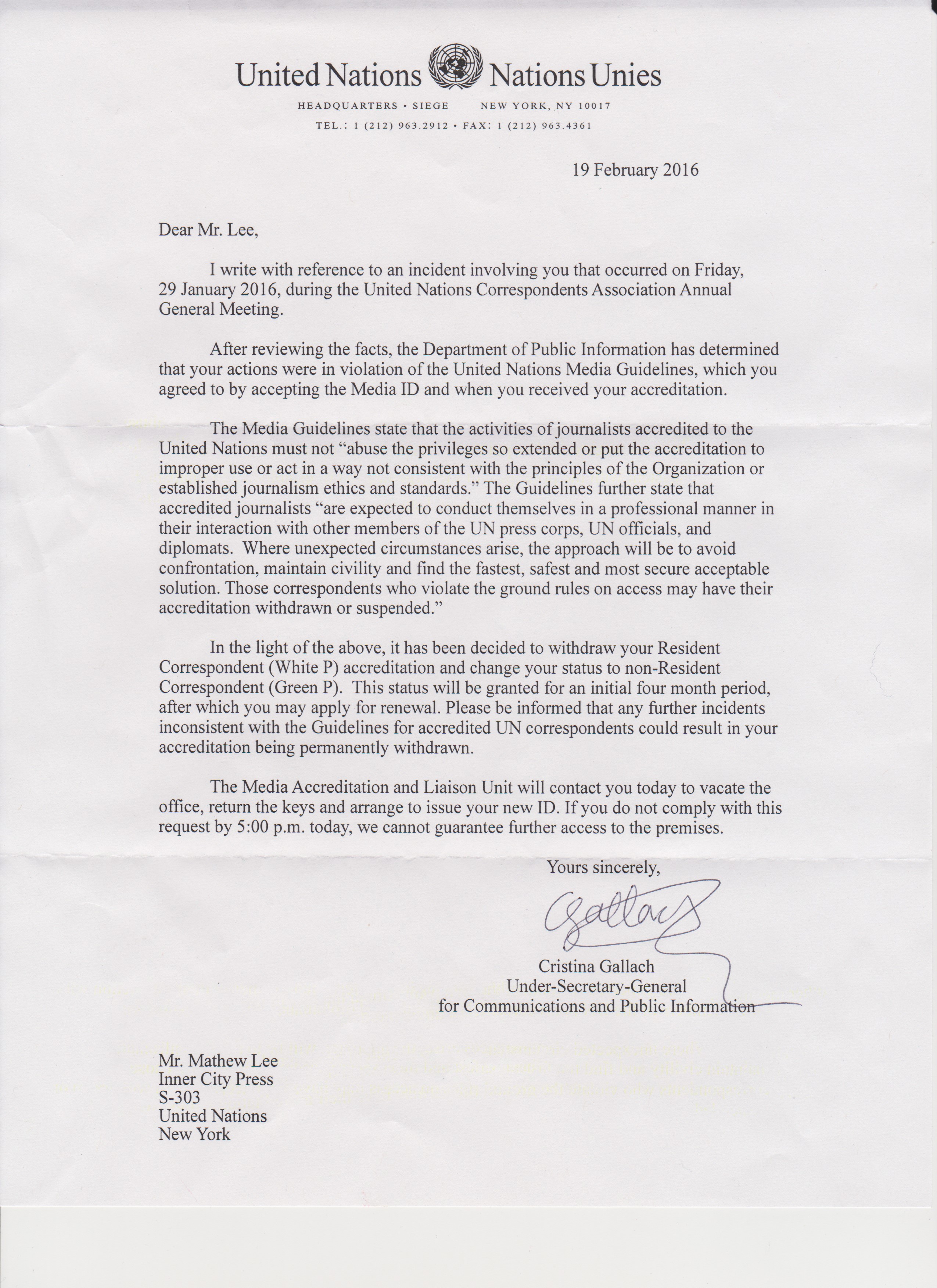
On the evening of February 19, UN Security Deputy Chief Michael McNulty, who refused to provide his name (audio), pushed Inner City Press out onto First Avenue (audio), having cut off its Periscope video livestream (video) and not allowed it to get its files, coat or passport from its longtime shared office. Gallach wants the office back, to retaliate and so the UN Correspondents Association can, in essence, sell the UN space just as it sells access to Secretary General Ban Ki-moon.
On February 20, Inner City Press posed four questions to Dujarric and his deputy Farhan Haq, with a copy to Gallach --which 24 hours later have not been answered or even acknowledged (while both Dujarric and Gallach were wildly spinning to those who contacted them, includingNobel Laureate Jose Ramos Horta, see here, who was told there was no problem taking over Inner City Press' office and undermining its ability to report, edit videos, conduct interviews. There is a big problem. Here are the questions:
"Please state the status and condition of all of my papers and property in my office, Room S-303A, including investigative papers, communications from sources including whistleblowers and my passport and when I will have the access to them that I was denied on February 19 and since.
Please state when the Resident Correspondent UN pass I have had for years, but which was torn off my neck on Feb 19, will be returned, in connection with 1, above, and the UNSC meeting(s) and UN Noon Briefing on Monday February 22.
Please state and explain the role of the Office of the Spokesperson of the Secretary General in the deprivations in 1 and 2, above.
Finally, for now, please state the Secretary-General's position on UN Security Deputy McNulty on February 19 threatening twice to have me “handed over to NYPD” (including the concomitant acceptance by the UN of the NYPD's jurisdiction), of UN Security officers grabbing my phone which was live-broadcasting Periscope video at the UN Security Council stakeout and turning it off.
I have other questions but these are most pressing, for immediate answer."
And as yet, 42 hours later, no answer. Watch this site.
While Inner City Press was writing up a UN Security Council meeting on Syria that went into the evening, and Periscope broadcasting, UN Security guards walked up, grabbed Inner City Press' laptop, blocked its Periscope camera and turned off the livestream. Video here.
Then eight UN Security officers led by Deputy Chief McNulty tore off Inner City Press' UN ID badge and carted off Inner City Press' laptop and camera, returning these by throwing them on the sidewalk of First Avenue. Audio here.
They did not allow Inner City Press to get coat or sweater, or the files in its office. No provision was made for this.
The ejection letter was signed by the Under Secretary General for Public Information Cristina Galach of Spain but ultimately Secretary General Ban Ki-moon is in charge. Ban and his chief of staff Edmond Mulet and Deputy SG Jan Eliasson were all written to with details as this took place.
USG Gallach's office, Darrin Farrant in charge, merely "took note" of questions about and criticism of the lack of due process. Gallach did not respond to email, even from Nobel Peace Prize winner Jose Ramos-Horta, here.
When Inner City Press was thrown out onto First Avenue, standing waiting, laughing and filming, was Voice of America's Margaret Besheer and another board member of the UN Correspondents Association, whose president Giampaoli Pioli told Inner City Press if it didn't remove a (truthful) article about his screening of a war crimes denial film for a tenant of his, Sri Lanka's then ambassador Palitha Kohona, he would get Inner City Press thrown out of the UN.
But who is running this asylum? Ban Ki-moon, his spokesman also involved Stephane Dujarric (who threw Inner City Press out of the UN Press Briefing Room on January 29, also trying to turn off ICP's Periscoping phone), and, some surmise, some who don't like Inner City Press' questions. We'll have more on this.
The pretext was Inner City Press three weeks earlier seeking to cover a meeting in the UN Press Briefing Room by an organization which has taken money from now indicted Ng Lap Seng and Frank Lorenzo's South SOuth News, then gave Ng Lap Seng a photo op with Ban.
(As Inner City Press reported, Gallach attended the South South Awards with Frank Lorenzo, photo here, just before his indictment. She should have been recused from any decision-making on this.)

UN Security demanded ICP's pass - and later tore it off.

Saturday, December 12, 2015
On Next SG, Inner City Press Asks Ukraine and Lithuania, They Cite Charter, Crimea
By Matthew Russell Lee
UNITED NATIONS, December 11 -- How should the next UN Secretary General be selected, to improve the Organization?
On December 11, Inner City Press asked the foreign ministers of both Ukraine and Lithuania, both members of the Eastern European Group, about who should be next SG. Video here.
From the answers, it seems at least these two countries will demand a candidate which would condemn a P5 Security Council member's violation of the UN Charter. Since p5 members have a veto over the SG, maybe the post will move beyond the group. We'll be covering this, watch this site.
On November 18, after the UN Security Council met behind closed doors on the issue, the month's UN Security Council President Matthew Rycroft of the UK emerged and read a short Elements to the Press on “the issue of the letter that will be written shortly by the President of the Security Council and the President of the General Assembly, on the selection process for the appointment of the next secretary general, and an exchange of views on the basis of a draft letter from the UK and we agreed to do further work, both on the letter and to keep in touch with each other on the timing of that, in order to fulfill our side of the work of the security council. The General Assembly has already begun with their resolution 69/321.”
But less than an hour before, Russia's Ambassador Vitaly Churkin had told the press that “I’m sure the President of the Council is going to speak. And what I proposed, half-jokingly I must admit, that we should set a working group which will have weekly meetings until the end of next year on a draft letter by the President of the General Assembly and the President of the Security Council. In fact, if we stick to the resolution of the General Assembly, it says that they are asking for a joint letter, which is going to describe the process and invite candidates. The process is described in the Charter and inviting candidates is saying yes please, submit your candidates. But if you try to turn it into a lengthy negotiation, some kind of a fancy document, then it will take 12 months for us to achieve this draft letter. So my pitch, which was shared by some colleagues, let’s not over-complicate things. Come on. And if we don’t over-complicated things, then I think it can be done.
France 24 asked Churkin, You have a candidate? Churkin replied there are seven or eight candidates from Eastern Europe, but France 24 insisted, “From Russia?”
Churkin explained that Permanent members of the Security Council don't submit UNSG candidates. And so it goes. We note that at the increasingly corrupt UN Correspondents Association, there are no term limits and this year, all six officers are running without opposition, headed by Giampaolo Pioli who previously rented one of his apartments to Sri Lanka's ambassador then screened his war crimes denial film, and now sells seats with Ban Ki-moon for $6,000. Let's hope this process can lead to an SG who can clear the UN up.
On September 22, after the Permanent Representatives of Estonia and Costa Rica announced a high level meeting on the topic on September 26; Estonia's Sven Jürgenson said his priority is the best candidate, not necessarily from the Eastern European group.
Inner City Press asked if this same push for transparency applies to the current murky process of selecting the new High Commissioner for Refugees, of which it is said Ban Ki-moon alone choose (Danish UNGA President Mogens Lykketoft told Inner City Press he “favors” the Danish ex-Prime Minister but plays no role.)
Costa Rica's Juan Carlos Mendoza Garcia told Inner City Press that reforms in Secretary General selection could help reform other selections in the UN system. Inner City Press - and the Free UN Coalition for Access -- ask, isn't the refugee top post something of a test case?
Tellingly, the old UN Correspondents Association demanded to ask - and largely waste - the first question, the time of meritless hierarchy that is precisely what's wrong with the UN. We'll have more on this, and on the September 26 high level meeting.
Back on July 22 the subject was discussed behind closed doors by the UN Security Council. Afterward UK Ambassador Matthew Rycroft emerged and described the meeting as a first step, adding that the UK intends to convene a so-called Arria formula meeting of the Council once candidates come forward.
Inner City Press asked Rycroft if the issue of regional rotation - that is, the the Next SG post belongs to the Eastern European Group -- came up. He said that it did, adding among other things that the UK does not think that is the most important factor. Periscope video here, for now.
It was argued to Inner City Press that while the UN Charter in English assumes that the Secretary General is male, that is not the case in the Chinese (or Russian) versions - for what it's worth.
Update: as to Russian, an astute reader notes that
Within Chapter XV of the Charter (“The Secretariat”), in the third sentence of Article 97, where the English version of the Charter says of the Secretary-General, “He shall . . .”, the Russian version instead uses the name “TheSecretary-General shall . . .”, thus avoiding specifying the SG’s gender. But in Article 99, where the English says, “The Secretary-General may bring to the attention of the Security Council any matter which in his opinion may threaten . . .”, the Russian also uses, “. . . in his opinion”.
h/t/ SC Procedure
Статья 97
Секретариат состоит из Генерального Секретаря и такого персонала, который может потребоваться для Организации. Генеральный Секретарь назначается Генеральной Ассамблеей по рекомендации Совета Безопасности. Генеральный Секретарь является главным административным должностным лицом Организации.
Статья 98
Генеральный Секретарь действует в этом качестве на всех заседаниях Генеральной Ассамблеи, Совета Безопасности, Экономического и Социального Совета и Совета по Опеке и выполняет такие другие функции, какие возлагаются на него этими органами. Генеральный Секретарь представляет Генеральной Ассамблее ежегодный отчет о работе Организации.
Генеральный Секретарь имеет право доводить до сведения Совета Безопасности о любых вопросах, которые, по его мнению, могут угрожать поддержанию международного мира и безопасности.
The Security Council's President for July, Gerard von Bohemen of New Zealand, spoke at the UNTV stakeout after the consultations. Inner City Press asked him as well about the regional rotation issue. Periscope video for now here. He said he had come up; he said that New Zealand's position is consistent with that of the ACT - Accountability, Coherence and Transparency - group, see background below. Here's from July 22 transcriptio by the NZ UN Mission:
"On the Secretary General appointment, this was the first time the Council had discussed the issue, there was a reference made to the ACT letter and the processes suggested in that, but it was a more general conversation than that. I was very encouraged by both the spirit of the discussion, also by the relative convergence of views, although there was no specific agreement on any outcome, there was a recognition that transparency is an important consideration, and clarity and recognition that the General Assembly membership is very interested in this issue and that the Council should be responding to it. So we agreed that this was the first of a number of conversations we would have as to any specific action that might be taken, that’s for the future."
Inner City Press: How would you characterize the issue of regional rotation in the Eastern European Group, just to give some sense of what people said or what the view is?
A: Well, a number of speakers referred to it, no one disagreed with it, but it wasn’t seen as being inconsistent with the processes, some of the processes that were being recommended.
Inner City Press: How would you characterize the issue of regional rotation in the Eastern European Group, just to give some sense of what people said or what the view is?
A: Well, a number of speakers referred to it, no one disagreed with it, but it wasn’t seen as being inconsistent with the processes, some of the processes that were being recommended.
Background: on June 30, UN Conference Room 11 was full to discuss the Next SG question, in an event organized by the 27 member states (so far) making up ACT (Accountability, Coherence, Transparency).
Surprising to some, on the panel was UK Permanent Representative Matthew Rycroft, who said among other things that the Next SG should not necessarily be from the Eastern European Group.
The room was full -- Inner City Press stood by the door,broadcasting by Periscope and live-tweeting with laptop in hand -- but with a notable contingent of Eastern European representatives. One question identified herself as such: a woman, and Eastern European. Just saying.
William Pace of WFM reminisced how Boutros Boutros Ghali's second term was vetoed in a deal between the (Bill) Clinton adminstration and then-Senator Jesse Helms, to release dues payments to the UN.
The proposal now is for a single seven year term. Mary Robinson says she knows of another P5 country, beyond the UK, which is open to a single seven year term.
When it was open for questions, Inner City Press (also on behalf of the new Free UN Coalition for Access, which unlike the older correspondents grouping actually fights for more transparency by the UN) asked why not have a debate among prospective candidates?
Why not require disclosure of how much is spend on each candidates campaign, including banning or requiring the disclosure of spending of the funds of UN Programmes (UNDP) or Organizations (UNESCO) for their chiefs to campaign to replace Ban Ki-moon?
The UK's Rycroft said that prohibitions are not the answer -- agreed -- but did not answer on requiring financial disclosures. (He said we don't want massive spending, one isn't running for president. Which raises another question: what about some form of matching funds for candidates from lower income countries?)
While much of the focus seems to be on arranging letters from the President of the Security Council to the President of the General Assembly, as Inner City Press asked at the ACT event and asked the new PGA Mogens Lykketoft himself, twice (video), can't the PGA call a high level meeting and invite candidates to present themselves? In this way, the wider world outside the UN could get engaged, and put on some pressure. The anonymous polling of which candidates are “discouraged” by the P5 members should not, FUNCA contends, be repeated.
Costa Rica's Permanent Representative Juan Carlos Mendoza-García wrapped up, and the event was over. It was promising, but moves for reform and opening up should begin as soon as possible. Watch this site.
Back on June 1, after several press conference on the topic and a closed door General Assembly session on April 27, the ACT group of 27 states (Accountability, Coherence and Transparency) submitted their page and a half set of proposals to the Presidents of the Security Council and of the General Assembly.
Here is a photo, re-tweeted from the Swiss by the Free UN Coalition for Access.
Even before these proposals are debated, candidates are edging for an advantage; dark horses are positioning themselves for it the post slips away from the Eastern European Group. Inner City Press has mentioned Helen Clark, using the UN Development Program post to campaign (staff who cross her on Twitter are reprimanded, as Inner City Press reported here.)
Another "dark horse" candidate, Inner City Press is told, is Swedish foreign minister and former UN official Margot Wallstrom. We'd like to hear from her what she thnks of the UN's handling of allegations of sexual abuse by French "peacekeepers" in the Central African Republic, including the role of another reputed dark horse candidate, or at least candidate to head the UN in Geneva, Susana Malcorra. And what did Ban know, and when did he know it?
The Free UN Coalition for Access agrees, there should be formal candidacies, platforms -- and adds, why not debates?
We'd like to hear the Swiss view on this - from today forward, from a new mission spokesperson, Simone Eymann. Her predecessor Adrian Sollberger at his farewell reception on June 1 joked how being an elections officer is like speed dating. He is remaining with the the Foreign Department of Switzerland working in the Cabinet of the Secretary of State, in Berne.
So why NOT some debates among candidates for Secretary General, when they declare? We'll have more on this.
How to pick the next UNSG: that was the question on the afternoon of April 27 in what was called a "closed" meeting in the Trusteeship Council Chamber. The meeting being labeled closed, and not on UN webcast, is a bad beginning, the Free UN Coalition for Access believes.
To counter-act this Inner City Press did its reporting about the meeting, from India urging that there be more than one - a panel - of candidates proposed, to Moldova emphasizing that the next SG should come from Eastern Europe.
Canada said regional rotation should inform but not determine the selection. The UK to its credit released a copy of the speech by new Permanent Representative Matthew Rycroft - but how to square its proposals with David Cameron nominating Andrew Lansley to replace Valerie Amos as Emergency Relief Coordinator, then insisting that the UK should have the post, now in the person of Stephen O'Brien.
Update: With only a few dozen states choosing to speak, the chair decided to try to finish them all -- five states in twelve minutes? -- to end the debate on April 27. This too may not be the right spirit.
Update II: And when the rushed session ended, the next one was announced for May 12, on the "institutional memory" of the Office of the President of the General Assembly.
Earlier in a 10 am press conference by the campaign called "1 for 7 Billion: Find the Best UN Leader."
At the April 27 UN noon briefing, Inner City Press asked Ban Ki-moon's deputy spokesperson for Ban's views on needed reforms. Apparently there are none: it is up to member states, he said, adding that selecting a women would be good. What about pay to play?
Inner City Press asked the panel if, as happened last time, increase trade and aid funding by a candidates' country should at least be disclosed, if not prohibited. William Pace of WFM replied not only about countries spending hundreds of million of Euros, but also about the heads of international agencies using their posts to campaign.
Since UNDP's Helen Clark is known to have told associates and underlings she would like to be the next SG, Inner City Press asked the panel for comment. They were diplomatic, including on the UK, said to be a reformer on the SG post, having insisted it retain the Emergency Relief Coordinator positioon, albeit in the person of Stephen O'Brien and not Cameron's first nominee (and National Health Service destroyer) Andrew Lansley.
Natalie Samarasinghe of UNA-UK said the campaign around (well, against) Lansley was a positive step forward; she said that social media makes secret processes less possible. (But see the replacement at Yemen envoy of Jamal Benomar by a Mauritanian official who has not made public financial disclosure).
Yvonne Terlingen, now Senior Policy Adviser at WFM, also cited the OCHA process or campaign. WFM's Pace seemed to conflate the entire UN press corps with the UN Correspondents Association, a group that for example tried to censor Press coverage of how Under Secretary General Herve Ladsous got the job, then tried to get the Press thrown out.
The new Free UN Coalition for Access seeks to open the UN and these processes - watch this site.
Wednesday, May 27, 2015
On Burundi, Inner City Press Asks Lithuania of Attacks on Press, Is Told To Ask Penholder, France
By Matthew Russell Lee
UNITED NATIONS, May 27 -- Two weeks after the UN Security Council, the United States and the UN Peacebuilding Configuration on Burundi on May 15 issued statements urging calm in the country given the return of Pierre Nkurunziza to presumably run for a third term, on May 27 the UN Security Council got a closed-door briefing from envoy Said Djinnit.
Later on May 27 Inner City Press asked the May presidency of the Security Council, Lithuania's Foreign Minister Linas Linkevicius and Permanent Representative Raimonda Murmokaité about the closed door briefing, and why attacks on journalists in Burundi wasn't mentioned in the Council's most recent Press Statement on Burundi. Video here and embedded below.
Raimonda Murmokaité provided a second summary of the meeting, and told Inner City Press that it surely knew how Council press statements work. (A corresponent in the front row, already called on, appeared to giggle.)
Inner City Press replied that yes, it does know how the process works or is supposed to work -- so, was language about press freedom proposed and rejected? Or never proposed?
Raimonda Murmokaité replied, Ask the penholder. That is France, and Inner City Press did ask, see below.
An hour before Djinnit's briefing, Inner City Press asked UN spokesman Stephane Dujarric, transcript here, video here:
Inner City Press: On Burundi, I'd wanted to ask you this. The… in today's debate in the Council, a number of the Council members brought up the crackdown on media in Burundi alongside the, obviously, attacks on opposition and protesters, including the closing of three radio stations, the seeming shooting of a radio station reporter along with the opposition leader that was killed. I wanted to know, is the UN doing… given all that's being said in the Security Council chamber today, is the UN and its existing missions in Burundi doing anything to actually try to protect journalists in Burundi?
Spokesman: Obviously, the question of protection of journalists is one that's high on the agenda and you… as explained by the Deputy Secretary-General himself this morning. It is critical for Burundi to move forward. A critical part of Burundi moving forward in a peaceful way and political dialogue is a free press and that a free press be allowed to operate. So, it's clearly part of the overall discussions that are going on.
Inner City Press: But in the Secretary-General's statement on the attack on the opposition leader, was he or DPA [Department of Political Affairs] or whoever wrote it unaware there was a journalist also gravely wounded at the same time?
Spokesman: We may not have been aware of the full details, but obviously, attacks on journalists are condemned.
Inner City Press: And just one other question on Burundi. There's a lot of discussion there, there's a picture, in fact, of a police individual shooting a submachine gun and also a picture of him in a peacekeeper uniform. So, I wanted to know, is there… is DPKO [Department of Peacekeeping Operations] doing anything to see whether people previously deployed or prospectively deployed… there's another individual named Donat [a/k/a Rukonangwe] as possibly deploying… are involved in a picture of shooting in a crowd?
Spokesman: I think… I haven't personally seen that picture. If it turns out to be true, as we've seen in other cases, you know, troop contributors are not permitted to use UN insignia, symbols, emblems on uniforms or planes outside of UN peacekeeping operation, so, obviously, if this turned out to be true, it would… it would be in violation of those understandings. Obviously, the vetting process of peacekeepers from all countries goes through… is cooperation between DPKO and the Office of the High Commissioner for Human Rights (OHCHR). I think there's a special focus if troops would be coming in recently from Burundi; at this point, Burundian soldiers are continuing to serve in UN peacekeeping troops, and obviously, we… the UN has no operational or any control over the troops that have returned to the country.
Spokesman: Obviously, the question of protection of journalists is one that's high on the agenda and you… as explained by the Deputy Secretary-General himself this morning. It is critical for Burundi to move forward. A critical part of Burundi moving forward in a peaceful way and political dialogue is a free press and that a free press be allowed to operate. So, it's clearly part of the overall discussions that are going on.
Inner City Press: But in the Secretary-General's statement on the attack on the opposition leader, was he or DPA [Department of Political Affairs] or whoever wrote it unaware there was a journalist also gravely wounded at the same time?
Spokesman: We may not have been aware of the full details, but obviously, attacks on journalists are condemned.
Inner City Press: And just one other question on Burundi. There's a lot of discussion there, there's a picture, in fact, of a police individual shooting a submachine gun and also a picture of him in a peacekeeper uniform. So, I wanted to know, is there… is DPKO [Department of Peacekeeping Operations] doing anything to see whether people previously deployed or prospectively deployed… there's another individual named Donat [a/k/a Rukonangwe] as possibly deploying… are involved in a picture of shooting in a crowd?
Spokesman: I think… I haven't personally seen that picture. If it turns out to be true, as we've seen in other cases, you know, troop contributors are not permitted to use UN insignia, symbols, emblems on uniforms or planes outside of UN peacekeeping operation, so, obviously, if this turned out to be true, it would… it would be in violation of those understandings. Obviously, the vetting process of peacekeepers from all countries goes through… is cooperation between DPKO and the Office of the High Commissioner for Human Rights (OHCHR). I think there's a special focus if troops would be coming in recently from Burundi; at this point, Burundian soldiers are continuing to serve in UN peacekeeping troops, and obviously, we… the UN has no operational or any control over the troops that have returned to the country.
Note: the first asked about is Alfred Innocent Museremu...
On the way into the UNSC for the 1:15 pm meeting, a Permanent member's deputy ambassador told Inner City Press there would probably be no outcome from the meeting. And so it was -- after an hour and a half, when the Ambassador of the Council's "penholder" on Burundi Francois Delattre emerged, he declined to speak on the UNTV camera.
He did however to his credit answer questions on the stairs leaving the stakeout. Inner City Press asked him about the timing of the presidential election; he said the conditions are not met.
But why not put that in a Security Council statement? To make it a Council position?
Inner City Press asked Delattre about attacks on journalists, the Security Council's topic before and after the Burundi consultation. He genially said it might be a good idea for the Council to speak on that. We'll see -- cell phone video here, in the spirit of Freedom of the Press, by the Free UN Coalition for Access, along with this rough transcript:
Inner City Press: What about the timing of the presidential election?
A: There’s a wide unity around the table, conditions are not met. A wide unity, everybody says that conditions for election are not met. That’s what we should work on. Raising these conditions.
Inner City Press: what about attacks on journalists?
A: There’s a wide unity around the table, conditions are not met. A wide unity, everybody says that conditions for election are not met. That’s what we should work on. Raising these conditions.
Inner City Press: what about attacks on journalists?
A: That’s a really good point, because you have these consultations on Burundi, and you have this debate on protection of journalists. That’s something that I stressed to my colleagues. Protection of journalists is everywhere and also in Burundi.
Inner City Press: Will there be a statement on it?
Inner City Press: Will there be a statement on it?
A: You had a statement already on Sunday, you cannot have a statement every day. These are real concerns.
Tuesday, June 17, 2014
On Kyiv Embassy Attack, Lithuania Links to Downed Ukrainian Military Transport Plane -- But Not at UN Security Council Stakeout
By Matthew Russell Lee
UNITED NATIONS, June 17, more here -- After the UN Security Council met on June 16 about Ukraine, Russian Ambassador Vitaly Churkin came to the UN Television stakeout and said that it was Lithuania which blocked the proposed press statement about the attack on its embassy in Kyiv and Ukraine's duties under the Vienna Convention.
As Inner City Press reported, Churkin also spoke to proposals to link condemnation the embassy attack to a statement on the plane downing near Luhansk.
Lithuania's foreign ministry tweeted to Inner City Press that its Mission to the UN "asked for a statement condemning the downing of Ukrainian [Army transport] plane by armed insurgents which cost 49 lives. Blocking? No way."
The explanation is appreciated, as have been Foreign Minister Linas Linkevicius' responses. But the Free UN Coalition for Access believes that Lithuania's Mission to the UN should have followed -- or it is wished preceded -- Churkin to the stakeout and stated its position on record.
This is not a one-time occurrence. As Inner City Press (and FUNCA) pointed out earlier this year, during Lithuania's month as Security Council president they did few, very few, stakeouts even after closed-door consultations. After the review, it was said that this would change as Lithuania gained more experience on the Council.
On that, until now it has been said that the Security Council condemns attacks on diplomats and diplomatic facilities, like terrorism, without attempting to link them to stated underlying causes. So it would still be good for Lithuania's mission to speak to this on the record.
At work in all this is the non-identity of particular diplomats with the country they represent. Inner City Press strives to distinguish the two -- the upcoming departure of French PR Gerard Araud will present an opportunity, possibly brief -- and so once again notes: hearing more rather than less on the record is always better.
Earlier on June 16 Inner City Press asked Ban's deputy spokesperson Farhan Haq about it the attack on Russia's embassy in Kyiv. Video here.
Haq replied, "certainly we are concerned about the efforts on the ground that have led to greater violence," then referred again to "Eastern Ukraine."
Inner City Press pointed out that the embassy attacked is not in the East, but in the capital.
Haq replied that Ban's "statement was designed to stress the main root of the problem." Video here.
So, Inner City Press asked, is the UN saying that attacks on some embassies are justified? Haq did not answer.
Meanwhile Journalists Evgeny Davydov and Nikita Konashenkov were detained by Ukraine's National Guard at the Dnepropetrovsk airport in the Donetsky region, in what is becoming a pattern, on June 14.
In this they are at least luckier than Italian journalist Andrea Rocchelli and his interpreter Andrey Mironov, both killed in May in the run up to the election.
With the UN Security Council yet to issue its usual boilerplate press statement citing the Vienna Convention after the attack on Russia's embassy in Kyiv, any statement on the detention of these journalists seem even more UNlikely.
When the UN Security Council met after the election, Lithuania's Ambassador cited the killed young Italian journalist without mentioning (Russian) Mironov, nor that authorities killed both of them. While others might take this approach, at the UN the Free UN Coalition for Access says journalists are journalists, just as civilians are civilians.
On that, it's similar to the reaction of some to Ukraine's air force bombing Luhansk, click here for more on that.
Back on May 25 amid voting in Ukraine, Italian journalist Andrea Rocchelli and his interpreter Andrey Mironov were found dead near the village of Andreevka outside Slavyansk on May 25.
Rocchelli had been taking photographs, for example of children seeking protection from shelling in a basement in Slavyansk's Cherevkovka neighborhood.
Italian Foreign Minister Federica Mogherini confirmed the deaths; another photographer who was traveling with Rocchelli and Mironov said they were hit by mortar fire as they were taking shelter in a roadside ditch; it's reported the journalists came under shelling from Ukrainian troops late on May 24.
If this happened say in Syria, what would the reaction be? What will the reaction be now?
On May 23 when Ukraine's Permanent Representative to the UN Yuriy Sergeyev held a press conference two days before the elections, Inner City Press asked about the “UN” painted helicopters shown by LifeNews as being in Ukraine, and about the two LifeNews journalists then detained.
Sergeyev said he contacted his government's defense department and was assured that helicopters that serve for pay in UN peacekeeping mission returned painted white but with the UN insignia “erased.” He said the filming was not in Ukraine.
Inner City Press asked if it was in a UN peacekeeping mission why the soldiers around the copter were in camouflage and not UN blue helmets. This has not been answered.
On the LifeNews journalists, Sergeyev said they had confessed to not being “pure journalists” and had revealed Ukraine military positions.
Inner City Press asked if that wasn't always a possible charge of war reporters. It might also be asked which others detained while engaged in acts of journalism, sometimes, are not “pure journalists.”
The Free UN Coalition for Access supports these journalists and continued to ask about their fate, as it asked the UN's Ivan Simonovic in late May.
The two were later released, and have said they were held with sacks over their heads, arms and legs tied.
On a second round of questions on May 23, Inner City Press asked about the four or five investigations of the May 2 murders in Odessa that Simonovic had described. Sergeyev said Simonovic must have been referring to four or five versions of events, because there are only Ukrainian investigations.
Inner City Press at the day's noon briefing asked Secretary General Ban Ki-moon's spokesman Stephane Dujarric how many investigations of Odessa there are, and if one involving the Organization for the Prevention of Chemical Weapons is being considered.
And so far from the UN, nothing on the detention of journalists Evgeny Davydov and Nikita Konashenkov. Watch this site.
Thursday, February 27, 2014
In UNSC Month, No Questions Taken by Lithuania on Somalia, Lebanon or Guinea Bissau Statements
By Matthew Russell Lee
UNITED NATIONS, February 27 -- How much credit should the monthly president of the UN Security Council take or get for the number of press statements adopted?
Concluding its month as president, Lithuania's mission to the UN on February 27 bragged of four Resolutions, three Presidential Statements, 10 Press Statements, 14 public meetings & eight consultations, calling this the "highest number of products delivered since 2012."
Notably, there appear to have been no question and answer stakeouts by the Mission with the media after these eight consultations. (Only the Lithuanian foreign minister Linas Linkevicius took questions during his visit which included a stakeout featuring the EU's Catherine Ashton).
Even when a Press Statement on Guinea Bissau was read out by the Lithuanian Mission on February 26, no questions about the briefing or consultations behind it were answered or taken.
The number of Press Statements in a month is largely a product of the number of terrorist incidents in the month, not the Security Council presidency's acumen. In February there were three Press Statements on attacks in Lebanon, and two in Somalia.
Even if controversial -- many are boilerplate denunciations of acts of terrorism -- the statements are drafted by the country which "holds the pen," France for Lebanon and the UK from Somalia, not by the president.
One thing the presidency DOES control is how transparent it tried to be, including at least endeavoring to hold a question and answer stakeout after closed consultations. China's Liu Jieyi, for example, held nine such Q&A stakeouts in his recent months as president.
But no Q&A stakeouts? And not even yet answering aquestion, rather than praise, on the lack of transparency?Another answer said Lithuania will aim for better going forward. We will be looking for that.
As the most recent example, on February 26 the Security Council issued a Press Statement, now here, on which the Lithuanian deputy who read-out the statement took no questions.
Three months ago, when UN envoy Jose Ramos-Horta came to brief in person, Inner City Press asked him about the proposed Amnesty Law for the authors of the 2012 coup. Ramos-Horta on November 26 expressed support for it only if there are iron-clad commitments by the military to stay out of politics. So: a conditional amnesty that would end if that commitment were broken?
So on February 26, when Lithuania's Deputy Permanent Representative Rita Kazragiene came out to read the Council's press statement, including "the fight against impunity," Inner City Press waited and once she was finished asked if the Amnesty Law, which Ramos-Horta spoke about, had come up in consultations.
But Rita Kazragiene declined to answer any questions. One wonders why, given that the Security Council and UN have a hard enough time trying to raise the profile of the problems in Guinea Bissau. Why NOT answer a question?
At the beginning of the month, Inner City Press on behalf of the Free UN Coalition for Access urged that Lithuania come to the stakeout and take questions after each closed door consultation. As noted, during China's more recent presidency, for example, Permanent Representative Liu Jieyi held nine Q&A stakeouts.
So far during this, Lithuania's, month, with all the scheduled meetings over and only one day left? None. (Though as noted Lithuania's foreign minister did answer questions, including one Inner City Press pushed to ask, about Ukraine, as it also had to press to ask the EU's Cathy Ashton.)
Lithuania is chair of the new Central African Republic sanctions committee, with an interesting mandate. When will it be spoken about, and questions taken? We'll retain an open mind and see.
Subscribe to:
Posts (Atom)