Showing posts with label kampala. Show all posts

Sunday, December 27, 2015

On Burundi, A Civil Society Statement Before Kampala Talks, As Imbonerakure Quoted by AP, CNARED


By Matthew Russell Lee

UNITED NATIONS, December 27 -- Amid killings by the security forces in Burundi, the Pierre Nkurunziza government with the agreement of UN Peacekeeping chief Herve Ladsous has undertaken to deploy officers allegedly involved in human rights abuses into Ladsous' Central African Republic mission, MINUSCA, see below. Also below, civil society statement in advance of the talks in Kampala on December 28.

  Nkurunziza's Imbonerakure militia was quoted by AP that "We would like to warn African Union troops that the majority of Burundians don't want them and they should not impose themselves on the people of Burundi." Here is a video of the ruling party demonstrations, on Facebook - and now, a second video, on Twitter.

  Also on Facebook (but not Twitter), Burundi's Permanent Representative to the UN Albert Shingiro -- who blocks Inner City Press from his Twitter feed -- tried to mock a protest by follow Burundians which Inner City Press covered on December 23, here. (Shingiro, like the presidential adviser and his alter-ego(s) liked to channel Bill Gates.) Some diplomacy: banning the Press from his statements, mocking rather than seeking to dialogue with his countrymen. To this has Burundi sunk.

 And so, we publish today this Statement of the Campaign “Halte au troisième mandat” on the occasion of the official opening of negotiations between  stakeholders in the Burundi conflict:

"On the occasion of the opening ceremonies of the negotiations between stakeholders in the Burundi conflict, in Kampala-Uganda on December 28, 2015, Civil society organizations members of the Campaign “Halte au troisième mandat” release the following statement:

1. They welcome the beginning of negotiations between Burundi stakeholders for their objective is to find a solution to the Burundian crisis since they will now take place outside Burundi; the same allowing stakeholders to negotiate in conditions that guarantee their safety;

2. However, they regret that the mediation has accused a huge delay in the fulfillment of its mission and that prior consultations as well as the official opening of negotiations are conducted under conditions that ignore the Campaign Halte au troisième mandat, yet widely known as leading group in defending the dignity of the people of Burundi through peaceful protests that started on April 26, 2015.

3. They take the opportunity to reaffirm their support to various groups defending the agenda of the restoration and respect for the Arusha Agreement for peace and reconciliation and the constitution; including CNARED;

4. They rejoice that the CNARED received and accepted the invitation to attend the opening ceremonies of the negotiations. Following due assessment of the achievements of the citizenry movement CNARED and bearing in mind the pressing responsibility to focus and limit mainly on the defense of democratic principles and the fight against impunity in the Supreme interest of the people of Burundi, the Campaign “Halte au troisième mandat” decides to withdraw from CNARED. They will from now on defend the positions and proposals of civil society contained in the document entitled " Burundi Crisis: Diagnosis and proposed solutions by civil society" that was made public;

6. They pledge to keep committed to the fight against the violation of the Arusha Agreement for Peace and Reconciliation and the Constitution and reaffirm their determination to continue the struggle until the restoration of citizens' constitutional legality;

7. They reiterated their willingness and readiness to fully participate in the negotiations and that civil society group should be represented on a same basis as the government of Nkurunziza and the political opposition;

8. Finally, they warn all the stakeholders against any attempt to a deal maintaining Nkurunziza in the position he has usurped and any arrangement likely to provide an opportunity for some to enjoy impunity for crimes committed. Done at Bujumbura, December 27, 2015"

  This last has resonance in other mediations: we'll have more on this.

 On December 24, Inner City Press asked for the second time, video here:

Inner City Press: whether you have any... first, any readout of Mr. Benomar's travels and attempts to speak with the Government in the region.  I'm asking you... yesterday there was… you may have seen it; you may not have seen it… there was a protest outside the building by Burundians, and in speaking with them, they judge the performance of the Secretariat as weak.

And I wanted to know, just to get, I guess, your response to that, and if there's any update on the deployment of these two, Pierre Niyonzima and Jimmy Rusheshe, both of whom have been linked to the hospital killings in May…

Spokesman Stephane Dujarric:  On your second part, no, I have no update than what was given.  I know there are discussions going on.  I don't have an update to share with you.  On your first part, I think we can all agree on the frustration of the Burundian people as they see the violence increase in their country.  The Secretary-General, through the work of his Special Envoy, is very much focused on finding ways to move the political dialogue forward and to obviously see an end to the current violence that we're seeing.  He is currently in Kampala in Uganda meeting with local officials, and I believe there will be talks there early next week.

Inner City Press:  Will your office be sending stuff out during this break?

Spokesman:  Obviously, as I said, we'll be fully staffed.  If there are updates to share, we will share them with you.

   Back on December 17 Inner City Press was told, the third time it asked, that the Burundi's Army spokesman Gaspard Baratuza's deployment to the UN mission in CAR had been suspended, and Baratuza was being repatriated. UN spokesman Stephane Dujarric, who has shielded Secretary General Ban Ki-moon from such Press questions, said "it's an example of the [vetting] policy working."

 But Inner City Press has obtained the Burundi government document for the deployment not only of Baratuza but other officers in Ladsous' MINUSCA. Today we focus and ask about Major Pierre Niyonzima.

According to Inner City Press' sources, Niyonzima not only defended extrajudicial executions, he participated in them.  On May 14, they say, Major Niyonzima was the Senior army officer who led the attack on the hospital where those accused of involvement in the attempted coup were slaughtered.  They say Niyonzima reports to Guillaume Bunyoni and has been involved in killings in Musaga, Nyakabiga and Mutakura. We'll have more on this, and on other deployees to Ladsous' MINUSCA, including  Jimmy Rusheshe.

On December 21 Inner City Press asked the UN's Deputy Spokesperson Farhan Haq about these deployments, and the Burundian government's rejection of the African Union's proposed deployment, video here,transcript here:

Inner City Press: on Burundi, as you know, the African Union Peace and Security Council has made this proposal 5,000 peacekeepers and set a 96-hour deadline for the Government to respond.  The assembly has met and rejected it and said it would be a violation of the sovereignty of the country.  So, I wanted to know, what is the Secretariat… Mr. [Jamal] Benomar, what do they… you think of both the [African Union Peace and Security Council] taking a seemingly fairly aggressive protection of civilian stance and the Government rejecting it?

Deputy Spokesman:  Well, first of all, regarding that, I believe that the discussions will continue with the African Union and the Government of Burundi.  But, we certainly support the efforts by the African Union and its Peace and Security Council to deal with the protection of civilians in Burundi.  We've made clear our alarm at recent developments and the need for there to be additional steps to bring the tensions on the ground to a halt.  As you know, the Security Council itself has been apprised by the Secretary-General of various options for the way forward, and we await their guidance on that.  Meanwhile, Mr. Benomar has started some of his travels.  I believe he was in Washington, D.C., in the last few days, and he is expected to head to the region shortly.

Correspondent:  And then… thanks a lot.  I wanted… something a little more specific.  It has to do with this vetting of troops from Burundi, but I guess you could say elsewhere.  I know it was said last week that Gaspard Baratuza, a Deputy Spokesman of the army, was being repatriated.

Deputy Spokesman:  Yes.

Inner City Press:  But, I've since seen a letter… it was his deployment letter, but it also involved two other majors in the army who are said to have been involved in the… the assault on a hospital in May, right after the coup attempt in which people were killed in their beds, and these involve Mr. Pierre Niyonzima and Jimmy Rusheshe.  And both of them, according to a letter from the Burundian Army, are… were being deployed to the UN in the Central African Republic.  So, I wanted… I guess I want to ask you, like, what does the vetting consist of?  What was the vetting that Mr. Baratuza failed that these two individuals apparently don't fail, given their involvement in extrajudicial executions?

Deputy Spokesman:  As we get information… if any information causes us to have concerns about deployment, it is reviewed in that light.  In that light, Mr. Baratuza, his suspension was first delayed, and then he was repatriated.  And so, depending upon the information, as we get it, we'll act upon it.

Inner City Press:  So, does… I guess what I'm saying is does the… either the human rights presence of the UN in Burundi have information about those who commanded the assault on this hospital, it's called Bumerec Hospital, in May and the connection to the people that were being deployed?

Deputy Spokesman:  Like I said, we… yes, we do have a human rights presence in Burundi.  As we get information, we act upon, and that includes anyone being deployed.


Obtained by Inner City Press

Ladsous' lack of vetting was criticized in the recently released report into the cover up of peacekeepers' rapes in the Central African Republic. Earlier, Inner City Press exclusive reported on Ladsous in his October 1, 2015 meeting with Burundi's vice president saying that he is "pragmatic" on human rights.

 On December 16 Inner City Press was banned from questions to Secretary General Ban Ki-moon, but learned from the mission MINUSCA that Baratuza was already in Entebbe. Inner City Press asked several Security Council members, then Ban's spokesman Stephane Dujarric on December17.

Dujarric told Inner City Press Baratuza's deployment is suspended and he is being repatriated: "based on the information we've received regarding the Lieutenant Colonel, his deployment has been suspended, and he will be repatriated back to Burundi." Video here. Dujarric told Inner City Press this shows the UN system working - on a day when a report on rapes was issued showing UN Peacekeeping under Herve Ladsous not sufficiently vetting for human rights. We'll have more on this.


 Amid the escalating killings in Burundi, last weekend's summary executions in neighborhoods opposed to Pierre Nkurunziza's third term stand out. But Burundi Army spokesman Gaspard Baratuza was quoted on December 12 blaming all of the deaths on attempts to steal weapons to free prisoners.

   Inner City Press had heard that Mr. Baratuza was already in the process of being deployed to the UN Peacekeeping mission in the Central African Republic (MINUSCA) even when he was giving these quotes, issuing statements and speaking to state-owned radio, and so asked MINUSCA's acting spokesperson, “Is Gaspard Baratuza of Burundi's army getting a MINUSCA job?”

  On December 16, hours before UN Secretary General Ban Ki-moon held a rare press conference, MINUSCA's acting spokesperson sent this to Inner City Press:

"To: Matthew.Lee [at] InnerCityPress.com
From: Vladimir MONTEIRO [at] UN.org
Date: Wed, Dec 16, 2015
Subject: ICP question: Gaspard Baratuza of Burundi's army getting a MINUSCA-related post?
Cc: FUNCA [at] funca.info

"No decision related to Lt Col Baratuza's deployment can be taken before we finish looking into the matter. We can confirm that Lt Col Baratuza is in Entebbe but he has not yet deployed to MINUSCA.  Regards. VNM"

There are some questions about Baratuza, a Colonel in Burundi's Army, being listed by the UN as “Lt. Col.”

  Despite multiple follow-up questions by Inner City Press, Mr. Monteiro - previously a spokesperson for the UN electoral mission in Burundi - replied that “This is what we can say about this issue.”

   But the UN should have to say more. Inner City Press has repeatedly asked the UN how its Department of Peacekeeping Operations under Herve Ladsous vets those who deploy to UN missions; Inner City Pressexclusively reported on an October 1, 2015 meeting in which Ladsous told Burundi's Vice President Joseph Butare that he is “pragmatic” on human rights.
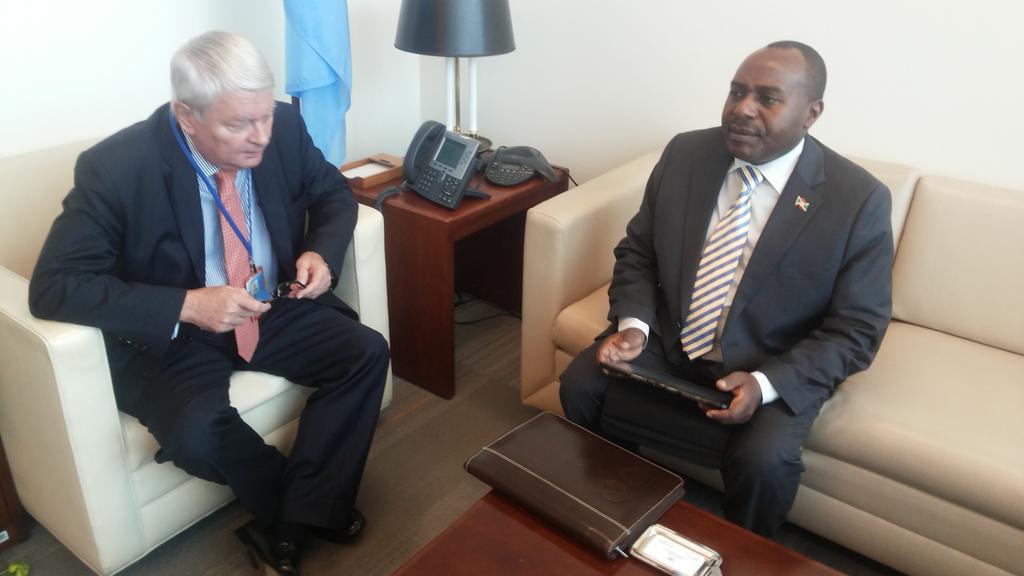


 Ban Ki-moon and his spokesman declined to take Inner City Press' questions on December 16, as they did on December 14. Vine here. But concerned members of the UN Security Council have now been asked about Baratuza by Inner City Press. Watch this site.

Wednesday, January 22, 2014

On Syria and Iran, Ban Ki-moon Eschews Security Council's Elected 10 Members, Then Gets Dominated by US: Hijacking the UN


By Matthew Russell Lee
UNITED NATIONS, January 22 -- After UN Secretary General Ban Ki-moon un-invited Iran to the Syria talks in Switzerland, many focused on the obvious, that Ban had been openly dominated by the United States. 
  This was nothing new - but Ban has gone further in excluding and devaluing the other members of the UN Security Council, not only debasing but delegitimating the UN Secretariat.
  On January 21 as the Security Council concluded a scheduled meeting about Central Asia, at the stakeout outside there were at most two media. 
  This month's Security Council president, Prince Zeid Ra'ad Zeid Al-Hussein of Jordan, stopped and amiably told the Press his impressions of Ban's reversal and of the upcoming talks, asking that some but not all of it be off-the-record.
  Significantly, Prince Zeid told Inner City Press of Ban's invitation to Iran to attend the talks, "we learned about it like everybody else, most other people," when Ban held a hastily arranged press conference on the evening of Sunday, January 19.
  Along with contrasts to the 1995 talks on Bosnia and more recent negotiations on the Crime of Aggression, Prince Zeid returned to Ban's reversal. "Clearly there was a miscalculation somewhere," he said, "yesterday there was a lot of back and forth." Not being "a principal," he said, he had not been told. (Inner City Press joked that if not a principal, he is a Prince.)
  But it's not just that he's a Prince, or a long-time Permanent Representative to the UN for a country directly impacted by the situation in Syria, taking in wave after wave of refugees. It's that he's the President of the Security Council, the body charged with international peace and security and that ostensibly oversees and thus legitimates Ban Ki-moon as Secretary General.
  But Ban has institutionalized a two-tier marginalization of most of the Security Council's Elected Ten members, for example meeting first with the Permanent Five and then with "the others."
  When Ban included nine other states with Iran in his last round of invitations to the Syria talks, these were Australia, Bahrain, Belgium, Greece, the Holy See / Vatican, Luxembourg, Mexico, the Netherlands and South Korea.
  Ban's native South Korea and Luxembourg are on the Security Council. But not among his invitees to the talks in Switzerland from among current Security Council members are not only Chad -- which Ban uses for peacekeepers in Mali and, through MISCA, Central African Republic, and Rwanda, used there and in Darfur, but also Argentina, Lithuania, Chile and Nigeria.
(Argentina's Permanent Representative Perceval told Inner City Press that, in the Council's day to day work, she was headed to Darfur on January 18, as part of her work chairing the Council's Sudan Sanctions Committee.)
  While Security Council member countries like Argentina, Rwanda and even Jordan were kept out of the loop in the run-up to Ban's invitation to (and then dis-invitation of) Iran, Jordan's Prince Zeid for example has a wealth of experience. On January 21 he told the Press, "if in July of 1995 someone said in four months there'd be peace in Bosnia, after so much killing, after everything had failed, what analysts could have seen fighting would have stopped in three months?"
   Prince Zeid added another hopeful analogy, to the more recent negotiation of amendments to the Rome Statute of the International Criminal Court: "when we went to Kampala to negotiate the amendment to the crime of aggression, no one thought you could succeed, 193 lawyers, these are heads of legal departments, to agree there should be structure for this, no one thought it possible... It must be ratified by parliaments, it touched on the Charter. A colleague told the media, no way... In end, we had consensus."
  This seems unlikely for these Swiss talks on Syria. But Zeid said, "if two days after the start of the talks, both still there discussing baskets, something may happen." 
  While respecting that, we note that something has already happened: Ban Ki-moon has eschewed the Security Council and been openly dominated by the United States. Where the legitimacy in that? Watch this site.


Monday, November 11, 2013

On DR Congo, UN On Nov 6 Told ICP It Expected Agreement, Now Vague on "Format," Verifying Kiwanja & Bunagana Reprisals?


By Matthew Russell Lee

UNITED NATIONS, November 11 -- Now that the UN has used attack helicopters to drive out the M23 rebels, and the Congolese Army is reported arresting and even robbing civilians in the area, the government of Joseph Kabila declined to sign the peace agreement on Monday in Kampala.


  But now that Kabila and his foreign minister Raymond Tshibanda say they want only a "declaration," Ban's two envoys, Mary Robinson and Martin Koblers, along with the US' Russ Feingold and his EU and AU counterparts called on both sides to be flexible on "format." So much for the UN's expectations.
  And what of the UN's inquiries, which took so long (and still without effect) on the 135 rapes by the Congolese Army in Minova a year ago? On November 11, Inner City Press asked:
Spokesperson Nesirky: Thank you, last question, please?
Inner City Press: I want to ask you about DRC ( Democratic Republic of the Congo) and also Lebanon. In the DRC there are these reports--
Spokesperson Nesirky: I said last question, so choose.
Inner City Press: I’ll go with the DRC, but… There are reports of people being arrested by the Congolese army in Kiwanja and in Bunagana for suspected collaboration with M23 (23 March Movement), these are apparently civilians that weren’t part of the armed group. What is MONUSCO (United Nations Organization Stabilization Mission in the Democratic Republic of the Congo), is MONUSCO aware of this? Are they tracking this and what do they say about it?
Spokesperson Nesirky: We’ll check with the Mission. Thanks very much. Have a good afternoon.
  Later on Monday, as Ban Ki-moon told the General Assembly of "good news from the Democratic Republic of the Congo" where he said it is "essential that the Government quickly restore its authority," his spokesperson sent this to Inner City Press:
Subject: Your question at noon on the DRC
From: UN Spokesperson - Do Not Reply [at] un.org
Date: Mon, Nov 11, 2013 at 3:24 PM
To: Matthew.Lee [at] innercitypress.com
Regarding your question on reports about reprisals in Bunagana and Kiwanja, the UN Mission, MONUSCO, is aware of the allegations and is trying to verify them.
  Verify like Minova? And then what - continue to support the FARDC units even while no one is prosecuted?
From the November 6 transcript:
Inner City Press: Laurent Mende, the Minister of Information and Communications, has said the DRC Government may not sign the Kampala agreement and instead just issue some kind of a statement, a unilateral statement. They are saying now that since they were defeated militarily, there is no reason to sign an agreement and I wondered, since the announcement by M23 seemed tied to a signing of an agreement, does the UN believe that the understanding is that an agreement will actually be signed by the two parties?
Deputy Spokesperson Haq: I am not going to speculate on what may happen in the coming days, but our expectation remains that the parties will be able to deal with each through an actual agreement.
And now, even that UN position changes. Watch this site.


Monday, October 28, 2013

At UN, France's Araud Declares "Military End" of M23, Dead Rwandans Added to Statement


By Matthew Russell Lee, With exclusive audio

UNITED NATIONS, October 28 -- After the Security Council met about Eastern Congo at France's request on Monday afternoon, the first announcement came from French Ambassador Gerard Araud.


  He said the M23 has met its "military end." Others noted that while M23 left towns it had controlled, it was not wiped out, a la Sri Lanka (no matter how much it seems France would have liked that.)

   The meeting was called by France on the death of a Tanzanian member of the UN's Force Intervention Brigade or FIB. Inner City Press asked Araud of the UN's role in the military "finishing" of M23.

  Araud, more detailed than in the morning (see below) said that the Tanzanian soldier had his helmet on, but was shot in the neck. 

  Inner City Press understands that in the consultations, the 21 shells into Rwanda from the DRC were raised, leading to the death of two civilians and injuring of ten. Araud told Inner City Press, that is in the press statement. 
    On Friday the UN Security Council expressed concern about renewed hostilities in Eastern Congo, called for "maximum restraint and de-escalation" and for a political solution. Video here.
  On Sunday UN envoy Martin Kobler announced that a member of MONUSCO's Force Intervention Brigade or "FIB" had been killed -- how that happened without being involved remains UNclear. Then Kobler toured land re-taken by the Congolese Army which the UN supports, even in the face of mass rape.
  On Monday in front of the Security Council, French Permanent Representative Gerard Araud told the Press about the weekend's developments in the Eastern Congo, "What is happening is great. It is the collapse of the rebels... The DRC army is restoring the sovereignty of the country. It is exactly what we were hoping for."  Exclusive audio here.
  How is this consistent with the Security Council's calls, agreed to and actually drafted by France which "hold the pen" for the Council on the DRC, for "restraint" and for a political solution through the Kampala talks?
  Or some now ask, were those calls just lies or a diversion, at least for some that agreed to or issued them?
  When the Security Council traveled recently to Eastern Congo, France was allowed to hand-pick which media could go on the UN plane and cover the trip. These scribes, predictably, are not raising or reporting these questions.
  Inner City Press asked Araud, on Monday, if MONUSCO and its FIB had in fact been involved despite the statements that it was not.
  Araud said that the killed "Tanzanian was part of the Force Intervention Brigade. What I heard was the Intervention Brigade went to Kiwanja after the M23 withdrew, to protect civilians. At a roadblock, from the side of the M23, he was killed." He said Martin Kobler would brief the Council by video Monday afternoon.
  But will Kobler take and at last answer questions? Or has he fully inhabited the character of his boss Herve Ladsous, who refuses Press questions? Video here, UK coverage here.Here is Ladsous' history in the Great Lakes region, for France.
  Here is a question. Araud said, of the weekend's fighting, "It is exactly what we were hoping for. Who is the "we"? The Security Council? UN Peacekeeping under Herve Ladsous? France? Is there any difference between the latter two? Watch this site.


Sunday, October 27, 2013

As African Union Slams Sudan for Abyei Blockage, OPCW Praises Syria Reporting, UN Security Council UNfocused?


By Matthew Russell Lee

UNITED NATIONS, October 27 -- After the UN Security Council met on October 24 about Sudan and South Sudan, Inner City Press asked Azerbaijan's Agshin Mehdiyev, the Security Council's president of October, if there had been any discussion of the idea of holding the Abyei referendum now.

  Mehdiyev answered that the elements to the press which he had just read out to an otherwise empty media stakeout contained the answer: no, the Council is not in favor.

  But what now, that Sudan has "obstructed" the African Union visit to Abyei planned for October 26-27? The AU has already complained, here.

  Inner City Press on October 24 obtained and published the UN Security Council's agreed-to elements to the press, including:

The members of the Council expressed support for the African Union Peace and Security Council visit to Abyei on 26-27 October and urged both communities to use this visit as an opportunity to ease tension.
The members of the Council looked forward to hearing from the AUPSC regarding its findings and to advancing the Parties’ efforts to peacefully resolve their differences.

  Well, now Sudan for whatever reason has blocked the visit -- they cited security -- and so, what will the Council hear from the AUPSC, other than this statement blaming Sudan for any negative consequences of blocking the visit?
    For comparison's sake, the Organization for the Prevention of Chemical Weapons on October 27 announced that Syria has met its deadlines, and that it is reporting that to the Security Council. 
   Some say that, like Susan Rice, much of the energetic concern about Sudan and Abyei has left the Security Council. 
  So how will the Council process these different reports on Sudan and Syria, where France for example openly wants to just name a replacement leader, the Saudi-sponsored and Turkey-based Ahmad al Jarba? 
  And what about the people trying to return to Abyei to vote, reportedly left under insufficient sheet plastic without enough mosquito nets?
  Inner City Press asked the UN's special rapporteur on the human rights of internally displaced persons Chaloka Beyani about the IDPs in Abyei. He said that in his visit to Sudan, he had not been able to visit Abyei, Southern Kordofan or Blue Nile states due to security concerns; he will soon travel to South Sudan.
  Inner City Press asked him about accountability, including for UN Peacekeeping, for the killing of IDPs in Nahibly camp in Cote d'Ivoire. He said the government had said it will prosecute but he had no information that it has -- rather like the assurances UN Peacekeeping under Herve Ladsous accepted from Congolese authorities about the 135 rapes at Minova by their forces.
  These are other examples of the Council's concern moving on, or never really being there. 
  Amid the calls for accountability in the Kampala talks between M23 and the Congolese, the callers including the US and its envoy Russ Feingold are not making the obvious link to the Congolese failure to hold to account even one of those who committed mass rape in Minova, including from the US trained 391st Battalion. 
 With Ladsous in DRC using attack helicopters and devoting UN resources to support France in Mali, while not protecting perceived Laurent Gbagbo supports in Cote d'Ivoire, one has to wonder what has become of UN Peacekeeping under his tenure.
To return to Abyei, what is the result of the promised investigation into the killing of the Paramount Chief of the area, which Ladsous' DPKO promised? What is it? Ladsous will not answer: video here, UN coverage here. Is this the UN? We'll find out. Watch this site.


Thursday, August 22, 2013

On DR Congo, UN's Mulet Tells Press No M23 Violation of Security Zone Except Mortars, Reuters Blind Quote Different: Why?


By Matthew Russell Lee
UNITED NATIONS, August 22 -- Amid conflicting reports from Eastern Congo, Inner City Press and another journalist twice asked UN Peacekeeping acting chief Edmond Mulet Thursday if the M23 rebels had entered the security zone established around Goma.
  "No," Mulet said. "Just mortars." He went on to refer to the separate "red line" established when M23 agreed in Kampala to pull out of Goma. (The portion of that agreement that gave M23 one third of the security force at the Goma airport remains unimplemented.)
  But later on Thursday, the wire service Reuters reported "a senior U.N. official, who asked not to be named, said that on Thursday the rebels entered a security zone surrounding Goma" -- which Mulet, the acting chief of DPKO, had just denied. Inner City Press and the other journalist waited to ask Mulet again, and got the same answer.
  So who is this "senior UN official who asked not to be named"? In UN Peacekeeping, only Herve Ladsous, long absent from UN Headquarters, is senior to and could over-rule Mulet.
   But with only a few arrests for the 135 rapes, Ladsous' DPKO continues supporting the 391st Battalion, even as it is now implicated in corpse desecration.
That the UN would try to use Reuters, willingly, resonates with a documented instance in June 2012 when Reuters UN bureau chief Louis Charbonneau gave to UN official Stephane Dujarric an internal UNCA anti-Press document,three minutes after saying he would not do so. Story here,audio here, document here, in which Charbonneau tells Dujarric, "You didn't get this from me."
  So is Reuters' "senior UN official who asked not to be named" someone junior to Mulet, or as another journalist suggested, no one at all? Watch this site.


Tuesday, June 18, 2013

As US Envoy, What'll Feingold Do on Minova Rapes by DRC Army, UN Inaction?


By Matthew Russell Lee

UNITED NATIONS, June 18 -- Amid advocates' congratulations and advice for Russ Feingold as US President Barack Obama named him US envoy to the Great Lakes today, several issues seemed to be missing.
While there was much urging of Feingold to focus on external support to the M23, little was said of the Congolese Army's UN-enabled abuses, such as the mass rape of 135 women and girls at Minova in November 2012.
The US is the largest single funder of the UN, but has done little as UN Peacekeeping chief Herve Ladsous first stonewalled about the rapes for four months (click here for Inner City Press video compilation), then failed to follow through on the UN's stated conditionality or Human Rights Due Diligence policy.
In fact, one of the two FARDC units implicated, the 391st Battalion, was US trained. This is an issue that Feingold should work on very quickly. It will be something of a litmus test.
Meanwhile, Inner City Press on June 18 asked Secretary General Ban Ki-moon's deputy spokesman Eduardo Del Buey to comment on the DRC government of Joseph Kabila ending talks with M23 in Kampala, and if sending an "Intervention Brigade" led by Tanzania whose president has said Rwanda should negotiate with the historically genocidal FDLR militia has not, in fact, made things worse.

  Del Buey said he would check with Mary Robinson, who as Inner City Press first reported is based in Dublin. Where will Feingold be based? What will he do about the Minova rapes and the UN's failure to follow through? Watch this site.

Friday, January 4, 2013

At UN, Pakistan Cites "Differing Views" on Drones, Says DRC Ceasefire Would be Good


By Matthew Russell Lee

UNITED NATIONS, January 3 -- When Pakistan's Ambassador Masood Khan, January's UN Security Council president, took questions Thursday about the Council's work, drones came up again and again.

  Inner City Press asked Khan not about US drone strikes on his country, but about the proposal by Department of Peacekeeping Operations chief Herve Ladsous to use drones in the MONUSCO mission in Eastern Congo.

  Khan said there are consultations but there are "differing views." He did not say Thursday, but other member states on the UN's C-34 have told Inner City Press, differences include who would get the information.

  Wouldn't all 193 member states have a right to it? Or only the 15 Security Council members? Or only the Permanent Five?

  Inner City Press also asked Khan about the call by the M23 rebels for the Congolese government to sign a ceasefire, for the Kampala talks to continue. 

  A ceasefire is good, Ambassador Khan replied, they should cease fire. At noon, Secretary General Ban Ki-moon's spokesman Martin Nesirky said much the same.

  But the Security Council's last resolution calls, unrealistically, for the M23 to disband. And the Council on New Year's Eve passed a travel ban which undermines the Kampala talks. That part of the question, Ambassador Khan did not answer. But it was a good start.

  Masood Khan pointed out that the current consultation on drones is under Operative Paragraph 9 of the most recent DRC resolution. 

  But Ladsous, in an interview with the blog of the French publication La Croix, said drones would help in Cote d'Ivoire.  Inner City Press asked the UN, and got back this:

"On UAVs: DPKO says it is continuing with its feasibility study on the use of unarmed aerial vehicles by peacekeeping operations, and with its consultations with Member States."

 So under which paragraph or resolution, and for whom,  is Ladsous talking about drones in Cote d'Ivoire? This is question to which Pakistan or another large Troop Contributing Country might want to get and provide an answer. We'll see.

Footnote: Inner City Press on behalf of the Free UN Coalition for Access, FUNCA asked Khan in advance if he will take stakeout questions after closed door consultation. Video here, from Minute 18:18. He replied that Pakistan's presidency will be transparent and inclusive. So far, so good.