Friday, September 28, 2012

On Explosive Abyei, Ladsous Refuses to Answer ICP Question, "He Should Go"


By Matthew Russell Lee

UNITED NATIONS, September 27 -- Despite the disputes between Sudan and South Sudan, and the unresolved issue of Abyei where a UN Peacekeeping (DPKO) mission is based, on Thursday at the UN Television stakeout DPKO chief Herve Ladsous refused to answer a simple Inner City Press question: "On Abyei, what is the UN's role?"

  Ladsous' spokeswoman told the UNTV boom microphone operator not to give the mic to Inner City Press, and tried to convince the two other correspondents present to ask questions. But there were no other questions. Ladsous walked away from the microphone. Video here.

  Ladsous is hitting a new low. Beginning in late May, after Inner City Press ran an exclusive article about Ladsous' proposal behind closed doors that DPKO use drones, Ladsous had refused to answer any Inner City Press questions, no matter how simple.

Inner City Press asked Ladsous why his Department flew Congolese military officials to a meeting to recruit the Mai Mai militia to fight another group, the M23. Ladsous refused to answer.

But on Sudan and South Sudan, on which the member states which pay Ladsous' tax-free salary have spent billions, after millions of people have been killed, Ladsous' refusal to answer the basic question -- "on Abyei, what is the UN's role?" -- is particularly troubling.

By contrast, at the very same stakeout area earlier on the same day, Inner City Press questions were taken and answered by the foreign ministers of Jordan and Italy,Australia and the Netherlands. But Ladsous, ostensibly an international public servant, won't answer. 

After Ladsous' September 27 performance, a number of UN diplomats told Inner City Press this has gone too far; it was suggested if Ladsous "can't handle it," he leave or have the Department of Field Support, which was split off from DPKO, actually answer questions.

Under Ladsous, missions like MONUSCO in the Congo don't explain their work with militia; in Sudan, UNAMID doesn't speak out about deaths of civilians unless asked. A fish rots from the head, as the old saw goes. And this old saw, more than one diplomat has said, should go. Watch this site.

UN Free Press, Italy Talks of Blocking Websites, Jordan of Registering Them


By Matthew Russell Lee

UNITED NATIONS, September 27 -- When the Foreign Ministers of Italy and Jordan came Thursday to speak of religious tolerance, the Italian mission's press note referred to "diffusion of the video Innocence of Muslims." Inner City Press went, to ask about censorship not only in Jordan but Italy.

  Inner City Press asked minister Giulio Terzi about his comment that "It is absolutely legitimate for governments to block sites that include... incitement to hatred." Inner City Press asked, how would this be decided? By whom?

  Terzi replied that Italy "believes in freedom of speech and expression and of thought... My reference was to, when I was asked, the crime of blasphemy, considered by national criminal code, could be pursued though impeding access to contemporary way of communications."

  That is, blocking websites. Is that freedom of speech and expression and of thought?

Jordan has recently required hundreds of websites to register with the government, which as Inner City Press asked, has been seen as undermining freedom of the press.

The Foreign Minister of Jordan Nasser Judeh replied that this "press and publications law has nothing to do with freedoms or the right to free expression, it has a lot to do with regulation." He said there are "website that are not registered." Oh. Watch this (proudly unregistered) site.

At UN, Dutch and Aussies Lavish Praise on Obama, Even on Test Ban Treaty


By Matthew Russell Lee

UNITED NATIONS, September 27 -- Even on the Comprehensive Test Ban Treaty, which the US has not ratified, the foreign ministers of Australia and the Netherlands replied to Inner City Press' question on Thursday with fulsome praise of Barack Obama.

  Bob Carr of Australia replied, "I would commend president Obama for his leadership, and urge the US Congress to see this as the world sees it."
  Many here have that urging for the US Congress.

  Inner City Press asked, for a second time, if the changes in Egypt, from Mubarak to Morsi, made that country ratifying the CTBT any more likely.

  Dutch foreign minister Uri Rosenthal ignored the Egypt question, but offered, "on the role of the US, I noticed that the Obama administration actually has been very active on nuclear security... held in Seoul, and will be held in the Netherlands in 2014, very much at the initiative of the president of the United States."

  On the changes in Egypt and the CTBT Carr replied, "I'm not sure I can comment usefully on that," a formulation he used a moment later on a question about Article 7 of the Treaty. And so it goes at the UN. Video here.

At UN, Bragging of Sudans Deal But Abyei Unresolved and Little on Darfur


By Matthew Russell Lee

UNITED NATIONS, September 27 -- A high-level meeting on the Sudans was convened at the UN Thursday afternoon, less than a day after Presidents Omar al Bashir and Salva Kiir reached agreements in Addis Ababa. It seemed there would be drama, and so when "interested media" were summoned to cross the barricades and go into the meeting, Inner City Press went.

  Conference Room 3 was less than half full. Sudan was represented by Foreign Minister Ali Karti, with whom Inner City Press spoke earlier in the week. A member of his delegation conceded to Inner City Press that "Abyei is not yet agreed," but predicted it would soon be.

  Another African Union source came over and told Inner City Press "it'll have to be decided by the PSC," the Peace and Security Council of the AU.

On a television screen in the front of the room, a major player seemed to be missing: Thabo Mbeki, the head of the High Level Implementation Panel. "He's delegated it," a Security Council member told Inner City Press.

Earlier in the day on another unresolved Sudan conflict, Darfur, the UN told Inner City Press a day after it asked that

"UNAMID was prevented by Government security authorities from access to the Kushina area (approximately 20 km south-east of Tawilla, North Darfur) to verify reports of fighting between Government and movement forces. UNAMID peacekeepers are continuing to endeavour to gain access to the area. The Mission is calling on Government officials at all levels to allow its personnel unrestricted freedom of movement throughout Darfur."

But this does not seem to be repeated, at least now, at the top levels at the General Debate.

From Secretary General Ban Ki-moon's team, there was the head of the Department of Field Support Amira Haq, and off to the side her deputy Tony Banbury. Her predecessor Susana Malcorra was in the front, now Ban's chief of staff. There was speechwriter Michael Meyer and former deputy chief of staff, now "Change Management" tzar Kim Won-soo, working the crowd.

Norway's foreign minister came in, with his Permanent Representative and able, Sudan-focused staff. That Norwegian Hilde Johnson heads the UN's mission in South Sudan gives the country an additional "dog in the hunt," as the Clintonian colloquialism has it.

Hillary Clinton is in town, but not present at this meeting, just as she was not at the meeting with Ban of the other foreign ministers of the Permanent Five members of the Security Council. That was handled by Susan Rice, who was not present at the beginning of the Sudans meeting.

In fairness, in the hall outside was a Rwandan delegation, and Inner City Press surmises that Rice was meeting with that country's foreign minister. (The Mission would not confirm this, but indicted that Rice would participate in the later stages of the Sudans meeting).

Ban Ki-moon arrived, shaking hands all around, then delivered his upteenth speech of the day. This was followed by the AU's outgoing Jean Ping, who noted his successor -- painfully, one imagines, given the hard two-round electoral campaign between them.

Then the UN's top Peacekeeper Herve Ladsous said, we will wait for the press to be escorted from the room. As noted, Ladsous has since May repeatedly refused to answer any questions from Inner City Press. Somehow, despite the UN, the news continues to be reported -- but it is too often "despite the UN." Watch this site.

For France's Global Anti-Executions Campaign, Fabius Rebuffs Q on Francophony


By Matthew Russell Lee

UNITED NATIONS, September 27 -- When French foreign minister Laurent Fabius came to the UN stakeout to promote what he called France's global campaign against the death penalty, one assumed he would take questions other than in French, and that he would explain what France is doing with the group of countries in the so-called Francophonie.

But the first question selected was about Iran, and in French. Then another French journalist was called on, to ask about Japan and its executions.
Inner City Press spoke up, asking "What about the countries in the Francophonie?" But the questioning was pushed elsewhere.

Then France's Permanent Representative Gerard Araud, who several Security Council members tell Inner City Press bragged in closed consultations of being proud to be able to denigrate religion, came in whispered in Fabius' ear.

When Benin's foreign minister Nassirou Bako Arifari finished answering a question, Fabius shook his head and said no, he had to go. He had heard the Francophonie question, but chose not to answer it. And so goes this French government and its global anti death penalty campaign.

Footnote: by contrast, at the very same stakeout area on the very same morning, Inner City Press questions were taken and answered by the foreign ministers of Jordan and Italy,Australia and the Netherlands. The first two professed support for freedom of the press. This French presidency, and particularly its French Mission to the UN, does not seem to share that.

UNODC Say No Contact with Guinea Bissau Military Junta, GA, Ban Ki-moon UNclear


By Matthew Russell Lee

UNITED NATIONS, September 27 -- While the UN remains elusive about whether Guinea Bissau's post-coup leader Manuel Serifo Nhamadjo will speak for the country in the General Assembly, and whether he will meet with Secretary General Ban Ki-moon or his team, the head of the UN Office of Drugs and Crime Yuri Fedotov was more clear midday on Thursday.

  Inner City Press asked Fedotov about UNODC's work in and analysis of Guinea Bissau, including whether, since the April 12 coup d'etat, UNODC has worked with the post-coup government. Inner City Press asked asked whether UNODC believes drug trans-shipment has increased or decreased since the coup.

  Fedotov replied, "Unfortunately, it is clear the trans-shipment of drugs through Guinea Bissau is increasing. It puts an additional challenge."

  On whether UNODC works with the post-coup government, he replied that it "obviously" does not even have any contacts with what he called the "military junta." Fedotov said:

"So far we keep our profile very low. We keep alive facilities we helped to install in Guinea Bissau, including transnational crime unit. Obviously as you understand we don't have any contacts with members of the military junta in Guinea Bissau. But we are keeping the modest assets we built, in close coordination with all UN programs and fund present there... That is an issue we are discussion with colleagues. I've had several meeting in New York. We'll continue to pursue matter and we'll see what could be done in this particular context."

One wonders, who has Fedotov met with about this while in New York for the General Assembly? With whom has Manuel Serifo Nhamadjo met? Watch this site.

UN's Ban Ki-moon Has No Comment on Bahrain Jailing Zainab al-Khawaja


By Matthew Russell Lee

UNITED NATIONS, September 27 -- With all the talk at the UN General Assembly about the Arab Spring and freedom of expression, the UN's and others' failure to speak out again Bahrain jailing Zainab al-Khawaja for tearing up a photo of the King, even when asked, is noteworthy.

  On September 26, the day after US President Obama's speech about freedom of expression and after months of UN Secretary General Ban Ki-moon statements about the right to non-violent protest, Inner City Press asked Ban's spokesman Martin Nesirky:

Inner City Press: The daughter of a very prominent Bahrain activist — the daughter’s name is Zainab al-Khawaja — has been sentenced to two months in jail for tearing up the picture of a Bahraini royal, and I am wondering, does the Secretary-General or the Secretariat have any view of this arrest in terms of freedom of speech, or in terms of the right to oppose one's Government?

Spokesperson Nesirky: No specific comment on this specific case. If that changes, I will let you know.

  Twenty-one hours later, no statement had been issued.Nesirky went on to point backward:

Spokesperson Nesirky: But you will have seen that the Secretary-General met already with the Foreign Minister from Bahrain. And I would refer you to the readout that we gave on that.

But here was that readout:

The Secretary-General today met with H. E. Shaikh Khalid Bin Ahmed Al-Khalifa, Minister for Foreign Affairs of the Kingdom of Bahrain.

The Secretary-General and the Foreign Minister reviewed the situation in the region. They also discussed current developments in Bahrain, including the human rights situation. The Secretary-General welcomed the commitment made by His Majesty King Hamad bin Issa Al Khalifa, to dialogue, good governance and genuine democracy and called on the Government to complete the implementations of the recommendations of the Bahrain Independent Commission of Inquiry and the recommendations of the Universal Periodic Review. He also emphasized that a genuine, all-inclusive dialogue that addresses the legitimate aspirations of all Bahraini communities is the best way to promote lasting peace, stability, justice and economic progress in Bahrain.

  And days after Ban "welcomed the commitment made by His Majesty King Hamad bin Issa Al Khalifa, to dialogue, good governance and genuine democracy," a prominent democracy activist was sentences to prison for tearing up the King's photograph. Now Ban, and others, have "no specific comment on this specific case." So it goes at the UN.

Wednesday, September 26, 2012

As UNSC Adopts Statement, Religion Added at Demand of Pakistan


By Matthew Russell Lee, Exclusive Follow Up

UNITED NATIONS, September 26 -- When Germany circulated a draft Presidential Statement for its September 26 UN Security Council meeting about the Middle East, the fight was thought to be about whether and how to include Palestine in the statement.

  The first draft, which Inner City Press put online, mention Syria but not Palestine. A second draft had language about the Arab Israel issue and the Arab Peace Initiative. Inner City Press asked German foreign minister Guido Westerwelle and Arab League chief Nabil Elaraby about this and even on Wednesday morning, neither could say it would be adopted.

 After it was, Security Council sources told Inner City Press that the fight had been about, not surprisingly, denigration of religion. The second draft, with language about the attacks on diplomatic personnel, spoke only about tolerance for cultures.

 But, the sources told Inner City Press, Pakistan wanted a direct reference to religion. The language adopted is as follows:

"The Security Council recalls its press statements of 12 and 14 September regarding recent attacks on diplomatic personnel and premises and reaffirms that such acts are unjustifiable regardless of their motivations, whenever and by whomsoever committed. The Security Council stresses the importance of respect and understanding for persons of all religions and beliefs and for cultural diversity throughout the world."

  Earlier, there was outrage among some in the Security Council at what they said was French Ambassador Gerard Araud's statement, in closed door consultations negotiating the post-Benghazi attack Council Press Statement, that he is proud to be from a country where he can denigrate religion. Inner City Press exclusively reported it, here andhere.

Now as predicted begins the fight back, statement by statement. Watch this site.

After Kenyan Navy Shells Somalia, Lamamra Says Kenya IS Part of AMISOM


By Matthew Russell Lee

UNITED NATIONS, September 26 -- For weeks as the Kenyan Navy has shelled the Somali town of Kismayo, resulting even back in mid August in the death of civilians, Inner City Press has asked the UN what safeguards are in place.


Earlier in the week, this and a question about Kenya's ground forces killing six civilians outside Kismayo were referred by the UN Spokesperson to envoy Augustine Mahiga's press conference later that day. But Mahiga canceled that press conference.

Finally on Wednesday Mahiga appeared at a stakeout after a mini-summit on Somalia, along with UN top politico Jeffrey Feltman, Abdiweli Mohamed Ali, Prime Minister of Somalia, and Ramtane Lamamra, African Union Commissioner for Peace and Security. Inner City Press posed the question, explicitly about the shelling by Kenya's Navy.

The AU's Lamamra insisted that "Kenya is part of AMISOM." But again -- not the Navy, which was asked about. On land forces killing civilians, Abdiweli Mohamed Ali to his credit said he had spoken with the Kenyan defense forces. 

  He also told Inner City Press that Puntland is part of the process, and he hopes to convince Somaliland to join. It was not possible to ask Lamamra a follow up on this, at least not on Wednesday evening. Watch this site.

At UN's Mis-Run MDGs Q&A, Key Rwanda Question Cannot Be Asked


By Matthew Russell Lee

UNITED NATIONS, September 26 -- The topic was the Millennium Development Goals Advocacy group, and the three stakeout speakers on Wednesday at 5 pm were to be Secretary General Ban Ki-moon, Julia Gillard of Australia and Rwanda's Paul Kagame, the chairman.

But when it began, late, Deputy Secretary General Jan Eliasson stood in the middle between the two heads of state and apologize. Moments later, Jeffrey Sachs joined the three, and also gave an opening statement.

There should have been time for questions -- Inner City Press wanted to ask not only about the impact of the global financial downturn on the non-attainment of many MDGs, but also what President Kagame thought of countries cutting their aid to Rwanda after report of the UN Group of Experts coordinated by Steve Hege.

But none of these questions could be asked. Only two questions were taken before it ended, one from the Australian business press, as Gillard is lobbying to win a three way race for two Security Council seats with Luxembourg and Finland, and the first about "one cow per family." Basic homework could have improved this and the following stakeout.

On his way out Eliasson apologized to the Press, saying he hadn't been the one selecting or limiting the questions. President Kagame was in a rush, and it is not clear if there will be any press availability to ask about aid and M23 and Hege. So it goes at this UN.

On Syria, BRICS Ministers Call for "Immediate Simultaneous Cease Fire"


By Matthew Russell Lee

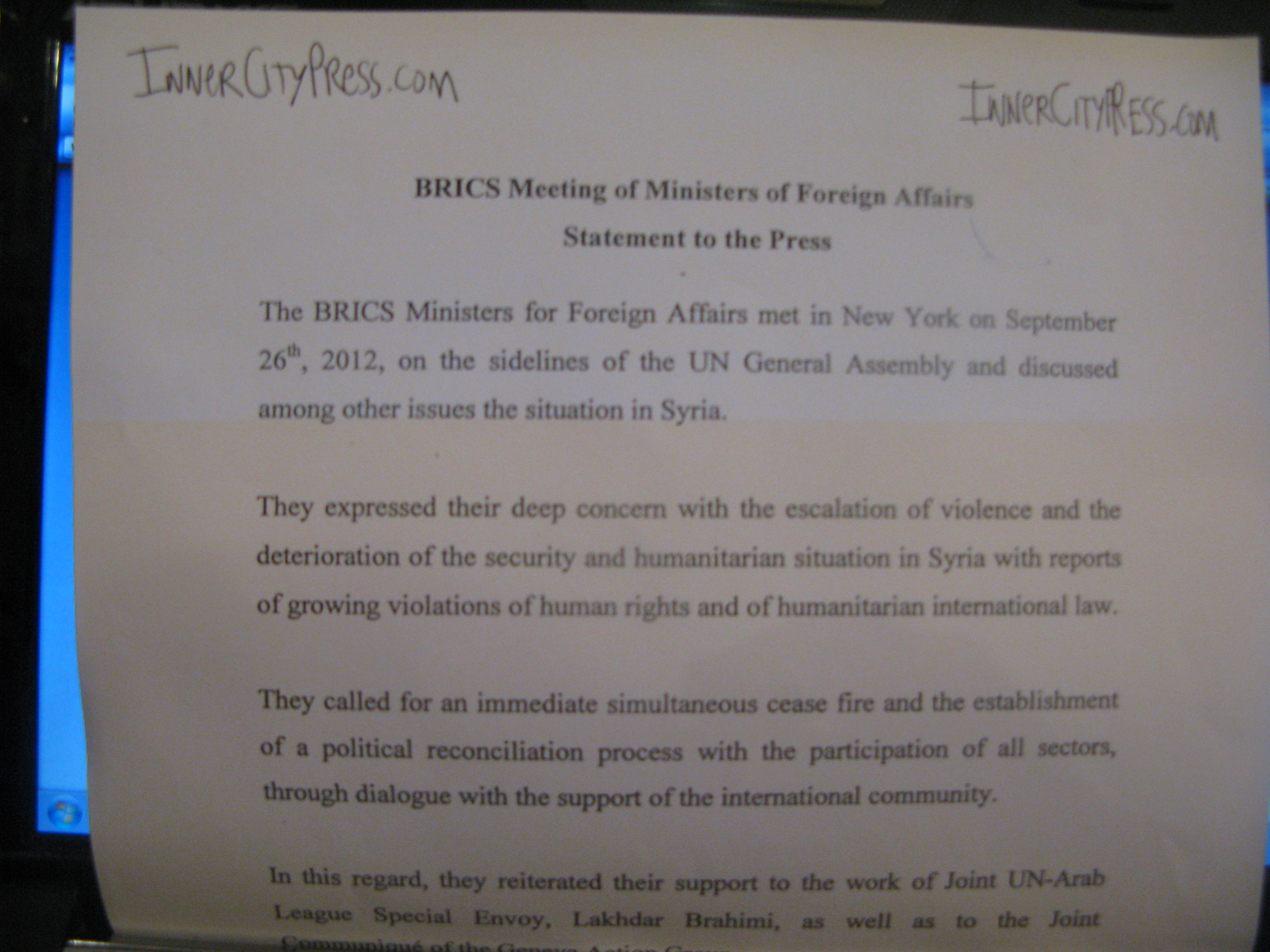
UNITED NATIONS, September 26 -- When India's Foreign Secretary Ranjan Mathai held a press conference at his country's mission Wednesday afternoon, he read a prepared statement and took only two questions. But handed out in the Mission's windowless room was a four-sentence "BRICS Meeting of Ministers of Foreign Affairs Statement to the Press" on Syria.

  These minister of BRICS are calling for an "immediate simultaneous cease fire." Inner City Press is putting the Statement online here, as a JPEG.

  Earlier, failed envoy Kofi Annan said it was for the Syrian government to stop first. That is not with the BRICS ministers are calling for. It is also unclear how the various parts of the armed opposition could or would simultaneously cease fire.

  While the Statement was presented as having been adopted, and Russia's Sergey Lavrov has having said his country supports India for a permanent seat on the Security Council, at least one other BRICS country would not confirm the statement to "its" press corps. And so it goes. Watch this site.

Christofias Say Cyprus Would Share Gas, No Answer on UNSC Abstentions


By Matthew Russell Lee

UNITED NATIONS, September 26 -- After Cyprus President Christofias' last UN General Assembly speech, he told the press that he had met with and thanked the five permanent members of the UN Security Council. 

 What about the Elected Ten members of the UNSC, Inner City Press asked him, particularly the two of them which abstained on the Cyprus resolution in July, Azerbaijan and Pakistan?

  Inner City Press also asked about the stated intention of Turkish Republic of Northern Cyprus leader Dervis Eroglu, in his meeting with Secretary General Ban Ki-moon this Saturday, to present a plan for gas exploration and hydrocarbon exploitation?

  Christofias never answered the Security Council question about Pakistan and Azerbaijan. But on gas and oil, he said he made it clear he was willing to share this natural bounty, but Eroglu wouldn't negotiate.

Inner City Press asked Ban's spokesman Martin Nesirky what Ban thinks of the issue. Nesirky said to wait until Saturday, but until then to look at the statements of Ban's envoy Alexander Downer.

  Eroglu will be at the event this evening at the Roger Smith Hotel. Watch this site.

Westerwelle Won't Comment on Spying on Syria, Elaraby Easy on US


By Matthew Russell Lee

UNITED NATIONS, September 26 -- When German foreign minister Guido Westerwelle and the Arab League's Nabil Elaraby appeared for an 8:30 am press conference on Wednesday, seven hours before the German-organized UN Security Council meeting about the Arab League, each made a point of speaking in their native language, for the home audience.

 But Inner City Press got in two questions in English, one of which was dodged and the other not directly answered.

  Inner City Press asked Westerwelle about reports that German ships have been collecting intelligence from Syria, for example on army movements, and providing it to the Syria opposition. 

  Westerwelle said he would not comment on that. It was in the German newspaper Die Welt. Some say there are countries that want to be able to tell their home audience they are helping the rebels, but then... don't want to answer questions about it.

  Elaraby had said that Palestine is the most important issue. Inner City Press asked about the draft(s) of a Council Presidential Statement for the afternoon, and about what Council sources tell Inner City Press is the "Host Country's" opposition to a reference to Palestine and the Arab peace initiative.

  But Elaraby did not answer about this specific opposition, rather saying that the tragedy of Palestine was caused by the Security Council, and should be fixed by it. Welcome to the world of the Security Council veto -- as on Syria. Watch this site.

At UN, Hollande Micro-Manages Room But Not Time, Blather on Mali


By Matthew Russell Lee

UNITED NATIONS, September 25 -- Giving a speech at the UN General Assembly may give one 15 minutes of fame, as Andy Warhol promised. But one doesn't know when they will be.

 This French president Francois Hollande learned or should have learned on Tuesday. He scheduled his press conference for 12:30 pm, then moved it back to 1:30, then finally after 2 pm as speakers before him went overtime.

 During this time, the French Mission to the UN had the Dag Hammarskkjold Auditorium cleared out, such that a crowd of journalists built up in the hall in front of the Capital Master Plan office.

  Not so the room could be sniffed by dogs for bombs, Inner City Press was told, but to try to ensure that French diplomats and traveling media got places in the front row, which were marked "Reserved." The back row, too, was marked "Reserved," and the microphone to ask questions was closely controlled.

  He was not asked, for example, about France's continuing colonialism in Africa, for example twice now being the one to announce the wishes of the post-coup government in Mali, all the while offering "logistical" help for retaking northern Mali. Click here for the Inner City Press story written before Hollande's speech and press conference, but not able to be updated with any answer.

  Another of France's pet projects is "innovative financing." For this, they have sent to the UN their ex minister Philippe Douste-Blazy, who has run the "MassiveGood" project into the ground, with a $500,000 film by Spike Lee featuring among others Bill Clinton.

  Hollande was asked what he thought of Barack Obama not even attending the Secretary General's luncheon, at which US Presidents traditionally give the toast. He excused Obama, smiling that he is busy. He added that he'll see Obama after November, one imagines.

  That was in French; when asked a rare permitted question in English, Hollande grabbed a special ear piece, smaller than given to the journalists.

 As run, Hollande was largely asked softball questions, from beginning to end. Ultimately, after Hollande had made much of his commitment to a new environmental agency for the UN, he cut 20 minutes into the time of UNFCCC climate change chief Figueres. 

  Then Hollande and his large entourage -- or "retinue" as the translator called it -- headed out. It includes former French Mission political coordinator Emmanuel Bonne.They'll be in New York until Thursday. Watch this site.

At UN, As Hague Opposes Aid to M23, Cameron Asked Not of Aid but Mitchell


By Matthew Russell Lee

UNITED NATIONS, September 25 -- When UK foreign secretary William Hague spoke Tuesday about the importance of the Sexual Violence and Conflict issue to his country, Inner City Press asked him about the Eastern Democratic Republic of Congo, when the UN Peacekeeping mission has admitted flying the army to a meeting seeking support in the fight against the M23 from Mai Mai militia, themselves reportedly involved in sexual violence.

 Hague was fast with an answer about the M23 -- he said "it is very important that any external support to rebel groups in Eastern DRC come to end," taken as a code word for Rwanda and perhaps Uganda -- but did not address why a UN mission created and supervised by the Security Council, on which the UK has one of five permanent seats, is simultaneously claiming to get trainings to combat sexual violence, while facilitating it with the Mai Mai militia.

  Perhaps naively, some continue to expect the UK to use its permanent seat on the Security Council to oversee at least the human rights related performance of UN authorized or supported missions, for example the shelling of Kismayo in Somalia by the Kenyan Navy, working in conjunction with the UN funded AMISOM mission. But the UK is generally loath to criticize the UN.

 Later on Tuesday UK Prime Minister David Cameron took questions in the same acoustically challenged stakeout, ostensibly on Post-2015 Development. 

  The two UK questions, however, concerned former international aid minister Andrew Mitchell: how can he not fully resign if the police say he calls them plebs?
At least the Australia-centric questions to that country's Julia Gillard had a UN angle, how much was spent on the run for Security Council seat? (Gillard answered Inner City Press that "twenty four million dollars were allocated," but would not say much much was spent.)

  Some countries' media identify closely with their governments, asking the Press for example, "how did we do?" BBC and ITV from the UK prepared and asked a harder question, but didn't link it to the UN. 

   Mitchell back on June 28, 2010 took ten minutes of questions from Inner City Press; coming full circle, his answers included praise of Rwanda. And so it goes with the UN - and the UK. Watch this site.

At UNGA's Surreal Stakeout, Swiss Small 5 Lost in Translation, Morocco Runs


By Matthew Russell Lee

UNITED NATIONS, September 25 -- Even penned in cavernous Conference Room 1 during a badly administered first day of the UN General Debate, opportunities that seem potentially newsworthy crop up unexpected.

  Between scheduled "media availability" stakeouts by Julia Gillard of Australia and Guatemala's president, Switzerland's president Eveline Widmer-Schlumpf appeared on UN Television speaking at the stakeout microphone.

  After first her answers were in German. But then an Australian journalist asked if Europeans would vote, in thecurrent Security Council seat race, for Luxembourg and Finland rather than Australia. 

  She declined this question, but half-answered the next one, about Obama or Romney. She said they would be the same on banks, that she has a preference but will not say it.

  As she responded to a question about sanctions on Iran, Inner City Press ran from the Media Center along a corridor of blue painted barricades to the stakeout and asked a Swiss question: does the "Small Five" effort to reform the Security Council's working methods survive its withdrawal earlier this year?

To be diplomatic, it seems the question was misheard. She answered "2022," apparently that Switzerland is running for a Security Council seat in a decade's time. She called it a "one year term," when the terms are for two years.

Afterward a spokesman told Inner City Press, "you can't use that." If agreed in advance, Inner City Press always respects that. 

  But in this case, the comments were already broadcast on UN Television. And this comes shortly after hoopla about Switzerland's ten years in the UN -- click here for decade's review by Inner City Press. For the record, Inner City Press has had praise for the Swiss Mission to the UN and related community. But answers to questions on UN TV are for use.

  Minutes later the foreign minister of Morocco Saad-Eddine El Othmani appeared. Inner City Press has previously filmed Q&A with him, and this time ran to the stakeout as for Switzerland's president. 

 But this time a signal was given and the media availability abruptly called to a close. There are questions. Hey, it might have been a softball about Morocco's position on a UN envoy for the Sahel. Maybe -- watch this site.